Residents of Plumsville who have been keeping a watch on the gradual resurgence of Wodehousitis in the Nordic countries might recall that at the last meeting of the Drones Club at Vollen in Norway, befittingly held on the 15th of October 2016, those present had planned for the next meeting of the Club to be held closer to the National Day of Norway, that is, on or around the 17th of May 2017.
And that is how it transpired that the Egg, the Bean, the Crumpet and the Pieface met at Asker recently. After much back-slapping, flag waving and associated patriotic activities, the four settled down to wide ranging discussions on a variety of Plummy affairs.
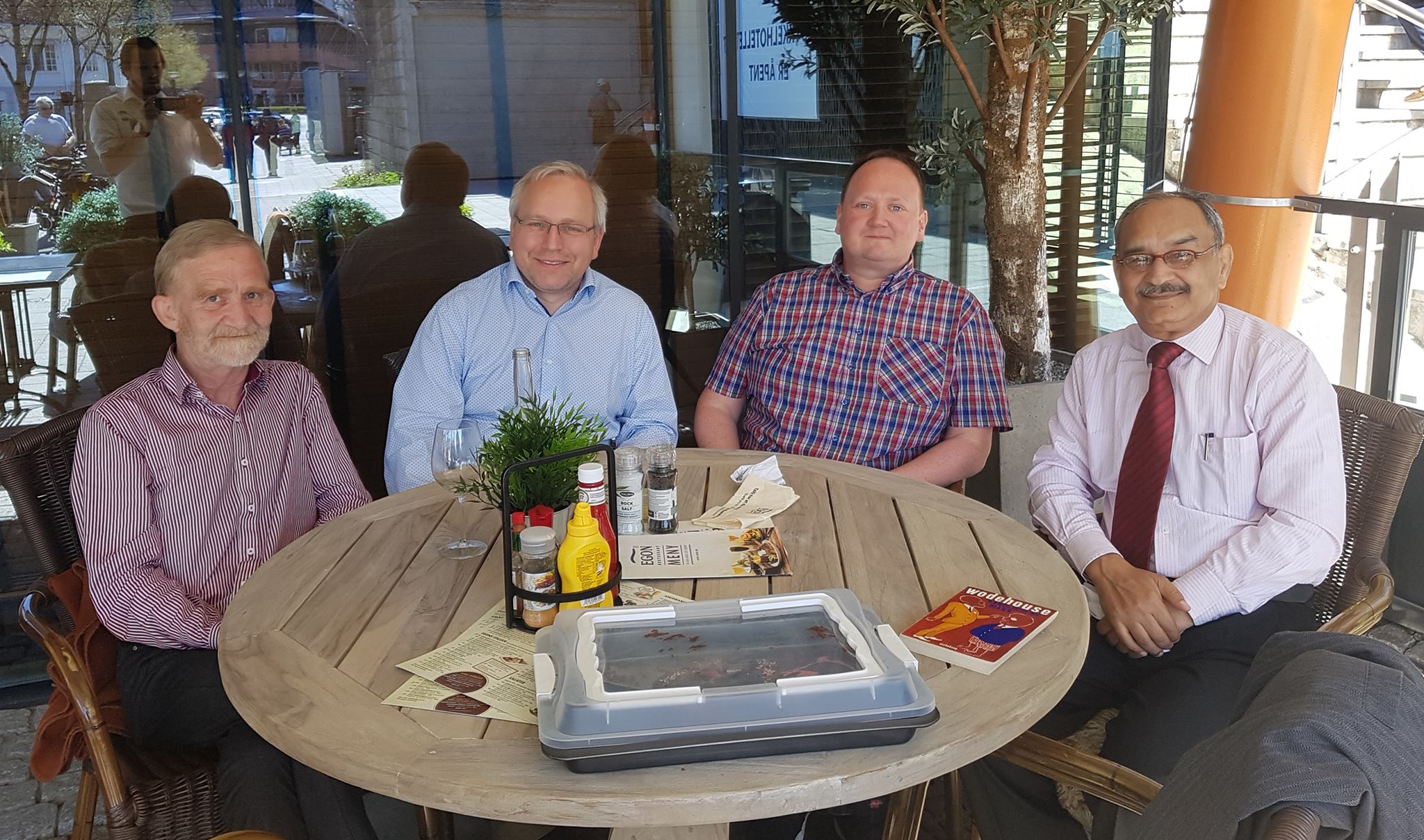
Here is a quick recapitulation of the deliberations.
Spreading cheer and happiness
Plum has left behind a range of work which is as prolific as it is magnificent. Homo sapiens need to be made aware and encouraged to drink deep from this underground reservoir of bliss. Hope was expressed that the economies dependent on black gold till now would eventually start becoming dependent on this joyous variety of gold, thereby improving the happiness levels of humanity.
The prodigal sons
When it comes to musicals, it is well recognized that kids of rich producers with bulging pockets and cigars in their mouth alone call the shots. Attempts should be made to breed more of such canine species as McIntosh, so kids can be suitably influenced and musicals can bounce back and regain their popularity amongst the masses.
A teen connection
Thanks to their ignorance about the Wodehouse canon, the millennials are not aware of what they happen to be missing in life. The group wondered if some of our dream merchants would start producing short animated clips which showcase the stories dished out by Plum. Once launched on dedicated ‘Apps’ and other digital platforms, the younger lot with their short attention spans may get drawn to the sunlit valleys of Plumsville, with streets lined on both sides with low hanging fruits of delectable humour.
The translation challenge
The Crumpet wondered as to how the beauty of Plum’s writings could be retained while translating his works into such other languages as Norwegian. The Pieface clarified that such translators often dig up the local history and quote juicy instances therefrom, thereby maintaining the lyrical beauty of the original prose.
Of feminism and the delicately nurtured
In a society which provides equal opportunity to its delicately nurtured, even going to the extent of making both the sexes serve a fixed duration military tenure, just how popular could be the old Victorian-era notions of chivalry, such as opening doors, holding chairs, and the like?
The Bean opined that such notions no longer had a meaning. The practice of such overt gestures of chivalry might be silently appreciated. But the absence of such gestures does not get noticed, much to the obvious relief of the so-called sterner sex.
The literary landscape of Plum
Almost all his works are littered with quotes from, and references to, those at the high table of English literature, such as Shakespeare, et al.
The Egg felt that literary figures preceding Plum had helped shape the present contour of English language. The Pieface thought that this is a vast subject which merits much careful analysis. The group felt they would admire the perseverance and erudite scholarship of anyone who might undertake a mighty task of this nature.
The real estate connection
Is Plum in any way related to the real estate sector of the economy? The Pieface did think so. He felt that he was nowhere near achieving his ambition of having collected all of Plum’s works in English as well as in Norwegian. His room was already overflowing, inviting sinister comments from the Rosie M Banks of his life. In order to fulfil his desire, a barn may soon need to be added. This, he felt, would serve a completely unintended purpose – that of providing a much-needed fillip to the local economy.
The Empress of Blandings

She was the guest of honour, adorned atop a small cake which was baked and provided by the daughter of the Crumpet. The Egg did the honours. All those assembled hummed ‘Sonny Boy’ and devoured few helpings of the same.
Wodehousitis in Norway
Those assembled agreed that all efforts need to be made to popularize the fact that such meetings are taking place in the Land of the Midnight Sun. By making prospective members green with envy, it was felt, the objective could be accomplished in the days to come.
The uneven spread of Wodehousitis
Concern was expressed at the fact that there were wide disparities in the per capita affliction of Wodehousitis across different countries. According to latest informal estimates, USA, UK and India appeared to be leading other countries when it came to per capita affliction of the dreaded disease. Netherlands, Italy and Russia appeared to be forming the middle order. Down Under, the affliction rates were reported to be rather poor. Same was the case with Switzerland which, though famous for its cheese, chocolates and watches, had very little to show when it came to Wodehousitis.
The consensus was that much more needed to be done to facilitate a more equitable distribution of Wodehousitis across the globe. The Royal Academy of Goofy Technologies may be approached to come up with a concrete action plan which, once approved by Rupert Psmith, the Prime Minister of the Republic of Plumsville, may be set in motion. It would also do well to conduct studies establishing the precise characteristics of Wodehousitis, thereby making it amenable to measurement.
Norway is a unique country in more ways than one. It hosts the Nobel Peace Prize. It is presently ranked as the happiest country in the world. The fact that it is shoring up its ranking in terms of Wodehousitis is yet another feather in its cap.
(A vote of thanks is due to Morten Arnesen, Jo Ingebrigt Spalder and Oystein Moe for propelling the Nordic Wodehousitis Mission further)
(Related Posts:
https://ashokbhatia.wordpress.com/2016/01/30/a-drones-club-meet-at-asker-in-Norway
https://ashokbhatia.wordpress.com/2016/10/20/a-drones-club-meeting-at-vollen-in-Norway
https://ashokbhatia.wordpress.com/2017/05/03/a-drones-club-meeting-in-Amsterdam)



 ashokbhatia
In Russia it’s dead. At least in former “society” way.
LikeLiked by 1 person
Oh, one shudders to hear that. Hopefully it would bounce back after some time!
LikeLike
You could not step twice into the same rivers, but… it was fun
LikeLiked by 1 person
What a fascinating story. I wish I’d been able to join you, but I look forward to being among those present another day. Perhaps on your next European jaunt? I can’t wait to meet the Egg, the Bean, the Crumpet, and the one called Pieface.
I have a long and complicated theory as to Australia’s lack of appreciation for Plum (excluding a small, select few of us who have seen the light). The nub of the thing is that Wodehouse’s work and reputation is misunderstood there –as it is to some extent in modern Britain also — as somehow endorsing the idle rich. If there’s one thing your ‘true-blue’ Aussie dislikes, it’s the idle rich, and the British idle rich in particular. Feelings on the subject ran deeply within Australia after WWI, when Wodehouse was approaching his peak. Many Australians deeply resented the use of their men as canon fodder by the British (at Gallipoli in particular) and the Great Depression that followed hit Australian working people very hard, further deepening resentment.
Wodehouse’s writing would have been completely at odds with mood, and means, of many Australians during the peak of his writing career.
Modern Australian readers are unlikely to share (or even be aware of) this resentment. In my case, I was very close to grandparents, great aunts and uncles, who lived through this era and talked about it. And I was interested in what they had to say — I even went on to study this period of Australia’s history at University. The modern Australian reader simply doesn’t know who Wodehouse is. And this is partly because there was never a strong Wodehouse appreciation among the older generation to pass on.
In the 40 years I lived in Australia, I met just one other Wodehouse reader. I had to visit the UK to buy most of my books, and my local second hand book dealer refused to take my ‘excess’ Wodehouse books when I moved to the UK four years ago –on the grounds that he couldn’t sell them. But whenever I ‘gave the gift of Wodehouse’ to my Australian friends, it was always appreciated. I even had the pleasure of introducing Wodehouse to my parents. Ironically, it’s only since moving to the UK that I’ve become aware of three other Australian Wodehouse enthusiasts.
But Australia is a nation of humour-lovers and I think people would grow to love Wodehouse in time. They just need a shove in the right direction.
LikeLiked by 1 person
Detailed comment this, coming from someone who has experienced it first hand. Thank you for sharing your thoughts.
The Royal Academy of Goofy Technologies surely needs to be persuaded to go deeper into this fascinating subject. A correlation needs to be ascertained between the Happiness Index (on which Norway and Switzerland get counted at the top but appear to be diametrically opposite when it comes to affliction with Wodehousitis).
Yet another area which got touched upon this meeting – and I apologize for missing it out – was that of the population of Plum fans outside the purview of social media platforms.
Your presence at a future meeting will surely brighten up the proceedings. Look forward to it. It would also help the group here to get a makeover in favour of gender diversity!
LikeLiked by 1 person
Let’s coordinate diaries for your next visit. I shall also bring Miss G so there shall be at least two fs of the s.
LikeLiked by 1 person
A lovely prospect!
LikeLiked by 1 person
I must say I never thought the Norwegians had much fun in them. I’m glad to be wrong, and that you had such a good time there Ashok. On the other hand, Honoria, I think your theory about our fellow Australians is a bit curate’s-eggish. I have a large collection of Wodehouse books, nearly all of them second hand bought from Australian shops. I have actually been watching the market: PGW books are plentiful and sell here for good prices, although at a discount to England and the US. The oldest first edition I have is My Man Jeeves from 1919. I bought it here in about 1975. Someone must have owned it before me. . My copy of Big Money from 1931 is actually an Australian edition. The first PGW I read came from my high school library c.1961 or 2. Can’t remember what it was. But the first one I ever bought was a Penguin edition of The Mating Season — 1961 but the purchase would have been 1964 or 65. I still have it. The TV series are always popular. And you need to consider PGW in the context of all the other English novelists who ploughed the same field — whether as romances, mysteries or school stories — at the same time and were solid sellers in Australia. If there is a blight on Wodehouse here, it’s because of his war record. I get this thrown at me all the time. Also, Australians just don’t seem to form literature appreciation societies and play around with the characters and the writers.
LikeLiked by 1 person
An insightful comment, this. Literary figures are perhaps handled with a great deal of respect there, leading to a confinement of sorts in the ivory tower constructed by their respective creators. One can’t complain, of course. To each his own.
Which brings me to a very basic query which someone as knowledgeable as you may brood upon and answer at leisure: How would one measure the Index of Wodehousitis of any country? Number of Plum fans? The intensity of their devotion to the Master? Number of his works sold – online and offline – in the country?
The data would be impossible to get, I suppose. Or, would social media group administrators like to ascertain the countries from which various members come?
LikeLike
An excellent report from a joyfull meeting.
As to measuring the Index of Wodehousitis in any county I would think it a near impossible task. I know the original publications/translations here in Norway sold well for the times, and also the reissued paperbacks in the seventies. As to how many bought the English versions here or when travelling/by postal orders (and in these glorious days online) I have no idea. That both Wodehouse and his works had good coverage in the media would also indicate that there was no lack of interest back in the earlier days.
Also the TV series were very popular.
The somewhat lacklustre following and interest in the web page and FB page I myself set up, as well as the limited number of Norwegian members of the Fans of Wodehouse group, could indicate that few of the dedicated lovers of Plum and his works have survived – or that they are not all that active online.
I know several book lovers who almost frown upon this “brave new world”, and prefer what’s to be found within the covers of books and magazines.
The limited availability of Plum’s books in the libraries and books shops of Norway these days does limit the potential for new and younger readers, as also does the fact that Plum has never been part of the literary curriculum of our school system.
On the other hand, dealers of secondhand books I’ve had dealings with tell me that most of the books they get in has a relatively short life on their shelves, which would indicate that there still must be quite a number of fans, or alternatively that the fans who still do excist are like me – they buy every book they can get their hands on, even if duplicate or triplicate.
LikeLiked by 1 person
Thank you for your invaluable insight. You are right that the intensity of love for his works survives very well, though, perhaps, the numbers might have declined.
Let us simply resolve to continue with our humble and modest efforts nevertheless, with our chins up and our heads held high!
LikeLike
What fun. The account is reminiscent of the Mad Hatter and so forth. I look forward to status reports re the Pieface’s book barn.
LikeLiked by 1 person
Shall surely share any updates from Pieface!
LikeLike