Feeds:
Posts
Comments

Posts Tagged ‘Values’

There is a widespread perception that the larger the business, the broader and deeper its adherence to values and ethics. In other words, enterprises which happen to be either in the small scale or in the tiny sector could ill afford a luxury of this kind!

Many CEOs believe values and ethics can wait until a business is financially strong. In other words, the weaker ones, which are in a struggling phase, can’t afford the luxury. This approach risks embedding bad habits deeply into the company’s culture, making change difficult. Like a tiger’s stripes, these habits are hard to shake off.

True values stem from the inner conviction of leaders, not from a company’s size or profits—and often, strong values lead to better success.

Let us relook at the case of Infosys. Since its inception, the founders are known to have resisted the temptation of paying ‘speed money’ to get things moving faster on the bureaucratic front. Its annual revenue reached US$100 million in 1999, US$1 billion in 2004, US$10 billion in 2017 and US$ 19.3 billion in 2024. The company was formed in 1981, but even as late as 2011, T.V. Mohandas Pai had alleged that his company was asked to pay bribes by government officials to clear projects, which it refused to do.

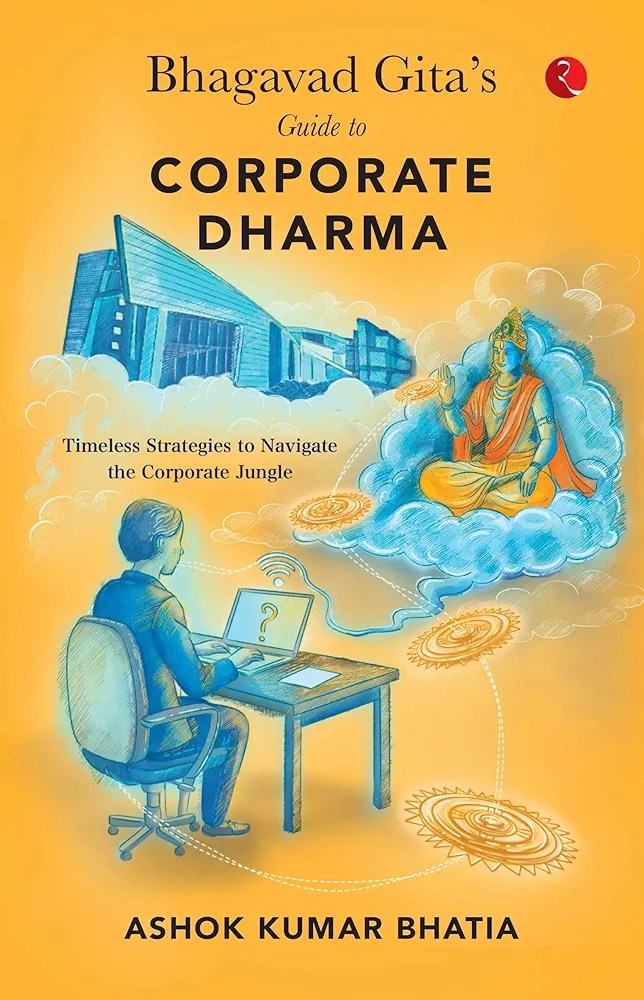
(The text is an edited excerpt from my latest book ‘Bhagavad Gita and Corporate Dharma’.)

Related Posts

Read Full Post »

Vision and mission statements of corporates adorn their walls and can be readily copied. However, the value system of an organisation is not something which can be copied very easily. It permeates the entire organisation—its hierarchy and its various divisions or departments. It rubs off on most of its employees. Even service providers and supporting manufacturers get tuned to the same frequency. It would perhaps not be wrong to say that values are to an organisation what the soul is to a physical body. Businesses which thrive over a long period of time and achieve sustainable commercial success would invariably be found to have sound values at the core of their operations.

Manifestation of Values

Small things reflect the values being followed—whether nephews and nieces of the top person are getting freely hired to do jobs they are not competent at, whether spaces in the car parking lot are allotted hierarchy-wise or are based on a first-come first-served basis, whether the corner office has high sound proof walls all around or is open to all to signify transparency, whether the boss is entitled to charge the company for her spouse accompanying her on a business trip, whether office stationery items get whisked off to executives’ households for use by their kids, or whether the use of cell phones or social media platforms is viewed with a sense of benign resignation by a hapless human resources honcho.  

It is the leader who sets the tone. Those down the ladder fall in line.

Values Defy Death

Products and organisations have life cycles of their own, just like the human body is prone to many changes—birth, existence, growth, decay, disease, and death. But values outlive these perils of life; somewhat akin to the Self, our inner core, which the Gita holds to be eternal and deathless.

अविनाशि तु तद्विद्धि येन सर्वमिदं ततम्
विनाशमव्ययस्यास्य कश्चित्कर्तुमर्हति 2.17

That which pervades the entire body, know it to be indestructible. No one can cause the destruction of the imperishable soul.

(The text is an edited excerpt from my latest book ‘Bhagavad Gita and Corporate Dharma’.)

Related Posts

Read Full Post »

Which are the things that have a longer shelf life, one may well ask. One’s value system. One’s character. What one places one’s faith in. One’s attitude towards life in general. One’s capacity to be able to handle the rough and tumble of a management career. One’s ability to make decisions based not only on big data analytics but also on intuition.

These are the kinds of things that build the resilience of individual managers and organisations to face macroeconomic shocks and market uncertainties with aplomb. Over time, the harsh slings and arrows of a career find it difficult to chip away at one’s innate qualities. Once this core is managed well, external things fall in place most of the time. One’s responses to people and circumstances become more refined, thereby improving one’s managerial effectiveness. One’s personal brand equity acquires a better sheen.

The Bhagavad Gita highlights the importance of faith in our lives and the latent way it provides a compass that determines the direction of our efforts.

सत्त्वानुरूपा सर्वस्य श्रद्धा भवति भारत
श्रद्धामयोऽयं पुरुषो यो यच्छ्रद्ध: एव : 17.3

The faith of all humans conforms to the nature of their mind. All people possess faith, and whatever the nature of their faith, that is verily what they are.

This explains why many businesses end up merely being ‘businesses’, whereas some make the cut as ‘industrialists’, trying to give back to society in whichever way they can.

(I believe that businesses whose collective faith is sattvic in nature end up being industrialists!)   

The Tata Group: Good Thoughts, Good Words and Good Deeds

Consider the case of the house of Tatas. The group can rightfully boast of a value system which goes back more than 158 years.

(Detailed examples follow in the book.)

(The text is an edited excerpt from my latest book ‘Bhagavad Gita and Corporate Dharma’.)

Related Posts

Read Full Post »

If Marie Curie had decided to become a human-resource professional at some point of time in her illustrious career, she would surely have had something to say about the half-life of so many things: interpersonal relationships, joys and sorrows, promotions, increments, awards and other recognitions which come one’s way all the time. Even insults, abuses, and rebukes hurled at managers by their bosses, whether in private or in public, would have been held to be things which have a rather short half-life.

This is what the Gita has to say on the nature of material things:

मात्रास्पर्शास्तु कौन्तेय शीतोष्णसुखदु:खदा:
आगमापायिनोऽनित्यास्तांस्तितिक्षस्व भारत 2.14

O son of Kunti, contacts (of the senses) with (their)  objects, giving rise to (the experience of) cold and heat, pleasure, and pain, are transient and they come and go. Bear them, O Bharata (without being disturbed).

If everything in the material world is of a transient nature, one might as well ask as to what is eternal, or at the least, longer-lasting, when compared to the kind of small stuff we touched upon here.

In the book, we go on to discuss the importance of values followed by organisations and the very purpose of business. If one looks at business entities that have been alive and kicking for a very long time, and have a shimmering brand equity to boot, one realises that these are indeed the considerations which are not of a transient nature.

(The text is an edited excerpt from my latest book ‘Bhagavad Gita and Corporate Dharma’. Visual courtesy the World Wide Web.)

Related Posts

Read Full Post »

Read Full Post »

Read Full Post »

Often, we complain about the inane offerings of mainstream Bollywood cinema. We bemoan the fact that we are expected to spend our hard-earned money, leave our brains outside a cinema hall, give our common sense a commercial break, temporarily suspend our beliefs and just enjoy the proceedings on the silver screen.

Some scripts make us go through the romantic upheavals in the lives of the hero and the heroine. Few others offer us unique insights into the world of crime and gore. Others thrive on keeping us glued to our seats wondering as to what may happen next. The thrill of a car chase, a saga of revenge and dollops of suspense make the experience worthy of our time, cost and attention.  

But there has always been a tiny segment of intellectually inclined directors who have kept regaling us with their unique insights on ills which plague our society as well as our economy. Call it the Parallel Cinema, the Consciousness Movement or the Cinema on the Fringes, if you will.

When Cinema on the Fringes becomes Meaningful

When it comes to caste-based prejudices, we have had Sujata (1959), Masaan (2015) and Article 15 (2019). A movie like Jhund (2022) showcases the everyday struggles of vagabond Dalit youngsters, haunted by the humiliating gaze of society. Speak of the disadvantaged and we are apt to think of Ankur (1974), Akrosh (1980), Chakra (1981) and Nil Battey Sannata (2015). Think of the angst of the educated unemployed and we discover Albert Pinto Ko Gussa Kyoon Aata Hai (1980) and Rang De Basanti (2006). Speak of sex workers and movies like Chandni Bar (2001), Chameli (2003) and Gangubhai Kathiawadi (2022) pop up in our minds.

When it came to our criminal justice system, movies such as Do Ankhen Barah Haath (1957), Kanoon (1960), Bandini (1963) and Achanak (1973) stood up for bold reforms. A cooperative movement leading to a resounding success in brand management inspired Manthan (1976). Difficulties faced by marginal farmers formed the central theme of such movies as Do Bigha Zameen (1953) and Heera Moti (1959). Challenges based on disabilities were poignantly captured in such movies as Koshish (1972), Black (2005) and Guzaarish (2010).

If the plight of rural migrants was showcased in Jagte Raho (1956), movies like Garm Hava (1973) and Pinjar (2003) brought home the trials and tribulations of those affected by Partition. Patriarchal maladies formed the crux of such movies as Sahib, Bibi aur Ghulam (1962). The plight of a widow moved us in Ek Chaadar Maili Si (1986). Swades (2004) spoke of using innovative frugal engineering solutions to the issues faced by villagers.

The Winds of Change

However, jingoistic nationalism, often camouflaged as patriotism, is the flavour of the season. In the past, movies like Haqeeqat (1964), Shaheed (1965), Lakshya (2004) and Mangal Pandey (2005) led to a rise in patriotic fervour amongst movie watchers. Upkar (1967) was all about ‘Jai Jawaan Jai Kisaan’. In the recent past, we have had Bajrangi Bhaijaan (2015), Raazi (2018) and Kesari (2019).

In tandem with the political headwinds, Islamic terrorism has come under a sharper focus. Gone are the days of such socials as Chaudvin Ka Chaand (1960), Mere Mehboob (1963), Mere Huzoor (1968) and Jodhaa Akbar (2008), wherein our composite Ganga-Yamuna ‘tehzeeb’ (culture) was lovingly portrayed. Instead, we now rejoice in people of a certain faith being portrayed as violent aggressors and anti-nationals. The recent successes of such movies as Padmaavat (2018) and The Kashmir Files (2022) form a part of this trend.

It is not that riots and genocides have not been captured by Bollywood before. A wonderful example which stands out is that of Mr. and Mrs. Iyer (2002). Movies like Mission Kashmir (2002), Parzania (2007) and Firaaq (2008) brought home the futility and tragedy of hatred. Some of these have attempted to uncover the inner turmoil experienced by the main protagonist. Many such movies have been banned. However, the focus now appears to have shifted on widening our social fissures rather than mending the same. Perhaps, a deeper cleaning of sorts of our social fabric is taking place.   

The rise of OTT platforms, thanks partly to a pandemic, has broadened the scope of offerings. If Jalsa (2022) keeps us on tenterhooks, The Fame Game (2022) gives us a sneak peek into the lives of celebrities. If Bombay Begums (2021) captures the ambition of gutsy females wanting to break the proverbial glass ceiling, Panchayat (2020) took us back to the countryside and showed us the kind of challenges which rural folks face. Bandish Bandits (2020) was a brilliant ode to the prowess of classical music.  

Even outside the traditional channels of cinema halls and OTT platforms, several talented directors keep coming up with offerings which show the day to day challenges faced by us in an inspiring mode. Those of you who have heard of Nirmal Anand Ki Puppy (2021) directed by Sandeep Mohan would heartily agree with me.

The line between conscious cinema and not-so-conscious cinema (in other words, ‘masala’ movies!) often gets blurred.  

Of Creative Consciousness

Creative juices need several favourable conditions which enable these to spring forth and eventually reach their target audience. When it comes to the powerful medium of cinema, a good script, backed by proficient actors, lilting lyrics and music, adroit editing and good production values surely helps. We may call many of these as meaningful. But if a movie entertains, educates and even goes on to address our deeply embedded social concerns and prejudices, it plays a useful role in shaping the values which govern our society. Such movies originate from a higher level of consciousness. Personally, I would prefer to call these movies as being the real meaningful ones!

A question may be asked as to whether it is possible for producers and directors to churn out socially relevant movies even when commercial considerations rule the roost. In Awara (1951), Boot Polish (1954) and Shri 420 (1955) Raj Kapur showed us how. So did B. R. Chopra when he came up with Nikaah (1982), and Yash Chopra when he offered us Dharmputra (1961) and Veer Zara (2004)!

Eventually, it all boils down to the level of consciousness of the producer-director duo. Awareness, Care and Intent alone are the enabling factors. These alone act as catalysts of Creative Consciousness. Those who have the courage and conviction to offer such movies pay back to the society what they get from it. 

Some Neglected Areas

There are three areas of strategic concern which appear to have been given the short shrift in the scheme of things.

What we lack is a vibrant children’s film movement. Movies like Aakhri Khat (1966), Makdee (2002), The Blue Umbrella (2005), Tare Zameen Par (2007) and Bumm Bumm Bole (2010) are few and far between. In the rat race of commercial considerations, this segment of the audience has lost its appeal. The outcome is that the age of innocence has got brutally cut short. The advent of internet and animation movies has further eroded the interest in child-friendly offerings. Children are losing the opportunity of imbibing rich values from such ancient texts as ‘Hitopadesha’ and ‘Panchatantra’. Poor souls are getting sucked into adult entertainment right away.   

Secondly, state funding for socially relevant and meaningful cinema has all but vanished. Unlike countries such as France where state support ensures that movies steeped in consciousness keep getting made, the rulers of today turn a blind eye to their own soft power.

Thirdly, the interest in preserving the history of cinema for the sake of posterity is singularly absent. It is an irony that not even a single print of Alam Ara (1931), the first ‘talkies’ to be churned out by Bollywood, is available in our archives.

If such strategic issues are left to the manipulations of the private sector alone, Bollywood will keep marching ahead with bolder and bolder themes, wooing their audience with exotic locales, sex appeal and special effects which leave the viewers in a state of shock and awe. Return on investments alone would count. The movies it churns out may be entirely soulless, so to say. Viewer tastes will keep getting manipulated by our dream merchants.

Related Posts:

Read Full Post »

Can an organization’s human resource policies be so designed as to facilitate a bottoms-up approach to leadership? In other words, can it encourage and enable people at the lower rung to automatically assume a leadership role without anyone else egging them on to give their best?

It is well known that leadership is a function of at least two factors. The individual traits of an employee surely play a role. Another is the situation which could be such as to produce a leader. But for all the employees to spontaneously respond to a situation in an empathic manner in the face of an unforeseen crisis goes on to show that a share of the credit must also go to the design and implementation of conscious human resource policies.     

Consider the Mumbai Taj Hotel terror attack on the 26th of November, 2008. Not even a single Taj employee abandoned the hotel and ran away, but stayed right through the attack. They helped the guests escape. In the process, many employees died.

Eventually, this became an important psychology case study at Harvard. The result was a deep insight into the way in which the company’s recruitment policies had been designed. Three of the major factors which stood out have been as follows:

1) Taj did not recruit from big cities; instead, they recruited from smaller cities where traditional culture values still holds strong.

2) They did not recruit toppers; they spoke to school masters to find out who were most respectful of their parents, elders, teachers and others.

3) They taught their employees to be ambassadors of their guests to the organization, not ambassadors of the company to their guests.

For some details of what transpired during the terror attack and the Harvard study, please check out the following:

“The Ordinary Heroes of the Taj Hotel: Rohit Deshpande at TEDxNewEngland.”

The Tata group is well known for the values, integrity, transparency and fairness it practices while dealing with various stakeholders across all its business verticals. The response of its employees to the terror attack is merely one of the many manifestations of its enlightened human resource policies.  

Related Posts:

Read Full Post »

ashokbhatia's avatarashokbhatia

I confess I have never had the chance of listening to the prattle of tender feet around me. However, this does not mean that I do not observe kids. I do so, with all the shrewdness at my command. When they giggle and stare at public speakers, the latter are all of a twitter. When they seek protection money from their wannabe step fathers, the soul cringes. When they use paraffin wax to douse fires, one sickens in horror. When they decide to extract a revenge of sorts from cabinet ministers who have reported their smoking endeavours in the shrubberies, one draws appropriate conclusions. When they celebrate their birthdays by either putting sherbet in ink pots or by going AWOL to enjoy a dinner and a movie, one gets overawed with the kind of courage they have.

Having suffered at the hands of such obnoxious kids as Thos, Seabury, Edwin…

View original post 1,696 more words

Read Full Post »

(Continued)

Some Missing Ingredients in the Curry

In Plum’s narratives, we encounter American millionaires, French cooks, Russian peasants, Italian waiters, Spanish ladies and white hunters and huntresses who keep popping up in Africa. We also get to meet well-endowed American ladies who are on the lookout for castles which are owned by impecunious English gentlemen.

When it comes to India, we get introduced to military men, royals and others who narrate some juicy details or the other about that exotic land. He also gives us a sneak peek into the civil disobedience movement of Mahatma Gandhi, the Father of the Nation of India. Rabindranath Tagore’s dietary habits, like those of Mahatma Gandhi, get commented upon. Taj Mahal finds a mention.

Some of his characters are even desirous of trooping down to India to study its social conditions while some emulate the mystics contemplating on the infinite in caves in Himalayas or elsewhere. We come to know of some cities as well.

To Plum’s credit, he even quotes Rudyard Kipling, the India-born author whose works were inspired by his country of birth:

‘I’ve said it before, and I’ll say it again – girls are rummy. Old Pop Kipling never said a truer word than when he made that crack about the f. of the s. being d. than the m.’ (Right Ho, Jeeves)

But if he had wanted to, Plum could have used a number of other Indian resources to further enrich his narratives.

Alas, we do not find any mention of such literary figures as Kalidasa, besides Aryabhata or Ramanuja, the famous mathematicians. The four Vedas are nowhere to be found. References to India’s soft power comprising such aspects as spirituality, its multi-layered scriptures and various dance forms are sadly missing.

Above all, the mind-numbing diversity of the spirit of India is missing. Its wide spectrum of ethnicities, languages, beliefs, practices and cuisines is nowhere to be found. These are facets of India which have missed out on his wit and wisdom. It is indeed a delectable irony of sorts that this write up is labelled as The Indian Curry Dished Out by P G Wodehouse, even though it has not thrown up even a single reference to any Indian dish!

Imagine a distraught Gussie Fink-Nottle pining for Madeline Bassett and sending messages to her through clouds passing overhead, a la ‘Meghadut’, the classic poem penned by Kalidasa. Poets like Ralston McTodd would have been found drawing some inspiration from the creative outpourings of Tagore. Personalities like Indian scientists and mathematicians would have helped some sleepless guardians of the peace – like Constable Oates – to improve their methods of investigation, improving the prospects of their being noticed by Scotland Yard. To improve Bertie’s intellect, all Florence Craye had to do was to insist that he peruse at least one of the chapters of the ‘Bhagavad Gita’. Laura Pyke could have drawn some inspiration from the science of ‘Ayurveda’, the healthy-lifestyle system that people in India have used for more than 5,000 years. Anatole could have been found whipping up ‘chhole bhature’ or ‘dosa’s!

Yoga could have helped someone like Ashe Marson to treat his clients suffering from acute dyspepsia to heal faster and better. Sir Roderick Glossop could have gone about advising his loonier patients to make meditation an essential part of their mundane lives. Vicars could have lived a happier Thos-infested life while brooding on spiritual tenets dished out by Indian scriptures, thereby becoming hotter at their jobs. George Bevan, while working on one of his next musical comedies, could have been drawing inspiration from the ‘Natya Shastra’ of Bharata Muni. Gentlemen aspiring for India rubber legs could have been practising such dance forms as ‘Kathak’ or ‘Bharatnatyam.’

The possibilities are endless. The mind boggles. But one would do well not to be concerned with what might have been. Instead, the focus needs to be on the rich legacy Plum left behind for us to rejoice in.

A Consistent Depiction, Despite 1947

The India that Plum would refer to belongs to an era which is long since bygone. India gained independence in 1947, but his works published during the period from 1947 (Joy in the Morning) till 1974 (Aunts Aren’t Gentlemen) do not reveal much change in his imagination. If one were to compare allusions to India based on Wodehouse’s works published before and after 1947, one notices a singular consistency. Astral bodies, scorpions and cobras continue to rule the roost.

The insignificance of the year of India gaining independence from the British Raj in Plum’s works has its own merits. Much like the relationship between Bertie Wooster and Tuppy Glossop, which soured for some time when the former was forced to take a dip in the water even when suitably attired, a friendly spirit of joie de vivre appears to have prevailed and both countries have moved on.

Malcolm Muggeridge, who was an editor of Punch, had spent two extended periods in India, once during 1923-26, as a lecturer in English at a college in Kerala, and then during the early 1930s as an assistant editor of the Statesman. According to Ruskin Bond, he is reported to have said that ‘the only real Englishmen to be found in the world were to be found in India.’    

Many enlightened Indians who take a broad view of things, or those who were born much after 1947 and have not suffered the birth pangs of their country, admire the Crown rule for having left behind a rich legacy in terms of a legal framework, a bureaucracy, a railway network, partial linguistic proficiency in English and a fine army with its own traditions. The genesis for such a legacy to have come about could have been rooted in stark commercialism and a stiff-upper-lip-type control over the people, but that need not distract us from the fine institutions created and left behind by the British in 1947.  

But many others, especially those who have been exposed to the personal trauma of partition which ended up displacing an estimated 10 to 20 million people along religious lines, or their descendants who have heard the horror stories of those trying times, and many others, would speak of the manner in which Indians of yore were exploited by the British. They would lament the decline of their country’s share in the global Gross Domestic Product from roughly 27 percent in the 1700s to roughly 3 percent in 1947. (Sources: Wikipedia and a talk by Dr. Shashi Tharoor, a famous fan of Plum’s and a Member of Parliament of India, https://www.youtube.com/watch?v=OB5ykS-_-CI)

In the present scenario, both the countries, the erstwhile rulers as well as the ruled, enjoy a healthy and vibrant relationship. Even during the two World Wars in the 1900s, Indian soldiers had made the supreme sacrifice, supporting the British/Allied forces. Over time, close to 150,000 soldiers are said to have died while supporting the wars fought by the Empire. A private sector steel company in India had produced rails much to the satisfaction of the rulers. Sure enough, there were mutinies, internal skirmishes and episodes of non-violent civil disobedience, but there were clear signs of good collaboration between the two even prior to 1947.

In any case, it should come as no surprise that Plum maintains consistency throughout his canon while using Indian condiments for the curry he serves. During 1947, the Indian subcontinent was undergoing some major changes. But these did not register on the Plumsville radar.

From a global perspective, the devastation caused by the Second World War (1939–45) was then the main area of concern, rather than the fact of India gaining independence on 15 August 1947. Plum had personally suffered in his life owing to political developments then and had relocated from Europe to USA during April 1947, never to visit Europe again. One believes that the press in the USA had then covered the fact of India gaining independence rather prominently, probably because it was the first significant nation to have gained independence from the British after the USA, which had achieved the feat some 171 years earlier, in 1776. However, due to his preoccupation with other matters then, perhaps the last thing on his mind would have been the British (or American) reaction to the events unfolding in India. Hence his storylines and characters never touched upon the emergence of an independent India.

Even though his works do not offer any commentary on the politics of the day, at times he does not refrain from deploying the communist ideology to amuse and entertain his readers. Psmith brims over with socialist ideas. George Cyril Wellbeloved has strongly communistic views. At one stage, even Bingo Little becomes a member of the ‘Red Dawn’. Roderick Spode happens to be a born crusader and revolutionary. Vanessa Cook leads protest marches and appears to be gravitating towards politics by chance. Stilton Cheesewright, who is otherwise content being a vigilant guardian of peace at Steeple Bumpleigh, gets egged on by Florence Craye to pursue a career in politics.

(Continued)

Notes:

The inspiration for this essay comes from the scholarly work done by Ms. Masha Lebedeva, who had earlier whipped up a research paper entitled The Russian Salad by P. G. Wodehouse.

The author expresses his sincere gratitude to an eminent expert on Plummy matters for having spared the time to go through a part of this composition and provide insightful suggestions. Some fans of P. G. Wodehouse have also suggested improvements in its contents.

Thanks are also due to Mr. Suvarna Sanyal for dishing out the main illustration in Part 1; also, to Ms. Sneha Shoney, who has edited the text.

Those of you who wish to cruise through this essay in its entirety may kindly write to akb_usha@rediffmail.com for a PDF version of the complete document to be mailed to them.

Related Post:

The Indian Curry Dished Out by P. G. Wodehouse (Part 7 of 9)

Read Full Post »

Older Posts »