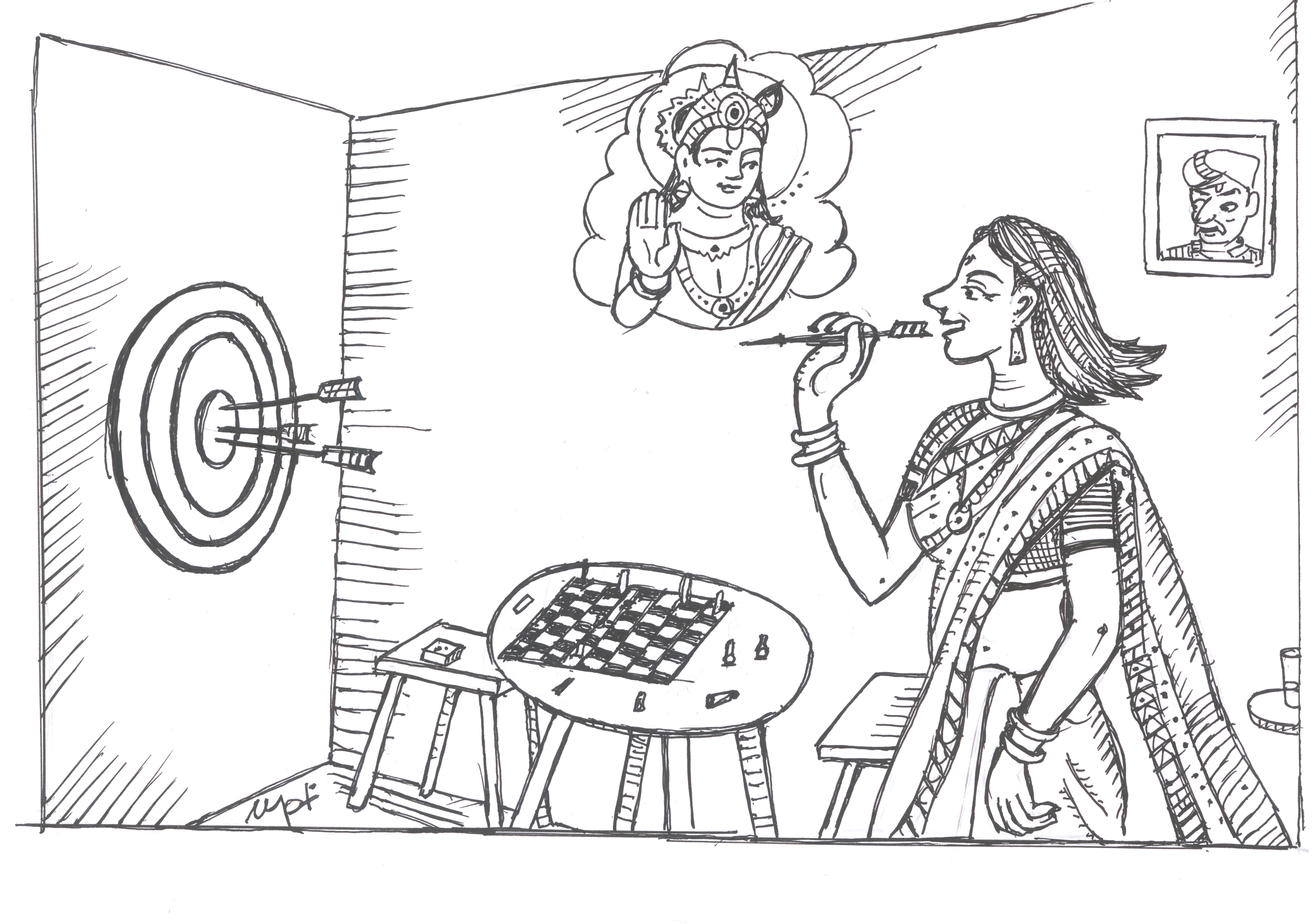
What kind of desires would be found on the bucket list of a CEO? Perhaps due recognition, more power and pelf, special privileges, a fat expense account, rapid growth, ESOPs, a loyal and committed team comprising persons who happen to be competent in areas where she herself may be weaker, executing her business plans more effectively and efficiently, and the like.
In general, the Happiness Quotient of any professional could possibly be defined as follows:
HQ = [ { FD (t) / AD (t) } * f (IR, IG)]
Where HQ is Happiness Quotient, FD (t) is the number of fulfilled desires at a given point in time, AD (t) represents the sum total of all her desires at the same point in time. The notation f (IR, IG) suggests that HQ is directly proportional to her Inner Resilience and the Inner Glow of satisfaction she feels when a job is well done. A happier CEO could often be spotted in the recreation room, perfecting her aim at throwing darts!
It also follows that one’s level of happiness could be improved upon merely by enlarging the scope of FD; or, by reducing the spread of AD.
The former is a Western proposition, leading to crass commercialism. A heavy dose of advertising and public relations keeps the inner fires of desires burning brighter with each passing year, making it the classic case of our chasing an elusive rainbow in a desert. Corporates keep stoking these embers of desire and we keep falling prey to the same at regular intervals.
The latter proposition happens to be an Eastern construct. By keeping a check on one’s desires, one can attain a state of happiness. This calls for an inner awakening and a realization that one needs to outgrow one’s sensual gratification and consciously shepherd oneself to use one’s intellect and restrict the spread of desires one has. Or, to focus on desires which are either aligned with the values of the organization or which happen to be our needs.
Western experts had originally recommended Command and Control as a means to generate wealth and had gone on to imply that stark materialism is the way to seek peace and happiness. However, the Eastern approach is based on an inward blossoming, an inner growth and development which holds an inner glow of success superior to sensual gratification of an external nature. By proactively adopting a Conscious Capitalism approach, several businesses have already recognized the truth that they have a greater purpose, much beyond delivering value to their own stakeholders.
Conscious businesses have trusting, authentic, innovative and caring cultures that make working there a source of both personal growth and professional fulfilment. They endeavour to create financial, intellectual, social, cultural, emotional, spiritual, physical and ecological wealth for all their stakeholders.
An inward blossoming
Bhagavad Gita gives us a clue to be happy, and also to create happier working places. Consider this verse:
यदा संहरते चायं कूर्मोऽङ्गानीव सर्वश: |
इन्द्रियाणीन्द्रियार्थेभ्यस्तस्य प्रज्ञा प्रतिष्ठिता ||2.58||
One who is able to withdraw the senses from their objects, just as a tortoise withdraws its limbs into its shell, is established in steady wisdom.
What is being recommended here is not a suppression of desires but a voluntary renunciation of those desires which take us on a path of sensuous gratification, sans a higher purpose in our life and career.
In fact, this takes us back to the idea of living in the present; also, a ‘We and Us’ approach to problem solving than an ‘I and Me’ one.
In Robin S. Sharma’s famous book ‘The Monk Who Sold His Ferrari’, Julian says that goals and dreams for the future are very essential elements in every truly successful life. But he advises never to put off happiness for the sake of achievement; never to put off the things that are important for your well-being and satisfaction to a later time. ‘Today is the day to live fully…..never put off living!’ he says.
Bhagavad Gita reinforces this message as follows:
रागद्वेषवियुक्तैस्तु विषयानिन्द्रियैश्चरन् |
आत्मवश्यैर्विधेयात्मा प्रसादमधिगच्छति ||2.64||
But one who controls the mind, and is free from attachment and aversion, even while using the objects of the senses, attains peace.
A CEO who exercises self-control would eventually experience a sense of inner peace. She would patiently hear out a voice of dissent and use the feedback judiciously. She would see something positive happening and share it with others, without getting attached to it. She would smell a coup in the making and take appropriate steps to defuse the situation in an objective manner. She would praise in public but reprimand in private. She would taste either the sweetness of a resounding success or the sourness of a colossal failure but would neither become complacent nor reach a stage of despondence thereafter. She would sit back and redraw her business plans and put them in motion.
Some manifestations of Self-control
One manifestation of self-control would be the need to accord an equitable and honourable treatment to women at the work place. Just like a cashier who is caught with his hand in the till, often we find some powerful male executives wrecking the careers and lives of relatively vulnerable female team members. If this had indeed been the case, the recent #MeToo campaign would not have gained much currency.
Hormones are surely more powerful than hierarchy. But when such incidents happen and the managements decide to look the other way, or decide to be opaque about handling such issues, they end up causing severe damage to their brand equity.
On the contrary, when business houses like Tatas are majority-owned by trusts which do pioneering philanthropic work for the society, the money with them is truly held in trust, in the true spirit of detachment.
Consider this verse from the Bhagavad Gita:
विहाय कामान्य: सर्वान्पुमांश्चरति नि:स्पृह: |
निर्ममो निरहङ्कार: स शान्तिमधिगच्छति ||2.71||
That person, who gives up all material desires and lives free from a sense of greed, proprietorship, and egoism, attains perfect peace.
Creating happier working places
What with the advent of Industrial Revolution 4.0, many HR honchos these days can be found to be twiddling their thumbs, trying to figure out how to create happier working places even while maintaining a sense of discipline, decorum and decency. Happier people make organizations thrive and prosper.

Dr. Noelle Nelson, in her book ‘Make More Money by Making Your Employees Happy’, explains how progressive employers try to understand the pain points of their employees and then try to address the same. One of the several examples she quotes is that of when Paul O’Neil who took over the reins of ALCOA in 1987, the world’s leading producer of aluminium; O’Neil announced that his sole priority was to increase worker safety. This came as a shock to the company’s directors. O’Neil understood, however, that safety was a major concern for his workers. Over the next 13 years, employee productivity soared as accident rates decreased from roughly one per week per plant to some plants going years without an accident. When O’Neil stepped away just over a decade later, ALCOA’s annual income had grown 500%!
Being happy is possible when one is at peace with oneself and others. Attaining a state of harmony is imperative. Managements need to enable this. They need to provide the necessary tools to their people so as to facilitate an inner sense of peace and happiness.

What makes Starbucks a good employer? Perhaps, one of the factors which contributes towards its people being happy is the kind of training they receive to handle angry and unreasonable customers. This takes the negativity away from a potentially stressful situation, leaving space for a sense of peace and happiness to prevail within the front line staff.
People in organizations do not always look for more monetary rewards. They seek recognition. They relish a sense of fulfilment arising out of their contribution towards a greater goal. They value positive relationships with other team members. Harmony, peace and happiness comprise their inner goal.
(Related Post:
https://ashokbhatia.wordpress.com/2018/05/03/from-an-i-and-me-approach-to-a-we-and-us-one)



 ashokbhatia