
When owners and founders of businesses hire CEOs, they hope for an attitude of quiet and respectful deference towards themselves, sans dissidence of any kind. Often, their attachment to the business surpasses all other considerations. Thus, fissures between the two power centers soon start popping up. If some of the actions of a CEO are leading to a compromise on the basic values of the business, like in the case of Tatas and Cyrus Mistry, or like in the case of Infosys and Vishal Sikka, it is understandable. But if the gaps have arisen due to the manner in which operations are getting handled, it just shows that the owner or founder is not willing to let go.
In family owned businesses, the younger generation is often raring to go. Many a scion keep twiddling their thumbs trying to figure out as to when the elder owner would hang his corporate boots or sandals, so they could have a free hand to nudge the enterprise towards newer markets, adopting the latest technologies sprouting in the era of Industrial Revolution 4.0. But for most of the elderly owners, it is a tough challenge to give up controls. Like the proverbial man who keeps clinging to a tree but blames the tree for not allowing him to let go, they refuse to fade away gracefully into the sunset. During the period of transition, chaos and confusion reigns. Hapless employees continue to suffer silently, caught as they are between the divergent thought processes of the two generations.
The war depicted in the epic Mahabharata, of which Bhagavad Gita is an integral part, came about only because King Dhritarashtra could not overcome his attachment to either the throne or his son, Duryodhana. The outcome was the death of all his hundred sons, loss of prestige and kingdom and, of course, social and economic misery of the multitudes who had earlier thrived during his reign.
Different Hues of Attachment
Attachment is an intoxicant which, when taken in excessive doses, leads to perilous outcomes. When consumed without a moderating dose of detachment, it could prove to be a disastrous tissue restorative, a concoction which is surely injurious to the efficiency and effectiveness of a manager.
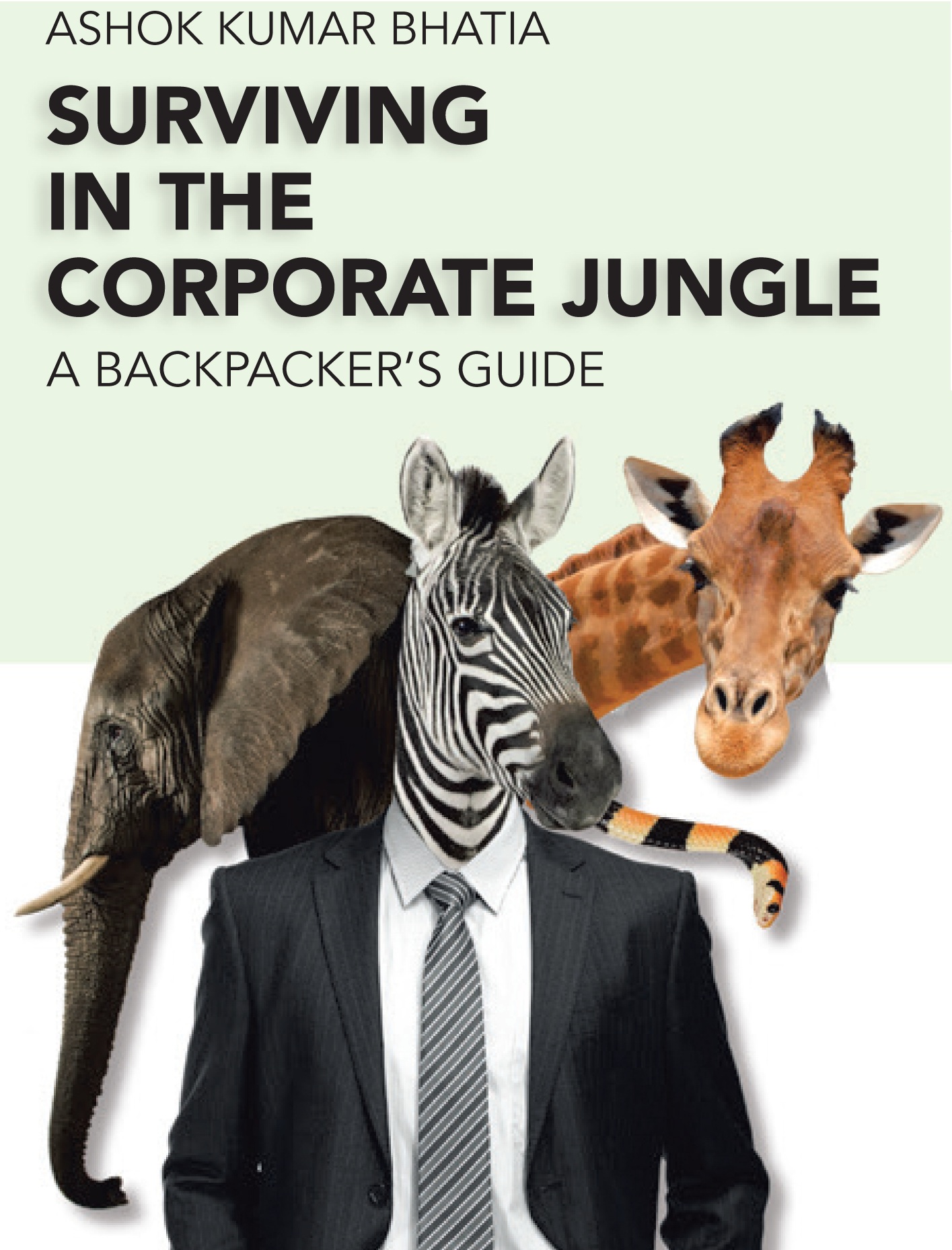
Attachment with a Lion King could leave a sheep ending up as its prey. If the Lion King himself feels attached to a wily Finance-Fox and ends up promoting him as a CEO, the organization may soon start running only on Standard Operating Procedures, neglecting customer service and employee relationships. A Production-Bovine who is attached to the technology in use on the shop floor would take a jaundiced view of a more efficient technology being planned to be introduced by the management. A Human-Resources-Canine may start hiring people only from his own ethnic background, resulting into lack of diversity in the organization. Separations with non-performing employees do not get handled well, impacting down-sizing initiatives of the management. A sprightly Operations-Reindeer might start believing that the whole organization would collapse if he were to proceed on leave.
Often, attachment to a person leads to complications. Those who do not deserve a raise might even end up getting a promotion, impacting employee morale adversely. Those who are competent could get sidelined, increasing the chances of their seeking greener pastures. Ultimately, the organization suffers. Undue attachment to a senior could gradually transform one into a seasoned Yes-person. If ever the senior’s career graph takes a hit, the one hanging onto his coat tails would also suffer.
Likewise, when one gets attached to an experience, whether positive or negative, one’s Guardian Angels go into a state of hibernation and disaster lurks around the corner. A promotion could go to one’s head, leading to aberrant behaviour, with negative results quick to follow. Spectacular success in a project could lead to complacency. On the flip side, a sharp public rebuke from someone senior could make one withdraw into an emotional shell, thereby impacting one’s performance. One could decide to play the victim card for some time and continue to seek solace from those who are in no way capable of helping. It does not bring about desired results.
Attachment and Resistance to Change
In other words, attachment often leads to resistance to change. One’s sense of objectivity gets compromised. A tendency to remain in one’s comfort zone rules the roost. Innovation takes a back seat. Procrastination kicks in. Delegation gets dumped. Distortions start popping up. Conflicts and dilemmas do not get resolved in an unbiased manner. Relationships with key stakeholders turn sour. Signals of an imminent shift in customer tastes and preferences start getting neglected. Market share starts shrinking. Advances in technology do not get absorbed in the organizational processes. Business takes a hit. Brand equity nosedives. Existence of a business itself may come under a cloud.
Elsewhere, we have already touched upon the manner in which such market leaders as Kodak and Nokia have suffered in the past. Likewise, organizations which resist absorbing the newer technologies coming up in Industrial Revolution 4.0 could face a serious threat of either scaling down or getting completely wiped off in the times to come.
The Approach of Detached Attachment
All this is not to say that attachment is something which can be completely avoided. The concept of attachment is central to organizational life. Attachment is essentially an enduring emotional bond between people, events and belief systems. Experts have studied the nature, development, maintenance, and dissolution of this emotional bond through the lens of Attachment Theory, providing an insightful perspective in the understanding of human relationships. Dynamics of leadership is surely impacted by it. So is the concept of trust, mentoring and employer-employee relationships. Employees get motivated and become proactive when under the spell of attachment. It impacts ethical behaviour in a significant manner.
If the Western models of Attachment touch upon its gravitational pull and inevitability, Lord Krishna presents an Eastern template of Detachment, which could be held to be a spaceship which enables one to foray into interstellar space and enjoy the captivating beauty of a fraction of the universe.
Can a target be cracked unless the team working on it is truly attached to it? But the sense of attachment need not cloud the team’s judgement and even make it blind to other options which might result in the target being achieved more effectively and efficiently. Similarly, a leader has to give up his likes and dislikes for individual team members and handle all in an impartial manner, thereby highlighting the need to remain detached.
What is desirable is a healthy combination of Attachment and Detachment. Some may allude to it as a Detached Attachment!
Detachment: The Art of Living in the Present
Bhagavad Gita elaborates on the basic concept of detachment. It exhorts a CEO not to worry over and get herself preoccupied with the anxieties for the rewards of her actions, thereby avoiding a tendency to live in the future. Nor does it make sense for her to keep analyzing as to what transpired in the past and get overly worked up about it. The advice here is not to waste the present moment in inane memories and in concerns about the future. Rather, she can do her very best in the present moment, keep relevant stakeholders in the loop, and perform her duties, as dictated by a sense of virtuous righteousness. This way, she is released from all of her mental preoccupations. Work alone makes her live in the joy and ecstasy of inspired self-forgetfulness. The work itself becomes the reward.
कर्मण्येवाधिकारस्ते मा फलेषु कदाचन |
मा कर्मफलहेतुर्भूर्मा ते सङ्गोऽस्त्वकर्मणि || 2.47 ||
You have a right to perform your prescribed duties, but you are not entitled to the fruits of your actions. Never consider yourself to be the cause of the results of your activities, nor be attached to inaction.
Cultivating a sense of detachment is easier said than done. CEOs need to make frequent inward journeys a habit. What helps is a practice to mentally walk away from a given situation and view it not as a participant but as a neutral witness or observer. As a neutral person, the CEO does not interfere with things. Nor does she expect or impose anything. She may still experience thoughts, but does not judge them or fight with them. There may still be chaos all around, but the witness is disinterested, and does not react to these inputs. To the witness, they are like the clouds that merely pass us by.
Who is this witness? It is not the mind. The mind is incapable of witnessing. Lord Krishna says that one’s soul is the Witness. If the CEO assumes a witness-like stance – witnessing her own thoughts, likes, dislikes actions and intentions – she is in resonance with her inner self. This has the potential to bring about a harmony between her thoughts, her words and her actions, thereby making her an inwardly happier and an outwardly successful professional.
(Published in the April 2019 issue of New Race journal of SACAR, Sri Aurobindo Centre for Advanced Research)

 ashokbhatia
Leave a comment