When Cupid strikes, a relationship blossoms. But when it comes to expressing love, our dream merchants often deem it fit to put the hero on the forefront, who conveys his feelings in myriad ways. The colourful spectrum of the ways in which they express their emotions ranges from their being chivalrous to even being tormentors. Earlier, in a blog post, I had touched upon the nine different ways in which a hero sets about wooing the love of his life.
But occasionally, our dream merchants overcome their patriarchal mindset and let the heroine also express such tender sentiments as affection, adoration, adulation, devotion, attachment, fondness, passion, or love. Occasionally, they capture the precise moment when it dawns upon her that she is falling in love with the hero.
However, such songs are rather few and rare. But howsoever limited the availability of such songs, the range of emotions these songs capture is very wide. Some are downright submissive or devotional in nature. The bliss of domesticity gets poignantly showcased. Some are mildly flirtatious in their tone. Some others capture a dispute between the two also getting resolved in the process. Many others, picturized on the bold and the beautiful amongst the tribe of the delicately nurtured, express their admiration for the party of the other part in a frank and forthright manner. Some of these get rendered while the heroine is enjoying the bliss of solitude, or even in the presence of the party of the other part, thereby leaving the latter with no option but to eventually succumb to the charms of the party of the first part.
I do not allude here to songs of a rather seductive nature, like ‘Raat akeli hai…’ (Jewel Thief, 1967), ‘Husn ke laakhon rang…’ (Johnny Mera Naam, 1970) or ‘Kajra re…’ (Bunty aur Babli, 2005). You are not apt to find any ‘item numbers’ listed here. Songs where the heroine is pining for the hero in his absence do not appear in this compilation. Nor do I wish to cover here the songs which capture both the hero and the heroine expressing their unabashed love for each other, because these are available a dime a dozen, so to say.
Consider the following which come to my mind in this context.
Over time, with changes in our social attitudes, the heroines have gradually evolved from being mostly devotional to being more open, frank, and even flirtatious and goofy; bindaas is the word that comes to my mind!
On several occasions, the heroine tries to mollify a hero whose feelings have been willy-nilly hurt by her. For a list of such songs, please see this lovely post from Dusted Off.
If you ask a Wodehouse fan to quote the funniest situations in his works, he/she would have a tough time in choosing, because there are so many of them. Let me cite a few that come to my mind right now. (I am quoting purely from memory):
The exchange of telegrams between Bertie and Aunt Dahlia in the early part of ‘Right Ho, Jeeves’. Those from the favorite aunt, although full of the choicest derogatory language that can be used against an irritating nephew, always end with the word ‘Love’.
In the same novel, Tuppy glossop, overcome by hunger in the middle of the night (because he had returned the dishes at dinner, on Bertie’s advice, in order to impress his estranged fiance, Angela) goes to the kitchen, takes out whatever there is in the fridge and starts eating. His host, Tom Travers, his wife Dahlia, and their daughter, Angela, roused by the sound made by Tuppy, come into the kitchen and see him. Angela makes a pointed reference to a python.
In the same novel again, the fully sozzled Gussie Fink Nottle, when the Head Master (the bearded bloke) first mis-pronounces Gussie’s name and after being corrected, says “I should say Mr Fink Nottle”, says “Of course you should, you silly ass ” and is loudly cheered. The author says ‘that someone should be public spirited enough to call their Head Master a silly ass went straight into the simple hearts of the scholars of the Market Snodsbury grammar school.’
Towards the end of his famous speech on the occasion, Gussie notices Bertie standing in the back row and starts attacking him for being a pessimist and having tried to stop him (Gussie) from coming here to distribute the prizes, lest his trousers split at the back when he bends to give the prize. As the embarrassed Bertie tries to leave, a freckled kid in the row in front of him turns round and asks for his autograph.
In ‘Summer lightning ‘, the Private Investigator, Percy Pilbeam, is all smiles after receiving a telegram about ‘big robbery’ at Blandings Castle. However, after Lord Emsworth’s secretary, Hugo Carmody, calls on him a little later to inform him about his services being required to investigate a pig robbery, not only is the bubble burst but the detective feels it an affront to his dignity that he, Pilbeam, should be called upon to be on a case like this! He tells Carmody so in no uncertain terms.
In the same novel, Lord Emsworth’s younger brother, the dapper and sprightly Galahad Threepwood,(who has no right to be in the pink of health that he is in , in his fifties, after the type of life that he has led) tells Sue Brown (whom he looks upon as his own daughter) about how he hates tea, which he calls poisonous stuff, he himself being a life-long advocate of alcohol. He speaks of a friend of his “I told him with tears in my eyes not to drink it (tea) but he did not listen. He died within the year (run over by a hansom cab )”!
In the same novel again, Hugo Carmody and Lord Emsworth’s niece, Millicent, who were out on the grounds in the evening are caught in a sudden rain and take shelter in the game keeper’s cottage that was at hand. It soon grows dark. After some time, the frightened girl says “There is someone here. He spoke in German”. Later it turns out that the sound Millicent had heard had been made by Lord Emsworth’s prize pig, the Empress of Blandings, which was hidden in the cottage by Ronnie Fish, Emsworth’s nephew.
In ‘Heavy Weather’ (sequel to ‘Summer Lightning’), when it was discovered that the manuscript of Galahad’s memoirs, pilfered by Pilbeam and hidden by him in a cottage, had been eaten by the Empress of Blandings who was in the cottage unknown to Pilbeam, Lord Emsworth, instead of feeling sorry for the loss of his brother’s literary labour, feels worried about the effect of the ink on the Empress’s health.
In ‘Money in the Bank’, the cross examination of Lionel Green by his former school mate, Jeff Miller, the young lawyer, in a case where Green is a witness for the prosecution and Jeff is the defence lawyer, Jeff asks “Is it not a fact that we used to call you stinky at school and on the day you took bath, a half holiday was declared for the school?” When the judge asks Jeff what relevance all this has with the case, he says he wants to shake the reliability of the witness.
In the same novel, the eccentric peer, Lord Uffenham, asks Jeff “Do you know how you can tell the temperature ?” “Look at a thermometer?” “Simpler than that. Count the number of chirps a grasshopper makes in fourteen seconds, and add forty”‘.
In the golf story ‘The Clicking of Cuthbert’, the celebrated Russian novelist, whom the members of the local literary club have been fawning upon, expressing his opinion: “Tolstoy and Wodehouse not bad; not good but not bad. I am the only novelist that counts.”
The effect of Mulliner’s Buck-u-Uppo on the frail and timid young curate. It was actually meant for taming elephants in India but his aunt sends it to him by mistake and the effect on him after he imbibes one single does is nothing short of spectacular.
About the Author
Mr. Subbaraman is not unlike the ‘Oldest Member’ in Plum’s golf stories. He has already clocked 94 circumambulations around the sun. However, the dark clouds of wholsesome pessimism which often engulf a person at an advanced age are yet to hover upon him. He has been reading Wodehouse from his school days. Thirty-three years of slogging it out in the Archaeological Survey of India by assiduously tending to such world-famous artworks and monuments as the mural paintings of Ajanta, Lepakshi (A.P.), Brihadeeshwara Temple, Thanjavur (Tamil Nadu), Bamiyan Budha statues, Angora Wat of Cambodia etc., has failed to dull his passion for the works of the Master Wordsmith of our times. He has lived in Rome for nearly a year, studying art restoration. He has travelled in Europe. He has also studied in British Museum Research Laboratory, London. During 2023, he was honoured by the Government of India by a Padmashree award. His permission to publish this compilation of his here is gratefully acknowledged.
No one needs a word processor if he has an efficient secretary. Robertson Davies.
Let me declare at the very outset I had no idea who Robertson Davies (1913-95) was, when I came across that quote, and like any diligent writer I looked him up. Evidently one of the foremost novelists, playwrights, journalists and poets to come out of Canada; if I had not heard of him, that is down to my ignorance and no reflection on the man’s reputation. His relevance to this piece is his quote on the office secretary which I came across quite by accident, and the subject on which I was spurred to expound. Now the curious thing about that particular pearl of wisdom by Mr. Davies is that in the context of the present day automated, mechanized world in which we live, it could so easily be flipped, with much relevance, the other way…
Esteemed patrons, you may recall that Father’s Day gets celebrated on the third Sunday of every month of June. It manifests as a sporadic event that, to the detriment of fathers, does not adequately recognize their rightful place in our lives. Perhaps, this terrible reality stems from the fathers themselves, who, misguided by their own inadequacies, fail to embrace their pivotal role in their offspring’s lives. This woeful state of affairs tragically relegates countless fathers to a rather unjust oblivion, depriving them of the heartfelt admiration that they so richly deserve.On this propitious occasion, I invite you to join me in honouring the esteemed progenitors of our race by embarking upon a transcendental sojourn among the multidimensional fatherly exemplars who grace the literary canon that I happen to be somewhat familiar with.
In Our Vernacular
Allow me to commence with the riches of my mother tongue: literary jewels on paternal relationships in Bengali literature.
1. Firstly, dear readers, let me draw your attention to Rabindranath Tagore’s “Kabuliwala,” for it masterfully celebrates the profound bond between a father and daughter. Rahmat, the protagonist, is estranged from his daughter because of his professional commitments, but he gradually finds solace in Mini, a young Indian girl he encounters. Through its tender narration, “Kabuliwala” deftly explores Rahmat’s connection with Mini, as documented (in first person) by Mini’s biological father.
2. Another Tagore masterpiece that deserves mention is “Khokababur Protyabartan,” (“The Return of the Kid”) which tells the tale of a father’s sacrifice in replacing his child as his master’s son after the latter drowned in water. He does so out of his tremendous sense of duty and loyalty towards his master
3. “Yoggeshwarer Yagna,” (“The Offerings of Yoggeshwar”) is another literary gem from Tagore’s treasury. It delves into a father’s anxiety regarding his daughter’s marriage and the eventual resolution of his tribulations.
4. Furthermore, it would be remiss of me not to mention Sarat Chandra Chattopadhyay’s “Mahesh,” which beautifully presents the tender connection shared between a father and his daughter, although the story primarily revolves around the bond between a human and an animal.
5. Lastly, one should not forget Upendrakishore Roychowdhury’s “Adventures of Goopy and Bagha,” where a subtle fatherly figure emerges in the form of the ghost king. Though the story does not explicitly delve into the father-ward relationship, the king of ghosts offers unwavering support to the protagonists, embodying the essence of a father – to proffer guidance, care, and love during times when it is most imperative.
I confess that what I have covered here is but a minuscule fragment from the vast oceanic expanse of Bengali literature which beautifully bestows accolades upon the patriarchs who are undoubtedly the quintessential protagonists of any narrative.
In English Language
English literature, too, sketches out numerous father-ward relationships deserving of exploration on Father’s Day. Countless literary works illustrate the profound bond between a father and his ward showcased ingeniously by their creators.
Some of the noteworthy examples, my discerning readers, include:
1. The venerable Shakespeare’s opus magnum, Hamlet, lends itself to a peculiar intergenerational dynamic in the familial sphere, where the titular ‘Prince of Denmark’ attains the realisation that the passing of his father was an act of corporeal malevolence, perpetrated by his own mother and dear uncle. Fuelled by an unbridled sense of filial devotion to his patriarch, he makes a covenant to exact just retribution. One of my innumerable preferences is when the knightly Hamlet emits the immortal line – “He was a man. Take him for all in all, I shall not look upon his like again”.
2. Jane Austen’s “Pride and Prejudice” portrays the paternal figure of Mr. Bennet exuding an endearing tenderness towards his family, particularly his daughters, effectively representing the epitome of a responsible father within any household.
3. Upon perusing P.G. Wodehouse’s sagacious and witty “Blandings Castle” chronicles, one cannot help but admire the touching rapport between Freddy and his paternal figure– none other than the woolly-headed Lord Emsworth. Though at first, his lordship’s distaste for his offspring may seem unjustified, an explanation, documented in Wodehouse’s literary oeuvre, lays bare the reasoning thus:
Unlike the male codfish which, suddenly finding itself the parent of three million five hundred thousand little codfish, cheerfully resolves to love them all, the British aristocracy is apt to look with a somewhat jaundiced eye on its younger sons.
Nevertheless, in a display of magnanimous character, the nobleman strives zealously to extricate Freddy from the ramifications of his follies.
Wodehouse presents to us a wide range of paternal figures. Bingo Little feels proud when Algernon Aubrey Little tops a bonny baby contest. Blumenfeld Senior depends upon his kid to vet his upcoming theatrical productions before unleashing them upon the unsuspecting public. At the other end of the spectrum, we find a hapless Sir Roderick Glossop who, upon refusing to part with a sum of ten shillings by way of protection money to his soon-to-be stepson Seabury, gets treated to a tumble down a staircase duly covered with butter. To Mr. Pett, never at his ease with boys, Ogden Ford is a constant irritant. He dislikes his stepson’s personality, and he more than suspects him of stealing his cigarettes. He is frustrated at his own inability to be able to catch him in the act.
4. The literary figment by the great Margaret Mitchell, in her monumental masterpiece ‘Gone With The Wind’: a character of singular fortitude and paternal instinct, Gerald O’ Hara, an Irishman of rough-hewn exterior, loud of voice and manner, with a penchant for tippling and carousing, yet despite his brusque proclivities, provides a glimpse into the tenderest of fathers, as he moulds his daughter Scarlet into a force to be reckoned with, a lioness amongst men. Truly, Mitchell’s creation of Gerald is a nuanced and complex portrayal of an individual who, despite his faults, remains a loveable figure, endearing himself to the readers as he enchants his daughter with tales and kisses her goodnight.
5. In “The Godfather,” Mario Puzo masterfully depicts the intricate father-son bond of Vito Corleone and his four children. Vito lavishes his love on his eldest, Sonny, imparting his business know-how with hopes of a successful succession. He dutifully protects his other sons – Freddy and Michael – with equal fervour. He approves of Michael’s pursuit of education which aligns with his own lifelong aspiration. Vito also cares deeply for his daughter Connie, readily coming to her aid. As family head, Vito staunchly defends his children whenever they are in peril.
6. The creation of Harper Lee, ‘To Kill a Mockingbird’, chronicles the life of a patriarch who sets an arduous benchmark for fatherhood. The eminent Atticus Finch, with his lofty principles, intrepid spirits, august demeanour, staunch fidelity, and altruistic benevolence, stands tall as an embodiment of the ideal father figure, capable of instilling awe and admiration in any progeny. Indeed, he epitomizes what every child could possibly fantasize about their dream daddy.
7. In Alistair MacLean’s “Fear is the Key,” Talbot, the father, tormented by the untimely death of his son, embarks on a vengeful quest against those responsible.
8. Robin Cook’s “Fever” chronicles Charles Martel’s desperate struggle to save his daughter from the clutches of acute leukaemia, vividly capturing the depth of their relationship.
By no stretch of imagination can these honourable mentions considered to be exhaustive. As is the case with all the languages of the world, the Anglo-Saxon dialect affords innumerable variants in its portrayal of paternal figures. One bows in reverence to all the literary geniuses who have immortalized fathers by depicting them empathically for posterity.
In Other Languages
Whilst one may contend that this is perhaps not the most suitable juncture, I am strongly compelled to discuss yet another aspect of a father’s impact on his offspring’s life and offer a word of caution.
My understanding of foreign literature (excluding English) is limited. However, I find a remarkable book that explores a troubled father-son relationship.
Henrik Ibsen’s Norwegian play “Ghosts”, written in 1881, shows how a father can negatively affect his son’s life. In the story, Oswald suffers because of his father’s past mistakes, which lead to bad consequences.
Honestly, I have not read much foreign literature besides English works. But I do aspire to change that and explore more of the many amazing books available to us. Like the stories mentioned before, we are bound to find innumerable tales of brave fathers that would keep inspiring future generations for a long time.
Fathers in Indian Epics
In the vast and rich tapestry of the Indian literary tradition, the two epics that stand out like sparkling jewels are the Ramayana and the Mahabharata. These ancient works of art are not only a testament to the prodigious creative imagination of the Indian psyche but also a poignant portrayal of the sublime bonds between family members.
1. If I am to think of the Ramayana, my consciousness about father’s agony for his child is prominent with the image of Dasharatha, the father of Rama, whose life was plunged into an abyss of sorrow and despair when his own transgressions resulted in the exile of his beloved son. The heartrending portrayal of Dasharatha’s plight, as he withers away in unceasing agony, is a testament to the towering genius of Valmiki.
2. In a similar vein, the Mahabharata is a sublime exposition of familial relations. One of the main characters is that of Dhritarashtra, the blind king, whose blind love for his own sons leads to disastrous consequences not only for the Kuru clan but also for the society at large. When crushed by the weight of his unutterable grief arising out of the loss of all his sons in the ill-fated war between the Pandavas and the Kauravas, he intends to crush his nephew Bheema with his bare hands. Lord Krishna, however, manages to save the day by letting him instead crush an iron statue of the nephew. This is a vivid portrayal that invokes both pity and admiration for the old king.
Yet another key character, Arjuna, the mighty warrior, laments the death of his teenage son Abhimanyu by a group of cunning warriors on the Kauravas’ side. Overcome by grief, he vows either to kill Jayadrath by the time the sun sets the next day, or, if unsuccessful, to immolate himself thereafter. Here also, Lord Krishna intervenes by means of a celestial trick, thereby saving Arjuna’s life and avoiding an eventual loss in the war for the Pandavas.
Henceforth, it can be declared with utmost conviction that the oeuvres of literature not only eulogize sundry acts of valour and divinity but do so with great intensity, capturing a father’s unmistakable predilection towards his offspring.
To Conclude
To most of us, fathers happen to be role models. When they are emotionally present, we, the kids, become more resilient and confident. When they listen to our woes and setbacks with affirmation and empathy, we get an inner resilience. When they apologize, they show us the value of humility, courage, and emotional accountability. A hug, irrespective of how grown up we are, boosts our morale no end.
In summation, fathers, my splendid patrons, shoulder the weight of numerous literary masterpieces. On a day exclusively dedicated to celebrating fathers, let us extend our warmest admiration to all of them anywhere on this planet. Let us unreservedly acknowledge their invaluable contributions to the lives of their beloved children, thus affirming their truly splendid and invaluable roles.
(Reviewed and somewhat spruced up by yours truly!)
Friendship is one of the main condiments which spices up our lives. It helps us to face the harsh slings and arrows of life. Whether formed during our student days, or while pursuing our career goals and even during the sunset years of our lives, we develop relationships based on matching personality traits, common interests, mutual trust and quite a few other factors. Often, the bonds which get forged turn out to be strong and resilient. Bonds which are like underground cable connections – dormant, but in place, ready to be reactivated as and when necessary.
Friendship is a theme which is regularly harvested by our dream merchants to enrich their offerings and evoke emotions amongst their audience. If scenes of goofing around with pals make us happy, misunderstandings act like villains, making us sad.
In the post here, I have attempted to mention some movies which, I believe, have friendship as one of the main planks of their theme. Love and revenge are almost always around, but often occupy a back seat in the overall scheme of things.
However, I have avoided movies where the relationship between friends ends up becoming a love triangle of sorts. So, you may find such movies as Sangam (1964), Muqaddar Ka Sikandar (1978), Saajan (1991), Mujhse Dosti Karoge (2002), Kal Ho Na Ho (2003), and many others missing from the list below. Likewise, I have given a miss to the ones wherein friendships fall in the LGBTQ category, of which there is no dearth these days. Thus, series like Anokhi Daastaans (Episode: Geeli Pucchi: 2021), Modern Love, Mumbai (Episode: Baai: 2022) and movies like Maja Ma(2022) have been given a skip.
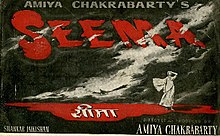
Seema (1955)
Director: Amiya Chakrabarty
The chemistry between Nutan and Shubha Khote in the surroundings of an orphanage stood out. Some of you may remember the long cycle ride undertaken by the latter towards the climax of the movie.
Dosti (1964)
Director: Satyen Bose
Circumstances and love for music brings together a blind person and a handicapped one. Trust Rajshri Productions to keep regaling us with family-oriented themes which tug at our heart strings.
Anand (1971)
Director: Hrishikesh Mukherjee
An unusual bond develops between an idealistic doctor and a terminal cancer patient who comes to stay with him during the last few months of his life. The frustration of a doctor at not being able to alleviate the suffering of his new-found friend was etched out so very poignantly.
Victoria No. 203 (1972)
Director: Brij
Two old golden-hearted crooks get released from jail and wish to spend the rest of their lives as good, respected men. The plan is short lived when they willy-nilly find themselves on the trail of some stolen diamonds.
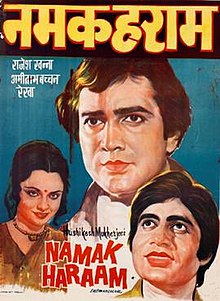
Namak Haraam (1973)
Director: Hrishikesh Mukherjee
An industrialist who does not care much about maintaining harmonious relations with his labour force ends up being confronted by a close friend who empathizes with the travails of the workers and evolves into a trade union leader of sorts.
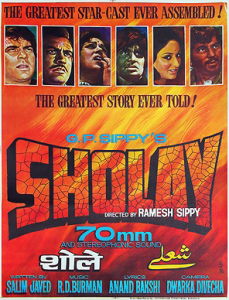
Sholay (1975)
Director: Ramesh Sippy
Even though the main theme was all about revenge with romantic sub-plots thrown in, the friendship between Jai and Veeru went on to become the stuff of cinematic legends.
Hera Pheri (1976)
Director: Prakash Mehra
Two small-time crooks loot other rich ‘respected’ but criminal-minded people for a living. Misunderstandings arise between them, but eventually get cleared up and the friendship between them gets reestablished.
Chashme Baddoor (1981)
Director: Sai Paranjape
Three friends who live together run into a young lady from the neighbourhood. The studious one ends up winning her heart. Out of jealousy, the other two try to complicate the relationship between the couple. A grandmother ends up clearing the mists, reuniting the couple.
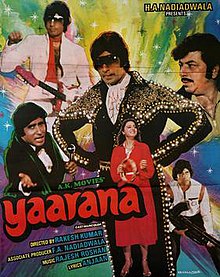
Yaarana (1981)
Director: Raakesh Kumar
If one friend goes out of his way to promote the singing career of a childhood friend, the other, upon becoming famous and rich, reciprocates the gesture by donating the proceeds of his earnings and consequent record deals in order to rid his friend of his many mortgages and to reunite his family. When one gets admitted into a lunatic asylum, the other one manages to sneak in and restore his sanity.
Andaaz Apna Apna (1994)
Director: Rajkumar Santoshi
Two daydreamers come up with a get-rich-quick scheme by pursuing a millionaire’s daughter. Once they meet each other, they form a competitive bond and land up at the daughter’s place under some false pretexts. Diamonds, mafia dons and jealous uncles play a role. Eventually, they play saviours to the daughter, her secretary, and the family, thereby achieving their goals.
Dil Chahta Hai (2001)
Director: Farhan Akhtar
Three close friends pursue a different career path after passing out of college. Love blossoms for each one, though differently. They go on a road trip together. Misunderstandings between them get cleared in the end.
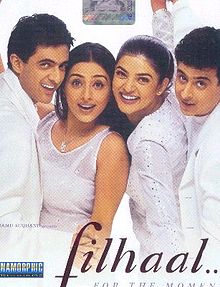
Filhaal (2002)
Director: Meghna Gulzar
One of the rare movies which portrayed a strong bond of friendship between two inseparable friends. During a fencing session, a freak accident leaves one of the friends injured, rendering her unable to conceive later in life. The other one offers to be a surrogate mother for the couple. Complications arise in the relationship, though the story eventually ends up on a positive note.
Rang de Basanti (2006)
Director: Rakeysh Omprakash Mehra
When a British student decides to make a film on pre-independence freedom fighters from India, contemporary reality meets history, forcing the viewers to introspect as to where we are headed as a country. The bond between the friends stood out for its empathic and realistic portrayal.
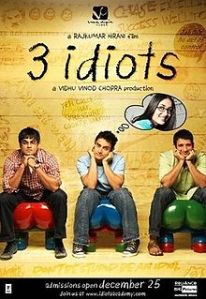
3 Idiots (2009)
Director: Rajkumar Hirani
The friendship between three classmates withstands the test of time. Ten years down the road, their common antagonist also joins in when they decide to search for one of the missing friends. The central message of the movie was to decide one’s career moves based not on parental or popular expectations but on one’s inner passion.
Zindagi Na Milegi Dobara (2011)
Director: Zoya Akhtar
Three friends undertake a joint trip so as to experience different facets of life. Their plan is that during the road trip each of them will pick a surprise adventure sport in which they all have to participate together. They complete the event successfully, bonding better with each other and gaining a renewed sense of purpose in life.
Kai Po Che (2013)
Director: Abhishek Kapoor
Three friends spot a talented boy who is good at cricket and decide to groom him. A love affair leads to misunderstandings arising between them. The 2001 earthquake in Gujarat and the riots of 2002 also pose many challenges to their bond of friendship.
Dedh Ishquia (2014)
Director: Abhishek Chaubey
Two partners in crime run into a pair of scheming ladies who have ideas of their own. The latter end up cocking a snook at the former by selling a necklace stolen by them, buying a property from the proceeds, and settling down there to start a dance school for young girls – a scheme the two friends had hatched between themselves.
Parched (2015)
Director: Leena Yadav
Four women in a desert village of Gujarat, India, forge a strong bond of friendship between themselves while facing social evils, age-old traditions and practices of patriarchy, child marriage, dowry, marital rapes, and physical and mental abuse.
Double XL (2022)
Director: Satramm Ramani
A common challenge of being overweight results into a bond of friendship developing between two young ladies. They decide to work together and demonstrate the perks of obesity to the world, ridiculing the current craze for Size Zero and unrealistic norms of beauty peddled by fashionistas and the media.
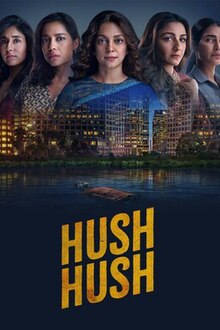
Hush Hush (2022, Series)
Director: Tanuja Chandra
A taut thriller where one of the four close friends dies in mysteriously circumstances. The other three ladies eventually uncover the real reason for the death of their friend, while battling the challenges in their own lives.
Uunchai (2022)
Director: Sooraj Barjatya
When a close friend suddenly dies, three friends decide to honour his last wish – that of visiting the Himalayas. Despite health challenges, they undertake a hiking trip to the Everest base camp. They manage to scatter the ashes of their departed friend there. The perilous journey makes them realize that each one of them has heights within which are waiting to be scaled, bringing home the key message of striving to realize our fullest potential in life.
Why Are Women Short-changed?
There may be many more friendship-based movies which I would have missed out here. However, one thing that strikes is that of a serious shortage of movies on friendships between women. Is it that those hailing from the tribe of the delicately nurtured do not have friends?
The underlying cause could perhaps be that a major chunk of our society thrives on a patriarchal mindset; while males enjoy their friendships for a very long time, females often get a raw deal on this front because family commitments reign supreme, often to the exclusion of all else. With hardly any personal space and a minimal availability of ‘Me Time’, the bonds of female friendship, if any, do not enjoy the kind of continuity that male friendship does.
We need to encourage and empower the women in our lives to keep their own embers of friendship aglow, alive and kicking!
Ahoy there, my dear readers, gather around and let me regale you with the tale of my first encounter with the bewitching world of cinema. It was a sweltering summer day, the kind where even your sweat sweats, and I found myself being herded by my good mother into a dark hall which reeked of human sweat and stale tobacco. A set of noisily whirring wall-mounted fans were unsuccessfully trying to dispel the stuffy ambience inside. I was but a wee lad of about five summers then, not yet ready to face the world on my own, and so, like many other youths of my age and station, I clung to my parent’s skirts for dear life.
As we plopped ourselves down onto our seats, my imagination ran wild with thoughts of dashing heroes and fair maidens in distress, of swashbuckling adventure and sizzling romance. And what did we get? A paltry provincial flick that was as perplexing for a five-year-old as someone studying in the 5th standard trying to grasp the laws of quantum physics.
It purportedly bore some resemblance to the tale of Romeo and Juliet, although I can confidently declare that the Bard himself would have been scratching his head trying to figure out what the hullabaloo was about. From what I could gather, the movie was an incomprehensible cacophony of adults bawling in some alien tongue. And yet, a few scenes still stick in my noggin to this day.
For instance, there was one where the protagonist (or at least, I think he was ‘the one’) was getting pummeled by a bunch of goons, crying like a banshee. I couldn’t help but wonder why the fella didn’t just give them a good thrashing like a bona fide English gentleman – and then it dawned on me that he was probably too busy wailing like a newborn babe to do anything else. He would have done well to undergo a crash course in martial arts under someone like Roderick Spode.
Then came another scene where the leading lady was being implored to partake in some grub, and exasperated with the incessant pestering, she chucked the plate across the room like a discus thrower. I must admit, even at my tender age, I was mightily impressed by her spunk in the face of such adversity. She sounded like Minna Nordstrom throwing tantrums and insisting upon being offered some meatier roles on the screen in the days to come.
Needless to say, the film might as well have been the first production of the Perfecto-Zizz-baum Corporation, the leading movie studio headed by Mr. Schnellenhamer, envisaged at a time when he might have been having an odd disagreeable feeling, caused by what Roget’s Thesaurus would describe as agitation, fury, violent anger, wrath and similar emotions listed under the heading ‘Rage’, that too of an impotent kind. Discussions with his team of directors, script writers, music composers, yes-persons, deputy yes-persons, junior yes-persons, nodders, and trainee nodders might have led to a rather patchy outline of the movie.
What was on offer was a mere collection of moving images on a screen. However, despite my befuddlement and general indifference, I maintained a stiff upper lip and remained mum throughout the entire affair – a feat that earned me many a pat on the head and back from those around me. I suppose I had already honed my cinema etiquette from my prior dalliances with the proverbial idiot box, where I had already been spending quite a few jolly hours watching Mickey Mouse and Donald Duck.
But fret not, my companions, for the yarn doesn’t conclude just there. As soon as the film rolled to a halt and the lights flickered on, my dear old ma and I trudged along the sunny byways of Kolkata in search of refreshment for our weary souls. And lo and behold, we chanced upon a confectionery – Kamola Sweets, it was named – that promised to satiate our whims.
Picture my rapture, dear chums, when I first laid eyes upon the wondrous delicacies being served at this place. There were samosas as colossal as my noggin, chock-full of spiced potatoes and peas and dripping with oil – the kind of fare that’s more precarious than a boomerang sharpened to a razor’s edge. And then, there were the gulab jamuns, those pillowy globes of khoya (highly condensed milk) soaked in syrup and served piping hot – a dessert worthy of gods alone.
Needless to say, I was smitten with those toothsome delights, and I fancy that my ardour for cinema would have been just as fervent if only that rascal of a movie had been a tad more intelligible. But that’s life for you, my dearest bosom pals – brimming with twists and turns and the occasional sweet surprise.
In any case, it was like love at first sight. This is how my enchantment with movies began. As the lights dim and the images start rolling on the silver screen, I would sit wide-eyed, lapping up the juicy goings on with a single-minded devotion which would have put someone like Chaitanya Mahaprabhu to shame. The thrill of a car chase, the sheer pleasure of listening to some uplifting lyrics set to soulful music, the excitement of seeing a villain and his sidekicks getting brow-beaten by a smart hero, the gravity-defying stunts which would make someone like Newton squirm in his grave, and the rush of hormones when a comely heroine eventually fell into the arms of a dashing hero!
As the couple walked hand in hand into a sunset and the credits started rolling by, one had no other option but to snap out of yet another phase of escapism. The thoughts quickly turned to satiating the needs of a stomach which suddenly started demanding its quota of nourishment.
I can go on and on, dear comrades, but have no intentions of boring you any further with the apparent frivolity of my first cinematic encounter which led to a lifetime bondage of sorts.
(Reviewed and somewhat spruced up by yours truly!)
(This article first appeared in the Khaleej Times, Saturday, May 13, 2023)
Wodehouse wrote 95 books, and authored more than 30 plays and musical comedies, and more than 20 film scripts. His impact on the English language was considerable.
Those who follow my literary life are aware of my boundless admiration for P.G.Wodehouse (1881-1975), the great British comic novelist, playwright and lyricist, whom I consider to be an absolutely unrivalled craftsman of English prose. But since this column is not about literature, I will refrain from sharing with you the many examples of Wodehousean style and technique that justify my judgement. Instead, since our column is about language, I will just confine myself to some of the words the Master invented, or brought into circulation (a habit he shared with William Shakespeare, no less), to our endless delight. Of course, it’s much more fun to encounter these words in his novels, but this is just to whet your appetite!
Wodehouse wrote 95 books, and authored more than 30 plays and musical comedies, and more than 20 film scripts. His impact on the English language was considerable. The Oxford English Dictionary, for example, contains 1,756 quotations from Wodehouse to explain word usage. It confirms he invented multiple common expressions, like the word “cuppa” (as in “Come and have a cuppa”, Sam the Sudden, 1925) and “fifty-fifty” (“Let’s go fifty-fifty”, Little Nugget, 1913). And his famous character Jeeves, the super-smart valet to the feckless Bertie Wooster, is entered in the dictionary as a generic noun. A “Jeeves” means “a valet or butler especially of model behaviour.”
The most-quoted Wodehouse invention must be gruntled. It’s from his brilliant The Code of the Woosters (1938): ‘He spoke with a certain what-is-it in his voice, and I could see that, if not actually disgruntled, he was far from being gruntled.’ Now the word ‘disgruntled’ never had an antonym before, but here’s a mock-serious adjective meaning ‘satisfied’ or ‘contented’.
Wodehouse’s upper-class idlers, members of the Drones Club, were all steeped in alcohol, but the author did not describe them merely as inebriated. In his 1927 book Meet Mr Mulliner, Wodehouse had already anticipated new words for ‘drunk’: ‘Intoxicated? The word did not express it by a mile. He was oiled, boiled, fried … whiffled, sozzled, and blotto.’ His characters’ lexicon for those who have consumed too much fire-liquid also included: awash; lathered; illuminated; ossified; pie-eyed; polluted; primed; scrooched; stinko; squiffy; tanked; and woozled.
And, as befits a master of comic-hall theatre, Wodehouse had a great ear for onomatopoeia. At the age of 22 he published a story which used a new word for the sound of a cricket ball hitting a bat: ‘There was a beautiful, musical plonk, and the ball soared to the very opposite quarter of the field.’ (From Tales of St. Austin’s, 1903).
The same talent is evident in this description from Blandings Castle (1935) of a pig eating: ‘A sort of gulpy, gurgly, plobby, squishy, wofflesome sound, like a thousand eager men drinking soup in a foreign restaurant.’ Neither “plobby” nor “wofflesome” will be found in your home dictionary, but they marvellously convey a greedy and ill-mannered creature tucking in. Apply it to some of your acquaintances at their next meal?
When someone speaks sharply, it’s hard to think of a more original way of describing it than this, from the 1930 novel Very Good, Jeeves: ‘When not pleased Aunt Dahlia, having spent most of her youth in the hunting-field, has a crispish way of expressing herself.’ Also in Very Good, Jeeves, came a new way of saying things were ‘all right’ or ‘fine’: ‘“All you have to do,” I said, “is to carry on here for a few weeks more, and everything will be oojah-cum-spiff.”’
The Oxford English Dictionary includes at least one Wodehousean invention that didn’t last: “snooter”, meaning to ‘harass’ or to ‘snub’, (“My Aunt Agatha wouldn’t be on hand to snooter me for at least another six weeks”, The Inimitable Jeeves, 1923) never really caught on and is listed in OED with the parenthesis ‘Only in P. G. Wodehouse.’ But some Wodehousiana seems very contemporary. Zing, for instance, inserted to convey ‘the sudden advent of a new situation or emotion’, as the OED puts it, could work today but actually appeared in the 1919 book Damsel in Distress: ‘The generous blood of the Belphers boiled over, and then—zing. They jerked him off to Vine Street [police station].’


















 ashokbhatia