Preamble
Hassled CEOs have no other option but to keep issuing guidelines from one quarter to the next without fail. Much in tandem, every quarter, a new corporate scam hits the headlines. The precise regularity with which skeletons keep tumbling out of corporate closets at frequent intervals would put the atomic clocks on our planet to shame.
When it comes to perpetrating a fraud on unsuspecting stakeholders, human ingenuity has never been found wanting. If America had Enron and Lehman Brothers, UK had Barclays. If Norway had Nortel, Portugal had Banco Espirito Santo. If Switzerland had UBS, Germany had Volkswagen. India has had Satyam and Punjab National Bank. She has also earned the dubious distinction of improving upon its Ease of Emigration rank for defaulting high net worth individuals in the recent past.
No industry could lay a specific claim on such man-made disasters. Be it banking, insurance, mining, automobiles, liquor, energy, commodities, IT or real estate, all have set examples of devious plans to deceive their stakeholders, whether of the gullible kind or the colluding kind.
Human greed and avarice are obviously the root cause. The sheer pleasure derived by a minority in making some extra gains at the cost of a silent majority apparently has a sense of gratification which surpasses all else.
A business environment of this nature needs leaders and managers who have nerves of chilled steel and a disposition backed by a high degree of inner resilience. A deep commitment to values and ethics in business. A premium on fairness and transparency in all kinds of deals. A long-term view of sustainable success, as opposed to a fly-by-night approach to decision-making. A constant connection with one’s inner self. In short, they need to have a high Spiritual Quotient.
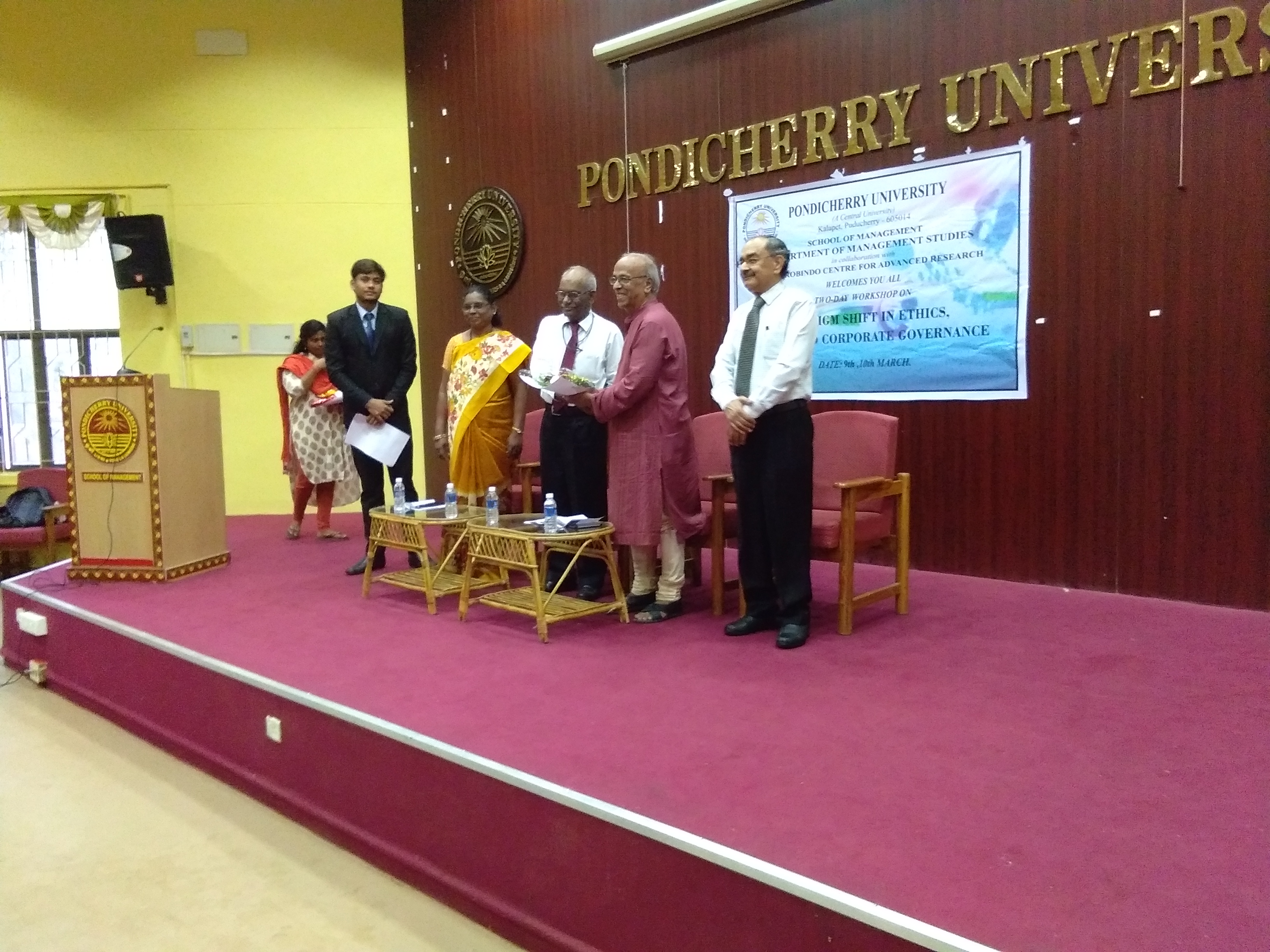
A two-day workshop at Pondicherry University
The Department of Management Studies of Pondicherry University, in collaboration with Sri Aurobindo Centre for Advanced Research (SACAR), recently conducted a two-day workshop, highlighting the manner in which aspiring managers can work on an inner transformation and achieve unparalleled satisfaction and growth in their careers, whether as professionals or as individuals.

In his keynote address, Dr Ananda Reddy, Director, SACAR, highlighted the challenge the leaders and managers of today face: that of following values and ethics in business, of imbibing the principles of corporate governance in their decision-making, and the need for being aware of the potential of spiritual consciousness as a solution to the problems they face.
Organizations are made up of human beings. Thus, the mantle of transforming corporates falls squarely on the young and strong shoulders of individual leaders and managers. This alone can lead to a meaningful evolution in the manner in which organizations function. By being an important part of society at large, such organizations set high standards and spearhead social evolution.
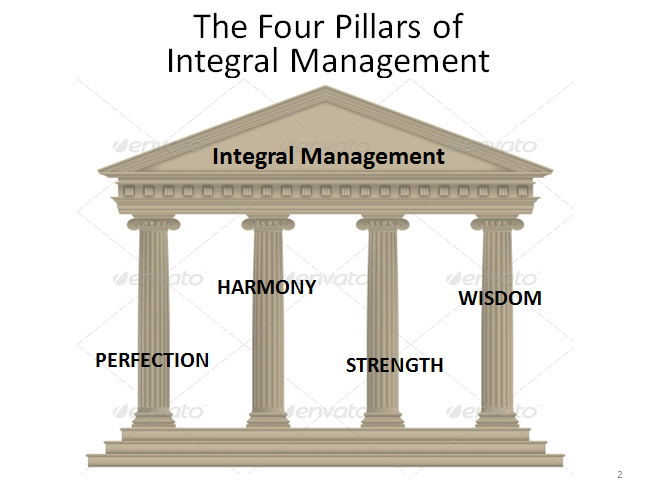
The need of the day is to view the management process through a new lens – that of the Four Pillars of Harmony, Strength, Perfection and Wisdom. This new paradigm of Management goes beyond the self-centred ‘I and Me’ approach of Western models. Rather, it focuses on the overall good, espousing a ‘We and Us’ approach, which is more holistic in nature. This new paradigm is based on ancient Indian wisdom and can help leaders and managers to deal with corporate affairs more effectively and efficiently.
The new paradigm of Integral Management
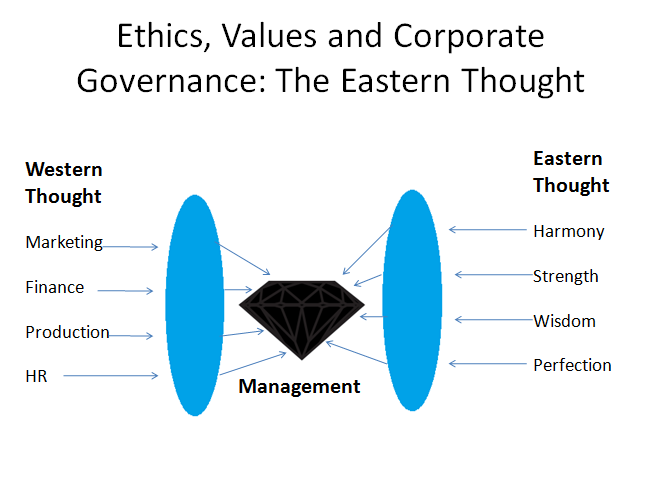
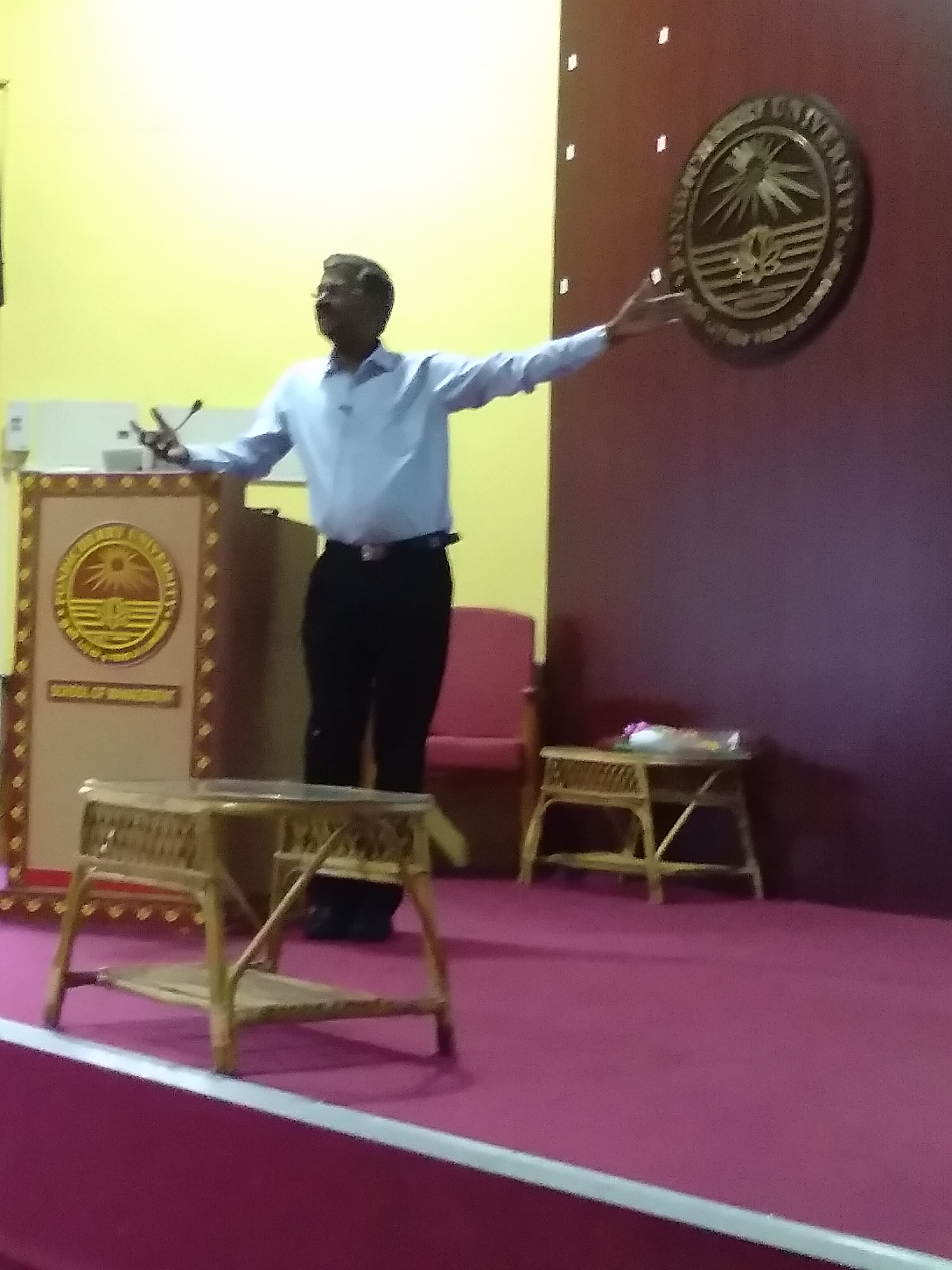
Yours truly provided to the participants an overview of the Four Pillars of Integral Management, backed by real life examples from the business world.
The challenges of maintaining Harmony were brought up, as also the need for a higher Spiritual Quotient. Use of planned disharmony in the market place, as evidenced by the disruptive entry of Reliance Jio in the telecom sector and that of Patanjali in the FMCG sector, was mentioned.
The need to deploy Strength for the overall good was substantiated by the case of Tata Trusts. The abuse of corporate muscle power was brought out by quoting the case of Erin Brockovich, who spearheaded the campaign to secure substantial relief for those who suffered at the hands of the Pacific Gas and Electric Company of California in 1993.

The development of hybrid cars and several product recalls were cited as examples of dynamic Wisdom in company’s policies. The need to build brand equity was discussed, so was the role of intuition in decision-making. The story of how the Indian Institute of Science at Bangalore came up based on the singular initiative of Sir Jamsetji Tata (1839-1904) was narrated.
Participants were exhorted to give up the culture of mediocrity and strive for Perfection in all their actions. Example of Apple products and Rolls Royce cars were cited.
Harmony and Collaboration

Professor Kisholoy Gupta, an accomplished international trainer in Management Sciences, based in Bangalore, invited the participants to play some games to demonstrate the role and importance of Harmony and to experience a freedom of expression, so one could feel free and happy, and therefore, work more productively.
Ms Padma Asokan, who manages Omeon Solutions, a global software company in Chennai, explained the need and mechanics of achieving Harmony in organizations.

The core of any organization being love and harmony, managers can improve their contribution by achieving a balance between their inner and outer selves.
Managements need to enable harmony at different levels. At the infrastructure level, care needs to be taken of tools, office layouts, work station design, and rest and recuperation facilities. The top person is the DNA of the company’s culture and thereby enables organizational harmony. Operational harmony is achieved through teams which aim to achieve success in whatever they choose to do. Smooth communication, whether vertical or horizontal, ensures better harmony across an organization. Treating employees with respect and dignity and innovative HR policies ensure a high degree of motivation at all levels.
Order and cleanliness attract all stakeholders to a business. Waste reduction, productivity improvement and minimal friction are the key benefits one derives.
The highest form of harmony results from conflict resolution of values across individuals, departments and profit centers. Managements keen to achieve a state of sustainable corporate harmony counsel their employees to cleanse their minds of such negative emotions as anger, hatred, passion, lust, delusion and pride.
The Strength of Self-belief
Professor Kisholoy Gupta conducted some practical exercises to make the participants aware of the importance of the Strength of being impartial and objective and “stepping-back” before taking any decision.

Mr Ganesh Babu, a strategic thinker and a coach extraordinaire based at Pondicherry, touched upon the importance of self perception, self-control and a belief in one’s own abilities. By quoting examples of several spiritual stalwarts in the fields of business as well as in spirituality, he demonstrated that it was their belief in themselves and their unique capabilities that led them to scale great heights and become the leading lights of humanity, inspiring one and all.
An individual manager’s values and beliefs shape his attitude. These, in turn, determine his feelings and behaviour, making him what he is. The power that he exercises is often derived from his beliefs. By reviewing one’s belief systems, one can enjoy greater power over one’s actions and circumstances, thereby enhancing one’s efficiency and effectiveness.
A manager can increase his Strength manifold by:
-Basing his decisions on empathy and respect towards others;
-Refusing to accept anything below standard, treating all tasks as Divine work and, thus, striving for perfection;
-Dealing with Materialistic Resources in a firm and polite manner.
Perfection in Management
Professor Kisholoy Gupta conducted a series of practical exercises of making quality products, thereby driving home the relevance of Perfection in management.
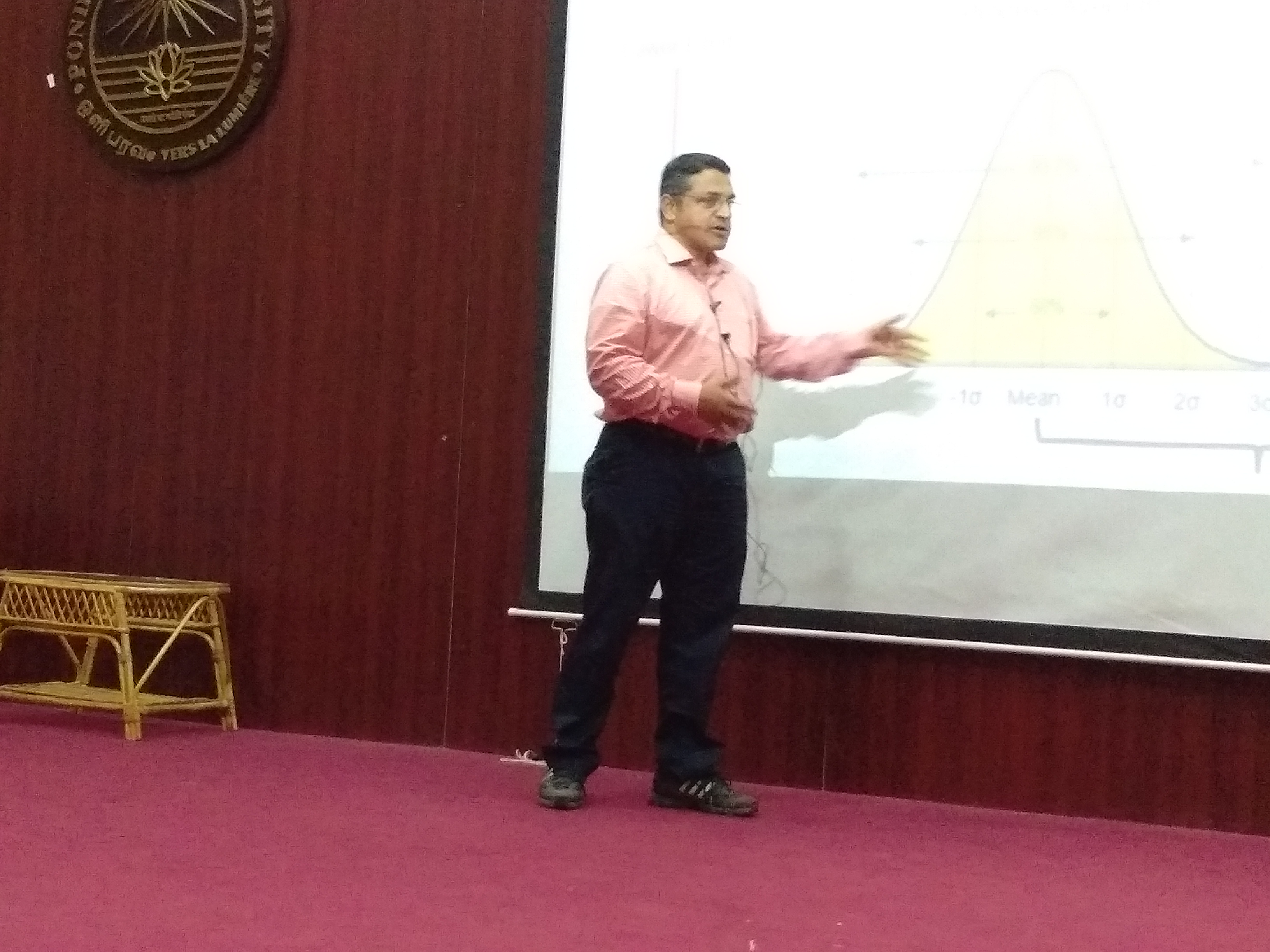
Dr Sridarshan Kaundinya, having had cross-functional experience in such companies as GE, Indus and TCS, and presently based in Bangalore, explained the manner in which Perfection gets practiced in the industry. The need to go for quality levels far beyond Six Sigma, like in aircraft engines where a failure could directly lead to loss of precious human lives, was touched upon.
Perfection is not only about having an intuitive power to accuracy but also about an unfailing attitude of fulfilling commitment, of being unscrupulous, unsleeping, indefatigable, and touching every detail, and of organizational execution and achieving an unfailing exactitude of result.
The Power of Wisdom in Values
By way of a warm-up exercise on Wisdom, participants were invited to describe the lines along which the city of Pondicherry should develop in another decade or so. Brighter minds at the workshop came up with some lofty and pragmatic goals for the city planners and administrators.
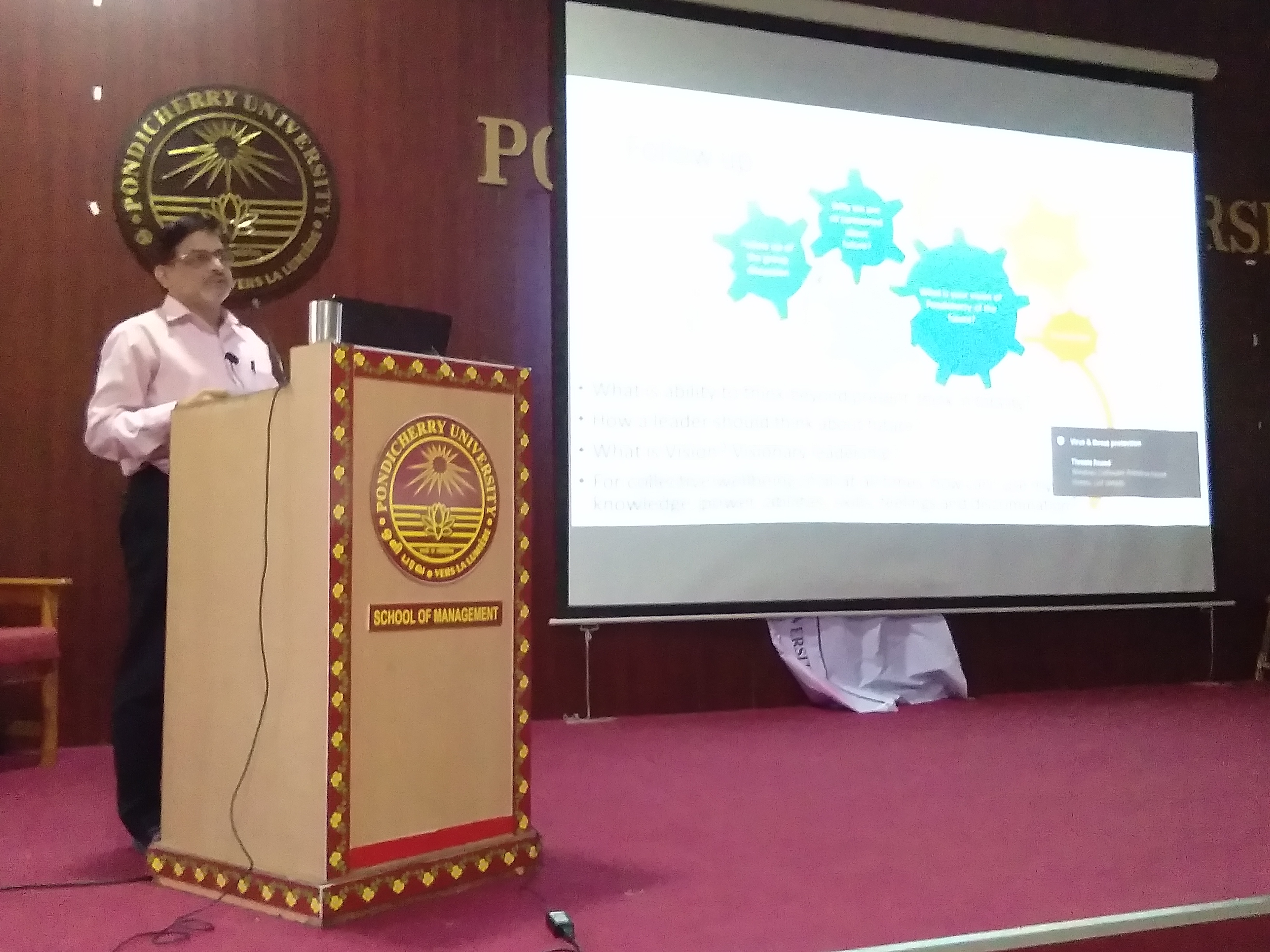
Dr Narendra Joshi, an eminent educationist from Mumbai, who has also worked on the interface between Artificial Intelligence and Spirituality, described Wisdom as comprising vision, wideness of understanding, and as a result, an endless compassion and patience for the time needed to effectuate and implement the intention of the Supreme in the manifestation.
He stated that it is not uncertainty alone that has paralyzed CEOs today. Many find it difficult to reinvent their corporations rapidly enough to cope with new technologies, demographic shifts, and consumption trends. They’re unable to develop truly global organizations that can operate effortlessly across borders. Above all, leaders find it tough to ensure that their people adhere to values and ethics.
The prevailing principles in business make employees ask, “What’s in it for me?” Missing are those that would make them think, “What’s good, right, and just for everyone?”
Practical wisdom, according to several studies, is experiential knowledge that enables people to make ethically sound judgements. It is similar to the Japanese concept of Toku—a virtue that leads a person to pursue the common good and moral excellence as a way of life. It is also akin to the Indian concept of Yukta, which connotes “just right” or “appropriate.”
One way of describing Wisdom is to have the ability to see the trees and the forest at the same time. With meditation and an inner connection with oneself, this can be cultivated.
Going beyond CSR
Mr. N Harihara Subramanian, a passionate Social Worker involving and supporting many Projects and a founder and promoter of the Indian Institute of Governance (IIG), Chennai, delivered the Valedictory Address.
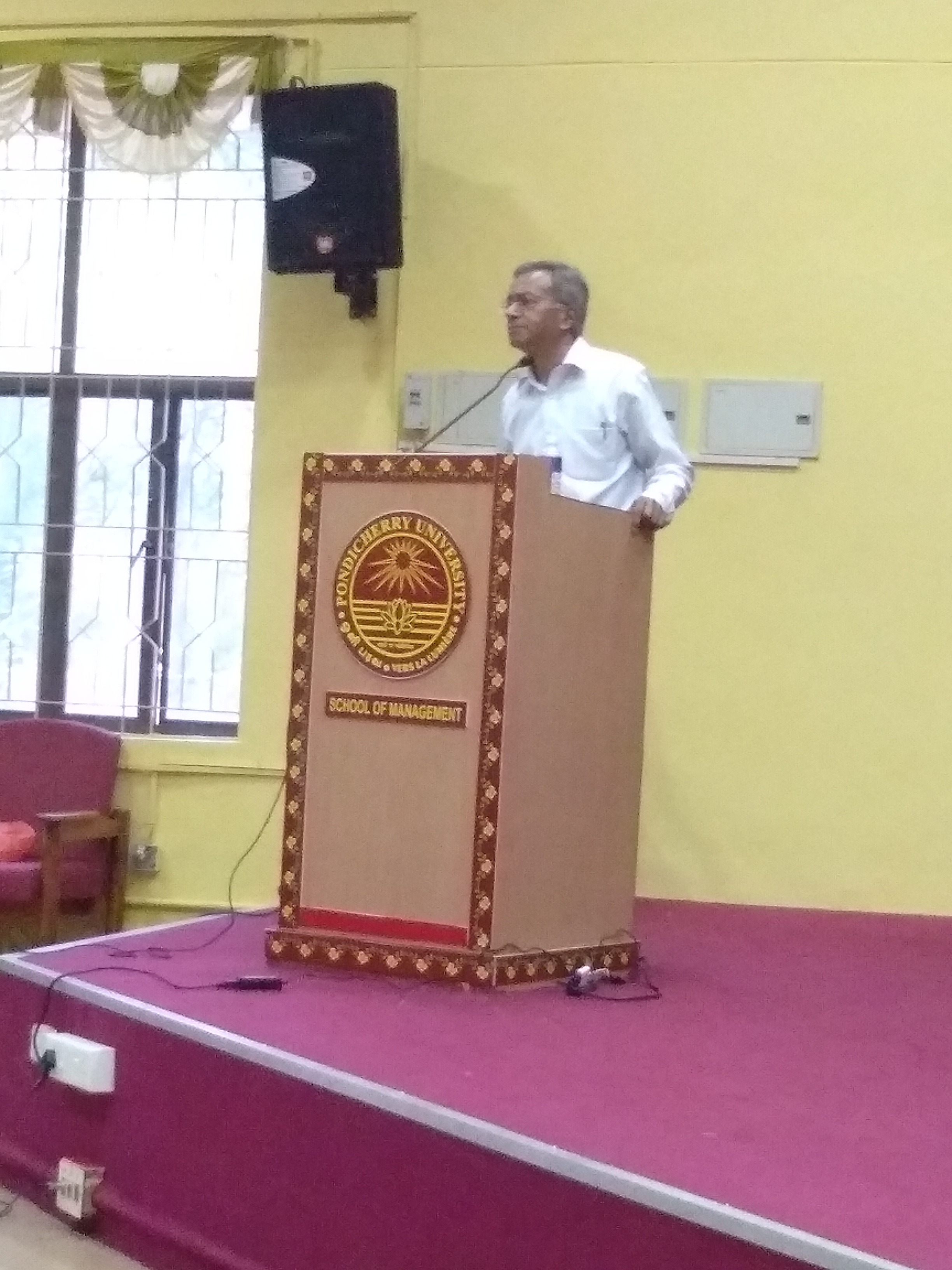
He exhorted the participants to propel their organisations beyond traditional norms of Corporate Social Responsibility, and work for the overall benefit of the communities surrounding them.
Proceedings summarized
Dr Ananda Reddy, Director, SACAR, summed up the proceedings of the workshop. He reiterated the need to train young managers not only based on the Western models of management, but also to draw deeply from the wisdom contained in Indian scriptures. This alone could lead to businesses which work for the overall good of the society.
Workshop Design, Execution and Coordination
The workshop was designed to develop the inner capabilities of students as future managers in terms of the aforesaid Four Pillars of Harmony, Strength, Wisdom and Perfection.
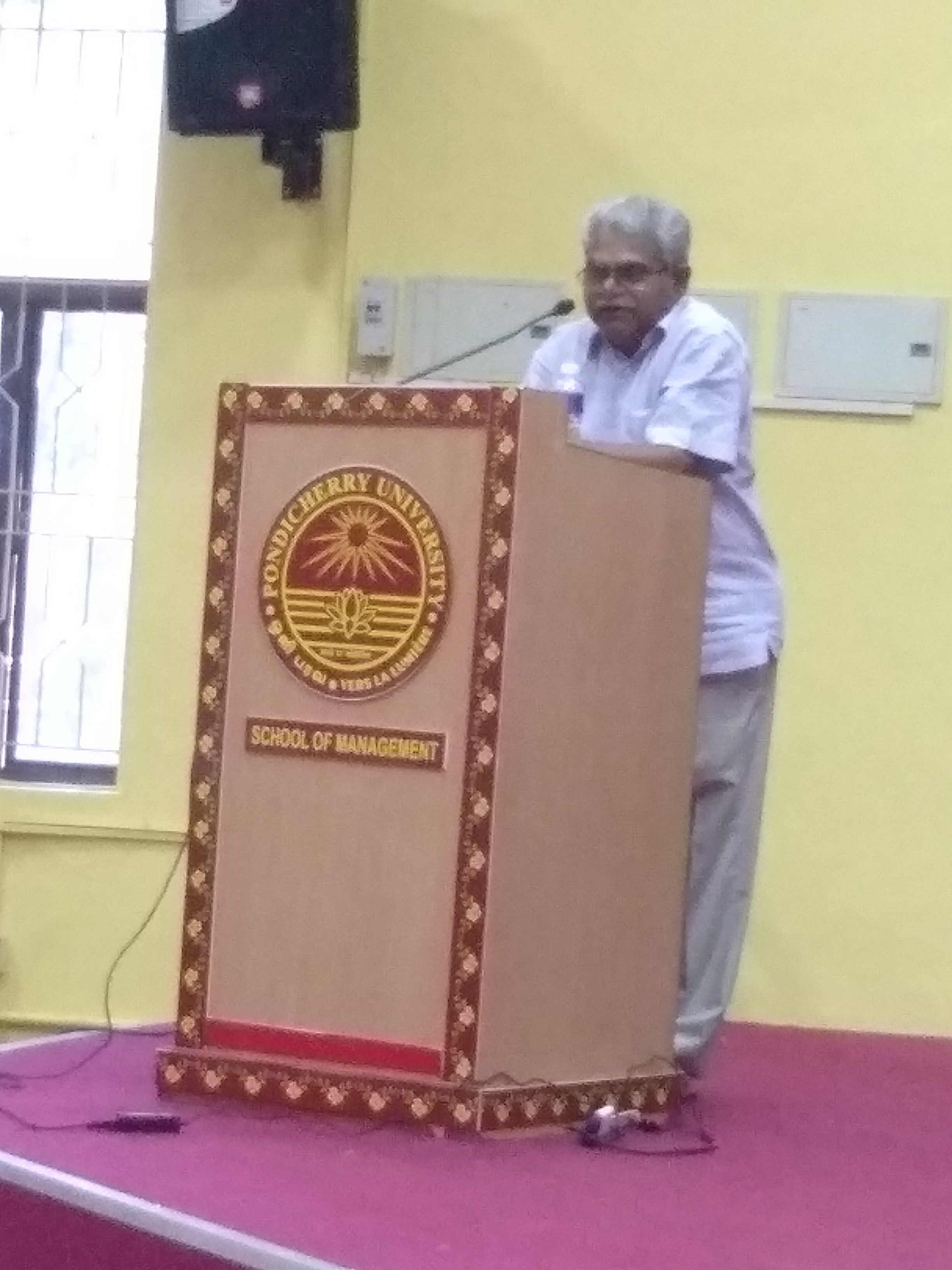
The event was chaired by Dr. G. Anjaneyaswamy, Professor and Dean, School of Management, Pondicherry University. In his concluding remarks, he appreciated the unique contents of the workshop and expressed a hope that the Department of Management Studies may like to have the same incorporated into the formal syllabus of a regular MBA course at Pondicherry University.
The Inaugural Session was chaired by Professor K C S Rao, Head, Department of Banking Technology, School of Management, Pondicherry University.
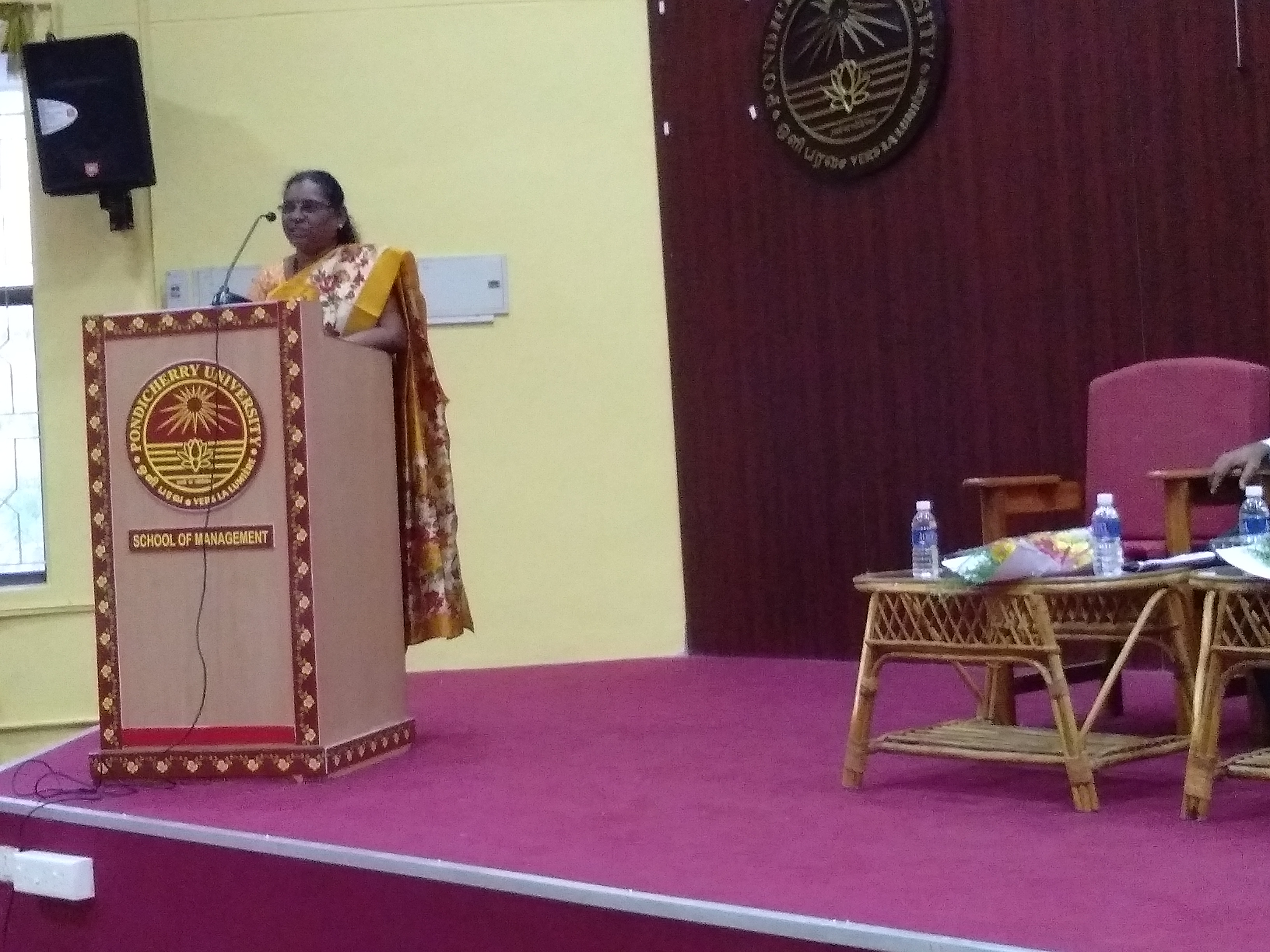
The Convener of the workshop was Dr. R. Chitra Sivasubramanian, Professor & Head, Department of Management Studies (DMS), Pondicherry University.
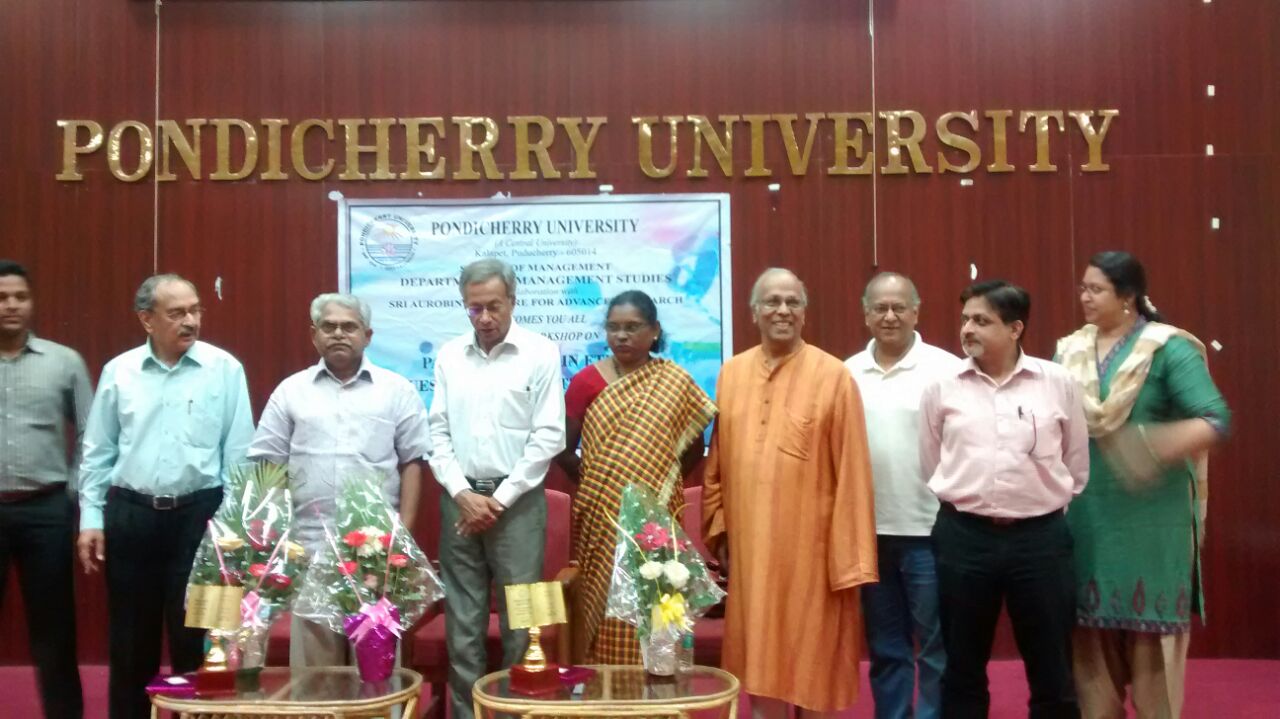
The entire event was coordinated by Dr. B. Rajeswari, Assistant Professor, and Dr. R. Venkatesakumar, Assiociate Professor, DMS, School of Management, Pondicherry University. Dr Shruti Bidwaikar was the main coordinator from Sri Aurobindo Centre for Advanced Research (SACAR), Pondicherry.
The Road Ahead
Businesses with a futuristic vision need managers who are not only tech-savvy but also situation-savvy, adept at handling stressful challenges with ease and aplomb.
SACAR is open to the prospect of conducting similar workshops in commercial organizations as also at management institutes of repute, whether for the students or for the faculty.
For institutes interested in incorporating the content in their regular management courses, a draft syllabus has also been prepared under the guidance of Professor G P Rao, who, after retiring from Madurai Kamaraj University in 1997, has devoted himself to the mission of spreading human values in organizations, through his NGO, SPANDAN.
(Related Posts:
https://ashokbhatia.wordpress.com/2012/11/19/spirituality-in-management
https://ashokbhatia.wordpress.com/2016/03/26/harmony-in-management-a-seminar-at-pondicherry-india
https://ashokbhatia.wordpress.com/2016/08/30/power-in-management-a-seminar-at-puducherry-india












 ashokbhatia