Winners were recently announced in respect of a pan-India essay competition on Human Values in Present Day Organizations. The competition was organized by Spandan, a NGO which aims to spread the criticality of human values in management.
Vasu Garg of the Management Development Institute (MDI), Gurugram, Shreya Kumari of Patna Women’s College and Ankur Mahajan of KJ Somaiya Institute of Management, Mumbai, were declared winners of the first three positions, respectively.
Spandan: A Brief Note
Spandan Foundation for Human Values in Management and Society (Spandan in short) originated as a result of the academic and research interest of Prof G P Rao. It had been formed about two decades back. It is supported by a small group of industrial organizations, management institutions and individuals.
The word Spandan is drawn from the Sanskrit language. It means heartbeat, vibration, pulsation and echo. As a concept, the term is meant to convey that faith in the basic goodness and intrinsic altruism of human beings have both always been the driving force for human existence, growth and development.
TheMission
Propagation and inculcation of human values in education, management and society.
The Vision
‘Humanising self through a communion of hearts’.
The Belief
Businesses deliver suboptimal results when their ‘Results’ are viewed as being at odds to their ‘Relations’ with different stakeholders. An optimal balance between ‘Results’ and ‘Relations’ needs to be struck; this alone can enable an organization to achieve its goals effectively and efficiently on a sustainable basis.
The team at Spandan strongly feels that the need of the hour is to create Functionally Humane Organizations – a committed group of human beings doing their best in the interests of various stakeholders.
The Essay Contest (2021-22)
The contest was steered by Satish Sekhri, a senior management professional. Scholars and students from more than 100 management institutes were invited to participate. Fifty-eight entries from different institutes were received for the competition.
Of these, fourteen entries were short-listed and referred to a jury comprising Prof. Varun Arya, Founder Director of Aravali School of Ignited Minds, and Ashok Bhatia, a management thinker and author. The jury zeroed in onto five finalists. The criteria for evaluation were: The emphasis on human values, language and approach to the subject, and the practicality of the suggestions made.
The five short-listed essays were finally evaluated by Mr. Virender Singh, a former Chief Justice of the Chhattisgarh High Court. Thereafter, the three winners mentioned above were announced at a virtual event in the presence of Chief Justice Mr. Virender Singh, Jagesh Khaitan, who is the chairman of Kuantum Papers and of Spandan, and Anil Kohli, the NGO’s honorary secretary.
The winners were given cash rewards of ₹50,000, ₹30,000 and ₹20,000 respectively.
Future Activities
A series of lectures by eminent experts in the field of human values are on the anvil. As and when the dates are finalized, necessary details would be available at the Spandan website: spandanfhv.com.
If you are looking for a book imparting management lessons backed by some shimmering jargon and quotes from famous experts in the field adorning its pages, this one is bound to disappoint you.
In case you have a researcher’s attitude and are hoping to unearth some new facts or discovering new management theories, you will find nothing here that may excite you or whet your appetite for a scholastic understanding of the science and art of management.
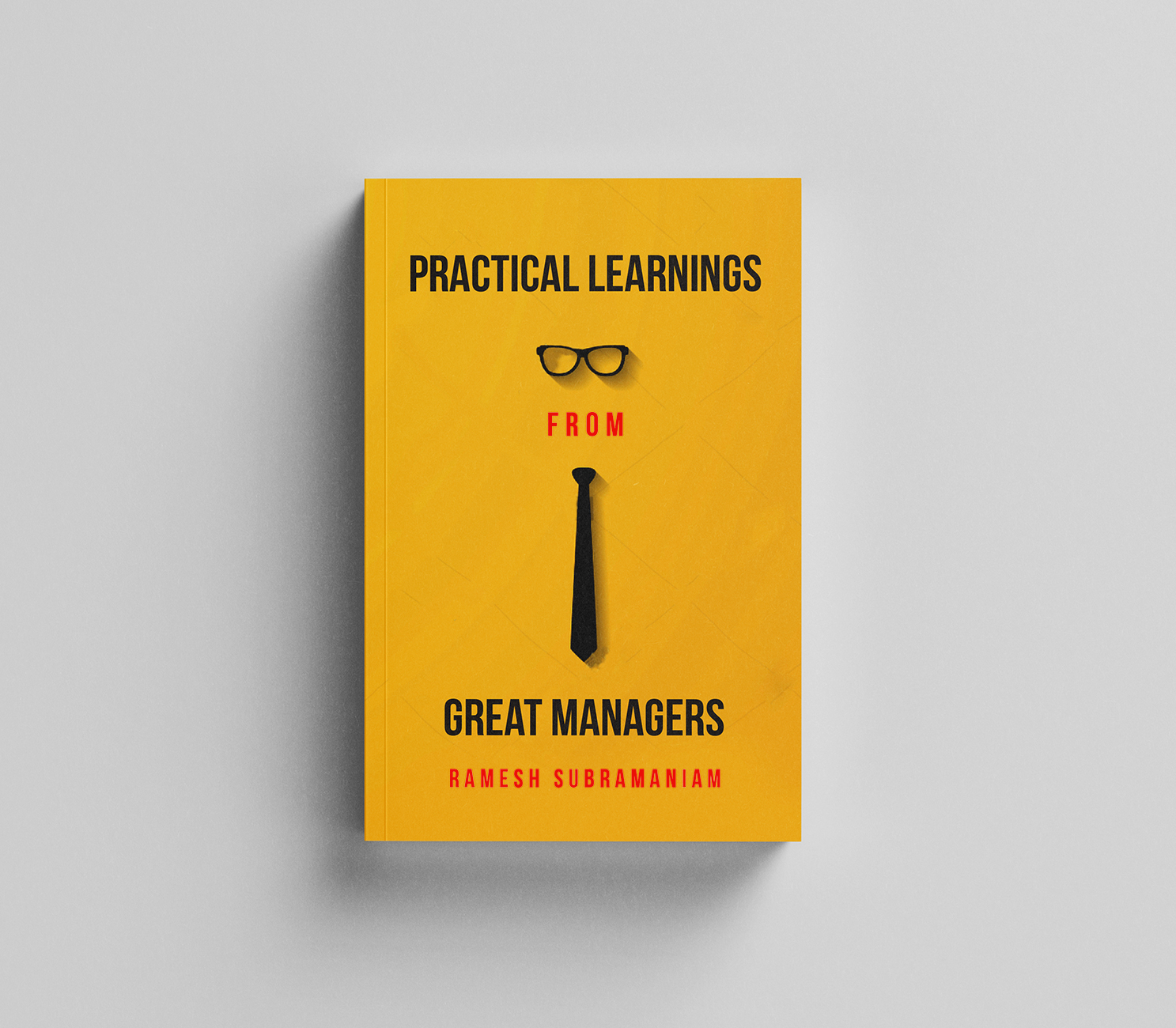
However, if you believe that the real world of management has lot of experiential learning to offer and that values and ethics play a crucial role in the sustained success of a business organization, you would be delighted to have come across this book, entitled Practical Lessons from Great Managers.
By the time you devour this plain vanilla offering, you would have realized that a formal management degree is but a launching pad of sorts. It is not essential to achieve success in one’s career. It may be merely desirable so as to advance your career prospects, especially given the corporate world’s preference for formal degrees.
The author of the book, Mr. Ramesh Subramaniam, offers keen insights into the practice of management. Based on his five decades long experience in the leather footwear industry and in industrial promotion, he shares his experiences in a very lucid manner. The narrative has an easy flow and touches upon various concepts, drawn from his observations about the kind of situations and challenges faced from time to time. The book is arranged in 14 chapters and runs into 104 odd pages. The presentation is not chronological in order. Rather, it takes up a concept and develops it across the entire span of his career.
Written to impart acquired knowledge, the book categorically deals with such facets of management like communication, strategy, integrity, customer relations, leadership, policies, innovation and the like. The underlying messages are very clear – the importance of training one’s mind, decision making based on sound values and cultivating a passion for continuous learning. This is akin to Stephen R. Covey, in his book The 7 Habits of Highly Effective People, exhorting managers to always keep their ‘saw sharpened.’
One of the typical practices which define a manufacturing mindset of yesteryears is brought out rather clearly in the book – that of employers taking a jaundiced view of employees taking leaves! Yet another is that of treating physical availability as a sign of higher productivity. In the current pandemic driven operations, where work-from-home has proved its value, albeit in other sectors of the economy, some of these notions may not be relevant.
I confess I had the good fortune of working with the author of the book for close to five years when we were together at the Footwear Division of Tata International. He was thorough in whatever he took up, was a good teacher and always encouraged me to maintain two diaries – one for routine work, another to keep a meticulous record of new things learnt on the job.
If you wish to learn creative problem-solving in such organizations as Bata, Tata, FDDI and Sri City, this is precisely the book you are looking for. If you are curious to know how such organizations follow ethics and values and how managers therein resolve the dilemmas inherent in such cases, it is a must-read.
Going through a pragmatic book of this kind, penned by a management veteran, is a pleasure. It would surely be a worthwhile journey for those who aspire to survive and excel in the corporate jungle!
Can an organization’s human resource policies be so designed as to facilitate a bottoms-up approach to leadership? In other words, can it encourage and enable people at the lower rung to automatically assume a leadership role without anyone else egging them on to give their best?
It is well known that leadership is a function of at least two factors. The individual traits of an employee surely play a role. Another is the situation which could be such as to produce a leader. But for all the employees to spontaneously respond to a situation in an empathic manner in the face of an unforeseen crisis goes on to show that a share of the credit must also go to the design and implementation of conscious human resource policies.
Consider the Mumbai Taj Hotel terror attack on the 26th of November, 2008. Not even a single Taj employee abandoned the hotel and ran away, but stayed right through the attack. They helped the guests escape. In the process, many employees died.
Eventually, this became an important psychology case study at Harvard. The result was a deep insight into the way in which the company’s recruitment policies had been designed. Three of the major factors which stood out have been as follows:
1) Taj did not recruit from big cities; instead, they recruited from smaller cities where traditional culture values still holds strong.
2) They did not recruit toppers; they spoke to school masters to find out who were most respectful of their parents, elders, teachers and others.
3) They taught their employees to be ambassadors of their guests to the organization, not ambassadors of the company to their guests.
For some details of what transpired during the terror attack and the Harvard study, please check out the following:
“The Ordinary Heroes of the Taj Hotel: Rohit Deshpande at TEDxNewEngland.”
The Tata group is well known for the values, integrity, transparency and fairness it practices while dealing with various stakeholders across all its business verticals. The response of its employees to the terror attack is merely one of the many manifestations of its enlightened human resource policies.
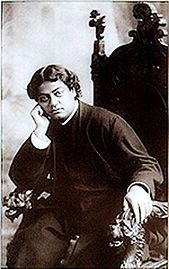
A Tribute to Swami Vivekananda: Leader Extraordinary
“On the seventh of August 1941, in the city of Calcutta, a man died. His mortal remains perished but he left behind a legacy… that no fire can ever consume…”
That was the baritone, sonorous voice of Satyajit Ray in his documentary titled ‘Rabindranath’ created as a tribute to Rabindranath (a project mandated on Ray, the genius in film making, arts and literature, commissioned by Ministry of Culture, Government of India) on the occasion of the birth centenary of the another genius, Rabindranath Tagore the Nobel laureate poet, musician, novelist, dramatist, artist and philosopher. The first scene of the documentary depicted the last and final journey of Tagore to the burning ghat (crematorium).
Ray’s portrayal of Tagore began with the scene finale. But where do we start in our odyssey with the volcanic monk of India whose 150th birth anniversary we celebrated…
Practising managers have had a look at it. Entrepreneurs – of the social as well as the anti-social kind – have gone through it. Management consultants have flipped through it. Eminent personalities have browsed through it. Academicians have devoured it.
“Behind the veil of humour and punch – there is a message. As the human drama unfolds itself in the corporate jungle, the best and worst of human natures battle for space. Sure enough, the early warnings in the book might help the hapless to survive and the smart to succeed. However, buried in the crevices of the chapters lies a deeper secret. The secret of an inner tuning – developing an inner compass based on personal values that not just protects you but also guides you towards happiness…
In the preceding post, we brought in focus the fact that the first step in the process of evolution is the act of creation of information, followed by the emergence of energy and matter. Their interaction creates the Cosmic Mind and the Cosmic Consciousness, which also comprises such other subsets as a human consciousness, or an animal’s consciousness, and the like.
Having explored different facets of Consciousness, we realize how woefully short our present methods of running businesses are when compared to the ideal situation we at the Conscious Enterprises Network (CEN) are aiming for.
Admittedly, there are silver linings to this dark cloud. These are in the form of several individuals and groups of people who are aware of this deficiency and wish to do something about it. Right from environmental activists to business groups which follow Plan B and aim for a triple-bottom surplus from operations, there are many disparate attempts to nudge others in the direction of a heightened consciousness.
The Challenge
The challenge here is three-fold. One aspect is that of identifying and grooming leaders who vibrate at the same frequency, despite their operating in diverse fields of business. A bevy of leaders such as these would be like an orchestra which plays out a mellifluous piece of music even though the instruments are as diverse as a cello, a clarinet, a trumpet or a piano.
The second one is that of creating a leaderless movement so as to avoid getting into ego traps of any kind. One way to do so could be to develop a common Charter of Consciousness which is voluntarily agreed upon by those who wish to come on board. This is likely to promote a better degree of interconnectedness between like-minded organizations, thereby ensuring that the Consciousness Virus becomes the next thing to grab the attention of Homo sapiens.
The third one is to create a credible and transparent forum which would not only keep the flame alive but also facilitate an exchange of ideas, techniques and practices. The collective learning opportunity such a forum would generate can be readily imagined. The forum would comprise individuals/organizations which have already set the bar high by demonstrating that businesses can be run successfully based on a twin compass, a commercial one and a conscious one.
Rewiring the Leaders
The task of inner rewiring of leaders can neither be abdicated nor delegated. Charity begins at home, as they say. The call for a transformation of this kind can only come from within. Unless this inner change takes place, those around cannot be expected to fall in line.
Through the ages, our spiritual leaders have laid an emphasis on reengineering ourselves at the individual level. However, this does not get done by attending seminars and events; or, by reading up on the subject. These help us to receive good thoughts. But the challenge lies in applying these thoughts to our mundane lives, and then to act upon the same. The process at work here needs to follow the manasa-vaacha-karma process. In other words, the concept of Consciousness needs to seep into our thoughts, our words and then into our actions. It needs to become a way of living life; a way of being.
This is a long-term project, requiring tenacity and commitment.
Here are some tips which may help leaders achieve this objective:
Developing a circle of close friends and confidantes who happen to be virtuous souls; networking with like-minded persons/organizations on social media platforms.
Regular meditation, so as to remain connected with our inner selves.
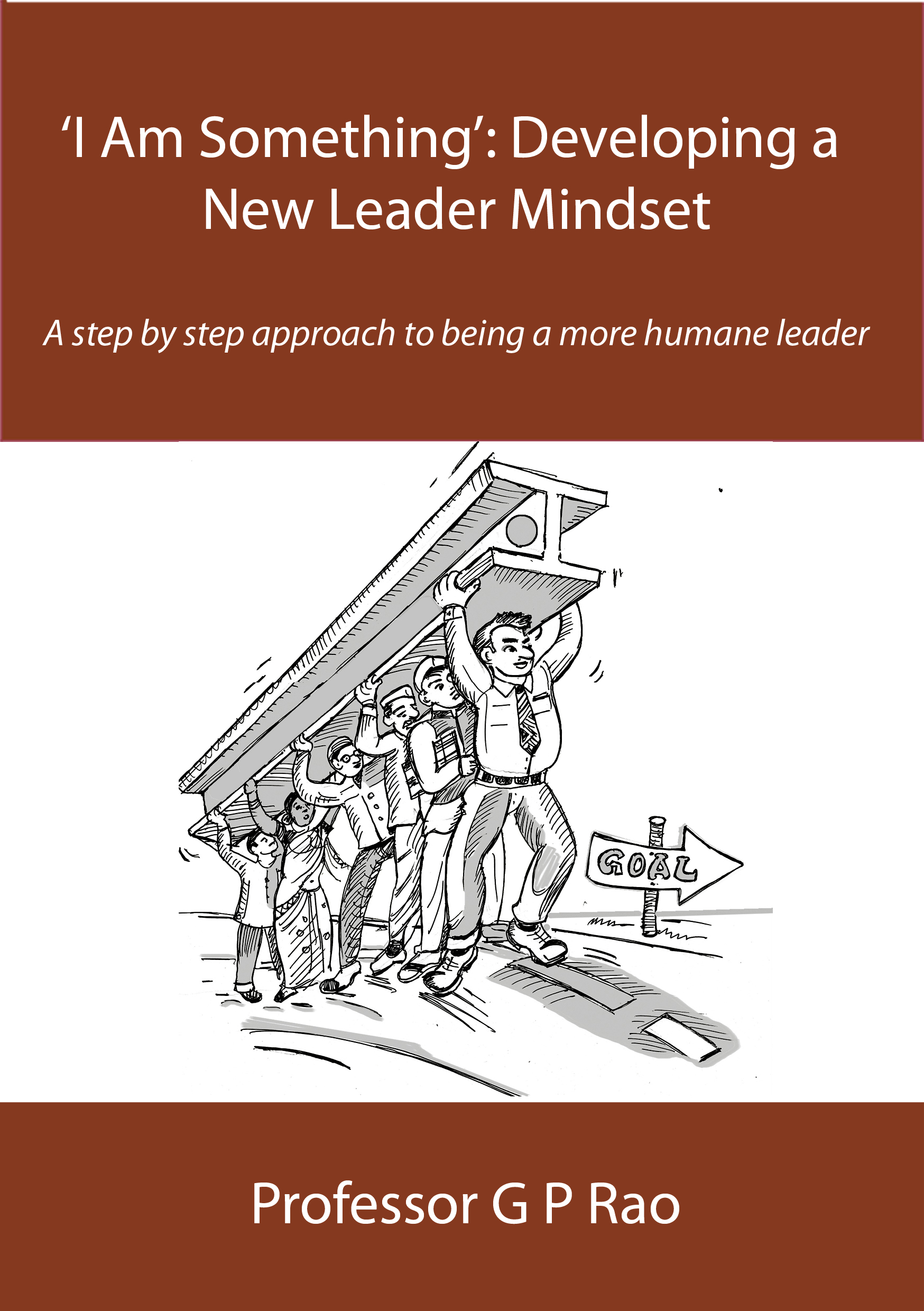
Shifting our attention from ‘me’ to ‘we’; adopting a mindset of ‘I Am Something’ instead of ‘I Am Everything’.
As we proceed further, our Consciousness expands to a still higher dimension, where the qualities of generosity of heart, humility, compassion and kindness reach their epitome.
We start engaging with our people more effectively, capitalizing better on our human capital.
Spreading the Consciousness Virus
Technology, if deployed with a benign intention, could go a long way in assisting us to spread this virus far and wide. The intention needs to be that of serving and facilitating rather than controlling. Advances labeled as Industrial Revolution 4.0 can assist us in propelling ideas such as consciousness more efficiently and, hopefully, even effectively.
Herein lies the primary challenge. Technology can merely be a tool. It is necessary, but not sufficient. What it needs is for humanity to wake up to its spiritual obligations. Our civilization’s present state is that of abject hedonism. This has led to a vast majority amongst us who have become slaves to technology. We have become zombies for whom checking the latest update on our technical gizmo is the first as well as the last act of the day. Virtual relationships have become more important than real relationships.
The endeavour needs to be that of creating a number of tribes and networks which propagate such thoughts and motivate people and organizations to start making a transition to a higher plane of consciousness.
Tribes which are created to achieve a common purpose and believe in the same set of values would readily collaborate with each other and bring about a synergy. Different tribes may be at different levels of enlightenment/consciousness but if the values and the goals are the same, better results would be imminent.
Technical tools like Artificial Intelligence can help us to keep inside a firewall of sorts, keeping us shielded from distractions which retard our spiritual awakening/progress – the realization of the ultimate reality, that we all are one. It could give us the deeper private space which we need to grow inwardly and to realize that one of the most pleasurable things in life is to give succor to those who need it.
This is why at CEN we believe that conscious leadership starts with the awakening of a leader to what he/she really is. The journey has to begin with a single aspiration – that of being a knight in shining armour who rides his/her nimble steed of technology to rescue the triad of hapless damsels best described by Plato over two thousand years ago as Truth, Goodness and Beauty. All three are in serious trouble and could do with a daring act of rescue.
Dear reader, are you game? If so, let us look forward to a book by one of CEN’s co-founders, Dominique Conterno, which goes into further details of the concepts we have touched upon briefly in this series of posts!
(Inputs from Dominiuqe Conterno and Esther Robles, co-founders of Consciousness Enterprises Network (https://www.consciousenterprises.net) are gratefully acknowledged)
In the earlier part of this series of articles on Consciousness, we had covered the wide range of models which experts have used to define the concept of Consciousness, whether from management practitioners, scientists or those who repose their faith in either religion or spirituality.
We notice that most of the models used for explaining Consciousness have been centered on these four concepts:
A physiological activity taking place in the human neo-cortex (human only).
More generally, a physiological activity taking place in the whole brain (human and other animals to some degrees).
An energy like phenomenon that uses the brain to manifest itself.
A deeper phenomenon at the core of everything, eventually connecting us to a Universal Consciousness.
The CEN Perspective
The model that Conscious Enterprises Network believes in is related to some extent to point 4 above. The aspect we are investigating is information based and not just energy/vibration based. To us, energy is of secondary importance.
Of Evolutionary Forces
We believe that Nature (or, ‘The act of Informative Creation’) came about first, followed by matter/energy. Over millennia, driven by forces of natural evolution, we have been chiseled to a state we find ourselves in today. We have repeatedly enjoyed biological benevolence and good fortune. From a single cell structure, we have today become a highly sophisticated machinery which willy-nilly is aware of its own existence.
In the interim, we have undergone repeated transformations. We have never been attached to a particular type, shape, color or size for too long. We first developed a liking for oxygen. We then frolicked about in the deep oceans, before trying to rule land in various forms. We bore our way underground and climbed on trees. We took wings and enjoyed the freedom of mobility, often backed by a highly effective GPS.
We assumed different forms, whether of the hissing or slithering kind or of the ferocious carnivorous kind. From bonobos and apes to Homo Sapiens has been a logical jump for us, and we know that we have indeed arrived.
We now roam about all corners of the solar system. We keep messing up the fragile environment we have been gifted with. We have possibly come to believe that the journey of evolution is over. We think we can now rest on our laurels and remain content with inventing newer and better means to destroy ourselves. We need pandemics to come knocking to our doors to wake us up from this slumber and drive home the reality that we need to be more conscious of the inexorable forces of nature and respect its mandate.
The Importance of Information
Our physical bodies serve the unique purpose of facilitating the process of learning that we continue to undergo. It would not be wrong to say that our bodies are merely the tools provided to us by Nature. This helps us to keep amassing information-based wisdom – the wisdom of survival, the wisdom of living a happy, contented and fulfilling life.
Thus, information is the key input. The characteristics of information are as follows:
It is alive from the simplest form to the more complex form.
It brings about stability by having a self-organizing capability.
Self-learning helps it to expand in complexity.
Self-reflectivity enables a dynamic continuity.
Since information is the key, energy assumes a subservient role in our evolution.
Another Take on Consciousness
In this model, we can readily explain Consciousness as a process belonging to the realm of information. Information, when backed by self-reflection, tends to get distilled and refined. Through this process of involution, we fulfill our purpose of self-learning.
As per this model, the source of everything could be called a Quantum Soup from which all possibilities and all potential creations of nature keep emerging and becoming extinct. The Quantum Soup is beyond the physical and the multidimensional universes, akin to the Vishwa-Roopam described by Lord Krishna in the Bhagavad Gita, an Indian scripture, some 5,500 years back.
What comes about is a timeless chain of procreation which, in turn, leads to an environment which, even though in a flux over time, gets established temporarily. We keep growing, duly propelled by a complex information structure.
Consciousness is a process of singular information. With further information packages thrown in, it assumes a condensed form. Thus, it does not belong to its parts but to all of creation. It may appear as if it is confined merely to a specific situation, say, a human life. But that is just an illusion created from a perception created as we mentally travel back and forth between the past and the future. It is not a perception of an eternal present.
The Toltec/Shamanic Tradition
To absorb this concept better, let us consider the Toltec Shamanic tradition. For a Toltec Shaman (see work from Carlos Castaneda), when a living entity dies, it faces the “Eagle” that is generally explained by a mass of pure consciousness with a mass of information behind it. This mass of consciousness absorbs the dead entity’s history with its consciousness too in its action. In other words, the “Eagle” devours even the awareness of the dead. We base our observations on the work done by Carlos Castaneda in this context.
Consciousness as a Process
Because of its functional aspect, consciousness is universal and does not belong to any portion of information. This is another important point as my consciousness, yours and anything that exists is fundamentally the same one.
Indeed, there are packets of consciousness, such as a human consciousness, a tiger’s consciousness, and the like. Owing to the self-organizing property of information, such packets lead to an apparent compartmentalization of consciousness.
Sure enough, it takes time and understanding for one to realize that our individual consciousness is actually the same as that of anyone else even though each entity’s physical sheath and history may be quite different.
(Inputs from Dominiuqe Conterno and Esther Robles, co-founders of Consciousness Enterprises Network (https://www.consciousenterprises.net), are gratefully acknowledged; illustration courtesy the www)
Defining Consciousness is akin to the case of seven blind men trying to describe an elephant. People have different perspectives. So, when it comes to saying what it really is, the descriptions are often as different as chalk and cheese.
The reason for a wide spectrum of ways in which we understand this concept is what one could label as the Yin and Yang factor. Many of us use our brains to explain what we understand it to be. Many others use our hearts to do so. Perhaps this concept is rather profound. It is beyond the sensory limitations of the human mind, which has an uncanny ability to divide and analyze things. This is what eventually leads to the phenomenon called Analysis Paralysis in management. Our hapless hearts are rooted in what Daniel Goleman refers to as Emotional Intelligence. A solely emotional perspective has its own limitations.
But the situation is not as challenging as it appears to be. The common denominator underlying the entire spectrum is that of the collective good. An integrated view of the concept is surely possible, provided we move on to the level of what Danah Zohar and Ian Marshall, in their book Spiritual Wealth: Wealth We Can Live By, allude to as Spiritual Intelligence.
However, before we move further, let us consider some of the perspectives which one normally comes across.
What is Consciousness?
The Five Maxims
Ask Jeffrey Deckman, and he is apt to say that it is imperative for a Conscious Leader to play the following roles:
Being a ‘healer’, who calms, comforts and connects those around him.
Of being an ‘elder’, by practicing wisdom, empathy and patience.
Acting as a ‘steward’, nurturing talent and creating conditions for growth just like a gardener would act.
Doffing the hat of a ‘navigator’, envisioning challenges and opportunities, defining broad goals and guiding others.
Being a ‘facilitator’, acting like the conductor of an orchestra, ensuring harmony, encouraging open discussions and aligning by voting and not by consensus.
Of Gallant Knights
Danah Zohar and Ian Marshall speak of Knights, the leaders who choose to embark on a spiritual path. Having sensed something fundamentally sacred underlying human life, they embed this reality in their actions and in their life’s work.
In both life and work, the knight abides by five principles:
There is something sacred, some deeper, shared consciousness, unfolding in this universe and providing a baseline for every aspect of life.
Life and all its enterprises are interconnected.
All human endeavour, including business, is part of the larger and richer fabric of the whole universe.
The relationship of the healthy individual to the world is one of engagement and responsibility.
Service conveys deep sense of humility and gratitude.
A Triple Bottom Line Approach
Stephen Karbaron exhorts businesses to embrace an approach of profiting from a purpose driven, triple bottom line paradigm. To him, this is what defines a conscious business strategy approach. He emphasizes the need to be innovative, adaptable and prepared for change, whilst being aware of all stakeholder needs. He keeps sharing live examples of businesses which follow this approach.
Of Philosopher Kings
Dr Roy Woodhead is of the opinion that the very words ‘conscious enterprise’ imply some sense of an ‘enlightened enterprise’. In one of his thought provoking articles, he says that Plato put forward the idea of ‘philosopher kings’ to lead us. They would not be allowed material gains but would be well looked after; their economic neutrality and lack of vested interests were seen as very important for effective government by the philosopher kings.
Ramayana, one of the revered Hindu scriptures, speaks of King Janaka, the foster father of Sita, the heroine of the epic story. He is said to be a ‘philosopher king’. He is revered as being an ideal example of non-attachment to material possessions. He not only administers his country but also invites sages and intellectuals to spiritual discourses in his assembly. His interactions with sages and seekers such as Ashtavakra and Sulabha are recorded in ancient texts and are illuminating treatises on spiritual principles.
In their book ‘Rajarshi Leadership’, authors S. K. Chakraborty and Debangshu Chakraborty espouse the cause of spiritual leadership. This is a concept which sums up a key lesson from India’s tryst with spirituality: that of first discovering the divinity within, and then to manifest it without. Such conscious leadership is blissful to oneself and to others.
A Holistic View of Affairs
Jack Beauregard is of the opinion that it is about one connecting with the wholeness and the process of creation. A higher level of consciousness opens one’s life to one’s inner cores, thereby allowing the creativity of the universe to flow into one’s life. This enables one to find innovative solutions for solving the numerous challenges that one faces. He believes that a higher level of consciousness also creates a spiritual perspective. It allows one to view one’s life, other people, our work organizations, technology, the planet earth, and the universe from a sacred point of view.
Jack Beauregard opines that one can help create a new, harmonious world in which to live by taking responsibility for transforming one’s own consciousness. When enough people choose to develop, act, and do business from a balanced, wholistic paradigm, this will automatically have a positive influence on the consciousness of our planet. We can help co–evolve with the intelligent creative process of the universe. When a critical mass is reached, we will then create a positive alternative to the negative actions and beliefs of today’s world.
Our species will evolve to its rightful inheritance when we realize that human consciousness is a smaller part of the larger consciousness of the universe, and our individual lives, and the human species in general, are small parts of the vast web of life and just one manifestation of the mystery of creation.
The Realm of Creativity
Hindu and other scriptures speak of one reaching a state when one’s consciousness becomes one with that of the universe, often leading to an exalted phase of creativity. Our physical body then acts as an antenna, translating signals from the universe into something human beings would comprehend. When someone like Mozart composes music, he merely writes what he hears. When a humourist like P. G. Wodehouse creates his unique characters and weaves them into a dramatic plot, he acts more like a celestial author who enables lesser mortals like us to notice a humorous strain in all things around us.
When Science Steps In
When humanity gropes for the source or the definition of Consciousness, our scientists do not disappoint.
Consider The Global Consciousness Project which is an international, multidisciplinary collaboration of scientists, engineers, artists, and others. Their goal is to examine subtle correlations that may reflect the presence and activity of consciousness in the world. Their researchers predict structure in what should be random data, associated with major global events. Their contention is that when millions of people share intentions and emotions, their data show meaningful departures from expectation. This is an area where science appears to establish the reality of a global consciousness.
A materialistic scientist would tell us that our brains consist of neurons made of atoms. These process our external experiences. At times, our neural processes lead us to recognize a higher meaning in things. According to them, our 40 Hz oscillations happen to be the neural basis for consciousness in the brain.
A Spiritual Insight
More than a century ago, this is how Sri Aurobindo, a highly revered spiritual master and a visionary from India, described his concept of Consciousnessthus:
Consciousness is a fundamental thing, the fundamental thing in existence; it is the energy, the motion, the movement of consciousness that creates the universe and all that is in it not only the macrocosm but the microcosm is nothing but consciousness arranging itself. For instance, when consciousness in its movement or rather a certain stress of movement forgets itself in the action it becomes an apparently unconscious energy; when it forgets itself in the form it becomes the electron, the atom, the material object. In reality it is still consciousness that works in the energy and determines the form and the evolution of form. When it wants to liberate itself, slowly, evolutionarily, out of Matter, but still in the form, it emerges as life, as animal, as man and it can go on evolving itself still farther out of its involution and become something more than mere man.
— Sri Aurobindo, The Life Divine, pp. 236-7.
Consciousness is usually identified with mind, but mental consciousness is only the human range which no more exhausts all the possible ranges of consciousness than human sight exhausts all the gradations of colour or human hearing all the gradations of sound — for there is much above or below that is to man invisible and inaudible. So there are ranges of consciousness above and below the human range, with which the normal human [consciousness] has no contact and they seem to it unconscious….
— Sri Aurobindo, The Life Divine, p.233.
In a way, what he appears to be pointing out is that understanding Consciousness is akin to realizing the difference between a physical body which is alive and one which is dead. It is like the sole element which is missing from a dead body.
By providing us with a very wide canvas to understand the term Consciousness, Sri Aurobindo is also indicating that organizations which are conscious are most likely to have the following characteristics embedded in their culture:
An attitude of humility and devotion which enables people to operate – individually as well as in teams – at a higher level of productivity;
A flatter hierarchy which redefines the relationship between those who lead and those who are led; in other words, a Theory Y approach to human relations, a higher diversity of cross-departmental teams, a premium on gender diversity, and an optimum gap between the packages and perks of the highest and the lowest paid people;
A harmonious engagement with diverse stakeholders.
(Notes:
Inputs from Dr Ananda Reddy of the Sri Aurobindo Centre for Advanced Research (SACAR), Pondicherry, India, are gratefully acknowledged.Illustrations courtesy www and Huta, Sri Aurobindo Ashram, Pondicherry, India.
2. Inputs from Dominique Conterno and Esther Robles, co-founders of Consciousness Enterprises Network (https://www.consciousenterprises.net), are also gratefully acknowledged.)
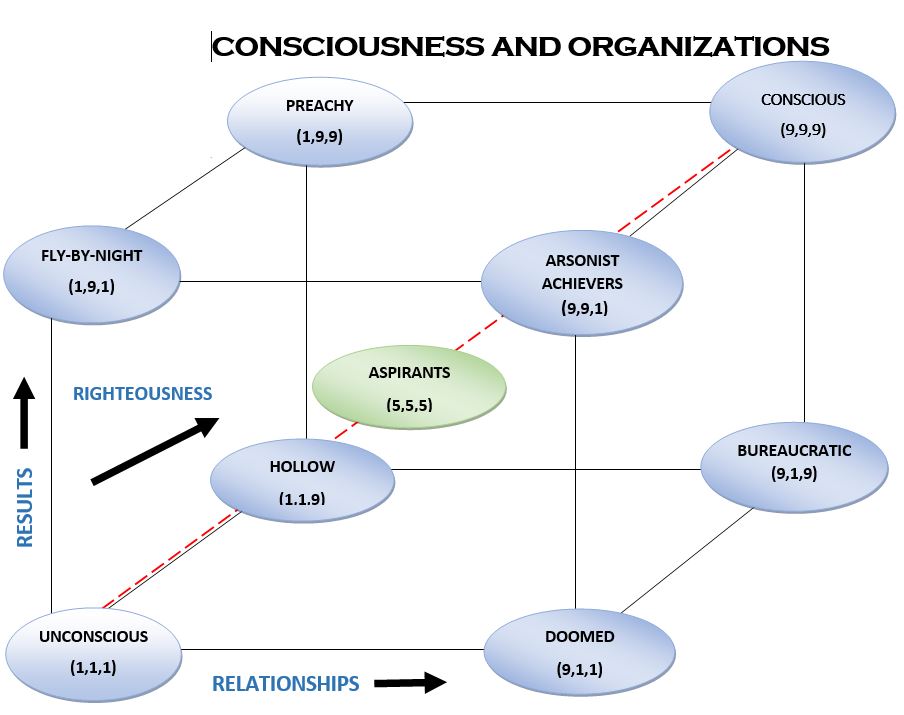
Exploring the concept of Consciousness further, one may say that whereas a normal organisation cares for Results alone, an organisation steeped in Consciousness would provide equal weight to all of its three ‘R’s – Results, Relationships, and Righteousness – in its strategic and tactical thinking.
Results could be either of the financial kind, the market share kind, or a combination of the two.
Relationships would imply a positive working atmosphere where, besides harmonious relations, dissent is not suppressed; rather, it is encouraged. Following human values is an essential part of this attribute. So is respect and dignity towards people in general.
Righteousness would encompass such features as concern for sustainability, giving back to the society and running operations not only within the ambit of law but beyond it, wherever possible. Being pro-active, when it comes to corporate governance; taking care of the rights of the minority shareholders; ensuring that principles of natural justice get followed; and, following values and ethics.
Yes, the precise definitions of each of these sets of attributes would vary depending not only upon the kind of business an organisation is in, but also on the kind of business environment it operates in.
If each of these three dimensions of conscious organisations is taken into consideration, organisations which are committed to achieving a higher level of Consciousness could consider doing a self-assessment by using the kind of representation shown below:
Here is a scheme which can enable an organisation to rate itself against each of the attributes, on a scale of 1 (low) to 9 (high).
Conscious organisations which rate themselves very close to the (Relationships: 9, Results: 9, Righteousness: 9) position in the figure could pat themselves on the back and keep up the good work they are doing, inspiring others to follow suit.
The ones which are in the Aspirant (5, 5, 5) category are already on the right track and would do well to start firing at all the twelve cylinders and reach a higher level of Consciousness.
The majority of organisations we come across might fit into the Arsonist Achievers (9, 9, 1) slot. To them, both Results and Relationships count, though they could not care less when it comes to following the path of Righteousness. Such enterprises end up contributing to the kind of situation where we find that during 2020, for instance, humanity needed to be supported by the planetary resources which 1.7 Earths alone could provide. (https://www.footprintnetwork.org/2021/01/19/we-do-not-need-a-pandemic-to-movethedate)
The Bureaucratic ones (9, 1, 9) are bound in red tape, caring only for Relationships and Righteousness, with poor accountability for Results. Yes-persons rule. Sycophancy prevails. Service to the public goes for a toss.
Organisations in the Doomed category (9, 1, 1) prophesize caring only for Relationships, while neither producing Results nor caring for Righteousness. For example, some of the Bretton Woods and other institutions set up after World War II now appear to be out of sync with the global realities.
Then we run into some Hollow ones (1, 1, 9) which profess to care only for the path of Righteousness but, in reality, are shams, pampering only to the ego of a self-styled guru heading a sect. Internal working conditions are akin to labour camps. The pomp and show of serving humanity is often more of a public relations exercise.
We also have the Preachy ones (1, 9, 9), which care two hoots about Relationships but keep delivering results while making it appear as if they are also on the path of Righteousness. Their bluff is easily called because this unique feat cannot be achieved unless Relationships are given due importance in the scheme of things. Many political outfits that are steering their countries away from the core tenets of democracy and turning these into dictatorships would fall into this category. Political power surely comes their way but at a great cost to the socio-economic fabric of the nation.
Most of us dread dealing with the Fly-By-Night (1, 9, 1) kinds, where Results alone count. Long-term survival is not the aim. Just keeping the head above the water remains the sole aim. Quite a few enterprises – mostly in the tiny and small sector – may fall into this category, simply because they can neither afford the luxury of Relationships and Righteousness nor do they consider it necessary to do so. Ponzi schemes and financial scams belong to this category.
Then there are mafia organisations which are blissfully ignorant of any such niceties; these continue to chug along in an Unconscious manner. Our society shall surely be better off in their absence.
Within the three ‘R’s outlined here, there may appear to be a sort of gradation. To many of our embryonic start-ups, it may appear that only when a certain stage of stability has been attained can the business imagine paying attention to Relations and Righteousness. But habits, once formed, die hard. Such organisations run the risk of getting caught in a conceptual warp, evolving into pure money-spinning outfits, eventually landing either in the Fly-By-Night slot or in the Arsonist Achievers slot.
The Many Lenses of Viewing Consciousness
But this is merely one way of viewing the concept of Consciousness.
Over time, our scientists, philosophers, academicians, management honchos and spiritualists of all hues, sizes and shapes have attempted to define the same. Each of these presents a unique perspective and is worthy of consideration.
The final choice, of course, rests on our leaders. It could be based either on the nature of activity of an organization or on the leaders’ strategic vision.
The pandemic plaguing humanity since 2020 has yet again awakened us to the urgency of uplifting our state of Collective Consciousness and getting an injection of Vitamin Consciousness.
Note: Inputs from Dominique Conterno and Esther Robles, co-founders of Consciousness Enterprises Network (https://www.consciousenterprises.net), are gratefully acknowledged.
A culture which is rooted in Consciousness does not throw up hapless leaders who keep burning the proverbial midnight oil in their relentless pursuit of commercial goals only, while shoving concerns such as the environment, the society and human resources under the corporate carpet. It does not merely mean that our marketing honchos are doing their best in servicing our customers effectively and efficiently; instead, it implies that they do so while ensuring that the product/service as well as its packaging is environment-friendly.
It means that those toiling on the operations side design the processes in such a way that the carbon footprints are at least neutral, if not positive; that our financial wizards keep nudging the organization towards maximizing returns to all its stakeholders; and the human resource executives keep burning the midnight oil to ensure that people and processes respect human values and dignity, while keeping the costs to the bare minimum.
Professionals in an organisation could be performing their roles while understanding challenges at the mental level alone in a rather artificial manner, leading to rigidity and even fanaticism in some cases. But then we suffer some limitations which are not different from the kind of handicap some of our sensory organs often face – a nose which fails to detect the putrid smell of a corporate scandal in the offing, an eye which can see but does not register wastage of resources in the operations, an ear which can hear but does not listen to a female employee reporting an incident of harassment at the hands of a superior and defers taking an action against the latter, a tongue which turns to complacency upon tasting a mighty success and a skin which has turned so thick that bribing one’s way through a regulatory agency no longer feels prickly.
Contours of a Conscious Culture
Values which drive an organization create its cultural ambience. Thus, a Conscious Culture is based not only on the kind of high values and principles being followed by a business but also on a smarter recognition of the purpose of the company and the interdependent relationship between the company’s stakeholders.
The drive of propagating a Conscious Culture need not start only from the desk of a top honcho in an organisation. One may find even a liftman, a receptionist, a cleaner, a postroom employee, a supervisor, or a manager initiating it. If the working atmosphere is such as to recognise and encourage conscious behaviour, the drive is bound to have a snowballing effect across an enterprise.
Many of us are aware that spiritual experts recommend not merely a sitting meditation but also a walking one; in other words, not a static meditation but a dynamic one. Likewise, Consciousness is not merely a waking awareness at the mental level but also the force which moves and propels the organisation towards its enlightened goals. When interconnectedness between various departmental silos gets activated, the chances of a synergy coming about improve. The net result is a quantum jump in the overall efficiency of the organisation, leading to uniform satisfaction all around, amongst all its stakeholders.
The marketing honchos then refrain from registering sales which could eventually become bad debts due to customer expectations not having been really met. The operations experts do not lose sleep over shipments which must be booked just before a quarter ends even though the physical goods might still be stuck on the manufacturing line. The finance guys do not indulge in window dressing to please their superiors. The human resources team does not start shifting those in permanent employment to a mode of contract employment, or decide to under-report employment figures to pension/provident fund regulators.
To put it simply, the silo approach gives way to an interconnected way of working, where each silo head is aware of the implications of his actions over all the other silos. A truly Systems Approach to doing things comes about. All elements and all clusters of the network are connected in some ways, leading to overall improvement in efficiency and effectiveness.
In a large IT hardware outfit where I used to work, ballooning sales receivables used to make the top management lose sleep. An aggressive sales force kept earning handsome incentives on billings while the finance head kept twiddling his thumbs trying to keep a lid on dues from customers. Based on repeated caution from internal auditors, a joint group comprising managers from marketing and finance was formed to review the matter. The incentive scheme was suitably tweaked and a monthly review by the joint group eventually brought the situation under control.
A Self-actualization of Sorts
Following a paradigm of Consciousness does not belittle the importance of generating profits. Rather, it encourages a business to make decent profits and plough a part of the wealth generated therefrom into the welfare of the society at large. It exhorts an enterprise to act based on the harsh realisation that resources drawn from the earth and the environment happen to be limited in supply. Often, the stark choice facing management is that of profits today versus survival tomorrow. Wiser organisations would strike a balance between the two.
Some of us may recall the Maslow’s Hierarchy of Needs, where the last stage is that of self-actualisation. This is akin to our realising who we really are and what we aspire for in life. However, when we turn to Eastern philosophies of motivation, we may discover that Maslow is not the ultimate authority while adopting either a spiritual or a conscious approach to management. He merely offers an image of the individual and social achievement based on our egos. In the Eastern view, there is instead an attempt to transcend the ego at all levels.
Adhering to Consciousness would not mean that one expects our business leaders to evolve to a stage of being such selfless persons as Swami Vivekananda, Mahatma Gandhi, Martin Luther King or Nelson Mandela.
Lord Krishna is often portrayed as someone who encouraged a mighty war to take place some 5,500 years back. But if we scratch a little deeper, we shall find that he had no selfish motive in doing so. He had already built a small independent state for himself and his family in Dwarka and was seeking neither more property nor wealth for himself. His motive was essentially to demonstrate that the path of Dharma – righteousness – is to be always upheld. Admittedly, the war caused large-scale devastation. Humanity had to bear an enormous cost. The irony was that even the so-called victors never felt victorious!
Our scriptures have never held that making profits is a taboo. Instead, they hold that a portion of the same is shared with the society at large. This is indeed the way of nurturing a culture steeped in Consciousness in the organisation that we happen to lead.
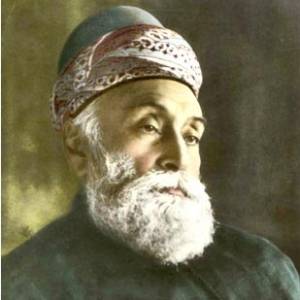
Way back in 1889, when the visionary industrialist J N Tata kept aside half of his personal wealth for the purpose of setting up an educational institute where Indian youth could receive world-class learning in science and engineering subjects, he was not concerned about his business in any way benefiting from the gesture. He did it for India, the country he loved. It comes as no surprise to see that today the Indian Institute of Science in India, set up in 1909 after Tata had expired, is held to be an educational institute of eminence.
Notes:
Inputs from Dominiuqe Conterno and Esther Robles, co-founders of Consciousness Enterprises Network (https://www.consciousenterprises.net), are gratefully acknowledged.
Illustration courtesy Huta of Sri Aurobindo Ashram, Pondicherry, India.











 ashokbhatia
‘Surviving in the Corporate Jungle’ – Some comments
Posted in Management Lessons, tagged Comments, Endorsements, Leadership, Management, The Book on November 27, 2021| Leave a Comment »
Practising managers have had a look at it. Entrepreneurs – of the social as well as the anti-social kind – have gone through it. Management consultants have flipped through it. Eminent personalities have browsed through it. Academicians have devoured it.
Here are some of the comments received so far in respect of the book ‘Surviving in the Corporate Jungle’.
“Behind the veil of humour and punch – there is a message. As the human drama unfolds itself in the corporate jungle, the best and worst of human natures battle for space. Sure enough, the early warnings in the book might help the hapless to survive and the smart to succeed. However, buried in the crevices of the chapters lies a deeper secret. The secret of an inner tuning – developing an inner compass based on personal values that not just protects you but also guides you towards happiness…
View original post 1,978 more words
Read Full Post »