When it comes to scenes of physical intimacy, Bollywood seldom disappoints. Most of the offerings from our dream merchants use these as an essential ingredient to ensure success at the box office.
Here is yet another thought-provoking post from Sharada Iyer.
There has been so much brouhaha in the past few days over the censored kiss in the latest James Bond film Spectre, which released on Friday, 20th November 2015. While many people have criticized the Censor Board Chief Mr Pahlaj Nihalani calling him a ‘sanskari’ Chief, there are others who endorse his views and stand by the decision.
But the debate reached ridiculous proportion and assumed unnecessary importance when Mr Arnab Goswami of Times Now channel decided to devote one whole hour of his show , trying to corner Mr Nihalani asking him repeatedly throughout the interview as to why was the kissing scene between Daniel Craig and Monica Belluci watered down to a mere few seconds…Honestly was it such a big issue to discuss on prime time television?
The censor board chief remained unperturbed by all the accusations hurled at him and…
When winsome kids get cast in Bollywood flicks, the results are invariably gratifying. They could be playing to role of a Cupid, reuniting sundered hearts. They could be showcasing a unique illness, thereby winning our sympathies. They could be providing comic interludes, so as to pep up the proceedings. Or, they could be chasing their simple but profound dreams, battling parental oversight, poverty and other odds. Whatever their role, they bring solace to our souls.
It is a tough task to try to encapsulate all such roles essayed by children in movies. It goes to the credit of Sharada Iyer to whip up yet another detailed post on an important facet of Bollywood!
Our film industry has been very fortunate to have had some of the most brilliant child artistes who have given memorable performances in scores of films. These child-stars have endeared themselves to us with their spontaneity and natural acting. Coupled with their innate innocence and amazing confidence, they have effortlessly stolen the show from their seasoned co-stars on screen.
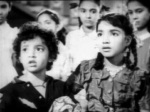
Daisy Irani and Baby Naaz
Daisy Irani, Honey Irani, Baby Naaz, Baby Tabassum, Baby Farida, Baby Gowri, Wonder child-Bobby, Baby Guddu, Master Raju, Master Ratan, Master Sachin, Master Satyajeet, Master Alankar, Master Shahid, Master Tito, Junior Mehmood, etc., are some of the names which immediately come to our mind though there are many more who have been associated with our films. It is really difficult to comprehend how such small children could memorize such long dialogues and bring such perfect expressions and emote with so much feeling…
For those who love songs from Bollywood, the versatile singing talent of the late Geeta Duttis remembered very fondly to this day. Here is an article from Mr Raj Kanwar, an India-based author, freelance journalist and music lover.
A Singer called ‘Geeta’
Geeta Dutt and her versatile voice are remembered on her death anniversary, which was on July 20.
When Geeta Dutt (née Roy) sang, ‘Yaad karoge, yaad karoge, ik din humko yaad karoge’ in ‘Do Bhai’ in 1947, she had not imagined how prophetic the lyrics by Raja Mehdi Ali Khan would turn out to be. Today, 68 years after that song had captured the imagination of music lovers and 43 years since her death in 1972, three generations of her die-hard fans still fondly remember her and her melodious voice continues to mesmerise them. Her 43 death anniversary was observed on July 20.
The music of ‘Do Bhai’ with another of Geeta’s song, ‘Mera sundar sapna beet gaya,’ topping the charts, was a hit, and the movie became the second highest grosser at the box office in 1947.
It was virtually Geeta’s first movie, and the countrywide popularity of her songs made the teenager’s nascent career leap overnight to another dimension. Her popularity scaled newer heights in 1948 and 1949, eclipsing Shamshad Begum and Raj Kumari, who then ruled the roost. She became every director’s choice and the reigning diva.
Then suddenly, she found her supremacy being challenged by another teenager, Lata Mangeshkar. Lata had scored a unique hat-trick in 1949 with three mega-hits in ‘Mahal,’ ‘Andaz’ and ‘Barsaat.’ Naushad’s lilting music in Mehboob Khan’s ‘Andaaz’ and Khemchand Prakash’s soulful songs in Kamal Amrohi’s ‘Mahal,’ enthralled listeners. However, it was in Raj Kapoor’s ‘Barsaat,’ with amazing music by the new duo Shankar-Jaikishan, that Lata demonstrated new facets of her talent. She emerged as the new singing sensation, and Geeta found herself relegated to the second position. Nevertheless, Geeta managed to hold her own.
In fact, 1950 turned out to be the most productive year for Geeta, during which she recorded more songs than in the previous year. In ‘Jogan,’ she sang six of Meerabai’s devotional bhajans. ‘Mat jaa mat jaa jogi,’ ‘Main to Giridhar ke ghar jaaoon,’ ‘Eri main to prem diwani’ and the most popular one, ‘Ghunghat ke pat khol’ that captivated the devout. That year, she sang for several reputed music composers as well, such as S.D. Burman, Avinash Vyas, Bulo C. Rani, Chitragupta, Ghulam Mohammed, Khayyam, Hansraj Behl, Khemchand Prakash, Husnlal Bhagatram, SN Tripathi and Vasant Desai.
Then Guru Dutt happened in 1951. Dev Anand’s ‘Baazi’ was his directorial debut. It was on its sets that Geeta and Guru met and fell in love. They married in May, 1953. They spent the first three years blissfully. Their first son Tarun came in 1954 and the next, Arun, in 1956.
Ironically, Dutt’s entry into her life became both a blessing and a curse. A blessing, as Geeta’s career blossomed and she sang some of the most lilting songs in movies such as ‘Aar Paar’ (1954) and ‘Mr. and Mrs. 55’ (1955). Both were huge hits. Coquettish songs such as ‘Ye lo main haari piya’, ‘Jaa jaa jaa bewafa’ and ‘Babu ji dheere chalna’ became chartbusters.
Other singers, such as Lata, were as good if not better, but Geeta’s singing possessed an ethereal charm; she sang from the heart. At one moment, she would sing a devotional song and the next, she would switch over to a catchy ‘Mera naam chin chin chu,’ and then to a seductive number, ‘Tadbir se bigdi hui taqdeer bana de.’ There was no end to her versatility.
“A soft spoken woman in real life, she would metamorphose into an exotic cabaret performer with clever modulation of voice in the recording studio. Her voice was rich, vibrant and well-toned and could switch from exotica to melancholy in a matter of minutes,” says Shikha Biswas Vohra, daughter of the veteran composer, Anil Biswas.
Both Geeta and Guru were temperamental, sensitive and emotionally fragile. Geeta as a top playback singer in 1953 made more money than Guru Dutt, who was struggling to make his mark as a director. A few busybodies insinuated that Dutt had married Geeta for money. That hurt Guru no end and he asked her to sing only for his movies. Some brushed aside these insinuations. “Guru Dutt belonged to the type for whom money meant nothing; it was only a commodity to trade dreams with,” comments Amit Biswas who, as a child, used to play with Tarun and Arun in their beautiful bungalow on top of Pali Hill.
Guru was a strict disciplinarian on the sets, but was the opposite in personal life; he was a chain smoker and drank a lot. Though ostensibly they continued to live together, they had started drifting apart. In the midst of this marital turmoil, Guru Dutt introduced a newcomer, Waheeda Rehman in his movie ‘C.I.D.’ in 1956. Rumours of Guru’s affair with Waheeda distressed Geeta. She ignored rehearsals and recordings, neglected her riyaz and took to drinking. Both began neglecting their respective careers. Then Guru Dutt faced heavy financial loss with ‘Kaagaz ke Phool.’
Amid the personal problems was born their third child, Nina, in 1962. Two years later, on October 10, 1964, Guru Dutt allegedly committed suicide. His death shattered Geeta. Then followed the years of financial hardship.
It was out of compulsion that she took up singing again in Basu Bhattacharya’s ‘Anubhav.’ Music was by Kanu Roy and lyrics by Gulzar. She sang three memorable songs, ‘Meri jaan mujhe jaan na kaho,’ ‘Koi chupke se aake’ and ‘Mera dil jo mera hota.’ It was remarkable that Geeta, despite a gap of a few years, had not lost the verve and vivacity of old.
She loved her children. “She was an extrovert and a fun-loving person. I remember the good times we had; at a moment’s notice Mummy would say, ‘Come on, let’s go for a picnic,’ and we would pack up and leave. She loved having people around, our friends used to stay over and she would cook and look after everyone. She loved doing that,” Arun had said about his mother.
But she continued to drink, which eventually took its toll and she died on July 20, 1972, of cirrhosis of the liver. She was only 42.
Notes:
The writer Mr Raj Kanwar can be reached at rkanwar_in@yahoo.co.uk.
Recently three powerful filmmakers of Bollywood, viz., Karan Johar, Rohit Shetty and Subhash Ghai got together to announce their latest collaborative venture titled Ram Lakhan– the remake of Subhash Ghai’s 1989 super-hit film-Ram Lakhan. This has come as a surprise and makes one wonder why would these three well-established bigwigs of the industry with all the money and resources at their disposal choose a ‘remake’ rather than come-up with an original story! And that too of a movie whose stars are still associated strongly with the original film. Even in the recently concluded finale of the popular TV show, Indian Idol Junior, Anil Kapoor made his entry dancing to the title song of this film-‘My name is Lakhan…’
A funny point about this remake is that while the original starring Anil Kapoor and Jackie Shroff was made at the time when…
Many amongst us chug along in life somewhat dissatisfied with our life partners. A neighbour’s wife always looks smarter. A friend’s husband sounds more dashing and practical. Our own spouse invariably sounds duller and listless in comparison. We are never quite satisfied with what we have. We often yearn for what we do not have.
What do we expect from a soul-mate? An unqualified acceptance by the party of the other part, perhaps? A companionship which comforts and soothes? A fulfillment of some of our basic needs?
At a deeper level, the illusory search for a perfect soul-mate, The One, begins with a realization that we cannot become more perfect all by ourselves. We need another person’s help to chisel ourselves better. To do so, we search for a person who is perfect in more ways than one.
Some Bollywood movies have dealt with this aspect of our relationships in a poignant manner. Here is a quick recapitulation of some such offerings which come to one’s mind.
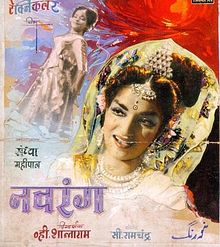
Navrang
(1959, V. Shantaram)
A poet struggling for recognition starts fantasizing about a dancing diva cast in the mould of his own wife. Whereas the wife is busy with mundane affairs of life, the poet is happy to remain in an imaginary world inhabited by the make-believe seductress. The harsh slings and arrows of life eventually make him realize his folly and accept his wife whole-heartedly.
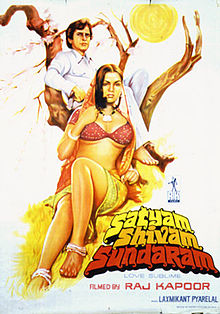
Satyam Shivam Sundaram
(1978, Raj Kapoor)
A young engineer who abhors ugliness falls in love with a vivacious young woman whose face is partially scarred. Besotted by her mellifluous voice and religiosity, he does not notice her facial disfigurement and marries her. Rejected by her husband, the woman keeps meeting him at nights, making him believe that he is spending time with a mistress instead. Eventually, events make him realize his folly. He gives up his shallow perception of beauty and understands the value of inner beauty in life.
Maya Memsaab
(1993, Ketan Mehta)
Based on Gustave Flaubert’s ‘Madame Bovary’, the film captures the quest of a perfect mate by a young, beautiful and intelligent woman. After a failed marriage with a busy doctor, affairs follow. Her search for The One remains elusive. She remains dissatisfied and eventually dies.
Rab Ne Bana Di Jodi
(2008, Aditya Chopra)
A diffident and introverted male ends up marrying a beautiful and vivacious young woman who claims her inability to love him. She loves the dashing heroes of Bollywood and enters a dancing competition, where she runs into a breezy character who is none other than her husband, duly remodeled by a friend of his. Romance blossoms. Eventually, she realizes the value of true love that her otherwise boring husband possesses for her.
7 Khoon Maaf
(2011, Vishal Bhardwaj)
The film narrates the story of an Anglo-Indian woman who murders her seven husbands in an unending quest for love. Eventually, she finds true love and solace in Jesus – at Pondicherry. It is based on a short story by Ruskin Bond: “Susanna’s Seven Husbands”.
All these movies portray an important facet of life. Our quest for The One is all about the search for our own true self. The desire to search for a mate is not about finding the right person. It is about becoming the right person.
A perfect spouse cannot make us complete. He/she can only help us in discovering ourselves and in becoming the right person. The partners only supplement each other’s strengths and weaknesses and tackle the challenges of life together, as a team.
This realization is a humble new beginning and a part of our own process of perfection; our evolution to a higher plane of consciousness.
For those who continue to be enamoured of the velvet-like voice of the late Talat Mahmood, here is an article from Mr Raj Kanwar, an India-based author, freelance journalist and music lover.
His ‘quivering’ voice still a rage
One of Talat Mahmood’s most unforgettable songs is “Meri yaad mein tum na aansoo bahana,” rendered way back in 1951. Over the following two decades, Talat sang one hit ghazal after another and continued to cast a spell on legions of ghazal aficionados both in India and abroad.
Today 64 years later, the musicality and lyricism of these ghazals still haunt generations of his loyal fans.
However, it was not all hunky dory for Talat Mahmood as he had to compete with the likes of Mohammad Rafi, Kishore Kumar, Mukesh and Manna Dey.
It is, therefore, creditable that Talat was able to hold his own and remain the first choice for composers and lyricists alike when it came to singing ghazals for films.
Like many of his contemporaries, Talat too had his share of good luck. It took him little time in early the 1940s to establish himself as a ghazal singer of no mean merit in his hometown, Lucknow, with All India Radio becoming his launch pad. His first disc by HMV in 1941, “Sab Din Ek Samaan Nahin The” was hailed as a success. However, it was his next, “Tasveer Teri Dil Mera Behela Na Sakegi…” written by Faiyyaz Hashmi that turned out to be a chartbuster and brought him much accolade and national fame. Talat was just 16 then.
Talat Mahmood’s ghazals still find takers 17 years after his death. His death anniversary falls on May 9.
Calcutta – then the hub of both Hindi and Bengali movies – was his next destination. Taking on the pseudonym Tapan Kumar, Talat recorded numerous hit songs in Bengali. With his good looks, Talat also starred in three successful Bengali movies.
Bombay, however, was not so easy for Talat. He met one music director after another but they disapproved of the ‘quivering note’ or ‘kampan’ that characterised his voice. Though disappointed, Talat continued his rounds of music composers. His perseverance eventually paid off when he found an admiring mentor in the doyen Anil Biswas. Ironically, the very ‘kampan’ that other music directors had considered a flaw, fascinated Biswas no end. He had by then completed the music of ‘Arzoo.’ But so taken in was Biswas by that trademark quiver that he persuaded the director to add another song to the movie. The song was “Ae Dil Mujhe Aisi Jagha Le Chal Jahan Koi Na Ho…,” written by Majrooh Sultanpuri and picturised on Dilip Kumar. It became an instant rage.
Fortuitously, the Bombay film industry had by then become the Mecca for lyricists and poets such as Sahir Ludhyanvi, Majrooh Sultanpuri, Hasrat Jaipuri, Shakeel Badayuni, Mehdi Ali Khan, Kaifi Azmi and D.N. Madhok.
Their lyrics struck a chord with the listener and brought tears to his eyes when rendered in impeccable Urdu diction by Talat. No wonder then that some of these poets wrote lyrics specifically for Talat. Such was the magic of this Lucknow boy! And Khayyam always reserved a special place for Talat in his heart.
In a way, Talat’s first song “Ae Dil Mujhe..” in 1949, became the harbinger of the ghazal craze in the country, and Talat became the heart-throb of ghazal lovers.
Songs such as “Shaam e gham ki qasam..” (Footpath 1953), “Jayen to jayen kahan…” (Taxi Driver 1954), “Main dil hoon ek armaan bhara..” (Anhonee 1952), “Hain sabse madhur woh geet..” (Patita 1953), “Itna na mujhse tu pyar badha..” and “Aansoo samajh ke..” (Chhaya 1961) are timeless. These and many more such classics are still in demand, 17 years after his death, at music functions and soirees.
What further lent a sense of poignancy to many of Talat’s songs was their sensitive picturisations. “Jalte hain jiske liye..” (Sujata 1959), written by Majrooh Sultanpuri and set to music by S.D. Burman, is one such example. The song, picturised on Sunil Dutt and Nutan, was so tenderly done that it tugged at the heartstrings of those who watched the movie then.
Talat Mahmood sang 747 songs in 12 Indian languages and starred in 13 films thus becoming Hindi cinema’s biggest singing star next only to Kishore Kumar.
He also had the distinction of having sung duets with all the top female playback singers of his time. Not many will recalls easily but he sang with Shamshad Begum too, their duet “Milte hin aankhein dul dua” was a raging hit then.
Incidentally, he was the first Indian singer to have performed abroad when he visited East Africa in 1956. After that he toured several countries such as the U.S. and the U.K. His last tour abroad was to the Netherlands in 1991.
The ‘king of ghazal’ died on May 9, 1998.
Notes:
The writer Mr Raj Kanwar can be reached at rkanwar_in@yahoo.co.uk.
How have our dream merchants handled the issue of organ donation? Have they done justice to the emotions of the donor as well as the recipients? Has this aspect of our lives received due attention on the silver screen?
Here are some Bollywood movies which readily spring to one’s mind in this context.
Anuraag
(1972; Director Shakti Samanta)
A blind sculptor receives the eyes of a young boy suffering from terminal cancer. For the first time in her life, she is able to see.
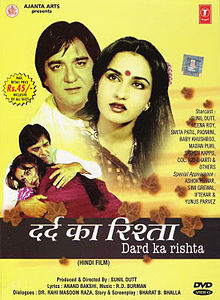
Dard ka Rishta
(1982; Director Sunil Dutt)
A young girl gets diagnosed with leukemia. To cure her cancer, she must have a bone marrow transplant from a donor with matching blood group and genes. A foster-brother is found to have a perfect match and he donates the marrow, thereby saving her life.
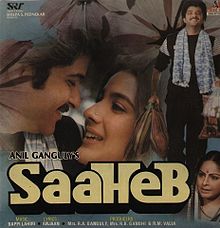
Saaheb
(1985; Director Anil Ganguly)
Saaheb is the black sheep of the family – unemployed & uneducated. He is only interested in playing football. When the family needs funds to get his sister married, he donates a kidney of his to raise the money.
The Ship of Theseus
(2013; Anand Gandhi)
The movie has three sub-plots. A visually impaired and celebrated Egyptian photographer undergoes a cornea transplant but has trouble adjusting to her newfound sense of sight and is dissatisfied with her resulting photography. An erudite monk is diagnosed with liver cirrhosis but continues to be reluctant towards medication. A young Indian stockbroker receives a new kidney. He learns of a case of organ theft involving a poor bricklayer, and tries to get him either a large financial settlement or both his kidneys back.
Of course, the above list does not include plain blood donation or transfusion. Many movies strike an emotional chord, with estranged sons or relatives donating their blood either to a yet-to-be-discovered mother or to someone from their arch enemy’s camp.
Unless one has missed out on many others, one finds very few movies which have touched upon the critical issue of organ donation. Given the persuasive powers of cinema, this is a pity indeed.
We live in an era when socially and politically relevant messages get couched in a commercial wrapper, embellished with a dash of humour and served piping hot to the audience. Movies like Chak de! India, Lage Raho Munna Bhai, 3 Idiots, Bajrangi Bhaijaan and Drishyam – to mention only a few – show us that innovation in script writing is never in short supply.
One hopes that imaginative directors, producers and script writers would recognize the urgent need for promoting organ donation and come up with more movies which touch upon this vital subject.
(Published on the occasion of Organ Donation Day; Inputs from Sanjana are gratefully acknowledged)
If ‘Paan Singh Tomar’, ‘Bhaag Milka Bhaag’ and ‘Mary Kom’ had you in enthral, here is a line up of future biopics from Bollywood. As always, a thoroughly informative post from the stable of ‘My views on Bollywood’!
The box-office success as well as critical acclaim of recent biopics Paan Singh Tomar, Bhaag Milka Bhaag and Mary Kom celebrating the spirit and determination of our sportspersons seems to have spawned a plethora of biopics in our industry. We are attacking this genre with a new found vigour and enthusiasm.
In fact this year on 23rd October, 2015, the biopic on our very own Mahendra Singh Dhoni, Indian Cricket Captain is going to hit the theatres. Titled M S Dhoni: The Untold Story, the film is directed by Neeraj Pandey and young Sushant Singh Rajput will be essaying the role of the Indian Captain while Alia Bhatt will play his wife Sakshi. The link below shows the stars who will be playing the other members of the Indian squad.
13th May 2016 will see the release of Azhar, the biopic on cricketer…
During 1950s and 60s, TB played the role of a villain in quite a few Bollywood flicks. Cancer soon took over. Movies like ‘Anand’, ‘Safar’, ‘Mili’ and ‘Ankhiyon ke Jharokhon Se’ had scripts which were centered around some form of cancer or the other.
‘Anand’ remains a Bollywood classic in more ways than one. Hard hitting socio-economic messages well-couched in scintillating humour gave us enough food for thought. Hrishikesh Mukherji conveyed some profound thoughts on life and the need to have a positive attitude.
The illness from which the hero suffered became engraved in our memory cells. Here is an interesting post on the illness.
Your average non-Bollywood viewer will probably read the words above and feel nothing. They will also probably pronounce intestine with a normal emphasis on the second syllable and won’t make it rhyme with “shine.” But ask anyone on the streets of Bombay who knows a thing or two about life from the silver screen, and you’ll be amazed. For Hindi cinema, the dreaded diagnosis “lymphosarcoma of the intestine” is synonymous with unavoidable impending doom of a most serious and scientifically complex nature. How did this all start and Bollywood folklore aside, what is lymphosarcoma of the intestine? Let us step back in time to 1971 to the film Anand when the hysteria all began…
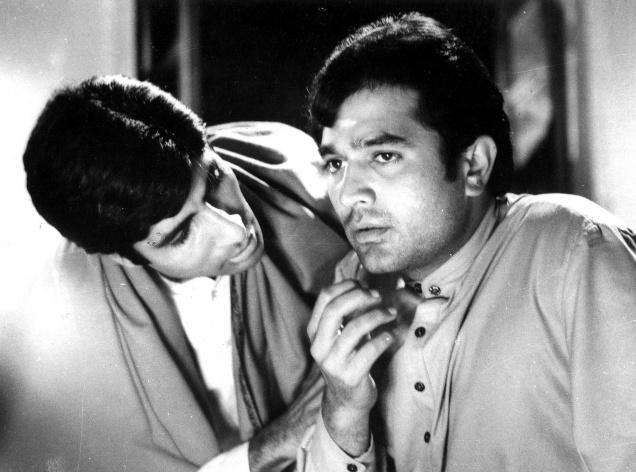
Amitabh Bachhan and Rajesh Khanna both can’t pronounce intestine in Anand (1971)
Anand is a film about a life-loving cancer patient whose optimism touches everyone he encounters. The film’s writer, Hrishikesh Mukherji, had majored in chemistry…
Branding is an important part of marketing, and who knows this better than the celebrities from the realm of cinema? Assuming an appealing name is a crucial aspect of a celebrity’s image and persona. Here is a well-researched two-part series of posts on some Bollywood personalities. A sumptuous treat for Bollywood fans.
Does this hold true for our industry? A peep into our film industry’s history reveals a fascinating number of artistes of the early era who changed their name to try their luck and write their destiny in the industry. Some chose the names on their own, some were rechristened to suit their personalities, some had to change to avoid confusion with already existing similar name…Well! Whatever the reason, they are now part of our cinematic consciousness and today we cannot imagine them by their original names…
The most famous change of name that comes to our mind is that of Dilip Kumar who did not hesitate in giving up his original name Yusuf Khan and take on the screen name of Dilip Kumar thus establishing…

 Daisy Irani and Baby Naaz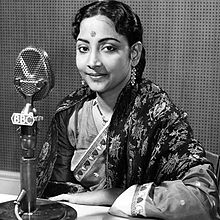






 ashokbhatia