Feeds:
Posts
Comments

The Chinese Premier Li Keqiang honored Indians with a visit, his first international foray after he assumed charge. Once the Beijing imageeuphoria has died down, one is likely to find solace in the fact that both China and India have the courage of conviction to put all matters on the table and to try to thrash them out. Rhetoric apart, one also hopes that the Indian government shall nevertheless set in motion a long-term strategic plan to handle the game of Chinese Checkers that our northern neighbor plays with us.

The Chinese Premier is absolutely right that our two nations are destined to be together. But good words sometimes convey only pious intentions and do not get converted into positive ground realities. An entire state of India, Arunachal Pradesh, is claimed by China. Even at a forum like the ADB, loans for developmental works in Arunachal Pradesh have been scuttled at China’s behest. Zangmu and other dams are being planned on the Brahmaputra, with no participation by India which is a lower riparian state. India’s claim for a seat in the UN Security Council is not getting supported by China. Its stand on Kashmir touches a very sensitive chord amongst Indians and its support for Pakistan is an added thorn in the flesh.

If China is said to be working on a ‘string of pearls’, India is no less capable of creating an ivory necklace around itself, so it Rashtrapati Bahavanwould not be taken lightly by China. Maintaining better relations with other neighboring countries, backed by investments in strategic assets, is a singular step in that direction. The government has already shown imagination in going in for the development contract for Chahbahar port in Iran. Many more initiatives of this nature need to be followed through.

We surely need better highways within India. But our top priority has to be building up our border defense muscle. This can only be deferred at our own long-term risk and peril. The humiliation of 1962 is difficult to forget and so is the recent arm-twisting in Ladakh.  

At times, our innate sense of decency is taken to be a sign of weakness. Sure enough, India needs to far more proactive rather than just being reactive to Chinese manoeuvres, militarily or otherwise.

With due respects to the leader who is an honored guest, allow me to say that we need to judge countries not by what their leaders say but by what they actually do.

QUALITYQUALITY

Hire a quality expert who is practical and does not live in an ivory tower, or else your billings may nosedive and your entire manufacturing team may end up doing only rework.

In the services sector, quality invariably means an extension of the core job being done. A shipping agent who keeps you updated of the status of a shipment at all times is a delight to work with; so is a dentist who sends you a discreet s-m-s reminding you of your appointment that evening.

To quote Dr. Laurence J Peter and Raymond Hull: “……man cannot achieve his greatest fulfilment through seeking quantity for quantity’s sake; he will achieve it through improving the quality of life, in other words, through avoiding life-incompetence.”


QUANTITATIVE APPROACH

Quite a few times, a team leader has to let go of his quantitative obsession and take a decision off the seat of his pants. A crucial input to decision-making is intuition and gut feel. In turn, intuition and gut feel get sharpened over a period of time by the sheer availability of good quality quantitative data.


QUESTIONNAIRE

A well designed questionnaire is an important tool in any research project. It pays to pre-test one before freezing it. However, in case of behavioural and attitudinal studies, a structured interview approach works much better.


It pains me to see Delhi University getting dragged into a controversy over its proposed four-year undergraduate program. Its graduate degrees are henceforth meant to be different, introducing academic separation of a different kind. 0002 (58)

I walked out of the hallowed precincts of Delhi University (DU) close to forty years back. However, the attachment with the Alma Mater remains as strong as ever. Warm memories of the carefree days spent at DU long time back come flooding back. 

A Touch of Nostalgia

I have fond memories of evenings when the mess-y food provided in the hostel mess motivated us to saunter across to nearby Kamala Nagar market. When it came to nourishment for keeping our bodies and souls together, piping hot chhole-bhatoore, or the modest aloo-tikki and samosas were always rated better than the tepid and monotonous fare dished out at the hostel.

Much before Munna Bhai reinvented Gandhi-giri, the hostel food taught us rich lessons in civil disobedience. A day came when we could no longer bear to even look at – let alone gobble up – the all-potato meals served day after day. A huge container went around the dining tables of the hostel mess. All potatoes one could lay one’s hands on got piled up in the container. The Mess Manager was promptly called in, garlanded, applauded and presented with the container overflowing with potatoes of all shapes and sizes. With a sheepish grin on his pock-marked face, he quickly withdrew to the safety of his store-room. 0002 (64)

Our college used to be derisively referred to as a ‘brahmachari’ college those days. As aspiring pseudo-ornithologists, we had to find some solace in whatever ‘bird-watching’ we could accomplish – either while walking to and from the main University Campus, or in the course of our evening snack-athons in Kamala Market. However, once we completed our academic sojourn and departed, the authorities thought it safe enough to make the college a co-educational institution!

The cafeteria on the main campus was a breeding ground for proponents of communist as well as capitalist ideologists. Traits of professors were discussed threadbare, as also top news of the day. Impromptu gatherings in the lawns led to much singing talent getting discovered, what with movie songs of Hemant Kumar and Kishore Kumar getting belted out with gay abandon.

Come monsoon time and young men’s fancy would lightly turn to thoughts of love. Lover’s Lane used to suddenly get more traffic than it could possibly handle. When a member of our group started dating a smart class fellow regularly, some turned green with envy whereas others started entertaining romantic thoughts of the unilateral kind.   0002 (12) 

Lessons in chivalry were yet to be learnt. Money supply for those residing in hostels was erratic and woefully inadequate, so it was common to see day-scholar sweethearts graciously footing the coffee and dosa bills. While passing through a door, it was never a custom to hold it open for the accompanying female. Holding a chair for a female companion was never heard of. Luckily, the fairer amongst us were equally un-initiated, so no one seemed to mind such indiscretions.

Classes were invariably a serious affair, followed by feverish exchanges of hand written notes and of text books sourced from various quarters. The studious types were obliged to take separate ‘classes’ in their hostel rooms, so the not-so-serious types could pursue their hobbies without missing out much on the academic front. During examination times, it was pretty common to see the brainy ones going through bulky text books cleverly concealed within the covers of the latest Batman comic. 0002 (83)

Other than academic accomplishments, we could forge long-lasting bonds of friendship. One is now a successful entrepreneur while another rose to dizzying heights in the realm of banking. Another one is now at a very senior position with one of India’s largest business houses. Yet another one enriched the IAF with his dedication and continues his romance with cloud-computing, though not of the IT kind. One went on to become the Director Finance in one of the leading airlines in India. Another one has made it big in the IT sector, whereas several others have excelled in such diverse fields as pure sciences, law and order and even in international diplomacy.

Innovation and Isolated Glory

Allow me to come back to DU’s attempt to innovate its graduate degree course. Sure enough, it sounds like a good step. However, the apparent absence of academic refinements and adequate discussion with faculty, prospective students and with other stakeholders is discouraging. Quite possibly, DU would start churning out youngsters who would be more ‘marketable’. But the prospective employers are sure to be twiddling their thumbs in anxiety, trying to cope with an unpredictable quality of performance.

There is a long and justifiable debate on encouraging real innovation in higher education in India. One of the major goals is to demolish the strict boundaries between various disciplines and allow students to choose a mix of as diverse streams of learning as, say, Physics and Fine Arts. The real test of the proposed system would lie in ensuring that each student can grow as per his/her individual aptitude. That would be the only way to harness the innate potential of the youth of today, thereby increasing their contribution to society at large. Macaulay

I believe the basic innovation we need in the area of higher education is that of ridding it of Lord Macaulay’s legacy. We need to hone the entrepreneurial skills of the young, so they could transform India economically.

The Indian system of higher education boasts of over 600 university-level institutions and more than 36,000 colleges. Any reform must therefore address three basic issues: standardization across the country, parity between different centers of learning and vertical as well as lateral mobility of students. In the absence of these features, DU may merely end up basking in its isolated glory.

Here is hoping that wider consultations will take place before an academic reform of the kind proposed gets implemented. A prestigious entity like DU can ill afford to have several degrees of separation between itself and other institutions of higher learning in India.


My dear, never did I dream of being with you,

With silent feet you waltzed into my life, it is true.


You came in and took control of all aspects of my life,

All kinds of sweets and savouries are now denied by my loving wife. 


When others feast on dishes and foods exotic,

You make me learn the art of detachment and turn me into an ascetic.


To remain aloof from all kinds of cuisines and tastes,

You exhort me to walk, exercise and not let my life go waste.


I abide by all your wishes and try my best to keep you in good cheer,

I live like a recluse, satisfying all your demands, dear.  


When it comes to taking good care of me, my wife is near perfect,

But all my vital organs you alone appear determined to effect.


O dear Diabetes, my beloved,

It appears you are in no hurry to take leave.


But a guest needs to know when it is time to depart,

Hope you leave my abode before death make us part!


[Related Posts:

https://ashokbhatia.wordpress.com/2013/08/04/getting-india-in-the-pink-of-health

https://ashokbhatia.wordpress.com/2014/10/06/handling-the-diabetes-tsunami-in-india%5D

(Published in The Hindu dated August 11, 2013)

http://www.thehindu.com/opinion/open-page/diabetes-my-dear/article5010531.ece

Much before I was born, cocooned in my mother’s womb,

The society tried to kill me and bury me in an unmarked tomb.


I arrived in this beautiful world hoping to chase my own rainbows,

But was treated like a burden and made to suffer all kinds of blows.


At a tender age of five years, all chirpy, playful and carefree,

I was either married off or violated beneath a mute tree.


My brothers got better rights when it came to wealth and health,

Education was their privilege, mine to tend house and hearth.


When I was happy, carefree and sprightly at the age of sixteen,

I was brutalized by some booze and porn-addicted teens.


Out in the streets, I was hounded, teased, touched and groped,

Disrobed by eyes and leered at in thoughts – not the life I had hoped.


Caged always was I by the customs, rules and traditions of the society,

Held captive by precious stones and gold jewelry, devoid of any gaiety.


Dependent on a father, then a husband and then a son,

I always craved for freedom which I could never have won.

Prime enabler of progeny, I was shared, bartered, depraved and sold,

Killed in cold blood, family prestige I was mandated to uphold.

I spent my life multi-tasking and managing the entire family universe,

To give me due credit in my country’s GDP, economists were averse.

I was put on religious pedestals and worshipped with fervor,

Chased in my youth but later abandoned and entombed forever.


For someone’s momentary pleasure and a spot of weakness,

Blame was laid at my own doorstep; abused for my meekness.


Maimed by acid attacks, beaten black and blue and burnt alive,

Freedom to make choices invariably denied on my own life’s drive.


Lying awake each night, the untold misery and terror I continued to relive,

Those supposed to protect me in fact exploited me, difficult to believe.


For each brutality, my countrymen, alas, barked up the wrong tree,

They asked for tougher laws and went on a police-blaming spree.


The courts tried to help, but too little and too late,

The politicians were too busy chasing their own fate.


The media and movies gleefully always used me as a sex object,

TV soaps ignored the reality, my stereotype roles they still project.


Religious and spiritual gurus never raised their voice and let it pass,

Society never decided to look within and re-set its attitudinal compass.


However, each violation has left me stronger than before,

My body they might have crushed and bruised, not my soul.


O Creator, give me the courage to forgive those who have tormented me,

Let me be born a female in coming births, making me assert myself with glee.

Never shall I let males dominate me, even if it means facing death,

For equality between the sexes, I shall always fight till my last breath.

(Related Posts:

https://ashokbhatia.wordpress.com/2013/01/02/an-open-letter-to-damini

https://ashokbhatia.wordpress.com/2015/03/11/to-nirbhaya-the-fearless-a-daughter-of-india)

Is there a scope of improvement in management education? If so, how do we enrich it further?

I confess that management education is not my forte. The only exposure I have had to this exalted field was when I was at the receiving end, so to say – that is, as a MBA student myself! But, over the years, interaction with the younger managers has provided me with valuable clues as to the challenges being faced by the current crop of MBAs. This alone emboldens me to endeavor to propose what I believe could be done to enrich the process further. Of course, I do so with utmost humility at my command!

·         A 360-degree CEO View

Management education opens up one’s mind to various facets of an enterprise. However, it does so through the bifocals of a top honcho’s perspective. Upon entering the industry, a befuddled greenhorn could get a thermal shock. Most of the concepts covered in a typical MBA course appear to be irrelevant at that stage of one’s career. Depending upon an incumbent’s innate strengths and the type of opportunities one gets in one’s career, it could take around 15-20 years for one to reach a level where the first whiff of real business strategy and corporate planning etc comes one’s way.

What we need perhaps is a better emphasis on the dilemmas faced by middle level managers. This can possibly be achieved by structured interactions with management experts in the middle rung of large organizations. Case studies which are designed to showcase the types of challenges faced by middle management could also help.

A 360-degree view is absolutely fine, as long as the gondola takes us not only to a mountain top at 3,500 m in the Swiss Alps, but also delights us with the panoramic views at 1,500 m and 2,500 levels.

·         Business History

The way Tatas, Birlas and Ambanis grew up, adapting to times which ranged from British governance to the license and permit-raj days, followed by the phase of economic reforms in India, is fascinating.

If one group focused on weaving ethical values into its business operations, the other capitalized on the pent-up demand in the market. Even their approach to philanthropy was different – one ploughed back its resources by focusing on the fine arts, fundamental sciences and medical facilities, the other earned the public’s respect by constructing a string of temples and related facilities for the common man.

Dhirubhai Ambani became a darling of the masses and popularized the concept of equity investments amongst the teeming millions of India. Post economic reforms, entrants like Infosys delivered good value to shareholders and employees in the newly emerging knowledge economy of India.

Examples abound from the international business arena as well. One is not talking merely of legends like Henry Ford and Steve Jobs here. Alfred D. Chandler’s ‘The Visible Hand: The Managerial Revolution in American Business’, and Charles Wilson’s ‘History of Unilever’ offer great insights into the field of business history.

While pursuing business history, one comes across entrepreneurial heroes as well as exploitative villains and empire builders as well as corporate raiders. A truly enriching exposure for a wannabe entrepreneur and/or an intra-preneur!

·         Lessons from Scriptures

Whether it is Ramayana, Mahabharat, Thirukkural or Chanakya’s Artha Shastra, there is a rich repertoire of management strategy as well as tactics enshrined in our scriptures. Each one contains gems of wisdom which can be put to effective use by management institutes which are already waking up to utilizing the wealth of wisdom available in literature to drive home some key management concepts.

The story of Lord Rama teaches us about waging a war with very limited resources. It also tells us about succession planning, ideal management practices based on fair and impartial conduct of those in power, humility, besides covering several other concepts.

Mahabharat can teach us about the perils of attachment to one’s near and dear ones in life/career, merit taking precedence over pedigree in promotions, tactical retreats in the face of imminent disaster and the risks of hasty decision making sans careful thought, to name only a few. Bhagavat Gita is full of practical wisdom for those aspiring to become professional managers.

Thirukkural tells us about the duties of a king and so does Chanakya Neeti.

For grooming business leaders who have a strong sense of values embedded in their thought processes, our scriptures are an invaluable resource.

·         Finishing

For those who are aspiring for a global career, the main cultural differences between different continents of the world can improve the value-add of management education. Dining habits, etiquette and manners followed by diverse cultures across the globe can also be incorporated in consultation with institutes of learning in the field of hospitality and tourism management.

Observing and following the organization’s culture when kick-starting one’s career, protocols of behaving with seniors, peers and subordinates and do’s and don’ts of e-manners to be followed while handling e-mails, etc. can also be driven home.

Some of the above could be immensely useful to students who step into management education with socially disadvantaged sections of our society. Covering such areas would tend to make this field more inclusive in nature.

·         A Focus on Follower-ship As Well

‘Leadership’ is a favorite topic in management. We have a rich literature providing invaluable insights into various aspects of leadership. Somehow, the traits of ‘Follower-ship’ have not merited much attention at the hands of management gurus and academics. As a discipline, does management education not need to create good followers as well? After all, a leader without a gang of followers could end up being pretty clueless!

The harsh reality is that an overwhelming majority of MBAs would turn out to be followers. If a leader is expected to have charisma, a follower needs to have common sense. If a leader leads by example, the follower realizes that blind faith could mislead the team. If a leader is supposed to be adept at resolving inter-personal conflicts, a follower is expected to work harmoniously with other team members.

Most business leaders today concur that planning is relatively easy; their real challenge lies in flawless implementation. Now, if a leader lays out a strategic vision backed by meticulous planning, smooth   implementation can only come through a bevy of hard-working followers.

·         Yoga and Meditation

Physical and mental fitness is a sine qua non to do well in one’s career. Institutions training the managers for tomorrow can figure out innovative ways to bring in these elements as well into the management education curriculum.

It appears that we would do well to beef up conceptual knowledge imparted in management courses with skills and values that would make MBAs more competitive and more balanced in their approach to real issues in the industry.

The managers of management education (in India, as also elsewhere) may find some merit in the above propositions.  
 

TagoreWhere the mind is with fear and the head hangs in shame
Where knowledge is up for sale
Where the world has been broken up into fragments
By narrow domestic walls
Where words come out from the depth of deception
Where mindless striving stretches its arms towards ‘chalta hai’
Where the clear stream of reason has lost its way
Into the dreary desert sand of dead habit
Where the mind is led forward by thoughts grey and blue
Into ever-sickening incidents of brutality against the fairer sex
Into that heaven of freedom, my Father, let not my country awake.

(With due apologies to Gurudev Rabindranath Tagore; With reference to the 5-year-old girl recuperating from her traumatic experience in AIIMS, Delhi)


Even though quite a few business houses from India had joined the World Economic Forum’s Initiative against Corruption in November 2012, not a single Indian company has so far become a signatory to the UN Convention against Corruption. This is deeply regrettable and projects the image of a corrupt business environment in India. It discourages foreign investments and erodes the brand value of Indian companies. In the absence of a level playing field, businesses shy away from potential opportunities. Mr. Ratan Tata’s lament on not having able to enter the field of aviation quite some time back is still fresh in our minds.

Companies can never be faulted for hiring Vice Presidents who are highly virtuous, law abiding and disciplined souls. Understandably, only those who follow high ethical standards and are in sync with the core values of the company would make the grade. However, in quite a few organizations, such qualities are merely necessary but not sufficient. When it comes to handling external agencies, incumbents who can either bend a few rules or interpret the fine print of law creatively to add to the bottom line of the company alone would be rated high and viewed with awe and reverence.

The Dr. Jekyll and Mr. Hyde Scenario

In other words, VPs should not only be ‘Virtue’ Presidents, but should also possess the flexibility of doubling up as ‘Vice’ Presidents while dealing with liaison matters. This stems from the core belief that businesses cannot be run successfully without back-stage dealing and wheeling, obviously with the aid of what many would euphemistically refer to as ‘appeasement initiatives’.

Appeasement of any kind is invariably geared towards either tweaking government policy to suit the ends of business, as also for specific time bound gains in the forms of large contracts, largesse, concessions and indirect favors. Organizations believe that advance knowledge of government plans, policies and rules is a great tool to deliver results to shareholders who not only look for long-term capital gains but also for better results quarter after quarter.

Sleeping with the enemy

If a professional gets stuck with an assignment which involves corrupt practices which do not match his or her personal core values, one option would be to escalate the issue. This would ensure that the matter is reviewed at a higher level in the organization.

If this option turns out to be impractical for some reasons – whether professional or personal – another one would be to start actively searching for career options with companies which value ethical practices in business!

A much better option, however, could be to work for a change from within the organization. This could be done either by presenting alternative business plans to management or by recommending an approach whereby the company could sidestep the issue by projecting its innate strengths in an aggressive manner. Let us consider some of the tactics in a professional’s arsenal which could be used to combat corruption in business deals.

Tackling Business Competition in the Market Place

The best strategy for a business to have is one which is based on avoiding government doles and concessions. By focusing on core competence and by fighting out the competition in the market place, the business can reduce its dependence on a wide section of the government policies. Surely this calls for rare qualities of leadership, statesmanship and openness. Inviting the government to play favorites and to resolve competitive business issues that are better dealt with in the market place could be a boon as well as a bane. However, this may not be possible in industries which are highly regulated.

Operating in an Unethical Environment

If one has absolutely no other option but to operate in an unethical business environment, the following steps might help to avoid corrupt practices.

  1. Building trust: An honest and humble approach, backed by a long relationship built on explaining the contribution of business can and does work. Investments made, employment opportunities offered and revenue generated are a few of the things that can be leveraged to secure favorable decisions without indulging in corruption.
  2. Reputation travels ahead: The fact that a business house does not stoop down to corrupt practice is generally well-known. It is a strategic advantage to have a squeaky clean image which ensures that a request from such an outfit is treated with the respect it deserves.
  3. Investing in underground cables: It never pays to flaunt one’s relationships. By keeping them underground, one not only wards off competition but also ensures that in case of a change of regime, the damage is minimal.
  4. Diversifying one’s liaison ‘assets’: One learns to be friendly with political opponents. In TN, one needs to be friendly with both the Dravidian parties. In WB, it is tough even if both CPM and TMC are one’s friends. In Maharashtra, Congress, NCP and both the variants of Sena must all like one for one’s business to make some headway.                                                                           Business history teaches us the same lesson. In the pre-independence era, Tatas were funding Gokhale and engaging with the nationalist elements while British officers retired from ICS were being employed by the group. JRD had excellent personal rapport with Nehru. G D Birla had been corresponding with Winston Churchill for a long time. Churchill’s dislike for Mahatma Gandhi was well-known; even though he was being supported by Birlas. They gave a job to one of his sons. It is a fact that he was assassinated while staying as a guest at Birla House in Delhi.
  5. Be courteous, humble but firm: Most government officers take a dim view of business executives. Firstly, they are not viewed as being dependable. Secondly, they are thought to be paid exorbitantly high and generate a feeling of awe as well as jealousy in a public servant. Now, if one walks in with one’s latest cell phone and/or tablet in his office and starts showing off the latest Rolex watch, one would be surely shown the door promptly.

Setting the Moral Compass Right

The UN Convention against Corruption is a laudable initiative and deserves to be given a serious thought by our present day business leaders. It binds an organization to (a) reducing corruption risk in procurement and contracts, (b) engaging in competitive and transparent procurement processes and (c) disclosing all payments made in procurement deals. The global panel already has names such as Coca-Cola, Microsoft, Siemens and Accenture.

It is not that India does not have shining examples of groups which have demonstrated the strategic advantage of pursuing business goals while staying the ethical course. The Tata group has been at it for the past 120 years or so. Liberalization of the economy appears to have thrown up quite a few scams, but companies like Infosys keep our hopes alive. As per Elaine Dezenski, senior director at WEF and the head of PACI, Infosys, Godrej Industries, Bajaj Auto, Genpact, Wipro and M&M are already signatories to the initiative.

As argued in an earlier blog (Getting a Moral Compass Would be a Sound Business Strategy for India Inc, published on December 9, 2012), companies in India would do well to seize the opportunity to clean up their business deals. A beginning can be made by persuading major political parties to make their funding transparent. Those in real estate business can come out with a time bound plan to rationalize stamp duties all across India, thereby making their deals more transparent.

Hopefully, progressive companies in India would see the strategic benefits of committing themselves to such initiatives soon enough!

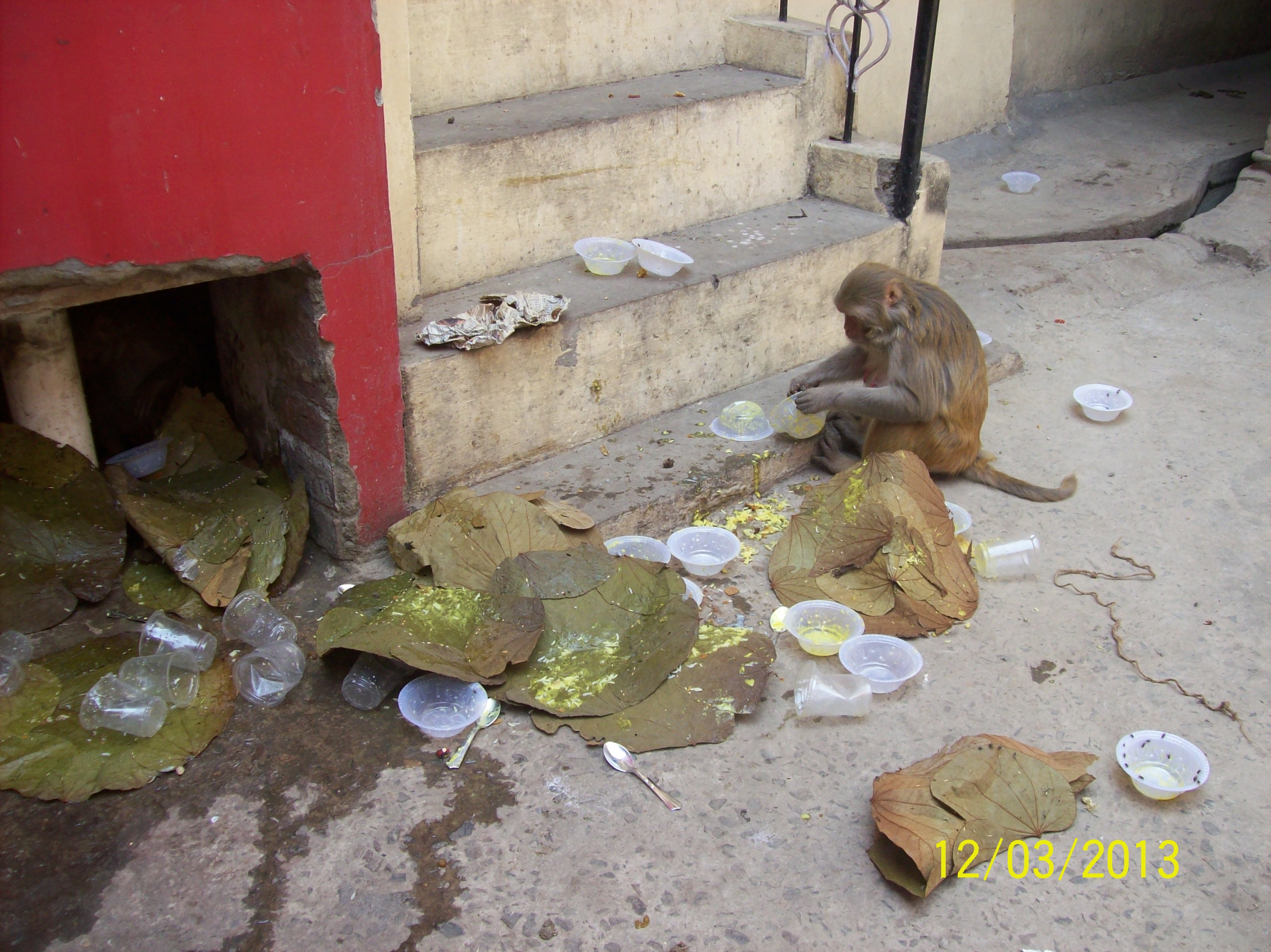
On a recent visit to Vrindaban, I was pleasantly surprised to discover the innate intelligence of our evolutionary predecessorsMarch 2013 471 residing there. A monkey decided to swoop down on our auto rickshaw and snatch away the spectacles of my wife. Not to despair, said the helpful driver. A currency note was offered to the monkey, and back came the glasses without much ado. We were told that it was standard practice for the monkeys to earn money in this manner, only to be exchanged with bananas and peanuts with a trader later! Sure enough, they have figured out how to survive and do well in life!

This led me to think of several other monkeys who have perfected the art of survival in the lives of ordinary Indians. The monkeys of ignorance, superstition, poverty, illiteracy, absence of clean drinking water, inadequate and ineffective delivery of public services and a marked absence of manners, civic sense and politeness in our public spaces. Unlike the Vrindaban monkey who left us in peace, these ones keep returning to haunt us. Each time, they leave us clueless as to how to make them go away permanently.

The Art of Apathy, Callousness and Greed

There is no point in blaming it all on our government. Do we ourselves care about the domestic waste that we generate – eventually, where does it land up and what happens to it? If we pass by an accident site, do we stop to check if anyone needs urgent medical help? While traveling by a bus or car, do we think before spitting or throwing a plastic bag out of the window? In public spaces, do we try to show restraint, respect and courtesy to those who are seniors in age? Do we not enjoy displaying our bravery by breaking a queue, whether at a railway station or while getting into a bus?

Blatant traffic violations are the order of the day. Our drivers routinely use high beams even during city limits, both during day as well as night-time. Overtaking from the left is a norm, and so is merciless honking, despite knowing that the vehicle in front has no way of giving us any overtaking space. When facing a traffic jam, we believe it is smart to go into the opposite lane, so as to make matters worse. Our respect for an authority figure is intact, though. Remove a traffic cop from a busy intersection and we are sure to jump the red light.

We have more mobile phones than toilets – which speaks volumes about the skewed priorities we have in life. Even if there are public conveniences, these are rendered useless by sheer neglect and apathy. In trains, there is no consideration for the following passengers who would like the place to be left in a reasonably clean condition. Men relieving themselves in public and fertilizing our soil across all roads is a common sight to behold.

Many of our corporates indulge in malpractices, perhaps believing that tax evasion is the same as tax avoidance! The fact that four major audit firms are now planning to hire forensic experts to check corporate frauds once again highlights the need for our moral compass to be set right. Our disdain for laws and courts is exemplary. We appear to thrive in informal systems, where rules are meant to be bent.

Blame it on Maasai Mara!

Why are we the way we are? Perhaps our ancestors and genes are to blame? Our ancestors had perhaps migrated all the way from 220px-Elephants_in_masai_maraAfrica. May be their nomadic lifestyles have shaped our genes, making us thrive only in a high degree of chaos. Then we had the invaders who kept plundering us time and again, making us love disorder and aggressive behavior. Or, has our own selfishness and individual greed grown to such an extent that we have turned highly myopic, with the greater good completely invisible to us?

The outlook of a majority of our workforce is still agrarian, giving rise to what one could label as a ‘Rabi-Kharif’ syndrome. What cannot be done today can easily be put off for another six months. No doubt, the attitudes we bring in to our work places (relative to our western colleagues) reflect this reality. As does our habit of making compromises in matters of quality – the thinking that ‘sab chalta hai’ (everything goes).

Ask any business executive and he would complain about long working hours and absence of quality time with family and loved ones. But is the quantity of time spent at the work place commensurate with the quality of the output? Having put in two hours’ honest work, don’t we get tempted to indulge in a long gossip session with a colleague, relaxing unduly long over a cup of tea or coffee?

Rights and Responsibilities

Come to think of it, are we not imitating the three monkeys loved by Gandhi-ji? Like one of those, we refuse to see the filth and squalor220px-Three_wise_monkeys_figure all around us. In fact, we go around spreading it all the more. Like another, we do not hear any voices emanating from our leaders, having given up on them quite some time back. And, of course, like the third one, we do not speak out when we see a serious issue plaguing a majority of our population. We remain safely cocooned in our comfort zone.

It is not my case that all is wrong with us Indians. The world can learn a lot from us – organizing mega events like the Kumbh Mela, managing coalition governments, yoga and spirituality, to name only a few. Our family bonds and values are still intact.  We have several systems that do work.

We also have a vibrant democracy to boast of. However, individually as well as collectively, we appear to be more keen on securing our rights rather than discharging our responsibilities. A touch of decency, concern, compassion, courtesy and humility is surely the need of the hour!

(Images of Elephants and Three Monkeys Courtesy Wikipedia)

POLICIES

Grandiose written policies are useful to Accountants who would love to raise relevant as well as irrelevant objections on various transactions, legitimate or otherwise. These are also useful to procedure oriented executives who would love to drive innovation and imaginativeness out of the organization.

If you happen to be a big fish in a small outfit, prepare and circulate a Policy Manual only at the organization’s risk and peril. If you have to, do so with scope for flexibility, and ensure it gets updated and re-circulated at regular intervals.

In case of very large organizations, Policy Manuals end up being statements of benign intentions of the top management. Internal Audit uses these to conduct frequent audits, pointing out minor deviations and confusing the top management at regular intervals. Often, crucial deviations having long-term impact on the business are left out, thereby increasing the organization’s vulnerability in facing either a legal or a statutory compliance related tsunami.

POLITICIANS

Like them or hate them, they are here to stay. Keep them in good humor, if you definitely have to interact with their tribe. After all, they could be high either on their Utility Quotient or on Nuisance Quotient.

Keep equidistant from politicians of all hues. You never know when the opposition party’s turn to warm the treasury benches may come.

When doing a favor, keep it away from public eye. This way, you would not only keep your competitors guessing but also ensure that a change in regime would be less likely to derail your business plans.

PROMISES

Either don’t make promises; if you do, try your very best to keep them. If necessary, buy time to commit on deadlines. Surprise your boss by delivering on your promise in advance.

Do this without fail. In the long run, your brand value as a manager would grow.

PROMOTIONS

An effective tool in the management’s arsenal to reward and motivate guys who excel in their jobs.

There are two key challenges faced in case of promotions:

1.     Pressure for time bound promotions:Everyone expects to get promoted after having slogged it out at a given level in the     organization for few years. The reason you find most organizations top-heavy today is because the managements twenty years back did not pay attention to managing the aspirations of its people and instead went along with the philosophy of time based promotions!

2.     Managing is different:   Doing a job yourself is one thing. Getting it done through others is a different ball game altogether. To be a good manager, one needs to be a leader, bestowed with skills in team building, communication, delegation and supervision. Often, two-thirds of the promotions in corporates are based on the incumbent putting in an impressive show in his/her present role. Once promoted, the incumbent is left twiddling his thumbs, trying to figure out how to manage the same activity through others.

The solution possibly lies in building up a culture which rewards good performance but does not overlook the projected managerial talent of the promotee. Job rotation, counseling and job enrichment are some of the tools which a wise HR guy may use to manage the majority which deems a promotion as its birth-right based on the fourth dimension of our universe – time – alone!

A populist approach like resorting to time based promotions can only be practiced at the organization’s long term peril, unless there is an aggressive scheme in place to enforce employee separations also, that too in a time bound manner!  

PRAISE & REPRIMAND

When responding to a team member’s performance, always praise in public but reprimand in private. Try not to follow the obnoxious policy of getting rid of an utterly-butterly useless guy by humiliating him in public. Assist him in getting out-placed instead.

Be generous with your formally conveyed appreciation only at your own risk. If a swollen-headed guy falls in his subsequent performance ratings, he could well turn around to use your formal communication to promote his case for the next promotion!

PROCRASTINATION

It is not altogether wrong to say that it is the early worm which gets caught! Procrastination works best when the idea is to delay a crucial decision which, if taken at that point in time, could create more problems than it would solve. Governments appear to do it all the time. The flip side is the higher probability of losing a business opportunity.  

PUBLIC RELATIONS

In a large complex business, you may need to hire an expert to handle your public relations. Check the guy’s credentials, and sign him on for a maximum period of two years at a time. Better still, get one of the smart secretaries to handle it in-house.