Feeds:
Posts
Comments

We appear to be headed for two new challenges to our mental equipoise in this century – Nomophobia and Noconnphobia! The fear of being out of mobile contact, that is, NoMobile-Phobia, is already well-recognized. The significance of the other, NoConnectivity-Phobia, is perhaps yet to dawn on most of us!

Our addiction to mobile phones and internet knows no bounds. Six years back, I was working with a company in a very senior position. A night before I was to be wheeled into an operation theatre for a cardiac surgery, I was furiously making calls to my team members to ensure that things were handled right when I was away from work for some time. My distressed daughter ended up confiscating the mobile phone, leading me to a feeling of utter loneliness and helplessness. It was as if my world had collapsed!

While recovering over the next four weeks, the ring tone of the mobile phone kept ringing in my ears, even though the equipment was nowhere around. My family ensured I could not lay my hands on it; otherwise, they felt, and rightly so, that I shall again get hooked on to it!

Surrounded by Gizmos!

Mobile phones are now everywhere. We go to a restaurant, and find that the friends who have met only to have a decent time together are instead glued to their individual mobile phones, chatting away merrily with those who are not physically present. On the roads, we find young and old alike walking absent-mindedly, talking on their mobile phone, quite oblivious to the traffic whizzing past and around them. Two-wheeler riders continue driving with an eye on the road while talking to someone far away, with a mobile phone wedged between their hunched up shoulder and an ear. With the arrival of blue tooth, the hunched shoulder has disappeared, but not the ingrained habit of using this all-pervasive gadget while driving.

Travel in a train and chances are that all the passengers are calling up their near and dear ones at the same time, prompting us to avoid the cacophony by taking a stroll down the crowded aisle. Visit a family and just as we start relishing a cup of tea with them, a shrill ring tone distracts one of the host’s party and we start wondering when the conversation in the drawing-room shall resume. Attend a management talk by an eminent expert, only to be interrupted by someone’s mobile ringing loud and clear, leaving the hapless expert clueless and the audience twiddling its thumbs. Even group meditation sessions are not free from this scourge.

When we call up a person on his mobile, we seldom bother if it is an appropriate time for him to have a conversation. If he does not pick up the phone in four or five rings, we conclude that he is being rude and arrogant; the poor guy might just be having a quiet candle-light Valentine Day dinner with his fiancée!

Internet is Fast Catching Up

Same is the case with internet accessibility. It appears to have assumed the same significance in our lives as oxygen which is vital to our survival. Withdraw it and the person withers away like a plant which has not been watered for quite some time. Ask any bleary-eyed child why he is looking tired and sleepy and the reason could well be that the only book he was working on the previous night was Facebook!  The realization that there is a real world out there – which is not the same as the virtual world – is difficult to come by.

According to a 2008 study in the UK, 53% of cell users there suffer from Nomophobia. It is not too different when compared to the stress we feel when we visit a dentist, start a new job or get jitters on our wedding day!

The day is not far off when some of us would be so lost in our technical gizmos that we may end up having to ‘Google’ ourselves to find who and where we are! With the convergence of voice and data services, we may soon end up getting mini-sim-cards planted in our skulls, much like the character of Neo played by Keanu Reeves in the ‘Matrix’ series of movies a decade back.

Just like the advent of the internal combustion engine changed our lifestyles forever, easy availability of connectivity is contributing towards making our civilization even more sedentary. The onslaught of lifestyle related diseases like diabetes, hypertension and cardiovascular complications is getting further speeded up with our addiction to internet. Our transition time – from being a couch potato at home to becoming a patient in a psychiatrist’s couch – is possibly getting shorter.

Enjoying Freedom with Responsibility

It is not my case that newer technologies are bad. Thanks to social networking, distances have shrunk – physically as well as mentally. A virtual democracy of information has led to grouping of like-minded individuals. Regimes world over are waking up to the potential as well as the power of internet, as we have seen in the case of the ‘Arab Spring’ and also in the recent case of a brutal gang rape case in Delhi.

We have enviable options today to remain connected with the world, but there is an overload of information. We need a higher level of maturity and wisdom to be able to moderate its usage in our day-to-day lives. We need a higher degree of inner strength to be able to sift between what is relevant and truly beneficial for us, and whom we associate and network with. It is up to us to enjoy this new-found freedom with responsibility.

We have to take a conscious call whether we wish to use the technology to our advantage, or to become slaves to it, 24 x 7! Yes, it is not easy to switch off our smart phones, I-pads, tablets and laptops. But there is no other way but to do so at select times during the day. Let us give our gadgets some well deserved rest.  Overcoming Nomophobia and Noconnphobia is not as hard as it sounds!

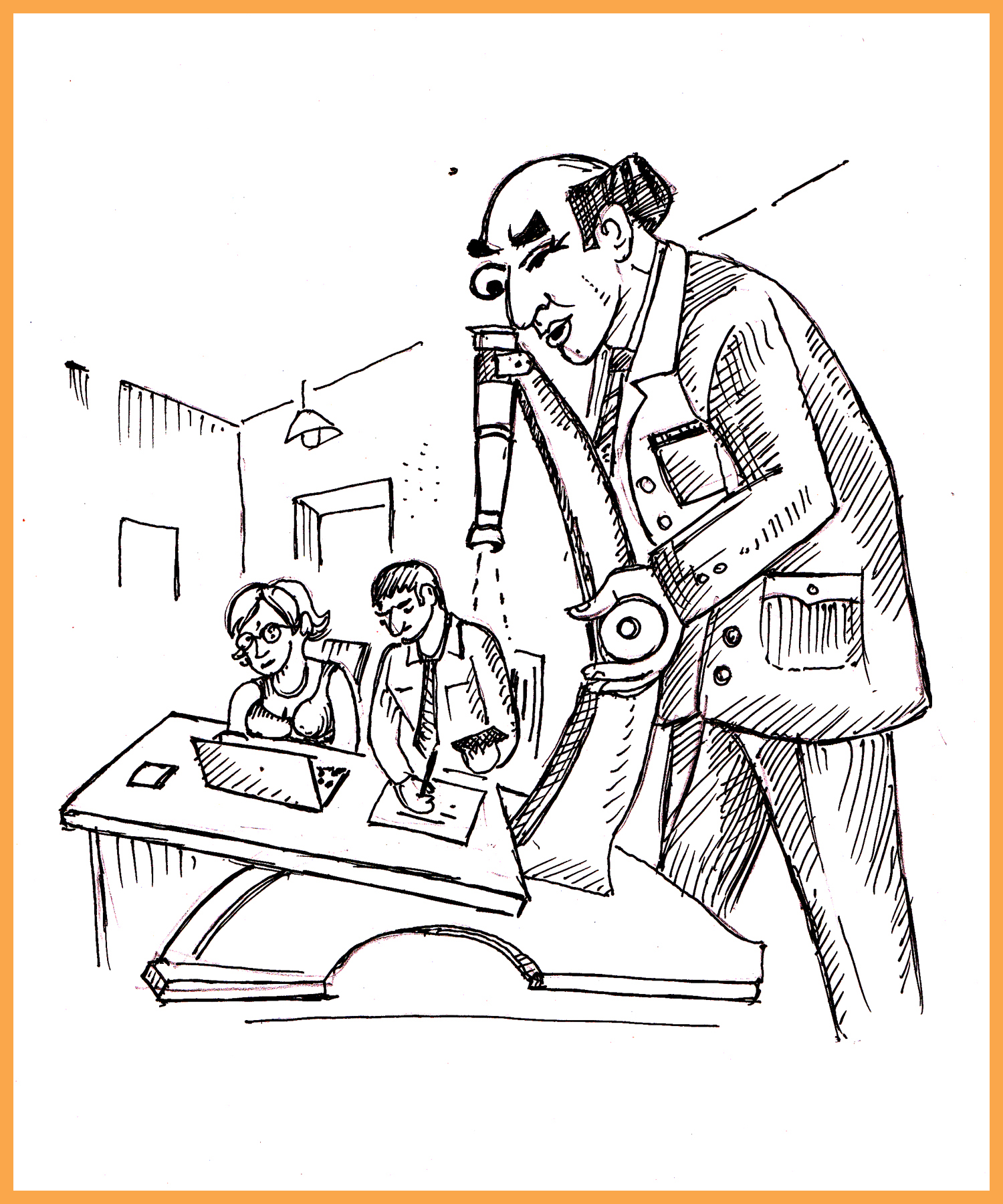
Quite a few of the managers I run into are frustrated because they could never make it to the top slot. The corner office with plush seating and an exclusive wash room has somehow always managed to elude them. I admit that the power and pelf a Number One slot bestows upon a manager is alluring as well as intoxicating. But I believe that being a Number Two is also not too bad a proposition; in fact, it could be more rewarding, instructive and exciting!PROMOTIONS

Now, don’t get me wrong. I am not advocating a drive against perfection or excellence in whatever you do. I am only trying to say that there is divine contentment in being a Number Two as well – relish it!

The Perils of Being a Number One

Being a Number One is rewarding as well as challenging. Take it from someone like me who has been at the top of a pyramid several times in his career. There are obvious drawbacks to reaching the top, and let me sum these up.

  1. When one does get to occupy the corner office, one gets no one to talk to freely. One may be lucky to have a few unsuspecting souls whom he can use as a sounding board for his ideas. But there is no denying that such team members who listen to the top boss respectfully could very well be those who believe in merely being ‘Yes Men’.
  2. Even if one gets a nay-sayer, there is no guarantee that he does not suffer from a tendency towards premature ejaculation, spilling the beans to a group of his own confidantes, thereby nipping all well thought out plans in the bud. In other words, one may be commanding fake respect, but not necessarily genuine loyalty.
  3. The sheer pressure of being a part of the rat race is rather high. Ensuring that one remains unchallenged in one’s top position brings along a level of stress that many may not be able to handle for long. If they do so, it could be at the cost of either health or quality time with their near and dear ones.
  4. One has to constantly watch over oneself to ensure that the ego does not balloon into something unmanageable. If humility does not come to one naturally, the stress builds up faster.

Being Number One does not necessarily imply that one is happy and satisfied. If so, one may be making good money but not having fun. Could it be really worth it?

The Perks of Being a Number Two

You Are Responsible, Not Accountable

The boss decides the overall paradigm and the goal to be achieved. Like the captain of a ship who has a better and wider perspective on things, he decides the course to be taken. Your own task becomes simpler to that extent. Sure enough, you add value by providing operational feedback which could alter the course quite effectively. In other words, you may be responsible, but it is he who is accountable!

Extra Time on Your Hands

The poor guy also takes the rap for all the failures. So, that leaves you with enough time to catch up with other pleasures at the work place – like, hob-nobbing with the HR guys to keep an ear to the ground, sweetening up the Accounting devils to ensure that all your claims get settled fast, chatting up with the legal eagles to ensure that your operations are free of any blemishes, and to network with other departmental heads so as to derive synergistic benefits for your own area of work.

Managing Insecurity of Your Boss

You know how insecure some of the top bosses are. Of course, this is internal to them and is never meant to be displayed publically. At times, you might have felt that your salary is getting paid only to ensure that his mental balance is always under control – a unique privilege, to say the least. Many a times, a boss gets so worked up about an insignificant issue that you need to intervene without delay – either taking the responsibility of resolving the problem yourself, or by simply diverting his mind to another pressing problem.

Some Role Models

Being a King Maker (and not a King) has its unique advantages. When you offer yourself as a sounding board, you can give sane advice as and when asked for. In our scriptures, you might have admired the sage counsel of people like Vidura (of Mahabharat fame) and Chanakya (advisor to Chandra Gupta Maurya).

In literature, if you have been introduced to the chronicles of Bertie Wooster, you would have admired the feudal spirit of Jeeves who invariably comes to the aid of the young master in his hour of peril.

These people could perhaps be the role model for those of us who are relegated to a Number Two slot in our careers.

Continue Honing Your Technical Skills

There are professions in which an elevation means getting away from honing one’s technical expertise further and instead getting bogged down with administrative hassles. Ask a doctor who has become a Medical Superintendent or a teacher who has risen to the level of a Principal; in all likelihood, they would readily attest to having experienced this syndrome.

You Always Try Harder

The best advantage you drive from being a Number Two is that of immense learning and untiring efforts towards improving your own performance. You cannot afford the luxury of being complacent. You always try to work better, because somewhere deep within you, you cannot get rid of the desire to attain the top slot some day!

I believe this logic applies to companies as well. Decades back, Nirma gave sleepless nights to HUL. Samsung is now beating Nokia at its own game. There are several David-Goliath type cases in the industry which justify this belief.

Being Number Two means that you always have a high testosterone level in your blood stream, thereby making you more aggressive and a highly focussed achiever.  The fire in the belly remains unabated.

The Flip Side

On the flip side, by being Number Two, you run the risk of becoming a scape goat at times. Too long a sojourn in this slot could either mean that the company has stopped growing, or that you have overstayed your welcome. If so, seeking greener pastures could be a solution.

A Disclaimer!

My arguments in favour of being a Number Two might have made you jump to a conclusion that I am a lazy bum, devoid of burning ambition and a fire in the belly! Or, I am a manager who believes only in abdication and not in delegation. Or, even worse, that I am rudderless drifter!

With all emphasis at my command, I deny all such insinuations! Rather, allow me to urge upon you not to lose sleep if you have just missed that coveted elevation to a Number One slot recently!

The recent economic meltdown has impacted not only the bottom lines of the companies but also the lives of a vast majority of senior managers and CEOs. Over-burdened, stressed, sleep-deprived and burnt out, they try to cope with Hurricane Stress that has hit them hard in the past few years.

How is it that they are coping with such a scenario? I spoke to twenty professionals who are in senior leadership roles in industries as diverse as IT, leather, chemicals, engineering and R&D to understand the contours of the arsenal these leaders use to combat stress. The sizes of the companies varied from 50 to 1,500, and the annual turnover ranged from USD 2 million to USD 5 billion.

I found the exercise to be pretty instructive. It led me to explore the practices adopted by CEOs and senior managers to minimize the adverse impact of stress in their lives and careers. It also gave me an insight into the kind of steps the managements are taking to address the issue effectively.

This is What They Do Differently

Using Stress For Positive Outcomes

The people who I found to be less stressed out were the ones who had perfected the art of time management. They had learnt to pace themselves. They had realized their own limitations and configured their working accordingly.

For example, the head of a regional manufacturing hub called upon to spearhead the company’s endeavours to influence government policy realized that he was out of his depth in handling such affairs. For quite some time, he was stressed out on this account. Gradually, he roped in another manager who had a flair for such activities. In two years’ time, he was not only handling the whole affair himself, but was also called upon by the company to handle similar challenges at the national level.He now loves what he used to detest earlier and has overcome his stress on this account. In the process, he has developed yet another USP for himself!

The Art of Creative Dissatisfaction

Almost two-thirds of the leaders/managers I spoke to had, subconsciously or otherwise, developed a keen sense of creative dissatisfaction. Rather than aiming for and insisting upon perfection, they went about guiding their teams towards achieving targets in a practical manner. Each time a target was met, there would be an informal session where, besides much back-slapping, an introspective discussion led everyone to discover what they could have done better. Most of the times thereafter, the team ended up achieving the target in a smarter way!

Loosening Up

Having someone to share their troubles with – whether at office or at home – was a need almost three-fourths of them mentioned. the difference lay in the severity with which the need was expressed by each one of them.

Digging deeper, I found that their need for unburdening themselves was somehow linked to their managerial styles. Those who were participatory in their decision-making approach had a lesser need, perhaps because they enjoyed a higher degree of warmth in their relationships at work. In fact, a vast majority of them were spending a lot of their time on resolving some or the other personal problems of their team members. On the other hand, those who were rather dictatorial in their approach were living in a self-created vacuum. Their sense of loneliness was acute, and so was their need to speak out aloud about their frustrations. In almost all the cases, they sought it in their families, or amongst friends who were not related to their work place.

A Dash of Humour

A positive attitude and a strong tendency to laugh off things was another common trait. At least one-third of the leaders/managers I spoke to had even cultivated the habit of remembering and narrating jokes, poems or couplets to their team members even in formal meetings. This resulted in much merriment around, but a point was made with a dash of humour. Two of them even had the capacity to laugh at themselves, prompting other team members to be very open in sharing their failures and seeking feedback and inputs from others.

Spin-offs of Meditation

The most quoted antidotes to stress were hobbies, better work-life balance, exercise and having fun! At least five of them stressed upon the importance of meditation to overcome their work-related blues.

One of them spoke enthusiastically of Mr Matthieu Ricard (66), a molecular geneticist and confidant of the Dalai Lama. According to studies done at University of Wisconsin, scans showed that when he was meditating on compassion, Mr Ricard’s brain produces a level of gamma waves never reported before in neuroscience literature. The scans also showed a very high capacity for happiness and a reduced propensity towards negativity.

Two others said that meditation brings many benefits. It refreshes them, makes them look at their surroundings and events in a detached manner, makes them wiser and gentler, and improves their ability to cope in a world which overloads them with information and communication. In other words, they felt a good improvement in their own productivity levels, linked to their meditative forays.

Diagnosing Stress

I believe that even though stress is a result of external circumstances beyond one’s control, the actual impact felt by a leader/manager also depends upon his/her own inner resilience. If it is directly proportional to the external circumstances, it is inversely related to one’s inner resilience and work attitudes. It also depends on the personality type that we are. The perennially anxious ‘A’ types end up experiencing higher levels of stress than the often composed ‘B’ types.

When an aggressive boss misbehaves, no two team members would be affected the same way. One may take it too seriously, and feel despondent for days together; another may just brush it off and be cheerful the very next day; whereas, yet another one may look upon the incident as a feedback, view it as constructive criticism and start working on a definite plan to avoid a recurrence of the event.

Role of Management

I am happy to share that as many as half of the CEOs and senior managers I spoke to had already introduced remedial measures at the work place. The steps quoted by them included piped music, group yoga for ten minutes at the beginning of each day, a dedicated resource in the HR Department to take care of family and personal needs of employees and sensitization of all HoDs to be vigilant of signs of burn-outs amongst their team members. One CEO had even organized spiritual classes for his employees.

There are several studies to show that stress impacts productivity at the work place. The faster the employers and the employees learn to handle ‘Hurricane Stress’, the better would be the bottom line of the organization!

Leadership is a much discussed virtue in management literature. However, like Peter Drucker says, there is no ideal type of leader. “Leadership personality’, ‘leadership style’ and ‘leadership traits’ don’t exist”, he writes in The Leader of the Future. The emergence of a leader is the result of a complex interplay of two factors – personality traits of the leader and what needs to be done at a given point in time. The moment the two become congruent, a new leader could emerge on the scene and deliver the goodies!LEADERS

There is no doubt that the leaders of tomorrow would need personality traits which would be qualitatively different from those of today. Here is my take on what business environment circa 2025 would be like, and how our future business leaders would be tackling it.

2025 – A Likely Business Scenario

What would be the business environment like in 2025? Several CEOs I spoke to said that business leaders in 2025 shall be working against the backdrop of a world which would, in all likelihood, be a multi-polar one, with Asia, particularly China, exerting more influence on global events. It would be a world which would be more inter-connected, commercially and otherwise. Thanks to new communication means, the individual empowerment levels would have risen significantly. Also, it would be a more urbanized world. Thanks to the rise of a new global middle-class, society in general would have reached a higher level of aspiration, resulting into a much higher demand for energy, food and water. On the flip side, income disparities would have risen substantially. Changes arising out of our climatic patterns would also pose a formidable challenge to the leaders of those times.

We could still be in for surprises, though. Disruptive changes are quite likely to overwhelm us. These changes could come in the form of impact of new technologies in the field of robotics, biotechnology, space sciences and communication. Increasingly, governments world over may start becoming enablers of entrepreneurship, faced as they will be with direct and intensive pressure from those they govern. We shall surely be seeing more entrepreneurs amongst our midst – whether in the commercial sector or in the societal sector.

A Business Leader in 2025

Decision Making Under Higher Uncertainty

Since the level of entropy in the system would have gone up further by then, a business leader of circa 2025 would have to be adept at making decisions under a higher level of uncertainty. The abnormal today would be the new normal, and many a leader would be feeling more like experts at river rafting in our economic and statutory rapids, often being called upon to go against the current.

I am not an expert in Econometrics, but could venture to guess that for those who are quantitatively inclined, advanced statistical tools would come in even more handy. I say so because there will be an overdose of data as well as information available to a business leader then. However, ultimately, his/her intuitive abilities – based on personal experiences in their formative years – would prove to be more valuable.

Sir Colin Marshall, the ex-Chairman of British Airways, transformed his organization into one of the premier customer service kinds in the days of yore. The uncertainty he faced in the period of his association with BA was monumental and serves as an example to be followed by CEOs of future.

Jeff Bezos of Amazon came up with the concept of ‘predictive analytics’, paving the way for all of us to enjoy the convenience of shopping on-line.

Higher Trust in Instincts

A logical corollary of the above would be the need for a leader to be ahead of the curve. Those who have counter-intuitive responses and place a higher trust in their natural instincts would surely fare better. In turn, there would be a strong need for a much higher degree of inner resilience, because this alone would enable them to keep their stress levels under control even in trying circumstances. Dynamism will be yet another critical input. It would ensure that they are able to steer their businesses through the dense economic fog enveloping the business highways.

The World Economic Forum had proposed a theme centered on the twin traits of resilience and dynamism for 2013. Given that there are no risk free growth models available to leaders and CEOs of the future, one could not agree more with this proposition.

A good example of facing flak and not losing sight of one’s goals is that of Larry Page of Google. He continues to trust his instincts and doing what he thinks is best for his business.

A Global Mindset

Given a much more inter-connected world, a business leader in the future would need to possess a vast knowledge of commercial, behavioral and societal norms followed in different parts of the world. A primary task would obviously be to ensure that his/her organization has world-class management processes. Only those institutionalizing best practices in strategic planning, marketing and human relations would be able to make their organization a successful one.  The fact that a leader would, in all likelihood, be leading a multicultural team of followers would pose a challenge – irrespective of whether the situation demands a leadership which is ‘transactional’ or ‘transformational’.

When one considers the example of Compaq’s Eckard Pfeiffer, who was a leader in a race against himself, it becomes clear as to how organizational renewal can be brought about. “No matter what industry a company competes in”, he said, “it must live with one foot in the present and the other in the future….there is simply no other way to build world leadership”.

A Democratic Style

The profile of the followers would also be different. Hierarchical authority is already proving difficult to manage change; there is no reason to believe this would not be even more so in the future. The followers would demand a higher degree of participation in the decision-making processes. Leaders who recognize this need of their followers and create a working environment which enables the same would achieve higher levels of efficiency and effectiveness in their business processes.

Creating a non-coercive environment in which employees and other stakeholders are clear about the corporate identity and the mission would be far more important than it is today. Reverse mentoring would be more a norm than an exception in the days to come.

Monsanto’s CEO, Robert Shapiro, had the ability to go against traditional hierarchy. He initiated strategy sessions with cross-sections of employees of different ranks, specialties and geographical perspectives and reaped rich dividends for his company.

The Moral Compass

Leaders who believe in sustainable businesses would not only use their commercial compass while determining the direction to take. Using a moral compass would be a valuable trait amongst the future leaders. A strong inner core, embedded with a value system which recognizes the needs of the society at large, would be a great quality to have. A pre-condition for employing key managers would be their endorsement and support of the core values of the business.

When the likes of Siemens and Wal-Mart come clean on their misdemeanors, they set an excellent example of probity in the business world. When Mr. Ratan Tata, the Chairman Emeritus of India’s salt to software conglomerate rues his inability to enter some fields of business because of the absence of a level playing field in India, his focus is on one of the core values of his business.

Indra Nooyi is charting a unique course for PepsiCo globally, shedding traditional markets and going in for healthier food products instead.

 Preparing Leaders for 2025

Captains of industry today can set a personal example by getting cross-functional teams in their organizations to come up with suggestions to face the challenges of future effectively. They can also emulate some of the traits, thereby leading to a trickle-down effect across the entire organization.

HR honchos can re-design their appraisal processes and re-assess training needs of key managers to address this issue.

Those in senior management positions can consciously plan to hone their skills in areas they find themselves deficient.

Management institutes can tweak their course content to ensure that those leaving their hallowed portals possess these traits, so as to improve their contribution towards the organizations they decide to either float or serve.

And our time to start preparing the leaders of tomorrow starts now!


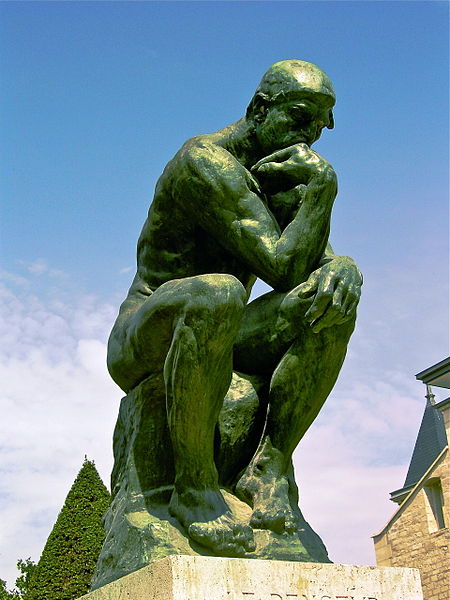
Whenever you pass by the desk of a colleague in office and see him staring with blank eyes at nothing in particular, you may 'The Thinker' : Rodinbe wrong in assuming that he is either worried about his upcoming annual appraisal or concerned about the academic performance of his kids. For all you know, like Rodin’s ‘The Thinker’, he could simply be withdrawn into himself, in a rather introspective mood, and trying to unravel life’s managerial mysteries which appear unfathomable at normal times.

One of the profound mysteries is that of facilitating innovation. History of major breakthroughs tells us of at least one factor which prompted the coveted ‘Aha!’ moment – a spot of idleness. Not the kind of idleness which is a trademark of laziness, but the dynamic type where the mind, firing at all six cylinders, suddenly decides to take a break, looks at its own self in a detached manner, delves into the realms of the sub-conscious and comes up with a gem of wisdom which had eluded it so far at the conscious level.

Some Unforgettable ‘Aha!’ Moments

Rewind to around 250 BC. If Archimedes had not decided to take some time off and soak himself in a bath tub, possibly playing with some floating toy ducks and singing along in a leisurely fashion – much to the discomfiture of his neighbors, world would have surely missed great many developments so far. There would have been no boats and ships. Countries the world over would have been dependent only on their foot soldiers and armies to defend their borders. At a more mundane level, the streets of ancient Syracuse would have missed the sight of a guy in his birthday suit running along, shouting ‘Eureka’ in gay abandon.

Visualize this scenario in 1666 AD. Newton has once again retired from Cambridge. In a contemplative mood, he is taking a leisurely stroll at Lincolnshire, in an apple orchard ostensibly owned by his mother. He has just been enjoying some tea which has had a remarkably invigorating effect on his grey matter. He sees an apple falling to the earth and starts wondering why it always has to fall down, an observation which lesser mortals like you and I would have merely shrugged off and resumed our walk. He gets down to doing some calculations and ends up giving to the inhabitants of Earth a great theory on forces of gravitation. Goes on to show what a relaxing cup of tea sipped in quiet repose in an apple orchard can accomplish.

Einstein, who left us as late as 1955 AD, was much impressed by the violin sonatas of Mozart and used to play chamber music. An inspiration for all those who suffer from absent-minded professor-itis, he pushed the frontiers of knowledge to mind-boggling levels at that point in time. History does not record a particular ‘Aha!’ moment when the theory of relativity got discovered, but the connection between the paradigm shift in our understanding of the universe and his love for music and the soothing effect it has on one’s grey matter can be readily understood. There is no doubt that the great man did not find the environment of the Swiss Patent Office conducive enough for innovative thinking.

Contemplative Downtime   

A common thread running through all these events is the presence of a unique ‘Aha!’ moment of illuminating thought, undoubtedly facilitated by a phase of idleness. Some scientists in California now say that even lesser mortals can benefit from a spot of daydreaming. This goes on to prove – if proof was ever needed – that sitting idle is not wasteful, as many whip-cracking CEOs would have us believe. A vast majority of managers, workers and students would heartily attest to the fact that difficult assignments are handled much better if only preceded by a spot of contemplative downtime. This way, they are likely to envision a more productive approach to the issue at hand, resulting into substantial savings for the organization they serve. As Tom Hodgkinson says, ‘The art of living is the art of bringing dreams and reality together’.

Globally, managements need to seriously look at the utility of mental downtime when the thinking faculties are allowed to wander freely. Rather than mistaking hectic physical activity for real efficiency and effectiveness on the job, most bosses heading a team of innovators and developers typically create a work culture which facilitates a contemplative mood. They also perfect the art of refraining from micromanaging. Nor do they abdicate. They lead simply by inspiring and standing up for their team members, whenever necessary. The result is an exponential jump in the much-coveted ‘Aha!’ moment for their team members.

Does A Rigid Hierarchy Stifle Innovation?

It has been shown that under favorable circumstances, problem solving abilities tend to improve by as much as 40%! If such moves are introduced, and further backed by tea/coffee breaks, the results could be even better. High time some ad honchos took up this clue and designed some clever TV spots for companies marketing these beverages!

In India, where the propensity to innovate appears to have diminished substantially compared to what it used to be in the Aryabhatta days, this proposition deserves far more serious thought. Perhaps our national laboratories, centers of excellence and R&D institutions need to work more days, but provide for additional tea/coffee breaks and exciting vacation binges. Going in for flatter organizations devoid of strict hierarchy could also lead to better quality of informal interactions, thereby increasing the productivity and rate of innovation. The Peter Principle is proof that organizations which put a higher premium on seniority are more likely to have a dismal record in the realm of innovation.

The Power of Daydreaming

Scientists may now claim to have discovered that the rejuvenating powers of officially sanctioned breaks are reduced if people skip off-times and use these to perform other equally demanding tasks. But the power of dynamic daydreaming was never in doubt. Our grand-parents have always held that ‘All work and no play make Jack a dull boy’!

REMEMBERING YASH CHOPRA

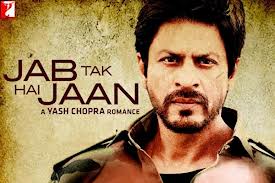
When we think of gorgeous heroines draped in plain color chiffon saris and sleeveless blouses – swaying to rhythmic beats composed poster jab tak hai jaanby eminent musicians and lip-synching soulful lyrics penned by proficient poets – with the magnificent Alps as a backdrop, the only name that comes to our minds is that of Yash Chopra!

The producer and director showed us the value of pure romance sans vulgarity in times when the only mantra to box office success appears to be “the lewder and cruder, the better”. He passed away last year. He has left behind a rich legacy of social comment through the wide-ranging themes of movies he produced or directed.

But the king of romance acquired this sobriquet by a very interesting process of evolution, through a long and arduous journey of making socially relevant movies which reflected our society’s challenges of their respective times. Like other popular directors of Bollywood – Raj Kapoor, Subhash Ghai and others – he had a unique ear for music, which was a hallmark of all his movies. The lyricists he associated with were accomplished poets who invariably came up with relevant and meaningful verses.

Evolving Into a King of Romance220px-Dhool_Ka_Phool

Partition, Secularism and Peace

If ‘Dhool ka Phool” (1959) was about illegitimate children, ‘Dharamputra’ (1961) touched upon religious intolerance in days when the term Hindu fundamentalism was not part of our vocabulary. The story of a Muslim bringing up a Hindu boy tugged at one’s heart-strings. The scenes of partition were hard-hitting, leading to a backlash at the time. That was perhaps the reason he never ventured to make a film on a political theme again during his lifetime.

However, he did come up with a clear message on peace and unity with his ‘Veer Zaara’ (2004). Not even a single bullet was fired in the film, but the message was loud and clear – that India and Pakistan share a common culture and a strong bond – by implication, both countries deserve a poster veer zaarachance to be together again, pooling their scarce resources to alleviate poverty, hunger and disease, instead of war mongering.

Family Values, Wealth and Bigamy

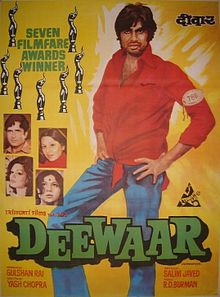
‘Waqt’ (1965) was his last movie where he worked with his elder brother Baldev Raj Chopra. It was the first one to have had a multi-star cast, a practice which is followed till today. It also spawned several other movies in the lost-and-found genre, popular ones being ‘Yaadon ki Baraat’ and ‘Amar Akbar Anthony’. The movie also depicted the lavish styles of the rich, conveying that 220px-Deewar_posteracquiring wealth is not necessarily evil.

Then he formed Yash Raj Films, his own banner, and came out with ‘Daag’ (1973). The issue of bigamy was handled with his trademark elegance and suavity.

The Angst of the Youth

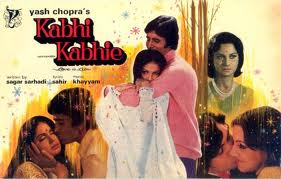
This was followed by two angry-young-man-phase movies, capitalizing on Amitabh Bachchan’s recently acquired image in ‘Zanjeer’. It started off with ‘Deewar’ (1975) and was followed by ‘Trishul’ (1978). In ‘Mashaal’ (1984), he cast thespian Dilip Kumar who portrayed an angry old man. Much to the glee of middle class audience struggling with rising aspirations kabhie kabhie posterand astronomical living costs, the means were no longer important; ends were.

Elegant Romance

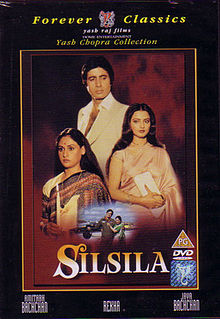
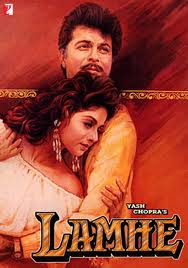
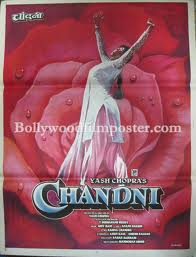
With ‘Kabhie Kabhie’ (1976), he introduced a poetic touch into the art of commercial movie making and set the box office registers tingling. This trend continued in his subsequent movies like ‘Silsila’ (1981), ‘Chandni’ 220px-Silsila(1989) and ‘Lamhe’ (1991). The angst eventually mellowed down and human emotions acquired center stage. All the characters in these movies were from an affluent background. In each venture, the canvas only got larger. In each, candy-floss romance was in the air, backed by melodious music and soulful lyrics that would remain etched in our collective psyche for a long time to come.

His style of depicting romance was muted, elegant and refined. The main protagonists were invariably civil and dignified, following the norms of propriety. It was devoid of lewd dialogues, coarse lyrics and vulgar scenes. Even in ‘Darr’ (1993), we had an anti-hero stalking the heroine, but never in bad taste.

Social Values and the Indian Diaspora Lamhe poster

He produced ‘Dilwaale Dulhania Le Jayenge’ (1995), which was directed by his son, Aditya Chopra. The movie set new records and Indians world over could readily connect with the superiority of family values it espoused. A daughter brought up in UK needs permission from her overbearing father for a vacation in Europe; a hero refuses to get persuaded by the heroine’s mother to elope with the heroine; instead, the couple works towards getting an approval of the match from the heroine’s father, come what may – these were market savvy master strokes in the script which made the movie immensely popular with all age groups.

Musical Romanceposter of chandni

Very few directors have ventured to work on a theme with music as a backdrop. ‘Dil To Pagal Hai’ (1997) did precisely that. All the main characters had a different perspective on love, and the movie was about the transformation of their belief systems. It was beautifully built around music and dance, elevated to a level where soul-mates discover each other.

We live in terrorism infested times. It is not surprising that his last venture, ‘Jab Tak Hai Jaan’ (2012) used this as a backdrop of a triangular love story.

An Ear for Music and Rich PoetryDDLJ poster

While supporting his brother, B. R. Chopra, Yash Chopra got to work with music directors like N. Dutta and Ravi. However, once on his own, he first worked with Lakshmikant Pyarelal for ‘Daag’, and then with Rahul Dev Burman for ‘Deewar’. Khayyam was his choice for ‘Kabhie Kabhie’ and ‘Trishul’. All through these movies, he worked with Sahir Ludhianvi as the lyricist.

Yet another master stroke was his persuading legendary classical musicians Shiv Kumar Sharma and Hari Prasad Chaurasia to compose the music for several of his movies. Together, they created a rich legacy of music in such movies as ‘Silsila’, ‘Chandni’, ‘Lamhe’ and ‘Darr’. The classical dance sequences performed with aplomb by  Sridevi in ‘Chandni’ and ‘Lamhe’ remain as fresh today as they were when captured on celluloid. ‘Silsila’ and ‘Veer Zaara’ had lyrics by Javed Akhtar, whereas all others had poetic inputs from Anand Bakshi.DTPH poster

For ‘Dil To Pagal Hai’, he turned to Uttam Singh, who came up with mellifluous compositions for the movie. His best was, however, reserved for ‘Veer Zaara’, which dug up old compositions of the legendary Madan Mohan, revived by the latter’s son Sanjeev Kohli.

In his last offering, ‘Jab Tak Hai Jaan’, he teamed up with A. R. Rehman, with lyrics by Gulzar.

Setting New Benchmarks

Undoubtedly, he set new benchmarks for the film industry. Several trends that we take for granted today were initiated by him. He set the template for future Bollywood directors who continue to ape his technical gloss but lack the depth of romance and human emotions captured by him. He was among the first to push the industry into professionalism. Working with classical musicians and accomplished Urdu poets, he has left behind a rich repertoire of music for all of us to savor for a long time to come.

He would always be fondly remembered for a certain elegance and refinement of language which many of the current breed of Bollywood dream merchants sadly lack. Also, for the unique brand of secularism, peace and unity he propagated through his movies.

Dear Amitabh ji,

I often wonder as to how you are able to handle yourself so well despite a continuous barrage of praise getting heaped on you from all sides. How do you keep your mental balance and equipoise in the face of unprecedented love and adulation being received by you at all times?

You conduct and carry yourself so well on KBC. When you suddenly have a winner of a “Ghar Baithe Jeeto Jackpot” award gushing all over you on phone, it is a treat to see your muted and calibrated response! The innumerable gifts and poems being presented to you by those making it to the “hot seat” of this game show do seem to move you but only for a few fleeting moments. You recover very quickly and get back to the job on hand, just like a true professional and gentleman that you indeed are!

You are ten years senior to me. I have had the pleasure of watching you enter Bollywood with “Saat Hindustani”. The way you have re-invented yourself in each of the subsequent decades is something to be learnt from you. Your career and that unique baritone voice is so well documented that I do not wish to bore you by repeating it here.

Some time back, a friend of mine gave me the entire set of four books comprising the biography of your illustrious father. Some parts were very touching – like the one which describes the first meeting between your parents, and the one where Khwaja Ahmed Abbas writes to your father, seeking his consent to offer you a role!

I also found the biography very instructive. It led me to a better understanding of the excellent family background that you have. Sure enough, your grooming has resulted into the calm and mature manner in which you conduct yourself. Your parents have set a fine example for all parents, bringing you up the way they had.

However, other than your excellent grooming, there is apparently something more to your unique quality of not allowing the abundant praise received by you to go to your head. A lesser mortal in your place would have surely become excessively swollen headed by now, leading to his own downfall. The younger actors of today need to learn this from you.

Can you please take some time off your busy schedule and answer this query? How did you develop this trait?

Warm regards,

Ashok Bhatia

Pondicherry, India

MANAGEMENT

Unlike a “should” guy who is a philosopher, and a “would” guy who is a politician, a good manager is a “could” guy. He is aware of the constraints of resources at his disposal, and get things done accordingly.

He is the first one to come in and the last one to go from office. No job is too small for him; he is a true hands-on guy, but develops his team by delegation.

He defines and respects the invisible boundary of professional distance between himself and his key team players. When his team members are attacked, he behaves like a lioness out to protect her cubs. His team just loves him!

MARKETINGMARKETING

An ever-changing discipline, though surely not the only one. When conceived and described by Philip Kotler, it consisted of the famous 4 Ps – Product, Price, Place and Promotion. With due respects to the great man, one may safely add one more P – Password (used for viral marketing).

With the advent of internet has come a virtual democracy in information. Changes in technology have brought in a new way the customers and brands interact. Marketing has undergone a sea change and will continue to do so in future as well, what with social re-engineering leading to a greater degree of inclusion in the economy, with hordes of new customers from a so-far underprivileged social milieu joining the market. Persons with access to internet now research the brands before making a decision. They are increasingly welcoming fresh content rather than repetitive ads.

Take note of the mini packs of biscuits, noodles and other consumer items being marketed at price points of Rs. 5 and below. Thirty years back, Indians had to wait for years to get to ride their own “Hamara Bajaj”. On the car front, there were hardly three suppliers in the fray then. Now, we see global brands wooing the customer and competing cheek and jowl for a slice of the market pie.

The Customer has now become a more empowered king!

MEETINGS

Meetings to decide strategic issues are best held off campus, though not necessarily in exotic locales.

Meetings to review operations are best kept short, held in the standing mode, at regular intervals (like TV news) without prior intimation, kept crisp by ruthlessly disallowing inter-departmental issues getting discussed while all others gape in horror and ignorance, ending much before the deadline and minutes being circulated by the end of the day with clear responsibilities defined in respect of targets to be met and respective deadlines.

It is generally accepted that the probability of a meeting taking place is inversely proportional to the number of participants.

Parkinson’s Law of Meetings states that “To a certain degree, the time spent in a meeting on an item is inversely proportional to its value”.

MEDIOCRITY vs. EXCELLENCE vs. PERFECTION

Always aim for perfection! It is said that Mr. R. M. Lala, an editor, writer and publisher of repute, once commented to Mr. J. R. D. Tata that the latter believed in excellence. The great man is said to have retorted thus: “Not excellence. Perfection. You aim for perfection, you will attain excellence. If you aim for excellence, you will go lower.”

Rabindranath Tagore, in his Gitanjali, captures the same concept thus: “Where tireless striving stretches its arms towards perfection”. Even though “perfection” may not be attainable in reality, what matters is the “tireless striving”, which could well prove to be a reward in itself. “Perfection”, like happiness, need not be a station one arrives at, but a mode of travel, making the journey interesting and worthwhile.MICROMANAGING

To improve our personal capacity utilization, our basic struggle needs to be attitudinal – to adopt a Culture of Perfection and to give up the Culture of Mediocrity.  Our collective chalta hai attitude is passé.

MICROMANAGING

A sure way of becoming a liability for your team and also for your employers is to micromanage – getting into the nitty-gritty of each and every aspect of the task at hand. Learn to delegate and allow your team members to make mistakes. Demand results, but develop your people in the long run.

MISTAKES, HANDLING OF

As an individual, say sorry. Say it openly. Add a dash of humor and laugh at yourself publically. Avoid a buck passing posture. Do a root cause analysis. Suggest and work on a solution to rectify the mistake. Try to avoid a recurrence.

As a corporate, get your PR to handle the issue well. Take demonstrable steps to set the record straight. During June 2011, Toyota globally recalled as many as 1,06,000 vehicles, offering to replace front right hand shaft in selected vehicles. During 2007, Mattel announced a recall of over 19 million toys fearing that the toys had powerful magnets which could come loose and be swallowed by infants. Their brand recall value only shot up.

Dear Damini,

Sadly, you are gone. But don’t you worry. Each spark out of the fire which was lit to consign your mortal remains to flames carries a luminous glow which would keep us introspective and acting upon the deficiencies in our system for a long time to come.

The Accused Are Bound to Suffer

You are lucky to have escaped a tormented and difficult life. Had you survived, life would not have been hunky dory. Media would not have left you in peace. Your relatives would have repeatedly questioned you as to why you had to stay away from home so late at night, indirectly blaming you for the brutal ordeal you had to undergo. Repeated visits to hospitals would have become tortuous after some time.

Not so for the accused. For a few moments of vicarious pleasure and sadistic revenge, they would atone throughout their remaining lives. Given the pressure which has got built up, the system would ensure that they receive the harshest punishment possible, that too possibly within a fraction of the time it normally takes to get a conviction announced.

The Hope You Have Generated

You have left behind a definite hope that our system would change for the better. Once the initial anguish and revulsion has subsided, meaningful action will get taken to ensure that India becomes a safer place for women in the days to come. The judiciary is awake, and so is the legislature. There is a realization that tightening laws alone will not help. The primary challenge lies in their interpretation and delivery, in ensuring that justice is swift and is also perceived to be inevitable. This involves not only sensitizing all arms of our republic better but also ensuring that there are more women occupying senior positions in the hierarchy.

Changes We Can Expect

From a heavenly perch, your soul must be watching in amazement the kind of contradictions our multi-layered society keeps coming up with. Politicians of all hues have decided to use your case as another scoring point with their eyes firmly fixed on their vote banks. But that is precisely what will ensure that we get tougher laws in the days to come.

Those responsible for enforcing the laws are presently claiming that they are under-staffed, under-paid and over-worked. Sheer public pressure will ensure that suitable changes happen over a period of time. As to our abysmally poor conviction rates – close to 25% in rape cases – your case is set to raise the bar. Our leaders are also coming forward to forego a part of their security staff, which would mean better per capita availability of police personnel for the common citizen.

Our self-anointed guardians of religious values and the great Indian tradition have not so far thought it fit to make an appeal to reform the gender-bias inherent in our society. There is no call as yet to reinterpret our scriptures to make them more progressive in their thought, in tune with the times. Our spiritual masters are yet to react to the underlying malaise in our society which does not provide a level playing field to females – whether before or after birth. Slowly and steadily, these changes would also come about.

Our advertising honchos believe that they cannot survive without using sexual innuendo in the ads they create. But brands which persist with obnoxious campaigns will eventually suffer in the market place. Our movie makers think that they can get the box office registers tingling only by putting in raunchy item songs, lewd lyrics and coarse dialogues. Admittedly, movies that one can watch with the entire family at home can be counted on finger tips. But, come to think of it, there is no dearth of such movies as well. To quote only a few of recent origin: ‘Chak De, India’, ‘Well Done, Abba’, ‘Do Dooni Chaar’ and ‘Ferrari Ki Sawari’, besides a host of others which have steered clear of pandering to the front rows in a theater.

You can readily see through the argument that provocative dresses and influence of ads and movies are responsible for the gender bias prevalent in our society. If the males shed their chauvinism a wee bit, and instead develop an inner resilience, these external factors would hardly make a difference. This can only be done through a sustained campaign directed at parents and bringing in an education system which places greater emphasis on moral aspects of life.

Business, even though it sustains itself on resources pooled in from the society, is too busy to bother about ensuring an absence of harassment at work or even in transit to and from the place of work. Often one sees a makeshift crèche coming up only when a buyer’s inspection is to take place in a manufacturing establishment. But progressive companies which take care of gender issues do end up attracting better talent.

The Rising Female Power

Economies the world over may not be in the pink of health. But the pink collar brigade has already made its presence felt in so many spheres of our lives. Right from the armed forces to civil engineering, from banking to pharmaceuticals, from medicine to management, from space exploration to music and fine arts – look at any field of expertise and you would find the finer of our species leading the pack. Until two decades back, women were found only in the jobs of receptionists, stenographers and laboratory technicians. Now, they hold sway over executive and managerial positions as well.

According to Grant Thornton’s International Business Report, percentage of Indian women in senior management roles had gone up from 9% in 2011 to 14% in 2012. Globally, however, the percentage has remained unchanged at about 21%. Global average of women chief executives rose from 8% to 9%; in India, it has gone up from 1% in 2011 to 10% in 2012! As per the same report, globally, less than 10% of businesses have female CEOs, with women largely employed in HR and finance functions.

You may be aware that for some time now, EU has been planning to introduce a law that would impose penalties on companies that do not allocate 40% of the seats on their boards to women. It has met with opposition from Britain and other countries and stands blocked, as of now. But the day is not far off when this will eventually get done.

The Real Challenges

The most difficult change is going to be that of our patriarchy oriented value system. The next would be to ensure that delivery of justice is swift and inevitable. Above all, we need to ensure that the pressure of public opinion is sustained; that your case does not fade from the collective public memory for a long time to come.

Rest in Peace

Rest assured that positive changes will come about. The pace and the contours of the change may not exactly delight us. But your supreme sacrifice will not go in vain!

(Related Posts:

https://ashokbhatia.wordpress.com/2013/05/01/the-anguish-of-a-soul

https://ashokbhatia.wordpress.com/2015/03/11/to-nirbhaya-the-fearless-a-daughter-of-india)

14As Mr. Ratan Tata demits office as a Chairman of Tata Sons and as a head of the $84 billion conglomerate of over 100 companies in the world-famous Tata group on the 28th of December, 2012, permit me to salute the group as well as its illustrious leaders who have led it to great heights in the field of business, as also in philanthropy and in socially relevant initiatives.

I am just one amongst millions of the group’s ex-employees who have had a stint with the Tata group.  The connection of my family with the group spans three generations. Way back in 1945, my father was associated with Tata Airlines. In 1976, I started my career with the Leather Complex of Tata Exports (now known as Tata International). Due to compelling personal reasons, I had to finally leave the group in 1993. In 2003, my son started his career innings with Tata Motors.

What is it that goes on to make the Tata group different from its competitors and contemporaries in the business world? With all humility that I can muster, here is my take.

Succession Planning

Mr. Jamsetji N. Tata was the founder of the group. In 1904, he handed over the baton to Sir Dorab Tata, who was at the helm of affairs till 1932, followed by Sir Nowroji Saklatvala who was there till 1938.

The group was then steered by Mr. J. R. D. Tata till 1991, when the charge passed on to Mr. Ratan Tata. It was on March 23, 1991, that Mr. Ratan Tata was told by his uncle that he intended to handover the baton of the group to him. Coinciding with the economic reforms unleashed by Dr. Manmohan Singh, the group has had a remarkable journey since then!

Mr. Ratan Tata took over the reins of the group at a time when it was an empire made up of several independent fiefdoms, run by stalwarts like Mr. Darbari Seth, Mr. Russi Mody, Mr. Ajit Kerkar and Mr. Nani Palkhivala.

Much like the King Bharata in Mahabharata who chose a successor based on merit alone, the group has invariably followed the principle of meritocracy when choosing a successor. What Cyrus Mistry takes over from him today is a much more well-knit and cohesive group, united by a shared philosophy, vision and identity.

A Conservative Outlook on Diversification

Tatas have often been criticised for not being enterprising enough to diversify into new fields. Mr. J. R. D. Tata himself attributed this in 1991 to two factors – an unwillingness to compromise on certain principles in the licence and permit raj prevalent then, and a long-held belief that the group’s principal role was to develop basic industries.

From textiles, hotels and a premier institute of learning, the group took a leap of faith to set up the first steel plant in India at the beginning of the last century. Then it ventured into hydro-electric power, soaps and detergents, cement, tin, soda ash, housing and commercial vehicles. Post 1947, when India gained independence, the group went in for cosmetics, steel tubes, refrigeration, fisheries, refractories and pharmaceuticals. Tea, watches, bearings and several others followed.

During Mr. Ratan Tata’s tenure, the group improved its focus on the business horizon. In tune with the changing times, TOMCO, Lakme, Merind, ACC, Nerolac Paints and others got hived off. Businesses like IT, telecom and financial services got added to the group’s portfolio. TCS became a flagship company, leading India’s march into the knowledge economy.

In 2000, Tata Tea took over UK brand Tetley. During 2007, Tata Steel acquired Anglo-Dutch rival Corus. The buyout of JLR in 2008 supplemented the core competency of the group company now referred to as Tata Motors. This move further established the global aspirations of the group – a segment which today contributes 60% of its revenues. Leveraging its strengths in the automobile sector, the group entered the territory of passenger cars, overcoming such hurdles as the Singur controversy. Nano is an innovation which has been taken note of globally.

Mr. Ratan Tata did not have it easy. Due to a negative business environment, the entry of Tatas in the field of airlines got aborted. It moved in time to save Tata Financial Services when the top management there committed fraud. In the telecom field, it had to grapple with a nascent industry which is still plagued by policy uncertainty. The controversy surrounding the infamous Radia tapes went on to show that what would have been considered a minor transgression by any other business house proved to be a demoralizing factor, somewhat sullying the group’s pristine white image.

Referring to the airline fiasco, he claimed in a press interview that he was rather proud of the fact that he could not handle political manipulations.

Concern for Environment and CSR

Industrialists complaining about environmental regulations and land acquisition issues today could surely learn a few lessons from Mr. J. N. Tata when he went about setting up India’s first steel plant during the early 1900s in what was then a predominantly forest area, inhabited by tribals.

In a letter written to his son in 1902, five years before the site of the steel plant was finally located, Mr. J. N. Tata laid down broad guidelines covering the design of the industrial complex which was to come up at Jamshedpur: “Be sure to lay wide streets planted with shady trees, every other of a quick-growing variety. Be sure that there is plenty of space for lawns and gardens. Reserve large areas for football, hockey and parks. Earmark areas for Hindu temples, Mohammedan mosques and Christian churches”.

When TELCO Pune was planned, thousands of trees got planted first. Since trees needed water, an artificial lake was created with a circumference of four kilometres. The factory buildings came up much later.

At the Leather Complex at Dewas (MP) that I was associated with, other than a massive plantation of trees of all kinds, a deer park was also set up. Our Accounts Department was often twiddling its thumbs to figure out if the cost incurred on the animals’ upkeep was reasonable!

Focus on People

The average Tata manager is sober, knowledgeable, mature, restrained, dignified, humane and downright ethical.  It does not boast of, but is quietly aware of, being part of a group which has always conducted its affairs in a transparent and ethical manner. There is an in-born self-belief that the values Tatas follow are not a mere statement of pious intentions; rather, these form a blueprint which guides and permeates all the activities the group.

Tata Steel has several firsts to its credit in the realm of labour welfare. An eight-hour working day was introduced in 1912 itself, whereas the law mandated it only in 1948. Likewise, free medical aid, establishment of a Welfare Department, formation of a Works Committee for handling employee grievances and leave with pay, provident fund, etc. were introduced much before the relevant laws came into being.

The social welfare measures across various Tata companies may vary, but the standards set by them somewhat exceed the legal requirements. Tax planning, yes; tax evasion, never. The group’s foray into education, fine arts and other socially relevant projects was planned and executed at a time when CSR norms were not even heard of.

How closely the value of compassion is cherished became very clear in the aftermath of the 26/11 terrorist attack on The Taj Mahal Hotel. The conduct of the employees during the attack and the subsequent support they received from the management is a case study in organizational behaviour and employee motivation.

I had a first-hand experience of this value of compassion in 1991 when I and a colleague of mine were mercilessly beaten up by a gang of misinformed workers of one of the small ancillary units of the Tata Exports. Prompt medical attention, legal support, counselling for the self and the family and a compulsory vacation followed automatically. A month later, Mr. Syamal Gupta, the then MD, nine rungs above us in the rigid Tata hierarchy, called for a personal meeting and instilled in us a sense of pride and fulfilment for having stood up to the rowdy elements in the work force.

The fact that I write this piece almost twenty years after I parted company with the group goes on to show the sense of belongingness I still – and shall continue to – carry with me!

Ethics and Values – A High Moral Quotient

When I look back at my association with the group, which lasted over ten years split over two phases, I am amazed at the rich learning I had. Job rotation, technical training and job knowledge apart, the exposure to the nuts and bolts of business ethics left an everlasting impression on my psyche.

A bribe was a simply not payable, whatever the commercial cost of keeping an entire manufacturing facility idle for three weeks. A senior manager who made the error of judgement of offering a bribe to a government servant for securing a permission was publically rebuked and persuaded to leave the company. Instead, I, a junior office then, was sent to accomplish the task without any speed money being paid. Luckily, I could manage this feat, though the company ended up incurring a cost of five times the bribe amount on my trip alone!

Aiming for Perfection

As per Mr. J. R. D. Tata, “One of the weaknesses of our country is that we are satisfied with the second or third best in everything. The basic attitude of chalega, ayega, dekhega. Therefore almost everything we do, we do it poorly”. He always maintained that “You can’t achieve high standards by aiming at those standards. You can only achieve a standard by aiming at something more. If you want excellence, you must aim at perfection”.

This implies painstaking attention to detail, a trait which permeates all spheres of the group’s activities. When a new factory block came up in the company, I asked my boss as to why a black stone slab was made a part of the flooring at the entrance to the shop floor. He was quick to point out: “That is the only way to ensure that we have minimum dirt and dust entering the floor; black colour will show any deviations without fail!”

“Humata”, “Hukhta”, “Hvarshta”

These words form a part of the Tata crest, designed by the founder Mr. Jamsetji Tata. In the ancient Avesta language, these mean “Good Thoughts”, “Good Words” and “Good Deeds”. The premium that the Tata brand enjoys in the market is the culmination of more than a century of efforts of the group, based on these principles and values preached as well as practised by the group.

As Mr. Ratan Tata henceforth channelizes his dynamism towards philanthropic activities and development projects, I have no doubt that he would come up with more innovations in the field of social entrepreneurship, so as to transform and upgrade the lives of millions in India at the bottom of the pyramid.

I once had the privilege of meeting him fleetingly at a Pragati Maidan Expo held in New Delhi in 1993. From what little I know of him, he is not the retiring kind. To him one cannot express the usual wishes of a peaceful and quiet retirement, howsoever well deserved it is. One may instead wish him long life, health, contentment and all the fun and excitement he can find in any activity he may choose to indulge in hereafter.

Likewise, one wishes Mr. Cyrus Mistry a great cruise ahead in these times of exciting business possibilities for the group! To quote a song from “The Sound of Music” – one of the greatest musical movies ever produced:

“Climb every mountain, ford every stream; Follow every rainbow, till you find your dream….!”