Feeds:
Posts
Comments

MANAGEMENT

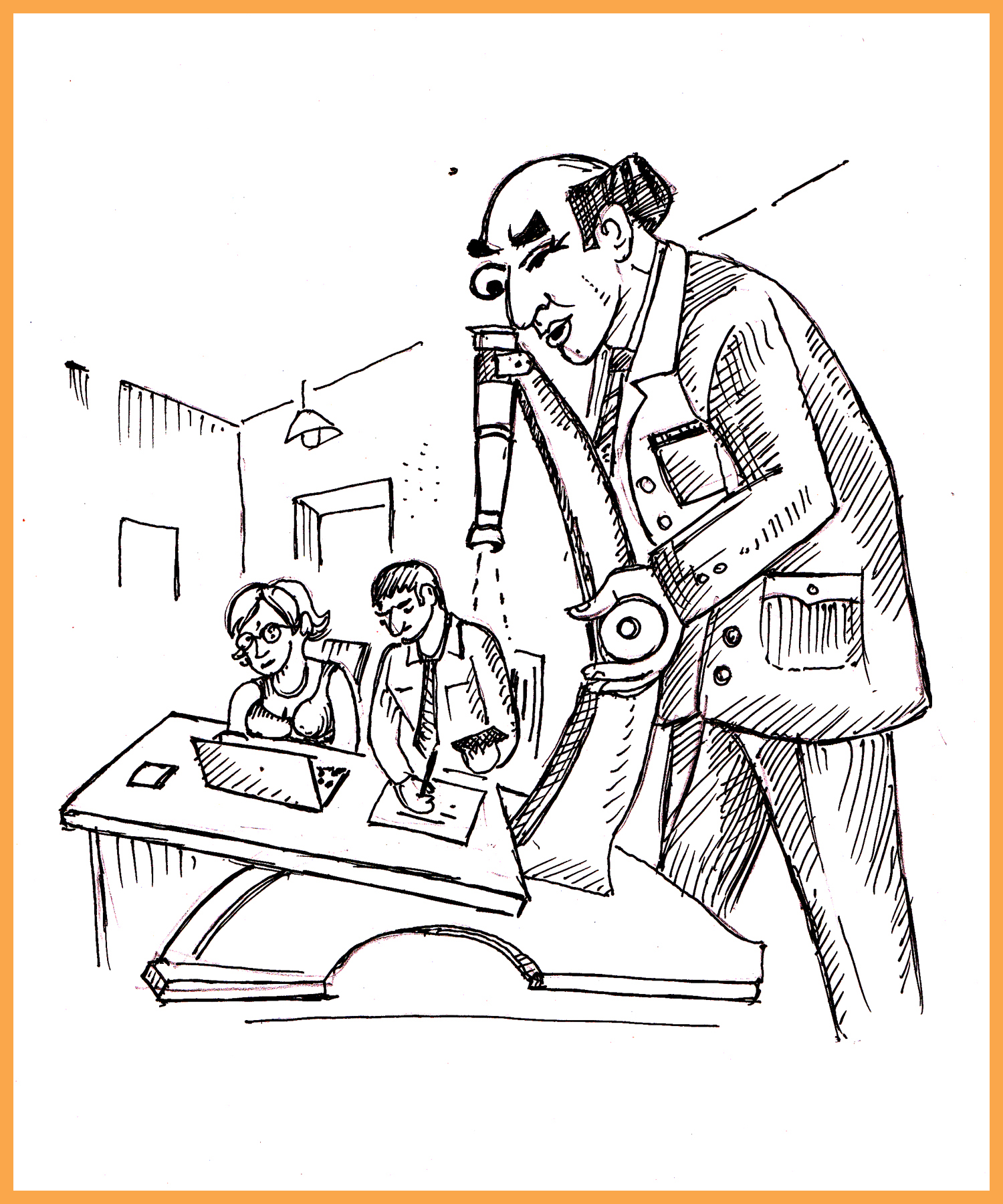
Unlike a “should” guy who is a philosopher, and a “would” guy who is a politician, a good manager is a “could” guy. He is aware of the constraints of resources at his disposal, and get things done accordingly.

He is the first one to come in and the last one to go from office. No job is too small for him; he is a true hands-on guy, but develops his team by delegation.

He defines and respects the invisible boundary of professional distance between himself and his key team players. When his team members are attacked, he behaves like a lioness out to protect her cubs. His team just loves him!

MARKETINGMARKETING

An ever-changing discipline, though surely not the only one. When conceived and described by Philip Kotler, it consisted of the famous 4 Ps – Product, Price, Place and Promotion. With due respects to the great man, one may safely add one more P – Password (used for viral marketing).

With the advent of internet has come a virtual democracy in information. Changes in technology have brought in a new way the customers and brands interact. Marketing has undergone a sea change and will continue to do so in future as well, what with social re-engineering leading to a greater degree of inclusion in the economy, with hordes of new customers from a so-far underprivileged social milieu joining the market. Persons with access to internet now research the brands before making a decision. They are increasingly welcoming fresh content rather than repetitive ads.

Take note of the mini packs of biscuits, noodles and other consumer items being marketed at price points of Rs. 5 and below. Thirty years back, Indians had to wait for years to get to ride their own “Hamara Bajaj”. On the car front, there were hardly three suppliers in the fray then. Now, we see global brands wooing the customer and competing cheek and jowl for a slice of the market pie.

The Customer has now become a more empowered king!

MEETINGS

Meetings to decide strategic issues are best held off campus, though not necessarily in exotic locales.

Meetings to review operations are best kept short, held in the standing mode, at regular intervals (like TV news) without prior intimation, kept crisp by ruthlessly disallowing inter-departmental issues getting discussed while all others gape in horror and ignorance, ending much before the deadline and minutes being circulated by the end of the day with clear responsibilities defined in respect of targets to be met and respective deadlines.

It is generally accepted that the probability of a meeting taking place is inversely proportional to the number of participants.

Parkinson’s Law of Meetings states that “To a certain degree, the time spent in a meeting on an item is inversely proportional to its value”.

MEDIOCRITY vs. EXCELLENCE vs. PERFECTION

Always aim for perfection! It is said that Mr. R. M. Lala, an editor, writer and publisher of repute, once commented to Mr. J. R. D. Tata that the latter believed in excellence. The great man is said to have retorted thus: “Not excellence. Perfection. You aim for perfection, you will attain excellence. If you aim for excellence, you will go lower.”

Rabindranath Tagore, in his Gitanjali, captures the same concept thus: “Where tireless striving stretches its arms towards perfection”. Even though “perfection” may not be attainable in reality, what matters is the “tireless striving”, which could well prove to be a reward in itself. “Perfection”, like happiness, need not be a station one arrives at, but a mode of travel, making the journey interesting and worthwhile.MICROMANAGING

To improve our personal capacity utilization, our basic struggle needs to be attitudinal – to adopt a Culture of Perfection and to give up the Culture of Mediocrity.  Our collective chalta hai attitude is passé.

MICROMANAGING

A sure way of becoming a liability for your team and also for your employers is to micromanage – getting into the nitty-gritty of each and every aspect of the task at hand. Learn to delegate and allow your team members to make mistakes. Demand results, but develop your people in the long run.

MISTAKES, HANDLING OF

As an individual, say sorry. Say it openly. Add a dash of humor and laugh at yourself publically. Avoid a buck passing posture. Do a root cause analysis. Suggest and work on a solution to rectify the mistake. Try to avoid a recurrence.

As a corporate, get your PR to handle the issue well. Take demonstrable steps to set the record straight. During June 2011, Toyota globally recalled as many as 1,06,000 vehicles, offering to replace front right hand shaft in selected vehicles. During 2007, Mattel announced a recall of over 19 million toys fearing that the toys had powerful magnets which could come loose and be swallowed by infants. Their brand recall value only shot up.

Dear Damini,

Sadly, you are gone. But don’t you worry. Each spark out of the fire which was lit to consign your mortal remains to flames carries a luminous glow which would keep us introspective and acting upon the deficiencies in our system for a long time to come.

The Accused Are Bound to Suffer

You are lucky to have escaped a tormented and difficult life. Had you survived, life would not have been hunky dory. Media would not have left you in peace. Your relatives would have repeatedly questioned you as to why you had to stay away from home so late at night, indirectly blaming you for the brutal ordeal you had to undergo. Repeated visits to hospitals would have become tortuous after some time.

Not so for the accused. For a few moments of vicarious pleasure and sadistic revenge, they would atone throughout their remaining lives. Given the pressure which has got built up, the system would ensure that they receive the harshest punishment possible, that too possibly within a fraction of the time it normally takes to get a conviction announced.

The Hope You Have Generated

You have left behind a definite hope that our system would change for the better. Once the initial anguish and revulsion has subsided, meaningful action will get taken to ensure that India becomes a safer place for women in the days to come. The judiciary is awake, and so is the legislature. There is a realization that tightening laws alone will not help. The primary challenge lies in their interpretation and delivery, in ensuring that justice is swift and is also perceived to be inevitable. This involves not only sensitizing all arms of our republic better but also ensuring that there are more women occupying senior positions in the hierarchy.

Changes We Can Expect

From a heavenly perch, your soul must be watching in amazement the kind of contradictions our multi-layered society keeps coming up with. Politicians of all hues have decided to use your case as another scoring point with their eyes firmly fixed on their vote banks. But that is precisely what will ensure that we get tougher laws in the days to come.

Those responsible for enforcing the laws are presently claiming that they are under-staffed, under-paid and over-worked. Sheer public pressure will ensure that suitable changes happen over a period of time. As to our abysmally poor conviction rates – close to 25% in rape cases – your case is set to raise the bar. Our leaders are also coming forward to forego a part of their security staff, which would mean better per capita availability of police personnel for the common citizen.

Our self-anointed guardians of religious values and the great Indian tradition have not so far thought it fit to make an appeal to reform the gender-bias inherent in our society. There is no call as yet to reinterpret our scriptures to make them more progressive in their thought, in tune with the times. Our spiritual masters are yet to react to the underlying malaise in our society which does not provide a level playing field to females – whether before or after birth. Slowly and steadily, these changes would also come about.

Our advertising honchos believe that they cannot survive without using sexual innuendo in the ads they create. But brands which persist with obnoxious campaigns will eventually suffer in the market place. Our movie makers think that they can get the box office registers tingling only by putting in raunchy item songs, lewd lyrics and coarse dialogues. Admittedly, movies that one can watch with the entire family at home can be counted on finger tips. But, come to think of it, there is no dearth of such movies as well. To quote only a few of recent origin: ‘Chak De, India’, ‘Well Done, Abba’, ‘Do Dooni Chaar’ and ‘Ferrari Ki Sawari’, besides a host of others which have steered clear of pandering to the front rows in a theater.

You can readily see through the argument that provocative dresses and influence of ads and movies are responsible for the gender bias prevalent in our society. If the males shed their chauvinism a wee bit, and instead develop an inner resilience, these external factors would hardly make a difference. This can only be done through a sustained campaign directed at parents and bringing in an education system which places greater emphasis on moral aspects of life.

Business, even though it sustains itself on resources pooled in from the society, is too busy to bother about ensuring an absence of harassment at work or even in transit to and from the place of work. Often one sees a makeshift crèche coming up only when a buyer’s inspection is to take place in a manufacturing establishment. But progressive companies which take care of gender issues do end up attracting better talent.

The Rising Female Power

Economies the world over may not be in the pink of health. But the pink collar brigade has already made its presence felt in so many spheres of our lives. Right from the armed forces to civil engineering, from banking to pharmaceuticals, from medicine to management, from space exploration to music and fine arts – look at any field of expertise and you would find the finer of our species leading the pack. Until two decades back, women were found only in the jobs of receptionists, stenographers and laboratory technicians. Now, they hold sway over executive and managerial positions as well.

According to Grant Thornton’s International Business Report, percentage of Indian women in senior management roles had gone up from 9% in 2011 to 14% in 2012. Globally, however, the percentage has remained unchanged at about 21%. Global average of women chief executives rose from 8% to 9%; in India, it has gone up from 1% in 2011 to 10% in 2012! As per the same report, globally, less than 10% of businesses have female CEOs, with women largely employed in HR and finance functions.

You may be aware that for some time now, EU has been planning to introduce a law that would impose penalties on companies that do not allocate 40% of the seats on their boards to women. It has met with opposition from Britain and other countries and stands blocked, as of now. But the day is not far off when this will eventually get done.

The Real Challenges

The most difficult change is going to be that of our patriarchy oriented value system. The next would be to ensure that delivery of justice is swift and inevitable. Above all, we need to ensure that the pressure of public opinion is sustained; that your case does not fade from the collective public memory for a long time to come.

Rest in Peace

Rest assured that positive changes will come about. The pace and the contours of the change may not exactly delight us. But your supreme sacrifice will not go in vain!

(Related Posts:

https://ashokbhatia.wordpress.com/2013/05/01/the-anguish-of-a-soul

https://ashokbhatia.wordpress.com/2015/03/11/to-nirbhaya-the-fearless-a-daughter-of-india)

14As Mr. Ratan Tata demits office as a Chairman of Tata Sons and as a head of the $84 billion conglomerate of over 100 companies in the world-famous Tata group on the 28th of December, 2012, permit me to salute the group as well as its illustrious leaders who have led it to great heights in the field of business, as also in philanthropy and in socially relevant initiatives.

I am just one amongst millions of the group’s ex-employees who have had a stint with the Tata group.  The connection of my family with the group spans three generations. Way back in 1945, my father was associated with Tata Airlines. In 1976, I started my career with the Leather Complex of Tata Exports (now known as Tata International). Due to compelling personal reasons, I had to finally leave the group in 1993. In 2003, my son started his career innings with Tata Motors.

What is it that goes on to make the Tata group different from its competitors and contemporaries in the business world? With all humility that I can muster, here is my take.

Succession Planning

Mr. Jamsetji N. Tata was the founder of the group. In 1904, he handed over the baton to Sir Dorab Tata, who was at the helm of affairs till 1932, followed by Sir Nowroji Saklatvala who was there till 1938.

The group was then steered by Mr. J. R. D. Tata till 1991, when the charge passed on to Mr. Ratan Tata. It was on March 23, 1991, that Mr. Ratan Tata was told by his uncle that he intended to handover the baton of the group to him. Coinciding with the economic reforms unleashed by Dr. Manmohan Singh, the group has had a remarkable journey since then!

Mr. Ratan Tata took over the reins of the group at a time when it was an empire made up of several independent fiefdoms, run by stalwarts like Mr. Darbari Seth, Mr. Russi Mody, Mr. Ajit Kerkar and Mr. Nani Palkhivala.

Much like the King Bharata in Mahabharata who chose a successor based on merit alone, the group has invariably followed the principle of meritocracy when choosing a successor. What Cyrus Mistry takes over from him today is a much more well-knit and cohesive group, united by a shared philosophy, vision and identity.

A Conservative Outlook on Diversification

Tatas have often been criticised for not being enterprising enough to diversify into new fields. Mr. J. R. D. Tata himself attributed this in 1991 to two factors – an unwillingness to compromise on certain principles in the licence and permit raj prevalent then, and a long-held belief that the group’s principal role was to develop basic industries.

From textiles, hotels and a premier institute of learning, the group took a leap of faith to set up the first steel plant in India at the beginning of the last century. Then it ventured into hydro-electric power, soaps and detergents, cement, tin, soda ash, housing and commercial vehicles. Post 1947, when India gained independence, the group went in for cosmetics, steel tubes, refrigeration, fisheries, refractories and pharmaceuticals. Tea, watches, bearings and several others followed.

During Mr. Ratan Tata’s tenure, the group improved its focus on the business horizon. In tune with the changing times, TOMCO, Lakme, Merind, ACC, Nerolac Paints and others got hived off. Businesses like IT, telecom and financial services got added to the group’s portfolio. TCS became a flagship company, leading India’s march into the knowledge economy.

In 2000, Tata Tea took over UK brand Tetley. During 2007, Tata Steel acquired Anglo-Dutch rival Corus. The buyout of JLR in 2008 supplemented the core competency of the group company now referred to as Tata Motors. This move further established the global aspirations of the group – a segment which today contributes 60% of its revenues. Leveraging its strengths in the automobile sector, the group entered the territory of passenger cars, overcoming such hurdles as the Singur controversy. Nano is an innovation which has been taken note of globally.

Mr. Ratan Tata did not have it easy. Due to a negative business environment, the entry of Tatas in the field of airlines got aborted. It moved in time to save Tata Financial Services when the top management there committed fraud. In the telecom field, it had to grapple with a nascent industry which is still plagued by policy uncertainty. The controversy surrounding the infamous Radia tapes went on to show that what would have been considered a minor transgression by any other business house proved to be a demoralizing factor, somewhat sullying the group’s pristine white image.

Referring to the airline fiasco, he claimed in a press interview that he was rather proud of the fact that he could not handle political manipulations.

Concern for Environment and CSR

Industrialists complaining about environmental regulations and land acquisition issues today could surely learn a few lessons from Mr. J. N. Tata when he went about setting up India’s first steel plant during the early 1900s in what was then a predominantly forest area, inhabited by tribals.

In a letter written to his son in 1902, five years before the site of the steel plant was finally located, Mr. J. N. Tata laid down broad guidelines covering the design of the industrial complex which was to come up at Jamshedpur: “Be sure to lay wide streets planted with shady trees, every other of a quick-growing variety. Be sure that there is plenty of space for lawns and gardens. Reserve large areas for football, hockey and parks. Earmark areas for Hindu temples, Mohammedan mosques and Christian churches”.

When TELCO Pune was planned, thousands of trees got planted first. Since trees needed water, an artificial lake was created with a circumference of four kilometres. The factory buildings came up much later.

At the Leather Complex at Dewas (MP) that I was associated with, other than a massive plantation of trees of all kinds, a deer park was also set up. Our Accounts Department was often twiddling its thumbs to figure out if the cost incurred on the animals’ upkeep was reasonable!

Focus on People

The average Tata manager is sober, knowledgeable, mature, restrained, dignified, humane and downright ethical.  It does not boast of, but is quietly aware of, being part of a group which has always conducted its affairs in a transparent and ethical manner. There is an in-born self-belief that the values Tatas follow are not a mere statement of pious intentions; rather, these form a blueprint which guides and permeates all the activities the group.

Tata Steel has several firsts to its credit in the realm of labour welfare. An eight-hour working day was introduced in 1912 itself, whereas the law mandated it only in 1948. Likewise, free medical aid, establishment of a Welfare Department, formation of a Works Committee for handling employee grievances and leave with pay, provident fund, etc. were introduced much before the relevant laws came into being.

The social welfare measures across various Tata companies may vary, but the standards set by them somewhat exceed the legal requirements. Tax planning, yes; tax evasion, never. The group’s foray into education, fine arts and other socially relevant projects was planned and executed at a time when CSR norms were not even heard of.

How closely the value of compassion is cherished became very clear in the aftermath of the 26/11 terrorist attack on The Taj Mahal Hotel. The conduct of the employees during the attack and the subsequent support they received from the management is a case study in organizational behaviour and employee motivation.

I had a first-hand experience of this value of compassion in 1991 when I and a colleague of mine were mercilessly beaten up by a gang of misinformed workers of one of the small ancillary units of the Tata Exports. Prompt medical attention, legal support, counselling for the self and the family and a compulsory vacation followed automatically. A month later, Mr. Syamal Gupta, the then MD, nine rungs above us in the rigid Tata hierarchy, called for a personal meeting and instilled in us a sense of pride and fulfilment for having stood up to the rowdy elements in the work force.

The fact that I write this piece almost twenty years after I parted company with the group goes on to show the sense of belongingness I still – and shall continue to – carry with me!

Ethics and Values – A High Moral Quotient

When I look back at my association with the group, which lasted over ten years split over two phases, I am amazed at the rich learning I had. Job rotation, technical training and job knowledge apart, the exposure to the nuts and bolts of business ethics left an everlasting impression on my psyche.

A bribe was a simply not payable, whatever the commercial cost of keeping an entire manufacturing facility idle for three weeks. A senior manager who made the error of judgement of offering a bribe to a government servant for securing a permission was publically rebuked and persuaded to leave the company. Instead, I, a junior office then, was sent to accomplish the task without any speed money being paid. Luckily, I could manage this feat, though the company ended up incurring a cost of five times the bribe amount on my trip alone!

Aiming for Perfection

As per Mr. J. R. D. Tata, “One of the weaknesses of our country is that we are satisfied with the second or third best in everything. The basic attitude of chalega, ayega, dekhega. Therefore almost everything we do, we do it poorly”. He always maintained that “You can’t achieve high standards by aiming at those standards. You can only achieve a standard by aiming at something more. If you want excellence, you must aim at perfection”.

This implies painstaking attention to detail, a trait which permeates all spheres of the group’s activities. When a new factory block came up in the company, I asked my boss as to why a black stone slab was made a part of the flooring at the entrance to the shop floor. He was quick to point out: “That is the only way to ensure that we have minimum dirt and dust entering the floor; black colour will show any deviations without fail!”

“Humata”, “Hukhta”, “Hvarshta”

These words form a part of the Tata crest, designed by the founder Mr. Jamsetji Tata. In the ancient Avesta language, these mean “Good Thoughts”, “Good Words” and “Good Deeds”. The premium that the Tata brand enjoys in the market is the culmination of more than a century of efforts of the group, based on these principles and values preached as well as practised by the group.

As Mr. Ratan Tata henceforth channelizes his dynamism towards philanthropic activities and development projects, I have no doubt that he would come up with more innovations in the field of social entrepreneurship, so as to transform and upgrade the lives of millions in India at the bottom of the pyramid.

I once had the privilege of meeting him fleetingly at a Pragati Maidan Expo held in New Delhi in 1993. From what little I know of him, he is not the retiring kind. To him one cannot express the usual wishes of a peaceful and quiet retirement, howsoever well deserved it is. One may instead wish him long life, health, contentment and all the fun and excitement he can find in any activity he may choose to indulge in hereafter.

Likewise, one wishes Mr. Cyrus Mistry a great cruise ahead in these times of exciting business possibilities for the group! To quote a song from “The Sound of Music” – one of the greatest musical movies ever produced:

“Climb every mountain, ford every stream; Follow every rainbow, till you find your dream….!”

THE COUNTDOWN IS OVER!

If you are reading this on the 23rdof December, 2012, it is proof enough that the world has not come to an end on the 21st of this month!

Quite a few doomsday believers had interpreted an ancient Mayan calendar to indicate that on the fateful day of 21st of December, 2012, a 5,125-year cycle known as the Long Count would come to an end. So, they had predicted an end of the world on that day.

You may be aware that this prediction had come in handy for many glum faced entrepreneurs and marketing professionals in these hard-hit recessionary times. As a result, employment prospects had improved for many in several countries. In USA, sales of survival shelters had sky-rocketed. In France, China and Russia demand for candles and essential items had shot up sharply. Film producers had a field day cashing in on the fear psychosis.

Had the world really ended that day, you would have never known what eventually happened to President Obama’s difficulties. The manner in which the Euro-zone crisis had got resolved would have remained a mystery. The fate of Afghanistan would have remained unclear. The manner in which ties between Japan and China had shaped up after the elections in Japan would have never been known to you.

Closer home,Chief Minister of a big state which had just gone to the polls would have possibly lost a chance of fulfilling his prime ministerial ambitions in the 2014 general elections. Our legislative bodies would have been denied further luxury of delaying vital pieces of legislation through shadow-boxing. MNCs wanting to invest in India would no longer have been around twiddling their thumbs to figure out how to kick-start their businesses in India, weaving their way through the corruption-infested systems we have in place.

If you happen to be a public-spirited soul, you would have never known which VIPs are being targeted next by our self-anointed anti-corruption crusaders. The eventual fate of the Aam Aadmi Party would have been lost to posterity, thereby denying you some chance of cleaning up our political arena. For the poorest amongst you, there would have been no way of knowing if the ruling party’s plans of direct transfer of benefits to your bank account had indeed fructified. Benefits of economic growth trickling down to you would no longer have been possible.

Had the end come, your dreams of making a trip either to Moon or to Mars, or even settling down there, would have come to a naught. For the well-heeled amongst you who had planned to have an exciting vacation covering the Grand Canyon, the Niagara Falls, the fjords in Norway, Mount Titlis, or an overnight boat ride in the famous backwaters of Kerala, grave disappointment would have been in store.

Plans for lavish New Year parties or grand resolutions would have been mercilessly cut short. Just-married couples would have been denied the opportunity of raising bright-eyed kids who would have delighted their grandparents no end. Those with young children would have never known how their progeny fared in the competitive exams for acquiring professional degrees which would have improved their lot in life.

For the tech-savvy amongst you, the roll-out of 4G would have remained a pipe dream. You would have also lost the chance of fiddling with the latest i-Pads, tablets and smart phones due to hit the market pretty soon. The debate of freedom of speech over the internet would have been left inconclusive.

As to the artistically inclined, the remainder of the December music season in Chennai would have been sorely missed. Fans of Salman Khan and Kamal Hasan would have been severely disappointed if they had missed the first day shows of Dabangg-2 and Viswaroopam.

So while you enjoy your steaming cup of filter coffee while devouring the contents of today’s edition of your favourite newspaper, be grateful for the fact that the countdown is over for now, and the end is still far away. Catch up with a good night’s sleep, because today is winter solstice – the longest night in the year!

Celebrate the fact that the inexorable march of humanity towards the next step of its evolution continues uninterrupted!


I recently had the uplifting experience of being confined to a public hospital of repute. I call the experience “uplifting” because of the simple reason that if I were to forget the medical problem and just concentrate on the overall experience, both the body and the soul were truly enriched by the time my confinement had ended.

I have stayed in private as well as in public hospitals. We often speak of the latter in deprecatory terms. The term “government hospital” invariably leads us to imagine dingy corridors, dust-covered wards, negligent and indifferent doctors and nurses, and equipment which is seldom found in working order. Well, a recent experience of mine has been rather different. The doctors have a richer exposure, and commercial considerations do not overtake health issues.

I found that staying in a public hospital eventually disperses the pall of gloom which envelopes one on knowing of a medical problem. Moreover, the experience has its funnier aspects which leave one convinced that a brief stay of ten days not only changes one’s outlook on life but also reveals its sunnier side!

In Safe Hands!

The pre-admission check-ups led me to various “speciality” departments of the hospital. Even though my problem pertained to the abdomen, my eyes, teeth, heart, lungs, kidney, liver as well as my feet were all subjected to a complex battery of tests. Surprisingly, the doctors did not think there was anything wrong with my grey matter, so the brain was – thankfully – let off the hook. All the brisk walking that I had to do within the hospital campus left me in a much fitter shape than I ever was.

Interspersed with social distractions, it took as many as ten visits spread over six weeks before I could secure the coveted admission slip. I confess this feat would not have been possible without a strong will-power. Of particular help were the juices of patience and perseverance sloshing about within us. The underlying spirit of perfection which permeated the whole pre-admission process left me in awe of the robust systems which are in place. The fact that an allopathic view of the body is highly segmented and organ-centric did lead to inconvenience. However, at the end of it all, I felt that I was in safe hands!

An Unjustified Feeling of Being Lucky

Once diagnosed and advised to get admitted, I needed the support of two able-bodied relatives for a week to get a room allotted. The endless running from pillar to post made me learn the value of team work. When entering the hospital with our bag and baggage, we had to negotiate our way through the over-crowded corridors. Our experience and skills in weaving our car through the arterial roads of the metropolis we live in came in handy. It took us some time for our nasal faculties to get adjusted to the all-pervading smell of disinfectants.

On the way to the room allotted to me, human suffering in various forms was clearly visible. As a result, my own ailment paled into insignificance. Suddenly, a realization dawned that I was luckier to have a sickness which was much more manageable. Looking at people of all shapes and sizes with hopelessness oozing out of their sullen eyes, I thanked the Almighty for having been kinder to me than to quite a few others.

Being in a Medical Zoo

Once I and my wife had settled down in the room, we had a feeling as if we were either in a fish bowl or in a zoo. Just like the hapless animals confined to their cages, much away from their natural habitat, we were in a room, temporarily uprooted by fate from our home and hearth. In a zoo, the poor animals get ogled at, teased and harassed by the visiting public. Likewise, it was pretty normal for us to be visited by a group of enthusiastic as well as not-so-enthusiastic doctors, nurses, paramedics and other staff.

I dare say that the animals in a zoo are much better off; they at least have fixed visiting hours. We had no such luck. Late in the night, when we had switched off the lights and believed ourselves to have earned a night’s reprieve, a group of interns walked in, asking all kinds of questions regarding my medical history and current predicaments.

Animals get fed at random by some naughty kids, egged on by their cheering parents. In the hospital, I was fed medicines from time to time by the visiting nurses. I dare not call them naughty, because some of them wore a stern look which would have put a Hitler to shame.

Suprabhatam

Early morning, we would get rudely woken up by the cleaning lady at some ungodly hour. Her concept of playing “Suprabhatam” was a loud and unending banging on the door. The rude banging, reminding me of the percussion beats of a broken tabla would continue till the time my wife gingerly got up and switched on the lights.

Throughout the day, at frequent intervals, nurses would waltz in, either drawing a blood sample, or taking body temperatures, or simply reminding us to arrange our things tidily since the doctors would be on their routine rounds soon. A single doctor would pop up, aiming to check my blood pressure and pulse rate. A gang of doctors would then troop in, shoot a couple of perfunctory questions, and leave us wondering what would happen next. Specialists from various disciplines like cardiology, orthopaedic and ophthalmology would keep turning up in an endless stream throughout the day.

A Delighted Better Half!

Cleaning ladies, maids serving three meals and milk, coffee etc. in the day, would make a beeline for our room, ensuring that we both were well fed. This kind of dietary pampering left my wife in high spirits after a very long time. She no longer had to worry about the cooking and household management issues that plague her at home.

Experiencing Medical Tourism

We had several Good Samaritans supporting our unique venture in medical tourism. Delicious home cooked meals were just a call away. Internet connectivity was never an issue, though we never got leisurely time to enjoy the same. Supplies like newspapers, fruits, snacks and biscuits kept pouring in automatically.

One afternoon, a charming friend walked in and we had a leisurely chat on spiritual matters. Another evening, a friend walked in with piping hot samosas. Wife volunteered to use her electric kettle to produce a few cups of tea. A senior acquaintance walked in, only to find a rather boisterous tea party in progress. Overcoming his surprise and amazement, he lost no time in joining in!

Absolute Surrender

On the day of the surgery, it was as if my physical body had been forced to surrender, albeit not to a higher force but to an angel doctor who played God at that point in time. Post-operative care was compassionate and even small complaints were promptly attended to. On our request, the nurse on duty ensured that we were not woken up very early, but only at a more decent hour when it was absolutely necessary. This speeded up my recovery.

Why Public Hospitals Score Over Private Ones

By the time my treatment got over, I was not only healthier but also wiser. Having dutifully paid my taxes all through my working life, I realized the good silent work the government was doing in running these institutions of excellence, where the best possible medical care was being made available to the public at a minimal cost. Due to a much better exposure to various kinds of ailments, the technical knowledge of the doctors was much better than in privately managed hospitals. Above all, the patient is only expected to fall in line with the system and be “patient”, rather than being viewed as yet another money-making apparatus for the hospital.

Home, Sweet Home!

At the end of the ordeal, I look outside the window of my bedroom and notice that the birds are chirping merrily, the sun is shining brightly on a lazy winter morning, flowers are in full bloom, colourful butterflies are flitting about seeking their daily dose of nectar and the bees and the ants are going about their daily chores with much zest and vigour. Sipping a cup of tea, I fondly remember the efficient doctors, caring nurses and empathic staff I had come across during this unique medical sojourn!

It is heartening to note that as many as six large Indian corporate groups have joined World Economic Forum’s Partnership Against Corruption Initiative at a recently concluded WEF India Summit in New Delhi. Infosys, Wipro, Godrej, Bajaj and Genpact have thus joined ranks with MNCs like Siemens, ABB and Rio Tinto in pledging to stamp out corruption across all their business verticals. Thirty more companies have apparently discussed concrete action that they can take to curb graft in their business dealings. A small beginning, but a crucial step appears to have been taken in the right direction. 

Corporates – Victims as well as Participants

To lay the entire blame for corruption in high places at the doorstep of either the politicians or the bureaucrats is like looking at only one side of the coin. The corporate world is not only a victim but also a participant in the vicious cycle of corruption that corrodes our economy and saps the vitality of our constitutional institutions. The fact that business has finally articulated its voice against unfair practices goes on to confirm that anti-graft measures make eminent sense as a business strategy.

India Inc willy-nilly becomes a partner in institutionalized corruption not only because of its need to line the pockets of those who make and implement laws and regulations which touch upon their businesses. The need to milk the exchequer to generate vast sums of cash to fund political activity also contributes towards the malaise.

Setting the Moral Compass Right

Siemens’ is a case in point. Based on investigations between 2001 and 2007, the German engineering major admitted to several bribery charges and paid fines of USD 1.6 billion to US and German authorities. The cases involved its operations in such far-flung countries as China, Venezuela, Argentina, Iraq, Bangladesh and Vietnam.

A massive clean-up started, starting right from the Board of Directors. A Compliance Director was brought in. Besides organizational changes, compliance teams were set up across all the business verticals. All such teams formed an integral part of the respective business processes but functionally reported to the Compliance Director. As a policy, internal whistle-blowing platforms were created. A conscious decision was taken to withdraw from projects and territories where it was not possible for the company to engage in clean business.  In other words, rather than confining itself to paper affirmations and lip service, anti-graft measures were made an integral part of the business processes of the company.

It is not surprising that Tatas, a group renowned for its ethical standards in business, decided to study the Siemens model. It is well-known that for more than a century, Tatas have maintained a steady rate of growth without succumbing to the charms of shady deals as a means to the end of making profits. The result has been a steady build up of the trust placed by the public in the Tata brand.

There are many instances of small businesses the owners of which suffer sleepless nights when asked to shell out taxes of any kind. Some reckless souls end up crossing the thin line dividing tax evasion and tax avoidance. There is no dearth of professionals who specialize in supporting such efforts, either due to pecuniary considerations or owing to the need to be in the good books of their bosses.

Quality and Types of Corruption

The World Economic Forum deserves to be lauded for its efforts to facilitate the anti-graft renaissance amongst India Inc. However, what needs to be realized is that the quality of corruption has undergone a major change over the past several decades. Way back in the late 1970s, it used to be either about bending the rules or for terming a “wrong” as a “right”. Now, it is mostly about framing the rules in such a way as to favor a privileged few, and terming a “right” as a “right”!

Corruption, as we face it today, has become more refined, operating within the legal paradigm, at subterranean levels. Corrupt practices brook no standardization; there are different kinds which have evolved depending upon the situation at hand.

The customary kind is designed to prevent harassment and delays. “Speed money” helps smoother implementation of a business venture, within the ambit of rules and regulations in force. This kind also covers a bidding process where all players do not get a level playing field.

The predatory type of corruption is one where those connected to power centers exploit business opportunities armed with prior knowledge of the development projects being planned. Again, all activities would be within the ambit of law, though there would be an in-built advantage in favor of the well-heeled.

The patronage kind of corruption is based on cliques. A team gets formed, and the proceeds typically flow towards the higher echelons. Private businesses as well public sector entities fall prey to this type of corruption.

Companies typically face internal corruption in such areas as procurement, logistics, outsourcing and the like. Internal audits are useful to curb these to some extent, but the real game changer is a clear message from the top, as also an exemplary reward and reprimand system for those who work in sensitive areas.

Then there is petty corruption which all companies and individuals face in their day-to-day operations! Eradicating this type could perhaps be the toughest challenge.

The Road Ahead

The RTI Act in India has surely been a very progressive step in the right direction. It has brought the corruption issue centre-stage and continues to remind us of the fragility of our systems and procedures at regular intervals.

The response of our business leaders to the initiative of WEF is praiseworthy. One would watch their future actions with a keen sense of anticipation and hope. If the business in India comes together and forms a self-regulatory Corruption Watchdog, it could bring in a major change in the way the masses perceive its conduct. Corporates can also resolve to make all political donations transparent, thereby dismantling one of the main pillars of our parallel economy.

The fact that India is ranked 94th out of 176 countries in corruption by the 2012 scores released by Transparency International is a wake-up call to all stakeholders to address this issue with all the seriousness it deserves.

Leaders with a High Moral Quotient

I may sound like a pessimist, but I do believe that just like the oldest profession in the world, viz. prostitution, the oldest practice in the world, viz. corruption, cannot be altogether eliminated. But all self-respecting citizens – corporate or otherwise – would perhaps agree with me that it can at least be reined in, if not eliminated.

For this to be achieved, both the Government and India Inc can work in tandem. The Government can pitch in by playing the role of a transparent facilitator of business and by renewing its efforts towards creating a more equitable and inclusive society. Corporates can effectively contribute towards this goal by depending upon those who have the wisdom to differentiate between right and wrong. In other words, by having leaders and managers who have a high Moral Quotient!

In the long run, a sound business strategy means steering a business by using a moral compass as well!


Going by the caption, I guess you imagine me to be a Casanova of sorts, with a bevy of beauties chasing me, eager to swamp me with their irresistible charms. Nothing could be farther from the truth. I am a simpleton, in looks as well as in physique. If ever there was an Oscar awarded to people who excel in projecting a permanently-worried-and-constipated look on their not-so-handsome faces, I would have won it long time ago. God has not endowed me with the kind of exceptional grey matter that appeals to the fairer of our species. Even those with the most fertile imagination may not call me either bold or dashing. I am your average middle-class guy, leading an average life – a conformist to the core. Well, that about sums me up!

If so, which mistresses am I talking about? Well, my wife is of the firm belief that even if we both are tied in holy matrimony by virtue of having taken the seven sacred wows while rounding a ceremonial fire as per traditional Hindu rites, I do not pay her the kind of attention she deserves. She claims that I am always engaged in pursuing courtship with the other interests in my life, namely, my career, my profound love for books and my infatuation with such technical gizmos as laptops, smart-phones, internet-savvy television sets, et al. She claims that all these extra-marital affairs of mine deprive her of an exclusive access to my love and affection, increasing her sense of abandonment and isolation.

Career obviously takes the first priority for me, much to the exclusion of family and other interests. Having come up in life due to an excellent education provided for by my parents long time back, I am mortally afraid of jeopardizing my career growth prospects just because a Parent Teacher Meeting is scheduled for the very day on which an all important client meeting is due to take place. Or, taking leave for a day to show a movie to a bunch of giggly kids from my in-laws’ side who have suddenly decided to swoop down on us, taking our hospitality for granted.

If an assignment needs me to lead my team for up to 15 hours on most days, I feel I have to be physically present in office there to buck them up. But my better half could not disagree with me more. Invariably, I am held responsible for having “married” my job, as also the company I work for.

Another “marriage” I get blamed for is that of my fondness for reading and writing. Savoring my early morning cup of tea, accompanied by the latest edition of The Hindu, I often get lost in its thought-provoking editorials. This is a sight that makes her register a strong protest in no uncertain terms. I am supposed to help her instead in deciding the sari she is supposed to wear when some guests arrive for dinner that day, followed of course by a long list of provisions I have to shop for on my return from office.Bertie image

Late at night, if I curl up in bed with my Kindle e-book reader, enjoying the escapades of Bertie Wooster trying to wriggle out of an impending walk down the aisle with a goofy female like Madeline Bassett, subtly assisted by the inimitable Jeeves, her priority would be to update me either with the misdemeanors of the maid servant during the day, or some gossip about the neighbor’s daughter.

On a lazy Sunday forenoon, if I am found composing a new article while sitting in front of my laptop, all hell would break loose. I shall either receive a sermon on the sacrosanct duties and responsibilities of a householder, or simply get asked if I can help her in locating her spectacles. My tenuous thought process having got disrupted thus, the creative juices would stop flowing, leading me to sigh in exasperation and grudgingly get back to the mundane affairs of life.

For a nationally acclaimed couch potato like me, it is easy for me to empathize with my wife when she thinks that the television set in the house is yet another mistress whose charms I find more alluring. When it comes to attracting my attention, it is definitely her arch-rival, especially if Amitabh Bacchhan’s baritone voice is wafting in the air, posing the next question to a participant in the quiz show “Kaun Banega Crorepati”.

Anyhow, let me confess that I enjoy such affairs with these mistresses only when my better-half is around, pottering about in the kitchen and running the household affairs as efficiently as only she can. The male of the species can surely pursue their “other interests”, but let them not take their wives for granted. Take a wife  out of the scenario, and the charm of all the extra-marital affairs would simply evaporate!

A vast majority of our management professionals may typically scoff at the idea of any common areas between the realms of happinessspirituality and management. After all, management is all about getting things done, irrespective – perhaps – of the means deployed. Result orientation, MBO, resource optimization, mentoring, etc, have been the key words in the better part of the last century. On the other end, spirituality is widely perceived as one being decent and nice to others, of being considerate and empathic. This sounds more like a surreal concept, because then, it is commonly feared, there is a good chance of either insubordination, or an emotional blackmail by others in the organization, thereby diluting the chances of achieving one’s goals effectively and efficiently.

In other words, management is perceived to be at one end of the spectrum whereas spirituality is believed to be at the opposite end. However, if one were to look a little deeper, one is likely to find not only several dots which join the two apparently diametrically opposite view points, but also a new vision and strategy to manage affairs more effectively than ever.

BEING SPIRITUAL

What do we understand by spirituality? Sure enough, it is not being good to others around us. It has more to do with an inner call and a yearning to do better, whatever may be the chosen field of one’s activity. Like perfection and happiness, which are not destinations in life but the journey of life itself, being spiritual is a process in itself. An inner process of self introspection, development and improvement is what makes a person spiritual. Spirituality is awakening oneself and developing one’s unique abilities to the maximum, thereby maximizing one’s innate potential to achieve excellence in management.

Spirituality is not about withdrawing from the worldly activities; instead, it is about an active engagement with the mundane affairs of life, whether pertaining to managing an enterprise, or related to one’s personal life and self-development,

A manager is not an exception to this fundamental truth. In fact, armed with his systematic approach, he would chalk out a plan to achieve the goal of becoming spiritual in all his dealings. And that would make him even more spiritual than he originally would have been!

ATTRIBUTES OF A SPIRITUAL MANAGER

A manager who is keen to realize his own self would be more empathic towards his team mates’ problems. He would instinctivelyMahabharat Krishna Arjuna know when to motivate whom and when to pull up a defaulting team member. He would never rebuke a team member in public and praise in private. He would do his own home work in advance, and base his plans on feedback and suggestions from his team. Invariably, he would go into minute details of the plan, thereby striving for and achieving perfection. Failures would be taken as stepping-stones of future successes, and not necessarily used for witch-hunting. He is a leader as well as a mentor.

Why did Krishna choose to teach the essential principle of detachment to Arjuna on the battlefield of Kurukshetra? Because due to a misplaced sense of attachment, Arjuna was deviating from his karma. The Lord was obviously a smart leader, so he decided to motivate him at a crucial juncture in his career. If the goal was to facilitate a win for the Pandavas in the war and avenge injustice and humiliation suffered by them at the hands of the Kauravas, he got it done very effectively indeed! Would it then be wrong to label Krishna as a Spiritual Manager?!

MOVING OVER TO “SQ” – A SPIRITUAL QUOTIENT

Management thought and practice has evolved dramatically over the past few decades.  The early 20th century saw our civilization coming up with an index for our cognitive and intellectual abilities – the IQ. Then in 1985, Howard Gardner came up with his research on “multiple intelligences” in his book Frames of Mind. Later, John Mayor and Peter Salovey co-propounded a new concept of “emotional intelligence” that is said to shape the quality of our inter- and intra-personal relationships. Reuven Bar-On coined the term “EQ” and described it thus:

            It is thought that the more emotionally intelligent individuals are those who are able to recognize and express their emotions,c1 (25) who possess positive self-regard and are able to actualize their potential capacities and lead fairly happy lives; they are able to understand the way others feel and are capable of making and maintaining mutually satisfying and responsible interpersonal relationships without becoming dependent on others; they are generally optimistic, flexible, realistic and are fairly successful in solving problems and coping with stress without losing control.

Daniel Goleman published his book Emotional Intelligence in 1996, confirming that success in life is based more on our ability to manage our emotions than on our intellectual capabilities; also, that a lack of success is more often than not due to our mismanagement of emotions. Some factors comprising emotional intelligence are “self-awareness, seeing the links between thoughts, feelings and reactions; knowing if thoughts or feelings are ruling a decision; seeing the consequences of alternate choices; and applying these insights to choices.”

Now, the time is coming for another paradigm shift – that of considering SQ – a Spiritual Quotient. Managers of tomorrow not only need to unlearn what they have learnt so far in business – their own or others’. To be effective, they need to refurbish their arsenal of managerial techniques by bringing in a spiritual awareness in whatever area they work in. Work, tempered with a liberal dose of contemplation alone would hold the key to managerial success in the days to come.

SELF-REVERENCE, SELF-KNOWLEDGE AND SELF-CONTROL  

The young executive today has excellent media exposure. A completely different set of rules at home have ensured an upbringing which is quite different from that of the earlier generation of managers. Undoubtedly, HR professionals today have a far more challenging job at hand in attracting as well as retaining the people.

The other day, the HR manager of a reputed software company bemoaned that unless one gets used to such inane tantrums as thea1 1 (11) aroma of toilet soap provided to employees in the wash rooms of their sprawling campus, and took care of the temperature at which a pizza or a hamburger was served in the canteen, the guy who is worth a couple of million dollars worth of revenue to the company might just decide to call it quits!

When it comes to appraising their team members, how many leaders are comfortable to be candid and straightforward? The underlying cause is for them to mix up between the person and his performance. Irrespective of the amount of rating scales developed, judging a person remains a subjective affair. But when it comes to rating performance, a great deal of objectivity is essential as well as desirable. A sense of detachment is of great help in such situations.

Likewise, when there are separations to be handled, true blue HR guys would handle the same with professionalism – in other words, with a sense of objective detachment.

Leaders have to make great sacrifices on the personal front so they may set a good example to their followers. “Self-reverence, self-knowledge, self-control – these three alone lead life to sovereign power”, Alfred Lord Tennyson wrote in Oenone, the poem named after the daughter of Mount Ida, who precipitated the Trojan War. Leaders without a spiritual compass in hand could result in their teams going astray.

THE HEART-MIND CONNECT

The heart, considered to be the seat of our spirit, isn’t a sentimental or an emotional entity. It is now understood to be intelligent and04 powerful in its own right. Its intelligence manifests itself as an intelligent flow of awareness and insight, or simply put, as intuition.

Several ancient civilizations, like the Egyptian, the Greeks and the Indian, have held the heart to be a primary organ capable of influencing our emotions, our morality and our decision-making abilities. Similar views are echoed in the Bible as well as in Chinese, Hindu and Islamic beliefs and scriptures. According to pioneering work done by Doc Childre, Howard Martin and Donna Beech: “All these conceptions have a common view of the heart as harboring an “intelligence” that operates independent of the brain yet in communication with it.”

Unlike the mind, the heart processes its intelligence in a more intuitive and different manner. The heart is not only open to new possibilities; it actively seeks from the environment newer understandings. The head “knows” but the heart “understands”.

In spiritual practice, we have streams which focus on quietening the mind; we also have systems in which the focus is on the “divine light” in one’s heart. All forms of spiritual practices nevertheless lead to better clarity of thought. This eventually translates into higher effectiveness and productivity at the work place.

THE AGE OF THE SPIRITUAL MANAGER

The following are some of the ways in which a spiritual manager stands to benefit:Technology MEDITATION-ENTREPRENEUR-SUCCEED

  1. Improving his self management, resulting into better effectiveness and improved personal productivity.
  2. Radiating his positivity to those around him/her, thereby improving organizational climate. This surely has a long-term impact on the operations.
  3. Improving communication, thereby enhancing his capability of getting things done.
  4. Facilitating sustained invigoration of operational strengths and continuous replenishment of organization’s resources.

In the future, thanks to shorter attention spans of consumers and an information overload, businesses would be facing higher levels of uncertainties. Managers with a high SQ would invariably have a higher chance of succeeding in meeting their goals.

Thanks to Lehman Brothers and the ensuing economic meltdown, there is an increasing realization in the west that there are serious pitfalls in the culture of materialism. No wonder that Harvard, MIT and Sloan are a few of the business schools which are now actively collaborating with management education institutes in India. This gives a unique opportunity to their students to learn the Indian culture and ethos first-hand. Management lessons from Gita, socially relevant projects and mentoring of under-privileged children in Indian slums are some of the points of interest to them.

Sure enough, the age of the Spiritual Manager is likely to dawn upon us rather early.

KISS FREQUENTLYKISS FREQUENTLY

Managements are well-known for their propensity to give priority to business targets, and to hell with all the systems, controls and procedures! So, go in for systems which are simple and can be operated by idiots. Auditors will keep coming up with new SoPs. Before rolling these out, a manager would do well to apply the KISS (Keep It Simple and Stupid) test.

LAWYERS

Choose a lawyer based on the gravity of the issue at hand. Local lawyers are pretty effective for minor matters. For global issues affecting the industry, get your HO to rope in the second best in the country. This way, you will get first-rate attention, service and results.

LEADERS

Management can be learnt; leadership is inborn. The good news is that in some cases, leadership styles trickle down the organization, and get copied, thereby improving the behavioral consistency across the set up.

Lao-tzu, a Chinese philosopher, said “To lead the people, walk behind them”. LEADERS

LOGIC VS EMOTION

Formal education systems lead us to depend more on the mind, which thrives on logic alone. However, the heart is the seat of emotions, and has intelligence of its own. The power of intuition flows from the heart, and so does empathy. To survive and do well in the corporate jungle, managers need both in equal measure!

LONELINESS BLUES

The men at the top are a lonely lot, with no one to share their blues with. Special care needs to be taken to ensure they have a circle of neutral confidantes who can help them in retaining their balance and perspective on issues facing the organization from time to time.

The other day, I walked into a shop which stocks household provisions. To my utter delight, I found a brand of constipation relieving powder which I had not seen since quite a long time in Pondicherry, where I live. However, the shop owner was not amused by my decision to buy a pack. “Sir”, he cautioned, “initial results would be good, and you will end up using it regularly. But after a year, the problem will become much worse!” Well, the Good Samaritan lost a small sale, but won over a dedicated customer for life!

On the contrary, my experience in big shopping malls has been rather disheartening. The eye contact is often perfunctory. The personal touch is invariably missing. Most of the stores have some loyalty programs running, but the warmth and the courtesy extended is superficial. If I need a product exchange, the procedural complexities leave me gasping for breath. If I wish to leave behind an order for a specific product, there is a good chance I would never hear from the store again. Often, the product knowledge of sales staff is so sketchy that it leaves one wondering what professionalism in sales management is all about.

To me, the raging controversy about Government of India’s decision to allow 51 per cent FDI in multi-brand retail is meaningless. The Government appears to be over-stating the benefits of FDI in retail, whereas the Opposition is hell-bent upon projecting this as the last nail in the coffin for all the chemists, kiryana stores and sari stores in India. 

As and when Wal-Mart, IKEA and others enter India, they would face challenges of high density of population, high real estate costs, absence of parking spaces and professionally managed supply chains, poor infrastructure and a policy environment which could spring unpleasant surprises. Anyone who imagines the Indian market to be a cake walk for retail MNCs would surely be off the mark.  

As per a recent CRISIL study, reported recently in The Hindu, organized retail penetration during 2011-12 was merely 7 per cent of the $430 billion domestic retail industry. The balance was held by the Mom-and-Pop Stores. If all states in India were to allow FDI in retail, CRISIL estimate the organized retail’s share to rise to 10-15 per cent in about five years time. 

Retail majors in the developed world are struggling to keep afloat. Internet is changing the way we buy things. Smart shoppers these days browse for books and other items in stores, but finally buy them off the internet, enjoying whopping discounts. Strong backward linkages in warehousing and logistics are quietly bringing about this retail revolution.

Closer home, we find a housewife in Surat buying a mobile phone from Indiatimes and a student in Assam ordering a book on Flipkart. A family in Hyderabad plans for a bus trip to Tirupati and makes its bookings using Redbus. A businessman from Ludhiana orders shoes off Myntra and a teenager in Cochin buys a swanky new salwar kameez from Yebhi. A health-conscious housewife in Jaipur gets her supplies of Omega-3 supplements courtesy HealthKart. An executive pursuing his hobby in gardening in Nagpur seeks the support of Costco to buy a hedge trimmer. A book-worm like me in Pondicherry orders a Kindle book reader from Amazon!

In the days to come, advances in technology and wider internet connectivity will keep nibbling at the market share of nut and bolt retail. But who can resist the feel and touch of a silk sari and the whiff of fresh printed paper when browsing a book before taking a buying decision?! Organized retail may suffer much more on this account than our Mom-and-Pop stores. They offer personalized service. Door delivery is not an issue. If one is a regular customer, short-term credit is quite the norm. There are minimal exchange blues.

The trust generated in customers is a key factor which would always ensure that our  Mom-and-Pop stores shall not only survive but also flourish! In a worst case scenario, their rate of growth may get a temporary dampener, but survive they shall. After all, David did win over Goliath eons back!