Feeds:
Posts
Comments

(Continued)

India Rubber

India rubber is one name for the natural rubber that comes from the sap of certain trees. Rubber trees that grow in South America and India produce the majority of India rubber. Plum uses its properties of agility, elasticity, flexibility and robustness to cover a wide range of physical endeavours of the characters in many of his narratives.  

In Psmith in the City, we come to know of Jow who plays great cricket. He is said to behave as tough as India rubber. In ‘The Inferiority Complex of Old Sippy’, Very Good, Jeeves, Sippy is found chewing a piece of India rubber. In ‘Bramley is So Bracing’, Nothing Serious, Bingo’s baby, when left in Rev. Aubrey Upjohn’s study, does the same.

  • In The Inimitable Jeeves, when confessing his having fallen in love with Honoria Glossop to Bertie, Bingo’s eyes bulge, his cheeks get flushed and his ‘Adam’s apple hops about like one of those India-rubber balls on the top of the fountain in a shooting-gallery.’
  • In The Mating Season, the cosh which gets used by Jeeves to temporarily knock off Constable Dobbs is said to be an object which is ‘small but serviceable and constructed of India rubber.’
  • In Pigs Have Wings, we are told that Lord Emsworth’s writing desk contains not only pens, ink, sealing wax and an instrument which looks like an instrument for taking stones out of horses’ hooves, but also India rubber.
  • Those who have gone through Luck of the Bodkins may recollect how Albert Peasemarch, the steward, produces ‘from his trousers pocket a pencil, a ball of string, a piece of India rubber, three pence in bronze, the necklace, a packet of chewing gum, two buttons and a small cough lozenge’, and places these on the table.
  • In Indiscretions of Archie, when a girl who has been posing for Archie standing for a solid hour on one leg, holding a tennis racket over her head and smiling brightly, he ventures an opinion as follows: ‘The female of the species is more India-rubbery than the male.’ Modern emancipated females who care for physical alacrity and fitness may heartily approve of this sentiment. 
  • When it comes to agility in dancing, India rubber legs often get mentioned. ‘The Masked Troubadour’, Lord Emsworth and Others assures us thatFreddie is endowed with them. Money in the Bank tells us that Mr. Trumper is able to forget all about the mystery man with India rubber legs only when being told by Mrs. Cork about an emu she had known which ate aspirin tablets. In Money for Nothing, John, who lacks India rubber legs, proves to be lucky. By the time he has to prove his performance to a girl of high ideals in dancing, the floor has already become congested, allowing him merely to shuffle. This suits his individual style. In Psmith, Journalist Mr. Wolmann is said to have once danced around The Kid with an Indian rubber agility.
  • ‘Quick Service’, Indiscretions of Archie tells us that when someone’s neck appears to be growing longer any moment, it is believed to be composed of India rubber. Elsewhere, we run into Mr. Steptoe who is found rubbing his nose on his shirt front. Joss concludes his prospective employer is blessed with an India rubber neck. It is a matter of speculation if he may be alluded to as a contortionist.  
  • In Money in the Bank, we run into Mrs. Wellesley Cork, the well known explorer and a big game hunter of such India-rubber-necked animals as giraffes.
  • In The Girl on the Boat Swenson misinterprets Sam’s motives and starts resisting being pulled away from cash which he regarded as his legacy. He is an emotional Swedish gentleman, ‘six foot high and constructed throughout of steel and India rubber’. He begins to struggle with all the violence at his disposal.
  • In The Coming of Bill, Aunt Lora is described by Bill as a human cyclone and even like an earthquake. He feels that the company of a woman capable of taking other people’s lives and juggling with them as if they were India rubber balls is best avoided.
  • ‘Have you ever played a game called Pigs in Clover? We have just finished a merry bout of it, with hens instead of marbles, which has lasted for an hour and a half. We are all dead tired, except the Hired Man, who seems to be made of India rubber. He has just gone for a stroll on the beach. Wants some exercise, I suppose.’  (Love Among the Chickens)

Indian Clubs

Many of Plum’s characters have a fetish for remaining as fit as a fiddle. One of the instruments which they happen to depend upon is a pair of Indian clubs.

Something Fresh has Ashe Marson using them. In A Damsel in Distress, when Percie gets criticized by Reggie for the condition of his liver, he uses them. In Coming of Bill, the hero swings them in slow and irregular sweeps while his eyes stare fixedly at the ceiling.

(Continued)

Notes:

The inspiration for this essay comes from the scholarly work done by Ms. Masha Lebedeva, who had earlier whipped up a research paper entitled The Russian Salad by P. G. Wodehouse.

The author expresses his sincere gratitude to an eminent expert on Plummy matters for having spared the time to go through a part of this composition and provide insightful suggestions. Some fans of P. G. Wodehouse have also suggested improvements in its contents.

Thanks are also due to Mr. Suvarna Sanyal for dishing out the main illustration in Part 1; also, to Ms. Sneha Shoney, who has edited the text.

Those of you who wish to cruise through this essay in its entirety may kindly write to akb_usha@rediffmail.com for a PDF version of the complete document to be mailed to them.

Related Posts:

(Continued)

Indian Ocean and Typhoons

The Indian Ocean surrounds India on most of its Eastern, Southern and Western sides. It is the third largest of the world’s oceanic divisions. Often, cyclones and tsunamis come about, enabling water, one of the five elements of nature, to demonstrate its disastrous powers. Plum uses this to comic advantage.     

  • In Jeeves in the Offing, Kipper, upon seeing the newspaper announcement of the engagement of Bobby Wickham and Bertie, writes a stinker to her. Bobby Wickham takes umbrage. She takes his head off and Kipper experiences something akin to that of facing a typhoon on the Indian Ocean. She promptly announces her intention to get married to Bertie and returns Kipper to store. Jeeves, who is off to Herne Bay on a vacation, gets promptly roped in and helps Bertie Wooster to avoid a saunter down the aisle.  
  • In ‘Feet of Clay’, Nothing Serious, Captain Jack Fosdyke tells Agnes Flack of the time he saved Princess della Raviogli in the Indian Ocean. He claims that ‘there were half a dozen sharks horsing about then and behaving as if the place belonged to them’. He used a Boy Scout pocket knife to teach them a lesson or two.

Of Fakirs and Mystic Powers

Indian scriptures often use the Sanskrit term ‘siddhi’ to signify either a remarkable accomplishment or a singular proficiency attained by an aspirant. These could be material, paranormal, supernatural or magical in nature, attained by such practices as meditation, yoga and intense ‘tapas’ (austere practices).

Such attainments could include the ability to reduce one’s body to the size of an atom or even become invisible, to become infinitely large, to become weightless or lighter than air, to instantaneously travel or be anywhere at will, to achieve or realize whatever one desires, to control nature, individuals, organisms, etc., and also the ability to control all material elements or natural forces.

Like much else, this facet of India is also used by Plum to amuse, elevate and entertain his readers.

Floating Around Like a Gas

One of the sterling qualities of Jeeves is that of quietly popping up as and when the Master needs him. This quality of his is routinely invoked by Plum, using the teleportation analogy from India.

  • In ‘The Artistic Career of Corky’, Carry On, Jeeves, he is described as ‘one of those birds in India which dissolves itself into thin air and hop through space in a sort of disembodied way, assembling the parts again just where it wants them’.
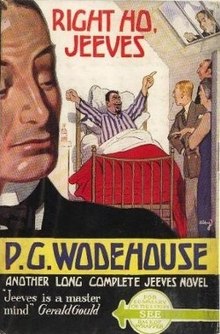
  • In such other narratives as Right Ho, Jeeves and Stiff Upper Lip, Jeeves, he is said to be like those who go into thin air in Bombay (now Mumbai), reassemble the parts a little later in Calcutta (now Kolkata), displaying the property of a kind of gas which seems to float from Spot A to Spot B without much ado.
  • Joy in the Morning compares Jeeves to Indian blokes ‘who shoot their astral bodies to and fro’, disappearing in Rangoon (now Yangoon) and reassembling the parts in Calcutta (now Kolkata).
  • In ‘Trouble Down at Tudsleigh’, Young Men in Spats, Freddie demonstrates a similar proficiency by means of the speed at which he rushes down the stairs, only to run into Captain Bradbury. He behaves like an Indian fakir who would go ‘into thin air in Bombay (now Mumbai) and reassemble the parts two minutes later in Darjeeling’.
  • Galahad at Blandings also alludes to Indian fakirs of this kind.

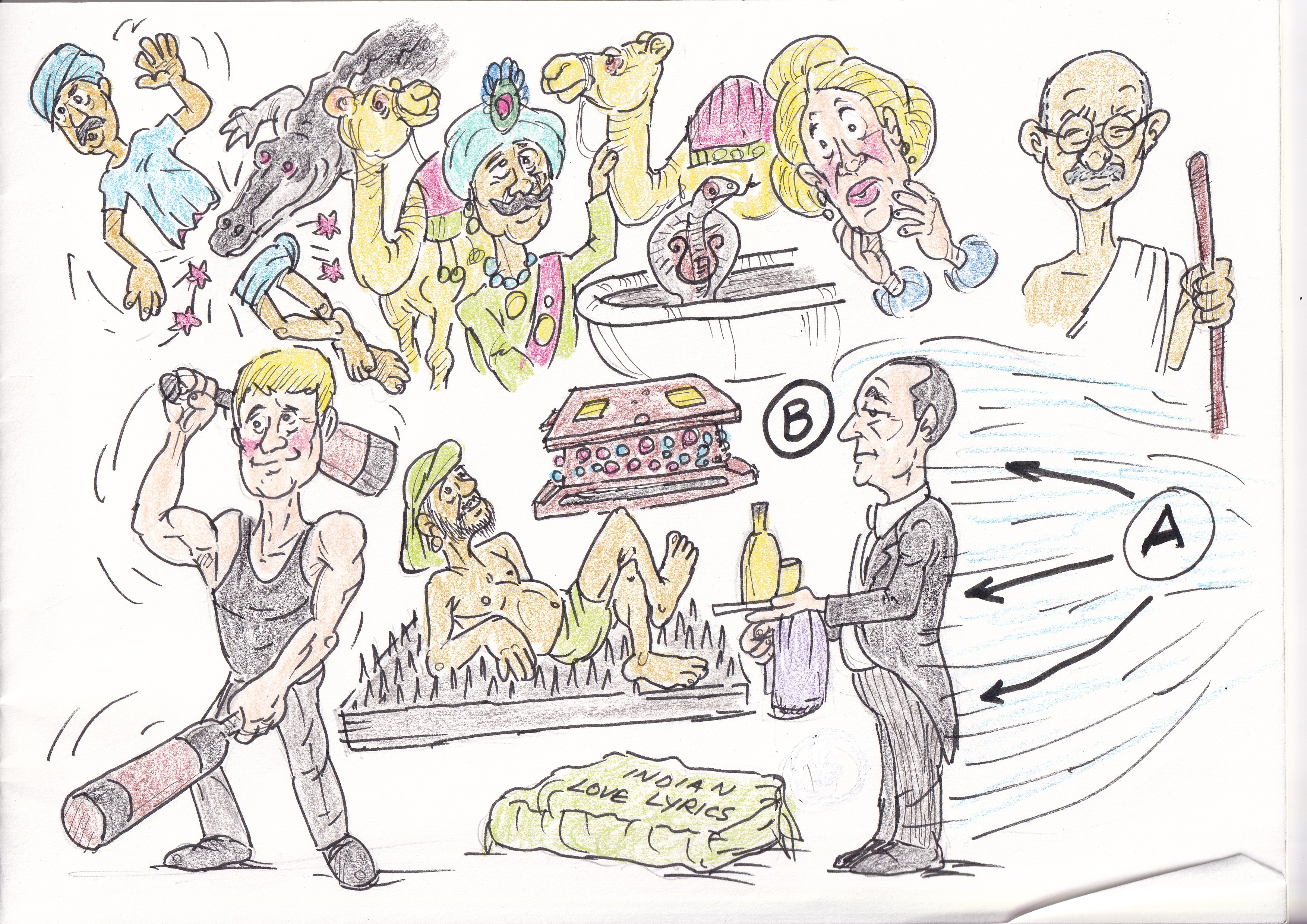
Curling Up on Spikes

  • In Pigs have Wings, Jerry Vail does not like the ambience of Emsworth Arms and finds a furnished villa on rent as an option. However, when inspecting the bed on offer, he shrinks from the prospect of occupying it for many nights. After all, he is not an Indian fakir who is accustomed from childhood onwards to curling up on spikes.
  • In Summer Lightning, Rupert Baxter, when he starts becoming conscious of a growing cramp in his left leg, turns on one side with the nonchalance of those Indian fakirs who spend the formative years of their lives lying on iron spikes.

Contemplating the Infinite

  • In The Clicking of Cuthbert, Plum captures the kind of discipline and meditative contemplation required while playing golf. The club gets raised at least two times, touching the ball and being raised back again after a careful inspection of the horizon. At the third attempt, he brings it down and ‘then stands motionless, wrapped in thought, like some Indian fakir contemplating the infinite. Then he raises his club again and replaces it behind the ball. Finally he quivers all over, swings very slowly back, and drives the ball for about a hundred and fifty yards in a dead straight line.’
  • In The Girl on the Boat, when Sam achieves an almost imbecile state of boredom, his position is described as that of one of those Indian mystics who sit perfectly still for twenty years, contemplating the Infinite.

Indian Love Calls

Wherever Plum is, love cannot be far behind. India has gifted the world with the Kama Sutra, but it is not surprising that Plum never alludes to this unique treatise, because he never used sex as a ploy to popularize his narratives. All of his male characters are steeped in chivalry, strictly bound by Victorian norms. This aspect of his work had been covered by me in an earlier article entitled ‘Cupid in Plumsville’: (https://ashokbhatia.wordpress.com/2019/02/14/cupid-in-plumsville)

In his narratives, Wodehouse appears to have instead based his observations on The Garden of Kama, a collection of lyric poetry of Indian origin published in 1901, which makes liberal use of imagery and symbols from the poets of the North-West Frontier of India and the Sufi poets of Persia (Iran). The poems, written by Laurence Hope, a pseudonym of Violet Nicholson, are typically about unrequited love and loss. She had married Colonel Malcolm Hassels Nicolson, who was a commandant of the 3rd Battalion of the Baluch Regiment. The couple lived in Mhow in the central part of India from 1895 to 1900. 

One of her famous compositions, known as a ‘Kashmiri Song’, also appears in at least two of Plum’s narratives. 

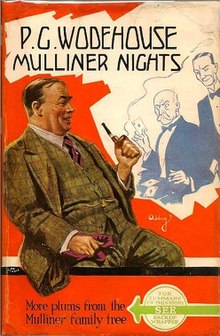
  • In ‘The Knightly Quest of Mevryn’, Mulliner Nights, when Mervyn pops up at Clarice’s abode to report having suffered several privations and challenges in procuring strawberries in the month of December, he is made to wait in the drawing room where there is not much to entertain and amuse a visitor. He finds a photograph of the girl’s late father on the mantelpiece and several other items, including a copy of Indian Love Lyrics bound in limp cloth.
  • In Galahad at Blandings, Galahad strongly urges Lord Emsworth to be alert and on his guard. Dame Daphne Winkworth is not to be allowed to get him alone in the rose garden or on the terrace by moonlight. If she starts talking about the dear old days, he is to change the subject. He is to be wary if Dame Daphne Winkworth asks him to read her extracts from the Indian Love Lyrics after dinner. According to him, these have to be avoided like poison, because the consequences could be disastrous.
  • Jeeves and the Feudal Spirit opens with Bertie Wooster in his bath tub. ‘As I sat in the bath tub, soaping a meditative foot and singing, if I remember correctly, “Pale Hands I Loved Beside the Shalimar”, it would be deceiving my public to say that I was feeling boomps-a-daisy. The evening that lay before me promised to be one of those sticky evenings, no good to man or beast. My Aunt Dahlia, writing from her country residence, Brinkley Court down in Worcestershire, had asked me as a personal favour to take some acquaintances of hers out to dinner, a couple of the name of Trotter.’
  • In Ring for Jeeves, we find an alert and bright Captain Biggar crooning ‘Pale hands I loved beside the Shalimar, where are you now, where are you now? Where are you now? Where are you now?’ Jeeves walks in just then and outlines his ‘spider sequence’, a scheme to deprive Mrs. Spottsworth of a precious pendant she wears around her neck, thereby bringing some financial relief to all concerned. 

(Continued)

Notes:

The inspiration for this essay comes from the scholarly work done by Ms. Masha Lebedeva, who had earlier whipped up a research paper entitled The Russian Salad by P. G. Wodehouse.

The author expresses his sincere gratitude to an eminent expert on Plummy matters for having spared the time to go through a part of this composition and provide insightful suggestions. Some fans of P. G. Wodehouse have also suggested improvements in its contents.

Thanks are also due to Mr. Suvarna Sanyal for dishing out the main illustration in Part 1; also, to Ms. Sneha Shoney, who has edited the text.

Those of you who wish to cruise through this essay in its entirety may kindly write to akb_usha@rediffmail.com for a PDF version of the complete document to be mailed to them.

Related Posts:

(Continued)

Of Civil Disobedience and Mutinies

Till the year 1947, India was under the British Raj. The period was marked by Indians struggling to gain independence through means which were peaceful as well as violent. From 1920 onwards, the self-rule struggle was characterized by Mahatma Gandhi’s policy of non-violence and civil disobedience, duly complemented by several other campaigns.  

  • When people are hungry, they become angry. They want to go out and fight. This could even be true of Mahatma Gandhi, who is given a singularly juicy mention in ‘The Juice of an Orange’ in Blandings Castle and Elsewhere.

While narrating the story of Wilmot Mulliner, Mr. Mulliner blames the modern dieting craze of women for all the unhappiness which afflicts the world.

‘Women, of course, are chiefly responsible. They go in for these slimming systems, their sunny natures become warped, and they work off the resultant venom on their men-folk. These, looking about them for someone they can take it out of, pick on the males of the neighbouring country, who themselves are spoiling for a fight because their own wives are on a diet, and before you know where you are war has broken out with all its attendant horrors.

‘This is what happened in the case of China and Japan. It is this that lies at the root of all the unpleasantness in the Polish Corridor. And look at India. Why is there unrest in India? Because its inhabitants eat only an occasional handful of rice. The day when Mahatma Gandhi sits down to a good juicy steak and follows it up with roly-poly pudding and a spot of Stilton you will see the end of all this nonsense of Civil Disobedience.

‘Till then we must expect Trouble, Disorder … in a word, Chaos.’

  • Those who are familiar with the Indian mutiny of 1857 may recall that the Siege of Cawnpore is one of its key episodes. The British forces and civilians in Cawnpore (now Kanpur) were unprepared for an extended siege and surrendered to rebel forces in return for a safe passage to Allahabad (now Prayagraj), another city nearby. As a rescue force approached Kanpur, an unfortunate massacre took place, leading even to a war cry ‘Remember Cawnpore’. On at least two occasions, Plum captures the sentiments of elation experienced by girls under siege in Kanpur when they hear the sound of the bagpipers of the British reinforcements.   

The Girl in Blue describes how an authoress feels when she finds that a horn-rimmed American is trying to locate a copy of her latest book Daffodil Days. Flannery and Martin’s book shop in Sloane Square in London does not stock her latest brain child but when a stranger walks in and asks for it, Vera Upshaw is thrilled beyond measure. 

She whips around, her lips part, her eyes widen and her lovely body experiences a tingling of sorts. Her sentiments get compared to the thrill a girl would have experienced when, in the midst of the Indian Mutiny, during the siege of Cawnpore (Kanpur, 1857), she would have heard the skirl of the bagpipes, heralding the arrival of British reinforcements.

In Pearls, Girls and Monty Bodkin, similar uplifting sentiments are experienced by Monty when he suddenly finds a friend and sympathizer in Mr. Llewellyn.

Men in Uniform, the North Western Frontier Province (NWFP) and Hunting

Military men who had served in India as part of their duties tell us interesting anecdotes about that distant land, including about their time in the NFWP. The latter was a province of British India from 1901 to 1947, when it was ceded to Pakistan. Hunting was a common pastime. Some such references enrich many of Plum’s narratives.   

  • In Right Ho, Jeeves, while allaying the fears of Gussie that his trousers will split while delivering a speech at the Market Snodsbury Grammar School, an example is cited by Bertie Wooster – that of General Bosher, who was a D.S.O. (Distinguished Service Order), ‘with a fine record of service on the north-western frontier of India, and his trousers split.’  
  • In ‘Ukridge and the Home from Home’, Lord Emsworth and Others, we find that Ukridge has turned his Aunt Julia’s house into a hotel. Amongst the six guests, we find one Lieutenant-Colonel B. B. Bagnew, late of the Fourth Loyal Lincolnshires. In Ukridge, we find a suave and genial host, presiding over the dinner-table on most nights. As and when the conversation in the group ‘touched a high level and feasts of Reason and flows of Soul occurred’, one of the major contributors was the Colonel. He narrated his anecdotes of India, where he had served his country faithfully and well.
  • In the same story, Ukridge tells Corky that Indian army men are not to be trusted.  He thinks that all of them believe themselves to be heroes. Hence, they get greatly disliked. He cites Lieutenant-Colonel B. B. Bagnew’s clear views on lesser mortals like burglars. Colonel is of the view that if he were to ‘show them a good old army revolver, they would run like rabbits.’
  • In ‘Trouble Down at Tudsleigh’, Young Men in Spats, Freddie Widgeon gets formally introduced by Lady Carroway to Captain Bradbury from the Indian Army. He is competing with Freddie for the affections of April. Freddie believes that the Captain might have such advantages as a natty moustache, a rich tan and deep-set eyes, but what bowls over a refined and poetical girl is a refined soul. He intends to devour Tennyson over the next few days and be equivalent to six souls so as to beat his rival hollow.

At the end of a get-together, Captain Bradbury draws him aside and gives him the sort of look he would have given a Pathan discovered pinching the old regiment’s rifles out on the North-Western Frontier. He also mentions to Freddie that he had won the Heavyweight Boxing Championship of India earlier  

  • In the same narrative, one gets to learn that when one is up against one of the Indian Army strategists, one realizes how thoroughly they get trained from early youth to do the dirty on the lawless tribes of the North-Western Frontier. Captain Bradbury, when outfoxed at the door, is not one to beat a hasty retreat. Rather, he tries to outflank Freddie by trying to enter through the sitting-room window.

This is how Plum describes the aftermath:

‘But the interchange of glances did not last long. These Indian Army men do not look, they act. And it has been well said of them that, while you may sometimes lay them a temporary stymie, you cannot baffle them permanently. The Captain suddenly turned and began to gallop round the corner of the house. It was plainly his intention to resume the attack from another and a less well-guarded quarter. This, I believe, is a common manoeuvre on the North-West Frontier. You get your Afghan shading his eyes and looking out over the maidan (field), and then you sneak up the pahar (mountain/hillock) behind him and catch him bending.’

  • In the story ‘Bill the Bloodhound’ in Man with Two Left Feet, we find Henry, dressed up as an old Indian colonel one week, contentedly puffing away at a cigar provided by Walter Jelliffe while fondling his silver moustache. Only when Walter finds him comfortable enough does he pop the question.

‘And now tell me, old man, which of us is it you’re trailing?’

  • In Summer Moonshine, Colonel Tanner tells Mr. Waugh-Bonner about his life in Poona (now Pune), while Mr. Chinnery plays croquet with Mrs. Folsom. Throughout the narrative, he speaks enthusiastically of his life in the city, supplementing the spoken word with a display of photographic snapshots illustrating conditions in those parts. He also speaks of the Bengal Lancers, a regiment of the British Indian Army.
  • Captain Biggar, one of the several unique characters in Ring for Jeeves, loves hunting. One would never get surprised to run into him ‘in such hunting grounds as in Kenya or Malaya or Borneo or India’! It would be perfectly in order.

(Continued)

Notes:

The inspiration for this essay comes from the scholarly work done by Ms. Masha Lebedeva, who had earlier whipped up a research paper entitled The Russian Salad by P. G. Wodehouse.

The author expresses his sincere gratitude to an eminent expert on Plummy matters for having spared the time to go through a part of this composition and provide insightful suggestions. Some fans of P. G. Wodehouse have also suggested improvements in its contents.

Thanks are also due to Mr. Suvarna Sanyal for dishing out the main illustration in Part 1; also, to Ms. Sneha Shoney, who has edited the text.

Those of you who wish to cruise through this essay in its entirety may kindly write to akb_usha@rediffmail.com for a PDF version of the complete document to be mailed to them.

Related Posts:

(Continued )

Indian Fauna, Royalty

Indian fauna such as spiders, scorpions, cobras, elephants, tigers, cheetahs and lions regale the reader across many of Plum’s narratives. Princes and maharajas of yore also find a mention occasionally. 

  • Take the example of Summer Moonshine’s Colonel Tanner, who, during his tenure in India under the English raj, had learnt to be comfortable with the presence of Afridis, snakes, scorpions and even tigers in his sleeping quarters. Members of these species would ‘saunter into his abode as if it were a country club to which they had paid the entrance fee’.
  • In Thank You, Jeeves, Chuffy introduces Bertie to Sergeant Voules, who claims to have tackled as many as ninety-six big spiders while in India. Bertie’s protests that he is unable to sleep in his own bedroom because there is a big pink spider lurking around there (indirectly referring to Pauline Stoker, Chuffy’s fiancée, in his heliotrope pajamas!) get ignored. He gets hauled back to his bed. Luckily for all concerned, Pauline has already done the vanishing trick by then. 
  • In Aunts Aren’t Gentlemen, Orlo Porter runs into Bertie Wooster and is as startled as an Indian native who sees a scorpion in his path. He goes on to ejaculate: ‘Wooster, you blasted slimy creeping crawling serpent, I might have expected this!’
  • What does an Indian native do when bitten by a scorpion? In Uneasy Money, Plum tells us that ‘He does not stop to lament, nor does he hang about analysing his emotions. He keeps running until he has worked the poison out of his system. Not until then does he attempt introspection.’ The amiable Lord Dawlish, after a rather unpleasant meeting with Lady Wetherby, follows a similar policy. After leaving her house, he does not run. Instead, he takes a very long and rapid walk. He has an acute sense of being poisoned and wishes to work the poison out of his system. He has nothing on his mind other than walking faster and faster.
  • In Jeeves and the Feudal Spirit, Ma Trotter, upon going through a morning journal, discovers that the powers that be have gone ahead and knighted Robert Blenkinsop instead of her illustrious husband. ‘She stares at The Times much like an Indian resident would eye a cobra, had he found it nestling in his bath tub’.
  • On his part, the husband, L. G. Trotter, is a man who suffers from dyspepsia and is already out of harmony with his wife. The latter screaming her head off in the middle of the breakfast startles him, making him give her ‘the sort of look the cobra might have given the resident of India who had barged in on its morning bath.’
  • In Bachelors Anonymous, we run into Mr. Ivor Llewellyn, head of the Superba-Llewellyn studio of Hollywood. Having suffered through as many as five divorces, he wishes to remain a bachelor. However, upon Joseph “Joe” Pickering’s insistence that he visit a hospital, Cupid strikes yet again. He ends up proposing to Amelia Bingham, a nurse he comes in touch with at the hospital. He squarely blames Joe for having got him entangled into yet another prospect of marriage. Upon return, he looks at Joe with an open dislike, much like a resident of India registers ‘when he comes to have his morning bath and finds a cobra nestling in the bath tub.’
  • In Galahad at Blandings, as also in Pigs Have Wings, Plum says that Beach never buzzes off, ‘his customary mode of progression being modelled on that of an elephant sauntering through an Indian jungle.’
  • As per Meet Mr. Mulliner, as well asthe story ‘Gala Night’ in Mulliner Nights, when royalty goes a-hunting, it expects to be supported by elephants which display an easy nonchalance when their masters spot a tiger in an Indian jungle. But there are times when such hunting expeditions get spoiled by ‘the failure of the elephant to see eye to eye with its owner in the matter of what constitutes sport.’ How does one avoid the prospect of an elephant turning and galloping home? How does one ensure that a timid elephant would instead trumpet loudly and charge the fiercest tiger without any hesitation, ‘facing the tiger of the jungle with a jaunty sang-froid?’
  • Wilfred Mulliner has a solution in the form of a tonic known as Mulliner’s Buck-U-Uppo. Were a teaspoonful of it be mixed with the morning bran-mash, better results ensue.
  • Sunset at Blandings tells us how one feels when one is likely to face the prospect of facing a formidable person like Dame Daphne Winkworth? If Gally is to be believed, one would find oneself in the position of a native of India who knows that a tigress is lurking in the undergrowth near at hand and wonders how soon she will be among those present.
  • In Big Money, when Berry acts like a buoyant and aspiring sportsman in the jungles of India who has caught a tiger by its tail, he realizes that even though all has been well so far, his next move would need careful consideration.
  • Uncle Dynamite records the reaction of Sir Aylmer when being told by Lord Ickenham that he would go hundred miles to judge bonny babies. This thwarts the ambitions of Sir Aylmer no end. He starts ‘like a tiger that sees its Indian villager being snatched away from it.’ His face, already mauve, becomes an imperial purple.
  • Uncle Dynamite also describes the emotions of Hermione, a young authoress, who finds that her royalty earnings are likely to go up substantially but her father is conniving to rob the publisher of his means to publish her work. Her feelings are said to be even more poignant than those of ‘wolves which overtake sleighs and find no Russian peasant aboard and of tigers deprived of their Indian coolie just as they are sitting down to lunch.’
  • In Full Moon, Freddie, at Gally’s suggestion, smuggles Bill Lister back into Blandings Castle disguised as a false-bearded gardener, having paid off Angus McAllister. Lister soon ruins things, however, when he mistakes Veronica’s mother, Lady Hermione, for a cook and tries to bribe her to pass a note to Prudence. Later on, when Freddie appears to be whole-heartedly welcoming Lister after the latter has been asked to leave, Lady Hermione is found twitching her hands and has gleaming eyes. She is then likened to the puma of an Indian jungle about to pounce upon its prey.
  • In Piccadilly Jim, Jimmy has a unique style of proposing to Ann. He points out that if he were to go out of her life, she would be miserable. She would have nobody to fight with. She would be like the female jaguar of the Indian jungle who expresses her affection for her mate ‘by biting him shrewdly in the fleshy part of the leg, getting a shock one day to find that the mate has simply vanished.’
  • In ‘The Story of Cedric’, Mr. Mulliner Speaking, when Cedric crawls on all fours on the floor, his teeth are clenched and his eyes gleam with a strange light, he is said to look like an ‘exact replica of the hunting cheetah of Indian jungle stalking its prey.’
  • In the same narrative, when he cries out aloud, he sounds like an Indian peasant who, ‘while sauntering on the banks of the Ganges, suddenly finds himself being bitten in half by a crocodile.’
  • ‘Leave it to Algy’, A Few Quick Ones depicts Purkiss, having handed over a five-pound note to Bingo, giving a defiant look at Algernon Aubrey. His look gets likened to that of an Indian coolie, who, when he is safe up a tree, may give it to the baffled crocodile at the foot of it.
  • In The Girl in Blue, Jerry chooses to celebrate his triumph at the grill room of the Barribault’s which is said to be a ‘stamping ground of Texas millionaires and Indian Maharajas.’
  • In Luck of the Bodkins, Mr. Llewellyn wonders if his sister-in-law has ‘mistaken him for Rockefeller, Pierpont Morgan, Death Valley Scotty or one of those Indian Maharajas.’  
  • In Bachelor’s Anonymous, Sally realizes the true nature of Joseph Pickering while sitting in the lobby at Barribault’s, infested by Texas millionaires and Indian maharajas.
  • In Pearls, Girls and Monty Bodkin, Monty waits for Gertrude to show up in the lobby of Barribault’s world-famous hotel, the doors of which normally swivel around only to admit Texan millionaires and Indian Maharajas. The doors then revolve yet again to admit an elderly man with a face like a horse, Mr. J. B. Butterwick, who promptly proceeds to inform him that Gertrude will not be lunching with him on the day.
  • The story The Man Who Disliked Cats in The Man Upstairs speaks of Hotel Jules Priaulx in Paris. When rich people of any nationality come over to stay there, they often bring their pets along with. If an Indian prince has two dromedaries for company, the other one brings along a giraffe. The giraffe is reported to drink a dozen of the best champagne every day, so as to keep his coat in good shape. Young lions and alligators also pop up once in a while.

(Continued)

Notes:

The inspiration for this essay comes from the scholarly work done by Ms. Masha Lebedeva, who had earlier whipped up a research paper entitled The Russian Salad by P. G. Wodehouse.

The author expresses his sincere gratitude to an eminent expert on Plummy matters for having spared the time to go through a part of this composition and provide insightful suggestions. Some fans of P. G. Wodehouse have also suggested improvements in its contents.

Thanks are also due to Mr. Suvarna Sanyal for dishing out the main illustration in Part 1; also, to Ms. Sneha Shoney, who has edited the text.

Those of you who wish to cruise through this essay in its entirety may kindly write to akb_usha@rediffmail.com for a PDF version of the complete document to be mailed to them.

Related Post:

What ho!

To the best of my knowledge and belief, P. G. Wodehouse never set foot on Indian soil. But he has often alluded to its exotic temples, its wildlife, its royalty, its fakirs and mystics with magical powers, and even its love lyrics. Many times he has vividly captured facets of my beautiful country, serving up a delectable curry spiced with uniquely Indian condiments.

In this essay, the reader will find a random sample of references to India in Wodehouse’s novels and short stories. Such references are found across all his narratives, whether he is writing a Jeeves and Bertie story, a tale of Blandings, or a stand-alone novel.

Plum’s Indian Connection

Plum’s elder brother, Ernest Armine Wodehouse, was an English Theosophist, poet and educator. He is better known as the tutor of Jiddu Krishnamurti, the famous Indian author and lecturer on spiritual and philosophical subjects. He was admitted to the Theosophical Society at Poona (now Pune) in 1908. Before the First World War, he held a position as professor at Deccan College in Poona, India. After the war he returned to India. One can understand the source of Plum’s inspiration when he named one of his pet cats as Poona.

One of the important landmarks on Wodehouse Road in the Indian city of Mumbai is the Cathedral of the Holy Name. The seat of the Archdiocese of Mumbai, the cathedral is one of the most striking churches of the city. Its foundation stone was laid in 1902. It had then come to be known as the Wodehouse Church since it stands on Wodehouse Road, named after Sir Philip Edmond Wodehouse who was Governor of the city from 1872 to 1877. He was a distant relative of Plum’s. Sometime back, the road was renamed Nathalal Parekh Marg.

Few writers have Plum’s mesmerizing command over English. He uses it in an innovative manner, leaving the reader stepped to the gills with an overdose of Vitamin H(umour). It comes as no surprise that English-speaking Indians who are aware of his works simply adore him.

One of the unique features of India is its linguistic diversity. By default, English is the sole means of communication between different people from across the country. It acts as a bridge between large chunks of its 1.4 billion people who otherwise speak as many as 447 languages. Of these, 22 happen to be scheduled ones, deserving official recognition and support. Six languages – Kannada, Malayalam, Odiya, Sanskrit, Tamil and Telugu – are recognized as classical ones. English being a prominent link between people, Plum’s popularity in India is readily understandable.

But we digress. We are here to consider the kind of ingredients Plum uses while dishing out an Indian curry.

Some Indian fans of P G Wodehouse who have a chin-up attitude like that of Bertie Wooster and also a hearty capacity to laugh at themselves may appreciate the kind of India-centric similes Wodehouse uses at times to depict the behaviour of his characters.

In reading what follows, it may be advisable for a reader to imagine herself taking a leisurely stroll through either the Shalimar or the tulip gardens of Kashmir, or the Mughal Gardens in New Delhi, relishing the enchanting aroma of each section at a time.

The Indian Curry

Idols, Temples and Priests

Religious fervour is one of the main strands in the socio-cultural tapestry of India. One of its many unique features is its vast pantheon of gods and goddesses, its handcrafted and bejewelled idols, its magnificent temples and its overzealous priests.

  • In Ring for Jeeves, Rory speaks to Monica of a story published in The Strand Magazine in which a gang of blighters pops over to India and pinches a great jewel which is the eye of an idol. When one of the gang is deprived of his share in the booty, he seeks revenge by tracking down all the others and wiping them out. Rory is of the opinion that Captain Biggar is likewise casting a vengeful eye on Bill, as if the latter had denied the former his share of the proceeds of the green eye of the little yellow god in the temple of Vishnu. 
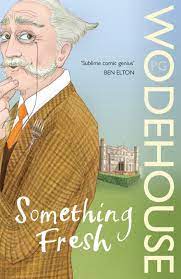
  • The feisty heroine of Something Fresh, Joan Valentine, acts as a muse for Ashe Marson when he suffers from a temporary writer’s block. She suggests that ‘The Adventure of the Wand of Death’ can only be about the sacred ebony stick stolen from an Indian temple which is supposed to bring death to whoever possesses it. Priests dog this person and send him threatening messages. Yet another episode of the adventures of Gridley Quayle, Investigator, gets dished out by Ashe.
  • Mr. Chinnery of Summer Moonshine is said to be an enormously rich person in spite of the incessant demands placed on his income by a platoon of ex-wives to whom he has to keep paying alimonies. Notices keep getting served on him in that respect. He suspects Mr. Bulpitt to be following him to serve yet another notice and shares his discomfiture with Sir Buckstone. He describes his latest encounter with Mr. Bulpitt as that of someone who steals the jewel and thinks he has hid himself rather well, only to look over his shoulder to find some sinister Indian priests around the corner. (Continued)

Notes:

The inspiration for this essay comes from the scholarly work done by Ms. Masha Lebedeva, who had earlier whipped up a research paper entitled The Russian Salad by P. G. Wodehouse.

The author expresses his sincere gratitude to an eminent expert on Plummy matters for having spared the time to go through a part of this composition and provide insightful suggestions. Some fans of P. G. Wodehouse have also suggested improvements in its contents.

Thanks are also due to Mr. Suvarna Sanyal for dishing out the main illustration; also, to Ms. Sneha Shoney, who has edited the text.

Those of you who wish to cruise through this essay in its entirety may kindly write to akb_usha@rediffmail.com for a PDF version of the complete document to be mailed to them.

Defining Consciousness is akin to the case of seven blind men trying to describe an elephant. People have different perspectives. So, when it comes to saying what it really is, the descriptions are often as different as chalk and cheese.

The reason for a wide spectrum of ways in which we understand this concept is what one could label as the Yin and Yang factor. Many of us use our brains to explain what we understand it to be. Many others use our hearts to do so. Perhaps this concept is rather profound. It is beyond the sensory limitations of the human mind, which has an uncanny ability to divide and analyze things. This is what eventually leads to the phenomenon called Analysis Paralysis in management. Our hapless hearts are rooted in what Daniel Goleman refers to as Emotional Intelligence. A solely emotional perspective has its own limitations.

But the situation is not as challenging as it appears to be. The common denominator underlying the entire spectrum is that of the collective good. An integrated view of the concept is surely possible, provided we move on to the level of what Danah Zohar and Ian Marshall, in their book Spiritual Wealth: Wealth We Can Live By, allude to as Spiritual Intelligence.

However, before we move further, let us consider some of the perspectives which one normally comes across.

What is Consciousness?

The Five Maxims  

Ask Jeffrey Deckman, and he is apt to say that it is imperative for a Conscious Leader to play the following roles:

  1. Being a ‘healer’, who calms, comforts and connects those around him.
  2. Of being an ‘elder’, by practicing wisdom, empathy and patience.
  3. Acting as a ‘steward’, nurturing talent and creating conditions for growth just like a gardener would act.
  4. Doffing the hat of a ‘navigator’, envisioning challenges and opportunities, defining broad goals and guiding others.
  5. Being a ‘facilitator’, acting like the conductor of an orchestra, ensuring harmony, encouraging open discussions and aligning by voting and not by consensus.    

Of Gallant Knights

Danah Zohar and Ian Marshall speak of Knights, the leaders who choose to embark on a spiritual path. Having sensed something fundamentally sacred underlying human life, they embed this reality in their actions and in their life’s work.

In both life and work, the knight abides by five principles:

  • There is something sacred, some deeper, shared consciousness, unfolding in this universe and providing a baseline for every aspect of life.
  • Life and all its enterprises are interconnected.
  • All human endeavour, including business, is part of the larger and richer fabric of the whole universe.
  • The relationship of the healthy individual to the world is one of engagement and responsibility.
  • Service conveys deep sense of humility and gratitude.

A Triple Bottom Line Approach

Stephen Karbaron exhorts businesses to embrace an approach of profiting from a purpose driven, triple bottom line paradigm. To him, this is what defines a conscious business strategy approach. He emphasizes the need to be innovative, adaptable and prepared for change, whilst being aware of all stakeholder needs. He keeps sharing live examples of businesses which follow this approach.  

Of Philosopher Kings

Dr Roy Woodhead is of the opinion that the very words ‘conscious enterprise’ imply some sense of an ‘enlightened enterprise’. In one of his thought provoking articles, he says that Plato put forward the idea of ‘philosopher kings’ to lead us. They would not be allowed material gains but would be well looked after; their economic neutrality and lack of vested interests were seen as very important for effective government by the philosopher kings.

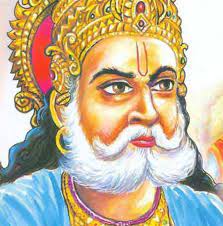
Ramayana, one of the revered Hindu scriptures, speaks of King Janaka, the foster father of Sita, the heroine of the epic story. He is said to be a ‘philosopher king’. He is revered as being an ideal example of non-attachment to material possessions. He not only administers his country but also invites sages and intellectuals to spiritual discourses in his assembly. His interactions with sages and seekers such as Ashtavakra and Sulabha are recorded in ancient texts and are illuminating treatises on spiritual principles.

In their book ‘Rajarshi Leadership’, authors S. K. Chakraborty and Debangshu Chakraborty espouse the cause of spiritual leadership. This is a concept which sums up a key lesson from India’s tryst with spirituality: that of first discovering the divinity within, and then to manifest it without. Such conscious leadership is blissful to oneself and to others.  

A Holistic View of Affairs

Jack Beauregard is of the opinion that it is about one connecting with the wholeness and the process of creation. A higher level of consciousness opens one’s life to one’s inner cores, thereby allowing the creativity of the universe to flow into one’s life. This enables one to find innovative solutions for solving the numerous challenges that one faces. He believes that a higher level of consciousness also creates a spiritual perspective. It allows one to view one’s life, other people, our work organizations, technology, the planet earth, and the universe from a sacred point of view.

Jack Beauregard opines that one can help create a new, harmonious world in which to live by taking responsibility for transforming one’s own consciousness. When enough people choose to develop, act, and do business from a balanced, wholistic paradigm, this will automatically have a positive influence on the consciousness of our planet. We can help co–evolve with the intelligent creative process of the universe. When a critical mass is reached, we will then create a positive alternative to the negative actions and beliefs of today’s world. 

Our species will evolve to its rightful inheritance when we realize that human consciousness is a smaller part of the larger consciousness of the universe, and our individual lives, and the human species in general, are small parts of the vast web of life and just one manifestation of the mystery of creation.

The Realm of Creativity 

Hindu and other scriptures speak of one reaching a state when one’s consciousness becomes one with that of the universe, often leading to an exalted phase of creativity. Our physical body then acts as an antenna, translating signals from the universe into something human beings would comprehend. When someone like Mozart composes music, he merely writes what he hears. When a humourist like P. G. Wodehouse creates his unique characters and weaves them into a dramatic plot, he acts more like a celestial author who enables lesser mortals like us to notice a humorous strain in all things around us. 

When Science Steps In

When humanity gropes for the source or the definition of Consciousness, our scientists do not disappoint.

Consider The Global Consciousness Project which is an international, multidisciplinary collaboration of scientists, engineers, artists, and others. Their goal is to examine subtle correlations that may reflect the presence and activity of consciousness in the world. Their researchers predict structure in what should be random data, associated with major global events. Their contention is that when millions of people share intentions and emotions, their data show meaningful departures from expectation. This is an area where science appears to establish the reality of a global consciousness.

A materialistic scientist would tell us that our brains consist of neurons made of atoms. These process our external experiences. At times, our neural processes lead us to recognize a higher meaning in things. According to them, our 40 Hz oscillations happen to be the neural basis for consciousness in the brain.

A Spiritual Insight

More than a century ago, this is how Sri Aurobindo, a highly revered spiritual master and a visionary from India, described his concept of Consciousnessthus:

Consciousness is a fundamental thing, the fundamental thing in existence; it is the energy, the motion, the movement of consciousness that creates the universe and all that is in it not only the macrocosm but the microcosm is nothing but consciousness arranging itself. For instance, when consciousness in its movement or rather a certain stress of movement forgets itself in the action it becomes an apparently unconscious energy; when it forgets itself in the form it becomes the electron, the atom, the material object. In reality it is still consciousness that works in the energy and determines the form and the evolution of form. When it wants to liberate itself, slowly, evolutionarily, out of Matter, but still in the form, it emerges as life, as animal, as man and it can go on evolving itself still farther out of its involution and become something more than mere man.

— Sri Aurobindo, The Life Divine, pp. 236-7.

Consciousness is usually identified with mind, but mental consciousness is only the human range which no more exhausts all the possible ranges of consciousness than human sight exhausts all the gradations of colour or human hearing all the gradations of sound — for there is much above or below that is to man invisible and inaudible. So there are ranges of consciousness above and below the human range, with which the normal human [consciousness] has no contact and they seem to it unconscious….

— Sri Aurobindo, The Life Divine, p.233.

In a way, what he appears to be pointing out is that understanding Consciousness is akin to realizing the difference between a physical body which is alive and one which is dead. It is like the sole element which is missing from a dead body.

By providing us with a very wide canvas to understand the term Consciousness, Sri Aurobindo is also indicating that organizations which are conscious are most likely to have the following characteristics embedded in their culture:

  1. An attitude of humility and devotion which enables people to operate – individually as well as in teams – at a higher level of productivity;
  2. A flatter hierarchy which redefines the relationship between those who lead and those who are led; in other words, a Theory Y approach to human relations, a higher diversity of cross-departmental teams, a premium on gender diversity, and an optimum gap between the packages and perks of the highest and the lowest paid people;
  3. A harmonious engagement with diverse stakeholders.

(Notes:

  1. Inputs from Dr Ananda Reddy of the Sri Aurobindo Centre for Advanced Research (SACAR), Pondicherry, India, are gratefully acknowledged. Illustrations courtesy www and Huta, Sri Aurobindo Ashram, Pondicherry, India.

2. Inputs from Dominique Conterno and Esther Robles, co-founders of Consciousness Enterprises Network (https://www.consciousenterprises.net), are also gratefully acknowledged.)

Related Posts:

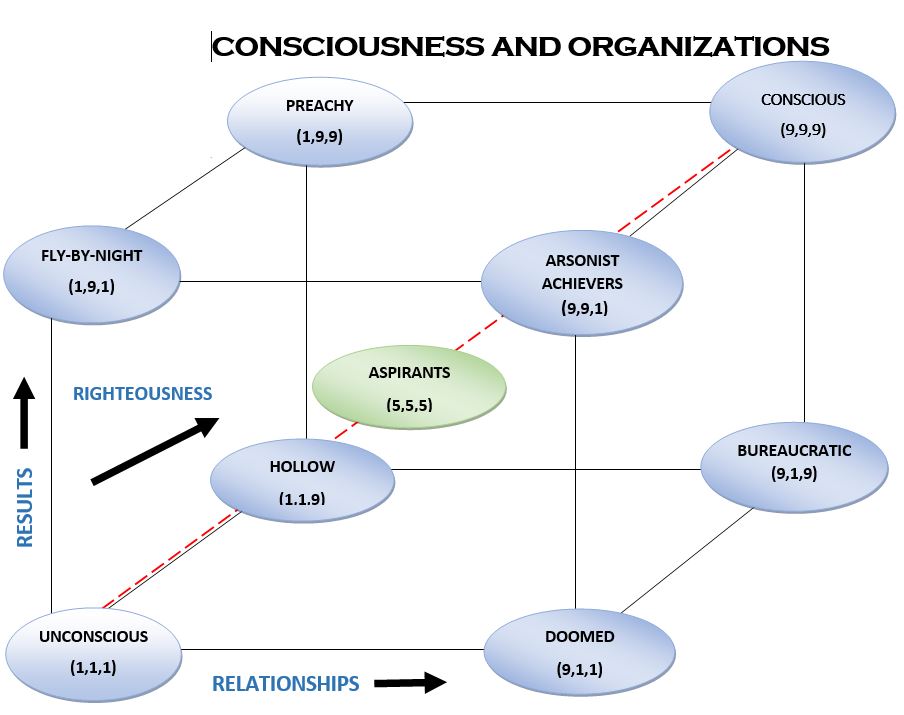
Exploring the concept of Consciousness further, one may say that whereas a normal organisation cares for Results alone, an organisation steeped in Consciousness would provide equal weight to all of its three ‘R’s – Results, Relationships, and Righteousness – in its strategic and tactical thinking.

Results could be either of the financial kind, the market share kind, or a combination of the two.

Relationships would imply a positive working atmosphere where, besides harmonious relations, dissent is not suppressed; rather, it is encouraged. Following human values is an essential part of this attribute. So is respect and dignity towards people in general.  

Righteousness would encompass such features as concern for sustainability, giving back to the society and running operations not only within the ambit of law but beyond it, wherever possible. Being pro-active, when it comes to corporate governance; taking care of the rights of the minority shareholders; ensuring that principles of natural justice get followed; and, following values and ethics.

Yes, the precise definitions of each of these sets of attributes would vary depending not only upon the kind of business an organisation is in, but also on the kind of business environment it operates in.   

If each of these three dimensions of conscious organisations is taken into consideration, organisations which are committed to achieving a higher level of Consciousness could consider doing a self-assessment by using the kind of representation shown below:

Here is a scheme which can enable an organisation to rate itself against each of the attributes, on a scale of 1 (low) to 9 (high).

Conscious organisations which rate themselves very close to the (Relationships: 9, Results: 9, Righteousness: 9) position in the figure could pat themselves on the back and keep up the good work they are doing, inspiring others to follow suit.

The ones which are in the Aspirant (5, 5, 5) category are already on the right track and would do well to start firing at all the twelve cylinders and reach a higher level of Consciousness.

The majority of organisations we come across might fit into the Arsonist Achievers (9, 9, 1) slot. To them, both Results and Relationships count, though they could not care less when it comes to following the path of Righteousness. Such enterprises end up contributing to the kind of situation where we find that during 2020, for instance, humanity needed to be supported by the planetary resources which 1.7 Earths alone could provide. (https://www.footprintnetwork.org/2021/01/19/we-do-not-need-a-pandemic-to-movethedate)

The Bureaucratic ones (9, 1, 9) are bound in red tape, caring only for Relationships and Righteousness, with poor accountability for Results. Yes-persons rule. Sycophancy prevails. Service to the public goes for a toss.

Organisations in the Doomed category (9, 1, 1) prophesize caring only for Relationships, while neither producing Results nor caring for Righteousness. For example, some of the Bretton Woods and other institutions set up after World War II now appear to be out of sync with the global realities.     

Then we run into some Hollow ones (1, 1, 9) which profess to care only for the path of Righteousness but, in reality, are shams, pampering only to the ego of a self-styled guru heading a sect. Internal working conditions are akin to labour camps. The pomp and show of serving humanity is often more of a public relations exercise. 

We also have the Preachy ones (1, 9, 9), which care two hoots about Relationships but keep delivering results while making it appear as if they are also on the path of Righteousness. Their bluff is easily called because this unique feat cannot be achieved unless Relationships are given due importance in the scheme of things. Many political outfits that are steering their countries away from the core tenets of democracy and turning these into dictatorships would fall into this category. Political power surely comes their way but at a great cost to the socio-economic fabric of the nation.  

Most of us dread dealing with the Fly-By-Night (1, 9, 1) kinds, where Results alone count. Long-term survival is not the aim. Just keeping the head above the water remains the sole aim. Quite a few enterprises – mostly in the tiny and small sector – may fall into this category, simply because they can neither afford the luxury of Relationships and Righteousness nor do they consider it necessary to do so. Ponzi schemes and financial scams belong to this category.  

Then there are mafia organisations which are blissfully ignorant of any such niceties; these continue to chug along in an Unconscious manner. Our society shall surely be better off in their absence.

Within the three ‘R’s outlined here, there may appear to be a sort of gradation. To many of our embryonic start-ups, it may appear that only when a certain stage of stability has been attained can the business imagine paying attention to Relations and Righteousness. But habits, once formed, die hard. Such organisations run the risk of getting caught in a conceptual warp, evolving into pure money-spinning outfits, eventually landing either in the Fly-By-Night slot or in the Arsonist Achievers slot.

The Many Lenses of Viewing Consciousness

But this is merely one way of viewing the concept of Consciousness.

Over time, our scientists, philosophers, academicians, management honchos and spiritualists of all hues, sizes and shapes have attempted to define the same. Each of these presents a unique perspective and is worthy of consideration.

The final choice, of course, rests on our leaders. It could be based either on the nature of activity of an organization or on the leaders’ strategic vision.

The pandemic plaguing humanity since 2020 has yet again awakened us to the urgency of uplifting our state of Collective Consciousness and getting an injection of Vitamin Consciousness.

Note: Inputs from Dominique Conterno and Esther Robles, co-founders of Consciousness Enterprises Network (https://www.consciousenterprises.net), are gratefully acknowledged.

Related Post:

A culture which is rooted in Consciousness does not throw up hapless leaders who keep burning the proverbial midnight oil in their relentless pursuit of commercial goals only, while shoving concerns such as the environment, the society and human resources under the corporate carpet.   It does not merely mean that our marketing honchos are doing their best in servicing our customers effectively and efficiently; instead, it implies that they do so while ensuring that the product/service as well as its packaging is environment-friendly.

It means that those toiling on the operations side design the processes in such a way that the carbon footprints are at least neutral, if not positive; that our financial wizards keep nudging the organization towards maximizing returns to all its stakeholders; and the human resource executives keep burning the midnight oil to ensure that people and processes respect human values and dignity, while keeping the costs to the bare minimum.

Professionals in an organisation could be performing their roles while understanding challenges at the mental level alone in a rather artificial manner, leading to rigidity and even fanaticism in some cases. But then we suffer some limitations which are not different from the kind of handicap some of our sensory organs often face – a nose which fails to detect the putrid smell of a corporate scandal in the offing, an eye which can see but does not register wastage of resources in the operations, an ear which can hear but does not listen to a female employee reporting an incident of harassment at the hands of a superior and defers taking an action against the latter, a tongue which turns to complacency upon tasting a mighty success and a skin which has turned so thick that bribing one’s way through a regulatory agency no longer feels prickly.

Contours of a Conscious Culture

Values which drive an organization create its cultural ambience. Thus, a Conscious Culture is based not only on the kind of high values and principles being followed by a business but also on a smarter recognition of the purpose of the company and the interdependent relationship between the company’s stakeholders.

The drive of propagating a Conscious Culture need not start only from the desk of a top honcho in an organisation. One may find even a liftman, a receptionist, a cleaner, a postroom employee, a supervisor, or a manager initiating it. If the working atmosphere is such as to recognise and encourage conscious behaviour, the drive is bound to have a snowballing effect across an enterprise.

Many of us are aware that spiritual experts recommend not merely a sitting meditation but also a walking one; in other words, not a static meditation but a dynamic one. Likewise, Consciousness is not merely a waking awareness at the mental level but also the force which moves and propels the organisation towards its enlightened goals. When interconnectedness between various departmental silos gets activated, the chances of a synergy coming about improve. The net result is a quantum jump in the overall efficiency of the organisation, leading to uniform satisfaction all around, amongst all its stakeholders.

The marketing honchos then refrain from registering sales which could eventually become bad debts due to customer expectations not having been really met. The operations experts do not lose sleep over shipments which must be booked just before a quarter ends even though the physical goods might still be stuck on the manufacturing line. The finance guys do not indulge in window dressing to please their superiors. The human resources team does not start shifting those in permanent employment to a mode of contract employment, or decide to under-report employment figures to pension/provident fund regulators.

To put it simply, the silo approach gives way to an interconnected way of working, where each silo head is aware of the implications of his actions over all the other silos. A truly Systems Approach to doing things comes about. All elements and all clusters of the network are connected in some ways, leading to overall improvement in efficiency and effectiveness.

In a large IT hardware outfit where I used to work, ballooning sales receivables used to make the top management lose sleep. An aggressive sales force kept earning handsome incentives on billings while the finance head kept twiddling his thumbs trying to keep a lid on dues from customers. Based on repeated caution from internal auditors, a joint group comprising managers from marketing and finance was formed to review the matter. The incentive scheme was suitably tweaked and a monthly review by the joint group eventually brought the situation under control.       

A Self-actualization of Sorts

Following a paradigm of Consciousness does not belittle the importance of generating profits. Rather, it encourages a business to make decent profits and plough a part of the wealth generated therefrom into the welfare of the society at large. It exhorts an enterprise to act based on the harsh realisation that resources drawn from the earth and the environment happen to be limited in supply. Often, the stark choice facing management is that of profits today versus survival tomorrow. Wiser organisations would strike a balance between the two.

Some of us may recall the Maslow’s Hierarchy of Needs, where the last stage is that of self-actualisation. This is akin to our realising who we really are and what we aspire for in life. However, when we turn to Eastern philosophies of motivation, we may discover that Maslow is not the ultimate authority while adopting either a spiritual or a conscious approach to management. He merely offers an image of the individual and social achievement based on our egos. In the Eastern view, there is instead an attempt to transcend the ego at all levels.

Adhering to Consciousness would not mean that one expects our business leaders to evolve to a stage of being such selfless persons as Swami Vivekananda, Mahatma Gandhi, Martin Luther King or Nelson Mandela.

Lord Krishna is often portrayed as someone who encouraged a mighty war to take place some 5,500 years back. But if we scratch a little deeper, we shall find that he had no selfish motive in doing so. He had already built a small independent state for himself and his family in Dwarka and was seeking neither more property nor wealth for himself. His motive was essentially to demonstrate that the path of Dharma – righteousness – is to be always upheld. Admittedly, the war caused large-scale devastation. Humanity had to bear an enormous cost. The irony was that even the so-called victors never felt victorious!  

Our scriptures have never held that making profits is a taboo. Instead, they hold that a portion of the same is shared with the society at large. This is indeed the way of nurturing a culture steeped in Consciousness in the organisation that we happen to lead.

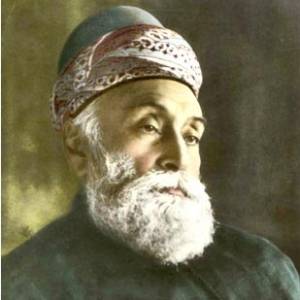
Way back in 1889, when the visionary industrialist J N Tata kept aside half of his personal wealth for the purpose of setting up an educational institute where Indian youth could receive world-class learning in science and engineering subjects, he was not concerned about his business in any way benefiting from the gesture. He did it for India, the country he loved. It comes as no surprise to see that today the Indian Institute of Science in India, set up in 1909 after Tata had expired, is held to be an educational institute of eminence.

Notes:

  1. Inputs from Dominiuqe Conterno and Esther Robles, co-founders of Consciousness Enterprises Network (https://www.consciousenterprises.net), are gratefully acknowledged.
  2. Illustration courtesy Huta of Sri Aurobindo Ashram, Pondicherry, India.

Introduction

Lord Emsworth, as we all know him, is a very kind, loveable and harmless soul. Still, a park-keeper in Kensington Gardens once characterized him as: “a dangerous criminal, the blackest type of evil-doer on the park-keeper’s index.”

This provoked some other questions:

  • How is it possible that this mild man could cause such a harsh judgement?
  • What terrible deeds had he committed?
  • Are there other incidents in the “Blandings Saga” when people consider Lord Emsworth’s activities as evil deeds, skullduggery or crime?

In the following I present occasions when Lord Emsworth in the opinion of other people might be regarded as guilty of misdemeanour. I am just presenting a list of possible accusations, not prosecuting nor judging him. I don’t claim the list to be exhaustive, and all comments, corrections and complements from readers are most welcome. You find my email below, in the ‘About the Author’ paragraph.

Criminal acts frequently occur in Wodehouse’s stories and are often important ingredients in the plot. A bunch of criminals, for instance Chimp Twist and the couple Dolly and Soapy Molloy, are recurring as minor characters in many stories. However, not only crooks commit criminal acts. Wodehouse’s heroes and heroines as well sometimes commit crimes. Finding themselves deep in the soup they resort to acts like theft and blackmail as a way out of tight places. Besides, many young men regard certain violations of the law, like pinching a policeman’s helmet, as a proof of courage and thus as an quite excusable peccadillo, especially on the night after the Boat Race. To occasionally spend a night in the quod is nothing unusual for a Drone and is not regarded as a blot on his escutcheon.

But back to the amiable and absentminded ninth earl of Emsworth? When we associate him with crime and transgressions, we usually think of him as a victim of criminal acts such as pig theft and blackmail. In Service with a Smile (1962), Plum wrote: “Lord Emsworth was a man with little of the aggressor in his spiritual make-up.” But, when upset, Lord Emsworth’s judgement is obscured and on some occasions also he is wandering astray in the back-country around and outside the limits of the law. And he is not totally devoid of aggressiveness.

In The Clicking of Cuthbert (1922), Plum wrote: “There is an ethical as well as a legal code, and this it was obvious that Raymond Parsloe Devine had transgressed.” In line with this thought I present Clarence’s transgressions of legal rules as well as of common social rules and ethical codes, such as lying. Besides, it depends on one’s perspective if you regard a certain act as an evil deed. Plum pointed out that the opinion about fox-hunting very much depends on at which end of the rifle you are. The perpetrator and the victim may have opposing ethical views on the same act. My perspective down is that of the victim, and I include deeds which from the victim’s point of view might be regarded as evil even if Lord Emsworth certainly had no evil intentions. His sister, Lady Constance, has her very rigid views on which ethical and behavioural code is appropriate for the head of the family. In A Pelican at Blandings (1969), she is called “the Führer of Blandings Castle”. I don’t include her accusations of his lordship’s possible transgressions of her rules.

What terrible deeds did the “evil-doer” Lord Emsworth really commit?

Down, is a list of some different kinds of perpetrations/crimes/evil-doings Lord Emsworth is accused of. The incidents are listed in a random order. Intentional as well as unconscious malefactions are mixed. Deeds just planned and deeds actually committed are mixed. Crimes are mixed with peccadilloes.

Theft/unlawful misappropriation

A few times the absentminded Lord Emsworth happens to bag an object that doesn’t belong to him. In Something Fresh (1915), the first novel in which Lord Emsworth is the main character, he commits two unconscious thefts. The first incident occurs in his club, where he pockets a fork, something the head steward makes him aware of. Later, in the home of Mr. Peters, he pockets an Egyptian scarab. When, at home, he discovers the scarab he remembers Mr. Peters showing it to him and supposes that he got it as a gift. The plot in the novel then circulates around Mr. Peters’ efforts to get the scarab back. Mr. Peters promises a reward to the one who gets it back and several persons engage in stealing attempts.

In the short story The Custody of the Pumpkin, (1924) the absentminded Lord Emsworth again falls foul of the law. He is in Kensington Gardens in London. Mesmerized by the beauty of all the flowers he forgets where he is and begins picking flowers. A park-keeper watches him, and becomes horrified: “ … the stranger was in reality a dangerous criminal, the blackest type of evil-doer on the park-keeper’s index. He was a Kensington Gardens flower-picker.” The park-keeper yells, a crowd gathers, a police-man materializes and asks the sinner for his name. When he gives it, his statement is rewarded with a roar of laughter from the crowd. Fortunately, Lord Emsworth’s gardener Angus McAllister is at hand and can confirm the poor peer’s identity. The policeman, who is a glowing admirer of blue blood, chooses to turn a blind eye. This incident evidently stuck in Lady Constance’s memory. Later (in Service with a Smile, 1962), she exclaims: “I forgot to tell Clarence to be sure not to pick the flowers in Hyde Park. He will wander off there, and he will pick the flowers. He nearly got arrested once for doing it.”

Forgive me a short digression from the topic, a short reflection. Plum didn´t mention it, but perhaps a memory of the incident in Kensington Gardens subconsciously appeared in Lord Emsworth’s (Plum’s) mind some time later? Perhaps a dim reminiscence and a deep feeling that flower-picking should be allowed for real flower-lovers cropped out when his lordship once met a small girl from London who was punished for picking “flarze” in the garden of Blandings. Lord Emsworth this time showed unusual heroism, revolted against the authorities, took command and declared that young Gladys was allowed to pick all the flowers she wished. (Lord Emsworth and the Girl Friend, 1928).

Extortion/blackmailing/taking bribes

In the short story The Birth of a Salesman (1950), Lord Emsworth visits his younger son Freddie in New York. A young lady, selling encyclopædias of Sport, knocks at the door and Lord Emsworth courteously, but carelessly, promises to help her. A neighbour, “named Griggs or Follansbee or something”, is hosting orgies in his house while his wife is away. Clarence begins with this neighbour, who several times has noticed Lord Emsworth drooping over his (the neighbour’s) fence. He (Lord E) was really admiring the flowers, but the neighbour suspects that he (still Lord E) is a private eye snooping around on behalf of his (the neighbour’s) wife and he (the neighbour again) tries to bribe him (Lord E). His (Lord E’s) mind is absorbed by the idea of selling encyclopædias and when the neighbour asks “How much?” he (Lord E) interprets it as “How many?” Lord Emsworth emphasizes that the encyclopædias could be used as appreciated gifts and suggests a number of one gross, 144 copies, which the neighbor accepts. The earl is happy that he has been able to help the young lady and is absolutely unaware that he had provoked bribery, or that the neighbour regarded his lordship’s suggestion of such a great number as blackmail.

Armed threat

In Summer Lightning (1929), Lord Emsworth is quite convinced that his secretary Rupert Baxter has gone mad as a coot as well as violent, and furthermore that he has stolen the Empress of Blandings. Armed with a gun, Lord Emsworth forces the unhappy, angry and humiliated Baxter to crawl out from his hiding place under a bed.

In Service with a Smile (1962), Plum tells us how Clarence enters his sister Connie’s room: “He was a light mauve in colour, and his eyes, generally so mild, glittered behind their pince-nez with a strange light. It needed but a glance to tell her that he was in one of his rare berserk moods.” We know nothing about his earlier fits of rage and it seems that Lord Emsworth luckily avoided to commit serious crimes during them. This time his rage is aroused by discovering that his pigman, Wellbeloved, is plotting to steal the Empress. Clarence naturally fires him, not at him, but furiously tells him that he will be after him with a shotgun if he isn’t out of the place in ten minutes. He clearly has forgotten that he himself once participated in plotting a pig-napping! (See further down.)

Firing at people

Lord Emsworth doesn’t only use guns as a threat, but actually fires them. Fortunately, he never causes serious wounds.

In Something Fresh (1915) he empties a revolver with six shots in the darkness of the night in the hall at Blandings. He heard some noise and believes he is firing at burglars. As a matter of fact, it is poor Baxter, who, in his turn in pursuit of what he believes are burglars, has overturned a table and fallen on the floor. Luckily no living person was hit by any of the bullets, but one bullet hit a portrait of his lordship’s maternal grandmother in the face and “improved it out of all knowledge”.

In Plum’s unfinished novel Sunset at Blandings (1977) a person catching a burglar says: “It’s all right shooting a burglar. I asked my solicitor.” I’m not sure whether this is true, but anyhow, when Lord Emsworth fired the revolver in the hall it was at random, in complete darkness and no burglar had actually been revealed.

In the short story The Crime Wave at Blandings (1936) he actually shoots his former secretary and tormentor Rupert Baxter in his back-side, fortunately with an air gun. Lady Constance had confiscated the gun from his lordship’s grandson, who had shot Baxter with it. Furthermore, his lordship commits this crime twice! The first time, he was holding the confiscated gun in his hands, reviving his youth, and wondered if his marksmanship was still intact. Seeing the nuisance Baxter turning his back to him a bit away outside an open window, the temptation overpowered him. It may be considered a mitigation that his victim was such a menace. The wounds were insignificant, but the shot caused a sharp pain, a kangaroo-jump up in the air and wounded pride. The second time Lord Emsworth shot Baxter, he wanted to prove his marksmanship to his butler Beach, and Baxter was already leaving Blandings on his motor-bicycle. This farewell salute was both a further revenge and a message to Baxter to stay away from Blandings for all future, which purpose he achieved. The crime wave in the story didn’t consist only of Lord Emsworth and his grandson shooting Baxter. Beach does the same thing and even Lady Constance yields to an impulse to test her accuracy of aim. She shoots at the backside of Beach, really a not very challenging target to hit. She believes her shot was a hit. It wasn’t, but Connie’s shot gave Clarence the ability to get away from the events without consequences.

Lies

Lord Emsworth’s most frequent violation against common ethical values is probably to lie and stoutly deny what he has done, even if this is not so often told explicitly in the “saga”. Blank denial has become almost a reflex when he is accused, especially by Lady Constance, for having done something. “He was a great believer in stout denial and very good at it.” Pigs have wings (1952).

In the short story The Crime Wave at Blandings (1936) Connie asks him if he shot Baxter and Clarence flatly denies it: “Of course I didn’t.” He further adds to his lie by telling that he doesn’t even know how to load the gun. He fabricates two other explanations, either that Baxter was stung by a wasp or that he once more had relapsed into hallucinations. One of his lordship’s nieces happened to see when he shot Baxter, who was overhearing it when she told Lord Emsworth. Although revealed, Lord Emsworth flatly denies it again. Baxter asks him: “Do you deny that you shot me, Lord Emsworth?” and his lordship remorselessly lies: “Certainly I do.”

Attempted dog-napping

Lord Emsworth once makes an unsuccessful attempt to steal a dog. His son Freddie has (again) got into the soup. This is told in the short story First Aid for Freddie (1966). Eager to sell dog biscuits Freddie gave away a dog, to a young lady in the neighbourhood, despite the fact that the dog belonged to his wife Aggie. Freddie’s intention was to replace the dog by buying another. But Aggie announces her early return before he had time to fix this. If the dog isn’t at Blandings when she arrives, a possible outcome is divorce and that Freddie loses his job in USA. Lord Emsworth faces the frightful prospect of having Freddie living at Blandings again. The dog has to be brought home quickly. Freddie has got a sprained ankle so Clarence has to perform the theft. Of course, he fails. Snooping around the house where the dog is, he gets caught, is believed to be a crook and is locked into the coal cellar. Beach rescues him from both cellar and disgrace. The young lady fortunately returns the dog in time, because it had bitten one of her father’s favourite dogs.

Plotting a pig-napping

To his horror, Lord Emsworth’s prizewinning pig The Empress of Blandings has been stolen. The perpetrator is his sister’s son Ronnie Fish, but this Lord Emsworth doesn’t know. Ronnie’s plan is to “find” the pig, return it and then be able to extract money from a most thankful uncle. Clarence and Gally are absolutely convinced that Lord Parsloe-Parsloe at Matchingham Hall lies behind the theft, in order to make his own sow, The Pride of Matchingham, becomes the prizewinner as the fattest pig at the coming exhibition. Gally and Clarence conspire about appropriate contra strikes and decide that stealing The Pride of Matchingham would give them a good position to negotiate. The idea came of course from Gally and Clarence is naturally out of question as participant in the pig-napping act, but he has no objections of any kind against the plans. However, the plans were never executed, because the Empress was found in Baxter’s camping van. (Summer Lightning 1929).

Damaging property of others

Ignoring her brother’s protests, Lady Constance has allowed the Church Lads to camp by the lake in Service With a Smile (1962). Clarence caught a Church Lad red-handed, occupied with the worst possible sort of cruelty to animals Lord Emsworth could imagine: The Lad had put a potato on a string and jerked it away from the Empress when she tried to eat it! Another Church Lad took advantage of Lord Emsworth’s dim eyesight and prompted him to jump into the lake, with his clothes on, to save a fellow Lad from drowning. The presumed drowning Lad was a floating log. Lord Emsworth broods on revenge. Inspired by Lord Ickenham he sneaks out early in the morning and cuts off their tent ropes while the Church Lads are asleep. The Church Lads and Lady Constance consider this as an appalling skullduggery. Afterwards, his lordship has no remorse whatsoever, but he is scared to death that somehow Connie will get to know the identity of the perpetrator.

Intrusion

A deep rift had arisen in the lute between Freddie and his wife Aggie. One of Aggie’s female “friends” has informed her that she had seen Freddie in a restaurant together with a glamourous female movie star and she advocates divorce. It was an innocent meeting, for a good, but secret, reason, so Freddie had not informed Aggie about it. She has moved out to a hotel suite. Divorce is threatening and Lord Emsworth again fears to become stuck with Freddie living at Blandings. This is told in the short story Lord Emsworth Acts for the Best (1926). Aggie refuses to see Freddie, who asks his father to go to her and plead for him and convince her that the whole thing was innocent. His lordship and Aggie had never met before. Confronted with the threat of having Freddie at Blandings Lord Emsworth reluctantly goes to Aggie’s hotel suite. No one hear him knocking at the door to the suite, but he finds out that the door isn’t quite closed. So, he enters the suite, uninvited, as an intruder. The drawing-room is empty and his attention is caught by the beautiful flowers. He potters around putting his nose into the flowers, sniffing. The “friend” enters, takes him for a burglar and threats him with a pistol. She doesn’t believe him when he tells his name. Soon, Freddie arrives and confirms his lordship’s identity. The rift is eliminated, the “friend” is disposed of, and his lordship happily escapes the horror of having Freddie living at Blandings.

Some final comments

Exceptionally, Lord Emsworth is regarded by some others as an evil-doer. Wodehouse created him a kind of unobtrusive hero, without the normal characteristics of a hero. He is timid, not bold; whimsical, not decisive; evasive, not action-oriented; usually striving just to be left alone and to do no harm. According to Wikipedia, an anti-hero is “a protagonist in a story who lacks conventional heroic qualities and attributes such as idealism, courage, and morality. Although antiheroes may sometimes do the right thing, it is not always for the right reasons, often acting primarily out of self-interest or in ways that defy conventional ethical codes”. Lord Emsworth for sure lacks conventional heroic qualities. I regard Lord Emsworth as a kind of comical anti-hero, even if anti-heroes normally are crooks and are more complicated souls than the harmless, simple-minded peer, who just wants to please everybody, but now and then fails.

Often Lord Emsworth is absentminded and unaware of his transgressions, but a few times he commits them deliberately. If his reasons are strong enough, Lord Emsworth doesn’t hesitate even to commit crime. To prevent Freddie from settling down at Blandings, (in his lordship’s opinion a disaster worse than if the Castle should suffer from an outbreak of foot-and-mouth disease and an invasion of green-flies at the same time), he is prepared to transgress both legal and ethical codes.

His lordship can also be vindictive. If an opportunity appears, for instance to shoot Baxter, and he thinks he can get away with it, he can take revenge. His transgressions are however very rare. They are mostly provoked by others, and his victims are often unsympathetic characters and we feel that they have deserved to be “punished”.

It is very easy to feel sympathy for the amiable and whimsical peer, to understand and forgive him. Almost all the time he is kind and benevolent to all and sundry. However, this doesn’t mean that he never has hostile intentions. He avoids quarrels and fights if possible, but there is a limit for what he can stand, and he is no saint. Under enough pressure, if pushed and cornered, this meek man can at times feel compelled not to turn his other cheek. I, for one, can’t blame him.

By writing an essay on this topic, with this headline, it may be that some friends of Lord Emsworth might accuse me for being an evil-doer against his lordship. I certainly have no evil intentions and really enjoy spending time with him. However, Plum didn’t create Lord Emsworth an infallible hero. When upset, when his “world” and way of life is threatened, his mind and judgement may become obscured and his acts too hasty. Why should we close our eyes to these very human qualities? His weaknesses, in my opinion, just make him more loveable. Among all the heroes and anti-heroes in the world which Wodehouse created for our joy, he is my favourite. As Pope said: To err is human, to forgive is divine.

(Notes:

  1. A version of this article appeared in the March 2021 issue of Wooster Sauce, the quarterly journal of The P. G. Wodehouse Society of UK.
  2. Illustrations are from the serialized version “Something New” in Saturday Evening Post. Ill. F. R. Gruger.
  3. The author’s permission to reproduce this piece here is gratefully acknowledged.)

About the Author

Mr Tomas Prenkert has been a Wodehouse addict since his teens. He popularized the principles of management as a Lecturer in Business Administration at Linné University in Växjö (Sweden) till 2006. Thereafter, he opted to spread sweetness and light all around by bringing Plum’s works to denizens of Sweden.

Of his own initiative, he and a fellow Wodehouse fan undertook a research project and discovered Plum texts in old forgotten Swedish magazines. He edited and published two collections of these stories in 2010 and 2011. A third collection, with translations made by members of the Wodehouse Society in Sweden (WSS), was brought out by the WSS in 2015.

He has done commendable work in digging up innumerable texts of the Master. Over the years, he has undertaken an editorial endeavour and also dished out several translations and insightful articles which can often be found in Wooster Sauce, Plum Lines and Jeeves – the yearbook of the WSS.

His work can be accessed at the following two websites of his:
http://www.wodehousebibliografier.n.nu
and http://www.wodehouseforskning.weebly.com.

He can be reached at tomas.prenkert@gmail.com.
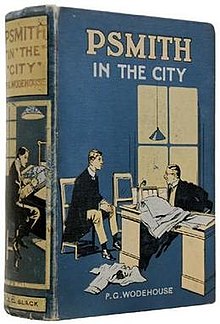
I conclude this series in celebration of the 10th anniversary of this blog site! I wish to thank all my followers and readers who have always encouraged me (and keep doing so) in this journey.

ashokbhatia's avatarashokbhatia

Uncle Fred and Shakespeare

Yet another sterling example of Wodehouse’s use of Shakespeare is found in Uncle Fred in the Springtime (1939).

When Alaric, Duke of Dunstable decides to take Empress of Blandings away from her loving master and get her fit, Lord Emsworth calls in the services of the redoubtable Uncle Fred. Fred arrives full of the joys of spring, with nephew Pongo Twistleton and old friend Polly Pott in tow, and despite the efforts of the efficient Baxter, endeavours to scupper the Duke and bring together a variety of romantic couplings.

The perils of a financial obligation

‘Beginning by quoting from Polonius’s speech to Laertes, which a surprising number of people whom you would not have suspected of familiarity with the writings of Shakespeare seem to know, Mr Pott had gone on to say that lending money always made him feel as if he were rubbing velvet the…

View original post 1,386 more words