Feeds:
Posts
Comments

As a neighbour, an impartial observer and a well-wisher of Auroville for close to twenty five years, let me share a few impressions I have of this ‘City of Dawn.’

In 1997, I had just joined a company in Pondicherry and the need arose of a couple of computers. Orders were duly placed. A friend of the owner of the business, based in Auroville and a technocrat by profession, not only organized the hardware and the software but also brought in intranet, helping us to exchange notes via emails sent and received over our monitors. At the time, the term ‘internet’ was not known to me!

That was my first realization that Auroville was indeed a Centre of Excellence in various fields – IT, solar power, wind power etc.

Visitors to Auroville, especially those who live in matchbox kind of flats in our urban concrete jungles, get bowled over by its greenery and its open spaces.

Background

The visionary concept of Auroville is that of a universal township“where men and women of all countries are able to live in peace and progressive harmony, above all creeds, all politics and all nationalities.”

“Auroville belongs to nobody in particular. Auroville belongs to humanity as a whole. But to live in Auroville, one must be a willing servitor of the Divine Consciousness.” 

“Auroville will be the place of an unending education, of constant progress, a youth that never ages.” (Auroville Charter, 1968)

The Birth of Auroville

The township is a tangible manifestation of the spiritual collaboration between the Mother and Sri Aurobindo. After he passed away in 1950, it was the Mother who took on the task of bringing his idea of a “universal town” to fruition. Her guiding principles were Sri Aurobindo’s ideal of human unity, his emphasis on cultural collaboration and his vision of India as a spiritual leader of the world.

It is supposed to be a place which is like a crucible in a laboratory from where Homo sapiens of a higher consciousness would eventually emerge.

Born in 1878, Mother was over 90 when, on February 28, 1968, Auroville was inaugurated. She worked with architect Roger Anger to chalk out a blueprint for a city of 50,000 people. On the day of the inauguration, over 5,000 people from 124 countries, including India, had gathered.

To signify that the township belonged to none in particular but to humanity as a whole, these delegates also deposited a handful of their native soil into a marble-clad urn at the amphitheatre.

Government of India Steps In

The baby was born. But its growing challenges had just begun.

An enterprise like this one can almost only be built in difficult conditions. Without a maturity that arises from problems, on the level of those people who live the experience, it seems hard to conceive that the goal of Auroville and its message can be arrived at in a comprehensive manner…..What is important is not to build a city, it is to build a new humanity.

(Roger Anger, 1973)

In 1973, after the Mother’s death, a bitter conflict developed between the residents and the township’s ‘parent’ organisation, the Sri Aurobindo Society. The Society laid a claim to the land acquired by Auroville.

The matter went right up to the Supreme Court, which eventually decided in favour of Auroville.

Sensing a situation of continued tension between the sister organisations and to legally permit Auroville to own land, Government of India stepped in. In 1988, the Indian Parliament unanimously passed the Auroville Foundation Act to make the township a legal entity and safeguard its autonomy. Eventually, the Society transferred the land to Auroville.

Thanks to the tireless efforts of Mr. Kireet Joshi, a senior IAS officer, the township earned global recognition by UNESCO. In the Cold War era, it was considered a manifestation of India’s commitment to the cause of the Non Aligned Movement. Prominent persons like Mr. J R D Tata, Mr. Nani Palkhivala and HH the Dalai Lama have supported Auroville.

The Organisation

Auroville is managed by a three-tier structure.

  1. International Advisory Board
  2. Working Committee (comprising 9 members: 1 Secretary, 4 nominees of the Government of India, 4 nominees of Auroville)
  3. Resident Assembly (comprising all the residents of Auroville, the decisions of which need unanimous approval)

Interestingly, nothing in Auroville is owned by any person there. Every single asset in the township is owned by the Auroville Foundation, which, in turn, is under the Government of India’s Ministry of Human Resource Development.

Achievements

Today, Auroville is home to over 3,200 people — architects, writers, artists, doctors, engineers, chefs, teachers, farmers, students etc — from over 60 countries, not to mention all regions of India. Thanks to its multi-faceted talent pool, the township has been a trail blazer in sustainable practices, environment-friendly operations, futuristic technologies, water resource management, alternate farming, to name a few. From ecology to economy and from education to entertainment, it offers a fulfilling life to its residents. Its expertise in different domains is sought by governments and other bodies from time to time.

Over the years, a massive forestation drive by residents and villagers has ensured a lush green campus, buildings which draw their energy needs primarily from the sun and houses which are not connected to power grid of Tamil Nadu but are solely dependent on wind/solar power.

Take the case of Buddha Garden which is a farm that experiments with sensor-based precision irrigation system — the first crop cycle saw an almost 80% drop in water consumption!

The Universe and its Centre

The layout of the township resembles that of a galaxy, with the magnificent Matri Mandir at its centre, considered the “soul of Auroville”. Over time, separate zones have evolved: for residences, for industrial units, for cultural events and for visitors.   

Matri Mandir is an elaborate gold-plated sphere that took 37 years to see the light of day. The structure comprises 1,415 large gold discs and is suspended above 12 “petals” or themed mini concentration rooms, each of which is flanked by a themed garden. The main hall for concentration, known as the Inner Chamber, is a pristine white in colour, whereas each of the “petals” has a distinct colour to it.

The approach to the Inner Chamber has three levels through which one ascends, much like a spiritual aspirant would evolve through the three states of Aspiration, Rejection and Surrender, eventually reaching a state of realisation.

The global structure rests on four directional pillars: Mahakali (North), Maheshwari (South), Mahalakshmi (East) and Mahasaraswati (West).  

Woods are Lovely….

Auroville presents to us an exemplary blend of India’s age old spiritual tenets on the one hand and futuristic thought in terms of sustainability and technology on the other.

The journey of evolution is surely not an easy one. Coordinating between various opinions and views is a mighty task. Recently, in respect of the implementation of the Master Plan, some differences have arisen between two groups of residents. There is no doubt that with compassion and a spirit of give and take, the same will get resolved amicably and Auroville will emerge stronger.

It is hoped that future developments would retain the township’s Unique Selling Proposition – greenery, low rise structures and open spaces.  

Mother has never said this journey is going to be easy. She would typically discourage enthusiastic newcomers to join in. Her recommendation was that once we have made up our mind to join, we should go to the very end.  

The journey of Auroville reminds me of the famous poem by Robert Frost where he says:

The woods are lovely, dark and deep.

But I have promises to keep, and miles to go before I sleep.

(Inputs from Mr Sanjay Mohan are gratefully acknowledged)

Related Posts:

I wanted to send some sort of holiday greeting to you, my friends, but it is so difficult in today’s world to know exactly what to say without offending someone. So I met with my lawyers yesterday, and on their advice I wish to say the following to you my dear friends.

“Please accept with no obligation, implied or implicit, my best wishes for an environmentally conscious, socially responsible, low stress, non-addictive, gender-neutral celebration of the winter solstice holiday, practiced with the most enjoyable traditions of religious persuasion or secular practices of your choice with respect for the religious/secular persuasions and/or traditions of others, or their choice not to practice religious or secular traditions at all.

“I also wish you a fiscally successful, personally fulfilling and medically uncomplicated recognition of the onset of the generally accepted calendar year 2022, but not without due respect for the calendars of choice of other cultures whose contributions to society have helped make our country great (not to imply that India is necessarily greater than any other country) and without regard to the race, creed, colour, age, physical ability, religious faith or sexual preference of the wishes.

“By accepting this greeting from me, the Wisher, you, the Wishee, are accepting these terms:
– This greeting is subject to clarification or withdrawal.
– It is freely transferable with no alteration to the original greeting.
– It implies no promise by the Wisher to actually implement any of the wishes for her/himself or others and is void where prohibited by law, and is revocable at the sole discretion of the Wisher.
– This wish is warranted to perform as expected within the usual application of good tidings for a period of one year or until the issuance of a subsequent holiday greeting, whichever comes first, and warranty is limited to replacement of this wish or issuance of a new wish at the sole discretion of the Wisher.”

Disclaimers:

  1. No trees were harmed in the sending of this message.
  2. However, a significant number of electrons were slightly inconvenienced. The Wisher hereby offers an unconditional apology to them.
  3. The Wisher hereby asserts that he does not represent the commercial interests of either any of the IT service providers or social media platforms who have enabled the transmission of this message to the Wishee.
  4. The Wisher hereby confesses that this message is shamelessly picked up by him from the FB page of Mr. Rahul Nandkeolyar. For any legal clarifications, the Wishee is hereby advised to contact him directly.
  5. Image courtesy Pinterest.

Christmas at Blandings

Here is an uplifting piece from the stable of Plumtopia which transports one to the idyllic world left behind for us by Plum! The Yuletide spirit prevails at Blandings, perhaps also because Lady Constance Keeble is not there!!

Honoria Plum's avatarPlumtopia

Blandings Castle sparkled in the winter frost.

After a crisp, clear day, the sun was beginning to set and a tranquil calm descended upon the Castle and its inhabitants. Beach the Butler was in his pantry, enjoying a special drop of port, which he had been saving for the occasion. Lord Emsworth was dozing in a favourite armchair with Whiffle’s ‘Care of the Pig‘ across his lap.

Somewhere outside, amongst the evergreen shrubberies – or perhaps the kitchen garden, where bare fruit trees created a romantic silhouette in the fading light – an assignation between lovers was taking place. And in the warmth of her sty, the Empress of Blandings lay in contented majesty after feasting on her Christmas provisions.

Off in the distance, the twinkling lights of Market Blandings had begun to flicker, and a hum of woozled carolling from the Beetle and Wedge drifted upon the…

View original post 18 more words

The day was mildly cold, so fair, so magically a thing of sunshine and greyish-blue skies and bird-song that anyone acquainted with Clarence, the ninth Earl of Emsworth, and aware of his liking for fine weather, would have pictured him pottering about his terraced garden on a December morning with a beaming smile and an uplifted heart.

Instead, prompted by the Countess of Emsworth, he was being the genial host, ensuring that all the guests and a sole imposter present could lay their hands on their favourite tissue restoratives, of which a wide range was available in abundant supply, Plum wine being only one of the many.

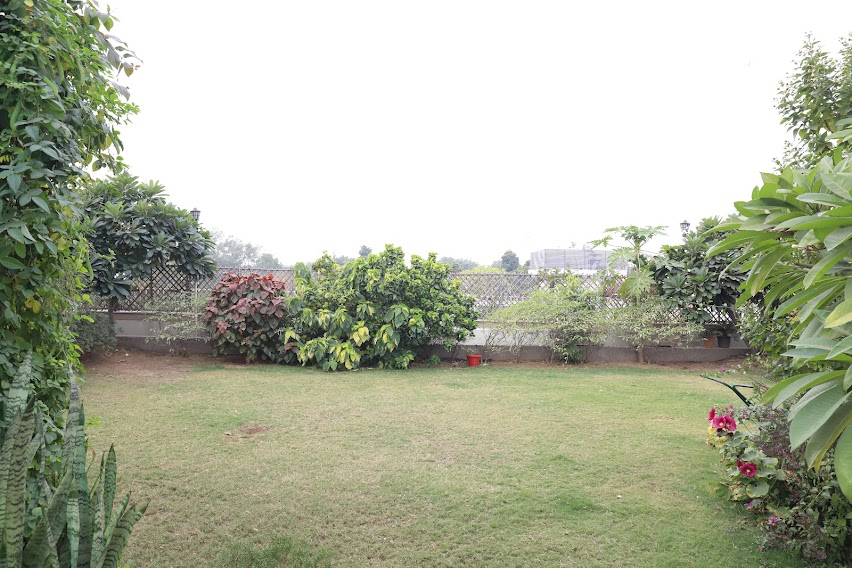
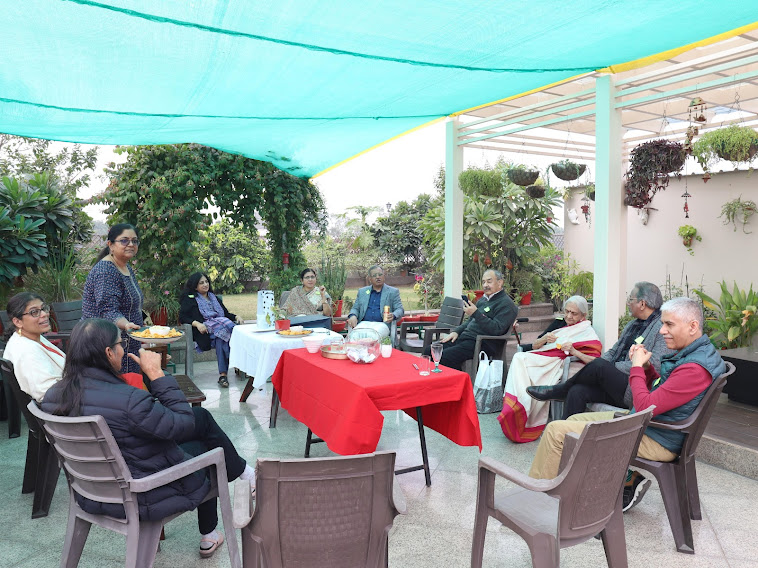
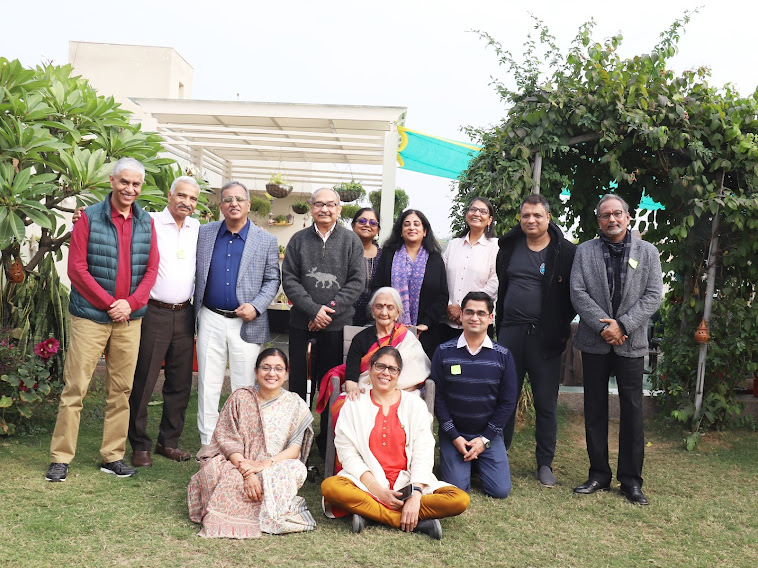
On the lavish lawns of Blandings Castle, around fifteen of Plum fans had assembled. Flowers were in full bloom. The birds had ceased twittering and were looking askance at the mirthful peals of uncontrollable laughter emanating from the group.

Once the introductions had been made, the proceedings were kicked off by recalling the Yeoman’s Wedding Song and then a playback of Sonny Boy.

A quiz followed, leaving many a brainy cove stumped and gasping for fresh air. A dumb charade came up next, regaling all those present.

Personal reminences were shared. Many of the characters created by Plum came in for a loving mention. The conversation in the group often touched a high level and feasts of Reason and flows of Soul occurred.

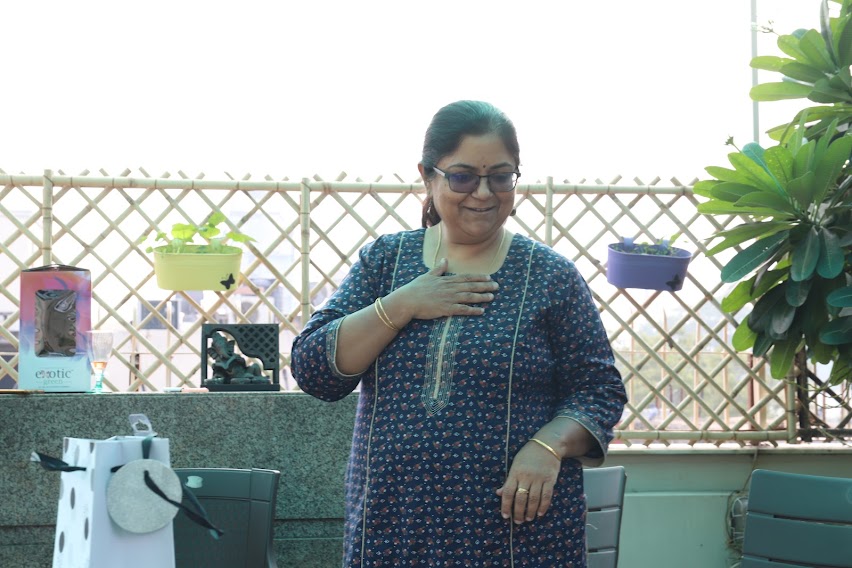
The eldest known fan, Mrs. Sushama Varma, was felicitated on the occasion. She rendered a soul-stirring ghazal in her sweet and melodius voice. She also released the hard copy version of ‘The Indian Curry Dished Out by P. G. Wodehouse.’

In the absence of Angus McAllister, flowers and plants were freely offered by the genial host. Regrettably, the Empress of Blandings was missing in action, having been whisked off to a secret location. Thus, pig-napping was ruled out.

With the assistance of Gerturde, Beach, Miss Twemlow and other maids, the Countess of Emsworth had organized a lavish spread which could well have been the envy of Anatole. Sweets and savouries were plentiful. Cakes beseeching the participants to tuck them in kept pouring in even after the gig was over.

Overall, a grand rollicking time was had by all those assembled. Fun-filled, blissful and overflowing with sublime joy. The Plum wine was intoxicating indeed. The true spirit of fan following was in evidence. Those who ventured to attend left beaming from ear to ear, carrying with them the sweet memories of the fun, warmth and laughter that normally gets uncorked when a bunch of Plum’s fans gets together.

Photographs courtesy The Imposter

Related Posts:

ashokbhatia's avatarashokbhatia


Mr Schnellenhamer, the head of the Perfecto-Zizz-baum Corporation, the leading movie studio, is reported to be having an odd disagreeable feeling these days. Perhaps, it is caused by what Roget’s Thesaurus would describe as  agitation, fury, violent anger, wrath and similar emotions listed under the heading ‘Rage’, that too of an impotent kind.

Having struck a deal with Coronavirus Global Corp (CGC in short) to unleash upon the public a movie based on the current pandemic, he believes things to be moving a tad sluggishly. He is not able to gather enough goofy ideas to add a sparkle to the script. Discussions with his team of directors, script-writers, music composers, yes-persons, deputy yes-persons, junior yes-persons, nodders and trainee nodders have led to finalization of the basic outlines of the movie. But he feels much more could be done. CGC had mandated that the movie should get released before any…

View original post 1,179 more words

ashokbhatia's avatarashokbhatia

Practising managers have had a look at it. Entrepreneurs – of the social as well as the anti-social kind – have gone through it. Management consultants have flipped through it. Eminent personalities have browsed through it. Academicians have devoured it.

Here are some of the comments received so far in respect of the book Surviving in the Corporate Jungle’.

“Behind the veil of humour and punch – there is a message. As the human drama unfolds itself in the corporate jungle, the best and worst of human natures battle for space.  Sure enough, the early warnings in the book might help the hapless to survive and the smart to succeed. However, buried in the crevices of the chapters lies a deeper secret. The secret of an inner tuning – developing an inner compass based on personal values that not just protects you but also guides you towards happiness…

View original post 1,978 more words

ashokbhatia's avatarashokbhatia

Of all the reading that I have done, I have never ever had so much fun,
Than whilst perusing Wodehouse, Laughing to burst out of my blouse.

That Bertie Wooster is so British, such a jolly good fellow,
Can erupt like a volcano at times, yet is disarmingly mellow,
Ample bosomed Aunt Agatha et al bully him into the ground,
Bertie would be lost if Jeeves, that paragon wasn’t around.

The aunts make mincemeat of Bertie without so much as a by your leave,
If it wasn’t for Jeeves the saviour, we’d weep for Bertie and for him grieve,
The Wooster name would fall into ruin, rust corrode their noble family crest,
Sans Jeeves to keep a vigilant eye and shoo away both aunt and other pest.

Bertie Wooster is so upper class, so stiff upper lip, simply so very English,
He belongs to the right club, yet tormented by…

View original post 169 more words

ashokbhatia's avatarashokbhatia

The big and fat weddings which keep taking place all across the length and breadth of India are well known. These are occasions on which gullible parents, overjoyed by the prospect of finally getting rid of their respective wards, loosen their purse strings, showcasing their wealth, power and pelf.

Ostentatious decorations, lavish dinner spreads which could make Anatole raise his eyebrows a fraction of an inch, sumptuous upholstering of those in attendance and a chain of rituals which keep the hapless bride and the groom on their toes – all of these create an ambience which befits the social status of the well-heeled parents, making many others green with envy. It is another matter that such display of wealth often makes our tax sleuths sit up and take notice. The Bartholomews under their supervision promptly start sniffing around, their bare teeth on full display. Unless prompt steps are taken through…

View original post 1,003 more words

Bjorn Bergstrom, Sweden

Ashok, your excellent Indian Curry is really spicy! I can imagine how hard you must have worked on it to find all those references to India.

Chakravarti Madhusudana, Australia

P G Wodehouse never visited India. But even a first reading of his works reveals his affinity for India, Indians and Indian things in general. He may not be always complimentary about Indians and sometimes be even wrong, but his observations were totally without malice and always with an acute sense of the absurd.

In “The Indian Curry Dished Out”, Ashok Bhatia has made an extensive study of Indian references in Plum’s stories and novels. He has classified them into more than a dozen categories and presented them in a style that would be the envy of probably the master himself. I particularly liked the section “Missed Ingredients…” which hints at how PGW’s works might have been enriched by looking at other aspects of Indian culture.

This is a momentous work performed with great love and respect for Plum. I am sure it will be read with delight by Wodehouse fans whether or not they have an Indian background.

John Dawson, USA

This is a unique, delightful and informative essay. Of course I knew that Plum had referenced Indian matters quite a few times in his books, but the volume of these references you’ve included were surprising to me. You’ve done a superb job on an ambitious project! I don’t believe anyone has heretofore attempted to gather all of the Indian references in Wodehouse’s books. Please accept my congratulations for a lovely and worthwhile contribution to Wodehouse scholarship.  

Masha Lebedeva, Russia

The article is absolutely wonderful. It not only gives us a chance to enjoy Master’s humour again and again but also a possibility to look through Plum’s eyes at India’s history, politics and culture. Bravo, Ashok, great work!

Kartik Pashupati, USA

Excellent essay. It’s interesting that Plum’s cat was named Poona. “Poonai” is also the Tamil word for cat, although I doubt if that’s what he had in mind. It’s also worth noting that all of the references to gemstones and similar artifacts stolen from Indian temples are parodies of “The Moonstone” by Wilkie Collins, which is said to be one of the earliest detective novels in English.

Nikhil Rathod, India 

Thank you for the fascinating piece. It took me a while, but I finally finished all 50+ pages. You’ve really researched it!

A couple of things stood out to me:

– India was a huge part of British culture. More than PGW having a fascination for India, I got the impression he was just reflecting the popular culture. PGW was quintessentially English, which is reflected in his writing-style and stories. The references to India weren’t particularly knowledge about India.

– Speaking of “stories”, I’ve loved reading PGW. But, I always knew that the storyline or theme of most books never changed. Obviously, that didn’t lessen my enjoyment of his writing. Similarly, the references that you pointed out in your essay were also repeated in several books. The essay really illustrated this point.

I would have said, Happy Reading, in conclusion, but I don’t think we’ll find an author to compare. Again, thanks for sharing your essay.

Pradeep Swaminathan, India

Ashok has taken the pains book by book to correlate all facts that the Master has made about India. Right from the origins of Wodehouse Road in Colaba, Mumbai, to practically every single mention of anything connected with India. I was a small kid living in Colaba, in the early 60s, when my father was working for that very British institution – The Indian Railways. The colonial hangover still lingered. Colaba was where British India administered Mumbai and the surrounding areas. I still recollect the magnificent building we lived in – Beryl House. Just for the record the ICS exams were replaced with the IAS exams after 1947, so this British Structure is still very much there.

Back to Ashok. If and when he decides to share his essays publically do make it a point to delve deeply into them. How PGW without ever coming to India could garner so many facts about India amazes me. How Ashok has managed to pick each of these gems relate it to the book and give the references also amazes me.

Rajeev Varma, India

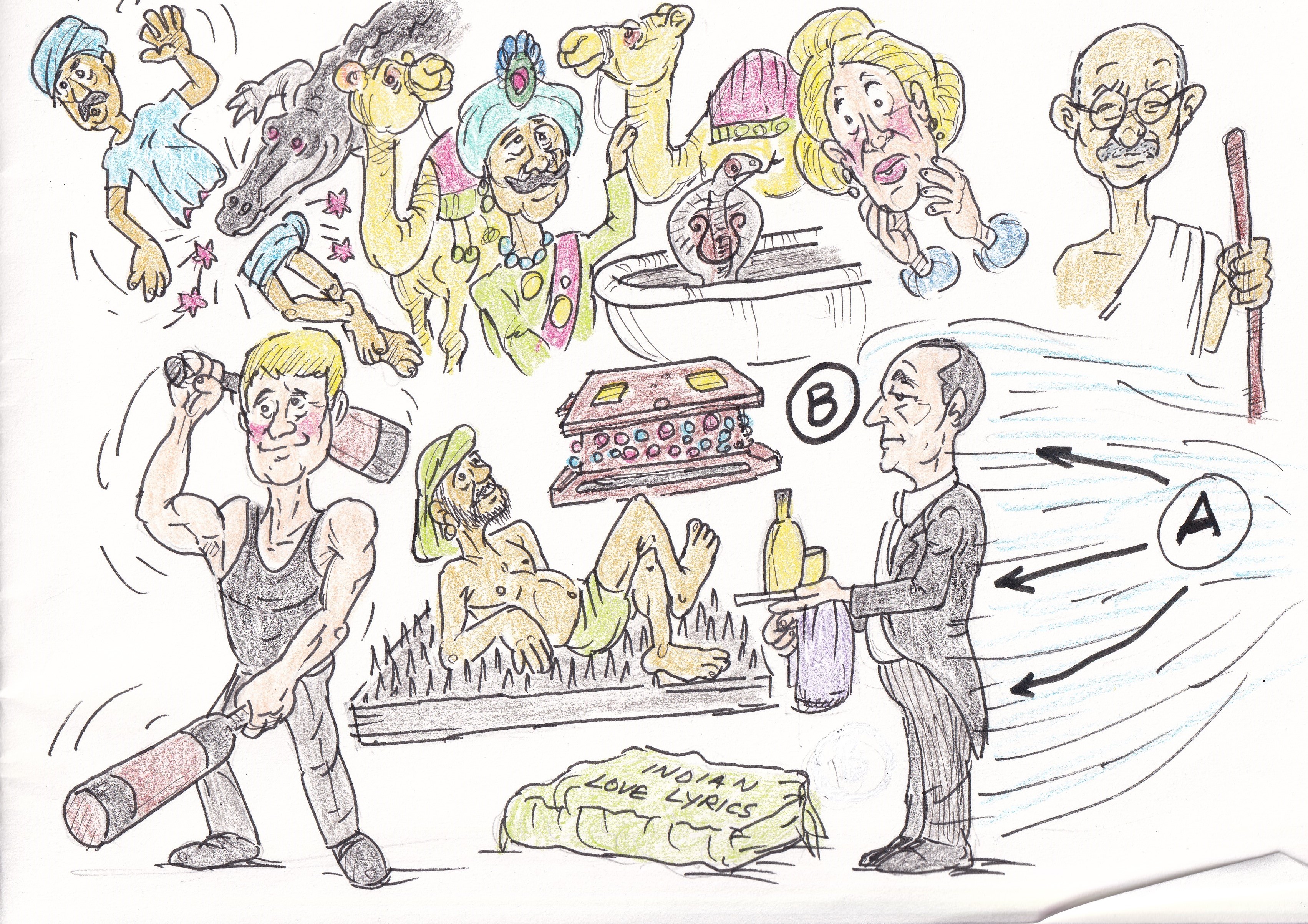
This is a fabulous collection of PGW’s literary rendezvous with the Indian curry – scorpions, cats, cobras, fakirs and their spikes, the Maharajas, the princes, the Taj Mahal and Mahatma Gandhi and Rabindranath Tagore – all put in an appearance.  Some modern day Indian nationalists might be critical  of what PGW felt about Mahatama Gandhi’s fasting but one must take into account the time and circumstances while he spoke of Indian Civil Disobedience.  Ashok has admirably captured the essence of PGW’s humour and wit. Undoubtedly, Ashok’s write-up will be immensely liked by PGW’s fans all over India and even elsewhere.

Ashok’s command over the language and the flourish of presentation evoke immediate interest in his writing. A commendable work indeed!

Sanjit Ghatak, India

Imagine my rapture as I turned to page 49 of ‘The Indian Curry dished out by P. G .Wodehouse’ where you kindly mentioned about my humble effort to translate P. G. Wodehouse in Bengali.

At the outset, I must congratulate you on how you have painstakingly collated the India related references scattered in plethora of Wodehouse works, garnishing them suitably with appropriate comments. I hope you will not mind if I mention below some of the other India-related anecdotes appearing in Wodehouse work.

a) It was mentioned somewhere that a Hindu flung himself into the Ganges, got devoured by an alligator and considered the day well spent!

b) Horse racing was a favourite topic for Plum- Hon. Galahad Threepwood was a noted sportsman in his youth. Mention of winning the Great Calcutta Sweep was made on many occasions.

c) In Big Money Major Flood Smith “said something sharply in one of the lesser-known dialects of Hindu-Kush”.

Shalini Kala, India

What a feat – a comprehensive compilation of Plum’s India, accompanied with a wonderful commentary! Loved every bit of it.  I think it will be a treat for any Indian or Indophile who has enjoyed PGW’s writings.

Sriram Paravastu, India

Brilliant writeup and accompanying cartoons by Suvarna Sanyal sir.

Subrata Sarkar, India

Superb. All people wanted to know about “Plum and India” but were too lazy to find out themselves. Hurry Bongsho Jabberjee is obviously a Bengali. I suspect Plum remembered the surname had something to do with incessant talking “chatter” which he recalled as “jabber”. And hence Jabberjee.

Oh! I must mention Suvarna Sanyal and his collage. He brings the characters to life with an additional x-factor.

Suvarna Sanyal, India

Truly PhD level work.

Swarupa Chatterjee, India

This is brilliant. Such an exhaustive account of PGW’s Indian references. And the accompanying illustration is out of the world!

Thakshila Jayasinghe, Sri Lanka

What a read! Enjoyed it very much. I had no idea there were so many references to India in Plum’s books. I suppose you only realise the extent of it when they’re all compiled together like this. Thank you for sharing this with me. It is truly a labour of love as only a real Wodehouse fan could’ve had such dedication.

Related Post: