Feeds:
Posts
Comments

This is an abridged version of the talk that Peter Nieuwenhuizen, president of the Dutch P. G. Wodehouse Society, gave on 15 March 2024 at Wodehouse at the UK Conference ‘Wodehouse in the Springtime’ in Bath, in which he explained some of the links between the two authors and revealed the truth about an ‘unknown’ plaque.

The author Ian Lancaster Fleming (1908–64) wrote 14 novels about the British MI6 secret agent James Bond, 007. Fleming’s wartime service (he helped plan several naval operations) and his postwar career as a journalist for the Sunday Times provided much of the background for his Bond stories. Fleming, a keen birdwatcher, especially during his sojourns at his holiday home in Jamaica, took the name of his spy hero from that of the ornithologist James Bond, whose book Birds of the West Indies was an indispensable guide for the budding thriller writer. As for the character of 007, the model was said to be master spy Sidney George Reilly (1873–1925).

P. G. Wodehouse also used a familiar name, of course, for one of his most famous fictional creations: the name of Bertie Wooster’s inimitable valet was inspired by professional cricketer Percy Jeeves. In 2016, 100 years after he was killed at the Battle of the Somme, a commemorative blue plaque donated by The Wodehouse Society was installed in Manuel Street, Goole, Yorkshire, where Percy Jeeves lived before he joined Warwickshire County Cricket Club.

Fleming lived in London in the 1930s and was very familiar with the streets and squares of Mayfair that we know from the Wodehouse novels. He visited several of the gentlemen’s clubs, where he might have met Wodehouse, although there is no record of it. Fleming’s home at Belgravia’s 22B Ebury Street was, coincidentally, once the address of Oswald Mosley, leader of the British Union of Fascists, on whom Wodehouse modelled Roderick Spode. There is a blue plaque in Ebury Street commemorating Fleming’s residential connections.

When Fleming sold the film rights to his immensely popular Bond novels in 1961 to EON Productions, he hoped that the lead role might be given to David Niven, but it was given to the “overgrown stuntman” (Fleming’s words!) Sean Connery. However, one of the two Bond films not produced by EON, the 1967 Casino Royale, did cast Niven as 007 – which leads to another Wodehouse link. Niven had previously appeared as Bertie Wooster in the film Thank You, Jeeves! (1936), and as Frederick Altamont Cornwallis Twistleton, fifth Earl of Ickenham, in Uncle Fred Flits By (1955), an episode of the American network television series Four Star Playhouse. So, the Spy and the Gentleman united in one person.

Fleming knew his Wodehouse canon and included a few references to him in his Bond stories. In From Russia with Love (1957), Fleming describes the muscular agent Donovan Grant, a German-Irish psychopath who had defected to Russia and had become the head executioner for SMERSH. Grant, having learned Russian, maintains his knowledge of the English language by reading Wodehouse – in the first chapter, he is reading “The Little Nugget – an old P. G. Wodehouse”. In chapter 13 of The Man with the Golden Gun (1965), Bond is faced with the villain Scaramanga and says to himself “that he must increase the other man’s unawareness, his casual certitude, his lack of caution. He must be the P. G. Wodehouse Englishman, the limey of the cartoons. He must play easy to take.”

Both Fleming and Wodehouse had stories published in Playboy magazine. One issue, April 1965, contained both the first chapter of The Man with the Golden Gun and PGW’s short story ‘Stylish Stouts’, which would be incorporated in the anthology Plum Pie a year later.

Let us turn now to Le Touquet, the French seaside town within easy reach of Paris and close to the south coast of England. In the 1930s, Le Touquet became accessible by air when the local airport was built, and this led to a rise in the popularity of the resort as a holiday location for the well-to-do amongst English society. Fleming, a member of this ‘smart set’, frequented Le Touquet both before and after the war, and in 1952 started writing his first Bond novel, Casino Royale. The eponymous gambling house is based on the Casino de la Fôret in Le Touquet, and the town is mentioned several times in the book. Fleming was based at the Mirrlees family villa, close to the golf course. More on this a little later!
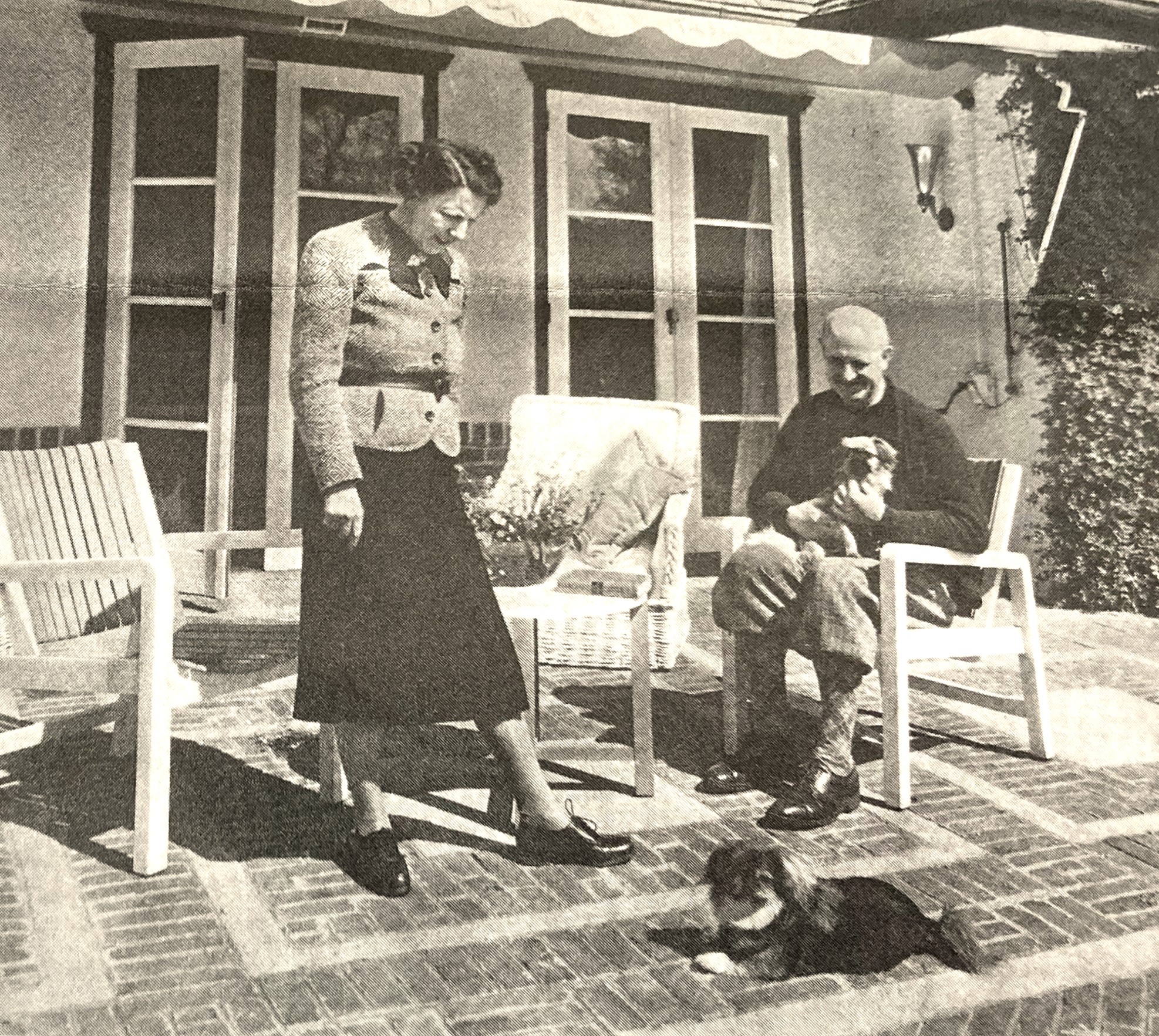
By the time Fleming became a regular visitor to Le Touquet, Wodehouse and his wife, Ethel, had made their home there, having spent many years enjoying a somewhat nomadic life in France, to escape his conflict with the British and American tax authorities. They had spent some time on the Riviera, where their neighbours included H. G. Wells and E. Phillips Oppenheim. They had also tried living in Paris, but Wodehouse had quickly realised that the quieter atmosphere of the coastal resort suited his working life better. Furthermore, there were two good golf courses, plenty of tennis for Leonora on her visits from England, and a local casino that Ethel enjoyed patronising.

Wodehouse had mentioned Le Touquet long before he moved there. In Carry On, Jeeves (1925), the story ‘Clustering Round Young Bingo’ included a sartorial discussion between Bertie and Jeeves, in which the former argued his case thus: “It may interest you to learn that when I was at Le Touquet the Prince of Wales buzzed into the Casino one night with soft silk shirt complete.”

In November 1934, the Wodehouses rented Low Wood, an Anglo-Norman style villa next to the golf course at Le Touquet. The house, and particularly the garden, suited them so well that six months later they bought the property. Here, PGW’s creativity flourished. Having struggled with a lack of plots, he now invented a new character for his stories, Uncle Fred, who made his debut in ‘Uncle Fred Flits By’ (1935). In 1936, Wodehouse wrote Laughing Gas, which was serialised in Pearson’s magazine. The following year he started on a new novel, The Silver Cow, which later transformed into the masterpiece The Code of the Woosters. And Wodehouse then produced Uncle Fred in the Springtime (1939), in which Le Touquet played a role.

After their enforced wartime absence from Low Wood, the Wodehouses returned to inspect the house and found it had been looted and was now in a ruinous state. Renovation was deemed too expensive, and so in 1948 they sold the remains of the villa and emigrated to the USA.

The present owner of Low Wood, Philippe Cotrel, former mayor of Le Touquet, bought the property in 1995, to save it from demolition. The roof and all the windows were renewed or replaced, and an extra wing was added to the house.

The Mirrlees family villa (mentioned earlier) was built in 1936 as a summer residence for Major-General William (‘Reay’) Mirrlees and his second wife, Frances Lalanne, after whom the house was named Villa Les Lambins-Lalanne. Her son from her first marriage took his stepfather’s name and was known as Robin Mirrlees (1925–2012). He led a flamboyant life, during which he became a friend of Fleming and invited him to work in the family villa.

Robin Mirrlees was also a source of information for Norman Murphy, who refers in his A Wodehouse Handbook Vol. 1 (2006) to a Wodehouse plaque in Le Touquet.

Murphy: I am indebted to Robin Mirrlees for the information that, on the back wall of his Villa Lambins-Lalanne, Les Lambins, Avenue de Trepied, Le Touquet, is a black marble plaque to P.G. Wodehouse. The house which, Mr Mirrlees told me, is the only one in Le Touquet still in English hands since before the war, stands next door to the Wodehouse’s villa, and the plaque was erected to commemorate his stay there.

I believe that Murphy never actually saw this plaque himself, and my research suggests that there has been no picture of it published anywhere – until now, that is!

In 2023, I decided to investigate, and after much laborious research I discovered the Mirlees villa to be at a completely different address from the one Murphy referenced: not Avenue de Trepied, but 520 Avenue Allen Stoneham (the same road that gives access to the back garden of Low Wood – now called Low Wood Manor – whose actual address is 1965 Avenue du Golf). I wrote a letter to the owner of the villa, asking for permission to visit. No answer. After a few months my letter came back to The Netherlands, unopened.

On 25th of August 2023, I went to Le Touquet and found Villa Lambins-Lalanne at the newly discovered location. The house looked dilapidated, and there was a sign ‘Attention au chien’ – almost the setting of the Wodehouse story ‘The Level Business Head’, I thought. There was no letterbox at the front of the house, and I presumed any mail was simply stuck in the wooden fence and left there open to all weather conditions or simply not delivered but returned to sender, as mine had been. The unkempt garden contained some rusting metal chairs. The house was clearly empty and appeared to have been uninhabited for many years.

Nevertheless, there it was in the shining sun, I thought – the villa where Ian Fleming started writing his first James Bond novel in 1952!

The stairs to the front entrance of the villa were ankle-deep in leaves and pine needles as, with some trepidation, I approached the door. To my delight, I espied a copper plaque, mounted on a wooden background, that read:

Cette maison fut batie en 1936 par le Général Reay Mirrlees et Madame de La Lanne-Mirrlees pour le plaisir de leurs Amis. Ils y ont reçus des Personnages distingués parmi lesquels les Ecrivains célébres P.G. Wodehouse et Ian Fleming.

(This house was built in 1936 by General Reay Mirrlees and Madame de La Lanne-Mirrlees for the pleasure of their friends. They received distinguished people including the famous writers P.G. Wodehouse and Ian Fleming.)

Wodehouse and Fleming both mentioned on this plaque! There it was – the riddle solved! But was it? Robin Mirrlees mentioned a “black marble plaque” in his report to Norman Murphy. So, I continued my quest.

I entered the wilderness of the backyard, where I was able to take a look at the terrace and the rear of the villa. Rusting sunbeds made me imagine famous authors lounging in the sun, but the whole area still exuded a sad desolation. And then I noticed it – a black marble plaque with the same text as on the copper plaque at the front, in which Wodehouse and Fleming are commemorated together. The golden lettering was clearly legible. I had solved the mystery of the ‘unknown’ plaque – and discovered a duplicate of it as a bonus.

Clearly, Wodehouse must have been a guest at this villa in the 1930s. With the back garden of Low Wood only 100 yards away from the front garden of Villa Les Lambins-Lalanne, he could have reached the path to the villa via a rear exit. When Fleming stayed with the Mirrlees family in 1952, Wodehouse was already living in America, of course, so it seems unlikely that the two authors actually met at Villa Lambins-Lalanne. But at least they are both commemorated for posterity at this location.

It is a pity that the villa is in such a dilapidated state. There are plenty of potential buyers who would like to live near the golf course and cherish these plaques, but the Mirrlees family apparently does not want to sell the villa for the time being, and so it remains in English hands, as Murphy noted.

On the 7th of September 2024, the Dutch P. G. Wodehouse Society, together with The Drones Club of Belgium, honoured Low Wood with a new plaque. So, if you have plans to visit Le Touquet, you will soon be able to admire three plaques commemorating the great P. G. Wodehouse, two of which contain the names of the Spy and the Gentleman.

Notes

  1. This article first appeared in the June 2024 issue of Wooster Sauce, the journal of the P. G. Wodehouse Society (UK).
  2. The author’s consent to publish it here is gratefully acknowledged.

Related Posts

For more than six decades, Suchitra Sen, originally named Roma Dasgupta, stood as the undisputed queen of Bengali cinema, embodying the essence of Bengali femininity, beauty, and elegance. Even after her unexpected withdrawal from the public eye in 1978, her allure and mystique remained intact; in fact, her choice to retreat into seclusion only deepened the intrigue surrounding her.

It is believed that one of director Sukumar Dasgupta’s assistants was responsible for bestowing upon Roma Dasgupta the iconic screen name, Suchitra Sen. Sukumar Dasgupta was the director of her debut film, Saat Number Kayedi.

Her passing on January 17, 2014, signified the conclusion of a remarkable era in Bengali cinema.

The Suchitra Sen phenomenon was unprecedented in the history of Bengali cinema. Not only was she the leading female actor of her time, but she also emerged as one of the most significant stars to grace the Bengali film industry, with her widespread popularity rivaling only that of Uttam Kumar, with whom she shared the screen in 30 of her 60 films. She was the first and only actress to earn the title ‘Mahanayika,’ a distinction that was only similarly awarded to Uttam Kumar in Bengali cinema.

During the height of her fame in the 1950s and 1960s, it is estimated that she commanded a fee of around ₹ 1 lakh per film. Her immense star power made her a central figure in the film industry, often featured prominently on movie posters, and her name was typically highlighted even more than that of the male lead, with the exception of Uttam Kumar, where they shared equal prominence.

The partnership of Suchitra Sen and Uttam Kumar on screen marked a pivotal era in Bengali cinema. Their collaboration spanned 30 films, starting with Sharey Chuattar in 1953, and significantly altered the landscape of Bengali film history. For over two decades, from 1953 to 1975, Suchitra and Uttam reigned supreme in the industry, delivering memorable hits such as Agnipariksha, Shap Mochan, Sagarika, Harano Sur, Indrani, Saptapadi, and Bipasha.

They became icons that resonated with the youth, embodying their dreams and aspirations. Their undeniable on-screen chemistry was so powerful that they transcended their individual stardom, merging into a single entity: Suchitra-Uttam or Uttam-Suchitra. Uttam Kumar himself acknowledged this bond, stating, ‘Had Suchitra Sen not been by my side, I would never have been Uttam Kumar.’

Suchitra is hailed as the first style icon of Bengali cinema, with her unique mannerisms inspiring generations of young Bengali women. The characters she portrayed were often progressive, reflecting the aspirations of women ahead of their time. In many of her films, she took on the roles of ‘professional women,’ whether as an artist in Jiban Trishna, a doctor in Harano Sur, or a politician in Aandhi.

Madhuja Mukherjee, an associate professor of Film Studies at Jadavpur University, noted, ‘Her star persona was shaped by her roles. She exuded a remarkable star quality, both in her appearance and her performances. Compared to the societal norms of her time, she was almost placed on a pedestal, embodying the aspirations of women.’ Remarkably, according to Mukherjee, Suchitra maintained her status as a leading star throughout the 1960s, even as she entered her thirties.

Suchitra’s stunning beauty and immense fame frequently eclipsed her acting talent. Nevertheless, she made history as the first Indian actress to win the best actress award at an international film festival, receiving the honor for her role in Saat Paake Bandha (1963) at the Moscow International Film Festival. Her star power was well-recognized in the Hindi film industry, where she appeared in several major films, including Devdas, Bambai Ka Babu, Mamta, and Aandhi.

Born on April 6, 1931, in Pabna, now part of Bangladesh, Roma was one of eight siblings. Her father, Karunamoy Dasgupta, served as a school headmaster, and she was raised in a culturally rich environment. The Partition led her family to West Bengal, and Roma, already a captivating beauty, soon married Dibanath Sen, the son of a prosperous industrialist. Before venturing into acting, Roma aspired to pursue a music career and reportedly recorded several songs in her own voice.

Despite the admiration she garnered and the unwavering attention from her devoted fans, Suchitra Sen remained a mystery. Known as ‘Mrs Sen’ in the film industry, she was often viewed as distant and hard to approach. By the time she entered the film world, she was already a married woman and a young mother, and her striking looks, reserved demeanor, and privileged background often intimidated those around her. However, she was also recognized for her warmth and friendliness.

Veteran actress Moushumi Chatterjee remarked, ‘Suchitra Sen embodied elegance. She had a remarkable ability to distinguish her personal life from her public persona.’

Industry insiders believe that Suchitra’s keen awareness of her own celebrity status contributed to the myth surrounding her. This understanding may explain her enduring reign as the queen of Bengali cinema and the continued fascination with her, even 36 years after she chose to live in complete seclusion. Her abrupt withdrawal from the public eye only heightened interest in her, sparking numerous discussions, debates, and theories about the reasons behind her choice to retreat.

Rarely spotted in public, she became the most renowned recluse in West Bengal, drawing comparisons to Hollywood’s Greta Garbo. Her commitment to privacy and the lengths she reportedly went to maintain it often seemed almost obsessive.

In 2005, she allegedly declined the Dada Saheb Phalke Award because accepting it in person would compromise her privacy. Even in death, she preserved her enigmatic aura: her final journey was conducted in a black-tinted hearse, obscuring her body from public view.

Suchitra Sen had never collaborated with any of the three giants of Bengali parallel cinema: Satyajit Ray, Ritwik Ghatak, or Mrinal Sen. According to reports, she turned down an opportunity to work with Satyajit Ray because he requested that she refrain from taking on other projects while filming. Suchitra expressed her willingness to honor her commitment to him but was unwilling to promise exclusivity. As a result, the collaboration fell through, and Satyajit Ray ultimately abandoned the project.

While discussing her views on Hindi actors, she touched upon her decision to decline a collaboration with Raj Kapoor. Suchitra explained that the reason for her refusal stemmed from an encounter where the legendary actor and director positioned himself near her feet and presented her with a bouquet of roses. She expressed her preference for men who engage in sharp, intelligent dialogue, which made her uncomfortable with Raj Kapoor’s gesture.

Suchitra Sen and Dharmendra starred together in the film Mamta, directed by Asit Sen. According to a report, Suchitra recounted an incident where Dharmendra unexpectedly kissed her on the back during a scene. She revealed that this moment was not scripted, but the director, Asit Sen, found it compelling enough to include in the final cut of the film. Describing it as an ’embarrassing moment,’ Suchitra made it clear that she was not fond of Dharmendra’s spontaneous kiss.

The world had undergone significant changes in those 36 years of her seclusion, yet the image of Suchitra Sen remains timeless. This enduring presence continues to resonate with the Bengali community, as demonstrated by the large crowds of all ages that filled the streets of Kolkata during her final farewell.

While many regarded Suchitra Sen’s passing as a profound loss for the film industry, the esteemed director Buddhadeb Dasgupta offered a poignant perspective: ‘She will forever be celebrated as the greatest heroine of Bengali cinema. No one can rival her mass appeal. However, the industry truly lost her when she chose to live in seclusion over 30 years ago.’

Suchitra Sen has been honored with four BFJA Awards, the Best Actress Award at the 3rd Moscow International Film Festival, a Filmfare Bangla Award, the Filmfare East Lifetime Achievement Award, the Banga Bibhushan, and the Padma Shri.

Today marks Suchitra Sen’s 94th birthday, a perfect occasion to celebrate her remarkable film legacy. You can catch some of her iconic performances on Prime Video, where titles like Agnipariksha, Sagarika, Indrani, Bipasha, and Devdas are available. On YouTube, check out Shap Mochan, Harano Sur, Saptapadi, Jiban Trishna, Aandhi, Bambai Ka Babu, Mamta, and Uttar Phalguni. On Hoichoi, don’t miss Saat Paake Bandha, Deep Jwele Jai, and Sharey Chuattar.

Notes

  1. A version of this article first appeared in The Reviewer Collective group on Facebook. The author’s consent to reproduce it here is gratefully acknowledged.
  2. I believe that after she retired from acting, she lived in Pondicherry for a few years as a reclusive inmate of the Sri Aurobindo Ashram.
  3. All the visuals are courtesy the World Wide Web.

Wodehouse

P. G. Wodehouse was a prolific author. Thus, it comes as no surprise that many of his books and stories provide us with an insightful take on the lives of owners, publishers, and editors.

In the publishing world, owners are often perceived to be the hands-off kind of entities who have invested their surplus funds into a journal which is supposed to serve a loftier goal of either reforming its target audience or keeping it amused, entertained, and informed. Over time, any journal could become an insignificant part of their portfolio, and they might think of it only while pronging a kippered herring on their plate with a gloomy fork. One case of an absentee owner is that of Mr Benjamin Scobell in The Prince and Betty.

Occasionally, we find owners who have bought a publishing business based on either a transient passion for the written word or a nudge from Cupid. Once the interest nosedives or the romance has drifted off like a meditative ring of smoke, they take prompt steps through proper channels to hive off the business to someone else.

But P. G. Wodehouse also introduces us to many publishers and editors who take their professional commitments with due alacrity, diligence, and seriousness.

Think of Lord Tilbury, founder and proprietor of that vast factory of popular literature known as the Mammoth Publishing Company, who often gets noticed rushing off on a busy street in disguise, ostensibly to avoid any manuscripts being hurled at him by aspiring authors from the windows of a passing bus. He detests missing out on juicy memoirs which could boost the topline of his business empire. He does not like editors who end up losing him subscribers.

Or, consider the case of Mr John Hamilton Potter, founder, and proprietor of the well-known New York publishing house of J. H. Potter, Inc. Imagine the hapless owner gazing dreamily across the green lawns and gleaming flower beds at Skeldings Hall, duly basking in the pleasant June sunshine. God, it seems to Mr. Potter, is in his heaven and all is right with the world. But a publisher is never free. He is on vacation, but his office has sent across a manuscript – Ethics of Suicide – which he has to go through in otherwise heavenly surroundings and decide if it is worth publishing. (“Mr. Potter Takes a Rest Cure”)

It is also not too difficult for us to understand why Aunt Dahlia often keeps thinking up brainy schemes to retain the services of Anatole. His absence would inevitably mean a weakening of the lining of Uncle Tom’s stomach. In turn, this would dry up the funds for keeping Milady’s Boudoir afloat and running.

Editors: The backbone of publications

However, the slender shoulders on which the burden of keeping the publishing activity alive and kicking falls invariably happen to be those of the editors. They are the eager beavers who keep a sharp eye on the circulation figures and decide the nature and form of the content that gets routinely unleashed upon hapless readers like us. They happen to be industrious little creatures who work hard and shrink from the public gaze, except when they are called upon to socially hobnob with the powers that be, or to pick up an occasional award in journalistic excellence at a public forum. They exercise unparalleled authority over all matters. They are the lion kings of their publishing fiefdom and are the masters of all they survey. Bosses love them when circulation figures show an upward trend. Yet, they are hated by authors whose manuscripts they keep throwing into the nearest dustbin in their office.

But this does not imply that their jobs are without any challenges. Their conscience may or may not permit the publication of either an item or a book, but they routinely face pressure from all corners to go ahead with the same. Remaining objective and balancing conflicting needs in such matters makes them lose their daily quota of beauty sleep. Whether to grant a raise to someone critical to the operations often leads to dark circles under their eyes. Keeping a sharp eye on the top stories of the day, verifying their authenticity, and being fleet-footed when keeping a libel suit at bay takes its toll. Some of them even offer their hearts to unsuccessful female authors when unable to offer them any column space, regretting the decision for the rest of their lives. If they decide to take up a social cause, they need to marshal the support of gang lords and pugilists, who are then known as ‘fighting editors.’   

The books and stories dished out by P G Wodehouse are replete with cases of hapless publishers and editors who face the harsh slings and arrows of fate. Even if we ignore the kind of roadblocks they face while pursuing their romantic goals, we are often left overwhelmed by the kind of challenges they face in the discharge of their duties while keeping the rag with which they happen to be associated alive and kicking.

The challenge of keeping Milady’s Boudoir afloat

Aunt Dahlia’s example could inspire many owners and editors to keep their rags alive and kicking, even if only for a few years.

Readers would recall that Milady’s Boudoir is a weekly newspaper for women, of which Aunt Dahlia is the proprietor. According to her, there is a short story in each issue, adding that “in seventy per cent of those short stories the hero won the heroine’s heart by saving her dog or her cat or whatever foul animal she happened to possess.”

According to Bertie, each issue costs sixpence. Its office is in “one of those rummy streets in the Covent Garden neighbourhood”.

Uncle Tom’s support

Milady’s Boudoir never sold well and only stayed in business because Tom Travers reluctantly paid the bills.

In Right Ho, Jeeves, Dahlia loses the money to pay her magazine’s printers at baccarat and has Bertie and Jeeves help her get more money from her husband. In Jeeves and the Feudal Spirit, she temporarily pawns her pearl necklace to buy a serial from Daphne Dolores Morehead to help sell the Milady’s Boudoir to the newspaper magnate Mr. Trotter.

A sharp eye for content

Aunt Dahlia surely uses the hunting experience gained in her younger days to spot content which would keep regaling her readers. It is common knowledge that during her youth, she had spent quite a few years with such fox-hunting packs as the Quorn and the Pytchley.

In Jeeves Makes an Omelette, a story that takes place before the sale of her magazine, she asks Bertie to steal a painting so she can get a story for its use.

Here are some of the better-known persons who have contributed towards making Milady’s Boudoir an interesting magazine: 

  • Bertie Wooster contributed an article, titled “What the Well-Dressed Man Is Wearing”, and proudly mentions it in other stories. (“Clustering Round Young Bingo”)
  • Lady Bablockhythe contributed her “Frank Recollections of a Long Life” as a serial. (“Clustering Round Young Bingo”)
  • Pomona Grindle was commissioned to contribute a serial. (The Code of the Woosters)
  • Cornelia Fothergill contributed her latest romance novel as a serial. (“Jeeves Makes an Omelette”)
  • Daphne Dolores Morehead, the famous novelist, was commissioned to write a serial. (Jeeves and the Feudal Spirit)
  • Blair Eggleston wrote a series of articles on The Modern Girl. (“Jeeves and the Greasy Bird”)

When the husband’s digestive troubles score

Unfortunately, wifely concerns about Uncle Tom’s lining of the stomach end up depriving the magazine’s readers of devouring a juicy piece “How I Keep the Love of my Husband-Baby”, written by Rosie M. Banks. Bingo, of course, is much relieved but has to pay a heavy price by sacrificing the services of Anatole, God’s gift to our gastric juices. (“Clustering Round Young Bingo”).

Much to the credit of the homemaker in Mrs Bingo, she had identified and employed Anatole. However, she made a bloomer by inviting Uncle Tom and Aunt Dahlia over for dinner. A combination of consommé pâté d’Italie, paupiettes de sole à la princesse, and caneton Aylesbury à la brocheconsommé pate d’Italie, ends up reviving Uncle Tom like a watered flower.

Aunt Dahlia gets Jeeves to somehow persuade Anatole to join her. Jeeves manages to pull off this feat. A breach of cordial relations between the two ladies ensues. Mrs Little declines to contribute the ghastly article for Aunt Dahlia’s rag. Matrimonial peace prevails.

The fact that she managed to launch and keep Milady’s Boudoir afloat for many years despite her onerous social responsibilities deserves to be applauded. She has a significant role to play as a Governor of Market Snodsbury Grammar School. She must keep a strict vigil on Tuppy Glossop who loses interest in Angela, her daughter, on at least three occasions. Bertie has to be often persuaded to undertake such delicate assignments as sneering at a cow creamer, pinching a painting, and kidnapping a cat which is a favourite of Potato Chip, the racehorse. Sir Roderick Glossop, the loony doctor, is to be roped in as a butler at Brinkley Court to investigate the sanity of a man courting her goddaughter Phyllis Mills.

A keen eye for Family Memoirs  

Who does not want to read some juicy details of the younger days of the high and mighty? When memoirs overflowing with scandalous stories about people one knows to be the essence of propriety today, but who seem to have behaved, when they were in their twenties, in a wild manner, editors of publications which thrive on society gossip make a beeline for the same. They are always eager to lap up such manuscripts and often go to great lengths to secure these.

In Heavy Weather, when the Hon. Galahad’s reminiscences are withdrawn from the market, Lord Tilbury is anxious to get hold of the manuscript. Lord Tilbury had looked at the thing from a different angle. He knows that there is big money in that type of literature. The circulation of his nasty little paper, Society Spice, proved that. It seemed to him that Galahad’s memoirs could not fail to be the succès de scandale of the year. He goes to great lengths to lay his hands on the manuscript but, as luck would have it, the Empress of Blandings ends up gobbling it, depriving the Mammoth Publishing Company of an opportunity to earn sackfuls of the green stuff.

In “Jeeves Takes Charge”, Bertie’s Uncle Willoughby has whipped up his memoirs which contain scandalous stories, many of which involve himself and Lord Worplesdon, the father of Lady Florence Craye, to whom Bertie is engaged at the time. Florence is appalled and expects Bertie to destroy the manuscript of ‘Recollections of a Long Life.’

Thanks to Jeeves’ ingenuity, the manuscript eventually lands at the offices of Messrs. Riggs & Ballinger, the publishers, who had earlier published Lady Carnaby’s “Memories of Eighty Interesting Years.”

While Mr. Riggs is delighted to confirm to Uncle Willoughby that he has received the manuscript, he is blissfully unaware of the consequences of his confirmation. Florence breaks her engagement to Bertie. Bertie sacks Jeeves. However, having slept over the matter, Bertie realises that he has been saved from a walk down the aisle with the lady who had kept egging him on to improve his intellect by reading ‘Types of Ethical Theory.’ Jeeves gets rehired.

Facing the pressure to hire someone

In Heavy Weather, Lady Julia Fish, a handsome middle-aged woman of the large blonde type, and of a personality both breezy and commanding, decides to pay a visit to Lord Tilbury. She hopes to secure a job for her son Ronnie Fish who is trying to marry a chorus girl. It seems to her that if Ronnie were safe at Tilbury House, inking his nose and getting bustled about by editors and people, it might take his mind off the tender passion. Lord Tilbury hastens to clarify that his company publishes newspapers, magazines, and weekly journals. It is not a Home for the Lovelorn. He refuses to permit Ronnie Fish to punch the clock at his company.

He is already seething within for having earlier accepted a recommendation to hire Monty Bodkin, who happens to be the assistant editor of Tiny Tots which is otherwise ably edited by that well-known writer of tales for the young, the Rev. Aubrey Sellick. Since the latter is off on a vacation, Monty is holding the fort. Perusing an editorial which speaks of mugs, betting, and whisky bottles, Lord Tilbury imagines the publication to have already lost close to ten thousand subscribers. Monty gets a prompt sack.

When an editor’s output lacks zip and ginger

Among the numerous publications which had their being in Tilbury House was that popular weekly, Society Spice, a paper devoted to the exploitation of the seedier side of British life and edited by one whom the proprietor of the Mammoth had long looked on as the brightest and most promising of his young men – Percy Pilbeam.

When it comes to ferreting out juicy gossip from amongst the high and mighty of the city’s society, Percy never had any scruples. Talk of ethics and values in journalism, and one is apt to draw a blank. His focus is on boosting circulation figures, something which is highly appreciated by Lord Tilbury. To him, Percy had set a gold standard in editorial conduct. Under his guidance, the publication had reached a high pitch of excellence, with a new scandal featured almost every week.

When Jerry wriggles his way into the offices of Society Spice, he finds it difficult to perform as brightly as his predecessor. He finds it to be a loathsome rag, full of glamour girls and scandal. He hates his assignment. Tilbury House never believed in paying its minor editors large salaries, and the dinginess of the room which is allotted to him merely testifies to the limitations of Jerry’s means. The cubbyhole’s ink-stained furniture, cheap carpeting, and stuffiness invariably lowered his spirits. In such dismal surroundings, designed to send an editor’s spirits down in the basement, it was not easy for Jerry to concentrate on uncongenial work.

His friend, Biff, who is soon likely to inherit a massive sum from a recently departed uncle across the pond, assures him that when he is rich, he will buy the intellectual Thursday Review and make Jerry its editor.

Since Jerry falls short in the way of dishing the dirt, his work lacks zip and ginger. Lord Tilbury fires him.

By the end of the narrative, it indeed looks possible that Biff would end up inheriting millions. The reader hopes that he makes good on his promise of buying Thursday Review, giving Jerry his dream job.

(Frozen Assets; Biffen’s Millions)

The art of soothing irate contributors

We do not know much about the kind of challenges that Mr. Matthew Wrenn faced in his editorial capacity. However, we do know that he is a brainy cove. After all, during his off-duty hours, he plays chess with one of his friends. Moreover, someone who could manage to work with a boss of Napoleonic dispensation – like Lord Tilbury – for a long duration and could rise to become the editor of that same Pyke’s Home Companion of which he had once been the mere representative, surely deserves our respect and admiration.

In actual years, Matthew Wrenn was on the right side of fifty, but as editors of papers like Pyke’s Home Companion are apt to do, he looked older than he really was. He was a man of mild and dreamy qualities and was respected by all who knew him.

Sam Shotter, recommended by his uncle, worms his way into Tilbury House and charms Lord Tilbury into attaching himself to Wrenn’s team. He is a great admirer of the stuff that Pyke’s Home Companion keeps unleashing upon its readers. It keeps spreading sweetness and light. It includes such serials as Hearts Aflame, by Cordelia Blair, and a regular feature by Aunt Ysobel which he takes off the hands of the editor who used to hate having to write it.

To many of the rag’s devout followers, Aunt Ysobel was indeed like a wise pilot, gently steering her fellow men and women through the shoals and sunken rocks of the ocean of life.

A weakness Mr. Wrenn has is his inability to face a woman novelist who is all upset. There are indeed times when he wishes that he could edit some paper like Tiny Tots or Our Feathered Chums, where the aggrieved contributors would not come charging in. Mr. Wrenn was much persecuted by female contributors who called with grievances at the offices of Pyke’s Home Companion; and of all these gifted creatures, Miss Cordelia Blair was the one he feared most. The role of soothing such contributors was soon taken over by Sam.

Eventually, one thing leads to another and Lord Tilbury, when found by Sam in a trouser-less situation, loses no time in sacking him.

(Sam the Sudden)

The perils of refusing a raise

Mr. Hebblethwaite, editor of Ladies’ Sphere, protects his privacy by employing door-hounds like George Mellon, who sits in the anteroom at the offices of the publication and keeps people from seeing the editor. He looks fierce but George plans to look him in the eye and ask him for a raise with all the fortitude at his command.

On a fateful day, he takes the plunge but gets rudely rejected. When he is sulking at his failure, Mrs. Hebblethwaite walks in. George does not allow her to enter the sanctum sanctorum without a prior appointment and she leaves in a huff. The very next day, he gets called in by the hassled editor for questioning. Goerge clarifies that he had refused her entry because he is sincere about not permitting anyone without an appointment to disturb him. The editor asks him why he wants a raise. He clarifies that he wishes to marry Rosie. The editor then scribbles something on a bit of paper, which happens to be a note to the cashier for quite a decent raise.

(“The Spring Suit”; Saturday Evening Post; Illustration courtesy Charles D Mitchell)

When the passion for football ends an editorial career

Between Henry’s House and the School House there had existed for some time a feud, the intensity of which fluctuated over time. Scott, of the School House, spots a void in the unofficial newspapers being dished out at St. Austin’s. For some terms, a publication entitled The Glow-Worm had been appearing. It simply aimed at being a readable version of the dull Austinian, the official organ of the school. It chronicled school events in a snappy way, but it never libelled anyone. Scotts’ brainchild, which he called The Rapier, never did anything else. Moreover, it was presented free, not sold. Secondly, it was many degrees more scandalous. Scott virtually dictated it to Pillingshot, the so-called editor.

Scott was someone who would get easily bored with a thing, especially if a counterattraction presented itself. In his case, he wished to excel at football. He was soon cornered by the incoming captain of the football team, suggesting that a short notice be put in the journal’s third edition, due the next day, announcing that owing to the pressure of his journalistic work, he would be unable to play for the first fifteen against Daleby. Immediately, Scott has second thoughts. He wonders if the sedentary style of a journalistic life would be in his line, football being much healthier.

Thus ended the short editorial career of Pillingshot.

(“Pillingshot’s Paper”: The Captain)

Keeping libel suits at bay

Before going to Brinkley Court, Bertie learns that Reginald (Kipper) Herring, the chap with a cauliflower ear, is on the staff of the Thursday Review, a weekly paper. He had recently been tasked with reviewing a slim book authored by Rev. Aubrey Upjohn, giving an enthusiastic buildup to the Preparatory School. This brought back such nausea-inducing memories as the receipt of six of the juiciest from a cane that used to bite like a serpent and sting like an adder, the sausages on Sunday, and the boiled mutton with caper sauce. Normally, a book like that would get a line and a half in the Other Recent Publications column, but Kipper, driven by righteous fury, gave it six hundred words of impassioned prose. Anonymously, of course.

Upjohn eventually becomes aware that Kipper wrote the scathing review. He intends to sue Kipper’s paper for libel. He also refuses to stay in the same house. It takes some ingenuity from Jeeves and Bobbie Wickham to get Upjohn to withdraw the idea of filing a libel suit, thereby eliminating the risk of Kipper losing his job.

(Jeeves in the Offing)

Watching out for latent advertising  

Conscientious editors are often bombarded with self-promoting doctors who boast of making New Men for Old. In the letters to the editors of different publications, they claim to do wonders for those who are out of shape. These letters have creatively crafted headings such as

THE STRAIN OF MODERN LIFE

DO WE EAT TOO MUCH?

SHOULD THE CHAPERONE BE RESTORED?

A hapless overworked editor could hardly be blamed for not being able to spot that all of these letters to them, cleverly spread across different major publications, are authored by the same gentleman, offering health-restoration residential programs to the gullible denizens who wished to be in the pink of health.   

Once they report to the establishment, they are first made to part with the green stuff in sackfuls, covering the entire program duration. They are then subjected to sessions of skipping ropes, performing unpleasantness-inducing bending, and stretching exercises, holding their hands above their heads, and swinging painfully from what one may loosely term their waists. Subsequently, invigorating cold baths and rubdowns are unleashed upon them. Spartan meals are served, comprising a lean mutton chop apiece, with green vegetables and dry toast, accompanied by water. A spot of port is ruled out, as is consumption of tobacco in any form.

(“Healthward Ho”; Money for Nothing)

Of Doctor Cupid and the Heart Specialist

One of the more interesting features editors offer to their readers is by way of a column which addresses personal issues of a romantic kind. Just like Aunt Ysobel (of Pyke’s Home Companion fame in Sam the Sudden) whose advice is taken very seriously by her assiduous followers, publications like the Fireside Chat and Home Moments also take up complicated personal matters which cannot be left to amateurs. They offer sagacious advice under such pseudonyms as Doctor Cupid or Heart Specialist. It is not difficult to guess that the burden of burning the midnight oil to answer readers’ queries addressed to such experts falls inevitably on the editorial staff.

But what happens when such doctors or specialists offer contradictory advice to their respective followers? Well, much chaos, heartache, and hilarity ensue.

Arthur Welch is a barber at the Hotel Belvoir. He is engaged to Maud Peters, who is a manicurist at the same hotel. While she takes care of her customers’ hands, Maud thinks, as part of her profession, that she must chat gaily with them. Arthur, who is extremely jealous, thinks otherwise. One day he no longer seems jealous, which at first makes Maud happy though she soon worries he no longer cares about her.

She decides to take advice from Doctor Cupid, who answers questions on Matters of the Heart in the weekly magazine Fireside Chat. Dr Cupid advises her to try to pique her fiancé. And this is what she does with a bold young American pugilist, known as “Skipper” Shute. But surprisingly, Arthur does not appear to mind, leaving Maud further disheartened.

One evening, Arthur and Mr Shute get into a shuffle in the city but get interrupted by a constable who asks the contestants to stop creating trouble on the street. While they move away, Maud confesses to Arthur that Dr Cupid had advised her that when jealousy flew out of the window indifference came in at the door and that she must exhibit pleasure in the society of other gentlemen and mark his demeanour.

Arthur then shows Maud a paper clipping, from the magazine Home Moments, where, in answer to his request, the Heart Specialist has written that Arthur should show no resentment to her fiancée, whenever he sees her flirting with other men!

The couple gets fully reconciled with each other.

(“When Doctors Disagree”; Success; Illustration courtesy W D Rahn)

A happy riddance!

Roland Bleke, who has recently earned good money in a theatrical venture, meets a pretty young girl crying in the park. Trying to comfort her, he learns that she has lost her job as editor of the Woman’s Page of Squibs magazine. His chivalry stirred, he thinks of buying the paper.

Visiting the offices, he meets the vibrant young chief editor, Mr. Aubrey Petheram, who is full of ideas for boosting the circulation of the paper. The infusion of capital by Roland into the business acts upon him like a powerful stimulant. Roland not only buys the paper but also restores the girl to her position, but he soon finds that she has a clear affection for her boss.

Frustrated by yet another problematic venture, Roland goes to Paris for a month. Returning to London, he finds the place overrun with bizarre advertising stunts for the paper. The police even arrest six persons for disturbing the peace by parading the Strand in the undress of Zulu warriors, shouting in unison the words “Wah! Wah! Wah! Buy ‘Squibs.’” Confronting the editor, he finds that the sales are up, thanks to the campaigns and a new scandal page, which shocks him.

When the editor is hospitalised, Roland asks the girl to prepare the rest of the paper, while he volunteers to write the scandal page himself. He writes a provocative piece about Mr Windelbird and the financier’s morals. A week later he is approached with an offer to buy the paper. Happy to be rid of it, he nevertheless names a high price, which he is surprised to find accepted without quibble. He learns that the buyer is none other than his old friend, Mr Geoffrey Windelbird.

(A Man of Means: The Episode of the Live Weekly; In collaboration with CH Bovill)

Encouraging a best-selling author

Egbert Mulliner disliked female novelists. The reason was not difficult to understand. In his capacity as an assistant editor, attached to the staff of The Weekly Booklover, a literary weekly, he had to listen to female novelists talking about Art and their Ideals every week. The strain had taken its toll. He had been advised to visit a quiet seaside village for a rest cure. What he needed was to augment the red corpuscles in his bloodstream.

While there, the supply of red corpuscles suddenly makes a quantum jump when he is strongly attracted to a female he meets at a picnic. He feels that without her, life would not be worth living. He thinks of proposing to her. But before proposing, he must make certain that there is no danger of her suddenly producing a manuscript fastened in the top left corner with pink silk and asking his candid opinion of the same. He is assured that is not the case, thereby sowing the seed of a relationship between the couple.

The very next day, whereas Egbert goes on to play golf, Evangeline Pembury starts writing a novel of her own. When she confides in him and starts reading it out to him, Egbert feels that he has plumbed the lowest depths of misery and anguish. Evangeline, he tells himself, has fallen from the pedestal on which he had set her. She has revealed herself as a secret novel writer. He is also appalled to find that quite a few of the real-life interactions between them have become a part of her offering. He does not think highly of her work, and a rift of sorts arises between them.

But her guardian angels happen to be in a benevolent mood. Thanks to the boredom induced by an overdose of sex, the discerning public suddenly discovers that it has had enough of it. Instead, what it yearns for now is good, sweet, wholesome, tender tales of the pure love of a man for a housekeeper. “Parted Ways” ends up becoming a best seller. Publishers started queuing up at the door, fighting to secure the rights to her next manuscript. Mainprice and Peabody soon come up with a contract which obliges her to dish out as many articles and stories as she can.

When a ‘Chat with Evangeline Pembury’ is needed for the big Christmas Special Number, it is of Egbert that his editor thinks first. But upon landing for the occasion, Egbert is surprised to find her in a highly depressed frame of mind. She greets him accompanied by a Niagara of tears. And, on the instant, Egbert Mulliner’s adamantine reserve collapses. He dives for the sofa. He clasps her hand. He strokes her hair. He squeezes her waist. He pats her shoulder. He massages her spine. Pretty soon, he has committed himself to about two thousand words of a nature calculated to send Mainprice and Peabody screaming with joy about their office.

Before he had become an assistant editor, he, too, had been an author, and he understands. “It is not being paid money in advance that jars the sensitive artist: it is having to work.”

He proposes to her, assuring her that, once married, he will endow all his worldly possessions upon her. These will include three novels he was never able to kid a publisher into printing, and at least twenty short stories no editor would accept.

“I give them to you freely. You can have the first of the novels tonight, and we will sit back and watch Mainprice and Peabody sell half a million copies.”

(“Best Seller”, the Mulliner version)

How a romantic success leads to editorial authority   

Bertie Wooster thinks that when Sipperley used to be a freelancer, bunging in a story here and a set of verses there, he used to be a cheery cove, full of happy laughter. However, after six months as an editor at The Mayfair Gazette, he looks careworn and burnt out. Haggard. Drawn face. Circles under the eyes.

Standing up to an old headmaster

The Mayfair Gazette is supposed to be a paper devoted to the lighter interests of Society. However, Waterbury, the headmaster of Sippy’s old school, an important-looking bird with penetrating eyes, a Roman nose, and high cheekbones, is putting undue pressure on him to publish such of his scholarly articles as “Landmarks of Old Tuscany.” As to the latest one, which is about Elizabethan dramatists, he also wants Sippy to give it a prominent position in the rag.

He shares his dilemma with Bertie.

“You must be firm, Sippy; firm, old thing.”

“How can I, when the sight of him makes me feel like a piece of chewed blotting paper?”

However, on his next call, Waterbury faces a transformed man. Bubbling over with self-confidence. Radiating. Old Sippy refuses to publish his latest article. He reaches out and pats him in a paternal manner on the back. He suggests that Waterbury would do well to try having a dash at a light, breezy article on pet dogs.

“If you do not require my paper on the Elizabethan Dramatists, I shall no doubt be able to find another editor whose tastes are more in accord with my work.”

“The right spirit absolutely, Waterbury,” said Sippy cordially. “Never give in. Perseverance brings home the gravy. If you get an article accepted, send another article to that editor. If you get an article refused, send that article to another editor.”

“Thank you,” said the bloke Waterbury bitterly. “This expert advice should prove most useful.”

The headmaster leaves in a huff, banging the door behind him.

Developing a spine of chilled steel     

Earlier, Sippy had confided in Bertie his unspoken love for Miss Gwendolen Moon. But, in her presence, he feels like a worm.

“She is so far above me.”

“Tall girl?”

“Spiritually. She is all soul. And what am I? Earthy.”

Bertie mentions the problem to Jeeves, who is always known for his sagacity. Bertie eventually discovers that he is also quite capable of strong-arm work. Unbeknown to him, Jeeves had called Sippy over to Bertie’s lair and struck a sharp blow on his head with one of Bertie’s golf clubs. A phone call to Miss Moon ensured that she came rushing to the aid of the stricken hero. The pair had become engaged. Sippy’s inferiority complex had evaporated.

(“The Inferiority Complex of Old Sippy”)

It does not always pay to be kind-hearted

When Joseph Kyrke, the newly appointed editor of the Mayfair Gazette decides to encourage budding talent and give young authors a start, he learns of the kind of trauma another editor had to face owing to an excessive supply of the milk of editorial kindness coursing through his veins.

Being a kind-hearted editor had not suited Alexander Tudway, the editor of the Piccadilly Weekly. Rather than rejecting the inane contributions from one Mr. Aubrey Jerningham, he went on to recast the same. He would not only cut out the first thousand words, but write in fifteen hundred of his own, put the end of the story in the middle and the middle at the end, alter the murder to a croquet party, make a character the hero instead of the villain, and send it to the printer. When the author expressed his disappointment at the payment received, an additional amount was promptly sent to him, duly accompanied by an apology. Pretty soon, contributions of dubious merit started pouring in from brothers, cousins, and other members of the Jerningham family. Piccadilly Weekly ceased to be an exclusive journal carrying scintillating pieces from authors of established merit. Instead, it became quite a family affair, a Jerningham family affair. At the end of Tudway’s first year as editor, no fewer than seven Jerninghams were contributing regularly, and the amount of extra work he had to put in was appalling. However, his proprietor congratulated him on discovering such a bevy of geniuses.

“Imitators of your work, Tudway. Their style is singularly like yours in parts. But they could have no better model, my dear Tudway, no better model!”

And Tudway would thank him with a ghastly grin.

The risk of offering one’s heart but no column space

On a fateful day, a visibly upset lady from the Jerningham clan calls upon him to discuss the rejection of the story “Gracie’s Hero.” She whips out a pocket handkerchief and bursts into a flood of tears. Tudway’s dilemma is now painful. He cannot print “Gracie’s Hero.” No amount of doctoring would make any impression on that masterpiece of inept writing. On the other hand, he does wish to soothe his visitor somehow. Then he remembers that an option available to a kind-hearted editor, confronted with a similar situation, is to offer his heart where he cannot give his columns. Must he follow editorial etiquette? He has no desire to marry. Indeed, the prospect appals him. No.

However, just as he decides to be firm, his visitor’s heels begin to drum upon the floor. He waits no longer. Two minutes later he becomes an engaged man, and soon afterwards a married one.

Tudway continues to be the editor of the Piccadilly Weekly. He supports by his own exertions the entire family of Jerninghams, who are most prolific contributors. His wife writes a story every month. The strain of making these efforts readable has made him haggard, prematurely old, and bent. And all because he let his determination to be kind to the Young Author get the better of his judgment.

(“The Kind-Hearted Editor”; The Throne and Country)  

How to win celebrity authors and secure your job back  

When a rejection leads to a green slip

Upon becoming the editor of Wee Tots, Bingo Little perfected the art of rejecting articles that came his way from a few chums of his.

However, the rejection of Bella Mae Jobson’s literary outpourings proved to be his nemesis. The American author had for some years past been holding American childhood spellbound with her tales of Willie Walrus, Charlie Chipmunk, and other fauna. Purkiss, the proprietor of Wee Tots, met her on the boat while returning from New York. He thought that hers was the circulation-building stuff well-suited for his journal, and he entered into tentative negotiations for her whole output, asking her on arriving in London to look in at the office and fix things up with his editor – viz., Bingo.

However, Bingo gave her his customary brush off when she called upon him. A subsequent meeting with Purkiss made him realise his folly. It dawned upon him that Jobson was not a run-of-the-mill author. She was someone who had to be sucked up to, given the old oil and made to feel that she was among friends and admirers. Purkiss lost no time in handing him the pink slip.

Cosying up to a celebrity author

But Bingo was made of sterner stuff. He uses his spare time to fuss over Jobson, showing her around, without, of course, declaring his true identity. He takes her to the London Zoo, the Tower of London, Madame Tussaud’s, five matinees, seven lunches and four dinners. He also gives her a bunch of white heather, several packets of cigarettes, eleven lots of roses and a signed photograph. A day before Jobson is to sail back across the pond, she decides to throw a party to which, besides Bingo, Mrs Bingo and Purkiss and his wife are also invited.

Meanwhile, Purkiss, in his enthusiasm to soften up the author, has taken her to the National Gallery, the British Museum, and a matinee at Sadler’s Wells. And then, seeing that she was weakening, he gifts her a Pekinese which is the apple of the eyes of his spouse. This has created a domestic crisis, and he is keen on Bingo helping him to somehow stop his wife from attending the luncheon, where she is sure to recognise the dog and proceed to make enquiries which would stir the stoutest soul. Bingo, having already heard from his wife that she was cancelling her luncheon with Jobson to console Mrs Purkiss at the sudden loss of her favourite canine, gracefully accepts the task of ensuring matrimonial peace in the Purkiss household. Prompt negotiations follow between the proprietor and the editor, whereby the latter gets his job back, at double the salary.

(“The Editor Regrets”)

How the character of Cosy Moments gets changed

When the overworked and burnt-out Mr. J. Fillken Wilberfloss, editor-in-chief of Cosy Moments magazine, is forced to go away to the mountains for ten weeks of rest, leaving his subordinate Billy Windsor in charge, little does he know how the magazine’s character will undergo a major change in his absence.

Cosy Moments is a journal for the home. It is the sort of paper which the father is expected to take home from his office and read aloud to the kids at bedtime. Psmith and Mike happen to be across the pond. While Mike is busy with his cricket tournaments, Psmith is finding life a bit dull. He volunteers to act as an unpaid subeditor and ends up suggesting a different strategy. He outlines his vision for the magazine thus:

Cosy Moments should become red-hot stuff. I could wish its tone to be such that the public will wonder why we do not print it on asbestos. We must chronicle all the live events of the day, murders, fires, and the like in a manner which will make our readers’ spines thrill. Above all, we must be the guardians of the People’s rights. We must be a search-light, showing up the dark spot in the souls of those who would endeavour in any way to do the PEOPLE in the eye. We must detect the wrong-doer, and deliver him such a series of resentful buffs that he will abandon his little games and become a model citizen.”

This is how Psmith goes about rebuilding the paper and making it more exciting for its readers.

  1. Sacking all the existing contributors.
  2. Befriending Bat Jarvis, a local gang leader by restoring to him his favourite cat which had gone astray.
  3. Visiting “Pleasant Street”, a slum neighbourhood. Upset by the poverty and the living conditions, Psmith resolves to dedicate the energies of Cosy Moments to the issue. In this tenement business, he had touched the realities. He felt that here was something worth fighting for. His lot had been cast in pleasant places, and the sight of actual raw misery had come home to him with an added force from that circumstance. He was fully aware of the risks that he must run. It was a fight without the gloves, and to a finish at that. But he meant to see it through. Somehow or other those tenement houses had got to be cleaned up. If it meant trouble, as it undoubtedly did, that trouble would have to be faced.
  4. Earning the gratitude of Kid Brady, who has been complaining to Windsor that he cannot get a fair chance in the crooked world of New York boxing; they resolve to use the magazine to boost his career. He has his first big fight and wins handsomely. After the fight, the Cosy Moments team hires Brady as “fighting editor”, to protect them. This helps them as and when they get dragged into unsavoury street fights.
  5. Thanks to a series of articles on the conditions in “Pleasant Street,” a large new readership springs up and keeps growing every week. Advertisements come trooping in. Cosy Moments, in short, experiences an era of prosperity undreamed of in its history.
  6. Highlighting the issues faced by tenement dwellers also draws the attention of an unsavoury kind. Bribes get offered and promptly refused. Death threats loom large.
  7. Finding the paper’s distribution hit by thugs, Psmith realises they must up their game. He plans to use the tenement’s rent collector to track the owner.
  8. After another skirmish gets successfully tackled, Windsor gets the rent collector to divulge a name, that of Stewart Waring, a candidate for city Alderman and former Commissioner of Buildings.
  9. Kid Brady goes off for a round of fights, while Windsor gets picked up by the police. Psmith gets kidnapped in broad daylight but, thanks to Kid Brady, manages to escape.
  10. Bat Jarvis and his henchman Long Otto are persuaded to stand guard at the Cosy Moments office the following day. Some gang members burst in but are chased off with a warning from Jarvis to leave the magazine alone.
  11. Wilberfloss returns with the old contributors, enraged at the changes in the paper; he threatens to contact the owner, but Psmith reveals that he owns the paper, having bought it a month previously. Mr. Wilberfloss is deeply disturbed. Editorships of the kind which he aspired to are not easy to get. If he were to be removed from Cosy Moments, he would find it hard to place himself anywhere else. “Editors, like manuscripts, are rejected from want of space.”
  12. Waring appears. He walks into the room with the air of one who would never apologise for existing. There are some men who seem to fill any room in which they may be. Mr. Waring was one of these. He threatens Psmith but is forced to give him $5,000 to improve the tenements, plus three to replace his hat which had got damaged in one of the untoward instances.
  13. Psmith restores Wilberfloss and the staff of Cosy Moments to their positions, Billy Windsor having been offered his previous job at another paper at a fine salary.
  14. A few months later, back in rainy Cambridge, Psmith hears that Waring lost his election. Still, he has one consolation. He owns what, when the improvements are completed, will be the finest and most commodious tenement houses in New York. Also, Kid Brady has won his chance at a title fight, while Mr Wilberfloss has regained the paper’s old subscribers.

To bring about the desired transformation, Psmith stands up to external pressure. He does not allow the magazine to get muzzled. Such are the perils of journalistic life.

(Note: There are quite a few differences between Psmith, Journalist and The Prince and Betty. However, both have a similar storyline, leading us to similar lessons from a journalistic life. Thus, the latter has not been covered here.)

A socialistic streak

Plum is often said to concentrate more on the aristocracy and the eccentricities of the upper echelons of British society. However, to be fair to him, he is an author who is concerned not only about the classes but also about the masses. If Something Fresh takes a detailed look at life below the stairs, Psmith, Journalist also reveals a socialistic streak by dwelling at length on the plight of those who live in Big Apple’s slums, and the courage shown by Psmith to serve them in some way.

More to be pitied than censured?

Having had a cursory look at the journalistic escapades of quite a few of Plum’s characters who have an abiding passion for the written word, one may safely conclude that they are more to be pitied than censured.

To sum up some of the challenges they face:  

  1. Being always on the lookout for revenue-yielding memoirs, juicy gossip, and current affairs of interest to the general public.
  2. Correcting a manuscript while maintaining the sanctity of the voice of the author. Being kind-hearted has its own perils.
  3. Having to face pressure from seniors in the hierarchy and from those who happen to be the pushy/dominating kind. Developing spines made of chilled steel helps.
  4. At times, facing the guilt of having rejected a manuscript which eventually goes on to be a roaring success at the hands of another publisher.
  5. The stress of having to interact with authors whose manuscripts have been found to have little merit.
  6. Hiring those who come armed with references; firing those who end up losing subscribers.

When it comes to those who keep the giant wheels of the publishing universe spinning, Plum paints a wide canvas of the kind of constraints they work under. They face financial pressures. Keeping readers in a positive frame of mind implies a strict scrutiny of the content they decide to publish. Hiring the right talent and firing the deadwood is an area of concern. Interpersonal and legal challenges must be faced with a chin-up attitude. Ethical issues need to be tackled with aplomb. Relationships with authors and other stakeholders deserve to be managed with empathy and firmness. If a major concern of a social nature is to be taken up, networking with the underworld and strongmen becomes crucial for attaining success.

While capturing the nuances of professional hazards faced by doctors, lawyers, bank managers, dog-biscuit marketeers, detectives, rozzers, principals, politicians, movie magnates, actors, musicians, artists, painters, accountants, secretaries, valets, butlers, cooks, gardeners, pig-keepers, et al, Plum’s sharp eye does not miss much. Likewise, when it comes to describing a journalistic life, he does not disappoint.

Note

  1. Inputs from Neil Midkiff, Eulalie (https://madameulalie.org/index.html), and Suryamouli Datta are gratefully acknowledged.
  2. This article can also be accessed at https://consciousenterprisenetwork.blogspot.com/2025/03/the-myriad-challenges-faced-by.html

Related Post