Posted in What ho! | Tagged Humour, Masha Lebedeva, P G Wodehouse, Russia, Russian Ballet, The Russian Salad | Leave a Comment »
Posted in What ho! | Tagged Death Anniversary, Humour, P G Wodehouse, Tribute, Valentines Day | Leave a Comment »
This is an abridged version of the talk that Peter Nieuwenhuizen, president of the Dutch P. G. Wodehouse Society, gave on 15 March 2024 at Wodehouse at the UK Conference ‘Wodehouse in the Springtime’ in Bath, in which he explained some of the links between the two authors and revealed the truth about an ‘unknown’ plaque.

The author Ian Lancaster Fleming (1908–64) wrote 14 novels about the British MI6 secret agent James Bond, 007. Fleming’s wartime service (he helped plan several naval operations) and his postwar career as a journalist for the Sunday Times provided much of the background for his Bond stories. Fleming, a keen birdwatcher, especially during his sojourns at his holiday home in Jamaica, took the name of his spy hero from that of the ornithologist James Bond, whose book Birds of the West Indies was an indispensable guide for the budding thriller writer. As for the character of 007, the model was said to be master spy Sidney George Reilly (1873–1925).
P. G. Wodehouse also used a familiar name, of course, for one of his most famous fictional creations: the name of Bertie Wooster’s inimitable valet was inspired by professional cricketer Percy Jeeves. In 2016, 100 years after he was killed at the Battle of the Somme, a commemorative blue plaque donated by The Wodehouse Society was installed in Manuel Street, Goole, Yorkshire, where Percy Jeeves lived before he joined Warwickshire County Cricket Club.
Fleming lived in London in the 1930s and was very familiar with the streets and squares of Mayfair that we know from the Wodehouse novels. He visited several of the gentlemen’s clubs, where he might have met Wodehouse, although there is no record of it. Fleming’s home at Belgravia’s 22B Ebury Street was, coincidentally, once the address of Oswald Mosley, leader of the British Union of Fascists, on whom Wodehouse modelled Roderick Spode. There is a blue plaque in Ebury Street commemorating Fleming’s residential connections.
When Fleming sold the film rights to his immensely popular Bond novels in 1961 to EON Productions, he hoped that the lead role might be given to David Niven, but it was given to the “overgrown stuntman” (Fleming’s words!) Sean Connery. However, one of the two Bond films not produced by EON, the 1967 Casino Royale, did cast Niven as 007 – which leads to another Wodehouse link. Niven had previously appeared as Bertie Wooster in the film Thank You, Jeeves! (1936), and as Frederick Altamont Cornwallis Twistleton, fifth Earl of Ickenham, in Uncle Fred Flits By (1955), an episode of the American network television series Four Star Playhouse. So, the Spy and the Gentleman united in one person.
Fleming knew his Wodehouse canon and included a few references to him in his Bond stories. In From Russia with Love (1957), Fleming describes the muscular agent Donovan Grant, a German-Irish psychopath who had defected to Russia and had become the head executioner for SMERSH. Grant, having learned Russian, maintains his knowledge of the English language by reading Wodehouse – in the first chapter, he is reading “The Little Nugget – an old P. G. Wodehouse”. In chapter 13 of The Man with the Golden Gun (1965), Bond is faced with the villain Scaramanga and says to himself “that he must increase the other man’s unawareness, his casual certitude, his lack of caution. He must be the P. G. Wodehouse Englishman, the limey of the cartoons. He must play easy to take.”
Both Fleming and Wodehouse had stories published in Playboy magazine. One issue, April 1965, contained both the first chapter of The Man with the Golden Gun and PGW’s short story ‘Stylish Stouts’, which would be incorporated in the anthology Plum Pie a year later.
Let us turn now to Le Touquet, the French seaside town within easy reach of Paris and close to the south coast of England. In the 1930s, Le Touquet became accessible by air when the local airport was built, and this led to a rise in the popularity of the resort as a holiday location for the well-to-do amongst English society. Fleming, a member of this ‘smart set’, frequented Le Touquet both before and after the war, and in 1952 started writing his first Bond novel, Casino Royale. The eponymous gambling house is based on the Casino de la Fôret in Le Touquet, and the town is mentioned several times in the book. Fleming was based at the Mirrlees family villa, close to the golf course. More on this a little later!
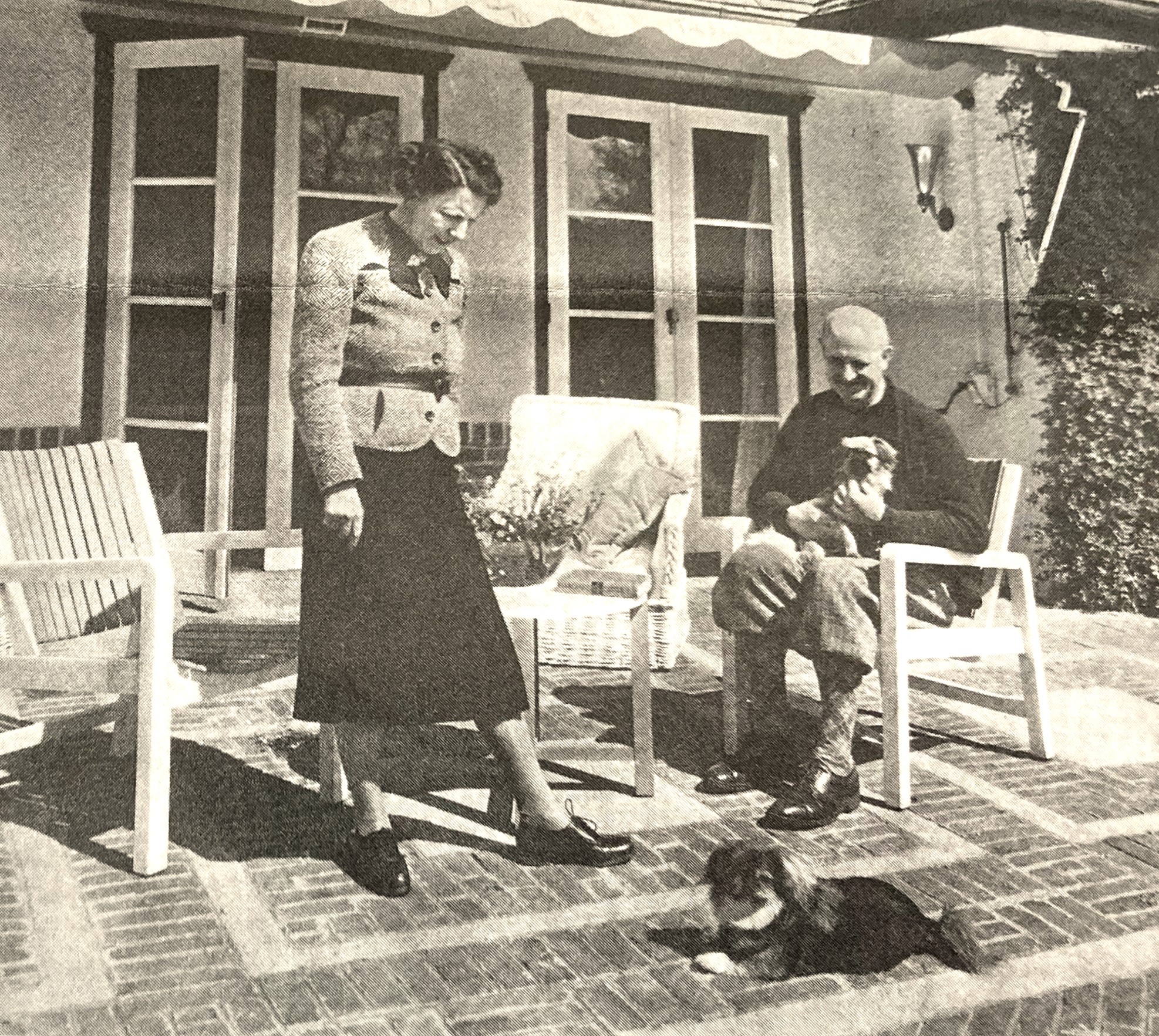
By the time Fleming became a regular visitor to Le Touquet, Wodehouse and his wife, Ethel, had made their home there, having spent many years enjoying a somewhat nomadic life in France, to escape his conflict with the British and American tax authorities. They had spent some time on the Riviera, where their neighbours included H. G. Wells and E. Phillips Oppenheim. They had also tried living in Paris, but Wodehouse had quickly realised that the quieter atmosphere of the coastal resort suited his working life better. Furthermore, there were two good golf courses, plenty of tennis for Leonora on her visits from England, and a local casino that Ethel enjoyed patronising.
Wodehouse had mentioned Le Touquet long before he moved there. In Carry On, Jeeves (1925), the story ‘Clustering Round Young Bingo’ included a sartorial discussion between Bertie and Jeeves, in which the former argued his case thus: “It may interest you to learn that when I was at Le Touquet the Prince of Wales buzzed into the Casino one night with soft silk shirt complete.”
In November 1934, the Wodehouses rented Low Wood, an Anglo-Norman style villa next to the golf course at Le Touquet. The house, and particularly the garden, suited them so well that six months later they bought the property. Here, PGW’s creativity flourished. Having struggled with a lack of plots, he now invented a new character for his stories, Uncle Fred, who made his debut in ‘Uncle Fred Flits By’ (1935). In 1936, Wodehouse wrote Laughing Gas, which was serialised in Pearson’s magazine. The following year he started on a new novel, The Silver Cow, which later transformed into the masterpiece The Code of the Woosters. And Wodehouse then produced Uncle Fred in the Springtime (1939), in which Le Touquet played a role.
After their enforced wartime absence from Low Wood, the Wodehouses returned to inspect the house and found it had been looted and was now in a ruinous state. Renovation was deemed too expensive, and so in 1948 they sold the remains of the villa and emigrated to the USA.
The present owner of Low Wood, Philippe Cotrel, former mayor of Le Touquet, bought the property in 1995, to save it from demolition. The roof and all the windows were renewed or replaced, and an extra wing was added to the house.

The Mirrlees family villa (mentioned earlier) was built in 1936 as a summer residence for Major-General William (‘Reay’) Mirrlees and his second wife, Frances Lalanne, after whom the house was named Villa Les Lambins-Lalanne. Her son from her first marriage took his stepfather’s name and was known as Robin Mirrlees (1925–2012). He led a flamboyant life, during which he became a friend of Fleming and invited him to work in the family villa.
Robin Mirrlees was also a source of information for Norman Murphy, who refers in his A Wodehouse Handbook Vol. 1 (2006) to a Wodehouse plaque in Le Touquet.
Murphy: I am indebted to Robin Mirrlees for the information that, on the back wall of his Villa Lambins-Lalanne, Les Lambins, Avenue de Trepied, Le Touquet, is a black marble plaque to P.G. Wodehouse. The house which, Mr Mirrlees told me, is the only one in Le Touquet still in English hands since before the war, stands next door to the Wodehouse’s villa, and the plaque was erected to commemorate his stay there.
I believe that Murphy never actually saw this plaque himself, and my research suggests that there has been no picture of it published anywhere – until now, that is!
In 2023, I decided to investigate, and after much laborious research I discovered the Mirlees villa to be at a completely different address from the one Murphy referenced: not Avenue de Trepied, but 520 Avenue Allen Stoneham (the same road that gives access to the back garden of Low Wood – now called Low Wood Manor – whose actual address is 1965 Avenue du Golf). I wrote a letter to the owner of the villa, asking for permission to visit. No answer. After a few months my letter came back to The Netherlands, unopened.
On 25th of August 2023, I went to Le Touquet and found Villa Lambins-Lalanne at the newly discovered location. The house looked dilapidated, and there was a sign ‘Attention au chien’ – almost the setting of the Wodehouse story ‘The Level Business Head’, I thought. There was no letterbox at the front of the house, and I presumed any mail was simply stuck in the wooden fence and left there open to all weather conditions or simply not delivered but returned to sender, as mine had been. The unkempt garden contained some rusting metal chairs. The house was clearly empty and appeared to have been uninhabited for many years.
Nevertheless, there it was in the shining sun, I thought – the villa where Ian Fleming started writing his first James Bond novel in 1952!

The stairs to the front entrance of the villa were ankle-deep in leaves and pine needles as, with some trepidation, I approached the door. To my delight, I espied a copper plaque, mounted on a wooden background, that read:
Cette maison fut batie en 1936 par le Général Reay Mirrlees et Madame de La Lanne-Mirrlees pour le plaisir de leurs Amis. Ils y ont reçus des Personnages distingués parmi lesquels les Ecrivains célébres P.G. Wodehouse et Ian Fleming.
(This house was built in 1936 by General Reay Mirrlees and Madame de La Lanne-Mirrlees for the pleasure of their friends. They received distinguished people including the famous writers P.G. Wodehouse and Ian Fleming.)
Wodehouse and Fleming both mentioned on this plaque! There it was – the riddle solved! But was it? Robin Mirrlees mentioned a “black marble plaque” in his report to Norman Murphy. So, I continued my quest.

I entered the wilderness of the backyard, where I was able to take a look at the terrace and the rear of the villa. Rusting sunbeds made me imagine famous authors lounging in the sun, but the whole area still exuded a sad desolation. And then I noticed it – a black marble plaque with the same text as on the copper plaque at the front, in which Wodehouse and Fleming are commemorated together. The golden lettering was clearly legible. I had solved the mystery of the ‘unknown’ plaque – and discovered a duplicate of it as a bonus.
Clearly, Wodehouse must have been a guest at this villa in the 1930s. With the back garden of Low Wood only 100 yards away from the front garden of Villa Les Lambins-Lalanne, he could have reached the path to the villa via a rear exit. When Fleming stayed with the Mirrlees family in 1952, Wodehouse was already living in America, of course, so it seems unlikely that the two authors actually met at Villa Lambins-Lalanne. But at least they are both commemorated for posterity at this location.
It is a pity that the villa is in such a dilapidated state. There are plenty of potential buyers who would like to live near the golf course and cherish these plaques, but the Mirrlees family apparently does not want to sell the villa for the time being, and so it remains in English hands, as Murphy noted.

On the 7th of September 2024, the Dutch P. G. Wodehouse Society, together with The Drones Club of Belgium, honoured Low Wood with a new plaque. So, if you have plans to visit Le Touquet, you will soon be able to admire three plaques commemorating the great P. G. Wodehouse, two of which contain the names of the Spy and the Gentleman.
Notes
- This article first appeared in the June 2024 issue of Wooster Sauce, the journal of the P. G. Wodehouse Society (UK).
- The author’s consent to publish it here is gratefully acknowledged.
Related Posts
Posted in Uncategorized, What ho! | Tagged Bertie Wooster, Casino Royale, Ian Fleming, James Bond, Jeeves, Le Touquet, P G Wodehouse | 5 Comments »
Posted in What ho! | Tagged Bore, Boredom. Jerome K Jerome, Humour, P G Wodehouse | Leave a Comment »
Posted in A Vibrant Life! | Tagged linkedin, Management, Stephen Covey, White-collar productivity, Work Life Balance, Yoga | Leave a Comment »

For more than six decades, Suchitra Sen, originally named Roma Dasgupta, stood as the undisputed queen of Bengali cinema, embodying the essence of Bengali femininity, beauty, and elegance. Even after her unexpected withdrawal from the public eye in 1978, her allure and mystique remained intact; in fact, her choice to retreat into seclusion only deepened the intrigue surrounding her.
It is believed that one of director Sukumar Dasgupta’s assistants was responsible for bestowing upon Roma Dasgupta the iconic screen name, Suchitra Sen. Sukumar Dasgupta was the director of her debut film, Saat Number Kayedi.
Her passing on January 17, 2014, signified the conclusion of a remarkable era in Bengali cinema.
The Suchitra Sen phenomenon was unprecedented in the history of Bengali cinema. Not only was she the leading female actor of her time, but she also emerged as one of the most significant stars to grace the Bengali film industry, with her widespread popularity rivaling only that of Uttam Kumar, with whom she shared the screen in 30 of her 60 films. She was the first and only actress to earn the title ‘Mahanayika,’ a distinction that was only similarly awarded to Uttam Kumar in Bengali cinema.
During the height of her fame in the 1950s and 1960s, it is estimated that she commanded a fee of around ₹ 1 lakh per film. Her immense star power made her a central figure in the film industry, often featured prominently on movie posters, and her name was typically highlighted even more than that of the male lead, with the exception of Uttam Kumar, where they shared equal prominence.
The partnership of Suchitra Sen and Uttam Kumar on screen marked a pivotal era in Bengali cinema. Their collaboration spanned 30 films, starting with Sharey Chuattar in 1953, and significantly altered the landscape of Bengali film history. For over two decades, from 1953 to 1975, Suchitra and Uttam reigned supreme in the industry, delivering memorable hits such as Agnipariksha, Shap Mochan, Sagarika, Harano Sur, Indrani, Saptapadi, and Bipasha.
They became icons that resonated with the youth, embodying their dreams and aspirations. Their undeniable on-screen chemistry was so powerful that they transcended their individual stardom, merging into a single entity: Suchitra-Uttam or Uttam-Suchitra. Uttam Kumar himself acknowledged this bond, stating, ‘Had Suchitra Sen not been by my side, I would never have been Uttam Kumar.’
Suchitra is hailed as the first style icon of Bengali cinema, with her unique mannerisms inspiring generations of young Bengali women. The characters she portrayed were often progressive, reflecting the aspirations of women ahead of their time. In many of her films, she took on the roles of ‘professional women,’ whether as an artist in Jiban Trishna, a doctor in Harano Sur, or a politician in Aandhi.
Madhuja Mukherjee, an associate professor of Film Studies at Jadavpur University, noted, ‘Her star persona was shaped by her roles. She exuded a remarkable star quality, both in her appearance and her performances. Compared to the societal norms of her time, she was almost placed on a pedestal, embodying the aspirations of women.’ Remarkably, according to Mukherjee, Suchitra maintained her status as a leading star throughout the 1960s, even as she entered her thirties.

Suchitra’s stunning beauty and immense fame frequently eclipsed her acting talent. Nevertheless, she made history as the first Indian actress to win the best actress award at an international film festival, receiving the honor for her role in Saat Paake Bandha (1963) at the Moscow International Film Festival. Her star power was well-recognized in the Hindi film industry, where she appeared in several major films, including Devdas, Bambai Ka Babu, Mamta, and Aandhi.
Born on April 6, 1931, in Pabna, now part of Bangladesh, Roma was one of eight siblings. Her father, Karunamoy Dasgupta, served as a school headmaster, and she was raised in a culturally rich environment. The Partition led her family to West Bengal, and Roma, already a captivating beauty, soon married Dibanath Sen, the son of a prosperous industrialist. Before venturing into acting, Roma aspired to pursue a music career and reportedly recorded several songs in her own voice.
Despite the admiration she garnered and the unwavering attention from her devoted fans, Suchitra Sen remained a mystery. Known as ‘Mrs Sen’ in the film industry, she was often viewed as distant and hard to approach. By the time she entered the film world, she was already a married woman and a young mother, and her striking looks, reserved demeanor, and privileged background often intimidated those around her. However, she was also recognized for her warmth and friendliness.
Veteran actress Moushumi Chatterjee remarked, ‘Suchitra Sen embodied elegance. She had a remarkable ability to distinguish her personal life from her public persona.’
Industry insiders believe that Suchitra’s keen awareness of her own celebrity status contributed to the myth surrounding her. This understanding may explain her enduring reign as the queen of Bengali cinema and the continued fascination with her, even 36 years after she chose to live in complete seclusion. Her abrupt withdrawal from the public eye only heightened interest in her, sparking numerous discussions, debates, and theories about the reasons behind her choice to retreat.
Rarely spotted in public, she became the most renowned recluse in West Bengal, drawing comparisons to Hollywood’s Greta Garbo. Her commitment to privacy and the lengths she reportedly went to maintain it often seemed almost obsessive.
In 2005, she allegedly declined the Dada Saheb Phalke Award because accepting it in person would compromise her privacy. Even in death, she preserved her enigmatic aura: her final journey was conducted in a black-tinted hearse, obscuring her body from public view.
Suchitra Sen had never collaborated with any of the three giants of Bengali parallel cinema: Satyajit Ray, Ritwik Ghatak, or Mrinal Sen. According to reports, she turned down an opportunity to work with Satyajit Ray because he requested that she refrain from taking on other projects while filming. Suchitra expressed her willingness to honor her commitment to him but was unwilling to promise exclusivity. As a result, the collaboration fell through, and Satyajit Ray ultimately abandoned the project.
While discussing her views on Hindi actors, she touched upon her decision to decline a collaboration with Raj Kapoor. Suchitra explained that the reason for her refusal stemmed from an encounter where the legendary actor and director positioned himself near her feet and presented her with a bouquet of roses. She expressed her preference for men who engage in sharp, intelligent dialogue, which made her uncomfortable with Raj Kapoor’s gesture.

Suchitra Sen and Dharmendra starred together in the film Mamta, directed by Asit Sen. According to a report, Suchitra recounted an incident where Dharmendra unexpectedly kissed her on the back during a scene. She revealed that this moment was not scripted, but the director, Asit Sen, found it compelling enough to include in the final cut of the film. Describing it as an ’embarrassing moment,’ Suchitra made it clear that she was not fond of Dharmendra’s spontaneous kiss.
The world had undergone significant changes in those 36 years of her seclusion, yet the image of Suchitra Sen remains timeless. This enduring presence continues to resonate with the Bengali community, as demonstrated by the large crowds of all ages that filled the streets of Kolkata during her final farewell.
While many regarded Suchitra Sen’s passing as a profound loss for the film industry, the esteemed director Buddhadeb Dasgupta offered a poignant perspective: ‘She will forever be celebrated as the greatest heroine of Bengali cinema. No one can rival her mass appeal. However, the industry truly lost her when she chose to live in seclusion over 30 years ago.’
Suchitra Sen has been honored with four BFJA Awards, the Best Actress Award at the 3rd Moscow International Film Festival, a Filmfare Bangla Award, the Filmfare East Lifetime Achievement Award, the Banga Bibhushan, and the Padma Shri.
Today marks Suchitra Sen’s 94th birthday, a perfect occasion to celebrate her remarkable film legacy. You can catch some of her iconic performances on Prime Video, where titles like Agnipariksha, Sagarika, Indrani, Bipasha, and Devdas are available. On YouTube, check out Shap Mochan, Harano Sur, Saptapadi, Jiban Trishna, Aandhi, Bambai Ka Babu, Mamta, and Uttar Phalguni. On Hoichoi, don’t miss Saat Paake Bandha, Deep Jwele Jai, and Sharey Chuattar.
Notes
- A version of this article first appeared in The Reviewer Collective group on Facebook. The author’s consent to reproduce it here is gratefully acknowledged.
- I believe that after she retired from acting, she lived in Pondicherry for a few years as a reclusive inmate of the Sri Aurobindo Ashram.
- All the visuals are courtesy the World Wide Web.
Posted in The Magic of Movies! | Tagged Bengali, Bollywood, Movies, Suchitra Sen, Tollywood, Tribute | Leave a Comment »
Posted in What ho! | Tagged Creative Juices, Humour, P G Wodehouse | Leave a Comment »
Posted in What ho! | Tagged C Northcote Parkinson, Frederick Winslow Taylor, Henry Ford, Humour, Management, Mary Parker Follett, Max Weber, P G Wodehouse, Philip Kotler, Stephen Covey | Leave a Comment »
-
Recent Posts
Buy the Book
Buy the Book

buy the book
Categories
-
cc
Tags
Art Bertie Wooster Bhagavad Gita Bingo Little Birthday Blake Mouton Grid Blogging Bollywood Book Campus Life CEO Chivalry Consciousness Coronavirus Corruption Empress of Blandings English Ethics Feminism Happiness Health Hindi Hollywood Human Values Humour India Jeeves Kalidasa KIds Leadership linkedin Literature Lord Emsworth Love Lyrics Mahabharata Mahatma Gandhi Management Movies Music Norway Paintings Panjab University People P G Wodehouse Politics Pondicherry Portugal Psmith Puducherry Rabindranath Tagore Ramayana Ritusamhara R K Laxman Romance Rosie M Banks Rupert Psmith Seasons Shakespeare Social Media Something Fresh Songs SPANDAN Spirituality SQ Sri Aurobindo Stephen Covey Switzerland Tatas Thos UBS Values Wodehousitis Women Work Life BalanceArchives
- June 2026 (5)
- May 2026 (5)
- April 2026 (3)
- March 2026 (2)
- February 2026 (5)
- January 2026 (2)
- December 2025 (1)
- November 2025 (2)
- October 2025 (2)
- September 2025 (3)
- August 2025 (3)
- July 2025 (2)
- June 2025 (2)
- May 2025 (4)
- April 2025 (5)
- March 2025 (5)
- February 2025 (4)
- January 2025 (4)
- December 2024 (6)
- November 2024 (6)
- October 2024 (6)
- September 2024 (5)
- August 2024 (5)
- July 2024 (4)
- June 2024 (4)
- May 2024 (5)
- April 2024 (5)
- March 2024 (3)
- February 2024 (1)
- January 2024 (4)
- December 2023 (2)
- November 2023 (3)
- October 2023 (3)
- September 2023 (3)
- August 2023 (5)
- July 2023 (5)
- June 2023 (7)
- May 2023 (6)
- April 2023 (6)
- March 2023 (8)
- February 2023 (8)
- January 2023 (7)
- December 2022 (6)
- November 2022 (5)
- October 2022 (8)
- September 2022 (5)
- August 2022 (6)
- July 2022 (6)
- June 2022 (8)
- May 2022 (7)
- April 2022 (8)
- March 2022 (7)
- February 2022 (3)
- January 2022 (7)
- December 2021 (4)
- November 2021 (8)
- October 2021 (7)
- September 2021 (6)
- August 2021 (7)
- July 2021 (7)
- June 2021 (9)
- May 2021 (8)
- April 2021 (9)
- March 2021 (10)
- February 2021 (8)
- January 2021 (8)
- December 2020 (7)
- November 2020 (6)
- October 2020 (5)
- September 2020 (9)
- August 2020 (9)
- July 2020 (8)
- June 2020 (8)
- May 2020 (6)
- April 2020 (5)
- March 2020 (7)
- February 2020 (4)
- January 2020 (7)
- December 2019 (12)
- November 2019 (10)
- October 2019 (5)
- September 2019 (9)
- August 2019 (10)
- July 2019 (9)
- June 2019 (14)
- May 2019 (13)
- April 2019 (14)
- March 2019 (11)
- February 2019 (11)
- January 2019 (14)
- December 2018 (12)
- November 2018 (12)
- October 2018 (14)
- September 2018 (9)
- August 2018 (10)
- July 2018 (10)
- June 2018 (8)
- May 2018 (11)
- April 2018 (11)
- March 2018 (6)
- February 2018 (9)
- January 2018 (10)
- December 2017 (10)
- November 2017 (9)
- October 2017 (8)
- September 2017 (11)
- August 2017 (10)
- July 2017 (10)
- June 2017 (11)
- May 2017 (9)
- April 2017 (7)
- March 2017 (7)
- February 2017 (8)
- January 2017 (10)
- December 2016 (9)
- November 2016 (11)
- October 2016 (10)
- September 2016 (10)
- August 2016 (9)
- July 2016 (6)
- June 2016 (10)
- May 2016 (10)
- April 2016 (10)
- March 2016 (10)
- February 2016 (12)
- January 2016 (10)
- December 2015 (11)
- November 2015 (11)
- October 2015 (10)
- September 2015 (10)
- August 2015 (10)
- July 2015 (10)
- June 2015 (10)
- May 2015 (10)
- April 2015 (10)
- March 2015 (9)
- February 2015 (10)
- January 2015 (8)
- December 2014 (9)
- November 2014 (8)
- October 2014 (8)
- September 2014 (7)
- August 2014 (7)
- July 2014 (7)
- June 2014 (7)
- May 2014 (7)
- April 2014 (7)
- March 2014 (7)
- February 2014 (6)
- January 2014 (7)
- December 2013 (6)
- November 2013 (6)
- October 2013 (6)
- September 2013 (6)
- August 2013 (6)
- July 2013 (6)
- June 2013 (6)
- May 2013 (6)
- April 2013 (6)
- March 2013 (6)
- February 2013 (6)
- January 2013 (6)
- December 2012 (4)
- November 2012 (4)
- October 2012 (3)
- September 2012 (2)
- August 2012 (4)
- July 2012 (2)
- June 2012 (2)
- May 2012 (2)
- April 2012 (2)
- March 2012 (2)
- February 2012 (3)
- December 2011 (3)
- November 2011 (1)
- October 2011 (2)
- September 2011 (2)
- August 2011 (2)
- July 2011 (2)
- June 2011 (3)

 ashokbhatia