Feeds:
Posts
Comments

(Here are some excerpts from a blog by Mr N Harihara Subramaniyan. The full version can be found at his own blog site: http://www.visionhari.com/chanakya.php.

Permission to reproduce it here is gratefully acknowledged.)
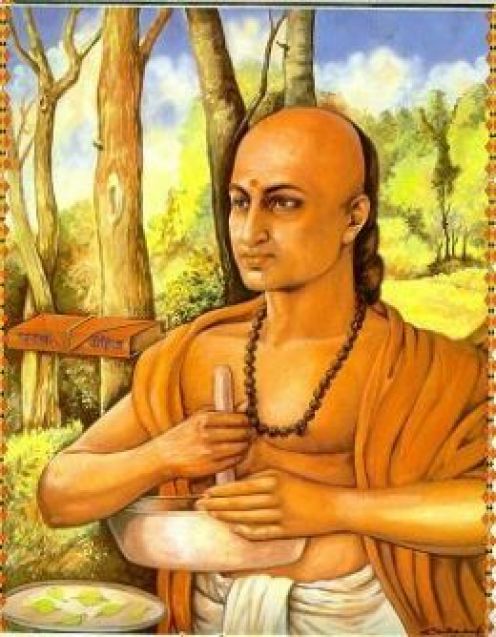
 

Chanakya was an Indian teacher, philosopher, and royal advisor. Originally a professor of economics and political science at the ancient Takshashila University, Chanakya managed the first Maurya emperor Chandragupta’s rise to power at a young age. He is widely credited for having played an important role in the establishment of the Maurya Empire, which was the first empire in archaeologically recorded history to rule most of the Indian subcontinent. Chanakya served as the chief advisor to both Chandragupta and his son Bindusara. Chanakya is traditionally identified as Kautilya or Vishnu Gupta, who authored the ancient Indian political treatise called Arthasastra (Economics). As such, he is considered as the pioneer of the field of economics and political science in India, and his work is thought of as an important precursor to classical economics. His works were lost near the end of the Gupta dynasty and not rediscovered until 1915.

Brief About Chanakya

Son of Rishi Chanak, Chanakya, also known as Kautilya or Vishnugupta, was born in Pataliputra, Magadh (modern Bihar), and later moved to Taxila, in Gandhar province (now in Pakistan). At a very early age little Chanakya started studying Vedas. The Vedas considered being the toughest scriptures to study were completely studied and memorized by Chanakya in his infancy. He was attracted to studies in politics. In politics Chanakya’s acumen and shrewdness was visible right from childhood. He was a student of politics right from child hood. Known as a masterful political strategist, He knew how to put his own people in the opposite camp and spy the enemy without his knowledge before destroying him forever. Chanakya was an ace in turning tables in his favor irrespective of the circumstances. He never budged to pressure tactics by the ruthless politicians. In this way after studying religion and politics, he turned his attention to economics, which remained his lifelong friend. “Nitishastra”, a treatise on the ideal way of life shows his in depth study of the Indian way of life. He was a professor (acharya) of political science at the Takshashila University and later the Prime Minister of the Emperor Chandragupta Maurya. He is regarded as one of the earliest known political thinkers, economists and king-makers. He was the man to envision the first Indian empire by unification of the then numerous kingdoms in the Indian sub-continent and provide the impetus for fights against the Greek conqueror Alexander.

Leadership Qualities

  • He was brave enough to speak from his heart to any ruler at any situation.
  • His strategic movement based on information from enemy side using his spies
  • He administered well on various faculties like law & order, taxation, revenue, foreign policy, defence, war, strategy formation and foreign relations etc.
  • He worked at the total annihilation of problems by the roots.
  • As a person, Chanakya had been described variously, as a saint, as a ruthless administrator, as the king maker, a devoted nationalist, a selfless ascetic and a person devoid of all morals.
  • Some of his stark views made him into an ambivalent personality for the world like the observance of morals and ethics was secondary to the interests of the ruler.

Principles & Practices

Chanakya advocated the following for the welfare of country

  • Self-sufficient economy not dependent on foreign trade.
  • An egalitarian society where there are equal opportunities for all.
  • The efficient management of land is essential for the development of resources.
  • The state should take care of agriculture at all times.
  • Government machinery should be directed towards the implementation of projects aimed at supporting and nurturing the various processes; beginning from sowing of seeds to harvest.
  • The nation should envisage constructing forts and cities.
  • Internal trade was more important to Chanakya than external trade.
  • The state should collect taxes at a bare minimum level, so that there is no chance of tax evasion.
  • Laws of the state should be the same for all, irrespective of the person who is involved in the case.
  • Destitute women should be protected by the society because they are the result of social exploitation and the uncouth behavior of men.
  • Antisocial elements should be kept under check along with the spies who may enter the country at anytime.

Chanakya envisioned a society where the people are not running behind material pleasures. Control over the sense organs is essential for success in any endeavor. Spiritual development is essential for the internal strength and character of the individual. Material pleasures and achievements are always secondary to the spiritual development of the society and country at large.

Achievements

His work on Arthashastra transcends the time broadly covers fourteen areas

  • Deals with the King – his training, appointment of minister etc.
  • Describes the duties of various officers of the state and gives a complete picture of the state activities.
  • Concerned with law and administration of justice.
  • On suppression of crimes.
  • A sundry collection of topics including salaries of officials.
  • On foreign policy and constituent elements of state.
  • The way in which each of the six methods of foreign policy may be used in various situations
  • Relates to calamities.
  • On preparations of war.
  • Concerned with fighting and types of battle arrays.
  • How a conqueror deal with a number of chiefs rather than one king.
  • Shows how a weak king when threatened by a stronger one must overpower him.
  • Concerned with the conquest of the enemy’s fort by fighting.
  • Deals with occult practices.

Literary Works

Chanakya is perhaps less well known outside India compared to other social and political philosophers of the world like Confucius and Machiavelli. His foresight and wide knowledge coupled with politics of expediency helped found the mighty Mauryan Empire in India. He compiled his political ideas into the ‘Arthashastra’, one of the world’s earliest treatises on political thought and social order. His ideas remain popular to this day in India. In Jawaharlal Nehru’s Discovery of India, Chanakya has been called the Indian Machiavelli. Three books are attributed to Chanakya: Arthashastra, Nitishastra and Chanakya Niti. Arthashastra (literally ‘the Science of Material Gain’ in Sanskrit) is arguably the first systematic book on economics. It discusses monetary and fiscal policies, welfare, international relations, and war strategies in details. Many of his nitis or policies have been compiled under the book title Chanakya Niti. Nitishastra is a treatise on the ideal way of life, and shows Chanakya’s in depth study of the Indian way of life.

 

Teams

For cross-functional tasks to be carried out, build teams with due care. Let your team have like-minded people as well as a minority of likely dissidents who will ensure the team does not go off track.

Hunters have practised this art since the beginning of our civilization.

(Excerpt from my book ‘Surviving in the Corporate Jungle’, the English version of which was released recently. The Portuguese version of the excerpt follows.)


EQUIPAS

Para que as tarefas multifuncionais possam ser realizadas, deverá constituir as equipas com todo o cuidado. Assegure que na sua equipa há pessoas que pensam da mesma forma, mas também alguns tendencionais dissidentes que irão garantir que a equipa se mantém no bom caminho.

Os caçadores praticam esta arte desde o início da nossa civilização.

(This is how you can lay your hands on the Portuguese version of the book, launched in Portugal during March, 2016.)


Missing Bertie Wooster


Where have all the Berties gone? 
The lilies that toil not, nor do they spin,
They’ve all arisen with the dawn,
To get their three miles running in.

Then holed up all day, in offices or banks,
Won’t join you in a leisurely brunch, 
No afternoon tennis or games or pranks,
Coping with month’s end accounting crunch.

Even dinner is a rushed affair, 
No time for idle chat or chit,
March through the rose garden’s scented air,
To meet the quota of the Fitbit.

One sighs for the Berties of yester-year,
Mentally negligible, but always at hand.
One found their naïveté rather dear,
And could have molded them into something grand!

(The above mentioned composition has been whipped up by Lisa Dianne Brouwer who describes herself thus:

“Lisa cut her milk teeth on P.G. Wodehouse. Literally, in fact, as many of her father, Professor W. Brouwer’s orange and white Penguins are frayed and eroded at the edges. In later years this destructive child was wont to dip them in the bath water.

However, a lifetime of absorbing Plum’s gently humorous philosophy of life had given her father a mild and forgiving disposition, always excepting when his daughter escaped out the window of a summer evening….

These days father and daughter continue to share books, conversations over coffee and dabble into writing, occasionally diving sideways into rhyme.”

Here is wishing more power to her pen!)

Stress

Pressure is an ‘external’ stimulus. Stress is what ‘we’ experience. The level of stress we experience therefore is directly proportional to the pressure we receive. The good news is that stress is inversely proportional to our inner strength and resilience.

Since each individual is uniquely configured, the response of each person to the same level of pressure would be different. Some would take it lightly and focus on the action at hand, thereby improving their chances of a better and quicker delivery of results. Others would take it seriously, and jeopardize their own achievements and career. Those who are ever-anxious and have an ‘A’ type personality would invariably experience more stress than those who are the happy-go-lucky ‘B’ types.

Stress experienced by a professional is also a function of time. The psychological condition varies with time and also plays a role.

To sum up, a mathematical formulation for stress could qualitatively be along the following lines:

stress

Distress can be handled positively. Art of creative dissatisfaction, loosening up and letting go, a habit of forgiveness, a dash of humour, and meditation can help.

A little bit of stress is good for a professional’s health and output. Thanks to Richard Lazarus and Hans Selye, we understand the distinction between ‘eustress’ and ‘distress’!

(Excerpt from my book ‘Surviving in the Corporate Jungle’, the English version of which was released recently. The Portuguese version of the excerpt follows.)


STRESS

A pressão é um estímulo “externo”. O stress é o que “nós” sentimos. O nível de stress que sentimos, portanto, é diretamente proporcional à pressão que recebemos. A boa notícia é que o stresse é inversamente proporcional à nossa
força interior e resiliência.

Como cada indivíduo tem uma configuração única, a resposta de cada um ao mesmo nível de pressão será diferente. Alguns conseguem aceitar a pressão de ânimo leve, concentrando-se naquilo que estão a fazer e aumentando, assim, as suas probabilidades de uma execução mais rápida e com melhores resultados. Outros levam a pressão demasiado a sério, pondo em perigo as suas próprias realizações e carreira. Aqueles que estão sempre ansiosos e têm uma personalidade do tipo A sofrem invariavelmente de mais stresse do que os ‘deixa-andar’ do tipo B.

O stress que um profissional sente é também uma função do tempo. A condição psicológica varia com o tempo e também desempenha um papel.

É possível lidar com a angústia de forma positiva. A arte da insatisfação criativa, soltar-se e deixar andar, o hábito de perdoar, uma pitada de humor e meditação, tudo isso pode ajudar.

Um pouco de stress é bom para a saúde e para os resultados de um profissional.  Graças a Richard Lazarus e Hans Selye, sabemos distiguir o ‘eustress’ (stress bom) do ‘distress’ (stress mau)!

(This is how you can lay your hands on the Portuguese version of the book, launched in Portugal during March, 2016.)

My pride, my UBS

In our lives, UBS played the role of a dynamic and bustling airport,
From which we soared in life´s azure skies, enjoying our flights of high
import;
Some took to exploring various corners of our Mother Earth,
Of CEOs, diplomats, businessmen and bankers amongst us there is no dearth.

While in UBS’ hallowed portals, we enjoyed bunking classes,
The brainy ones worked on assignments which were copied by the masses;
Cornering important books from the Central Library was a critical vocation,
For poking fun at our faculty, Student Centre was the prime location.

OB theories and riddles of Sales Forecasting kept us on our toes,
Figuring out Quantitative Techniques made us feel abysmal lows;
Twiddling our thumbs to read between the lines of a Balance Sheet,
Devouring the works of Philip Kotler was much up our street.

Weekend treks to Kasauli and Morni Hills were favourite gigs,
Midnight gorging on the greasy omelettes at PGI gate like pigs;
Catching up with first day first show of Bollywood flicks was the norm,
Securing high Class Participation marks invariably kept us in form.

(UBS stands for University Business School, Panjab University, Chandigarh, India, from where your truly completed his MBA in 1976. This composition has also been shared on the Facebook page of UBS. It has also been featured at https://universitybusinessschool.wordpress.com/2020/07/05/my-pride-my-ubs).

(One of the several related posts: https://ashokbhatia.wordpress.com/2016/10/01/the-class-of-1976-how-it-managed-to-get-suspended-for-a-week)


When someone of the calibre of Arunabha Sengupta decides to wield his pen (oops….keyboard!) and dishes out something Plummy, die-hard fans of the Master Wordsmith of our times rejoice. The sceptics make feeble attempts to punch holes in the arguments put forth. The fence-sitters suddenly realize that there is more to Plum than meets the intellectual eye.

The rest of humanity, comprising those who remain not-so-blissfully unaware of the blissful works of P G Wodehouse, continues to trudge through life, sans the succour which low-hanging fruits of eternal wisdom offer on the streets of Plumsville.

Source: About

There are many facets to the fare that a creative soul dishes out. P G Wodehouse is no exception.

Here is a post from the stable of Plumtopia which many of Plum’s fans would relish.

Honoria Plum's avatarPlumtopia

The name Tony Ring is familiar to many P.G. Wodehouse enthusiasts — it pops up often and in an surprising variety of places: from journal articles and forewords of new editions, to theatre programmes. Tony’s books on Wodehouse’s life and work line many of our shelves, and his sparkling presence has enlivened Wodehouse society events around the world. It is an honour and a pleasure to add Plumtopia to his long list of appearances.

Another Centenary to Celebrate

The Sunday Times Magazine for 9 April this year included a four-page article saluting Andrew Lloyd Webber’s extraordinary achievement in having four shows in performance simultaneously on Broadway, though two of them are revivals. It suggests he shares this record with Rodgers and Hammerstein, and states that it hasn’t been done for 60 years.

Well, Rodgers, like Lloyd Webber, was a composer. Hammerstein was a lyricist. The paper overlooked Lloyd Webber’s one-time lyricist…

View original post 857 more words

Retiring

Chief Executive Officers and  top honchos should retire themselves every five to six years. This would ensure some sanity in the operations of the company. As to lesser mortals, there is no point in clinging to their seats of power till ill health (or worse, death) comes knocking on the door.

Life is much bigger and brighter than work. The many shades of life which remain to be explored after retirement include simple joys – spending exclusive time with one’s spouse, putting life in the reverse gear by playing with grandchildren, taking up hobbies neglected for years, and fulfilling other desires which had merely remained benign intentions all those years.

(Excerpt from my book ‘Surviving in the Corporate Jungle’, the English version of which was released recently. The Portuguese version of the excerpt follows.)


REFORMA

Os Diretores Executivos e os manda-chuvas devem reformar-se ao fim de 5 ou 6 anos. Com isso garantem alguma sanidade às operações da empresa. Quanto aos simples mortais, não há nenhuma vantagem em manterem-se agarrados aos seus lugares de poder até que os problemas de saúde (ou, pior, a morte) lhes venham bater à porta.

A vida é muito maior e mais interessante do que o trabalho. Entre as muitas nuances da vida que continuam a ser exploradas após a reforma estão as alegrias simples – passar mais tempo com o cônjuge, fazer marcha-atrás e brincar com os netos, dedicar-se a passatempos que foram negligenciados
durante anos e cumprir outros desejos que nunca passaram.

(This is how you can lay your hands on the Portuguese version of the book, launched in Portugal during March, 2016.)

You are the main engine of economic growth,

Making global MNCs continue to fuss over you;

Splurging on goodies, traveling all over the world,

Your hard work yielding fruits which are your due.

You work very hard to secure a better future,

For yourself, for your progeny, and for your kith and kin;

The joint family system you appear to have given up,

Bringing up kids amidst the social media din.


You are the upholder of values and character,

Quietly paying your taxes, fulfilling social commitments;

A God-fearing and law-abiding citizenry of the country,

Balancing a scientific outlook with superstitious predicaments.


Great sacrifices you are also willing to make,

When making India stronger is your belief and view;

You do not mind spending hours in a queue,

Retrieving hard-earned cash which is due to you.


Government subsidies you are willing to give up,

So the poor and the needy may live a better life;

You live the life of a silent but true patriot,

Ignoring social unrest, mobocracy and strife.


Corruption in high places you do not like,

Petty bribes which save you time you do not mind;

Inefficient delivery of public services you hate,

To trains and buses running late you are often kind.


But much like the three monkeys of the Mahatma,

Unpleasant things you do not hear;

You remain blind and mute to many a thing,

Indignities which do not touch you directly, silently you bear.


You remain faithful to the concept of democracy,

Keeping the flame of our independence aglow;

Pushing the Indian nation on its path of glory,

Hoping for a better tomorrow, even if the progress is slow.


Perhaps a day would dawn when you would speak up,

Push also for social, judicial and political reforms;

Chasing not only GDP and per capita income numbers,

But also Gross National Happiness in its myriad forms.


Strive for India to excel in its Millennium Development Goals,

Contribute towards building up Gross National Character;

Refuse to let caste and religion determine vote banks,

Of the unfolding Indian drama, be the outspoken main actor.

(Related Post: https://ashokbhatia.wordpress.com/2015/05/13/the-perks-of-being-a-vip)

Quality

Hire a quality expert who is practical and does not live in an ivory tower, or else your billings may nosedive and your entire manufacturing team may end up doing only rework.

In the services sector, quality invariably means an extension of the core job being done. A shipping agent who keeps you updated of the status of a shipment at all times is a delight to work with; so is a dentist who sends you a discreet short message reminding you of your appointment that evening!

To quote Dr. Laurence J Peter and Raymond Hull: ‘…man cannot achieve his greatest fulfilment through seeking quantity for quantity’s sake; he will achieve it through improving the quality of life, in other words, through avoiding life-incompetence’.

(Excerpt from my book ‘Surviving in the Corporate Jungle’, the English version of which was released recently. The Portuguese version of the excerpt follows.)

QUALIDADE

Contrate um especialista em qualidade que seja pragmático e não viva numa torre de marfim; caso contrário, a sua faturação poderá cair a pique e toda a equipa de produção pode acabar a retrabalhar produtos e nada mais.

No setor dos serviços, a qualidade significa sempre uma extensão do trabalho principal que é feito. É um prazer trabalhar com uma transportadora que o mantém a todo o momento a par do estado de uma encomenda; tal como com
um dentista que lhe envia uma mensagem breve e discreta a lembrar-lhe que tem consulta nesse dia!

Para citar o Dr. Laurence J. Peter e Raymond Hull: “…um homem nunca estará realizado se procurar a quantidade por si só; realizar-se-á através da melhoria da qualidade de vida, ou seja, evitando as incompetências da vida”.

(This is how you can lay your hands on the Portuguese version of the book, launched in Portugal during March, 2016.)