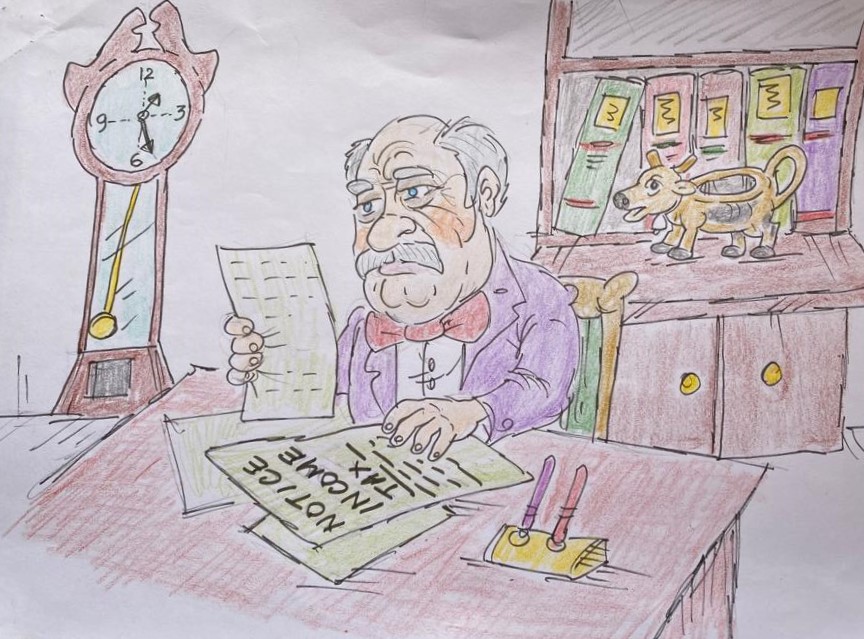
When it comes to owning a sprawling property like Brinkley Manor, there is no way I can compete with Bertie Wooster’s miserly Uncle Tom, or, if you wish me to be precise, Thomas “Tom” Portarlington Travers. I do have a humble roof over my head which serves its purpose rather well.
Nor do I have a dynamic wife like Aunt Dahlia who, when she loses a sum of 500 pounds while gambling at Cannes, might ask me to replace the money in order to keep financing her magazine, Milady’s Boudoir. Simply because I do not have ample resources at my command.
My lair can also not boast of someone like Anatole, God’s gift to our gastric juices. Guests who get invited over to my place often try to come up with the flimsiest of excuses to escape the trauma of having to put plain dal-roti-subzi-chawal down the hatch.
Nor am I a collector of silver cow creamers. I merely collect books, movies and music albums.
But when it comes to an aversion to payment of taxes, my thinking absolutely matches that of Uncle Tom.
The Psychology of a Taxpayer
I daresay it is not greed that makes one detest the payment of taxes. Rather, it is the disproportionately high rate of taxes which one objects to. Services delivered by the government barely touch one. Our roads continue to be as bumpy as ever. Our power supply often keeps us on tenterhooks. Our public transport systems offer services which are rarely punctual, seldom tidy and often substandard. Quality medical care only enriches either the hospital owners or the insurance companies. Premium education is a rare commodity, accessible only to the well heeled.
Above all, the taxation systems are designed to promote dishonesty. Evasion becomes the norm. By dodging taxes, a lay citizen has the power to cock a snook at the revenue authorities. What could be a sweeter revenge than to have been able to resort to some sharp practices to generate some black money and thereby contribute to the parallel economy of the country? In such matters, our ingenuity knows no bounds. Give us a tougher system and we shall always be one step ahead of the government of the day in browbeating it, appear to say the denizens.
In fact, by resorting to such practices, a citizen may as well be contributing to nation building in his own humble way. One, the parallel economy is well isolated from the formal financial systems, thereby acting as a shock absorber to the jalopy of the formal economy when it runs into a speed breaker like that of the infamous 2008 meltdown. Two, politicians of all hues badly need unaccounted funds to keep winning elections all the time. Thus, we, the people, stand a better chance of keep electing governments which we deserve. Three, the shadow economy keeps greedy banks in tax heavens in the pink of health, partially fulfilling one of the key dictates of our scriptures, namely Vasudhaiva Kutumbakam. Four, such professions as accountants, lawyers and management seniors keep thriving in a perennial state of blissful existence, guiding one through the taxation maze.
I wonder if the tax rates are deliberately kept high so the above mentioned objectives of diverse stakeholders keep getting met. Also, the compliance maze is so designed as to invariably need a bevy of professionals to keep interpreting the fine print year after year.
Perhaps, the sage advice dished out by Chanakya a few centuries back is willfully neglected. It may be recalled that in his seminal work Arthashastra, he had opined as follows:
Ideally, governments should collect taxes like a honeybee, which sucks just the right amount of honey from the flower so that both can survive. Taxes should be collected in small and not in large proportions.
What we have instead is a group of honeybees which collects not only the honey but also keeps a sharp eye on the soft petals and other tender parts of the flower.
Our revenue authorities would be quick to point out the miniscule base of the tax-paying public being a reason for high taxes. Uncle Tom may not concur, though. Instead, he may recommend the following: a relentless focus on the employment generating businesses, thereby ensuring a steady income in the hands of a majority; predictable taxation systems which enthuse investors; use of modern technology to connect the dots between the direct and the indirect tax bases.
However, these are not low hanging fruits. Our politicos typically have a five-year vision which prompts them to continue to be in an election mode most of the times.
The Great Indian Milled Class
Unlike Uncle Tom, I did not make a fortune doing business in the Far East. I belong to the great Indian Middle Class, famed for the manner in which it upholds such values as honesty, truthfulness and fairness in its dealings with others. Those who belong to this segment of the society also uphold family values and social harmony.
Having slogged for over 35 years in the private sector as a salaried employee, I have always been a sitting duck for tax collectors of all kinds. Scriptures have taught us the value of perseverance and patience. Take away our Standard Deduction and we would simply squirm and keep quiet. Reduce the rates of our bank deposits and some of us may merely write a protest letter to the editor of our daily newspaper. Keep threatening us with a change-over of our hard-earned savings parked in a public provident fund account from the Exempt-Exempt-Exempt category to the Exempt-Exempt-Tax category, and few of us might make some ineffective noises.
Keep inflating our personal transport costs and we shall meekly accept the same. We ignore the fact that close to 45% of the fuel prices get cycled back to the government of the day. Home makers amongst us may keep twiddling their thumbs trying to balance their domestic budgets, but unless there is a direct threat to political power, nary an eyebrow is raised. We eagerly look forward to the next round of elections in the country so at least a transient relief may come our way.
Not to forget the Great Spiritual Tax which does not discriminate between the haves and the have-nots. It is designed to make us suppress our desires, focusing only on our bare needs. Thus, it makes all of us a wee bit more spiritual. A CEO pays as much tax on a bottle of shampoo as his liftman or driver does.
In general, the only long term satisfaction we may have is that of educating our children well and facilitating a smoother life for them in the times to come.
The Exorbitant Price of Honesty
Honesty does not come cheap, though. Recently, when I enquired about the kind of taxes applicable if one were to sell a property and send funds abroad, I was baffled. The mind was boggled to its soggy core. If I were lucky enough to find a buyer who would agree to do a 100% transparent transaction, the dreadful tax implications left me shivering from the top of my head to the base of my feet.
The buyer would need to shell out close to 11% by way of registration charges. As to the seller, a slice of close to 23.6% will need to be paid by way of compliance to the mandarins in the taxation department. If this were not enough, the bank would be happy to provide foreign exchange only if the seller would agree to an additional cost of 5%, by way of a higher education cess. The plea that a 4% education cess would already have been paid as a part of the 23.6% and that a further 5% contribution towards improvement of higher education in the country made no sense may simply fall on deaf ears. The only assurance provided was that of the total damage of 28.6% suffered, the seller may get some refund in due course of time. Thus, between the buyer and the seller, the transaction would get shaved off by a whopping 39.6%. Add to this the legal costs and the speed money which smoothens our lives in general, and we are talking about a cost in excess of 40%!
I am not too sure if the government ever played any role in the organic appreciation of the value of the property over a period of some 20 years when it would have remained in my family’s investment basket. However, I am certain that those framing our taxation rules have undergone an advanced diploma at an academy run by Shylock somewhere on the outskirts of Venice. Chanakya, were he to discover this harsh reality, would surely be found turning in his grave.
A vast majority amongst you would be quick to point out the need for a prospective seller to promptly consult some sharp minds in the realm of finance, so that much of this excessive cost may be avoided. What else could a mentally negligible nincompoop like me do?
But what about one’s humble contribution to the mighty task of nation building? Also, is there a merit in inviting a jaundiced view of the authorities concerned, leading to some nasty notices in the letter box six months hence?
Indeed, it is at times such as these that one’s commitment to honesty and transparency gets tested. Scales fall from one’s eyes. It dawns upon one as to why the real estate market continues to be a shady one, perpetually contributing to the parallel economy of the country.
A Sense of Detachment
Just as P. G. Wodehouse once wrote in the Vanity Fair, I also imagine sitting in my poverty-stricken home and wondering how a tax bandit, having entered my house uninvited, would wave a gun at me, rummage through my pockets and empty these out. He now wears a mask which reminds me of the popular OTT serial Money Heist. Alas, he does not realize that I am not the Royal Mint of Spain.

Nevertheless, he would be leading me to cultivate a sense of detachment from my hard-earned money, much along the lines of what Lord Krishna advises in the Bhagavad Gita. Hope when he leaves me, I shall be in a carefree state of mind.
Next time I get invited to Brinkley Manor, I shall surely ask Uncle Tom about the tax expert he consults!
(For details on the tax blues faced by P. G. Wodehouse, please check out Tony Ring’s book: https://www.amazon.com/You-Simply-Hit-Them-Extraordinary/dp/1870304225)
(Inputs from Dr Renu Singh Parmar are gratefully acknowledged; Illustration courtesy Suvarna Sanyal)
Related Post:
Remembering Chanakya (Kautilya The Great)


 ashokbhatia