Feeds:
Posts
Comments

Posts Tagged ‘Bollywood’

In Ritusamhara, Kalidasa paints a highly romantic picture of the pre-winter season. Given the lower temperatures, metallic embellishments get avoided by the delicately nurtured. The fabric chosen for clothing undergoes a subtle change. The pastes and lotions to be applied to the body are different. Liquors come into play. Passions get aroused by the sheer promise of the winter season which is yet to arrive.

When it comes to capturing different shades of passion and putting across suggestions of love-making, Bollywood is never found wanting. Snow-covered mountains, gently murmuring rivulets, enchanting lakes, flying birds and lotuses in bloom form the perfect backdrop for romantic songs. Heroes can be seen aggressively pursuing lissome heroines clad in figure-enhancing dresses.

Here are some of the couplets from Canto Four of Ritusamhara and the kind of songs which could possibly do some justice to the poet’s evocative portrayal of nature and romance.

“Delightful are trees and fields with the outgrowth of new tender-leaves and crops; Lodhra trees are with their blossomy flowers, crops of rice are completely ripened, but now lotuses are on their surcease by far, for the dewdrops are falling. Hence, this is the time of pre-winter that drew nigh. [4-1]

Hamraaz (1967, B R Chopra)

Jewel Thief (1967, Vijay Anand)

Silsila (1981, Yash Chopra)

Veer-Zaara (2004, Yash Chopra)

“Unbearable is the touch of metallic circlets on wrists and bicep-lets on upper-arms of the couple of arms of vivacious women, or the touch of new silk cloths on the discoid of their waistline, or fine fabric on their robust breasts. [4-4]

Madhumati (1958, Bimal Roy)

Bees Saal Baad (1962, Biren Nag)

Chandni (1989, Yash Chopra)

“Overspread with abundant rice crops and ornamented with herds of she-deer, and delightfully reverberated by the ruddy geese, with their calls and counter-calls, the complacent corridors of confines are captivating hearts. [4-8]

Dharti Kahe Pukar Ke (1969, Dulal Guha)

Aradhana (1969, Shakti Samanta)

Prem Pujari (1970, Dev Anand)

Saathiya (2002, Shaad Ali)


“Now the lakes are adorned with fully blossomed black-lotuses, and elaborated with swan-like water fowls in their excitement, and sheeted with considerably coldish waters that are depurated, thus these lakes are stealing the hearts of men, for men look up to them as the visages of women that are with black-lotus-like hairdo, with swan like eyes, and whose bodies are cold, wanting a warm hug. [4-9]

Hum Dono (1961, Amarjeet, Vijay Anand)

Ek Musafir Ek Hasina (1962, Raj Khosla)

 Tere Ghar Ke Samne (1963, Biren Nag, Vijay Anand)

Who Kaun Thi? (1964, Raj Khosla)

Sangam (1964, Raj Kapoor)

Kabhie Kabhie (1976, Yash Chopra)


“Oh, dear, the Priyangu plants that give fragrant seeds are ripened by the snow caused coldness, and they are frequently wobbled by the snowy winds, and they now appear like the fragrant and frisky women gone into paleness and wobbliness by their dissociation from their lovers. [4-10]

Jab Jab Phool Khile (1965, Suraj Prakash)

Prem Pujari (1970, Dev Anand)

Aandhi (1975, Gulzar)

“Let this season hemanta, dew fall, pleasant with many an attribute, a stealer of the hearts of women, fields of villages abundantly overspread with rice-crop, sky overlaid with garlands of ruddy geese flights, and which always is a heart-pleasing season, endow comfort to all of you passionate people. [4-18]

Waqt (1965, Yash Chopra)

Dil To Pagal Hai (1997, Yash Chopra)

Saathiya (2002, Shaad Ali)

Veer Zara (2004, Yash Chopra)

Lakshya (2004, Farhan Akhtar)


During this season, the sky is a clear blue, the water is sparkling clean and the trees are lush green. Flowers are in full bloom and fields are about to deliver a bountiful harvest to humanity. Snow has just started reminding us that winter is not too far away.

Kalidasa captures the pre-winter season in all its glory, interspersed with some details of passionate love-making. Bollywood strives hard to catch up with the poet and, quite understandably, leaves much to the imagination of the viewers. Poets obviously enjoy certain degrees of freedom which our dream merchants lack, though they often make up for it by bringing in lewd lyrics and suggestive body gyrations in what are euphemistically referred to as ‘item numbers.’

[Note: Translation of ‘Ritusamhara’ courtesy Mr. Desiraju Hanumanta Rao:http://www.sanskritdocuments.org/sites/giirvaani/giirvaani/rs/rs_4.htm]


(Related Posts:

https://ashokbhatia.wordpress.com/2016/05/14/the-six-seasons-of-kalidasa-in-bollywood

https://ashokbhatia.wordpress.com/2016/05/15/the-six-seasons-of-kalidasa-in-bollywood-summer

https://ashokbhatia.wordpress.com/2016/05/20/the-six-seasons-of-kalidasa-in-bollywood-monsoon

https://ashokbhatia.wordpress.com/2016/05/27/the-six-seasons-of-kalidasa-in-bollywood-autumn)
 

Read Full Post »

The departure of the rainy season leaves us with a weather which is hot and humid. The sky is a clean blue. The sun tends to get merciless yet again but is unable to catch up with the ferocity it displays during summers. Rivers and lakes are full to the brim, but are relatively quieter.

In ‘Ritusamhara’, Kalidasa captures this season as evocatively as he does all others. All the natural features of autumn get compared to either some activity or some ornament of the delicately nurtured. Immaculate moonshine is often said to be veiled by clouds. Twinkling stars get alluded to as jewellery of the autumnal night. Affairs of the heart invariably take centre stage.

Bollywood does not refrain from showing us the beauty of this season in all its glory while the hero and the heroine profess their love for each other. But there is a difference. Whereas the attention of the poet is invariably on nature, ornamentation and courtship, Bollywood goes a step further. It uses the season of autumn to also depict hearts which are steeped in a sense of melancholy. The spectacle of dry yellow leaves getting crushed beneath the feet of separated lovers singing soulful songs is common place. The hero and the heroine suffer the pangs of loneliness, laying the blame at the door of a harsh Fate. Their faces are invariably downcast. A sense of despondency prevails.

Consider these couplets from Canto Three of this work of the poet and some of the songs which spring to one’s mind.

“Presently the rivers are journeying slowly with a strutting of prideful lovely girls, for the rising and falling fish in the rivers seem to be the delightful sets of strings at the waistlines of rivers, like the sets of girdle-strings on the waists of girls, and the ranges of white waterfowls on riverbanks seem to be the whitish pearly pendants of rivers, like the pearly pendants around the bosoms of prideful girls, more so the broad sand-dunes at edges of those rivers appear to be the roundish fundaments of those rivers like that of those girls. [3-3]

Baiju Bawra (1952, Vijay Bhatt)

Mujhe Jeene Do (1963, Moni Bhattacharjee)

Kashmir Ki Kali (1964, Shakti Samanta)

Safar (1970, Asit Sen)


“A girl burgeons as a damsel day by day, so the autumnal night is lengthening its night-time day by day, and as a damsel wears shiny jewellery on her nubility, this damsel, called the autumnal night, is wearing clusters of twinkling stars as her jewellery, as the veil of a damsel will be unveiled frequently presenting her face, these veils called clouds on the sky scape are now being unveiled to present the moon like face of this autumnal damsel, and a damsel starts to wear raiment with unblemished whiteness at her pubescence, so also, this autumnal damsel’s wraparound is the immaculate moonshine. [2-7]

Chaudavin Ka Chand (1960, Mohammed Sadiq)

Ganga Jamuna (1961, Nitin Bose)

Bandini (1963, Bimal Roy)

Chandni (1989, Yash Chopra)

“These days the moon is an eye-festival and heart-stealing with his profuse moonbeams, and he is the real gladdener for he is the sprinkler of fresh and coolant dewdrops through those moonbeams, but nowadays he alone is becoming an inflamer, for he is burning the bodies of the women, who are already felled by the arrow of Love-god, which arrow is daubed with the venom, which venom is nothing but their own lusting after their itinerant husbands, that are now separated from them. [3-9]

Jhumroo (1961, Shankar Mukherjee)

Kohinoor (1960, S U Sunny)

Maya (1961, D D Kashyap)


“The fragrance of flowers of white-flower trees is heart-stealing, and nowadays birds are not scorched by the sun, thus they are there in fine fettle, and they are calling each other reciprocally, thus those birds and their callings are heart-stealing, and the eyes of she-deer that are abiding all over there are like black-lotuses, thus with all them the woodlands and their fringes beyond ken, are ecstasizing the hearts of men. [3-14]

Anupama (1966, Hrishikesh Mukherjee)

Black Mail (1973, Vijay Anand)

Kabhi Alvida Na Kehna (2006, Karan Johar)

“These days the vault of heaven smiles with the vast of earth in their forms of exalted splendour. On the earth the lakes are bejewelled with emeraldine waters; similar is the sky with somewhat emeraldine hue. Such water is overspread with white-lotuses, similar is the cloudless sky overlaid with stars. These waters are overprotective to kingly swans, similarly the vault of cloudless heaven is holding out the moon, the king of the nights. [3-21]

Jhanak Jhanak Payal Baaje (1955, V Shantaram)

Rajkumar (1964, K Shankar)

Aandhi (1975, Gulzar)


Autumnal blues

Bollywood has a marked preference for using the autumn season as a backdrop for melancholic songs of separation and for depicting the yearning for the beloved. Even though Kalidasa refrains from painting this aspect of the season, it may be worth our while to look at some songs which fall in this category.

Dulaari (1949, A R Kardar)

Awaara (1951, Raj Kapoor)

Baiju Bawra (1952, Vijay Bhatt)

Chaudvin Ka Chaand (1960, Mohammed Sadiq)

Baaton Baaton Mein (1979, Basu Chatterjee)


When it comes to capturing the beauty of nature and describing the affairs of the heart, Kalidasa reigns supreme. His knowledge of the geography as well as the topography of India is even more commendable, given the fact that he lived in times when maps, modern navigation tools, internet and global positioning systems did not exist.

[Note: Translation of ‘Ritusamhara’ courtesy Mr. Desiraju Hanumanta Rao: http://www.sanskritdocuments.org/sites/giirvaani/giirvaani/rs/rs_3.htm]


(Related Posts:

https://ashokbhatia.wordpress.com/2016/05/14/the-six-seasons-of-kalidasa-in-bollywood

https://ashokbhatia.wordpress.com/2016/05/15/the-six-seasons-of-kalidasa-in-bollywood-summer

https://ashokbhatia.wordpress.com/2016/05/20/the-six-seasons-of-kalidasa-in-bollywood-monsoon)


Read Full Post »

After a long spell of a harsh summer, the monsoon ushers in a season of joy and relief. The aroma of the scorched earth touched by the first torrent of rains is intoxicating. Birds and beasts are equally delighted. The whole nature changes its texture.

This is indeed the season where Bollywood outdoes itself. Farmers rejoice. Those who are lonely go about dancing in the rain, hoping that a beloved would be discovered soon enough. Lissome heroines prance about in their fully drenched attires, performing dance steps which could put an Olympic gymnast to shame. When it gets pitch dark, lightning helps young ladies to locate their lovers.

Courtship reaches a higher level of intensity. Hormones run amok. Sounds of thunder make the heroine cling closer to the hero. Those who have lost their beloveds to the harsh workings of Fate fondly recollect their lady-love in this season. Perched on their mighty swings, groups of young ones indulge in much playfulness.

Kalidasa holds monsoon to be the king of all seasons and draws a parallel between sweaty elephants and dark water-laden clouds. The copious rains these bring are even compared to the elixir of life on the lips of offspring: mother’s milk. Peacocks dance in gay abandon. Rainbows get linked to the waistline ornaments of young ladies. Rivers in spate get compared with damsels who flirt with their lovers with gay abandon. In doing so, both are reckless about their own kith and kin. The season unites a separated couple. It also brings about separation between lovers.

Consider some of the couplets from Canto Two of Ritusamhara and few Bollywood songs which come to one’s mind.

“Oh, dear, now the kingly monsoon radiantly shining like a king is arriving with a convoy of rainy clouds as its ruttish elephants; lighting flashes as its pennants and buntings; percussive thunder-claps as its drum beats… welcome it for it is the delight of voluptuous people… [2-1]

Do Bigha Zameen (1953, Bimal Roy)

Chhalia (1960, Manmohan Desai)

Dil To Pagal Hai (1997, Yash Chopra)

“Oh, dear, sheeny are the faces of the deer with their swiftly zipping eyes, which are akin to black-lotuses and to your eyes as well, and they the deer and you, zip your eyes more and more, when there is a thunder or a rumble, then you run into my embrace, as they run to overcrowd the white sand-beds amidst lushly thickets of forests, and this gorgeous beauty of forests and the graceful beauty of yours, all this is promptly rendering the heart highly ecstatic… [2-9]

Chalti Ka Naam Gaadi (1958, Satyen Bose)

1942: A Love Story (1994, Vidhu Vinod Chopra)

Koi Mil Gaya (2003, Rakesh Roshan)

Hum Tum (2004, Kunal Kohli) 2004

“Though the cloud-cover rendered the nights as pitch-dark, and though thundering is thunderous, and though the pathways on ground are indiscernible for it is pitch-black, even in such nights the lover-seeking women are making haste on those paths, that are indiscernibly shown by the flashes of torch-lights, called the flashes of lightning, for they are impassioned to meet their lovers, to all intents and purposes… [2-10]

Kala Bazar (1960, Vijay Anand)

Barsaat Ki Raat (1960, P L Santoshi)

Mera Naam Joker (1972, Raj Kapoor)

“Well decorated are the water-bearing blackish clouds with the wiry flashes of lightning and with rainbows, and they are flashily dangling down with the weight of water, likewise the jewelly ear-hangings and waist-strings of the womenfolk are dangling down that flashily, thus even those vivacious women are instantly stealing the hearts of sojourners, for these exotic women are reminiscent of the lady loves of those sojourners… [2-19]

Parakh (1960, Bimal Roy)

Jeevan Mrityu (1970, Satyen Bose)

Guru (2007, Mani Ratnam)

“These days the women are not applying sandal-paste that is mixed with yellow camphor etc., for it will be too coolant, and hence their limbs are quietly bedaubed with the powder of aloe vera and sandal-paste as bodily scents, and with flowers bedecked as ear-hangings at hairslides, their plaited hairdo is rendered fragrant with these flowers and shampoos, such as they are, they are in the service of their in-laws in their chambers, but on hearing the rumbles of clouds, they are hastening themselves to their own bedchambers, where their men are in long wait, though the nightfall has not fallen that deep…[2-21]

Barsaat (1949, Raj Kapoor)

Milan (1967, Adurthi Subba Rao)

Fanaa (2006, Kunal Kohli)

“In this rainy season when congeries of clouds have showered enough, plethoric is the flowery blossom, hence the womenfolk embed their hairdos with the tassels of Maalati flowers together with Vakula flowers, and with other new blossomy flowers, and the tassels of new buds of Kadamba flowers are pinned and pensile like their ear-hangings, and this has all the hallmarks of lovers, that decorate the hairdos of their lady loves, themselves with their own hands… [2-24]

Chandni (1989, Yash Chopra)

Lamhe (1991, Yash Chopra)

Rudaali (1993, Kalpana Lajmi)

Bollywood uses rains to depict not only the hopes and aspirations of spinsters and the blossoming of romantic affairs of ardent lovers. Once in a while, it also uses the rainy season to capture the moods of separation and melancholy. Some of the compositions and their settings in a movie are quite innovative, and are based on pure classical music, like this one:

Saaz (1997, Sai Paranjpye) 

In Ritusamhara, Kalidasa captures different shades of the rainy season so very eloquently. Luckily for us, he lived and worked in a tropical country and thus included this season in his classic work.

Our dream merchants also do a fine job, armed as they happen to be with a medium which is visual and has a greater potential for engrossing the senses. However, Bollywood songs often lack the emotional depth and societal context which the poet captures in some detail.

[Notes:

  1. Translations of ‘Ritusamhara’ courtesy Mr. Desiraju Hanumanta Rao:

http://www.sanskritdocuments.org/sites/giirvaani/giirvaani/rs/rs_2.htm

  1. Movie buffs might be surprised at not finding the iconic song from Shri 420 ‘Pyaar hua iqrar hua…’ here. Since it has already been covered in the opening post, one did not wish to repeat it here as well.]

(Related Posts: https://ashokbhatia.wordpress.com/2016/05/14/the-six-seasons-of-kalidasa-in-bollywood

https://ashokbhatia.wordpress.com/2016/05/15/the-six-seasons-of-kalidasa-in-bollywood-summer)


Read Full Post »

When Kalidasa speaks of Summer in Ritusamhara, he not only talks of the hot and dusty earth but also of the comfort of fountains and lily ponds, the moonlit nights spent either on cold slabs of marble or on terraces, the expectations of a good monsoon soon to follow and the affairs of the heart. He touches upon the manner in which lovers prepare for courtship in this harsh season. The use of fragrant flowers and sandal paste gets mentioned. The mention of soft sounds of the anklets worn by lissome damsels fires up our imagination.

How does Bollywood depict summer?  If the hero happens to be an agriculturist, and the script has a situation pertaining to drought, starvation or death, despondency prevails. Prayers get offered to the Rain God. Farmers even repose their faith in a saint-like man who, they believe, has miraculous powers to bring copious rains.

Romance is invariably in the air. Lovers continue to express their sentiments for the party of the other part. Young ladies pine for the company of their beloved, either alone or in the company of a close friend and confidante. Nights, moonlit or otherwise, offer a unique opportunity for a couple to enjoy few moments of privacy. The intoxicating fragrance of flowers cannot be smelt, though the joyful faces of the hero and heroine say it all.

Let us consider translation of some of the couplets of ‘Ritusamhara’ and some Bollywood songs which give us an inkling of the various ways in which our dream merchants depict the summer season.

“Oh, beloved, somewhere the moon is shoving the blackish columns of night aside, somewhere else the palace-chambers are highly exciting with water showering, sprinkling and splashing machines, and elsewhere the matrices of gems like moon-stones, coolant pearls etc are there, and even the pure sandalwood is liquefied with other coolant scents for smearing on bodies… thus, this season is getting an adoration from all the people…” [1-2]

Chori Chori (1956, Anant Thakur)

Dilli Ka Thug (1958, S D Narang)

Silsila (1981, Yash Chopra)

Razia Sultan (1983, Kamal Amrohi)

“Throughout the night the moon beheld the lineaments of damsels comfortably sleeping on white terraced rooftops and he is ecstasised, for he is unpossessed of any such flawless face; for his own face is dented with rabbit or deer; he is becoming pale-faced with the dwindling of night and surely he must be going into hiding as he has no face to face the flawless sun.”[1-9]

Asli-Naqli (1962, Hrishikesh Mukherjee)

Pakeezah (1972, Kamal Amrohi)

Lamhe (1991, Yash Chopra)

“The intolerable westerly wind of the summer is upheaving the clouds of dust; set by the blazing sun even the earth is ablaze; for the itinerants whose hearts are already put to blaze by the blaze called the detachment from their lady loves, now it has become impossible even to look at the blazing earth, to tread further…” [1-10]

Lekin (1991, Gulzar)

 Saathiya (2002, Shaad Ali)

“Certain women with their eagerness to meet their lovers are decorating necklaces on biceps, girdle chains at arms, eye mascara on forehead, and the vermilion mark of forehead – tilaka – on cheeks, and red lipstick as eye mascara etc in ecstatic confusion, which is inciting love in the hearts of itinerants.” [1-12]

Saudagar (1973, Sudhendu Roy)

Utsav (1984, Girish Karnad)

“Extremely withered as though by wildfire and utterly shriveled are the tender stalks of crops; as if windswept by harsh winds they are uprooted and completely wilted and reduced to straw; all over scorched are they in an overall manner as the water is vanished; if seen from highlands till the end of forest, this summer is foisting upon the onlookers a kind of disconcert, as the straw in the wind about the monsoon is unnoticeable.” [1-22]

Guide (1965, Vijay Anand)

Lagaan (2001, Ashutosh Gowariker)

“Oh, dear melodious singer, what if the summer is scorching… fragrant lotuses are overlaid on coolant waters, agreeably refreshing is the fragrance of Trumpet flowers, comfortable is the fresh water in bathing pools, pleasurable are those moonbeams, and with these pearly pendants and these jasmine garlands, let our simmering summer nights enjoyably slip by, while we abide on the tops of buildings right under the moonscape, savouring potations and amidst music and song…” [1-28]

Jaal (1952, Guru Dutt)

Leader (1964, Ram Mukherjee)

Kalidasa also speaks of forest fires and its devastating effect on the flora and fauna. He talks of lions, elephants and buffaloes who roam around with their parched throats. The searing heat makes them forget the natural animosity towards each other. Snakes find a shade beneath the plumage of peacocks, who are otherwise their sworn enemies. Even animals, when they face a mighty challenge of nature, they tend to forget a basic instinct – that of attacking their prey and devouring them.  Social dangers pale in significance when a natural calamity strikes.

“When wildfire scorched their bodies, elephants, buffalos and lions are coming together as friends discarding their dichotomic thinking of mutual hostilities; blighted thus by the fire, they are quickly exiting their habitual confines to enter the areas of rivers that have broad sandbanks…” [1-27]

Bollywood does not appear to have paid much attention to this aspect of Kalidasa’s work.

Admittedly, literature and movies are different genres in the realm of art and entertainment. The endeavour in this series of posts is not to compare Kalidasa’s inimitable works to Bollywood songs. It is merely to connect the dots, as it were, and check if some songs generate the kind of emotions the poet so very poignantly captures in his classical work.

[Note:

Translations of ‘Ritusamhara’ courtesy Mr. Desiraju Hanumanta Rao (http://www.sanskritdocuments.org/sites/giirvaani/giirvaani/rs/rs_1.htm)]

(Related Post: https://ashokbhatia.wordpress.com/2016/05/14/the-six-seasons-of-kalidasa-in-bollywood)


Read Full Post »

KalidasaKalidasa, said to be born in the 4th century AD, is widely regarded as the greatest poet and dramatist in the Sanskrit language.  Had he been alive today, he would have been a very busy man, possibly assisted by a huge team of research assistants, dishing out scripts, dialogues and lyrics for a vast majority of our dream merchants in Bollywood.

His emphasis on capturing the innate beauty of nature might not have enthused many of our present day producers and directors. However, his evocative portrayal of female beauty and the passionate depiction of the affairs of the heart would have surely had the Bollywood movie makers in enthrall.

In his ‘Ritusamhara’ (Medley of Seasons), Kalidasa describes six seasons in his inimitable style: Summer (Greeshma), Monsoon (Varsha), Autumn (Sharad/Patjhad), Pre-winter (Hemant), Winter (Shishir) and Spring (Vasanta). Each one is dealt with evocative descriptions of the elements of nature. The seasons form a backdrop for the affairs of the heart and the sensuous pleasures of the skin.

The four seasons of Bollywood

Bollywood movies also capitalize on the affairs of the heart. But these use primarily four seasons as a backdrop: Summer, Monsoon, Winter and Spring. Autumn and Pre-winter do not get covered so very explicitly, though the landscape and the situation in the story can often give the viewer a clue about the same.

The following songs readily attest to the concept of four seasons expounded by Bollywood.

Jhanak Jhanak Payal Baaje (1955, Director: V. Shantaram)

Aap Ki Kasam (1974, Director: J. Om Prakash)

Some Bollywood songs and the lens of Kalidasa

Even though Bollywood explicitly speaks of four seasons, it is tempting to use the lens of Kalidasa to view Bollywood songs.

Bollywood lovers court each other with gay abundance in all the seasons. Seasons often act as a complimentary backdrop to the mood of the hero and the heroine.

Moonlit nights of Summer facilitate singing of melodious songs in gardens with swaying palm trees.

Love Marriage (1959, Subodh Mukherjee)

Monsoon invariably induces a bolder expression of love. Hormones get all charged up.

Shri 420 (1955, Raj Kapoor)

Autumn is the season when lovers pine for each other.

Arzoo (1965, Ramanand Sagar)

Pre-winter is the season of renewed hope for the lovers.

Silsila (1981, Yash Chopra)

Winter ushers in a season of warm embraces and closer encounters of the amorous kind.

Aap Ki Kasam (1974, J. Om Prakash)

Spring is decidedly the season when thoughts of the young ones turn to romance.

Aandhi (1975, Gulzar)

For each of the seasons, a wide variety of songs can be mentioned. In the following posts, we shall review the six seasons of Kalidasa in some detail and try to see if Bollywood has willy-nilly celebrated these in the same spirit as that of the great Sanskrit poet.

Kalidasa’s challenges in the 21st century

Kalidasa, had he been around in our materialistic times, would have surely been laughing all the way to the bank, thanks to the insatiable appetite of Bollywood producers and directors for bolder and raunchier item numbers year after year. Commercial success being the motto, the demand for situations which justify an erotic twist to their scripts would have kept him and his team overworked at all times.

Nevertheless, one doubts if he would have been a happy man. Feminists of all hues would have hounded him no end, perhaps charging him with objectification of women’s anatomies. The delicately nurtured might have taken offence at the graphic details of their intimate affairs. Even those belonging to the tribe of the so-called sterner sex would have registered strong protests, demanding equal rights for their muscular and brawny anatomies also to be covered in the future editions of ‘Ritusamhara’.

Kalidasa might have taken a jaundiced view of the cinematic liberties taken with his scripts. He would have surely protested at being asked to pen inane soulless songs to suit whacky situations – that too with his lyrics expected to fit into a melody which would have already been composed and decided upon.

He would have lamented the lack of reference to nature, flora and fauna in Bollywood’s present day offerings. He would have fervently wished for yet another V. Shantaram to have burst upon the scene, with a delectable offering like this one from the movie Boond Jo Ban Gayi Moti of 1967 vintage.

(Related Posts:

https://ashokbhatia.wordpress.com/2016/05/15/the-six-seasons-of-kalidasa-in-bollywood-summer

https://ashokbhatia.wordpress.com/2016/05/20/the-six-seasons-of-kalidasa-in-bollywood-monsoon

https://ashokbhatia.wordpress.com/2016/05/27/the-six-seasons-of-kalidasa-in-bollywood-autumn

https://ashokbhatia.wordpress.com/2016/06/01/the-six-seasons-of-kalidasa-in-bollywood-pre-winter-hemanta

https://ashokbhatia.wordpress.com/2016/06/04/the-six-seasons-of-kalidasa-in-bollywood-winter-shishira

https://ashokbhatia.wordpress.com/2016/06/11/the-six-seasons-of-kalidasa-in-bollywood-spring-vasanta)

Read Full Post »

raja_harishchandra_1913On the 3rd of May, 1913, the first ever Bollywood movie, ‘Raja Harishchandra’, was screened at Mumbai’s Coronation Cinema. Here is a tribute to some of the directors who have made the 103 year long journey of Bollywood so very remarkable.

ashokbhatia's avatarashokbhatia

Quite early in life, I discovered that a movie should be selected for viewing not based on its cast Lekinbut based on its director. Each director has a distinctive perspective on life, and the manner in which he/she presents a theme is as unique as, say, one´s finger prints. Admittedly, the core brilliance of a movie is determined by the producer-director duo. But the unmistakable stamp on the narrative is that of the director. To put it simply, if you sit down to watch a movie by Gulzar saheb, you know what to expect. On the other hand, if you are going to see a David Dhawan flick, you already suspect what is in store.

The Brand Equity of a Director

Over a period of time, a movie director builds up a strong brand equity for himself. It comes from the uniqueness of his style, the choice of his…

View original post 2,706 more words

Read Full Post »

Dadasaheb_Phalke_Stamp_1971As Indian cinema completes 103 years of its remarkable journey, it is time to remember the doyen of the industry whose passion, determination and perseverance started it all.

findshars's avatarMy Views On Bollywood

 By

 Sharada Iyer

 dadasaheb

A hundred and thirteen years back, one man’s passion and vision gave birth to what has become a billion dollar industry today which has managed to carve a unique identity for itself commanding respect from a worldwide audience and holds the distinction of producing the maximum number of films in the world in a year.

The man was Dhundiraj Govind Phalke or Dadasaheb Phalke as he is popularly referred to and with the release of his first silent film ‘Raja Harishchandra’, he not only became the Father of our Indian Cinema, but also inadvertently sowed the seeds of a passionate and deep-rooted relationship between movies and moviegoers in our country which has only grow deeper with the passage of time.

200px-Publicity_poster_for_film,_Raja_Harishchandra_(1913)My article is but a small tribute to this visionary genius…
May 3rd, 1913: This historic day marked the beginning of the journey…

View original post 1,612 more words

Read Full Post »

GulzarWhen inane movies get honoured, we get a feel that the selection process is rigged. When genuine talent does not get recognized, we feel tormented.

Here is a thought-provoking post on the subject.

findshars's avatarMy Views On Bollywood

By Sharada Iyer

There is nothing more disheartening to an artiste than to have his/her work not appreciated at the right time…

Dadasaheb Phalke Award

Recently veteran writer-director-lyricist-poet Gulzar was bestowed with the coveted Dadasaheb Phalke award for his outstanding contribution to the world of Indian cinema. A truly deserving award for such a multi-talented genius the like of whom the industry may never produce again. But does he realize how lucky he is to have received the award when he is still active and is in full possession of his mental and physical faculties to enjoy the award?

Unlike the last year’s recipient of this same award –the late veteran actor Pran who was given the award too late in life. This gem of an actor hung his boots several years ago and though he had been in good health for a number of years after that, the Government…

View original post 1,606 more words

Read Full Post »

One of the reasons for the persistent allure of Shakespeare’s works is obviously the depth as well as the range of human behaviour these capture. One can easily relate to such elements as greed, power, jealousy, suspicion, love and lust which form the undercurrent of all his characters.

These are precisely the ingredients which producers, directors and script writers in Bollywood bank upon to whip up larger than life narratives, keeping the viewers enamoured and enthralled.

If a movie is said to be either ‘inspired by’ or ‘adopted from’ a literary classic, the intellectual coves are left more than satisfied. The critics could anyway pan the movie for its digressions from the original, but the common man is quite happy to have connected with a classic which he might otherwise never have the time, inclination or capacity of devouring in his saner moments.

A dash of spicy item numbers further adds to the mass appeal of such a movie. The ‘Masala Quotient’ for the front benchers also improves drastically.

It comes therefore as no surprise that Bollywood can boast of a number of screen adaptations of the Bard’s works. Here are a few which readily spring to one’s mind.

The Comedy of Errors

The tale of two sets of twins has invariably left the audience in splits.

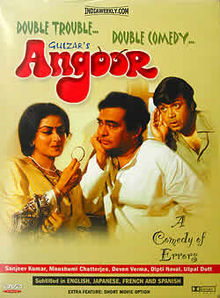
If ‘Do Dooni Chaar’ had the Kishore Kumar-Asit Sen duo, ‘Angoor’ had Sanjeev Kumar- Deven Verma, ably assisted by Moushumi Chatterjee, Deepti Naval and Aruna Irani. Both are ageless comedies. shakespeare do dooni chaar  (A still from the movie ‘Do Dooni Chaar, Year: 1968, Director: Debu Sen)

Shakespeare Angoor

(1982, Gulzar)

Othello

When the cancer of distrust and suspicion spreads, disaster looms ahead.

If ‘Hamraaz’ had a stage performance based on the travails of Othello, ‘Omkara’ brought home the anguish of the hero in a poignant manner.

Shakespeare Humraz

(1967, B R Chopra)

Shakespeare Omkara

(2006, Vishal Bhardwaj)

Romeo and Juliet

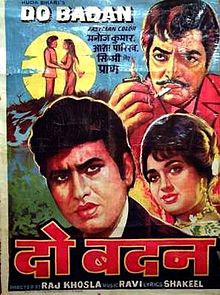
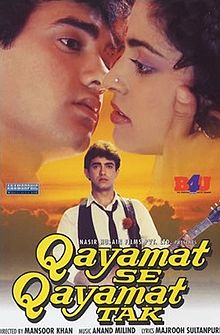
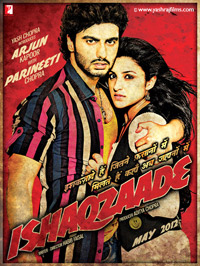
The tale of star-crossed lovers has been used by Bollywood in a number of its offerings. ‘Do Badan’, ‘Qayamat Se Qayamat Tak’, ‘Ek Duje Ke Liye’, ‘Goliyon Ki Leela – Raas Leela’ and ‘Ishaqzaade’ can be said to be based on the Bard’s eternal love classic.Shakespeare Do badan

(1966, Raj Khosla)

Shakespeare Qayamat_Se_Qayamat_Tak

(1988, Mansoor Khan)

Shakespeare Ek_Duuje_ke_liye

(1981, K Balachander)

Shakespeare Ishaqzaade

(2012, Habib Faisal)

Shakespeare Ramleela

(2013, Sanjay Leela Bhansali)

In tune with the changing times, the last two were rather graphic in their depiction of the heat of desire, an aberration which only made them stray even farther from the original theme.

Macbeth

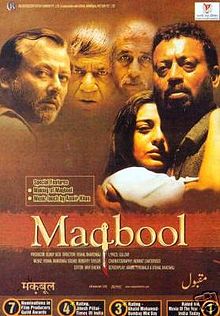
Maqbool’ had finely etched performances by the likes of Tabu, Pankaj Kapur and Irrfan Khan. A dark offering against the backdrop of a Mafia gang, it left the viewer struck with its audacity and the departures from the original work.

Shakespeare Maqbool

(2003, Vishal Bhardwaj)

Hamlet

Haider’ had all the elements of the original – intrigue, ambition, retribution and an amorous love affair to boot.

Shakespeare Haider

(2014, Vishal Bhardwaj)

A Midsummer Night’s Dream

’10 ml Love’ came enchantingly close to the original, but did not have the depth of the original.

shakespeare 10 ml love

(2010, Sharat Katariya)

Most of these movies had the necessary ingredients for commercial success – exotic locales, lavish sets and costumes, outlandish exaggeration and intense passion. Opposites co-existed in many of these movies. Comedy often walked hand in hand with tragedy, poetic language got intermeshed with coarse slang, and middle class morality and values were juxtaposed with unabashed display of physical desire.

A timeless appeal

It would be too simplistic to say that the poet is merely a vestige of India’s colonial past. Much like Thomas Hardy, Jane Austen, P G Wodehouse, Agatha Christie and many others, the multi-layered characters etched out by him touch a chord somewhere deep within the psyche of Indian movie buffs of all hues, sizes and shapes.

It is this mass appeal which makes the Bard a source of inspiration for many a scriptwriter in Bollywood. His works depict the essential traits of human beings and shall forever continue to regale movie goers all over the world.

(If you liked this post, there is a chance you may like these as well:

https://ashokbhatia.wordpress.com/2015/03/06/some-bollywood-movies-with-a-dash-of-wodehousian-humour

https://ashokbhatia.wordpress.com/2015/12/30/fifty-years-and-three-classics)

Read Full Post »

Much before the term ‘Super Star’ was coined, we had the inimitable K L Saigal.

Here is a well researched post on the legendary work of this great artist.

findshars's avatarMy Views On Bollywood

 By

Sharada Iyer

 saigal1

Acknowledged as one of Hindi Cinema’s greatest legends, Kundan Lal Saigal was hailed as ‘Shahenshah-e-mausiqi’ (emperor of music) as well as the ‘ghazal king’ and became a phenomenon in his lifetime.  He appeared at a time when recording techniques were rudimentary and the film industry was on the brink of changing from ‘silent films’ to ‘talkies’. As songs started becoming an integral part of movie scripts, he had to devote his time equally between acting and singing.  Within a short span of 15 years and without any formal training in music, the irresistible spell cast by his golden voice remains unparalleled and his songs recorded eighty years ago evoke the same kind of magic even today…

Often while writing columns on superstars of Hindi Cinema, the counting incongruously starts with the triumvirate of Dilip Kumar-Dev Anand-Raj Kapoor who dominated a large part of the Black&White…

View original post 2,241 more words

Read Full Post »

« Newer Posts - Older Posts »