Feeds:
Posts
Comments

Posts Tagged ‘Ethics’

Here is a thought provoking post on the subject of ethics. In my own career, I have come across several kinds of persons with different approaches to the issue of following ethics. There are the Pragmatic ones who would do whatever it takes to ride up in the company hierarchy. At the other end of the spectrum, we have the Idealists who would chuck a lucrative career at the first sign of deviant corporate behaviour. Midway, we run into the Negotiators who would not give up on the system but would try and attempt to make it more compliant from the inside. Yet another category is that of The Conformists, who would simply go along with the flow.

Leadership plays a vital role in setting up the standards down the organization.

This post is based on the media, but has lessons which are relevant for all sectors of the economy.

broadsideblog's avatarBroadside

By Caitlin Kelly

Do you trust what you read, hear or see in the mass media?

THINK LIKE A REPORTER

Even blogs?

A Gallup poll of 1,000 Americans a few months back says no:

Their findings: just 21 percent of the people surveyed ranked newspaper reporters with high or very high honesty and ethical standards. Next came lawyers, tying with 21 percent, followed by TV reporters at 20 percent, then advertisers at a miserable 14 percent.

View original post 1,278 more words

Read Full Post »

If you happen to be a professional to whom the allure of becoming a director on the board of a company is irresistible, here is a confidential note written by the Chairman of an imaginary company to one such aspirant, listing out the unstated terms and conditions of the offer.

From: The Chairman, XYZ Ltd.
To: A wannabe Independent Director

“Dear Aspirant,

I am happy to know that you aspire to be an independent director on the board of our company. Whereas a formal letter of appointment would soon follow, I write to you in my personal capacity to explain the real rights and responsibilities of an independent director.

1. You shall be hired only for your fame, your excellent contacts and your eminence. Your subject knowledge, competence and seriousness of participation in the meetings are important but secondary to the scheme of things.

2. Our company believes that machinations of the management (read “real owners”) are supreme. Our business is run on a quarter to quarter basis. PROMOTIONSAny talk of business strategy, etc, happens against this background. You shall always remain an embellishment on the board and shall conduct yourself with grace and equanimity accordingly.

3. Please appreciate that the Chairman and the President/CEO are advised by the best brains in legal and accounting matters. Their word is final and binding.

4. For the sake of excellent PR, as also to keep our market image shining and bright, the company has a set of clear guiding principles, a sparkling vision document, an exemplary code of conduct, a well spelled-out corporate philosophy, a robust governance framework, a sound CSR policy and a clearly articulated intention of zero tolerance to graft, corruption or sexual harassment. However, based on exigencies faced in the business environment or the seniority of the person involved, the management reserves the right to be flexible in its approach towards enforcing the aforesaid.

5. During your tenure, you may discover some creative accounting practices resorted to by the company. You may come across audit notes which point out the calculated risks we take while planning our direct as well as indirect taxes. You may also discover highly ingenious ways in which we interpret the laws of the land. You shall be expected to put across innovative suggestions to further refine such practices. You shall not be expected to raise any objection to the same, whether in private or in public.

6. You shall be encouraged to represent a group of shareholders, or appear to be partial to a group of stakeholders of the company; provided, of course, that your performance shall always be evaluated based only on the key deliverables – namely, towing the line of the management and ensuring that the company’s image is protected and its business interests advanced at all times.

7. Should you become involved in any legal hassle owing to having not registered a dissent on issues of either corporate governance or legal compliance by the company, an issue-based support may be provided. In such an eventuality, the company reserves its right to publically disown you and terminate its association with you forthwith.

8. Any attempt on your part to form a group of Independent Directors shall be treated as an act of dissidence and betrayal by management. As a matter of corporate policy, we do not encourage dissent, whether expressed or otherwise.

9. In respect of any matter pertaining to the operations of the company, you shall never take a moral high ground and start teaching us ethics and value YES-MENsystems. The last thing we need is a lecture from a glorified employee, the real capacity in which you shall serve the company.

10. The company expects you to observe complete confidentiality even after the end of your term as an Independent Director.

11. Post-retirement, you shall undertake not to become a whistle-blower and seek protection under any such scheme offered by the government of the day.

12. Advances, affiliations and activities of an amorous nature attempted by you towards directors from the other sex shall be frowned upon; unless, these happen to be dictated by the business needs of the company and have prior tacit approval of the management.

Even if you do not appear in the database of prospective candidates maintained by the Ministry of Corporate Affairs, we trust that you have so far been smart enough to ensure that your legal record is squeaky clean. We are sure that you shall continue to be vigilant on this score.

We look forward to a long-term mutually beneficial association with you. We welcome you as a part of the growing tribe of (perceived to be) independent directors in the country. We have no doubt whatsoever that you shall conduct yourself in a manner which would enhance the prestige and influence of this newly created labor market.

Yours truly, etc”

Background note:

Indian companies having a paid up capital of more than INR 100 millions and those whose aggregate outstanding loans, debentures and deposits exceed INR 500 millions are now required to have at least two independent directors on their respective boards. The new rules notified by the Government of India come into force from the 1st of April, 2014.

Likewise, some companies are now required to have at least one woman director on their board. For some, it is now mandated to spend 2% of their profits on CSR activities.

Hopefully, in the days to come, the newly emerging tribe of Independent Directors would play a far more effective role in ensuring that more companies conduct their affairs with better attention to transparency, ethical standards, gender diversity, environment protection measures and socially relevant investments.

Read Full Post »

It is heartening to know that India’s civil services aspirants shall soon be taking an examination in ‘Ethics, Integrity and Aptitude’ as part of their endeavor to make a career in public administration. It is a laudable initiative, and one does hope that in the days to come, our denizens’ issues with the administration shall start getting resolved with empathy, pragmatism and promptness, sans any corrupt practices.    

As an average person, one is tempted to ask if our politicos should also be taking a similar test! We live in an era when probity in India emblempublic life is at a nadir. The conduct of some of our honorable MPs and MLAs on the floor of our august legislative bodies often leaves us red-faced and scurrying for cover. The only time we see a semblance of unity amongst politicians of different hues is when they are faced by the threat of declaring their finances under the landmark RTI Act or when trying to thwart the judiciary’s attempts to keep criminals out of our polity.

How about an Indian Political Service?!

May be, the time has come to introduce an Indian Political Service? If meritocracy has to rule, those aspiring for a career in politics can be made to first apply to a body like the Union Political Service Commission! Detailed CVs backed by details of socially relevant projects handled, vision for the future, parentage and financial backing etc will need to be submitted and made public. Thereafter, the aspirants would need to undergo a rigorous selection process, comprising a written examination, followed by a group discussion, individual PPT presentations for the benefit of their target constituents, personal interviews and the like.

A professional working license can get issued only after a five-year internship with a duly registered political party. Thereafter, the incumbent could become entitled to joining the election fray. license can be put up for renewal once every five years.

Criteria for disqualification can also be laid down. Involvement in scams of any kind, a lapse in discharge of core duties, getting convicted in a court of law, disrupting legislative work, browsing the net for pornographic content while on duty, tax arrears of any kind, etc., could lead to suspension of the license to practice.

An exhaustive appraisal system can be put in place. Performance could be rated on various aspects like development works completed in the constituency, number of new legislations introduced, hours of legislative attendance registered, besides core targets met for the portfolio handled. For re-election, the license will need to be renewed based on the ballot performance.   

Would a Management Development Program Help?India Parliament House

In case our leaders and constitutional experts declare the above mentioned approach as null and void, another option is at hand. We can ask some of our premier management institutes to design a Management Development Program for our politicians! Such a program could have modules on ethics and integrity and behavioral sciences – with a focus on etiquettes and manners. A crash course on meditation techniques could lead our politicos to do some introspection on their own part, trying to figure out ways to attract today’s educated youth into the political mainstream, handling important legislations with equipoise and equanimity, controlling passions on the floor of the house and cleaning up the finances of the parties they owe their affiliations to.

In an era of scams and systemic corruption, the reputation of our political honchos has taken a severe beating. This is not to say that there are no straight forward and honest politicians ruling us. But corruption appears to rule the roost. Whether it is through a loot of the exchequer (Westland helicopters, fodder scam), sale of patronage (allocation of natural resources) or plain extortion and rent-seeking (pay or take the highway), the ingenuity with which public money gets siphoned off to either fill the political parties’ tills or to shore up personal fortunes is something which one cannot learn at management or accounting institutes.

Connecting with the Post-reforms Generation

All political parties need to do some introspection as to how to win and influence potential voters, specifically Gen-Z, meaning those who were born in the post-reforms era and who expect performance in place of promises and delivery in place of dithering.

The writing on the wall is clear – cleaning up political funding, giving up vote bank politics, avoiding inane bickering to win India Rashtrapati Bhavanbrownie points and joining hands to work together and taking concrete steps which enable common citizens to become successful entrepreneurs and make the delicately nurtured amongst us experience true freedom.

It is apparent that as a country, India has so far focused only on economic reforms. Reforms in the other realms of a vibrant democracy, like legislature and judiciary, are yet to be conceptualized and rolled out. We have miles to go before we get to sleep!


Read Full Post »

Poster The_Beauty_InsideWould hi-tech companies like Intel and Toshiba believe in the traditional Indian ethos of spirituality and reincarnation? The fact that their recent promos give us a glimpse into a universe where what is on the inside alone counts does indicate this. The key message appears to be that whether it is a man or a machine, it is only the entity inside which makes a difference. ‘The Beauty Inside’ promo has a narrative of daily incarnations, which fits in rather well with what Lord Krishna tells us in the Bhagavad Gita – that the soul inside us is what really matters!

This is obviously not to say that the essential principles enshrined in Eastern scriptures necessarily need an endorsement from the West. It is common knowledge that post-Lehman Brothers, premier management institutions from the West have started showing some interest in the Eastern philosophy. The concepts of morality and ethics have gained currency in management circles. The fact that Stephen Covey speaks of an inner voice and a soul in his book ‘The 8th Habit’ is yet another manifestation of this trend.

Learning it from intelligent apes

The concept of a soul is an integral part of various streams of religion and spirituality we see around us today. It is interesting to understand how religion and spirituality originated; also, the value these really add to our mundane lives.Bonobos

After years of research on bonobos – intelligent apes closely related to us, homo-sapiens – Frans de Waal argues that human morality is not imposed from above but comes from within us. In his path-breaking book entitled The Bonobo and the Atheist, he therefore proposes that moral behavior does not begin and end with religion. It appears that our values and ethics are instead a product of evolution and cultural response.

The fact that our innate goodness resulted into diverse streams of religions we see around us today readily explains the success of religion – and various Gods revered in each stream – as a concept. The spiritual thought process is also an outcome of the same core of our need to be good within ourselves, in our own eyes.

A cat or a dog may not think through the process so thoroughly, but bonobos surely appear to be aware of the nuances of social norms. Religion Ankara_Muzeum_They have a developed sense of reciprocity and fairness. They are even known to intervene in a fight between two tribe members so as to maintain peace and harmony!

Ancient apes, whales and dolphins deserve our gratitude for several qualities that we possess – our sensitivity to others, our concern for fairness, love of harmony and other just forms of societal behavior. If religion or spirituality attract us, it is because these touch a chord somewhere deep within us.

Templates of Exemplary Conduct  

The contribution of religion therefore is in presenting us with templates of exemplary conduct. It has codified the social and ethical norms for the average person. In particular, it has made it easier to explain the nuances of ethical and moral values by portraying examples of Gods and Goddesses whose conduct is worth emulating for the average person. Religion cleverly uses fear and temptation to guide and control human conduct.

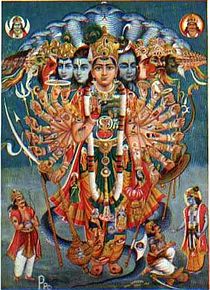
Irrespective of the stream of spirituality one chooses to follow, the basic template invariably is again that of exemplary conduct. However,A_Vishva-rupa_print the focus is on listening to one’s inner self. The endeavor is to silence the mind, thereby attaining inner peace and happiness. Each stream of spirituality has a different prescription and a unique methodology, but all are unanimous that the spirit is at the centre of it all. To that extent, spirituality has the potential of uniting people, whereas religion has been seen to divide it along communal lines.

As compared to religion, spirituality is more embracing. In religion, we have the good guys – devas – and the bad guys – asuras. Following one’s Dharma, the code of righteousness, man can hope to attain salvation. However, spirituality encompasses the good as well as the evil, both being manifestations of the Divine. When Krishna manifests his all-pervasive and all-inclusive Vishwarupa form in the midst of his sermon to Arjuna, it shows the negative side of the Divine as well.

A Heady Cocktail

Intel and Toshiba have surely come up with a winner promo in ‘The Beauty Inside’. Similar campaigns which work on a heady cocktail ofintel logo some basic tenets of religion and philosophy on the one hand and the latest that technology and management has on offer on the other would surely follow.

Given that our scriptures are replete with gems of wisdom and lay down templates of exemplary conduct, more and more corporates could be hopping on to the spiritual bandwagon in the days to come. Already, we find companies appointing Chief Belief Officers and Chief Ethics & Compliance Officers. Goes on to show that the role of conscience keepers in corporates is getting the recognition it deserves.

Toshiba logo

Such developments give one hope that the upcoming generations of our future business leaders and professional managers would rate high not only on their Intelligence and Emotional Quotients, but also on their Moral or Spiritual Quotient, bringing to the work place a set of ethical values and practices.

Read Full Post »

India can justifiably boast of a long history of culture, tradition and values. Scriptures of Indian origin are a treasure trove of nuggets of wisdom. These continue to be relevant in the current context and also find ready application in the field of business management and administration.

Here are some of the areas where I believe Ramayana can inspire management14 practitioners.

  • A Premium on Values

Sticking to some core values which are steeped in righteousness eventually leads to success. The main protagonist, Rama, is depicted in Ramayana as an epitome of virtue. He is an ideal king, an ideal son and a pragmatic person. He sets high ethical standards in warfare and invariably sides with dharma, or righteousness.

A random sample of all successful business houses which have been around for more than a century now – Siemens and Tatas, for instance – is ample proof that ethics in business do pay dividends in the long run. Names of such business houses enjoy tremendous brand equity in the market; understandably, that rubs off on their products as well.

  • High on Motivation

To me, the Ahalyaa episode is all about a good leader enthusing a team of demoralized members who have become zombies over a period of time and have stopped delivering results. Once ‘woken up’, they are fully charged and start performing along expected lines.

Rama wages a war on Lanka with very limited resources, backed by an army which is pretty out-of-the-box or unconventional. It is an army which is highly motivated, expecting minimal facilities. Goes on to show the superiority of motivation levels over the availability of physical resources.

A CEO who is out to increase his market share needs the back up of a highly motivated sales staff which – if motivated well – would go all out to win the hearts and wallets of the company’s customers.

  • Mergers and Alliances

When a merger is based upon a congruence of basic value systems of both the parties involved, long-term benefits accrue.

The alliance between Rama and Sita is a turning point in the Ramayana for more reasons than one. Sita is brought up in the household of the sage-king Janaka. When Rama gets banished to the forest after their marriage, she displays a clear absence of any hedonistic tendencies and chooses to accompany him to the forest. Without a synergy of this kind, the sequence of events could have been quite different!

Likewise, the friendship of Rama and Sugriva sets a good example of mutual cooperation between two people facing a similar predicament in life and career. What follows is Sita getting traced in Lanka and Ravana eventually getting vanquished.

When Etihaad decides to team up with Jet Airways, or when Tata Steel ties up with Corus, the parties involved are looking for synergies in their respective core strengths, so as to tap their joint business potential better.

  • Succession Planning

Dasaratha’s plans for installing Rama on the throne of Ayodhya do turn topsy-turvy, but the existence of a clear succession plan can never be denied. This is meant to ensure continuity in governance. It helped that besides being the eldest son, Rama was liked by all and hence chosen to lead the kingdom once his father passed away.

As per Raghuvansham of Kalidasa, when the time comes to relinquish his body, Rama divides the kingdom equitably between his two sons – Lava and Kusha.

All well-managed companies ensure that the career development plans of their top performers are directly linked to succession plans. Ideally, good leaders invariably groom at least three managers under them. When one gets promoted to the coveted slot, it is quite likely that two others may seek greener pastures elsewhere. Whatever happens, the goals and the processes involved in achieving the same enjoy uninterrupted continuity.

  • Leaving the Comfort Zone

When Rama gets ordered to remain in the forest for a span of fourteen years, Sita and Rama take it as an opportunity to engage with the ordinary citizens of their kingdom, rather than remaining confined to the comforts of their palace. This helps them to understand the ground realities better.

CEOs and marketing honchos of today who travel through the hinterland to get a better first-hand feel of the customer’s pulse do a far better job of servicing the market.

  • Excellence in Execution

The plan to locate Sita gets brilliantly executed by Hanuman. The wisdom withRamayana 3 which he conducts the search and the single-minded pursuit of the goal is an example worth emulating by managers at all levels. While crossing the sea, he declines an invitation from Mount Mynaaka to take some rest on the way.

The manner in which he assures Sita of his genuineness exhorts managers to conduct commercial negotiations by first setting the anxieties of the opposite party at rest.

  • Concern for Environment

For three days, Rama prays to the god of the sea to grant a passage to his army. Nothing happens. Rama then shoots arrows into the bosom of the sea, whereupon the sea-god appears and explains that he is bound by the laws of nature, just like earth, air, space, light and all constituents of the universe. Creatures living under his shelter he cannot forsake, but surely a shallow area can be shown where a causeway can be built.

Rama accepts the sea-god’s apology and orders the building process to start. Thus, the objective is met without damaging the eco-system.

In the current context, governments all over the world are realizing the importance of striking a judicious balance between economic growth and environmental concerns. Rama’s approach inspires us to strive to find the middle path and ensure that Mother Nature is not unduly disturbed to pave way for crass commercialism.

  • Dependence on Yes-men!

Ravana is a highly learned and accomplished person. One of the reasons for hisRamayana 2 downfall is to neglect the advice of nay-sayers. His wife, Mandodari, brother Vibheeshana and minster and maternal grandfather Malyavaan – all advise him to return Sita to Rama. Instead, he chooses to listen to his courtiers who play on his ego and pride and advise him not to do so.

A couplet in Sundara Kanda of Ramcharitmanasa clearly advises us to ignore the advice of a paid deputy, a doctor and a teacher who speak positively out of either fear or expectation of a gain. A king who acts upon such motivated advice loses his kingdom, his body and his righteousness (dharma) as well.

  • Humility in Victory

When Ravana is on his death-bed, Rama exhorts Lakshmana to learn the tenets of good governance from him. Lakshmana approaches Ravana rather haughtily first and fails. Rama then advises him to approach Ravana with due humility, whereupon Ravana speaks of the pitfalls of procrastination and shares his knowledge about statecraft and diplomacy.

  • Power of Attorney

The sincerity with which Bharata takes care of the kingdom’s affairs while Rama is away speaks of true values of follower-ship. Upon his return to Ayodhya, Bharata informs him that the kingdom’s revenue had gone up ten-folds during the fourteen years he was away.

Here is an excellent example of a kingdom held in trust and good faith, much akin to the present day concept of a power of attorney getting appointed to take care of administrative and legal matters of a business when owners are not readily available.

  • Make Haste, But Slowly!

Rama has won the war and is on his way back to Ayodhya. He decides not to rush back. Instead, he stays back at Sage Bharadwaj’s ashram for a night and makes enquiries about the state of affairs in Ayodhya. Also, he sends Hanuman upfront to break the news of his imminent arrival to Bharata who is living like an ascetic in Nandigram. He moves to Ayodhya only after receiving adequate feedback about its current situation.

  • Leadership Traits

With the possible exception of his handling of Sita upon her return from Lanka, Rama conducts himself in an exemplary manner throughout the narration. Feminists these days may scoff at the treatment meted out to Sita but the fact remains that Rama acts like a true-blue king for whom the overall welfare of the kingdom comes first, even though he suffers personally in the process.

Whether it is befriending Nishaad Raaj, refusing to return to Ayodhya when Bharat approaches him in Panchavati, conducting the last rites of Jataayu, accepting Vibheeshana in his fold or even when reuniting with his mothers and brothers upon his return to Ayodhya, he sets a high bar for humanity in general.

In the corruption-infested times we live in, his leadership traits inspire managers to do their best even under the most trying circumstances.

  • Ram Rajya

The concept of being fair to all is the bedrock on which modern management is based. For those in power at the top, an impartial conduct of those in authority is a sine qua non for the morale of the people. Sita gets banished to the Valmiki ashram when an ordinary citizen casts an aspersion on her character. Rama’s role is not much different from that of a true-blue CEO whose loyalty to the company’s overall welfare is unflinching.

Skirt-groping CEOs who have a roving eye and managements which look the other Ramayana 1way just because they accord a higher priority to business goals than to the character of their top honchos could take a leaf out of Rama’s conduct.

There are several instances when management has to divulge information on a ‘need to know’ basis. However, if the basic practices are perceived to be fair to all, even management policies which impact the employees adversely – like a down-sizing – are not taken amiss across the company.

Ramayana is rich with several other narratives which could be useful to management practitioners. Also, each narrative may be interpreted in several ways, depending upon how one goes about analyzing it.

References:

Ramcharitamanas by Goswami Tulasidas, Valmiki Ramayana, Ramayana by C. Rajagoplachari, Raghuvansham by Kalidasa, Adhyatma Ramayana, Series on Ramayana by Narendra Kohli.

Illustrations Courtesy Internet

http://attachment.benchmarkemail.com/c117651/July-Augusl.pdf 

(Related Posts: 

https://ashokbhatia.wordpress.com/2013/07/12/management-lessons-from-mahabharata

https://ashokbhatia.wordpress.com/2015/09/04/management-lessons-from-the-life-of-lord-krishna)

Read Full Post »

Is there a scope of improvement in management education? If so, how do we enrich it further?

I confess that management education is not my forte. The only exposure I have had to this exalted field was when I was at the receiving end, so to say – that is, as a MBA student myself! But, over the years, interaction with the younger managers has provided me with valuable clues as to the challenges being faced by the current crop of MBAs. This alone emboldens me to endeavor to propose what I believe could be done to enrich the process further. Of course, I do so with utmost humility at my command!

·         A 360-degree CEO View

Management education opens up one’s mind to various facets of an enterprise. However, it does so through the bifocals of a top honcho’s perspective. Upon entering the industry, a befuddled greenhorn could get a thermal shock. Most of the concepts covered in a typical MBA course appear to be irrelevant at that stage of one’s career. Depending upon an incumbent’s innate strengths and the type of opportunities one gets in one’s career, it could take around 15-20 years for one to reach a level where the first whiff of real business strategy and corporate planning etc comes one’s way.

What we need perhaps is a better emphasis on the dilemmas faced by middle level managers. This can possibly be achieved by structured interactions with management experts in the middle rung of large organizations. Case studies which are designed to showcase the types of challenges faced by middle management could also help.

A 360-degree view is absolutely fine, as long as the gondola takes us not only to a mountain top at 3,500 m in the Swiss Alps, but also delights us with the panoramic views at 1,500 m and 2,500 levels.

·         Business History

The way Tatas, Birlas and Ambanis grew up, adapting to times which ranged from British governance to the license and permit-raj days, followed by the phase of economic reforms in India, is fascinating.

If one group focused on weaving ethical values into its business operations, the other capitalized on the pent-up demand in the market. Even their approach to philanthropy was different – one ploughed back its resources by focusing on the fine arts, fundamental sciences and medical facilities, the other earned the public’s respect by constructing a string of temples and related facilities for the common man.

Dhirubhai Ambani became a darling of the masses and popularized the concept of equity investments amongst the teeming millions of India. Post economic reforms, entrants like Infosys delivered good value to shareholders and employees in the newly emerging knowledge economy of India.

Examples abound from the international business arena as well. One is not talking merely of legends like Henry Ford and Steve Jobs here. Alfred D. Chandler’s ‘The Visible Hand: The Managerial Revolution in American Business’, and Charles Wilson’s ‘History of Unilever’ offer great insights into the field of business history.

While pursuing business history, one comes across entrepreneurial heroes as well as exploitative villains and empire builders as well as corporate raiders. A truly enriching exposure for a wannabe entrepreneur and/or an intra-preneur!

·         Lessons from Scriptures

Whether it is Ramayana, Mahabharat, Thirukkural or Chanakya’s Artha Shastra, there is a rich repertoire of management strategy as well as tactics enshrined in our scriptures. Each one contains gems of wisdom which can be put to effective use by management institutes which are already waking up to utilizing the wealth of wisdom available in literature to drive home some key management concepts.

The story of Lord Rama teaches us about waging a war with very limited resources. It also tells us about succession planning, ideal management practices based on fair and impartial conduct of those in power, humility, besides covering several other concepts.

Mahabharat can teach us about the perils of attachment to one’s near and dear ones in life/career, merit taking precedence over pedigree in promotions, tactical retreats in the face of imminent disaster and the risks of hasty decision making sans careful thought, to name only a few. Bhagavat Gita is full of practical wisdom for those aspiring to become professional managers.

Thirukkural tells us about the duties of a king and so does Chanakya Neeti.

For grooming business leaders who have a strong sense of values embedded in their thought processes, our scriptures are an invaluable resource.

·         Finishing

For those who are aspiring for a global career, the main cultural differences between different continents of the world can improve the value-add of management education. Dining habits, etiquette and manners followed by diverse cultures across the globe can also be incorporated in consultation with institutes of learning in the field of hospitality and tourism management.

Observing and following the organization’s culture when kick-starting one’s career, protocols of behaving with seniors, peers and subordinates and do’s and don’ts of e-manners to be followed while handling e-mails, etc. can also be driven home.

Some of the above could be immensely useful to students who step into management education with socially disadvantaged sections of our society. Covering such areas would tend to make this field more inclusive in nature.

·         A Focus on Follower-ship As Well

‘Leadership’ is a favorite topic in management. We have a rich literature providing invaluable insights into various aspects of leadership. Somehow, the traits of ‘Follower-ship’ have not merited much attention at the hands of management gurus and academics. As a discipline, does management education not need to create good followers as well? After all, a leader without a gang of followers could end up being pretty clueless!

The harsh reality is that an overwhelming majority of MBAs would turn out to be followers. If a leader is expected to have charisma, a follower needs to have common sense. If a leader leads by example, the follower realizes that blind faith could mislead the team. If a leader is supposed to be adept at resolving inter-personal conflicts, a follower is expected to work harmoniously with other team members.

Most business leaders today concur that planning is relatively easy; their real challenge lies in flawless implementation. Now, if a leader lays out a strategic vision backed by meticulous planning, smooth   implementation can only come through a bevy of hard-working followers.

·         Yoga and Meditation

Physical and mental fitness is a sine qua non to do well in one’s career. Institutions training the managers for tomorrow can figure out innovative ways to bring in these elements as well into the management education curriculum.

It appears that we would do well to beef up conceptual knowledge imparted in management courses with skills and values that would make MBAs more competitive and more balanced in their approach to real issues in the industry.

The managers of management education (in India, as also elsewhere) may find some merit in the above propositions.  


Read Full Post »

« Newer Posts