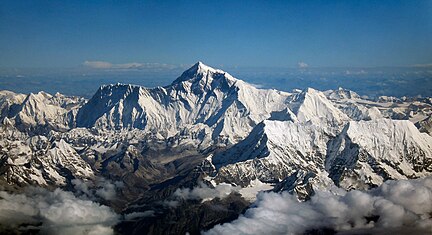
Non-statutory warning: This post is not about mountaineering. Nor is it about either global warming or the pollution of the Himalayas. It is about different shades of narcissism.
A vast majority of those I come across happen to have an ‘I-am-OK-but-you-are-not-OK’ disposition towards their fellow beings. Like Thomas ‘Thos’ Gregson, the fiend in human shape, they cast supercilious glances at others, often treating them like the dust beneath their chariot wheels. Talk to them on any subject, and they puff up their chests and play a game of one-upmanship, trying to prove their superior knowledge on the subject at hand. They come in many forms, sizes, and shapes. They pop up as relatives, friends, acquaintances, superiors, colleagues, or even subordinates.
Some of them have perfected the art of first gaining your attention and then peeping deep into your lives, asking all kinds of inane questions, much like Aunt Agatha. Often, they leave you convinced that you are an utterly-butterly useless person, a mere parasite eking out an existence while cornering some valuable resources of the planet. Ferreting out some unknown part/incident of your life and then subsequently using it to ridicule you is the work of a moment for them. When it comes to the fine art of seeking details about your finances, sleuths from the Income Tax department could learn a lot from them.
At social gatherings, they monopolise the conversation. They simply love hearing their own voice. When they narrate a joke, they expect all others to guffaw, that too in an appreciative manner. If they get requested to belt out a song like Sonny Boy, they, believing that their skill level at singing is superior to that of Cora Bellinger of The Song of Songs fame, consent to do so only after throwing some tantrums. At the end of the performance, they expect to be lustily applauded.

A few others excel at gaslighting, raising queries that leave you shaken from the base of your feet to the top of your head. Remember Dame Daphne Winkworth of The Mating Season fame? In the company of such people, you can be forgiven for feeling baffled, befuddled, bewildered, confounded, confused, fazed, flummoxed, mystified, perplexed, puzzled, and stumped, all at the same time. You are left twiddling your thumbs trying to figure out if your life is going in the right direction.
Such people believe that they happen to be perched atop the Mount Everest. Whichever way they look, they only find other mountains that are not as high as they happen to be stationed on. They suffer from what yours truly would allude to as The Everest Syndrome. Let me hasten to add that I do not refer here to the genial souls who offer constructive criticism and help me to improve myself.
Do you have a career issue? They will tell you how they would manage the same better. A health challenge? They would pounce upon you with an exotic treatment that has already given them superior results. A diet plan? They would invariably have a better one up their sleeves. Putting a morsel of food down the hatch in their presence? Be prepared for it to turn into ashes in your mouth when told of the innumerable unhealthy constituents it may hold. It is another matter that when the evening dawns, they could be found chomping on a samosa or some other deep-fried stuff with much glee.
A moody and obdurate teenager at home? They would make it a point to counsel you and point out where you are at fault. An elaborate lecture on kid management will soon follow. A prompt comparison will be made between you and another family member, proving you are deficient in your teen management skills. Their own family members could not be smarter and more successful. Their affairs are always in perfect order. They themselves could do nothing wrong.
Oh, you just got back from a trip to Norway? Great. But you missed seeing the Northern Lights? What a pity! Could you at least visit the spiral tunnel in Drammen? Oh, you missed that, too? A wasted trip! A comment of this kind, accompanied by a condescending glance, makes them sound like Doctor E. Jimpson Murgatroyd. You may recall that he has sad, brooding eyes and long whiskers, and his resemblance to a frog which has been looking on the dark side since it was a slip of a tadpole is apt to send your spirits right down into the basement.

Simply put, they happen to be omniscient, having expertise in all knowledge domains, be it astrology, astronomy, gastronomy, medicine and its myriad branches, meditation, nature cure, reiki, regression therapy, spirituality, and yoga. They are the lord and master of all that they survey. Wherever they go, they need to have the last word. They believe themselves to be God’s gift to humanity. Judging others is what they do with great enthusiasm and aplomb.
Unlike Sir P. G. Wodehouse, whose works spread light, joy, and sweetness, any interaction with these descendants of Sir Edmund Hillary leaves you a wee bit depressed and glum, diluting your self-confidence and making you wonder why you are not as smart as they pose themselves to be. Contrary to being ‘sources’ of wisdom, joy, and comfort, they tend to be ‘sinks.’ If you happen to be one of those over-sensitive types, you will need to develop nerves of chilled steel, so they do not end up sapping your energy.
On the mere mention of such people, you could be excused for giving in to trembling your knees a trifle. The thought of being confronted with such a solid bunch of detractors who otherwise wear the masks of a well-wisher is unnerving.

If Jeeves were to be consulted on the matter, he would surely provide a few insights on the psychology of such persons.
One, they could be inwardly jealous of your multi-faceted achievements. They could thus be behaving like Aunt Agatha, trying to hide their own embarrassment at having temporarily lost a pearl necklace, thereby trying to overcome their own inferiority complex while in your company.
Two, they might be living in a bubble of superciliousness and simply enjoying the game of psychologically putting down all those whom they meet. In other words, it is a personality trait which is deeply ingrained in them. Thus, they might deserve more to be pitied than censured.
Three, they happen to be deficient in such behavioural traits as empathy, generosity, humility, and sincerity. Expressing gratitude and acknowledging the value others bring to their lives does not occur to them. Honest communication is not their forte. As a result, they often lack adaptability and fail to grow themselves, blissfully unaware of what they are missing in life.
Without a doubt, they have shades of what could be alluded to as a narcissistic personality. They exaggerate their achievements and talents and disregard others’ feelings. They have perfected the art of blaming others for all their problems, and unabashedly play the victim card.
How does one handle such people? Consider the following.
- Reminding ourselves that in this life it is not such people that matter but the courage with which one maintains a sang froid in their company. Our lives are our own responsibility. We cannot live as per the opinion of others about us. Often, we waste much time in our lives worrying about what others would say about our decisions and actions. But if we act as per our conscience and if our moral/value compass is functional, the only thing we need to watch out for are the karmic consequences of our actions. This, in turn, needs deep reservoirs of resilience, a stiff-upper-lip attitude in general, and a higher level of self-confidence.
- Let us cut through the mists of our own prejudices and try and sift the grain and the chaff. There could indeed be some merit in what such persons say. It can help if we were to first judge if such people happen to be genuine well-wishers; and if they are sincere. If so, their feedback could be given some weightage, paving the way for us to improve our lives.
- We can of course decide to go on the offensive. Lives are seldom perfect. Pointing out a few flaws in their own scheme of things could be tried, though subject to the boundaries prescribed by the norms of civilised society, the dictates of behavioural sciences, and the standards of politeness. Occasionally, a back-handed compliment could stop them in their tracks, not unlike Roderick Spode when the word Eulalie is mentioned to him. A joke can lead to a light-hearted banter, designed to make them sit up and take notice. In any case, arguing with them on some point or the other might as well turn out to be an exercise in futility.
- We also have the option to laugh it off and not take such people seriously. Any feedback from them could be brushed off nonchalantly, much like Bertie Wooster would tick off a dust particle from his coat sleeves. In other words, try and develop a Teflon-coated skin which repels any water that may happen to fall on it.
All of us have distinctive personalities. All of us have a set of unique circumstances under which we operate. Our responses to similar situations are as varied as the colours of a rainbow. The universe created us to enjoy our lives and strive towards achieving a state of bliss, harmony, and perfection. Those of us who happen to be steeped in consciousness seek purity and unity of thought, words, and deeds. Do we have a right to judge others? Do others have a right to judge us? I doubt.

However, as long as we are in the company of those who suffer from The Everest Syndrome, we are apt to find that the air is congested with V-shaped depressions. Consequently, while standing atop the K-2 that we infest, we look north, south, east, and west and discover quite a few clouds on the horizon.
But Bertie Wooster would tell us never to repine, never to despair, never to allow the upper lip to unstiffen, but always to remember that, no matter how dark the skies may be, the sun is shining somewhere and will eventually come smiling through.
In general, we would do well to pull ourselves together, have a chin-up attitude, and march on with our lives. If we were to gear ourselves up to scale the world’s tallest mountain, let the mountain be defined as that of our aspirations in life, whether material or spiritual. We can care better for our fellow beings and our environment. We can focus on reining in our ego, desires, anger, jealousy, avarice, and greed. We can be grateful for what we have. We need not allow others to treat us as a doormat. We can elevate our level of consciousness.
Notes:
- Illustrations courtesy www.
- Inputs from Suryamouli Datta and Rajeev Verma are gratefully acknowledged.
Related Post:


 ashokbhatia
The Book on Leader Mindsets: Some Comments
Posted in Management Lessons, tagged Book, Comments, feedback, Leadership, Management, SPANDAN on June 1, 2019| Leave a Comment »
“Little did I imagine that someday Professor Rao will do an empirical study and bring out a book on this subject. The book brings out leadership mindsets so clearly and analyses these based on research and experiential wisdom. The thing that struck me most was the linkage of these styles with the three gunas in Hindu scriptures: Sattva, Rajas and Tamas. The book does not prescribe any style but makes the reader think through what his style is and what he would like it to be. Then, it provides the reader with a pair of new glasses and suddenly one starts seeing things in a different perspective.”
Satish Sekhri
Formerly Managing Director
Bosch Chassis Systems Ltd,
Pune, India
(An excerpt from the Foreword to the book)
“I think the leader mindset proposed in the book is “Indian tinted”. As someone from the “West”, I am pleased to enrich my understanding with “your views”. You make a good contribution to enlarge our perspectives on how you see the leader mindset.
Very few of us are internally STRONG to accept negativity; also, the contexts that most of us live with is toxic. So, “I Am Something” approach can be extremely healthy.
When you try to explore the role of human values in the face of Industrial Revolution 4.0 (AI, Robotics, etc), you may consider the fact that the drivers of technology ARE weak in terms of human values.
I think that we are headed towards a phase of self-inflicted extermination, possibly leading to the emergence of a new species. Before the end of this century, we will have ourselves and the others species. We will be creating living beings among us and, little by little, we (little and fragile creatures) will fade away, hopefully graciously. We do not wish to change ourselves. We also do not have the collective will power to change the context in which we operate. So, the next evolutionary step of our civilization may get taken much earlier than most of us may think.”
Marco Paulo Abrunhosa Cardoso
Serving in boards in different jurisdictions
Finland
“The writing is excellent. As the editor of a journal, I rarely see papers with no errors. Your book is thus a rarity. I initially wondered why some words like “Student” and “Maternalistic” are capitalized. I now realize that there is a meaningful reason behind it.
I see that the style is half-way between a discourse and a scholarly
paper. If you are positioning it as a scholarly paper (like a journal
article or academic book), it certainly needs more references. The book has some quotations which too need references.
This book is obviously positioned as to not tap into management
literature on leadership a lot (at least in part 1). Rather, it offers another way to look at leadership.”
Ram Mohan Pisharodi
Marketing Professor/Chief Editor, Alliance Journal of Business Research at Oakland University
Greater Detroit Area, USA
“From an Australian’s point of view, I found that the thesis of the book provides a fresh perspective on the issue of leadership – a very sub-continental perspective and interpretation.
It appears that the intent of the book is to provide aspiring (or current) leaders with a way for them to become a happier and more contented person. Greater contentment would lead to a warmer and more positive individual. The thesis is supported by research and empirical observation.
My conclusions include the following issues:
Dr Jack Jacoby
Executive Chairman
Jacoby Consulting Group, Australia
Read Full Post »