Feeds:
Posts
Comments

Posts Tagged ‘Human Values’


You are a leader in any realm of human endeavour, whether managerial, social, political or cultural. You could be an entrepreneur, an institution builder, a Chief Executive Officer, a policy maker or a related functionary, either in the private sector, or in the public sector. You could be serving as a senior officer in a government department. You could even be heading the operations at a non-governmental organization.

You are perceived to be a successful leader. However, somewhere deep within, you carry within you a sense of creative dissatisfaction; a yearning to discover a practical way to transport yourself, your team and your organization into a happier and contented frame of mind. You are keen on going beyond your own professional and personal interests and in getting involved in humanizing your organization.

If so, this book could prove to be a game changer in more ways than one. It makes you see the world around you in a new light, without the filters of your preconceived notions. By making you aware of the kind of mindsets which affect your decision making, it offers a new lens with which you can view the phenomenon we call leadership.  The book then goes on to capture the results of an empirical study done by the author, thereby demonstrating the practical wisdom of what it proposes. Eventually, it offers you a practical guide as to how to go about implementing the changes you wish to make, so as to become a happier and a contented leader.

This book is not about a new leadership theory which might leave you fuming after discovering that it merely offers the proverbial old wine in a new bottle. It provides a fresh perspective on leadership. The perspective it presents has already been tried and tested in real time. Much along the lines of the famous Hawthorne studies of the 1920s, the approach to leadership is being rolled out in a corporate entity in India even as you go through the book in your hands.

The book also presents divergent perspectives on the subject of leadership from different subject experts, touching upon globalization and a bird’s eye view of different theories of leadership through the recent history of management thought. There is an attempt to understand leadership through the basic tenets of Buddhism. It also endeavours to connect the key teachings of Raman Maharishi to the realm of leadership.

The Soul of the Book and Some Crystal Gazing

The soul of the book, however, lies in its unique approach of SPANDAN, or human vibrations. Around the nucleus of this concept, it builds a mighty edifice of propositions which offer the potential of making you a more effective leader.

In the times to come, just how serious would be the threat to human supremacy from machines? In our age of Artificial Intelligence, Robotics, Machine Learning, Algorithm Analytics and Internet of Things, just how relevant would this new approach to leadership be?

The book proposes that in the impending man–machine conflict, human beings are not likely to suffer the same fate as that of the non-avian dinosaurs which went extinct some sixty-five million years ago. But the writing on the wall is clear. They need to roll up their sleeves and get down to the task of sharpening their soft skills. A humane approach to handling team members needs to be consciously developed.

Transforming Yourself and Others

To sum up, the book, through theoretical propositions and empirical evidence, presents a new way to look at the kind of a leader you could aspire to be, and the potential you have to grow further, making you a happier and contented person, exuding warmth and positivity to those whom you happen to lead.

It provides a fresh perspective which is not likely to lose its relevance in a future replete with technological advancements, environmental challenges and more potent uncertainties which leaders in any field of human endeavour would face in the decades to come.

Chapter-end Tasks on Introspection, Interaction and Initiation (3 Is)

To facilitate your learning process, the author has selected some themes and some quotes from mentors of repute. These are designed to enable you to Introspect at the individual level and also to Interact with others at a small group level. These could also motivate you to Initiate suitable steps at the collective/large group level, so members of your organisation could empower themselves and become more productive and responsible citizens over a period of time.

You will come across these suggestions at the end of some of the chapters. You can develop these themes further and convey the same to key individuals, small groups and large groups, in any form of communication – written, verbal, a group presentation and even a panel discussion. A final report based on collective feedback could assist you in measuring the effectiveness of this approach.


Read Full Post »


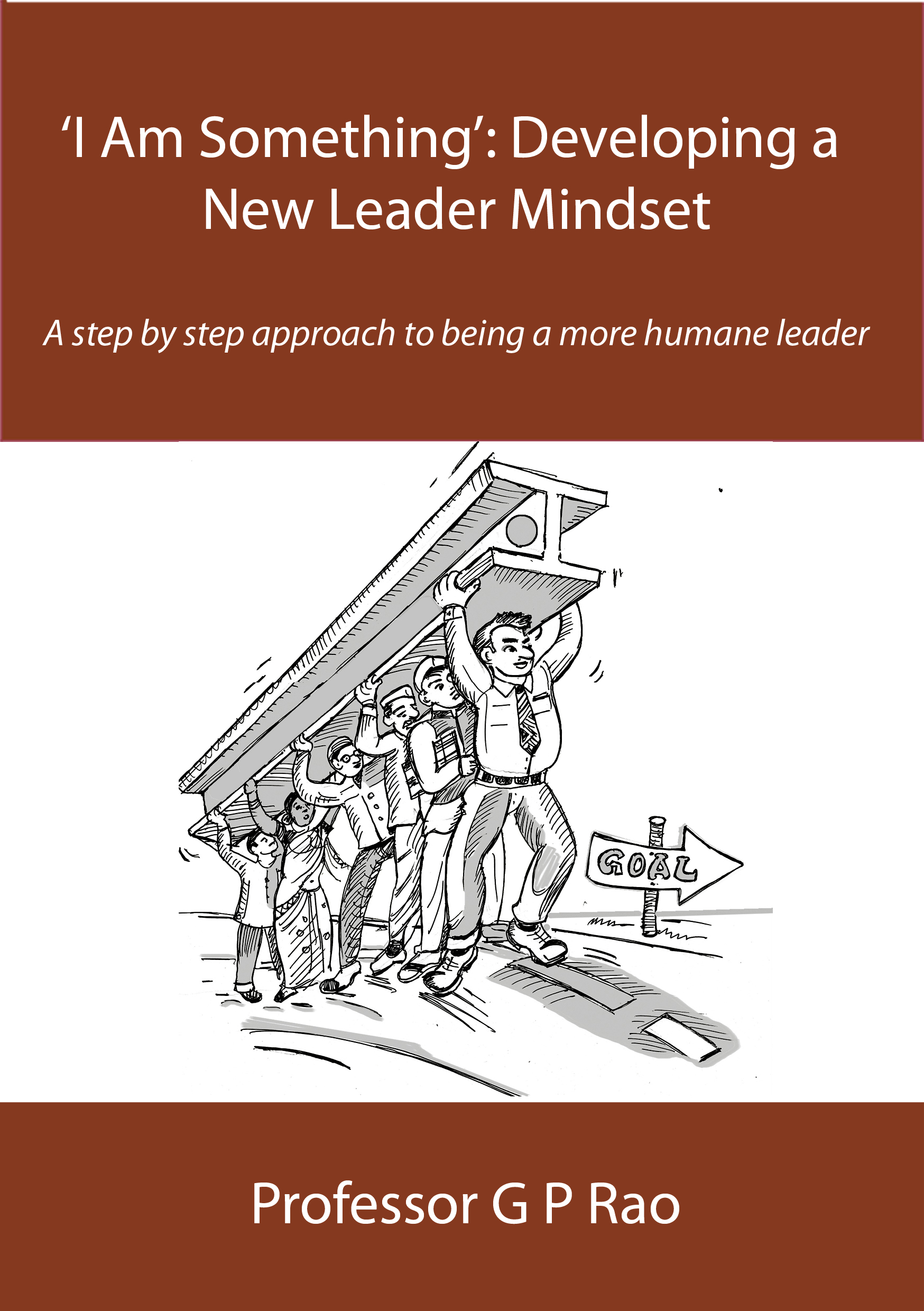
The importance of human values in our lives – whether personal or professional – can never be overestimated. In a book about to hit the market, the author, Professor G P Rao, builds upon his considered belief that managements which choose to ignore this crucial aspect in their decision-making do so at their own risk and peril. Their market valuations take a hit. Their brand image gets dented. They fail to take a long-term view of things. Instead, they end up window dressing the key performance parameters till the time the proverbial bubble bursts. They simply live from one quarter to the next, focusing on immediate deliverables.

In the upcoming book, the author not only proposes a theoretical construct of Leader Mindsets but also takes you through the steps involved in practising the same. Whether by way of an empirical study or by the means of a practical roll-out of the Spandan approach in an organization, results have been gratifying, establishing the value of the ‘I Am Something’ mindset towards the goals of organizations.

As humanity cruises along and takes off on the path of an exponential growth in technology, the need for a Spandan kind of approach would come into a sharper focus. Human values alone have the potential of acting as a rudder, keeping the trajectory of our evolutionary path on the right track. Leaders of tomorrow would find better satisfaction and happiness by adopting the ‘I Am Something’ mindset. So would their team members, were the leader to decide to facilitate their developing along similar lines. A spread across organizations and then across societies would be a logical corollary.

Read Full Post »

(The following is an abridged and modified excerpt from the book ‘I Am Something: Developing a New Leader Mindset’, authored by Prof G P Rao, founder of SPANDAN, yours truly and others.)

Advances in technology inevitably lead to more efficiencies, better products and improved lifestyles for people. But each leap of faith into the domain of a newer technology brings with it a set of newer challenges for mankind. As machines increasingly take over the drudgery of repetitive tasks and become more intelligent, human beings invariably need to re-skill themselves. This applies to business leaders as well as their followers.

The Fourth Industrial Revolution in the offing now builds on the Digital Revolution, representing new ways in which technology becomes embedded within societies and even the human body.

Skill-sets of the future

As per a World Economic Forum document titled ‘Future of Jobs Report’, employers are said to anticipate a significant shift in the division of labour between humans, machines and algorithms for the tasks of today.

The aforesaid report states that of the total task hours across the industries covered, on an average, 71% are currently performed by humans, whereas 29% are performed by machines or algorithms. By 2022, this average is expected to have shifted to 58% task hours performed by humans, and 42% by machines or algorithms. It can be readily appreciated that this signifies a very rapid pace of change, something for which leaders need to be better prepared.

The report goes on to project that skills related to analytical thinking, active learning, technology design and technology competency would grow in prominence. It also proposes that such ‘human’ skills as creativity, originality and initiative, critical thinking, persuasion and negotiation will either retain or increase their value, as will attention to detail, resilience, flexibility and complex problem-solving.

It follows that in the impending man-machine conflict, human beings are not likely to suffer the same fate as that of the non-avian dinosaurs which went extinct some sixty-five million years ago. But the writing on the wall is clear. They need to roll up their sleeves and get down to the task of sharpening their soft skills. A humane approach to handling team members needs to be consciously developed, especially when operating in a business environment characterized by a shortage of skilled workers. In turn, this would pre-suppose a higher Emotional Quotient and better service orientation. Even as the reliance on artificial intelligence grows for the analytical part of decision making, the role of intuition would become even more crucial.

A focus on the bottom line

Most employers would go in for innovating through technology if it makes business sense. It follows that technology would continue to remain a tool in the arsenal of the corporate world to squeeze more profits out of their operations, thereby making careers more fragile and impacting labour incomes adversely. With 24×7 connectivity, people are already working longer and enjoying lesser leisure time.

In a scenario of this kind, there is a grave risk that leaders would end up losing a connection with themselves even more than at present and hence end up de-humanizing the work place.
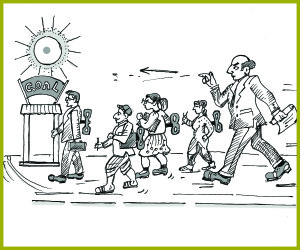
However, values remain indestructible. As an example, honesty and truthfulness in relationships is something which is bound to withstand the onslaught of newer technologies in the centuries to come. Same is the case with empathy, compassion, resilience and a flexible approach in problem solving.

Perhaps there is a need for governments the world over to anticipate newer moral and ethical dilemmas in a proactive manner and influence technological developments suitably, so human dignity and freedom is not compromised.

The perks and the perils

One may also surmise as to how the imminent advances in technology could throw up positive as well as negative factors which are likely to impact the man-machine equation in the times to come.

According to a 2014 report entitled ‘AI, Robotics, and the Future of Jobs’, published by Pew Research Centre, researchers Aaron Smith and Janna Anderson went to the extent of seeking feedback from as many as 1,896 experts. They found that when it came to the impact of advances in technology upon economic opportunity and employment, the opinion was deeply divided.

The optimists opined that technology would free us from day-to-day drudgery and end up redefining our relationship with ‘work’ in a more positive and socially beneficial manner. They felt that we shall adapt to these changes by inventing entirely new types of work and control our own destiny through the choices we make.

The pessimists amongst those who participated in the aforesaid study were of the opinion that the coming wave of innovation would mostly impact those involved in white-collar work. Whereas highly skilled workers will do better, many more might get pushed into lower paying jobs, and might even face permanent unemployment. They also felt that our educational, political and economic institutions are poorly equipped to handle the challenges which are likely to come up.

The aforesaid piece of research throws up instructive insights into how the future might shape up. Leaders and managers really need to think up some innovative ways in which they would handle a highly polarized workforce, comprising a disgruntled lot at one end and a highly skilled one at the other.

The challenge of creating happier workplaces

Unlike the earlier industrial revolutions, which first created and then changed the skill sets required by our blue collar workforce, the Fourth one promises to change the work profile of our white collar workers.

In his book, The Fourth Industrial Revolution, Professor Klaus Schwab, founder and executive chairman of the World Economic Forum, describes how this fourth revolution is fundamentally different from the previous three, which were characterized mainly by advances in technology. According to him, these technologies have great potential to continue to connect billions of more people to the web, drastically improve the efficiency of business and organizations and help regenerate the natural environment through better asset management.

As we grapple to understand the future direction of monumental changes in our socio-economic fabric owing to the next phase of technological evolution, few things stand clear.

One, that our educational institutions are nowhere near the task of training a workforce which would not learn analytical skills by rote but would grasp the importance of creativity, resilience and improve upon their Emotional Quotient.

Two, most of our governments are yet to devise ways and means of regulating issues of protecting individual privacy, executive burnouts arising out of a 24×7 connectivity and heightened civic strife due to growing inequalities. The next phase is bound to create a newer class of elite – those who are adept at newer technologies, leaving far behind those who are not.

Those in the first category could end up believing that they are all too powerful. Those who remain blissfully ignorant and continue to be disconnected to those who are reaping the benefits of newer technologies are likely to gravitate towards a belief that they have no place in the knowledge universe. With poor resources of material as well legal kind at their command, these new ‘have-nots’ of the society may be doomed to languish for a long time, till the governments of the day intervene, willfully or otherwise, and ensure implementation of economic policies which are more inclusive in nature.

The third kind, comprising those left in the middle of the normal distribution curve of technology dispersal, could end up having a balanced approach to issues. In fact, with advances in technology, this kind could well face a higher risk of extinction, paving the way for those who believe themselves to be all too powerful to rule the roost.

The same pattern may become apparent in the realm of management as well. Leaders and executives would need to increase their engagement not only with the society at large, but also with the governments of the day. A massive effort at re-skilling personnel would become a necessity.

A matter of trust and privacy

Infosys co-founder N R Narayana Murthy happens to be of the view that technology is a great leveller. He thinks that technology has improved transparency, conquered distance and class barriers. Also, that it has the potential to create a fair society and enhance the accountability of the rich, the powerful and the elite to the poor and disenfranchised in all societies.

One cannot dispute this. However, concerns regarding an increasing trust deficit remain. Denizens of many countries are feeling increasingly jittery over instances of data privacy. Moral policing, electoral pitching, rumour mongering – all these are fuelling this trust deficit.

One case in point is that of Facebook which is already armed with tools to dig deep into our lives, with the singular aim of moulding our thoughts and opinions about diverse aspects of our lives.

Employees in most organizations already resent living in a virtual fish bowl, where all their communications are suspected to be getting monitored. No one likes to be micro-managed, especially those who are capable and self-confident. Business enterprises have already started deploying tools to monitor employee productivity by collecting and analyzing their activity and inactivity levels.

In the long run, a work environment of this nature would end up impacting productivity, commitment and motivation levels adversely.

(Since 2020, the coronavirus has brought into focus the perils of techno-capitalism, dividing the society into those who can readily access technology and those who cannot. In an emerging economy like that of India, many school students have been left out of the formal learning loop because of their not having been able to access online classes. Rather than technology proving to be a leveller, it has instead proved itself to be a disruptor. Work-from-home has brought in behavioural changes amongst the knowledge workers, whereas migrant labourers have suffered from the trauma of displacement and loss of earnings.) 

The ever-increasing rate of change

One thing is certain. Change is not only a constant. With each passing year, the rate of change is also increasing. Much like Alice in Wonderland, Homo sapiens are discovering that they need to keep running faster and faster, with nary a respite in sight. Mankind is bound to evolve further much earlier than what was believed in the past. Alvin Toffler would perhaps heartily approve of this proposition.

Unlike thought so far, the man machine relationship shall become more integrated with each other in the near future. As a result, the combined force of processing of billions of data points for efficient decision making by machines, and contextual, emotional and intuitive aspects of decision making by human beings, would be, to that extent, higher and greater in their respective impacts – for good or bad.

What can be done to meet the challenge

– Employees, whether present or potential, can go beyond the formal education system and aggressively look for avenues to hone their skills, so as to remain employable. As Stephen R Covey has said, we need to keep our saws sharpened.

– Same applies to our business leaders, who would do well to improve upon their Emotional Quotient.

– The agenda for educationists and politicians is clear: To keep taking steps to facilitate the change already upon us; to anticipate the challenges of privacy and rumour mongering and to intervene to have appropriate safeguards embedded in upcoming technologies.

(References:
https://www.weforum.org/reports/the-future-of-jobs-report-2018
“Future of Jobs.” Pew Research Center, Washington, D.C. (December 11, 2014);
http://www.pewinternet.org/2014/08/06/future-of-jobs)

(Illustrations courtesy www)

Read Full Post »

Why do we hold leadership to be something which is fascinating? Perhaps we do so because of the inherent complexity it represents.

One, it is the outcome of a delicate chemistry between an individual and his/her environment. All individuals have personality traits. Some of these come to the fore under some special circumstances. Take away those circumstances, and the trait may continue to remain dormant for a long time.

It follows that there is as much probability at work here as, say, in the tossing of a coin or in a game of chance. In the realm of human resources, we see examples of dullards becoming heroes in a given situation. In case of brands and organizations, we come across several cases where some which were ‘nothing’, when assiduously worked upon and when the market conditions were right, evolved into ‘everything’ and started enjoying commendable market equity.

Two, experts have always been at pains to distinguish it from management. To the initiated, if management is all about people and processes which enable an organization to run smoothly, leadership is all about disruptive vision which could spur innovation and end up transforming the way the organization works and responds.

If one were to draw a parallel from the vast pantheon of Hindu gods and goddesses, one could perhaps say that if management is represented by someone like Lord Vishnu, leadership could be held to be portrayed better by someone like Lord Shiva. One is said to be maintaining and running the universe, while the other is the disruptive force which creates things anew.

Three, the term leadership itself leads us to another pertinent question – that of people being led. Just who are these followers? What are their characteristics? What are their aspirations? It is regrettable that while much research has been done on leadership, the followers – who make a leader what he/she is – have got a short shrift. The traits of this multitude of humanity have never been directly addressed; these are merely covered elsewhere, under the guise of subjects like motivation, communication, delegation, and the like.

Be that as it may, the charisma which a leader is said to possess remains a subject of relentless enquiry. This is yet another reason as to why leadership is fascinating. The inherent difficulty in defining the aura of a leader perhaps makes the phenomenon called leadership an enigma. Anything which is not readily grasped by the human mind invites even more attention. Such are indeed its ways. However, if one were to speak to one’s heart, the mystery unfolds. Human values, compassion and empathy come into play. The cumulative effort of a leader to connect with his/her followers goes a long way in creating the larger-than-life charismatic image of a leader.

Read Full Post »

The cultural ethos of an organization is essentially reflected in the way the top honchos conduct themselves. It also manifests in the manner in which the organization handles its relationships with diverse stakeholders.

Empathy is a critical component of the ethos of an organization. The trait of being able to put oneself in another person’s shoes and arriving at business goals and decisions by consensus helps the organization to be more efficient.

Understanding and empathizing with the perspective of the party of the other part also makes it easier to negotiate and successfully close tricky business deals. As an example, when one tries to finalize an order with a customer of Japanese origin, one discovers the value of empathy and mutual trust, because the latter is apt to ask for a detailed costing of the product on offer, a prospect often disliked by most businessmen hailing from a different culture.

Unfortunately, empathy and consensus do not always form a part of the arsenal of business owners and CEOs who are considered successful. Quite a few business leaders have brought to fore a leadership style which tolerates no dissent and abhors a natural impulse to seek consensus. Bill Gates, Steve Jobs and Jeff Bezos are some who have demonstrated that a leadership style which celebrates conflict, disruption and dominance is not only a virtue but possibly also an enabler of sustained creativity, technological evolution and advancement.

Of humility, consensus and culture

However, it appears that CEOs with a Western mind and an Eastern heart are configured somewhat differently. Microsoft CEO, Satya Nadella, sounds passionate about leadership and transformation, but the route he chooses is based on ethos, empathy, empowerment and democratization. In his book Hit Refresh, he concludes that ‘the choice of leading through consensus versus fiat is a false one.’

He goes on to propose that the ‘C’ in the CEO represents culture, thereby implying that culture building forms the core of his leadership style. In his leadership paradigm, hubris gives way to humility and envy to empathy. A CEO is as much responsible to the investors as he is accountable to the citizens.

A transformation in the offing?

Brand Microsoft has never been about empathy. Rather, its operating style has always been that of crushing the competition. But then, why would it allow Linux applications to run on Windows as well? Perhaps, rapid progress in the realm of technology is making friends out of foes, leveling off the field and making diversity and inclusion the critical components of a business strategy.

How this transformation plays out in future would depend on many factors. The way the market environment shapes up. The degree of freedom truly enjoyed by a senior person at the helm of affairs. The collective consciousness and value system of the core team which supports the CEO in steering the business, possibly based not only on a commercial compass but also on a spiritual one.

The argument one often comes across is that when satisfactory business results are coming in, what is the need for management to deploy such soft practices as empathy, humility and consensus in their operations?

In his book entitled “Be Unreasonable”, Paul Lemberg argues that when a top honcho believes in being reasonable, the business only gets buried deeper in conventional wisdom. He goes on to demonstrate how unreasonable strategies can bring one unconventional success.

This does seem like a workable proposition, especially when one is working in a highly competitive and disruptive environment. However, such a materialistic approach is open to challenge in some ways. One, the long term sustainability of business itself could come under a cloud. The success can then be fuelled only by a perennial outpouring of disruptive innovations, a feat which many businesses may find difficult to achieve. Two, the human capital of the business is likely to remain underserved and underexploited. It is almost certain that team members working under such conditions would not be happy souls who put in their best performance.

A feminine touch

In yet another noteworthy piece of work entitled Shakti Leadership, authors Nilima Bhat and Raj Sisodia argue that too many people have bought into a notion of leadership that exclusively emphasizes traditionally ‘masculine’ qualities: hierarchical, militaristic, win-at-all-costs. They propose that this approach has led to corruption, environmental degradation, social breakdown, stress, depression and a host of serious problems.

They show us a more balanced way, a leadership that is generative, cooperative, creative, inclusive and empathetic. These are traditionally regarded as ‘feminine’ qualities, but are worthy of emulation. In the Indian yogic tradition, these are symbolized by Shakti, the source that powers all life.

Indian scriptures speak of the concept of Ardha Naareeshwara, a form which is an eclectic mix of masculine and feminine features. This is what could turn out to be a better recipe for sustained success in the decades to come. A leadership style which is based on both masculine as well as feminine traits.

The technology explosion

Much like capital, technology in itself is soulless. However, American author Tracy Kidder has held that ‘technology is nothing more than the collective soul of those who build it.’ One would therefore not be wrong in surmising that even in the face of the technological explosion that we experience in our times, human beings – and as a logical corollary, human values – shall always play a definitive role in shaping the society along more just and humane lines.

The power of social media to shape public discourse and reform political decision making is already on display. Yes, there is always the danger of people getting manipulated by an overt use of the same social media. But surely these are short-time blips on the dimension we label as time and cannot last too long.

The future holds hope

Empathy appears to be kicking in. So-called feminine traits like creation and inclusion are taking centre stage. Competition is giving way to collaboration.

A noteworthy feature of organizations which believe in the virtue of empathy is the intention to give back to society some part of what the business gains from it. What follows is a keenness to offer products and services for the overall good. That is the kind of approach that Microsoft and many other enlightened businesses take.

(Related Post: https://ashokbhatia.wordpress.com/2016/04/04/super-leaders-the-near-perfect-ceos)


Read Full Post »

Successful organisations which boast of high brand equity follow several sustainable practices. One of these is the practice of treating their human assets with the respect and dignity they deserve. While compassion and empathy govern their HR practices, it would be wrong to surmise that they do so by compromising on their business goals.

This unique species of organisations, referred to here as Homo Organisationum, is envisaged as the one comprising Functionally Humane Organisations, where an optimal balance is maintained between business results and human relations.

Let me share one such instance from my own career.

High performance vs domestic bliss

A star performer in an IT manufacturing set-up had to strike a fine balance between her role as a crucial final quality controller and that of being a homemaker. In her absence, high-priority shipments could get delayed. At home, she had to take care of an ailing mother-in-law and a kid. Her husband used to work in another set-up around 900 kms away and would come visiting once every two months.

On a specific weekend, when an important shipment was to leave the factory late at night, amessage came that her husband was on his way home. Much to her dismay, a permission to leave the factory at the normal closing time was promptly turned down by her immediate superior.

The grapevine ensured that the incident of refusal of permission percolated upwards to the manufacturing head. The superior was called in without delay and given a dressing down. He, and the head of Quality Assurance, were guided on making alternative arrangements.

Eventually, the woman was delighted to receive permission to leave the place of work by lunchtimeinvolve itself, adding a few precious hours to her domestic bliss. The shipment also got despatched without any compromise on the immediate business goal.

Several such examples abound. Regrettably, however, these are outnumbered by the kind of instances which involve blatant exploitation of employees. Across organisations, this manifests in so many ways. Inhuman treatment while pursuing an immediate business goal. Depriving the employees of their rightful dues. Lower salaries, accompanied by liberal grant of personal loans and advances, thereby keeping the employees perennially indebted to the employer, and the like.

The leaner Davids and the flabbier Goliaths

When I look back at my 35+ years of exposure to the private sector, one thing stands out. The positive examples were mostly from the larger companies in the organized sector. The negative examples were invariably from the small-scale sector.

Large companies have a better-organised way of working. They often carry some flab. Systems take precedence over individuals. On the contrary, the smaller ones tend to be much leaner – though decidedly not fitter – simply because one person gets hired only when three are required!

The Consciousness of Organisations

Members of the species of entities known as Homo Organisationum thrive only when they can add value to their diverse stakeholders. However, to create a brand which is respected by their customers as well as their employees, as also to add value on a sustainable basis, they need to have a working culture which places a higher premium on such values as empathy, compassion, dignity, respect, justice, honesty, openness, transparency and equality.

Their employees then become their brand ambassadors, making it easier for them to attract better talent. In turn, this makes them more efficient and effective.

All organisations have a consciousness which seeps through all their organs. It manifests itself in myriad ways; specifically, through its culture. It is reflected in the manner in which the seniors conduct themselves. It shows up in the way decisions get taken. Unlike grandiose Vision and Mission statements which adorn their physical walls, it is not easy to articulate culture in words. Nor can it be readily replicated.

Just like a tiger is known by its stripes, an organisation is known by the kind of consciousness it lives and operates by. The more humane the same, the higher the probability of sustainable success.

Some crystal gazing

Advances in technology are already reshaping our organisations. Gone are the control-and-command structures. Hierarchies are getting flatter. Mundane tasks are being taken over by Artificial Intelligence and Robotics. Geeks are twiddling their thumbs, trying to cope with Machine Learning, Augmented Reality, Virtual Reality, the Internet of Things, et al.

Besides technology, buyer behaviour is changing. Geopolitics is changing. Workforce attitudes are changing.

But Homo Organisationum face little risk of becoming extinct. On the contrary, it is quite likely that with the kind of changes in the offing, the need for organisations to be humane would only go up in the future.

Time for CEOs and HR honchos to re-skill themselves.

(A version of this article was published in the IBA Journal, volume 9, issue 2)

Read Full Post »

« Newer Posts