Can the works of P. G. Wodehouse impart some lessons to CEOs and managers in managing their affairs better? His fans are always eager to relive the moments of mirth and bliss experienced by them while going through his books and stories. However, those of you who are from the realm of management and are dimly aware of the existence of a British humourist known as P. G. Wodehouse would by now be shaking your heads in disbelief wondering how something dished out by way of making one chuckle, guffaw and laugh could have anything to do with the stiff-upper-lip discipline of management.
To the latter, one would say that humour is serious business indeed. It is bound to make us feel lighter but cannot be taken lightly. In the past, we have examined in some detail the question if humour is serious business and have found an answer in the affirmative. In an earlier post, we also touched upon the way management theories and practices have evolved over the past century and checked if there are any common points between such theories and what Plum dishes out by means of his scintillating works.
The Intellectual Halo Around Seriousness
The deeper reality is that we value seriousness and tragedy over humour and laughter. Our minds boss over our hearts. Seriousness somehow makes us sound more intellectual. Most of the times, anything humorous is treated by us as being frivolous and perhaps fit to be scoffed at on the intellectual plane. On campuses of high-brow seats of learning, it is easy for us to visualize absent-minded professors going about with a heavy tome or two clutched in their hands, with a morose look on their faces, as if they were just being led by an invisible hand to the gallows. At management seminars and conclaves, serious talks get applauded while a speaker conveying a plain vanilla message coated in delectable humour gets ridiculed for playing to the gallery. In companies, at board meetings, detailed power point presentations of a serious kind get appreciated, whereas anything said in a lighter vein runs the risk of being greeted with healthy scorn.
One admires such management thinkers as C. Northcote Parkinson, Sharu Rangnekar and Laurence J. Peter who have broken this glass ceiling and given us rich management lessons in a humorous manner.
In their book Humour, Seriously, Naomi Bagdonas and Jennifer Aaker debunk the myth that humour has no place at the work place. In an interview, Jennifer Aaker opines that leaders with a sense of humour are seen as 27% more motivating; their teams are more than likely twice as likely to solve a creativity challenge. When leaders use humour in their interactions with their team members, they signal humility and humanity, thereby reducing the status barrier between themselves and their audience. The goal of humour at the work place is not merely to make others laugh; it is to put people at ease, thereby enabling them to be more open and candid in sharing their opinions.
Humour in Brand Management
Consider the innovative way humour gets deployed by a few brands of repute to keep their images shining bright.
Since 1946, the Air India Maharajah has been representing India with charm and dignity, making the company more visible to its customers all over the world. Created by Bobby Kooka along with Umesh Rao of J. Walter Thompson, the advertising agency, it has kept pace with the times – as a lover boy in Paris, a sumo wrestler in Tokyo, a Romeo in Rome and even a guru of transcendental meditation in Rishikesh.
Likewise, we have the case of the Amul girl. The mascot was created as a response to Amul’s rival brand Polson’s butter-girl. The idea was conceived in 1967 once ASP (Advertising, Sales and Promotion) clinched the brand portfolio from the previous agency FCB Ulka. It was executed by Mr. Sylvester Da Cunha, the owner of the agency and his art director Eustace Fernandes on hoardings, painted bus panels and posters in Mumbai. The mascot, since then, has been mobilized to comment on many events of national and political importance.
Not to forget some of our politicos who have risen from the ranks after having been successful comedians, managing countries and motivating their denizens to stand up to bullying by oversized neighbours waging wars so as to widen their sphere of influence.
If a lay manager were to pick up such books by P. G. Wodehouse as Psmith in the City, Blandings Castle and Elsewhere and Something Fresh and put them under a managerial lens, she is surely apt to discover a treasure trove of precious lessons in such diverse fields as marketing, entrepreneurship, operations, systems and procedures and human resources.
When it comes to the art and science of managing bosses, Rupert Psmith, Reginald Jeeves and Ashe Marson have created a few templates for a manager to follow.
The higher the level of entropy of our business environment, the higher would be the need for humour in business. As we march into the future, a Wodehousean approach to Management could help CEOs and managers in more ways than one.
“You have the right to work, but never to the fruit of the work. You should never engage in action for the sake of reward, nor should you long for Inaction”. These are some of prominent verses of Shri Bhagavad Gita, which essentially convey the most significant human values that we must inculcate within us throughout this journey of life.
In this era of 21st century, where employees in the organizations are in a constant competitive space, trying to fulfil their individual and organizational goals, basic values which make up the human are often getting ignored. As Samuel Johnson, one of the prolific English writers quoted, ‘The true measure of a man is how he treats someone who can do him absolutely no good’, explains the true quality that every human being should possess.
Values are basically the beliefs that refer to desirable goals that drive action. Our values are extremely important as they help us to grow and develop in the desired way. They help us to create the future we desire to experience. Every organization and the individuals working there are involved in making hundreds of decisions every day. These decisions are the reflection of our own values and beliefs and they are always directed towards a specific purpose. Thus, this purpose serves as the satisfaction of our individual or collective needs.
2. Present context in organizations
Technology is now ingrained at each and every step of our lives. Organizations have been keen on leveraging the maximum usage of these technological advancements and, thus, are looking out to a better diversification of their businesses. Start-ups have been rising at a tremendous pace, not only creating a competition to the established entities but also offering wide opportunities to the working employees’ segment. Thus, with such hustle and bustle in the outside world, most of the employees at any level or designation are today being compelled to only think about the results and achieving recognition in the market. While achieving the results is, undoubtedly significant, but focussing on processes is equally important. Today, in the quest of achieving more, higher managements can often be seen setting goals which seem impractical to achieve and employees while striving to achieve the same are seen as being being ruthless to their subordinates. According a study by Gallop across 27 million employees and over 2.5 million work units, it was seen that only 30% of the employees in US are actually engaged at work and only around 13% around the globe are engaged in the work at their workplaces.
3. Significance of Human Values in Organizations
Values are significant as they guide our beliefs, attitudes and behaviour. Realising, understanding, and staying true to our values is, therefore, one of the most important efforts that any human being can make. The same applies to our work places where the importance of values cannot be ignored.
When we say values in organizations, these can be perceived through two perspectives. One belongs to ‘Leadership Values’ which pertains to values possessed by the higher management in the organizations. The second one is the ‘Employee Values’ which is associated with the values possessed by the employees working in any organization.
a. Leadership Values
i. Compassion and Patience
The higher management and managers in the organizations, today, should necessarily inculcate a sense of compassion and patience within them. Though the company’s goals and targets are equally important, at the same time, leaders must also realise that the employees working towards it should not get overburdened. A true leader must always have an understanding of employee capabilities and interests and thus taking these factors into account, one should shape one’s expectations from them accordingly.
Patience is another human value which gets ignored these days while getting the things get done. Leaders should precisely consider the work efforts required for a particular task and should also consider the employee constraints while working on it. Thus, having a perfect balance of compassion and patience, leaders in the organization will be able to achieve the results as desired without disturbing the employee morale.
ii. Self Confidence and Trust in Employees
In this rapidly changing technological environment, leaders often come across situations where they need to adopt or develop a completely new emerging application based on the requirements. In such cases, the leaders have to rely upon their past experience and have to find out ways in which the new application can be developed.
A sense of trust has to be built among the employees and higher management, where it is ensured that the employees do not feel exploited by the company. At the same time the management has to also ensure that they express their trust towards employees by offering them the required and expected rewards and entitlements.
b. Employee Values
i. Adaptability and Inclusivity
The value of adaptability can be seen as one of the most influencing factors in the organizations. The ability of any employee to adjust with his/her fellow colleagues drives not only that particular employee but also the overall team. Employees, when they join a new organization or a new team, often find it challenging to bond with the new colleagues. But the quality of ‘accepting people as they are’ is extremely necessary in such cases.
When it comes to solving the problems in the organizations, the value of inclusivity ensures every team member is given the required value and their opinions are equally respected. This provides a freedom for the employees to express their views and promotes the feeling of ‘every thought is precious.’
ii. Love, Care and Respect towards Subordinates
Staying competitive in business is obviously important. However, the value of loving, caring and respecting the subordinates is no less important and critical. Today, it can be seen that employees, either to mark their prominence, betray their subordinates by taking the credit or create hurdles for them in achieving their goals.
The values of love, care and respect for employees, will not only help their subordinates in achieving the goals, but in turn, they themselves will be benefitted in their work, as a sense of positivity will be running through their veins
4. Conclusion
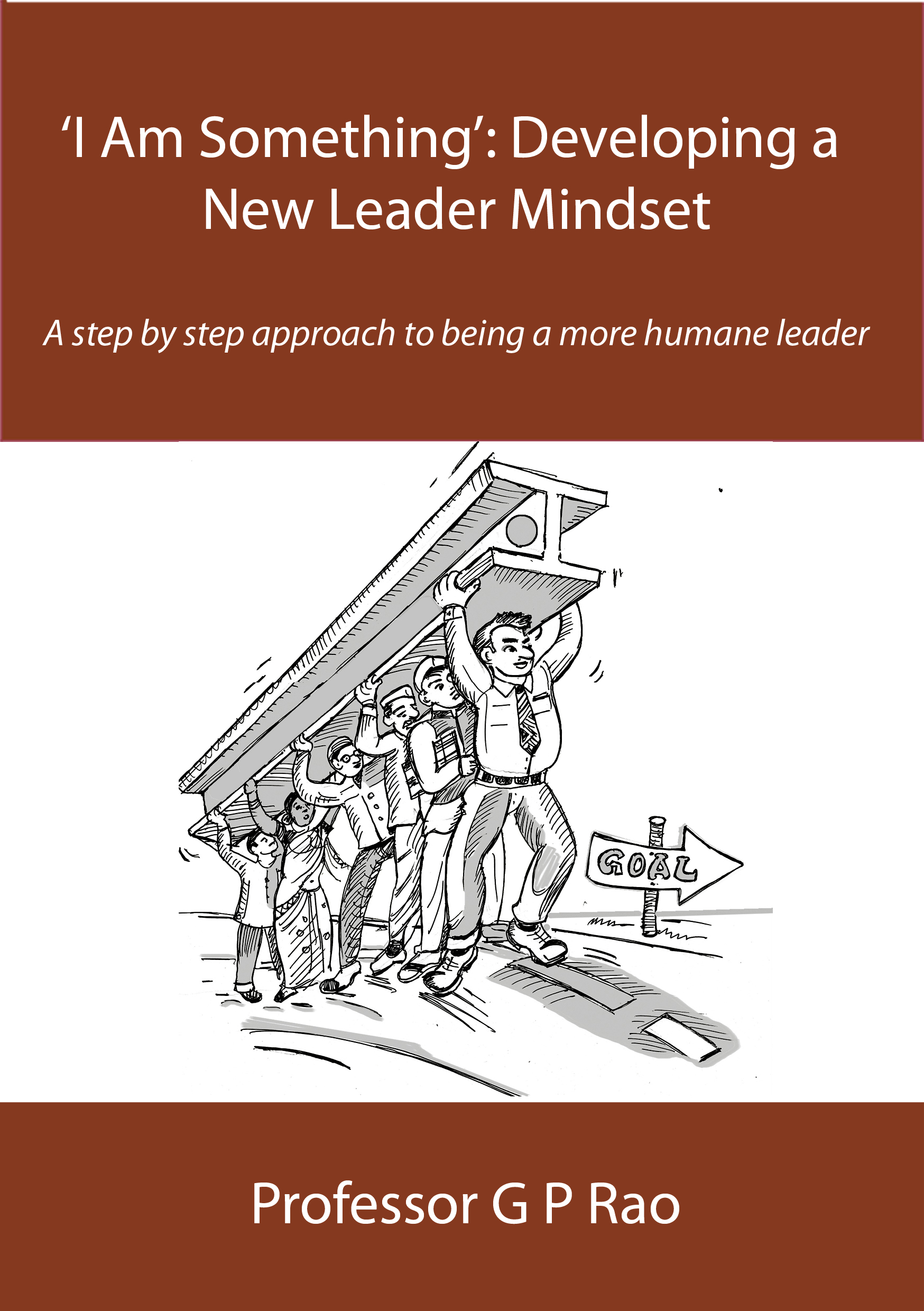
As conveyed by Lord Krishna in Bhagavad Gita, ‘the human intent behind any act always matters’. It follows that employees should always posses the intent of accomplishing their tasks in the best possible way, while helping anyone whom they meet in their journey. Employees in the organizations, today, should not develop a sense of either “I am Everything’ or ‘I am Nothing’. Instead, they need to develop an attitude of ‘I am Something’, which induces the self-confidence within them and also at the same time reminds them that there is lot of scope for them to learn and grow.
Having these essential values makes the working environment very conducive to new ideas and innovations, where every employee does not only feel valued, but they work at their fullest potential in order to make their organizations reach newer heights. Thus, in this era of fierce competition, human values combined with right skills to work will not only make the organizations thrive and be successful, but also add much required strength to humanity and make this planet a much better place to live.
Introducing the Author:
Ankur Sharad Mahajan is 27 years young and is currently pursuing my MBA in Operations at K J Somaiya Institute of Management, Mumbai, India.
He is an Instrumentation Engineer and worked at Tata Consultancy Services before joining his MBA. His hobbies include writing articles and poems, chanting Sanskrit Hymns and playing cricket, table-tennis and chess. Participating in various article writing competitions has always been his core interest. He is happy to have availed the opportunity provided by SPANDAN of expressing his views on a topic that he believes is most relevant and important in the present context.
Notes:
Permission of SPANDAN to reproduce this essay here is gratefully acknowledged.
This essay is a winning entry in an Essay Contest organized by SPANDAN recently.
“Carrots and sticks are well alive and well within the change canon, and some businesses forgo the carrots”
The dominant paradigm, particularly in today’s world, is that organizations are there to principally generate shareholder value and profit. When profit is threatened, laying off workers; and when profit is surplus and so is demand, then skill-scale-speed followed by HRs as an optimum variable in the recruitment, has become an uncontroversial norm. In both of these cases, human values take a backseat and that won’t do. While this archetype has been further reinforced by the pandemic, it doesn’t hurt to reevaluate the same while visiting some of the catastrophic consequences in the 20th century that coercion and neglect of human rights had on organizations and nations at large. While the unions and strikes against some marginalisation and enslavement based on extreme structures, like that of the US Plantation Economy or the Atlantic slave trade, have resulted in the enactment of labor laws, formulation of code of conduct and structuring the blueprint of corporates, methods inculcating humanistic values including self-actualization, dignity and purpose are still a far cry.
Organizations might have evolved around structure, policy, culture and technology but the need to centralize business through human intrinsic values still holds relevance. Now is the time that we start devising structural plans to align the present day organizations with human values and most importantly take cognisance of its relevance in all kinds of setups.
The stepping stone to understand the relevance and eventuate the same would revolve around redefining the role of HRs, understanding the core values that remains the same irrespective of the changes in organizational set up, the importance of adhering to the human values in the ever changing world around AI and envisioning the implications on stakeholders outside the organization while formulating any plan.
HR = Human Resilience
Industry stalwarts like Ajeet Bajaj are now defining resilience as an important attribute of HR. In this ever changing dynamic and diversity of the business world, employees are expected to emerge as a winner no matter what. They are expected to manage boundaries, conflicts, transitions, and deliver sustainable results. In short, they are expected to be resilient along with holding competence. However, more than physical and mental strength, resilience is a person’s emotional response to the situation, says Former MD & CEO of National Skills Development Corporation. And to harbour that level of emotional resilience, we can’t expect this term “HR” to be merely referred to as “Human Resources” but there is a need to redefine it as “Human Resilience”, there is a need to see humans as more than just well-oiled machines. HR is a profession that identifies the potential of people, nurtures the talent, facilitates self discovery and incentivises talent multiplication. And all of this is imperative to an organization’s success.
The pandemic however has made HRs respond reactively rather than proactively that further libeled them as “Termination Trays”. To break this notion, it would require organizations to diverge from “profit maximization to value maximization” and to bring about the change, HRs remaining at the very apex of it. This would involve HRs to undertake fundamental research about people in the context of governments, societies, corporate sector, villages, districts, talukas, so that they have a shared vision and value with humans coming from all walks of life. This, in turn, empathetically guides them towards the path of passion-purpose-positivity and revert back the setback brought in by the COVID-19 pandemic through a knack of bringing out the best in them amid crisis situations. And in this process, the resilience and adaptability fostered by human values remains innate as a key functionality in the ongoing digital revolution, an era that surely demands even more inclusivity, employee engagement and innovation. In short, it demands us to be more human.
THE CORE REMAINS THE SAME!
In recent times, we have seen massive changes in the corporate scenario which is an amalgamation of reconstruction driven by the digital revolution. Needless to say, the dimension and scope of hybrid culture, remote work, and most importantly startups gets much larger.
Having said that, there is a greater need for organizations to enhance competitiveness everyday. But, the core principle that makes an organization competitive remains the same regardless of the dimension and its setup. It is mostly a reflection of human characteristics such as adaptability, ethics and resilience.
The increased number of startups and ventures has made the stakeholders enamoured and obsessed with the products and services but the rate of success still revolves around business intent, customer connection, and employee experience. This requires us to make work more relational than transactional. When investors at times push a firm to professionalize and strive to fulfil market demands, companies tend to take a superficial approach and neglect what truly matters to the venture. But the successful examples of ventures like Nike, Netflix, Study Sapuri has taught us that the root of successful businesses can always be traced back to Employee Experience, customer satisfaction and organizational spirit.
The most consistent and flexible of them has been Netflix. It worked relentlessly to retain its soul of helping best content creators around the world get a wider audience and became the best global distributor. It epitomizes the concept of human values and organizational profit going hand in hand while perfectly complementing each other.
And some recent examples like that of the Google employees demanding the tech giant to shelve plans to stifle dissent in China in 2018 show that organizations and employees are still willing to place human values above profit even for the stakeholders outside the ambit of organization. And in today’s world of automation and digitization, we surely need more such examples to set precedents and instill a sense of oneness.
CHANGED MANAGEMENT (AUTOMATION AND ARTIFICIAL INTELLIGENCE)
While the world is leapfrogging towards Artificial Intelligence and Automation, it is incumbent upon us to practice it with utmost care and for the service of humanity and not against it. Some of the notable uses of AI for wildlife conservation or climate change through unmanned aerial vehicles and Machine Learning informatics are truly praiseworthy. But, we need to exercise wariness when we bring AI to the organizational setup. Taking a human centric approach would help the use of AI and automation intelligibly and proportionately. For that, it’s important that we have open and inclusive discussions about human values across diverse communities so as to avoid reinforcing unfair bias and create more innovative and representative uses of AI.
CONCLUSION
All of the three stepping stones including redefinition of HR’s role, Core values, Changed Management and automation help us to delve into the deeper trenches of the relevance and applicability of human values in present day organizations. To further augment all the three, there is a need to democratize businesses in order to envision the implications of our decisions that the stakeholders even outside the immediate sphere of an organization face. This would help us reevaluate some of the disastrous decisions including patent policy, jacking up the prices of life saving drugs and working against environmental protections that the organizations took lately in the light of shareholders profit.
While a transition to this self realization is surely difficult, observers suggest the main deterrence to the transition is our own mindset which is informed by a set of global narrative of how business is supposed to be. It has deepened the narrative of “dog eats dog” as a successful model of business. But, successful models like”Twin win” and “human chain” can be the silver lining to the ever evolving relationship between an organization’s success and the human values it professes.
And let’s remember that business and organization are the places where experience and insights came first and theories later. And in order to keep evolving and formulating new successful theories it is important to treat the significance of human values as being foundational, so as to solidify the ever evolving superstructures including business models and organizational cultures.
Shreya is 21 years young and a 3rd year Chemistry (Hons) student from Patna women’s college, Bihar. She has been active in the field of debating and speaking and has won awards at both national and international levels.
2. Jashn e abhivyakti, National debate competition, Satyawati college 2021 3. JIMS Kalkaji National Debate, 2021 4. Evaluation contest winner, Toastmasters International 2020
Besides, she is an avid reader, writer with experience in the field of management, education and writing. She aspires to form a community of like minded people while always striving to learn more.
Notes:
Permission of SPANDAN to reproduce this essay here is gratefully acknowledged.
This essay is a winning entry in an Essay Contest organized by SPANDAN recently.
Values can be defined as abstract and conceptual beliefs which act as a guideline in the lives of humans and influence the ways in which people and events are evaluated. The values of honesty, integrity, love, and happiness are termed as destination values whereas the values of health, status, intelligence are path values which help attain destination values.
While the destination values remain constant and act as a guiding light towards higher order goals, the path values are temporary and help achieve lower-order goals for humans. Humans are a mix of both types of values which are reinforced by the culture and environment in which they grow.
Where Do Values come from?
Values cannot exist in isolation from society. Every value can be referred to as a ‘goodness’ that exists in one’s mind, which in turn, exists as a sociometer construct that guides both collective and individual action.
Values can be formed biologically, determined by human needs, wants, and desires, and following one’s birth, they are formed from particular social groups, whose core values are determined by its purpose.
HUMAN VALUES AND ORGANIZATIONS
One can hardly glance at the front page of a newspaper without being confronted by a story of misconduct or unethical behavior in organizations. With this world becoming more and more profit centered, the relevance of value-based lens in this world of materialism is getting blurred.
For a vehicle to perform efficiently, it needs both an engine for power and a steering system for guidance. A similar analogy can be applied to any organization as well; the purpose or vision is the engine that propels it forward and the human values act as the steering system which guides it.
Just as it is important to be able to identify with an organization’s purpose, it is also important to align with its values. Organizations that authentically define their values show employees how to align their behaviors with the things that matter to the organization.
MAKING VALUES EFFECTIVE
An organization’s core values only have power when – and to the extent that – the humans in and around the organization feel a connection to them. When human values and organizational values overlap for employees, that’s when they are truly connected to their workplace.
The three ingredients that actually make values effective in an organization setup can be termed as follows:
Make Values Operationalized: Every organization can come up with a fancy set of value system that they follow. However, in order to make it effective it is important that similar values are reflected in the way the organization, its departments, teams and individual employees’ work on a day to day basis, propelled by actions and decisions.
Start from the Top: Leadership group of every organization must live up to the values that they stand for. Developing such value driven organizations always flows from the actions and decisions at the top level. An employee always idolizes his boss, so it is important that people at the top level are able to practice what they preach.
Communicate Values: Using content to communicate one’s value helps to develop a virtuous cycle. The content connects the organization to its values, keeping the values at the top of the mind for each team member when they are making decisions or crafting processes as a part of their daily tasks.
HUMAN VALUES AND RELEVANCE FOR ORGANIZATION STAKEHOLDERS
Values are an indispensable component of a healthy workplace culture. These provide a framework within which the organization can test its decisions, accomplish tasks, and interact with outside stakeholders.
Values and Organization: When organizations explicitly define their values and beliefs, they provide immediate clarity for decision making. Upholding human values helps create boundaries that show staff and clients where the organization is headed to.
A recent study conducted by the World Economic Forum highlighted how the organizations that nurtured a value system making it a part of their brand appeal without being single-mindedly focused on profit making were the ones which actually generated the most value and attained market leadership position.
The best example within the Indian context is that of the Tata Group. The guiding principles of the TATA group evolve from its rich value system and traditions of trusteeship as a way to redistribute the wealth created by the industrial society kept aside exclusively for the benefit of people at large.
Values and Leadership: Many leading thinkers and business practitioners advocate that true leadership is best expressed through the lens of values and beliefs of an organisation’s senior management, which serve to mould the broader organisation’s core identity and mindset. Values distinguish an able leader from a mere instructor.
As per the definition given by Busch and Murdock (2014), value-based leadership is considered as goal-setting, language-creating, problem-solving, and value-developing interaction, which is an integral part of any organization’s human values and very high ethical standards.
Following a value-driven path not only brings about clarity but also facilitates better decision making and goal accomplishment on the part of a leader. Value-driven decision making makes the leader standout and leave an everlasting imprint.
Values and Employees: Any business is as value-driven as the value systems of its individual employees. Value-driven employees not only turn into a long-term asset for the organization but also end up doing well in their lives and careers.
According to Maslow’s Need Hierarchy theory, human needs can be broadly categorized under five categories. Of these, Self Actualization needs come at the top of the pyramid. This clearly highlights how an employee – being a social animal – wants much more than monetary satisfaction.
Various studies show how employees are positively impacted when involved in CSR initiatives or when they follow their value system, rather than when driven by greed. Human values can act as a guiding light towards a better professional and personal life for an employee.
FINAL REMARKS
Business Ethics is a recent buzzword in modern organizations which constitutes the different human values and goes much beyond the materialistic business objective of profitability and growth. As most of the organization decisions are based upon values, the long-term sustenance of any organization is not possible without a robust value system.
With the increasing needs of different stakeholders, the modern organizations demand a more value-based approach of decision making. Value alignment not only helps in better decision making but also help organizations develop a feeling of trust with external stakeholders – like customers – ultimately leading to improved business performance.
Human Values can be considered as the soul of any modern organization. These act like the binding thread that integrates the organization with individual employees leading to holistic growth of the organization and the associated stakeholders.
Introducing the Author:
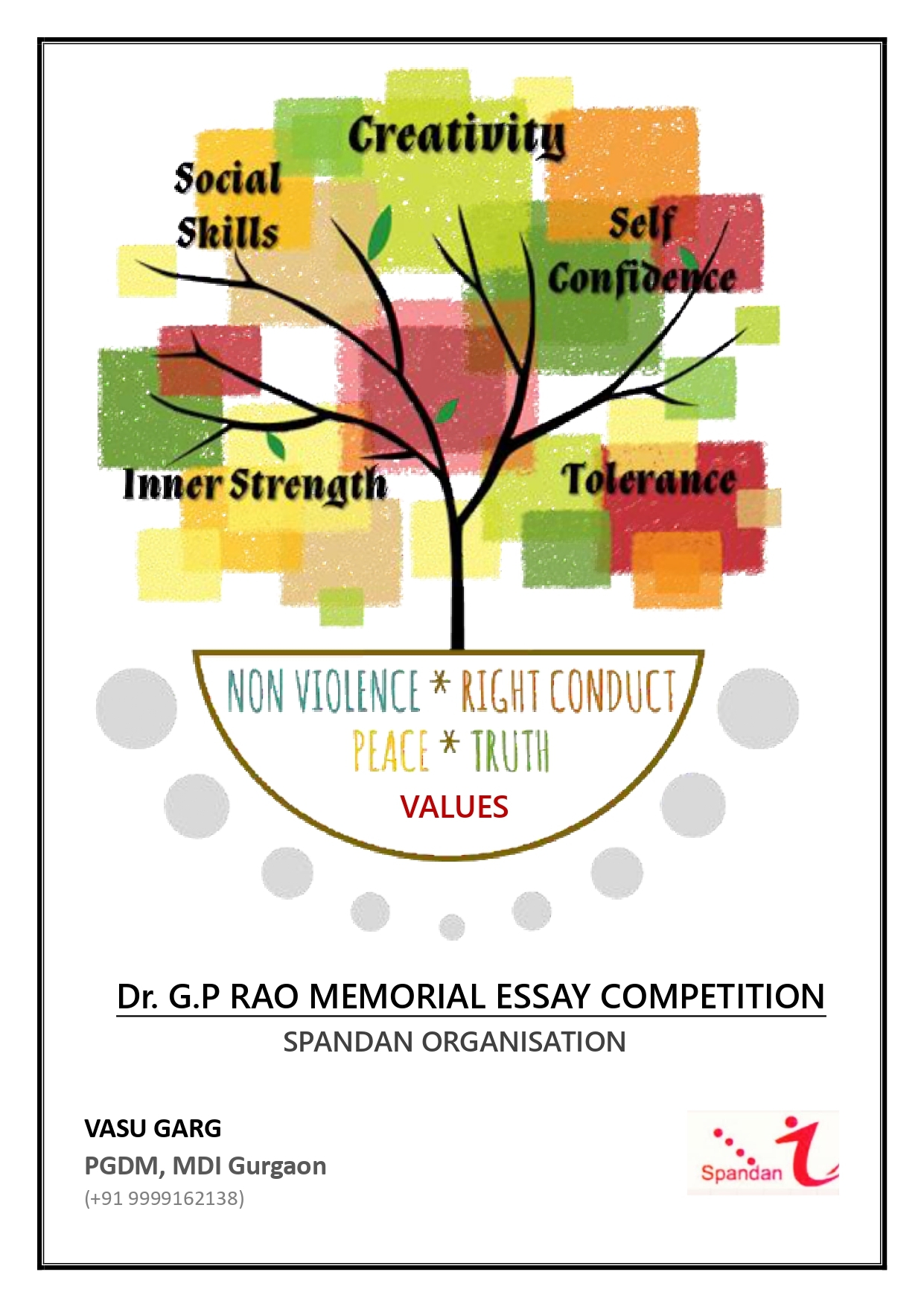
Vasu Garg (22 Years) is a 2nd-year student at MDI Gurgaon specializing in the field of Finance and Marketing. Prior to this, he completed his B.com (Hons) from Hansraj College, University of Delhi.
Despite no past experience in a corporate environment as a full-time employee, he has gained a certain level of exposure to the corporate world through a range of internships with organizations like Nomura, PharmEasy, UrbanCompany, IIFL, etc.
In terms of hobbies, he is passionate about participating in social work and playing cricket.
Notes:
Permission of SPANDAN to reproduce this essay here is gratefully acknowledged.
This essay is the top winning entry in an Essay Contest organized by SPANDAN recently.
Winners were recently announced in respect of a pan-India essay competition on Human Values in Present Day Organizations. The competition was organized by Spandan, a NGO which aims to spread the criticality of human values in management.
Vasu Garg of the Management Development Institute (MDI), Gurugram, Shreya Kumari of Patna Women’s College and Ankur Mahajan of KJ Somaiya Institute of Management, Mumbai, were declared winners of the first three positions, respectively.
Spandan: A Brief Note
Spandan Foundation for Human Values in Management and Society (Spandan in short) originated as a result of the academic and research interest of Prof G P Rao. It had been formed about two decades back. It is supported by a small group of industrial organizations, management institutions and individuals.
The word Spandan is drawn from the Sanskrit language. It means heartbeat, vibration, pulsation and echo. As a concept, the term is meant to convey that faith in the basic goodness and intrinsic altruism of human beings have both always been the driving force for human existence, growth and development.
TheMission
Propagation and inculcation of human values in education, management and society.
The Vision
‘Humanising self through a communion of hearts’.
The Belief
Businesses deliver suboptimal results when their ‘Results’ are viewed as being at odds to their ‘Relations’ with different stakeholders. An optimal balance between ‘Results’ and ‘Relations’ needs to be struck; this alone can enable an organization to achieve its goals effectively and efficiently on a sustainable basis.
The team at Spandan strongly feels that the need of the hour is to create Functionally Humane Organizations – a committed group of human beings doing their best in the interests of various stakeholders.
The Essay Contest (2021-22)
The contest was steered by Satish Sekhri, a senior management professional. Scholars and students from more than 100 management institutes were invited to participate. Fifty-eight entries from different institutes were received for the competition.
Of these, fourteen entries were short-listed and referred to a jury comprising Prof. Varun Arya, Founder Director of Aravali School of Ignited Minds, and Ashok Bhatia, a management thinker and author. The jury zeroed in onto five finalists. The criteria for evaluation were: The emphasis on human values, language and approach to the subject, and the practicality of the suggestions made.
The five short-listed essays were finally evaluated by Mr. Virender Singh, a former Chief Justice of the Chhattisgarh High Court. Thereafter, the three winners mentioned above were announced at a virtual event in the presence of Chief Justice Mr. Virender Singh, Jagesh Khaitan, who is the chairman of Kuantum Papers and of Spandan, and Anil Kohli, the NGO’s honorary secretary.
The winners were given cash rewards of ₹50,000, ₹30,000 and ₹20,000 respectively.
Future Activities
A series of lectures by eminent experts in the field of human values are on the anvil. As and when the dates are finalized, necessary details would be available at the Spandan website: spandanfhv.com.
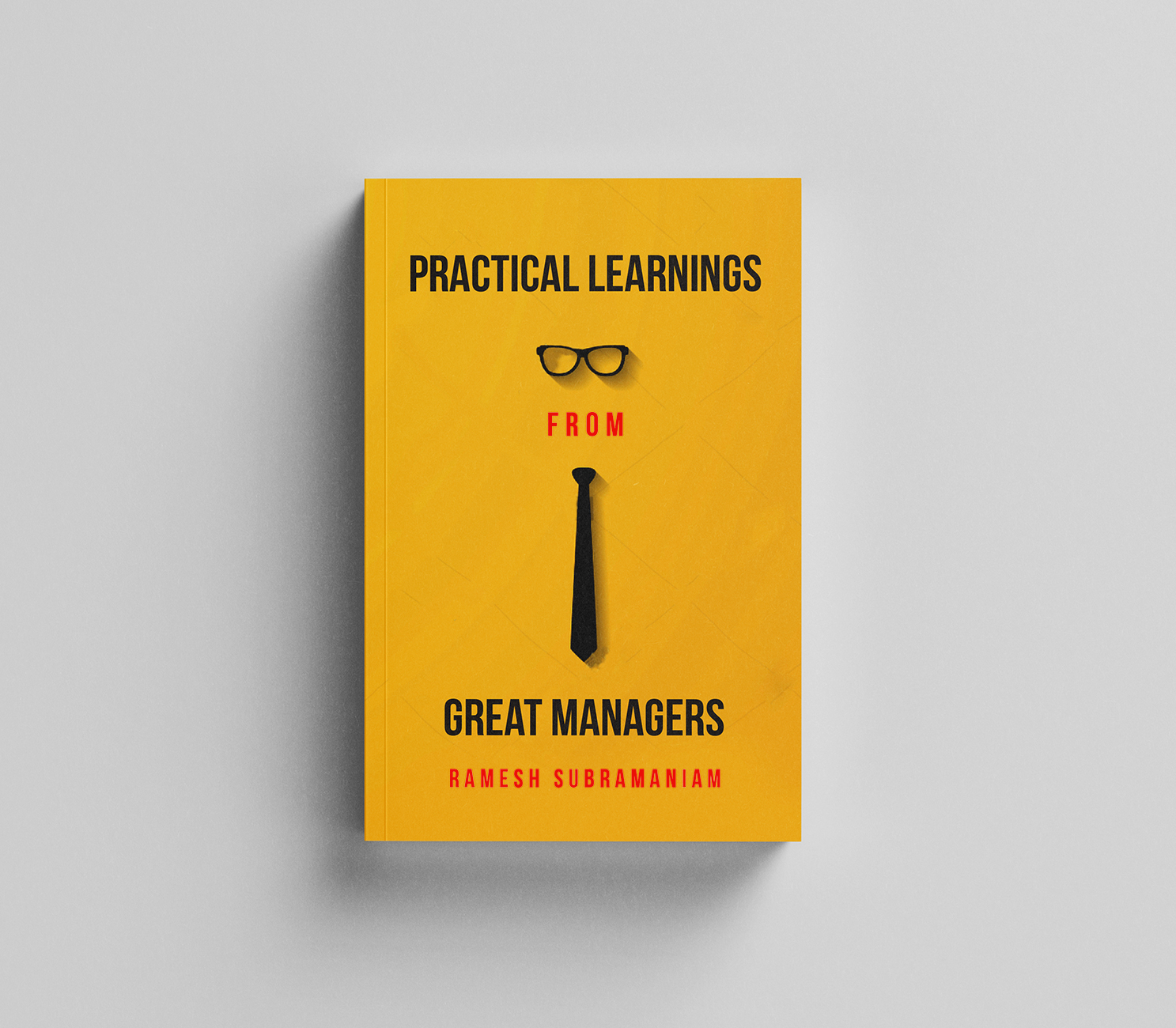
If you are looking for a book imparting management lessons backed by some shimmering jargon and quotes from famous experts in the field adorning its pages, this one is bound to disappoint you.
In case you have a researcher’s attitude and are hoping to unearth some new facts or discovering new management theories, you will find nothing here that may excite you or whet your appetite for a scholastic understanding of the science and art of management.
However, if you believe that the real world of management has lot of experiential learning to offer and that values and ethics play a crucial role in the sustained success of a business organization, you would be delighted to have come across this book, entitled Practical Lessons from Great Managers.
By the time you devour this plain vanilla offering, you would have realized that a formal management degree is but a launching pad of sorts. It is not essential to achieve success in one’s career. It may be merely desirable so as to advance your career prospects, especially given the corporate world’s preference for formal degrees.
The author of the book, Mr. Ramesh Subramaniam, offers keen insights into the practice of management. Based on his five decades long experience in the leather footwear industry and in industrial promotion, he shares his experiences in a very lucid manner. The narrative has an easy flow and touches upon various concepts, drawn from his observations about the kind of situations and challenges faced from time to time. The book is arranged in 14 chapters and runs into 104 odd pages. The presentation is not chronological in order. Rather, it takes up a concept and develops it across the entire span of his career.
Written to impart acquired knowledge, the book categorically deals with such facets of management like communication, strategy, integrity, customer relations, leadership, policies, innovation and the like. The underlying messages are very clear – the importance of training one’s mind, decision making based on sound values and cultivating a passion for continuous learning. This is akin to Stephen R. Covey, in his book The 7 Habits of Highly Effective People, exhorting managers to always keep their ‘saw sharpened.’
One of the typical practices which define a manufacturing mindset of yesteryears is brought out rather clearly in the book – that of employers taking a jaundiced view of employees taking leaves! Yet another is that of treating physical availability as a sign of higher productivity. In the current pandemic driven operations, where work-from-home has proved its value, albeit in other sectors of the economy, some of these notions may not be relevant.
I confess I had the good fortune of working with the author of the book for close to five years when we were together at the Footwear Division of Tata International. He was thorough in whatever he took up, was a good teacher and always encouraged me to maintain two diaries – one for routine work, another to keep a meticulous record of new things learnt on the job.
If you wish to learn creative problem-solving in such organizations as Bata, Tata, FDDI and Sri City, this is precisely the book you are looking for. If you are curious to know how such organizations follow ethics and values and how managers therein resolve the dilemmas inherent in such cases, it is a must-read.
Going through a pragmatic book of this kind, penned by a management veteran, is a pleasure. It would surely be a worthwhile journey for those who aspire to survive and excel in the corporate jungle!
A Tribute to Swami Vivekananda: Leader Extraordinary
“On the seventh of August 1941, in the city of Calcutta, a man died. His mortal remains perished but he left behind a legacy… that no fire can ever consume…”
That was the baritone, sonorous voice of Satyajit Ray in his documentary titled ‘Rabindranath’ created as a tribute to Rabindranath (a project mandated on Ray, the genius in film making, arts and literature, commissioned by Ministry of Culture, Government of India) on the occasion of the birth centenary of the another genius, Rabindranath Tagore the Nobel laureate poet, musician, novelist, dramatist, artist and philosopher. The first scene of the documentary depicted the last and final journey of Tagore to the burning ghat (crematorium).
Ray’s portrayal of Tagore began with the scene finale. But where do we start in our odyssey with the volcanic monk of India whose 150th birth anniversary we celebrated…
Practising managers have had a look at it. Entrepreneurs – of the social as well as the anti-social kind – have gone through it. Management consultants have flipped through it. Eminent personalities have browsed through it. Academicians have devoured it.
“Behind the veil of humour and punch – there is a message. As the human drama unfolds itself in the corporate jungle, the best and worst of human natures battle for space. Sure enough, the early warnings in the book might help the hapless to survive and the smart to succeed. However, buried in the crevices of the chapters lies a deeper secret. The secret of an inner tuning – developing an inner compass based on personal values that not just protects you but also guides you towards happiness…
Defining Consciousness is akin to the case of seven blind men trying to describe an elephant. People have different perspectives. So, when it comes to saying what it really is, the descriptions are often as different as chalk and cheese.
The reason for a wide spectrum of ways in which we understand this concept is what one could label as the Yin and Yang factor. Many of us use our brains to explain what we understand it to be. Many others use our hearts to do so. Perhaps this concept is rather profound. It is beyond the sensory limitations of the human mind, which has an uncanny ability to divide and analyze things. This is what eventually leads to the phenomenon called Analysis Paralysis in management. Our hapless hearts are rooted in what Daniel Goleman refers to as Emotional Intelligence. A solely emotional perspective has its own limitations.
But the situation is not as challenging as it appears to be. The common denominator underlying the entire spectrum is that of the collective good. An integrated view of the concept is surely possible, provided we move on to the level of what Danah Zohar and Ian Marshall, in their book Spiritual Wealth: Wealth We Can Live By, allude to as Spiritual Intelligence.
However, before we move further, let us consider some of the perspectives which one normally comes across.
What is Consciousness?
The Five Maxims
Ask Jeffrey Deckman, and he is apt to say that it is imperative for a Conscious Leader to play the following roles:
Being a ‘healer’, who calms, comforts and connects those around him.
Of being an ‘elder’, by practicing wisdom, empathy and patience.
Acting as a ‘steward’, nurturing talent and creating conditions for growth just like a gardener would act.
Doffing the hat of a ‘navigator’, envisioning challenges and opportunities, defining broad goals and guiding others.
Being a ‘facilitator’, acting like the conductor of an orchestra, ensuring harmony, encouraging open discussions and aligning by voting and not by consensus.
Of Gallant Knights
Danah Zohar and Ian Marshall speak of Knights, the leaders who choose to embark on a spiritual path. Having sensed something fundamentally sacred underlying human life, they embed this reality in their actions and in their life’s work.
In both life and work, the knight abides by five principles:
There is something sacred, some deeper, shared consciousness, unfolding in this universe and providing a baseline for every aspect of life.
Life and all its enterprises are interconnected.
All human endeavour, including business, is part of the larger and richer fabric of the whole universe.
The relationship of the healthy individual to the world is one of engagement and responsibility.
Service conveys deep sense of humility and gratitude.
A Triple Bottom Line Approach
Stephen Karbaron exhorts businesses to embrace an approach of profiting from a purpose driven, triple bottom line paradigm. To him, this is what defines a conscious business strategy approach. He emphasizes the need to be innovative, adaptable and prepared for change, whilst being aware of all stakeholder needs. He keeps sharing live examples of businesses which follow this approach.
Of Philosopher Kings
Dr Roy Woodhead is of the opinion that the very words ‘conscious enterprise’ imply some sense of an ‘enlightened enterprise’. In one of his thought provoking articles, he says that Plato put forward the idea of ‘philosopher kings’ to lead us. They would not be allowed material gains but would be well looked after; their economic neutrality and lack of vested interests were seen as very important for effective government by the philosopher kings.
Ramayana, one of the revered Hindu scriptures, speaks of King Janaka, the foster father of Sita, the heroine of the epic story. He is said to be a ‘philosopher king’. He is revered as being an ideal example of non-attachment to material possessions. He not only administers his country but also invites sages and intellectuals to spiritual discourses in his assembly. His interactions with sages and seekers such as Ashtavakra and Sulabha are recorded in ancient texts and are illuminating treatises on spiritual principles.
In their book ‘Rajarshi Leadership’, authors S. K. Chakraborty and Debangshu Chakraborty espouse the cause of spiritual leadership. This is a concept which sums up a key lesson from India’s tryst with spirituality: that of first discovering the divinity within, and then to manifest it without. Such conscious leadership is blissful to oneself and to others.
A Holistic View of Affairs
Jack Beauregard is of the opinion that it is about one connecting with the wholeness and the process of creation. A higher level of consciousness opens one’s life to one’s inner cores, thereby allowing the creativity of the universe to flow into one’s life. This enables one to find innovative solutions for solving the numerous challenges that one faces. He believes that a higher level of consciousness also creates a spiritual perspective. It allows one to view one’s life, other people, our work organizations, technology, the planet earth, and the universe from a sacred point of view.
Jack Beauregard opines that one can help create a new, harmonious world in which to live by taking responsibility for transforming one’s own consciousness. When enough people choose to develop, act, and do business from a balanced, wholistic paradigm, this will automatically have a positive influence on the consciousness of our planet. We can help co–evolve with the intelligent creative process of the universe. When a critical mass is reached, we will then create a positive alternative to the negative actions and beliefs of today’s world.
Our species will evolve to its rightful inheritance when we realize that human consciousness is a smaller part of the larger consciousness of the universe, and our individual lives, and the human species in general, are small parts of the vast web of life and just one manifestation of the mystery of creation.
The Realm of Creativity
Hindu and other scriptures speak of one reaching a state when one’s consciousness becomes one with that of the universe, often leading to an exalted phase of creativity. Our physical body then acts as an antenna, translating signals from the universe into something human beings would comprehend. When someone like Mozart composes music, he merely writes what he hears. When a humourist like P. G. Wodehouse creates his unique characters and weaves them into a dramatic plot, he acts more like a celestial author who enables lesser mortals like us to notice a humorous strain in all things around us.
When Science Steps In
When humanity gropes for the source or the definition of Consciousness, our scientists do not disappoint.
Consider The Global Consciousness Project which is an international, multidisciplinary collaboration of scientists, engineers, artists, and others. Their goal is to examine subtle correlations that may reflect the presence and activity of consciousness in the world. Their researchers predict structure in what should be random data, associated with major global events. Their contention is that when millions of people share intentions and emotions, their data show meaningful departures from expectation. This is an area where science appears to establish the reality of a global consciousness.
A materialistic scientist would tell us that our brains consist of neurons made of atoms. These process our external experiences. At times, our neural processes lead us to recognize a higher meaning in things. According to them, our 40 Hz oscillations happen to be the neural basis for consciousness in the brain.
A Spiritual Insight
More than a century ago, this is how Sri Aurobindo, a highly revered spiritual master and a visionary from India, described his concept of Consciousnessthus:
Consciousness is a fundamental thing, the fundamental thing in existence; it is the energy, the motion, the movement of consciousness that creates the universe and all that is in it not only the macrocosm but the microcosm is nothing but consciousness arranging itself. For instance, when consciousness in its movement or rather a certain stress of movement forgets itself in the action it becomes an apparently unconscious energy; when it forgets itself in the form it becomes the electron, the atom, the material object. In reality it is still consciousness that works in the energy and determines the form and the evolution of form. When it wants to liberate itself, slowly, evolutionarily, out of Matter, but still in the form, it emerges as life, as animal, as man and it can go on evolving itself still farther out of its involution and become something more than mere man.
— Sri Aurobindo, The Life Divine, pp. 236-7.
Consciousness is usually identified with mind, but mental consciousness is only the human range which no more exhausts all the possible ranges of consciousness than human sight exhausts all the gradations of colour or human hearing all the gradations of sound — for there is much above or below that is to man invisible and inaudible. So there are ranges of consciousness above and below the human range, with which the normal human [consciousness] has no contact and they seem to it unconscious….
— Sri Aurobindo, The Life Divine, p.233.
In a way, what he appears to be pointing out is that understanding Consciousness is akin to realizing the difference between a physical body which is alive and one which is dead. It is like the sole element which is missing from a dead body.
By providing us with a very wide canvas to understand the term Consciousness, Sri Aurobindo is also indicating that organizations which are conscious are most likely to have the following characteristics embedded in their culture:
An attitude of humility and devotion which enables people to operate – individually as well as in teams – at a higher level of productivity;
A flatter hierarchy which redefines the relationship between those who lead and those who are led; in other words, a Theory Y approach to human relations, a higher diversity of cross-departmental teams, a premium on gender diversity, and an optimum gap between the packages and perks of the highest and the lowest paid people;
A harmonious engagement with diverse stakeholders.
(Notes:
Inputs from Dr Ananda Reddy of the Sri Aurobindo Centre for Advanced Research (SACAR), Pondicherry, India, are gratefully acknowledged.Illustrations courtesy www and Huta, Sri Aurobindo Ashram, Pondicherry, India.
2. Inputs from Dominique Conterno and Esther Robles, co-founders of Consciousness Enterprises Network (https://www.consciousenterprises.net), are also gratefully acknowledged.)
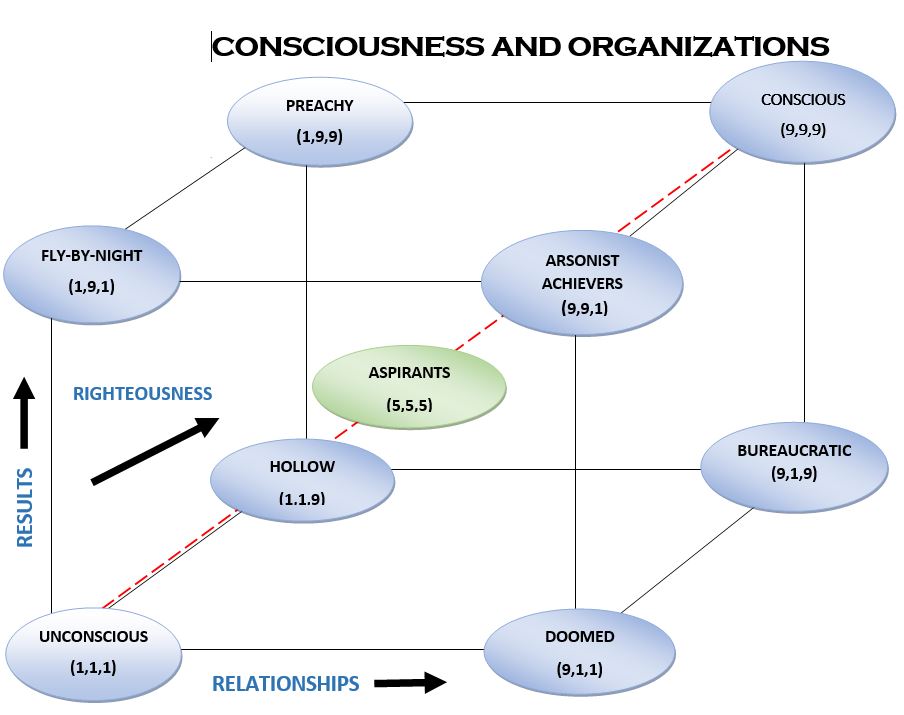
Exploring the concept of Consciousness further, one may say that whereas a normal organisation cares for Results alone, an organisation steeped in Consciousness would provide equal weight to all of its three ‘R’s – Results, Relationships, and Righteousness – in its strategic and tactical thinking.
Results could be either of the financial kind, the market share kind, or a combination of the two.
Relationships would imply a positive working atmosphere where, besides harmonious relations, dissent is not suppressed; rather, it is encouraged. Following human values is an essential part of this attribute. So is respect and dignity towards people in general.
Righteousness would encompass such features as concern for sustainability, giving back to the society and running operations not only within the ambit of law but beyond it, wherever possible. Being pro-active, when it comes to corporate governance; taking care of the rights of the minority shareholders; ensuring that principles of natural justice get followed; and, following values and ethics.
Yes, the precise definitions of each of these sets of attributes would vary depending not only upon the kind of business an organisation is in, but also on the kind of business environment it operates in.
If each of these three dimensions of conscious organisations is taken into consideration, organisations which are committed to achieving a higher level of Consciousness could consider doing a self-assessment by using the kind of representation shown below:
Here is a scheme which can enable an organisation to rate itself against each of the attributes, on a scale of 1 (low) to 9 (high).
Conscious organisations which rate themselves very close to the (Relationships: 9, Results: 9, Righteousness: 9) position in the figure could pat themselves on the back and keep up the good work they are doing, inspiring others to follow suit.
The ones which are in the Aspirant (5, 5, 5) category are already on the right track and would do well to start firing at all the twelve cylinders and reach a higher level of Consciousness.
The majority of organisations we come across might fit into the Arsonist Achievers (9, 9, 1) slot. To them, both Results and Relationships count, though they could not care less when it comes to following the path of Righteousness. Such enterprises end up contributing to the kind of situation where we find that during 2020, for instance, humanity needed to be supported by the planetary resources which 1.7 Earths alone could provide. (https://www.footprintnetwork.org/2021/01/19/we-do-not-need-a-pandemic-to-movethedate)
The Bureaucratic ones (9, 1, 9) are bound in red tape, caring only for Relationships and Righteousness, with poor accountability for Results. Yes-persons rule. Sycophancy prevails. Service to the public goes for a toss.
Organisations in the Doomed category (9, 1, 1) prophesize caring only for Relationships, while neither producing Results nor caring for Righteousness. For example, some of the Bretton Woods and other institutions set up after World War II now appear to be out of sync with the global realities.
Then we run into some Hollow ones (1, 1, 9) which profess to care only for the path of Righteousness but, in reality, are shams, pampering only to the ego of a self-styled guru heading a sect. Internal working conditions are akin to labour camps. The pomp and show of serving humanity is often more of a public relations exercise.
We also have the Preachy ones (1, 9, 9), which care two hoots about Relationships but keep delivering results while making it appear as if they are also on the path of Righteousness. Their bluff is easily called because this unique feat cannot be achieved unless Relationships are given due importance in the scheme of things. Many political outfits that are steering their countries away from the core tenets of democracy and turning these into dictatorships would fall into this category. Political power surely comes their way but at a great cost to the socio-economic fabric of the nation.
Most of us dread dealing with the Fly-By-Night (1, 9, 1) kinds, where Results alone count. Long-term survival is not the aim. Just keeping the head above the water remains the sole aim. Quite a few enterprises – mostly in the tiny and small sector – may fall into this category, simply because they can neither afford the luxury of Relationships and Righteousness nor do they consider it necessary to do so. Ponzi schemes and financial scams belong to this category.
Then there are mafia organisations which are blissfully ignorant of any such niceties; these continue to chug along in an Unconscious manner. Our society shall surely be better off in their absence.
Within the three ‘R’s outlined here, there may appear to be a sort of gradation. To many of our embryonic start-ups, it may appear that only when a certain stage of stability has been attained can the business imagine paying attention to Relations and Righteousness. But habits, once formed, die hard. Such organisations run the risk of getting caught in a conceptual warp, evolving into pure money-spinning outfits, eventually landing either in the Fly-By-Night slot or in the Arsonist Achievers slot.
The Many Lenses of Viewing Consciousness
But this is merely one way of viewing the concept of Consciousness.
Over time, our scientists, philosophers, academicians, management honchos and spiritualists of all hues, sizes and shapes have attempted to define the same. Each of these presents a unique perspective and is worthy of consideration.
The final choice, of course, rests on our leaders. It could be based either on the nature of activity of an organization or on the leaders’ strategic vision.
The pandemic plaguing humanity since 2020 has yet again awakened us to the urgency of uplifting our state of Collective Consciousness and getting an injection of Vitamin Consciousness.
Note: Inputs from Dominique Conterno and Esther Robles, co-founders of Consciousness Enterprises Network (https://www.consciousenterprises.net), are gratefully acknowledged.









 ashokbhatia
‘Surviving in the Corporate Jungle’ – Some comments
Posted in Management Lessons, tagged Comments, Endorsements, Leadership, Management, The Book on November 27, 2021| Leave a Comment »
Practising managers have had a look at it. Entrepreneurs – of the social as well as the anti-social kind – have gone through it. Management consultants have flipped through it. Eminent personalities have browsed through it. Academicians have devoured it.
Here are some of the comments received so far in respect of the book ‘Surviving in the Corporate Jungle’.
“Behind the veil of humour and punch – there is a message. As the human drama unfolds itself in the corporate jungle, the best and worst of human natures battle for space. Sure enough, the early warnings in the book might help the hapless to survive and the smart to succeed. However, buried in the crevices of the chapters lies a deeper secret. The secret of an inner tuning – developing an inner compass based on personal values that not just protects you but also guides you towards happiness…
View original post 1,978 more words
Read Full Post »