Feeds:
Posts
Comments

Posts Tagged ‘Management’

After the 2008 economic meltdown, the management world has discovered that CEOs need to follow not only a Business Compass but also a Moral Compass to steer the enterprises they happen to head. Improving one’s Spiritual Quotient is now a sheer business necessity, and shall be more so in the decades to come.

It is here that Indian scriptures and sages provide a ready template for managers of all sizes and shapes. Let us consider a few facets of some of the pearls of Indian wisdom which find ready application in the realm of management.

Some pearls of Indian wisdom 

Ramayana

  • The entire narrative highlights the importance of values in our lives.Ramayana 1 Businesses which follow a policy of righteousness and conduct their operations in an ethical manner enjoy tremendous brand equity in the market. This rubs off on their products as well as on their employees.
  • Lord Rama decides to leave his comfort zone for fourteen years and ends up connecting with lesser mortals better. Likewise, CEOs and marketing honchos of today who travel through the hinterland to get a better first-hand feel of the customer’s pulse do a far better job of servicing the market.
  • An alliance with Sugreeva, coupled with an out-of-the-box unconventional army, eventually leads to Sita getting traced and Ravana getting vanquished. Mergers and alliances based on mutual respect and trust leads to better market share. Mighty objectives can be achieved even based on frugal resources.
  • Beware of sycophants. A couplet in Sundara Kanda of Ramcharitmanasa clearly advises us to ignore the advice of a paid deputy, a doctor and a teacher who speak positively out of either fear or expectation of a gain. A king who acts upon such motivated advice loses his kingdom, his body and his righteousness (dharma) as well.
  • When Sita gets banished from the kingdom, Rama’s role is not much different from that of a true-blue CEO whose loyalty to the company’s overall welfare is unflinching.
  • CEOs and managers who entertain amorous intentions in respect of women team members and managements which look the other way just because they accord a higher priority to business goals than to the character of their top honchos could take a leaf out of Rama’s conduct.

Mahabharata

  • The attachment of Dhritarashtra, the blind king, to his evil son, Mahabharat Draupadi_and_PandavasDuryodhana, proves to be highly destructive in nature. The entire Kuru clan gets eliminated. CEOs who promote their kith and kin without assessing the overall welfare of an organization get doomed likewise. Same holds true for many a political outfit.
  • Arjuna’s skills in archery are well-known. He achieves mighty feats based on his power of intense concentration on the job at hand. Multi-tasking, a misleading buzzword in current business parlance, has no place in his dictionary.
  • The perseverance of Pandavas eventually pays off. Repeated setbacks do not deter them from seeking their share in the kingdom. War follows only when even a settlement with five villages only gets turned down by Duryodhana. The tenacity of bouncing back in the face of adversity that Pandavas display is worth emulating by MNCs which try to penetrate the Indian market.
  • The unity of purpose amongst the five Pandava brothers is exemplary. Theirs is a unified and invincible family which goes through its trials and tribulations as a single unit. Likewise, large conglomerates like Tatas draw their strength from a set of core values. Each company within the group’s fold has a unique place in the market. The companies operate in fields as disparate as salt and software. Yet, all of them are connected by a common value system and a similar business philosophy.
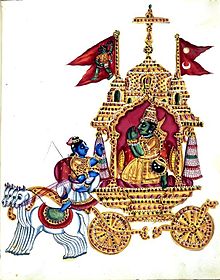
  • The manner in which Krishna persuades a demoralized Arjuna to take up his arms by enunciating the basic principles of life in the Bhagavad-Gita is exemplary.

Bhagavad-Gita

  • One of the basic concepts enunciated by Krishna in the Bhagavad-Krishna_Arjuna_GitaGita is that of the everlasting nature of the soul. The concept of a soul now finds a resonance even in modern management literature. In ‘The 8th Habit’, Stephen Covey urges professionals to pay heed to their ‘inner voice’. While proposing the whole person paradigm, he speaks of the four dimensions of a person – spirit, body, heart and mind.
  • Over its eighteen chapters, Krishna propounds the intricacies of different forms of Yoga, a philosophical system which treats all life as a management enterprise. It exhorts managers to be impartial, not favouring any one goal, any one mode any one or group of persons.
  • A manager’s goal is the total overall good, in keeping with environmental necessities and societal requirements.
  • He is not swayed by happiness or sorrow, ego or nepotism, greed or desire.
  • He is not swayed by external temptations of tangible, material success and thus attains a state of happiness, peace and contentment. He radiates positivity and his decisions bring happiness sooner or later to maximum number of people.
  • In other words, detachment is the key takeaway from Bhagavad-Gita. Detachment from the rewards of any work or action taken results into a neutral state of mind.

Thirukkural

This is a classic Tamil ‘sangam’ (3rd century BC to 4th century AD) literature

Thiruvalluvar

Thiruvalluvar

composition. It has 1,330 couplets or ‘kurals’. It was authored by the renowned poet Thiruvalluvar. It is replete with words of wisdom. It is simple and contains profound messages.

Thirukkural has 133 chapters, each containing 10 couplets. Broadly speaking, all the 133 chapters can be divided into three sections: Righteousness, Wealth and Love. Even though the contents are meant for kings of yore, many of the messages are equally relevant for CEOs of business world.

Consider these ‘kurals’:

  • It is not good to forget the benefit received; but it is good to forget then and there the injury done by another. (108)
  • Those who alienate friends by back-biting may have forgotten the art of making friends through suavity of speech. (187)
  • Entering an assembly without sufficient knowledge is like playing at a dice board without its knowledge. (401)
  • Men of foresight who guard themselves against coming events know no distress. (429)
  • A king must act after measuring the strength of his plan, his own resources, the strength of the enemy and that of the ally. (471)
  • Let men be chosen with deliberate care; when once the choice is made, let no suspicions crawl into your soul. (509)
  • Strict enquiry and impartial justice mark the rule of a just monarch. (541)
  • The greatness of a person is proportionate to the strength of his will power. (595)
  • What you have clearly decided to do, do it without hesitation and delay. (668)
  • An unfinished deed and an unfinished fight will, like a half-extinguished fire, cause ultimate harm. (674)

Each ‘kural’ is complete in itself. It deserves to be meditated upon, one at a time, and imbibed in our day-to-day lives. One wonders at the keen observations of the poet, his sagacity and the effort he has taken to collate and compile this beautiful work, replete with words of wisdom which continue to be as relevant today as they were in the days of yore.

Chanakya Neeti 

Chanakya is a well-known Indian teacher, philosopher, economist, jurist and chanakyaroyal advisor. He is said to have lived from 350-275 BCE. He authored the ancient Indian political treatise, the Arthshastra. He is considered a pioneer in the field of political science.  He assisted the first Mauryan emperor, Chandragupta, in his rise to power. He is widely credited for having played an important role in the establishment of the Mauryan Empire.

One of his seminal works happens to be Chanakya Neeti, or Chanakya’s Aphorisms. It is a treasure trove of wisdom and speaks of the criteria to be used to judge people, the need for keeping one’s intentions confidential, the value of continued learning, situations wherein it pays to be a hypocrite, the supremacy of one’s duty, and the like.

He draws an interesting analogy between the animal kingdom and those who waste their time criticizing others. He holds such persons to be worse than the crows amongst birds and dogs amongst animals.

Sri Aurobindo

Profound thoughts of one of the prominent Indian seers of modern times, Sri Aurobindo, could be interpreted to propose a different paradigm of management. Sri_aurobindo

Whereas the Western model of management thought is based on such functions as Marketing, Finance, Production and People, the Eastern model, so to say, could be said to comprise four pillars of management: Perfection, Harmony, Power and Wisdom. Collectively, this paradigm could be called Integral Management.

Analyze the conduct of any business leader and one is apt to find the underlying presence of all these elements. It does not matter whether a manager handles marketing, finance, production or human resources.

  • It is by striving for perfection that one achieves excellence in results. Being perfect implies putting our best foot forward and doing our best under the given circumstances. It is the striving for perfection which assumes significance.

When Apple launches a new product, the whole market is abuzz. The toil and hard work which goes into creating and launching a new product is exemplary indeed.

  • A harmonious conduct with respect to all key stakeholders is essential for sustained success in business. Relations with financial institutions, regulatory authorities, customers, distributors, suppliers, staff and labour need to be based on a harmonious blend of business needs and the principles of natural justice.

The manner in which the Taj Hotel management responded after the 26/11 terror attack is a shining example of harmonious conduct of business.

  • Use of power with a sense of responsibility, that too for the greater good, leads to higher brand equity for a business. Marketing prowess can influence customers’ decision making, and has to be directed at their needs and not wants. Financial strength can also be leveraged to do something useful for the society. Administrative authority comes with a great deal of responsibility.

The case of Dr Pachauri being shown the door by TERI in a sexual harassment case is just one of the several examples of how the high and mighty should not exercise the power at their command.

  • Wisdom in decision-making leads to a sustainable business, which gives back to the society and the environment what it draws from the same.

In September 1898, Jamsetji Nusserwanji Tata decided to set aside half of his wealth as an endowment to establish a university of science. His donation was worth Rs. 30 lacs in those days. The other half he left for his two sons. The Indian Institute of Science eventually came up in 1911, paving the way for quality research and teaching in India.

This is the kind of unique learning which an aspiring manager receives in her formative years in the Eastern world.

Managers with a Western Mind and an Eastern Heart

Successful CEOs and managers of the future would need to be those who have a Western Mind and an Eastern Heart.

The success of the likes of Satya Nadella (currently the CEO of Microsoft) and Sundar Pichai (currently the CEO of Google Inc) goes on to show the growing importance of managers who are not only exposed to the Western models of management but also steeped in Eastern wisdom in the realm of management.

(Presented as a talk to the members of the Pondicherry Chapter of Madras Management Association during June 2016)

(Related Posts:

https://ashokbhatia.wordpress.com/2013/05/27/management-lessons-from-ramayana

https://ashokbhatia.wordpress.com/2013/07/12/management-lessons-from-mahabharata

https://ashokbhatia.wordpress.com/2015/09/04/management-lessons-from-the-life-of-lord-krishna

https://ashokbhatia.wordpress.com/2015/01/16/management-lessons-from-thirukkural

https://ashokbhatia.wordpress.com/2015/10/06/managerial-perfection-notes-from-a-seminar-at-pondicherry-india

https://ashokbhatia.wordpress.com/2016/03/26/harmony-in-management-a-seminar-at-pondicherry-india)


Read Full Post »

Here is an excerpt from a book titled ‘Future Proof Your Business‘ by Mr Prakash Seshadri.Book Future Proof Your Business Cover

Realistically speaking, we are always on the verge of a slow down or a flat economy. In the past, CEOs made serious mistakes in trying to cope with a slowing economy. Here is a list of What Not to Do.

All of them hurt innovation. Unless you really want to compete on price, the ability to do sustained innovation is the one competitive edge left. Innovation is the driver of performance, growth and stock market valuation.

Here are the 10 worst mistakes you can make in a slow down that will hurt innovation:

1) Fire talent

Cutting back on people, especially really smart, high-priced people, is a quick way to cut costs. It will hurt companies who follow this way. Talent is the single most important variable in innovation.

2) Cut back on technology

It is being reported that companies are already curbing investments in technology to save money; banks especially. The rise of social networking and consumer power means that companies have to be part of a larger conversation with their customers. This means big money spent on IT.

3) Reduce Risk

Innovation requires taking chances and dealing with failure. Recessions push managers to be more conservative. They need to fight this instinct.

4) Stop New Product Development

Saving money often means cutting back on new products and services during an economic downturn. This hurts companies when growth returns and they have fewer offerings in the marketplace to attract consumers.

5) Boards Replace Growth-Oriented CEOs with Cost-Cutting CEOs

Sudden declines in revenues and profits often lead boards of directors to search for managers with experience in pinching pennies. That’s what appeared to happen recently at Bang & Olufsen. Penny-pinching CEOs don’t have the skills to grow, when growth returns.

6) Companies Retreat from Globalization

It’s expensive to expand globally and managers often save money by cutting back on emerging markets. It’s a big mistake. Emerging markets are sources of new revenue, business models, and talent.

7) CEOs Replace Innovation as Key Strategy

By turning defensive, top managers take innovation off the top of the official agenda and replace it with systems management and squeezing costs. The entire organization follows. It is extremely hard to reverse this when growth returns.

8) Performance Metrics Are Changed

To save money and cut costs, managers shift employee evaluations away from rewarding riskier new projects toward sustaining safer older goals. Risk-averse behavior follows. Again, this is hard to change.

9) Hierarchy Is Reinforced Over Collaboration

Sudden drops in revenue and profit often lead companies to panic and mobilize to stem the decline. The need for fast decision-making often leads to a return to command-and-control management. This alienates creative-class employees, young Gen Y and Xers and stops the evolution of corporation organization toward a flat, collaborative, open source model.

10) Retreat into Walled Castles

Cutting back on outside consultancies is seen as a quick way to save money. Yet one of the key ways of introducing change into business culture is to bring in outside innovation and design consultants. They know what companies across a broad range of industries around the world are doing to promote change. Not receiving this information can hurt a company’s global competitive position.

Winners always emerge out of slow downs and they almost always beat their competition on the basis of something new. Apple worked on iTunes, iPod and its retail stores during the last slow down and came out swinging once growth returned to destroy its competition. Apple didn’t make any of the top 10 innovation mistakes. Your company shouldn’t either.

(Here is a link to a teaser of the book:http://imojo.in/crpeqy)

(Related Post: https://ashokbhatia.wordpress.com/2013/01/23/of-idleness-innovation-and-the-peter-principle)

Read Full Post »

The Indian view of the discipline of management speaks of four pillars of Integral Management – Wisdom, Power, Harmony and Perfection. Of these, Harmony stands out as a key enabler for CEOs and business leaders to achieve their goals.

An individual manager can improve his/her effectiveness by ensuring harmony and balance within oneself – between his/her inner thoughts and outer actions and between the mind and soul.Technology MEDITATION-ENTREPRENEUR-SUCCEED

Large corporations and owners of the family businesses have to ensure that harmony prevails within the various arms of the organisation. The latter have to ensure that there is a clear succession plan in place, so that no disharmony is created at any stage. Maintaining a harmonious liaison with the financial institutions and the regulatory agencies is a key concern for many MSMEs.

Much like musicians in an orchestra, managers have to move in tandem with each other so as to create a symphony. A harmonious working inevitably leads to ‘synergy’, a term often used in the realm of management.

From a strategic point of view, operations have to be so conducted as to remain in harmony with the environment and the society at large.

A cordial relationship between the organization and its distributors allows a Marketing Manager to sleep peacefully.

A Finance Manager has to ensure the right balance between cost controls being implemented and the efficiency of departments which are affected by the same.

A Production Manager has to maintain harmony between his supervisors and workmen. He not only needs to deliver finished goods on a target date but also within the cost limits specified.

Harmony between management and employees is essential for a smooth run of the business. So is the harmony between employees at different levels of hierarchy and between employees of different age groups.

At the personal level, the owner of a family business has to ensure that a harmonious succession plan is in place. An individual manager can improve her effectiveness by ensuring there is harmony between her inner thoughts and outer actions.

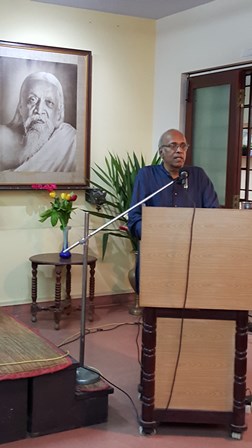
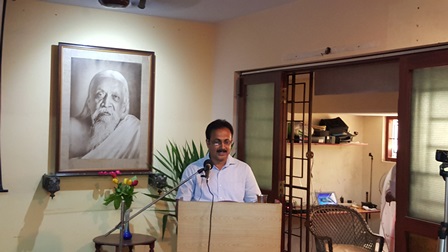
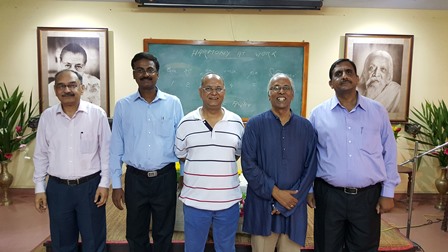
At a one-day seminar on “Harmony in Management” organized by SACAR on the 20th of March, 2016, speakers from a wide spectrum of managerial expertise addressed the participants on the need for, and the ways to achieve, harmony in operations.SACAR Harmony 2

Dr. G. Natchiar, co-founder, Emeritus, Director Aravind Eye Hospital, Madurai, the chief guest, stressed upon the importance of the Vision and Mission of an organization. She not only spoke about the “Aravind Eye Model” but also shared with those present,the innovative HR policies of Aravind Eye Care. Dr. Natchiar highlighted the frugal aspect of her organization which enables it to continue to offer affordable eye care to people of India and bring about harmony in its operations. She detailed the steps taken to improve the productivity of doctors, thereby making the operations cost-effective and the institution becoming a role model for similar health care providers in other parts of the world.SACAR Harmony 1

Dr. Ananda Reddy, the Director of SACAR, elaborated upon the four essential components of Harmony ― Collaboration, Goodwill, Benevolence and Tolerance. These alone enable organizations to work and progress smoothly. Management education in India needs to be re-engineered to impart training in these components as well, so as to make it more holistic and in tune with the times.SACAR Harmony 3

Mr. B. R. Babu, IAS, Secretary Welfare, Government of Puducherry, shared with the participants his experiences of bringing about industrial harmony in public sector undertakings. He highlighted the need for managers to take ownership of their tasks and fulfill those within the ambit of the law.SACAR Harmony 4

Prof. Sibnath Deb, Prof. of Psychology and Director Incharge of the Directorate of Distance Education, Pondicherry University, elaborated upon the psychological aspects of inter-personal relationships which alone contribute towards bringing about harmony and happiness in one’s personal life.SACAR Harmony 5

Yours truly spoke about ways of establishing harmony at work. I touched upon the manner in which challenges faced by managers from customers, suppliers, personnel, superiors, peers and subordinates could be successfully met.SACAR Harmony 6

Mr. Ganesh Babu, Director of “Winning Minds”, emphasized the importance of harmonizing oneself first. He stressed upon the fact that performance of CEOs is evaluated based on not only the results they achieve but also the quality of relationships they have with other stakeholders in their organizations.SACAR Harmony 7

Ms. Uma Prajapati, Director of Upasana, Auroville, spoke of the inner call of a professional designer and the satisfaction gained when serving the community around a business. She highlighted her singular achievement of creating Tsunamika, a tiny doll, which brought about a positive change in the lives of women affected by the 2004 tsunami.

Prof. Kisholoy Gupta conducted an interactive group discussion which led the participants to articulate their major takeaways from the day-long event and also imparted the value of appreciating others.SACAR Harmony 8

Dr. Arvind Gupta, Assistant Director, Directorate of Distance Education, Pondicherry University, coordinated the entire event. His back up support was invaluable in the planning as well as the hosting of the entire event.

Dr.Shruti Bidwaikar, Assistant Director, SACAR, summed up the proceedings and offered a vote of thanks.

The seminar received an overwhelming response from participants coming from various walks of life, like government officials, management educationists, corporate executives, businessmen, Aurovillians, entrepreneurs and students.

The Integral Management Group of SACAR had already covered the facet of Perfection during September 2015. The next event, focusing on the facet of Power, is planned to be hosted during August, 2016.

(http://www.bienveillance-entreprise.fr/entreprise-2/la-bienveillance-ou-lharmonie-dans-le-management-chez-les-dirigeants-indiens)

(Press coverage by The Hindu:

http://googleweblight.com/?lite_url=http://www.thehindu.com/news/cities/puducherry/harmony-in-management-builds-a-successful-team/article8408054.ece&ei=o_mBYHhC&lc=en-IN&s=1&m=225&host=www.google.co.in&ts=1459225799&sig=APY536zzDjXkqVeszf8Ya9EQqwJnWp7JFg)

(Related Posts:

https://ashokbhatia.wordpress.com/2015/10/06/managerial-perfection-notes-from-a-seminar-at-pondicherry-india

https://ashokbhatia.wordpress.com/2015/03/17/an-inner-approach-to-leadership-and-management-note-on-a-seminar)

Read Full Post »

Amongst the kinds of CEOs we have reviewed so far elsewhere, this kind happens to belong to a very rare species in the private sector. However, many public sector outfits, government departments and political outfits owing allegiance to some outdated doctrines could boast of a significant number of CEOs of this genre.

Concern for Output or for results is not their priority. Concern for People is their primary concern. Concern for Ethics is also uppermost in their minds. In terms of an upgraded Blake Mouton Grid, they rank at 1,9,9.X Y Z upgraded

Trade unions of all hues simply love them. Managements dread and despise them. To face an ardent believer who pounds his fists onto teak wood tables of conference rooms and demands strict compliance with labour and industrial laws of all kinds is a prospect which owners bestowed with nerves of chilled steel wish to avoid.

Those who happen to have an uncompromising attitude could willy-nilly end up damaging the very cause they wish to champion. Their vision about welfare of people is always myopic.

Few enlightened ones amongst this tribe care about norms of welfare in a more pragmatic fashion. They understand the need to move along with the times and have a healthy regard for the norms of productivity as well. They collaborate with managements in adopting newer technologies. They hammer out detailed re-skilling plans so their people can embrace change for the overall good of the organization.

Managements which are conscious of the disruptive change being brought about by Artificial Intelligence and Robotics could use such CEOs with great alacrity. Their utility lies in their pro-people attitude and their incorruptibility.

Note: Inputs from Ms Somali K Chakrabarti are gratefully acknowledged. She can be found at Scribble and Scrawl (https://prepforum.wordpress.com)

(Related Posts:

https://ashokbhatia.wordpress.com/2015/12/24/looking-for-ceos-inspired-by-the-yuletide-spirit

https://ashokbhatia.wordpress.com/2016/01/07/ceos-who-happen-to-be-charmless-charlies

https://ashokbhatia.wordpress.com/2016/01/14/ceos-who-end-up-becoming-road-rollers

https://ashokbhatia.wordpress.com/2016/01/22/the-sponge-comforter-ceos

https://ashokbhatia.wordpress.com/2016/01/28/ceos-who-are-arsonist-achievers

https://ashokbhatia.wordpress.com/2016/02/04/the-missionary-zealot-ceos

https://ashokbhatia.wordpress.com/2016/02/19/ceos-who-happen-to-be-crazy-conformists)

Read Full Post »

On the occasion of Women’s Day, here is a post which salutes some of those who have broken through the so-called glass ceiling in the management world!

ashokbhatia's avatarashokbhatia

When a finer member of our species becomes the part of an all-men group, the results are obvious – better focus on the job at hand, a far more effective team, higher levels of decency and a groundswell of chivalrous overtures.

Chamaiporn Uerpairojkit Chamaiporn Uerpairojkit

Better still, if she happens to be a CEO, we have a boardroom which is painted a deeper shade of pink, thereby driving away the boredom from the drab proceedings. We also have a crackling company which is more result-oriented and has better empathy while dealing with diverse stakeholders. We are also likely to get a greener and cleaner business entity which believes in corporate ethics and good governance.

In the Pink of Health

Several studies done in far-flung countries such as USA, France and Vietnam have shown that companies led by women deliver better financial results. A McKinsey study compared the top-quartile of companies in terms…

View original post 2,222 more words

Read Full Post »

Surviving in the Corporate Jungle

BookFrontCover

This is in continuation of two earlier posts, providing a short introduction to a book by yours truly. The Portugese version of the book is getting launched in Portugal shortly.

The launch event  in Porto is planned on the 2nd of March, along with a talk on “Work Life Harmony” at the  Catolica Porto Business School  of  Universidade Catolica do Porto.

The launch event in Lisbon is planned at Universidade Europeia on the 3rd of March, 2016, as part of an event titled ‘Passport to India.’

What is the book about?

This book is a compilation of some tactics you can use to not only survive but also do well in the corporate jungle. It is intended to amuse, entertain, and educate. It is a light-hearted take on the art and science of management, from the jaundiced perspective of someone who is still learning it!

It offers quite a few gems of wisdom meant for managers and entrepreneurs of all hues, sizes, and shapes. They could be the aspiring kind, the practising and the tired kind, or the retired kind.

Glum Chief Executive Officers, hassled by the harsh slings and arrows of managing a business, upon leafing through some of its contents, might get motivated to look at the sunnier side of life.

Nail-biting aspiring managers may understand how to successfully navigate their way through the corporate jungle.

Entrepreneurs, whether of a social or an unsocial kind, could find some clue on getting out of the blunder-prone world they frequently find themselves in.

We live in exciting times. An information overload saps managers’ energies faster than the time it takes to gulp down a cup of their favourite tissue restorative. Thanks to rapid strides in technology, newer challenges keep popping up in all areas of management.

The rigors of corporate governance keep snapping at the Chief Executive Officer’s heels at a much faster pace. Issues of gender diversity keep giving Human Resource honchos sleepless nights. Hapless managements, pre-occupied as they are with their aim of delivering better value to their stakeholders quarter after quarter, continue to miss the woods for the trees.

How does one retain one’s sanity in such challenging times? Surviving in the Corporate Jungle (A Backpacker’s Guide) is an endeavour to present to you some basic secrets and techniques of managing a business successfully and happily. You will pick up some aphorisms, some in-depth analyses, and some tongue in cheek comments.

The format of the book is that of a ready reckoner, with topics arranged in alphabetical order. Each topic gets covered in a short and crisp write up. Each topic gets a page all its own, thereby making the book easy on your already frayed nerves.

About Liberty Seguros, S. A.

Liberty Seguros has over eight decades of experience in the insurance business. They rely on the dedication of each one of our 510 employees to find the best protection solutions for Portuguese households, individuals and for micro, small and medium-sized companies.

The company has 31 business offices, called Espaços Liberty Seguros, and 7 branch offices distributed across the whole of Portugal, that give support to the insurance agents, their strategic allies, through whom they offer a broad range of products and services designed to ensure their customers enjoy safer, better protected lives.

Liberty Seguros is governed by values of Solidarity, Team Spirit, Dedication, Work Commitment and Responsibility to the Community.

Introducing Vida Economica, the book publishers

Vida Economica is the best source of information for Portuguese companies and professionals. They have an experience of more than 80 years on delivering news that their readers can use. Vida Economica is the first business weekly in Portugal.

Their activities include special interest magazines covering most important subjects for business as books. Their book portofolio has more than 300 titles with some of the best-sellers on economy and management.

Statutory Warning

This book does not guarantee solving any of your problems. Yes, it could help you to gain a fresh perspective on the challenges you face in your career.

Mandatory Declaration

No animals were harmed during the writing of this book.

You can buy the book here

(Related Posts:
https://ashokbhatia.wordpress.com/2016/02/26/the-book-como-sobreviver-na-selva-empresarial-guia-pratico
https://ashokbhatia.wordpress.com/2016/02/28/the-book-como-sobreviver-na-selva-empresarial-guia-pratico-2-0)

Read Full Post »

Surviving in the Corporate Jungle
BookFrontCover

This is in continuation of an earlier post, providing a short introduction to a book by yours truly. The Portugese version of the book is getting launched in Portugal shortly.
The launch event  in Porto is planned on the 2nd of March, along with a talk on “Work Life Harmony” at the  Catolica Porto Business School  of  Universidade Catolica do Porto.
The launch event in Lisbon is planned at Universidade Europeia on the 3rd of March, 2016, as part of an event titled ‘Passport to India.’

Why the reference to a jungle?

One, it is fashionable these days to talk about environment and sustainability. Two, in many ways, the type of organizations we work in and the kind of people we meet there, many parallels can be drawn.

I believe there are three kinds of organizations: the Circus kind, the Zoo kind and the Jungle kind.

Whatever the kind you work for, you get to see Lion King bosses who are the lords and masters of all they survey. Mentors who keep an eye on the quality of work that you do, much like a giraffe would.

Colleagues who are like enchanting deers, always willing to support you. Subordinates who are snakes in the grass, waiting for an opportunity to back-stab you. Customers who are as prickly as a porcupine. Suppliers who are as cunning as a fox.

Fed up with a company? Change over to another one. You would still find people there with similar traits. Only the names and the faces would change. In other words, there is no escaping the jungle!

Some bouquets

Those who deserve bouquets for what they have unwittingly contributed towards the conception as well as the delivery of this book:

My friends, philosophers and guides: They continued to egg me on to write a book of this kind – late Prof. S. P. Singh, Ashok Kalra, S. P. Krishnamurthy, Vipin Dewan, C. S. Dwivedi, Prof. R. P. Raya, and a few others.

Thought leaders, like Peter F. Drucker, Philip Kotler, J. R. D. Tata, C. Northcote Parkinson, Laurence J. Peter, Ratan Tata, Sharu Rangnekar, Stephen R. Covey and many others.

Hapless souls who have undergone the trauma of going through and commenting upon the rough portions of this book: Miguel Dias, Founder, CEO World, Jose Antonio de Sousa, President & CEO, Liberty Seguros, Jack Jacoby, Executive Chairman, Jacoby Consulting Group Pty Ltd, and a few others.

Those who have worked so very hard on the illustrations – thereby making the book a wee bit livelier.

Vida Economica, the publishers, who showed the courage to pick up a whacky manuscript from an unknown first-time author.

Quite a few others who have burnt the midnight oil, acted as proficient midwives and taken me through the labour pains of the editing and publishing process, ensuring that the baby got delivered.

The souls which play the role of my immediate family members in this life, without whose support this book would not have seen the light of the day.

Special thanks are due to my soul-mate and the very young ones, without whose support the book could have been finished in half the time it actually took to write.

Few brickbats

If any brickbats are to be hurled, those have to be unerringly directed at the author of the book. However, before flexing your muscles, please be so kind as to check if he is covered for such exigencies by any insurance policy issued by Liberty Seguros.

You can buy the book here.

(Related Post:
https://ashokbhatia.wordpress.com/2016/02/26/the-book-como-sobreviver-na-selva-empresarial-guia-pratico)

Read Full Post »

Surviving in the Corporate Jungle

BookFrontCover

This is a short introduction to a book by yours truly, the Portugese version of which is getting launched in Portugal shortly. The launch event  in Porto is planned on the 2nd of March, along with a talk on “Work Life Harmony” at the  Catolica Porto Business School  of  Universidade Catolica do Porto. The launch event in Lisbon is planned at Universidade Europeia on the 3rd of March, 2016, as part of an event titled ‘Passport to India.’

How this book happened

Forty years back, the School of Business at a prestigious university in India made a big mistake. They awarded me a degree in Business Management. They were so very happy to see me off the campus that they even awarded a silver medal to me.

I owe this book to my professors – some of whom taught so well that I learnt a lot. Others taught so poorly that I had to study some subjects on my own. So, I developed extra interest in such subjects!

I also owe this book to my bosses, colleagues and subordinates. Some of them were as tough as nails. They were a terror and kept me awake most nights.

Others were tough but deceptively soft and sweet on the outside.

Some were so systematic that I dreaded any of my difficult targets getting entered into their bulky diaries. Once the entry was there, reminders after reminders kept pouring in, keeping me forever on my toes.

Some were so chaotic in their working that I was often roped in to assist them.

Why this book happened

The creative juices sloshing about within me bear the full responsibility for this book to have come about.

It was an inner urge to share my learning with managers and executives of all sizes, stature and shapes that made me start compiling my observations. The result is this book.

So, the book you will have with you soon enough is like a management summary of a part of the life I have led for around forty years, practising as well as observing the science and art of management.

As a senior manager with Tatas, the largest and the most respected business group in India, as also in several other companies which are large corporates and single owner driven outfits, I have seen delightful facets of management.

Why in Europe?

One has had personal as well as professional relations with individuals and corporates in several countries in Europe. Portugal is an important member of the European Union. The fact that most management lessons are universal in nature also helped.

Sacking an employee in Timbuktu is as difficult as an employee in Germany of UK. Motivating a team member could be as challenging in India as in Portugal. Yes, the social context is different. The economy may be chugging along in a different manner. But the art of getting work done has universal principles.

When your boss calls you, looks you in the eye, and asks you to go and sell a refrigerator to someone on the North Pole, you know you are in serious trouble. Further, if he flatters you by saying that you are the only one who can do it, you realize you are being handed a pink slip.

CEO World

I also happen to be one of the Founding Members of CEO World, an innovative start-up in Portugal. One of the services it offers to CEOs world over is that of engagement with their peers in diverse businesses and continents; Peer Groups which are virtual in nature and work on video conferencing basis. The challenges faced by CEOs get shared in an open manner, without any competitive risks, in an atmosphere of mutual trust and complete confidence. This broadens the vistas of managerial wisdom of all the participants and improves the capacity of a CEO to face challenges better.

Statutory Warning

The messages you would find in this book are serious, their packaging is not. The idea is to make you chuckle and see if there is any solution to the present challenges that you face. The book does not offer any problem-solving guarantees.

If you do make the mistake of owning a copy, ensure that your boss or your girlfriend are not able to lay their hands on it.

If you do not find anything of use here, simply gift it to someone you hate.

This is how you can lay your hands on it.

Read Full Post »

CEOs who happen to rank very high in terms of their Concern for Production and Concern for Ethics but rank poorly in terms of Concern for People fall in this category. They are crazy about getting results. They strive to conform to high values, ethics and systems and procedures.

In terms of an upgraded Blake Mouton Grid, they rank at 9,1,9.X Y Z upgraded

Driven by ideals, these CEOs happen to be perfectionists. They are passionate about their work. They are technically proficient. In their value system, goals are as important as the means to achieve them.

In the hearts of their team members, they strike terror. Anyone who is deemed to be either ineffective or inefficient is ruthlessly ticked off. Much like Napoleon, they have no use for losers. They are extremely reluctant to buy excuses. They reprimand in public and may never shower praise even in private.

Under them, attrition rates are invariably high. Those who are good at their jobs and have a shared sense of ethics and values do well in their teams. Those who are either sloppy or believe themselves to be more pragmatic in life seek greener pastures – either in other business units or in other organizations. Many would struggle, perhaps in vain, not to land up in a lunatic asylum.

Those who have worked for such CEOs for some time appreciate the relevance of Albert Einstein’s Theory of Relativity in their careers. Four years of slogging under them sounds like ten years!

Those in Finance and Audit simply love them. But those who handle HR, public relations and liaison hate them. If an Industrial Relations dispute has to be resolved by means which may not be entirely ethical, or if speed money needs to be dished out to secure a government contract or approval, hierarchy has to be ignored and someone senior has to be kept in the loop. Dubious acts and expenses get covered up subtly.

There are times when this creates a bipolar culture in the organization – islands of excellence separated by vast lakes of mediocrity. Overall efficiency of the organization takes a hit. Employees often spend more time twiddling their thumbs trying to figure out as to what information needs to be successfully kept hidden from the boss.

This is the breed which takes a proprietary interest in the affairs of business. They roam around the remotest corners of a business empire, much like a lion would supervise its territory. They are the lords and masters of all that they survey. Ticking off peers comes easy to them.Lion_King_CEOs

Managements are often clueless about handling them. Despite strong undercurrents of revolt, they get tolerated and survive. The reason is not far to seek: they deliver. Moreover, they are incorruptible and have a great sense of values and ethics. They are blue blooded intra-preneurs and make great project managers.

They happen to be great assets especially when a new project is being set up. Once the project becomes operational, though, managements would be inclined to move them to another one. Or, find them a suitably elevated silo, where they could work with a smaller team on a different set of Key Result Areas.

Note: Inputs from Ms Somali K Chakrabarti are gratefully acknowledged. She can be found at Scribble and Scrawl (https://prepforum.wordpress.com)

(Related Posts:

https://ashokbhatia.wordpress.com/2015/12/24/looking-for-ceos-inspired-by-the-yuletide-spirit

https://ashokbhatia.wordpress.com/2016/01/07/ceos-who-happen-to-be-charmless-charlies

https://ashokbhatia.wordpress.com/2016/01/14/ceos-who-end-up-becoming-road-rollers

https://ashokbhatia.wordpress.com/2016/01/22/the-sponge-comforter-ceos

https://ashokbhatia.wordpress.com/2016/01/28/ceos-who-are-arsonist-achievers

https://ashokbhatia.wordpress.com/2016/02/04/the-missionary-zealot-ceos)

Read Full Post »

This breed of CEOs is not as rare as one would believe it to be, provided the canvas is not restricted to the private sector alone. Consider some non-government organizations working in the social sector. Or, look at some government-owned companies or research outfits. In many such cases, one is apt to run into CEOs whose Concern for Production is not inspiring. Nor is their Concern for People. They are primarily driven by their Concern for Ethics. Their work ethics are drawn from a value system which places a high premium on discipline and procedural compliance. A feudal approach comes naturally to them. Their passion for perfection could easily drive others around them crazy.

In terms of an upgraded Blake Mouton Grid, they rank closest to 1,1,9.X Y Z upgraded

CEOs of this kind thrive in environments where the control over resources provided is not very strict, where excuses and justifications for lapses are readily accepted and where norms of accountability are poor. Situations which involve results which are not easily measurable, say, in the realm of social change, attract and retain such talent readily.

Some of these could be brainy coves who are brimming over with ideas. Often, they rank high in terms of their IQ levels, but pretty low in their EQ levels. They lack the ability to compromise. For their team members, it is either their way or the highway. Publically dressing down those who under-perform – in their view – is a habit with them.

What makes them handicapped in realizing their true potential is their inability to organize things and to handle people.

If they decide to become stand-alone entrepreneurs, they take off well. But after the business has grown to a certain level, they are neither able to delegate tasks, nor able to build up teams to support them. The business continues to chug along with high attrition rates, sans any major growth.

The private sector views them with the healthy contempt they deserve. They never quite make it to the much-coveted corner office. Once they hit the proverbial glass ceiling and prove the veracity of the Peter’s Principle, managements find ways to either get rid of them or park them in a relatively harmless spot of the organization.Peters_principle.svg

They could be stand-alone zealots equipped with technical knowledge of a superior kind. They could be great leaders in such areas as Product Engineering, Research and Development, Innovation and the like. They could also make great Executive Assistants – loyal, sincere and devoted. Some could even get to head such functions as Internal Audit and Finance and prove to be a perennial pain-in-the-neck to all and sundry.

Such CEOs are saint-like souls who have to willy-nilly manage to keep their body and souls together. Driven by altruistic motives, their conduct is often an object of ridicule. Often, they happen to be known as GFN – Good for Nothing fellows.

Note: Inputs from Ms Somali K Chakrabarti are gratefully acknowledged. She can be found at Scribble and Scrawl (https://prepforum.wordpress.com)

(Related Posts:

https://ashokbhatia.wordpress.com/2015/12/24/looking-for-ceos-inspired-by-the-yuletide-spirit

https://ashokbhatia.wordpress.com/2016/01/07/ceos-who-happen-to-be-charmless-charlies

https://ashokbhatia.wordpress.com/2016/01/14/ceos-who-end-up-becoming-road-rollers

https://ashokbhatia.wordpress.com/2016/01/22/the-sponge-comforter-ceos

https://ashokbhatia.wordpress.com/2016/01/28/ceos-who-are-arsonist-achievers)

Read Full Post »

« Newer Posts - Older Posts »