Feeds:
Posts
Comments

Posts Tagged ‘Management’

When a finer member of our species becomes the part of an all-men group, the results are obvious – better focus on the job at hand, a far more effective team, higher levels of decency and a groundswell of chivalrous overtures.

Chamaiporn Uerpairojkit

Chamaiporn Uerpairojkit

Better still, if she happens to be a CEO, we have a boardroom which is painted a deeper shade of pink, thereby driving away the boredom from the drab proceedings. We also have a crackling company which is more result-oriented and has better empathy while dealing with diverse stakeholders. We are also likely to get a greener and cleaner business entity which believes in corporate ethics and good governance.

In the Pink of Health

Several studies done in far-flung countries such as USA, France and Vietnam have shown that companies led by women deliver better financial results. A McKinsey study compared the top-quartile of companies in terms of share of women  in executive committees against companies that have all-male executive committees. It found that the former companies exceeded the latter by 41% in return on equity and by 56% in operating results.

Two studies have shown that companies with significant numbers of top women managers do better when compared to competitors in the same sector. The improved performance is in both in terms of such organizational aspects as innovation and accountability as also in terms of profit.

Wang Feng Ying

Wang Feng Ying

The tipping point is the key: At three members of the board, the benefits of women start to make a real difference. It appears that with that critical mass, female board members are more likely to come up with challenging questions and encourage the entire group to arrive at a more inclusive and better decision.

There are also studies which negate this view. The Credit Suisse Research Institute, acknowledging that it is hard to make sense of the many confusing and contradictory findings, came up with its own analysis. The study suggested that better performance by companies with female board members does not necessarily suggest that the women led to the stronger performance; it could also mean that companies that are financially successful tend to be more inclusive. Nevertheless, the authors concluded that “more balance on the board brings less volatility and more balance through the cycle.”

Eva Chen

Eva Chen

The Global Scenario

A Grant Thornton International Business Report released earlier this year concluded that 49 per cent of CEOs in Thailand are women, which is the highest proportion in the world. The global ratio was reported to be 24 per cent of senior management roles filled by women, up from 21 per cent in 2012 and 20 per cent in 2011.

In general, ASEAN and the Asia-Pacific regions are ahead of the global average with 32 and 29 percent female proportions, respectively. Vietnam and the Philippines are in the top 10, with 37 per cent of senior posts in the Philippines being held by women, down by two percentage points from 2012.

Nonkululeko Nyembezi-Heita

Nonkululeko Nyembezi-Heita

The G-7 economies appeared at the bottom of the league table with just 21 per cent of senior roles occupied by women. This compares to 28 per cent in the BRIC economies and a remarkable 40 per cent in the Baltic countries.

Japan was the worst performer with just 7 per cent of senior roles occupied by women. UK (19 per cent) and the USA (20 per cent) were reported to be within the bottom eight countries for women in senior management. In contrast, top of the table for women in senior management – not only CEOs – is China, with 51 per cent.

The report also revealed that proportion of women in senior positions depends on the sector under consideration. More than double the number of positions in the global healthcare sector was occupied by women than in construction or mining. The most popular top management position for women was reported to be chief financial officer, while chief information officer was the least.

If Thailand has Chamaiporn Uerpairojkit as a President of Henkel, Australia has Veronica Johns heading Fiat Chrysler’s operations down under. Di Humphries takes care of Pumpkin Patch in New Zealand, whereas Wang Feng Ying looks after the Great Wall Motor Company in China.

Eva Chen is the CEO of Trend Micro of Japan. Nonkululeko Nyembezi-Heita oversees the operations of Arcelor Mittal South Africa Limited.

Maria Asuncion Aramburuzabala

Maria Asuncion Aramburuzabala

Maria Asuncion Aramburuzabala fusses over Group Modelo in Mexico.

Women on Top

Globally, women have made it to the top in diverse sectors of businesses, ranging from IT, FMCG, chemicals, social media and banking. According to a Deloitte study, women comprise 12.5 percent of board directors on ASX 200 companies in Australia. Fortune lists an impressive array of powerful women, globally as also in USA. Think Ginni Rometty of IBM, Indra Nooyi of PepsiCo, Ellen Kullman of DuPont, Sheryl Sandberg of Facebook and Marissa Mayer of Yahoo and you get a part of the picture in USA alone.

The European Commission proposed new rules last year to require companies listed in EU countries with more than 250 workers to have 40 percent of women on their boards by 2020. But Germany and other EU countries resisted, arguing that rules should be set at the national level.

Ginni Rometty

Ginni Rometty

According to German media reports, women currently hold about 12 percent of corporate board seats. Among the 30 largest DAX companies, women have 101 of the 488 board seats, or 22 percent, according to the DSW, Germany’s largest association of private investors. Coalition compulsions have now made the Angela Merkel government to introduce a legislation that will require German firms to allot 30 per cent of their non-executive board seats to women from 2016.

Norway, which is not an EU member, imposed a 40 per cent quota in 2003, a target reached in 2009. Norwegian companies can be liquidated if they fail to reach the target. However, a recent study by two University of Michigan professors shows that a government mandated quota led to younger and less experienced boards, thereby putting the businesses to higher risk.

In UK, the Cranfield report came up with the assertion that women hold more than one in five (21.8%) of non-executive FTSE 100 posts but still only account for little over one in 17 (5.8%) executive roles. That means there are just 18 women executive directors in Britain’s top boardrooms, against 292 men. Perhaps more alarming still, the Cranfield study found, among the broader top management tier at FTSE 100 firms – the key decision-making groups, known as executive committee members – the representation of women had fallen dramatically, down from 18.1% in 2009 to 15.3% today.

Indra Nooyi

Indra Nooyi

Susan Vinnicombe, co-author of the Cranfield report, suggested this shrinking pool of top-flight women managers made it harder for progress to be made with chief executive and finance director appointments. “Despite women dominating the fields of human resources, law and marketing … [executive positions in the boardroom] are still going to men, who are being promoted internally over experienced female candidates.”

Annika Falkengren heads SEB, a Swedeish Bank. Angela Ahrendts takes care of Burberry in UK, while Jonella Ligresti oversees the operations of Fondiaria-SAI of Italy.

Wanted: Women Directors in India

In India, men make up 94.7 per cent of the boardroom. A survey conducted by the Association of Chartered Certified Accountants (ACCA) and the Commonwealth Business Council (CBC) earlier this year, across Commonwealth countries, found that India has one of the lowest percentiles of women in senior management positions, second only to Pakistan among the countries surveyed. In many cases, even when women are present in the board, they usually tend to be “sleeping partners”.

Kalpana Morparia

Kalpana Morparia

With the new Companies Act coming in force in India, mandating women’s representation on boards, companies are searching far and wide for good candidates. Naina Lal Kidwai of HSBC, Kalpana Morparia of JP Morgan and  Renuka Ramnath of Multiples Alternate Asset Management are all busy running their own companies. It does not help that top women bankers like Chanda Kochhar and Shikha Sharma cannot be tapped because RBI rules do not allow bank CEOs to be on the boards of other companies except by rare special permission.

The first woman to head the SBI in its 206 year old history, Arundhati Bhattacharya, recently made headlines by joining the elite group of women who control banks and financial outfits in India.

Mallika Srinivasan is a well-known thought leader and strategist, heading TAFE. Vinita Bali heads Britannia, whereas Kiran Mazumdar-Shaw steers Biocon. Roshni Nadar takes care of HCL Corporation. Debjani Ghosh heads Intel’s operations in South Asia.

Chanda Kochhar

Chanda Kochhar

One of the highly respected business groups from India, Tatas, is already on a gender-diversity overdrive. Falugni Nayar, Vishakha Mulye and Ireena Vittal have recently joined select companies of the group.

A case in point is that of ICICI Bank where winds of a subtle change are blowing. Chanda Kochhar is making the company transform its work culture from a stress-ridden one to a more relaxed one. She has drawn an internal road-map to make the bank a service-led and not a distribution-led organization. One of the key challenges the bank is handling is to tone down aggression without losing its USP of being a dynamic and result-oriented organization.

According to information available in the public domain, out of India’s top 100 listed companies, 34 do not have any women directors. Demand for proven, independent women who are well experienced in board service, possess the required domain or functional skill experience and fit the culture of a company far outstrips supply.

Mallika Srinivasan

Mallika Srinivasan

In India, gender diversity is more pronounced in the banking sector. By nature, men and women are not better bankers. The conditioning by society perhaps plays a more important role in shaping up women’s skills in money management. One, they carry the burden of balancing the household budget. Two, they tend to be thrifty because they have to manage the household affairs within the resources provided by the bread-winner of the family.

The Glass Ceiling of Corporate Frauds

A study reported in one of the recent issues of the American Sociological Review found that only 9 percent of people involved in high-level financial  corporate conspiracies are women. The study also shows that female criminals stole less than their male counterparts. The study proposes that this could be happening because men see women as less criminally competent.

However, according to a survey of nearly 1400 global fraud cases from the Association of Certified Fraud Examiners, at the lower levels, women

Roshni Nadar Malhotra

Roshni Nadar Malhotra

made up 45 percent of the culprits. But at all levels, women steal less than their men counterparts. The difference lay in that women do it for a specific reason or purpose, whereas men tend to do it for longer periods, more as a habit of sorts. Women are brought up with an ‘ethic of care’ which means they are less likely to behave in a manner which hurts others.

Have Daughter, Be Gentler

In another study covering more than 10,000 Danish companies, a study done by Michael Dahl, Cristian Dezso and David Gaddis Ross found that CEOs paid lesser salaries to their staff after having had a son. But there was no reduction when they had a daughter! The hypothesis appears to be that daughters tend to make fathers more gentle and caring.

Studies led by Alice Eagly demonstrate that women tend to give more than their male counterparts in close relationships than men.

The Pink Shades of Philanthropy

Bill Gates believes that his mother Mary and wife Melinda are behind his philanthropic initiatives. At a wedding in 1993, Mary read out a letter she had written to Melinda: ‘From those to whom much is given, much is expected.’

It is quite likely that with more women at the helm of affairs, organizations may take their environmental and social responsibilities more seriously.

The Gender Bender 

Women tend to be more balanced and meticulous in their approach. Giving care and offering empathy comes naturally to them. Look across various companies and one would notice that most HR departments are wo-manned.

Annika Falkengren

Annika Falkengren

When it comes to the impact of women heading organizations, the jury is perhaps still out. Recently, professors at the Stanford University Graduate School of Business and the University of Edinburgh examined two thousand firms and found that larger companies with bigger boards were more likely to add women. In other words, better performance was not necessarily due to women power in the top echelons.

In India, the challenge is to keep up a continuous supply of leadership talent of the delicately nurtured. This can be met only by progressive HR policies of organizations which proactively offer a level playing field to women enabling them to break the corporate glass ceilings.

Just as the Norway example has shown, it is debatable whether introduction of a government mandated quota is a good move. Yes, it does force

Sheryl Sandberg

Sheryl Sandberg

companies to do some soul-searching and ensure better succession planning while placing greater emphasis on gender parity. A positive beginning gets made. Over the long run, such steps would surely improve corporate governance levels and possibly check the cancer of graft and corruption nibbling away at the roots of India’s vibrant democracy.

Gender bias is deep-rooted in our psyche. Cultural bias and stereotyping restrains women from realizing their full potential. With her book ‘Lean In: Women, Work and Will to Lead’, Sheryl Sandberg has recently brought back the agenda of gender inequality on the global conversation map.

From Capitalism to Idea-ism

We are rapidly moving from capitalism to ‘idea-ism’ where the definition of capital is getting enlarged with each passing decade. The term capital covers not only the material and financial resources but also its softer and gentler variety – intellectual resources. In a world of this nature, gender parity can bring in a hitherto latent capital. A more efficient use of the same would be a key driver of competitiveness in the days to come.

The moves to paint our ‘bored-rooms’ a deeper shade of pink are endeavors in the right direction. Howsoever long it takes to achieve gender parity in business circles, the journey has begun.
Read Full Post »

What is it that makes a professional fondly look back and remember the time spent with a particular organization?

The initial package sounds jaded over a period of time and the Law of Diminishing Utility eventually kicks in. The seniority for which one so adroitly negotiates at the entry stage fails to charm after some time,  unless backed by further achievements, recognition and rewards, added responsibilities and advancements. Time also takes the glow and shine off the social prestige which goes with being associated with one of the better known brands in the industry.

So, what is a professional left with after having left an organization?

The Lingering Sweetness

Much after the association with an organization has come to an end, the everlasting impression one carries in one’s mind depends on two simple factors. One, professional achievements which were individually attained but facilitated and enabled by the support systems ingrained in the culture of the organization. Two, the manner in which one was treated as a human being. Often, one of the results is the number of long-lasting relationships that one makes while the association lasts.

Organizations happen to be made up of people of all sizes, shapes and temperaments. But the treatment received at the hands of key people one comes in touch with determines whether the after-taste remains sweet or sour; also, how long it lingers in the taste buds of our memory cells.

The Brand of the People

A brand represents an element of trust and reliability. The concept is not limited merely to the quality of the product or service on offer.  In fact, the systems and procedures followed by an organization, their sturdiness in the face of adversity and change, the element of fairness in its dealings with diverse stakeholders – all go on to add to the allure and enigma of the brand.

Much of the aura which characterizes a brand emanates from its people. It is they who create a buzz in the employment market. The lingering sweetness of an association is often determined by the Employee Brand Value.

I have had the opportunity of working with several companies. Each one had a different culture and a unique way of handling people. Nevertheless, it was interesting to observe how employees got treated far better by companies which had a stronger brand identity.

Allow me to share with you some of my experiences which have left me with a positive feel and a sweet after-taste!

The Human Touch

The care and companionship I was fortunate to receive in all the companies I worked with was unique in more ways than one.

When the management decided to shut down an operation headed by me, a colleague of mine and I were mercilessly beaten up by a gang of misinformed workers. Prompt medical attention, legal support, counseling for the self and the family and a compulsory vacation followed automatically. A month later, the then MD, nine rungs above us in the rigid hierarchy, called us over for a friendly chat over a cup of tea and instilled in us a sense of pride and fulfillment for having stood up to the rowdy elements in the work force.

In another company, a colleague met with a serious road accident on a busy highway while reporting for work. Over the next two years, he had to undergo a series of reconstructive surgeries to regain normality. No effort was spared to ensure that he and his family got the best support available. This, despite the company facing a severe financial challenge at the time.

In yet another case, my entry was marked by a gentle induction into the operations of the company. As my role expanded and evolved over a period of time, support – technical as well as emotional – was invariably close at hand. Above all, the HR policies facilitated a healthier work-life balance to be achieved. Which is not to say that there was ever a compromise on the goals to be achieved.

A Premium on Compassion

While I was on a personal overseas trip, a much revered colleague suddenly died of a cardiac failure. A prompt mail came from a colleague of mine. I was simply devastated. When I called back to find out precisely what had occurred and how, I was given only sketchy details. Subsequently, an inquiry was instituted to find out who had made the bloomer of conveying the disturbing news to me at a personally critical time!

A woman playing a critical role on the operations side faced a dilemma on a day which was very crucial for the company. Her husband, working in a far off city, was to return home for a brief period on the same day, that too after a gap of a few months. Having delegated her tasks and arranging a smooth conduct of her area of responsibility, she requested for half a day off from work. The immediate boss was in no mood to oblige, but relented after the top boss decided to intervene on humanitarian grounds.

Separations as Brand Building Opportunities

In one instance, a popular and effective manager suddenly decided to leave the company. At a glittering farewell ceremony, he was showered with lavish praise and presented with a gold medal by the President of the company himself. Within six months, he found that he was a cultural misfit in the next company. Feelers came in through informal channel and he soon rejoined us.

In another case, a much pampered and popular junior decided to leave the company after a long stint when he was in fact being groomed to take over a key department. A red-faced bunch of seniors met to discuss what steps could be taken to prevent the person from leaving the company’s employment. When all efforts failed, the group decided not to be vindictive in nature. Instead, the exit was facilitated so as to leave the employee in a highly positive frame of mind. The result is that even today, the , channels of communication between the company and the ex-employee remain open and smooth. Whenever the employee needs support in his new assignment, the company is there to back him up.

When the time came for me to part company (due to personal reasons, of my own accord), a smooth and graceful exit was ensured. In a farewell meeting, seniors, colleagues and others from across the company paid rich compliments in a manner which would forever remain fresh in my memory. An informal association continues till this day.

Winding Up With Minimal Resistance

Since business was not doing well, management decided to wind up the operations at the unit I was associated with in the past. The unit, directly employing more than 1,000 persons, happens to be located in an area which has seen multifold increase in labor disputes of all kinds over the past decade. As of date, there is hardly any unit which does not sport a red flag on its main gate, declaring the union which is active therein.

And what happens in this case? A well thought-out separation package gets rolled out. Most of the management staff get either relocated or out-placed. A well-rehearsed PR campaign gets underway with all the key government functionaries to ensure adequate and effective communication. The outcome of this well-designed initiative is that there are no unpleasant obstructions to the winding up plans of the company. Also, no one in authority enjoys the dubious pleasure of subsequently claiming that he or she could have done something to stop the loss of employment to a plethora of people, had they only been told of it before hand. A smart winding up, no?!

The Trust Reposed in the Employee

A common feel-good factor is the exemplary support provided to a senior manager on a critical mission. Just the feeling that one was free to take a call and will get backed up by the management, come what may, does the trick. An intrapreneur gets enthused no end when he or she is working on a mission wherein the survival of a business entity depends on him or her ensuring that a particular issue gets settled favorably. The top man merely looks him in the eye and tells him to go for it – and the goal is met. The after-glow of a professional  achievement of this kind surely lasts a life time!

Building up the Employee Brand Value

Organizations focus on crafting a powerful employee brand so as to attract and retain the best talent. What I have mentioned above are some examples which have added to the company’s brand value by focusing even on separations. A well thought out plan for winding up ensured that while business goals were met effectively, there was no damage caused to the brand.

When alumni recall their positive association with the organization, it is a sure sign that the memory of its brand is getting leveraged right. Making an employee feel valued even after he or she has parted company only adds to the long-term allure of the brand.

(Related Post: ashokbhatia.wordpress.com/2012/09/11/ramping-down-a-business-the-smart-way)

Read Full Post »

WEAKNESSES – MARKET THEM!

There are rich rewards to be reaped by practicing transparency at the personal level. Be open about your weaknesses and discuss them upfront. You would get respected for your maturity.

WORK-LIFE BALANCEWORK-LIFE BALANCE

Neglect this vital part of life only at a personal risk of your well-being – mental as well as physical. Take time off for your kid’s parent teacher meeting due next Saturday. Cultivate a hobby which helps you retain your sanity while handling the whirlwind operations that you manage at the speed of light.

Remember, E (Energy and Enthusiasm) = m (Mental peace) X c (mental and physical Capacity) squared. When you achieve a better work-life balance, you improve your inner peace, as well as your capacity to do things.

WORKING HOURS

Those who watch the clock remain one of the hands! For a real growth in career, stop grumbling about long working hours. Work smarter. Improve you productivity. If you follow Parkinson’s First Law (Work increases depending upon the time available), and are prone to spending 20 hours in the office, you could end up having a tendency to defer important assignments for later in the day – you then get into a vicious cycle of low performance and low productivity.

Read Full Post »

Poster The_Beauty_InsideWould hi-tech companies like Intel and Toshiba believe in the traditional Indian ethos of spirituality and reincarnation? The fact that their recent promos give us a glimpse into a universe where what is on the inside alone counts does indicate this. The key message appears to be that whether it is a man or a machine, it is only the entity inside which makes a difference. ‘The Beauty Inside’ promo has a narrative of daily incarnations, which fits in rather well with what Lord Krishna tells us in the Bhagavad Gita – that the soul inside us is what really matters!

This is obviously not to say that the essential principles enshrined in Eastern scriptures necessarily need an endorsement from the West. It is common knowledge that post-Lehman Brothers, premier management institutions from the West have started showing some interest in the Eastern philosophy. The concepts of morality and ethics have gained currency in management circles. The fact that Stephen Covey speaks of an inner voice and a soul in his book ‘The 8th Habit’ is yet another manifestation of this trend.

Learning it from intelligent apes

The concept of a soul is an integral part of various streams of religion and spirituality we see around us today. It is interesting to understand how religion and spirituality originated; also, the value these really add to our mundane lives.Bonobos

After years of research on bonobos – intelligent apes closely related to us, homo-sapiens – Frans de Waal argues that human morality is not imposed from above but comes from within us. In his path-breaking book entitled The Bonobo and the Atheist, he therefore proposes that moral behavior does not begin and end with religion. It appears that our values and ethics are instead a product of evolution and cultural response.

The fact that our innate goodness resulted into diverse streams of religions we see around us today readily explains the success of religion – and various Gods revered in each stream – as a concept. The spiritual thought process is also an outcome of the same core of our need to be good within ourselves, in our own eyes.

A cat or a dog may not think through the process so thoroughly, but bonobos surely appear to be aware of the nuances of social norms. Religion Ankara_Muzeum_They have a developed sense of reciprocity and fairness. They are even known to intervene in a fight between two tribe members so as to maintain peace and harmony!

Ancient apes, whales and dolphins deserve our gratitude for several qualities that we possess – our sensitivity to others, our concern for fairness, love of harmony and other just forms of societal behavior. If religion or spirituality attract us, it is because these touch a chord somewhere deep within us.

Templates of Exemplary Conduct  

The contribution of religion therefore is in presenting us with templates of exemplary conduct. It has codified the social and ethical norms for the average person. In particular, it has made it easier to explain the nuances of ethical and moral values by portraying examples of Gods and Goddesses whose conduct is worth emulating for the average person. Religion cleverly uses fear and temptation to guide and control human conduct.

Irrespective of the stream of spirituality one chooses to follow, the basic template invariably is again that of exemplary conduct. However,A_Vishva-rupa_print the focus is on listening to one’s inner self. The endeavor is to silence the mind, thereby attaining inner peace and happiness. Each stream of spirituality has a different prescription and a unique methodology, but all are unanimous that the spirit is at the centre of it all. To that extent, spirituality has the potential of uniting people, whereas religion has been seen to divide it along communal lines.

As compared to religion, spirituality is more embracing. In religion, we have the good guys – devas – and the bad guys – asuras. Following one’s Dharma, the code of righteousness, man can hope to attain salvation. However, spirituality encompasses the good as well as the evil, both being manifestations of the Divine. When Krishna manifests his all-pervasive and all-inclusive Vishwarupa form in the midst of his sermon to Arjuna, it shows the negative side of the Divine as well.

A Heady Cocktail

Intel and Toshiba have surely come up with a winner promo in ‘The Beauty Inside’. Similar campaigns which work on a heady cocktail ofintel logo some basic tenets of religion and philosophy on the one hand and the latest that technology and management has on offer on the other would surely follow.

Given that our scriptures are replete with gems of wisdom and lay down templates of exemplary conduct, more and more corporates could be hopping on to the spiritual bandwagon in the days to come. Already, we find companies appointing Chief Belief Officers and Chief Ethics & Compliance Officers. Goes on to show that the role of conscience keepers in corporates is getting the recognition it deserves.

Toshiba logo

Such developments give one hope that the upcoming generations of our future business leaders and professional managers would rate high not only on their Intelligence and Emotional Quotients, but also on their Moral or Spiritual Quotient, bringing to the work place a set of ethical values and practices.

Read Full Post »

What do Reka Maximovitch, Araceli Roiz and Lisa Rundle have in common? Well, their hormones broke through the glass ceilings of the rigid hierarchies of their respective employers. All of them had affairs with their high and mighty bosses and ended up filing sexual harassment cases against them. I am convinced that besides harassment, they also underwent the trauma of lewd comments and ridicule at the hands of their peers and subordinates. One can readily imagine the mental anguish suffered by them in the process.

Sexual harassment cases in companies are notorious for being immoral as well as immortal. Penguin Canada ex-CEO David Dravidar eventually went in for an out-of-court settlement. So did Phaneesh Murthy a decade back when he quit Infosys. The fact that he was recently back in the news for the wrong reasons, with i-GATE handing him a pink slip so as to minimize damages, goes on to show that old habits die hard.

Sexual-predator seniors and victim-subordinates often live off each other. As long as managements have a tolerant attitude on issues of sexual harassment at work place, skirt-groping CEOs and seniors with irrepressible libidos would conveniently continue to forget keeping their trousers zipped.

CEOs who are power drunk could indulge in this. So could those who are over-stressed and find such affairs an easy way to relax and unwind. Then there are the incorrigible ones who could not stay out of trouble. Whatever the justification, affairs of such nature lower the self-esteem of employees as well as the employers. These also corrupt the working eco-system, thereby impacting business results in the long run.

Some career-wise ambitious PYTs who do not mind petty flirtation in return for rapid advances in career could reach a tipping point after which it becomes difficult for them to apply brakes on the relationship. They then end up keeping the boss’ amorous treadmills running.

Managements which keep their eye only on the performance of their CEOs and tend to look the other way when it comes to issues of moral turpitude also create an enabling environment for immoral activities to flourish. They could also use a sexual harassment case to ease out a senior who has become too big for his boots.

What is it that managements can do without appearing to be intruding into the privacy of an individual? Having women in senior positions in the organization surely helps. Creating an atmosphere where developments of an amorous nature get reported and promptly acted upon is another anti-dote. The best deterrent is a clear and unambiguous message that sexcapades of any kinds are just not acceptable, irrespective of the level or importance of the persons involved.

Physical attraction and lust easily pass for love in the confined office space. And an affair of such nature easily turns into litigation. Once the mutual needs are no longer congruent, hot babes in offices, whether blonde or otherwise, could easily file lawsuits in countries where laws take a dim view of such conduct and courts award millions of greenbacks as compensation.

To save unnecessary costs as also to avoid a severe dent in their market image, managements need to understand that if they lock up a bunch of smart people in a room and not expect them to react to each other, they live in a fools’ paradise. After all, if left unchecked, human hormones are powerful enough to demolish a hierarchy!

Read Full Post »

MANAGEMENT

Unlike a “should” guy who is a philosopher, and a “would” guy who is a politician, a good manager is a “could” guy. He is aware of the constraints of resources at his disposal, and get things done accordingly.

He is the first one to come in and the last one to go from office. No job is too small for him; he is a true hands-on guy, but develops his team by delegation.

He defines and respects the invisible boundary of professional distance between himself and his key team players. When his team members are attacked, he behaves like a lioness out to protect her cubs. His team just loves him!

MARKETINGMARKETING

An ever-changing discipline, though surely not the only one. When conceived and described by Philip Kotler, it consisted of the famous 4 Ps – Product, Price, Place and Promotion. With due respects to the great man, one may safely add one more P – Password (used for viral marketing).

With the advent of internet has come a virtual democracy in information. Changes in technology have brought in a new way the customers and brands interact. Marketing has undergone a sea change and will continue to do so in future as well, what with social re-engineering leading to a greater degree of inclusion in the economy, with hordes of new customers from a so-far underprivileged social milieu joining the market. Persons with access to internet now research the brands before making a decision. They are increasingly welcoming fresh content rather than repetitive ads.

Take note of the mini packs of biscuits, noodles and other consumer items being marketed at price points of Rs. 5 and below. Thirty years back, Indians had to wait for years to get to ride their own “Hamara Bajaj”. On the car front, there were hardly three suppliers in the fray then. Now, we see global brands wooing the customer and competing cheek and jowl for a slice of the market pie.

The Customer has now become a more empowered king!

MEETINGS

Meetings to decide strategic issues are best held off campus, though not necessarily in exotic locales.

Meetings to review operations are best kept short, held in the standing mode, at regular intervals (like TV news) without prior intimation, kept crisp by ruthlessly disallowing inter-departmental issues getting discussed while all others gape in horror and ignorance, ending much before the deadline and minutes being circulated by the end of the day with clear responsibilities defined in respect of targets to be met and respective deadlines.

It is generally accepted that the probability of a meeting taking place is inversely proportional to the number of participants.

Parkinson’s Law of Meetings states that “To a certain degree, the time spent in a meeting on an item is inversely proportional to its value”.

MEDIOCRITY vs. EXCELLENCE vs. PERFECTION

Always aim for perfection! It is said that Mr. R. M. Lala, an editor, writer and publisher of repute, once commented to Mr. J. R. D. Tata that the latter believed in excellence. The great man is said to have retorted thus: “Not excellence. Perfection. You aim for perfection, you will attain excellence. If you aim for excellence, you will go lower.”

Rabindranath Tagore, in his Gitanjali, captures the same concept thus: “Where tireless striving stretches its arms towards perfection”. Even though “perfection” may not be attainable in reality, what matters is the “tireless striving”, which could well prove to be a reward in itself. “Perfection”, like happiness, need not be a station one arrives at, but a mode of travel, making the journey interesting and worthwhile.MICROMANAGING

To improve our personal capacity utilization, our basic struggle needs to be attitudinal – to adopt a Culture of Perfection and to give up the Culture of Mediocrity.  Our collective chalta hai attitude is passé.

MICROMANAGING

A sure way of becoming a liability for your team and also for your employers is to micromanage – getting into the nitty-gritty of each and every aspect of the task at hand. Learn to delegate and allow your team members to make mistakes. Demand results, but develop your people in the long run.

MISTAKES, HANDLING OF

As an individual, say sorry. Say it openly. Add a dash of humor and laugh at yourself publically. Avoid a buck passing posture. Do a root cause analysis. Suggest and work on a solution to rectify the mistake. Try to avoid a recurrence.

As a corporate, get your PR to handle the issue well. Take demonstrable steps to set the record straight. During June 2011, Toyota globally recalled as many as 1,06,000 vehicles, offering to replace front right hand shaft in selected vehicles. During 2007, Mattel announced a recall of over 19 million toys fearing that the toys had powerful magnets which could come loose and be swallowed by infants. Their brand recall value only shot up.

Read Full Post »

KISS FREQUENTLYKISS FREQUENTLY

Managements are well-known for their propensity to give priority to business targets, and to hell with all the systems, controls and procedures! So, go in for systems which are simple and can be operated by idiots. Auditors will keep coming up with new SoPs. Before rolling these out, a manager would do well to apply the KISS (Keep It Simple and Stupid) test.

LAWYERS

Choose a lawyer based on the gravity of the issue at hand. Local lawyers are pretty effective for minor matters. For global issues affecting the industry, get your HO to rope in the second best in the country. This way, you will get first-rate attention, service and results.

LEADERS

Management can be learnt; leadership is inborn. The good news is that in some cases, leadership styles trickle down the organization, and get copied, thereby improving the behavioral consistency across the set up.

Lao-tzu, a Chinese philosopher, said “To lead the people, walk behind them”. LEADERS

LOGIC VS EMOTION

Formal education systems lead us to depend more on the mind, which thrives on logic alone. However, the heart is the seat of emotions, and has intelligence of its own. The power of intuition flows from the heart, and so does empathy. To survive and do well in the corporate jungle, managers need both in equal measure!

LONELINESS BLUES

The men at the top are a lonely lot, with no one to share their blues with. Special care needs to be taken to ensure they have a circle of neutral confidantes who can help them in retaining their balance and perspective on issues facing the organization from time to time.

Read Full Post »

DECISION MAKING
Strategic decisions made in a jiffy on a sudden impulse could lead to disasters. The company could end up having a wrong plant location, an outdated product, or a service of which the time is yet to come. Changing such a decision would invariably be an expensive affair.
Run of the mill decisions, like which brand of Xerox paper to buy for the office, or whether the car parking positions of officers should depend on hierarchy or time of arrival, are best delegated and left to be made at the operational level, where the executives are closer to the ground realities.

DELEGATION
When you can’t do something as well as the other person can, a smart choice you can make is that of delegating the task; that is, moving from doing it yourself to getting it done through others. If you do not learn to delegate, you could suffocate.
Trust, instinct, communication and control are the pre-requisites of delegation. Delegation without benchmarking and monitoring of targets is abdication!

DESIGNATIONS
Designations are not important in cases where the external exposure of the employee is minimal. They form the psychological part of an employee’s compensation package.DESIGNATIONS
For those whose role demands an external exposure, a higher sounding designation would improve the canvas of opportunities, enabling a faster realization of company’s goals.
For employees who have outlived their core utility in companies which believe in firing people only when there is a disaster of a nuclear nature, an improvement in designation would be a valuable tool in the HR arsenal.

DETACHMENT
Beware of managements which exhort you to follow the much misunderstood principle of detachment expounded in the Gita – you should continue to slog all year long but do not expect that elusive overdue promotion. Do a reality check – are you repeating your own past performance? Is there a way you can improve the quality of your targets? Upgrade your work plans and actions accordingly.
If you can follow the principle of detachment, though, mental peace is guaranteed.

DIRECTOR, BEING ONE
Invited to be a director on the board of a company? Accept the offer only after a due diligence at your own risk and peril. You may earn a modest fee and some handsome privileges, but would have little control over the kind of legal and procedural misadventures taking place across the company. Unless, of course, getting served with a notice or landing in a jail is your idea of having fun in life.

DISCRETION
If you wish to start a relationship with the receptionist, better give the idea skip. There is not much difference between a manager rooting for an executive and a cashier having his hands in the till. Managements need to handle such cases with discretion; if the manager concerned is otherwise a good performer, he can be helped to get transferred to a temptation free location and kept under watch. Another misdemeanor, just throw him out.
Complex businesses require discretion in handling information of a sensitive nature – could be related to pay packets, new products and services or long term business plans. Judge the pros and cons and be discreet wherever necessary.

DRAUPADI SYNDROME
In what are euphemistically known as “matrix” organizations, reporting to several bosses at the same time could be a challenging experience. One has to learn to balance each one’s expectations against those of others. Much depends on their relative seniority or clout in the company, based on which one could handle the situation. Of course, it does not pay to pitch one of your bosses against the other, whether directly or indirectly.

Read Full Post »

The other day, I was surprised to run into a friend of mine. He seemed to have suddenly advanced in age. With drooping shoulders, he offered a rather limp handshake, a far cry from his ebullient self and the firm grip I had experienced all along. We sat down to enjoy a cup of tea. It did not take me long to figure out that his long working hours, devoid of any relaxation and exercise, had possibly led to a gradual decline in his well-being. If urgent steps were not taken, he would be soon courting trouble with his heart, a contingency which is best avoided.

Some Corporate Maxims

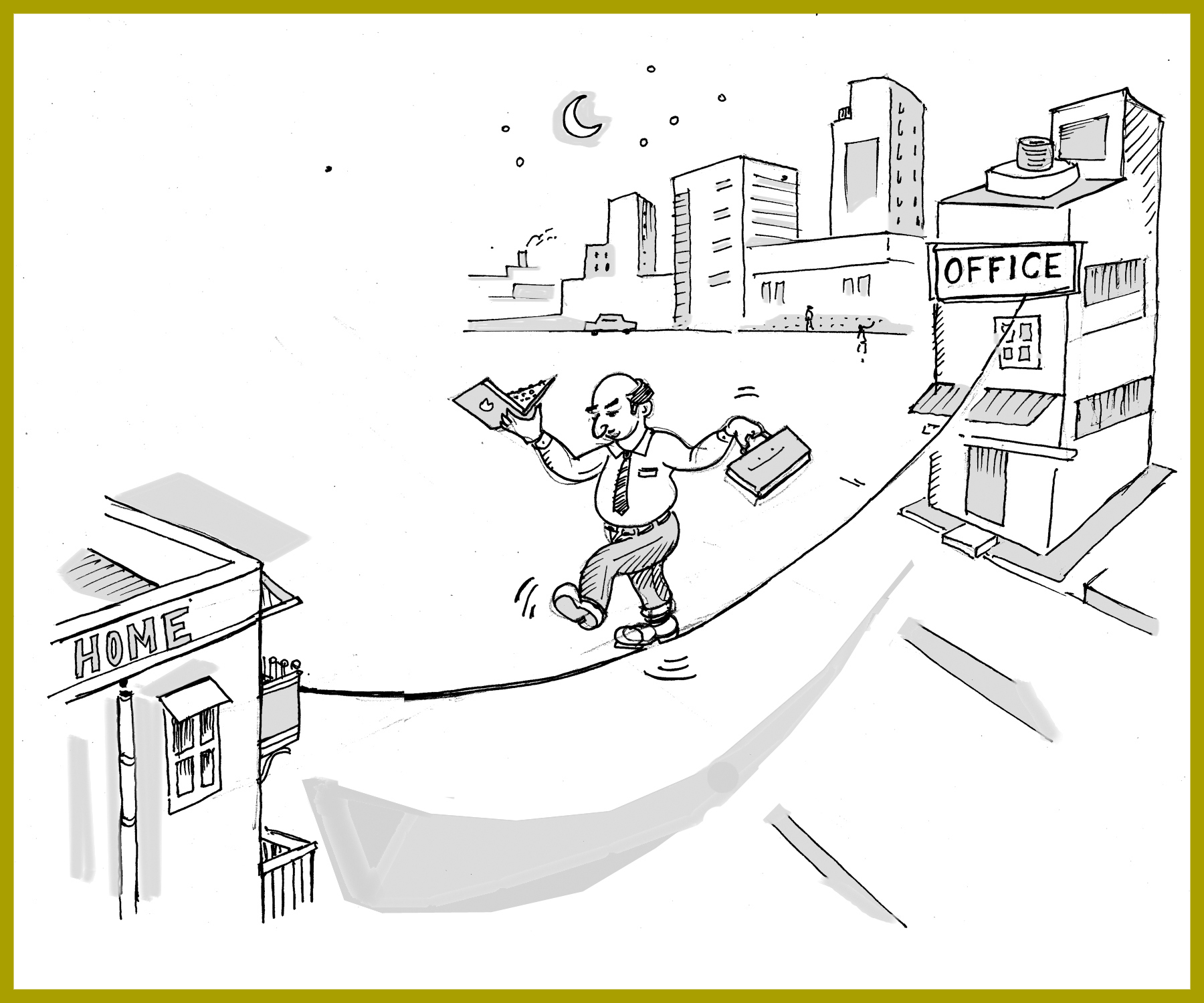
In the rush of living life in the fast lane, most managers today hardly find time for themselves. A high-octane careerSTRESS would often demand very long working hours at the work place. This is especially true in India, where the feudal mindset still prevails. As per some of the popular corporate maxims prevalent in this part of the world:

(1)                          A manager’s efficiency and effectiveness on the job is directly proportional to the number of hours put in at the work station,

(2)                          Promotions depend upon one’s commitment to company’s goals, where the level of commitment is in reverse proportion to the amount of leave taken,

(3)                          The company culture is designed to enforce a check-in time in the office, but the check-out time is invariably left open. After all, there is a strong belief in the old adage that those who watch the clock merely remain the hands!

(4)                          The manager has no life outside the place of work. More odd the hours at which mails emanate from him, especially those between the stroke of midnight and till about 4 AM, the more committed he/she is!

For those in the senior echelons, the communication revolution has made the task of “switching off” even more challenging. Laptops and cell phones are invariably present, even though they may be supposedly on leave with their near and dear ones. It is fashionable to answer a critical mail while on a vacation. We now have an entire generation of managers and executives who have developed an addiction to the latest gizmos. 24 by 7 connectivity is the buzz word. If you are not in the e-rat race, you just do not count!

The path of Least Resistance

The result is an early burn-out for most managers. With no time to spend with the family, let alone any quality time,WORK-LIFE BALANCE stress builds up pretty fast. Hobbies and extra-curricular activities get relegated to the background. If at all any health issue crops up, there is no time to see a doctor. Finally, when the visit to a medical specialist does fructify, a brief spell of pill popping provides instant relief and, voila, the problem is solved! A wise doctor would always work on a mix of drugs, diet, relaxation and exercise. But, as a patient, a manager is happy to find his own path of least resistance – focusing only on drugs but totally neglecting diet, relaxation and exercise.  

As to physical exercise, a “busy” manager could not care less. The physical bodies are taken for granted. If a gym is joined, the work-out keeps getting deferred on one pretext or the other. After all, the body is a sturdy one, so why pay any attention to it? On a daily basis, it is imagined that one is doing one’s duty by performing the morning ablutions, by providing the run down body with nourishment which could well be junk food, and by allowing oneself some sleep, howsoever disturbed it might be.

Recharging our batteries

It is rightly said that we are what we eat. If alone we were to focus on developing correct eating habits, with a large dose of fruits and vegetables, good results would ensue. When we eat junk food, do we realize that the same amount of money would allow us to buy fruits which we would not be able to consume in one go? When we continue to flush our digestive system with acidic foods, we cause irreparable damage to our delicate organs. Meals could also be irregular, depending upon the pressure of work at hand. The result is heartburn, upset stomach, ulcer, pancreatic malfunction and, in extreme cases, even cancer.

Why do we detest physical activity? In some cases, sheer lethargy, lack of time management skills and an over-ridingYoga Dhanurasana_Yoga-Asana_Nina-Mel addiction to desk work prompts us to lead sedentary lifestyles. Diabetes, hypertension, cardiovascular diseases soon follow. Quite a few of us end up facing the surgeon’s scalpel, with dietary restrictions and exercising regimen which we are then forced to follow.

Undoubtedly, managers perform under tremendous pressure. But what is more important is as to how they take the pressure. For a thick-skinned manager, the going may be relatively easier; for a thin-skinned one, the same assignment could involve a high degree of stress. Possibly, the solution lies in transforming one from with-in, so as to change the way a manager perceives stress because of the circumstances with-out. Regular meditation, a healthy diet and a positive frame of mind could work wonders in the long run, keeping the manager always charged up!

Need for innovative HR policies

Far-sighted managements would surely take notice and fine tune their HR policies to ensure that a healthy work-life balance is maintained for all senior employees. In one of the evolved companies I happened to be associated with some time back, an annual master health check-up was made mandatory for all those above the age of 45. The top guy resolved not to disturb his team members on weekends, unless absolutely unavoidable. A planned annual leave of 15 continuous days was made compulsory – the experiment demonstrated that the company did not collapse during the 15 days’ period! Managers learnt to plan in advance and also delegate their tasks better. Every six months, an in-house yoga camp was held. Two years down the road, employee satisfaction levels had improved, and so had white-collar productivity!

To quote Stephen Covey from his much celebrated book “The Seven Habits of Highly Effective People”: The physical dimension involves caring effectively for our physical body – eating the right kinds of foods, getting sufficient rest and relaxation, and exercising on a regular basis. (7th Habit, page 289).

The Divine has granted us this life and given us a body to live it through. The soul strives to evolve by gaining newer experiences in this life time of ours. But it can do so only through the medium of our physical body. Should we not respect it, take care of it and remain physically fit? Just like our vehicles and household gadgets need preventive maintenance, our bodies also need to be looked after well, so as to fulfill their purpose – that of supporting our soul, the Divine presence within us, to experience what this wonderful gift of life has on offer for us.

Surely, we can summon our will power and plan as well as execute a plan to achieve this worthy goal?

(Related Posts:

https://ashokbhatia.wordpress.com/2014/08/22/of-offices-and-vacations

https://ashokbhatia.wordpress.com/2015/06/06/achieving-work-life-harmony)


Read Full Post »

« Newer Posts