Till the year 1947, India was under the British Raj. The period was marked by Indians struggling to gain independence through means which were peaceful as well as violent. From 1920 onwards, the self-rule struggle was characterized by Mahatma Gandhi’s policy of non-violence and civil disobedience, duly complemented by several other campaigns.
When people are hungry, they become angry. They want to go out and fight. This could even be true of Mahatma Gandhi, who is given a singularly juicy mention in ‘The Juice of an Orange’ in Blandings Castle and Elsewhere.
While narrating the story of Wilmot Mulliner, Mr. Mulliner blames the modern dieting craze of women for all the unhappiness which afflicts the world.
‘Women, of course, are chiefly responsible. They go in for these slimming systems, their sunny natures become warped, and they work off the resultant venom on their men-folk. These, looking about them for someone they can take it out of, pick on the males of the neighbouring country, who themselves are spoiling for a fight because their own wives are on a diet, and before you know where you are war has broken out with all its attendant horrors.
‘This is what happened in the case of China and Japan. It is this that lies at the root of all the unpleasantness in the Polish Corridor. And look at India. Why is there unrest in India? Because its inhabitants eat only an occasional handful of rice. The day when Mahatma Gandhi sits down to a good juicy steak and follows it up with roly-poly pudding and a spot of Stilton you will see the end of all this nonsense of Civil Disobedience.
‘Till then we must expect Trouble, Disorder … in a word, Chaos.’
Those who are familiar with the Indian mutiny of 1857 may recall that the Siege of Cawnpore is one of its key episodes. The British forces and civilians in Cawnpore (now Kanpur) were unprepared for an extended siege and surrendered to rebel forces in return for a safe passage to Allahabad (now Prayagraj), another city nearby. As a rescue force approached Kanpur, an unfortunate massacre took place, leading even to a war cry ‘Remember Cawnpore’. On at least two occasions, Plum captures the sentiments of elation experienced by girls under siege in Kanpur when they hear the sound of the bagpipers of the British reinforcements.
The Girl in Blue describes how an authoress feels when she finds that a horn-rimmed American is trying to locate a copy of her latest book Daffodil Days. Flannery and Martin’s book shop in Sloane Square in London does not stock her latest brain child but when a stranger walks in and asks for it, Vera Upshaw is thrilled beyond measure.
She whips around, her lips part, her eyes widen and her lovely body experiences a tingling of sorts. Her sentiments get compared to the thrill a girl would have experienced when, in the midst of the Indian Mutiny, during the siege of Cawnpore (Kanpur, 1857), she would have heard the skirl of the bagpipes, heralding the arrival of British reinforcements.
In Pearls, Girls and Monty Bodkin, similar uplifting sentiments are experienced by Monty when he suddenly finds a friend and sympathizer in Mr. Llewellyn.
Military men who had served in India as part of their duties tell us interesting anecdotes about that distant land, including about their time in the NFWP. The latter was a province of British India from 1901 to 1947, when it was ceded to Pakistan. Hunting was a common pastime. Some such references enrich many of Plum’s narratives.
In Right Ho, Jeeves, while allaying the fears of Gussie that his trousers will split while delivering a speech at the Market Snodsbury Grammar School, an example is cited by Bertie Wooster – that of General Bosher, who was a D.S.O. (Distinguished Service Order), ‘with a fine record of service on the north-western frontier of India, and his trousers split.’
In ‘Ukridge and the Home from Home’, Lord Emsworth and Others, we find that Ukridge has turned his Aunt Julia’s house into a hotel. Amongst the six guests, we find one Lieutenant-Colonel B. B. Bagnew, late of the Fourth Loyal Lincolnshires. In Ukridge, we find a suave and genial host, presiding over the dinner-table on most nights. As and when the conversation in the group ‘touched a high level and feasts of Reason and flows of Soul occurred’, one of the major contributors was the Colonel. He narrated his anecdotes of India, where he had served his country faithfully and well.
In the same story, Ukridge tells Corky that Indian army men are not to be trusted. He thinks that all of them believe themselves to be heroes. Hence, they get greatly disliked. He cites Lieutenant-Colonel B. B. Bagnew’s clear views on lesser mortals like burglars. Colonel is of the view that if he were to ‘show them a good old army revolver, they would run like rabbits.’
In ‘Trouble Down at Tudsleigh’, Young Men in Spats, Freddie Widgeon gets formally introduced by Lady Carroway to Captain Bradbury from the Indian Army. He is competing with Freddie for the affections of April. Freddie believes that the Captain might have such advantages as a natty moustache, a rich tan and deep-set eyes, but what bowls over a refined and poetical girl is a refined soul. He intends to devour Tennyson over the next few days and be equivalent to six souls so as to beat his rival hollow.
At the end of a get-together, Captain Bradbury draws him aside and gives him the sort of look he would have given a Pathan discovered pinching the old regiment’s rifles out on the North-Western Frontier. He also mentions to Freddie that he had won the Heavyweight Boxing Championship of India earlier
In the same narrative, one gets to learn that when one is up against one of the Indian Army strategists, one realizes how thoroughly they get trained from early youth to do the dirty on the lawless tribes of the North-Western Frontier. Captain Bradbury, when outfoxed at the door, is not one to beat a hasty retreat. Rather, he tries to outflank Freddie by trying to enter through the sitting-room window.
This is how Plum describes the aftermath:
‘But the interchange of glances did not last long. These Indian Army men do not look, they act. And it has been well said of them that, while you may sometimes lay them a temporary stymie, you cannot baffle them permanently. The Captain suddenly turned and began to gallop round the corner of the house. It was plainly his intention to resume the attack from another and a less well-guarded quarter. This, I believe, is a common manoeuvre on the North-West Frontier. You get your Afghan shading his eyes and looking out over the maidan (field), and then you sneak up the pahar (mountain/hillock) behind him and catch him bending.’
In the story ‘Bill the Bloodhound’ in Man with Two Left Feet, we find Henry, dressed up as an old Indian colonel one week, contentedly puffing away at a cigar provided by Walter Jelliffe while fondling his silver moustache. Only when Walter finds him comfortable enough does he pop the question.
‘And now tell me, old man, which of us is it you’re trailing?’
In Summer Moonshine, Colonel Tanner tells Mr. Waugh-Bonner about his life in Poona (now Pune), while Mr. Chinnery plays croquet with Mrs. Folsom. Throughout the narrative, he speaks enthusiastically of his life in the city, supplementing the spoken word with a display of photographic snapshots illustrating conditions in those parts. He also speaks of the Bengal Lancers, a regiment of the British Indian Army.
Captain Biggar, one of the several unique characters in Ring for Jeeves, loves hunting. One would never get surprised to run into him ‘in such hunting grounds as in Kenya or Malaya or Borneo or India’! It would be perfectly in order.
(Continued)
Notes:
The inspiration for this essay comes from the scholarly work done by Ms. Masha Lebedeva, who had earlier whipped up a research paper entitled The Russian Salad by P. G. Wodehouse.
The author expresses his sincere gratitude to an eminent expert on Plummy matters for having spared the time to go through a part of this composition and provide insightful suggestions. Some fans of P. G. Wodehouse have also suggested improvements in its contents.
Thanks are also due to Mr. Suvarna Sanyal for dishing out the main illustration in Part 1; also, to Ms. Sneha Shoney, who has edited the text.
Those of you who wish to cruise through this essay in its entirety may kindly write to akb_usha@rediffmail.com for a PDF version of the complete document to be mailed to them.
Indian fauna such as spiders, scorpions, cobras, elephants, tigers, cheetahs and lions regale the reader across many of Plum’s narratives. Princes and maharajas of yore also find a mention occasionally.
Take the example of Summer Moonshine’s Colonel Tanner, who, during his tenure in India under the English raj, had learnt to be comfortable with the presence of Afridis, snakes, scorpions and even tigers in his sleeping quarters. Members of these species would ‘saunter into his abode as if it were a country club to which they had paid the entrance fee’.
In Thank You, Jeeves, Chuffy introduces Bertie to Sergeant Voules, who claims to have tackled as many as ninety-six big spiders while in India. Bertie’s protests that he is unable to sleep in his own bedroom because there is a big pink spider lurking around there (indirectly referring to Pauline Stoker, Chuffy’s fiancée, in his heliotrope pajamas!) get ignored. He gets hauled back to his bed. Luckily for all concerned, Pauline has already done the vanishing trick by then.
In Aunts Aren’t Gentlemen, Orlo Porter runs into Bertie Wooster and is as startled as an Indian native who sees a scorpion in his path. He goes on to ejaculate: ‘Wooster, you blasted slimy creeping crawling serpent, I might have expected this!’
What does an Indian native do when bitten by a scorpion? In Uneasy Money, Plum tells us that ‘He does not stop to lament, nor does he hang about analysing his emotions. He keeps running until he has worked the poison out of his system. Not until then does he attempt introspection.’ The amiable Lord Dawlish, after a rather unpleasant meeting with Lady Wetherby, follows a similar policy. After leaving her house, he does not run. Instead, he takes a very long and rapid walk. He has an acute sense of being poisoned and wishes to work the poison out of his system. He has nothing on his mind other than walking faster and faster.
In Jeeves and the Feudal Spirit, Ma Trotter, upon going through a morning journal, discovers that the powers that be have gone ahead and knighted Robert Blenkinsop instead of her illustrious husband. ‘She stares at The Times much like an Indian resident would eye a cobra, had he found it nestling in his bath tub’.
On his part, the husband, L. G. Trotter, is a man who suffers from dyspepsia and is already out of harmony with his wife. The latter screaming her head off in the middle of the breakfast startles him, making him give her ‘the sort of look the cobra might have given the resident of India who had barged in on its morning bath.’
In Bachelors Anonymous, we run into Mr. Ivor Llewellyn, head of the Superba-Llewellyn studio of Hollywood. Having suffered through as many as five divorces, he wishes to remain a bachelor. However, upon Joseph “Joe” Pickering’s insistence that he visit a hospital, Cupid strikes yet again. He ends up proposing to Amelia Bingham, a nurse he comes in touch with at the hospital. He squarely blames Joe for having got him entangled into yet another prospect of marriage. Upon return, he looks at Joe with an open dislike, much like a resident of India registers ‘when he comes to have his morning bath and finds a cobra nestling in the bath tub.’
In Galahad at Blandings, as also in Pigs Have Wings, Plum says that Beach never buzzes off, ‘his customary mode of progression being modelled on that of an elephant sauntering through an Indian jungle.’
As per Meet Mr. Mulliner, as well asthe story ‘Gala Night’ in Mulliner Nights, when royalty goes a-hunting, it expects to be supported by elephants which display an easy nonchalance when their masters spot a tiger in an Indian jungle. But there are times when such hunting expeditions get spoiled by ‘the failure of the elephant to see eye to eye with its owner in the matter of what constitutes sport.’ How does one avoid the prospect of an elephant turning and galloping home? How does one ensure that a timid elephant would instead trumpet loudly and charge the fiercest tiger without any hesitation, ‘facing the tiger of the jungle with a jaunty sang-froid?’
Wilfred Mulliner has a solution in the form of a tonic known as Mulliner’s Buck-U-Uppo. Were a teaspoonful of it be mixed with the morning bran-mash, better results ensue.
Sunset at Blandings tells us how one feels when one is likely to face the prospect of facing a formidable person like Dame Daphne Winkworth? If Gally is to be believed, one would find oneself in the position of a native of India who knows that a tigress is lurking in the undergrowth near at hand and wonders how soon she will be among those present.
In Big Money, when Berry acts like a buoyant and aspiring sportsman in the jungles of India who has caught a tiger by its tail, he realizes that even though all has been well so far, his next move would need careful consideration.
Uncle Dynamite records the reaction of Sir Aylmer when being told by Lord Ickenham that he would go hundred miles to judge bonny babies. This thwarts the ambitions of Sir Aylmer no end. He starts ‘like a tiger that sees its Indian villager being snatched away from it.’ His face, already mauve, becomes an imperial purple.
Uncle Dynamite also describes the emotions of Hermione, a young authoress, who finds that her royalty earnings are likely to go up substantially but her father is conniving to rob the publisher of his means to publish her work. Her feelings are said to be even more poignant than those of ‘wolves which overtake sleighs and find no Russian peasant aboard and of tigers deprived of their Indian coolie just as they are sitting down to lunch.’
In Full Moon, Freddie, at Gally’s suggestion, smuggles Bill Lister back into Blandings Castle disguised as a false-bearded gardener, having paid off Angus McAllister. Lister soon ruins things, however, when he mistakes Veronica’s mother, Lady Hermione, for a cook and tries to bribe her to pass a note to Prudence. Later on, when Freddie appears to be whole-heartedly welcoming Lister after the latter has been asked to leave, Lady Hermione is found twitching her hands and has gleaming eyes. She is then likened to the puma of an Indian jungle about to pounce upon its prey.
In Piccadilly Jim, Jimmy has a unique style of proposing to Ann. He points out that if he were to go out of her life, she would be miserable. She would have nobody to fight with. She would be like the female jaguar of the Indian jungle who expresses her affection for her mate ‘by biting him shrewdly in the fleshy part of the leg, getting a shock one day to find that the mate has simply vanished.’
In ‘The Story of Cedric’, Mr. Mulliner Speaking, when Cedric crawls on all fours on the floor, his teeth are clenched and his eyes gleam with a strange light, he is said to look like an ‘exact replica of the hunting cheetah of Indian jungle stalking its prey.’
In the same narrative, when he cries out aloud, he sounds like an Indian peasant who, ‘while sauntering on the banks of the Ganges, suddenly finds himself being bitten in half by a crocodile.’
‘Leave it to Algy’, A Few Quick Ones depicts Purkiss, having handed over a five-pound note to Bingo, giving a defiant look at Algernon Aubrey. His look gets likened to that of an Indian coolie, who, when he is safe up a tree, may give it to the baffled crocodile at the foot of it.
In The Girl in Blue, Jerry chooses to celebrate his triumph at the grill room of the Barribault’s which is said to be a ‘stamping ground of Texas millionaires and Indian Maharajas.’
In Luck of the Bodkins, Mr. Llewellyn wonders if his sister-in-law has ‘mistaken him for Rockefeller, Pierpont Morgan, Death Valley Scotty or one of those Indian Maharajas.’
In Bachelor’s Anonymous, Sally realizes the true nature of Joseph Pickering while sitting in the lobby at Barribault’s, infested by Texas millionaires and Indian maharajas.
In Pearls, Girls and Monty Bodkin, Monty waits for Gertrude to show up in the lobby of Barribault’s world-famous hotel, the doors of which normally swivel around only to admit Texan millionaires and Indian Maharajas. The doors then revolve yet again to admit an elderly man with a face like a horse, Mr. J. B. Butterwick, who promptly proceeds to inform him that Gertrude will not be lunching with him on the day.
The story The Man Who Disliked Cats in The Man Upstairs speaks of Hotel Jules Priaulx in Paris. When rich people of any nationality come over to stay there, they often bring their pets along with. If an Indian prince has two dromedaries for company, the other one brings along a giraffe. The giraffe is reported to drink a dozen of the best champagne every day, so as to keep his coat in good shape. Young lions and alligators also pop up once in a while.
(Continued)
Notes:
The inspiration for this essay comes from the scholarly work done by Ms. Masha Lebedeva, who had earlier whipped up a research paper entitled The Russian Salad by P. G. Wodehouse.
The author expresses his sincere gratitude to an eminent expert on Plummy matters for having spared the time to go through a part of this composition and provide insightful suggestions. Some fans of P. G. Wodehouse have also suggested improvements in its contents.
Thanks are also due to Mr. Suvarna Sanyal for dishing out the main illustration in Part 1; also, to Ms. Sneha Shoney, who has edited the text.
Those of you who wish to cruise through this essay in its entirety may kindly write to akb_usha@rediffmail.com for a PDF version of the complete document to be mailed to them.
To the best of my knowledge and belief, P. G. Wodehouse never set foot on Indian soil. But he has often alluded to its exotic temples, its wildlife, its royalty, its fakirs and mystics with magical powers, and even its love lyrics. Many times he has vividly captured facets of my beautiful country, serving up a delectable curry spiced with uniquely Indian condiments.
In this essay, the reader will find a random sample of references to India in Wodehouse’s novels and short stories. Such references are found across all his narratives, whether he is writing a Jeeves and Bertie story, a tale of Blandings, or a stand-alone novel.
Plum’s elder brother, Ernest Armine Wodehouse, was an English Theosophist, poet and educator. He is better known as the tutor of Jiddu Krishnamurti, the famous Indian author and lecturer on spiritual and philosophical subjects. He was admitted to the Theosophical Society at Poona (now Pune) in 1908. Before the First World War, he held a position as professor at Deccan College in Poona, India. After the war he returned to India. One can understand the source of Plum’s inspiration when he named one of his pet cats as Poona.
One of the important landmarks on Wodehouse Road in the Indian city of Mumbai is the Cathedral of the Holy Name. The seat of the Archdiocese of Mumbai, the cathedral is one of the most striking churches of the city. Its foundation stone was laid in 1902. It had then come to be known as the Wodehouse Church since it stands on Wodehouse Road, named after Sir Philip Edmond Wodehouse who was Governor of the city from 1872 to 1877. He was a distant relative of Plum’s. Sometime back, the road was renamed Nathalal Parekh Marg.
Few writers have Plum’s mesmerizing command over English. He uses it in an innovative manner, leaving the reader stepped to the gills with an overdose of Vitamin H(umour). It comes as no surprise that English-speaking Indians who are aware of his works simply adore him.
One of the unique features of India is its linguistic diversity. By default, English is the sole means of communication between different people from across the country. It acts as a bridge between large chunks of its 1.4 billion people who otherwise speak as many as 447 languages. Of these, 22 happen to be scheduled ones, deserving official recognition and support. Six languages – Kannada, Malayalam, Odiya, Sanskrit, Tamil and Telugu – are recognized as classical ones. English being a prominent link between people, Plum’s popularity in India is readily understandable.
But we digress. We are here to consider the kind of ingredients Plum uses while dishing out an Indian curry.
Some Indian fans of P G Wodehouse who have a chin-up attitude like that of Bertie Wooster and also a hearty capacity to laugh at themselves may appreciate the kind of India-centric similes Wodehouse uses at times to depict the behaviour of his characters.
In reading what follows, it may be advisable for a reader to imagine herself taking a leisurely stroll through either the Shalimar or the tulip gardens of Kashmir, or the Mughal Gardens in New Delhi, relishing the enchanting aroma of each section at a time.
Religious fervour is one of the main strands in the socio-cultural tapestry of India. One of its many unique features is its vast pantheon of gods and goddesses, its handcrafted and bejewelled idols, its magnificent temples and its overzealous priests.
In Ring for Jeeves, Rory speaks to Monica of a story published in The Strand Magazine in which a gang of blighters pops over to India and pinches a great jewel which is the eye of an idol. When one of the gang is deprived of his share in the booty, he seeks revenge by tracking down all the others and wiping them out. Rory is of the opinion that Captain Biggar is likewise casting a vengeful eye on Bill, as if the latter had denied the former his share of the proceeds of the green eye of the little yellow god in the temple of Vishnu.
The feisty heroine of Something Fresh, Joan Valentine, acts as a muse for Ashe Marson when he suffers from a temporary writer’s block. She suggests that ‘The Adventure of the Wand of Death’ can only be about the sacred ebony stick stolen from an Indian temple which is supposed to bring death to whoever possesses it. Priests dog this person and send him threatening messages. Yet another episode of the adventures of Gridley Quayle, Investigator, gets dished out by Ashe.
Mr. Chinnery of Summer Moonshine is said to be an enormously rich person in spite of the incessant demands placed on his income by a platoon of ex-wives to whom he has to keep paying alimonies. Notices keep getting served on him in that respect. He suspects Mr. Bulpitt to be following him to serve yet another notice and shares his discomfiture with Sir Buckstone. He describes his latest encounter with Mr. Bulpitt as that of someone who steals the jewel and thinks he has hid himself rather well, only to look over his shoulder to find some sinister Indian priests around the corner. (Continued)
Notes:
The inspiration for this essay comes from the scholarly work done by Ms. Masha Lebedeva, who had earlier whipped up a research paper entitled The Russian Salad by P. G. Wodehouse.
The author expresses his sincere gratitude to an eminent expert on Plummy matters for having spared the time to go through a part of this composition and provide insightful suggestions. Some fans of P. G. Wodehouse have also suggested improvements in its contents.
Thanks are also due to Mr. Suvarna Sanyal for dishing out the main illustration; also, to Ms. Sneha Shoney, who has edited the text.
Those of you who wish to cruise through this essay in its entirety may kindly write to akb_usha@rediffmail.com for a PDF version of the complete document to be mailed to them.
Lord Emsworth, as we all know him, is a very kind, loveable and harmless soul. Still, a park-keeper in Kensington Gardens once characterized him as: “a dangerous criminal, the blackest type of evil-doer on the park-keeper’s index.”
This provoked some other questions:
How is it possible that this mild man could cause such a harsh judgement?
What terrible deeds had he committed?
Are there other incidents in the “Blandings Saga” when people consider Lord Emsworth’s activities as evil deeds, skullduggery or crime?
In the following I present occasions when Lord Emsworth in the opinion of other people might be regarded as guilty of misdemeanour. I am just presenting a list of possible accusations, not prosecuting nor judging him. I don’t claim the list to be exhaustive, and all comments, corrections and complements from readers are most welcome. You find my email below, in the ‘About the Author’ paragraph.
Criminal acts frequently occur in Wodehouse’s stories and are often important ingredients in the plot. A bunch of criminals, for instance Chimp Twist and the couple Dolly and Soapy Molloy, are recurring as minor characters in many stories. However, not only crooks commit criminal acts. Wodehouse’s heroes and heroines as well sometimes commit crimes. Finding themselves deep in the soup they resort to acts like theft and blackmail as a way out of tight places. Besides, many young men regard certain violations of the law, like pinching a policeman’s helmet, as a proof of courage and thus as an quite excusable peccadillo, especially on the night after the Boat Race. To occasionally spend a night in the quod is nothing unusual for a Drone and is not regarded as a blot on his escutcheon.
But back to the amiable and absentminded ninth earl of Emsworth? When we associate him with crime and transgressions, we usually think of him as a victim of criminal acts such as pig theft and blackmail. In Service with a Smile (1962), Plum wrote: “Lord Emsworth was a man with little of the aggressor in his spiritual make-up.” But, when upset, Lord Emsworth’s judgement is obscured and on some occasions also he is wandering astray in the back-country around and outside the limits of the law. And he is not totally devoid of aggressiveness.
In The Clicking of Cuthbert (1922), Plum wrote: “There is an ethical as well as a legal code, and this it was obvious that Raymond Parsloe Devine had transgressed.” In line with this thought I present Clarence’s transgressions of legal rules as well as of common social rules and ethical codes, such as lying. Besides, it depends on one’s perspective if you regard a certain act as an evil deed. Plum pointed out that the opinion about fox-hunting very much depends on at which end of the rifle you are. The perpetrator and the victim may have opposing ethical views on the same act. My perspective down is that of the victim, and I include deeds which from the victim’s point of view might be regarded as evil even if Lord Emsworth certainly had no evil intentions. His sister, Lady Constance, has her very rigid views on which ethical and behavioural code is appropriate for the head of the family. In A Pelican at Blandings (1969), she is called “the Führer of Blandings Castle”. I don’t include her accusations of his lordship’s possible transgressions of her rules.
What terrible deeds did the “evil-doer” Lord Emsworth really commit?
Down, is a list of some different kinds of perpetrations/crimes/evil-doings Lord Emsworth is accused of. The incidents are listed in a random order. Intentional as well as unconscious malefactions are mixed. Deeds just planned and deeds actually committed are mixed. Crimes are mixed with peccadilloes.
Theft/unlawful misappropriation
A few times the absentminded Lord Emsworth happens to bag an object that doesn’t belong to him. In Something Fresh (1915), the first novel in which Lord Emsworth is the main character, he commits two unconscious thefts. The first incident occurs in his club, where he pockets a fork, something the head steward makes him aware of. Later, in the home of Mr. Peters, he pockets an Egyptian scarab. When, at home, he discovers the scarab he remembers Mr. Peters showing it to him and supposes that he got it as a gift. The plot in the novel then circulates around Mr. Peters’ efforts to get the scarab back. Mr. Peters promises a reward to the one who gets it back and several persons engage in stealing attempts.
In the short story The Custody of the Pumpkin, (1924) the absentminded Lord Emsworth again falls foul of the law. He is in Kensington Gardens in London. Mesmerized by the beauty of all the flowers he forgets where he is and begins picking flowers. A park-keeper watches him, and becomes horrified: “ … the stranger was in reality a dangerous criminal, the blackest type of evil-doer on the park-keeper’s index. He was a Kensington Gardens flower-picker.” The park-keeper yells, a crowd gathers, a police-man materializes and asks the sinner for his name. When he gives it, his statement is rewarded with a roar of laughter from the crowd. Fortunately, Lord Emsworth’s gardener Angus McAllister is at hand and can confirm the poor peer’s identity. The policeman, who is a glowing admirer of blue blood, chooses to turn a blind eye. This incident evidently stuck in Lady Constance’s memory. Later (in Service with a Smile, 1962), she exclaims: “I forgot to tell Clarence to be sure not to pick the flowers in Hyde Park. He will wander off there, and he will pick the flowers. He nearly got arrested once for doing it.”
Forgive me a short digression from the topic, a short reflection. Plum didn´t mention it, but perhaps a memory of the incident in Kensington Gardens subconsciously appeared in Lord Emsworth’s (Plum’s) mind some time later? Perhaps a dim reminiscence and a deep feeling that flower-picking should be allowed for real flower-lovers cropped out when his lordship once met a small girl from London who was punished for picking “flarze” in the garden of Blandings. Lord Emsworth this time showed unusual heroism, revolted against the authorities, took command and declared that young Gladys was allowed to pick all the flowers she wished. (Lord Emsworth and the Girl Friend, 1928).
Extortion/blackmailing/taking bribes
In the short story The Birth of a Salesman (1950), Lord Emsworth visits his younger son Freddie in New York. A young lady, selling encyclopædias of Sport, knocks at the door and Lord Emsworth courteously, but carelessly, promises to help her. A neighbour, “named Griggs or Follansbee or something”, is hosting orgies in his house while his wife is away. Clarence begins with this neighbour, who several times has noticed Lord Emsworth drooping over his (the neighbour’s) fence. He (Lord E) was really admiring the flowers, but the neighbour suspects that he (still Lord E) is a private eye snooping around on behalf of his (the neighbour’s) wife and he (the neighbour again) tries to bribe him (Lord E). His (Lord E’s) mind is absorbed by the idea of selling encyclopædias and when the neighbour asks “How much?” he (Lord E) interprets it as “How many?” Lord Emsworth emphasizes that the encyclopædias could be used as appreciated gifts and suggests a number of one gross, 144 copies, which the neighbor accepts. The earl is happy that he has been able to help the young lady and is absolutely unaware that he had provoked bribery, or that the neighbour regarded his lordship’s suggestion of such a great number as blackmail.
Armed threat
In Summer Lightning (1929), Lord Emsworth is quite convinced that his secretary Rupert Baxter has gone mad as a coot as well as violent, and furthermore that he has stolen the Empress of Blandings. Armed with a gun, Lord Emsworth forces the unhappy, angry and humiliated Baxter to crawl out from his hiding place under a bed.
In Service with a Smile (1962), Plum tells us how Clarence enters his sister Connie’s room: “He was a light mauve in colour, and his eyes, generally so mild, glittered behind their pince-nez with a strange light. It needed but a glance to tell her that he was in one of his rare berserk moods.” We know nothing about his earlier fits of rage and it seems that Lord Emsworth luckily avoided to commit serious crimes during them. This time his rage is aroused by discovering that his pigman, Wellbeloved, is plotting to steal the Empress. Clarence naturally fires him, not at him, but furiously tells him that he will be after him with a shotgun if he isn’t out of the place in ten minutes. He clearly has forgotten that he himself once participated in plotting a pig-napping! (See further down.)
Firing at people
Lord Emsworth doesn’t only use guns as a threat, but actually fires them. Fortunately, he never causes serious wounds.
In Something Fresh (1915) he empties a revolver with six shots in the darkness of the night in the hall at Blandings. He heard some noise and believes he is firing at burglars. As a matter of fact, it is poor Baxter, who, in his turn in pursuit of what he believes are burglars, has overturned a table and fallen on the floor. Luckily no living person was hit by any of the bullets, but one bullet hit a portrait of his lordship’s maternal grandmother in the face and “improved it out of all knowledge”.
In Plum’s unfinished novel Sunset at Blandings (1977) a person catching a burglar says: “It’s all right shooting a burglar. I asked my solicitor.” I’m not sure whether this is true, but anyhow, when Lord Emsworth fired the revolver in the hall it was at random, in complete darkness and no burglar had actually been revealed.
In the short story The Crime Wave at Blandings (1936) he actually shoots his former secretary and tormentor Rupert Baxter in his back-side, fortunately with an air gun. Lady Constance had confiscated the gun from his lordship’s grandson, who had shot Baxter with it. Furthermore, his lordship commits this crime twice! The first time, he was holding the confiscated gun in his hands, reviving his youth, and wondered if his marksmanship was still intact. Seeing the nuisance Baxter turning his back to him a bit away outside an open window, the temptation overpowered him. It may be considered a mitigation that his victim was such a menace. The wounds were insignificant, but the shot caused a sharp pain, a kangaroo-jump up in the air and wounded pride. The second time Lord Emsworth shot Baxter, he wanted to prove his marksmanship to his butler Beach, and Baxter was already leaving Blandings on his motor-bicycle. This farewell salute was both a further revenge and a message to Baxter to stay away from Blandings for all future, which purpose he achieved. The crime wave in the story didn’t consist only of Lord Emsworth and his grandson shooting Baxter. Beach does the same thing and even Lady Constance yields to an impulse to test her accuracy of aim. She shoots at the backside of Beach, really a not very challenging target to hit. She believes her shot was a hit. It wasn’t, but Connie’s shot gave Clarence the ability to get away from the events without consequences.
Lies
Lord Emsworth’s most frequent violation against common ethical values is probably to lie and stoutly deny what he has done, even if this is not so often told explicitly in the “saga”. Blank denial has become almost a reflex when he is accused, especially by Lady Constance, for having done something. “He was a great believer in stout denial and very good at it.”Pigs have wings (1952).
In the short story The Crime Wave at Blandings (1936) Connie asks him if he shot Baxter and Clarence flatly denies it: “Of course I didn’t.” He further adds to his lie by telling that he doesn’t even know how to load the gun. He fabricates two other explanations, either that Baxter was stung by a wasp or that he once more had relapsed into hallucinations. One of his lordship’s nieces happened to see when he shot Baxter, who was overhearing it when she told Lord Emsworth. Although revealed, Lord Emsworth flatly denies it again. Baxter asks him: “Do you deny that you shot me, Lord Emsworth?” and his lordship remorselessly lies: “Certainly I do.”
Attempted dog-napping
Lord Emsworth once makes an unsuccessful attempt to steal a dog. His son Freddie has (again) got into the soup. This is told in the short story First Aid for Freddie (1966). Eager to sell dog biscuits Freddie gave away a dog, to a young lady in the neighbourhood, despite the fact that the dog belonged to his wife Aggie. Freddie’s intention was to replace the dog by buying another. But Aggie announces her early return before he had time to fix this. If the dog isn’t at Blandings when she arrives, a possible outcome is divorce and that Freddie loses his job in USA. Lord Emsworth faces the frightful prospect of having Freddie living at Blandings again. The dog has to be brought home quickly. Freddie has got a sprained ankle so Clarence has to perform the theft. Of course, he fails. Snooping around the house where the dog is, he gets caught, is believed to be a crook and is locked into the coal cellar. Beach rescues him from both cellar and disgrace. The young lady fortunately returns the dog in time, because it had bitten one of her father’s favourite dogs.
Plotting a pig-napping
To his horror, Lord Emsworth’s prizewinning pig The Empress of Blandings has been stolen. The perpetrator is his sister’s son Ronnie Fish, but this Lord Emsworth doesn’t know. Ronnie’s plan is to “find” the pig, return it and then be able to extract money from a most thankful uncle. Clarence and Gally are absolutely convinced that Lord Parsloe-Parsloe at Matchingham Hall lies behind the theft, in order to make his own sow, The Pride of Matchingham, becomes the prizewinner as the fattest pig at the coming exhibition. Gally and Clarence conspire about appropriate contra strikes and decide that stealing The Pride of Matchingham would give them a good position to negotiate. The idea came of course from Gally and Clarence is naturally out of question as participant in the pig-napping act, but he has no objections of any kind against the plans. However, the plans were never executed, because the Empress was found in Baxter’s camping van. (Summer Lightning 1929).
Damaging property of others
Ignoring her brother’s protests, Lady Constance has allowed the Church Lads to camp by the lake in Service With a Smile (1962). Clarence caught a Church Lad red-handed, occupied with the worst possible sort of cruelty to animals Lord Emsworth could imagine: The Lad had put a potato on a string and jerked it away from the Empress when she tried to eat it! Another Church Lad took advantage of Lord Emsworth’s dim eyesight and prompted him to jump into the lake, with his clothes on, to save a fellow Lad from drowning. The presumed drowning Lad was a floating log. Lord Emsworth broods on revenge. Inspired by Lord Ickenham he sneaks out early in the morning and cuts off their tent ropes while the Church Lads are asleep. The Church Lads and Lady Constance consider this as an appalling skullduggery. Afterwards, his lordship has no remorse whatsoever, but he is scared to death that somehow Connie will get to know the identity of the perpetrator.
Intrusion
A deep rift had arisen in the lute between Freddie and his wife Aggie. One of Aggie’s female “friends” has informed her that she had seen Freddie in a restaurant together with a glamourous female movie star and she advocates divorce. It was an innocent meeting, for a good, but secret, reason, so Freddie had not informed Aggie about it. She has moved out to a hotel suite. Divorce is threatening and Lord Emsworth again fears to become stuck with Freddie living at Blandings. This is told in the short story Lord Emsworth Acts for the Best (1926). Aggie refuses to see Freddie, who asks his father to go to her and plead for him and convince her that the whole thing was innocent. His lordship and Aggie had never met before. Confronted with the threat of having Freddie at Blandings Lord Emsworth reluctantly goes to Aggie’s hotel suite. No one hear him knocking at the door to the suite, but he finds out that the door isn’t quite closed. So, he enters the suite, uninvited, as an intruder. The drawing-room is empty and his attention is caught by the beautiful flowers. He potters around putting his nose into the flowers, sniffing. The “friend” enters, takes him for a burglar and threats him with a pistol. She doesn’t believe him when he tells his name. Soon, Freddie arrives and confirms his lordship’s identity. The rift is eliminated, the “friend” is disposed of, and his lordship happily escapes the horror of having Freddie living at Blandings.
Some final comments
Exceptionally, Lord Emsworth is regarded by some others as an evil-doer. Wodehouse created him a kind of unobtrusive hero, without the normal characteristics of a hero. He is timid, not bold; whimsical, not decisive; evasive, not action-oriented; usually striving just to be left alone and to do no harm. According to Wikipedia, an anti-hero is “a protagonist in a story who lacks conventional heroic qualities and attributes such as idealism, courage, and morality. Although antiheroes may sometimes do the right thing, it is not always for the right reasons, often acting primarily out of self-interest or in ways that defy conventional ethical codes”. Lord Emsworth for sure lacks conventional heroic qualities. I regard Lord Emsworth as a kind of comical anti-hero, even if anti-heroes normally are crooks and are more complicated souls than the harmless, simple-minded peer, who just wants to please everybody, but now and then fails.
Often Lord Emsworth is absentminded and unaware of his transgressions, but a few times he commits them deliberately. If his reasons are strong enough, Lord Emsworth doesn’t hesitate even to commit crime. To prevent Freddie from settling down at Blandings, (in his lordship’s opinion a disaster worse than if the Castle should suffer from an outbreak of foot-and-mouth disease and an invasion of green-flies at the same time), he is prepared to transgress both legal and ethical codes.
His lordship can also be vindictive. If an opportunity appears, for instance to shoot Baxter, and he thinks he can get away with it, he can take revenge. His transgressions are however very rare. They are mostly provoked by others, and his victims are often unsympathetic characters and we feel that they have deserved to be “punished”.
It is very easy to feel sympathy for the amiable and whimsical peer, to understand and forgive him. Almost all the time he is kind and benevolent to all and sundry. However, this doesn’t mean that he never has hostile intentions. He avoids quarrels and fights if possible, but there is a limit for what he can stand, and he is no saint. Under enough pressure, if pushed and cornered, this meek man can at times feel compelled not to turn his other cheek. I, for one, can’t blame him.
By writing an essay on this topic, with this headline, it may be that some friends of Lord Emsworth might accuse me for being an evil-doer against his lordship. I certainly have no evil intentions and really enjoy spending time with him. However, Plum didn’t create Lord Emsworth an infallible hero. When upset, when his “world” and way of life is threatened, his mind and judgement may become obscured and his acts too hasty. Why should we close our eyes to these very human qualities? His weaknesses, in my opinion, just make him more loveable. Among all the heroes and anti-heroes in the world which Wodehouse created for our joy, he is my favourite. As Pope said: To err is human, to forgive is divine.
(Notes:
A version of this article appeared in the March 2021 issue of Wooster Sauce, the quarterly journal of The P. G. Wodehouse Society of UK.
Illustrations are from the serialized version “Something New” in Saturday Evening Post. Ill. F. R. Gruger.
The author’s permission to reproduce this piece here is gratefully acknowledged.)
About the Author
Mr Tomas Prenkert has been a Wodehouse addict since his teens. He popularized the principles of management as a Lecturer in Business Administration at Linné University in Växjö (Sweden) till 2006. Thereafter, he opted to spread sweetness and light all around by bringing Plum’s works to denizens of Sweden.
Of his own initiative, he and a fellow Wodehouse fan undertook a research project and discovered Plum texts in old forgotten Swedish magazines. He edited and published two collections of these stories in 2010 and 2011. A third collection, with translations made by members of the Wodehouse Society in Sweden(WSS), was brought out by the WSS in 2015.
He has done commendable work in digging up innumerable texts of the Master. Over the years, he has undertaken an editorial endeavour and also dished out several translations and insightful articles which can often be found in Wooster Sauce, Plum Lines and Jeeves – the yearbook of the WSS.
I conclude this series in celebration of the 10th anniversary of this blog site! I wish to thank all my followers and readers who have always encouraged me (and keep doing so) in this journey.
Yet another sterling example of Wodehouse’s use of Shakespeare is found in Uncle Fred in the Springtime (1939).
When Alaric, Duke of Dunstable decides to take Empress of Blandings away from her loving master and get her fit, Lord Emsworth calls in the services of the redoubtable Uncle Fred. Fred arrives full of the joys of spring, with nephew Pongo Twistleton and old friend Polly Pott in tow, and despite the efforts of the efficient Baxter, endeavours to scupper the Duke and bring together a variety of romantic couplings.
The perils of a financial obligation
‘Beginning by quoting from Polonius’s speech to Laertes, which a surprising number of people whom you would not have suspected of familiarity with the writings of Shakespeare seem to know, Mr Pott had gone on to say that lending money always made him feel as if he were rubbing velvet the…
Amongst the not-so-delicately-nurtured characters in the Wodehouse canon, there are at least three brainy coves we all admire – Jeeves, Lord Ickenham and Psmith. As to the last one, here is how one of his theories of Life gets bolstered by The Bard.
‘It was one of Psmith’s theories of Life, which he was accustomed to propound to Mike in the small hours of the morning with his feet on the mantelpiece, that the secret of success lay in taking advantage of one’s occasional slices of luck, in seizing, as it were, the happy moment. When Mike, who had had the passage to write out ten times at Wrykyn on one occasion as an imposition, reminded him that Shakespeare had once said something about there being a tide in the affairs of men, which, taken at the flood, &c., Psmith had acknowledged with…
There are several reasons as to why P G Wodehouse, fondly referred to as Plum, is revered so very highly. For lesser mortals, one of these is surely the manner in which he makes fun of a decadent British aristocracy. He does so by skillfully juxtaposing strict social norms against nonsensical and ridiculous acts which rank rather high on the Goofiness Index. Then there is his unique use of the English language, with twists which could gladden the hearts of some of the most morose amongst us.
One other factor which endears Wodehouse to his ardent fans is the manner in which he draws upon the works of such other literary figures as Shakespeare, Keats, Shelley, Tennyson, Rudyard Kipling, Sir Arthur Conan Doyle and Oscar Wilde.
In the Wodehouse canon, The Bard has a unique place. Almost all of Plum’s works are littered with references to the literary outpourings of…
To be or not to be a die-hard fan of a particular literary figure is perhaps decided by our Guardian Angels. Mines have been benevolent and ensured that I suffer from acute Wodehousitis.
But when it comes to William Shakespeare, much revered by all and sundry, my GAs have ensured that I never qualify to be even a mild case of Shakespearitis. One of the several challenges I have faced in my life is that of understanding the literary fare dished out by William Shakespeare. Given the high level of what Bertie Wooster might label as my Pumpkin Quotient, repeated attempts on my part to comprehend the ingenious outpourings of The Bard have failed miserably.
But an absence of Shakespearitis does not necessarily guarantee peace of mind. On the contrary, it makes life even more of a challenge. The brow is invariably furrowed. The heart is leaden with woe. This…
The final section of my researches involves quotations relating to what I would essentially call the ‘Russian Spirit’ – with the meaning of this expression adopted by Alexander Pushkin in Ruslan and Ludmila, when he wrote: ‘The Russian spirit… Russia’s scent’. Moreover, the words ‘Russian spirit’ appears twice in Wodehouse’s text, as I mentioned earlier in the article, in the Russian Culture part. I now move on to the manifestations of the Russian spirit that were described by Wodehouse himself.
Before doing so, however, I must make some reference not to the Russian Spirit itself, but to the basis of this spirit. I mean the land of Russia: its territory, its climate, its rivers, its cities, and everything else that Wodehouse tells us as a geographer. We certainly can’t call his information exhaustive, but it is quite sufficient for a country which neither Plum nor his characters ever visited.
From Wodehouse we learn that there are at least three cities in Russia: Moscow, the main city with the political centre in the Kremlin, with an Artbashiekeff (‘Chester Forgets Himself’, from The Heart of a Goof)that might turn out to be a Moscow suburb; Leningrad, formerly Petrograd; and Nijni Novgorod. There are at least two rivers: the Volga and the Don the famous Russian steppes seem to be situated near the River Don (The Swoop, Part 2, ch7). And somewhere in Russia you will find Siberia.
The climate in Russia is inclement, at least in winter (Frozen Assets, ch9) and in Moscow, where it enables Winter Sports to take place (Summer Lighting, ch2). However, if you are not a sportsman but one of Napoleon’s generals, you would say something worth about the Moscow weather (Jill the Reckless, ch2). In Siberia, despite what we might hear from other sources, some claim the climate is not so terrible compared, say, to the weather in the late English summer (The Swoop, Part 2, ch5). On the whole, the atmosphere there doesn’t evoke such a crushed gloom, as do the park and gardens of Blandings Castle on occasion (Something Fresh, ch2).
Having briefly depicted the geographical and climatic peculiarities of Russia, Wodehouse passes to ethnographical research. To his credit, he avoided that trite set of images: matrioshka; balalaika; and beers in Moscow streets. He wrote instead about samovars, not only that of Vladimir Brusiloff but also in the drawing-rooms, where the English intelligentsia had parties (‘Jane Gets off the Fairway’, from The Heart of a Goof). And icons help to provide the atmosphere in some of these drawing-rooms (‘The Purification of Rodney Spelvin’, from The Heart of a Goof). Once Wodehouse mentioned Russian boots, and drew his readers’ attention to the habit of Russian men of concealing almost their entire faces behind a dense zareba of hair. But he did realise that under that disguise there was a picturesque swarthiness, which could be enhanced by a touch of the Raven Gipsy No. 3 grease paint (The Swoop, Part 2, ch6).
There is another stereotypical image wich Wodehouse was not able to avoid: vodka. But before I concentrate on the role that vodka plays in forming the Russian national character, I’d like to take a short digression into the general area of Russian cuisine. Wodehouse devoted a lot of his pages to matters culinary. We probably shouldn’t consider an egg for Vladimir Brusiloff’s breakfast as a national Russian dish, even when mixed with a brace of bombs. But Wodehouse does tell us about two real pearls of the Russian cuisine: Russian Salad and Charlotte Russe (‘Best Seller’,from Mulliner Nights), and as for beverages, it must be said that – in addition to vodka – the only specific spirits or liquor Plum mentioned that he thought might be Russian, is Artbashiekeff, which I mentioned above. In fact, it is no more a drink than a Moscow suburb, but those readers who – like Felicia Blakeney’s good husband-to-be – don’t know what it really is, will find the secret disclosed in Norman Murphy’s Wodehouse Handbook. Norman suggests this is PGW’s version of Artzybashev, who was not so much a Great Russian as a Rude Russian; his 1907 novel Satin caused a sensation with its frank discussion of sex.
Now let us turn to Russian vodka. As we have already learned, its absence causes that abysmal soul-sadness which so frequently afflicts Russian peasant after a heavy day’s work (Jill the Reckless, ch8), while by contrast a decanter and a half of the neat spirit would encourage a Russian general (in the days of his youth) to sing at a bump-supper at Moscow University (The Swoop, Part 2, ch2).
Nobody knows what song was presented by the future general. We may imagine, however, that it was like hearing the Siberian wolfhound in full cry after a Siberian wolf (Cocktail Time, ch9). If the English butler (a former steward on a transatlantic liner) could sing in such a way in the company of an English aristocrat, so much easier would the future Russian general find it. It is also quite possible that the general’s song was similar to the ‘Volga Boat Song’, because, as Wodehouse showed us with his examples of Russian literary chef d’oeuvres, no Russian, even from higher social layers, would lose a chance to get filled with the sad and gloomy Russian spirit.
It is notable how frequently I have referred to Grand Duke Vodkakoff, the general in charge of one of the two main invading armies in The Swoop. He is a typical representative of the Russian aristocracy who won’t sing without drinking vodka (rather like a proponent of modern karaoke), and refuses to eat fried fish only with his fingers. Nevertheless, as a general of the Russian army, he prefers to speak with his opponents in a smooth, cynical, Russian way, and when he acts, it is a typical Muscovite acts, with behaviour which is at the same time swift, secret, and deadly, wholly unlike the manners of the effervescent Russian writer who, being in raptures, kisses people on both cheeks.
Russian aristocrats, Russian generals, and Russian writers together make up just a small proportion of the Russian people. The good investigator should come down to the simple folk, who are the real source of the national spirit. While Russian writers may describe the Russian peasant as being in a hopeless misery, when he can’t find pleasure in the shining sun and singing birds and decids to commit suicide at the page 380, a Wodehouse moujik – whether a peasant of the steppes or a Volga boatman – is an active person who can find his way out of any difficult and dangerous situation. Of course, Volga boatmen have to do heavy work, which is why they walk with a slow and dragging step (The Code of the Woosters, ch8) and with something of the weary moodiness (‘Excelsior’, from Nothing Serious), but they knew, unlike Bertie, that they should not stick their stomachs out.
As for the peasants, one of Plum’s favourite anecdotes which with minor variations and diverse details was told in no fewer than 11 novels and short stories (see, for example, ‘The Man Who Gave Up Smoking’, from Mr Mulliner Speaking) is the story of peasant on the steppes of Russia who is compelled, in order to ensure his own safety, to throw his children out of the back of the sleigh to the pursuing wolf pack.
A detailed study of this story shows that the complete version, reaching the peak of tragedy when the loving father has to sacrifice his infant son, appeared in three of Wodehouse’s stories. In the remainder, thankfully, there is no such sacrifice, although in a further three (such as The Mating Season, ch6) the peasant stays sufficiently tête-à-tête with a wolf that in the absence of a child the peasant’s fate still evokes strong apprehensions. In the final four sources we realise that the happy end is possible, especially if a suitably high tree had suddenly grown in the middle of the steppes (Right Ho, Jeeves, ch11).
Undoubtedly, the story of the relationship between the peasant and the wolves is quite entertaining by itself, and it becomes more interesting when we recall that sometimes Plum retold it, turning the landscape of the Russian steppes into the Indian jungles, the wolf into a tiger and the Russian peasant into a coolie (see, for example, Uncle Dynamite, ch10). However, Wodehouse was not the only writer who used this wolf–peasant story. It also features on the pages of Rex Stout’s 1946 detective novel The Silent Speaker, in which Archie Goodwin, giving himself up to his childhood reminiscences, refers to ‘an old picture, there was one in our dining-room out in Ohio, of the people in the sleigh throwing the baby out to the wolves that were chasing them’. This coincidence makes one think about the actual existence of such a picture. Perhaps both Wodehouse and Stout had seen this painting in an American gallery? And while Stout put the picture on his pages, so to speak, in its entirety, Wodehouse preferred to use the image. It is possible, however, that Stout, having read one of Wodehouse’s five versions of the story which was published before The Silent Speaker, was so inspired by its drama that he couldn’t help reproducing it in his own novel.
Wodehouse himself teases us about the story’s origin in chapter 9 of Bring on the Girls, in which he describes Guy Bolton’s fiancée, Marguerite Namara, as wearing around her neck was ‘a collar decorated with silver bells similar in design to those seen in paintings of troikas pursued through the Siberian woods by wolves’. But although Wodehouse met Namara in 1918, he did not write about it until the 1950s.
Masha Lebedeva
Masha Lebedeva infests the environs of Moscow and suffers from the delectable affliction of Wodesousitis since 1992 or so. She is a member of both the UK Wodehouse Society and The Wodehouse Society (USA). She has written essays on Wodehouse, undertaken themed tours and has even attended as many as 4 TWS Conventions so far, hobnobbing with Plum fans on both sides of the Atlantic. With the help of The Russian Wodehouse Society (TRWS), she has organized an Old Home Week in Moscow.
The excrept you read here is a part of her scholarly research on all things Russian in the Wodehouse canon, titled ‘The Russian Salad’. The series covers the following facets: Russian Culture, Russian History and Russian Spirit. Its Russian version of her work has earlier appeared on the TRWS website; the English version having been serialized in Wooster Sauce, with huge help of accomplished Wodehouseans from different parts of the world.
Her permission to reproduce her work here is gratefully acknowledged.
In Monday begins on Saturday, the fantastic novel of the remarkable Russian writers the Strugatsky brothers, there is a chapter in which the hero, using a time machine, visits the so-called ‘describing future’ and is very surprised when he finds out that the most of the people are nearly naked. Then he realises that the cause of this phenomenon is the habit of authors describing a typical character as ‘a man in a cap and spectacles’.
In the same way, Russia appears in the first works of Wodehouse as a scantily attired person. It is quite understandable – there was no place for contemporary Russia in the early school stories. From time to time English schoolboys recalled Napoleon’s exploits, but no more than that. In the course of time, however, Wodehouse clothed Russia in more contemporary dress, though – we have to say – dress of rather gloomy, bloody-red colours.
Here I must stress one point. Although the world of Wodehouse is extremely sweet and light, even parts of this world are penetrated here and there by representatives of different left-wing movements. But neither Psmith with his socialist ideas, nor Vanessa Cook leading protest marches, nor George Cyril Wellbeloved with his strongly communistic views, nor even Bingo Little at the time of his membership of the ‘Red Dawn’ could be counted as contributing Russian references unless and until other characters begin – correctly or not – to mention their names in connection with their colleagues, pals or tutors from Moscow.
Neither do I include the anarchists with bombs who were mentioned in Summer Lighting, ch12, since I suppose there were enough Anarchists in other countries. However, a brace of bombs coming in through the window and mixing themselves up with the breakfast egg of Vladimir Brusiloff in ‘The Clicking of Cuthbert’ is right within my brief.
One of the first Wodehouse’s works where contemporary Russians appear, is The Swoop, a 1909 story and one of two stories where Russians are active – almost the main – participants in the plot. In The Swoop we have the Grand Duke Vodkakoff, the leader of the Russian army that, along with eight others, had simultaneously invaded Great Britain. Though fortunately this event never took place in historical reality, in reading the story we can readily imagine Russia as the country with a powerful army; a country which, together with Germany, had been playing a leading role in the interventionist coalition (Part 1, ch7). I don’t know whether British politicians took Wodehouse’s warnings into consideration, but the fact remains that during both the world wars, Great Britain joined in coalition with Russia. I leave you to draw your own conclusions!
From the pages of The Swoop we learn for the first time about the role that Cossacks had been playing in Russian army – the Cossacks of the Don, those bearded soldiers from the steppes: fierce, semi-civilised fighting machines who know no fear (Part 2, ch7). In ‘The Castaways’, from Blandings Castle, we learn more of the Cossacks’ role in Russian politic life: they were charged with punitive functions such as committing pogroms. From Aunts Aren’t Gentlemen, ch2, we realise that they had a role instopping protesters such as Vanessa Cook from shouting certain things during a protest march, and, reading between the lines of Something Fresh, ch2,this sometimes resulted in individuals being exiled to Siberia.
So on the whole we can see that pre-revolutionary Russia is depicted in Wodehouse as a militant autocratic monarchy (see, for example, A Prince for Hire, ch9, in which the authority of the Czar was compared to that of an unscrupulous moneyed man in 1930s New York) where blood could be spilt in large quantities (A Gentleman of Leisure, 1910, ch9), a phenomenon that held some attraction for a certain part of the British populace.
Completing Wodehouse’s description of the pre-revolutionary period of Russian history, I’d like to remind readers of the writer Vladimir Brusiloff from ‘The Clicking of Cuthbert’. Though Russia never knew him as an author, he was named after the well-known Russian general Alexey Brusilov, a hero of the First World War. Another eminent but fictional cultural figure was Gotsuchakoff, whose works (alongside those of Thingummyowsky and other foreigners) were permitted (despite being modern) to be played at school concerts (The Head of Kay’s, ch4). Wodehouse does not specify Gotsuchakoff as being Russian, but Norman Murphy suggest in his Wodehouse Handbook that he was PGW’s way of referring Prince Alexander Gortchakoff, the Russian Foreign Secretary of the late 19th century. Norman also confirmed my suspicion that to a 16-year-old schoolboy mind in 1900, Thingummyowsky was Peter Tchaikovsky.
The revolutionary events of 1917 were not described directly in Wodehouse. Only once, in the words of Archibald Mulliner’s valet Meadows, do we learn, that the revolution à la russe includes ‘massacres and all that’ (see ‘Archibald and the Masses’from Young Men in Spats, 1935), but the attentive reader undoubtedly understands that something important was happening in Russia, after which Europe had been inundated with crowds of ‘exiled Grand Dukes and dowagers of the most rigid respectability’ (Ring for Jeeves, 1953). And if some Grand Dukes or Princes – at least, in the minds of the press-agents of gullible actresses – still had enough money to buy expensive presents (such as pet snakes) for these actresses (Indiscretions of Archie, ch7), the dowagers, on the contrary, were in the most deplorable state. Not being able to compete with English peeresses who earned fortunes by performing Greek – and even Russian – dances on the New York stage (Uneasy Money, 1916, ch6), Russian princesses had to pose before incompetent artists lying on divans in the semi-nude with their arms round tame jaguars (‘The Story of Webster’, from Mulliner Nights).
By the way, we can see from Wodehouse’s pages how the Europe of the 1930s differed from the Europe of the 1970s, by which time these Russian princesses tended to be in the absolute nude, and the tame jaguars had been replaced by tiger skins (The Girl in Blue, 1970, ch2).
Meanwhile, Wodehouse had noticed that, in post-revolutionary Russia, Petrograd had been renamed Leningrad (A Prince for Hire, ch9), and the Bolshevists, who had come to rule instead of the Czar, had settled not in Leningrad but in Moscow, even in the Kremlin. It is interesting that in 1919, in A Damsel in Distress, ch21, Wodehouse uses the word ‘Bolsheviki’, which is absolutely identical with the Russian term, but by 1921, with the revised edition of Love Among the Chickens he changed to the Anglicised version ‘Bolshevist’. Later variations included ‘Bolshevik’ and, in 1931, in If I Were You, ch3, the pretty word ‘Bolshie’.
I will be examining Wodehouse’s attitude to the Bolshevists later, but I should remind readers that though not every one of his Communists is a Russian communist, every reference to a Bolshevik certainly has a Russian origin. I have traced 12 mentions in the books and short stories from 1919 to 1957, the year when the Bolshevists themselves (as members of the Bolshevist faction, which was formed after the Party’s split at the Second Congress of the Russian Socialist-Democratic Party in London in 1903) ceased to exist. Perhaps this was because most of them – as may have been the case with Orlo Porter’s pal in Aunts Aren’t Gentlemen, ch8 (1974) – had been liquidated during a course of what Wodehouse so delicately referred to as Old Home Week in Moscow.
Naturally, life in Russia didn’t become easier under the Bolshevists. The police persecution, even after the demise of the Cossacks, still remained (The Code of the Woosters, ch4), and nobody doubted that it was these Russians who introduced the fashion of imposing substantial fines for moving pigs without a permit. And even in spite of the fact that the Wilson Hymack song ‘Mother’s Knee’ was a best-seller among the Bolshevists as well as among Borneo cannibals and Scots elders (Indiscretions of Archie, ch23), the idea of staging Broadway musicals in Moscow seemed rather impracticable (Barmy in Wonderland, ch18).
On the whole, however far Soviet Russia was situated from the Great Britain and the United States, and however light-hearted were Wodehouse’s characters, they knew that the time had come when Drama was stalking abroad in the night in the more vivacious quarters of Moscow (Bill the Conqueror, ch5). And not only in Moscow. Even in Nijni-Novgorod, as the Russian novelist Vladimir Brusiloff could witness, the internecine strife was proceeding so briskly that a brace of bombs could always happen to come in through a fellow’s window and mix themselves up with his breakfast egg (‘The Clicking of Cuthbert’).
Such attempts to cut the supply of Russian novelists, as well attempts to assassinate the Bolshevist leader V. Lenin with rewolwers (by then Russia’s great national sport), should undoubtedly be considered as by-products of the revolutionary activity of the Soviet Bolshevists, whose main purpose was a massacre of the Bourgeoisie.
An attentive reading of Wodehouse’s works forces us to the conclusion, however, that the Bolshevists must have put an end to their native Bourgeoisie rather quickly, as they seemed to be concentrating on exterminating the Bourgeoisie abroad. Even the Cloth-Capped Man from Valley Fields knew that such a Bourgeois as the City clerk didn’t swank about in a grey top-hat in Moscow and Leningrad, because Stalin was always ready to knock their heads off and stamp them into the mud (Big Money, ch6). But in London, there were plenty of City clerks and other representatives of the Bourgeoisie, which is why Moscow attached a special importance to the distribution of Red propaganda (Joy in the Morning, ch7).
The spread of Moscow agents was exceptionally versatile. One could meet not only the simple non-organised Proletarians like those Budd Street elements, who bunged turnips from the back row at Ronnie Fish and Hugo Carmody when they presented Shakespearean scenes at the Rudge-in-the-Vale annual dramatic and musical entertainment (Money for Nothing, ch7), or the charabanc driver nicknamed Weasel, who was indignant at the patrician hauteur in Jane Abbott’s voice (Summer Moonshine, ch19), but also Proletarians (sometimes even whole Proletarian families) more organised into movements like the League for the Dawn of Freedom (‘Archibald and The Masses’from Young Men in Spats) or The Red Dawn, ready to admit into their company Bolshevists who have to go about disguised because of the police (The Inimitable Jeeves, ch11).
The Bolshevist propaganda didn’t stop, however, with the Proletariat, for it sent out its feelers into the midst of valets, butlers and their flesh and bloods (see, e.g.,Spring Fever, ch.6). Moreover, we can see representatives of the upper classes in Britain citizens, and even the Mulliner family, inspired with Bolshevist ideas. We can recognize the revolutionary disposition in Archibald Mulliner’s wish to massacre the bourgeoisie, sack Park Lane, and disembowel the hereditary aristocracy, inspired by the pitiful love of the martyred proletariat. This is also seen in Mervyn Mulliner’s more mature understanding that what was wrong with the world was that all the cash seemed to be centred in the wrong hands and needed a lot of broad-minded redistribution (‘The Knightly Quest of Mervyn’, from Mulliner Nights). When we also recall Cedric Mulliner’s yearning for the day when the clean flame of Freedom, blazing from Moscow, should scorch Lady Chloe Downblotton and other wastrels to a crisp (‘The Story of Cedric’, from Mr Mulliner Speaking), perhaps we should admit that something was amiss within the Mulliner family.
Maybe the bloodthirsty intentions of lower-class characters were caused mainlyeither by a bad Shakespearean presentation, or by the patrician hauteur in a girl’s voice, or by the disgusting temper of an employer, though, to be honest, in the latter case, even the most anti-Soviet valet wouldn’t have stayed with Senator Opal for more than a week or so (Hot Water ch7).
What is there to say about the English aristocrats, who chose as a target of their bloody-minded plans their upper class equals? Even Orlo Porter’s main aggression (though he was not an ordinary Red Dawn blighter but a real Communist, probably on palsy-walsy terms with half of the big shots at the Kremlin) was aimed at the young aristocrat Bertie Wooster, even if Bertie himself believed that the more of the bourgeoisie that Orlo Porter disembowelled, the better Orlo’s pals in the Kremlin would be pleased (see Aunts Aren’t Gentlemen, ch7).
‘The Story of Cedric’, already referred to, provides us with a clue that it may be that dress was the cornerstone on which Bolshevist propaganda in England was based. Look at Wallace Chesney and his plus fours, for supporting evidence (‘The Magic Plus-Fours’, from The Heart of a Goof):
‘Miss Dix, I present a select committee of my fellow-members, and I have come to ask you on their behalf to use the influence of a good woman to induce Wally to destroy those Plus-Fours of his, which we all consider nothing short of Bolshevik propaganda and a menace to the public weal’.
If we add here the story of the top-hatted Lord Hoddeson’s meeting with the cloth-capped man in Big Money, chapter 6, the evidence seems pretty conclusive.
I must now invite readers to recall the first part of my article, in which I said that from the 1950s, Chekhov’s plays ousted the novels of Leo Tolstoy from Wodehouse’s pages. I now report a similar tendency in the historic-political record, where emphasis on the class struggle gave way to undisguised spy-mania. Thus, we can say, that – according to Wodehouse – the Russia of the first half of the 20th century was a country mainly known in Great Britain for its radical ideological philosophies, whether it was Count Tolstoy’s appeals to twiddle the fingers as an alternative to smoking or Red Bolshevist propaganda. After the Second World War, however, the situation changed, and Russia turned into an overtly unfriendly power, initiating more vigorous attempts to destabilise the situation in England by sending over its spies or by staging Chekhov’s plays.
The reason for this change of the attitude in the political sphere is quite understandable. Moscow did not have confidence in the sort of people whom they had tried to convert to Bolshevism. Yes, Syd Price had a way of twisting people’s remarks and making them recoil on his interlocutors like boomerangs because he spent half his time arguing with his Bolshie friends (If I Were You, ch3), but most of these so called Bolshevists clearly needed more support to bring about the Red Dawn. The charabanc driver Weasel has been wished Stalin were around to give Jane Abbott a piece of his mind (Summer Moonshine, ch19). Bertie Wooster’s temporary valet Brinkley, though described as Moscow’s Pride, disgraced himself by getting stewed to the gills. As for Orlo Porter, he – like Ukridge’s Bolshevist hen, which ate its head off daily at Ukridge’s expense and bit the hand which fed it by resolutely declining to lay a single egg – completely forgot his duty of murdering capitalists and the needs of hard-up proletariat, dreaming instead about a Mayfair flat, champagne with every meal, and Rolls-Royces, matters that would hardly be approved by the boys in the Kremlin (Aunts Aren’t Gentlemen, ch17). On the contrary, Orlo’s dreams, as well Archibald Mulliner’s later meditations, which were definitely hostile to the Masses, would have compelled Stalin to pursue his lips. In such conditions it was quite natural that the Moscow big shots, being disillusioned with their native British followers, preferred to make use of their own Bolshevist spies.
We don’t meet an actual Russian spy in the pages of Wodehouse, but the atmosphere of spy hysteria is described in a masterly way in many of his books. We can see that the sweet times of the 1930s, when youth (represented by Sue Brown, alias the American Myra Schoonmaker, see Summer Lightning, ch8) was brooding over the situation in Russia, have gone with the wind. Now every British citizen began to feel that he was in the secret service. So one realised that the freelance journalist Murphy was suspected of being widely known at Scotland Yard as an agent of a certain unfriendly power (i.e. Russia) under his real name Ivanovitch or Molotov, especially when he could mop up alcohol like a vacuum cleaner – an apparent requirement of all Russian secret agents, who had been trained to acquire resistance to spirits and liquors (Frozen Assets, ch6, 8, 9).
In such an atmosphere of total espionage, it was hardly surprising that a former employee of the Foreign Office could go off his onion and began to send secret official papers over to Russia, believing that he was Stalin’s nephew (Cocktail Time, ch14). Or that (in Something Fishy, ch4), the former butler Keggs set a private eye onto the son of his former employer’s friend, and when it was suggested that he become the head of the secret police in Moscow, he only declined because of the unpleasant Russian climate. Or that the publisher Cyril Grooly was ready to adopt the nom de guerre Golinsky, assumed to be a Communist spy, in order to break his engagement with a female novelist (‘Sleepy Time’, from Plum Pie).
Perhaps what was saddest in the Great Britain of the 1950s and 60s was that people had lost faith in the altruism of pro-Bolshevist compatriots. If, at the end of the 1920s, only the proletariat, armed with turnips, was accused of being in the pay of Moscow (Money for Nothing, ch7), now one (e.g., the ‘Field Marshal’, in Something Fishy, ch12) might even be suspected of this merely because they voted for Labour blisters who (in the opinion of Lord Uffenham) were nothing but a bunch of bally Bolsheviks. Moreover, not only British citizens, but even their pets, were ready to suspect that a man found sitting on a roof or prowling about the house at night was involved in a Red plot or in the pay of Moscow (Summer Moonshine, ch12; Stiff Upper Lip, Jeeves, ch9).
Completing the theme of Russia’s international influence, I must point out that it was not only Russian spies that kept Europe in thrall. Even the representatives of Soviet Russia at the United Nations upset other countries with the firmness by which they issued their 111th veto (Company for Henry, ch12), inspired either by the memory of Molotov politics (The Old Reliable, ch2) or by the ancient traditions of shifty Russian diplomacy once demonstrated in the remote past by Grand Duke Vodkakoff (The Swoop, Part 1, ch7).
No historian could overlook the leaders of a country with the colourful history of Russia. So Wodehouse couldn’t pass over in silence the heads of the Russian state in silence. Some have been mentioned in previous parts of the article, but I would like to recap. Wodehouse gave us descriptions of the Russian Empress Catherine the Great and referred offten to the contemporary rulers of Russia during his lifetime, starting with a casual reference to a Czar living in Petrograd (A Prince for Hire, ch9), whom we can deduce to be Nicolay II, during whose period in office Maxim Gorky began his career as a writer (The Love Among the Chickens, ch10).
Vladimir Lenin – father of the October revolution – appears twice, both times in the company of Leon Trotsky, and we have to say that as so represented, Lenin seems to be very human. He enjoys golf – even in the presence of a crowd armed by rewolwers, and even against Russian novelists (‘The Clicking of Cuthbert’). It was probably Trotsky’s idea to acquaint Lenin with Russian novelists, organizing the golf matches or inviting the novelists to lunch to meet him. Lenin was always ready to further this acquaintance, and it was not his fault that Maxim Gorky couldn’t dash off a trifle in the vein of Stephen Leacock during such a lunch (Love among the Chickens, ch10). Very likely, it was Trotsky’s fault, because he was a man who couldn’t hit a moving secretary with an egg on a dark night (Uncle Fred in the Springtime, ch12). It is Trotsky whose photograph, when added to a couple of ikons, produces the gloomy atmosphere of a Russian novel (‘The Purification of Rodney Spelvin’, from The Heart of a Goof) and whose name was considered worthy to be assumed when Bertie’s friend Oliver Sipperley was arrested by the police on Boat Race night (‘Without the Option’, from Carry On, Jeeves).
But Wodehouse paid most attention to Stalin, and I have already described some of their references. We can’t expect any tolerance from such a man, whom you never find dancing at a time when the fundamental distribution of whatever-it-is so dashed what-d’you-call-it (‘Archibald and the Masses’ from Young Men in Spats). Nevertheless, we have surprising confidence that a go-getter like Freddie Threepwood could undertake to ingratiate himself with Stalin if he gave his mind to it (‘Company for Gertrude’, from Blandings Castle). And, without doubt, every young British aristocrat would prefer to have Stalin in his employment than the unspeakable Brinkley (Thank You, Jeeves, ch22).
Although, as we know, Wodehouse’s was a timeless world, he liked to be up to date and his works reflect signs of the time. That’s why, in addition to Lenin and Stalin, Nikita Kruscheff is referred to in Frozen Assets, ch9, although regrettably Biff Christopher was unable to obtain any details about what Kruscheff was really like.
Among other distinctive marks of the 1950s and 60s we notice the reference in ‘Sleepy Time’to students rioting in Saigon, Moscow, Cairo, Panama and other centres (although, in reality, no student was rioting in Moscow in the middle of the 1960s!). However, the real sign of the Present, which impressed and even frightened contemporaries, was the Russian Sputnik, which might hit you (see the updated version of ‘Big Business’ which appeared in A Few Quick Ones in 1958), though Lloyd’s could insure you against this (Do Butlers Burgle Banks?, ch6). Speaking of such an achievement of Russian science, we note that Wodehouse didn’t pay much attention to the scientists of Russia, his only reference to the University of Moscow having appeared in 1909 (The Swoop, Part 2, ch2)! So it is all the more pleasurable that he did not forget to mention the great Russian physiologist Doctor Pavlov and his research on induced reflexes (Galahad at Blandings, ch5).
And so we approach the end of our investigation. But Wodehouse, as a real Master, not only tells us about political life of contemporary Russia; he also provides us with information on the country’s economics. From his books we can learn about the rouble – for example, that the fees offered to an average Russian novelist for a lecture tour among English suburban literary societies, worked out in roubles, seemed just about right, especially if he knew that his principal creditors had perished in the last massacre of the bourgeoisie or fled from Russia (‘The Clicking of Cuthbert’). And though it was risky to buy roubles in 1922 (The Adventures of Sally, ch6), in 1931 you could already obtain high returns by investing some of your money in Soviet Russia (A Prince for Hire, ch2). Perhaps such divergent outcomes were due to the Five Year Plans of which adherents like Brinkley were so fond (Thank You, Jeeves,ch13).
Masha Lebedeva
Masha Lebedeva infests the environs of Moscow and suffers from the delectable affliction of Wodesousitis since 1992 or so. She is a member of both the UK Wodehouse Society and The Wodehouse Society (USA). She has written essays on Wodehouse, undertaken themed tours and has even attended as many as 4 TWS Conventions so far, hobnobbing with Plum fans on both sides of the Atlantic. With the help of The Russian Wodehouse Society (TRWS), she has organized an Old Home Week in Moscow.
The excrept you read here is a part of her scholarly research on all things Russian in the Wodehouse canon, titled ‘The Russian Salad’. The series covers the following facets: Russian Culture, Russian History and Russian Spirit. Its Russian version of her work has earlier appeared on the TRWS website; the English version having been serialized in Wooster Sauce, with huge help of accomplished Wodehouseans from different parts of the world.
Her permission to reproduce her work here is gratefully acknowledged.

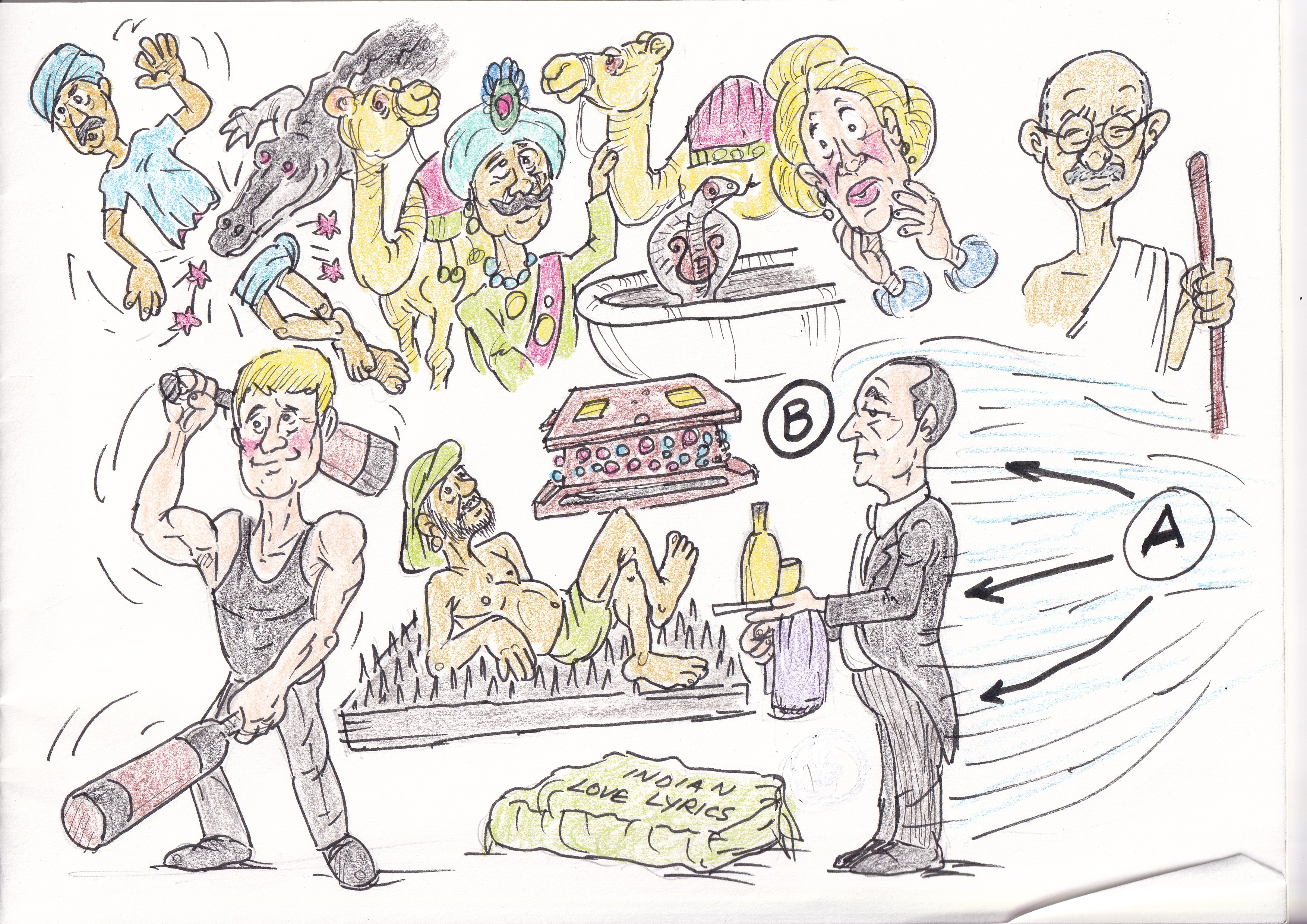






 ashokbhatia