Feeds:
Posts
Comments

Posts Tagged ‘P G Wodehouse’

THE RUSSIAN LITERATURE

Those Russians who could preserve their literary patriotism under the yoke of the school program, and those funny foreigners, who see the novels of Dostoevsky as the principal reason for the study of the Russian language, would scarcely like Wodehouse’s attitude towards Russian literature. The average, more light-hearted reader, however, will definitely approve.

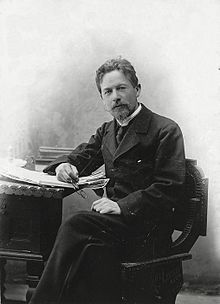
The 1922 story The Clicking Of Cuthbert might be considered the real text-book on Russian literature, but I’ll comment on this further. First, I’ll consider three bearded Russian classics – Chekhov, Tolstoy and Dostoevsky – who symbolise, I presume, the grandeur of the Russian literature in the opinion of the West, and begin with Chekhov, as both the most intently studied and the most frequently quoted by Wodehouse.

I will justify including Chekhov’s plays in a section on ‘Literature’ instead of attributing them to a separate part ‘Russian Theatre’ by pointing out that it was Chekhov’s texts, rather than the work of the directors or the performances of the actors that so depressed Wodehouse’s characters. From novel to novel Bertie Wooster recalled the agonizing experience when he was made by his Aunt Agatha to attend Russian plays at the Old Vic in order to improve the mind of her son Thos (for example, Jeeves in the Offing, ch4).

Admirers of the great Russian writer and dramatist would say that Bertie suffered torments rather because of Thos’s company, than because of Chekhov, but that is not quite right. Bertie had to see Chekhov not only with Thos, but also with Florence Craye at the time of their engagement – when on every Sunday night she took him to see Russian plays, amongst which we can recognize the themes of Chekhov’s Cherry Orchard (see The Mating Season, ch22).

Another character who was not in raptures at the idea of attending a performance of Chekhov’s plays – Seagull, at least – was Roberta Wickham (Jeeves in the Offing, ch4) although not everybody will consider young Bobbie as a competent authority. Especially – as we deduce see from the book – as she herself, unlike Phyllis Mills, never actually saw the play. But we may recollect here the genuine horror of the sweet Lord Uffenham – absolutely not a red-haired girl – when he recalled how an aunt of his once made him take her to something similar (Something Fishy, ch23).

Wodehouse will frequently describe briefly the plots of Chekhov’s plays, and may even name some of the characters, though they are not always spelt correctly. We can thus suppose that Plum was very familiar with the dramatic works of Chekhov, or – to be correct – with those examples which made Wodehouse recall the Chekhov spirit when he put his characters in an atmosphere of distress and misfortune (see, e.g., Big Money, ch7, or The Mating Season, ch2).

Curiously, the first Chekhov appearance in the pages of Wodehouse was absolutely unconvincing. The authorship of the play named Six Corpses in Search of an Undertaker (‘Best Seller’, from Mulliner Nights) was imputed to him. We may suppose that in 1930s Wodehouse knew Chekhov’s works only by hearsay, and that may be why, writing ‘Best Seller’, he produced a title which was a sort of cross between the Pirandello play Six Characters in Search of an Author and the spirit of Chekhov’s. Only by the 1960s and 70s did this spirit, widely quoted in the first half of the century, take the form of real plays with titles and personages.

Moreover, we can see, that by then Russian plays had completely forced out mentions of the Russian novel from Wodehouse’s works, which had been dominant in 1920s and 30s. Even the story of a relation who hanged himself in the barn, which evidently made a deep impression, being referred to several times as emanating from a Russian novel (see, e.g., (Money For Nothing, ch7, 1928), was apparently also found in a Russian drama by 1949 (The Mating Season, ch2).

Wodehouse’s biographers – as well, as experts in Russian literature – probably know the causes of this substitution the Russian novels with plays, but we may suppose that by the 1960s, at the rate at which the inhabitants of Russia were murdering one another, the supply of Russian novelists must have eventually given out.

As for us, we have only to regret the sad tendency of Russian culture to export its most dark and indigestible species. Tolstoy might write joyful comedies, Chekhov humorrous stories and sweet vaudevilles, even Dostoevsky contributed pretty melodrama.

All for nothing! To the annals of the world literature the Russian classic authors are perceived as writers whose collective main character was Grandpapa, who had hanged himself in that barn.

As we turn to the Russian novel, you may recall my earlier comment that the 1922 story ‘The Clicking Of Cuthbert’ might be considered the real text-book on the subject of Russian literature. From this story we learn that by 1922 it was insufficient to be an ‘English’ writer to have real success in the literary walk of life in England. You needed to be Russian or Spanish or similar, and have the mantle of the great Russians descend on you. Undoubtedly, even a top-class golfer such as Cuthbert Banks would have hated to have such misfortune with the mantle happen to him, but in another other golf-story, ‘Rodney Fails to Qualify’ from The Heart of a Goof, the rumour of the period (1924) about the great Russian writers had reached the drawing-rooms of the English intelligentsia, where a discussion on the subject of the Russian thought intruded on the peace of the night.

Now, as we accompany Cuthbert to the Wood Hills Literary and Debating Society meeting dedicated to the famous Russian novelist Vladimir Brusiloff, we learn many interesting things about Russian novelists. Two other Russian writers, Sovietski and Nastikoff, who were mentioned by Raymond Parsloe Devine in his conversation with the famous visitor, did not belong to the generation of the bearded Russian classics. His mastership, however, unlike the false glamour of the two precedents and much more than Mr Devine’s work, might be approved of by competent critics, because Vladimir specialised in grey studies of hopeless misery, where nothing happened till page three hundred and eighty, when the moujik decided to commit suicide. And, as we know, the Russian novelists love to write about grim, ironical, hopeless, grey, despairful situations (‘Ukridge’s Accident Syndicate’, from Ukridge).

Undoubtedly, not all authors or raconteurs are competent to describe these situations. Mr Mulliner, for example, disliked to dwell on the spectacle of human being groaning under the iron heel of Fate (‘Monkey Business’, from Blandings Castle). Wodehouse confessed his own limitations as a writer when he tried to convey a vision of Freddie Rooke trying to obtain a cocktail in a strange club (Jill the Reckless, ch8). Conceding that French or Russian authors would have been more successful, he perhaps spoke modestly, for did not Vladimir Brusiloff assert that only two novelists, Tolstoy and P G Wodehouse might be considered not too bad by comparison with him. Surely the author who had to describe – from novel to novel – the sufferings of Lord Emsworth (see, for example Pigs Have Wings, ch1) merits a place on the same pedestal as such a Great Master of the Russian novel as Leo Tolstoy.

Nevertheless, some things are beyond even the power of the great Russian masters with all their atmosphere and depths of psychology, at least in Mr Mulliner’s (or, rather, his nephew Archibald’s) opinion (‘The Code of the Mulliners’, from Young Men in Spats). And this is a valid opinion which has the right to exist, because the task of the Russian novel is not to describe unhappy love, but the sort of abysmal soul-sadness which afflicts one of Russian peasants when, after putting in a heavy day’s work strangling his father, beating his wife, and dropping the baby into the city reservoir, he turns to the cupboard, only to find the vodka-bottle empty (Jill the Reckless, ch8).

It is no secret that amongst the numerous girls to whom Bertie Wooster was more or less engaged, those who intended to jack up his soul definitely sought assistance from Russian literature. Earlier I mentioned Bertie’s enforced visits to watch Chekhov. Bertie may have been lucky that Vanessa Cook didn’t make him start his reading with Turgenev and Dostoevsky (Aunts Aren’t Gentlemen, ch15), but she, as Florence Craye before her (Jeeves and the Feudal Spirit, ch3) insisted on Tolstoy. Bertie doesn’t mention what particular reason Florence Craye had to select a ‘perfectly frightful thing by Tolstoy’ when she dashed the mystery thriller from his hand, but Vanessa Cook, inspired by his statement that twiddling the fingers was a good alternative to smoking (Aunts Aren’t Gentlemen, ch10), and having been trying to get Bertie to lose this bad habit, undoubtedly saw a way to kill two birds with one stone.

However, we must say, that the endeavours of Vanessa Cook weren’t entirely useless. While reading Tolstoy in the days of his engagement to Florence Craye had not furthered Bertie’s intellectual level (nor, it seemed, improved his memory), Bertie did learn during the course of an instructive conversation with Jeeves that Count Tolstoy – by then already the late Count Tolstoy – was a famous Russian novelist, not a bosom pal of Vanessa’s. And we can only regret that nobody told Bertie that Turgenev and Dostoevsky, who may have been a couple of Russian exiles who did a bit of writing on the side, had definitely never met Vanessa in London.

To summarise, then, we may affirm that if Wodehouse had to organise a gathering of Russian novelists (perhaps as envisaged in The Girl on the Boat, ch2), the first writers he would invite would be Chekhov and Tolstoy, followed, probably, by Dostoevsky and Turgenev. It is very interesting, that the first reference to Maxim Gorky (in Love Among the Chickens, ch10 (1906)) which envisaged his being invited to dinner with the Czar, was updated in the revised edition in 1920 so that now he was dining with Trotsky! But the suggestion that if he had been invited to lunch by Trotsky to meet Lenin, Gorky might sit down and dash off a trifle in the vein of Stephen Leacock seems unreasonable, when the presence even of Trotsky’s photograph can turn a drawing-room into the mise en scène of a Russian novel (‘The Purification of Rodney Spelvin’, from The Heart of a Goof).

As I finish the part of my researches devoted to Russian culture, I would like to invite real connoisseurs of Russian literature, to suggest which of Tolstoy’s novels Wodehouse was parodying in Jill the Reckless , ch9, with the sad story about the Russian peasant who found the vodka bottle empty after his hard, but tragic, day’s work. Or to identify the author and title of the Russian novel (or drama) where Grandpapa (or Ivan) hanged himself in the barn*, assuming that it is not in fact. Maxim Gorky’s play The Lower Depths, which seems to be the only Russian classical play in which a character did actually hang himself.

Finally, I can only add, that the novel By Order Of The Czar, which Bertie Wooster selected as his preferred reading in Aunts Aren’t Gentlemen (ch14) was undoubtedly not written by Leo Tolstoy, even under another name. Jeeves said so, and that’s good enough for me, so I do not consider this reference (even with the Czar in its title) to be a valid Russian one.

* After the article was already published I found out that a mujik committing suicide appears in Leo Tolstoy story Polikushka – though it is a garret, not a barn, in which the title character hangs himself. Moreover, a movie based on this story was released in 1922, starring Ivan Moskvin and Vera Pashennaya, two great Russian actors of that time. It may be possible that Plum had seen this movie, more so that if he had read the story.

Masha Lebedeva

Masha Lebedeva infests the environs of Moscow and suffers from the delectable affliction of Wodesousitis since 1992 or so. She is a member of both the UK Wodehouse Society and The Wodehouse Society (USA). She has written essays on Wodehouse, undertaken themed tours and has even attended as many as 4 TWS Conventions so far, hobnobbing with Plum fans on both sides of the Atlantic. With the help of The Russian Wodehouse Society (TRWS), she has organized an Old Home Week in Moscow.

The excrept you read here is a part of her scholarly research on all things Russian in the Wodehouse canon, titled ‘The Russian Salad’. The series covers the following facets: Russian Culture, Russian History and Russian Spirit. Its Russian version of her work has earlier appeared on the TRWS website; the English version having been serialized in Wooster Sauce, with huge help of accomplished Wodehouseans from different parts of the world.

Her permission to reproduce her work here is gratefully acknowledged.

(Related Post: https://ashokbhatia.wordpress.com/2021/05/16/p-g-wodehouses-russian-salad-masha-lebedeva-part-1)

Read Full Post »

ashokbhatia's avatarashokbhatia

There come some truly humbling moments in one’s life when, while imagining that one’s Guardian Angels are surely in a benevolent mood, one suddenly wakes up to a reality which appears to be quite to be contrary. Scales fall from one’s eyes. One realizes with sudden horror that one had perhaps been promoted to the post of an honorary Vice President of the Global Association of Morons, exuding negative vibes to all the hapless souls around. Or, as P G Wodehouse would have put it, one looks ‘like the hero of a Russian novel debating the advisability of murdering a few near relations before hanging himself in the barn.’ 

Yours truly was recently in a suburb of a city known as Trondheim in Norway. Nudged by my hosts, I had decided to take a walk on a relatively lonely road overlooking the fjord. Seagulls were having a gala time…

View original post 1,023 more words

Read Full Post »

THE RUSSIAN CULTURE

The Russian Ballet

The Russian Ballet as the cultural phenomenon of world-wide fame certainly couldn’t be ignored by Wodehouse, especially because it was a subject which the English intelligentsia was ready to discuss both in 1917 (Piccadilly Jim, ch9) and in 1931 (‘The Voice from the Past’, from Mulliner Nights). The Russian Ballet theme figured even in the knockabout cross-talk acts at village-halls up and down the country (The Mating Season, ch9 and 22). We can only regret that Wodehouse – unlike the guests of Mrs Pett – wouldn’t give his attention to the inner meaning of the Russian Ballet, but concentrated upon its outward manifestations, although he did once tell us about the famous Swan Lake (Bachelors Anonymous, ch10).

Here and there Wodehouse mentions the Russian ballet dancer – sometimes unnamed, sometimes Nijinsky. I decided not to attribute to Russia quotations such as ‘He spun round with a sort of guilty bound, like an adagio dancer surprised while watering the cat’s milk’ from Joy in the Morning, ch3, as I don’t wish to deprive other countries’ dancers from certain merits in the sphere of ballet.

Mostly, Wodehouse prefers to describe this and that step of the dancer to express, first of all, this and that state of mind of the character. It may be an unexpected pleasure, when Jeff d’Escrignon, learned of Mr. Clutterbuck’s plan to sell a hundred thousand copies of his book (‘The Ritz grillroom did a Nijinsky leap before Jeff’s eyes’, French Leave, ch8(1)); or something more unpleasant, as when Bingo Little realised that Mrs Bingo knew all (‘…the offices of Wee Tots did one of those entrechats which Nijinsky used to do in Russian Ballet’, ‘Bingo Bans the Bomb’, from Plum Pie). The reference might be to a mere expectation of unpleasantness, as when Bertie Wooster was on the very brink of his next engagement to Madeleine Basset (‘The mice in my interior had now got up an informal dance and were buck-ad-winging all over the place like a bunch of Nijinskys. The Mating Season, ch10).

It was not only a restaurant grill-room, but even a respectable liner such as the Atlantic which could behave like a Russian dancer and lower Nijinsky’s record for leaping on the air and twiddling the feet before descending, though in fairness to the ship we should add that its behaviour was caused by a terrible storm (The Luck of the Bodkins, ch13).

Wodehouse characters who themselves acted like Russian dancers should certainly be at least partly excused for their behaviour. In fact, from the List of quotations, you can see that Lord Emsworth, Bream Mortimer and James Corcoran shouldn’t be blamed very much at all, because they made the Ballet pas whilst under considerable stress. Especially we should excuse Mr Trout (Bachelors Anonymous, ch10), who had been floating about the room like something out of Swan Lake because of pure love which had suddenly come to him.

As for the case of Adrian Peake, he undoubtedly should refrain from jumping ‘with a lissom grace, like something out of the Russian ballet’ (Summer Moonshine, ch6). His action resembles Cyprian Rossiter’s adroitness in avoiding a blow from a dagger. (‘If he fails as a critic, there is always a future for him as a Russian dancer’, ‘The Man who gave up Smoking’, from Mr Mulliner Speaking).

Far more revolting is the situation, when the Brinkley Court servants, dancing at a country house ball, make Bertie Wooster think he might as well be living in the middle of the Russian Ballet (Right Ho, Jeeves, ch22). A similar remark may be addressed to Mr Slingsby after springing forward with war-cries and treading on a casual golf-ball (‘The Spot of Art’, from Very Good, Jeeves).

It is curious that the female characters in Wodehouse’s works exhibit rather an enviable restraint and are rarely found practising steps from the Russian Ballet. Marcia Ferris, an early fiancée of Tipton Plimsoll did so (Galahad at Blandings, ch10(1)), but otherwise we have to turn to Mrs Fisher, who contrived to turn even golf into the Russian Ballet, for assistance (‘Keeping in with Vosper’, from The Heart of a Goof).

Masha Lebedeva

Masha Lebedeva infests the environs of Moscow and suffers from the delectable affliction of Wodesousitis since 1992 or so. She is a member of both the UK Wodehouse Society and The Wodehouse Society (USA). She has written essays on Wodehouse, undertaken themed tours and has even attended as many as 4 TWS Conventions so far, hobnobbing with Plum fans on both sides of the Atlantic. With the help of The Russian Wodehouse Society (TRWS), she has organized an Old Home Week in Moscow.

The excrept you read here is a part of her scholarly research on all things Russian in the Wodehouse canon, titled ‘The Russian Salad’. The series covers the following facets: Russian Culture, Russian History and Russian Spirit. Its Russian version of her work has earlier appeared on the TRWS website; the English version having been serialized in Wooster Sauce, with huge help of accomplished Wodehouseans from different parts of the world.

Her permission to reproduce her work here is gratefully acknowledged.

Read Full Post »

When the Delicately Nurtured Get Ahead

He admired Joan’s courage, he was relieved that her venture had ended without disaster, and he knew that she deserved whatever anyone could find to say in praise of her enterprise: but, at first, though he tried to crush it down, he could not help feeling a certain amount of chagrin that a girl should have succeeded where he, though having the advantage of first chance, had failed. The terms of his partnership with Joan had jarred on him from the beginning.

A man may be in sympathy with the modern movement for the emancipation of woman and yet feel aggrieved when a mere girl proves herself a more efficient thief than himself. Woman is invading man’s sphere more successfully every day; but there are still certain fields in which man may consider that he is rightfully entitled to a monopoly–and the purloining of scarabs in the watches of the night is surely one of them.

Obesity

On the theory, given to the world by William Shakespeare, that it is the lean and hungry-looking men who are dangerous, and that the “fat, sleek-headed men, and such as sleep o’ nights,” are harmless, R. Jones should have been above suspicion.

The Gravity of Challenges

Trouble, after all, like beauty, is in the eye of the beholder.

The Perks of an Advanced Age

Among the compensations of advancing age is a wholesome pessimism, which, though it takes the fine edge off of whatever triumphs may come to us, has the admirable effect of preventing Fate from working off on us any of those gold bricks, coins with strings attached, and unhatched chickens, at which ardent youth snatches with such enthusiasm, to its subsequent disappointment. As we emerge from the twenties we grow into a habit of mind that looks askance at Fate bearing gifts. We miss, perhaps, the occasional prize, but we also avoid leaping light-heartedly into traps.

As we grow older and realize more clearly the limitations of human happiness, we come to see that the only real and abiding pleasure in life is to give pleasure to other people.

When the Heart Stands Still

To say that Baxter’s heart stood still would be physiologically inexact. The heart does not stand still. Whatever the emotions of its owner, it goes on beating. It would be more accurate to say that Baxter felt like a man taking his first ride in an express elevator, who has outstripped his vital organs by several floors and sees no immediate prospect of their ever catching up with him again. There was a great cold void where the more intimate parts of his body should have been.

The Perils of Handling a Millionaire

Success had made Mr. Peters, in certain aspects of his character, a spoiled child.

At the moment when Ashe broke the news he (Mr. Peters) would have parted with half his fortune to recover the scarab. Its recovery had become a point of honor. He saw it as the prize of a contest between his will and that of whatever malignant powers there might be ranged against him in the effort to show him that there were limits to what he could achieve. He felt as he had felt in the old days when people sneaked up on him in Wall Street and tried to loosen his grip on a railroad or a pet stock. He was suffering from that form of paranoia which makes men multimillionaires. Nobody would be foolish enough to become a multimillionaire if it were not for the desire to prove himself irresistible.

The Honourable Freddie hated piercing stares. One of the reasons why he objected to being left alone with his future father-in-law, Mr. J. Preston Peters, was that Nature had given the millionaire a penetrating pair of eyes, and the stress of business life in New York had developed in him a habit of boring holes in people with them. A young man had to have a stronger nerve and a clearer conscience than the Honourable Freddie to enjoy a tete-a-tete with Mr. Peters.

Of Cat Fights

The unpleasantness opened with a low gurgling sound, answered by another a shade louder and possibly more querulous. A momentary silence was followed by a long-drawn note, like rising wind, cut off abruptly and succeeded by a grumbling mutter. The response to this was a couple of sharp howls. Both parties to the contest then indulged in a discontented whining, growing louder and louder until the air was full of electric menace. And then, after another sharp silence, came war, noisy and overwhelming.

Standing at Master Waffles’ side, you could follow almost every movement of that intricate fray, and mark how now one and now the other of the battlers gained a short-lived advantage. It was a great fight. Shrewd blows were taken and given, and in the eye of the imagination you could see the air thick with flying fur.

Louder and louder grew the din; and then, at its height, it ceased in one crescendo of tumult, and all was still, save for a faint, angry moaning.

Pleasures of the Table

Occasions of feasting and revelry like the present were for him so many battlefields, on which Greed fought with Prudence.

(Related Post:

https://ashokbhatia.wordpress.com/2021/04/30/some-evergreen-life-lessons-from-something-fresh-part-1)

Read Full Post »

When the Wooer is a Persistent Superman

George Emerson is a persistent wooer. He is genuinely concerned about Aline getting thinner and paler since her arrival at the Castle, for which he holds her father responsible. The diet of the father of the wooed is the father’s personal problem, but for his daughter to support him by declining baked meats and restrict herself to some miserable vegetable dishes, is, he thinks, his problem. That is how he painstakingly assembles the tray which he intends to deliver at her doorstep late in the night. Unfortunately, laws of nature ensure that he collides with Ashe Marson on the staircase, rendering his efforts null and void, what with the cold tongue and its adjuncts getting strewn about the hall.

It never occurs to him that he is often offensively patronizing towards Aline. Supermen are made of a stern stuff of this kind.

By the end of the narrative, we conclude that perseverance is an essential part of the wooing process. Concern for the well being of the party of the other part, aided by a dash of chivalry and humility, also helps. His parting words to Aline are soaked in humility.

‘Why I should have imagined that there was a sort of irresistible fascination in me, which was bound to make you break off your engagement and upset the whole universe simply to win the wonderful reward of marrying me, is more than I can understand.’

Eventually, he wins her over; both the wooer and the wooed elope together. 

It is another matter that it was subsequently held by Mr Beach and Mrs Twemlow that the social fabric of the Castle never fully recovered from an upheaval of this magnitude.

Delegation, not Abdication

Like many other whodunits of his, Plum brings in R Jones as a villain who, having already pocketed a sum of five hundred pounds, plans to lay his hands on the scarab by wrongfully asserting that his letters to Joan are yet to be destroyed. An imaginative intervention by Ashe Marson saves the day.

Herein lie many lessons for all those young men of the upper classes with large purses and small foreheads. One is to refrain from putting their sentiments on record. Another is to delegate a task to an intermediary but not allow it to become a case of abdication owing to blind trust. Keep a check over the ambitions of an intermediary who poses as a friend, philosopher and guide but has eyes only on the green stuff.     

A Dash of Spirituality

Spirituality is often misconstrued to cover visions of ghosts of those who kicked the bucket quite some time back, or a magic wand of some kind, or the odd allusions to exotic and unintelligible mantras which seers recite while seated in a circle around a raging fire somewhere deep within a far off forest in an Eastern country.

My humble proposition is that it is nothing of this kind. It is the presence of an exotic combination of diverse qualities in a human being: Sincerity, Humility, Gratitude, Perseverance, Aspiration, Receptivity, Progress, Courage, Goodness, Generosity, Equality and Peace.

It involves nerves of chilled steel; a capacity to rise after each fall in life; not getting unduly uplifted by successes or depressed by failures; milk of human kindness; empathy; comprehending the psychology of another and offering comfort accordingly; remaining focused on one’s duty; an ability to encourage dissent amongst team members; being detached with what does not really matter; following good values and ethics in whatever one does, controlling our desires and fragile egos, and the like.

If Joan is a role model when it comes to failing and rising up to one’s higher self and being empathic, Ashe shows us how to have a chin up attitude and develop a sense of equanimity. Both aspire for progress and are receptive to feedback. The nonchalant manner in which Freddie reacts to the news that his fiancée has eloped with her lover is yet another example of equanimity. In the relationship between Aline and Joan, if the former has a sense of gratitude, the latter is a hallmark of sincerity.

Baxter is a great example of being committed to his duties and controlling his ego to lump public rebukes from Lord Emsworth. The latter presents to us a fine example of being at peace with his inner self. He may detest Freddie but is generous enough to offer him a trip to London so as to help him recover from the apparent trauma of having lost his fiancée to someone else.

The self control and discipline displayed by Mr Peters tells us how to control one’s desires. For him, improving his health is as important a task to be accomplished as a business goal to be achieved.   

A unique trait provided by nature to Homo sapiens is their ability to play a dual role at the same time – that of the ‘viewer’ and the ‘viewed’. Not many of us recognize and consciously develop this rare quality. An absence of introspection means the bliss of solitude is never enjoyed and an inner compass never used. One ends us missing the trees for the woods of life by not taking a strategic view of things.

Something Fresh also tells us that giving pleasure to others is a goal worthy of pursuing.

As we grow older and realize more clearly the limitations of human happiness, we come to see that the only real and abiding pleasure in life is to give pleasure to other people.

Fans of Plum all over the world would heartily acknowledge that he has always delivered satisfaction on this count.

Developing Spiritual Traits

How can one develop such qualities? Both nature and nurture play a role, I believe. Our inner software enables it. Also, the more challenges we face in life, the faster we run on the track of our evolution.

Take the case of Joan Valentine. Her life has been like a dusty road, filled with potholes of weekly bills to be settled. Her father is said to have been quite rich; he had died a pauper, sans any insurance.  After coming to London, she has done pretty nearly everything to keep the wolves away. She has worked in a shop, gone on to stage, and a myriad other things. She is sick of fighting. She wants money and ease. She is no longer interested in a life full of jerks. She is looking for a phase which is solid and continuous.

Because of the kind of setbacks she has had in life, she has developed a sense of compassion and empathy. She turns out to be a great comforter friend for Aline.

Shaken by the sudden elopement of Aline with George, she shares her innermost thoughts and vulnerabilities with Ashe Marson, who loses no time in expressing his feelings towards her and proposing to her. She accepts.

The moral of the story: a better connection with one’s own self, coupled with a higher level of consciousness, can facilitate spiritual growth. A tendency to soliloquize could initially help. Hamlet would heartily approve of the sentiment.  

A Balm for the Wounded Soul

Wodehouse is not necessarily about escapism in the guise of farcical butlers, spoiled nephews and nosy and overbearing aunts. His works also contain philosophical insights and hidden truths of life.

He paints a vast canvas for us to relish in each of his narratives. Something Fresh is no exception. The storyline may appear thin but there are deeper layers waiting to be discovered in the narrative. There are gems which, if discovered, brooded and acted upon, can lead us to live happier and healthier lives.

The wit, the wisdom and the pristine humour of his canon offer a concoction which is truly a balm for a wounded soul.

(Notes:

  1. For some other perspectives on Something Fresh, please check out: https://ashokbhatia.wordpress.com/2015/06/28/blandings-centenary-something-fresh-by-p-g-wodehouse, and https://ashokbhatia.wordpress.com/2021/03/05/book-review-something-fresh
  2. In case a similar analysis of The Code of the Woosters would interest you, please check out the series of posts beginning from the following one: https://ashokbhatia.wordpress.com/2014/10/20/bertie-wooster-and-the-art-of-breaking-bad-news-gently.)

Related Posts:

Read Full Post »

A Singular Absence of Morality

Once the Cheops of the Fourth Dynasty goes missing and the needle of suspicion points to a forgetful Lord Emsworth, Mr Peters veers around to the view that:

‘There’s no morality among collectors, none.’

Rupert Baxter, having served collectors in a secretarial capacity earlier in his career, also knows that collectors who would not steal a loaf of bread even if they are starving do fall before the temptation of a coveted curio.

A Female Who Aims to Break the Glass Ceiling

The feisty heroine of Something Fresh could well be a role model for the younger females who have to bear with prying eyes, eve teasing and inappropriate advances in all spheres of life. This is how Plum describes her at one stage:

Her eyes were eyes that looked straight and challenged. They could thaw to the satin blue of the Mediterranean Sea, where it purrs about the little villages of Southern France; but they did not thaw for everybody. She looked what she was–a girl of action; a girl whom life had made both reckless and wary–wary of friendly advances, reckless when there was a venture afoot.

While ticking off Ashe Marson on the subject of who steals the scarab, this is how she retorts:

‘That’s simply your old-fashioned masculine attitude toward the female, Mr. Marson. You look on woman as a weak creature, to be shielded and petted. We aren’t anything of the sort. We’re terrors! We’re as hard as nails. We’re awful creatures. You mustn’t let my sex interfere with your trying to get this reward. Think of me as though I were another man. We’re up against each other in a fair fight, and I don’t want any special privileges. If you don’t do your best from now onward I shall never forgive you.’

Gone are the days when the parents would urge upon their daughters to leave for their husband’s home and hearth with a submissive attitude, meekly submitting to the demands of her newly acquired family. It was like a one-way ticket, the only escape route being death.

Armed with a decent education, a higher level of literacy and renewed self-confidence, females no longer submit to bullying by the party of the other part. They demand a life of self-respect and dignity. They aim to break as many glass ceilings as they possibly can.  

Like many of his other heroines, Plum has been prescient in modeling Joan as an emancipated individual in a misogynistic society. He modeled her close to a century back, when Rosa Parks was an unknown name and the feminist movement was beyond anyone’s imagination in the Western world.      

The Perks of Being Woolly Headed

Many of us take a liking to Lord Emsworth, simply owing to his woolly headedness. His memory span is rather short, thereby leaving his mind uncluttered and relatively free to potter about in his gardens, taking care of the Empress of Blandings and, occasionally, an odd pumpkin or two. One suspects that his worries, if any, are limited only to what he is passionate about.     

Except for a few of life’s fundamental facts, like the drawer in which his cheque book is and that he has a young idiot like Freddie on his hands as a son, he does not remember anything for more than a few minutes. He could always rely on Rupert Baxter, his indefatigable secretary, to supply any other information that may become necessary.

Thus, he may be accused of lacking in subtler emotions of life, but he leads an extremely happy life. A success does not unduly uplift his spirits, nor does a failure dampen his spirits too much. In other words, he is already living a life based on the principle of detachment and equipoise recommended by Bhagavad Gita, the 5,500 years old scripture of Indian origin.

The secret of his state of happiness is that he does not worry too much about things which are beyond either his areas of interest or control. Whereas lesser mortals like us are often twiddling our thumbs trying to figure out the ways and means of controlling a surging pandemic, the future of humanity in the face of rapid advances in technology, global warming and even the political aspirations of a wannabe super power on the global front, he, blessed with a deep sense of contentment, keeps attending to the the Achillea, the Bignonia Radicans, the Ampanula, the Digitalis, the Euphorbia, the Funkia, the Gypsophila, the Helianthus, the Iris, the Liatris, the Monarda, the Phlox Drummondi, the Salvia, the Thalictrum, the Vinca and the Yucca in his extensive gardens.  

He shows us that the key to leading a happy life lies not in worrying but being contented with what life has already offered one.    

Securing an Opening and Being Disobedient  

When Ashe Marson walks into Mr Peter’s den for securing an assignment, he is full of gall. Looking the boss in the eye and giving it back to him occasionally earns him not only the assignment but also a long term career offer. The diet-exercise regime unleashed upon him to cure his dyspepsia gradually starts showing results. The employer-employee relationship here has a dash of disobedience on part of the latter but it does get results.

‘You’re a wonder,’ said Mr Peters. ‘You’re sassy and you have no respect for your elders and betters, but you deliver the goods. That’s the point. Why, I am beginning to feel great.’

After the scarab is restored and the assignment at hand is over, Mr Peter is impressed enough to offer him a career in watching over his health. He graciously accepts the offer to shift base to America, along with Joan Valentine, the love of his life. We are already aware that Ashe is conscious that a future in which Joan did not figure would be so unsupportable as not to bear considering.

Alas, much like Psmith and Eve of the Leave it to Psmith fame, both are never heard of again anywhere else in the canon.  

Thinking on One’s Feet

In the servant’s hall, when the true identity of Joan Valentine comes under focus, Ashe is quick to divert the group’s attention by imitating a fight between cats. This amuses the group no end and his popularity index goes up quite a notch.

Of Literature and Mental Prowess

In his earlier days, Freddie Threepwood had been persuaded to experiment with high brow literature in Greek, Latin and English. But he had shown a sheep-like stolidity in declining the rich fare. However, the Adventures of Gridley Quayle brought romance and excitement into his otherwise dull life. He had finally found the kind of literature that suited his mental prowess.

While devouring one of the escapades of the famed detective, he prefers to be left all alone. He objects to his reveries broken in upon not only by officious relatives but even by Aline, his fiancée. His inclination to relish his solitude makes her scratch the fixture and return him to store.

The Art and Science of Investigation

Courtesy Ashe Marson, we also get an inkling of the kind of tactics detectives apply to crack a case. They have their own methods. Inductive reasoning is one. A dash of intuition is another. Being a pitiless observer while remaining invisible is yet another. Waiting for coincidences is another important ingredient in cracking a case.

Sleuths at Scotland Yard and at similar other outfits might find these inputs of some use.    

Suspecting Everything

The Efficient Baxter earns his living by suspecting everything around him. His chief characteristic is a vague suspicion of his fellow human beings. He does not suspect them of any definite crime; he simply suspects them. Miss Willoughby describes him as a Nosy Parker.

His sense of duty deserves to be emulated. He takes a proprietary interest in all things at the Castle. His whole being revolts at the thought of allowing the sanctity of the museum to be violated. He performs his duties even by enduring considerable discomforts, physical as well as mental.

Nature has not intended him to be a night-bird. But he spends nine consecutive nights keeping a strict vigil on the proceedings on the ground floor hall from a discreetly placed chair in the gallery which runs above it. Alas, the suspect does not walk into the trap.

In the call of duty, he even undergoes mental anguish and withstands a public rebuke from Lord Emsworth. After an unpleasant encounter on the staircase, he manages to survive as many as six bullets fired in dark from the latter’s pistol. When the lights get switched on, he is found on the floor, duly accompanied by a cold tongue, a knife, a fork, some bread, a corkscrew and a bottle of white wine.    

The monstrous accusation he earns by way for a reward of his efforts is narrated thus:

‘My dear Baxter, if your hunger is so great that you are unable to wait for breakfast and have to raid my larder in the middle of the night, I wish to goodness you would contrive to make less noise about it. I do not grudge you the food — help yourself when you please — but do remember that people who have not such keen appetites as yourself like to sleep during the night. A far better plan, my dear fellow, would be to have sandwiches or buns — or whatever you consider most sustaining — sent up to your bedroom.’

Besides being a ceaseless vigilante, he also uses tact. Nipping Mr Pater’s do-it-yourself approach towards recovering the scarab in the bud, he does not embarrass his guest. Rather, he speaks of Mut and Bubastis, of Ammon and the Book of the Dead.

Those who wish to shine in their careers could draw a lot of inspiration from Rupert Baxter.

Related Post:

Some Evergreen Life Lessons from ‘Something Fresh’ (Part 1)

Read Full Post »

When it comes to the oeuvre of P G Wodehouse, Stephen Fry says that ‘You don’t analyse such sunlit perfection, you just bask in its warmth and splendour.’

With due respects to him, yours truly would beg to differ. As someone who suffers from the 3rd and final stage of a pleasurable affliction alluded to as Wodehousitis, I cannot but analyse the sunlit perfection of his narratives. In a world full of hatred and conflicts, one survives on the metaphorical juice of the oranges of his whodunits. Unless one analyses, one does not extract the maximum possible juice out of these luscious oranges. My Guardian Angels have conspired thus, and I just cannot help myself.

Allow me, therefore, to capture here some of the life-enriching lessons which dot the vide canvas of one of his works, Something Fresh – tips on well being, riding the socio-economic divide, the spirit of enterprise, the art and craft of delegating tasks, communication, exploring career options, the art of badmouthing seniors, becoming indispensable, suspecting everything, the true meaning of chivalry, being a superman, expressing one’s love, behaving like a millionaire, avoiding nervous breakdowns, being spiritual and the like.

By no means are these exhaustive. Many of you may have a different view of this work of Plum’s. Well, here is my humble take.

Health is Wealth

Following the prescription dished out by Ashe Marson – Larsen Exercises (all twenty nine of these), scientific deep breathing, cold baths and brisk walks –  helps one to remain as fit as a fiddle. Plenty of fresh air and no cigars are highly recommended. Cities may resent exercising in the open. But perseverance pays, and a sense of indifference sets in soon enough. Owners of nearby hotels, if any, regard one without a smile. The hotel employees continue to perform their duties impassively. The children are no longer interested in looking at one. Even the cat keeps rubbing its backbone against the railings unheeding.    

A frugal diet based on nuts and grasses helps. Understandably, this needs nerves of chilled steel, denying the sumptuous feast which would invariably be on offer. Prudence needs to prevail over greed. Pleasures of the table are best forsaken. Of course, it helps to have loving daughters like Aline Peters around who will do likewise and set a fine example for their fathers to behave. They themselves may suffer pangs of hunger at night. Their turning pale and thin may get commented upon by aspiring lovers. But the feudal spirit must prevail.  

Even the chewing habits assume significance. Lord Emsworth is of the view, as shared by him with Adams, the head steward at the Senior Conservative Club, that partaking large mouthfuls of food amounts to one digging one’s own grave with one’s teeth. Food should never be gobbled, he believes; Americans do this when young and ruin their digestion. Each mouthful needs to be chewed at least 33 times before being allowed to slide down the hatch.

Mr Peters shows to us that it is fatal to get angry at meals. His case proves that temper and indigestion are positively correlated with each other; as one goes a notch higher, so does the other. Thinking beautiful thoughts helps. Earlier, he had been advised by a New York specialist to avoid nervous breakdowns by taking up a hobby. That is how he had become an avid collector of scarabs.  

Even Baxter is aware that insufficient sleep made a man pale and sallow, and he had always aimed at the peach-bloom complexion which comes from a sensible eight hours between the sheets.   

Life Below the Stairs  

Something Fresh presents to us a sneak peek into the life below the stairs in a castle.  

It takes a bevy of servants to keep things running in an orderly fashion at Blandings Castle. There is a rigid hierarchy here, backed by customs and rituals which need to be scrupulously observed. Under the auspices of Mr Beach and Mrs Twemlow, things are always done properly at the Castle, with the right solemnity. There are strict rules of precedence among the servants. A public rebuke from the butler is the worst fate that can befall a defaulting member of this tribe.

Kitchen maids and scullery maids eat in the kitchen. Chauffeurs, footmen, under-butlers, pantry boys, hall boy, odd man and steward’s-room footman take their meals in the servants’ hall, waited on by the hall boy. The stillroom maids have breakfast and tea in the stillroom, and dinner and supper in the hall. The housemaids and nursery maids have breakfast and tea in the housemaid’s sitting-room, and dinner and supper in the hall. The head housemaid ranks next to the head stillroom maid. The laundry maids have a place of their own near the laundry, and the head laundry maid ranks above the head housemaid. The chef has his meals in a room of his own near the kitchen.

There is not much of a behavioural difference between our corporate citizens and those who work below the stairs. Both love discussing the idiosyncrasies of those above them.

Beach believes that with all the breach of promise cases being foisted on to the rich men, Anarchy is getting the Upper Hand and the Lower Classes are getting above themselves. Rampant Socialism is to be blamed; so are the cheap newspapers, which tempt the Lower Classes to get Above Themselves.       

Compassion for this class of persons is a desirable quality indeed. Towards the very end of the narrative, when Joan feebly objects to Ashe Marson kissing her in the open on the pretext of a scullery-maid looking out of the kitchen window, he responds thus:

‘Scullery-maids have few pleasures. Theirs is a dull life. Let her see us.’

A Contrast in Upbringing

There is a stark difference between the upbringing of Aline Peters and Joan Valentine. This tells us why their attitudes towards life are so very distinct. The contrast between the haves and the have-nots of the society is brought into sharp focus.

One of the compensations Life offers to those whom it has handled roughly is that they can take a jaundiced view of the petty troubles of the sheltered. Just like beauty, trouble is in the eyes of the beholder. Aline may not be able to endure with fortitude the loss of even a brooch whereas Joan has to cope with situations which often mean the difference between having just enough to eat and starving. For the reward of a thousand pounds, she finds it worth her effort to accompany Aline to Blandings Castle as a lady’s maid.

Free Masonry and the Spirit of Enterprise

The narrative also draws our attention to the Free Masonry amongst those live in large cities and on small earnings. Since both Joan and Ashe contribute to two different publications of the Mammoth Publishing Company, an instant bond gets formed between the two. Ashe feels like one who meets a boyhood’s chum on a desert island.

Joan even acts as a muse and helps Ashe overcome his writer’s block, when he is trying to figure out what a wand of death could be.

‘Why, of course it’s the sacred ebony stick stolen from the Indian temple which is supposed to bring death to whoever possesses it. The hero gets hold of it, and the priests dog him and send him threatening messages. What else could it be?’

When Ashe calls himself a failure, Joan is livid and asks him to start something new. Living in the biggest city in the world, she believes, means chances of adventure are simply shrieking to him on every side. She exhorts him thus:

‘Don’t get into a groove. Be an adventurer. Snatch at the next chance, whatever it is.’

Sane advice for entrepreneurs of all hues, sizes and shapes. The ideal adventurer needs a certain lively inquisitiveness. He is not content to mind his own affairs. Joan’s eloquence has the effect of pulling Ashe out of his laziness. His sense of enterprise gets rekindled, prompting him to assist Mr Peters in recovering his scarab, despite the fact that he is not an easy person to work with.

Read Full Post »

While etching out some of the feline and canine characters, P G Wodehouse never fails to amuse, entertain and educate. Many of you may agree that even when he decides to capture the spirit of a hearty brawl among different members of these species, he excels himself.

Consider these fight scenes captured by him.  

‘The unpleasantness opened with a low gurgling sound, answered by another a shade louder and possibly more querulous. A momentary silence was followed by a long-drawn note, like rising wind, cut off abruptly and succeeded by a grumbling mutter. The response to this was a couple of sharp howls. Both parties to the contest then indulged in a discontented whining, growing louder and louder until the air was full of electric menace. And then, after another sharp silence, came war, noisy and overwhelming.

Standing at Master Waffles’ side, you could follow almost every movement of that intricate fray, and mark how now one and now the other of the battlers gained a short-lived advantage. It was a great fight. Shrewd blows were taken and given, and in the eye of the imagination you could see the air thick with flying fur. Louder and louder grew the din; and then, at its height, it ceased in one crescendo of tumult, and all was still, save for a faint, angry moaning.’

(Something Fresh)

‘There is about any dog fight a wild, gusty fury which affects the average mortal with something of the helplessness induced by some vast clashing of the elements. It seems so outside one’s jurisdiction. One is oppressed with a sense of the futility of interference. And this was no ordinary dog fight. It was a stunning mêlée, which would have excited favourable comment even among the blasé residents of a negro quarter or the not easily-pleased critics of a Lancashire mining-village. From all over the beach dogs of every size, breed, and colour were racing to the scene: and while some of these merely remained in the ringside seats and barked, a considerable proportion immediately started fighting one another on general principles, well content to be in action without bothering about first causes. The terrier had got the poodle by the left hind-leg and was restating his war-aims. The raffish mongrel was apparently endeavouring to fletcherize a complete stranger of the Sealyham family.

The only reason why dog fights do not go on forever is that Providence has decided that on each such occasion there shall always be among those present one Master Mind; one wizard who, whatever his shortcomings in other battles of life, is in this single particular sphere competent and dominating.

At Roville-sur-Mer it was the red-haired young man. His dark companion might have turned from him in disgust: his services might not have seemed worth retaining by the haughty Scrymgeour: he might be a pain in the neck to “the family”; but he did know how to stop a dog fight. From the first moment of his intervention calm began to steal over the scene. He had the same effect on the almost inextricably entwined belligerents as, in mediaeval legend, the Holy Grail, sliding down the sunbeam, used to have on battling knights. He did not look like a dove of peace, but the most captious could not have denied that he brought home the goods. There was a magic in his soothing hands, a spell in his voice: and in a shorter time than one would have believed possible dog after dog had been sorted out and calmed down; until presently all that was left of Armageddon was one solitary small Scotch terrier, thoughtfully licking a chewed leg. The rest of the combatants, once more in their right mind and wondering what all the fuss was about, had been captured and hauled away in a whirl of recrimination by voluble owners.

(The Adventures of Sally)

Homo sapiens pride themselves on being superior to other species. But the scenarios described above, do these not remind us of bitter fights in our board rooms or even at our homes? The need for a dynamic leader is also brought home so very clearly.

Some introspection would lead us to conclude that when raw anger and impotent rage takes us over, there is little difference between members of different species. In fact, human beings have refined the art far better. We go a step ahead and start fighting others at the mental level, deliberately twisting facts and doing and saying things which would torment the souls of the party of the other part. Avarice and greed overcome our prudence. Human values get thrown out of the window. As to grudges against others, we carry these within us for a very long time, ruining our own health.     

This might well explain why the likes of Augustus and Bartholomew often treat us with a sense of dignified detachment and cast supercilious gazes at us, the lesser mortals.   

(Note: With due respects to Plum, passages quoted above have been slightly edited, so as to focus only on the fight part.)

Read Full Post »

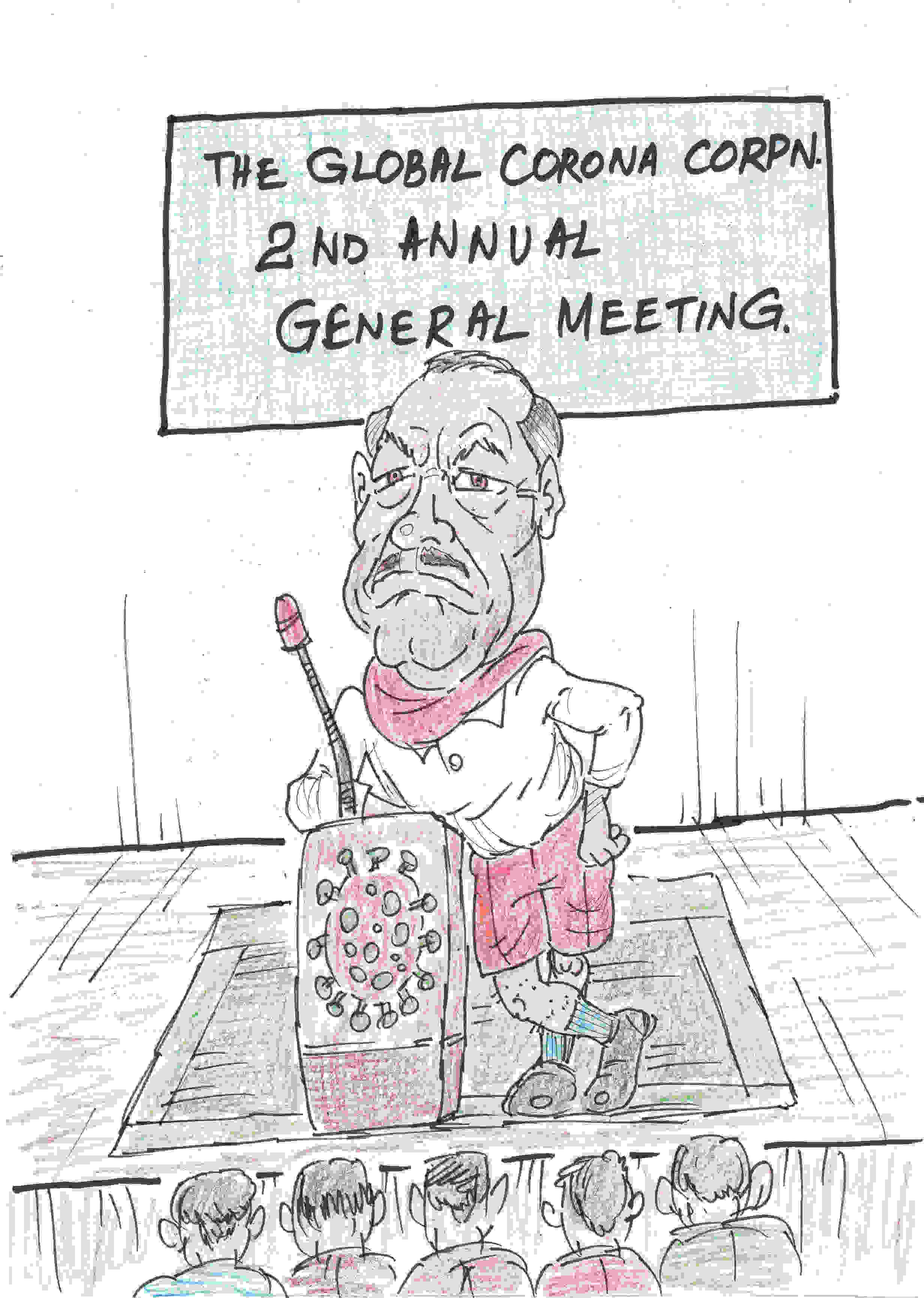
At the 2nd Annual General Meeting of the shareholders of the Global Corona Corporation (GCC), Roderick Spode, the Vice President (Operations) of the company, presented his Annual Report for the period from April 2020 to March 2021.

Here are some of the salient features of his report.

  1. Due to the aggressive marketing policies followed by GCC, brand Covid has captured a major share of the market during the year under reference. As of now, close to 136 million people have suffered from this onslaught, while as many as 2.94 million have kicked the bucket. This has reduced the pressure on the limited resources of our planet.
  2. If the world population is taken to be 7.8 billion, during the last year, GCC has touched a mere 0.02% of human beings. This shows the immense market potential which lies untapped for the products and services of GCC in the times to come. We have already trained an army of Red Shorts volunteering to help us expand our footprints across all the continents. The Honourable Frederick Threepwood, the famous marketing guru who is an expert at selling Donaldson’s Dog Joy biscuits, is already on our panel of distinguished advisors.
  3. Enthused by our success so far and its future potential,  several mutants of the virus have also got launched in quick succession, keeping the Homo sapiens in a continuous state of fear and stress, twiddling their thumbs trying to figure out ways and means of countering the pandemic.
  4. This has spurred a faster transformation to digital ways of handling transactions and led to a faster evolution of Industrial Revolution 4.0. Aunt Dahlia, who had always thrived on communicating by means of telegraphic means, is delighted at the simple life she lives now. Aunt Agatha now resorts to using video calls to give a piece of her mind to her errant nephew, Bertie Wooster.
  5. Reduction of Global CO2 emissions, leading to a cleaner environment, promoting healthier flora and fauna, making Lord Emsworth a happy man.
  6. Fault lines in managing economies have been exposed and the severe limitations of capitalism brought back in focus. Billionaires world over have improved their personal wealth by 54% during the period, while the poor are struggling to keep their body and souls together. Perhaps they followed what Ukridge preached that one accumulates only when one speculates. Those who believe in get-rich-quick schemes based on the stock market are also quickly learning to live with get-poor-quick outcomes instead. Office bearers of the Senior Conservative Club are appalled at the number of nouveau riche billionaires on their waiting list seeking membership.
  7. Globally, politicos heading the so-called democratic countries have been successfully nudged to shed their sheep-wool clothing and instead reveal their wolf-like dictatorial ambitions. Truth has been revealed for the greater good, though human rights and journalistic freedoms have been trampled upon ruthlessly. Taking a leaf out of my own outrage when a prized silver cow creamer goes missing, opposition leaders and intellectuals have been beaten into a jelly. One salutes such leaders who have nerves of chilled steel and would not mind either getting hit by a potato in the eye at election rallies or having to kiss babies dribbling at their mouths at Bonny Baby contests.
  8. Many countries have quickly learnt the art of covering up deficiencies in their economic growth and health infrastructure, keeping their statisticians busy perfecting their models of exponential smoothening. We live in an increasingly macho and muscle-flexing world, aided and abetted by our social media giants, devoid of noisy and argumentative democracies and led by leaders who decide policies based on window-dressed data submitted by Yes-persons around them. The prospects for an unbridled growth of GCC’s operations are indeed brighter.
  9. Companies in several sectors and specialists of hues, sizes and shapes are laughing all the way to their banks: pharmaceuticals, personal hygiene, immunity boosters, physical fitness, motivators, loony doctors, yoga-gurus-turned-business-honchos, management experts, mentors, internet service providers and online streaming platforms launched by the likes of Perfecto-Zizzbaum Corporation, to name only a few.
  10. A massive restructuring of jobs, highlighting the following needs of the businesses: (a) getting rid of the deadwood, (b) rapid re-skilling and (c) downsizing physical infrastructure while encouraging work-from-home. Mike Jackson has already helped organizations to go in for such changes.
  11. In turn, husbands reluctant to learn such home making skills as cooking, cleaning dishes, changing diapers and doing the laundry are mending their ways. They are realizing the true meaning of chivalry, as recommended by Bertie Wooster. Homemakers, overwhelmed by the continuous presence of a dominating spouse and naughty children at home are queuing up for consultations with such loony doctors as Sir Roderick Glossop.   
  12. Getting business owners and CEOs to hone their skills of Decision Making in Extreme Uncertainty, thereby making them hotter on their jobs. In turn, they enrich the syllabi of premier management institutes the world over. Rupert Psmith is now a much sought after consultant on the subject, even helping CEOs to respect values and ethics in their decision making, identify the core purpose of their businesses and thus making their organizations evolve into conscious ones.
  13. Improving the resilience of the hoi polloi who had so far been unable to handle the harsh slings and arrows of Fate with equanimity and aplomb. Reginald Jeeves is conducting some useful workshops to attend to this segment of our operations.
  14. Cupid is busy with his e-initiatives. Betrothed couples keep postponing a walk down the aisle, thereby keeping the tender flame of love alive. This has helped many of them to live through an extended period of intense romance, delaying the mummification of the corpse of love which often takes place after a marriage gets sanctified.
  15. Highlighting the effectiveness of the following anti-depressants: quality time with loved ones, an abundance of the milk of human kindness, literature, fine arts, uplifting movies and humour as effective anti-depressants.
  16. Promoting a healthier lifestyle amongst the couch potatoes by promoting Larsen Exercises, walking, cycling, partaking nourishment which would meet with the approval of Laura Pyke and feasting on tissue restoratives with such ingredients as turmeric, basil and the like.
  17. Spiritual evolution of the human species by allowing them adequate time to connect with their inner selves and practice meditation as well as introspection.

The Annual General Meeting was followed by a world premiere of the award winning movie The Corona Gladiators, presented by Mr Schnellenhamer, the head of the Perfecto-Zizzbaum Corporation.

The premiere was followed by a lavish spread dished out by Anatole, God’s gift to our gastric juices.

On the occasion, all the shareholders also received gift coupons of Eulalie Soeurs, the premium brand of ladies’ lingerie. 

(The GCC grapevine would make us believe that Roderick Spode could soon be promoted to head the company as its Chief Executive Officer.)

(Illustration courtesy Mr Suvarna Sanyal)

(https://ashokbhatia.wordpress.com/2020/07/25/the-corona-gladiators-proposal-for-a-plummy-movie

Read Full Post »

A 90 year young Peggy Mainwaring, a fan whom Plum would like to greet,

Still giggles and stares at speakers who forget speech and shuffle their feet.


As a friendly lion-tamer cast in the Aunt Dahlia mould,

Her steely gaze often demands perfection, though her heart is of pure gold.


Quite a few Berties and Angelas has she dandled on her sprightly knees,

 Brimming over with the feudal spirit, soothing the clan like a gentle breeze.


Her lair is full of hearty laughter, joy and dollops of Plummy bliss,

 Lavish spreads of Anatole-kind greet visitors before they get a parting kiss.


Melodies of the likes of Madan Mohan and Salil Chaudhary waft in the air,

Insightful poems of famous poets get read while she rocks in her chair.


She follows the Laura Pyke regime when it comes to her frugal diet,

Lining of her intestine stands her by, she thinks twice before taking a bite.  


Oh, what a transformation she has witnessed in these 90 years,

Wars, acts of terror and news of genocides have reached her ears.


She may miss fountain pens, LP records and telegrams,

Not to forget a cell-and-internet-free placid life, noisy cars and trams.


She has witnessed a man landing on the moon, a space mission to Mars,

The tragedy of having the time to network with the world but not with ours.


She has seen shrinking TV sets and shorter global hauls,

Several generations passing by, sprouting glitzy malls and highway tolls.


A transition from the rustic sophistication of Varanasi and many a boat ride,

To the hustle and bustle of a metro she has taken in her joyful stride. 


Time sits lightly on her mind and has certainly made her more wise,

Family and friends can lean on her shoulders, despite challenges that arise.


She continues to be young at heart, in her inspiration we find, 

As always, her advice is practical, objective, frank and kind.


With a chin up attitude, the elixir of eternal youth she has already found,

Drinking deep from the rivulets of life, a spirit of joie de vivre profound.


She is just short of ten to hit a century, surely a result of her positivity,

We all salute you, eager to learn more secrets of your longivity.


(Ms Sushama Varma is an avid fan of P G Wodehouse. Her permission to share this composition here is gratefully acknowledged.) 

Related posts:

My dear Clarence

Dear Jasper John, Happy Birthday!


Read Full Post »

« Newer Posts - Older Posts »