Posts Tagged ‘Rabindranath Tagore’
The Indian Curry Dished Out by P. G. Wodehouse
Posted in What ho!, tagged Army, Behavioural Traits, British Raj, Buddhism, Civil Disobedience, Civil Services, Conversations, Customs, English, Fakirs, Fauna, Handicrafts, Hindus, Humour, Hunting, Idols, Independence, India, India Rubber, Indian Clubs, Indian Ocean, Love Calls, Men In Uniform, Mutinies, Mystic Powers, Mythology, NWFP, P G Wodehouse, Partition, Priests, Rabindranath Tagore, Regional Languages, Royalty, Superstitions, Taj Mahal, Temples, Translations, Travel on February 10, 2025| Leave a Comment »
How P. G. Wodehouse helps me to grow spiritually: Guest Post by Suryamouli Datta
Posted in What ho!, tagged Bhagavad Gita, Bosses, Death, Friends, Humour, P G Wodehouse, Rabindranath Tagore, Rajanikant Sen, Spirituality, Spouses, Wisdom, Yamaraj on October 15, 2024| Leave a Comment »

So, you think that P G Wodehouse is only about farcical butlers, upper-class twits, domineering aunts, goofy females, rogue kids, dogs with supercilious gazes, cats that wear snootiness on their sleeves, horses that are fond of cats, and pigs which need their daily quota of 57,800 calories?
Think again, I would say! For, deep within the juicy narratives dished out by the Master Humourist of our times lie buried many lessons of a spiritual kind. These are latent nuggets of wisdom that, if adopted, could enable one to lead a spirited life, facing its ups and downs with a jaunty sang froid.
Baffled, bewildered, confounded, confused, flummoxed, mystified, perplexed, and puzzled?
Allow me to elucidate.
A Journey of Self-Discovery: Embracing the ‘Me First’ Mindset
Any spiritual quest begins with an inner journey of self-discovery. Like Bertie Wooster, one has to be a keen observer of the inner workings of one’s mindset. One should know when to slide down a pipe and when to board a cruise ship to avoid an impending encounter of an unpleasant kind. Self-preservation serves one well. To put it simply, one must have a ‘Me First’ approach to life.
Take my own case. Well, I must say, I happen to be a prime candidate for the “Me First” award, if ever one is instituted by the concerned authorities. You see, I’ve got this knack of putting my own pleasure and happiness on the pedestal, leaving others hanging like a wet sock in the wind.
It’s like that old saying about chasing the rainbow – the closer you get, the further it slips away. So, here I am, with my long face like a dropped pie, whinging about my sorry lot in life. And let me tell you, it’s not a pretty sight.
If I were watching myself on the telly, I’d hand that grumpy old git the remote control and tell him to skip to the next channel, pronto! Because, my friends, a moaner, and a whinger, is about as popular as a caterpillar discovered at the bottom of a bowl of salad.
My dears, we humans are like archers, shooting our arrows of hope into the void, never sure if they’ll hit their mark. I’ve tried everything under the sun, from meditation to listening to hot-air speeches. And let me tell you, spirituality is a tough nut to crack. It’s like trying to peel a banana with oven mitts!

Finding Light in the Darkest Moments: Unravelling the Tapestry of Adversity
Now, I know this is the path to freedom from my woes, but here’s the rub: I can’t seem to figure out the ‘how-to’ manual. It’s like trying to find Waldo in a crowd of walruses. Frustrating, isn’t it? But fear not, for I’m blessed with nerves of chilled steel and am not one to give up easily. I continue my quest, armed with a magnifying glass that remains duly focused on the works of the Master.
My dear compatriots, the pursuit of spirituality proved to be a meandering journey through the labyrinth of existence, a perplexing conundrum that tested the limits of my mortal soul. Alas, in the face of such a formidable challenge, we resilient humans are wont to seek out solutions that may not blaze a trail to perfection, but rather offer a semblance of respite in the stormy seas of life.
As fortune would have it, amidst my quest for spiritual enlightenment, I stumbled upon a veritable treasure trove – the timeless works of Sir Pelham Grenville Wodehouse. Ah, the sheer delight and solace that his writings brought to my weary heart in times of dire need! My lineage, bless their souls, had been perusing his literary masterpieces for generations, paving the way for my own delectable encounter with this literary luminary.
One of the things that captivates me most was the uncanny comportment of Wodehouse’s characters in the face of adversity. Take for instance the indomitable Psmith in “Psmith Journalist”, who maintains an air of nonchalance even when confronted by kidnappers.
Such a profound sense of detachment amidst chaos brings to mind the teachings of the Bhagavad Gita, does it not? Indeed, could we not consider this delightful escapade into the world of Wodehouse as a form of modern-day spirituality? My friends, the parallels are as intriguing as they are enlightening.
The Perks of Forgetfulness and Living in the Present
Ah, Lord Emsworth! A man with an asset so heart-warming that it could melt the frigid polar ice caps – forgetfulness, leading to a habit of living in the present!
In the annals of history, great minds have extolled the virtues of forgetting. Our scriptures enjoin us to live in the present. It’s like dusting off the cobwebs in your attic – why cling to the dusty remnants of the past when you could embrace the sparkling potential of the future?
Lord Emsworth’s forgetfulness is a veritable cornucopia of blessings. It allows him to shed the heavy cloak of past grievances, like an absent-minded hiker shedding a backpack filled with regrets. And behold, he emerges anew, lighter, brighter, and infinitely more lovable to those who grace his presence.
Perhaps the saints of yore sought solace in this blessed amnesia, freeing their spirits to soar among the celestial heights. For in forgetting, we find not only liberation from the shackles of the past but also an uncanny ability to charm the socks off those around us. Thoughts of future encounters with a belligerent sister never fill us with a sense of dread.
In the realm of the spirit, or that which offers me a sense of tranquillity, I find that Wodehouse has bestowed upon me a profound lesson. Lord Emsworth stands as a beacon of hope in this respect. His forgetfulness of past events allows him to embrace the present with an unencumbered mind. Unburdened by the weight of memory, he revels in his solitude, finding pleasure in his own company. As Plum so aptly puts it,
‘Lord Emsworth sat and smoked, and sipped and smoked again, at peace with all the world. His mind was as nearly a blank as it is possible for the human mind to be. The hand that had not the task of holding the cigar was at rest in his trousers pocket. The fingers of it fumbled idly with a small, hard object.’
When he finds a scarab in his pocket, does he not simply conclude that it must have been gifted to him by the American millionaire? Once he starts focusing on the Empress of Blandings, does he ever worry about the pumpkin? He surely practices the delicate art of detachment, spoken of so very highly in our scriptures.
From Being a Self-doubting Thomas to an Opportunity-Grabber
In my annals of domestic disputation, I recall a particular clash with my bitter half. She, with her fervent tongue, extolled the valour of a dear friend who had summoned the intrepidity to pen a social media missive, heedless of any sinister implications. And I, rather than question her judgment, was exhorted to contemplate my own measly progress in the realm of social media.
The aftermath of this matrimonial contretemps was, as one might surmise, somewhat perplexing. I found myself in an odd state of accordance with her sentiments, heaping further ignominy upon my own head. For though my pen may have faltered, I had hitherto cherished the notion that the contemplation of others’ creations and the articulation of my own preferences constituted an inherent privilege.
Yet now, as if by some cruel twist of fate, I could conjure no words for my own use. Unlike some prodigies, blessed with an inexhaustible reservoir of ideas, I had no such celestial aid. Suffice it to say, my aspirations of literary heroism faded before my wife’s eyes, leaving me a mere buffoon engaging in a pathetic display of self-sabotage.
And as I spiralled further into this abyss of self-reproach, a voice whispered through the labyrinth of my mind, a voice I recognized from Joy in the Morning:
‘It was one of those cases where you approve the broad, general principle of an idea but can’t help being in a bit of a twitter at the prospect of putting it into practical effect. I explained this to Jeeves, and he said much the same thing had bothered Hamlet.’
Dear readers, lend an ear to these words that wrought a profound transformation within me. Like a veil lifted from my vision, I beheld the absurdity of my former self-chastisement. A chuckle escaped me, a gentle mockery of the charade that had held sway over my existence.
And so, I cast off the shackles of self-criticism and chose a path of liberation. This, my friends, is spirituality in its purest form—not a celestial embrace or mystical communion, but a triumph over the prison of my self-limiting beliefs. For, in embracing the folly of self-doubt, we find true freedom and the boundless expansiveness of the human spirit.
Though not directly akin to the realm of the spirit, dear reader, I often find solace in the words of P. G. Wodehouse’s The Small Bachelor. When the weight of life’s trials weighs heavy upon my mind, I turn to these lines, finding therein a gentle balm that soothes my troubled heart.
‘That’s the way to get on in the world – by grabbing your opportunities. Why, what’s Big Ben but a wristwatch that saw its chance and made good?’
By Jove, friends! When I hear such stirring words, my very essence is transformed. I feel a surge of vigour coursing through my veins, aided and abetted by a burning desire to embrace uncharted territories. The shackles of doubt and hesitation fall away, replaced by a boundless sense of possibility. Trust me, friends, such words are the catalyst that ignite the flame of adventure within me! So, dear readers, let us raise a toast to such characters as Lord Emsworth, the master of forgetting, Bertie, the epitome of chivalry, and Jeeves, whose sage counsel is akin to the teachings of Bhagavat Gita.

Different Facets of Life and the Transformative Power of Wodehouse
Overcoming Road Rage
Picture yourself on a bustling Monday morning as you prepare to embark on your daily pilgrimage to the office – the place where your purpose perhaps lies. You find yourself surrounded by a sea of cars, all honking impatiently, and scowling faces in desperate search of an outlet for their irritation. In that moment, your motivation wanes, the world around you darkens, and you feel like you are trapped in a never-ending episode of the Twilight Zone.
But then, like a bolt from the blue, something changes. The darkness dissipates, and you find yourself grinning in the face of this adversity when you get reminded of the following quote, all of a sudden!
‘The best method of getting to the Highfield is by the Subway. To see the Subway in its most characteristic mood one must travel on it during the rush-hour, when its patrons are packed into the carriages in one solid jam by muscular guards and policemen, shoving in a manner reminiscent of a Rugby football scrum.’
Now, as a mere neophyte in the realm of spirituality, I hesitate to delve deeper into this phenomenon. Yet I can’t help but wonder – does spirituality possess the power to transform our outlook so swiftly, like a magician pulling a rabbit out of a hat? The mysterious ways of the author P. G. Wodehouse never cease to amaze me, dear reader!
Meeting Theatrical Challenges with a Chin-up Attitude
Coming to the dreaded stage fright, my fellow thespians! When all eyes are peeled upon you, like a banana waiting to be devoured, your mind races at a million miles per second, a veritable rollercoaster of emotions. You fear deviation from the script, like a wayward sailor lost at sea. And let us not forget the dreaded missiles from the audience. No, I do not allude here to rotten potatoes, tomatoes or eggs. I mean words that can sting like bees, leaving you with a swollen performance.
In these trying times, performers seek solace in a tonic, a shot of confidence to carry them through the ordeal. And may I suggest that this tonic be none other than Plum’s following lines:
‘To an outside spectator he would have seemed rather like a very well-dressed Daniel introduced into a den of singularly irritable lions.’
Upon getting reminded of these words, a surge of tranquillity washes over the performer. They gaze upon themselves from a newfound perspective, an indifferent platform. A sterling performance comes about, followed by a burst of applause which could be heard across many a busy street outside the auditorium.

Tackling Lion Bosses at Office
When life’s a right ol’ cacophony, with your boss booming like a bassoon, your missus harping on you like a broken trumpet, and your pals piping up with their well-intentioned but ear-splitting advice, I find solace in the quotes delivered by this fellow who is fondly referred to as Plum.
By Jove, my dear readers, have you ever felt as though you’ve been thrown into a spin cycle by your boss? Like a tie caught in a washing machine, I find myself being mercilessly zipped and tumbled around when summoned for a “little chat.”
As I stand before my superior, shuffling my feet, my tongue resembling a malfunctioning typewriter, I utter the fateful words, “I, er… well, I went into the call and told, er…”
“Spare me the details, my boy,” he interrupts with the subtlety of a charging rhinoceros. “Let’s cut to the chase and unscrew this mess.”
Oh, the irony! My boss, the man with the power to “screw” me over, is demanding a “solution” to the screw-up I was being “screwed” for. It is enough to make me feel like a human pretzel.
For those who have trodden the path of such encounters, the subsequent unfolding is a familiar script. But for the uninitiated, allow me to veil the scene in the obscurity reminiscent of the ancient Greek plays where violence was shown. The tumultuous emotions surging within me after such an encounter were weighty enough to prompt contemplation of departure from my current vocation.
But then, as if a bolt of lightning has struck my brain, I recall these wise words from the pages of P G Wodehouse:
‘The fact is, uncle—’
‘Never mind the facts. I know them! What I require is an explanation.’
In that instant, like a light bulb illuminating a dusty attic, the missing pieces of my explanation miraculously reappear. The scales fall from my eyes. I can finally see a way out of this corporate labyrinth.
My spirits, as I said before, were as low as a politician’s poll ratings after a particularly scathing dressing-down from the discerning public. It was a veritable downpour of negativity, threatening to drench my career aspirations and send them scurrying for cover. But the words from the maestro, in their infinite wisdom, have a rather amusing trick up their sleeves.
As the day wore on, a queer thing happened. I caught a glimpse of my reflection in the office window and, lo and behold, the thunderous frown that had been etched upon my visage had mysteriously evaporated, replaced by a glow as radiant as a summer sunset. As if on cue, the sun broke through the clouds, casting its golden rays upon the scene like a celestial stand-up comedian.
And then I realized it. My boss, who had hitherto been as dour as Bingo Little who has just been ridiculed by Laura Pyke for gorging on food like a python, now bore an uncanny resemblance to Sir Thomas, while I, your humble narrator, took on the unmistakable air of the legendary Lord Dreever, a man known for his wit and indomitable spirit. The realization was like a tonic, lifting my spirits and rendering the boss’s earlier admonishments as mere comedic fodder.
Indeed, I believe that if I had dared to venture into the restroom, I would have encountered a mirror that reflected not the glum visage of a man on the brink of despair, but a veritable symphony of smiles, as if the entire universe was conspiring to cheer me up. And so, my friends, I leave you with this profound observation: even in the darkest of times, Wodehouse has a way of finding its place, painting a smile upon our souls, and reminding us that life, like a good joke, is often more amusing than it first appears.
Depression comes in all sizes and shapes. But irrespective of whether it is U-shaped, V-shaped, or W-shaped, we would do well to remember this advice from Bertie Wooster.
‘A short while ago, the air was congested with V-shaped depressions, but now one looks north, south, east and west and descries not a single cloud on the horizon – except the fact that Gussie’s wedding is still off, and that can’t be helped. Well, this should certainly teach us, should it not, never to repine, never to despair, never to allow the upper lip to unstiffen, but always to remember that, no matter how dark the skies may be, the sun is shining somewhere and will eventually come smiling through.’

Marriage Melee: A Battle of Wits and Wiles
Now, the trials and tribulations of married life! The constant struggle for supremacy between husband and wife can often lead to heated arguments. I remember one particular instance when my bitter half uttered a particularly sharp remark, causing me to contemplate throwing in the towel altogether.
Indulge me in the whimsical ramblings of a man ensnared in married life’s merry-go-round of mishaps. Picture the daily drudgery: the perpetual hide-and-seek with misplaced keys, the ceaseless battle against the despotic alarm clock – each a farcical subplot in the grand theatrical spectacle of existence. Yet, amidst the cacophony of chaos, I find refuge in the absurdity, relishing the comedic undertones of my predicaments. Armed with naught but a wry grin and a dollop of fortitude, I gallantly press forward, for in the face of adversity, it’s not the weight of our burdens that defines us, but the panache with which we pirouette through the harsh slings and arrows of life.
Measuring Up: Dealing with Matrimonial Blues
Growing up in a typical Indian household, I was no stranger to the dreaded act of comparison. Whether it was with the neighbour’s kid, my cousins, or my school chums, I was always being held up against others to highlight my shortcomings. These never-ending comparisons turned even the sweetest successes sour, casting a shadow of self-doubt over my young existence.
When I finally graduated from college and landed a job, I thought I had escaped the torment of comparison, once and for all. Alas, fate had other plans in store for me, as I soon found myself walking down the aisle and entering the realm of marriage. To my dismay, the comparisons from my youth had simply taken on a new form – instead of being measured against other youngsters, I was now being pitted against other fellow husbands.
Despite the familiar pang of depression that accompanies these regular comparisons, I find solace in the wise words of the great author. Remembering his following lines helps me to shake off the gloom and face the day with renewed vigour:
‘Chumps always make the best husbands. When you marry, Sally, grab a chump. Tap his head first, and if it rings solid, don’t hesitate. All unhappy marriages come from husbands having brains. What good are brains to a man? They only unsettle him.’
It is said that indifference is the key to true enlightenment. Perhaps that is why this quote also enters my mind upon meeting my wife’s friends. After all, they are a minefield of potential misunderstandings, where every word uttered can be met with laughter… or judgment. The joys of married life indeed!
Dinner Dynamics: A Delicate Dance of Drollery and Discretion
In this age of dual toilers, the dining hour has become our cherished trysting place. Yet, for some hapless souls like mine, it brings nought but tribulation.
For, the myriad oddities I perpetrate throughout the day come under my beloved’s scrutiny at this nocturnal tribunal. The evaluation process is akin to a relentless gauntlet, where each gaffe is met with a withering gaze and each feeble defence checkmated with a dismissive sigh.
To endure such a scenario demands the courage of a martyr and the willingness to face the unvarnished truth about oneself. And woe betide those who would dare to argue, for their fate is to be cornered and outmanoeuvred with surgical precision.
Well, I found myself in a bit of a pickle the other day. I wasn’t paying proper attention to my bitter half’s chatter, and it wasn’t long before her dulcet tones turned into something akin to a vinegar factory. In a moment of weakness, I surrendered to my plate much like a hungry squirrel would to a nut.
But alas, my hopes for a swift meal were dashed, for when one is in a spot of bother, even the most basic of tasks seem to conspire against one. The words of humiliation flowed from my wife as freely as water over Victoria Falls, and I found myself longing for the respite that only a finished meal could provide. But as we all know, when we most need something, it inevitably eludes us, and so I was forced to endure the verbal onslaught, my own loquacity proving no match for her linguistic torrent.
Terribly wounded by the slings and arrows of outrageous fortune, my dear readers, I sought refuge in yonder privy, a sanctuary most welcome after such a verbal tempest. Upon reflection, however, I found myself dishing out a double dose of censure to my ears, for my assailants’ barbs had stung me less sharply than my inner dialogue. Indeed, I resembled the legendary Ratnakar the Bandit (later known as Valmiki – the esteemed composer of that epic tale, the ‘Ramayana‘), when his kith and kin turned a cold shoulder upon discovering the slightly unsavoury nature of his profession.
Perhaps the following limerick might better explain my predicament:
There once was me so vain,
My ego could cause quite a strain.
I felt humiliated,
My pride, agitated,
Frowning at myself was his bane!
Well, my word, I was right down in the dumps, looking for a celestial lifebuoy, only to be greeted by a chorus of proverbs that made my predicament look as clear as a bottle of brown ale. Allow me to enlighten you with their profound wisdom:
‘He had just about enough intelligence to open his mouth when he wanted to eat, but certainly no more.’
(On how I took my dinner while braving the crisis.)
‘He had the look of one who had drunk the cup of life and found a dead beetle at the bottom.’
(On my present disposition.)
‘I could see that, if not actually disgruntled, he was far from being gruntled.’
(On my present mental state.)
‘I’m not absolutely certain of the facts, but I rather fancy it’s Shakespeare who says that it’s always just when a fellow is feeling particularly braced with things in general that Fate sneaks up behind him with the bit of lead piping.’
(On my fate.)
Well, bless my buttons, as I sat there in the midst of all that gloom, a flicker of mirth gently tickled my lips. My addled noggin, after a spot of sulking, decided to drag its weary feet from the doldrums and amble towards the sunny uplands!
Stakeholder Strife: Navigating the Minefield of Marred Joys and Spousal Scrutiny
The joys of childhood! Such innocent days were tarnished only by the looming spectre of criticism from the dreaded external stakeholders. The lion-tamers at the school, who, when annoyed at a group of boisterous and noisy backbenchers, flash their canes, leaving the tender spots on one’s backside throbbing as if hit by electric jolts. Neighbours, those ever-watchful guardians of politeness, who never failed to report any deviation in my behaviour to my dear mother. Oh, the horrors that ensued! One might think that growing older would bring respite from such sinister critiques, but, alas, fate had other plans.
Enter marriage, that venerable institution where the list of stakeholders expands faster than rabbits in spring. And the criticism? It descends upon me with the relentless persistence of British rain, every deviation dissected with the meticulousness of a tax inspector. My once-dreaded mother’s interventions have faded into mere historical footnotes, overtaken by the ever-vigilant gaze of my beloved wife. It feels as though I am trapped in an endless cycle of scrutiny, with no escape from those eager to critique my every move.
In this bleak landscape, I am often reminded of the haunting lines from W.H. Auden’s The Unknown Citizen:
‘Was he free? Was he happy? The question is absurd:
Had anything been wrong, we should certainly have heard.’
So you see, my friends, the feeling of emptiness and how it impacts my mental well-being at times?
Indeed, the struggle is real. Yet, in moments of solitude, when the weight of the world threatens to crush my spirit, I find solace in the words of P. G. Wodehouse:
‘Marriage is not a process for prolonging the life of love, sir. It merely mummifies its corpse.’
Wodehouse! His wit and wisdom are like a tonic for the soul, lifting my spirits and infusing me with the courage to face whatever life may throw my way. And so, armed with the sagacity of Jeeves and the indomitable spirit of Bertie Wooster, I march forward, ready to take on whatever stakeholder challenges lie ahead.

Friends – The Good, The Bad, and The Ugly
Friends, like the delectable variety of cheese, come in all shapes and sizes. You’ve got the brie-lliant ones who lift you like a hot air balloon when you’ve plummeted into a pit of despair, and then the tangy Swiss kinds who puncture your ego with holes of different sizes using harsh words as soon as you confess your blunders.
On paper, the latter may seem like a blessing, especially when it comes to spiritual enlightenment. However, my heart belongs to the feta-tastic crew who know the art of providing a shoulder to cry on rather than dishing out a lecture. These friends are as rare as a unicorn riding a unicycle, and their absence can be as painful as an ingrown toenail.
Now, dear listeners, I shall not bore you with the details of my recent blunder (let us just say that I’m still learning the difference between ‘brake’ and ‘accelerator’), but as one of my well-meaning friends was giving me a verbal scolding that could have curdled milk, I heard the screeching of tires. And like a magic skipping rope, those words from the wise P. G. Wodehouse unravelled the knot in my mind, leaving me laughing at my own misfortune.
‘…she turned away, and the lift bore her aloft. Its machinery badly needed a drop of oil, and it emitted, as it went, a low wailing sound that seemed to John like a commentary on the whole situation.’
My dear astute readers, while I eschew the mantle of a pontificator, I must confess that spirituality for me is like a tête-à-tête with oneself, a tête-à-tête that, as the aforementioned anecdotes so eloquently attest, has the miraculous power to vanquish external woes like a magician making a rabbit disappear.
The Ambivalence of Aid: To Help or Not to Help?
As certain well-intentioned individuals may perceive me, I am eternally grateful for their estimation of my character, particularly their belief in my inherent propensity to extend assistance to those in need and remain steadfast in times of adversity. However, in all humility, I regret to disappoint them.
Indeed, there have been numerous occasions when I have grappled with the profound internal struggle ‘To help or not to help’. The nagging fear that my actions might lead to calamitous consequences, akin to those suffered by Corky Corcoran in his ill-fated attempts to aid Ukridge, has repeatedly paralyzed me. Thus, I have likely squandered countless opportunities to transcend my mortal coil and attain the ethereal heights of a Bertie Wooster, who unflinchingly sacrifices his own well-being for the sake of his companions.
One particularly vivid literary example that haunts my consciousness is P. G. Wodehouse’s timeless masterpiece, The Code of the Woosters. In its pages, we witness the indomitable Bertie willingly leaping into the abyss to rescue his beleaguered friend Gussie. Bertie’s unwavering loyalty is an exemplar of selfless love and unwavering friendship.
Moreover, Bertie’s compassion knows no bounds. To safeguard the delicate health of his esteemed Uncle Tom, he willingly embraces the ignominy of incarceration, all to ensure that the culinary artistry of the inimitable Anatole would continue to nourish the elderly gentleman.
‘You were actually contemplating giving up Anatole for my sake?’ I gasped.
‘Of course.’
‘Of course jolly well not! I would not hear of such a thing.’
‘But you can’t go to prison.’
‘I certainly can, if my going means that that supreme maestro will continue working at the old stand. Don’t dream of meeting old Bassett’s demands.’
‘Bertie! Do you mean this?’
‘I should say so. What’s a mere thirty days in the second division? A bagatelle. I can do it on my head. Let Bassett do his worst. And,’ I added in a softer voice, ‘when my time is up and I come out into the world once more a free man, let Anatole do his best. A month of bread and water or skilly or whatever they feed you in these establishments, will give me a rare appetite. On the night when I emerge, I shall expect a dinner that will live in legend and song.’
‘You shall have it.’
In contemplating Bertie’s unwavering moral compass, I am forced to confront my own shortcomings. I lament the realization that I fall woefully short of the spiritual ideal espoused by Wodehouse, who believed that true happiness lies in the selflessness of bringing joy to others.
Lessons from Literary Luminaries: Rajanikant Sen and the Art of Spiritual Affection
Dear friends, the memory of the celebrated Bengali poetaster Rajanikanta Sen dances upon my fancy like a sprite! For, through his enchanting melodies, he has instructed us in the art of coalescing prayer and affection for the Great Architect of the Cosmos. Indeed, a certain passage from his oeuvre brings to mind my own peculiar connection with the wordsmith Wodehouse. It is a bond forged in the crucible of admiration, tinged with a soupçon of jovial banter, akin to that between Jeeves and his beloved Wooster.
In the grand tapestry of literary artistry, where words are spun like silken threads to weave tales that captivate and inspire, I raise my voice in a resounding ode to the master wordsmith. Like the legendary Rajanikanta, whose words danced with such grace and power, I offer my humble tribute to the one who wields the magical power of lifting my spirits to the highest level with unmatched skill.
‘… You try to embrace me, with bonds so tight,
Through myriad ties, freedoms take flight.
Thoughts of parting, but I turn to see,
Not a step you’ve taken away from me.’

Wodehouse: The Divine Comic Conductor of My Life’s Soothing Symphony
Now, let us ponder, dear readers, who it is that has been my spiritual confidante? Why, none other than the literary luminary P. G. Wodehouse! One of my superiors (not the previously mentioned one) once referred to Wodehouse as a saint. Even at the risk of being labelled a Yes-Man, I find myself in complete accord. In the tapestry of life, Wodehouse has been an unwavering presence, a steadfast companion through both the sunny meadows of joy and the murky depths of despair. Like a literary guardian angel, he has assumed the weighty burden of my well-being, leaving me free to frolic in the fields of fancy.
If I may indulge in a bit of literary wordplay, I might say that Wodehouse’s prose has been the balm that has soothed my troubled mind, the tonic that has invigorated my weary spirit, and the elixir that has granted me spiritual stamina. In short, my dear readers, P. G. Wodehouse is the holy grail of my spirited pilgrimage of life, the literary oracle who has guided me through the labyrinth of life with his wit, his wisdom, and his unforgettable characters who have made me laugh and reflect upon the human condition in all its splendid absurdity.

A Plummy Plan for My Celestial Departure
The curious customs of humanity! In the land of the sacred Ganges, where the earthly shed their mortal coils, a peculiar tradition persists. They furnish the departed with a copy of the Bhagawat Gita, believing it shall guide the soul through the ethereal realms, awakening it to the futility of earthly attachment.
As for myself, I confess to being a shameless opportunist, teetering between the realms of faith and scepticism. When the spectre of danger looms, I implore the divine, accusing Him of neglect and demanding succour as a matter of fraternal obligation. But when fortune smiles upon me, my atheism reasserts itself, and I become an artist extraordinaire.
Contemplating my own celestial departure, I ponder the tome I shall carry to enlighten me enroute to my heavenly abode. After much deliberation, I have come to a profound realization: it must be a work by the inimitable P.G. Wodehouse. For he, to me, in the words of the great Tagore, which I have translated with my limited knowledge, is:
‘My Lord divine, my treasure rare,
On every path, with me You fare.
In joy or sorrow, let me find,
In freedom’s call, no chains to bind,
In life’s sweet song, Your presence there.
Within my soul, Your essence gleams,
In love’s eternal, flowing streams.
Oh, universal, oh, my own,
In every heart, Your light be shone,
In endless dance, where beauty teems.’
With Wodehouse as my cosmic companion, I shall traverse the celestial planes with a knowing grin, revelling in the absurdity of existence and finding solace in the delightful follies of humanity.
Comrades, consider this to be my last wish. When I get around to kicking the proverbial bucket, I shall bid a hearty farewell to all mortal concerns! I shall breathe my last with a copy of Right Ho, Jeeves by my side. If Yamaraj, the Lord of Death, would allow me some time, I may even ask him if he has ever read Plum. If he replies in the negative, I could perhaps read a part of the speech delivered by Gussie Fink-Nottle to him, hopefully cheering up the hapless guy a wee bit in the midst of the kind of gloomy and obnoxious work he has been assigned by the celestial powers.
I shall then gaze at him brightly, bracing myself with the old Wooster grit. Up will come the chin, and back will go the shoulders.
‘Lead on,’ I shall say, and he will lead on.
As the flames consume my mortal remains, the jolly old fumes of Right Ho, Jeeves shall waft in the air, spreading joy, sweetness, and light all around. Roses shall then be in bloom, butterflies shall be merrily flapping their wings, birds and bees shall be happily going around doing whatever nature ordains them to do, God shall be in heaven, and all will be well with the world.
Thus only shall I embrace the celestial with a dash of wit and humour, and carry with me the indomitable spirit of P. G. Wodehouse.
Related Posts:
https://ashokbhatia.wordpress.com/2018/02/14/the-death-of-death-at-the-hands-of-p-g-wodehouse
https://ashokbhatia.wordpress.com/2014/10/30/of-bertie-goofy-females-and-the-wooster-clan
Tagore’s Twilight: A Cinematic Ode to the Bard’s Legacy: Guest Post by Suryamouli Datta
Posted in The Magic of Movies!, tagged Adapatations, Bollywood, Gitanjali, Literature, Movies, Rabindranath Tagore, Satyajit Ray, Tapan Sinha on August 2, 2024| Leave a Comment »

Introduction
As the sombre mist of mortality settles upon the world, I find myself, along with countless others, lost in the labyrinth of thought, pondering the enigmatic fate that had beckoned the great poet, Rabindranath Tagore, to the realm of the eternal, on the 7th of August, 1941. For the 83rd time, we are forced to confront the stark reality of his passing, and the weight of his absence settles upon our collective conscience like a shroud. And yet, as we gaze upon the canvas of his extraordinary life, we cannot help but wonder what wondrous tapestry of words and ideas the Bard of India might have woven had he remained among us, a tantalizing what-if that haunts us like a persistent melody.
Looking back to early days
As a child of tender years, his idealistic nature found expression in a paean to the raindrops’ embrace upon leaves, their gentle patter evoking the rhythmic swaying of an elephantine behemoth –
“Water pours, leaves dance,
Crazy elephant’s head sways in a trance“
To attempt to encapsulate his colossal contribution to the arts would be like trying to capture the sun in a teacup. Like a literary Gargantua, he devoured every realm of culture, leaving behind a Gargantuan feast of creative output.
His ‘Nobel’ contribution
The year 1913 was a moment in the annals of literary history when the world finally awakened to the profound significance of Rabindranath Tagore’s contributions to world literature. It was as if the veil of ignorance had been lifted, and the international community beheld, with a mixture of wonder and reverence, the sheer brilliance of the Bengali bard’s thoughts. And we, as Indians, were filled with a sense of pride, nay, a deep-seated sense of ownership, for it was our own Tagore who had been instrumental in illuminating the path of human understanding.
It is worth noting that Tagore himself had taken the initiative to translate his creation, ‘Gitanjali’, into the English language, thereby rendering his exquisite and sensitive verse accessible to a global audience. The response was nothing short of astonishing, as the world was left agog at the beauty and profundity of his poetry. And it was none other than Thomas Sturge Moore, that erudite British poet, author, and artist, who had the foresight to recommend Tagore’s name for the Nobel Prize, even before the year 1913 had dawned.
Tagore in Bollywood
However, in this discourse, our attention shall be directed solely to the instances wherein the cinematic artisans of Bollywood have sought to translate the essence of his creations into the vibrant medium of visual storytelling. It is not easy to capture the nuances of a work of a literary kind in the medium of moving images. As we shall see, while some movie directors have done it very diligently, others have taken a few liberties with the original narrative. Nevertheless, let us consider some such endeavours where his words have found expression on the silver screen, making them reach out to a much wider audience.

Milan (1946)
Adapted Story: Noukadubi (The boat wreck)
Director: Nitin Bose
Cast: Dilip Kumar, Mira Misra, Ranjana, Moni Chatterjee, S. Nazeer
Synopsis: In the arcane tapestry of 1905 Calcutta, a city pulsating with intellectual fervour, Ramesh, our cogent protagonist, becomes ensnared in a labyrinth of societal dogma and the yearnings of the heart.
Dilip Kumar imbues Ramesh, a fledgling law student, with a palpable yearning for Hemnalini, portrayed by the enigmatic Ranjana. However, their burgeoning romance is stymied by the machinations of Akshay, menacingly brought to life by Pahari Sanyal, thus weaving a thread of intrigue into the narrative.
As the relentless tendrils of fate interlock, familial duty and the dictates of the heart collide. Ramesh is summoned back to his ancestral village, setting in motion a whirlwind of events characterized by mistaken identities and emotional tempests. Amidst this turmoil, Ramesh’s virtuous aspirations are put to the test as he grapples with the precarious equilibrium between obligation and amour, a timeless theme in the grand theatre of life.
Upon his return to Calcutta, Ramesh’s noble efforts to enlighten Kamala, his unanticipated bride, lend an intricate layer to the unfolding tale. The reverberations of Ramesh’s clandestine union resonate throughout the hallowed halls of society, threatening to shatter his impending marriage to Hemnalini.
As tensions escalate to a fever pitch, the stage is set for a grand denouement, wherein truths are elucidated, hearts are mended, and love emerges victorious, transcending the constraints of adversity.
The Music: Verily, the musical composition of this cinematic endeavour was undertaken by the esteemed Anil Biswas. The lyrics, crafted with utmost precision and elegance, sprang forth from the minds of the renowned Pyare Lal Santoshi and Arzu Lakhnavi.
Parul Ghosh, a vocal virtuoso who lent her dulcet tones to a significant portion of the filmic arias, shared a familial bond with Anil Biswas, being his sibling of less advanced years. Historia attests to her as one of the inaugural exemplars of that novel method of sonic preservation known as playback singing within our realm of cinematic entertainment.
Geeta Dutt, another vocalist of exceptional talent, graced the film with her mellifluous contributions.
Trivia: In a spirit of dialectical inquiry, it is imperative to elucidate that the cinematic narrative of this film emanated from the pen of Sajanikanta Das, editor of Shanibarer Chithi (Saturday’s Letter). Das, a man possessed of a keen intellect and a mordant wit, had previously directed his critical gaze upon the esteemed Rabindranath Tagore. With a discerning eye, he had dissected Tagore’s literary aesthetics and his profound societal influence, finding them wanting.
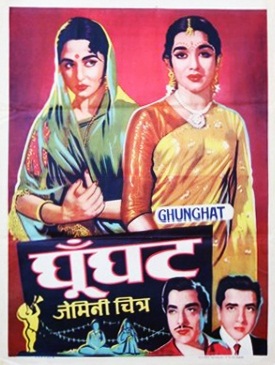
Ghunghat (1960)
Adapted Story: Noukadubi (The boat wreck)
Director: Ramanand Sagar
Cast: Bharat Bhushan, Pradeep Kumar, Bina Rai, Asha Parekh
Synopsis: In a tale akin to Milan’s classic narrative, the annals of modernity unveil a poignant drama. A young man, Ravi, faces an agonizing dilemma when his parents demand that he sever his affection for Laxmi and marry another. With a heavy heart, he acquiesces to their wishes.
As fate would have it, a fateful train journey brings together a group of newlyweds, including Ravi and his bride. Tragedy strikes and the train is engulfed in a catastrophic accident. Ravi awakens to find an unconscious bride lying beside him. Mistaking her for his own wife, he transports her to his abode.
Upon realizing the demise of his true wife, Ravi is horrified to discover that the bride he has brought home is a different lady named Parvati. Tormented by guilt and compassion, he embarks on a desperate search for her husband, Gopal.
Unbeknownst to Ravi, Parvati had already stumbled upon the truth and made her escape. Seeking solace, she wandered aimlessly until she fell into the river Jamuna. Her fate led her to the doorstep of Gopal’s residence, where she encountered his brother, Manohar, who had lost his eyesight in the accident.
Torn between her newfound duty to care for Manohar and her longing to reunite with Gopal, Parvati remained silent about her true identity. A web of secrets and unspoken truths now intertwined their lives, leaving them adrift in a sea of uncertainty.
Music: The renowned music maestro Ravi brought forth the essence of Shakeel Badayuni’s exquisite lyrics on the silver screen. The ten melodious compositions were rendered by such legendary artists such as Mohd. Rafi, Asha Bhosle, Lata Mangeshkar, and Mahendra Kapoor. Among these, stand-out gems like Lata Mangeshkar’s rendition of ‘Lage Na Mora Jiya’, Mohd. Rafi’s soulful ‘Insan Ki Majbooriyan’, Asha Bhosle’s enchanting ‘Gori Ghunghat Mein’, and the mesmerizing duet of Mahendra Kapoor and Asha Bhosle in ‘Kya Kya Nazaray Dikhati Hai Ankhiyan’.
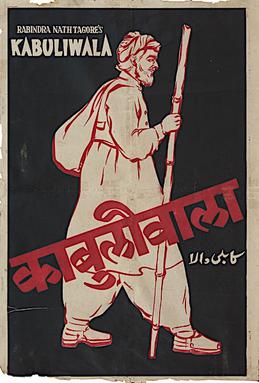
Kabuliwala (1961)
Adapted Story: Kabuliwala
Director: Hemen Gupta
Cast: Balraj Sahni, Sonu, Usha Kiran
Synopsis: In the realm of human narratives, we encounter a departure from convention—a tale in which the traditional roles of “boy” and “girl” are defined differently, “boy,” an elderly gentleman, finds himself interacting with a diminutive “girl” of five years of age, reminiscent of the incongruous coupling in P.G. Wodehouse’s “Lord Emsworth and Girlfriend.” However, this narrative possesses a distinctiveness that renders it a tale wholly its own.
Rahamat, a peripatetic merchant from Afghanistan, ventures to India seeking to peddle his wares. Here, he makes the acquaintance of Mini, a young lady of tender years. As their interactions deepen, a profound bond forms between them, akin to that of a father and daughter. Rahamat, reminded of his own daughter of Mini’s age, finds his paternal instincts stirring.
Circumstances conspire against them, and Rahamat is unjustly incarcerated. Upon his release, he seeks to reunite with Mini, unaware that the passage of time has wrought a significant change in her appearance. Mini, now a young woman, has no recollection of her former companion.
Grief-stricken, Rahamat departs India with a forlorn hope that his lost daughter may yet recognize him upon his return. Such is the nature of this enigmatic tale, where love and longing collide in a poignant exploration of the complexities of human relationships.
Music: Salil Choudhury, a veritable polymath, has bestowed upon us an ethereal symphony that perfectly encapsulates the narrative upon which it rests. In my humble estimation, there is no individual more adept at translating the Bengali soul into the universal language of music than this esteemed composer.
Furthermore, the illustrious voices of Hemant Kumar, Mohd. Rafi, Manna Dey, and Usha Mangeshkar serve as veritable conduits for the emotive lyrics penned by Prem Dhawan and Gulzar. Their vocal artistry transcends the realm of mere performance, becoming an integral thread in the tapestry of this cinematic masterpiece. Personally speaking, the “Ganga” song by Hemant Kumar is my all-time favourite!
Trivia: The Bengali iteration of the film was helmed by Tapan Sinha, a cinematic visionary whose repertoire extended beyond the hallowed borders of our country. His masterful direction of such seminal works as “Sagina” and “Zindagi Zindagi” has indelibly etched his name in the annals of cinematic history. To this humble observer, his unparalleled versatility renders him the paramount cinematic luminary of our times.

Uphaar (1971)
Adapted Story: Samapti (The Ending)
Director: Sudhendu Roy
Cast: Swarup Dutta, Jaya Bhaduri, Suresh Chatwal, Nandita Thakur
Synopsis: The eternal entanglements of the human heart! In the sweltering metropolis of Calcutta, a most intriguing tale of love, duty, and, dare I say, a pinch of mayhem unfolds. Our protagonist, Anoop, a law student with a mind as sharp as a razor, finds himself ensnared in the time-honoured tradition of arranged matrimony. His widowed mother, no doubt with the best of intentions, sets her sights on the lovely Vidya, a neighbour with a face as fresh as the morning dew.
But, alas, fate has a way of playing the mischief-maker. Upon making the acquaintance of Vidya, Anoop’s heart is suddenly hijacked by none other than Minoo, a rustic beauty from the village, with a smile that could charm the birds from the trees. In a most unbecoming display of defiance, Anoop defies his mother’s carefully laid plans and instead takes Minoo as his bride.
Now, it’s not long before the newlyweds discover that Minoo’s domestic skills are, shall we say, somewhat lacking. The poor dear can’t boil water to save her life, and Anoop’s mother, God bless her, is left to wonder if she’s made a grave mistake in letting her son marry this…this…Minoo.
The inevitable friction ensues, and Anoop, in a fit of exasperation, absconds to Calcutta, leaving Minoo to her own devices. But, as the days turn into weeks, Minoo’s love for Anoop begins to simmer, like a potent curry left to stew. She takes it upon herself to pen a heartfelt letter, a cri de coeur, if you will, only to have it met with deafening silence.
Still, undeterred by the setbacks, Minoo’s love for Anoop remains unwavering, a beacon of hope in the midst of marital turmoil. And it is at Anoop’s sister’s humble abode in Calcutta, a veritable haven of familial warmth, that the star-crossed lovers finally reunite, their love stronger and more resilient than ever.
As I see it, Minoo’s carefree spirit and boyish charm evoke the irrepressible Maria of ‘The Sound of Music’, yet whereas Maria had the solace of the Mother Superior at the Abbey who grasped the essence of her personality and encouraged her to ‘Climb every mountain…’, Minoo wandered, unguided, misunderstood and alone. It’s a difference that strikes a poignant chord.
Music: As I recall, the melodies that wafted through the evening air were the handiwork of the esteemed duo, Laxmikant Pyarelal, whose mastery of the musical arts is renowned far and wide. And, it was the legendary vocal triumvirate of Mohd. Rafi, Lata Mangeshkar, and Mukesh who lent their golden voices to the proceedings, imbuing the entire affair with a sense of grandeur and elegance.
Trivia: In 1971, this movie was chosen to represent India at the Academy Awards, but it did not get nominated. Later, it was dubbed into different South Indian languages, becoming successful in Malayalam as “Upaharam” in 1972. “Samapti” was originally a Bengali movie directed by Satyajit Ray and is one of three short films based on stories by Tagore, released together as “Teen Kanya.”

Geet Gata Chal (1975)
Adapted Story: Atithi (The Guest)
Director: Hiren Nag
Cast: Sachin, Sarika, Khyati, Urmila Bhatt
Synopsis: Durga Babu and his wife, Ganga, found themselves in the presence of Shyam, a lad possessing a talent for singing and dancing that was nothing short of extraordinary. Touched by his plight as an orphan, they extended a warm invitation to him to take up residence within their abode. As Shyam gradually assimilated into the daily routine of the household, a strong friendship blossomed between him and their daughter, Radha.
Little did Shyam realize, but Radha’s fondness for him extended beyond the boundaries of mere companionship. However, his feelings for her remained rooted in the soil of camaraderie. Shyam, with a heart yearning for the open road and unbridled liberty, recoiled at the very idea of settling down. When he caught wind of the family’s designs to wed him off, he felt a sense of confinement akin to that of a bird ensnared within a cage. In a dramatic turn of events, he made a swift getaway, leaving behind a heartbroken Radha.
The question lingers in the air like the scent of a freshly baked pie – will Shyam ever uncover his path back to the homestead? And what tumultuous repercussions will this sudden departure have upon the delicate balance of domestic relationships within the family?
Music: The music was scored by Ravindra Jain and Kishore Kumar, Mohd. Rafi, Aarti Mukherjee lent their voices.
Trivia: This cinematic tale too was brought to life in the Bengali language from literary origins by Tapan Sinha who had a discussion with Satyajit Ray about how to portray the ending of the story on-screen for an international audience. The original tale concludes with Tarapada leaving the mansion just before his marriage, abandoning his would-be wife. However, in a bid to conclude the story differently, Tapan Sinha depicted the bride-to-be weeping over the lost marriage. Satyajit Ray, sensing this wouldn’t resonate with international audiences, insisted on sticking to the original storyline of the protagonist vanishing. In contrast, the Hindi film adaptation opted for a happy ending, reuniting Shyam and Radha.

Lekin (1991)
Adapted Story: Kshudhita Pashaan (The Hungry Stones)
Director: Gulzar
Cast: Vinod Khanna, Dimple Kapadia, Amjad Khan, Hema Malini, Beena Banerjee
Synopsis: Sameer Niyogi (Vinod Khanna) encounters a mysterious woman, leading to a captivating tale set in Rajasthan.
This movie, produced by Lata Mangeshkar, is not a direct adaptation but rather an inspiration from Tagore’s original story wherein the protagonist, a fresh-faced tax collector, finds himself stationed in a quaint village. Opting to dwell in an ancient, decrepit palace, rumoured to be haunted, he dismisses the warnings of the townsfolk. They caution him that past occupants have either lost their sanity or met untimely demises, claiming the structure itself is voracious. Yet, he soon discovers a beguiling woman, shrouded in mystery, wandering the palace’s corridors under the cloak of darkness.
Music: The music was composed by Pt. Hridaynath Mangeshkar and the lyrics were penned by Gulzar. Each composition was unique and tugged at our heartstrings.
Trivia: This cinematic tale was brought to life from its literary origins in Bengali under the masterful direction of Tapan Sinha, the actors Soumitra Chatterjee and Arundhuti Devi graced the silver screen, weaving the characters into the fabric of our imaginations.
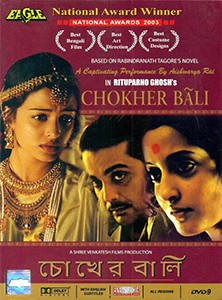
Sand in the Eye(2003)
Adapted Story: Chokher Bali (Eyesore)
Director: Rituparno Ghosh
Cast: Aishwarya Rai, Prosenjit Chatterjee, Raima Sen, Lily Chakravarty, Tota Roy Chowdhury
Synopsis: The tangled web of human relationships! Like a delicate spider’s silk, it ensnares us all, only to leave us dangling in a mess of our own making. Meet Binodini, a young widow, thrust into a world of moral ambiguity, where the lines between right and wrong are as blurred as the tears on her lovely face.
She finds herself in the midst of a most unsavoury triangle, with Mahendra, the self-absorbed cad, and his wife, Ashalata, who is naive and inexperienced. Mahendra, it seems, has a penchant for sampling the wares, only to discard them like a worn out [air of gloves. Binodini, however, is no fool, and she sees through his façade, recognizing the emptiness that lies beneath.
As the drama unfolds, we find ourselves entangled in a dance of deceit, where allegiances are forged and broken with all the finesse of a seasoned juggler. Behari, the stalwart friend, stands as a beacon of hope, a shining example of integrity in a sea of moral turpitude. But even he is not immune to the whims of fate, as Binodini’s mercurial heart leads him on a merry chase.
In the end, it is a tale of shattered dreams, of relationships reduced to tatters, like the fragile petals of a once beautiful flower. And yet, amidst the wreckage, we find a glimmer of hope, a testament to the human spirit’s capacity to endure, to persevere, and to love, despite the ravages of time and the cruel whims of fate. Ah, the human heart, that most confounding of puzzles, forever a mystery, forever a delight!
Music: The haunting strains of Debojyoti Mishra’s background score swirl around one, a melancholy mist that shrouds the narrative.
Trivia: This film is a dubbed version of the Bengali movie ‘Chokher Bali’.

Bioscopewala (2018)
Adapted Story: Kabuliwala
Director: Deb Medhekar
Cast: Danny Denzongpa, Geetanjali Thapa, Adil Hussain, Tisca Chopra
Synopsis: This cinematic offering is a departure from its literary progenitor. “Bioscopewala” chronicles the life of Rehmat Khan, a Kabulian cinemagician who regaled tykes with his flickering bioscope. Among his youthful admirers was Minnie, a lass of equal years to his own little cherub. But alas! Rehmat vanished as swiftly as a dodo, leaving Minnie to ponder his abrupt departure.
Fast forward, and Minnie, now a documentarist residing in the land of croissants and mime artists, stumbles upon a startling revelation: her father perished in an aerial catastrophe while attempting a pilgrimage to Afghanistan. Driven by an unquenchable thirst for knowledge, Minnie reunites with Bioscopewala, the narrator of her childhood adventures, to unravel the enigmatic circumstances surrounding her father’s fateful journey.
Prepare yourself for a tale that interweaves the whimsical with the poignant, where the complexities of human existence unfold amidst the flickering shadows of a Bioscope. May this cinematic concoction tickle your intellect and leave you pondering the true nature of life’s grand and enigmatic spectacle.
Music: There is only one song in the film, titled “Bioscopewala.” It was sung by K Mohan, and composed by Sandesh Shandilya, with lyrics written by Gulzar.
Influences of Tagore in Bollywood
In addition to the films I’ve already mentioned, here are a few Bollywood movies I can recall that are heavily influenced by Tagore’s works.
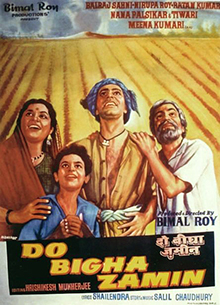
Do Bigha Zamin (1953)
Adapted Poem: Dui Bigha Jomi (Two Bighas of Land)
Cast: Balraj Sahni, Nirupa Roy, Ratan Kumar, Nana Palsikar, Meena Kumari, Mehmood
Director: Bimal Roy
Synopsis: The tale centres on Shambhu Maheto, a humble farmer living in a drought-stricken village with his family. When the rains finally arrive, Shambhu’s joy is short-lived as the scheming landlord, Harnam Singh, eyes Shambhu’s precious two bighas of land for a profitable mill project. Despite Shambhu’s desperate attempts, including selling all household items and moving to Calcutta to earn money, he fails to repay the inflated debt. His journey in Calcutta is fraught with hardship, culminating in his wife’s injury and his son’s foray into petty crime. Ultimately, Shambhu returns home to find his land auctioned off and a factory replacing his farm, leaving his family to walk away from their former life with nothing but memories.
Music: Salil Chowdhury composed the music for the film, with lyrics penned by Shailendra. In an interview with All India Radio, Chowdhury explained that the melody for “Apni Kahani Chod Ja – Dharti kahe pukaar ke” was inspired by a Red Army march song. Lata Mangeshkar, Manna Dey and Mohd. Rafi lent their voices.

Durban (2020)
Adapted Story: Khokababur Protyabartan (The Return of the Child)
Director: Bipin Nadkarni
Cast: Sharib Hashmi, Sharad Kelkar, Rasika Dugal, Flora Saini
Synopsis:, This film tells the story of a wealthy man’s son and his caretaker. Despite their social differences, they share a deep bond. However, an unfortunate incident drives them apart, leading the caretaker on a journey of redemption.
Music: The film’s soundtrack is composed by Amartya Bobo Rahut and Raajeev V. Bhalla, with lyrics written by Manoj Yadav, Siddhant Kaushal, and Akshay K. Saxena. Arijit Singh lent his voice.

Laapataa Ladies (2024)
Adapted Story: Noukadubi (The boat wreck)
Cast: Nitanshi Goel, Pratibha Ranta, Sparsh Shrivastav, Chhaya Kadam
Director: Kiran Rao
Synopsis: In 2001, in fictional Nirmal Pradesh, farmer Deepak travels with his new bride, Phool Kumari. On a crowded train, amidst other veiled brides, Deepak dozes off and accidentally disembarks with the wrong bride, Jaya, leaving Phool with another groom, Pradeep. The mix-up mirrors Rabindranath Tagore’s “Noukadubi.”
Deepak’s family realizes the mistake but Jaya, using the name Pushpa, lies about her identity. Phool, stranded at another station, is helped by Manju Mai. Deepak, searching for Phool, files a report. Jaya is arrested but reveals her troubled past and desire for independence. Eventually, Phool reunites with Deepak, and Jaya pursues her education.
Besides the wife-exchange element, there is little in common between this movie and the works of Tagore. The theme of women’s empowerment takes centre stage. If Manju Mai cautions Phool in respect of the ills of patriarchy, Jaya breaks the matrimonial bond with a self-centred, greedy and domineering husband. Instead, she decides to pursue an independent course in life.
Music: The film’s music was composed by Ram Sampath, featuring lyrics by Divyanidhi Sharma, Prashant Pandey, and Swanand Kirkire.
Conclusion
As we stand at the threshold of the great unknown, it is the poet-philosophers who have always dared to illuminate the darkness that lies beyond. Like the Dutch sage Spinoza, who glimpsed the infinite in the finite, and Wordsworth, who in his sublime poem “A Slumber Did My Spirit Seal” wrote,
“No motion has she now, no force;
She neither hears nor sees;
Rolled round in earth’s diurnal course,
With rocks, and stones, and trees.”
Rabindranath Tagore, the great Bard of India, has similarly beheld death not as an end, but as a new beginning, a gateway to the eternal.
To Tagore, death is not the extinguishing of the flame, but the merging of the individual spirit with the universe, a reunification that sets the stage for a new drama of thought to unfold. As he so eloquently put it, death is merely the “reunion of one’s spirit to the universe and thereby to eternity,” a notion that transcends the petty boundaries of mortality. It is here, in this realm of eternity, that the legacy of thought germinates, and the development of a society can continue, unfettered by the constraints of time and space.
And so, as we ponder the mystery of death, we would do well to recall Tagore’s wise words: “The song that I came to sing remains unsung to this day. I have spent my days in stringing and in unstringing my instrument.” For, in the end, it is not the song that we sang, but the song that we came to sing, that truly matters. And it is in this eternal realm, where thought and spirit converge, that our true legacy resides, waiting to be discovered, and sung anew.
So dear readers, as we fondly remember him on the day he embarked on his celestial journey, I wish to thank you for going through my musings on how Bollywood has honoured his legacy through its cinematic endeavours. I am certain that the list I have presented to you here is merely indicative and not exhaustive.
Which are the other movies you would like to add to this list of mine? Please leave a comment below, mentioning the name of the movie and its year of release. I shall be obliged.
Related Post:
Where the Mind is without Fear
Tribute to a Cinematic and Literary Genius: Guest Post by Suryamouli Datta
A visit to the Nobel Prize Museum in Stockholm, Sweden
Posted in The European Diaries, tagged Alfred Nobel, Chemistry, Economics, Irwing Wallace, Literature, Mahatma Gandhi, Malala Yousafzai, Medicine, Museum, Nobel Prize, Norway, Peace, Physics, Rabindranath Tagore, Sweden on July 30, 2022| Leave a Comment »

What happens when one comes across a bevy of super-brainy persons who ended up contributing something significant to the society at large?
For one, the sheer creativity and perseverance of such persons leaves one shaking one’s head in awe, admiration, and bafflement. One wonders as to from which plane of consciousness these persons were operating while making discoveries which have improved our lives. It also makes one realize how little one has achieved in one’s own life. A deep feeling of humility envelopes one. And yes, it motivates us lesser mortals to do something better in our own lives!
On a recent visit to Stockholm, your truly could visit the Nobel Prize Museum in the city. In the process, all the feelings mentioned above were experienced.
When Negativity Leads to Positivity

Swedish industrialist Alfred Nobel (1833-1896) was a chemist, engineer, and inventor. He amassed a fortune during his lifetime, with most of his wealth coming from his 355 inventions, of which dynamite is the most famous.
In 1888, Nobel was astonished to read his own obituary, titled “The merchant of death is dead”, in a French newspaper. In fact, it was Alfred’s brother Ludvig who had died in an uncontrolled experiment relating to explosives. The article disconcerted Nobel and made him apprehensive about how he would be remembered.
Nobel wrote several wills during his lifetime. Inspired by the death of his brother, he composed the last one over a year before he died, signing it at the Swedish–Norwegian Club in Paris on 27 November 1895, bequeathing all his ‘remaining reliable assets’ to create the prestigious prize named after him. In his will, he wrote that he wanted to reward those who had ‘conferred the greatest benefit to humankind’.
On December 10, 1896, Alfred Nobel died in his villa in San Remo, Italy, from a cerebral haemorrhage. He was 63 years old then.
Owing to scepticism surrounding the will, it was not approved by the Norwegian Parliament until 26 April 1897.
Nobel Prizes were first awarded in 1901.

Nobel Prizes were originally awarded in the fields of Physics, Chemistry, Physiology or Medicine, Literature, and Peace. In 1968, Sweden’s central bank funded the establishment of the Prize in Economic Sciences in Memory of Alfred Nobel, to also be administered by the Nobel Foundation.
In 1905, the union between Sweden and Norway was dissolved. Till this day, except for the Peace Prize, the Nobel Prizes are presented in Stockholm, Sweden, at the annual Prize Award Ceremony on December 10, the anniversary of Nobel’s death.
The Prize
The prize ceremonies take place annually. Each recipient (known as a “laureate”) receives a gold medal, a diploma, and a monetary award. In 2021, the Nobel Prize monetary award was 10,000,000 SEK.






The recipients’ lectures are normally held in the days prior to the award ceremony. The Peace Prize and its recipients’ lectures are presented at the annual Prize Award Ceremony in Oslo, Norway, usually on December 10.
The award ceremonies and the associated banquets are major international events. One can secure an invitation to these only if one happens to know some of the laureates! I understand that these are now broadcast live.

The Prizes awarded in Sweden’s ceremonies are held at the Stockholm Concert Hall, with the Nobel banquet following immediately at Stockholm City Hall.

The Nobel Peace Prize ceremony has been held at the Norwegian Nobel Institute (1905–1946), at the auditorium of the University of Oslo (1947–1989), and at Oslo City Hall (1990–present).
The highlight of the Nobel Prize Award Ceremony in Stockholm occurs when each Nobel laureate steps forward to receive the prize from the hands of the King of Sweden. In Oslo, the chairman of the Norwegian Nobel Committee presents the Nobel Peace Prize in the presence of the King of Norway and the Norwegian royal family.
After the award ceremony in Sweden, a banquet is held in the Blue Hall at the Stockholm City Hall, which is attended by the Swedish Royal Family and around 1,300 guests. The Nobel Peace Prize banquet is held in Norway at the Oslo Grand Hotel after the award ceremony. Apart from the laureate, guests include the president of the Norwegian Parliament, on occasion the Swedish prime minister, and, since 2006, the King and Queen of Norway. In total, about 250 guests attend.
The Curious Case of India’s Apostle of Non-violence

Although Mahatma Gandhi, an icon of non-violence in the 20th century, was nominated for the Nobel Peace Prize five times, in 1937, 1938, 1939, 1947, and a few days before he was assassinated on January 30, 1948, he was never awarded the prize, possibly due to the cordial relations between Norway and the United Kingdom.
In 1948, the year of Gandhi’s death, the Norwegian Nobel Committee decided to make no award that year on the grounds that “there was no suitable living candidate”.
In 1989, this omission was publicly regretted, when the 14th Dalai Lama was awarded the Peace Prize, the chairman of the committee said that it was “in part a tribute to the memory of Mahatma Gandhi”.
Geir Lundestad, 2006 Secretary of Norwegian Nobel Committee, said:
The greatest omission in our 106-year history is undoubtedly that Mahatma Gandhi never received the Nobel Peace Prize. Gandhi could do without the Nobel Peace Prize. Whether Nobel committee can do without Gandhi is the question.
Display at the Museum
Besides the history of the Nobel Prize, the museum displays many gifts from many of the laureates. These include a letter from Albert Einstein confessing the inability of mathematical formulae to capture the nuances of human behaviour. There is a unique display of the kind of dresses used by celebrities while attending some of the banquets and many other details.
A guided tour lasting about 30 minutes shares interesting anecdotes from the lives of some of the laureates.
At the age of 17, Malala Yousafzai, is so far the youngest to have received a Nobel Peace Prize in 2014.
The Cultural Outreach

Being a symbol of scientific or literary achievement which is recognisable worldwide, the Nobel Prize is often depicted in fiction. In my younger days, I recall having read The Prize, a novel by Irwing Wallace. There have been films like The Prize (1963), Nobel Son (2007), and The Wife (2017) about fictional Nobel laureates, as well as fictionalised accounts of stories surrounding real prizes such as Nobel Chor (The Nobel Thief), a 2012 film based on the theft of Rabindranath Tagore’s prize. In a series named Genius (2017) on Netflix, a meeting between Albert Einstein and Marie Curie at one of the Nobel Prize ceremonies was depicted.
Improving the World
The Nobel Prize shows that ideas can change the world. The courage, creativity and perseverance of the Nobel Laureates inspire us and give us hope for the future.
Such initiatives help create exciting encounters between people – people who dare to challenge the status quo, who want to ask new questions, think new thoughts and contribute to a better world.
(Sources: The Nobel Museum guided tour and website, Wikipedia)
(Related Post:
Tryst with Fire: Welcome to the Storm; Guest Post by Prof Sanjoy Mukherjee
Posted in Management Lessons, tagged Belur Math, Chicago, India, Leadership, Netaji Subhash Chandra Bose, Nietzsche, Rabindranath Tagore, Satyajit Ray, Shri Ramakrishna, Sister Nivedita, Socrates, Sri Aurobindo, Swami Vivekananda, Tribute on January 13, 2022| Leave a Comment »

A Tribute to Swami Vivekananda: Leader Extraordinary
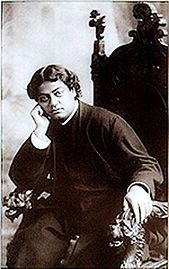
“On the seventh of August 1941, in the city of Calcutta, a man died. His mortal remains perished but he left behind a legacy… that no fire can ever consume…”
That was the baritone, sonorous voice of Satyajit Ray in his documentary titled ‘Rabindranath’ created as a tribute to Rabindranath (a project mandated on Ray, the genius in film making, arts and literature, commissioned by Ministry of Culture, Government of India) on the occasion of the birth centenary of the another genius, Rabindranath Tagore the Nobel laureate poet, musician, novelist, dramatist, artist and philosopher. The first scene of the documentary depicted the last and final journey of Tagore to the burning ghat (crematorium).
Ray’s portrayal of Tagore began with the scene finale. But where do we start in our odyssey with the volcanic monk of India whose 150th birth anniversary we celebrated…
View original post 2,153 more words
The Indian Curry Dished Out by P. G. Wodehouse (Synopsis)
Posted in What ho!, tagged British Raj, India, Mahatma Gandhi, P G Wodehouse, Partition, Rabindranath Tagore, Taj Mahal on January 8, 2022| Leave a Comment »
What ho!
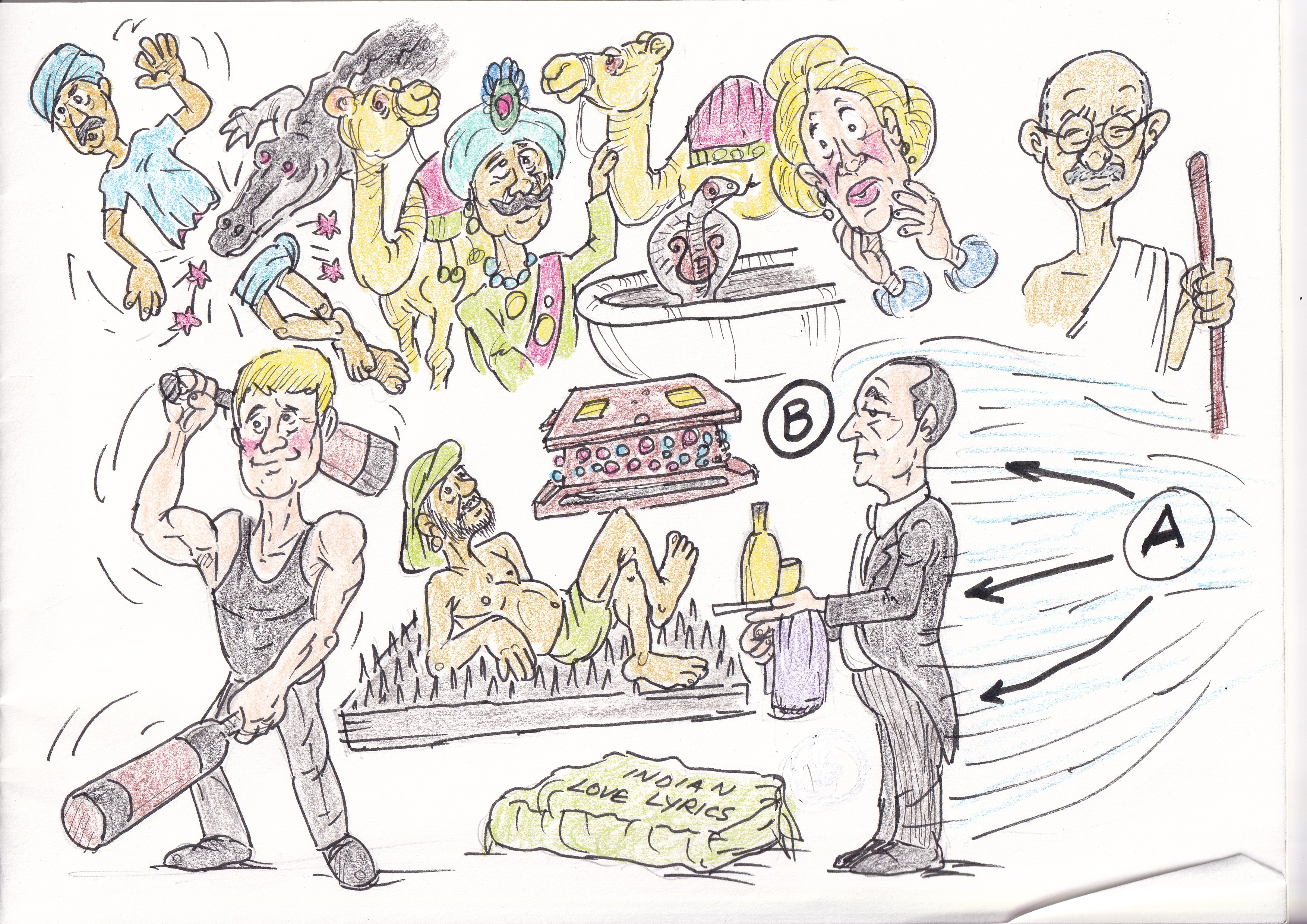
To the best of my knowledge and belief, P. G. Wodehouse never set foot on Indian soil. But he has often alluded to its exotic temples, its wildlife, its royalty, its fakirs and mystics with magical powers, and even its love lyrics. Many times he has vividly captured facets of my beautiful country, serving up a delectable curry spiced with uniquely Indian condiments.
In the essay under reference, the reader will find a random sample of references to India in Wodehouse’s novels and short stories. Such references are found across all his narratives, whether he is writing a Jeeves and Bertie story, a tale of Blandings, or a stand-alone novel. What I present here is merely a synopsis.
The Indian Curry: A Brief
- In some of his novels, jewels associated with idols of gods in Indian temples get stolen, with overzealous priests chasing the villains.
- Indian fauna such as spiders, scorpions, cobras, elephants, tigers, cheetahs and lions regale the reader across many of Plum’s narratives. Walking butlers like Beach get described as elephants sauntering through an Indian jungle. Princes and maharajas of yore also find a mention occasionally.
- Plum suggests a link between the Indian Civil Disobedience movement and the dietary and fasting habits of Mahatma Gandhi. Bertie Wooster motivates Tuppy Glossop to forsake pleasures of the table by quoting Mahatma’s example. The Cawnpore (now Kanpur) Mutiny gets referred to in at least two places.
- Military men who had served in India as part of their duties tell us interesting anecdotes about that distant land, including about their time in the North Western Frontier Province. Some of you may recall that the latter was a province of British India from 1901 to 1947, when it was ceded to Pakistan.
- When Bobby Wickham takes umbrage, she ticks off Kipper like a typhoon on the Indian Ocean. Elsewhere, to impress a heart throb, the hero claims to have used a Boy Scout pocket knife to teach the sharks there a lesson or two.
- Indian scriptures often use the Sanskrit term ‘siddhi’ to signify either a remarkable accomplishment or a singular proficiency attained by an aspirant. These could be material, paranormal, supernatural or magical in nature, attained by such practices as meditation, yoga and intense ‘tapas’ (austere practices).
Like much else, this facet of India is also used by Plum to amuse, elevate and entertain his readers. Jeeves, for instance, gets repeatedly portrayed as someone who possesses the property of a gas floating from Spot A to Spot B without much ado. Some characters undergo an experience akin to that of curling up on spikes while others are found contemplating the infinite.
- Wherever Plum is, love cannot be far behind. India has gifted the world with the Kama Sutra, but it is not surprising that Plum never alludes to this unique treatise, because he never used sex as a ploy to popularize his narratives. All of his male characters are steeped in chivalry, strictly bound by Victorian norms.
In his narratives, Wodehouse appears to have instead based his observations on The Garden of Kama, a collection of lyrical poetry of Indian origin published in 1901, which makes liberal use of imagery and symbols from the poets of the North-West Frontier of India and the Sufi poets of Persia (Iran). The poems, written by Laurence Hope, a pseudonym of Violet Nicholson, are typically about unrequited love and loss. One of her famous compositions, known as a ‘Kashmiri Song’, appears in at least two of Plum’s narratives.
- India rubber is one name for the natural rubber that comes from the sap of certain trees. Rubber trees that grow in South America and India produce the majority of India rubber. Plum uses its properties of agility, elasticity, flexibility and robustness to cover a wide range of physical endeavours of the characters in many of his narratives.
- Some characters have a fetish for remaining as fit as a fiddle. One of the instruments which they happen to depend upon to do so is a pair of Indian clubs.
- Some of his characters have either visited India or plan to do so. While Lady Malvern whips up a book relating to Indians, Crispin Blakeney goes off there to deliver a series of lectures. Some of us may recall that in ‘Bertie Changes His Mind’, Carry On, Jeeves, Bertie Wooster tells Jeeves that he has a sister in India.
- Indian handicrafts come up for a mention. So does Taj Mahal. Gurudev Rabindranath Tagore’s dietary habits get commented upon. Some behavioural traits of Indians get covered. The age old sordid custom of ‘sati’ gets touched upon, as do the Indian Civil Services. Stilton Cheesewright has the unique distinction of having come under the spell of Buddhism briefly.
- The Luck Stone, a concoction whipped up by Plum under the pseudonym Basil Windham, was serialized in a magazine known as ‘Chums: An Illustrated Paper for Boys’ during 1908-1909. It touches upon Indian Vedas, mythology and superstitions.
Some Missing Ingredients
Plum’s works surely throw up several references to India. But if he had wanted to, he could have used a number of other Indian resources to further enrich his narratives.
Alas, we do not find any mention of such literary figures as Kalidasa, besides Aryabhata or Ramanuja, the famous mathematicians. The Vedas do find a solitary mention but any other references to India’s soft power comprising such aspects as spirituality, its multi-layered scriptures and various dance forms are sadly missing.
Above all, the mind-numbing diversity of the spirit of India is missing. Its wide spectrum of ethnicities, languages, beliefs, practices and cuisines is nowhere to be found. These are facets of India which have missed out on his wit and wisdom. It is indeed a delectable irony of sorts that this write up is labelled as The Indian Curry Dished Out by P G Wodehouse, even though it has not thrown up even a single reference to any specifically Indian dish!
As to a liberal use of many other resources of an Indian origin, imagine a distraught Gussie Fink-Nottle pining for Madeline Bassett and sending messages to her through clouds passing overhead, a la ‘Meghadut’, the classic poem penned by Kalidasa. Poets like Ralston McTodd would have been found drawing some inspiration from the creative outpourings of Tagore. To improve Bertie’s intellect, all Florence Craye had to do was to insist that he peruse at least one of the chapters of the ‘Bhagavad Gita’. Laura Pyke could have drawn some inspiration from the science of ‘Ayurveda’, the healthy-lifestyle system that people in India have used for more than 5,000 years. Anatole could have been found whipping up ‘chhole-bhature’ or ‘dosa’s!
Yoga could have helped someone like Ashe Marson to treat his clients suffering from acute dyspepsia to heal faster and better. Sir Roderick Glossop could have gone about advising his loonier patients to make meditation an essential part of their mundane lives. Vicars could have lived a happier Thos-infested life while brooding on spiritual tenets dished out by Indian scriptures, thereby becoming hotter at their jobs. George Bevan, while working on one of his next musical comedies, could have been drawing inspiration from the ‘Natya Shastra’ of Bharata Muni. Gentlemen aspiring for India rubber legs could have been practising such dance forms as ‘Kathak’ or ‘Bharatnatyam.’
The possibilities are endless. The mind boggles. But one would do well not to be concerned with what might have been. Instead, the focus needs to be on the rich legacy Plum has left behind for us to rejoice in.
In fact, it is befitting that quite a few of his works have been translated into some other languages – like Bengali, Kannada, Telugu and Sanskrit – forming a pale parabola of subtle humour across India.
Consistent Depiction, Despite 1947
The India that Plum would refer to belongs to an era which is long since bygone. India gained independence in 1947, but his works published during the period from 1947 (Joy in the Morning) till 1974 (Aunts Aren’t Gentlemen) do not reveal much change in his imagination. Astral bodies, scorpions and cobras continue to rule the roost.
From a global perspective, the devastation caused by the Second World War (1939–45) was then the main area of concern, rather than the fact of India gaining independence on 15 August 1947. Plum had personally suffered in his life owing to political developments then and had relocated from Europe to USA during April 1947, never to visit Europe again. Owing to his preoccupation with other matters then, perhaps the last thing on his mind would have been the British (or American) reaction to the events unfolding in India. Hence his storylines and characters never touched upon the emergence of an independent India.
Love sans Borders
The love for Plum’s oeuvre in the Indian subcontinent transcends any political considerations. Moreover, Plum sets a gold standard of pristine humour not only in English but also in many other languages into which his works have been translated, including in many regional ones in India.
Plum dished out his narratives in a pre-Internet era, when access to information was severely restricted. It is amazing that based mostly on secondary data, so to say, he could leave behind for us a spicy Indian curry, making India shine through in so many ways through a vast array of his novels and stories.
Pip pip!
Notes:
- Illustration courtesy Suvarna Sanyal.
- The full text of this essay can be accessed at https://ashokbhatia.wordpress.com/2021/08/31/the-indian-curry-dished-out-by-p-g-wodehouse.
- A version of this synopsis appears in the December 2021 issue of Jeeves, the annual journal of The Wodehouse Society in Sweden (WSS).
- A version of this synopsis also appears in the March 2022 issue of The Wooster Sauce, the Quarterly Journal of The P. G. Wodehouse Society (UK).
- A version of this synopsis also appears in the Autumn 2022 issue of Plum Lines, the Qurterly Journal of The Wodehouse Society, USA.
The Indian Curry Dished Out by P. G. Wodehouse
Posted in What ho!, tagged Army, Behavioural Traits, British Raj, Buddhism, Civil Disobedience, Civil Services, Conversations, Customs, English, Fakirs, Fauna, Handicrafts, Hindus, Humour, Hunting, Idols, Independence, India, India Rubber, Indian Clubs, Indian Ocean, Love Calls, Men In Uniform, Mutinies, Mystic Powers, Mythology, NWFP, P G Wodehouse, Partition, Priests, Rabindranath Tagore, Regional Languages, Royalty, Superstitions, Taj Mahal, Temples, Translations, Travel, Vedas on August 31, 2021| 6 Comments »
What ho!
To the best of my knowledge and belief, P. G. Wodehouse never set foot on Indian soil. But he has often alluded to its exotic temples, its wildlife, its royalty, its fakirs and mystics with magical powers, and even its love lyrics. Many times he has vividly captured facets of my beautiful country, serving up a delectable curry spiced with uniquely Indian condiments.
In this essay, the reader will find a random sample of references to India in Wodehouse’s novels and short stories. Such references are found across all his narratives, whether he is writing a Jeeves and Bertie story, a tale of Blandings, or a stand-alone novel.
Plum’s Indian Connection
Plum’s elder brother, Ernest Armine Wodehouse, was an English Theosophist, poet and educator. He is better known as the tutor of Jiddu Krishnamurti, the famous Indian author and lecturer on spiritual and philosophical subjects. He was admitted to the Theosophical Society at Poona (now Pune) in 1908. Before the First World War, he held a position as professor at Deccan College in Poona, India. After the war he returned to India. One can understand the source of Plum’s inspiration when he named one of his pet cats as Poona.
One of the important landmarks on Wodehouse Road in the Indian city of Mumbai is the Cathedral of the Holy Name. The seat of the Archdiocese of Mumbai, the cathedral is one of the most striking churches of the city. Its foundation stone was laid in 1902. It had then come to be known as the Wodehouse Church since it was located on Wodehouse Road, named after Sir Philip Edmond Wodehouse who was Governor of the Bombay Presidency from 1872 to 1877. He was a distant relative of Plum’s. Sometime back, the road was renamed Nathalal Parekh Marg.
Few writers have Plum’s mesmerizing command over English. He uses it in an innovative manner, leaving the reader steeped to the gills with an overdose of Vitamin H(umour). It comes as no surprise that English-speaking Indians who are aware of his works simply adore him.
One of the unique features of India is its linguistic diversity. By default, English is the sole means of communication between different people from across the country. It acts as a bridge between large chunks of its 1.4 billion people who otherwise speak as many as 447 languages. Of these, 22 happen to be scheduled ones, deserving official recognition and support. Six languages – Kannada, Malayalam, Odiya, Sanskrit, Tamil and Telugu – are recognized as classical ones. English being a prominent link between people, Plum’s popularity in India is readily understandable.
But we digress. We are here to consider the kind of ingredients Plum uses while dishing out an Indian curry.
Some Indian fans of P G Wodehouse who have a chin-up attitude like that of Bertie Wooster and also a hearty capacity to laugh at themselves may appreciate the kind of India-centric similes Wodehouse uses at times to depict the behaviour of his characters.
In reading what follows, it may be advisable for readers to imagine themselves taking a leisurely stroll through either the Shalimar or the tulip gardens of Kashmir, or the Mughal Gardens in New Delhi, relishing the enchanting aroma of each section at a time.
The Indian Curry
Idols, Temples and Priests

Religious fervour is one of the main strands in the socio-cultural tapestry of India. One of its many unique features is its vast pantheon of gods and goddesses, its handcrafted and bejewelled idols, its magnificent temples and its overzealous priests.
- In Ring for Jeeves, Rory speaks to Monica of a story published in The Strand Magazine in which a gang of blighters pops over to India and pinches a great jewel which is the eye of an idol. When one of the gang is deprived of his share in the booty, he seeks revenge by tracking down all the others and wiping them out. Rory is of the opinion that Captain Biggar is likewise casting a vengeful eye on Bill, as if the latter had denied the former his share of the proceeds of the green eye of the little yellow god in the temple of Vishnu.
- The feisty heroine of Something Fresh, Joan Valentine, acts as a muse for Ashe Marson when he suffers from a temporary writer’s block. She suggests that ‘The Adventure of the Wand of Death’ can only be about the sacred ebony stick stolen from an Indian temple which is supposed to bring death to whoever possesses it. Priests dog this person and send him threatening messages. Yet another episode of the adventures of Gridley Quayle, Investigator, gets dished out by Ashe.
- Mr. Chinnery of Summer Moonshine is said to be an enormously rich person in spite of the incessant demands placed on his income by a platoon of ex-wives to whom he has to keep paying alimonies. Notices keep getting served on him in that respect. He suspects Mr. Bulpitt to be following him to serve yet another notice and shares his discomfiture with Sir Buckstone. He describes his latest encounter with Mr. Bulpitt as that of someone who steals the jewel and thinks he has hidden himself rather well, only to look over his shoulder to find some sinister Indian priests around the corner.
Indian fauna such as spiders, scorpions, cobras, elephants, tigers, cheetahs and lions regale the reader across many of Plum’s narratives. Princes and maharajas of yore also find a mention occasionally.
- Take the example of Summer Moonshine’s Colonel Tanner, who, during his tenure in India under the English Raj, had learnt to be comfortable with the presence of Afridis, snakes, scorpions and even tigers in his sleeping quarters. Members of these species would ‘saunter into his abode as if it were a country club to which they had paid the entrance fee’.
- In Thank You, Jeeves, Chuffy introduces Bertie to Sergeant Voules, who claims to have tackled as many as ninety-six big spiders while in India. Bertie’s protests that he is unable to sleep in his own bedroom because there is a big pink spider lurking around there (indirectly referring to Pauline Stoker, Chuffy’s fiancée, in his heliotrope pajamas!) get ignored. He gets hauled back to his bed. Luckily for all concerned, Pauline has already done the vanishing trick by then.
- In Aunts Aren’t Gentlemen, we come to know that Cook’s horse Potato Chip and Briscoe’s horse Simla are going to compete in a race at Bridmouth-on-Sea. Eventually, the race gets awarded to Simla after Cook’s cat runs across the racecourse and startles Simla. Aunt Dahlia wins her bet. Some of you may know that Simla (or, Shimla) is the name of a popular hill resort in northern India. It was once the summer capital of British India. Elsewhere, in the same narrative, Orlo Porter runs into Bertie Wooster and is as startled as an Indian native who sees a scorpion in his path. He goes on to ejaculate: ‘Wooster, you blasted slimy creeping crawling serpent, I might have expected this!’
- What does an Indian native do when bitten by a scorpion? In Uneasy Money, Plum tells us that ‘He does not stop to lament, nor does he hang about analysing his emotions. He keeps running until he has worked the poison out of his system. Not until then does he attempt introspection.’ The amiable Lord Dawlish, after a rather unpleasant meeting with Lady Wetherby, follows a similar policy. After leaving her house, he does not run. Instead, he takes a very long and rapid walk. He has an acute sense of being poisoned and wishes to work the poison out of his system. He has nothing on his mind other than walking faster and faster.
- In Jeeves and the Feudal Spirit, Ma Trotter, upon going through a morning journal, discovers that the powers that be have gone ahead and knighted Robert Blenkinsop instead of her illustrious husband. ‘She stares at The Times much like an Indian resident would eye a cobra, had he found it nestling in his bath tub’.
- On his part, the husband, L. G. Trotter, is a man who suffers from dyspepsia and is already out of harmony with his wife. The latter screaming her head off in the middle of the breakfast startles him, making him give her ‘the sort of look the cobra might have given the resident of India who had barged in on its morning bath.’
- In Bachelors Anonymous, we run into Mr. Ivor Llewellyn, head of the Superba-Llewellyn studio of Hollywood. Having suffered through as many as five divorces, he wishes to remain a bachelor. However, upon Joseph “Joe” Pickering’s insistence that he visit a hospital, Cupid strikes yet again. He ends up proposing to Amelia Bingham, a nurse he comes in touch with at the hospital. He squarely blames Joe for having got him entangled into yet another prospect of marriage. Upon return, he, like L G Trotter before him, looks at Joe with an open dislike, much like a resident of India registers ‘when he comes to have his morning bath and finds a cobra nestling in the bath tub.’
- In Galahad at Blandings, as also in Pigs Have Wings, Plum says that Beach never buzzes off, ‘his customary mode of progression being modelled on that of an elephant sauntering through an Indian jungle.’
- As per Meet Mr. Mulliner, as well asthe story ‘Gala Night’ in Mulliner Nights, when royalty goes a-hunting, it expects to be supported by elephants which display an easy nonchalance when their masters spot a tiger in an Indian jungle. But there are times when such hunting expeditions get spoiled by ‘the failure of the elephant to see eye to eye with its owner in the matter of what constitutes sport.’
- How does one avoid the prospect of an elephant turning and galloping home? How does one ensure that a timid elephant would instead trumpet loudly and charge the fiercest tiger without any hesitation, ‘facing the tiger of the jungle with a jaunty sang-froid?’
- Wilfred Mulliner has a solution in the form of a tonic known as Mulliner’s Buck-U-Uppo. Were a teaspoonful of it be mixed with the morning bran-mash, better results ensue.
- Sunset at Blandings tells us how one feels when one is likely to face the prospect of facing a formidable person like Dame Daphne Winkworth. If Gally is to be believed, one would find oneself in the position of a native of India who knows that a tigress is lurking in the undergrowth near at hand and wonders how soon she will be among those present.
- In Big Money, when Berry acts like a buoyant and aspiring sportsman in the jungles of India who has caught a tiger by its tail, he realizes that even though all has been well so far, his next move would need careful consideration.
- Uncle Dynamite records the reaction of Sir Aylmer when being told by Lord Ickenham that he would go a hundred miles to judge bonny babies. This thwarts the ambitions of Sir Aylmer no end. He starts ‘like a tiger that sees its Indian villager being snatched away from it.’ His face, already mauve, becomes an imperial purple.
- Uncle Dynamite also describes the emotions of Hermione, a young authoress, who finds that her royalty earnings are likely to go up substantially but her father is conniving to rob the publisher of his means to publish her work. Her feelings are said to be even more poignant than those of ‘wolves which overtake sleighs and find no Russian peasant aboard and of tigers deprived of their Indian coolie just as they are sitting down to lunch.’
- In Full Moon, Freddie, at Gally’s suggestion, smuggles Bill Lister back into Blandings Castle disguised as a false-bearded gardener, having paid off Angus McAllister. Lister soon ruins things, however, when he mistakes Veronica’s mother, Lady Hermione, for a cook and tries to bribe her to pass a note to Prudence.
- Later on, when Freddie appears to be whole-heartedly welcoming Lister after the latter has been asked to leave, Lady Hermione is found twitching her hands and has gleaming eyes. She is then likened to the puma of an Indian jungle about to pounce upon its prey.
- In Piccadilly Jim, Jimmy has a unique style of proposing to Ann. He points out that if he were to go out of her life, she would be miserable. She would have nobody to fight with. She would be like the female jaguar of the Indian jungle who expresses her affection for her mate ‘by biting him shrewdly in the fleshy part of the leg, getting a shock one day to find that the mate has simply vanished.’
- In ‘The Story of Cedric’, Mr. Mulliner Speaking, when Cedric crawls on all fours on the floor, his teeth are clenched and his eyes gleam with a strange light, he is said to look like an ‘exact replica of the hunting cheetah of Indian jungle stalking its prey.’
- In the same narrative, when he cries out aloud, he sounds like an Indian peasant who, ‘while sauntering on the banks of the Ganges, suddenly finds himself being bitten in half by a crocodile.’
- ‘Leave it to Algy’, A Few Quick Ones depicts Purkiss, having handed over a five-pound note to Bingo, giving a defiant look at Algernon Aubrey. His look gets likened to that of an Indian coolie, who, when he is safe up a tree, may give it to the baffled crocodile at its foot.
- In The Girl in Blue, Jerry chooses to celebrate his triumph at the grill room of the Barribault’s which is said to be a ‘stamping ground of Texas millionaires and Indian Maharajas.’
- In Luck of the Bodkins, Mr. Llewellyn wonders if his sister-in-law has ‘mistaken him for Rockefeller, Pierpont Morgan, Death Valley Scotty or one of those Indian Maharajas.’
- In Bachelor’s Anonymous, Sally realizes the true nature of Joseph Pickering while sitting in the lobby at Barribault’s, infested by Texas millionaires and Indian maharajas.
- In Pearls, Girls and Monty Bodkin, Monty waits for Gertrude to show up in the lobby of Barribault’s world-famous hotel, the doors of which normally swivel around only to admit Texan millionaires and Indian Maharajas. The doors then revolve yet again to admit an elderly man with a face like a horse, Mr. J. B. Butterwick, who promptly proceeds to inform him that Gertrude will not be lunching with him on the day.
- The story The Man Who Disliked Cats in The Man Upstairs speaks of Hotel Jules Priaulx in Paris. When rich people of any nationality come over to stay there, they often bring their pets along with. If an Indian prince has two dromedaries for company, the other one brings along a giraffe. The giraffe is reported to drink a dozen of the best champagne every day, so as to keep his coat in good shape. Young lions and alligators also pop up once in a while.
Of Civil Disobedience and Mutinies
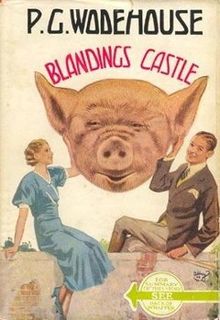
Till the year 1947, India was under the British Raj. The period was marked by Indians struggling to gain independence through means which were peaceful as well as violent. From 1920 onwards, the self-rule struggle was characterized by Mahatma Gandhi’s policy of non-violence and civil disobedience, duly complemented by several other campaigns.
- When people are hungry, they become angry. They want to go out and fight. This could even be true of Mahatma Gandhi, who is given a singularly juicy mention in ‘The Juice of an Orange’ in Blandings Castle and Elsewhere.
While narrating the story of Wilmot Mulliner, Mr. Mulliner blames the modern dieting craze of women for all the unhappiness which afflicts the world.
‘Women, of course, are chiefly responsible. They go in for these slimming systems, their sunny natures become warped, and they work off the resultant venom on their men-folk. These, looking about them for someone they can take it out of, pick on the males of the neighbouring country, who themselves are spoiling for a fight because their own wives are on a diet, and before you know where you are war has broken out with all its attendant horrors.
‘This is what happened in the case of China and Japan. It is this that lies at the root of all the unpleasantness in the Polish Corridor. And look at India. Why is there unrest in India? Because its inhabitants eat only an occasional handful of rice. The day when Mahatma Gandhi sits down to a good juicy steak and follows it up with roly-poly pudding and a spot of Stilton you will see the end of all this nonsense of Civil Disobedience.
‘Till then we must expect Trouble, Disorder … in a word, Chaos.’
- Mahatma Gandhi’s dietary habits come under the Wodehousean lens yet again in Right Ho, Jeeves. Bertie tries to mend the ties between Tuppy Glossop and Angela by advising the former to forsake the pleasures of the table. When immediate results are not obtained, he motivates Tuppy by citing the example of Gandhi who, according to him, has not had a square meal for years!
- Those who are familiar with the Indian mutiny of 1857 may recall that the Siege of Cawnpore is one of its key episodes. The British forces and civilians in Cawnpore (now Kanpur) were unprepared for an extended siege and surrendered to rebel forces in return for a safe passage to Allahabad (now Prayagraj), another city nearby. As a rescue force approached Kanpur, an unfortunate massacre took place, leading even to a war cry ‘Remember Cawnpore’. On at least two occasions, Plum captures the sentiments of elation experienced by girls under siege in Kanpur when they hear the sound of the bagpipers of the British reinforcements.
The Girl in Blue describes how an authoress feels when she finds that a horn-rimmed American is trying to locate a copy of her latest book Daffodil Days. Flannery and Martin’s book shop in Sloane Square in London does not stock her latest brain child but when a stranger walks in and asks for it, Vera Upshaw is thrilled beyond measure.
She whips around, her lips part, her eyes widen and her lovely body experiences a tingling of sorts. Her sentiments get compared to the thrill a girl would have experienced when, in the midst of the Indian Mutiny, during the siege of Cawnpore (Kanpur, 1857), she would have heard the skirl of the bagpipes, heralding the arrival of British reinforcements.
In Pearls, Girls and Monty Bodkin, similar uplifting sentiments are experienced by Monty when he suddenly finds a friend and sympathizer in Mr. Llewellyn.
Men in Uniform, the North Western Frontier Province (NWFP) and Hunting

Military men who had served in India as part of their duties tell us interesting anecdotes about that distant land, including about their time in the NWFP. The latter was a province of British India from 1901 to 1947, when it was ceded to Pakistan. Hunting was a common pastime. Some such references enrich many of Plum’s narratives.
- In Right Ho, Jeeves, while allaying the fears of Gussie that his trousers will split while delivering a speech at the Market Snodsbury Grammar School, an example is cited by Bertie Wooster – that of General Bosher, who was a D.S.O. (Distinguished Service Order), ‘with a fine record of service on the north-western frontier of India, and his trousers split.’
- In ‘Ukridge and the Home from Home’, Lord Emsworth and Others, we find that Ukridge has turned his Aunt Julia’s house into a hotel. Amongst the six guests, we find one Lieutenant-Colonel B. B. Bagnew, late of the Fourth Loyal Lincolnshires. In Ukridge, we find a suave and genial host, presiding over the dinner-table on most nights. As and when the conversation in the group ‘touched a high level and feasts of Reason and flows of Soul occurred’, one of the major contributors was the Colonel. He narrated his anecdotes of India, where he had served his country faithfully and well.
- In the same story, Ukridge tells Corky that Indian army men are not to be trusted. He thinks that all of them believe themselves to be heroes. Hence, they get greatly disliked. He cites Lieutenant-Colonel B. B. Bagnew’s clear views on lesser mortals like burglars. The Colonel is of the view that if he were to ‘show them a good old army revolver, they would run like rabbits.’
- In ‘Trouble Down at Tudsleigh’, Young Men in Spats, Freddie Widgeon gets formally introduced by Lady Carroway to Captain Bradbury from the Indian Army. He is competing with Freddie for the affections of April. Freddie believes that the Captain might have such advantages as a natty moustache, a rich tan and deep-set eyes, but what bowls over a refined and poetical girl is a refined soul. He intends to devour Tennyson over the next few days and be equivalent to six souls so as to beat his rival hollow.
- At the end of a get-together, Captain Bradbury draws him aside and gives him the sort of look he would have given a Pathan discovered pinching the old regiment’s rifles out on the North-Western Frontier. He also mentions to Freddie that he had won the Heavyweight Boxing Championship of India earlier
- In the same narrative, one gets to learn that when one is up against one of the Indian Army strategists, one realizes how thoroughly they get trained from early youth to do the dirty on the lawless tribes of the North-Western Frontier. Captain Bradbury, when outfoxed at the door, is not one to beat a hasty retreat. Rather, he tries to outflank Freddie by trying to enter through the sitting-room window.
This is how Plum describes the aftermath:
‘But the interchange of glances did not last long. These Indian Army men do not look, they act. And it has been well said of them that, while you may sometimes lay them a temporary stymie, you cannot baffle them permanently. The Captain suddenly turned and began to gallop round the corner of the house. It was plainly his intention to resume the attack from another and a less well-guarded quarter. This, I believe, is a common manoeuvre on the North-West Frontier. You get your Afghan shading his eyes and looking out over the maidan (field), and then you sneak up the pahar (mountain/hillock) behind him and catch him bending.’
- In the story ‘Bill the Bloodhound’ in TheMan with Two Left Feet, we meet Henry, a private detective. He happens to be shadowing Walter Jelliffe, one of the cast of a touring play, at the request of Walter’s wife. When Henry is dressed up as an old Indian colonel and is fondling his silver moustache and contentedly puffing away at a cigar provided by Walter himself, the latter finds him comfortable enough to pop the question. ‘And now tell me, old man, which of us is it you’re trailing?’
- In Summer Moonshine, Colonel Tanner tells Mr. Waugh-Bonner about his life in Poona (now Pune), while Mr. Chinnery plays croquet with Mrs. Folsom. Throughout the narrative, he speaks enthusiastically of his life in the city, supplementing the spoken word with a display of photographic snapshots illustrating conditions in those parts. He also speaks of the Bengal Lancers, a regiment of the British Indian Army.
- Captain Biggar, one of the several unique characters in Ring for Jeeves, loves hunting. One would never get surprised to run into him ‘in such hunting grounds as in Kenya or Malaya or Borneo or India’! It would be perfectly in order.

The Indian Ocean surrounds India on most of its Eastern, Southern and Western sides. It is the third largest of the world’s oceanic divisions. Often, cyclones and tsunamis come about, enabling water, one of the five elements of nature, to demonstrate its disastrous powers. Plum uses this to comic advantage.
- In Jeeves in the Offing, Kipper, upon seeing the newspaper announcement of the engagement of Bobby Wickham and Bertie, writes a stinker to her. Bobby Wickham takes umbrage. She takes his head off and Kipper experiences something akin to that of facing a typhoon on the Indian Ocean. She promptly announces her intention to get married to Bertie and returns Kipper to store. Jeeves, who is off to Herne Bay on a vacation, gets promptly roped in and helps Bertie Wooster to avoid a saunter down the aisle.
- In ‘Feet of Clay’, Nothing Serious, Captain Jack Fosdyke tells Agnes Flack of the time he saved Princess della Raviogli in the Indian Ocean. He claims that ‘there were half a dozen sharks horsing about then and behaving as if the place belonged to them’. He claims to have used a Boy Scout pocket knife to teach them a lesson or two.

Indian scriptures often use the Sanskrit term ‘siddhi’ to signify either a remarkable accomplishment or a singular proficiency attained by an aspirant. These could be material, paranormal, supernatural or magical in nature, attained by such practices as meditation, yoga and intense ‘tapas’ (austere practices).
Such attainments could include the ability to reduce one’s body to the size of an atom or even become invisible, to become infinitely large, to become weightless or lighter than air, to instantaneously travel or be anywhere at will, to achieve or realize whatever one desires, to control nature, individuals, organisms, etc., and also the ability to control all material elements or natural forces.
Like much else, this facet of India is also used by Plum to amuse, elevate and entertain his readers.
Floating Around Like a Gas
One of the sterling qualities of Jeeves is that of quietly popping up as and when the Master needs him. This quality of his is routinely invoked by Plum, using the teleportation analogy from India.
- In ‘The Artistic Career of Corky’, Carry On, Jeeves, he is described as ‘one of those birds in India which dissolves itself into thin air and hops through space in a sort of disembodied way, assembling the parts again just where it wants them’.
- In such other narratives as Right Ho, Jeeves and Stiff Upper Lip, Jeeves, he is said to be like those who go into thin air in Bombay (now Mumbai), reassemble the parts a little later in Calcutta (now Kolkata), displaying the property of a kind of gas which seems to float from Spot A to Spot B without much ado.
- Joy in the Morning compares Jeeves to Indian blokes ‘who shoot their astral bodies to and fro’, disappearing in Rangoon (now Yangoon) and reassembling the parts in Calcutta (now Kolkata).
- In ‘Trouble Down at Tudsleigh’, Young Men in Spats, Freddie demonstrates a similar proficiency by means of the speed at which he rushes down the stairs, only to run into Captain Bradbury. He behaves like an Indian fakir who would go ‘into thin air in Bombay (now Mumbai) and reassemble the parts two minutes later in Darjeeling’.
- Galahad at Blandings also alludes to Indian fakirs of this kind.
Curling Up on Spikes
- In Pigs have Wings, Jerry Vail does not like the ambience of Emsworth Arms and finds a furnished villa on rent as an option. However, when inspecting the bed on offer, he shrinks from the prospect of occupying it for many nights. After all, he is not an Indian fakir who is accustomed from childhood onwards to curling up on spikes.
- In Summer Lightning, Rupert Baxter, when he starts becoming conscious of a growing cramp in his left leg, turns on one side with the nonchalance of those Indian fakirs who spend the formative years of their lives lying on iron spikes.
Contemplating the Infinite
- In The Clicking of Cuthbert, Plum captures the kind of discipline and meditative contemplation required while playing golf. The club gets raised at least two times, touching the ball and being raised back again after a careful inspection of the horizon. At the third attempt, he brings it down and ‘then stands motionless, wrapped in thought, like some Indian fakir contemplating the infinite. Then he raises his club again and replaces it behind the ball. Finally he quivers all over, swings very slowly back, and drives the ball for about a hundred and fifty yards in a dead straight line.’
- In The Girl on the Boat, when Sam achieves an almost imbecile state of boredom, his position is described as that of one of those Indian mystics who sit perfectly still for twenty years, contemplating the Infinite.
Wherever Plum is, love cannot be far behind. India has gifted the world with the Kama Sutra, but it is not surprising that Plum never alludes to this unique treatise, because he never used sex as a ploy to popularize his narratives. All of his male characters are steeped in chivalry, strictly bound by Victorian norms. This aspect of his work had been covered by the author in an earlier article entitled ‘Cupid in Plumsville’: (https://ashokbhatia.wordpress.com/2019/02/14/cupid-in-plumsville)
In his narratives, Wodehouse appears to have instead based his observations on The Garden of Kama, a collection of lyrical poetry of Indian origin published in 1901, which makes liberal use of imagery and symbols from the poets of the North-West Frontier of India and the Sufi poets of Persia (Iran). The poems, written by Laurence Hope, a pseudonym of Violet Nicholson, are typically about unrequited love and loss. She had married Colonel Malcolm Hassels Nicolson, who was a commandant of the 3rd Battalion of the Baluch Regiment. The couple lived in Mhow in the central part of India from 1895 to 1900.
One of her famous compositions, known as a ‘Kashmiri Song’, also appears in at least two of Plum’s narratives.
- In ‘The Knightly Quest of Mervyn’, Mulliner Nights, when Mervyn pops up at Clarice’s abode to report having suffered several privations and challenges in procuring strawberries in the month of December, he is made to wait in the drawing room where there is not much to entertain and amuse a visitor. He finds a photograph of the girl’s late father on the mantelpiece and several other items, including a copy of Indian Love Lyrics bound in limp cloth.
- In Galahad at Blandings, Galahad strongly urges Lord Emsworth to be alert and on his guard. Dame Daphne Winkworth is not to be allowed to get him alone in the rose garden or on the terrace by moonlight. If she starts talking about the dear old days, he is to change the subject. He is to be wary if Dame Daphne Winkworth asks him to read her extracts from the Indian Love Lyrics after dinner. According to him, these have to be avoided like poison, because the consequences could be disastrous.
- Jeeves and the Feudal Spirit opens with Bertie Wooster in his bath tub. ‘As I sat in the bath tub, soaping a meditative foot and singing, if I remember correctly, “Pale Hands I Loved Beside the Shalimar”, it would be deceiving my public to say that I was feeling boomps-a-daisy. The evening that lay before me promised to be one of those sticky evenings, no good to man or beast. My Aunt Dahlia, writing from her country residence, Brinkley Court down in Worcestershire, had asked me as a personal favour to take some acquaintances of hers out to dinner, a couple of the name of Trotter.’
- In Ring for Jeeves, we find an alert and bright Captain Biggar crooning ‘Pale hands I loved beside the Shalimar, where are you now, where are you now? Where are you now? Where are you now?’ Jeeves walks in just then and outlines his ‘spider sequence’, a scheme to deprive Mrs. Spottsworth of a precious pendant she wears around her neck, thereby bringing some financial relief to all concerned.
- In Jill the Reckless, Uncle Chris (Major Selby) alludes to a romantic experience in Bangalore (now Bengaluru) when, some twenty-five years ago, beneath the shadows of the deodars, he had crushed in his arms a girl whose name he has forgotten, though he remembers that she had worn a dress of some pink stuff.
India rubber is one name for the natural rubber that comes from the sap of certain trees. Rubber trees that grow in South America and India produce the majority of India rubber. Plum uses its properties of agility, elasticity, flexibility and robustness to cover a wide range of physical endeavours of the characters in many of his narratives.
In Psmith in the City, we come to know of Joe, Mike’s brother, who plays great cricket. He is said to behave as tough as India rubber. In ‘The Inferiority Complex of Old Sippy’, Very Good, Jeeves, Sippy is found chewing a piece of India rubber. In ‘Bramley is So Bracing’, Nothing Serious, Bingo’s baby, when left in Rev. Aubrey Upjohn’s study, does the same.
- In The Inimitable Jeeves, when confessing his having fallen in love with Honoria Glossop to Bertie, Bingo’s eyes bulge, his cheeks get flushed and his ‘Adam’s apple hops about like one of those India-rubber balls on the top of the fountain in a shooting-gallery.’
- In The Mating Season, the cosh which gets used by Jeeves to temporarily knock off Constable Dobbs is said to be an object which is ‘small but serviceable and constructed of India rubber.’
- In Pigs Have Wings, we are told that Lord Emsworth’s writing desk contains not only pens, ink, sealing wax and a contraption which looks like an instrument for taking stones out of horses’ hooves, but also India rubber.
- Those who have gone through Luck of the Bodkins may recollect how Albert Peasemarch, the steward, produces ‘from his trousers pocket a pencil, a ball of string, a piece of India rubber, three pence in bronze, the necklace, a packet of chewing gum, two buttons and a small cough lozenge’, and places these on the table.
- In Indiscretions of Archie, when a girl who has been posing for Archie standing for a solid hour on one leg, holding a tennis racket over her head and smiling brightly, he ventures an opinion as follows: ‘The female of the species is more India-rubbery than the male.’ Modern emancipated females who care for physical alacrity and fitness may heartily approve of this sentiment.
- When it comes to agility in dancing, India rubber legs often get mentioned. ‘The Masked Troubadour’, Lord Emsworth and Others assures us that Freddie is endowed with them. Money in the Bank tells us that Mr. Trumper is able to forget all about the mystery man with India rubber legs only when being told by Mrs. Cork about an emu she had known which ate aspirin tablets. In Money for Nothing, John, who lacks India rubber legs, proves to be lucky. By the time he has to prove his performance to a girl of high ideals in dancing, the floor has already become congested, allowing him merely to shuffle. This suits his individual style. In Psmith, Journalist Mr. Wolmann is said to have once danced around The Kid with an Indian-rubber-agility.
- ‘Quick Service’, Indiscretions of Archie tells us that when someone’s neck appears to be growing longer any moment, it is believed to be composed of India rubber. Elsewhere, we run into Mr. Steptoe who is found rubbing his nose on his shirt front. Joss concludes that his prospective employer is blessed with an India rubber neck. It is a matter of speculation if he may be alluded to as a contortionist.
- In Money in the Bank, we run into Mrs. Wellesley Cork, the well known explorer and a big game hunter of such India-rubber-necked animals as giraffes.
- In The Girl on the Boat Swenson misinterprets Sam’s motives and starts resisting being pulled away from cash which he regarded as his legacy. He is an emotional Swedish gentleman, ‘six foot high and constructed throughout of steel and India rubber’. He begins to struggle with all the violence at his disposal.
- In The Coming of Bill, Aunt Lora is described by Bill as a human cyclone and even like an earthquake. He feels that the company of a woman capable of taking other people’s lives and juggling with them as if they were India rubber balls is best avoided.
- ‘Have you ever played a game called Pigs in Clover? We have just finished a merry bout of it, with hens instead of marbles, which has lasted for an hour and a half. We are all dead tired, except the Hired Man, who seems to be made of India rubber. He has just gone for a stroll on the beach. Wants some exercise, I suppose.’ (Love Among the Chickens)
Many of Plum’s characters have a fetish for remaining as fit as a fiddle. One of the instruments which they happen to depend upon is a pair of Indian clubs.
Something Fresh has Ashe Marson using them. In A Damsel in Distress, when Percie gets criticized by Reggie for the condition of his liver, he uses them. In Coming of Bill, the hero swings them in slow and irregular sweeps while his eyes stare fixedly at the ceiling.
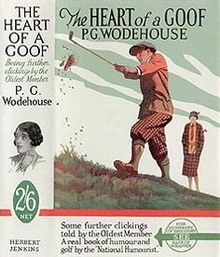
- In The Heart of a Goof, we come to know of Felicia Blakeney. Her brother, Crispin Blakeney, is an eminent young reviewer and essayist. He is said to have gone off to India to study its local conditions with a view to delivering a series of lectures.
- Many of us would recall that in ‘Bertie Changes His Mind’, Carry On, Jeeves, Bertie Wooster tells Jeeves that he has a sister in India. She is likely to return from there with her three daughters. Since Bertie wants to break the monotony of his life, he plans to move to a large house and invite the gang to stay with him. He looks forward to have ‘the prattle of childish voices around him’. Jeeves uses his tact and resource to make Bertie change his mind.
- In ‘Best Seller’, Mulliner Nights, we discover what happens to a young lady whose heart throb has gone off to India. Miss Postlethwaite, the sensitive barmaid, imagines that the lady is ‘standing tightlipped and dry-eyed in the moonlight outside the old Manor. And her little dog has crawled up and licked her hand, as if he understood and sympathized.’
- ‘Jeeves and the Unbidden Guest’, Carry On, Jeeves introduces us to Lady Malvern, a vicious specimen (to quote Bertie). She is said to have been in India for less than a month whereupon she has whipped up a book on social conditions in India, entitled ‘India and the Indians’.
- ‘The Ordeal of Osbert Mulliner’, Mr. Mulliner Speaking narrates the story of Osbert Mulliner who intends to board the boat sailing for India. His idea is to ‘potter awhile about the world, taking in en route Japan, South Africa, Peru, Mexico, China, Venezuela, the Fiji Islands and other beauty-spots’. When Major-General Sir Masterman Petherick-Soames hears of this, he claims to have been in India for many years. He offers to give him all sorts of useful hints. He also claims to know the old ‘Rajputana’ area (the present day state of Rajasthan in India) well.
Indian Handicrafts, Taj Mahal and Tagore

- In Leave it to Psmith, we find that the noise which had unduly perturbed the Efficient Baxter had been caused by ‘the crashing downfall of a small table containing a vase, a jar of potpourri, an Indian sandalwood box of curious workmanship and a cabinet size photograph of the Earl of Emsworth’s eldest son, Lord Bosham.’
- Taj Mahal, the ivory-white marble mausoleum located in the city of Agra, remains a key attraction for those who have India on their itinerary. Designated as a UNESCO World Heritage Site, it does not get left out in Plum’s references to India. In ‘Bingo Bans the Bomb’, Plum Pie, when Bingo Little sees a ray of hope for getting a coveted raise in his emoluments from Mr. Henry Cuthbert Purkiss, the proprietor of Wee Tots, he is said to gaze at the latter with as much appreciation as he would at the Taj Mahal in moonlight.
- Gurudev Rabindranath Tagore, a Nobel laureate, finds a brief mention in ‘Rodney Has a Relapse’, Nothing Serious. Rodney is of the opinion that the family can survive on wholesome and inexpensive vegetables. He thinks this will help his poetry. ‘He says look at Rabindranath Tagore. Never wrapped himself around a T-bone steak in his life, and look where he fetched up. All done on rice, he said, with an occasional draft of cold water from the spring.’
Some Behavioural Traits of Indians

- In Uneasy Money, Lady Wetherby despairingly speaks of having seen ‘Algie hanging over the rail during a three o’ clock race one May afternoon, yelling like an Indian’.
- In The Prince and Betty, Mr. Benjamin Scobbel, the unscrupulous millionaire, has built a casino on the small Mediterranean island of Mervo. He prides himself on its interiors which comprise many rooms, each having a table of its own and furnished in a different style. Besides a Dutch room, a Japanese room, a Swiss room and the like, it also boasts of an Indian room. However, one is ‘wary of accosting some nasty Hindoos’ who look at one rather oddly.
- Visitors to Blandings Castle, when discussing the character of The Efficient Baxter, allude to paranoia – a rush of blood to the head and fellows running amuck.
- ‘I’ve heard fellows who have been in India talk of it. Natives get it. Don’t know what they’re doing, and charge through the streets taking cracks at people with dashed whacking great knives…I have seen it happen so often in India, don’t you know, where fellows run amuck and kick up the deuce’s own delight.’ (Something Fresh)
Of Customs, Conversations and Civil Services
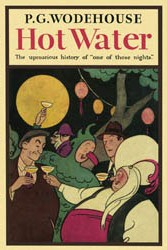
- In Hot Water, we also find a mention of the age-old sordid custom of ‘sati’, which, thanks to the efforts of Raja Ram Mohan Roy, was outlawed during the 19th century itself. It gets referred to by a widowed Mrs. Wilmot Brewster who thinks that Mabel, her sister-in-law, would have perhaps liked her to commit ‘suttee’, a practice followed in India. It means a widow burning herself on the funeral pyre of her husband when he has kicked the bucket.
- In ‘Honeysuckle Cottage’, Meet Mr. Mulliner, James, playing his role of a good host, tries to snap Colonel Carteret out of his absent-minded silence by talking about ‘the weather, golf, India, the Government, the high cost of living, first-class cricket, the modem dancing craze, and murderers he had met.’
- ‘When Papa Swore in Hindustani’, A Wodehouse Miscellany speaks of Colonel Reynolds, V. C., who, upon losing his temper, is apt to swear for half an hour in Hindustani, and for another half-hour in English. He feels better thereafter.
- In Ring for Jeeves, Jeeves clarifies that ‘Kuala Lumpur was first made a separate dependency of the British Crown in 1853 and placed under the Governor-General of India. In 1887 the Cocos or Keeling Islands were attached to the colony, and in 1889 Christmas Island. Mr. Somerset Maugham has written searchingly of life in those parts.’
- In Mike at Wrykyn, the elite administrative service alluded to as the Indian Civil Service gets mentioned by Plum. When Mike is in the Great Hall which has panels showcasing the work the school has done in the world, he finds that the panels are covered with the names of Wrykynians who had won scholarships at Oxford and Cambridge, and of ‘Old Wrykynians who had taken firsts in Mods or Greats’, or achieved any other recognized success, such as a place in the Indian Civil Service list.
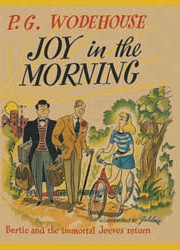
Many of us are aware that Buddhism is a religion of Indian origin, based on the teachings of Gautam Buddha. It is said to have originated sometime between the 6th and the 4th centuries BCE. Of all the characters etched out by Plum, Stilton Cheesewright has the unique distinction of having come under its spell briefly.
In Joy in the Morning, we discover the impressionable nature of the otherwise stiff-upper-lip cop Stilton Cheesewright whose head is said to be comparable to a pumpkin. Florence Craye talks socialism to him and persuades him to read Karl Marx. When at Oxford, someone had temporarily converted him to Buddhism. Bertie recalls that it had led to a lot of unpleasantness with the authorities since he had started to ‘cut chapel and go and meditate beneath the nearest thing the neighbourhood could provide to a bo tree.’
Indian Vedas, Mythology and Superstitions

The Luck Stone, a concoction whipped up by Plum under the pseudonym Basil Windham, was serialized in a magazine known as ‘Chums: An Illustrated Paper for Boys’ during 1908-1909. To the best of my knowledge, it is his only such novel of mystery, high adventure, and danger, where the story is set against the backdrop of a boarding school at Marleigh.
The narrative revolves around a blue stone which keeps popping up and vanishing. The stone is also known as The Tear of Heaven and is a sacred jewel of the Maharajahs of Estapore. The people of the state believe the stone to be sacred and worship it. Without it a Maharajah would have little chance of keeping his throne.
The novel has several Indian references. Ram, one of the class fellows of Jimmy, is described as small, round, and dark-skinned, wearing gold-rimmed spectacles. He is said to come from Calcutta. Jimmy’s father, Colonel Stewart of the Indian Army, has a walnut colour skin, thanks to the harsh sun in India. When posted there, he is said to have been fond of plunging off into the jungle after tigers. His subordinates repose the kind of faith in him which the officers of our Indian army inspire in their men.
We have a bunch of sinister goons who could possibly be broken army men who had got mixed up in shady affairs. There are said to be scores of them in the then underworld of India. The goons have a leader who is a lame man who speaks perfect English with the polished accent of the cultured Indian.
We also have a stiff-upper-lip teacher who is an expert at Indian Mythology, Superstitions and Vedas. He looks at the small stone with as much keen interest as he would if it were the Koh-i-noor and is not averse to hand over the stone to the goons at a price of two hundred and fifty thousand pounds (in 1909 money; or more than twenty-five million pounds in today’s).
How Jimmy Stewart, the hero, and Tommy Armstrong, his friend, use tact and resource to overcome various odds and ensure that the stone ends up falling into the right hands makes for an interesting read. (Source: https://www.madameulalie.org/chums/luckstone19.html)
Some Missing Ingredients in the Curry

In Plum’s narratives, we encounter American millionaires, French cooks, Russian peasants, Italian waiters, Spanish ladies and white hunters and huntresses who keep popping up in Africa. We also get to meet wealthy American ladies who are on the lookout for castles which are owned by impecunious English gentlemen.
When it comes to India, we get introduced to military men, royals and others who narrate some juicy details or the other about that exotic land. He also gives us a sneak peek into the civil disobedience movement of Mahatma Gandhi, the Father of the Nation of India. Rabindranath Tagore’s dietary habits, like those of Mahatma Gandhi, get commented upon. Taj Mahal finds a mention.
Some of his characters are even desirous of trooping down to India to study its social conditions while some emulate the mystics contemplating on the infinite in caves in Himalayas or elsewhere. We come to know of some cities as well.
To Plum’s credit, he even quotes Rudyard Kipling, the India-born author whose works were inspired by his country of birth:
‘I’ve said it before, and I’ll say it again – girls are rummy. Old Pop Kipling never said a truer word than when he made that crack about the f. of the s. being d. than the m.’ (Right Ho, Jeeves).
Not to forget the poem ‘Gunga Din’, which gets mentioned by Plum in few of his narratives.
But if he had wanted to, Plum could have used a number of other Indian resources to further enrich his narratives.
Alas, we do not find any mention of such literary figures as Kalidasa, besides Aryabhata or Ramanuja, the famous mathematicians. The Vedas do find a solitary mention but any other references to India’s soft power comprising such aspects as spirituality, its multi-layered scriptures and various dance forms are sadly missing.
Above all, the mind-numbing diversity of the spirit of India is missing. Its wide spectrum of ethnicities, languages, beliefs, practices and cuisines is nowhere to be found. These are facets of India which have missed out on his wit and wisdom. It is indeed a delectable irony of sorts that this write up is labelled as The Indian Curry Dished Out by P G Wodehouse, even though it has not thrown up even a single reference to any specifically Indian dish!
In his works, the term ‘curry’ does pop up once in a while. Bertie offers Bingo ‘some cold curry’ in ‘Bingo and the Little Woman’ (The Inimitable Jeeves). He also mentions ‘curried egg’ in The Code of the Woosters. There are few more instances of this kind. There are even references to mulligatawny soup. The reason these references do not appear here is simply that Plum never qualifies these as being specifically Indian. Whereas a resident of the UK could consider these as Indian references, those in the USA and elsewhere could interpret these to allude to any curry of Asian origin. Yes, there is a possibility that Plum had an Indian connection in mind while using the term in his works.
As to a liberal use of many other resources of an Indian origin, imagine a distraught Gussie Fink-Nottle pining for Madeline Bassett and sending messages to her through clouds passing overhead, a la ‘Meghadut’, the classic poem penned by Kalidasa. Poets like Ralston McTodd would have been found drawing some inspiration from the creative outpourings of Tagore. Personalities like Indian scientists and mathematicians would have helped some sleepless guardians of the peace – like Constable Oates – to improve their methods of investigation, improving the prospects of their being noticed by Scotland Yard. To improve Bertie’s intellect, all Florence Craye had to do was to insist that he peruse at least one of the chapters of the ‘Bhagavad Gita’. Laura Pyke could have drawn some inspiration from the science of ‘Ayurveda’, the healthy-lifestyle system that people in India have used for more than 5,000 years. Anatole could have been found whipping up ‘chhole-bhature’ or ‘dosa’s!
Yoga could have helped someone like Ashe Marson to treat his clients suffering from acute dyspepsia to heal faster and better. Sir Roderick Glossop could have gone about advising his loonier patients to make meditation an essential part of their mundane lives. Vicars could have lived a happier Thos-infested life while brooding on spiritual tenets dished out by Indian scriptures, thereby becoming hotter at their jobs. George Bevan, while working on one of his next musical comedies, could have been drawing inspiration from the ‘Natya Shastra’ of Bharata Muni. Gentlemen aspiring for India rubber legs could have been practising such dance forms as ‘Kathak’ or ‘Bharatnatyam.’
The possibilities are endless. The mind boggles. But one would do well not to be concerned with what might have been. Instead, the focus needs to be on the rich legacy Plum has left behind for us to rejoice in.
The Pale Parabola of Subtle Humour
In fact, quite a few of his works have been translated into the regional languages of India, forming a pale parabola of subtle humour across India. Encouraged by an expert on Plummy affairs, I recently posted an enquiry on Facebook. The results have been gratifying, though not exhaustive.
Some fans of his confirm that Sanskrit has in its fold The Great Sermon Handicap (Dharmopadeśasya Mahatī Aśvadhāva).
Bengali has translations of Psmith in the City (Sahar e elo Psmith), The Summer Lightning (The Summer Lightning) and Psmith the Journalist (Sambadik (P)smith), all done by Sanjit Ghatak. Bengali translation of Clicking of Cuthbert too was appended by him to Psmith the Journalist. Hemendra Kumar Roy’s offering Tara Tin Bondhu (They Were Three Friends) is noteworthy; therein one of the adventures of the titular trio is a take on The Truth About George. Then there is The Crime Wave at Blandings (Abhyartha Lakshabhed), a novella dished out by Narayan Gangopadhyay, the creator of ‘Tenida’ and his three followers. At least two stories, or incidents from those stories, were adapted by the great Bengali humourist Rajshekhar Basu (Parashuram). These happen to be Buck-U-Uppo (Rajbhog) and Pig-hoo-o-o-o-ey (Rajmahishi). Some other translators have retained the original titles in the Bengali versions, such as Carry on, Jeeves by Manindra Dasgupta and Thank You, Jeeves by Nripendra Krishna Chattopadhyay.
Kannada can boast of many Jeeves-Wooster and Mulliner stories, thanks to the efforts of Kefa (a pseudonym of Dr. A.V. Keshava Murthy). These were published in a satirical magazine known as ‘Koravanji’ in the 1950s and 1960s. Then there is a play entitled ‘Okay’ written by N. Kasturi which is based on Mulliner’s Buck-U-Uppo, which is also a sincere adaptation. Mr. Palahalli Vishwanath has adapted twenty stories to Kannada and published his collection as Alpa Swalpa Wodehouse (A Little Bit of Wodehouse).
Telugu can take pride in Gabbita Krishna Mohan who is the most recent and certainly the most prolific translator of Wodehouse in the language. He has published as many as seven books based on his narratives. These are actually not pure translations but more of adaptations since the same have been adapted to an Indian milieu. He is said to have been quite faithful to the plot and to the characterisations. Thus, fans who are adept in the language can devour:
The Old Reliable (Aapaatbandhavi)
Uncle Dynamite (Uncle Dynamite)
Frozen Assets (Lanke Bindelu)
If I Were You (Neeve Naenai Nene Neevai)
The other three dished out by the same author are titled Saradaga Kasepu (Fun For A While), Saradaga Marikasepu and Saradaga Marikonthasepu. These are a compilation of assorted short stories, several of them based on the Mulliner saga.
Marathi author Purushottam Lakshman Deshpande and Tamil author Mahadevan are as revered for their wit and humour as Plum is in English. However, there are no known translations of any of Plum’s books in these languages, though Prasanna Pethe is said to have published a book on the life of P. G. Wodehouse in Marathi.
When it comes to Hindi, I would rate the works of Hari Shankar Parsai, Sharad Joshi and Shrilal Shukl as being closest to Plum’s style which was characterized by wit and satire. I am not aware of any translations of his books in Hindi.
His fans are well aware that globally many of his books have been translated into several languages. One bows in reverence to the brainy coves who have facilitated the spread of Wodehousitis thus. Their literary skills and their passion for Plum deserve to be applauded. After all, it is not easy to figure out how one could translate such delectable phrases and, in particular, such expressions as ‘Right Ho’, ‘By Jove’, ‘Pip pip’, ‘Tinkery Tonk’, ‘Toodle O’ and the like. Perhaps the solution lies in adapting the stories to the local milieu and a liberal dash of colloquial slang!
A Consistent Depiction, Despite 1947

The India that Plum would refer to belongs to an era which is long since bygone. India gained independence in 1947, but his works published during the period from 1947 (Joy in the Morning) till 1974 (Aunts Aren’t Gentlemen) do not reveal much change in his imagination. If one were to compare allusions to India based on Wodehouse’s works published before and after 1947, one notices a singular consistency. Astral bodies, scorpions and cobras continue to rule the roost.
The insignificance of the year of India gaining independence from the British Raj in Plum’s works has its own merits. Much like the relationship between Bertie Wooster and Tuppy Glossop, which soured for some time when the former was forced to take a dip in the water even when suitably attired, a friendly spirit of joie de vivre appears to have prevailed and both countries have moved on.
Malcolm Muggeridge, who was an editor of Punch, had spent two extended periods in India, once during 1923-26, as a lecturer in English at a college in Kerala, and then during the early 1930s as an assistant editor of the Statesman. In his book Tread Softly for you Tread on my Jokes, he says that ‘Almost the only Englishmen left in the world today are Indians…. If there are Bertie Woostersstill around, they are called, we may be sure, Sen Gupta or Abdul Rahman.’
Many enlightened Indians who take a broad view of things, or those who were born much after 1947 and have not suffered the birth pangs of their country, admire the Crown rule for having left behind a rich legacy in terms of a legal framework, a bureaucracy, a railway network, partial linguistic proficiency in English and a fine army with its own traditions. The genesis for such a legacy to have come about could have been rooted in stark commercialism and a stiff-upper-lip-type control over the people, but that need not distract us from the fine institutions created and left behind by the British in 1947.
But many others, especially those who have been exposed to the personal trauma of partition which ended up displacing an estimated 10 to 20 million people along religious lines, or their descendants who have heard the horror stories of those trying times, and many others, would speak of the manner in which Indians of yore were exploited by the British. They would lament the decline of their country’s share in the global Gross Domestic Product from roughly 27 percent in the 1700s to roughly 3 percent in 1947. (Sources: Wikipedia and a talk by Dr. Shashi Tharoor, a famous fan of Plum’s and a Member of Parliament of India, https://www.youtube.com/watch?v=OB5ykS-_-CI)
In the present scenario, both the countries, the erstwhile rulers as well as the ruled, enjoy a healthy and vibrant relationship. Even during the two World Wars in the 1900s, Indian soldiers had made the supreme sacrifice, supporting the British/Allied forces. Over time, close to 150,000 soldiers are said to have died while supporting the wars fought by the Empire. A private sector steel company in India had produced rails much to the satisfaction of the rulers. Sure enough, there were mutinies, internal skirmishes and episodes of non-violent civil disobedience, but there were clear signs of good collaboration between the two even prior to 1947.
In any case, it should come as no surprise that Plum maintains consistency throughout his canon while using Indian condiments for the curry he serves. During 1947, the Indian subcontinent was undergoing some major changes. But these did not register on the Plumsville radar.
From a global perspective, the devastation caused by the Second World War (1939–45) was then the main area of concern, rather than the fact of India gaining independence on 15 August 1947. Plum had personally suffered in his life owing to political developments then and had relocated from Europe to USA during April 1947, never to visit Europe again. One believes that the press in the USA had then covered the fact of India gaining independence rather prominently, probably because it was the first significant nation to have gained independence from the British after the USA, which had achieved the feat some 171 years earlier, in 1776. However, due to his preoccupation with other matters then, perhaps the last thing on his mind would have been the British (or American) reaction to the events unfolding in India. Hence his storylines and characters never touched upon the emergence of an independent India.
Even though his works do not offer any commentary on the politics of the day, at times he does not refrain from deploying the communist ideology to amuse and entertain his readers. Psmith brims over with socialist ideas. George Cyril Wellbeloved has strongly communistic views. At one stage, even Bingo Little becomes a member of the ‘Red Dawn’. Roderick Spode happens to be a born crusader and revolutionary. Vanessa Cook leads protest marches and appears to be gravitating towards politics by chance. Stilton Cheesewright, who is otherwise content being a vigilant guardian of peace at Steeple Bumpleigh, gets egged on by Florence Craye to pursue a career in politics.

It would not be wrong to say that his works represent the composite way of life on the Indian subcontinent, often unimaginable these days in the din of nationalistic jingoism on either side of the India-Pakistan border.
The love for Plum’s oeuvre in the Indian subcontinent transcends any such mundane considerations. Moreover, Plum sets a gold standard of pristine humour not only in English but also in many regional languages.
The reasons for his popularity on the Indian subcontinent are many. Having been ruled by the dispensable siblings of the British nobility, many of them still carry a feeling of awe and respect for their white rulers. Perhaps the idea of acquiring a linguistic skill and being on an equal footing with their erstwhile rulers appeals to them. By taking a saunter down the sunlit valleys of Plumsville, perhaps they are temporarily relieved of the pain of their economic hardships, misery and lack of quality infrastructure and civic services. In other words, at a subconscious level, this could be their style of fighting the depressing shadows of imperialism while nourishing their own sense of patriotism.
He is often regarded as a writer about the ruling classes, touching upon the challenges faced by some woolly-headed but financially well-endowed characters. However, scratching below the surface, one finds that in the vast majority of cases his sympathies are with the less well-off, the underdog and even the down-trodden. Thus, those who happen to be less fortunate in their lives, facing its harsh slings and arrows, perhaps find it easier to identify with many of his characters. Moreover, when he lampoons figures which are dictatorial, authoritarian, magisterial and the bullying kind, one tends to be in sync with him.
One of his ardent fans is of the opinion that Plum uses stereotypes not only to make his readers chuckle but also to demonstrate the futility of painting all the people in a group with the same brush. In his works, all Scots are red-headed, frugal and angry; all Australians are rich sheep farmers and are prone to stealing anything that is not bolted to the ground; all Russians go around killing family members after a hard day’s work; all financiers are alumni of the Sing Sing and similar institutions; all aunts are dangerous, and the like. He leads his readers into valleys lit up with sunny humour, playing with these notions until they lie shattered on the ground. He might not have meant to do it but his lesson is that blanket ideas about people are nonsense.
Whatever the reasons, Plum’s appeal across the Indian subcontinent is as dispersed as the milk of human kindness coursing through the Wooster veins.
Conclusion
All inputs were invariably grist to the humour-producing mill of P. G. Wodehouse. He had this unique talent of turning and twisting even the most inconsequential things into something which would leave his readers chuckling, guffawing, rollicking, laughing and falling down from their couches. All his works are like beehives dripping with honey which possesses the unique property of making one look at the sunnier side of life. His sole aim has always been to amuse, entertain, educate and uplift his readers. Give him an enigmatic country like India teeming with enchanting wildlife, enigmatic mystics, magnificent temples and gallant men in uniform and he delivers utmost satisfaction.
Plum dished out his narratives in a pre-Internet era, when access to information was severely restricted. It is amazing that based mostly on secondary data, so to say, he could leave behind for us a spicy Indian curry, making India shine through in so many ways through a vast array of his novels and stories.
Pip pip!
Notes:
- The inspiration for this essay comes from the scholarly work done by Ms. Masha Lebedeva, who had earlier whipped up a research paper entitled The Russian Salad by P. G. Wodehouse.
- The author expresses his sincere gratitude to few eminent experts on Plummy matters for having spared the time to go through a part of this composition and provide insightful suggestions. Some fans of P. G. Wodehouse have also suggested improvements in its contents.
- Thanks are also due to Mr. Suvarna Sanyal for dishing out the main illustration; also, to Ms. Sneha Shoney, who has edited the text.
- The author wishes to emphasize his moral rights over the contents of this essay, save and except quotations from the books/stories of P. G. Wodehouse, the rights to which belong exclusively to the Wodehouse Literary Estate, UK. Anyone planning to publish any part of this essay including quotations from Wodehouse’s writing would do well to obtain appropriate consent from the Trustees of the Estate. Some material has been sourced from Wikipedia.
- Insofar as images of P. G. Wodehouse and book covers are concerned, every effort has been made to trace relevant copyright holders. If there have been inadvertent omissions I apologize to those concerned, and request them to contact Ashok Kumar Bhatia at akb_usha@rediffmail.com so that any oversights can be corrected.
- This is merely an indicative listing of references to India in Plum’s books and stories. It is surely not exhaustive.
- Feedback at akb_usha@rediffmail.com shall be welcome. Those who wish to receive a PDF version of this essay may please send a request to this mail id.
- The author suffers from two afflictions: Professoritis and Wodehousitis. His profile can be seen at https://www.linkedin.com/in/ashokkumarbhatia.
- This essay is for private circulation only. The intention is not commercial but merely to share some of the references made by P. G. Wodehouse in his books/stories to India.
The Indian Curry Dished Out by P. G. Wodehouse (Part 6 of 9)
Posted in What ho!, tagged Handicrafts, Humour, India, P G Wodehouse, Rabindranath Tagore, Taj Mahal, Travellers on August 2, 2021| Leave a Comment »
(Continued)
India on the Travel Itinerary
- In The Heart of a Goof, we come to know of Felicia Blakeney. Her brother, Crispin Blakeney, is an eminent young reviewer and essayist. He is said to have gone off to India to study its local conditions with a view to delivering a series of lectures.
- Many of us would recall that in ‘Bertie Changes His Mind’, Carry On, Jeeves, Bertie Wooster tells Jeeves that he has a sister in India. She is likely to return from there with her three daughters. Since Bertie wants to break the monotony of his life, he plans to move to a large house and invite the gang to stay with him. He looks forward to have ‘the prattle of childish voices around him’. Jeeves uses his tact and resource to make Bertie change his mind.
- In ‘Best Seller’, Mulliner Nights, we discover what happens to a young lady whose heart throb has gone off to India. Miss Postlethwaite, the sensitive barmaid, imagines that the lady is ‘standing tightlipped and dry-eyed in the moonlight outside the old Manor. And her little dog has crawled up and licked her hand, as if he understood and sympathized.’
- ‘Jeeves and the Unbidden Guest’, Carry On, Jeeves introduces us to Lady Malvern, a vicious specimen (to quote Bertie). She is said to have been in India for less than a month whereupon she has whipped up a book on social conditions in India, entitled ‘India and the Indians’.
- ‘The Ordeal of Osbert Mulliner’, Mr. Mulliner Speaking narrates the story of Osbert Mulliner who intends to board the boat sailing for India. His idea is to ‘potter awhile about the world, taking in en route Japan, South Africa, Peru, Mexico, China, Venezuela, the Fiji Islands and other beauty-spots’. When Major-General Sir Masterman Petherick-Soames hears of this, he claims to have been out there for years. He offers to give him all sorts of useful hints. He also claims to know the old ‘Rajputana’ area (the present day state of Rajasthan in India) well.
Indian Handicrafts, Taj Mahal and Tagore
- In Leave it to Psmith, we find that the noise which had unduly perturbed the Efficient Baxter had been caused by ‘the crashing downfall of a small table containing a vase, a jar of potpourri, an Indian sandalwood box of curious workmanship and a cabinet size photograph of the Earl of Emsworth’s eldest son, Lord Bosham.’
- Taj Mahal, the ivory-white marble mausoleum located in the city of Agra, remains a key attraction for those who have India on their itinerary. Designated as a UNESCO World Heritage Site, it does not get left out in Plum’s references to India. In ‘Bingo Bans the Bomb’, Plum Pie, when Bingo Little sees a ray of hope for getting a coveted raise in his emoluments from Mr. Henry Cuthbert Purkiss, the proprietor of Wee Tots, he is said to gaze at the latter with as much appreciation as he would at the Taj Mahal in moonlight.
- Gurudev Rabindranath Tagore, a Nobel laureate, finds a brief mention in ‘Rodney Has A Relapse’, Nothing Serious. Rodney is of the opinion that the family can survive on wholesome and inexpensive vegetables. He thinks this will help his poetry. ‘He says look at Rabindranath Tagore. Never wrapped himself around a T-bone steak in his life, and look where he fetched up. All done on rice, he said, with an occasional draft of cold water from the spring.’
(Continued)
Notes:
The inspiration for this essay comes from the scholarly work done by Ms. Masha Lebedeva, who had earlier whipped up a research paper entitled The Russian Salad by P. G. Wodehouse.
The author expresses his sincere gratitude to an eminent expert on Plummy matters for having spared the time to go through a part of this composition and provide insightful suggestions. Some fans of P. G. Wodehouse have also suggested improvements in its contents.
Thanks are also due to Mr. Suvarna Sanyal for dishing out the main illustration in Part 1; also, to Ms. Sneha Shoney, who has edited the text.
Those of you who wish to cruise through this essay in its entirety may kindly write to akb_usha@rediffmail.com for a PDF version of the complete document to be mailed to them.
Related Post:
Tryst with Fire: Welcome to the Storm; Guest Post by Prof Sanjoy Mukherjee
Posted in Management Lessons, tagged Belur Math, Chicago, India, Leadership, Netaji Subhash Chandra Bose, Nietzsche, Rabindranath Tagore, Satyajit Ray, Shri Ramakrishna, Sister Nivedita, Socrates, Sri Aurobindo, Swami Vivekananda, Tribute on May 20, 2020| 4 Comments »
A Tribute to Swami Vivekananda: Leader Extraordinary
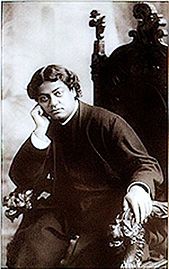
“On the seventh of August 1941, in the city of Calcutta, a man died. His mortal remains perished but he left behind a legacy… that no fire can ever consume…”
That was the baritone, sonorous voice of Satyajit Ray in his documentary titled ‘Rabindranath’ created as a tribute to Rabindranath (a project mandated on Ray, the genius in film making, arts and literature, commissioned by Ministry of Culture, Government of India) on the occasion of the birth centenary of the another genius, Rabindranath Tagore the Nobel laureate poet, musician, novelist, dramatist, artist and philosopher. The first scene of the documentary depicted the last and final journey of Tagore to the burning ghat (crematorium).
Ray’s portrayal of Tagore began with the scene finale. But where do we start in our odyssey with the volcanic monk of India whose 150th birth anniversary we celebrated earlier in this decade?
“Let’s start from the very beginning/ a very good place to start…” (The Sound of Music)
Naren or rather Bile (Narendranath Datta) was storm or turbulence personified from childhood in the premises of the Datta household in North Calcutta. Never obedient to seniors, ever an enigma to peers (his local friends), he would relish his father’s hookas (smoking pipes) or throw away his mother’s clothes from the windows to the beggars on street even while he was locked up in a room for his erratic unmanageable behaviour. But when the time of crisis came, his friends would run away at the sight of a snake. But he would remain seated, immersed in meditation while the snake rustled away leaving him in peace. Trained in the art of physical mastery, he would combat the white man for speaking ill of Indians. He showed the promise of a Life Exemplary and Leader Extraordinary!
“His pre-eminent characteristic was kingliness. Wherever he went he was the first.’ (Romain Rolland).
Narendranath was a born leader, never ‘made’ – only refined and directed by his great master Shri Ramakrishna.
A good leader accepts the situation at hand and tries to find a way out. But a great leader is ever in discomfort with the commonplace and the hackneyed reality. Naren began his quest for the beyond with burning questions on the existence of God and purpose of Life – only to be answered clear and direct by Sri Ramakrishna, who was to become his master though in appearance, upbringing and otherwise his direct antithesis. But this was not by any devout dedication but through a series of questioning he hurled upon his master. And then came the hour of consecration.
“Ei jonmo ei shorir oi murkho bamun kine niyeche”. (This life, this body is consecrated to that old illiterate Brahmin!) – He wrote to a brother disciple later.
By the way, Narendranath was projected as the leader of tomorrow by his master – not by himself!
“Naren shikshe debe” (Naren will teach the world) – was the prophecy of Shri Ramakrishna in the Master’s own writing.
A great leader emerges out of stormy crisis from various fronts – death of father, deprivation of mother from family property, futile search for a job. But he had the fortitude to stick to his master’s promise that he would never be plagued with basic sustenance. His primary preoccupation became an immersion into the self, deep in meditation. “Mon cholo nijo niketone…’ (O Mind! Return to thy own repose!). It was for his Master to turn him towards the world with the message of service, love, education to humanity. He was destined to be a leader –a banyan tree for one and many.
Storm as in crises for him was lifetime companion – severe hardship n Baranagar Math in North Calcutta after the death of his Master, hunger and uncertainty during his parivrajaka (the wandering monk) life in India, anxiety about funds for the America trip, spending sleepless and shivering night in Chicago railway station, lampooned and maligned by his opposition religious groups in the West and even from his close quarters back home.
But the fire in him was never to extinguish.
Vivekananda stood for the principles of acceptance and assimilation of diverse opinions, values and cultures. A true global leader in thoughts, words and action, he became a fiery inspiration to men and women from the East and West from myriads of background – businessmen like Rockefeller and Jamshetji Tata, European women like Margaret Noble (Sister Nivedita) and Emma Calve, scientists like Acharya J C Bose and many more. His style of communication was different for each according to the nature and character of individuals. His was an enlightened universal mind a century ahead of his times. But never did he lose his anchor in India.
“India was his daydream. India was his nightmare.” (Sister Nivedita)
And his thundering voice rose: “He Bharat bhuliona…” (O India! Forget not…). He never disowned the past and ever cherished the golden heritage of India. But he was ever stretching out his hand and heart of welcome to the West as well, to a future that is different and diverse yet mutually and globally enriching for one and all.
“Je somonnvoy kore sei lok” (The one who can synthesize is truly a human) said his Master. Swamiji lived this message throughout life – a grand synthesis of the best from all parts of the world that he had visited during his brief life span.
‘Srinvantu Vishwe Amritasya Putrah’ (Listen! O Children of Immortality, world over!). This was the invocation of the rishis of the Upanishads. The voice of Swamiji in Chicago Parliament of Religions resonated; “Sisters and brothers of America…” He was a modern incarnation of the ancient rishis (sages and seers) in the attire of a monk.
Back home he chose ‘atmanomoksharatham jagat hitaya cha’ as the motto of the Ramakrishna Mission – (For the liberation of the self and the welfare of the world) on the foundation of the philosophy and principle of action ‘Siva jnana jivaseva’ (To serve man is to serve God n Man) as he learnt from his Master.
His last life in Belur Math was like that of a child – playing with animals and enjoying the company of tribal people while giving lessons on Upanishads to brother monks. In fact his was a life of a child-like leader yearning for fresh air and new light and learning forever. He learnt from all possible sources including a low caste ‘bhangee’ (one from a low caste) with whom he had smoke and also a dancing girl who, in Rajasthan at the palace of Maharaja of Khetri, taught him the message of non-discrimination among humans.
“Jabot bnachi tabot shikhi” (I learn as long as I live) – was the message of Shri Ramakrishna. Following this precious teaching from his Master Swamiji lived, loved, learnt and left a legacy that is lasting and growing even beyond a century! Ramakrishna Mission is sustaining and flourishing every day all over the world for the service of humanity at large – spiritual, social and educational.
His funeral pyre was lit on the bank of the Ganges on the fifth of July 1902. The body of the monk inferno Swami Vivekananda was stretched on pyre in his chosen place under the bilwabrikshwa (The Bengal Quince tree) in Belur Math. His mother Bhubaneshwari Devi was sitting and watching the rising flames from the body of his eldest son. A speck of his saffron robe flew in the wind to Sister Nivedita, the devout disciple of the monk. She collected and preserved that ‘memento’ for her inspiration to action in the days to come.
Thus was the mortal consummation of the Swami, the Prince among men –the volcanic monk who shook the world with the fiery message of the Upanishads under the spiritual umbrage of his ‘seraphic master’ Sri Ramakrishna and ignited the spirit of India towards freedom.
Netaji (Subhas Chandra Bose) accepted him as his fiery guru in mortal absentia. In the words of Sri Aurobindo, it was like “baptism with blood and fire”. Netaji described Swamiji as a leader extraordinary in the following words:
“Reckless in his sacrifice, unceasing in his activity, profound and versatile in his wisdom, boundless in his love, exuberant in his emotions, merciless in his attacks and yet as simple as a child, he was a rare personality in this world of ours.
If Swamiji had been alive today he would have been my guru.”
I have ransacked the history of leadership and management literature in my voyage through Human values and Indian Ethos in Management, Spirituality and Leadership for nearly three decades but never found such a detailed, succinct yet most powerful and accurate assessment in these seven leadership qualities of one genius of a world leader by another of no mean stature.
We began with a tribute to Tagore by Satyajit Ray. And here we find a tribute to Swami Vivekananda, the Great Master and Leader Extraordinary by none other than Netaji Subhas Chandra Bose. They remain with us as fountainhead of boundless inspiration in a world ruled and dictated by leaders who at best belong to the class of mediocrity in academia and otherwise!
But the fire in the volcanic monk still remains alive and aflame in those who are willing and ready to be ignited.
‘Agne twam hridayam agachha’ – Oh Fire Eternal! Come and set our hearts ablaze!
“Amar modhye je agun jwolchhe tomader modhye o sei agun jwole uthuk… Ei sodai Vivekanandar prarthana.”
(The fire that is burning within me may set all your hearts aflame! This will ever be the eternal prayer of Vivekannada.)
May we live up to his prayers!
It was high in the snowy Himalayas. Swamiji was on pilgrimage with a few chosen disciples. His intense meditation led him to a vision of the Mother Kali, the Black Goddess, the mighty Destroyer and Time Eternal, lurking behind the veil of life. During one evening in a state of high fever he wrote a famous poem that concludes thus:
“Who dare misery loves,
And hug the form of Death,
Dance in destruction’s dance,
To him the Mother comes.”
He said to her chosen disciple Nivedita (an Irish lady of noble origin): “Meditate on death. Only by the worship of The Terrible can The Terrible itself be overcome…There could be bliss in torture too…The Mother Herself is Brahman…The heart must be a cremation ground – pride, selfishness, desire, all burnt to ashes. Then and then alone, will the Mother come!”
Vivekananda exemplified an authentic synthesis of the East and the West, the past and the present, Science and Religion, contemplation and action, spiritual pursuit and service to humanity. He was the messenger of dynamism and hope to India and the world. Could it be that he was under a spell of so-called negative thinking when he wrote the above verse? Or did he want to convey a pertinent message in a different mood that might be useful for all in moments of turbulence and uncertainty?
Leaders of tomorrow in business or otherwise, when shall we learn from death and destruction of old orders that we need creative quantum breakthroughs in our leadership principles, roles and practices to shake the very foundation of our outdated models and worn out concepts, our tunnel vision and fossilized values, by keeping alive and aflame just one precious element within our hearts – the passion to transform and infuse new life in our organizations and the planet at large?
Millennia ago, Socrates exhorted us to think and look within ourselves: “An unexamined life is not worth living.” Closer in time, the voice of Nietzsche sounded even more daring and adventurous: “If one is to live, one is to live dangerously.”
{Tribute to Swami Vivekananda, the Great Master and leader extraordinary on The Foundation Day (May 1st, 1897) of The Ramakrishna Mission, the first Indian international organization with headquarters in India (Belur Math, Howrah – Kolkata on the bank of the Ganges) but outreach all over the world with more than 200 centres and still thriving in glory for almost more than a century and a quarter dedicated to the service of suffering humanity. An entrepreneurial venture of timeless significance even in times of crisis as in the present, this institution remains and grows as the ever expanding global vision of this great master as an inexhaustible source of energy and inspiration, firmly rooted in Indian culture, ethos and heritage but with appeal reaching all over the world. At a level of Philosophy in Practice (Practical Vedanta, a term coined by himself that he spread like wild fire in the West even within the short span of his life of less than forty years) he gave a new turn to the ideal of monkhood with simultaneous emphasis on pursuit of salvation of the self through evolution of Consciousness and welfare of humanity at large.The Ramakrishna Mission that embodies the ideals of globalization and sustainability propounded by its founder a century before the pioneers of management in the West could even conceive of these ideas and principles. Even at a functional level the structure of the main temple of Shri Ramakrishna in Belur Math represents a grand synthesis of the East and the West – of Christian, Islamic and ancient Indian architecture.]
(Sanjoy Mukherjee (58) is Faculty of the Sustainability, CSR and Ethics academic group at the Indian Institute of Management (IIM) Shillong. He is the Chairperson of the Institute’s Annual International Sustainability Conference (SUSCON) and also the Chairperson of Student Affairs, Placement and Public Relations.
His detailed profile can be accessed at https://www.linkedin.com/in/sanjoy-mukherjee-72b18823
Permission to publish this tribute here is gratefully acknowledged.)
Norway: Where the head is held high
Posted in The European Diaries, tagged Freedom, Inclusivity, India, Norway, Poetry, Rabindranath Tagore, Values, Work Culture on May 16, 2019| Leave a Comment »

Here is a country where the mind is without fear
And the head is held high
Where knowledge to children and youth is virtually free
And those distressed by the world are welcomed with open arms;
Where the definition of nationalism implies inclusivity
Fine arts of all countries and cultures are welcome
If narrow domestic walls exist, these are only to protect national interests
Where respect for the law of the land reigns supreme;
Where gender equity and diversity is not a mere slogan
The care offered to the elderly is exemplary
Some wish the taxes to be lower but realize the money is well spent
In many ways does it serve and comfort the citizens;
Where human endeavour aims to attain perfection
Words come out from an inner conviction
Gentle, helpful, physically active and resilient
Following a work culture which deserves to be aped;
Where one can encounter the true…
View original post 51 more words
-
Recent Posts
Buy the Book

buy the book
Categories
-
cc
Tags
Art Bertie Wooster Bhagavad Gita Bingo Little Birthday Blake Mouton Grid Blogging Bollywood Book Campus Life CEO Chivalry Consciousness Coronavirus Corruption Edwin Empress of Blandings English Ethics Feminism Happiness Health Hindi Hollywood Human Values Humour India Jeeves Kalidasa KIds Leadership linkedin Literature Lord Emsworth Love Lyrics Mahabharata Mahatma Gandhi Management Movies Music Norway Paintings Panjab University People P G Wodehouse Politics Pondicherry Portugal Psmith Puducherry Rabindranath Tagore Ramayana Ritusamhara R K Laxman Romance Rosie M Banks Rupert Psmith Seasons Shakespeare Social Media Something Fresh Songs SPANDAN Spirituality SQ Sri Aurobindo Stephen Covey Switzerland Tatas Thos UBS Values Wodehousitis WomenArchives
- March 2026 (1)
- February 2026 (5)
- January 2026 (2)
- December 2025 (1)
- November 2025 (2)
- October 2025 (2)
- September 2025 (3)
- August 2025 (3)
- July 2025 (2)
- June 2025 (2)
- May 2025 (4)
- April 2025 (5)
- March 2025 (5)
- February 2025 (4)
- January 2025 (4)
- December 2024 (6)
- November 2024 (6)
- October 2024 (6)
- September 2024 (5)
- August 2024 (5)
- July 2024 (4)
- June 2024 (4)
- May 2024 (5)
- April 2024 (5)
- March 2024 (3)
- February 2024 (1)
- January 2024 (4)
- December 2023 (2)
- November 2023 (3)
- October 2023 (3)
- September 2023 (3)
- August 2023 (5)
- July 2023 (5)
- June 2023 (7)
- May 2023 (6)
- April 2023 (6)
- March 2023 (8)
- February 2023 (8)
- January 2023 (7)
- December 2022 (6)
- November 2022 (5)
- October 2022 (8)
- September 2022 (5)
- August 2022 (6)
- July 2022 (6)
- June 2022 (8)
- May 2022 (7)
- April 2022 (8)
- March 2022 (7)
- February 2022 (3)
- January 2022 (7)
- December 2021 (4)
- November 2021 (8)
- October 2021 (7)
- September 2021 (6)
- August 2021 (7)
- July 2021 (7)
- June 2021 (9)
- May 2021 (8)
- April 2021 (9)
- March 2021 (10)
- February 2021 (8)
- January 2021 (8)
- December 2020 (7)
- November 2020 (6)
- October 2020 (5)
- September 2020 (9)
- August 2020 (9)
- July 2020 (8)
- June 2020 (8)
- May 2020 (6)
- April 2020 (5)
- March 2020 (7)
- February 2020 (4)
- January 2020 (7)
- December 2019 (12)
- November 2019 (10)
- October 2019 (5)
- September 2019 (9)
- August 2019 (10)
- July 2019 (9)
- June 2019 (14)
- May 2019 (13)
- April 2019 (14)
- March 2019 (11)
- February 2019 (11)
- January 2019 (14)
- December 2018 (12)
- November 2018 (12)
- October 2018 (14)
- September 2018 (9)
- August 2018 (10)
- July 2018 (10)
- June 2018 (8)
- May 2018 (11)
- April 2018 (11)
- March 2018 (6)
- February 2018 (9)
- January 2018 (10)
- December 2017 (10)
- November 2017 (9)
- October 2017 (8)
- September 2017 (11)
- August 2017 (10)
- July 2017 (10)
- June 2017 (11)
- May 2017 (9)
- April 2017 (7)
- March 2017 (7)
- February 2017 (8)
- January 2017 (10)
- December 2016 (9)
- November 2016 (11)
- October 2016 (10)
- September 2016 (10)
- August 2016 (9)
- July 2016 (6)
- June 2016 (10)
- May 2016 (10)
- April 2016 (10)
- March 2016 (10)
- February 2016 (12)
- January 2016 (10)
- December 2015 (11)
- November 2015 (11)
- October 2015 (10)
- September 2015 (10)
- August 2015 (10)
- July 2015 (10)
- June 2015 (10)
- May 2015 (10)
- April 2015 (10)
- March 2015 (9)
- February 2015 (10)
- January 2015 (8)
- December 2014 (9)
- November 2014 (8)
- October 2014 (8)
- September 2014 (7)
- August 2014 (7)
- July 2014 (7)
- June 2014 (7)
- May 2014 (7)
- April 2014 (7)
- March 2014 (7)
- February 2014 (6)
- January 2014 (7)
- December 2013 (6)
- November 2013 (6)
- October 2013 (6)
- September 2013 (6)
- August 2013 (6)
- July 2013 (6)
- June 2013 (6)
- May 2013 (6)
- April 2013 (6)
- March 2013 (6)
- February 2013 (6)
- January 2013 (6)
- December 2012 (4)
- November 2012 (4)
- October 2012 (3)
- September 2012 (2)
- August 2012 (4)
- July 2012 (2)
- June 2012 (2)
- May 2012 (2)
- April 2012 (2)
- March 2012 (2)
- February 2012 (3)
- December 2011 (3)
- November 2011 (1)
- October 2011 (2)
- September 2011 (2)
- August 2011 (2)
- July 2011 (2)
- June 2011 (3)

 ashokbhatia