Feeds:
Posts
Comments

Posts Tagged ‘Satyajit Ray’

Introduction

As the sombre mist of mortality settles upon the world, I find myself, along with countless others, lost in the labyrinth of thought, pondering the enigmatic fate that had beckoned the great poet, Rabindranath Tagore, to the realm of the eternal, on the 7th of August, 1941. For the 83rd time, we are forced to confront the stark reality of his passing, and the weight of his absence settles upon our collective conscience like a shroud. And yet, as we gaze upon the canvas of his extraordinary life, we cannot help but wonder what wondrous tapestry of words and ideas the Bard of India might have woven had he remained among us, a tantalizing what-if that haunts us like a persistent melody.

Looking back to early days

As a child of tender years, his idealistic nature found expression in a paean to the raindrops’ embrace upon leaves, their gentle patter evoking the rhythmic swaying of an elephantine behemoth –

Water pours, leaves dance, 

Crazy elephant’s head sways in a trance

To attempt to encapsulate his colossal contribution to the arts would be like trying to capture the sun in a teacup. Like a literary Gargantua, he devoured every realm of culture, leaving behind a Gargantuan feast of creative output.

His ‘Nobel’ contribution

The year 1913 was a moment in the annals of literary history when the world finally awakened to the profound significance of Rabindranath Tagore’s contributions to world literature. It was as if the veil of ignorance had been lifted, and the international community beheld, with a mixture of wonder and reverence, the sheer brilliance of the Bengali bard’s thoughts. And we, as Indians, were filled with a sense of pride, nay, a deep-seated sense of ownership, for it was our own Tagore who had been instrumental in illuminating the path of human understanding.

It is worth noting that Tagore himself had taken the initiative to translate his creation, ‘Gitanjali’, into the English language, thereby rendering his exquisite and sensitive verse accessible to a global audience. The response was nothing short of astonishing, as the world was left agog at the beauty and profundity of his poetry. And it was none other than Thomas Sturge Moore, that erudite British poet, author, and artist, who had the foresight to recommend Tagore’s name for the Nobel Prize, even before the year 1913 had dawned.

Tagore in Bollywood

However, in this discourse, our attention shall be directed solely to the instances wherein the cinematic artisans of Bollywood have sought to translate the essence of his creations into the vibrant medium of visual storytelling. It is not easy to capture the nuances of a work of a literary kind in the medium of moving images. As we shall see, while some movie directors have done it very diligently, others have taken a few liberties with the original narrative. Nevertheless, let us consider some such endeavours where his words have found expression on the silver screen, making them reach out to a much wider audience.  

Milan (1946)

Adapted Story: Noukadubi (The boat wreck)

Director: Nitin Bose

Cast: Dilip Kumar, Mira Misra, Ranjana, Moni Chatterjee, S. Nazeer 

Synopsis: In the arcane tapestry of 1905 Calcutta, a city pulsating with intellectual fervour, Ramesh, our cogent protagonist, becomes ensnared in a labyrinth of societal dogma and the yearnings of the heart.

Dilip Kumar imbues Ramesh, a fledgling law student, with a palpable yearning for Hemnalini, portrayed by the enigmatic Ranjana. However, their burgeoning romance is stymied by the machinations of Akshay, menacingly brought to life by Pahari Sanyal, thus weaving a thread of intrigue into the narrative.

As the relentless tendrils of fate interlock, familial duty and the dictates of the heart collide. Ramesh is summoned back to his ancestral village, setting in motion a whirlwind of events characterized by mistaken identities and emotional tempests. Amidst this turmoil, Ramesh’s virtuous aspirations are put to the test as he grapples with the precarious equilibrium between obligation and amour, a timeless theme in the grand theatre of life.

Upon his return to Calcutta, Ramesh’s noble efforts to enlighten Kamala, his unanticipated bride, lend an intricate layer to the unfolding tale. The reverberations of Ramesh’s clandestine union resonate throughout the hallowed halls of society, threatening to shatter his impending marriage to Hemnalini.

As tensions escalate to a fever pitch, the stage is set for a grand denouement, wherein truths are elucidated, hearts are mended, and love emerges victorious, transcending the constraints of adversity. 

The Music: Verily, the musical composition of this cinematic endeavour was undertaken by the esteemed Anil Biswas. The lyrics, crafted with utmost precision and elegance, sprang forth from the minds of the renowned Pyare Lal Santoshi and Arzu Lakhnavi.

Parul Ghosh, a vocal virtuoso who lent her dulcet tones to a significant portion of the filmic arias, shared a familial bond with Anil Biswas, being his sibling of less advanced years. Historia attests to her as one of the inaugural exemplars of that novel method of sonic preservation known as playback singing within our realm of cinematic entertainment.

Geeta Dutt, another vocalist of exceptional talent, graced the film with her mellifluous contributions. 

Trivia: In a spirit of dialectical inquiry, it is imperative to elucidate that the cinematic narrative of this film emanated from the pen of Sajanikanta Das, editor of Shanibarer Chithi (Saturday’s Letter). Das, a man possessed of a keen intellect and a mordant wit, had previously directed his critical gaze upon the esteemed Rabindranath Tagore. With a discerning eye, he had dissected Tagore’s literary aesthetics and his profound societal influence, finding them wanting. 
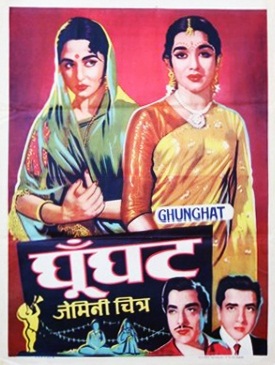
Ghunghat (1960)

Adapted Story: Noukadubi (The boat wreck)

Director: Ramanand Sagar

Cast: Bharat Bhushan, Pradeep Kumar, Bina Rai, Asha Parekh

Synopsis: In a tale akin to Milan’s classic narrative, the annals of modernity unveil a poignant drama. A young man, Ravi, faces an agonizing dilemma when his parents demand that he sever his affection for Laxmi and marry another. With a heavy heart, he acquiesces to their wishes.

As fate would have it, a fateful train journey brings together a group of newlyweds, including Ravi and his bride. Tragedy strikes and the train is engulfed in a catastrophic accident. Ravi awakens to find an unconscious bride lying beside him. Mistaking her for his own wife, he transports her to his abode.

Upon realizing the demise of his true wife, Ravi is horrified to discover that the bride he has brought home is a different lady named Parvati. Tormented by guilt and compassion, he embarks on a desperate search for her husband, Gopal.

Unbeknownst to Ravi, Parvati had already stumbled upon the truth and made her escape. Seeking solace, she wandered aimlessly until she fell into the river Jamuna. Her fate led her to the doorstep of Gopal’s residence, where she encountered his brother, Manohar, who had lost his eyesight in the accident.

Torn between her newfound duty to care for Manohar and her longing to reunite with Gopal, Parvati remained silent about her true identity. A web of secrets and unspoken truths now intertwined their lives, leaving them adrift in a sea of uncertainty. 

Music: The renowned music maestro Ravi brought forth the essence of Shakeel Badayuni’s exquisite lyrics on the silver screen. The ten melodious compositions were rendered by such legendary artists such as Mohd. Rafi, Asha Bhosle, Lata Mangeshkar, and Mahendra Kapoor. Among these, stand-out gems like Lata Mangeshkar’s rendition of ‘Lage Na Mora Jiya’, Mohd. Rafi’s soulful ‘Insan Ki Majbooriyan’, Asha Bhosle’s enchanting ‘Gori Ghunghat Mein’, and the mesmerizing duet of Mahendra Kapoor and Asha Bhosle in ‘Kya Kya Nazaray Dikhati Hai Ankhiyan’.
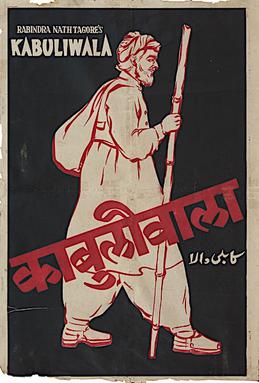
Kabuliwala (1961)

Adapted Story: Kabuliwala

Director: Hemen Gupta

Cast: Balraj Sahni, Sonu, Usha Kiran

Synopsis: In the realm of human narratives, we encounter a departure from convention—a tale in which the traditional roles of “boy” and “girl” are defined differently, “boy,” an elderly gentleman, finds himself interacting with a diminutive “girl” of five years of age, reminiscent of the incongruous coupling in P.G. Wodehouse’s “Lord Emsworth and Girlfriend.” However, this narrative possesses a distinctiveness that renders it a tale wholly its own.

Rahamat, a peripatetic merchant from Afghanistan, ventures to India seeking to peddle his wares. Here, he makes the acquaintance of Mini, a young lady of tender years. As their interactions deepen, a profound bond forms between them, akin to that of a father and daughter. Rahamat, reminded of his own daughter of Mini’s age, finds his paternal instincts stirring.

Circumstances conspire against them, and Rahamat is unjustly incarcerated. Upon his release, he seeks to reunite with Mini, unaware that the passage of time has wrought a significant change in her appearance. Mini, now a young woman, has no recollection of her former companion.

Grief-stricken, Rahamat departs India with a forlorn hope that his lost daughter may yet recognize him upon his return. Such is the nature of this enigmatic tale, where love and longing collide in a poignant exploration of the complexities of human relationships.

Music: Salil Choudhury, a veritable polymath, has bestowed upon us an ethereal symphony that perfectly encapsulates the narrative upon which it rests. In my humble estimation, there is no individual more adept at translating the Bengali soul into the universal language of music than this esteemed composer.

Furthermore, the illustrious voices of Hemant Kumar, Mohd. Rafi, Manna Dey, and Usha Mangeshkar serve as veritable conduits for the emotive lyrics penned by Prem Dhawan and Gulzar. Their vocal artistry transcends the realm of mere performance, becoming an integral thread in the tapestry of this cinematic masterpiece. Personally speaking, the “Ganga” song by Hemant Kumar is my all-time favourite!

Trivia: The Bengali iteration of the film was helmed by Tapan Sinha, a cinematic visionary whose repertoire extended beyond the hallowed borders of our country. His masterful direction of such seminal works as “Sagina” and “Zindagi Zindagi” has indelibly etched his name in the annals of cinematic history. To this humble observer, his unparalleled versatility renders him the paramount cinematic luminary of our times. 

Uphaar (1971)

Adapted Story: Samapti (The Ending)

Director: Sudhendu Roy

Cast: Swarup Dutta, Jaya Bhaduri, Suresh Chatwal, Nandita Thakur

Synopsis: The eternal entanglements of the human heart! In the sweltering metropolis of Calcutta, a most intriguing tale of love, duty, and, dare I say, a pinch of mayhem unfolds. Our protagonist, Anoop, a law student with a mind as sharp as a razor, finds himself ensnared in the time-honoured tradition of arranged matrimony. His widowed mother, no doubt with the best of intentions, sets her sights on the lovely Vidya, a neighbour with a face as fresh as the morning dew.

But, alas, fate has a way of playing the mischief-maker. Upon making the acquaintance of Vidya, Anoop’s heart is suddenly hijacked by none other than Minoo, a rustic beauty from the village, with a smile that could charm the birds from the trees. In a most unbecoming display of defiance, Anoop defies his mother’s carefully laid plans and instead takes Minoo as his bride.

Now, it’s not long before the newlyweds discover that Minoo’s domestic skills are, shall we say, somewhat lacking. The poor dear can’t boil water to save her life, and Anoop’s mother, God bless her, is left to wonder if she’s made a grave mistake in letting her son marry this…this…Minoo.

The inevitable friction ensues, and Anoop, in a fit of exasperation, absconds to Calcutta, leaving Minoo to her own devices. But, as the days turn into weeks, Minoo’s love for Anoop begins to simmer, like a potent curry left to stew. She takes it upon herself to pen a heartfelt letter, a cri de coeur, if you will, only to have it met with deafening silence.

Still, undeterred by the setbacks, Minoo’s love for Anoop remains unwavering, a beacon of hope in the midst of marital turmoil. And it is at Anoop’s sister’s humble abode in Calcutta, a veritable haven of familial warmth, that the star-crossed lovers finally reunite, their love stronger and more resilient than ever.

As I see it, Minoo’s carefree spirit and boyish charm evoke the irrepressible Maria of ‘The Sound of Music’, yet whereas Maria had the solace of the Mother Superior at the Abbey who grasped the essence of her personality and encouraged her to ‘Climb every mountain…’, Minoo wandered, unguided, misunderstood and alone. It’s a difference that strikes a poignant chord.

Music: As I recall, the melodies that wafted through the evening air were the handiwork of the esteemed duo, Laxmikant Pyarelal, whose mastery of the musical arts is renowned far and wide. And, it was the legendary vocal triumvirate of Mohd. Rafi, Lata Mangeshkar, and Mukesh who lent their golden voices to the proceedings, imbuing the entire affair with a sense of grandeur and elegance.

Trivia: In 1971, this movie was chosen to represent India at the Academy Awards, but it did not get nominated. Later, it was dubbed into different South Indian languages, becoming successful in Malayalam as “Upaharam” in 1972. “Samapti” was originally a Bengali movie directed by Satyajit Ray and is one of three short films based on stories by Tagore, released together as “Teen Kanya.”

Geet Gata Chal (1975)

Adapted Story: Atithi (The Guest)

Director: Hiren Nag

Cast: Sachin, Sarika, Khyati, Urmila Bhatt

Synopsis: Durga Babu and his wife, Ganga, found themselves in the presence of Shyam, a lad possessing a talent for singing and dancing that was nothing short of extraordinary. Touched by his plight as an orphan, they extended a warm invitation to him to take up residence within their abode. As Shyam gradually assimilated into the daily routine of the household, a strong friendship blossomed between him and their daughter, Radha.

Little did Shyam realize, but Radha’s fondness for him extended beyond the boundaries of mere companionship. However, his feelings for her remained rooted in the soil of camaraderie. Shyam, with a heart yearning for the open road and unbridled liberty, recoiled at the very idea of settling down. When he caught wind of the family’s designs to wed him off, he felt a sense of confinement akin to that of a bird ensnared within a cage. In a dramatic turn of events, he made a swift getaway, leaving behind a heartbroken Radha.

The question lingers in the air like the scent of a freshly baked pie – will Shyam ever uncover his path back to the homestead? And what tumultuous repercussions will this sudden departure have upon the delicate balance of domestic relationships within the family? 

Music: The music was scored by Ravindra Jain and Kishore Kumar, Mohd. Rafi, Aarti Mukherjee lent their voices.

Trivia: This cinematic tale too was brought to life in the Bengali language from literary origins by Tapan Sinha who had a discussion with Satyajit Ray about how to portray the ending of the story on-screen for an international audience. The original tale concludes with Tarapada leaving the mansion just before his marriage, abandoning his would-be wife. However, in a bid to conclude the story differently, Tapan Sinha depicted the bride-to-be weeping over the lost marriage. Satyajit Ray, sensing this wouldn’t resonate with international audiences, insisted on sticking to the original storyline of the protagonist vanishing. In contrast, the Hindi film adaptation opted for a happy ending, reuniting Shyam and Radha.

Lekin (1991)

Adapted Story: Kshudhita Pashaan (The Hungry Stones)

Director: Gulzar

Cast: Vinod Khanna, Dimple Kapadia, Amjad Khan, Hema Malini, Beena Banerjee

Synopsis: Sameer Niyogi (Vinod Khanna) encounters a mysterious woman, leading to a captivating tale set in Rajasthan. 

This movie, produced by Lata Mangeshkar, is not a direct adaptation but rather an inspiration from Tagore’s original story wherein the protagonist, a fresh-faced tax collector, finds himself stationed in a quaint village. Opting to dwell in an ancient, decrepit palace, rumoured to be haunted, he dismisses the warnings of the townsfolk. They caution him that past occupants have either lost their sanity or met untimely demises, claiming the structure itself is voracious. Yet, he soon discovers a beguiling woman, shrouded in mystery, wandering the palace’s corridors under the cloak of darkness.

Music: The music was composed by Pt. Hridaynath Mangeshkar and the lyrics were penned by Gulzar. Each composition was unique and tugged at our heartstrings.

Trivia: This cinematic tale was brought to life from its literary origins in Bengali under the masterful direction of Tapan Sinha, the actors Soumitra Chatterjee and Arundhuti Devi graced the silver screen, weaving the characters into the fabric of our imaginations. 
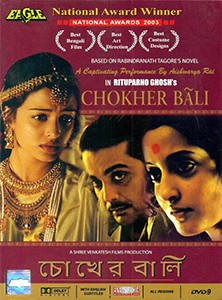
Sand in the Eye(2003)

Adapted Story: Chokher Bali (Eyesore)

Director: Rituparno Ghosh

Cast: Aishwarya Rai, Prosenjit Chatterjee, Raima Sen, Lily Chakravarty, Tota Roy Chowdhury

Synopsis: The tangled web of human relationships! Like a delicate spider’s silk, it ensnares us all, only to leave us dangling in a mess of our own making. Meet Binodini, a young widow, thrust into a world of moral ambiguity, where the lines between right and wrong are as blurred as the tears on her lovely face.

She finds herself in the midst of a most unsavoury triangle, with Mahendra, the self-absorbed cad, and his wife, Ashalata, who is naive and inexperienced. Mahendra, it seems, has a penchant for sampling the wares, only to discard them like a worn out [air of gloves. Binodini, however, is no fool, and she sees through his façade, recognizing the emptiness that lies beneath.

As the drama unfolds, we find ourselves entangled in a dance of deceit, where allegiances are forged and broken with all the finesse of a seasoned juggler. Behari, the stalwart friend, stands as a beacon of hope, a shining example of integrity in a sea of moral turpitude. But even he is not immune to the whims of fate, as Binodini’s mercurial heart leads him on a merry chase.

In the end, it is a tale of shattered dreams, of relationships reduced to tatters, like the fragile petals of a once beautiful flower. And yet, amidst the wreckage, we find a glimmer of hope, a testament to the human spirit’s capacity to endure, to persevere, and to love, despite the ravages of time and the cruel whims of fate. Ah, the human heart, that most confounding of puzzles, forever a mystery, forever a delight!

Music: The haunting strains of Debojyoti Mishra’s background score swirl around one, a melancholy mist that shrouds the narrative.

Trivia: This film is a dubbed version of the Bengali movie ‘Chokher Bali’.

Bioscopewala (2018)

Adapted Story: Kabuliwala

Director: Deb Medhekar

Cast: Danny Denzongpa, Geetanjali Thapa, Adil Hussain, Tisca Chopra

Synopsis: This cinematic offering is a departure from its literary progenitor. “Bioscopewala” chronicles the life of Rehmat Khan, a Kabulian cinemagician who regaled tykes with his flickering bioscope. Among his youthful admirers was Minnie, a lass of equal years to his own little cherub. But alas! Rehmat vanished as swiftly as a dodo, leaving Minnie to ponder his abrupt departure.

Fast forward, and Minnie, now a documentarist residing in the land of croissants and mime artists, stumbles upon a startling revelation: her father perished in an aerial catastrophe while attempting a pilgrimage to Afghanistan. Driven by an unquenchable thirst for knowledge, Minnie reunites with Bioscopewala, the narrator of her childhood adventures, to unravel the enigmatic circumstances surrounding her father’s fateful journey.

Prepare yourself for a tale that interweaves the whimsical with the poignant, where the complexities of human existence unfold amidst the flickering shadows of a Bioscope. May this cinematic concoction tickle your intellect and leave you pondering the true nature of life’s grand and enigmatic spectacle. 

Music: There is only one song in the film, titled “Bioscopewala.” It was sung by K Mohan, and composed by Sandesh Shandilya, with lyrics written by Gulzar.

Influences of Tagore in Bollywood

In addition to the films I’ve already mentioned, here are a few Bollywood movies I can recall that are heavily influenced by Tagore’s works.
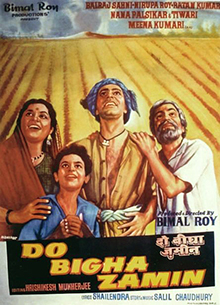
Do Bigha Zamin (1953)

Adapted Poem: Dui Bigha Jomi (Two Bighas of Land)

Cast: Balraj Sahni, Nirupa Roy, Ratan Kumar, Nana Palsikar, Meena Kumari, Mehmood

Director: Bimal Roy

Synopsis: The tale centres on Shambhu Maheto, a humble farmer living in a drought-stricken village with his family. When the rains finally arrive, Shambhu’s joy is short-lived as the scheming landlord, Harnam Singh, eyes Shambhu’s precious two bighas of land for a profitable mill project. Despite Shambhu’s desperate attempts, including selling all household items and moving to Calcutta to earn money, he fails to repay the inflated debt. His journey in Calcutta is fraught with hardship, culminating in his wife’s injury and his son’s foray into petty crime. Ultimately, Shambhu returns home to find his land auctioned off and a factory replacing his farm, leaving his family to walk away from their former life with nothing but memories.

Music: Salil Chowdhury composed the music for the film, with lyrics penned by Shailendra. In an interview with All India Radio, Chowdhury explained that the melody for “Apni Kahani Chod Ja – Dharti kahe pukaar ke” was inspired by a Red Army march song. Lata Mangeshkar, Manna Dey and Mohd. Rafi lent their voices.

Durban (2020)

Adapted Story: Khokababur Protyabartan (The Return of the Child)

Director: Bipin Nadkarni

Cast: Sharib Hashmi, Sharad Kelkar, Rasika Dugal, Flora Saini

Synopsis:, This film tells the story of a wealthy man’s son and his caretaker. Despite their social differences, they share a deep bond. However, an unfortunate incident drives them apart, leading the caretaker on a journey of redemption.

Music: The film’s soundtrack is composed by Amartya Bobo Rahut and Raajeev V. Bhalla, with lyrics written by Manoj Yadav, Siddhant Kaushal, and Akshay K. Saxena. Arijit Singh lent his voice.

Laapataa Ladies (2024)

Adapted Story: Noukadubi (The boat wreck)

Cast: Nitanshi Goel, Pratibha Ranta, Sparsh Shrivastav, Chhaya Kadam

Director: Kiran Rao

Synopsis: In 2001, in fictional Nirmal Pradesh, farmer Deepak travels with his new bride, Phool Kumari. On a crowded train, amidst other veiled brides, Deepak dozes off and accidentally disembarks with the wrong bride, Jaya, leaving Phool with another groom, Pradeep. The mix-up mirrors Rabindranath Tagore’s “Noukadubi.”

Deepak’s family realizes the mistake but Jaya, using the name Pushpa, lies about her identity. Phool, stranded at another station, is helped by Manju Mai. Deepak, searching for Phool, files a report. Jaya is arrested but reveals her troubled past and desire for independence. Eventually, Phool reunites with Deepak, and Jaya pursues her education.

Besides the wife-exchange element, there is little in common between this movie and the works of Tagore. The theme of women’s empowerment takes centre stage. If Manju Mai cautions Phool in respect of the ills of patriarchy, Jaya breaks the matrimonial bond with a self-centred, greedy and domineering husband. Instead, she decides to pursue an independent course in life.

Music: The film’s music was composed by Ram Sampath, featuring lyrics by Divyanidhi Sharma, Prashant Pandey, and Swanand Kirkire.

Conclusion

As we stand at the threshold of the great unknown, it is the poet-philosophers who have always dared to illuminate the darkness that lies beyond. Like the Dutch sage Spinoza, who glimpsed the infinite in the finite, and Wordsworth, who in his sublime poem “A Slumber Did My Spirit Seal” wrote,

No motion has she now, no force;

She neither hears nor sees;

Rolled round in earth’s diurnal course,

With rocks, and stones, and trees.

Rabindranath Tagore, the great Bard of India, has similarly beheld death not as an end, but as a new beginning, a gateway to the eternal.

To Tagore, death is not the extinguishing of the flame, but the merging of the individual spirit with the universe, a reunification that sets the stage for a new drama of thought to unfold. As he so eloquently put it, death is merely the “reunion of one’s spirit to the universe and thereby to eternity,” a notion that transcends the petty boundaries of mortality. It is here, in this realm of eternity, that the legacy of thought germinates, and the development of a society can continue, unfettered by the constraints of time and space.

And so, as we ponder the mystery of death, we would do well to recall Tagore’s wise words: “The song that I came to sing remains unsung to this day. I have spent my days in stringing and in unstringing my instrument.” For, in the end, it is not the song that we sang, but the song that we came to sing, that truly matters. And it is in this eternal realm, where thought and spirit converge, that our true legacy resides, waiting to be discovered, and sung anew. 

So dear readers, as we fondly remember him on the day he embarked on his celestial journey, I wish to thank you for going through my musings on how Bollywood has honoured his legacy through its cinematic endeavours. I am certain that the list I have presented to you here is merely indicative and not exhaustive.

Which are the other movies you would like to add to this list of mine? Please leave a comment below, mentioning the name of the movie and its year of release. I shall be obliged.

Related Post:

Where the Mind is without Fear

Tribute to a Cinematic and Literary Genius: Guest Post by Suryamouli Datta

Read Full Post »

Allow me to share with you how his creative genius has exercised his soft power on a lesser mortal like me.

My earliest interactions with the master of Indian Cinema

I shall not delve into an analysis of his writing or filmmaking style here. Instead, allow me to recount my enduring fascination with this individual, a fascination that has only grown over the years despite conceding to certain critics who possess a profound understanding of the art of cinema and literature. My initial encounter with this luminary was through his debut film, ‘Panther Panchali (Verses of the Road).’

Back then, in the third grade, I was enthralled by action-packed movies and witty dialogues, the kind that resonated with my young mind. To me, Spiderman, Superman, and He-Man held more allure than any film of that era. I would eagerly watch the screen, whether on television or at the cinema, during fight scenes, shootouts, or comedic moments. It was during this time that I first encountered ‘Verses of the Road.’ Watching it alongside my younger cousin, who was two years my junior, I experienced a newfound appreciation for storytelling. Unlike the captivating action sequences, my interest in this film stemmed not from its technical aspects, which was perhaps too much to expect from me at that time, but rather from its narrative, which evoked the storytelling style of my elders.

Then, a film called ‘Shakha Proshakha’ (‘The Branches of a Tree’) was aired on television. Despite being by the same director, it failed to captivate me, save for a few clever lines delivered by a young child actor who amusingly mimicked phrases like ‘Batman’ and ‘Superman’. His familiar gestures, like darting into a thicket with a toy gun, alone resonated with me deeply.

As I followed his journey, other films like ‘Apur Sansar’ (The World of Apu) and ‘Mohapurush’ (The God Man) caught my attention, yet failed to resonate, perhaps because I was too young to grasp their significance back then.

Back in my fifth-grade days, I harboured a fervent desire to emulate him – a film director, you see. It stemmed from my own struggles with academic achievements of any kind, a trait that he shares with me.  I recall stumbling upon his stories in books or magazines and catching a glimpse of him on TV. Looking back, I cannot help but chuckle at my youthful naivety. As I’ve matured, both physically and mentally, I’ve come to understand that he occupies a pedestal beyond my reach. Critics may nitpick, and there may have been filmmakers of greater acclaim before and after him, but none hold a candle to the place he holds in my heart. He serves as a guiding light, steering me towards a deep appreciation for the world of film and literature.

Immersed in the legend’s Literary Palette: An Anthology of Wonder

In the 5th grade, amidst one of my summer breaks, I stumbled upon a book from my mother’s collection titled ‘Ek Dojon Goppo’ (‘An Anthology of a Dozen Stories’). The initial tale, ‘Septopus-er Khide’ (‘The Hungry Septopus’), depicted a carnivorous plant resembling an octopus, bringing peril to its owner. At the time, while I found some scenes thrilling, overall, the story failed to captivate me.

Following this was ‘Bankubabu-r Bandhu’ (‘Banku’s Friend’), narrating the story of an innocent village schoolmaster teased by peers and students until encountering an alien named ‘Ang,’ subsequently altering his life. Interestingly, I had already watched a televised adaptation of this story, featuring Sadhu Meher as Banku. Having also seen ‘E.T.’ by then, the narrative felt somewhat familiar. Controversy arose when the author, also a filmmaker, envisioned earlier adapting the tale into a Hollywood collaboration film named ‘Alien,’ encountering similarities with ‘E.T.’ Yet, irrespective of the debate, the story failed to resonate with me at the time, likely due to my prior exposure to its audio-visual renditions.

First Realization: Indigo Terror

As I delved into the pages of the book ‘Ek Dojon Goppo,’ initially sceptical of its worth, one particular short story, ‘Neel Atanka’ (The Indigo Terror), captured my attention entirely. Aniruddha Bose, a 29-year-old employee of a prestigious multinational corporation, embarks on a journey to Dumka, near Bolpur, Shantiniketan, in his own car. Along the way, he encounters a series of mishaps—his car’s tires bursting at regular intervals, forcing him to rely on only one replacement. With no other recourse, he seeks refuge in a nearby house overseen by a caretaker, a narrative device that may have subsequently inspired the Ramsay Brothers, albeit uncredited (wink!). Exhausted, Aniruddha resigns himself to rest for the night. However, in the dead of night, he awakens to find himself transformed into the former owner of the house, a European indigo planter from long ago. The story unfolds with Aniruddha grappling with his new identity and the events that follow.

Long before the film ‘Bhool Bhulaiyaa,’ this narrative evoked the eerie atmosphere of a psychological horror tale. Moreover, being a short story, it left unresolved whether Aniruddha was possessed or was merely grappling with a psychological affliction that fateful night. Much like Tagore’s ‘The Hungry Stones,’ this tale masterfully navigated a complex plot with deceptive simplicity.

How The Indigo Terror Brought Out The Creator In Me

Let me share more reflections on this story, particularly the profound impact it had on me. Aniruddha, in my perception, embodied the essence of a western cowboy, albeit without the guns and horses. He exuded a down-to-earth demeanour, living life on his own terms. Even when faced with the peculiar experience in the former European indigo planter’s house, he approached it with remarkable nonchalance, almost as if it were just another day. This aspect deeply resonated with me. By no stretch of imagination can I be held to be an expert in the craft of dishing out screenplays. However, such was the grip of the narrative that I found myself compelled to draft my own screenplay.  Let me recount a few memorable elements from my envisioned screenplay:

FADE IN:

EXT. HIGHWAY – DAY

Aniruddha drives his Ambassador car at full speed on a highway, flanked by trucks and lorries. Tense and escalating background music sets the mood.

CUT TO:

INT. AMBASSADOR CAR – DAY

Close up on Aniruddha, his face filled with determination as he drives with full concentration. The camera shifts focus to three tyres – one on the driver’s side and two at the back.

CUT TO:

EXT. HIGHWAY – DAY

The right tyre at the back bursts suddenly, startling Aniruddha. He grips the steering wheel tightly, his irritation evident. The camera quickly moves outside to show the car stopped in a peculiar position on the side of the road.

CUT TO:

EXT. HIGHWAY – DAY

Aniruddha steps out of the car, frustration evident in his movements. He begins working on replacing the burst tyre, his hands moving swiftly. The camera blacks out from a top view, only the sharp sound of metal is heard.

CUT TO:

EXT. HIGHWAY – DAY

The camera lights up, revealing Aniruddha having completed his mission. His shirt clings to his body due to sweat, but his expression is one of determination and accomplishment.

End of Scene.

In the narrative, I recollect the scene vividly, perhaps the most haunting sequence I experienced at that time. Aniruddha gradually comes to the realization that he has transformed into someone else. His slumber is abruptly interrupted by the howling of a hound. Aniruddha casually attempts to check his watch, an automatic timepiece that was quite in vogue when the tale was penned, only to discover it missing. With a sense of dread creeping over him, he turns around to reach for his torch, only to find it absent as well! Gripped by fear, he wonders if he has been pilfered during the night in this unfamiliar locale. Springing out of bed, he rushes to inspect his luggage, only to find it gone too!

I recall envisioning myself directing this scene with a not-so-well-defined screenplay in my mind.

**FADE OUT.**

**INT. ANIRUDDHA’S BEDROOM – NIGHT**

Aniruddha’s POV: Darkness envelops the room. Moonlight spills in through the window, casting eerie shadows.

SOUND: Howling of the hound continues, distant yet haunting.

Camera captures Aniruddha’s left hand, indicating he was trying to look at his watch, finding it bare. Panic flickers in the darkness.

SOUND: A muffled gasp, barely audible.

Camera captures Aniruddha’s other hand that darts to the other side of the bed, finding emptiness where the torch should be.

SOUND: Howling of the hound intensifies, heightening the tension.

Aniruddha’s body lurches forward, the camera capturing the movement as he dives under the bed.

SOUND: Silence, broken only by the faint howling of the hound.

The camera captures the floor under the bed  which looks clean and empty.

SOUND: The rustle of fabric, as Aniruddha’s hand brushes against the floor.

**FADE OUT.**

**THE END.**

Discovering More of his Literature

The narrative left such an indelible mark upon me that I eagerly delved into the next tale, ‘Anathbabur Bhoy’ (The Fear of Anathbabu), with heightened anticipation. Even on a sweltering, sun-drenched afternoon, I recall vividly the lingering sense of unease that enveloped me after reading it. The enchantment, it seems, lies in the seamless integration of the supernatural, depicted with such casual and natural flair that its presence lingers long after the story concludes.

The next story I delved into was ‘Badur Bibhishika’ (The Terror of the Bat) – a tale infused with a werewolf or vampire undertone. The protagonist, also serving as the narrator, harbours a degree of chiroptophobia. Encountering a stranger named Jagdish Parcival Mukherjee in a local graveyard in Siuri, the situation takes a peculiar turn for the protagonist. He begins to suspect that Jagdish possesses the ability to transform into a bat! Undoubtedly, I found the story intriguing and maintained my curiosity into the following one – ‘Bipin Choudhury-r Smritibhram’ (Bipin Choudhury’s Amnesia). Here, Bipin Choudhury, the central character, encounters a stranger named Parimal Ghosh in a bookstore, who asserts a past connection with Bipin in Ranchi. Bipin is taken aback as he has never set foot in Ranchi before. As the narrative unfolds, Bipin confides in his close friends and realizes that indeed he visited Ranchi, yet cannot recollect the memories. The climax of the story hinges on what transpires with him. While this story adopts a thriller format, it inherently delves into the matter of values. It offers a unique fusion of values with the thriller genre. However, I must note that this narrative was adapted into a Netflix web series titled ‘Forget Me Not,’ which failed to captivate me. After revisiting ‘Bipin Choudhury-r Smritibhram,’ I revisited the stories that initially left me unimpressed, only to now find them intriguing. Thus, I found myself developing what one might dub ‘an acquired taste’ for the author’s oeuvre.

Exploring the World of a Master Storyteller: A Journey of Passion and Persistence

Following a series of articles in various newspapers and magazines, I found myself gradually developing a profound interest in the author behind these captivating stories. With each piece I read, my curiosity deepened.  I started grasping the remarkable genius underlying his diverse range of writings, films, and unique filmmaking approach, including his interactions with actors. Intrigued by his distinctive style, I embarked on a quest for more knowledge.

In those days, devoid of internet access, my pursuit led me to rely solely on the insights garnered from magazines and newspapers to uncover the next book to delve into. I vividly recall spending countless hours in local bookshops, yearning to simply touch and feel the pages of his works, knowing my limited financial resources barred me from purchasing them outright. Determined to acquire his books, I meticulously saved every penny, whether gifted to me on birthdays or in recognition of other achievements. My maternal aunt played a pivotal role in assisting me in obtaining these literary treasures.

Titles like ‘Aro Ek Dojon’ (One More Dozen), ‘Aro Baro’(Twelve More), ‘Ebaro Baro’ (Twelve Again This Time), and ‘Eker pithe dui’ (One Tenths and Two) proudly adorned my book rack, marking the beginning of a cherished collection. Moreover, delving into crime thrillers penned by this author became a thrilling adventure that I eagerly looked forward to with a keen sense of anticipation.

Simultaneously, my cinematic journey continued as I immersed myself in his films, gradually developing an acquired taste for his distinct storytelling prowess.

Tales of Crime and Detection

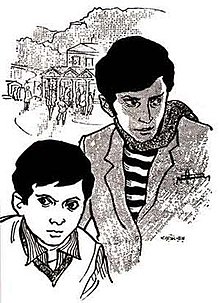
In the same book, ‘Ek Dojon Goppo,’ nestled at its conclusion were a couple of short stories: ‘Feludar Goendagiri’ (The Investigation by My Elder Brother Felu) and ‘Kailash Chowdhurir Pathor’ (The Gems of Kailash Choudhury), which whisked me away into a captivating universe of detective tales.

Enter ‘Felu,’ a detective extraordinaire, accompanied by his trusty cousin and sidekick, delving into a myriad of mysteries, each more intriguing than the last. These tales, so uniquely crafted, were bound to astonish any reader of my tender age. Thus began my enchantment with this universe, fuelling a relentless quest for Feluda books across bookshops, libraries, and even within the confines of relatives’ homes. And never once was I left disappointed, for ‘Feluda’ was a name omnipresent on the Bengali bookshelves, an iconic figure etched into the collective consciousness of every Bengali. Fortunately, a school friend, already steeped in the delights of this literature, graciously aided me in my quest, generously sharing volumes penned by this esteemed author. It’s worth noting that this friend of mine possessed a remarkable talent for storytelling, effortlessly weaving narratives that held us spellbound during our free periods. As the monitor of our class, I now realize, it served him twofold – honing his storytelling prowess while simultaneously diverting attention away from classroom duties. Soon, our circle of friends caught the fever, engaging in book swaps and animated discussions fuelled by the gripping adventures of Feluda.

Continuing with the same method outlined in the previous section, I embarked on my quest for the treasures of Feluda, the iconic fictional detective. Pouring over magazines and newspapers, I eagerly purchased and devoured books dedicated to him in rapid succession. Titles like ‘Feluda one, Feluda two’, ‘Feluda and Co.’, ‘Badshahi Angti’ (The Ring of the Emperor), ‘Baksho Rohossyo’ (The Mystery of the Suitcase), and many more swiftly found their place on my bookshelf, filling it with an ever-growing collection.

The dynamic chemistry between the trio who belong to different age groups – Feluda, his cousin Topse, and his humorous friend Lalmohanbabu – proved to be exceptional. It is this chemistry that makes revisiting these books a delight. Sometimes, I daresay, the camaraderie between them surpasses even that of Sherlock Holmes and Watson.

Much like the majority of the author’s other tales, Feluda narratives, frequently lacking in female presence, deftly entwine moral themes amidst their exhilarating plots. Isn’t it rather curious? The absence of women in Feluda tales – is simplicity the key to less complication? Though one might raise an eyebrow at the notion of a crime thriller sans complexity, I dare say this author was a virtuoso in such matters! His narratives, akin to a well-orchestrated symphony, subtly unveil moral motifs amidst the pulse-pounding intrigue. However, though told simply, some stories feature female characters and are given a noirish treatment, such as ‘Chinnamastar Abhishap’ (The Curse of Goddess Chinnamasta) and ‘Doctor Munshi-r Diary’ (The Diary of Doctor Munshi), reminiscent of Raymond Chandler, showcasing moral dilemmas and values subtly. In ‘Baksho Rahassya’ (The Mystery of the Suitcase), Feluda opts to let the antagonist go due to a lack of evidence for a courtroom conviction. However, when the same story is adapted into a screenplay by the author, Feluda harshly punishes the antagonist, labelling him a ‘thief’ in front of others. Perhaps the author aimed to underscore the importance of ‘values’ when presenting the story in a visual format.

One of my favourite Feluda tales, ‘Joto Kando Kathmandu Te’, was later remade as ‘Kissa Kathmandu Mein’ (The Trouble at Kathmandu) for television, targeting a national audience. Though I’m uncertain if any version of it exists online today, the adaptation featured Shashi Kapoor as Feluda, Alankar as Topshe, and Mohan Agashe as Lalmohan Babu.

Cinematic Revival: Rediscovering Masterpieces

A few days after enchanting me with his literary prowess, the author was bestowed with Oscars for his monumental contributions to world cinema before departing for his heavenly abode.

During that period, ‘Doordarshan’, the Indian Television Network, aired movies directed by him. I revisited ‘Panther Panchali’ with renewed reverence for the director, followed by the delightful ‘Goopy Gayen Bagha Bayen’ (Adventures of Goopy and Bagha), which I savoured thoroughly. Finally, a Feluda tale, ‘Sonar Kella’ (The Golden Fortress), captured my attention. I recall the television host summarizing the story before its airing, describing it as the tale of Mukul, who could recall his past life and claimed to have resided in a fort in Rajasthan. Pressured by the revelation of valuable stones in his past home, Mukul becomes the target of nefarious individuals. His father seeks the aid of a private investigator. As a kid, I distinctly recall a twinge of disappointment towards the television host as she casually mentioned Feluda (who, in my eyes as well as those of many Bengalis, had already attained an iconic status) as a ‘private detective.’

Deep Focus on the author as a filmmaker

After his Oscar-winning triumph and subsequent passing away, the media was flooded with articles delving into his life and work. Immersed in these pieces, I uncovered a deeper understanding of the man and his keen eye for detail, his cinematic philosophy, and his fusion of art and science. Concurrently, I delved into his literary repertoire. His eclectic interests permeated his writings, from the adventures of detective Feluda to his captivating science fantasy tales. Yes, I purposefully employ the term ‘fantasy’ because these narratives transcend the bounds of scientific certainty, inviting readers to imagine what science might one day substantiate.

The Professor Shonku stories, in particular, transported me to a realm where viruses inhabit spherical worlds, trees thrive on human cognition, and an enigmatic pistol has the power to make beings and objects vanish from existence.  In the past, depictions of robots, that are mentioned in such stories, mimicking human behaviour, seemed utterly fantastical. These days,  with the rise of artificial intelligence, one is left in awe of the prescient nature of the author’s works and wonders if such portrayals may eventually blur the lines of reality.

I embarked on my journey of maturation alongside this multi-talented artist, who excelled as a director, author, and illustrator, revelling in his imaginative works. Subsequently, post-college, I had the opportunity to revisit some of his cinematic masterpieces when they were reissued in theatres. Films like ‘Arannyer Din Ratri’ (Days and Nights of the Forest) and ‘Pratidwandi’ (The Adversary) captivated me anew, allowing me to rekindle my admiration for his boundless creativity.

The Author and Wodehouse: A Meeting of Literary Minds

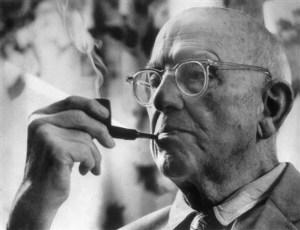
My fascination with P.G. Wodehouse was initially nurtured within my family circle, but his novels and stories significantly bolstered my admiration for the beloved author. I stumbled upon an article mentioning his affinity for Wodehouse, and as I matured, I discerned a striking resemblance between his works and those of the maestro himself. Whether through the sharp repartee in his films or the witty banter within his stories, his writing exudes a similar charm. Just as Feluda and Shonku have their own series, he crafted a distinct collection centered around ‘Tarini Khuro’ (Uncle Tarini), reminiscent of Wodehouse’s ‘Mulliner’ tales. While Tarini’s narratives occasionally veer into the supernatural or delve into emotional depths, the essence remains consistent. Moreover, the ‘Tarini Khuro’ stories serve as a masterclass in the art of storytelling, showcasing the creator’s versatility and prowess. One can truly grasp the breadth of his talent by delving into his literary oeuvre alone.

Feluda, the ingenious detective crafted by the author, to me, bears a striking resemblance to Psmith in his poised demeanour amid crises. Much like Feluda, who confronts his nemesis Maganlal Meghraj with remarkable calmness, Psmith maintains his cool in challenging circumstances. In ‘Joy Baba Felunath’ (The Elephant God), Feluda faces off against the formidable Maganlal Meghraj, yet his serene and collected demeanour never falters. Similarly,  in P.G. Wodehouse’s tales, Psmith confronts adversaries with a suave approach and an unflappable attitude.

In the story ‘Bombaiyer Bombete’ (The Bandits of Mumbai), the author weaves a narrative where the Bengali iconic sleuth Feluda steps forward to assist his friend and companion, Lalmohanbabu. This action surely evokes memories of Wodehouse’s character Bertie Wooster, who, to aid his friends, frequently finds himself in perilous situations.  The only divergence here is that Feluda must don both the Berite and Jeeves hats simultaneously to unravel the mystery.

Another story that I can remember at the moment is ‘Ghurghutiar Ghotona’ (The Trouble at Ghurghutiya) wherein, like Wodehouse’s stories, problem-solving involved misunderstandings and witty dialogues.

In ‘Shonku-r Shonir Dosha’ (Prof. Shonku in Dread Problem) we find, much like Wodehouse, characters resorting to mistaken identities and getting entangled in difficult situations.

P. G. Wodehouse is best known as a humourist. However, he had also dabbled in crime fiction, perhaps a rub-off of his having been an admirer of Sir Arthur Conan Doyle and Agatha Christie. Crime had found its way into some of his own writing, including into some of his Jeeves and Wooster and Blandings Castle stories. The range of misdemeanours depicted therein comprises thefts, bank heists, and airgun shootings, and even blackmail. In Wodehouse’s venture, ‘Death at the Excelsior’, he endeavours to concoct a crime thriller with a meticulously arranged sequence of events. Yet, at the close of the day, it leaves one with the impression of a light-hearted tale, with ‘murder’ serving as the solitary sombre element, a departure from his usual literary escapades.

While I’m fully aware that my stance might provoke the ire of passionate readers and discerning critics, let’s just say the comparison here is akin to trying to fit a square peg into a round hole. Allow me to elaborate. In the whimsical world of Wodehouse, these predicaments are served up with a generous dollop of humour and charm, akin to a delightful soufflé rising in the oven. On the other hand, our novel protagonists find themselves grappling with these challenges in the midst of murky criminal investigations, where the stakes are higher than a giraffe’s necktie. So, you see, it’s a bit like comparing apples to oranges – both fruit, but with vastly different flavours and textures!

Unveiling Wisdom: Exploring the Depths of Knowledge Through Timeless Tales

These stories are not only  exciting and mysterious but also teach us new things. For example, I learned what galoshes are from reading the story ‘Neel Atanka’, even though the internet didn’t exist then! The description was so clear and vivid that I could picture them in my mind, even though I had never seen them before.

Since many of the stories about Feluda, Shonku, and Tarini Khuro are also about travel, they not only make us want to visit new placesbut also to learn more about them.

Also, I learned the meaning of the word incredible in a really easy way from the story ‘Feludar Goendagiri.’ In the story, Topse, Feluda’s cousin, helper  narrator of the story, is sitting in a  Darjeeling mall and overhears two old people talking about something, and the word incredible comes up. Topse knew the meaning of the word and since he’s telling the story, he explains it to the readers. Later, Feluda uses his amazing skills like Sherlock Holmes to figure out which side of the mall Topse was sitting on just by looking at his face! Topse is surprised and thinks of the word incredible in his mind. This is the easiest way to learn new words in school: first know the word, then know the meaning, and finally use it. But this story teaches us the same thing without making it feel like we’re being taught something! 

From ‘Bankubabur Bondhu,’ I got a glimpse into the fascinating world of piranhas, those creatures of the depths with their sharp teeth. I also learned about the curious penguins that live in faraway lands.

There are many other such tales that I could share, but I do not  wish to overwhelm you with my discoveries. Instead, I encourage you to read these wonderful writings for yourselves and embark on your own journey of knowledge. 

Although the author is renowned as a director, his writings first stirred my soul. This inspired me to seek out his films, which I found equally endearing.

I may not have delved deeply into his cinematic endeavours here, for I believe the same have already been meticulously analysed by countless critics with a keen understanding of the art far surpassing my own.

Homage to the Maestro: Celebrating the Legacy of Satyajit Ray

On the auspicious occasion of his 103rd birth anniversary, I humbly acknowledge his creative genius.  I offer my reverence to the individual who, alongside my parents, has steered me on my path of this lifetime, and undoubtedly will continue to do so in the days ahead.

Incidentally, throughout the entire article, I realize that I have not once mentioned his name. Yet, for the sake of thoroughness, it’s worth noting – his name, in case you are still twiddling your thumbs, is Satyajit Ray.

(All illustrations courtesy the world wide web)

Related Posts:

Read Full Post »

ashokbhatia's avatarashokbhatia

 A Tribute to Swami Vivekananda: Leader Extraordinary

“On the seventh of August 1941, in the city of Calcutta, a man died. His mortal remains perished but he left behind a legacy… that no fire can ever consume…”

That was the baritone, sonorous voice of Satyajit Ray in his documentary titled ‘Rabindranath’ created as a tribute to Rabindranath (a project mandated on Ray, the genius in film making, arts and literature, commissioned by Ministry of Culture, Government of India) on the occasion of the birth centenary of the another genius, Rabindranath Tagore the Nobel laureate poet, musician, novelist, dramatist, artist and philosopher. The first scene of the documentary depicted the last and final journey of Tagore to the burning ghat (crematorium).

Ray’s portrayal of Tagore began with the scene finale. But where do we start in our odyssey with the volcanic monk of India whose 150th birth anniversary we celebrated…

View original post 2,153 more words

Read Full Post »

 A Tribute to Swami Vivekananda: Leader Extraordinary


“On the seventh of August 1941, in the city of Calcutta, a man died. His mortal remains perished but he left behind a legacy… that no fire can ever consume…”

That was the baritone, sonorous voice of Satyajit Ray in his documentary titled ‘Rabindranath’ created as a tribute to Rabindranath (a project mandated on Ray, the genius in film making, arts and literature, commissioned by Ministry of Culture, Government of India) on the occasion of the birth centenary of the another genius, Rabindranath Tagore the Nobel laureate poet, musician, novelist, dramatist, artist and philosopher. The first scene of the documentary depicted the last and final journey of Tagore to the burning ghat (crematorium).

Ray’s portrayal of Tagore began with the scene finale. But where do we start in our odyssey with the volcanic monk of India whose 150th birth anniversary we celebrated earlier in this decade?

“Let’s start from the very beginning/ a very good place to start…” (The Sound of Music)

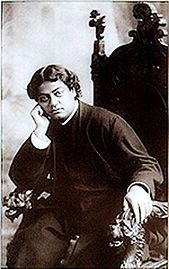
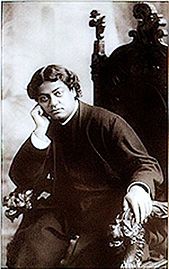
Naren or rather Bile (Narendranath Datta) was storm or turbulence personified from childhood in the premises of the Datta household in North Calcutta. Never obedient to seniors, ever an enigma to peers (his local friends), he would relish his father’s hookas (smoking pipes) or throw away his mother’s clothes from the windows to the beggars on street even while he was locked up in a room for his erratic unmanageable behaviour.  But when the time of crisis came, his friends would run away at the sight of a snake. But he would remain seated, immersed in meditation while the snake rustled away leaving him in peace. Trained in the art of physical mastery, he would combat the white man for speaking ill of Indians. He showed the promise of a Life Exemplary and Leader Extraordinary!

“His pre-eminent characteristic was kingliness. Wherever he went he was the first.’ (Romain Rolland).

Narendranath was a born leader, never ‘made’ – only refined and directed by his great master Shri Ramakrishna.

A good leader accepts the situation at hand and tries to find a way out. But a great leader is ever in discomfort with the commonplace and the hackneyed reality. Naren began his quest for the beyond with burning questions on the existence of God and purpose of Life – only to be answered clear and direct by Sri Ramakrishna, who was to become his master though in appearance, upbringing and otherwise his direct antithesis. But this was not by any devout dedication but through a series of questioning he hurled upon his master. And then came the hour of consecration.

Ei jonmo ei shorir oi murkho bamun kine niyeche”. (This life, this body is consecrated to that old illiterate Brahmin!) – He wrote to a brother disciple later.

By the way, Narendranath was projected as the leader of tomorrow by his master – not by himself!

Naren shikshe debe” (Naren will teach the world) – was the prophecy of Shri Ramakrishna in the Master’s own writing.

A great leader emerges out of stormy crisis from various fronts – death of father, deprivation of mother from family property, futile search for a job. But he had the fortitude to stick to his master’s promise that he would never be plagued with basic sustenance. His primary preoccupation became an immersion into the self, deep in meditation. “Mon cholo nijo niketone…’ (O Mind! Return to thy own repose!). It was for his Master to turn him towards the world with the message of service, love, education to humanity. He was destined to be a leader –a banyan tree for one and many.

Storm as in crises for him was lifetime companion – severe hardship n Baranagar Math in North Calcutta after the death of his Master, hunger and uncertainty during his parivrajaka (the wandering monk) life in India, anxiety about funds for the America trip, spending sleepless and shivering night in Chicago railway station, lampooned and maligned by his opposition religious groups in the West and even from his close quarters back home.

But the fire in him was never to extinguish.

Vivekananda stood for the principles of acceptance and assimilation of diverse opinions, values and cultures. A true global leader in thoughts, words  and action, he became a fiery inspiration to men and women from the East and West from myriads of background – businessmen like Rockefeller and Jamshetji Tata, European women like Margaret Noble (Sister Nivedita) and Emma Calve, scientists like Acharya J C Bose and many more. His style of communication was different for each according to the nature and character of individuals. His was an enlightened universal mind a century ahead of his times. But never did he lose his anchor in India.

“India was his daydream. India was his nightmare.” (Sister Nivedita)

And his thundering voice rose: “He Bharat bhuliona…” (O India! Forget not…). He never disowned the past and ever cherished the golden heritage of India. But he was ever stretching out his hand and heart of welcome to the West as well, to a future that is different and diverse yet mutually and globally enriching for one and all.

Je somonnvoy kore sei lok” (The one who can synthesize is truly a human) said his Master. Swamiji lived this message throughout life – a grand synthesis of the best from all parts of the world that he had visited during his brief life span.

Srinvantu Vishwe Amritasya Putrah’ (Listen! O Children of Immortality, world over!). This was the invocation of the rishis of the Upanishads. The voice of Swamiji in Chicago Parliament of Religions resonated; “Sisters and brothers of America…” He was a modern incarnation of the ancient rishis (sages and seers) in the attire of a monk.

Back home he chose ‘atmanomoksharatham jagat hitaya cha’ as the motto of the Ramakrishna Mission – (For the liberation of the self and the welfare of the world)  on the foundation of the philosophy and principle of action ‘Siva jnana jivaseva’ (To serve man is to serve God n Man) as he learnt from his Master.

His last life in Belur Math was like that of a child – playing with animals and enjoying the company of tribal people while giving lessons on Upanishads to brother monks. In fact his was a life of a child-like leader yearning for fresh air and new light and learning forever. He learnt from all possible sources including a low caste ‘bhangee’ (one from a low caste) with whom he had smoke and also a dancing girl who, in Rajasthan at the palace of Maharaja of Khetri, taught him the message of non-discrimination among humans.

Jabot bnachi tabot shikhi” (I learn as long as I live) – was the message of Shri Ramakrishna. Following this precious teaching from his Master Swamiji lived, loved, learnt and left a legacy that is lasting and growing even beyond a century! Ramakrishna Mission is sustaining and flourishing every day all over the world for the service of humanity at large – spiritual, social and educational.

His funeral pyre was lit on the bank of the Ganges on the fifth of July 1902. The body of the monk inferno Swami Vivekananda was stretched on pyre in his chosen place under the bilwabrikshwa (The Bengal Quince tree) in Belur Math. His mother Bhubaneshwari Devi was sitting and watching the rising flames from the body of his eldest son. A speck of his saffron robe flew in the wind to Sister Nivedita, the devout disciple of the monk. She collected and preserved that ‘memento’ for her inspiration to action in the days to come.

Thus was the mortal consummation of the Swami, the Prince among men –the volcanic monk who shook the world with the fiery message of the Upanishads under the spiritual umbrage of his ‘seraphic master’ Sri Ramakrishna and ignited the spirit of India towards freedom.

Netaji (Subhas Chandra Bose) accepted him as his fiery guru in mortal absentia. In the words of Sri Aurobindo, it was like “baptism with blood and fire”. Netaji described Swamiji as a leader extraordinary in the following words:

“Reckless in his sacrifice, unceasing in his activity, profound and versatile in his wisdom, boundless in his love, exuberant in his emotions, merciless in his attacks and yet as simple as a child, he was a rare personality in this world of ours.

If Swamiji had been alive today he would have been my guru.”

I have ransacked the history of leadership and management literature in my voyage through Human values and Indian Ethos in Management, Spirituality and Leadership for nearly three decades but never found such a detailed, succinct yet most powerful and accurate assessment in these seven leadership qualities of one genius of a world leader by another of no mean stature.

We began with a tribute to Tagore by Satyajit Ray. And here we find a tribute to Swami Vivekananda, the Great Master and Leader Extraordinary by none other than Netaji Subhas Chandra Bose. They remain with us as fountainhead of boundless inspiration in a world ruled and dictated by leaders who at best belong to the class of mediocrity in academia and otherwise!

But the fire in the volcanic monk still remains alive and aflame in those who are willing and ready to be ignited.

Agne twam hridayam agachha’ – Oh Fire Eternal! Come and set our hearts ablaze!

Amar modhye je agun jwolchhe tomader modhye o sei agun jwole uthuk… Ei sodai Vivekanandar prarthana.”

(The fire that is burning within me may set all your hearts aflame! This will ever be the eternal prayer of Vivekannada.)

May we live up to his prayers!

It was high in the snowy Himalayas. Swamiji was on pilgrimage with a few chosen disciples. His intense meditation led him to a vision of the Mother Kali, the Black Goddess, the mighty Destroyer and Time Eternal, lurking behind the veil of life. During one evening in a state of high fever he wrote a famous poem that concludes thus:

“Who dare misery loves,

And hug the form of Death,

Dance in destruction’s dance,

To him the Mother comes.”

He said to her chosen disciple Nivedita (an Irish lady of noble origin): “Meditate on death. Only by the worship of The Terrible can The Terrible itself be overcome…There could be bliss in torture too…The Mother Herself is Brahman…The heart must be a cremation ground – pride, selfishness, desire, all burnt to ashes. Then and then alone, will the Mother come!”

Vivekananda exemplified an authentic synthesis of the East and the West, the past and the present, Science and Religion, contemplation and action, spiritual pursuit and service to humanity. He was the messenger of dynamism and hope to India and the world. Could it be that he was under a spell of so-called negative thinking when he wrote the above verse? Or did he want to convey a pertinent message in a different mood that might be useful for all in moments of turbulence and uncertainty?

Leaders of tomorrow in business or otherwise, when shall we learn from death and destruction of old orders that we need creative quantum breakthroughs in our leadership principles, roles and practices to shake the very foundation of our outdated models and worn out concepts, our tunnel vision and fossilized values, by keeping alive and aflame just one precious element within our hearts – the passion to transform and infuse new life in our organizations and the planet at large?

Millennia ago, Socrates exhorted us to think and look within ourselves: “An unexamined life is not worth living.”   Closer in time, the voice of Nietzsche sounded even more daring and adventurous: “If one is to live, one is to live dangerously.”


{Tribute to Swami Vivekananda, the Great Master and leader extraordinary on The Foundation Day (May 1st, 1897) of The Ramakrishna Mission, the first Indian international organization with headquarters in India (Belur Math, Howrah – Kolkata on the bank of the Ganges) but outreach all over the world with more than 200 centres and still thriving in glory for almost more than a century and a quarter dedicated to the service of suffering humanity. An entrepreneurial venture of timeless significance even in times of crisis as in the present, this institution remains and grows as the ever expanding  global vision of this great master as an inexhaustible source of energy and inspiration, firmly rooted in Indian culture, ethos and heritage but with appeal reaching all over the world. At a level of Philosophy in Practice (Practical Vedanta, a term coined by himself that he spread like wild fire in the West even within the short span of his life of less than forty years) he gave a new turn to the ideal of monkhood with simultaneous emphasis on pursuit of salvation of the self through evolution of Consciousness and welfare of humanity at large.The Ramakrishna Mission that embodies the ideals of globalization and sustainability propounded by its founder a century before the pioneers of management in the West could even conceive of these ideas and principles. Even at a functional level the structure of the main temple of Shri Ramakrishna in Belur Math represents a grand synthesis of the East and the West – of Christian, Islamic and ancient Indian architecture.]

(Sanjoy Mukherjee (58) is Faculty of the Sustainability, CSR and Ethics academic group at the Indian Institute of Management (IIM) Shillong. He is the Chairperson of the Institute’s Annual International Sustainability Conference (SUSCON) and also the Chairperson of Student Affairs, Placement and Public Relations.

His detailed profile can be accessed at https://www.linkedin.com/in/sanjoy-mukherjee-72b18823

Permission to publish this tribute here is gratefully acknowledged.)

Read Full Post »