Feeds:
Posts
Comments

Posts Tagged ‘Swami Vivekananda’

The teachings of Swami Vivekananda are highly motivational and convey some deep truths of life in a spiritual manner. Plum, as we know, also has an undercurrent of spiritual messages in his stories and books. Superficially speaking, both may sound as different as chalk and cheese. One, an expert in spirituality. Another, an expert in humour.

However, scratch below the surface and one is apt to find that there is much similarity in what Swami Vivekananda preaches and what quite a few of Plum’s characters practice. If Vivekananda’s words awaken us spiritually, Plum’s works, though insanely humorous on the surface, keep soothing our souls in many ways. Let us see if these two thought streams have a resonance that we might be blissfully unaware of.

Take the case of Lord Emsworth who discovers that Gladys has not had any nourishment on the day of the Parva School Treat. He sees to it that Beach feeds her well. Moreover, even a basket of goodies gets handed over for her brother Ern. And when she wants to have some ‘flarze’ from the garden and McAllister comes running at a speed of forty-five miles per hour or so, what does Lord Emsworth do? Well, he is firm in protecting his girlfriend. He stands up to him, living up to the lofty standards set up by his ancestors. His basic desire is to help someone who is good and is in distress. (Lord Emsworth and the Girl Friend)

Likewise, some of us may consider Bertie Wooster as being mentally negligible, but there is no denying that he has a heart of gold. To help a pal, he often goes to ridiculous lengths. He even takes a rap for something he has never been involved in anyway. When Stiffy holds him to be superior to Sidney Carton, she is not much off the mark. (The Code of the Woosters)

Also consider the case of Psmith, to whom ends are more important than the means. When Eve is in distress across the road, he merely pinches an umbrella from the cloak room of The Senior Conservative Club and offers it to her with a smooth dignity. (Leave it to Psmith)

All of them go out of their way to help a fellow being who faces a challenge of some kind. Now, this is a sentiment that Vivekananda would heartily approve of.

A Primer on Swami Vivekananda

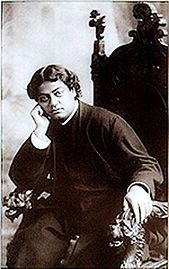
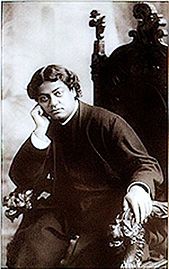
For the uninitiated amongst us, Swami Vivekananda (1863 – 1902), was an Indian monk, philosopher, author, and religious teacher. He was a key figure in the introduction of Vedanta and Yoga to the Western world. His attempt was to raise interfaith awareness and bring Hinduism to the status of a major world religion.

Many of us already know that he became a popular figure after the 1893 Parliament of Religions in Chicago at which he delivered his famous speech beginning with the words: “Sisters and brothers of America…”. While doing so, I am certain that unlike Gussie Fink-Nottle, he was not intoxicated, oiled, boiled, fried, plastered, whiffled, sozzled, or blotto. Rather than pouring scorn on many others present on the occasion, as Gussie did during his speech, he went on to introduce Hinduism to Americans.

After remarkable success at the Parliament, in the subsequent years, Vivekananda delivered hundreds of lectures across the United States, England and Europe, disseminating the core tenets of Hindu philosophy. He founded the Vedanta Society of New York and the Vedanta Society of San Francisco (now Vedanta Society of Northern California) both of which became the foundations for Vedanta Societies in the West. In India, Vivekananda founded the Ramakrishna Math, which provides spiritual training for monastics and householder devotees, and the Ramakrishna Mission, which provides charity, social work, and education.

Vivekananda and Plum: A Timeline

Plum was born in 1881, so he was eighteen years junior to Vivekananda. Luckily, he lived to a ripe age of ninety- four, whereas Vivekananda kicked the bucket at thirty- nine itself, in 1902.

By 1902, Plum had already taken a leap of faith and decided to leave the Hongkong and Shanghai Bank and turned to writing full time. At around the same time his first novel was published—a school story called The Pothunters, serialized incomplete in Public School Magazine in early 1902, and issued in full in hardback in September. He resigned from the bank that month to devote himself to writing full-time.

To the best of my knowledge and belief, the two had never met. Even though Plum’s works do carry an undercurrent of the kind of spiritual propositions Vivekananda makes, the name of the fearless monk from India does not pop up in any of Plum’s narratives.

What Vivekananda Stood For

To sum up what the saint from India stood for:

  1. He stressed the importance of individual development.
  2. He believed that three things are necessary to make every man great, every nation great, namely conviction of the powers of goodness; absence of jealousy and suspicion; and helping all who are trying to be and do good.
  3. Working unitedly for others.
  4. Having courage, patience, and perseverance to overcome all obstacles.
  5. Having a strong mind and a strong body.
  6. Women’s empowerment.
  7. Detachment.

Let us now consider these, one by one.

Individual Development

When it comes to pushing the envelope and learning new things, Plum’s characters are always game. Some of them teach us how to evolve into better human beings, office executives, and husbands.

When Bertie Wooster joins an institution designed to teach the aristocracy to fend for itself, the course he decides to take involves boot-cleaning, sock-darning, bed-making and primary grade cooking. His finances are quite sound, but he feels that it is wise to be prepared for a future when the social revolution sets in with even greater severity. (Ring for Jeeves)

Take the case of Psmith. When he joins the New Asiatic Bank, he does not lose much time as an intern to figure out how to develop into a popular person. He identifies a friendly native and makes enquiries about the likes and dislikes of his immediate boss. Armed with this intelligence, he endears himself to Rossiter, his immediate superior and the head of the Postal Department. His next mission is to cozy up to the top boss and tackle him suitably. By the end of Psmith in the City, when Mike’s career in the bank is at risk, we find Psmith resorting to extortion. He leverages the political ambitions of the top boss to pull Mike out of the soup. He digs up some old speeches made by Comrade Bickersdyke at the Tulse Hill Parliament. If published, these would adversely affect the boss’ chances of getting in as the Unionist candidate at Kenningford. Mike gets off the hook.

Yet another example of development is presented to us by Bingo Little. We are aware of his romantic nature. Like a butterfly, he keeps hopping from one object of his affection to the next. But after each failed affair, Bingo does not necessarily sulk. The scales fall from his eyes, and he suddenly realizes that the next girl alone is his true soul mate. After many failed affairs, Bingo ends up marrying the romance novelist Rosie M. Banks. In the post-matrimony phase, we find a Bingo Little who is completely transformed. He is singularly devoted to his wife. Maintaining matrimonial peace and harmony is the sole purpose of his life. When it comes to keeping his lady-love happy and contented, there is little that he leaves to chance, which includes ensuring that the lady of the house gets her afternoon cup of tea. His reverse transformation – from a butterfly to a caterpillar – is complete. One is certain that this fact never came to the notice of Charles Darwin, who handed in his dinner pail during 1882 itself. If so, we might have noticed him rushing to his publishers, a revised manuscript of the Theory of Evolution tucked under his arms.    

If Swami Vivekananda highlights the importance of individual development in his inimitable stiff-upper-lip manner, Plum deploys his wit and humour and gets some of his characters to set a high standard on the same count.

Conviction of the Powers of Goodness

Many of Plum’s characters have an abundant supply of the milk of human kindness coursing through their veins. Their belief in the power of goodness never wavers. When it comes to following a code, they never disappoint us. Bertie follows the family code of never letting a pal down. Captain Biggar sticks to a code that one should not propose to a female unless one’s own finances are in order. Chuffy refuses to propose to Pauline Stoker unless a deal to sell Chuffnell Hall materializes.

Chivalry is a sentiment which finds a place of prominence in Plum’s works. Bertie persuades Gussie Fink Nottle not to prod Stiffy between her legs to look for a missing diary. (The Code of the Woosters)

To save Uncle Tom from digestive troubles in the absence of Anatole, God’s gift to our gastric juices, he offers to undergo a sentence of thirty days. His only demand? A sumptuous fare dished out by Anatole at the end of his impending ordeal. (The Code of the Woosters)

Lord Emsworth, when caught picking up flowers from Kensington Gardens, seeks help from a recently sacked McAllister to identify himself to the police. His faith in the supremacy of goodness is touching, indeed. (The Custody of a Pumpkin)

While driving back from Brighton, Bertie and Jeeves offer Peggy Mainwaring a lift. Goodness prevails, though Bertie eventually realises the perils of delivering a talk to a bunch of girls who keep giggling and staring at him. (Bertie Changes His Mind)

Of Suspicion and Jealousy

Like all of us, Plum’s characters often suffer pangs of suspicion and jealousy. However, it does not take them much time to wriggle out of such negative emotions and live a happier life.

Think of Freddie who never suspects R Jones of any mischief. It takes a word of caution from someone like Ashe Marson for him to start seeing the truth for what it is. (Something Fresh)

Rupert Baxter earns his living by suspecting everything and everyone. If it means skipping a few nights’ sleep, so be it. (Something Fresh)

Roderick Spode suspects the intentions of anyone securing the affinity of Madeliene Bassett. (The Code of the Woosters)

Gussie Fink-Nottle experiences the perils of jealousy when he mistakenly thinks Bertie Wooster is competing for Madeline Bassett’s affection. (Right Ho, Jeeves). The same fate befalls Chuffy when he suspects Bertie of harbouring romantic thoughts about Pauline Stoker, whom he intends to marry. (Thank You, Jeeves). Madeleine suffers when she sees Gussie Fink-Nottle taking a fly out of Stiffy’s eye. (The Code of the Woosters).

Consider the emotions of Ronnie Fish when he finds Sue Brown dining with Percy Pilbeam.

The crust of calm detachment from all human emotion, built up by years of Eton and Cambridge, cracked abruptly, and there peeped forth a primitive Ronald Overbury Fish. […] His fists clenched. Eton was forgotten, Cambridge not even a memory. He inhaled so sharply that a man at the next table who was eating a mousse of chicken stabbed himself in the chin with his fork.

(Summer Lightning)

In most cases, explanations get called for and offered. Eventually, Reason returns to its throne. Sanity prevails. However, a spiritual purist like Swami Vivekananda would take a jaundiced view of such proceedings. 

Helping All Who Are Trying to Be and Do Good

When Bobbie Wickham ends up gifting Aunt Agatha’s pet McIntosh to Kid Blumenfeld, a sense of Noblesse oblige restrains Bertie from dashing off to the Savoy and demanding the pet back. As always, Jeeves comes up with a solution – a look-alike replacement is arranged for the kid, whereas Bertie rescues McIntosh after sprinkling his trousers with aniseed powder. Aniseed has an aroma which appears to speak straight to the deeps of the terrier’s soul. The scheme works. Harmony rules. (Episode of the Dog McIntosh)

Many of us would recall that Perfecto-Zizzbaum is the company which Wilmot works for. When the studio is said to be facing rough weather, Wilmot meets the top boss and readily accepts a salary reduction, down from fifteen hundred to three hundred dollars a week.

His parting dialogue to the boss goes thus:

What a perfectly lovely day it is, is it not? I was thinking as I came along here that I had never seen the sun shining more brightly. One just wanted to be out and about, doing lots of good on every side. Well, I’m delighted if I have been able to do anything in my humble way to make things easier for you, Chief. It has been a real pleasure.

Quite understandably, his engagement to Mabel Potter gets terminated soon after. (The Juice of an Orange)

Just like good people must be helped, those who are a menace to society in general also need to be restrained and neutralized. When Roderick Spode becomes a raging hippopotamus, Aunt Dahlia gets Jeeves to dig up some dirt on him. The secret of Eulalie gets discovered. Bertie uses it with much success.

Pure intentions underlying an act matter as much to Swami Vivekananda as they do to many of Plum’s characters.

Working Unitedly for Others

Many of Plum’s characters have a streak of selflessness about them. Despite their professional and personal concerns, they try to do something for others who happen to be in distress.

They might do it single-handedly, or, like Bertie and Jeeves, form a team to help others. In The Mating Season, the duo ends up uniting as many as six couples, providing priceless clues to our IT whizz kids who design dating apps these days!

Uncle Fred is quite focused on his mission of spreading sweetness and light everywhere he goes. Gally is another person whose conduct is quite selfless. Both help others in need, of course with hilarious consequences.

Sally is also selfless. One of her actions is to nurse an elderly resident of her boarding house through his case of the Spanish flu. (Adventures of Sally)

Take the case of Stilton Cheesewright whose head is said to be comparable to a pumpkin. Florence Craye talks socialism to him and persuades him to read Karl Marx. When at Oxford, someone had temporarily converted him to Buddhism which preaches compassion to all fellow beings. (Joy in the Morning)

All of them take the help of others, wherever needed, to support others.

That is precisely the kind of public-spirited attitude Vivekananda would like many of us to have.

Of Courage, Patience, and Perseverance

Elsewhere in the canon, we meet Ukridge, an opportunist who will do anything to increase his capital – except, of course, work. He believes in the adage that unless one speculates, one does not accumulate. He keeps coming up with get-rich-quick schemes and failing in his ventures with a remarkable degree of consistency. But his optimism never deserts him. He shows remarkable courage and keeps working on.

We find him setting up a Dog College where dogs can get trained to perform at a music hall. We then find him setting up an Accident Syndicate so insurance claims could be split up. He also supports sailors in the boxing ring. Elsewhere, we find that he is not averse to splitting a real estate commission earned during the sale of an English country house. In Love Among the Chickens, we find him setting up a chicken farm which also fails. But his buoyant optimism never deserts him. He starts visualizing starting up a duck farm!

Another good example is that of Joan Valentine’s, our feisty heroine from Something Fresh. After she falls on tough times, she does theatre, works in a shop, becomes a lady’s maid, and takes up many other odd jobs that can help her to keep the wolf away from the door. When she sees an opportunity, she just grabs it.

Don’t get into a groove. Be an adventurer. Snatch at the next chance, whatever it is.

She makes us appreciate that the ideal adventurer needs a certain lively inquisitiveness. She has a sense of enterprise which keeps her moving on in life.

Such characters truly practice what Swami Vivekananda preaches.

Mind, Body, and Well-being

Vivekananda emphasized the importance of a strong mind and body. He said:

Whatever you think, that you will be. If you think yourselves weak, weak you will be; if you think yourselves strong, strong you will be.

Plum highlights the importance of mental well-being through the actions of Sir Roderick Glossop, the loony doctor. We resent his not being able to fully enjoy his meal at Bertie’s flat where some cats also happened to be present. But we are secretly relieved when he decides to cancel Bertie’s fixture with Honoria Glossop, thereby saving our favourite hero from taking a saunter down the aisle with someone who reduces you to pulp with sixteen sets of tennis and a few rounds of golf and then comes down to dinner as fresh as a daisy, expecting you to take an intelligent interest in Freud. (Carry On, Jeeves)

In fact, if Vivekananda motivates us to develop nerves of chilled steel, Plum’s works enable us to go through life’s myriad challenges with a jauntiness which would put an elephant fed on Mulliner’s Buck-U-Uppo to shame. Both help us to have a strong mind.

When it comes to physical fitness, we look up to the prescription dished out by Ashe Marson – Larsen Exercises (all twenty-nine of these), scientific deep breathing, cold baths, brisk walks, and strict diet control. He also recommends plenty of fresh air and no cigars. (Something Fresh)

Coming to the subject of diet control, who could argue with Laura Pyke as to the importance of fat-soluble vitamins and the negation of all kinds of tissue restoratives? (Jeeves and the Old School Chum)

Women’s Empowerment

Vivekananda often spoke about educating women and empowering them to shape their own destinies.

The great Aryans, Buddha, among the rest, have always put women in an equal position with men.

Plum had his own way of putting across a similar message. This is what Joan Valentine says to Ashe Marson when he offers to steal the scarab in her place:

That’s simply your old-fashioned masculine attitude toward the female, Mr. Marson. You look on woman as a weak creature, to be shielded and petted. We aren’t anything of the sort. We’re terrors! We’re as hard as nails. We’re awful creatures. You mustn’t let my sex interfere with your trying to get this reward. Think of me as though I were another man. We’re up against each other in a fair fight, and I don’t want any special privileges. If you don’t do your best from now onward, I shall never forgive you.

(Something Fresh)

Vivekananda said:

Women will work out their destinies – much better, too, than men can ever do for them. All the mischief to women has come because men undertook to shape the destiny of women.

Plum has commented:

At the age of eleven or thereabouts women acquire a poise and an ability to handle difficult situations which a man, if he is lucky, manages to achieve somewhere in the later seventies.

It is easy to see that both have remarkably similar views about emancipation of women.

The Perks of Detachment

How does one face the harsh slings and arrows of fate? Vivekananda recommended a spirit of detachment. He emphasized the need to remain unperturbed by the difficulties in life.

Quite a few of Plum’s characters practice this. When they fail, they do not sulk. They move on.

Consider the case of Freddie when he tries to sell Donaldson’s Dog-Joy biscuits to Aunt Georgina (The Go- Getter). He is clear about his goal and faces challenges with a spirit of detachment. First, he briefs her on the product’s wholesomeness, richness in essential vitamins, and its bone-forming properties. Then he showers her with product brochures. He shows samples. He even offers a fortnight’s free trial. When he fails to enthuse her, he attempts to give a live demonstration by chewing a dog biscuit himself.

When he chokes and business does not result, he uses Bottles to demonstrate the superiority of his product. He fails, yet again. But it is seldom that he is baffled for more than about a minute and a quarter. He then walks in with a sack full of rats. However, this proposal is vetoed by the audience.

Eventually, Bottles ends up proving his mettle in a fight with Aunt Georgina’s Airedale. A timely intervention by Bingham saves the day, prompting Gertrude, Aunt Georgina’s daughter, to fall back into his arms. This pleases Aunt Georgina. She places an initial trial order of two tons!

Vivekananda encouraged individuals to face challenges with resilience, courage, and a smile. In the unique world created by Plum, Bertie Wooster displays an unwavering cheerfulness even in the face of perplexing situations.

How does Bertie feel when, prodded by Jeeves and Stiffy, he agrees to go and tell Pop Bassett that he plans to marry Stiffy?

It has been well said of Bertram Wooster by those who know him best that there is a certain resilience in his nature that enables him as a general rule to rise on stepping-stones of his dead self in the most unfavourable circumstances. It isn’t often that I fail to keep the chin up and the eye sparkling.

The Common Spiritual Code of Vivekananda and Wodehouse

Both Vivekananda and Wodehouse believed in the power of humour as a remedy for life’s hardships. They acknowledged the innate absurdity of the human condition and advocated for finding humour even in the darkest moments. Vivekananda himself had a good sense of humour. His diary has several self-deprecatory references, which reveal the sunnier side of his personality. If he advocated some stark spiritual practices, many of Plum’s characters exemplify the same by the way they behave in the kind of situations they face.

The methods used by them to convey some spiritual messages are poles apart. Plum conveys it through the wit and comedy contained in his charming works. Swami Vivekananda does it through his sombre teachings. Both speak of the power of optimism and unwavering resolve in the face of life’s challenges. Plum conveys to us the bitter reality of life by first dunking them in a chocolate syrup of amusement, joy, and mirth. Vivekananda offers the same in a youthful and uplifting manner which makes us sit up and take notice of the importance of what he is saying.

By exploring their writings, we discover the parallel between these two extraordinary thinkers. Both exhort us to always have a positive frame of mind, as Jeeves says somewhere in the canon. Both put a premium on tenacity, resilience, perseverance, and a capacity to embrace change and use it as a stepping stone to higher things in life.

Conclusion

Plum is not necessarily about escapism in the guise of farcical butlers, spoiled nephews, and nosy and overbearing aunts. His works also contain philosophical insights and hidden truths of life. Subtly hidden in the works of Plum is the philosophy which is remarkably in tune with the teachings of Swami Vivekananda. His characters are blissfully unaware of the way they intrinsically follow what Vivekananda preaches – drinking deep from the cup of life, that too with a light- heartedness that mirrors Vivekananda’s call for joyous detachment.

We can consider taking a leaf out of Wodehouse’s comedy and Vivekananda’s spirituality. Embrace challenges with the infectious optimism of a Bertie Wooster and face the world with the dignified detachment of a Jeeves. In this curious amalgamation of humour and enlightenment, we might just discover that, much like in a Wodehouse novel, life is best approached with a twinkle in the eye and a chin up attitude.

(Inputs from Suryamouli Datta are gratefully acknowledged.)

Related Posts:

Read Full Post »

Introduction

“In shattered gates, your radiant stride, proclaiming triumph’s song,

In the vast ascension from shadows, yours, the victory throng.

O triumphant soul, at life’s dawn anew,

In your grasp, the hopeful scythe, cutting bonds askew.

Through ancient woes, in desolation’s field, let freedom ring,

Come, O melancholy, come, O tranquil, yours, the victory spring.

Come, O unstained essence, come, O fearless breath,

In the morning sun’s arrival, midst storms, vanquish death.

The chariot of sorrow, in your path, resounds loud,

Awaken the dormant minds, in the heavens, be proud.

In the tapestry of life, weave melodies of joy,

Yours, the call of victory, that nothing can destroy.”

The translated lines above are from a song by Rabindranath Tagore. To me, they provide a clear description of the ‘Fearless Monk’ from India, which resonates with me and many others.

On His Birth Anniversary

As we commemorate Swami Vivekananda’s birth anniversary, it’s customary to applaud his spiritual wisdom and profound contributions. However, let us embark on a unique journey into an often-overlooked facet of his personality – his impeccable sense of humour, beautifully encapsulated in many of his writings, however, I want to highlight particularly the piece titled ‘Paribrajak’ or ‘Traveller’. Here, we get a glimpse into the witty and comical storytelling prowess of Swamiji, accompanied by his closest disciples, Brother Tu (Swami Turiyananda) and Sister Nivedita.

Lethargy and the Diary Debacle

Swamiji, in his typical playful style, initiates the narrative with a candid confession about his inability to maintain a daily journal of his travel experiences. Blaming it on his inherited Bengali lethargy (and of course, his ‘inability’ to remember dates), he humorously claims his intention to write daily but continuously postpones it to eternity due to various engagements. The struggles of a Bengali writer unfold comically, resonating with the perpetual promises to put pen to paper but succumbing to the irresistible allure of life’s myriad distractions.  Call it a shade of procrastination if you will.

Sea Sickness and Lord Hanuman

The adventure at sea brings its fair share of amusement as Swamiji ponders whether Hanuman, Lord Rama’s devoted monkey disciple, also experienced sea sickness during his legendary leap to Lanka. Tongue-in-cheek, Swamiji suggests that Hanuman might have encountered some sickness when he accidentally stumbled upon a demon’s mouth. Comparing their voyage on a ship to Hanuman’s ‘heroic leap’, (apart from the ‘small detail’ that Lord Hanuman managed to accomplish through a mere leap, here we have Swamiji, an ‘ordinary person’ (?!), attempting to achieve the same feat by riding in a ship that sways with the whims of the waves!), Swamiji further jokes that their fellow travellers are no less than mischievous imps (who Lord Hanuman encountered upon arriving in Sri Lanka), but unfortunately, as Swamiji describes, he himself is stuck traveling with these imps who, according to Swamiji, are heavy meat eaters, solely fixated on using forks and knives for their meals. With a playful tone, Swamiji teases his beloved disciple, Brother Tu, for being afraid of being assaulted by these harmless items of cutlery.  For, according to Swamiji, his disciple is quite traumatized about the fact that those imps who have taken the shape of travellers will be quite eager to have him (Brother Tu) as a snack!

Comic Description of the Sea and Rivers

In the realm of Kalidasa’s poetic tapestry, the sea unfurls its boundless expanse, merging seamlessly with the distant orbits of the wheel. Along the shores, dark blue illusions dance amidst rows of swaying palms, their rhythm mirroring the heartbeat of the forest. On the maritime horizon, where the earth meets the sky, a black line dissolves into the saline stream of the ocean, creating a mesmerizing spectacle.

Swamiji takes a jocular dig at the famed poet Kalidasa’s romanticized depiction of the sea in his work “Raghuvamsa”. He asserts that reality differs greatly from poetic imagination. From the ship’s wild swings to Britannias shouting slogans, Swamiji amusingly reveals how his disciple, Brother Tu, succumbs to seasickness, likening his troubled state to a desperate search for the first grain of rice consumed during a rice eating ceremony. He then dives into humorous descriptions of India’s rivers, adding a splash of laughter to the narrative.

A Satire on Caste and British Rule

Swamiji uses his unique sense of humour to shed light on the caste system prevalent in India during the British Raj. With a sarcastic tone, he applauds the British government for considering all Indians as mere “natives,” thereby eradicating the evil of caste discrimination.

Moving on, he mocks the Indians who attempted to disown undesirable aspects of Hinduism by claiming to be of Aryan descent and enlightened by British blood, only to find that the British government disagreed. Swamiji emphasizes the need to cherish and learn from the West rather than blindly imitate it.

Racism and the Loss of Homesickness

Condemning racism, Swamiji humorously compares the Western concept of maintaining a distance from natives to India’s caste system. He expresses how this realization, though bitter, temporarily erased his homesickness, as it mirrored the Indian belief of a caste getting corrupted when mingling with people of lower social standing.

Entertaining Tales of Forts, Businessmen, and Seasickness

Swamiji entertains readers with amusing stories of forts, businessmen, and the challenges faced by fellow travellers on their voyage to the west. The witty anecdotes and lively descriptions bring history and places to life, providing delightful storytelling and a fresh perspective.

A Humorous Take on Cultures and History

Swamiji, the master of wit, unveils a delightful indifference as he takes us on a journey through cultures and the histories of nations. With his clever and comical lines, he effortlessly breathes life into his writing, leaving us in stitches. Let me share with you one such gem that may leave you chuckling uncontrollably.

“The Europeans,” quips Swamiji, “believe it is scandalous to have bare feet, so they go to great lengths to cover them up, completely disregarding the exposure of any other body parts! And in this incredible land of India, women are expected to cover their heads with veils, seemingly unconcerned about which other body part is on display in the process.”

Swamiji’s light-hearted tone adds an extra layer of amusement and intrigue to his narrative, making it an enjoyable ride. 

How Swamiji Channels His Inner Western Art: A Delightful Analysis

Being an ardent admirer of the great humourist P.G. Wodehouse (whom, I think, Swamiji had never met), I can’t help but spot the same brilliant wit in Swamiji’s works! Believe it or not, his clever observations about society, the history of any nation documented, his fellow companions, and even himself, bring back fond memories of Plum’s delightful creations. You simply must delve into this masterpiece (Traveller) to grasp the essence of my claim. But alas, I must offer my sincerest apologies to my dear readers, as my feeble attempts at capturing the same mirth in my humble language may do grave injustice to the brilliance of his original writings.  But fear not, for Swamiji’s words are an absolute riot,   

For example, in the realm of architectural contemplation, Swamiji’s astute reflections on the nuances of German and French architecture elicit a hearty guffaw. With a dash of wit as effervescent as a perfectly shaken cocktail, he wittily opines:

“Behold the robust and masculine visage of German Architecture, akin to a residence crafted for grand elephants or noble horses. Contrastingly, the French architectural symphony, tailored for our cherished animal companions, paints a tableau of celestial beings frolicking in ethereal realms!”

Surely, such ingenious observations offer a sneak peek into the kind of humour-laced glasses which Swamiji used to differentiate between two starkly different architectural styles.

In a similar vein, Wodehouse describes a street in London in his inimitable tongue-in-cheek manner as follows:

In shape Arundell Street is exactly like one of those flat stone jars in which Italian wine of the cheaper sort is stored. The narrow neck that leads off Leicester Square opens abruptly into a small court. Hotels occupy two sides of this; the third is at present given up to rooming houses for the impecunious. These are always just going to be pulled down in the name of progress to make room for another hotel, but they never do meet with that fate; and as they stand now so will they in all probability stand for generations to come.

(Something Fresh)

In Conclusion

This exploration of Swami Vivekananda’s humour unveils a side of him rarely discussed – his comic genius. By delving into his humorous travel writings, readers gain insight into the wit possessed by this esteemed Indian monk. Beyond being a spiritual leader, Swamiji emerges as a storyteller with a keen sense of humour, inviting everyone to dive into the hilarity and discover the “Indian Monk with a sense of humour” for themselves.

Cheers to the fearless monk who not only enlightened our minds and exhorted us to lead purposeful lives, but also tickled our funny bones!

Related Posts:

Read Full Post »

ashokbhatia's avatarashokbhatia

 A Tribute to Swami Vivekananda: Leader Extraordinary

“On the seventh of August 1941, in the city of Calcutta, a man died. His mortal remains perished but he left behind a legacy… that no fire can ever consume…”

That was the baritone, sonorous voice of Satyajit Ray in his documentary titled ‘Rabindranath’ created as a tribute to Rabindranath (a project mandated on Ray, the genius in film making, arts and literature, commissioned by Ministry of Culture, Government of India) on the occasion of the birth centenary of the another genius, Rabindranath Tagore the Nobel laureate poet, musician, novelist, dramatist, artist and philosopher. The first scene of the documentary depicted the last and final journey of Tagore to the burning ghat (crematorium).

Ray’s portrayal of Tagore began with the scene finale. But where do we start in our odyssey with the volcanic monk of India whose 150th birth anniversary we celebrated…

View original post 2,153 more words

Read Full Post »

ashokbhatia's avatarashokbhatia

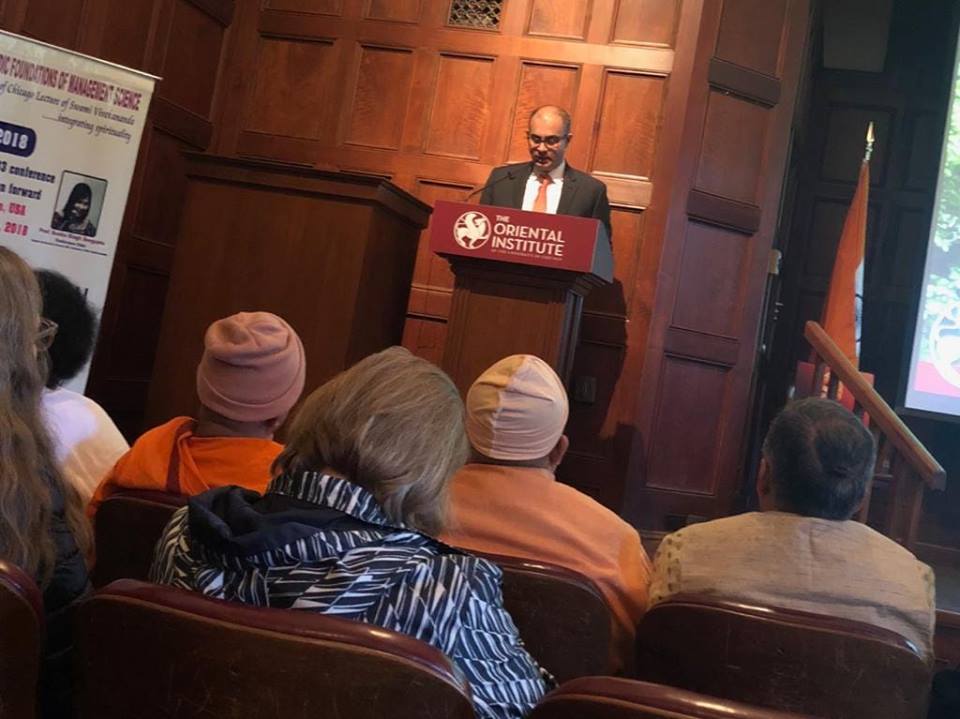
In order to commemorate 125 years of the Chicago address of Swami Vivekananda, Integrating Spirituality and Organisational Leadership (ISOL Foundation) had recently organised a World Congress on Vedic Foundations of Management Science.

Several luminaries and experts in diverse fields addressed the gathering, which was inaugurated on the 11th of September at the Breasted Hall, The Oriental Institute, The University of Chicago. Distinguished Trinity and ISOL Awards were presented on the day. The event concluded on the 13th of September, 2018.

The Inaugural Session started with a Welcome Address by Dr J L Raina, Chairman of ISOL Foundation. Vedic Mantras were chanted by Mr Ashok Vyas, followed by a Welcome Song penned by Mr D V Shastry.

Prof Sunita Singh Sengupta, Founder ISOL Foundation, welcomed the delegates and presented a Background Paper.

The Inaugural Addresses were delivered by the following:

  • Ms Neeta Bhushan, Consul General of India in Chicago
  • Dr Larry…

View original post 298 more words

Read Full Post »

 A Tribute to Swami Vivekananda: Leader Extraordinary


“On the seventh of August 1941, in the city of Calcutta, a man died. His mortal remains perished but he left behind a legacy… that no fire can ever consume…”

That was the baritone, sonorous voice of Satyajit Ray in his documentary titled ‘Rabindranath’ created as a tribute to Rabindranath (a project mandated on Ray, the genius in film making, arts and literature, commissioned by Ministry of Culture, Government of India) on the occasion of the birth centenary of the another genius, Rabindranath Tagore the Nobel laureate poet, musician, novelist, dramatist, artist and philosopher. The first scene of the documentary depicted the last and final journey of Tagore to the burning ghat (crematorium).

Ray’s portrayal of Tagore began with the scene finale. But where do we start in our odyssey with the volcanic monk of India whose 150th birth anniversary we celebrated earlier in this decade?

“Let’s start from the very beginning/ a very good place to start…” (The Sound of Music)

Naren or rather Bile (Narendranath Datta) was storm or turbulence personified from childhood in the premises of the Datta household in North Calcutta. Never obedient to seniors, ever an enigma to peers (his local friends), he would relish his father’s hookas (smoking pipes) or throw away his mother’s clothes from the windows to the beggars on street even while he was locked up in a room for his erratic unmanageable behaviour.  But when the time of crisis came, his friends would run away at the sight of a snake. But he would remain seated, immersed in meditation while the snake rustled away leaving him in peace. Trained in the art of physical mastery, he would combat the white man for speaking ill of Indians. He showed the promise of a Life Exemplary and Leader Extraordinary!

“His pre-eminent characteristic was kingliness. Wherever he went he was the first.’ (Romain Rolland).

Narendranath was a born leader, never ‘made’ – only refined and directed by his great master Shri Ramakrishna.

A good leader accepts the situation at hand and tries to find a way out. But a great leader is ever in discomfort with the commonplace and the hackneyed reality. Naren began his quest for the beyond with burning questions on the existence of God and purpose of Life – only to be answered clear and direct by Sri Ramakrishna, who was to become his master though in appearance, upbringing and otherwise his direct antithesis. But this was not by any devout dedication but through a series of questioning he hurled upon his master. And then came the hour of consecration.

Ei jonmo ei shorir oi murkho bamun kine niyeche”. (This life, this body is consecrated to that old illiterate Brahmin!) – He wrote to a brother disciple later.

By the way, Narendranath was projected as the leader of tomorrow by his master – not by himself!

Naren shikshe debe” (Naren will teach the world) – was the prophecy of Shri Ramakrishna in the Master’s own writing.

A great leader emerges out of stormy crisis from various fronts – death of father, deprivation of mother from family property, futile search for a job. But he had the fortitude to stick to his master’s promise that he would never be plagued with basic sustenance. His primary preoccupation became an immersion into the self, deep in meditation. “Mon cholo nijo niketone…’ (O Mind! Return to thy own repose!). It was for his Master to turn him towards the world with the message of service, love, education to humanity. He was destined to be a leader –a banyan tree for one and many.

Storm as in crises for him was lifetime companion – severe hardship n Baranagar Math in North Calcutta after the death of his Master, hunger and uncertainty during his parivrajaka (the wandering monk) life in India, anxiety about funds for the America trip, spending sleepless and shivering night in Chicago railway station, lampooned and maligned by his opposition religious groups in the West and even from his close quarters back home.

But the fire in him was never to extinguish.

Vivekananda stood for the principles of acceptance and assimilation of diverse opinions, values and cultures. A true global leader in thoughts, words  and action, he became a fiery inspiration to men and women from the East and West from myriads of background – businessmen like Rockefeller and Jamshetji Tata, European women like Margaret Noble (Sister Nivedita) and Emma Calve, scientists like Acharya J C Bose and many more. His style of communication was different for each according to the nature and character of individuals. His was an enlightened universal mind a century ahead of his times. But never did he lose his anchor in India.

“India was his daydream. India was his nightmare.” (Sister Nivedita)

And his thundering voice rose: “He Bharat bhuliona…” (O India! Forget not…). He never disowned the past and ever cherished the golden heritage of India. But he was ever stretching out his hand and heart of welcome to the West as well, to a future that is different and diverse yet mutually and globally enriching for one and all.

Je somonnvoy kore sei lok” (The one who can synthesize is truly a human) said his Master. Swamiji lived this message throughout life – a grand synthesis of the best from all parts of the world that he had visited during his brief life span.

Srinvantu Vishwe Amritasya Putrah’ (Listen! O Children of Immortality, world over!). This was the invocation of the rishis of the Upanishads. The voice of Swamiji in Chicago Parliament of Religions resonated; “Sisters and brothers of America…” He was a modern incarnation of the ancient rishis (sages and seers) in the attire of a monk.

Back home he chose ‘atmanomoksharatham jagat hitaya cha’ as the motto of the Ramakrishna Mission – (For the liberation of the self and the welfare of the world)  on the foundation of the philosophy and principle of action ‘Siva jnana jivaseva’ (To serve man is to serve God n Man) as he learnt from his Master.

His last life in Belur Math was like that of a child – playing with animals and enjoying the company of tribal people while giving lessons on Upanishads to brother monks. In fact his was a life of a child-like leader yearning for fresh air and new light and learning forever. He learnt from all possible sources including a low caste ‘bhangee’ (one from a low caste) with whom he had smoke and also a dancing girl who, in Rajasthan at the palace of Maharaja of Khetri, taught him the message of non-discrimination among humans.

Jabot bnachi tabot shikhi” (I learn as long as I live) – was the message of Shri Ramakrishna. Following this precious teaching from his Master Swamiji lived, loved, learnt and left a legacy that is lasting and growing even beyond a century! Ramakrishna Mission is sustaining and flourishing every day all over the world for the service of humanity at large – spiritual, social and educational.

His funeral pyre was lit on the bank of the Ganges on the fifth of July 1902. The body of the monk inferno Swami Vivekananda was stretched on pyre in his chosen place under the bilwabrikshwa (The Bengal Quince tree) in Belur Math. His mother Bhubaneshwari Devi was sitting and watching the rising flames from the body of his eldest son. A speck of his saffron robe flew in the wind to Sister Nivedita, the devout disciple of the monk. She collected and preserved that ‘memento’ for her inspiration to action in the days to come.

Thus was the mortal consummation of the Swami, the Prince among men –the volcanic monk who shook the world with the fiery message of the Upanishads under the spiritual umbrage of his ‘seraphic master’ Sri Ramakrishna and ignited the spirit of India towards freedom.

Netaji (Subhas Chandra Bose) accepted him as his fiery guru in mortal absentia. In the words of Sri Aurobindo, it was like “baptism with blood and fire”. Netaji described Swamiji as a leader extraordinary in the following words:

“Reckless in his sacrifice, unceasing in his activity, profound and versatile in his wisdom, boundless in his love, exuberant in his emotions, merciless in his attacks and yet as simple as a child, he was a rare personality in this world of ours.

If Swamiji had been alive today he would have been my guru.”

I have ransacked the history of leadership and management literature in my voyage through Human values and Indian Ethos in Management, Spirituality and Leadership for nearly three decades but never found such a detailed, succinct yet most powerful and accurate assessment in these seven leadership qualities of one genius of a world leader by another of no mean stature.

We began with a tribute to Tagore by Satyajit Ray. And here we find a tribute to Swami Vivekananda, the Great Master and Leader Extraordinary by none other than Netaji Subhas Chandra Bose. They remain with us as fountainhead of boundless inspiration in a world ruled and dictated by leaders who at best belong to the class of mediocrity in academia and otherwise!

But the fire in the volcanic monk still remains alive and aflame in those who are willing and ready to be ignited.

Agne twam hridayam agachha’ – Oh Fire Eternal! Come and set our hearts ablaze!

Amar modhye je agun jwolchhe tomader modhye o sei agun jwole uthuk… Ei sodai Vivekanandar prarthana.”

(The fire that is burning within me may set all your hearts aflame! This will ever be the eternal prayer of Vivekannada.)

May we live up to his prayers!

It was high in the snowy Himalayas. Swamiji was on pilgrimage with a few chosen disciples. His intense meditation led him to a vision of the Mother Kali, the Black Goddess, the mighty Destroyer and Time Eternal, lurking behind the veil of life. During one evening in a state of high fever he wrote a famous poem that concludes thus:

“Who dare misery loves,

And hug the form of Death,

Dance in destruction’s dance,

To him the Mother comes.”

He said to her chosen disciple Nivedita (an Irish lady of noble origin): “Meditate on death. Only by the worship of The Terrible can The Terrible itself be overcome…There could be bliss in torture too…The Mother Herself is Brahman…The heart must be a cremation ground – pride, selfishness, desire, all burnt to ashes. Then and then alone, will the Mother come!”

Vivekananda exemplified an authentic synthesis of the East and the West, the past and the present, Science and Religion, contemplation and action, spiritual pursuit and service to humanity. He was the messenger of dynamism and hope to India and the world. Could it be that he was under a spell of so-called negative thinking when he wrote the above verse? Or did he want to convey a pertinent message in a different mood that might be useful for all in moments of turbulence and uncertainty?

Leaders of tomorrow in business or otherwise, when shall we learn from death and destruction of old orders that we need creative quantum breakthroughs in our leadership principles, roles and practices to shake the very foundation of our outdated models and worn out concepts, our tunnel vision and fossilized values, by keeping alive and aflame just one precious element within our hearts – the passion to transform and infuse new life in our organizations and the planet at large?

Millennia ago, Socrates exhorted us to think and look within ourselves: “An unexamined life is not worth living.”   Closer in time, the voice of Nietzsche sounded even more daring and adventurous: “If one is to live, one is to live dangerously.”


{Tribute to Swami Vivekananda, the Great Master and leader extraordinary on The Foundation Day (May 1st, 1897) of The Ramakrishna Mission, the first Indian international organization with headquarters in India (Belur Math, Howrah – Kolkata on the bank of the Ganges) but outreach all over the world with more than 200 centres and still thriving in glory for almost more than a century and a quarter dedicated to the service of suffering humanity. An entrepreneurial venture of timeless significance even in times of crisis as in the present, this institution remains and grows as the ever expanding  global vision of this great master as an inexhaustible source of energy and inspiration, firmly rooted in Indian culture, ethos and heritage but with appeal reaching all over the world. At a level of Philosophy in Practice (Practical Vedanta, a term coined by himself that he spread like wild fire in the West even within the short span of his life of less than forty years) he gave a new turn to the ideal of monkhood with simultaneous emphasis on pursuit of salvation of the self through evolution of Consciousness and welfare of humanity at large.The Ramakrishna Mission that embodies the ideals of globalization and sustainability propounded by its founder a century before the pioneers of management in the West could even conceive of these ideas and principles. Even at a functional level the structure of the main temple of Shri Ramakrishna in Belur Math represents a grand synthesis of the East and the West – of Christian, Islamic and ancient Indian architecture.]

(Sanjoy Mukherjee (58) is Faculty of the Sustainability, CSR and Ethics academic group at the Indian Institute of Management (IIM) Shillong. He is the Chairperson of the Institute’s Annual International Sustainability Conference (SUSCON) and also the Chairperson of Student Affairs, Placement and Public Relations.

His detailed profile can be accessed at https://www.linkedin.com/in/sanjoy-mukherjee-72b18823

Permission to publish this tribute here is gratefully acknowledged.)

Read Full Post »

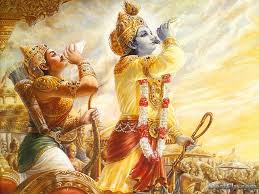
In its concluding chapter, Bhagavad Gita goes on to extol the virtue of surrender to a higher power. It does not specifically state that it is useful only when a CEO is facing a monumental challenge in her career or life. However, it is my belief that an attitude laced with liberal doses of surrender, duly backed by the personality attributes listed in the previous chapter, becomes the most crucial enabling factor which facilitates successful handling of such challenges.

तमेव शरणं गच्छ सर्वभावेन भारत |
तत्प्रसादात्परां शान्तिं स्थानं प्राप्स्यसि शाश्वतम् || 18.62||

Surrender exclusively unto Him with your whole being, O Bharat. By His grace, you will attain perfect peace and the eternal abode.

Much like a Senior Vice President who gets promoted as a CEO after the seniors notice a potential in her to shoulder a higher responsibility, coupled with a match between the value system of the incumbent and that of the business, and a deep sense of loyalty (read surrender) to the organization, Lord Krishna also stipulates the condition under which His grace would help a person to attain perfect peace – exclusive surrender. A conscious realization that it is not one’s own efforts alone which get success in life, and that it is one’s destiny also which plays a crucial role, helps one to surrender in such a manner. 

There are no free lunches in life, as the wise men say!

Challenges and evolution

Each of the demeaning experiences faced by yours truly and shared in the previous part led to some inner growth. A public rebuke made me learn the value of sensing dangerous turbulence on the flight path in advance, and punching the eject button in the cockpit before things spun out of control. Likewise, the kidnapping incident taught me the importance of having some acquaintance with the law and order and regulatory agencies in the country. As an additional perk, each incident revealed the true friends and foes of those around me at the time. An enriching string of experiences, one would say in retrospect.

When a pink slip gets dished out, one finds an opportunity of reassessing one’s strengths and weaknesses and act on them. A fall from grace eventually ends up increasing the depth of one’s inner reservoirs of patience, equipoise and fortitude.

When Kunti seeks challenges as a boon!

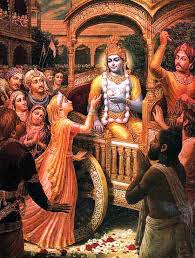
In one of the post-war episodes narrated in the Srimad Bhagavatam, when Krishna is about to depart for his kingdom of Dwarka, Uttara, the bereaved wife of Abhimanyu and the daughter-in-law of Arjuna, comes running to seek His protection for the son in her womb who has been killed by a mighty weapon unleashed by Ashwatthama. Krishna then brings the child back to life, at which time Kunti, the mother of the Pandavas and an aunt of Krishna, prays thus:

विषान्महाग्नेः पुरुषाददर्शनाद्  असत्सभाया वनवासकृच्छ्रतः ।
मृधे मृधेऽनेकमहारथास्त्रतो  द्रौण्यस्त्रतश्चास्म हरेऽभिरक्षिताः ॥ 1.8.24

My dear Krishna, you have protected us from a poisoned cake, from a great fire, from cannibals, from the vicious assembly, from sufferings during our exile in the forest and from the battle where great generals fought. And now You have saved us from the weapon of Asshwatthama.

विपदः सन्तु ताः शश्वत् तत्र तत्र जगद्‍गुरो ।
भवतो दर्शनं यत्स्याद् अपुनर्भवदर्शनम् ॥ 1.8.25

I wish that all those calamities would happen again and again so that we could see You again and again, for seeing You means that we will no longer repeated births and deaths.

Apprehending that she and her children would subsequently be missing being in touch with someone of the stature of Krishna, Kunti seeks a blessing from Him – that her family is always surrounded by some trouble or the other. The Lord is obviously surprised and bemused at someone seeking a negative blessing!

Of Challenges, Deprivation and Humiliation

Shri Ram Chandra Maharaj, affectionately referred to as Lalaji Maharaj by his followers the world over, was the original Master of the spiritual organization which is spear-heading the practice of Heartfulness Meditation globally these days. He has stated in one of his messages that there are three factors in one’s life which lead to spiritual evolution: Illat (Challenges), Quillat (Deprivation) and Zillat (Deprivation).

What is really implied here is that one needs to learn to accept challenges – major or minor – in the spirit of ‘illat’, ‘quillat’ and ‘zillat’. In other words, to have a little less money than necessary; to have a little less than good health; and to always have critics around one. Those who are on the path to an inward growth would do well to receive such brickbats and rocks as fragrant bouquets which life bestows on one.

The real examples quoted earlier in this context aptly justify this sobering thought.

Negatives support us better!

Swami Vivekananda, in his notes on Karma-Yoga, has the following to say:

‘Good and evil have an equal share in moulding character, and in some instances misery is a greater teacher than happiness. In studying the great characters the world has produced, I dare say, in the vast majority of cases it would be found that it was misery that taught more than happiness, it was poverty that taught more than wealth, it was blows that brought out their inner fire more than praise.’

Perhaps, if Mahatma Gandhi had not been kicked out of a train for traveling first class at Pietermaritzburg in 1893 in South Africa, the history of Indian continent might have been quite different!

The argument here is not that one should willingly court challenges and negativity in life. It is merely to state a basic truth in life – that challenges have an upside too.

The rhinoceroses of challenges

Challenges come in all sizes, hues and degrees of seriousness. Each challenge faced by one in life eventually results in speeding up one’s progress on the tricky path of evolution. One gains maturity and experience. One learns to be grateful when one is feeling unduly elated, and graceful when feeling totally down. One learns to be more careful and patient.

Challenges are blessings which bring about changes which uplift and enrich one. Our Guardian Angels would never desert us. Instead, they plan their furloughs in such a way that while they are having a rollicking time on a distant planet, one gets precisely the kind of challenges which enable us to become more humane, more pragmatic and more professional in our dealings with people and with situations.

One’s fight with mighty challenges in career and life could be decisively won by using the firepower of the tools in one’s arsenal – A relentless drive to keep upgrading one’s knowledge base and skill-sets, and to have faith in a higher power. An attitude of surrender enables one to march on in life, with one’s chin up, a smile adorning one’s visage, and a steely resolve to make the approaching rhinoceroses-like challenges to wilt and retreat into their own comfort zones.

(Sources:

The Spider’s Web, Vol. 3, Chapter “Attitude”, by Shri P Rajagopalachari;

Karma Yoga: The Yoga of Action, Chapter “Karma In Its Effect on Character”, Swami Vivekananda, ISBN 81-85301-89-1

Illustrations courtesy www)

(Related Post: https://ashokbhatia.wordpress.com/2019/06/13/when-life-hurls-big-rocks-at-one)


Read Full Post »

In order to commemorate 125 years of the Chicago address of Swami Vivekananda, Integrating Spirituality and Organisational Leadership (ISOL Foundation) had recently organised a World Congress on Vedic Foundations of Management Science.


Several luminaries and experts in diverse fields addressed the gathering, which was inaugurated on the 11th of September at the Breasted Hall, The Oriental Institute, The University of Chicago. Distinguished Trinity and ISOL Awards were presented on the day. The event concluded on the 13th of September, 2018.

The Inaugural Session started with a Welcome Address by Dr J L Raina, Chairman of ISOL Foundation. Vedic Mantras were chanted by Mr Ashok Vyas, followed by a Welcome Song penned by Mr D V Shastry.

Prof Sunita Singh Sengupta, Founder ISOL Foundation, welcomed the delegates and presented a Background Paper.

The Inaugural Addresses were delivered by the following:

  • Ms Neeta Bhushan, Consul General of India in Chicago
  • Dr Larry Greenfield, Executive Director, Parliament of the World Religions
  • Prof Bala Srinivasan, Vice President, Strategy and Global Initiatives, University of Chicago
  • Prof Sunaina Singh, Vice Chancellor, Nalanda University

Rich tributes were paid to Swami Vivekananda by:

  • Prof Dinesh Singh, Former Vice Chancellor, University of Delhi and Chancellor, K R Mangalam University
  • Dr Bharat Rai, Oncologist in Chicago
  • Dr H P Kanoria, Founder, Shristi Corporation, SREI Infrastructure Finance Limited and SREI Foundation
  • Swami Yatidharmananda, Managing Tustee, Swami Chidananda Sevashram

The following tracks were covered at the three-day event.

  • Sri Ramakrishna, Ma Sarada and Swami Vivekananda
  • Education in Ancient India
  • Women Empowerment
  • Contemporary Themes on Spirituality, Ethics and Management
  • Global climate change and Eco System Management: Insights from Vedas
  • Ancient Indian Mathematics and Astronomy: Its Contemporary Relevance
  • Ayurveda, Yoga and Meditation for Modern Health Care
  • Ancient Indian Architecture, Sculpture and Art
  • Exploring Sustainability through Spirituality
  • Contemporary Themes on Scriptures, Ethics and Management
  • Vedic Foundations of Management

The last mentioned session was chaired by Prof Neal McGregor.

  • Prof N Ravichandran shared ‘Managerial Insights from Panchtantra Stories’
  • Prof Omprakash K Gupta elaborated upon his passion for ‘Simplifying and Summarising Sanatana Dharma Scriptures for our Youth’
  • Prof Kisholoy Gupta spoke of ‘Vedantic Wisdom in Contemporary Management’
  • Dr Ravi Subramaniam presented ‘A Qualitative Examination of Leadership Traits of Ram from Shrimad Valmiki Ramayan’
  • Yours truly presented a paper on ‘Ramayana – Some Management Lessons’.


Here is the PPT which might be of interest to some of you.

Ramayana Management_Lessons Chicago PPT


Distinguished Valedictory Lecture was delivered by Lucy Forster-Smith, Senior Associate Pastor for Leadership Development, Fourth Presbyterian Church, Chicago.

Dr J L Raina and Prof Sunita Singh Sengupta summed up the proceedings of the commemoration event.

(Thanks are due to several persons who added value to my presentation and gave a final shape to it.)

Read Full Post »