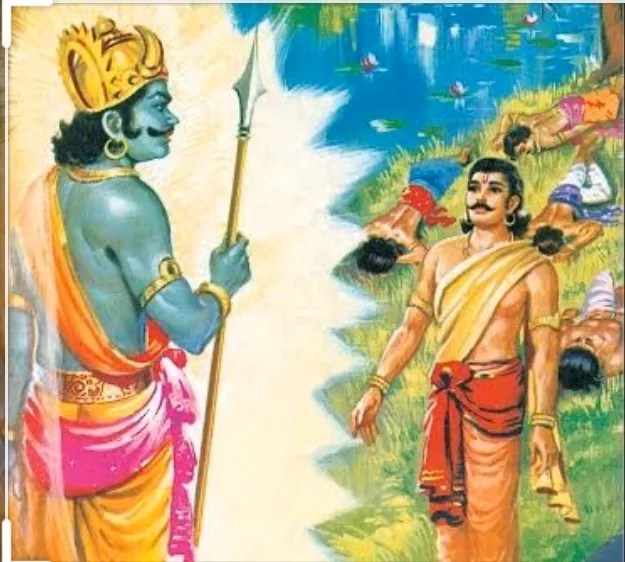
In the Yaksha Prashna episode of Mahabharata, Yudhishtira is asked many questions. One of these is:
“What do you find as the most surprising on earth?”
To which Yudhishtira replies:
“Numerous people are encountering death daily. Even though people are aware that they will have to die one day, they crave for worldly desires as if they are permanent on earth. There is nothing more surprising than this fact.”
Death and Taxes are both inevitable in life. But the sting of death is far deadlier than that of taxes. There is an irrevocability associated with it. When a loved one passes away, the physical form with which we associated ourselves for a long time simply vanishes. What is left behind is a void which is near impossible to fill.
The sting hurts us even more when the death is untimely. The passing away of a young person who was yet to drink deep from the joyful rivulet of life leaves us with a regretful feeling of deprivation. Shock, trauma, and depression follows. Our senses get numb. Nothing makes any sense anymore. A sense of disbelief envelopes us. Words of sympathy and condolences pour in, but these do not register. For some time, we act like zombies, moving about and doing things as we are advised by others to do. Lessons from Bhagavad Gita which tell us that the soul is immortal do not make any sense.
Feelings of guilt plague us. We regret not having done something more to save the person. We find it difficult to handle the anger we feel towards ourselves. Forgiving ourselves becomes an impossible task. We look up to the heavens and blame our favourite God for having been so cruel to us.
Losing a spouse is especially traumatic. I realized this myself when I lost my wife during 2018. Gradually, the reality of having lost a trusted companion, a bitter critic, and a true friend dawned upon me.
Two Persons Who Made Me Cry during 2022

Richa (1970-2022) was Principal Scientist at National Institute of High Security Animal Diseases (NIHSAD). Besides being an eminent scientist, she was a loving daughter, a devoted wife, and a caring and affectionate mother. She was not only a member of the selection committee of International Federation of Biosafety Associations for their much-coveted Biosafety Hero Awards; she had also won many awards herself at national as well as international level. She was the Secretary of Society for Biosafety, India, and a member of The Executive Council of the Asia Pacific Biosafety Association. She had published many research papers. A recognized badminton player, she was passionate about gardening, dancing, and singing. We lost her within a few months of 2022 to an aggressive form of cancer which was detected very late.

Pavan (1963-2022) was a self-made person. A first-generation entrepreneur par excellence. Someone who expanded his business by sheer dint of a lofty vision, hard work, perseverance, and a knack of identifying, nurturing, and deploying human talent. He played all the roles in his life to perfection, whether as a son, an elder brother, a husband, a father, and a grandfather. Above all, a fine and helping human being who would go out of his way to help the needy. With his passing away, we lost someone with excellent management skills. Premier management institutes would greatly benefit by publishing a case study on the business strategy which shaped his business and took it to dizzying heights. We lost him to a sudden cardiac arrest within a span of a few hours on a fateful day during December 2022.
The Five Aspects of Grief
In 1969, psychiatrist Elisabeth Kübler-Ross introduced what became known as the “five stages of grief.” These stages of grief were based on her studies of the feelings of patients facing terminal illness, but many people have generalized them to other types of negative life changes and losses, such as the death of a loved one or a break-up.
The five stages of grief, which I would prefer to refer to as aspects:
Denial: “This can’t be happening to me.”
Anger: “Why is this happening? Who is to blame?”
Bargaining: “Make this not happen, and in return I will ____.”
Depression: “I’m too sad to do anything.”
Acceptance: “I’m at peace with what happened.”
The reason I prefer to call these as aspects of grief rather than its stages is that these stages are not linear in nature, each following the preceding one over time. In my opinion, grief is cyclical or spiral in nature. Something happens, memories come flooding back, and we feel we are back to square one. But yes, the spiral does propel us forward, taking us gradually away from its epicentre.
Often, grief is like a sinusoidal curve of which the amplitude keeps decreasing over time, as the mundane concerns of life come back plaguing us soon enough. However, it is a curve which goes down in an exponential manner, never quite reaching a zero baseline. The emptiness within may never go away; we learn to accept it and move on in life. The time span of recovery is as individually unique as each one of us is.
Handling Grief
Remaining Surrounded by Loved Ones
In the initial phase, we tend to withdraw ourselves into a shell. Despite being surrounded by our loved ones, the feeling of loneliness and a vacuum inside persists.
Turn to friends and family members. Now is the time to lean on the people who care about us, even if we take pride in being strong and self-sufficient. Rather than avoiding them, draw friends and loved ones close and spend time together face to face. Physical hugs go a long way in the process of recovery.
Accepting the Assistance Offered
Often, people want to help but do not know how. We may have to be open and tell them what we need—whether it’s a shoulder to cry on, a listening ear, or just someone to hang out with. If we feel we do not have anyone you can regularly connect with in person, it’s never too late to build new friendships.
The Challenge of Comforting Others
We would do well to accept that many people feel awkward when trying to comfort us when we are grieving.
Grief can be a confusing, sometimes a frightening emotion for many people, especially if they have not experienced a similar loss themselves. They may feel unsure about how to comfort us and could be wary of saying or doing the wrong things.
Sharing Sorrow and Getting Busy
Sharing our sorrow with others who have experienced similar losses can help. What works best, however, is to get doubly busy with our occupation and start devoting more time to what we love doing.

Faith Can Help
As luck would have it, our physical body carries no guarantee. Perhaps, we can draw some comfort from our faith. If we follow a religious tradition, we may find that its mourning rituals may provide some comfort. Spiritual activities that are meaningful to us —such as praying, meditating, or going to religious places — can offer solace.
Lord Krishna speaks of reincarnation in the Bhagavad Gita, likening death to the way we change into a new set of clothes, discarding the old ones.
Fulfilling Pious Intentions
Most of us have a bucket list of things we always wished to do in our life. It helps to start fulfilling such pious intentions sooner than later.
It could be trips to places that we always wished to visit, a book that we always thought we could read, or write one of our own, few songs we could croon, close friends we wanted to visit, or movies that we wished to see, etc.
Imparting a Meaning to Our Suffering
Grief can beget meaning. It provides us an opportunity to reflect on what matters most to us. We could end up taking a social initiative which may, in some way, end up doing good to others. Suffering is virtually a steppingstone to spiritual upliftment.
On to Pleasant Memories
The good news is that the feeling of inner loneliness does get diminished over time. Our souls are forever seeking happiness within. Over time, memories which would have made us cry closer to the event, turn into pleasant ones. We remember the departed person with fondness. We keep in mind the values followed by the departed soul. We adapt to the new reality.

Making the Departed Soul Happier
The Mother of Sri Aurobindo Ashram, Pondicherry, India, has said that to make the soul happy, so that it reincarnates in good conditions, one should have no sorrow and remain very peaceful and quiet, while keeping an affectionate remembrance of the one who has departed. (Complete Works of the Mother; Words of the Mother – III; Death and Rebirth).
Some Myths and Misconceptions
Myth: The pain will go away faster if we ignore it.
Fact: Trying to ignore our pain or keep it from surfacing will only make it worse in the long run. For real healing, it is necessary to face our grief and actively deal with it.
Myth: It’s important to “be strong” in the face of loss.
Fact: Feeling sad, frightened, or lonely is a normal reaction to loss. Crying does not mean we are weak. We do not need to put on a brave front. Showing our true feelings can help us and those around us.
Myth: Not crying implies we are not sorry about the loss.
Fact: Crying is a normal response to sadness, but it is not the only one. Those who do not cry may feel the pain just as deeply as others. They may simply have other ways of showing it.
Myth: Grieving should last about a year.
Fact: There is no specific time frame for grieving. How long it takes differs from person to person.
Myth: Moving on with our life means forgetting about our loss.
Fact: Moving on means we have accepted our loss. This is not the same as forgetting. We can move on with our life and try to be happy. The memory of someone we lost shall always be an important part of us. In fact, as we move through life, these memories can become more and more integral to defining the people we are.
What To Avoid While Comforting Those Who Are Grieving
- Aggressively seeking details as to how it happened. Allowing the grieving person to open up on his/her own makes better sense.
- Right after the death, asking the affected person details about their immediate or future plans. Or, commenting on how things may shape up in the family in the times to come.
- Discussing financial details of any kind.
- Loose talk while being a part of any of the rituals or at any social gathering to mourn a death.
- Talking about health-related precautions being taken by one, thereby implying that the responsibility of the sudden demise somehow lies on the deceased person or his/her family.

A Transformative Event
In his epic poem Savitri, Sri Aurobindo, the renowned Indian seer, presents the end of a person’s life as a transformative event, a passage or a door through which one passes towards a greater life. Essentially, the poem recounts the saga of human victory over ignorance and conquest of death.
Thus, on the racing tracks of Life, Death is but a pit stop. One gives up one’s creaking old jalopy. In exchange, one gets a shimmering new vehicle. One then zooms off to a newer horizon, the engine firing on all six cylinders. With each pit stop, one evolves further.
Conveying Positive Vibes to Those Who Are Still Around
If I ever run into Yaksha and he asks me as to what the next most surprising thing in life is, I would surely respond as follows.
“All of us realize that those we love are not going to be around all the time. Yet, we consciously end up praising a person only when he/she is no longer alive. During their lifetime, most of the times, we take them for granted and spend quite some time censuring, condemning, criticizing, and ridiculing them.”
Think of those around us. When was the last time we conveyed our genuine appreciation, praise, and gratitude to them for their importance in our life? Is it not better to do so when the person we love is still around and can appreciate it?!
(1. The illustration depicting Krishna and Arjuna in the battlefield has been reproduced with permission from the illustrator, Arati Shedde, and Heartfulness Magazine – www.heartfulnessmagazine.com.
2. All other illustrations are courtesy www.
3. A version of this article also appears in the July 2023 issue of NAMAH, a journal of Sri Aurobindo Society, Pondicherry, India).
Related Post:









 ashokbhatia