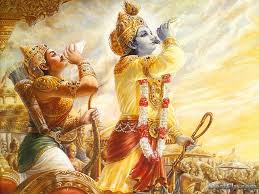
In its concluding chapter, Bhagavad Gita goes on to extol the virtue of surrender to a higher power. It does not specifically state that it is useful only when a CEO is facing a monumental challenge in her career or life. However, it is my belief that an attitude laced with liberal doses of surrender, duly backed by the personality attributes listed in the previous chapter, becomes the most crucial enabling factor which facilitates successful handling of such challenges.
तमेव शरणं गच्छ सर्वभावेन भारत |
तत्प्रसादात्परां शान्तिं स्थानं प्राप्स्यसि शाश्वतम् || 18.62||
Surrender exclusively unto Him with your whole being, O Bharat. By His grace, you will attain perfect peace and the eternal abode.
Much like a Senior Vice President who gets promoted as a CEO after the seniors notice a potential in her to shoulder a higher responsibility, coupled with a match between the value system of the incumbent and that of the business, and a deep sense of loyalty (read surrender) to the organization, Lord Krishna also stipulates the condition under which His grace would help a person to attain perfect peace – exclusive surrender. A conscious realization that it is not one’s own efforts alone which get success in life, and that it is one’s destiny also which plays a crucial role, helps one to surrender in such a manner.
There are no free lunches in life, as the wise men say!
Challenges and evolution
Each of the demeaning experiences faced by yours truly and shared in the previous part led to some inner growth. A public rebuke made me learn the value of sensing dangerous turbulence on the flight path in advance, and punching the eject button in the cockpit before things spun out of control. Likewise, the kidnapping incident taught me the importance of having some acquaintance with the law and order and regulatory agencies in the country. As an additional perk, each incident revealed the true friends and foes of those around me at the time. An enriching string of experiences, one would say in retrospect.
When a pink slip gets dished out, one finds an opportunity of reassessing one’s strengths and weaknesses and act on them. A fall from grace eventually ends up increasing the depth of one’s inner reservoirs of patience, equipoise and fortitude.
When Kunti seeks challenges as a boon!
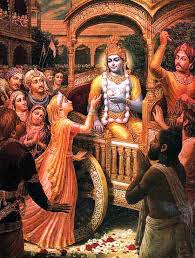
In one of the post-war episodes narrated in the Srimad Bhagavatam, when Krishna is about to depart for his kingdom of Dwarka, Uttara, the bereaved wife of Abhimanyu and the daughter-in-law of Arjuna, comes running to seek His protection for the son in her womb who has been killed by a mighty weapon unleashed by Ashwatthama. Krishna then brings the child back to life, at which time Kunti, the mother of the Pandavas and an aunt of Krishna, prays thus:
विषान्महाग्नेः पुरुषाददर्शनाद् असत्सभाया वनवासकृच्छ्रतः ।
मृधे मृधेऽनेकमहारथास्त्रतो द्रौण्यस्त्रतश्चास्म हरेऽभिरक्षिताः ॥ 1.8.24॥
My dear Krishna, you have protected us from a poisoned cake, from a great fire, from cannibals, from the vicious assembly, from sufferings during our exile in the forest and from the battle where great generals fought. And now You have saved us from the weapon of Asshwatthama.
विपदः सन्तु ताः शश्वत् तत्र तत्र जगद्गुरो ।
भवतो दर्शनं यत्स्याद् अपुनर्भवदर्शनम् ॥ 1.8.25॥
I wish that all those calamities would happen again and again so that we could see You again and again, for seeing You means that we will no longer repeated births and deaths.
Apprehending that she and her children would subsequently be missing being in touch with someone of the stature of Krishna, Kunti seeks a blessing from Him – that her family is always surrounded by some trouble or the other. The Lord is obviously surprised and bemused at someone seeking a negative blessing!
Of Challenges, Deprivation and Humiliation

Shri Ram Chandra Maharaj, affectionately referred to as Lalaji Maharaj by his followers the world over, was the original Master of the spiritual organization which is spear-heading the practice of Heartfulness Meditation globally these days. He has stated in one of his messages that there are three factors in one’s life which lead to spiritual evolution: Illat (Challenges), Quillat (Deprivation) and Zillat (Deprivation).
What is really implied here is that one needs to learn to accept challenges – major or minor – in the spirit of ‘illat’, ‘quillat’ and ‘zillat’. In other words, to have a little less money than necessary; to have a little less than good health; and to always have critics around one. Those who are on the path to an inward growth would do well to receive such brickbats and rocks as fragrant bouquets which life bestows on one.
The real examples quoted earlier in this context aptly justify this sobering thought.
Negatives support us better!

Swami Vivekananda, in his notes on Karma-Yoga, has the following to say:
‘Good and evil have an equal share in moulding character, and in some instances misery is a greater teacher than happiness. In studying the great characters the world has produced, I dare say, in the vast majority of cases it would be found that it was misery that taught more than happiness, it was poverty that taught more than wealth, it was blows that brought out their inner fire more than praise.’
Perhaps, if Mahatma Gandhi had not been kicked out of a train for traveling first class at Pietermaritzburg in 1893 in South Africa, the history of Indian continent might have been quite different!
The argument here is not that one should willingly court challenges and negativity in life. It is merely to state a basic truth in life – that challenges have an upside too.
The rhinoceroses of challenges
Challenges come in all sizes, hues and degrees of seriousness. Each challenge faced by one in life eventually results in speeding up one’s progress on the tricky path of evolution. One gains maturity and experience. One learns to be grateful when one is feeling unduly elated, and graceful when feeling totally down. One learns to be more careful and patient.
Challenges are blessings which bring about changes which uplift and enrich one. Our Guardian Angels would never desert us. Instead, they plan their furloughs in such a way that while they are having a rollicking time on a distant planet, one gets precisely the kind of challenges which enable us to become more humane, more pragmatic and more professional in our dealings with people and with situations.
One’s fight with mighty challenges in career and life could be decisively won by using the firepower of the tools in one’s arsenal – A relentless drive to keep upgrading one’s knowledge base and skill-sets, and to have faith in a higher power. An attitude of surrender enables one to march on in life, with one’s chin up, a smile adorning one’s visage, and a steely resolve to make the approaching rhinoceroses-like challenges to wilt and retreat into their own comfort zones.
(Sources:
The Spider’s Web, Vol. 3, Chapter “Attitude”, by Shri P Rajagopalachari;
Karma Yoga: The Yoga of Action, Chapter “Karma In Its Effect on Character”, Swami Vivekananda, ISBN 81-85301-89-1
Illustrations courtesy www)
(Related Post: https://ashokbhatia.wordpress.com/2019/06/13/when-life-hurls-big-rocks-at-one)



 ashokbhatia
First of all, thank you for sharing this brilliant piece of writing!
Your note on how surrendering to a higher power is possible only when one believes in an inherent destiny, made me think. In the past, I have had a different understanding of destiny- I believed that one who believes in one’s will and effort, cannot believe in destiny. But the way I see it now- we all have an inherent destiny. Hidden in our experiences and opportunities, are clues to this destiny. There is probably a purpose we serve in the larger scheme of the world by embracing that destiny. To embrace this path wholeheartedly and to trust in its meaning, helps us look at adversity as necessary in leading us to our destiny. There is something that adversity carves out of us in order to propel us towards this natural destiny.
The note on a human being’s maturity, as revealed by how we carry ourselves during our moments of success/elation, and during our moments of decline/downfall- this is worth embracing.
Finally, the note on a little less than what is ideal (health, wealth, appreciation)- I had once written about this in the context of cinema. There were many family movies in the past that constructed great meaning out of the small dreams that drives the ordinary human being. They were about lives that weren’t severely deprived, but were a little short of the ideal. The movie explored their motivated journeys and the beautiful meaning they constructed out of such journeys.
LikeLike
Thank you for your detailed comment. You are right that we are like chunks of granite which life’s myriad challenges gleefully chisel so as to produce a sculpture which is unique. A traumatic experience for the chunk of granite, of course, but the results are gratifying.
Even now, out of Bollywood, one finds movies of an aspirational kind. ‘Band, Baaja Baraat’ and ‘Sui Dhaga’, not to speak of sports biopics, readily come to my mind.
LikeLiked by 1 person