This is an abridged version of the talk that Peter Nieuwenhuizen, president of the Dutch P. G. Wodehouse Society, gave on 15 March 2024 at Wodehouse at the UK Conference ‘Wodehouse in the Springtime’ in Bath, in which he explained some of the links between the two authors and revealed the truth about an ‘unknown’ plaque.

The author Ian Lancaster Fleming (1908–64) wrote 14 novels about the British MI6 secret agent James Bond, 007. Fleming’s wartime service (he helped plan several naval operations) and his postwar career as a journalist for the Sunday Times provided much of the background for his Bond stories. Fleming, a keen birdwatcher, especially during his sojourns at his holiday home in Jamaica, took the name of his spy hero from that of the ornithologist James Bond, whose book Birds of the West Indies was an indispensable guide for the budding thriller writer. As for the character of 007, the model was said to be master spy Sidney George Reilly (1873–1925).
P. G. Wodehouse also used a familiar name, of course, for one of his most famous fictional creations: the name of Bertie Wooster’s inimitable valet was inspired by professional cricketer Percy Jeeves. In 2016, 100 years after he was killed at the Battle of the Somme, a commemorative blue plaque donated by The Wodehouse Society was installed in Manuel Street, Goole, Yorkshire, where Percy Jeeves lived before he joined Warwickshire County Cricket Club.
Fleming lived in London in the 1930s and was very familiar with the streets and squares of Mayfair that we know from the Wodehouse novels. He visited several of the gentlemen’s clubs, where he might have met Wodehouse, although there is no record of it. Fleming’s home at Belgravia’s 22B Ebury Street was, coincidentally, once the address of Oswald Mosley, leader of the British Union of Fascists, on whom Wodehouse modelled Roderick Spode. There is a blue plaque in Ebury Street commemorating Fleming’s residential connections.
When Fleming sold the film rights to his immensely popular Bond novels in 1961 to EON Productions, he hoped that the lead role might be given to David Niven, but it was given to the “overgrown stuntman” (Fleming’s words!) Sean Connery. However, one of the two Bond films not produced by EON, the 1967 Casino Royale, did cast Niven as 007 – which leads to another Wodehouse link. Niven had previously appeared as Bertie Wooster in the film Thank You, Jeeves! (1936), and as Frederick Altamont Cornwallis Twistleton, fifth Earl of Ickenham, in Uncle Fred Flits By (1955), an episode of the American network television series Four Star Playhouse. So, the Spy and the Gentleman united in one person.
Fleming knew his Wodehouse canon and included a few references to him in his Bond stories. In From Russia with Love (1957), Fleming describes the muscular agent Donovan Grant, a German-Irish psychopath who had defected to Russia and had become the head executioner for SMERSH. Grant, having learned Russian, maintains his knowledge of the English language by reading Wodehouse – in the first chapter, he is reading “The Little Nugget – an old P. G. Wodehouse”. In chapter 13 of The Man with the Golden Gun (1965), Bond is faced with the villain Scaramanga and says to himself “that he must increase the other man’s unawareness, his casual certitude, his lack of caution. He must be the P. G. Wodehouse Englishman, the limey of the cartoons. He must play easy to take.”
Both Fleming and Wodehouse had stories published in Playboy magazine. One issue, April 1965, contained both the first chapter of The Man with the Golden Gun and PGW’s short story ‘Stylish Stouts’, which would be incorporated in the anthology Plum Pie a year later.
Let us turn now to Le Touquet, the French seaside town within easy reach of Paris and close to the south coast of England. In the 1930s, Le Touquet became accessible by air when the local airport was built, and this led to a rise in the popularity of the resort as a holiday location for the well-to-do amongst English society. Fleming, a member of this ‘smart set’, frequented Le Touquet both before and after the war, and in 1952 started writing his first Bond novel, Casino Royale. The eponymous gambling house is based on the Casino de la Fôret in Le Touquet, and the town is mentioned several times in the book. Fleming was based at the Mirrlees family villa, close to the golf course. More on this a little later!
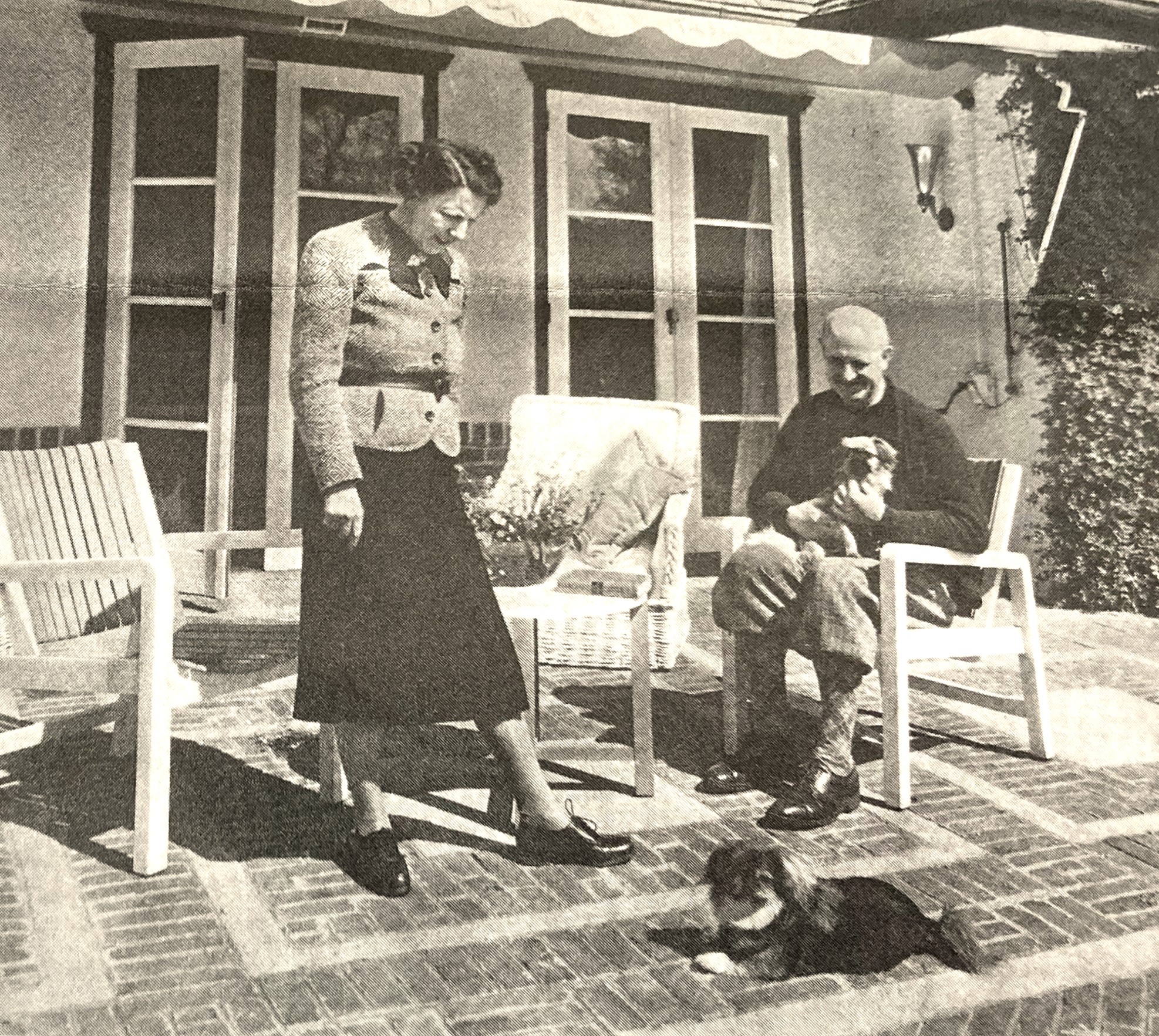
By the time Fleming became a regular visitor to Le Touquet, Wodehouse and his wife, Ethel, had made their home there, having spent many years enjoying a somewhat nomadic life in France, to escape his conflict with the British and American tax authorities. They had spent some time on the Riviera, where their neighbours included H. G. Wells and E. Phillips Oppenheim. They had also tried living in Paris, but Wodehouse had quickly realised that the quieter atmosphere of the coastal resort suited his working life better. Furthermore, there were two good golf courses, plenty of tennis for Leonora on her visits from England, and a local casino that Ethel enjoyed patronising.
Wodehouse had mentioned Le Touquet long before he moved there. In Carry On, Jeeves (1925), the story ‘Clustering Round Young Bingo’ included a sartorial discussion between Bertie and Jeeves, in which the former argued his case thus: “It may interest you to learn that when I was at Le Touquet the Prince of Wales buzzed into the Casino one night with soft silk shirt complete.”
In November 1934, the Wodehouses rented Low Wood, an Anglo-Norman style villa next to the golf course at Le Touquet. The house, and particularly the garden, suited them so well that six months later they bought the property. Here, PGW’s creativity flourished. Having struggled with a lack of plots, he now invented a new character for his stories, Uncle Fred, who made his debut in ‘Uncle Fred Flits By’ (1935). In 1936, Wodehouse wrote Laughing Gas, which was serialised in Pearson’s magazine. The following year he started on a new novel, The Silver Cow, which later transformed into the masterpiece The Code of the Woosters. And Wodehouse then produced Uncle Fred in the Springtime (1939), in which Le Touquet played a role.
After their enforced wartime absence from Low Wood, the Wodehouses returned to inspect the house and found it had been looted and was now in a ruinous state. Renovation was deemed too expensive, and so in 1948 they sold the remains of the villa and emigrated to the USA.
The present owner of Low Wood, Philippe Cotrel, former mayor of Le Touquet, bought the property in 1995, to save it from demolition. The roof and all the windows were renewed or replaced, and an extra wing was added to the house.

The Mirrlees family villa (mentioned earlier) was built in 1936 as a summer residence for Major-General William (‘Reay’) Mirrlees and his second wife, Frances Lalanne, after whom the house was named Villa Les Lambins-Lalanne. Her son from her first marriage took his stepfather’s name and was known as Robin Mirrlees (1925–2012). He led a flamboyant life, during which he became a friend of Fleming and invited him to work in the family villa.
Robin Mirrlees was also a source of information for Norman Murphy, who refers in his A Wodehouse Handbook Vol. 1 (2006) to a Wodehouse plaque in Le Touquet.
Murphy: I am indebted to Robin Mirrlees for the information that, on the back wall of his Villa Lambins-Lalanne, Les Lambins, Avenue de Trepied, Le Touquet, is a black marble plaque to P.G. Wodehouse. The house which, Mr Mirrlees told me, is the only one in Le Touquet still in English hands since before the war, stands next door to the Wodehouse’s villa, and the plaque was erected to commemorate his stay there.
I believe that Murphy never actually saw this plaque himself, and my research suggests that there has been no picture of it published anywhere – until now, that is!
In 2023, I decided to investigate, and after much laborious research I discovered the Mirlees villa to be at a completely different address from the one Murphy referenced: not Avenue de Trepied, but 520 Avenue Allen Stoneham (the same road that gives access to the back garden of Low Wood – now called Low Wood Manor – whose actual address is 1965 Avenue du Golf). I wrote a letter to the owner of the villa, asking for permission to visit. No answer. After a few months my letter came back to The Netherlands, unopened.
On 25th of August 2023, I went to Le Touquet and found Villa Lambins-Lalanne at the newly discovered location. The house looked dilapidated, and there was a sign ‘Attention au chien’ – almost the setting of the Wodehouse story ‘The Level Business Head’, I thought. There was no letterbox at the front of the house, and I presumed any mail was simply stuck in the wooden fence and left there open to all weather conditions or simply not delivered but returned to sender, as mine had been. The unkempt garden contained some rusting metal chairs. The house was clearly empty and appeared to have been uninhabited for many years.
Nevertheless, there it was in the shining sun, I thought – the villa where Ian Fleming started writing his first James Bond novel in 1952!

The stairs to the front entrance of the villa were ankle-deep in leaves and pine needles as, with some trepidation, I approached the door. To my delight, I espied a copper plaque, mounted on a wooden background, that read:
Cette maison fut batie en 1936 par le Général Reay Mirrlees et Madame de La Lanne-Mirrlees pour le plaisir de leurs Amis. Ils y ont reçus des Personnages distingués parmi lesquels les Ecrivains célébres P.G. Wodehouse et Ian Fleming.
(This house was built in 1936 by General Reay Mirrlees and Madame de La Lanne-Mirrlees for the pleasure of their friends. They received distinguished people including the famous writers P.G. Wodehouse and Ian Fleming.)
Wodehouse and Fleming both mentioned on this plaque! There it was – the riddle solved! But was it? Robin Mirrlees mentioned a “black marble plaque” in his report to Norman Murphy. So, I continued my quest.

I entered the wilderness of the backyard, where I was able to take a look at the terrace and the rear of the villa. Rusting sunbeds made me imagine famous authors lounging in the sun, but the whole area still exuded a sad desolation. And then I noticed it – a black marble plaque with the same text as on the copper plaque at the front, in which Wodehouse and Fleming are commemorated together. The golden lettering was clearly legible. I had solved the mystery of the ‘unknown’ plaque – and discovered a duplicate of it as a bonus.
Clearly, Wodehouse must have been a guest at this villa in the 1930s. With the back garden of Low Wood only 100 yards away from the front garden of Villa Les Lambins-Lalanne, he could have reached the path to the villa via a rear exit. When Fleming stayed with the Mirrlees family in 1952, Wodehouse was already living in America, of course, so it seems unlikely that the two authors actually met at Villa Lambins-Lalanne. But at least they are both commemorated for posterity at this location.
It is a pity that the villa is in such a dilapidated state. There are plenty of potential buyers who would like to live near the golf course and cherish these plaques, but the Mirrlees family apparently does not want to sell the villa for the time being, and so it remains in English hands, as Murphy noted.

On the 7th of September 2024, the Dutch P. G. Wodehouse Society, together with The Drones Club of Belgium, honoured Low Wood with a new plaque. So, if you have plans to visit Le Touquet, you will soon be able to admire three plaques commemorating the great P. G. Wodehouse, two of which contain the names of the Spy and the Gentleman.
Notes
- This article first appeared in the June 2024 issue of Wooster Sauce, the journal of the P. G. Wodehouse Society (UK).
- The author’s consent to publish it here is gratefully acknowledged.
Related Posts



 ashokbhatia
Suryamouli Datta commented thus:
“First of all, I must say this is an absolutely fascinating and meticulously researched article! The way Peter wove together the connections between Fleming, Wodehouse, Le Touquet, and even the details about the plaques was a real treat to read.
As I was reflecting on his piece, I was reminded of Kyril Bonfiglioli’s novel “Don’t Point That Thing at Me.” Bonfiglioli’s work, with its distinctive blend of wit, sophistication, and a certain roguish charm, seems to inhabit a literary space between Wodehouse’s light-heartedness and Fleming’s more adventurous spirit. It occurred to me that a brief mention of Bonfiglioli might offer an additional perspective on the tradition Peter has so eloquently described.” Rgrds
LikeLike
Very interesting. Thank you.
LikeLiked by 1 person
You are welcome, sir!
LikeLiked by 1 person
If you look up Villa Lambins-Lalanne on Google Streetview, you can see in the most recent photo that the brass plaque next to the front door has disappeared, whereas it is present in earlier photos. Is anything known about this?
LikeLiked by 1 person
Thank you for your query. I shall soon refer it to the author and see if he has a reply.
LikeLike