How does a member of the tribe of the delicately nurtured feel when taking a just-born baby into her hands? As someone who is instead a member of the so-called sterner sex, I am least qualified to describe that moment of overwhelming joy.
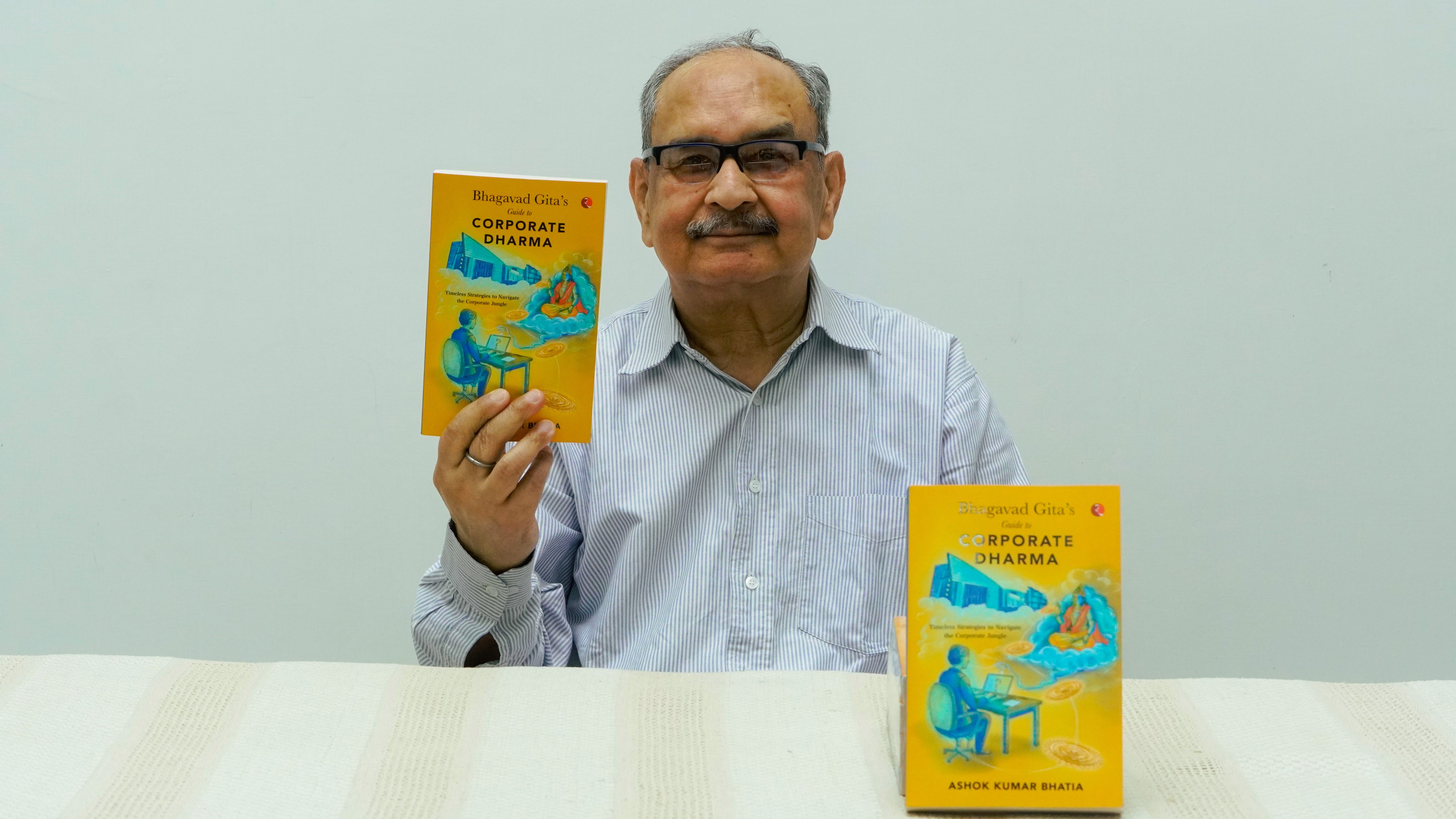
However, I guess I came pretty close to experiencing a somewhat similar emotion recently. A few days back, the first lot of my recently published book Bhagavad Gita’s Guide to Corporate Dharma: Timeless Strategies to navigate the Corporate Jungle arrived at my humble abode. A cloud of unalloyed joy enveloped me. I confess that a few tears of uncontrolled mirth rolled down my cheeks. This baby took close to seven years from its conception to delivery. Finally, I could hold it in my hands!
How this book happened
Studying the Gita had remained a pious intention for many years. Every time I tried to go through it, I could not progress beyond its fourth chapter. But the book then went back to its place on the bookshelf. Mundane concerns of life distracted one. Life rolled by.
Until the day, when Fate sneaked up from behind and struck me with the proverbial lead pipe. In 2018, my companion of over forty years passed away. A long phase of grieving followed, wherein the words of the Gita made little sense. When Reason started returning to its throne, the desire to go through the scripture resurfaced.
Having been a corporate warrior throughout my career, the only way I could look at the scripture’s contents would be through the tinted glasses of the art and science of management. Thus, when I again picked up one of the commentaries on the Gita, I was wondering if it had anything to say that would be considered relevant by managers. Gita did not disappoint. In fact, I found the vast canvas it paints to be of immense utility in the corporate world. It even touched upon the responsibilities of business leaders and entrepreneurs. It touched upon the importance of having saatvic (pious) thoughts and performing acts in a similar vein.
नियतं सङ्गरहितमरागद्वेषत: कृतम् |
अफलप्रेप्सुना कर्म यतत्सात्त्विकमुच्यते || 18.23||
The assigned action, which is done without attachment, attraction (or) repulsion and without clinging to (its) fruit that is called ‘sattvic.’
During my career span of 35+ years, I have had a privilege to be associated with many organisations. Each one had a unique set of values that it followed. Thus, each one’s culture was different. Quite a few of these could be found on the opposite ends of a spectrum of corrupt practices. To some, the means were as important as the ends. They put a high premium on values and ethics in business. An experience of this kind made a subjective interpretation of the Gita through the tinted glasses of someone who remains a student of management even more interesting.
Slowly, an idea of sharing this interpretation with a larger audience started taking shape. This is how the book under reference came about.
An Epidemic Intervenes
By the end of 2019, a manuscript was in place. During January 2020, an agreement was signed with a publisher.
However, my Guardian Angels had their own plans for the book. Come March 2020, and the epidemic of Covid played a spoilsport. The book went into cold storage. Every two years, I kept updating the manuscript. Finally, it was in 2025 that the book found its place on the conveyor belt of the publishers.
From October to December 2025, the publisher’s editorial team burnt the proverbial midnight oil, tolerating my tantrums on finer details. Like ministering angels, they kept supporting me in polishing up the text and giving the book its present shape. The manuscript underwent as many as six upgradations during this period, even as I was recovering from a previously planned eye surgery.
Much like Jonathan Livingston Seagull, the book is soon going to take a flight of its own. Time will tell how business owners, entrepreneurs, management scholars, and students receive it. That alone will decide if it soars to greater heights or gets dumped in the wastepaper basket of Time.
Well, I have done my duty. Results are surely not within my control, as Lord Krishna advises in the Gita!



 ashokbhatia
Leave a comment