Feeds:
Posts
Comments

Archive for the ‘The Magic of Movies!’ Category

Based on the 1949 memoir The Story of the Trapp Family Singers by Maria Augusta von Trapp, the film is about a young Austrian woman studying to become a nun in Salzburg in 1938 who is sent to the villa of a retired naval officer and widower to assume charge as a governess to his seven children. She brings love, spontaneity, and music into the lives of the family members through kindness and patience.

The heroine, though plagued by self-doubt, shows ample pluck and resource to win over a bunch of defiant children and their disciplinarian father. The characters of all the kids are well etched out and enchant us.

The governess ends up marrying the officer. Together with the children, they find a way to survive the loss of their homeland through courage and faith.

Underlying the whole narrative is the value of family togetherness, delicate love interwoven with the need for discipline and loyalty towards each other.

The musical scores stand out for their richness and the way in which they advance the plot of the movie. Even after sixty long years, the movie does not fail to cast a spell.

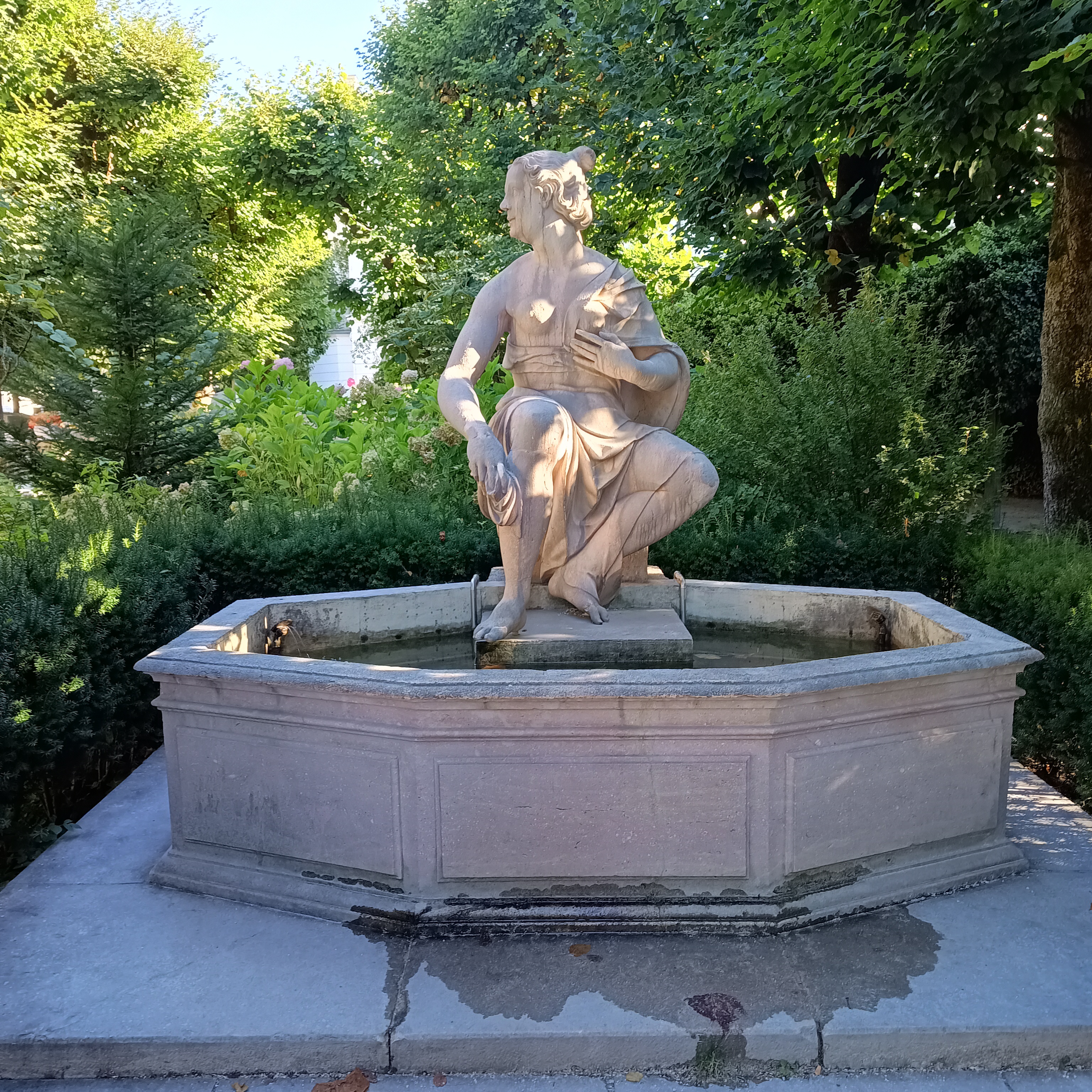
In Hollywood, everything is not only glamourised but also presented on a larger-than-life canvas, thereby leaving the audience mesmerised. Thus, it was interesting to recently visit some of the real locations where the movie was shot in Salzburg, Austria, in 1964.

How the movie came to be

Maria_Von_Trapp.tif

Maria Augusta von Trapp’s memoir was first brought to the silver screen in West Germany: Die Trapp-Familie (1956) and Die Trapp-Familie in Amerika (1958). Wolfgang Liebeneiner directed both.

Rodgers & Hammerstein’s Broadway musical opened at the Lunt-Fontanne Theatre on 16 November 1959. It ran for 1,443 performances and tied for the 1960 Tony Award for Best Musical with Fiorello!

Then came Robert Wise’s screen version for Twentieth Century-Fox. Released in 1965, it became a landmark musical, winning many accolades. The outdoor shooting in and around Salzburg took place in 1964. The planning was to wrap up the shoot within six weeks. However, due to disruptions caused by frequent rains, the crew had to camp there for around eight weeks, worrying the producers no end.

Salzburg: Places where key songs/scenes were filmed

The Opening

The opening sequence of Maria on the mountain was filmed at Mehlweg mountain near the town of Marktshcellenberg in Bavaria. The meadow itself is private property and, regrettably, is no longer accessible to the public. I was told that on a particular day, Julie Andrews and the entire crew had to wait for close to five hours for the rains to stop, so shooting could take place.

Solving a problem like Maria

For many of its scenes in the song, the film uses the authentic exterior of the Nonnberg Abbey, which is the real-life Benedictine convent where Maria was a novice. It sits on a hill above Salzburg and is still home to nuns. However, the interior “contemplation” scene was a set built in Hollywood to represent the abbey’s inner workings. 

I have confidence

Maria’s walk into town includes the Residenzplatz Square, which is a significant landmark in the old part of the city. It is a historical fountain which uses a horse head as a spout. Before the scene at the fountain, there is a segment that was filmed in the pedestrian underpass named Domgang, a few meters away from the fountain, near the Cathedral entrance. The scene towards the end, where she is seen approaching the von Trapp estate, was possibly filmed in an alley next to Mondsee Lake.

The von Trapp villa

The original house the Captain lived in was found to be rather modest. Whereas they lived at Villa Trapp – an estate in Aigen, not far from the city of Salzburg, the movie makers decided to combine two different Salzburg sites:

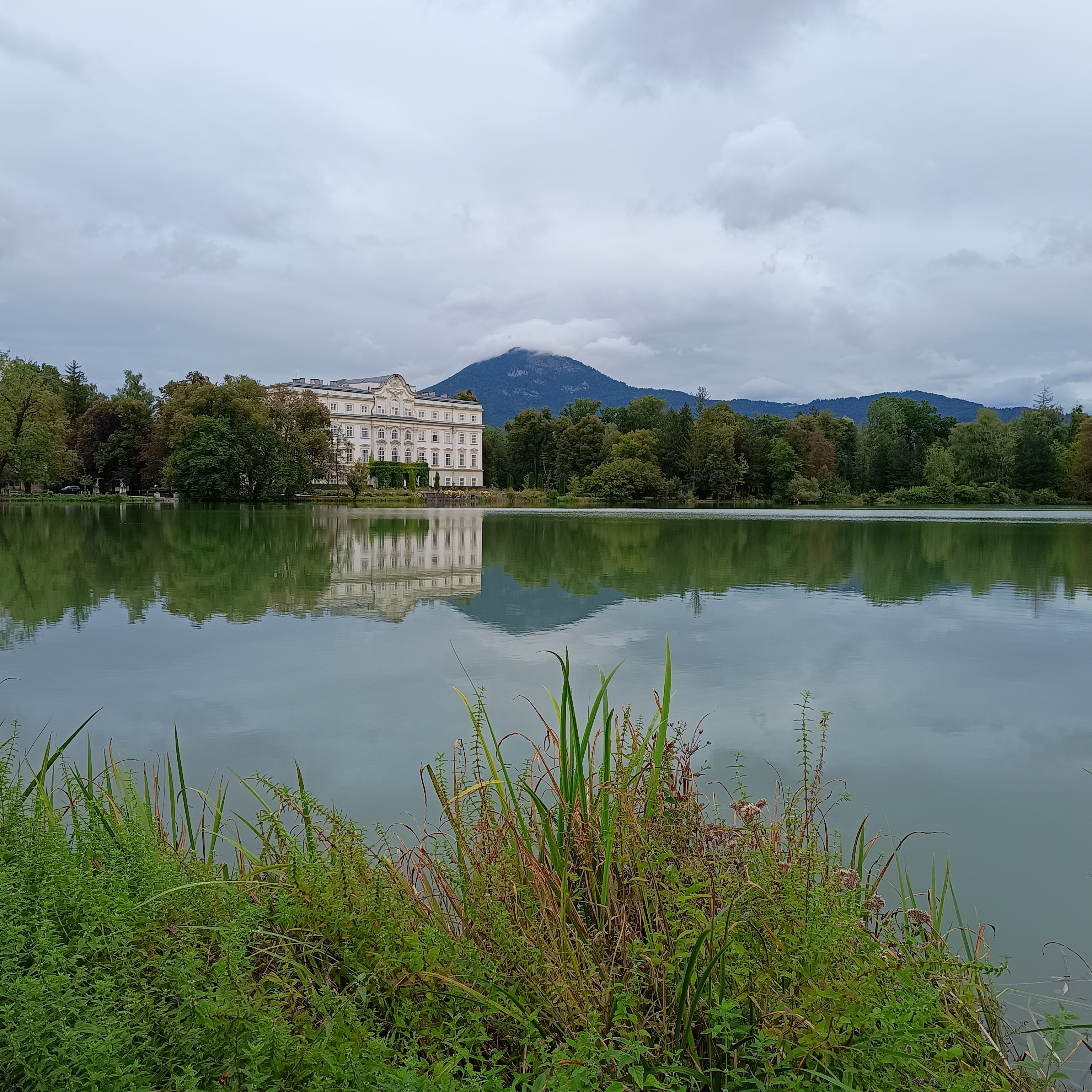
Schloss Frohnburg (front gates/drive) and Schloss Leopoldskron (lakeside terrace and gardens). Leopoldskron’s Venetian Salon inspired the ballroom set.

Do-Re-Mi

Some meadow shots were filmed near Werfen, where stunning rocky mountains form an enchanting backdrop. That is where the picnic scene was filmed, with Julie Andrews, playing everyone’s favourite nun Maria, strumming her guitar through these fields to teach the curtain-clad von Trapp kids to sing Do-Re-Mi.

The famous montage uses Mirabell Gardens (Pegasus Fountain and “Do-Re-Mi” steps) and a few other places in Salzburg. (Regrettably, I could not capture the steps, owing to overcrowding at the place.)

Edelweiss

The locals told me that the flower is a delicate one. It is a mountain flower belonging to the daisy or sunflower family. The plant prefers rocky limestone areas at altitudes of about 1,800–3,400 metres. It is a non-toxic plant. It is a scarce, short-lived flower found in remote mountain areas and has been used as a symbol for alpinism, for rugged beauty and purity. It is a national symbol of several countries, like Austria, Bulgaria, Slovenia, Switzerland, and Italy.

It is a protected flower. If you spot one, you are permitted to photograph it. However, picking up one is considered an offence.

Reverend Mother’s Office

Scenes of Reverend Mother’s Office were shot at St. Margarethen Chapel and Dürer Studios.

Sixteen Going on Seventeen/Something Good

The iconic gazebo used for filming these songs was originally located at Schloss Leopoldskron. However, owing to frequent trespassers, it was moved and reconstructed in the gardens of Schloss Hellbrunn. The structure is small and has only four stone slabs within its circular structure. The film used the structure only for exterior shots; a large studio replica was used for the interiors.
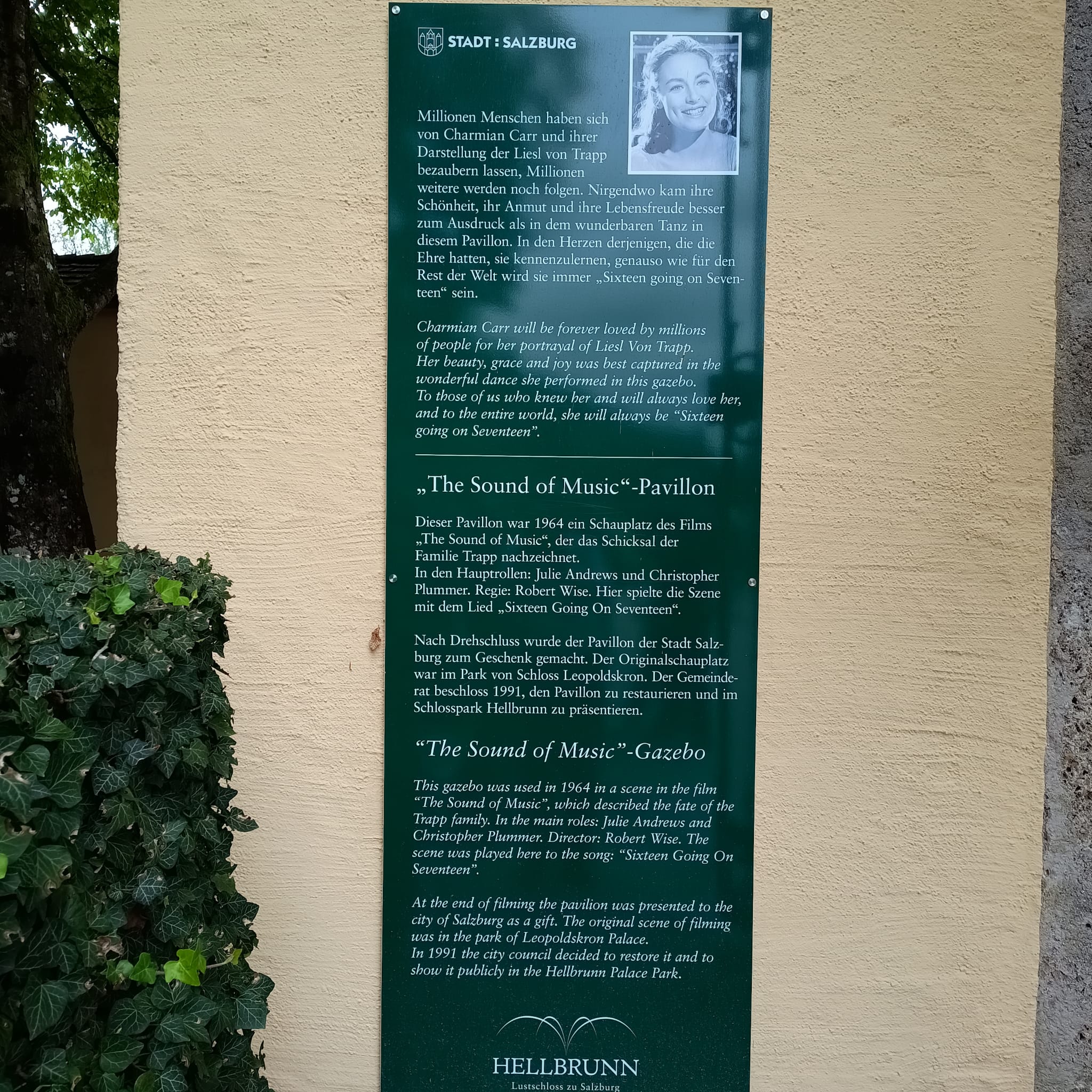
Just next to the Gazebo is a plaque featuring Charmine Carr who played Liesl in the movie.

The wedding

The interior wedding sequence was filmed at St Michael’s Basilica, Mondsee, which is about 30 km from Salzburg. The church is smaller than it appears on a large screen. However, the interiors are as captivating as shown in the movie.

The concert/finale

On the 12th of March 1938, Nazi Germany annexed the Federal State of Austria. The new rulers were keen on the captain joining the German navy, which had superior naval technology at its command. However, owing to ideological differences, the captain and his family decided to escape. The climactic festival performance used Salzburg’s Felsenreitschule (Rock Riding School), a real venue carved into the rock. This is where the escape plans were made.

Cemetery hideout

The tense hiding sequence was staged on a Hollywood set modelled on St Peter’s Cemetery in Salzburg.

The concluding scene

The final scene of the von Trapp family escaping over the mountains was filmed on the Obersalzberg in the Bavarian Alps.

The Making of a Classic  

Principal photography began on March 26, 1964, at 20th Century-Fox studios in Los Angeles, where scenes were filmed from Maria’s bedroom and the abbey cloister and graveyard. 

The company then flew to Salzburg, where filming resumed on April 23 at Mondsee Abbey for the wedding scenes. From April 25 through May 22, scenes were filmed at the Felsenreitschule, Nonnberg Abbey, Mirabell Palace Gardens, Residence Fountain, and various street locations throughout the old town area of the city.

From May 23 to June 7, the company worked at Schloss Leopoldskron and an adjacent property called Bertelsmann for scenes representing the lakeside terrace and gardens of the Trapp villa. 

From June 9 to 19, scenes were shot at Frohnburg Palace, which represented the front and back façades of the villa.

The Do-Re-Mi picnic scene in the mountains was filmed above the town of Werfen in the Salzach River valley on June 25 and 27. 

The opening sequence was filmed atop the mountain from June 28 to July 2, 1964.

The cast and crew flew back to Los Angeles and resumed filming at Fox Studios on July 6 for all remaining scenes, including those in the villa dining room, ballroom, terrace, living room, and gazebo. Following the last two scenes shot in the gazebo—for the songs Something Good and Sixteen Going on Seventeen—principal photography concluded on September 1, 1964.

A total of eighty-three scenes were filmed in just over five months.

Post-production work began on August 25 with three weeks of dialogue dubbing to correct lines that were ruined by various street noises and rain.

In October, veteran Disney playback singer Bill Lee dubbed Christopher Plummer’s singing voice. Christopher himself was a proficient singer and pianist and was not too pleased about this change.

Awards and accolades

  • Academy Awards (38th, 1966). The Sound of Music won five Oscars, including Best Picture and Best Director (Robert Wise).
  • Golden Globes (23rd, 1966). Won Best Motion Picture – Musical/Comedy and Best Actress – Musical/Comedy (Julie Andrews).
  • AFI honours. Ranked #4 on AFI’s list of Greatest Movie Musicals; the AFI also places the film across several “100 Years…” lists.
  • U.S. National Film Registry. Selected by the Library of Congress in 2001 as “culturally, historically, or aesthetically significant.”

Captain Georg von Trapp: life before Maria and career highlights

  • Family life. Georg von Trapp (born 1880, Zara—now Zadar) married Agathe Whitehead (granddaughter of torpedo inventor Robert Whitehead) in 1912; they had seven children. Agathe died of scarlet fever in 1922.
  • Naval career. An Austro-Hungarian Navy submarine commander in World War I, von Trapp commanded SM U-5, sinking the French armoured cruiser Léon Gambetta in April 1915, and later U-14; he became a decorated national figure.
  • Before Maria arrived. After Agathe’s death, von Trapp raised his seven children at their Salzburg estate. In 1926, Maria Kutschera was sent from Nonnberg Abbey as a tutor for his convalescent daughter (also named Maria), not as a governess to all the children. Georg and Maria married in 1927.

Where the film diverges from reality (key examples)

How they left Austria

The film depicts a dramatic Alpine hike to Switzerland. In fact, the family left by train for Italy, first travelling to London, before sailing to the United States for their first concert tour. Georg’s place of birth meant the family held Italian citizenship after World War I border changes.

Timing of the marriage

The movie places the wedding on the eve of the 1938 takeover by Nazi Germany; in reality, they married in 1927.

Maria’s initial role

She tutored one child recovering from scarlet fever, not all seven, as a household governess.

Georg’s temperament

The real Captain was warm and musical, not the stern, whistle-wielding disciplinarian portrayed on screen.

The music director

The group’s long-time musical director was Father Franz Wasner, not a fictional impresario.

Children’s identities

The film changed the names, ages and even sexes of the children (for example, “Liesl” is fictional; the eldest was Agathe).

Edelweiss: the song

Often mistaken for an Austrian folk song, Edelweiss was newly written for the musical by Rodgers & Hammerstein.

Sixty years on, and still counting…

Even after six decades of its release, the echoes of the songs of “The Sound of Music” keep us enchanted. Often, when we are plagued by self-doubt while leaving our comfort zone, the words of the song ‘I have confidence…’ give us solace. Whenever the harsh slings and arrows of fate lower our spirits, the lyrics of ‘Climb every mountain…’ keep us focused on our goals. As and when we feel extremely grateful to someone or something, the phrase ‘Somewhere in my youth or childhood, I must have done something good…’ comes up in our minds.
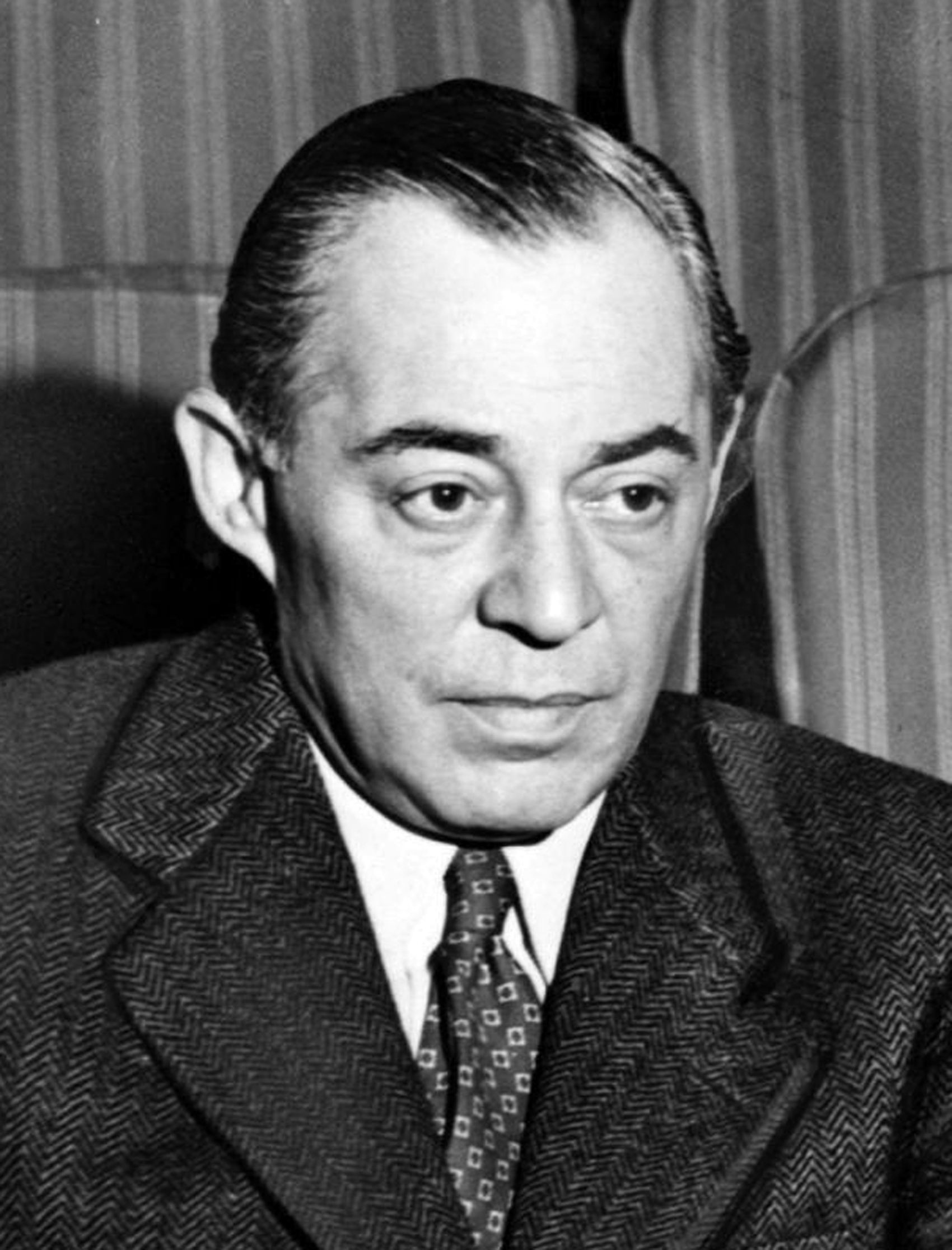
Richard Rodgers and Oscar Hammerstein deserve all the credit for creating such lilting and instructive compositions.
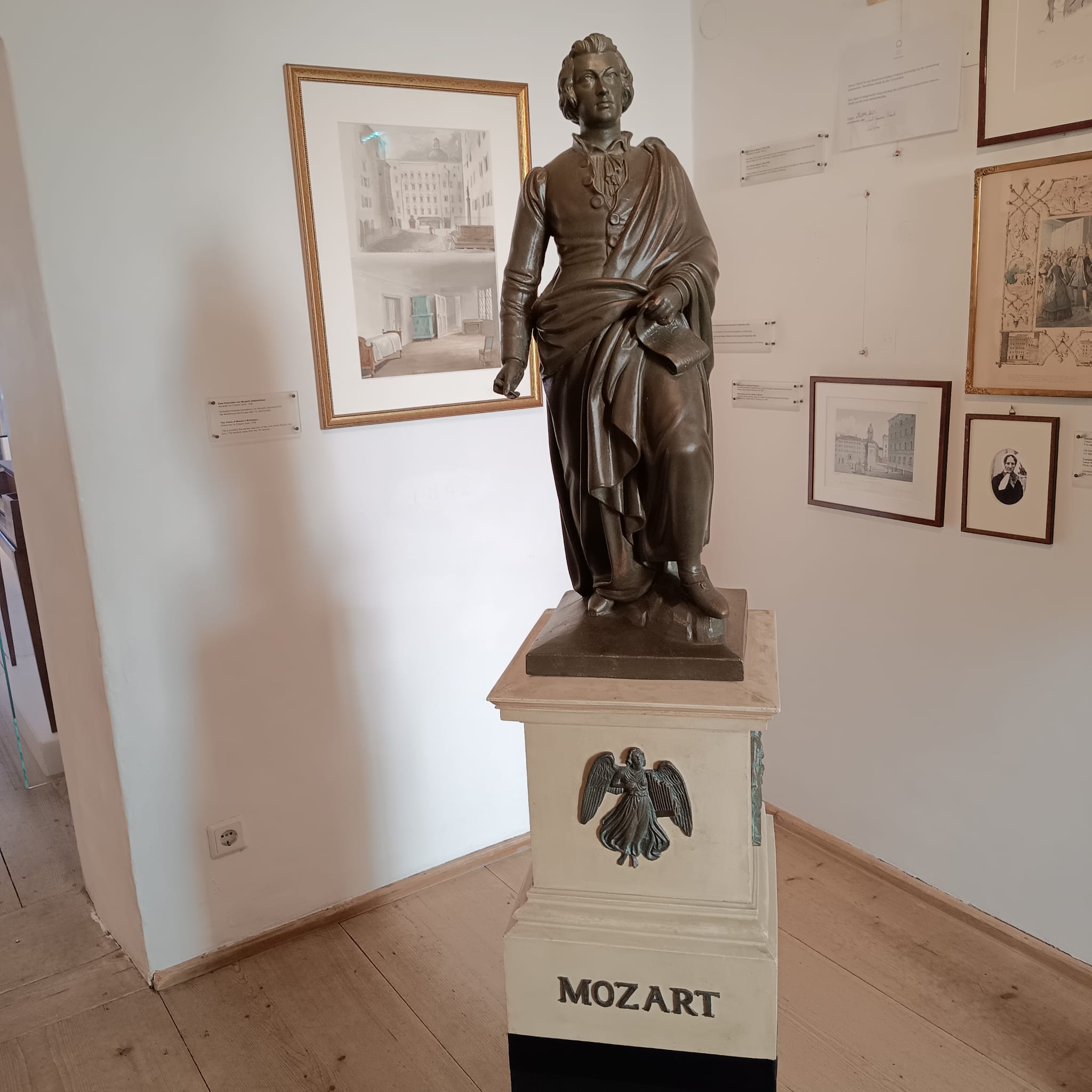
Hats off to the studio team, which whipped up a unique offering of this nature! It should come as no surprise that it originated in a city which is also famous for blessing humanity with a highly talented composer: Wolfgang Amadeus Mozart.

Notes:

  1. Sometime during 2026, just next to the present location of the gazebo, the gardens of Schloss Hellbrunn will also have an exclusive pavilion dedicated to the iconic movie.
  2. The photographs were either taken by me or subsequently downloaded from the internet.

References:  

Related Posts:

Read Full Post »

Read Full Post »

For more than six decades, Suchitra Sen, originally named Roma Dasgupta, stood as the undisputed queen of Bengali cinema, embodying the essence of Bengali femininity, beauty, and elegance. Even after her unexpected withdrawal from the public eye in 1978, her allure and mystique remained intact; in fact, her choice to retreat into seclusion only deepened the intrigue surrounding her.

It is believed that one of director Sukumar Dasgupta’s assistants was responsible for bestowing upon Roma Dasgupta the iconic screen name, Suchitra Sen. Sukumar Dasgupta was the director of her debut film, Saat Number Kayedi.

Her passing on January 17, 2014, signified the conclusion of a remarkable era in Bengali cinema.

The Suchitra Sen phenomenon was unprecedented in the history of Bengali cinema. Not only was she the leading female actor of her time, but she also emerged as one of the most significant stars to grace the Bengali film industry, with her widespread popularity rivaling only that of Uttam Kumar, with whom she shared the screen in 30 of her 60 films. She was the first and only actress to earn the title ‘Mahanayika,’ a distinction that was only similarly awarded to Uttam Kumar in Bengali cinema.

During the height of her fame in the 1950s and 1960s, it is estimated that she commanded a fee of around ₹ 1 lakh per film. Her immense star power made her a central figure in the film industry, often featured prominently on movie posters, and her name was typically highlighted even more than that of the male lead, with the exception of Uttam Kumar, where they shared equal prominence.

The partnership of Suchitra Sen and Uttam Kumar on screen marked a pivotal era in Bengali cinema. Their collaboration spanned 30 films, starting with Sharey Chuattar in 1953, and significantly altered the landscape of Bengali film history. For over two decades, from 1953 to 1975, Suchitra and Uttam reigned supreme in the industry, delivering memorable hits such as Agnipariksha, Shap Mochan, Sagarika, Harano Sur, Indrani, Saptapadi, and Bipasha.

They became icons that resonated with the youth, embodying their dreams and aspirations. Their undeniable on-screen chemistry was so powerful that they transcended their individual stardom, merging into a single entity: Suchitra-Uttam or Uttam-Suchitra. Uttam Kumar himself acknowledged this bond, stating, ‘Had Suchitra Sen not been by my side, I would never have been Uttam Kumar.’

Suchitra is hailed as the first style icon of Bengali cinema, with her unique mannerisms inspiring generations of young Bengali women. The characters she portrayed were often progressive, reflecting the aspirations of women ahead of their time. In many of her films, she took on the roles of ‘professional women,’ whether as an artist in Jiban Trishna, a doctor in Harano Sur, or a politician in Aandhi.

Madhuja Mukherjee, an associate professor of Film Studies at Jadavpur University, noted, ‘Her star persona was shaped by her roles. She exuded a remarkable star quality, both in her appearance and her performances. Compared to the societal norms of her time, she was almost placed on a pedestal, embodying the aspirations of women.’ Remarkably, according to Mukherjee, Suchitra maintained her status as a leading star throughout the 1960s, even as she entered her thirties.

Suchitra’s stunning beauty and immense fame frequently eclipsed her acting talent. Nevertheless, she made history as the first Indian actress to win the best actress award at an international film festival, receiving the honor for her role in Saat Paake Bandha (1963) at the Moscow International Film Festival. Her star power was well-recognized in the Hindi film industry, where she appeared in several major films, including Devdas, Bambai Ka Babu, Mamta, and Aandhi.

Born on April 6, 1931, in Pabna, now part of Bangladesh, Roma was one of eight siblings. Her father, Karunamoy Dasgupta, served as a school headmaster, and she was raised in a culturally rich environment. The Partition led her family to West Bengal, and Roma, already a captivating beauty, soon married Dibanath Sen, the son of a prosperous industrialist. Before venturing into acting, Roma aspired to pursue a music career and reportedly recorded several songs in her own voice.

Despite the admiration she garnered and the unwavering attention from her devoted fans, Suchitra Sen remained a mystery. Known as ‘Mrs Sen’ in the film industry, she was often viewed as distant and hard to approach. By the time she entered the film world, she was already a married woman and a young mother, and her striking looks, reserved demeanor, and privileged background often intimidated those around her. However, she was also recognized for her warmth and friendliness.

Veteran actress Moushumi Chatterjee remarked, ‘Suchitra Sen embodied elegance. She had a remarkable ability to distinguish her personal life from her public persona.’

Industry insiders believe that Suchitra’s keen awareness of her own celebrity status contributed to the myth surrounding her. This understanding may explain her enduring reign as the queen of Bengali cinema and the continued fascination with her, even 36 years after she chose to live in complete seclusion. Her abrupt withdrawal from the public eye only heightened interest in her, sparking numerous discussions, debates, and theories about the reasons behind her choice to retreat.

Rarely spotted in public, she became the most renowned recluse in West Bengal, drawing comparisons to Hollywood’s Greta Garbo. Her commitment to privacy and the lengths she reportedly went to maintain it often seemed almost obsessive.

In 2005, she allegedly declined the Dada Saheb Phalke Award because accepting it in person would compromise her privacy. Even in death, she preserved her enigmatic aura: her final journey was conducted in a black-tinted hearse, obscuring her body from public view.

Suchitra Sen had never collaborated with any of the three giants of Bengali parallel cinema: Satyajit Ray, Ritwik Ghatak, or Mrinal Sen. According to reports, she turned down an opportunity to work with Satyajit Ray because he requested that she refrain from taking on other projects while filming. Suchitra expressed her willingness to honor her commitment to him but was unwilling to promise exclusivity. As a result, the collaboration fell through, and Satyajit Ray ultimately abandoned the project.

While discussing her views on Hindi actors, she touched upon her decision to decline a collaboration with Raj Kapoor. Suchitra explained that the reason for her refusal stemmed from an encounter where the legendary actor and director positioned himself near her feet and presented her with a bouquet of roses. She expressed her preference for men who engage in sharp, intelligent dialogue, which made her uncomfortable with Raj Kapoor’s gesture.

Suchitra Sen and Dharmendra starred together in the film Mamta, directed by Asit Sen. According to a report, Suchitra recounted an incident where Dharmendra unexpectedly kissed her on the back during a scene. She revealed that this moment was not scripted, but the director, Asit Sen, found it compelling enough to include in the final cut of the film. Describing it as an ’embarrassing moment,’ Suchitra made it clear that she was not fond of Dharmendra’s spontaneous kiss.

The world had undergone significant changes in those 36 years of her seclusion, yet the image of Suchitra Sen remains timeless. This enduring presence continues to resonate with the Bengali community, as demonstrated by the large crowds of all ages that filled the streets of Kolkata during her final farewell.

While many regarded Suchitra Sen’s passing as a profound loss for the film industry, the esteemed director Buddhadeb Dasgupta offered a poignant perspective: ‘She will forever be celebrated as the greatest heroine of Bengali cinema. No one can rival her mass appeal. However, the industry truly lost her when she chose to live in seclusion over 30 years ago.’

Suchitra Sen has been honored with four BFJA Awards, the Best Actress Award at the 3rd Moscow International Film Festival, a Filmfare Bangla Award, the Filmfare East Lifetime Achievement Award, the Banga Bibhushan, and the Padma Shri.

Today marks Suchitra Sen’s 94th birthday, a perfect occasion to celebrate her remarkable film legacy. You can catch some of her iconic performances on Prime Video, where titles like Agnipariksha, Sagarika, Indrani, Bipasha, and Devdas are available. On YouTube, check out Shap Mochan, Harano Sur, Saptapadi, Jiban Trishna, Aandhi, Bambai Ka Babu, Mamta, and Uttar Phalguni. On Hoichoi, don’t miss Saat Paake Bandha, Deep Jwele Jai, and Sharey Chuattar.

Notes

  1. A version of this article first appeared in The Reviewer Collective group on Facebook. The author’s consent to reproduce it here is gratefully acknowledged.
  2. I believe that after she retired from acting, she lived in Pondicherry for a few years as a reclusive inmate of the Sri Aurobindo Ashram.
  3. All the visuals are courtesy the World Wide Web.

Read Full Post »

Basu Chatterjee was a champion of the middle class, who turned ordinary lives into captivating stories. His films showcased relatable characters dealing with real challenges, making their triumphs and losses deeply affecting us.

Basu da had a unique way of showing female characters. He was curious about women’s thoughts and dreams, exploring their views on romance and meaningful relationships, both romantic and platonic.

He began directing in 1969 with his film Sara Akash, starring FTII-trained actor Rakesh Pandey. The story, set in Agra, follows a newlywed couple dealing with the challenges of an arranged marriage in a joint family. This year marked the onset of the first wave of parallel cinema, showcasing films like Mrinal Sen’s Bhuvan Shome and Mani Kaul’s Uski Roti. However, the audience for these films, including Sara Akash, remained largely confined to film festivals.

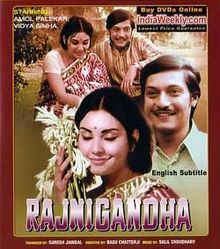
Basu Chatterjee first gained attention with his 1974 film, Rajnigandha, which is based on Manu Bhandari’s Hindi short story Yahi Sach Hai. The film looks at a woman’s struggle between her current partner and an ex who returns, evoking past emotions. Rajnigandha established Chatterjee’s unique filmmaking style. It featured newcomers Amol Palekar and Vidya Sinha, with mostly unknown actors, except for Dinesh Thakur. Chatterjee made a cameo as an annoyed moviegoer. The film’s music, by Salil Chowdhury with lyrics by Yogesh, included memorable songs. Its success led to lasting collaborations among Basu, Yogesh, Chowdhury, and cinematographer K. K. Mahajan. Shyam Benegal’s Ankur also found success that year, demonstrating that art and commerce could indeed thrive together.

He was a pioneering filmmaker who highlighted the Parsi community in Khatta Meetha, showing them authentically and avoiding clichés. Similarly, Baaton Baaton Mein focused on the Catholic community in Bandra, also avoiding stereotypes. Basu da’s films found romance in daily life in Bombay, whether on crowded trains, buses, or Delhi streets.

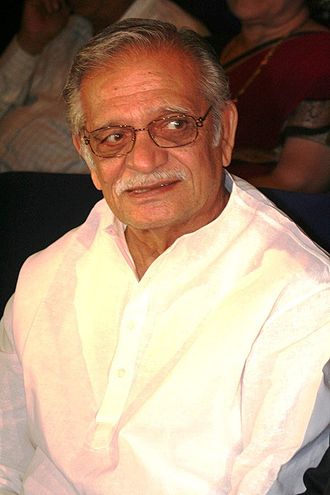
Basu Chatterjee, along with Gulzar and Hrishikesh Mukherjee, formed a strong trio that shaped middle-of-the-road cinema in the 1970s. Their films appealed to middle-class Indians longing for unique yet relatable stories, combining mainstream charm, memorable music, real emotions, and uplifting narratives based on everyday life.

Basu da was born in Ajmer on the 10th of January, 1927. Being close to his 98th birth anniversary, let me highlight a few of his timeless classics.

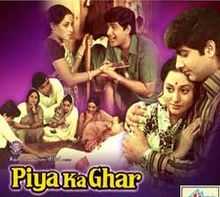
Piya Ka Ghar is a film featuring Jaya Bhaduri and Anil Dhawan, and is a remake of the Marathi film Mumbaicha Jawai. It tells the story of the difficulties faced by married couples in Mumbai, particularly due to limited living space. Malti, a girl from a village, marries Ram through a matchmaker but feels disappointed when she learns they must live with his extended family in a cramped apartment, which affects their privacy and intimacy. Available on Prime Video.

Rajnigandha, based on Mannu Bhandari’s short story Yahi Sach Hai, features Vidya Sinha as a woman torn between two suitors and takes her time to select a husband, a departure from typical glamorous roles. The film centers on the simple lives of three middle-class people without unnecessary melodrama. Vidya’s performance received praise from critics and audiences alike. The film marked the introduction of Amol Palekar and Vidya Sinha, and included memorable songs sung by Lata Mangeshkar and Mukesh, who won a National Award for their work. Available on Prime Video.

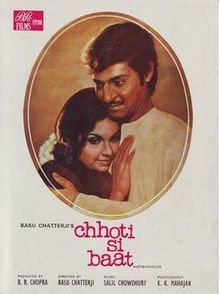
Chhoti Si Baat features Amol Palekar as a shy man who hires a life coach to learn how to propose to a girl. Palekar plays an introverted character, while Vidya portrays a woman who knows his feelings and waits for him to act. The film connects well with audiences due to its middle-class setting. It also includes beautiful music by Salil Chaudhury, showcasing Yesudas’ talent in the duet, Jaaneman Jaaneman Tere Do Nayan, filmed with Dharmendra and Hema Malini. Available on Prime Video.

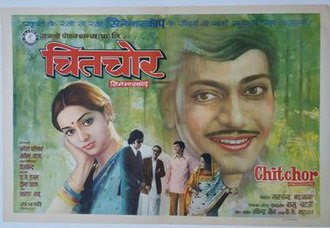
Chitchor is a romantic comedy about mistaken identities involving Geeta and her family eager for her to meet an eligible bachelor, Sunil, who is coming to their village. However, when overseer Vinod mistakenly arrives instead, he wins the affection of Geeta, who wants to marry him. The arrival of Sunil complicates matters as he also develops feelings for her. The film includes lovely songs by Ravindra Jain, such as Jab Deep Jale Aana. Available on Prime Video.

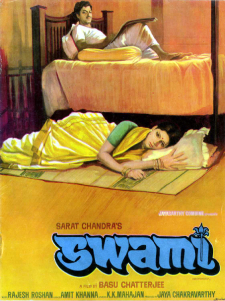
Swami is based on Sarat Chandra’s novel of the same name and follows Saudamini, played by Shabana Azmi, who admires her uncle while facing approval issues from her mother regarding her friendship with Naren. After marrying Ghanshyam, a kind wheat merchant, she feels trapped but learns of her husband’s true kindness. The film concludes with her transformation into a devoted wife, showcasing Azmi’s impressive performance. Available on YouTube.

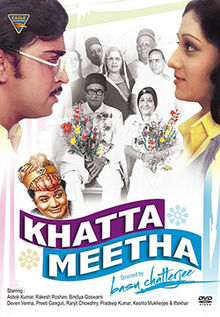
Khatta Meetha is inspired by the American classic Yours, Mine and Ours and tells the story of a middle-aged widower, played by Ashok Kumar, who marries a widow, portrayed by Pearl Padamsee. They both have children from previous marriages and face challenges in merging their families as the siblings conflict. Yet, through various trials, the family finds ways to unite and coexist peacefully, depicting a heartwarming conclusion. Available on YouTube.

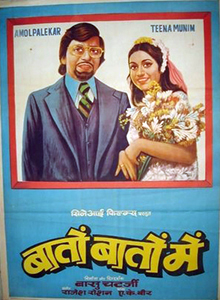
Baton Baton Mein is set in a Christian context and highlights the courtship of Amol Palekar and Tina Munim, with the help of her uncle, played by David. Rosie, a widow, wants her daughter to marry, while Nancy meets Tony on their daily commute. Tony’s shyness creates tension, prompting Rosie to look for other matches, but her uncle’s intervention helps reconnect Tony and Nancy. The film had some lovely songs like Suniye Kahiye Kahiye Suniye, Na Bole Tum Na Maine Kuch Kaha and Uthe Sabke Kadam tuned by Rajesh Roshan. Available on Prime Video.

Apne Paraye, inspired by Sarat Chandra’s novel Nishkriti, revolves around Utpal Dutt, a lawyer with a fondness for his cousin Chander (Amol Palekar), who prefers music over a steady job. Chander’s wife, Sheela (Shabana Azmi), is the strict one in the household. Their stable lives are disturbed when Utpal’s younger brother arrives with his wife, creating a complex family dynamic filled with rivalries. Available on Prime Video.

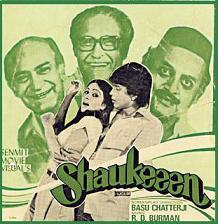
Shaukeen is adapted from the American comedy Boys’ Night Out and follows the lighthearted misadventures of three elderly men, played by Ashok Kumar, Utpal Dutt, and A K Hangal, who fantasize about romance while trying to meet a young woman. They embark on a trip to Goa thanks to their driver, Ravi, leading to humorous yet respectful situations. Ashok Kumar and the ensemble cast deliver exceptional performances throughout. Available on Prime Video.

Chameli Ki Shaadi represents a groundbreaking film tackling caste discrimination with a strong feminist lead. Charandas, (Anil Kapoor), is engrossed in wrestling but loses focus when he meets Chameli (Amrita Singh). Their love faces familial opposition due to caste differences, and to find a solution, they consult an advocate Harish (Amjad Khan), who suggests they elope. Available on YouTube.

One notable aspect of Basu da’s films was their exceptional music. He collaborated with a variety of music directors, including Salil Chowdhury, R D Burman, Laxmikant Pyarelal, Bappi Lahiri, Jaidev, and more. However, his most fruitful partnership was with Rajesh Roshan, producing memorable soundtracks for films like Swami, Khatta Meetha, Baaton Baaton Mein, Priyatama, and Hamari Bahu Alka.

The Chaterjee-Roshan duo have given some memorable songs, like, Pal Bhar Mein Yeh Kya Ho Gaya (Swami), Aaye Na Baalam (Swami), Koi Roko Na Deewane Ko (Priyatama), Tere Bin Kaise Din’(Priyatama), Thoda Hai Thode Ke Zaroorat Hai (Khatta Meetha), Badal Toh Aaye (Dillagi), Na Bole Tum Na Maine Kuch Kaha (Baaton Baaton Mein), Suniye Kahiye (Baaton Baaton Mein), Charu Chand Iss Chanchal Chitwan (Man Pasand), Prem Ki Hai Kya Sun Paribhasha (Hamari Bahu Alka), and many more.

In the 1980s, the number of supporters for his style of filmmaking dwindled, prompting Basu Chatterjee to transition to television. His debut serial, Rajani, featuring Priya Tendulkar, was a pioneering effort in consumer activism in India. Following Rajani, he directed other notable television series such as Darpan and Kakkaaji.

Basu Chatterjee received the Filmfare Best Director award for Swami, which also earned a National award. He was honoured with six Filmfare Awards – Critics for Screenplay.

In the new millennium, remakes of Chitchor and Shaukeen emerged, but they failed to capture the charm of the originals. Today, the success of films like Bareilly Ki Barfi and Badhaai Ho serves as a testament to the legacy of Basu Chatterjee’s cinematic style.

About the author

Shivdas Nair has been a cinephile for years. However, he has just started putting his thoughts on paper. A media professional for over two and half decades, and with changing times, now a Principal Advisor – Growth with a vibrant and innovative IT Consulting & Advisory Services company, i-Gizmo Global Technologies. He has just started blogging at https://thoughtsoveracuttingchai.blogspot.com.

Notes

  1. A version of this article first appeared in The Reviewer Collective group on Facebook. The author’s consent to reproduce it here is gratefully acknowledged.
  2. All the visuals are courtesy the World Wide Web.

Related Post

Read Full Post »

One of the compensations for leaving behind the phase of adolescence is a wholesome optimism that envelopes us in our youth. Yes, it does take the fine edge off the series of infatuations and whatever semi-romantic triumphs of a transient nature may have come our way in our formative years. But it has the admirable effect of making us believe that our Guardian Angels are working overtime to ensure that our cup is overflowing with hopes for a brighter future, whether professionally or personally. We are in an exuberant state of mind where the sun will always keep shining, the grass will always be green, flowers will forever be in bloom, and God will continue to be in heaven.

Our dream merchants have often showcased this state of affairs. Our heroes and heroines can be found admiring nature while belting out a melodious song, duly backed by a well-equipped orchestra amid the wilderness. In some cases, they are shown to realise that life is nothing but a journey, comprising ups and downs and twists and turns. A few are introspective, exemplifying the bliss of solitude, whereas some dream of a great career ahead.

Given the penchant of Bollywood to keep spinning romantic yarns, most of such solos showcase the inner yearning to run into a potential soul mate. One waits for a Cupid’s arrow to strike one sooner rather than later. A sinister restlessness creeps in and the unfulfilled desire for heartfelt companionship governs one’s behaviour. The latent wish to identify The Chosen One who will soon be swaying us off our feet gets expressed with gay abandon. A romantic spring is in the offing. Of interest here are songs wherein the party of the first part has dreams in his/her eyes and is seeking love, wandering around as a sole atom. The party of the second part is yet to appear on the horizon.

Here is a random sample of some such songs from Hindi movies.

A Communion with Mother Nature

Against a captivating landscape, our heroes and heroines cannot be blamed for feeling overawed and expressing their love for lush green mountains, sparkling lakes, roaring waterfalls, and the gentle rustle of water in a rivulet nearby.

Suhana safar aur ye mausam haseen

Movie: Madhumati (1958)

Music: Salil Chowdhury

Lyrics: Shailendra

Singer: Mukesh

Ye kaun chitrakar hai

Movie: Boond Jo Ban Gayi Moti (1967)

Music: Satish Bhatia

Lyrics: Bharat Vyas

Singer: Mukesh

Dil ye chota sa

Movie: Roja (1992)

Music: A.R. Rahman

Lyrics: P. K. Mishra

Singer: Minmini

Barso re

Movie: Guru (2007)

Music: A.R. Rahman

Lyrics: Gulzar

Singer: Shreya Ghoshal

Music: Food for the Soul

Occasionally, we get gently reminded of the unique power of music. The main protagonist finds music in whatever is happening in the environment. Mundane occurrences generate mellifluous notes which act like a balm for our frayed nerves.

Aawara bhanwre

Sapney (1997)

Music: A R Rahman

Lyricist: Javed Akhtar

Singer: Hema Sardesai

Sunne wale sun lete hain

Movie: Saaz (1998)

Music: Zakir Hussain, Bhupen Hazarika, Raj Kamal, Yashwant Dev

Lyricist: Javed Akhtar

Singers: Suresh Wadkar, Shraddha Pandit, Shweta Pandit

The Bliss of Solitude

Whether steering a vehicle on a busy road, relishing an introspective saunter in wooded hills, or riding a horse-driven carriage through a rural setting, reflecting on the purpose of life, these songs tug at our heartstrings.

Le chala jidhar ye dil nikal padey

Movie: Miss Bombay (1957)

Music: Hansraj Behl

Lyrics: Prem Dhawan

Singer: Mohd. Rafi

Kuchch dil ne kaha

Movie: Anupama (1966)

Music: Hemant Kumar

Lyrics: Kaifi Azmi

Singer: Lata Mangeshkar

Musafir hoon yaaron

Movie: Parichay (1972)

Music: R D Burman

Lyrics: Gulzar

Singer: Kishore Kumar

Jhooti mooti mitwa

Movie: Rudaali (1993)

Singer: Lata Mangeshkar

Lyrics: Gulzar

Music: Bhupen Hazarika

Celebrating freedom

Oh, the sheer joy of having freed oneself from the shackles of life and dreaming of soaring high in the sky!

Panchi banoon udti chaloon

Movie: Chori Chori (1956)

Music: Shankar – Jaikishan

Lyrics: Hasrat Jaipuri

Singer: Lata Mangeshkar

Dil mera ek aas ka panchi

Movie: Aas Ka Panchi (1961)

Music: Shankar – Jaikishan

Lyrics: Hasrat Jaipuri

Singer: Subir Sen

Udke pawan ke sang chaloongi

Movie: Shagird (1967)

Music: Laxmikant – Pyarelal

Lyrics: Majrooh Sultanpuri

Singer: Lata Mangeshkar

Dil chahta hai

Movie: Dil Chahta Hai (2001)

Music: Shankar – Ehsaan – Loy

Lyrics: Javed Akhtar

Singer: Shankar Mahadevan

Dil dhadakne do

Movie: Zindagi Na Milegi Dobara (2011)

Music: Shankar – Ehsaan – Loy

Lyrics: Javed Akhtar

Singers: Suraj Jagan, Joi Barua, Shankar Mahadevan

Jugni

Movie: Queen (2014)

Music: Amit Trivedi

Lyrics: Anvita Dutt

Singer: Amit Trivedi

Love you, zindagi

Movie: Dear Zindagi (2016)

Music: Amit Trivedi

Lyrics: Kausar Munir

Singer: Jasleen Royal

The Lonely Wanderers

Most of the time, we come across characters who wander hither and thither. They are keenly looking forward to an intense phase of courtship and, hopefully, an eventual walk down the aisle. The search for The Chosen One has begun in right earnest.

Hum hain rahi pyar ke

Movie: Nau Do Gyarah (1957)

Music: S.D. Burman

Lyrics: Majrooh Sultanpuri

Singer: Kishore Kumar

Ban ke panchi

Movie: Anari (1959)

Music: Shankar – Jaikishan

Lyrics: Hasrat Jaipuri

Singer: Lata Mangeshkar

Lakhon hain nigah mein

Movie: Phir Wohi Dil Laya Hoon (1963)

Music: O. P. Nayyar

Lyrics: Majrooh Sultanpuri

Singer: Mohd. Rafi

Kahin na kahin dil lagana padega

Movie: Kashmir Ki Kali (1964)

Music: O. P. Nayyar

Lyrics: S. H. Bihari

Singer: Mohd. Rafi

Pukarta chala hoon main

Movie: Mere Sanam (1965)

Music: O. P. Nayyar

Lyricist: Majrooh Sultanpuri

Singer: Mohd. Rafi

Ye samaan, samaan hai ye pyar ka

Movie: Jab Jab Phool Khile (1965)

Music: Kalyanji Anandji

Lyrics: Anand Bakshi

Singer: Lata Mangeshkar

Ye dil na hota bechara

Movie: Jewel Thief (1967)

Music: S. D. Burman

Lyrics: Majrooh Sultanpuri

Singer: Kishore Kumar

Bhai battoor

Movie: Padosan (1968)

Music: R.D. Burman

Lyrics: Rajendra Krishan

Singer: Lata Mangeshkar

Mere sapnon ki rani

Movie: Aradhana (1969)

Music: S. D. Burman

Lyrics: Anand Bakshi

Singer: Kishore Kumar

O ghata saanwari

Movie: Abhinetri (1970)

Music: Laxmikant Pyarelal

Lyrics: Majrooh Sultanpuri

Singer: Lata Mangeshkar

Aaj unse pehli mulaquat hogi

Movie: Paraya Dhan (1971)

Music: R. D. Burman

Lyrics: Anand Bakshi

Singer: Kishore Kumar

Mausam hai ashiquana

Movie: Pakeezah (1971)

Music: Ghulam Mohammed

Lyrics: Kamal Amrohi

Singer: Lata Mangeshkar

Meet na mila re man ka

Movie: Abhimaan (1973)

Music: S. D. Burman

Lyrics: Majrooh Sultanpuri

Singer: Kishore Kumar

Ek raasta hai zindagi

Movie: Kaala Patthar (1979)

Music: Rajesh Roshan

Lyrics: Sahir Ludhianvi

Singers: Kishore Kumar, Lata Mangeshkar

Papa kehte hain

Movie: Qayamat se Qayamat Tak (1988)

Music: Anand Milind

Lyrics: Majrooh Sultanpuri

Singer: Udit Narayan

Mere khwabon mein jo aaye

Movie: Dilwale Dulhaniya Le Jayenge (1995)

Music: Jatin – Lalit

Lyrics: Anand Bakshi

Singer: Lata Mangeshkar

Bholi si surat

Movie: Dil To Pagal Hai (1997)

Music: Uttam Singh

Lyrics: Anand Bakshi

Singers: Lata Mangeshkar, Udit Narayan

Kyon Hawa

Movie: Veer-Zara (2004)

Music: Late Madan Mohan

Music Recreated by: Sanjeev Kohli

Lyrics: Javed Akhtar

Voices: Yash Chopra, Lata Mangeshkar, Sonu Nigam

Challa

Movie: Jab Tak Hai Jaan (2012)

Music: A. R. Rahman

Lyrics: Gulzar

Singer: Rabbi Shergill

It is not that Bollywood does not believe in gender parity. Whether it is admiring the innate beauty of nature, realising the link between nature and music, soaring high like Jonathan Livingston Seagull and enjoying freedom, relishing the bliss of solitude, or looking out for The Chosen One, Bollywood does not discriminate between genders, ethnicity, caste, and religion.

As to the dashers who are like lonely wanderers, they often express their desire to be hit by an arrow of Cupid’s without any hesitation. Once a soul mate has been identified, a hectic phase of wooing dawns, wherein both parties can be seen cooing to each other like turtle doves. Love blossoms. Parental opposition is overcome. Nasty interference by a villain gets neutralised — eventually, love triumphs. Just before The End sign rolls up, the couple can be spotted rushing off to a honeymoon in a garishly decorated limousine, with the legend Just Married prominently adorning its boot.

The audience breathes easy, grateful that the movie has finally ended. However, they are blissfully unaware if the sheen of perfection that had enveloped the party of the other part so far might have a limited shelf life. Sometime after the couple walks down the aisle, scales could fall from their eyes, eventually mummifying the corpse of love.

Related Posts:

Read Full Post »

A voice that once resonated in the hearts of millions, Ameen Sayani’s journey through the golden age of radio is quite like a poetic legacy.

RJ-ing may be deemed modern and cool, but decades ago, Sayani redefined the art of storytelling, transforming radio waves into a mesmerising canvas of music, humour and heartfelt connection.

Through Binaca Geet Mala, later Cibaca Geet Mala, he brought alive songs in the minds of his listeners, making every home a stage and every heart a participant.

Sayani’s style was a symphony of modesty and charm.

Unlike the exuberant style of today’s RJs, he spoke softly, weaving nuggets of trivia, artiste anecdotes and public sentiments into a magical fabric.

His humour was gentle yet infectious, his knowledge vast yet accessible.

Listeners adored him for this balance, often valuing his voice over the songs he introduced.

The anticipation surrounding Binaca Geet Mala was unequalled.

Each week, families would assemble around the radio, waiting with bated breath to hear which song had claimed the coveted number one spot.

Behind the scenes, Sayani and his team meticulously curated rankings, with decisions accepted unquestioningly, a nod to his credibility.

Songs retired after 25 runs were saluted with dignity and a bugle, a ritual that amplified the programme’s charm.

In an era when radios were scarce, Sayani’s voice unified neighbourhoods, families, and even nations.

Broadcasting via Radio Ceylon, Binaca Geet Mala held sway for an extraordinary 42 years, a record that remains unbeaten.

His catchphrase greeting Bhaiyon aur behnon became a cultural phenomenon, as did the thousands of letters he received monthly from devoted fans.

Artistes revered him.

For musicians, singers, and composers, landing on Sayani’s charts was akin to earning a badge of honour.

The industry hung on his words, their hearts racing at his every announcement.

Such was his influence that Binaca Geet Mala turned chart-topping songs into timeless classics.

Beyond his flagship show, Sayani helmed iconic programmes like S. Kumar’s Filmi Mukadma and the Bournvita Quiz Contest.

His staggering repertoire, over 54,000 radio programmes and 19,000 jingles, stands as a monumental feat in broadcasting history.

Fluent in multiple languages, he reached a diverse audience, his voice bridging cultural and linguistic divides with ease.

Born in Bombay on 21st December, 1931, Sayani’s journey began at Scindia School and St. Xavier’s College, but it was his golden voice that would etch his name into history.

Honoured with the Padma Shri in 2009, he also made cameo appearances in a few films like Bhoot Bangla and Teen Deviyaan.

On 21st February, 2024, at the age of 91, Ameen Sayani’s voice fell silent.

Yet, his echo lingers, a melodic reminder of an era when radio was king, and one man’s voice united a nation.

Note

  1. Collage visual courtesy the world wide web.
  2. This article had first appeared in The Reviewer Collective group on Facebook.

Related Posts

Read Full Post »

For decades, Bollywood has showered us with unforgettable moments of romance under the rain, from shy glances under flickering streetlights to stolen moments beneath a sheltering umbrella. This humble prop, in Bollywood’s hands, transforms into much more than a simple shield from the rain. It becomes a cocoon, a private world that magically brings lovers closer, often igniting romance or intensifying feelings against the backdrop of monsoon showers.

Iconic and Unmatched – Shree 420 (1955)

Raj Kapoor and Nargis’ Pyar Hua Iqrar Hua remains Bollywood’s most legendary and unforgettable love scene under an umbrella. Here, the umbrella is a literal and a figurative shelter, a cocoon. Their rain-soaked declaration of love is still unmatched, symbolising romance that defies storms.

Rekindled Love – Kala Bazaar (1960)

Dev Anand and Waheeda Rehman’s enchanting stroll in Kala Bazaar unfolds the beautiful melody of Rimjhim Ke Tarane, an ode to love rekindled amidst the soothing Mumbai rains. This iconic scene captures the essence of timeless romance and heartfelt connection.

Enchanting Gem in Motion – Boond Jo Ban Gayi Moti (1967)

In the vibrant cinemascape of Bollywood, Jeetendra shines like a dazzling jewel. Especially in the enchanting song Ye Kaun Chitrakaar Hai, his innocent charm as the village educator weaves a spell. His trademark umbrella in hand, he renders a song which is an ode to the creator of this universe.  

Fragile Beginnings – Rajnigandha (1974)

In Rajnigandha, a broken umbrella offered by Amol Palekar to a Vidya Sinha stranded in a heavy downpour embodies the characteristics of a budding romance on the horizon. The scene beautifully captures the uncertainty, the hesitation, and the warmth of an empathic gesture. Based on the short story “Yehi Sach Hai” by noted Hindi writer Mannu Bhandari, Vidya Sinha’s character finds itself drawn back to a former flame. She is caught between past and present. How she overcomes this challenge forms the rest of the story.

Mystery Under Umbrellas – Judaai (1980)

In Judaai, Rekha and Jeetendra huddle together beneath an umbrella, creating a cocoon of secrecy and intimacy. This iconic moment beautifully encapsulates Bollywood’s enduring fascination with fleeting, stolen moments of love, highlighting the magic found in cherished connections.

Mera Kuch Samaan – Ijaazat (1987)

While umbrellas often signal romance, in Ijazat’s Mera Kuch Samaan, they represent nostalgia and lost love. As the song transports audiences through Anuradha Patel’s lyrical memories, the umbrella becomes a portal into the past, a shelter that once held warmth but now feels like an echo of something lost. Gulzar’s lyrics, in particular, Ek Akeli Chhatri Mein Aadhe Aadhe Bheeg Rahe They, Aadhe Sookhe, Aadhe Geele…captures a deep sense of nostalgia.

Iconic Sridevi Moments – ChaalBaaz (1989)

Sridevi’s iconic transparent umbrella in ChaalBaaz transcends mere props, becoming a vibrant symbol of her infectious playfulness and captivating charm. The song Na Jaane Kahaan Se Aayi Hai echoes the same magic, capturing a sense of wonder and spontaneity, much like Sridevi’s presence under that iconic umbrella.

Romantic Night – Afsana Pyar Ka (1991)

Aamir Khan serenading Neelam beneath an umbrella in Afsana Pyar Ka is a timeless tribute to Bollywood’s love for rain-laden romance. The song Tip Tip Tip Baarish Shuru Ho Gayi reiterates this sentiment, with its playful yet tender tone, as the rain becomes a backdrop for the blossoming connection, transforming the moment into a celebration of love’s simple joys.

Colourful Romance – Khiladi (1992)

Akshay Kumar and Ayesha Jhulka’s Khiladi brings to life playful moments under vibrant umbrellas, infusing their budding romance with a burst of colour, energy and innocence. Dekha Teri Masti Nigahon Mein captures this light-hearted spirit, with its playful rhythm reflecting the ease and charm of a love that blooms effortlessly, even in the rain.

Mountain Rains – 1942: A Love Story (1994)

The rain-soaked landscapes of Himachal provide the perfect backdrop for 1942: A Love Story, where Manisha Koirala’s red umbrella against Anil Kapoor’s embrace brings the song Rimjhim Rimjhim to life in a delicate, timeless romance.

Joyous Drizzles – Dil To Pagal Hai (1997)

Yash Chopra, known for cinematic romance, uses rain brilliantly in Dil To Pagal Hai. Shah Rukh Khan, under the spell of Madhuri Dixit’s smile, jokes that her smile causes a downpour before they dance joyfully in Chak Dhoom Dhoom. The rain here becomes an extension of their happiness and spark. Umbrellas make a sporadic appearance, though – first in the very beginning, and then later when Karishma gets escorted back by the hospital staff.  

Rain in The Big Apple – Kal Ho Naa Ho (2003)

In Kal Ho Naa Ho, Preity Zinta and Saif Ali Khan share an umbrella under New York’s rain, portraying friendship and affection amidst city lights. The rain-filled scene captures a mix of sweet nostalgia and urban romance.

Rain-soaked Realisations – Hum Tum (2004)

In Hum Tum, Rani Mukerji’s Rhea and Saif Ali Khan’s Karan find their love during a cold, rainy night. Rhea cares for Karan, who is drunk, and in that moment of vulnerability, their mutual feelings emerge. Lamhon Ki Guzarish Hai Yeh highlights moments where the rain acts as a backdrop to acknowledge love. Needless to say, umbrellas do put in a brief appearance.

A journey of Innocence and Hope – The Blue Umbrella (2005)

In The Blue Umbrella, the umbrella becomes a symbol of innocence and self-discovery. As the story unfolds, the simple act of holding the umbrella in the rain transforms into a journey of emotional growth for Pooja. The song Chatri Ka Udan Khatola carries this spirit, as the umbrella takes flight, not just through the skies but through the heart, weaving together themes of hope, dreams, and the quiet beauty of life unfolding under the rain.

Old-World Aesthetics – Saawariya (2007)

In Saawariya, Sonam Kapoor and Ranbir Kapoor’s romantic journey unfolds under Sanjay Leela Bhansali’s signature aesthetic. The umbrella in this film adds to the story’s vintage, dreamlike quality, even as their love story remains an unfulfilled yearning.

Saccharine Romance – Cheeni Kum (2007)

In London’s drizzling charm, every shared moment beneath the umbrella, helps blossom Amitabh and Tabu’s bond, proving that even the simplest things, like a rain-soaked city and a shared shelter, can weave stories of connection and understated romance.

A Captivating Tribute to Timeless Love – Rab Ne Bana Di Jodi (2008)

With Phir Milenge Chalte Chalte in Rab Ne Bana Di Jodi, Bollywood’s magic unfolds in a mesmerising homage to love across eras. Shah Rukh Khan and a bevy of heroines capture the essence of timeless romance, dancing through Bollywood’s golden moments. The very first sequence is a loving tribute to the umbrella of Shri 420 fame, as mentioned above. 

Fantasy in Polka Dots – 3 Idiots (2009)

In 3 Idiots, Aamir Khan and Kareena Kapoor light up the screen in a playful, dreamy sequence, dancing under polka-dotted umbrellas to the Zooby Dooby tune. This Bollywood-inspired rainy fantasy is a joyful tribute to the filmy romance we all adore.

Glamour and Chhatris – Race 2 (2013)

Deepika Padukone’s character in Race 2 shows that even the traditional umbrella can shine in high fashion. With her chic style, she seamlessly integrates this classic accessory, adding a sophisticated touch to Bollywood’s enchanting love affair with the rain.

Fashion Meets Rain – Kick (2014)

Jacqueline Fernandez in Kick brings a playful touch with her bright red umbrella, which adds flair to her character’s quirky look. It’s a lively reminder that umbrellas can also be fun, fashionable, and part of Bollywood’s colourful world.

Why Umbrellas Work: The Psychology of Umbrella Romance

Umbrellas naturally bring people closer together, creating a physical boundary that heightens the feeling of intimacy. They offer a shield from the outside world, creating a bubble of privacy even in the most public of places. The proximity, the shared warmth, and the playful tug-of-war as both try to fit under a single umbrella, these are elements that cinema uses to create moments of magic.

And in Bollywood’s signature use, umbrellas almost always appear when love is on the brink of blossoming or when emotions run high, turning mundane rainy-day encounters into moments of cinematic romance. They’re devices that trigger vulnerability, the need to protect, and the desire to draw close, lending themselves perfectly to Bollywood’s penchant for grand romantic expression.

A Lasting Symbol of Love and Shelter

From the monochromatic elegance of then to the vibrant visuals of now, umbrellas continue to hold a special place in Bollywood’s love stories. These cinematic moments remind us that sometimes, it’s the simplest things, a shared umbrella, a gentle rain, a crowded street, a song, that bring us closer, that make the world fall away so that all that remains is the quiet, breathtaking beauty of two souls meeting under a storm.

So the next time you find yourself in the rain, umbrella in hand, you might just be one scene away from your own Bollywood moment.

Related Posts:

Read Full Post »

Read Full Post »

Ah, chai! That comforting, fragrant, and beloved Indian beverage that transcends being just a drink. In Indian cinema, chai holds a special place, often serving as a backdrop for pivotal moments, whether it is humour, romance, or heartfelt connections. Let us take a fun look at how tea has made its way into some of Bollywood’s most iconic moments and why it remains a cultural symbol in films.

The Chaiwala: More than just a vendor

The chaiwala is a character almost as quintessential to Bollywood as the heroes and heroines. Often found on the streets, busy markets, and humble villages, the chaiwalas offer more than just a cup of tea; they provide a setting for conversations, friendships, and life-changing decisions.

Remember the iconic song Pyar Hua Iqrar Hua from Shri 420 (1955)? As Raj Kapoor and Nargis share an umbrella in the rain, they exchange tender glances, unaware of the chaiwala nearby, savouring his own cup of tea and watching the romance unfold.

In Raanjhanaa (2013), for example, Kundan (Dhanush) spends countless hours at the tea stall, not just drinking chai but plotting his next steps. The tea stall is where friendships blossom, secrets are spilled, and life, quite simply, unfolds.

Tea moments that make a mark

An unforgettable scene that brings tea into the spotlight is from the vintage film Kundan (1955). As the characters gather at a lively roadside hotel, a friendly server chimes in with unmatched enthusiasm, Aao hamare hotel mein chai piyo jee garam. Biscuit kha lo naram naram! The scene unfolds playfully as his cheerful call sets the backdrop, making tea and comfort food the quiet heroes of this charming moment that invites everyone to relax and feel at home.

Likewise, in Chennai Express (2013), Rahul (Shah Rukh Khan) stepping off a train for a quick chai leads to an entire adventure. What starts as a simple cup of tea triggers a series of hilarious and chaotic events, reminding us that in Bollywood, even a cup of chai can change everything.

Tea: A symbol of comfort and connection

Tea in Bollywood is not just a prop; it is a symbol of connection and comfort.

In Kabhi Khushi Kabhi Gham (2001), a simple scene where Amitabh Bachchan’s character Yash shares a quiet moment with Nandini (Jaya Bhaduri) over tea exemplifies how chai fosters a warm connection between family members.

Another such instance is from English Vinglish (2012), where Shashi (Sridevi) finds solace in brewing and serving tea. Her love for tea helps her bond with those around her, becoming a tool for her to regain confidence and independence.

Iconic movie scenes featuring chai

Bollywood has immortalised chai in numerous scenes, reflecting its role in everyday life. Here are ten standout moments where chai took centre stage:

Ram aur Shyam (1967): A nervous Ram (Dilip Kumar) fumbles with trembling hands as he serves tea to Anjana (Waheeda Rehman), the moment filled with unspoken emotions and anticipation.

Bawarchi (1972): Rajesh Khanna’s character Raghu gathers a dysfunctional family around cups of chai, uniting them in a ritual that symbolises peace and harmony.

Gol Maal (1979): Bhavani Shankar (Utpal Dutt) unexpectedly visits Ram Prasad (Amol Palekar) to uncover the truth about Kamala Srivastav (Dina Pathak) as his mother. While enjoying a cup of tea, the deception of the twin brother, Lakshman Prasad (also Amol Palekar), continues under the guise of warmth.

Baazigar (1993): The character Babulal’s (Johny Lever) declaration, Khaas maukon par khaas chai (Special tea for special occasions), underscores how chai can make or break important moments, even a marriage proposal.

Andaz Apna Apna (1994): Amar’s (Aamir Khan) landmark line, Do dost ek pyale mein chai piyenge, isse dosti badti hai (Two friends sharing a cup of tea strengthens friendship), is the perfect example of how tea fosters relationships in Bollywood.

Parineeta (2005): Tea serves as a bridge for important conversations, as a simple chai scene between Shekhar (Saif Ali Khan) and his mother Rajeshwari Roy (Surinder Kaur) shows how chai facilitates pivotal discussions.

Sarkar (2005): Subhash Nagre (Amitabh Bachchan) sipping tea while holding a saucer, backed by the intense Govinda Govinda soundtrack, shows the power and confidence associated with something as simple as tea.

Wake Up Sid (2009): Ranbir Kapoor’s character Sid takes Konkona Sen Sharma’s character Aisha to Marine Drive, where they share chai by the sea, building an intimate bond over the beverage.

Barfi (2012): A reunion over chai between Murphy (Ranbir Kapoor) and Shruti (Ileana D’Cruz) beautifully highlights how even unresolved love can find rekindling over a cup of tea.

Khoobsurat (2014): The simplicity of chai in a roadside stall helps break down the royal façade of a prince, Yuvraj Vikram (Fawad Khan), allowing a deep connection with a commoner, Mili (Sonam Kapoor).

Chai, a symbol of everyday life in Indian cinema

From budding romances to familial reconciliations, tea has long played a role in some of Bollywood’s most cherished moments. Here, chai isn’t just a drink. It is a symbol of warmth, love, and bonding.

The next time you sip your cup of chai, remember, you are part of a cultural phenomenon that has graced the silver screen for decades, bringing characters together in ways only Bollywood can.

About the author

With decades in the mad, mad world of advertising, Anupam Ganguli is synonymous with creativity, strategy, and storytelling. A true adman, author, and design buff, he’s the wizard behind landmark campaigns and 360-degree solutions that have shaped and birthed countless Indian brands. His flair does not stop at ads, though. He has named iconic structures across Gurugram, Faridabad, Kaushambi, and Noida, leaving his mark on more than just billboards. When it comes to storytelling and design, Anupam brings brands to life, setting the benchmarks for advertising excellence, often with wit and style.

Notes

  1. The collage used here has only been made for representational purposes. All the images therein are owned by their respective copyright holders.
  2. A version of this article had first been posted by Anupam Ganguly in The Reviewer Collective group on Facebook. His permission to publish it here is gratefully acknowledged.  

Read Full Post »

Gulzar once said lyrics should “amaze or amuse”, or otherwise no one would care. In his six-decade career as a poet-lyricist, he certainly stuck to this principle.

His best work in the first half of his career was with R.D. Burman. After a lull following Burman’s death, with composers like A.R. Rahman, Vishal Bhardwaj and Shankar-Ehsaan-Loy entering his world, his lyrics gained a new ferocity, as filmmakers and their gradually evolving subject matters gave him room to experiment and push the envelope.

Here are only some of Gulzar’s best-written (not necessarily his most successful) songs.

‘Mora Gora Ang’, Bandini (1963)

A textbook example of how Gulzar turns a traditional love song into something ethereal: evoking “Shyam”, which means evening as well as the Hindu god of love Krishna. He writes: “Mora gora ang lai lemohey shyam rang dei de / Choop jaungi raat hi meinmohey pee ka sang dei de” (‘Take my fair body, colour me as dark as shyam / I will hide myself in the night, grant me the company of my beloved’).

‘Humne Dekhi Hai Un Aankhon Ki Mehakti Khusboo’, Khamoshi (1969)

Can you see the fragrance of the eyes? Gulzar can. This was among one of Gulzar’s earliest songs where a sensory experience is accorded to a body part to which it is foreign. But what makes this song work, after its unorthodox opening, are the graceful lines that follow.

‘Haal Chaal Theek Thaak Hai’, Mere Apne (1971)

Among one of Gulzar’s earliest political songs, the lines here are caustic and timeless. In one verse, he refers to the ruling class with “makaanon pe pagdi waale sasur khade” (‘Tough father-in-laws stand atop buildings’), which is rhymed with “koi in buzurghon se kaise lade?” (‘How do we fight these old men?’).

In another, he explains the food-and-money situation with the image of a roti rolling down the street followed by a silver coin, but a kite flies away with the roti and a crow escapes with the coin.

‘Musafir Hoon Yaaron’Parichay (1972)

Gulzar creates some really simple but evocative images in this song about a wanderer. He writes, ‘if one path didn’t work out, another came by, and sometimes the path followed me the way I turned’. Then he writes: ‘sometimes the day beckoned me there, the night called me there, I made friends with both dawn and dusk’.

‘O Majhi Re’Khushboo (1975)

Rivers, shores and boatmen are recurring images in Gulzar’s lyrics, and this is perhaps his most definitive song in that respect. Among the stand-out metaphors here is Gulzar’s description of lonely wanderers as eroded strips of land floating in search of a shore.

‘Dil Dhoondhta Hai’, Mausam (1975)

In contrast to the upbeat tune, Gulzar’s free verse about reminiscing an old love is rather poised and graceful.

The lyrics perhaps may be better appreciated if read as a poem. Some pleasant imagery here: “Jaadon ki narm dhoop aur aangan mein let kar, aankhon pe kheench kar tere daaman ke saaye ko / aundhe pade rahe kabhi karvat liye huye” (‘I lay prone in the courtyard under the soft shade of trees, drawing your shadow over my eyes, sometimes twisting and turning’).

‘Tere Bina Zindagi’, Aandhi (1975)

Once again with a romantic song, Gulzar’s powerful introduction sets up and defines the sort of love to be explored. This time, there’s affection, but between old souls: ‘Without you, I have no complaints with life, but life isn’t life without you’, he writes.

‘Masterji Ki Aa Gayi Chitthi’, Kitaab (1977)

Gulzar’s reputation for wacky, out-there lyrics is surely courtesy his work with the post-1990s composers, but some of his particularly eccentric work with R.D. Burman deserves credit for sending him down that road.

In this song, among other things, out of the masterji’s letter pops out a betel leaf-chewing cat wearing shades and a mosquito with a mountain-carrying moustache.

‘Ek Akela Iss Shahar Me’, Gharaonda (1977)

A terrific song about urban loneliness. Had Travis Bickle heard this, he may have calmed down and not attempted assassinations and gunfights. Among its most haunting lines about the indifferent city: “Din khali khali bartan hai aur raat hai jaise andha kuaan” (The days are like empty vessels, the nights are a bottomless well).

‘Aaj Kal Paon Zameen Par’Ghar (1978)

The lightness of touch in Gulzar’s lyrics complements the optimistic yet modest hopes of a young blooming romance. In a standout verse, Gulzar writes, ‘whenever I held your hand and looked, people said it’s only the lines on your palm, but I saw two destinies coming together’.

‘Phirse Aaiyo Badra Bidesi’, Namkeen (1982)

Splendid imagery abounds in this haunting song filled with longing. With mentions of clouds, a lake, a terrace, a peepal tree, a garden, a small bridge and so on, he magnificently creates a psycho-geography that gets engulfed in yearning with each passing line.

‘Mera Kuchh Samaan’, Ijaazat (1987)

Gulzar’s ultimate breakup/heartbreak song, but such a facetious description hardly does justice to the brilliance of ‘Mera Kuchh Samaan’. From the simple idea of wanting your stuff back from your ex-lover’s house, Gulzar creates a tapestry of the haunted memories of a relationship that once was.

‘Khamosh Sa Afsana’, Libaas (1988)

This feels like a song created out of ideas and metaphors Gulzar has turned to before in other songs, for example, ‘Humne Dekhi Hai In Aankhon Ki Mehakti Khushboo’, which is concerned with love that is best left unexpressed, and ‘O Majhi Re’, with its metaphors of river as life and shore as companion. It is the combination of these two ideas that lend the song its potency.

‘Chhod Aye Hum’, Maachis (1996)

A great song that documents the emotions and memories one has for their homeland and the endless gloom that follows when it is ravaged. The best line in the song goes, “Ek chota sa lamhaa haijo khatam nahi hota / Main laakh jalata hoonyeh bhasm nahi hota”. (‘A small moment in time that just doesn’t end / I keep setting it on fire, but it is never burned down’).

‘Dil Se Re’, Dil Se.. (1998)

An absolutely bombastic declaration of love, in contrast to the subdued grace of the earlier romantic songs in this list. Just a sigh of the heart causes the sun to shine, the mercury to melt and a storm to rise, Gulzar writes in the opening verse. Then he creates some extraordinary imagery about two stray leaves in another verse, which gets better the more you listen and contemplate the lines.

‘Goli Maar Bheje Mein’, Satya (1998)

Don’t think, just shoot, for if you think, you die – Gulzar spins a rollicking fun song out of this simple gangster’s code of living. Gulzar is writing from the perspective of absolute scoundrels, using their lingo, and despite the coarseness of the words (or because of it), the message is communicated sharply.

‘Ghapla Hai Bhai’, Hu Tu Tu (1999)

Everything is a scam, Gulzar writes, in this satirical song through which he takes potshots at the political class. Gulzar drops the mocking tone in the final verse and embraces the true sadness of the subject matter: “… ghiste ghiste fat jaate hai juton jaise log bechaare … pairon mein pehne jaate haijalse aur jalluso mein”. (‘People are like shoes, tattered from overuse, worn at celebrations and processions’).

‘Hum Bhul Gaye’, Aks (1999)

If we are to strip the song of the film’s context, Gulzar’s lyrics, which depict an experience of feeling disassociated from oneself, might just be about depression. He writes, “Umeed bhi ajnabee lagti hai aur dard paraya lagta hai / Aaine me jisko dekha tha bichda huwa saya lagta hai.” (‘Hope seems like a stranger and pain feels foreign, the one I see in the mirror seems like a shadow separated from me’).

‘Haath Choote’Pinjar (2003)

Gulzar’s lyrics are a 101 on how to deal with relationships that are about to or have completely run their course. He writes, ‘even if the holding of hands gets loose, do not end ties’. Then he writes, ‘if one has to indeed leave, don’t break your heart for them’.

‘Piya Tora Kaisa Abhimaan’, ‘Raincoat’ (2004)

In a song essentially about endlessly waiting for your beloved, the allusions to Hindu traditions and myths lend it a timeless folkish quality. Gulzar weaves the angst of pining with the images of Radha-Krishna’s romance under the kadam tree, kahars carrying a palanquin, bathing in the Jamuna for absolving one’s sins and wearing the “garal saman” or poison-like mark of sandalwood on the forehead to embrace a hermit’s life as one’s lover won’t ever return.

‘O Saathi Re’, Omkara (2006)

As much as choosing the best lyrics in Omkara is a toss-up between the ornate raunchiness of ‘Namak’ and the sublime beauty of ‘O Saathi Re’, the warmth in the latter’s description of mutual affection is more effective than the cleverness of the former’s innuendos. Gulzar draws some lovely images in O Saathi Re, particularly in a verse that follows a couple fishing on a riverbank on a red evening.

‘Ay Hairathe’, Guru (2007)

Like moments in ‘O Saathi Re’ and a bunch of other love songs, like the ones from Ghar and Ijaazat, Gulzar is a master at highlighting the particularities of a relationship, mentioning specific details and giving the relationship a lived-in quality. ‘Ay Hairathe’ is just one more example in which Gulzar brings grace to the intense cuteness of a marriage’s honeymoon years.

‘Kaminey’, Kaminey (2009)

Gulzar writes, ‘everyone and everything is damned, including me, my hopes, my dreams, my friendships’, the list goes on. In a song where self-pity is the only conclusion of introspection, there are moments of cruel beauty, such as a verse where Gulzar writes, “Jiska bhi chehra cheelaandar se aur nika / Masoom sa kabootar / naacha to mor nika”. (‘I found someone else everytime I scratched a face’ / ‘An innocent pigeon danced, turned out to be a peacock’).

‘Dil To Bachcha Hai Ji’, Ishqiya (2010)

What’s great about the lyrics here is how from a definite premise – that of an old man feeling young again because of love – Gulzar draws out all kinds of specific images and ideas that feel extremely effortless. There are no complex metaphors at work, nothing that’s tired and overused, and it all comes together so neatly.

‘Bekaraan’, 7 Khoon Maaf (2011)

There are some lovely moments in this romantic paean. There’s the part where Gulzar writes, ‘please see beneath your feet if something’s stuck … it’s just time, please ask it to move along’.

But then written from the perspective of an abusive husband, the line “Kya laga honth talejaise koi chot chale” (‘What’s that under your lips, looks like a bruise’), gives the song a sinister edge.

‘Heer’, Jab Tak Hai Jaan (2012)

Yet another song about pining, but how to keep it fresh? Gulzar brilliantly blends two tragic romances: Heer-Ranjha and Mirza-Sahiban. He writes, ‘don’t call me Heer’ (who doesn’t get to build a home with her lover Ranjha, as she is married off, and both die before they can be united), ‘for I’ve become Sahibaan, and Mirza will bring a horse and take me away soon’. (Mirza escaped with Sahibaan on his horse the night right before her wedding ceremony).

‘Khul Kabhi Toh’, Haider (2014)

Like ‘Bekaraan’, again an intense love song written from the perspective of a guy who is not quite there in his head.

Beautiful lines like “saanssaans sek doon tujhe” (‘breath by breath, I will heat you up’), lead up to violent imagery: ‘when I was kissing your earrings, a gulmohar tree kept dancing’ … ‘in the heat, I felt ‘why don’t I throw you into the fire of the burning gulmohar’’.

‘Kill Dil’, Kill Dil (2014)

There are fantastic images and metaphors all throughout this song, which tells the story of two daredevil gunslingers. Gulzar himself recites their introduction: ‘Here come two bastard sons of darkness, walking down a coal-black road … they were raised drinking blood … they neither have skies overheard nor ground underneath … perhaps their life was crushed, this is their story’.

‘Patli Gali’, Talvar (2015)

A fun sardonic take on how torturous the legal system is for the common citizen, ‘Patli Gali’ is filled with delightful lines. For example, in the “patli gali” (narrow lane), Gulzar writes, ‘bald men sell combs, while lawmakers sell the ropes twisted round their [the people’s] necks’.

‘Aave Re Hichki’, Mirzya (2016)

Gulzar ties up the folk myth of hiccups occuring when one is remembered by their beloved with the widely held belief of their occuring due to a dry throat. But going past this conceit, Gulzar yet again evocatively describes the sorrow of longing, drawing in elements of the geography of the story, as he did with ‘Phirse Aaiyo Badra Bidesi’.

About the author:

Devarsi Ghosh loves to write on films, books and music when he is not working on his screenplays.

Notes:

  1. August 18 is Gulzar’s birthday.
  2. This article first appeared on The Wire: https://thewire.in/the-arts/gulzar-at-90-his-30-best-lyrics.
  3. The author’s permission to reproduce this article here is gratefully acknowledged.

Related Posts:

Read Full Post »

Older Posts »