Feeds:
Posts
Comments

A tide in the affairs of men

Amongst the not-so-delicately-nurtured characters in the Wodehouse canon, there are at least three brainy coves we all admire – Jeeves, Lord Ickenham and Psmith. As to the last one, here is how one of his theories of Life gets bolstered by The Bard.

‘It was one of Psmith’s theories of Life, which he was accustomed to propound to Mike in the small hours of the morning with his feet on the mantelpiece, that the secret of success lay in taking advantage of one’s occasional slices of luck, in seizing, as it were, the happy moment. When Mike, who had had the passage to write out ten times at Wrykyn on one occasion as an imposition, reminded him that Shakespeare had once said something about there being a tide in the affairs of men, which, taken at the flood, &c., Psmith had acknowledged with an easy grace that possibly Shakespeare had got on to it first, and that it was but one more proof of how often great minds thought alike.’

[Psmith in the City (1910)]

A dash of patriotic zeal

When it comes to loving their countries, both Wodehouse and Shakespeare do not disappoint.

‘He spoke of England’s future, which, he pointed out, must rest on these babies and others like them, adding that he scarcely need remind them that the England to which he alluded had been described by the poet Shakespeare as this royal throne of kings, this sceptred isle, this earth of majesty, this seat of Mars, this other Eden, demi-Paradise, this fortress built by nature for herself against infection and the hand of war. Than which, he thought they would all agree with him, nothing could be fairer.’

[Leave it to Algy – A Few Quick Ones (1959)]

Of soldiers with a growth of fungus

“Oh, there you are,” I said.
“Yes, here we are,” replied the relative with a touch of asperity. “What’s kept you all this time?”
“I would have made it snappier, but I was somewhat impeded in my movements by pards.”
“By what?”
“Bearded pards. Shakespeare. Right, Jeeves ?”
“Perfectly correct, sir. Shakespeare, speaks of the soldier as bearded like the pard.”

[Jeeves Makes an Omelette – A Few Quick Ones (1959)]

Of hard-working citizens guaranteeing the country’s future

‘In an age so notoriously avid of pleasure as the one in which we live it is rare to find a young man of such sterling character that he voluntarily absents himself from a village concert in order to sit at home and work: and, contemplating John, one feels quite a glow. It was not as if he had been unaware of what he was missing. The vicar, he knew, was to open the proceedings with a short address: the choir would sing old English glees: the Misses Vivien and Alice Pond-Pond were down on the programme for refined coon songs: and, in addition to other items too numerous and fascinating to mention, Hugo Carmody and his friend Mr Fish would positively appear in person and render that noble example of Shakespeare’s genius, the Quarrel Scene from Julius Caesar.

Yet John Carroll sat in his room, working. England’s future cannot be so dubious as the pessimists would have us believe while her younger generation is made of stuff like this.’

[Money for Nothing (1928)]

When decorum has to be maintained at the Drones

Members of this exalted club need to be persuaded to allow a kid to be allowed on the premises.

‘”Yes,” said a Bean. “He can try as much as he likes to cloud the issue by calling him ‘Algernon Aubrey’, as if he were a brother or cousin or something, but the stark fact remains that the above is his baby. We don’t want infants mewling and puking about the Drones.”
“Keep it clean,” urged a Pieface.
“Shakespeare,” explained the Bean.
“Oh, Shakespeare? Sorry. No,” said the Pieface, “we don’t want any bally babies here.”
A grave look came into the Crumpet’s face.
“You want this one,” he said. “You can’t afford to do without him. Recent events have convinced Bingo that this offspring of his is a Grade A mascot, and he feels that the club should have the benefit of his services. Having heard his story, I agree with him. This half-portion’s knack of doing the right thing at the right time is uncanny. I believe the child is almost human.”
His eloquence was not without its effect.’

Little, Algernon Aubrey [A Few Quick Ones (1959)]

When the nerves are all of a twitter

Very often, Plum’s characters are all of a twitter. Confusion reigns supreme. Here are some snippets where The Bard comes to Plum’s aid.

When Oofy faces a financial dilemma

‘To say that Oofy was all in a dither is really to give too feeble a picture of his emotions. They were such that only a top-notcher like Shakespeare could have slapped them down on paper, and he would have had to go all out.’

[Oofy, Freddie and the Beef Trust, A Few Quick Ones (1959)]

A challenging assignment leaves Bertie shaken and stirred

When Aunt Dahlia tells Bertie to pinch the silver cow creamer, he is all of a twitter. ‘The cat chap’ gets quoted.

‘That is the problem which is torturing me, Jeeves. I can’t make up my mind. You remember that fellow you’ve mentioned to me once or twice, who let something wait upon something? You know who I mean — the cat chap.’
‘Macbeth, sir, a character in a play of that name by the late William Shakespeare. He was described as letting ‘I dare not’ wait upon ‘I would’, like the poor cat i’ th’ adage.’
‘Well, that’s how it is with me. I wobble, and I vacillate — if that’s the word?’
‘Perfectly correct, sir.’

[The Code of the Woosters (1938)]

Ringing for The Bard

In Ring for Jeeves (1953), we find Jeeves offering his services to William “Bill” Rowcester, the impoverished 9th Earl of Rowcester, whose stately home, Rowcester Abbey, is an encumbrance for which the Earl is seeking a buyer. He becomes embroiled in a complicated affair involving ‘fake’ bookies, stolen gems, a wealthy American widow and a big game hunter. Much excitement comes about before he succeeds in resolving matters to the satisfaction of all parties.

In praise of scoundrels

“Popped off like a jack rabbit, with me after him.”
“I don’t wonder you’re upset. Scoundrels like that ought not to be at large. It makes one’s blood boil to think of this . . . this . . . what would Shakespeare have called him, Jeeves?”
“This arrant, rascally, beggarly, lousy knave, m’lord.”
“Ah, yes. Shakespeare put these things well.”
“A whoreson, beetle-headed, flap-eared knave: a knave, a rascal, an eater of broken meats; a beggarly, filthy, worsted- stocking.”

The slings and arrows of Fate

When questioned by Jill as to why she had not been informed by Bill about his knowing Mrs Spottsworth, he is convinced that his Guardian Angels are surely upset.

‘It seemed to Bill that for a pretty good sort of chap who meant no harm to anybody and strove always to do the square thing by one and all, he was being handled rather roughly by Fate tins summer day. The fellow—Shakespeare, he rather thought, though he would have to check with Jeeves —who had spoken of the slings and arrows of outrageous fortune, had known what he was talking about. Slings and arrows described it to a nicety.’

When enterprises of great importance are afoot

The Bard comes in handy when Captain Biggar, Bill and Jeeves discuss prospects at the races.

‘Captain Biggar lowered his voice again, this time so far that his words sounded like gas escaping from a pipe.
“There’s something cooking. As Shakespeare says, we have an enterprise of great importance.”

Jeeves winced.

” ‘Enterprises of great pith and moment’ is the exact quotation, sir.”’

When one is a fiancée short

When Bill rues the loss of a beloved, some consolation is in order.

“Precisely. You want to take the big, broad, spacious view. Bill. You are a fiancée short, let’s face it, and your immediate reaction is, no doubt, a disposition to rend the garments and scatter ashes on the head. But you’ve got to look at these things from every angle. Bill, old man. Remember what Shakespeare said: ‘A woman is only a woman, but a good cigar is a smoke.'”

Jeeves winced.

“Kipling, Sir Roderick.”

A magnificent idea, ascribed wrongly to Shakespeare

In The Code of the Woosters (1938), Jeeves advises Bertie to drop the policeman’s helmet out of the window.

‘Yes, sir. But since then I have been giving the matter some thought, and am now in a position to say ‘Eureka!’’
‘Say what?’
‘Eureka, sir. Like Archimedes.’
‘Did he say Eureka? I thought it was Shakespeare.’
‘No, sir. Archimedes.

(To be continued)

(Related Posts:

https://ashokbhatia.wordpress.com/2017/06/26/the-perils-of-not-suffering-from-shakespearitis

https://ashokbhatia.wordpress.com/2017/07/01/presenting-a-plummy-shakespeare-part-1-of-3)
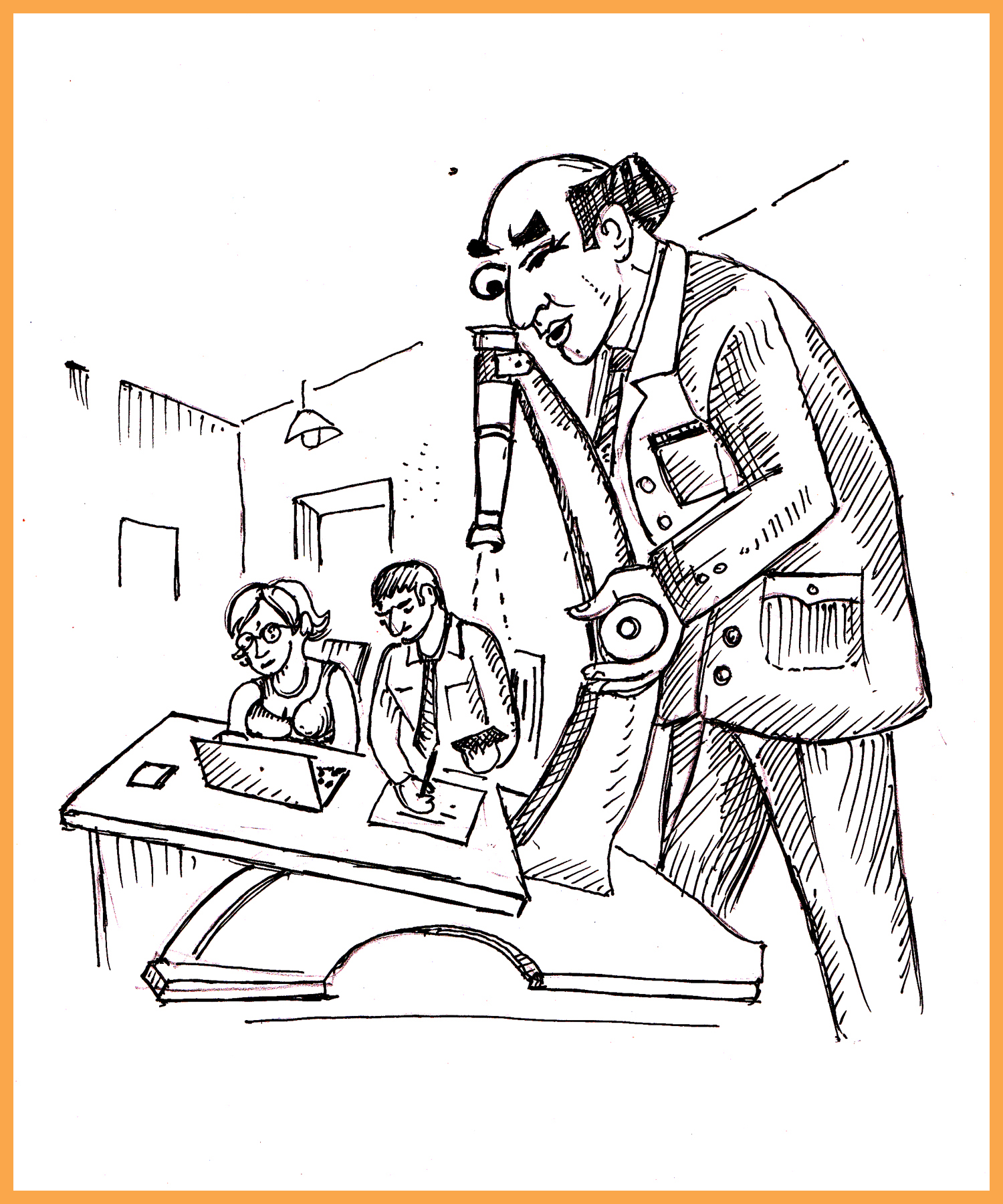
Micromanaging

A sure way of becoming a liability for your team and also for your employers is to micromanage – getting into the nitty-gritty of each and every aspect of the task at hand.

Learn to delegate and allow your team members to make mistakes.

Demand results, but develop your people in the long run.

If you happen to report to a boss who believes in getting things done by breathing down your neck, try the following to keep your sanity in check:

  1. Make it a habit to meet him half-way through.
  2. Empathize with the poor soul. Try to reduce his blood pressure. That is what you get paid for.
  3. Be clear about your deliverables.
  4. Sincerity helps. Following due processes and protocol helps.
  5. Have a positive attitude. At an opportune time, let him know that you are not too comfortable being micromanaged.

(Excerpt from my book ‘Surviving in the Corporate Jungle’, the English version of which was released recently. The Portuguese version of the excerpt follows.)

MICROGESTÃO

A maneira mais certa de se tornar um peso para a sua equipa e também para seus empregadores é a microgestão –meter-se em todas as tarefas até ao mais ínfimo pormenor.

Aprenda a delegar e a permitir que os seus colaboradores cometam erros.

Exija resultados, mas desenvolva as competências dos seus colaboradores no longo prazo.

(This is how you can lay your hands on the Portuguese version of the book, launched in Portugal during March, 2016.)

ashokbhatia's avatarashokbhatia

After a long spell of a harsh summer, the monsoon ushers in a season of joy and relief. The aroma of the scorched earth touched by the first torrent of rains is intoxicating. Birds and beasts are equally delighted. The whole nature changes its texture.

This is indeed the season where Bollywood outdoes itself. Farmers rejoice. Those who are lonely go about dancing in the rain, hoping that a beloved would be discovered soon enough. Lissome heroines prance about in their fully drenched attires, performing dance steps which could put an Olympic gymnast to shame. When it gets pitch dark, lightning helps young ladies to locate their lovers.

Courtship reaches a higher level of intensity. Hormones run amok. Sounds of thunder make the heroine cling closer to the hero. Those who have lost their beloveds to the harsh workings of Fate fondly recollect their lady-love in this season. Perched on…

View original post 875 more words

There are several reasons as to why P G Wodehouse, fondly referred to as Plum, is revered so very highly. For lesser mortals, one of these is surely the manner in which he makes fun of a decadent British aristocracy. He does so by skillfully juxtaposing strict social norms against nonsensical and ridiculous acts which rank rather high on the Goofiness Index. Then there is his unique use of the English language, with twists which could gladden the hearts of some of the most morose amongst us.

One other factor which endears Wodehouse to his ardent fans is the manner in which he draws upon the works of such other literary figures as Shakespeare, Keats, Shelley, Tennyson, Rudyard Kipling, Sir Arthur Conan Doyle and Oscar Wilde.

In the Wodehouse canon, The Bard has a unique place. Almost all of Plum’s works are littered with references to the literary outpourings of Shakespeare. This enriches the very texture of Plum’s whodunits, placing him at the magnificent table of our literary high priests and priestesses. A fan of his cannot be blamed for savouring the delectable cocktails Wodehouse serves, much like the warm inner glow of spring sunshine she relishes, especially after having braved a prolonged spell of harsh winter.

The Bard’s contribution to Plum’s scintillating humour

When someone’s obesity is to be commented upon, The Bard comes in handy. When the protagonist or the narrator faces an apparently insurmountable challenge, the term ‘sea of troubles’ gets deployed. When confusion reigns supreme, as it invariably does when such woolly headed characters as Bertie Wooster or Lord Emsworth happen to be around, poor Macbeth – ‘the cat chap’ in Bertie’s lingo – reinforces the scenario. Lady Macbeth, when taunting her husband for being indecisive about murdering King Duncan and occupying the throne of Scotland, would have little imagined the kind of indelible impact she has left behind in the realm of humour.

A lay reader, while navigating her way through one of Plum’s narratives, could suddenly come upon a turn of Shakespearean phrase and get surprised, much like a nymph while bathing. Many of the phrases are so very well-knit into these narratives that one who is not familiar with the extensive works of The Bard could be forgiven for simply missing out on the same. The notion that ‘it’s always just when a fellow is feeling particularly braced with things in general that fate sneaks up behind him with the bit of lead piping’ is one such fine example. The phrase ‘harsh slings and arrows of fate/life’ perhaps falls in the same genre. Another one is Jeeves’ reference to ‘quills upon the fretful porpentine’, a phrase deployed by the ghost in Hamlet. Yet another one is about ‘some rain falling in each one’s life’.

If poor Macbeth and Hamlet get mangled up by Bertie in quite a few of Plum’s narratives, King John and Henry VI pop up in Something Fresh. Whether a work was published in the 1920s or in the 1970s appears to make no difference, what with Shakespearean references popping up at frequent intervals, much to the delight of Plum’s fans.

Here is a random sample of some such references.

Diving into a sea of troubles

Not surprisingly, ‘a sea of troubles’ is an expression which pops up rather frequently.

Making Bertie dive into a sea of troubles

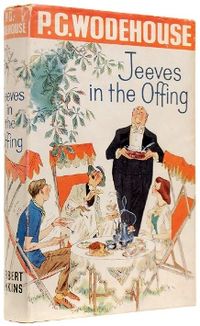
In Jeeves in the Offing (1960), we have in residence at Brinkley Court an American family, the Creams, who need to be handled delicately so as to facilitate a big business deal with Bertie’s uncle. The Rev. Aubrey Upjohn is around, with his stiff upper lip chilling Bertie’s soul; so is his daughter Phyllis, who is infatuated with the supposedly kleptomaniac Willie Cream, and must be put off. Roderick Glossop, the eminent loony doctor, is there disguised as a butler. To add to all this we have Roberta Wickham! The scenario is ripe for the Bard to come in.

‘I quivered like a startled what-d’you-call-it. She had spoken with a cheery ring in her voice that told an experienced ear like mine that she was about to start something. In a matter of seconds by Shrewsbury clock, as Aunt Dahlia would have said, I could see that she was going to come out with one of those schemes or plans of hers that not only stagger humanity and turn the moon to blood but lead to some unfortunate male—who on the present occasion would, I strongly suspected, be me— getting immersed in what Shakespeare calls a sea of troubles, if it was Shakespeare. I had heard that ring in her voice before, to name but one time, at the moment when she was pressing the darning needle into my hand and telling me where I would find Sir Roderick Glossop’s hot-water bottle.

Many people are of the opinion that Roberta, daughter of the late Sir Cuthbert and Lady Wickham of Skeldings Hall, Herts., ought not to be allowed at large. I string along with that school of thought.’

When falling in love with the wrong sort of person

In The Right Approach (A Few Quick Ones), Shakespeare comes to the aid of Augustus at the very moment he discovers he is in love.

‘”I am relieved to hear it. He used to be troubled a good deal by clergyman’s sore throat, like my niece Hermione’s father, the late Bishop of Stortford,” said Mrs. Gudgeon, and it was at this moment that Augustus came to the decision which was to plunge him into what Shakespeare calls a sea of troubles.’

The famous Gussie speech

Who can forget the hilarious and abusive speech delivered by a thoroughly sozzled Gussie Fink Nottle at the Market Snodsbury Grammar School? [Right Ho, Jeeves (1934)]

“What I wanted to say was this—and I say it confidently—without fear of contradiction—I say, in short, I am happy to be here on this auspicious occasion and I take much pleasure in kindly awarding the prizes, consisting of the handsome books you see laid out on that table. As Shakespeare says, there are sermons in books, stones in the running brooks, or, rather, the other way about, and there you have it in a nutshell.”

When obesity needs to be captured in all its glory

Those of us who fret and fume over the losing the flab can surely draw some comfort from the fact that Wodehouse often casts a critical eye on characters which possess too many layers of fat onto their physical frames.

A grave challenge for bathing suit designers

‘It was the photograph of an elderly man in a bathing suit; an elderly man who, a glance was enough to tell, had been overdoing it on the starchy foods since early childhood; an elderly man so rotund, so obese, so bulging in every direction that Shakespeare, had he beheld him, would have muttered to himself “Upon what meat doth this our Horace feed that he is grown so great?” One wondered how any bathing suit built by human hands could contain so stupendous an amount of uncle without parting at the seams. In the letter he had written to Oofy announcing his arrival in England Horace Prosser had spoken of coming home to lay his bones in the old country. There was nothing in the snapshot to suggest that he had any bones.’
The Fat of the Land (A Few Quick Ones)

Of agents who ‘recover’ potentially harmful letters from chorus girls

Residents of Plumsville would recall the character of R. Jones, who is commissioned by Freddie to “recover” some letters he had sent in the past to a certain chorus girl who they would readily recognize as Joan Valentine. [Something Fresh (1915)]

This is how he gets described.

‘On the theory, given to the world by William Shakespeare, that it is the lean and hungry-looking men who are dangerous, and that the “fat, sleek-headed men, and such as sleep o’ nights,” are harmless, R. Jones should have been above suspicion. He was infinitely the fattest man in the west-central postal district of London. He was a round ball of a man, who wheezed when he walked upstairs, which was seldom, and shook like jelly if some tactless friend, wishing to attract his attention, tapped him unexpectedly on the shoulder.’

When a tedious tale has to be told!

In the same narrative, whereas Lord Emsworth thinks the scarab discovered in his coat pocket is a gift to him from Mr Peters, the latter suspects the Earl to have stolen the same. He is offering £1,000 to anybody who can pose as his valet and retrieve the scarab from Blandings Castle. Ashe Marson appears for an interview.

In Mr. Peters’ version the Earl of Emsworth appeared as a smooth and purposeful robber, a sort of elderly Raffles, worming his way into the homes of the innocent, and only sparing that portion of their property which was too heavy for him to carry away. Mr. Peters, indeed, specifically describes the Earl of Emsworth as an oily old second-story man.

‘Shakespeare and Pope have both emphasized the tediousness of a twice-told tale; the Episode Of the Stolen Scarab need not be repeated at this point, though it must be admitted that Mr. Peters’ version of it differed considerably from the calm, dispassionate description the author, in his capacity of official historian, has given earlier in the story.’

(To be continued….)

(Notes:

Inputs received from some ardent fans of Wodehouse are gratefully acknowledged. 

Related posts: 

https://ashokbhatia.wordpress.com/2017/06/26/the-perils-of-not-suffering-from-shakespearitis

https://ashokbhatia.wordpress.com/2017/07/08/presenting-a-plummy-shakespeare-part-2-of-3)

Marketing

An ever-changing discipline, though surely not the only one. When conceived and described by Philip Kotler, it consisted of the famous four Ps – Product, Price, Place, and Promotion. With due respects to the great man, one may safely add one more P – Password (used for viral marketing).

Till the 1970s, Indians had to wait for years to get to ride their own ‘Hamara Bajaj’. On the car front, there were just three manufacturers in the fray then. Now, the automobile market has global brands wooing the customer and competing cheek and jowl for a slice of the great Indian market pie.

With the advent of the Internet has come a virtual democracy in information. Changes in technology have brought in a new way the customers and brands interact. Marketing has undergone a sea change and will continue to do so in future as well, what with social re-engineering leading to a greater degree of inclusion in the economy and with hordes of new customers from a so-far underprivileged social milieu joining the market.

Brick and mortar retailers are increasingly competing with e-retailers for the customers’ attention. Tech-savvy customers now routinely research brands before making a decision. They are increasingly welcoming fresh content rather than repetitive ads.

The role of a Chief Marketing Officer continues to evolve in sync with the increasing complexities of brand-building and marketing. Ensuring that the customer’s voice is heard within the confines of the board room has already become one of his key roles.

The customer has now become a more empowered king!

(Excerpt from my book ‘Surviving in the Corporate Jungle’, the English version of which was released recently. The Portuguese version of the excerpt follows.)


Uma disciplina em constante mudança, embora certamente não a única. Quando o conceito foi elaborado e descrito por Philip Kotler, consistia nos famosos 4 Ps – Produto, Preço, Ponto-de-venda e Promoção. Com o devido respeito ao grande homem, pode-se perfeitamente acrescentar mais um P – Password (‘Senha’, que se refere ao marketing viral).

Até à década de 1970, os indianos tinha esperar anos para poderem conduzir o seu próprio “Hamara Bajaj”. Em matéria de automóveis, havia apenas três fabricantes em liça Como Sobreviver na Selva Empresarial na altura. Agora, o mercado automóvel tem marcas globais que cortejam os clientes e competem acerrimamente por uma fatia do grande bolo que é mercado indiano.

Com o advento da Internet, chegou a democracia virtual da informação. As mudanças tecnológicas trouxeram uma nova forma de interação entre os clientes e as marcas. O marketing sofreu uma mudança radical e vai continuar a mudar no futuro, com a reengenharia social a conseguir um maior nível de inclusão na economia e com hordas de novos clientes, oriundos de meios sociais até à data desfavorecidos, a entrarem no mercado.

Os vendedores de tijolos e de argamassa estão cada vez mais a concorrer com lojas online na disputa por clientes. Hoje em dia, os clientes que dominam a tecnologia, costumam fazer uma pesquisa de marcas antes de tomarem uma decisão. Estão cada vez mais recetivos a conteúdos novos, em vez de anúncios repetitivos.

O papel de um Diretor de Marketing continua a evoluir de acordo com as crescentes complexidades de desenvolvimento de marcas e do marketing. A garantia de que a voz do cliente é ouvida na sala de reuniões da Direção já se tornou um dos seus papéis principais.

O cliente passou a ser um rei com mais poderes!

(This is how you can lay your hands on the Portuguese version of the book, launched in Portugal during March, 2016.)


To be or not to be a die-hard fan of a particular literary figure is perhaps decided by our Guardian Angels. Mines have been benevolent and ensured that I suffer from acute Wodehousitis.

But when it comes to William Shakespeare, much revered by all and sundry, my GAs have ensured that I never qualify to be even a mild case of Shakespearitis. One of the several challenges I have faced in my life is that of understanding the literary fare dished out by William Shakespeare. Given the high level of what Bertie Wooster might label as my Pumpkin Quotient, repeated attempts on my part to comprehend the ingenious outpourings of The Bard have failed miserably.

But an absence of Shakespearitis does not necessarily guarantee peace of mind. On the contrary, it makes life even more of a challenge. The brow is invariably furrowed. The heart is leaden with woe. This is so because he is to be found everywhere and apt to spring surprises at all times, not a very pleasing prospect for a faint-hearted person like me. Such are the perils of not suffering from Shakespearitis.

The omnipresent Bard

The simple irony is that my GAs have always managed to make The Bard keep popping up through all stages of my life. His persistence to engage me over the past few decades deserves to be commended. His near-omnipresence in my life merely testifies to his feeble hope that one day he may be able to assist me in improving my intellect in some way, much like the aspirations of Florence Craye with respect to Bertie Wooster (as in ‘Joy in the Morning’). I suspect I might have left him severely disappointed, disgruntled, dismayed, disheartened and dispirited. I offer my sincere regrets for the same.

The taming of a student

His omnipresent nature can be readily appreciated. His works were there at school, shoring up the proverbial Tyrannical Quotient of the Classroom. Unlike Bertie Wooster, I never won a prize in Scriptural Knowledge. Yes, I did win several prizes and trophies in various essay-writing competitions. Surprisingly, I even managed to secure an all-India rank in the final school leaving examination. On all such occasions, his works kept finding their way to my bookshelves.

His plays were often staged at the University I went to. With renewed enthusiasm which is so very typical of Homo sapiens at a tender age, I attempted to burrow deep in his works. The intention was merely to impress some of the delicately nurtured around. But the language was beyond the capacity of my limited grey cells. The best I could achieve at one of the performances was the unique distinction of drawing the curtains in and out for a stretch of two and a half hours, merely to make a young lass in the troupe happy.

Much ado about nothing

Then came the whirlwind phase of my life in the corporate sector. At times, there were bosses whose state of indecision would remind me of Macbeth, the one alluded to by Bertie Wooster as ‘the cat chap’. In smaller businesses, there were owners who could have mentored even someone of the deviousness of Shylock. Often, I had morose colleagues who might have inspired Shakespeare to fashion Hamlet. And yes, there were indeed subordinates who could have been scoundrels, perhaps described by the poet as being ‘arrant, rascally, beggarly and lousy knave.’

When the entrepreneurial bug caught up with me, there was never a dearth of ‘enterprises of great pith and moment’ to be undertaken.

In the realm of entertainment, I kept running into movies which were either based on, or inspired by, one of his works. Even when trying to relax and enjoy a vacation, The Bard has been apt to pop up without fail and throw a spanner in the works.

The Merchants of Venice

While visiting Venice recently, I ran into a branded showroom where the manager took no pains to hide his Shylockian leanings. The stone-paved streets were not without their normal quota of small shops peddling their inane stuff at prices which might make even Hollywood celebrities cringe. Even those selling seeds to be fed to a swathe of pigeons at the Piazza San Marco were extorting prices which would have cheered up any farmer in the hinterland and pulled him out from his current state of depression.

The famed couple of Verona

When the family decided to visit the house of Juliet in Verona, all we were hoping for was to spend a few moments of togetherness, something we miss these days owing to the temptations offered by the world-wide-web we have spun around ourselves.

Alas, that was not to be. The courtyard outside her house was swarming with those eager to claim their fifteen seconds of fame when their photo grabbing a part of the anatomy of the famed heroine got uploaded without any delay, courtesy the smart phone carried by a friend/relative. There was a long queue of wide-eyed tourists wanting to clamour up to the famous balcony where the two lovers are supposed to have had their midnight rendezvous.

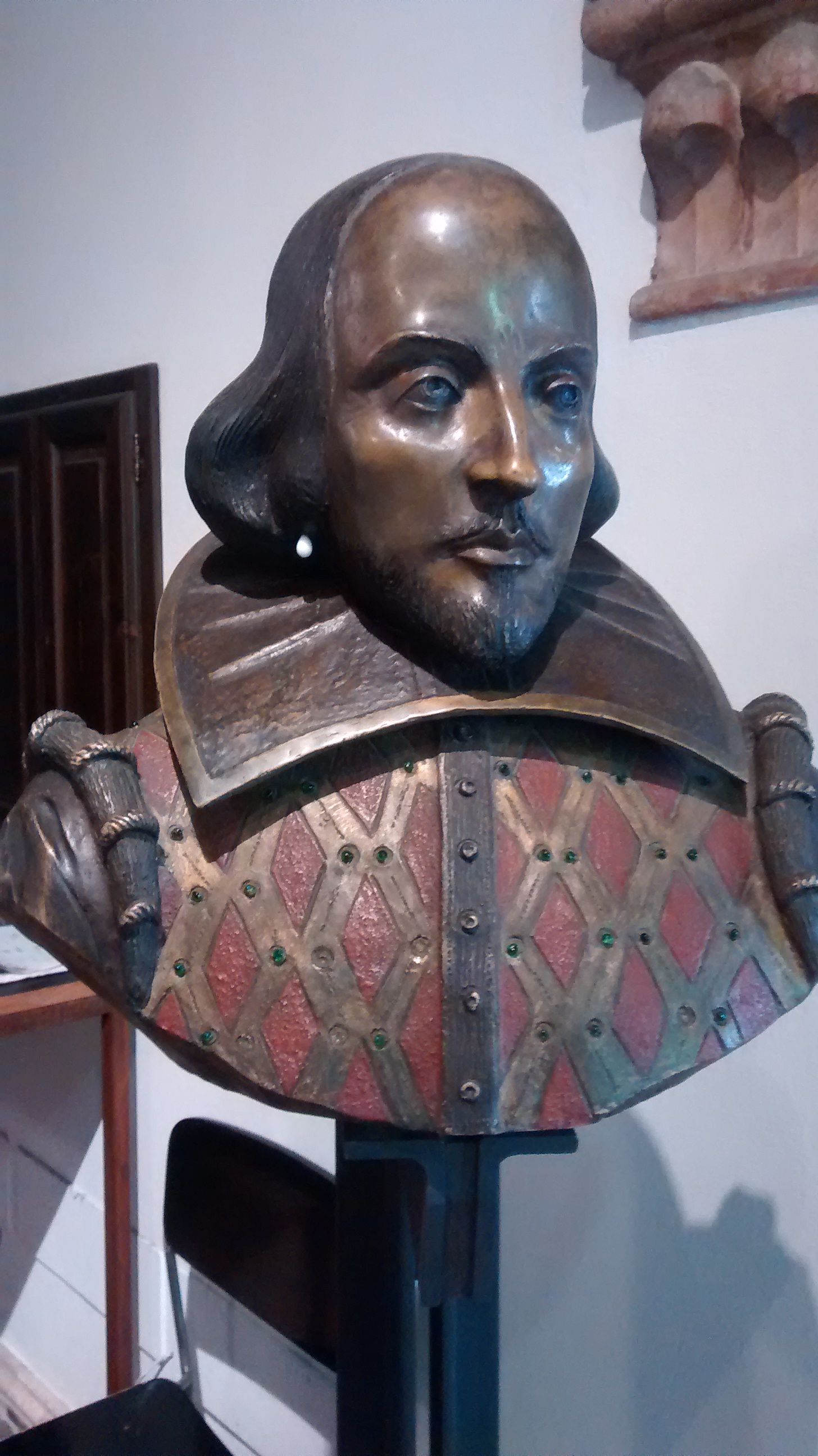
Immediately upon entering the hallowed premises, we encountered a shapely statue of Juliet. Right opposite was the bust of The Bard, appraising her comely profile with a stiff upper lip and a steely eye. Romeo, had he been around, might not have been amused by the poet’s presence in quarters where he would have appreciated privacy more than any kind of literary upliftment.

The hapless lover might already be turning in his grave, wondering as to how his name has become synonymous with ‘eve-teasing’ in a far off land known as India, where one of the state governments has recently thought it fit to set up so-called anti-Romeo squads so as to ‘control’ public display of affection. One, he was never known to be a roaming lecher. Two, his passion was heartily reciprocated by the party of the other part. Three, with such juicy choices available as Casanova and Don Juan, not to mention several CEOs who have recently hogged the limelight due to all the wrong reasons, there are certainly better options available when it comes to projecting someone as an unwelcome lover. Shakespeare’s star-crossed creation continues to get bad press for all the wrong reasons. But we digress.

As you do not like it

This uncanny habit of The Bard to keep popping up at regular intervals in my life has left me all of a twitter. Several times have I mustered up enough courage to pick up any work from the Shakespeare canon. With renewed enthusiasm and gusto have I tried to wade through a work of his. But the experience has repeatedly left me with a highly enfeebled state of nerves.

My worst nightmares have been those wherein I have been conferred a literary honour of some sort, only to be gifted with a big parcel containing some tomes of his. The mind boggles. The chin goes down. The jaw slackens. The shoulders droop down further.

The English Proficiency Pyramid

Pray do not get me wrong. I have nothing against Shakespeare. Given his everlasting popularity, there is no doubt that he must have captured all facets of human emotions in an impeccable manner. His usage of quite a few phrases appears to have spawned a veritable stream of English literature, and continues to do so today.

He must have also set high standards for Queen’s English. He must have enriched the language in a manner which might be more vast and deep than those who have either preceded or succeeded him. This surely warms the hearts of our linguistic purists. But lesser mortals like me, surely at the bottom of the English Proficiency Pyramid, are apt to feel very dense.

A tide in the affairs of languages

Modern day communication thrives on simplicity. Complex ideas which get conveyed in a language which the masses understand. It appears that most of our great poets and literary figures perfected the art which is just opposite. Simple ideas couched in high-profile and complex language, which only those at the top of the Language Proficiency Pyramid might fathom.

When it comes to this particular trait, Shakspeare has good company. In Urdu poetry, Mirza Ghalib is not always easy to understand. In Hindi, the poetry of Jai Shankar Prasad comes to my mind. In Sanskrit, Kalidasa often keeps a lay reader guessing.

The cause of sustained Shakespearitis is possibly purely literary. Perhaps there is a commercial logic to this web of poetic complexity. Publishers of his works might still be laughing all the way to their respective banks. Besides, those publishing dictionaries would also not be found complaining.

Presenting soon: A Plummy Shakespeare

Somehow, the bulldog spirit in me refuses to give up.

In order to soothen the frayed nerves, I plan to present to you a Plummy Shakespeare very soon. Since the Wodehouse canon is littered with quotes and references to The Bard, I shall soon take the liberty of sharing with you some references in the weeks to follow. This might help many others like me, already suffering from acute Wodehousitis, to also have a brush with yet another delectable affliction – Shakespearitis.

(Related Posts:

https://ashokbhatia.wordpress.com/2017/07/01/presenting-a-plummy-shakespeare-part-1-of-3

https://ashokbhatia.wordpress.com/2017/07/08/presenting-a-plummy-shakespeare-part-2-of-3

https://ashokbhatia.wordpress.com/2017/07/15/presenting-a-plummy-shakespeare-part-3-of-3)

After the 2008 economic meltdown, the management world has discovered that CEOs need to follow not only the Business Compass but also a Moral Compass to steer the enterprises they happen to run. Improving one’s Spiritual Quotient is now a sheer business necessity, and shall be more so in the decades to come.

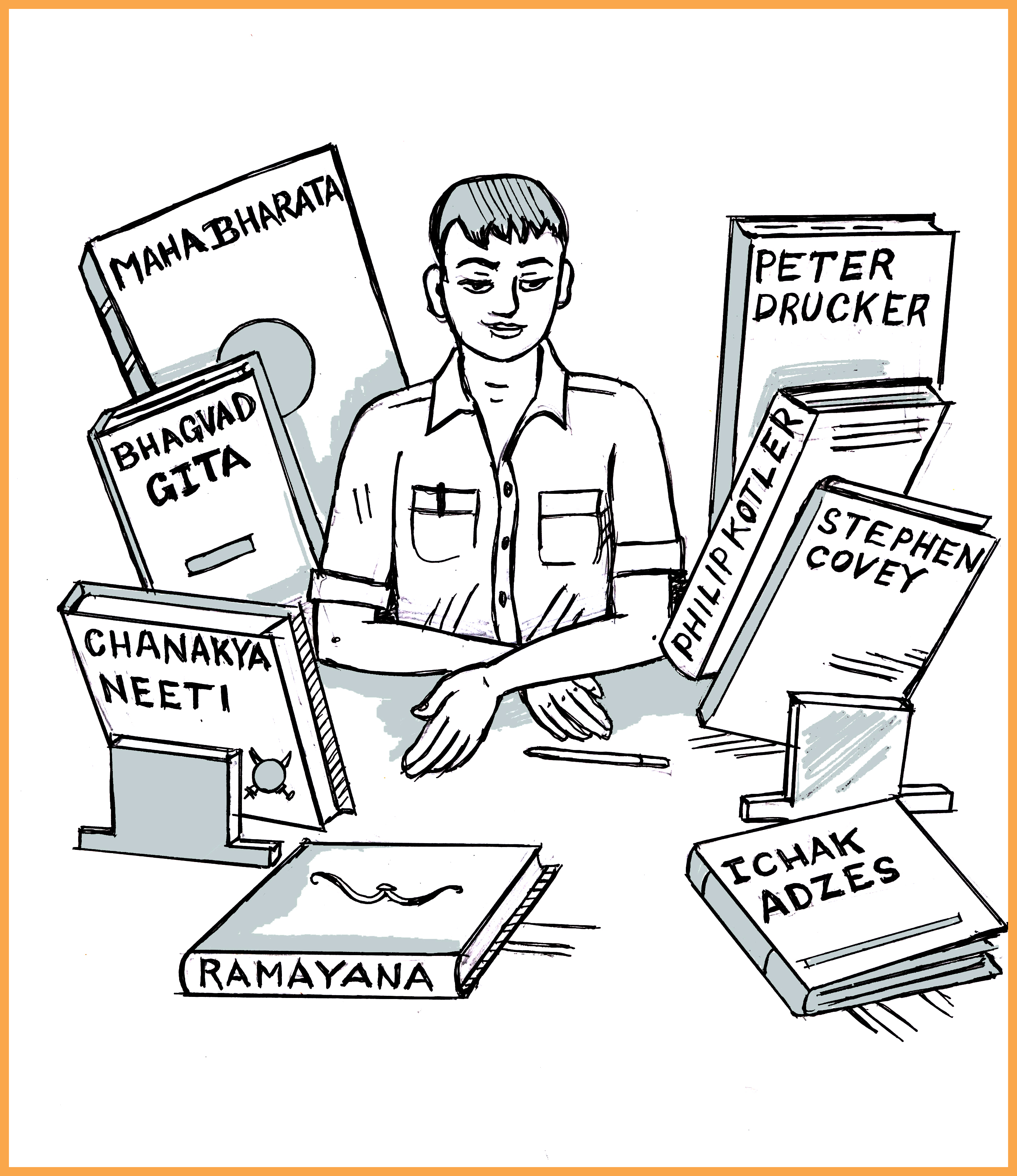
It is here that Indian scriptures and sages provide a ready template for managers of all sizes and shapes.

The bookSurviving in the Corporate Jungle’ covers some lessons from the following:

-Ramayana

-Mahabharata

-Bhagavad-Gita

-Thirukkural

-Chanakya Neeti

-Sri Aurobindo

Managers with a Western Mind and an Eastern Heart

The success of the likes of Satya Nadella (currently the CEO of Microsoft) and Sundar Pichai (currently the CEO of Google Inc) goes on to show the growing importance of managers who are not only exposed to the Western models of management but also steeped in Eastern wisdom in the realm of management.


Recently, while on a trip to Switzerland, yours truly had the opportunity of calling upon Mr. José Manuel Castro Santiago, Minister – Counsellor at the Embassy of Portugal in Bern.

Despite his busy schedule, he was kind enough to grant an audience to yours truly, who wished to present to him a copy of his book ‘Como Sobreviver Na Selva Empresarial’.

It happened to be a day when the soaring day temperature had left denizens of Berne gasping for breath and scurrying for cover. To match the heat outside, the Embassy of Portugal in Switzerland offered a degree of bonhomie and warmth, much like the genial and affable disposition of the people of Portugal.

An informal meeting took place in his tastefully done up office. He was genial, graceful and dignified. The frankness with which he spoke and the warmth he exuded was typical of the people of character, resource and rich culture he represents.

It transpired that he had also had a stint in India. He spoke warmly of his positive feel about the country. He touched upon its rich ancient culture and the diversity of its citizens. Yet another emerging economy he had been posted to in the past was that of Brazil.

He mentioned that he has himself authored and published a book which captures his experiences in a long and successful career. Yours truly expressed a wish that some kindly publisher might bring it out in English as well, so the wisdom contained therein may get shared more widely.

He was happy to know that yours truly had been associated with the Tata group for close to a decade, that too in the field of leather footwear and components. The courtesy extended to an ordinary soul from an emerging economy like India was impeccable.

Diplomats represent all that their land is and aspires to be. Much like Ms. Clara Nunes dos Santos, the Ambassador of Portugal to Norway (whom yours truly had the opportunity to meet recently), Mr. José Manuel Castro Santiago is also no exception. One has no doubt that both of them handle managerial challenges coming their way with characteristic aplomb.

One wishes them and their country a great innings in the days to come.

(Notes:

This is how you can lay your hands on the Portuguese version of the book, launched in Portugal during March, 2016, courtesy Liberty Seguros and Vida Economica.

The English version of the book, entitled ‘Surviving in the Corporate Jungle’, was released recently.

Related Post: https://ashokbhatia.wordpress.com/2017/05/30/a-meeting-with-the-ambassador-of-portugal-in-norway)


Those who practice as physicians in our society are increasingly looked upon with some suspicion. Dig a little deeper and one is apt to find that they are more to be pitied than to be censured.

A physician is denied the fundamental right to some solitude. Even at a social gathering, she is likely to be surrounded by wannabe patients who are keen to seek her impromptu advice as to the latest affliction the party of the other part has heard about and imagines oneself to be suffering from the same.

Close relatives are not too considerate either. A distant relative could call late at night, skillfully steering the conversation from children’s career prospects to the current bout of migraine she happens to be suffering from. If anyone in the circle of friends or relatives happens to be admitted to a hospital, the physician ends up spending sleepless nights, adroitly juggling her official commitments and personal relations, often messing up both.

Latest advancements in medicine keep them on their toes. So does the competition from various streams of medicine, such as Homeopathy, Ayurveda, Unani, Siddha and many other local variants of each of these streams. Superstitions, local beliefs, religion, social norms are but some of the constraints which need to be kept in mind. Legal tangles, such as those apply to road accident cases, keep them on the defensive.

In advanced countries, they face tough customer care regulations. In emerging economies like India, they suffer humiliation – occasionally violent – at the hands of irate relatives and well-wishers if the latter perceive the medical service provided to their kith and kin to be deficient.

Return on Investment considerations

To be a mere graduate in any discipline of medicine does not amount to much these days. Even to become a graduate, the hapless souls have to experience at least five and a half years of the tyranny of the classroom, with the trauma of a stint as an intern thrown in for good measure.

Monetary rewards obviously vary depending upon their choice of a career. They could choose to be in their own private practice, or join a private sector outfit, or become a part of the public health delivery mechanism.

If public spending on health infrastructure is woefully inadequate, private players end up playing an important role in the medical education scenario. Many aspiring physicians opt for a private sector skill provider. As a consequence, hassled parents end up shelling out sackfuls of the green stuff. Return on Investment considerations then determine the choice of their career.

The blue-eyed ones

The resourceful ones set up their own practice. If the going is good, some of them end up laughing all the way to the bank, what with hefty commissions coming in from such allied medical service providers as marketeers of branded medicines and diagnostic clinics.

Those who happen to be associated with five-star private sector health facilities have tough business targets to meet. This is not to say that patient care necessarily gets compromised, but an overdose of medical investigations surely leaves the patient and her family deprived of mental peace and some hard-earned green stuff.

When the costliest of medicines and gadgets get recommended by physicians, stakeholders of pharmaceutical companies and those in the field of medical equipment laugh all the way to the bank. Admittedly, quite a lot of money gets pumped into research and development, but it is open to debate as to how much profit could be considered rational and socially justified.

Much like the marketing honchos in the private sector who bring in business and resultant moolah, such physicians happen to be the blue-eyed boys of any entity which boasts of being a corporate facility.

The grey eyed ones

Physicians who are part of the government healthcare delivery system and happen to be conscientious by nature are often overloaded with work. Monetary rewards are often not commensurate with the efforts being put in. The eyes of a majority of them would be a dull grey, revealing a soul which is tormented and has given up hope.

Besides having to publish research papers in peer-reviewed journals and making presentations at medical seminars, students have to be guided, examinations have to be conducted and internal meetings need to be attended. Administrative chores cannot be ignored.

Above all, routine patient care cannot be made to suffer. Patients, whether of the ‘in’ or the ‘out’ kind, descend in droves, all eager to jump the queue and catch the attention of the physician. The plight of those in most of the emerging economies is most distressing because the per capita availability of physicians leaves much to be desired.

Of Attitude and Inner Resilience

Much depends on the attitude of a patient. One could come across persons with a cheerful disposition headed for their second open heart surgery, relishing a deep-fried item with much glee. One could also run into those who worry endlessly over such transient ailments as a bout of common cold or sinusitis.

Physicians obviously deal with a baffling variety of patients with much finesse and aplomb. Nerves of chilled steel get deployed. A sense of detachment pervades their handling of a patient. Their inner resilience deserves to be applauded.

With such fine qualities of head and heart, one can merely admire the quality of their work which keeps upholding the reputation of their profession. The Hippocratic Oath might appear to be relegated to the background, but is surely alive and kicking.

In many streams of alternative medicine, the patient is taken as a composite whole and treated holistically. The inner resilience of a patient is accorded a higher weightage. Allopathy, the mainstay of masses in the times we live in, does it the other way round, where each organ is looked at and treated separately. In mathematical parlance, alternative streams could be likened to Integral Calculus, whereas allopathy could be likened to Differential Calculus.

Shoring up one’s inner resilience

There are indeed ways for patients to improve one’s inner resilience, so as to be able to handle the harsh slings and arrows of Fate in a more positive manner. A deeper inner connection helps. To achieve the same, regular introspection and meditation helps.

As the Mother has said, the right approach would be to simply disallow negative thoughts to gain a foothold in one’s psychical system. Patients obviously need loads of patience to be able to put this advice in practice!

(Notes:

This forms part of an article which has appeared in NAMAH:

NAMAH_OCTOBER_2017

Inputs from Dr. Shivani Salil Dr. Shruti Bhatia are gratefully acknowledged.)

(Related Post: https://ashokbhatia.wordpress.com/2017/06/04/of-patient-satisfaction-quotient-motivation-and-kinds-of-patients)

Leaders

Management can be learnt; leadership is inborn. The good news is that in most cases, leadership styles trickle down the organization and get copied. This spawns leaders in the same genre and also improves behavioural consistency across the entire set up.

Successful leaders have several outstanding traits. Their intuitive faculties are well developed. They do not say one thing and do another. They handle tough tasks themselves. They take responsibility for their failures, often shielding their team mates. They do not have henchmen to execute their dirty plans so their own hands look clean. They put everyone on the same pedestal. They never encourage yes-men. They always encourage no-men to speak up.

CEOs who rank high not only on their Intelligence Quotient and Emotional Quotient but also on their Spiritual Quotient go on to make super leaders. Their concern for business ethics is as high as their concern for business results.

Lao-Tzu, a Chinese philosopher, said ‘To lead the people, walk behind them’.

(Excerpt from my book ‘Surviving in the Corporate Jungle’, the English version of which was released recently. The Portuguese version of the excerpt follows.)

LÍDERES

A gestão pode ser aprendida; a liderança é inata. A boa notícia é que, na maioria dos casos, os estilos de liderança encontram-
se espalhados pela organização e são replicados, o que produz líderes do mesmo tipo, melhorando ao mesmo tempo a consistência comportamental ao longo da cadeia hierárquica.

Os líderes de sucesso têm em comum vários traços que se destacam. As suas faculdades intuitivas estão bem desenvolvi as. Não dizem uma coisa e fazem outra. Enfrentam eles próprios as tarefas difíceis. Assumem a responsabilidade pelos seus fracassos, muitas vezes, protegendo os seus colaboradores.

Não recorrem a capangas para executar os seus planos sujos e parecer, assim, que têm as mãos limpas. Põem todos no mesmo pedestal. Nunca incentivam os “lambe-botas”. Incentivam sempre os “discordantes” a falarem.

Lao-Tzu, um filósofo chinês, disse: “Para liderar as pessoas, ande atrás delas”.

(This is how you can lay your hands on the Portuguese version of the book, launched in Portugal during March, 2016.)