Feeds:
Posts
Comments

Whosoever coined the term ‘patient’ in the distant past was indeed blessed patient 1with some degree of prescience. He could foresee that the poor soul will have to earn this exalted status in life the hard way. He would need to patiently await his turn in long serpentine queues at hospitals and at doctor’s clinics. He would have to be patient with his bank balance when it starts depleting the moment he is examined by a doctor. He would need to be patient and suffer the ignonimity of undergoing all the tests prescribed. He would then again have to patiently wait to report back the results to the doctor concerned. Nerves of chilled steel would be required to consume all the medications written out illegibly on a piece of paper. His reserves of patience would once again be called upon to mitigate his suffering when side effects of the drugs start tormenting him.

A singular challenge faced by patients of all hues, sizes and shapes these days is that of continuity. Family doctors happen to be a tribe which has become almost extinct by now. Gone are the days when a personal rapport with the family doctor could work wonders, or when the emphasis used to be more on physical examination and the symptoms of the patient rather than on excessive medical tests.

The ‘haves’ and the ‘have-nots’

In a dichotomous health delivery market like that of India, we have the multitudes of ‘have-nots’ who struggle to make two ends meet. For them, a challenge on the health front is not the very first priority to be handled. The question of survival itself comes first. When the body simply revolts and there are no options left, they turn to government-run centres and hospitals and make do with whatever facilities they are able to access.

Not so for the well-heeled ones. They have the means to avail the servicespatient 2 offered by swank hospitals run by the private sector. Recourse to fancy insurance schemes becomes helpful. In any case, since health is held to be more important than wealth, a slice of the latter getting lost to restore the former is seldom bemoaned. On the contrary, the massive cost incurred on a hospital stay gets worn on their slick sleeves, much like a proud soldier would display his medals earned on the fronts, and comes in pretty handy for an uplifting ego boost.

They get to pick and choose. Word of mouth often helps. Brand recognition helps. When an emergency comes up, distance becomes the determining factor.

Upon entering such institutions, the patient is spoilt for choice. Options for accommodation include air-conditioned special rooms, deluxe air-conditioned rooms and even super deluxe suites. He is then put on an assembly line and subjected to awe-inspiring medical diagnostics. The fear of the unknown on part of the patient helps the corporate body to fulfil its obligations towards its shareholders. When a surgery is deemed necessary, the kind cruelty of a surgeon’s knife also ends up drilling a gaping hole in the patient’s pocket. Admittedly, the patient has the satisfaction of having being in safe hands and possibly also getting the necessary relief.

Sandwiched between these two layers of society are the not-so-well-heeled. They detest the dinghy corridors and the surging crowds in public institutions. They place their trust in the private outfits, get exploited financially, and end up missing the objective healthcare advice dished out by medical practitioners in government clinics and hospitals.

A Supermarket approach to getting healed

Those who are well-heeled and suffer from life style diseases have even a wider patient 3choice available to them. They are like true customers in a market economy which could be best characterized as ‘laissez faire’. Hospitals and clinics in the private sector advertise their wares smartly and entice such customers to avail their services. Once a patient has enrolled himself, a Customer Relationship Management software takes over. Greetings on birthdays and anniversaries, special screening camps, package deals – these are but some of the pretexts which get used to woo the patient for his next round of illness.

The well-heeled also have the luxury of choosing the system of medicine they wish to pursue. Allopathy is believed to be providing only interim succour or, in most cases, a basic relief. A regimen of popping the pills, exercise and food habits gets prescribed. Once they have become used to the same, life runs in an auto-pilot mode.

The well-heeled explorers

But the human nature is always on the lookout for refinements and the proverbial icing on the cake. A sense of creative dissatisfaction prevails. Despair and despondency soon take over and the search starts for an alternate system of healing. New frontiers get explored. New therapists get met. Merits and demerits of various kinds of treatments on offer get analyzed threadbare by those around, while the patient experiences the inner glow of satisfaction at being the centre of continued attraction and also at exploring new frontiers, much like a Columbus on a maiden voyage to discover Newfoundland.Patient Columbus-Day

This is not to say that an explorer-type attitude can be scoffed at. It reveals a sunny disposition on part of the inner being. The soul, unhappy at being burdened with a physical sheath which is infirm, merely endeavours to attain a state of perfection in the body allotted to it during a particular birth cycle. It uses all the powers at its command – analytical or intuitional – to achieve good health. It tries to bring about better harmony between its body, mind and soul. Wisdom gleaned from the medical fraternity as well as from the scriptures assists the soul in this task.

Besides managing a bodily affliction, patients have to confront the cold impersonality and crass commercialization of the healthcare delivery mechanism. This is but one of the perils of being a patient in today’s world.

(All illustrations are courtesy the world wide web)

(Note: Part of an article which appeared in NAMAH journal: http://www.namahjournal.com/doc/Actual/Patients-and-the-art-and-science-of-healing-Vol-24-iss-2.html)

(Related Post: https://ashokbhatia.wordpress.com/2016/05/22/the-science-of-healing)

GulzarWhen inane movies get honoured, we get a feel that the selection process is rigged. When genuine talent does not get recognized, we feel tormented.

Here is a thought-provoking post on the subject.

findshars's avatarMy Views On Bollywood

By Sharada Iyer

There is nothing more disheartening to an artiste than to have his/her work not appreciated at the right time…

Dadasaheb Phalke Award

Recently veteran writer-director-lyricist-poet Gulzar was bestowed with the coveted Dadasaheb Phalke award for his outstanding contribution to the world of Indian cinema. A truly deserving award for such a multi-talented genius the like of whom the industry may never produce again. But does he realize how lucky he is to have received the award when he is still active and is in full possession of his mental and physical faculties to enjoy the award?

Unlike the last year’s recipient of this same award –the late veteran actor Pran who was given the award too late in life. This gem of an actor hung his boots several years ago and though he had been in good health for a number of years after that, the Government…

View original post 1,606 more words

Waitresses and bar maids get a place of prominence in many of the Plum’s narratives. Here is Mabel who is one of the many who captivate the heart of Bingo Little for a brief period of time.

Honoria Plum's avatarPlumtopia

Source: http://en.wikipedia.org/wiki/File:Lyons_Corner_House_recreation,_Museum_of_London.JPG) Image adapted from original photograph by Kim Traynor

I confess I have a soft spot for the romantic Bingo Little. When we first meet him in The Inimitable Jeeves,  Bertie warns us about his habit of falling in love.

Ever since I have known him – and we were at school together – he has been perpetually falling in love with someone, generally in the spring, which seems to act on him like magic. At school he had the finest collection of actresses’ photographs of anyone of his time; and at Oxford his romantic nature was a byword.

The first of Bingo’s romances to be chronicled by Bertram Wooster involves a Mabel, a waitress in a tea-and-bun shop. Described by Bertie as ‘rather a pretty girl’, Mabel attracts the attention of both Bingo and Jeeves. At the end of the proceedings, she and Jeeves have ‘an understanding’.

We know very little…

View original post 432 more words

AdvertisingAs a Chief Executive Officer, if you hire lions like Pablo Picasso or MF Hussain to create a corporate emblem for your company, would there be any point in getting a bunch of giraffe Vice Presidents and General Managers to meddle with his final work? Define a target and a budget, and let the agency have a free hand.

As a trainee cub, join an ad agency if you love irregular working hours, midnight escapades and hobnobbing with the hoi polloi of creative geniuses whose king (or, queen) size egos need to be managed at all times, with clients’ deadlines looming large over your work horizon. Depending on your skill set, you may gravitate towards copywriting, production, media planning, or client servicing. In all cases, creativity under pressure should be the motto of your life.

(An excerpt from the book ‘Surviving in the Corporate Jungle’, published in Portuguese recently)

BookFrontCover

Se fosse um diretor-geral, e contratasse um leão da estirpe do Pablo Picasso ou do Andy Warhol para criar a imagem da sua empresa, faria algum sentido ter uma manada de girafas vice-presidentes e quadros intermédios a meterem o bedelho no trabalho final dele? Defina um objetivo e um orçamento e deixe a agência fazer o seu trabalho à vontade.

Enquanto ‘cria’ estagiária, vá para uma agência de publicidade se adora ter um horário de trabalho irregular, ficar no escritório até altas horas e misturar-se com uma turba de génios criativos cujos egos gigantescos têm de ser constantemente bajulados, e com os prazos dos clientes a ensombrarem ameaçadoramente o seu horizonte de trabalho. Consoante as suas competências, poderá optar pelo departamento criativo, de produção, de planeamento de media ou de gestão de clientes. Seja como for, a criatividade
sob pressão será o seu lema de vida.

(This is where you can lay your hands on the book:
(Related Post:

One of the reasons for the persistent allure of Shakespeare’s works is obviously the depth as well as the range of human behaviour these capture. One can easily relate to such elements as greed, power, jealousy, suspicion, love and lust which form the undercurrent of all his characters.

These are precisely the ingredients which producers, directors and script writers in Bollywood bank upon to whip up larger than life narratives, keeping the viewers enamoured and enthralled.

If a movie is said to be either ‘inspired by’ or ‘adopted from’ a literary classic, the intellectual coves are left more than satisfied. The critics could anyway pan the movie for its digressions from the original, but the common man is quite happy to have connected with a classic which he might otherwise never have the time, inclination or capacity of devouring in his saner moments.

A dash of spicy item numbers further adds to the mass appeal of such a movie. The ‘Masala Quotient’ for the front benchers also improves drastically.

It comes therefore as no surprise that Bollywood can boast of a number of screen adaptations of the Bard’s works. Here are a few which readily spring to one’s mind.

The Comedy of Errors

The tale of two sets of twins has invariably left the audience in splits.

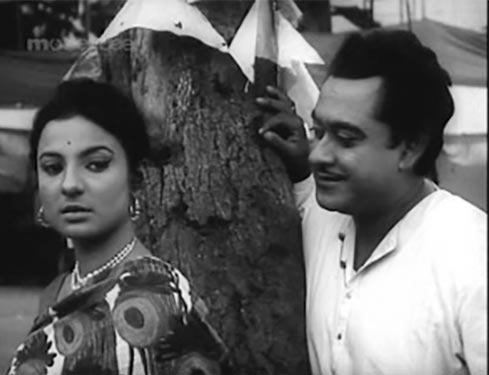
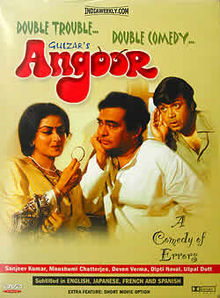
If ‘Do Dooni Chaar’ had the Kishore Kumar-Asit Sen duo, ‘Angoor’ had Sanjeev Kumar- Deven Verma, ably assisted by Moushumi Chatterjee, Deepti Naval and Aruna Irani. Both are ageless comedies. shakespeare do dooni chaar  (A still from the movie ‘Do Dooni Chaar, Year: 1968, Director: Debu Sen)

Shakespeare Angoor

(1982, Gulzar)

Othello

When the cancer of distrust and suspicion spreads, disaster looms ahead.

If ‘Hamraaz’ had a stage performance based on the travails of Othello, ‘Omkara’ brought home the anguish of the hero in a poignant manner.

Shakespeare Humraz

(1967, B R Chopra)

Shakespeare Omkara

(2006, Vishal Bhardwaj)

Romeo and Juliet

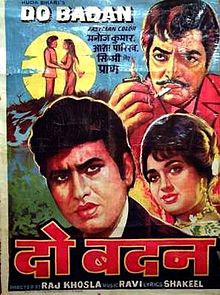
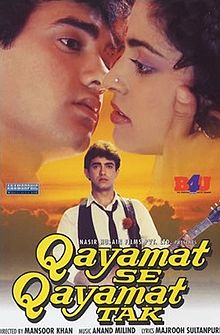
The tale of star-crossed lovers has been used by Bollywood in a number of its offerings. ‘Do Badan’, ‘Qayamat Se Qayamat Tak’, ‘Ek Duje Ke Liye’, ‘Goliyon Ki Leela – Raas Leela’ and ‘Ishaqzaade’ can be said to be based on the Bard’s eternal love classic.Shakespeare Do badan

(1966, Raj Khosla)

Shakespeare Qayamat_Se_Qayamat_Tak

(1988, Mansoor Khan)

Shakespeare Ek_Duuje_ke_liye

(1981, K Balachander)

Shakespeare Ishaqzaade

(2012, Habib Faisal)

Shakespeare Ramleela

(2013, Sanjay Leela Bhansali)

In tune with the changing times, the last two were rather graphic in their depiction of the heat of desire, an aberration which only made them stray even farther from the original theme.

Macbeth

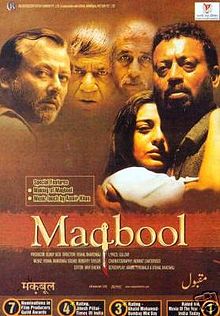
Maqbool’ had finely etched performances by the likes of Tabu, Pankaj Kapur and Irrfan Khan. A dark offering against the backdrop of a Mafia gang, it left the viewer struck with its audacity and the departures from the original work.

Shakespeare Maqbool

(2003, Vishal Bhardwaj)

Hamlet

Haider’ had all the elements of the original – intrigue, ambition, retribution and an amorous love affair to boot.

Shakespeare Haider

(2014, Vishal Bhardwaj)

A Midsummer Night’s Dream

’10 ml Love’ came enchantingly close to the original, but did not have the depth of the original.

shakespeare 10 ml love

(2010, Sharat Katariya)

Most of these movies had the necessary ingredients for commercial success – exotic locales, lavish sets and costumes, outlandish exaggeration and intense passion. Opposites co-existed in many of these movies. Comedy often walked hand in hand with tragedy, poetic language got intermeshed with coarse slang, and middle class morality and values were juxtaposed with unabashed display of physical desire.

A timeless appeal

It would be too simplistic to say that the poet is merely a vestige of India’s colonial past. Much like Thomas Hardy, Jane Austen, P G Wodehouse, Agatha Christie and many others, the multi-layered characters etched out by him touch a chord somewhere deep within the psyche of Indian movie buffs of all hues, sizes and shapes.

It is this mass appeal which makes the Bard a source of inspiration for many a scriptwriter in Bollywood. His works depict the essential traits of human beings and shall forever continue to regale movie goers all over the world.

(If you liked this post, there is a chance you may like these as well:

https://ashokbhatia.wordpress.com/2015/03/06/some-bollywood-movies-with-a-dash-of-wodehousian-humour

https://ashokbhatia.wordpress.com/2015/12/30/fifty-years-and-three-classics)

A place grows on us. It offers a comfort zone which we get used to. We might dislike the place for so many things. But when we are away for some time, the gravitational pull again comes into play. We start missing the place.

Lakshmi

Lakshmi

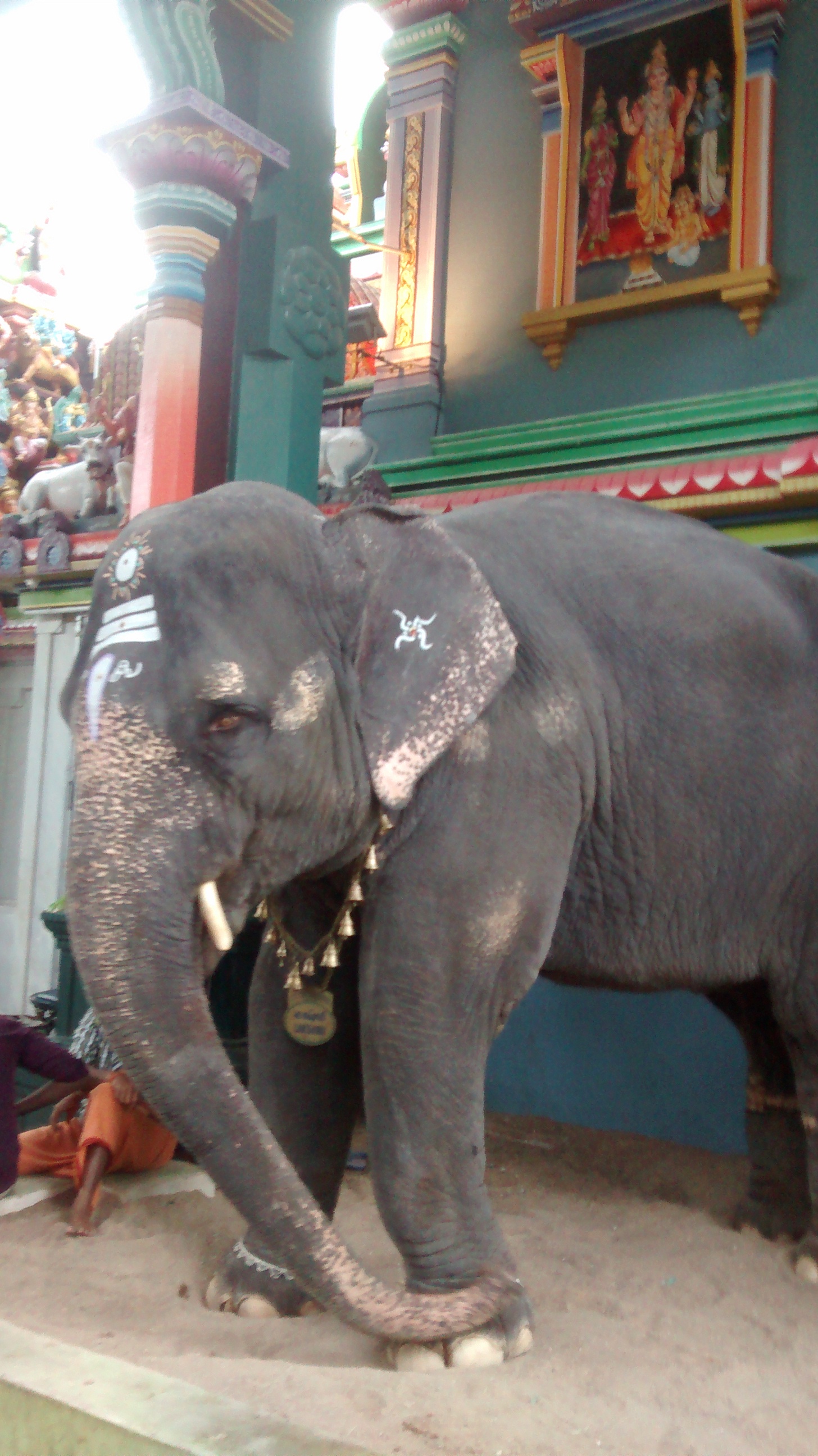
Pondicherry is no exception to this general rule. While here, we might bemoan the lack of civic sense, the streets littered with garbage, the reckless driving on the roads and the absence of adequate parking space in the town area. But take us away for some time, and we start missing it somehow. We yearn to get back to the humidity and the heat of the place.

What is so hot and happening about this quaint little town, perched on the Bay of Bengal, you may well ask.

Consider the following.

A small group of close friends

This is what makes Pondicherry so very special. Friends who are helpful. Friends who are there when you need them. Friends who have helped us make Pondicherry a home, far away from one’s roots. Friends who offer constructive criticism. One may not speak to them or see them for quite some time. But the underground cable connections remain in place.

For a nature lover

The restless waves of the Bay of Bengal somehow sweep away all that bothers one on any particular day. Watching an early morning sunrise is an uplifting experience. Mental peace reigns.Moon

A unique experience is that of watching a golden-hued moon rising out of the horizon a day or so after any full moon day. As it slowly changes its colour from a pale yellow to a light blue and then to its customary bright silver, the shimmering waves below keep dancing in tandem. One simply marvels at the beauty of nature on offer in Pondicherry.

For a pseudo-literary buff

For pseudo-literary buffs like me, it is a cerebral delight to attend book launches which happen at regular intervals. Perhaps inspired by the literary geniuses who made Pondicherry their abode in the not so distant past, authors of all hues and genres make it a point to include the place in their launch itinerary.BookFrontCover

Home grown authors are never in short supply, ready to fling their latest works at an unsuspecting audience. Tamil, French and English books keep popping up at regular intervals.

Even yours truly has gone ahead and published a book in Portugal, and is pretty happy about the fact that he is spared the trauma of having to read his own work in Portuguese, a language he does not understand himself!

Food for the soul

For a music-appreciating person like me, a flute recital by Hari Prasad Chaurasia, or a santoor recital by Shiv Kumar Sharma, is as uplifting and purifying as a vocal concert by Kalapini Komalini.

Even though national celebrities happen to be in Pondicherry only once in a blue moon, the soft glow of inner happiness lingers on for many more years to come.

For an art lover 

Art galleries like Aurodhan and Tasmai keep the place alive and happening. Dance performances of all genres keep me hooked to the place. When it comes to theatre, institutions like Aadishakti add their own charm to the place. Auroville has eclectic performances scheduled almost every week. Screening of offbeat movies is a routine affair. Alliance Francaise also keeps organizing some exciting events.IMG_0446

Workshops on masks, outfits teaching Salsa and Zumba, Baul performances, folk dances – you name it and Pondicherry has it!

For the intellectual pigmy 

Talks of subject experts organized by the local chapter of Madras Management Association do stir up the manager within me, reigniting my entrepreneurial passion. Held once or twice a month, the talks are short, crisp and highly focused. Business strategies get discussed. Power dressing tips are offered. Management lessons from movies are put across. In short, lot of management wisdom gets shared by those who practice the art and science of management.

Improving my Spiritual Quotient

For someone who is trying to understand how businesses can be run based on sound values and ethics, listening to some charismatic speakers steeped in Sri Aurobindo’s thoughts often leaves one gasping for more. The content may be incomprehensible to someone like me, a novice in the realm of spirituality, but there is a possibility that the quest may bring about some enlightenment in due course of time.

The heartfulness program of Sri Ram Chandra Mission offers a simple way for the lay person to peep within.

Brahma Kumaris happen to be very active, as do so many other outfits of the spiritual kind.

Minimizing the Pumpkin Quotient

It is fun to work with like-minded teams and create events like workshops and??????????????????????????????? seminars which allow stressed out managers to explore the spiritual dimensions of management. This way, they get an opportunity to sharpen their skills. I get rewarded in return by minimizing my own Pumpkin Quotient.

Frequent endeavours being made by such organizations as Sri Aurobindo Center for Advanced Research and Sri Aurobindo Foundation of Integral Management tend to increase the allure of Pondicherry.

Frequent guest lectures at academic institutions in the region also add to the gravitational pull of the place.

Keeping the body and soul together

  1. For the best North Indian food in town, the place you can head to is Roma’s Kitchen in Auroville.
  2. For vegetarian seekh kababs: Hotel Anandha Inn/Annamalai
  3. For the least greasy samosas in town: Madhu Sweets, Mission Street.
  4. For good tea (meaning not the milky tea we get to slurp otherwise): Sekar Snacks, a tiny joint right opposite Mithai Mandir.
  5. For greasy Punjabi dishes: Punjabi Dhaba off Mission Street.
  6. An eatery which transports you back to the ‘Life of Pi’ days: Indian Coffee House, Nehru Street.

Keeping alive and kicking

Howsoever oppressive the heat, a walk along the promenade leaves one feeling invigorated.

To a young-at-heart senior citizen like me, Pondicherry offers a wide array ofYoga Dhanurasana_Yoga-Asana_Nina-Mel ‘pathies’ to choose from. As a follower of allopathy, one just needs to brave the crowded corridors of JIPMER, to be able to avail of world-class medical advice. For a focused attention on dental blues, Mahatma Gandhi Postgraduate Institute of Dental Sciences comes to the rescue. Eye-related issues get readily addressed at either the School of Perfect Eyesight or the Aravind Eye Hospital.

For occasional forays into homeopathy, naturopathy, yoga and ayurveda, abundant choices are available. Acupuncture, acupressure and reflexology treatments are readily available. For spiritual healing, one just needs to walk in and meet a specialist.

Perhaps a day would soon come when a national level institute of Integral Medicine comes up here. My physical form will then not have to get compartmentalized into organs and ‘pathies’, but a holistic view will get taken of me as a whole being!

An accessible government

The upside of living in a small territory is that one could walk into any government office and meet smiling and helpful seniors. The problem gets heard. If it has merit, it also gets resolved as quickly as possible.

Experience of a unique kind

The kind of aggressive driving we get to experience in Pondicherry makes us fitdrawing to be able to drive any kind of vehicle in any part of the world. The dexterity required on the roads would make a circus stuntman squirm with shame. The kind of democracy on display on the roads could easily be packaged and marketed to train our wannabe politicians.

It is a unique experience which makes one feel as if all those rushing about on the roads are ardent functionaries eager to play their part in the French Revolution, following the dictum of Liberty and Equality but sans Fraternity.

Satisfying the wander lust

If ever boredom threatens to kick in, a short picnic at Alambara Fort (on ECR, 40 kms towards Mahabalipuram) is my recipe. It has long stretches of shallow water one can wade through and a pristine beach yet unsullied by the ravages of tourism.

A day’s trip to Gingee fort (60 kms, towards Tiruvannamalai) is another attraction. Other than the steep climb, we get to meet herds of our ancestors who are more interested in the bananas and eats we carry with us.

The bliss of doing nothing!

With its scenic promenade, picturesque locations, an old world FrenchExercise 1 ambience, Sri Aurobindo Ashram and Auroville, Pondicherry offers the lay visitor a curious combination of hedonistic as well as spiritual opportunities. One could go on a spirited binge and enjoy an upliftment of a transient kind. Otherwise, one could soak in its spiritual glow and relish a bliss which lasts much longer.

Often, when relatives call up to announce that they are planning to pounce on us, one of the most frequently asked questions is this: “What is there to do in Pondicherry?” When I say “Nothing”, they get disappointed. I then proceed to cheer them up by pointing out that this, the opportunity of doing nothing, is indeed the Unique Selling Proposition of the place.

The soft power of Pondicherry is the reason I do not relish being a Non Resident Pondicherryite for an extended period of time!

(Photograph of the moon and the yoga illustration are both courtesy the world wide web)

(Published in the New Race Journal, Vol II, Issue II: New Racehttp://sacar.in/2016_NR_V-2_I-2%20Aug2016.pdf)

Much before the term ‘Super Star’ was coined, we had the inimitable K L Saigal.

Here is a well researched post on the legendary work of this great artist.

findshars's avatarMy Views On Bollywood

 By

Sharada Iyer

 saigal1

Acknowledged as one of Hindi Cinema’s greatest legends, Kundan Lal Saigal was hailed as ‘Shahenshah-e-mausiqi’ (emperor of music) as well as the ‘ghazal king’ and became a phenomenon in his lifetime.  He appeared at a time when recording techniques were rudimentary and the film industry was on the brink of changing from ‘silent films’ to ‘talkies’. As songs started becoming an integral part of movie scripts, he had to devote his time equally between acting and singing.  Within a short span of 15 years and without any formal training in music, the irresistible spell cast by his golden voice remains unparalleled and his songs recorded eighty years ago evoke the same kind of magic even today…

Often while writing columns on superstars of Hindi Cinema, the counting incongruously starts with the triumvirate of Dilip Kumar-Dev Anand-Raj Kapoor who dominated a large part of the Black&White…

View original post 2,241 more words

When it comes to romantic affairs, age is never a bar. One gets the courage to stand up to dominating sisters and obtrusive gardeners. Moss covered alleys get preferred over stony ones. Stiff collars get forgotten. The joy of providing nourishment to keep the body and soul of the beloved together reigns supreme.


Honoria Plum's avatarPlumtopia

BlandingsCastle The superb short story ‘Lord Emsworth and the Girlfriend’ was published in ‘Blandings Castle’

My heartfelt thanks to the inimitable Ken Clevenger for contributing a wonderful and very fitting first piece in this Valentine’s series dedicated to the  Great Wodehouse Romances.

* * *

Lord Emsworth and the Girl Friend

by Ken  Clevenger

Lord Emsworth and the Girl Friend” is the great Wodehousian romance, most worthy of a special Valentine. My starting point is the very nature of great romances. Love must blossom, however improbably. It will be heroic, idyllic, and set in the beauty of nature, but not without the odd nettle. In the end love conquers all, as someone once noted; Jeeves, perhaps?

The easy part is to recognize in this “perfect short story” that Blandings and its gardens are the bounty of nature. The nettle, perhaps I should have said thistle, as le mot juste, is…

View original post 331 more words

BookFrontCoverAn interview of your truly which appeared in Vida Economica in Portuguese some time back:

1. You are publishing your book in Portugal in March. What’s your relationship with Portugal? Why Portugal to publish your book?

It would be recalled that the relationship between our two countries goes back quite a few centuries.

At the personal level, I have several friends from Goa and Cochin in India, both of which were the seat of power for Portugal till the 1960s. I have always people from these areas to be highly committed but fun-loving at the same time.

At the professional level, having worked in the leather footwear industry for a long time, I had occasionally been in touch with some such businesses in North of Portugal.

Some time back, I came across CEO World, and felt connected to your lovely country.

Relationships evolve over a period of time. It is time to improve the engagement between our two countries. Traditional knowledge and management wisdom is just one facet of the possibilities. That is how, the thought of publishing a book here came up.

2. Amazon said recently that they will not fail to be a major player in India (as it happened in China). They will invest much more this time. How do you see the opportunities for Portuguese companies in India?

Against the gloomy backdrop of major economies, India happens to be a bright spot in the world today. The new government has grand plans for development and is taking steps to improve the ease of doing business in India. The potential in the semi-urban and rural pockets of India is great. Portuguese businesses have a unique opportunity now to enter into tie-ups with companies of Indian origin.

Globally, the largest pool of educated manpower willing to work hard is available in India. History has taught Indians to live harmoniously together, despite wide-ranging diversity in terms of religion, languages and castes. These are unique strengths which can be effectively leveraged by businesses in Portugal.

Companies which want to do business in India would do well to (a) Identify their key strengths which would be of relevance to India, whether in the field of infrastructure, renewable energy, farm productivity, leisure and tourism, etc, (b) Take the help of experts who can put them in touch with reliable business partners in India, and (c) Be clear and patient about the characteristics of the market segment they identify to cater to.

3. “Surviving in the Corporate Jungle” mixes humour with management. Why do you think it should be read by Portuguese managers?

Management concepts are universal in nature. When you wish to motivate your team members, it does not matter whether you are in Porto or in Mumbai. When you are down-sizing, the challenges are the same, irrespective of whether you are in Lisbon or in Delhi.

Portuguese managers who follow one of the effective habits popularized by Stephen R Covey – KEEP SHARPENING YOUR SAW – would greatly benefit from the managerial wisdom of India.

The messages conveyed in the book are serious in nature. Their packaging is not. Profound truths conveyed with a dash of humour, I believe, have a better chance of being effectively communicated.

I believe the upcoming book can help managers in Portugal and elsewhere become smarter, in other words, more effective.

4. Why did you decide to become a founding member of the Portuguese start-up CEO WORLD?

We live in times when the world is shrinking faster than ever. We are at the cusp of a new kind of ‘Industrial Revolution’ which is knowledge-driven. Call it a ‘Binary Revolution’, if you will. Technology is making information more democratic in nature.

Start-ups which enable sharing of management practices across the world serve a useful purpose in the society. Moreover, when we share challenges and discuss possible solutions on a global platform, we gain in terms of empathy and expand our consciousness. We are then making a small but significant contribution towards global harmony, much like a small group of violinists which is a part of a grand orchestra.

For example, one of the platforms CEO World offers is that of Peer Groups. Here, I get to share my current challenges with CEOs from all over the world on a video conference platform. There is no conflict of interest, there is accountability, and there are no travel costs involved. As and when one is visiting each other, one can take the discussion forward.

Peer Groups have been in operation since the last 60/70 years in such countries as the US, Canada, AU, NZ and UK. But the novel idea being practiced at CEO World is that of virtual peer groups which are global in nature. This is a disruptive concept led by a Portuguese start-up.

5. What are your plans for the future and how do you envision your relationship with Portugal?

As a person who suffers from ‘Professoritis’, the plans are for an enhanced level of engagement with the management institutes and associations in Portugal. Another book proposal is on the drawing board. Given support, I would love to do a book comparing the managerial styles of CEOs in Portugal and in India.

It would also be exciting to connect with Portuguese companies who want to have a better understanding of the Indian culture and market and vice versa. Perhaps I can make a modest contribution towards building more bridges between our two countries. This gets aligned with the mission of CEO WORLD: of decreasing the gap between cultures and bringing about a better understanding between the two populations.

(Source: Vida Economica, February 26, 2016)

You can buy the book here.

(Related Posts:

https://ashokbhatia.wordpress.com/2016/02/26/the-book-como-sobreviver-na-selva-empresarial-guia-pratico

https://ashokbhatia.wordpress.com/2016/02/28/the-book-como-sobreviver-na-selva-empresarial-guia-pratico-2-0

https://ashokbhatia.wordpress.com/2016/03/02/the-book-como-sobreviver-na-selva-empresarial-guia-pratico-3-0)

Here is an excerpt from a book titled ‘Future Proof Your Business‘ by Mr Prakash Seshadri.Book Future Proof Your Business Cover

Realistically speaking, we are always on the verge of a slow down or a flat economy. In the past, CEOs made serious mistakes in trying to cope with a slowing economy. Here is a list of What Not to Do.

All of them hurt innovation. Unless you really want to compete on price, the ability to do sustained innovation is the one competitive edge left. Innovation is the driver of performance, growth and stock market valuation.

Here are the 10 worst mistakes you can make in a slow down that will hurt innovation:

1) Fire talent

Cutting back on people, especially really smart, high-priced people, is a quick way to cut costs. It will hurt companies who follow this way. Talent is the single most important variable in innovation.

2) Cut back on technology

It is being reported that companies are already curbing investments in technology to save money; banks especially. The rise of social networking and consumer power means that companies have to be part of a larger conversation with their customers. This means big money spent on IT.

3) Reduce Risk

Innovation requires taking chances and dealing with failure. Recessions push managers to be more conservative. They need to fight this instinct.

4) Stop New Product Development

Saving money often means cutting back on new products and services during an economic downturn. This hurts companies when growth returns and they have fewer offerings in the marketplace to attract consumers.

5) Boards Replace Growth-Oriented CEOs with Cost-Cutting CEOs

Sudden declines in revenues and profits often lead boards of directors to search for managers with experience in pinching pennies. That’s what appeared to happen recently at Bang & Olufsen. Penny-pinching CEOs don’t have the skills to grow, when growth returns.

6) Companies Retreat from Globalization

It’s expensive to expand globally and managers often save money by cutting back on emerging markets. It’s a big mistake. Emerging markets are sources of new revenue, business models, and talent.

7) CEOs Replace Innovation as Key Strategy

By turning defensive, top managers take innovation off the top of the official agenda and replace it with systems management and squeezing costs. The entire organization follows. It is extremely hard to reverse this when growth returns.

8) Performance Metrics Are Changed

To save money and cut costs, managers shift employee evaluations away from rewarding riskier new projects toward sustaining safer older goals. Risk-averse behavior follows. Again, this is hard to change.

9) Hierarchy Is Reinforced Over Collaboration

Sudden drops in revenue and profit often lead companies to panic and mobilize to stem the decline. The need for fast decision-making often leads to a return to command-and-control management. This alienates creative-class employees, young Gen Y and Xers and stops the evolution of corporation organization toward a flat, collaborative, open source model.

10) Retreat into Walled Castles

Cutting back on outside consultancies is seen as a quick way to save money. Yet one of the key ways of introducing change into business culture is to bring in outside innovation and design consultants. They know what companies across a broad range of industries around the world are doing to promote change. Not receiving this information can hurt a company’s global competitive position.

Winners always emerge out of slow downs and they almost always beat their competition on the basis of something new. Apple worked on iTunes, iPod and its retail stores during the last slow down and came out swinging once growth returned to destroy its competition. Apple didn’t make any of the top 10 innovation mistakes. Your company shouldn’t either.

(Here is a link to a teaser of the book:http://imojo.in/crpeqy)

(Related Post: https://ashokbhatia.wordpress.com/2013/01/23/of-idleness-innovation-and-the-peter-principle)