
The romantic saga of Ginger and Sally has many dimensions. Here is the second in a series of three blog posts courtesy Jon Brierly, reblogged by Honoria Plum.
Enjoy!
(Related Post:
Posted in What ho!, tagged Adventures of Sally, Ginger, Humour, P G Wodehouse, Romance on February 19, 2018| Leave a Comment »
The romantic saga of Ginger and Sally has many dimensions. Here is the second in a series of three blog posts courtesy Jon Brierly, reblogged by Honoria Plum.
Enjoy!
(Related Post:
Posted in What ho!, tagged Death, Humour, P G Wodehouse, Savitri, Sri Aurobindo on February 14, 2018| 16 Comments »
P G Wodehouse handed in his dinner pail on the 14th of February, 1975. While delving into any of his narratives, one is not likely to find a single character which comes under the clutches of one of the much-despised inevitable occurrences in life – Death (the other one being Taxation, which does get commented upon once in a while).
In the narratives dished out by him, Death figures only somewhere in the background. It does not depress. Nor does it make the spirits sag. Instead, it finds mention in a positive vein. It confers wealth, castles and titles upon the unsuspecting heirs and wards, paving their way for a smoother life, thereby spreading joy and sunshine all around.
The closest one gets to morbid thoughts is when a character is fed up with facing the harsh slings and arrows of Fate and contemplates an act of suicide, which, rather understandably, never happens.
When husbands kick the bucket
Former husbands do find honourable mentions in some of his narratives. Hot Water scores on this front. So does Ring for Jeeves, where one runs into rich husbands of Mrs Spottsworth who have already kicked their respective buckets, leaving behind sackfuls of the green stuff.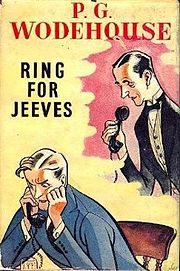
“Born Rosalinda Banks, of the Chilicothe, Ohio, Bankses, with no assets beyond a lovely face, a superb figure and a mild talent for vers libre, she had come to Greenwich Village to seek her fortune and had found it first crack out of the box. At a studio party in Macdougall Alley she had met and fascinated Clifton Bessemer, the Pulp Paper Magnate, and in almost no time at all had become his wife.
Widowed owing to Clifton Bessemer trying to drive his car one night through a truck instead of round it, and two years later meeting in Paris and marrying the millionaire sportsman and big game hunter, A. B. Spottsworth, she was almost immediately widowed again.
It was a confusion of ideas between him and one of the lions he was hunting in Kenya that had caused A. B. Spottsworth to make the obituary column. He thought the lion was dead, and the lion thought it wasn’t. The result being that when he placed his foot on the animal’s neck preparatory to being photographed by Captain Biggar, the White Hunter accompanying the expedition, a rather unpleasant brawl had ensued, and owing to Captain Biggar having to drop the camera and spend several vital moments looking about for his rifle, his bullet, though unerring, had come too late to be of practical assistance. There was nothing to be done but pick up the pieces and transfer the millionaire sportsman’s vast fortune to his widow, adding it to the sixteen million or so which she had inherited from Clifton Bessemer.”
When the cup that cheers causes death
In Summer Lightning, Galahad is seen advising his niece about the dangers of drinking tea (instead of whisky) and recalling the death of poor old Buffy Struggles.
“’You be careful,’ urged the Hon. Galahad, who was fond of his niece and did not like to see her falling into bad habits. ‘You be very careful how you fool about with that stuff. Did I ever tell you about poor Buffy Struggles back in ‘ninety-three? Some misguided person lured poor old Buffy into one of those temperance lectures illustrated with coloured slides, and he called on me the next day ashen, poor old chap – ashen.
“Gally,” he said. “What would you say the procedure was when a fellow wants to buy tea? How would a fellow set about it?”
“Tea?” I said. “What do you want tea for?”
“To drink,” said Buffy. “Pull yourself together, dear boy,” I said.
“You’re talking wildly. You can’t drink tea. Have a brandy-and-soda.”
“No more alcohol for me,” said Buffy. “Look what it does to the common earthworm.”
“But you’re not a common earthworm,” I said, putting my finger on the flaw in his argument right away.
“I dashed soon shall be if I go on drinking alcohol,” said Buffy.
Well, I begged him with tears in my eyes not to do anything rash, but I couldn’t move him. He ordered in ten pounds of the much and was dead inside the year.’
‘Good heavens! Really?’
The Hon. Galahad nodded impressively. ‘Dead as a door-nail. Got run over by a hansom cab, poor dear old chap, as he was crossing Piccadilly. You’ll find the story in my book.’”
Tea lovers would surely get offended by the sentiments expressed herein above. But Plum had a knack of making even Death amusing.
Being mentioned in passing
Elsewhere, one finds Clarence and Gally having a conversation of this nature:
“I wish I could consult Wolff-Lehmann”
“Why can’t you?”
“He’s dead.”
In Adventures of Sally, the main protagonist writes to Ginger: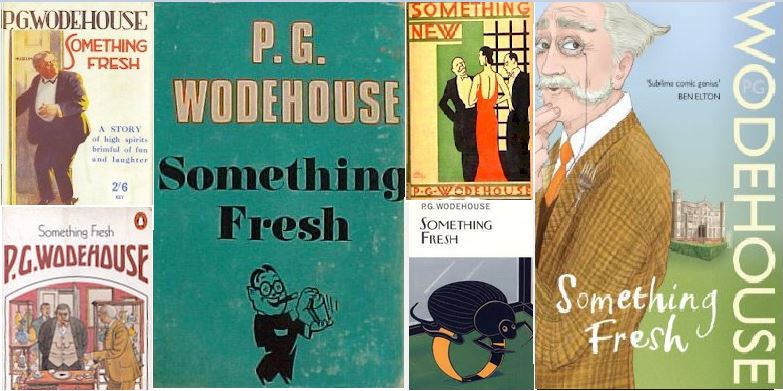
“If Gerald had died and I had lost him that way, I know quite well I shouldn’t be feeling as I do now. I should have been broken-hearted, but it wouldn’t have been the same. It’s my pride that is hurt.”
In Something Fresh, we find Ashe Marson suffering from a writer’s block. He looks blankly for half an hour in front of a sheet of paper bearing the words: “The Adventure of the Wand of Death,” and tries to decide what a wand of death might be. Joan Valentine walks in and demystifies it thus:
“Why, of course; it’s the sacred ebony stick stolen from the Indian temple, which is supposed to bring death to whoever possesses it. The hero gets hold of it, and the priests dog him and send him threatening messages.
What else could it be?”
When Uncles call it a day
Many of us successfully take off the negative emotions associated with death by using such clichés as “kicked the bucket,” and “cashed in his chips.” In a common Wodehouse usage, an uncle generally “hands in his dinner pail.”
“I’m taking my spade and bucket and going home” is a pout spoken by a child playing at the seashore who feels he or she is no longer wanted. Instead, like in Fixing it for Freddie, he uses the term “buckets and spades.”
When suicidal tendencies evaporate
In the short story Sea of Troubles, we get to meet Mr Meggs who happens to be a martyr to indigestion. Leading a sedentary life for over twenty years, and given to the pleasures of the table, he has no hope for the future.
After much thought, he has decided to commit suicide. The knife, the pistol and the rope do not charm him. Nor do the options of either drowning or jumping from a height. The idea of consuming poison alone appeals to him.
He has encashed his assets and decided to gift the same to six of his well-deserving pals. He has prepared letters enclosing neat wads of cash to all the six. He has even thought of his Miss Pellinger, his secretary, and gifts a sum of five hundred pounds to her by way of a parting gift. After handing over the letters to her, asking her to post the same, he hands over the money. Emotionally moved, he even plants a kiss.
But Miss Pillenger is a wary spinster of austere views, uncertain age, and a deep-rooted suspicion of men. She is always ready to swing her clenched fist on any male who might cross the limits of civil behaviour.
She takes the gesture amiss and runs off from the house, startling and shocking Mr Meggs who just cannot comprehend her act of perceived insult. So much so that he scratches the idea of gifting any of his money to some similarly ungrateful friends of his.
He starts chasing his secretary so as to be able to stop her from posting the six letters he has entrusted to her. The latter, thinking he is following him for some amorous reason, creates a scene on the street. A huffing and puffing Mr Meggs, red in the face with the exertion, explains his conduct to a rozzer who has descended on the scene and retrieves the letters.
Back home, he suddenly realizes that the infernal pain in his stomach has ebbed away. He finds hope in brisk walks and decides to cancel his suicide mission.
The Making of Mac’s is another story which also appears in The Man with Two Left Feet.
Katie is in love with Andy who is ambivalent towards her. She aspires to be a first-rate dancer but damages her ankle at one of the rehearsals. This crushes her ambition. Life turns hopeless.
This is how she expresses herself:
Darling Uncle Bill,
Don’t be too sorry when you read this. It is nobody’s fault, but I am just tired of everything, and I want to end it all. You have been such a dear to me always that I want you to be good to me now. I should not like Andy to know the truth, so I want you to make it seem as if it had happened naturally.
You will do this for me, won’t you? It will be quite easy. By the time you get this, it will be one, and it will all be over, and you can just come up and open the window and let the gas out and then everyone will think I just died naturally. It will be quite easy. I am leaving the door unlocked so that you can get in. I am in the room just above yours. I took it yesterday, so as to be near you.
Good-bye, Uncle Bill.
You will do it for me, won’t you? I don’t want Andy to know what it really was.”
Uncle Bill butts in at the last minute, consoles her, and rushes off to show the letter to Andy. Moved by the letter, Andy does not lose time and rushes to meet her. The affair ends on a positive note.
Slaying Death with his pen
Fans of P G Wodehouse are well aware that his world has different kind of challenges: Obdurate girl friends whose ambitions to either enforce dietary controls upon the parties of the other part, or uplift and refine their intellect, need to be kept on a tight leash; sartorial choices which unwilling masters bow to after having been saved from an impending disaster by their man servants; management of aunts who, when one’s Guardian Angels are busy elsewhere, are not gentlemen; tackling of stingy uncles who refuse to part with the green stuff for loftier goals in life; pigs which decide to register a protest by deciding to go in for unplanned dietary regimen; the art and science of pinching umbrellas and policemen’s helmets, and the like.
Death is on the other side of the spectrum and finds no place in his narratives, except when rich husbands or uncles decide to kick the bucket and leave a pile of money or real estate for their spouses or heirs. The D word, even if it makes a brief appearance, merely indicates a celebration of life.
A spiritual import
Incidentally, by treating Death as a celebration of life, Plum adds a deeper spiritual layer to his narratives.
In his epic poem Savitri, Sri Aurobindo, the renowned Indian seer, presents the end of a person’s life as a transformative event, a passage or a door through which one passes towards a greater life. Essentially, the poem recounts the saga of human victory over ignorance and conquest of death.
Thus, on the racing tracks of Life, Death is but a pit stop. One gives up one’s creaking old jalopy. In exchange, one gets a shimmering new vehicle. One then zooms off to a newer horizon, the engine firing on all six cylinders. With each pit stop, one evolves further.
All works of Wodehouse carry his trademark bright humour and sparkling wit. But hidden beneath the layers of his uplifting narratives are several gems of wisdom – material as well as spiritual.
He continues to live amongst us through his works. In his hands, even Death meets its own death.
(Inputs from the following fans of P G Wodehouse are gratefully acknowledged:
John Dawson, Lars Walker, Louise Culmer, Lucy Smink, Midge Coates, Murray Harper, Narayan Arvind, Pranava Singhal, Satish Pande, Subrata Sarkar and Sughosh Vardarajan.)
Posted in What ho!, tagged Humour, P G Wodehouse, Sally on February 11, 2018| 5 Comments »
 Every February Plumtopia celebrates the romances, great and small, in the work of P.G. Wodehouse, to mark the anniversary of his death on St Valentine’s Day, 1975. Guest contributions are warmly welcomed, and this year I’m thrilled to share a series by guest author Jon Brierley on the 1921 Wodehouse novel, The Adventures of Sally.
Jon is sound on Wodehouse and has written wonderfully in the Wodehouse style at his blog, Sloopjonb: Writing Wibble(try his Jeeves’ Christmas Carol). Jon is currently putting the finishing touches on his first novel and would love feedback from beta readers. Please do visit his blog to find out more.
“Chumps always make the best husbands. If you marry, Sally, grab a chump. Tap his forehead first and, if it rings solid, don’t hesitate. All the unhappy marriages come from the husbands having brains. What…
View original post 534 more words
Posted in What ho!, tagged Aunt Agatha, Bertie Wooster, Humour, P G Wodehouse, Seasoned Romance on February 7, 2018| Leave a Comment »
Other than the topsy-turvy romances of younger couples, P G Wodehouse also regales us with romantic affairs of those who are advanced in age and young at heart. An affection which was discernible in a couple’s younger days – whether declared or otherwise – survives the harsh slings and arrows of life. A chance meeting unearths and rekindles the deep buried embers of love. A well seasoned romance bears fruit. The Valentine Spirit prevails.
One such couple we get to meet is that of Joe Danby and Aunt Julia, who make an appearance in the story entitled ‘Extricating Young Gussie’ (The Man with two Left Feet). This is how the narrative unfolds.
An inconsiderate Aunt Agatha drags Bertie out of bed ‘in the small hours’ (perhaps around half past eleven in the morning!), much before he has finished his dreamless and sipped his first cup of tea. She is…
View original post 882 more words
Posted in What ho!, tagged Annotations, Humour, John Dawson, Laughing Gas, Madam Eulalie, P G Wodehouse on February 4, 2018| 2 Comments »
Fans of P G Wodehouse are of various kinds.
There are those who enjoy an occasional saunter down some of Plumsville’s streets which boast of trees laden with luscious low hanging fruits of sublime humour.
There are also those who decide to spend some time on the banks of Plumsville’s merry rivulets and experience their gentle murmur while delving into one of Plum’s juicy narratives.
Then there are fans who happen to be intellectual coves. They believe that such sunlit humour deserves to be subjected to a pitiless analysis. One cannot rest content with merely basking in it, soaking in the unique warmth it offers, and moving on. One needs to delve deeper, discover the gems of wisdom hidden therein, and share the same with unsuspecting fans.
John Dawson happens to be one of them. His name needs no introduction. Erudite scholarship at its very best. Madam Eulalie, of which he is one of the Principals, is a website which strives to deliver deeper satisfaction to Plum’s ardent fans.
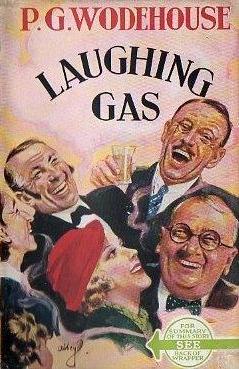
Here is a guest post from him, which carries a small slice of annotations of ‘Laughing Gas.’
Enjoy.
CHAPTER ONE
Sticky
requiring careful treatment; awkwardly difficult or unfortunate, unpleasant, nasty [1910-15]
P.E.N. Club
association of writers in founded London in 1921 to promote friendship and intellectual co-operation among writers; “Poets, Essayists and Novelists;” Its first members included Joseph Conrad, George Bernard Shaw, and H.G. Wells. Not to be confused with PGW’s fictional Pen and Ink Club of London, to which his female novelists Julia Ukridge, Leila Yorke, and Rosie M. Banks belonged.
Bicarbonate of soda
sodium bicarbonate; used as an antacid [1880-85]
Vet
to appraise, verify, or check for accuracy [1860-65]
Foozle
(d) to bungle or play clumsily [1825-35]
(my) tee shot
opening drive in golf
Anecdote about Scotsmen, Irishmen and Jews
Nineteenth and early twentieth century ethnic humor generally depicted Scotsmen as stubborn, Irishmen as drunks, and Jews as cheap; In a typical joke, two or three of them would be faced with a common situation and react according to stereotype. In Right Ho, Jeeves from 1934, Bertie relates a similar experience: I remember once detaining a dentist with the drill at one of my lower bicuspids and holding him up for nearly ten minutes with a story about a Scotchman, an Irishman, and a Jew.
Drones (Club)
PGW’s fictional young gentlemen’s club in Dover Street, Mayfair, which Wodehouse based on Buck’s Club at 18 Clifford Street in London; the origin of the name lies in a speech made by Joseph Chamberlain in the 1880s. Chamberlain, a renowned orator, in attacking the House of Lords, declared them to be ‘drones of the hive.” The phrase stuck in the public and (Wodehouse’s) consciousness. [NM] Geoffrey Jaggard estimates 173 Drones Club members, of which fifty-three are named in the course of the books and stories, including its most prominent member, Bertie Wooster
smoking room
a room set apart for smoking in a hotel or clubhouse [1680-90]
Cognoscenti
persons who have superior knowledge and understanding of a particular field, esp. in fine arts, literature, and fashion; from Lt. conoscere, to know [1770-80]
Right ho
Br. used to express understanding or assent [1895-1900]
Rummy
Br. slang, Odd, peculiar; also rum [1820-30] Swift speaks of ‘a rabble of tenants and rusty dull rums’ (country parsons). As these “rusty dull rums” were old-fashioned and quaint, a “rum fellow” came to signify one as odd as a “rusty dull rum.”
National Geographic Magazine
illustrated monthly journal of the National Geographic Society, begun in 1888 and known for its colorful photojournalism
Bilge (water)
Foolish, worthless or offensive talk or ideas; nonsense [1700-10]
Perisher(s)
a morally reprehensible person; a bounder Br. Au. Slang; an annoying person, esp. a naughty child Look at that frightful ass Spode swanking about in footer bags! Did you ever in your puff see such a perfect perisher? Code of the Woosters, 1938
Hollywood
Located in the northwestern part of Los Angeles, center of the American motion picture industry:
Joey Cooley
Wodehouse liked retaining the initial letters and rhythm of original names for his fictional characters; Norman Murphy writes that Joey is based on Jackie Coogan (1914-84) who became world-famous at the age of six when he played opposite Charlie Chaplin in The Kid (1920). But in 1934-35, when PGW wrote the prototype novelette for Laughing Gas, Coogan was no longer a child star — indeed, in 1937, her married Betty Grable. I think Joey is actually based on Jackie Cooper, born in 1922, who appeared in the early “Our Gang” shorts and emerged as a major child star in 1931 with “Skippy.” Wodehouse named the character Joey Cooley, but in the 1935 novelette of the same title, he’s Tommy Flower.
Idol of American Motherhood
PGW’s take on the sobriquets assigned by studios and fan magazines to movie stars; In Wodehouse’s short story The Nodder from 1933, child star Little Johnny Bingley — actually a 40-year old midget – is referred to as “The Idol of American Motherhood” and “The Child With the Tear Behind the Smile.”
Reggie Havershot
Outside of the physical description, background, and presence of Jeeves, Wodehouse has entirely appropriated his Bertie Wooster character to use as Reggie. There are dozens of points of similarity, from the way Reggie thinks and talks (in the otherwise-rare first person) to his quotations, his fractured and inane metaphors and similes, his self-deprecation/braggadocio, his appropriation of Bertie’s signature Gothic-Victorian musings: Hideous privations – A sort of hideous tenseness – Sheer horror – I reeled again – Hideous errand – I stood aghast – my blood froze – my soul recoiled in horror – Icy horror – hideous truth — a cold hand seemed to clutch my vitals – A fate. . . worse than death, and so on. Those familiar with the Bertie/Jeeves books and stories will immediately see that Reggie is cloned from Bertie — in a way that may be discomfiting to fans. In my opinion, Wodehouse, in adapting and expanding the original novelette, had to add material and more “personality” to Reggie, and chose Bertie as a convenient source. At any rate, almost the entirety of Reggie’s sentences and thoughts could be interpolated into a Bertie/Jeeves story and be entirely congruent to the Wooster character. If one had never read the Wooster/Jeeves output, Reggie would be an original, charming character — but since Wodehousians know and love Bertie, his appearance in someone else’s skin may leave some fans discombobulated.
Hark(ing) back
return to a previous subject or point; foxhunting, to return to a course for the hounds to regain the scent [1175-1225]
buckling down
setting to work with vigor and concentration [1300-1350]
Third Earl of Havershot
An Earl is a member of the British peerage, ranking below a marquess and above a viscount; an Earl has the title “Earl of” when the title originates from a place name; Havershot is fictional; but given Wodehouse’s propensity for using bits and pieces of real English towns for his own fictional names and places, it may be likely a compound of Havant (next door to Emsworth) and Aldershot, where public schools boxing competitions were held.
Cop(ping)
to catch, nab; to steal or filch; [1695-1705] the
. . . title
the Earldom
Hundred-to-eight shot
Gambling term indicating a chance of eight in one hundred to win; a long shot
Field was full of seasoned performers
Refers to other family members higher in succession order to the title; seasoned performer is usually used to describe a mature actor, actress, or athlete or someone who has long experience in his or her chosen field
Who could give me a couple of stone
boxing, refers to a heavier, larger opponent who would ostensibly be favored in a match. A stone is equivalent to fourteen pounds or 6.4 kg.
Uncles call it a day and hand in their spades and buckets
We try to take off the tension of death with a lighter cliché: “kicked the bucket,” “cashed in his chips,” and in a common Wodehouse usage, “handed in his dinner pail.” “I’m taking my spade and bucket and going home” is a pout spoken by a child playing at the seashore who feels he or she is no longer wanted. Although today the word order is usually reversed to “buckets and spades,” Wodehouse’s use was common in the late nineteenth century. He had used it in the 1928 story Fixing it for Freddie
Boxing Blue at Cambridge
A competitor who has represented Cambridge is permitted to wear a light blue blazer and an Oxford athlete a dark blue one. To earn a Blue, one has to have participated in an Oxford vs. Cambridge Varsity match. To be a boxing blue for either of these universities is a great honor.
Thorax
chest
Bill(s) of replevin
a court order for the purpose of recovering property in the wrongful possession of others
Give(ing) (me) the eye
To look fixedly at
(Isn’t it a) scream
something that is hilariously funny [1905-10]
Noblesse oblige
Lt., Nobility obliges; the moral obligation of those of high birth or powerful social position to act with honor, kindness, generosity, etc. “Nobility has its obligations” [1830-40]
Touch
The act of asking someone for money as a loan or gift
Collateral branches
Relatives descended from the same stock, but in a different line; not lineal; cousins, in-laws, etc
dip into the till
to help oneself to cash from a drawer, box or the like, as in a shop or bank, in which money or valuables are kept [1425-75]
Notice of Distraint
a legal filing to be served upon one in possession of assets belonging to a third party; a “padlock” or retainer action.
Tut-tut (ed)
Be still; hush; an exclamation used for checking or rebuking.
Tut, never fear me: I am as vigilant as a cat to steal cream; Tut, tut, thou art all ice, thy kindness freezeth
Shakespeare
Grew to Man’s estate
attained majority; reached a required age to inherit property and assume legal responsibilities
When I am grown to man’s estate, I shall be very proud and great, And tell the other girls and boys Not to meddle with my toys.
R L Stevenson in “A Child’s Garden of Verses”
London W. 1
London’s most fashionable district, encompassing Mayfair
Souse
drunkard [1915-20]
Bull-dog spirit
Stubborn and persistent; tenacious, ready to fight for one’s beliefs or wants [1490-1500]
If therefore that it is possible that the abolition of prize fighting may be prejudicial to that sort of bull-dog spirit of an Englishman, which is to be found in no other nation, we should pause before we attempt to effect it
Sporting Magazine, London 1823
Boat Race night
Gentlemen. If you ever find yourself in England on Boat Race night there are some things which it is absolutely necessary that you understand, if you mean to survive. Boat Race night is that night of nights when Oxford rows against Cambridge. What is important is the adherence to certain cultural protocols. For example, you must be well dressed. If your tailor is anything other than special you may as well not annoy the ancient day with your presence. Once you have succeeded in adding to the beauty of the landscape, you must find yourself a couple of equally well dressed chaps and plunge out in search of one of those most blessed merchants who deal strictly in the wines and spirits. You must be merry. However, there is a line you must not cross. Yes, you must be somewhat floating in potent fluid, but you cannot impair your mental or physical abilities. You need to be able to walk, and more importantly . . . run. Now remember, this is still before the actual race. You will have ample time to imbibe after the race as well, so pace yourselves. If you drink too much before, then you will have to turn down drinks afterward. I recommend drinking to that perfect equilibrium, where one decides to eschew the consequences and knuckle down to spreading sweetness and light. You now attend the race. Yell and holler until your throat needs a second moistening, and then unaware of the victor, return to the beverages. It is important that you have removed all means of identification from your person before this phase. It is also crucial that you not be arrested for disturbing the peace just yet, as you will be called upon by others to enact the most ancient and honored tradition the island kingdom has to offer. You will be told to pinch a policeman’s helmet. Now some might have ethical qualms about such a deed. Put these aside, if the alcohol has not already done it for you, and move on like a man. If policemen didn’t want their helmets stolen, then why, I ask you, would they wear them on Boat Race night? Approach the policeman from the rear. You will of course have to rob whatever policeman the boys have selected but remember that the bigger he is the slower he probably is. The smallish ones can be a bit tricky because they are generally able to run one down after the removal of the helmet. Do your best to disappear. This of course means that you must stop laughing. After assuming a position to the rear of your quarry,, remember above all things not to simply grab the helmet and pull straight back. In such a case the policeman comes with it. One must always pinch the helmet and never the policeman. As for the helmet, when successfully purloined, it will be an heirloom of your family’s for generations to come. So remember, thrust forward on the helmet first, for this disengages the strap from the chin, and then pull back. At this point you run away. But as is normally the case, you will more likely find yourself in a cell for the rest of the night and standing before the local magistrate in the morning. When in the courtroom remember what name you gave the constable when you checked into the facilities the night before. I suggest that you have a name in readiness before the day begins so you are less likely to make one up off the cuff and forget it in the morning. You must now plead guilty as charged and settle for whatever the magistrate imposes. Some will settle for a mere reprimand which is quite reasonable for a night’s entertainment, accommodation, and breakfast in the morning. A most unreasonable fellow will send you up the river for three days, or soak you for five pounds. Upon exiting the courtroom, you are a free man. You may return from whence you came with one Boat Race beneath your belt. Stand tall.
Nathan Wilson
Bonneting (policemen)
To pull or crush a person’s hat over their eyes, thus temporarily blinding them [1900-30’s]
Throwing soft-boiled eggs at the electric fan
Sport engaged in by the more inebriated Drones Club members and others on celebratory occasions; I believe the first appearance to be in Wodehouse’s 1916 Jeeves and the Unbidden Guest.
I have one friend, a most intelligent chap that writes sober, scientific books, and he’s always aching to throw an egg into an electric fan to see what will happen.
Jack London, The Valley of the Moon 1917
Harley Street
Just north of Oxford Street, the home of London’s most prestigious doctors for over a century [NM] home to Sir Roderick Glossop in Thank You, Jeeves, and to E. Jimpson Murgatroyd in Full Moon and Aunt’s Aren’t Gentlemen
Wireless
Chiefly Br. Wireless telegraphy [1890-95]
Drinking like the stag at eve
Sir Walter Scott (1771-1832) The Lady of the Lake: The stag at eve had drunk his fill, etc. Wodehouse uses it in The Story of Webster and The Old Reliable, among others
Pippin
(s) something or someone wonderful; an excellent or remarkable thing; Br. slang Used to describe an exceptionally attractive young woman.
Bird
Br. slang; a person, usually one who is odd or has some peculiarity
Dashed
Chiefly Br. Euphemism for damned [1790-1800] arose from the printers’ convention of rendering “damned” with dashes as “d—d”
Gruesome
causing great horror; repugnant; distressing; reverence: a feeling attitude of deep respect tinged with awe
High priest sicking the young chief
misprint/error for “siccing.” Probably inspired by a boy’s adventure story Wodehouse read at school. I haven’t been able to find an exact attribution. Ancient Aztec and Indian literature both could be sources as well, but more likely Wodehouse remembered the Kiplingesque adventure tales from his youth.
Butt(ing) in
to meddle in the affairs of others
Put a stopper on
finish up, cause to end; as in corking a bottle
Amour(s)
Fr. love affair
Live and let live
to tolerate other people’s actions and expect them to tolerate one’s own; “They thought differently about most things but worked together on a principle of live and let live” Dutch proverb, one of many versions of the theme
Spliced
joined together or united [1515-25]. Br. slang, Married
Twentieth Century Limited
express passenger train operated by the New York Central Railroad 1902-1967, it became one of the most famous trains in the world; Known for its style as well as for its speed, passengers walked to and from the train on a plush, crimson carpet which was rolled out in New York and Chicago, thus the “red carpet treatment” was born.
Heavyweight championship of the world
Coincidentally, on June 22, 1937, Joe Louis defeated James J. Braddock in Chicago to win the heavyweight championship. In Over Seventy Wodehouse wrote: This yearning I had to visit America. . . was due principally, I think, to the fact that I was an enthusiastic amateur boxer in those days and had a boyish reverence for America’s pugilists — James J. Corbett, James J. Jeffries, Tom Sharkey, Kid McCoy and the rest of them. I particularly wanted to meet Corbett and shake the hand that had kayoed John L. Sullivan.”
Trimmings
An accompaniment or garnish to the main dish [1510-1520] Reggie is referring to the money and property he inherited
Easy Street
A state of wealth, financial independence, or ease [1900-05]; also the title of a 1917 Charlie Chaplin movie
He determined to wait until the memory of his crime was forgotten, and then he would return, uncache his wealth, and live on Easy Street for the remainder of his days.
Bret Harte, Overland Monthly 1868
Application for soccage (socage) in fief
pro. SOAK-age; During the feudal period a person might hold land of a lord by knight service, which meant that he owed a certain number of days in service to his lord for the privilege of living on and cultivating it. But as the modern state arose, the concept of knight service waned and socage arose to fill in the gap. It entails the payment of a sort of annual tax to live on the land.
Heir apparent
an heir whose right is indefeasible provided he or she survives the ancestor [1325-75]
(Your) heart(s) rule your head(s)
To let impulse, esp. in romance, outweigh practicality. Origin unclear, very old.
“I suppose an affair of the heart to be such a situation of the feelings that the heart rules the head. The prime essence of love is that it should be complete, making no reservations and of allowing no checks from the reason.”
Doctor Claudius, 1883, Francis Marion Crawford.
Verbum sapienti satis
Lt. proverb “A word to the wise is sufficient.”
Collar
Legend has it that the detachable collar was invented in 1827 by a housewife who was having difficulties with her husband’s “ring-around-the-collar.” The most popular style of collar in 1900 was the “high-band,” a turndown collar with a height of from 2 to 3 inches that encased the whole neck in a smooth glossy cylinder of starched linen. Uncomfortable as these are, they made up over 60% of the collar trade in the summer of 1900. Hard collars continued to be popular through WW I, but the comfortable soft collared shirts worn in the trenches permanently impressed their wearers, so through the twenties the public slowly went back to spread collars, and discarded the detachables. By the 1930’s the hard collar was only the preserve of older men and conservative dressers, except for the wing collar for formal and evening wear.
Observation car
A railroad passenger car having a lounge or platform from which the passing scenery can be viewed. [1870-75]
Six-pennorth
Known as sixpence; American equivalent in 1936 would be about thirty cents.
(Permission to use this material is gratefully acknowledged.
In case you are tempted to savour more of such juicy stuff, please check out the Eulalie website: http://www.madameulalie.org/annots/pgwbooks/pgwlg1.html.)
Posted in Management Lessons, tagged Cartoons, Dilbert, Humour, Leadership, Management, R K Laxman, Terry Pratchett on February 1, 2018| Leave a Comment »
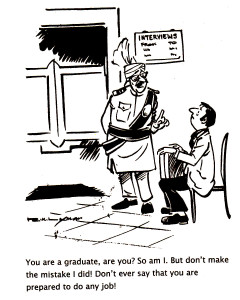
The management issues R K Laxman touches upon in his witty cartoons are wide-ranging. The messages are hard-hitting. For any manager who is trying to beat the blues, here is an effective anti-dote.
Driving the Boss Nuts

The perils of over-committing oneself
Punctuality
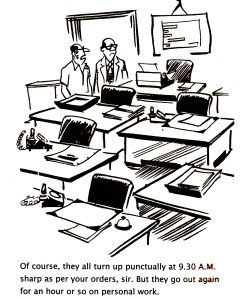
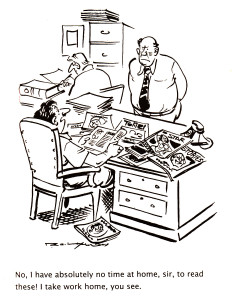
Caught reading naughty magazines in office?
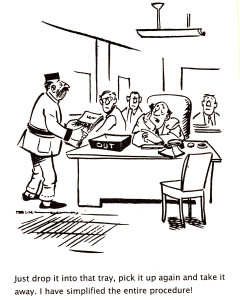
Simplifying systems and procedures
A manager’s life never has a dull moment. His/her career is like driving a crazy car which is always going either too fast or too slow. From the time a manager enters the n-dimensional space of his/her career space, till the time the boots/sandals are hung right and proper, a roller-coaster ride with uncertain twists and turns is the only certainty.
To maintain one’s sanity, it helps to revisit the works of literary geniuses who have created an eternal world full of blooming flowers bathed in the soft glow of humor. For those amongst us who are…
View original post 49 more words
Posted in Management Lessons, tagged Humour, Management, Management Cartoons, Mario MIranda, R K Laxman on January 29, 2018| 1 Comment »
What do we do when the raw excitements and vicissitudes of a managerial career sap our energy and excitement of life? With impossible deadlines looming large, a key team member suddenly disappearing on a furlough and the better half turning into a bitter half because of our indifference to attending the Parent Teacher Meeting in the kid’s school, we are just left gasping for some fresh air.
What could possibly perk us up on such a day? Browsing through the incisive and witty cartoons of someone like R K Laxman can surely help us to beat our blues. For decades, he has kept the sanity of our denizens intact by bringing us a daily dose of the travails of the ‘Common Man’. He has also produced some of the best management cartoons with messages for employees, CEOs and business owners alike.
There is a tongue-in-cheek quality in his cartoons which…
View original post 187 more words
Posted in What ho!, tagged Bertie Wooster, Global Happiness, Global Peace, Humour, Jeeves, Lord Emsworth, P G Wodehouse on January 22, 2018| 4 Comments »
 The foundations of our civilization are quivering. Homo sapiens are faced with a medical crisis of gigantic proportions. There is widespread concern about the pace at which the epidemic of Wodehousitis is spreading across countries and continents. Medical researchers of all hues are twiddling their thumbs, trying to figure out a cure for this dreaded affliction.
Wodehousitis is reported to be a disease which affects all human beings, irrespective of their age, sex, cast, creed or ethnicity. It is said to be highly contagious. A word of mouth is all that is required to lead one to contract it. One merely borrows a work of P G Wodehouse. A cursory perusal of any part of a narrative follows. A lifetime of bondage ensues. Frequent purchases of his books gladden the hearts of many a publisher. When one is not able to lay one’s hands on a particular title, one’s moral…
View original post 1,221 more words
Posted in What ho!, tagged C Northcote Parkinson, Happiness, Humour, International League of Happiness, Jeeves, P G Wodehouse, Royal Academy of Goofy Technologies, United Nations on January 10, 2018| 5 Comments »
The Honourable Secretary-General,
The United Nations,
New York City,
New York,
USA.
Respected Sir,
You may recall our brief interaction at the recent launch event of the International League of Happiness. You were then kind enough to spare a few moments of your precious time, graciously appreciating my talk there on preventing the misuse of Artificial Intelligence, just after releasing the Blandings Declaration of Happiness as a part of the proceedings.

As a concerned citizen of this planet of ours, allow me to offer my humble services for the cause of promoting international cooperation and maintaining international order.
Yours truly has an impeccable record in delivering satisfaction to all the employers one has been fortunate enough to assist so far in a long and spotless career. The aspiration hereafter is to offer my unique problem solving abilities for the benefit of all the denizens of this planet.
Permit me, sir, to present my credentials in brief:
Jeeves, Reginald, only son of the late Basil Jeeves, M. A., B. Ph., Oxford and London, and late Daisy Wiggins;
Family: Unmarried, no encumbrances;
Education: Privately;
Career graph:
Have been in service to the following:
Present occupation: Landlord, Angler’s Rest.
Specially appreciated for: Problem solving based on the psychology of the individuals concerned (even if it amounts to breaking a few eggs to make an omelet), Whipping up concoctions which could lift the sagging spirits of my lords and masters, Facilitating the creation of a positive image of even those who might otherwise be considered mentally negligible, Enabling harmony between disharmonious members of any group, Quick grasp of tricky situations and providing satisfaction to all stakeholders, Communication, Literary and scientific knowledge, Game Theory, Estate management and Sartorial matters.
Career objective:
General information:
Appeared in two films, Little Lord Fauntleroy and The Vampire of Vitriola, (Perfecto Zizzbaum);
Life member Junior Ganymede Club;
Honorary Deputy Secretary General, International League of Happiness;
Address: Angler’s Rest, Market Blandings, Wooster Estate, UK.
Testimonials and References:
Shall be happy to provide the same, as and when directed to do so.

To the best of my knowledge and belief, the esteemed organization under your wings faces mighty challenges in our turbulent times: Nuclear perils, terrorism, conflict resolution, continued violation of humanitarian laws, climate change, rise of protectionism, unemployment, income and wealth disparities, cyberspace warfare, and the like.
My humble skills have so far got utilized only by the rich and the lazy. Going ahead, it shall be my endeavour to assist someone of your stature in resolving problems which afflict humanity in general.
My advance gratitude for your kind attention and time,
Yours faithfully,
Reginald Jeeves
(Note: Personal and career details of Jeeves courtesy ‘Jeeves: A Gentleman’s Personal Gentleman’ (ISBN 0-312-44144-4), a book by C. Northcote Parkinson.)
(Related Posts:
https://ashokbhatia.wordpress.com/2017/12/13/a-brand-called-jeeves
Posted in What ho!, tagged Bertie Wooster, Humour, Jeeves, P G Wodehouse on January 6, 2018| 2 Comments »
All diehard fans of P G Wodehouse are well aware that when Jeeves takes charge, things begin to happen. When 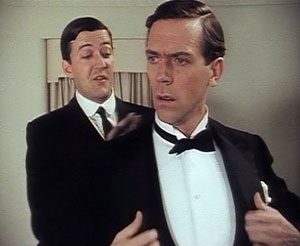 matters spin out of control and Bertie is twiddling his thumbs trying to figure out how to handle the harsh slings and arrows of life, Jeeves invariably comes to his rescue. With his eyes gleaming with intelligence and the head bulging out at the back, Jeeves is there to provide solace to his master. All others who repose their trust in his superior problem-solving abilities merely need to leave matters in his deft hands and positive results start showing up. More often than not, anyone who comes to depend upon him is concerned if he is eating enough fish those days. And no one really minds being a mere pawn in his hands because he delivers solid results.
How does Jeeves really pull it off? Here are some of the…
View original post 2,193 more words


 ashokbhatia