Feeds:
Posts
Comments

Posts Tagged ‘Humour’

Fans of P G Wodehouse are of various kinds.

There are those who enjoy an occasional saunter down some of Plumsville’s streets which boast of trees laden with luscious low hanging fruits of sublime humour.

There are also those who decide to spend some time on the banks of Plumsville’s merry rivulets and experience their gentle murmur while delving into one of Plum’s juicy narratives.

Then there are fans who happen to be intellectual coves. They believe that such sunlit humour deserves to be subjected to a pitiless analysis. One cannot rest content with merely basking in it, soaking in the unique warmth it offers, and moving on. One needs to delve deeper, discover the gems of wisdom hidden therein, and share the same with unsuspecting fans.

John Dawson happens to be one of them. His name needs no introduction. Erudite scholarship at its very best. Madam Eulalie, of which he is one of the Principals, is a website which strives to deliver deeper satisfaction to Plum’s ardent fans.

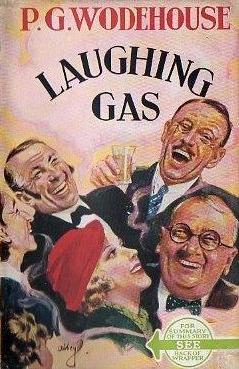
Here is a guest post from him, which carries a small slice of annotations of ‘Laughing Gas.’

Enjoy.
CHAPTER ONE

Sticky

requiring careful treatment; awkwardly difficult or unfortunate, unpleasant, nasty [1910-15]

P.E.N. Club

association of writers in founded London in 1921 to promote friendship and intellectual co-operation among writers; “Poets, Essayists and Novelists;” Its first members included Joseph Conrad, George Bernard Shaw, and H.G. Wells. Not to be confused with PGW’s fictional Pen and Ink Club of London, to which his female novelists Julia Ukridge, Leila Yorke, and Rosie M. Banks belonged.

Bicarbonate of soda

sodium bicarbonate; used as an antacid [1880-85]

Vet

to appraise, verify, or check for accuracy [1860-65]

Foozle

(d) to bungle or play clumsily [1825-35]

(my) tee shot

opening drive in golf

Anecdote about Scotsmen, Irishmen and Jews

Nineteenth and early twentieth century ethnic humor generally depicted Scotsmen as stubborn, Irishmen as drunks, and Jews as cheap; In a typical joke, two or three of them would be faced with a common situation and react according to stereotype. In Right Ho, Jeeves from 1934, Bertie relates a similar experience: I remember once detaining a dentist with the drill at one of my lower bicuspids and holding him up for nearly ten minutes with a story about a Scotchman, an Irishman, and a Jew.

Drones (Club)

PGW’s fictional young gentlemen’s club in Dover Street, Mayfair, which Wodehouse based on Buck’s Club at 18 Clifford Street in London; the origin of the name lies in a speech made by Joseph Chamberlain in the 1880s. Chamberlain, a renowned orator, in attacking the House of Lords, declared them to be ‘drones of the hive.” The phrase stuck in the public and (Wodehouse’s) consciousness. [NM] Geoffrey Jaggard estimates 173 Drones Club members, of which fifty-three are named in the course of the books and stories, including its most prominent member, Bertie Wooster

smoking room

a room set apart for smoking in a hotel or clubhouse [1680-90]

Cognoscenti

persons who have superior knowledge and understanding of a particular field, esp. in fine arts, literature, and fashion; from Lt. conoscere, to know [1770-80]

Right ho

Br. used to express understanding or assent [1895-1900]

Rummy

Br. slang, Odd, peculiar; also rum [1820-30] Swift speaks of ‘a rabble of tenants and rusty dull rums’ (country parsons). As these “rusty dull rums” were old-fashioned and quaint, a “rum fellow” came to signify one as odd as a “rusty dull rum.”

National Geographic Magazine

illustrated monthly journal of the National Geographic Society, begun in 1888 and known for its colorful photojournalism

Bilge (water)

Foolish, worthless or offensive talk or ideas; nonsense [1700-10]

Perisher(s)

a morally reprehensible person; a bounder Br. Au. Slang; an annoying person, esp. a naughty child Look at that frightful ass Spode swanking about in footer bags! Did you ever in your puff see such a perfect perisher? Code of the Woosters, 1938

Hollywood

Located in the northwestern part of Los Angeles, center of the American motion picture industry:

Joey Cooley

Wodehouse liked retaining the initial letters and rhythm of original names for his fictional characters; Norman Murphy writes that Joey is based on Jackie Coogan (1914-84) who became world-famous at the age of six when he played opposite Charlie Chaplin in The Kid (1920). But in 1934-35, when PGW wrote the prototype novelette for Laughing Gas, Coogan was no longer a child star — indeed, in 1937, her married Betty Grable. I think Joey is actually based on Jackie Cooper, born in 1922, who appeared in the early “Our Gang” shorts and emerged as a major child star in 1931 with “Skippy.” Wodehouse named the character Joey Cooley, but in the 1935 novelette of the same title, he’s Tommy Flower.

Idol of American Motherhood

PGW’s take on the sobriquets assigned by studios and fan magazines to movie stars; In Wodehouse’s short story The Nodder from 1933, child star Little Johnny Bingley — actually a 40-year old midget – is referred to as “The Idol of American Motherhood” and “The Child With the Tear Behind the Smile.”

Reggie Havershot

Outside of the physical description, background, and presence of Jeeves, Wodehouse has entirely appropriated his Bertie Wooster character to use as Reggie. There are dozens of points of similarity, from the way Reggie thinks and talks (in the otherwise-rare first person) to his quotations, his fractured and inane metaphors and similes, his self-deprecation/braggadocio, his appropriation of Bertie’s signature Gothic-Victorian musings: Hideous privations – A sort of hideous tenseness – Sheer horror – I reeled again – Hideous errand – I stood aghast – my blood froze – my soul recoiled in horror – Icy horror – hideous truth — a cold hand seemed to clutch my vitals – A fate. . . worse than death, and so on. Those familiar with the Bertie/Jeeves books and stories will immediately see that Reggie is cloned from Bertie — in a way that may be discomfiting to fans. In my opinion, Wodehouse, in adapting and expanding the original novelette, had to add material and more “personality” to Reggie, and chose Bertie as a convenient source. At any rate, almost the entirety of Reggie’s sentences and thoughts could be interpolated into a Bertie/Jeeves story and be entirely congruent to the Wooster character. If one had never read the Wooster/Jeeves output, Reggie would be an original, charming character — but since Wodehousians know and love Bertie, his appearance in someone else’s skin may leave some fans discombobulated.

Hark(ing) back

return to a previous subject or point; foxhunting, to return to a course for the hounds to regain the scent [1175-1225]

buckling down

setting to work with vigor and concentration [1300-1350]

Third Earl of Havershot

An Earl is a member of the British peerage, ranking below a marquess and above a viscount; an Earl has the title “Earl of” when the title originates from a place name; Havershot is fictional; but given Wodehouse’s propensity for using bits and pieces of real English towns for his own fictional names and places, it may be likely a compound of Havant (next door to Emsworth) and Aldershot, where public schools boxing competitions were held.

Cop(ping)

to catch, nab; to steal or filch; [1695-1705] the

. . . title

the Earldom

Hundred-to-eight shot

Gambling term indicating a chance of eight in one hundred to win; a long shot

Field was full of seasoned performers

Refers to other family members higher in succession order to the title; seasoned performer is usually used to describe a mature actor, actress, or athlete or someone who has long experience in his or her chosen field

Who could give me a couple of stone

boxing, refers to a heavier, larger opponent who would ostensibly be favored in a match. A stone is equivalent to fourteen pounds or 6.4 kg.

Uncles call it a day and hand in their spades and buckets

We try to take off the tension of death with a lighter cliché: “kicked the bucket,” “cashed in his chips,” and in a common Wodehouse usage, “handed in his dinner pail.” “I’m taking my spade and bucket and going home” is a pout spoken by a child playing at the seashore who feels he or she is no longer wanted. Although today the word order is usually reversed to “buckets and spades,” Wodehouse’s use was common in the late nineteenth century. He had used it in the 1928 story Fixing it for Freddie

Boxing Blue at Cambridge

A competitor who has represented Cambridge is permitted to wear a light blue blazer and an Oxford athlete a dark blue one. To earn a Blue, one has to have participated in an Oxford vs. Cambridge Varsity match. To be a boxing blue for either of these universities is a great honor.

Thorax

chest

Bill(s) of replevin

a court order for the purpose of recovering property in the wrongful possession of others

Give(ing) (me) the eye

To look fixedly at

(Isn’t it a) scream

something that is hilariously funny [1905-10]

Noblesse oblige

Lt., Nobility obliges; the moral obligation of those of high birth or powerful social position to act with honor, kindness, generosity, etc. “Nobility has its obligations” [1830-40]

Touch

The act of asking someone for money as a loan or gift

Collateral branches

Relatives descended from the same stock, but in a different line; not lineal; cousins, in-laws, etc

dip into the till

to help oneself to cash from a drawer, box or the like, as in a shop or bank, in which money or valuables are kept [1425-75]

Notice of Distraint

a legal filing to be served upon one in possession of assets belonging to a third party; a “padlock” or retainer action.

Tut-tut (ed)

Be still; hush; an exclamation used for checking or rebuking.

Tut, never fear me: I am as vigilant as a cat to steal cream; Tut, tut, thou art all ice, thy kindness freezeth

Shakespeare

Grew to Man’s estate

attained majority; reached a required age to inherit property and assume legal responsibilities

When I am grown to man’s estate, I shall be very proud and great, And tell the other girls and boys Not to meddle with my toys.

R L Stevenson in “A Child’s Garden of Verses”

London W. 1

London’s most fashionable district, encompassing Mayfair

Souse

drunkard [1915-20]

Bull-dog spirit

Stubborn and persistent; tenacious, ready to fight for one’s beliefs or wants [1490-1500]

If therefore that it is possible that the abolition of prize fighting may be prejudicial to that sort of bull-dog spirit of an Englishman, which is to be found in no other nation, we should pause before we attempt to effect it

Sporting Magazine, London 1823

Boat Race night

Gentlemen. If you ever find yourself in England on Boat Race night there are some things which it is absolutely necessary that you understand, if you mean to survive. Boat Race night is that night of nights when Oxford rows against Cambridge. What is important is the adherence to certain cultural protocols. For example, you must be well dressed. If your tailor is anything other than special you may as well not annoy the ancient day with your presence. Once you have succeeded in adding to the beauty of the landscape, you must find yourself a couple of equally well dressed chaps and plunge out in search of one of those most blessed merchants who deal strictly in the wines and spirits. You must be merry. However, there is a line you must not cross. Yes, you must be somewhat floating in potent fluid, but you cannot impair your mental or physical abilities. You need to be able to walk, and more importantly . . . run. Now remember, this is still before the actual race. You will have ample time to imbibe after the race as well, so pace yourselves. If you drink too much before, then you will have to turn down drinks afterward. I recommend drinking to that perfect equilibrium, where one decides to eschew the consequences and knuckle down to spreading sweetness and light. You now attend the race. Yell and holler until your throat needs a second moistening, and then unaware of the victor, return to the beverages. It is important that you have removed all means of identification from your person before this phase. It is also crucial that you not be arrested for disturbing the peace just yet, as you will be called upon by others to enact the most ancient and honored tradition the island kingdom has to offer. You will be told to pinch a policeman’s helmet. Now some might have ethical qualms about such a deed. Put these aside, if the alcohol has not already done it for you, and move on like a man. If policemen didn’t want their helmets stolen, then why, I ask you, would they wear them on Boat Race night? Approach the policeman from the rear. You will of course have to rob whatever policeman the boys have selected but remember that the bigger he is the slower he probably is. The smallish ones can be a bit tricky because they are generally able to run one down after the removal of the helmet. Do your best to disappear. This of course means that you must stop laughing. After assuming a position to the rear of your quarry,, remember above all things not to simply grab the helmet and pull straight back. In such a case the policeman comes with it. One must always pinch the helmet and never the policeman. As for the helmet, when successfully purloined, it will be an heirloom of your family’s for generations to come. So remember, thrust forward on the helmet first, for this disengages the strap from the chin, and then pull back. At this point you run away. But as is normally the case, you will more likely find yourself in a cell for the rest of the night and standing before the local magistrate in the morning. When in the courtroom remember what name you gave the constable when you checked into the facilities the night before. I suggest that you have a name in readiness before the day begins so you are less likely to make one up off the cuff and forget it in the morning. You must now plead guilty as charged and settle for whatever the magistrate imposes. Some will settle for a mere reprimand which is quite reasonable for a night’s entertainment, accommodation, and breakfast in the morning. A most unreasonable fellow will send you up the river for three days, or soak you for five pounds. Upon exiting the courtroom, you are a free man. You may return from whence you came with one Boat Race beneath your belt. Stand tall.

Nathan Wilson

Bonneting (policemen)

To pull or crush a person’s hat over their eyes, thus temporarily blinding them [1900-30’s]

Throwing soft-boiled eggs at the electric fan

Sport engaged in by the more inebriated Drones Club members and others on celebratory occasions; I believe the first appearance to be in Wodehouse’s 1916 Jeeves and the Unbidden Guest.

I have one friend, a most intelligent chap that writes sober, scientific books, and he’s always aching to throw an egg into an electric fan to see what will happen.

Jack London, The Valley of the Moon 1917

Harley Street

Just north of Oxford Street, the home of London’s most prestigious doctors for over a century [NM] home to Sir Roderick Glossop in Thank You, Jeeves, and to E. Jimpson Murgatroyd in Full Moon and Aunt’s Aren’t Gentlemen

Wireless

Chiefly Br. Wireless telegraphy [1890-95]

Drinking like the stag at eve

Sir Walter Scott (1771-1832) The Lady of the Lake: The stag at eve had drunk his fill, etc. Wodehouse uses it in The Story of Webster and The Old Reliable, among others

Pippin

(s) something or someone wonderful; an excellent or remarkable thing; Br. slang Used to describe an exceptionally attractive young woman.

Bird

Br. slang; a person, usually one who is odd or has some peculiarity

Dashed

Chiefly Br. Euphemism for damned [1790-1800] arose from the printers’ convention of rendering “damned” with dashes as “d—d”

Gruesome

causing great horror; repugnant; distressing; reverence: a feeling attitude of deep respect tinged with awe

High priest sicking the young chief

misprint/error for “siccing.” Probably inspired by a boy’s adventure story Wodehouse read at school. I haven’t been able to find an exact attribution. Ancient Aztec and Indian literature both could be sources as well, but more likely Wodehouse remembered the Kiplingesque adventure tales from his youth.

Butt(ing) in

to meddle in the affairs of others

Put a stopper on

finish up, cause to end; as in corking a bottle

Amour(s)

Fr. love affair

Live and let live

to tolerate other people’s actions and expect them to tolerate one’s own; “They thought differently about most things but worked together on a principle of live and let live” Dutch proverb, one of many versions of the theme

Spliced

joined together or united [1515-25]. Br. slang, Married

Twentieth Century Limited

express passenger train operated by the New York Central Railroad 1902-1967, it became one of the most famous trains in the world; Known for its style as well as for its speed, passengers walked to and from the train on a plush, crimson carpet which was rolled out in New York and Chicago, thus the “red carpet treatment” was born.

Heavyweight championship of the world

Coincidentally, on June 22, 1937, Joe Louis defeated James J. Braddock in Chicago to win the heavyweight championship. In Over Seventy Wodehouse wrote: This yearning I had to visit America. . . was due principally, I think, to the fact that I was an enthusiastic amateur boxer in those days and had a boyish reverence for America’s pugilists — James J. Corbett, James J. Jeffries, Tom Sharkey, Kid McCoy and the rest of them. I particularly wanted to meet Corbett and shake the hand that had kayoed John L. Sullivan.”

Trimmings

An accompaniment or garnish to the main dish [1510-1520] Reggie is referring to the money and property he inherited

Easy Street

A state of wealth, financial independence, or ease [1900-05]; also the title of a 1917 Charlie Chaplin movie

He determined to wait until the memory of his crime was forgotten, and then he would return, uncache his wealth, and live on Easy Street for the remainder of his days.

Bret Harte, Overland Monthly 1868

Application for soccage (socage) in fief

pro. SOAK-age; During the feudal period a person might hold land of a lord by knight service, which meant that he owed a certain number of days in service to his lord for the privilege of living on and cultivating it. But as the modern state arose, the concept of knight service waned and socage arose to fill in the gap. It entails the payment of a sort of annual tax to live on the land.

Heir apparent

an heir whose right is indefeasible provided he or she survives the ancestor [1325-75]

(Your) heart(s) rule your head(s)

To let impulse, esp. in romance, outweigh practicality. Origin unclear, very old.

“I suppose an affair of the heart to be such a situation of the feelings that the heart rules the head. The prime essence of love is that it should be complete, making no reservations and of allowing no checks from the reason.”

Doctor Claudius, 1883, Francis Marion Crawford.

Verbum sapienti satis

Lt. proverb “A word to the wise is sufficient.”

Collar

Legend has it that the detachable collar was invented in 1827 by a housewife who was having difficulties with her husband’s “ring-around-the-collar.” The most popular style of collar in 1900 was the “high-band,” a turndown collar with a height of from 2 to 3 inches that encased the whole neck in a smooth glossy cylinder of starched linen. Uncomfortable as these are, they made up over 60% of the collar trade in the summer of 1900. Hard collars continued to be popular through WW I, but the comfortable soft collared shirts worn in the trenches permanently impressed their wearers, so through the twenties the public slowly went back to spread collars, and discarded the detachables. By the 1930’s the hard collar was only the preserve of older men and conservative dressers, except for the wing collar for formal and evening wear.

Observation car

A railroad passenger car having a lounge or platform from which the passing scenery can be viewed. [1870-75]

Six-pennorth

Known as sixpence; American equivalent in 1936 would be about thirty cents.

(Permission to use this material is gratefully acknowledged.

In case you are tempted to savour more of such juicy stuff, please check out the Eulalie website: http://www.madameulalie.org/annots/pgwbooks/pgwlg1.html.)


Read Full Post »

ashokbhatia's avatarashokbhatia

The management issues R K Laxman touches upon in his witty cartoons are wide-ranging. The messages are hard-hitting. For any manager who is trying to beat the blues, here is an effective anti-dote.

Driving the Boss Nuts

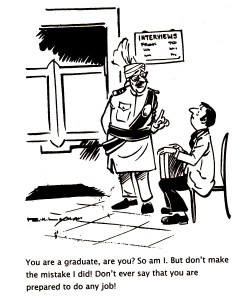
Cartoon Admitting Mistakes

The perils of over-committing oneself

Cartoon Flexibility in Jobs

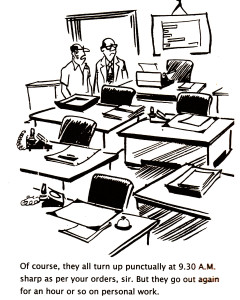
Punctuality

Cartoon Punctuality

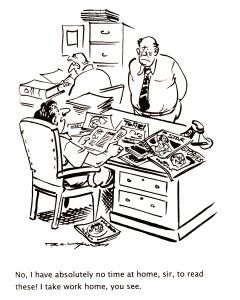
Caught reading naughty magazines in office?

Cartoon Taking Work Home

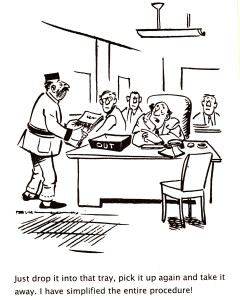
Simplifying systems and procedures

Cartoon Simplifying Procedures

A manager’s life never has a dull moment. His/her career is like driving a crazy car which is always going either too fast or too slow. From the time a manager enters the n-dimensional space of his/her career space, till the time the boots/sandals are hung right and proper, a roller-coaster ride with uncertain twists and turns is the only certainty.

To maintain one’s sanity, it helps to revisit the works of literary geniuses who have created an eternal world full of blooming flowers bathed in the soft glow of  humor. For those amongst us who are…

View original post 49 more words

Read Full Post »

ashokbhatia's avatarashokbhatia

What do we do when the raw excitements and vicissitudes of a managerial career sap our energy and excitement of life? With impossible deadlines looming large, a key team member suddenly disappearing on a furlough and the better half turning into a bitter half because of our indifference to attending the Parent Teacher Meeting in the kid’s school, we are just left gasping for some fresh air.

What could possibly perk us up on such a day? Browsing through the incisive and witty cartoons of someone like R K Laxman can surely help us to beat our blues. For decades, he has kept the sanity of our denizens intact by bringing us a daily dose of the travails of the ‘Common Man’. He has also produced some of the best management cartoons with messages for employees, CEOs and business owners alike.

There is a tongue-in-cheek quality in his cartoons which…

View original post 187 more words

Read Full Post »

ashokbhatia's avatarashokbhatia

PGWodehouseThe foundations of our civilization are quivering. Homo sapiens are faced with a medical crisis of gigantic proportions. There is widespread concern about the pace at which the epidemic of Wodehousitis is spreading across countries and continents. Medical researchers of all hues are twiddling their thumbs, trying to figure out a cure for this dreaded affliction.

Wodehousitis is reported to be a disease which affects all human beings, irrespective of their age, sex, cast, creed or ethnicity. It is said to be highly contagious. A word of mouth is all that is required to lead one to contract it. One merely borrows a work of P G Wodehouse. A cursory perusal of any part of a narrative follows. A lifetime of bondage ensues. Frequent purchases of his books gladden the hearts of many a publisher. When one is not able to lay one’s hands on a particular title, one’s moral…

View original post 1,221 more words

Read Full Post »

The Honourable Secretary-General,

The United Nations,

New York City,

New York,

USA.

Respected Sir,

You may recall our brief interaction at the recent launch event of the International League of Happiness. You were then kind enough to spare a few moments of your precious time, graciously appreciating my talk there on preventing the misuse of Artificial Intelligence, just after releasing the Blandings Declaration of Happiness as a part of the proceedings.

As a concerned citizen of this planet of ours, allow me to offer my humble services for the cause of promoting international cooperation and maintaining international order.

Yours truly has an impeccable record in delivering satisfaction to all the employers one has been fortunate enough to assist so far in a long and spotless career. The aspiration hereafter is to offer my unique problem solving abilities for the benefit of all the denizens of this planet.

Permit me, sir, to present my credentials in brief:

Jeeves, Reginald, only son of the late Basil Jeeves, M. A., B. Ph., Oxford and London, and late Daisy Wiggins;

Family: Unmarried, no encumbrances;

Education: Privately;

Career graph:

Have been in service to the following:

  • Esmond Haddock, Deverill Hall, King’s Deverill;
  • Dame Daphne Winkworth, Picklerod Academy for Young Ladies;
  • Percival Craye, 3rd Earl of Worplesdon, Worpley Maltravers;
  • The Hon. Digby Thistleton, 1st Baron Bridgeworth, Mayfair;
  • Nigel Strickland Davenant Rokely Fox-Medlicott, 5th Baron Brancaster Tittleridge;
  • Lord Frederick Ranelagh, Monte Carlo;
  • Montegue Todd;
  • Bertram Wilberforce Wooster (later 8th Earl of Yaxley), Mayfair (later Wooster Castle);
  • William Egerton Bamfylde Ossingham Belfry, 9th Earl of Rowcester, Rowcester Abbey.

Present occupation: Landlord, Angler’s Rest.

Specially appreciated for: Problem solving based on the psychology of the individuals concerned (even if it amounts to breaking a few eggs to make an omelet), Whipping up concoctions which could lift the sagging spirits of my lords and masters, Facilitating the creation of a positive image of even those who might otherwise be considered mentally negligible, Enabling harmony between disharmonious members of any group, Quick grasp of tricky situations and providing satisfaction to all stakeholders, Communication, Literary and scientific knowledge, Game Theory, Estate management and Sartorial matters.

Career objective:

  • To deliver satisfaction to the needy in all parts of the world; to utilize my unique skills in assisting you in the mighty task of promoting international cooperation and maintaining international order;
  • Open to being adviser to a head of state, preferably that of either a developed country or an emerging economy, on matters of international relations, sartorial protocol, management of coalition partners and parliamentary affairs.

General information:

Appeared in two films, Little Lord Fauntleroy and The Vampire of Vitriola, (Perfecto Zizzbaum);

Life member Junior Ganymede Club;

Honorary Deputy Secretary General, International League of Happiness;

Address: Angler’s Rest, Market Blandings, Wooster Estate, UK.

Testimonials and References:

Shall be happy to provide the same, as and when directed to do so.

To the best of my knowledge and belief, the esteemed organization under your wings faces mighty challenges in our turbulent times: Nuclear perils, terrorism, conflict resolution, continued violation of humanitarian laws, climate change, rise of protectionism, unemployment, income and wealth disparities, cyberspace warfare, and the like.

My humble skills have so far got utilized only by the rich and the lazy. Going ahead, it shall be my endeavour to assist someone of your stature in resolving problems which afflict humanity in general.

My advance gratitude for your kind attention and time,

Yours faithfully,

Reginald Jeeves

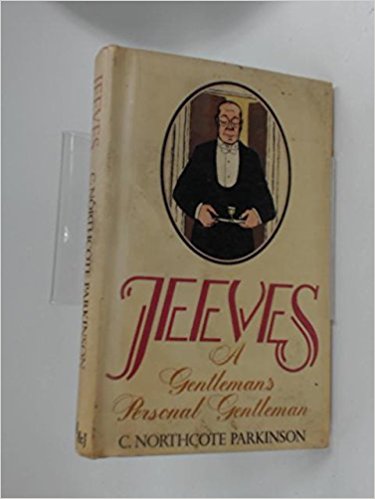
(Note: Personal and career details of Jeeves courtesy  ‘Jeeves: A Gentleman’s Personal Gentleman’ (ISBN 0-312-44144-4), a book by C. Northcote Parkinson.)

(Related Posts: 

https://ashokbhatia.wordpress.com/2017/12/13/a-brand-called-jeeves

https://ashokbhatia.wordpress.com/2017/10/12/an-invitation-from-the-international-league-of-happiness)

Read Full Post »

PGWodehouse

ashokbhatia's avatarashokbhatia

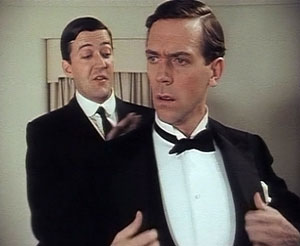
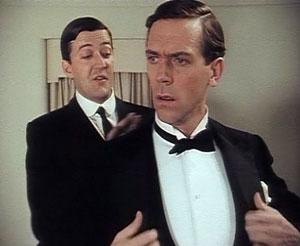
All diehard fans of P G Wodehouse are well aware that when Jeeves takes charge, things begin to happen. When PGW HughLaurie-BertieWoostermatters spin out of control and Bertie is twiddling his thumbs trying to figure out how to handle the harsh slings and arrows of life, Jeeves invariably comes to his rescue. With his eyes gleaming with intelligence and the head bulging out at the back, Jeeves is there to provide solace to his master. All others who repose their trust in his superior problem-solving abilities merely need to leave matters in his deft hands and positive results start showing up. More often than not, anyone who comes to depend upon him is concerned if he is eating enough fish those days. And no one really minds being a mere pawn in his hands because he delivers solid results.

How does Jeeves really pull it off? Here are some of the…

View original post 2,193 more words

Read Full Post »

The brand called Jeeves stands for impeccable service. It signifies delivery of results which exceed one’s expectations, that too with due respect, politeness and sagacity. The methods may be rough at times, but the neat results obtained do provide satisfaction to all concerned.

On the flip side, the brand also represents cunning. An undercurrent of subterfuge often manifests itself. An excessive control over the affairs of the hapless and mentally negligible masters is a cost to be borne to avail of the service package on offer.

Residents of Plumsville often wonder as to how Jeeves, the well-known gentleman’s personal gentleman, acquired the traits that eventually made him an indispensable asset to the upper crust of English society – the art of shimmering in and out, the detailed knowledge of Debrett’s British Peerage, the knack of solving some tricky problems facing his blue-blooded masters or his pals, and, of course, a deep understanding of the psychology of the individual.

C. Northcote Parkinson, the proponent of the famous law so very well known in management and bureaucratic circles, in his inimitable whodunit entitled ‘Jeeves: A Gentleman’s Personal Gentleman’ (ISBN 0-312-44144-4), unravels the kind of life Reginald Jeeves led, much before we get introduced to him in the memoirs of Bertie Wooster. For good measure, he also captures for us his life in the later years.

The making of the brand Jeeves

A rolling stone gathers no moss, the wise men have said. Jeeves, with his keen intelligence and a bulky head bulging at the back, uses each of his career pit stops to acquire diverse skills. Failures do not deter him. Instead, he uses these to learn and assimilate his knowledge, to be used for any future employer who might end up needing it.

Jeeves has learnt to beware of aunts. He has learnt to move silently, hear everything and say nothing. As a page boy in an academy for young ladies, he has learnt that all girls are to be avoided as much as possible and that those with red hair are especially dangerous. He has learnt that the ideal employer must always be, and should always remain, a bachelor. He has understood the nuances of flat racing. He has realized that a gentleman’s gentleman leads a more interesting life than that of a butler. He has discovered his talent in playing bridge and poker.

The repertoire of his skill sets is vast indeed. Regrettably, the narrative is completely silent on the kind of fish Jeeves is said to be fond of.

What makes Jeeves happy?

Intense introspection has led him to conclude that his inner happiness lies in resolving a tricky situation in such a manner as to merit a hearty round of applause from all concerned. The final scene has to belong to him. While all others are bewildered and confused, he would like to walk in, offering a neat solution to the problem at hand. He must be imperturbable, dignified and conclusively right. The solution may be such as to not only solve the main problem at hand, but also tie up a couple of other loose ends as well, thereby winning a warm approval from a wider cast of actors in the play. At this stage, the curtains may fall.

His keenest pleasure is in solving problems for people whose ability fell short of his.

Looking for an ideal employer

During the course of his long career, Jeeves has found that his preference is for prosperous and reasonably but not fanatically honest men. His employer must always be a gentleman, without a passion for horses, dogs, goldfish and parrots.

Pragmatic to the core, Jeeves does not boast of exceptionally high moral principles. Instead, he places a higher premium on social standards, excellence in sartorial tastes and polite behaviour.

Glisteroll in hair he does not approve of. Dazzlo toothpaste he scoffs at. Use of Seductor after shave lotion he does not recommend. Such are his exquisite tastes.

Bunter, the man of Lord Peter Wimsey, the detective, advises Jeeves to never work for a very clever gentleman like his own employer. After all, of what use is to work for someone whom one can never hope to deceive, someone who sees through every excuse and knows every trick? One has one’s own private life to lead. One should therefore find an employer who need not be mentally handicapped but should certainly be far from clever.

By seeking an employer who is stupid – good-natured, popular, but utterly brainless – he has the great possibility of making him dependent on himself. In his career, he aspires to be a Holmes to a Dr. Watson.

According to the narrative at hand, Jeeves goes out of his way to ferret out an employer who matches his expectations. Diving deep into the exhaustive journal maintained at the Junior Ganymede Club, he comes across one Bertram Wilberforce Wooster.

For Jeeves to identify his manservant Meadows and file a complaint against him for misappropriating his employer’s socks is the work of a moment. Meadows gets the sack and a vacancy gets created.

Two days later, Jeeves calls at 6A, Crighton Mansions, Berkeley Street, W1, only to find that there is indeed a vacancy for a gentleman’s personal gentleman.

The rest, as we all know, is history.

From valeting to buttling

Bertie taking a fancy to playing the banjolele marks the beginning of a phase where he and Jeeves start drifting apart.

Whereas a butler becomes the key figure in an established household, he does miss his days of roving the world as a bachelor’s personal attendant. ‘In becoming a valet the former valet admits to himself that middle age has arrived. He is about to settle down and put on weight.’

Jeeves accepts a position with the fifth baron Chuffnell, who is struggling to maintain Chuffnell Hall with his limited means. Once the baron decides to settle down with Pauline Stoker, Jeeves moves back to Bertie, when assured that the banjolele had been burnt in a fire at the cottage.

But this turns out to be a short reunion. Soon, the master decides to go off to learning the art of mending socks and Jeeves takes up the role of a butler to William Egerton Bamfylde Ossingham Belfry, 9th Earl of Rowcester, who is struggling to stay afloat at Rowcester Abbey, a picturesque ruin subject to regular flooding. Having assisted him in resolving his problems, Jeeves tactfully gives notice.

Jeeves yearns for permanence

Followers of Plum’s narratives would recall Jeeves returning to Bertie in the role of a valet thereafter. But Parkinson would have us believe that Jeeves has by then realized that to achieve stability and permanence in life, he has to settle down in the role of a butler, but not with some impoverished nobleman. A background of solid wealth is necessary. Eventually, he decides to return to Lord Worplesdon, who is now married to the wealthy Mrs. Gregson, Bertie Wooster’s formidable Aunt Agatha.

For many years, Aunt Agatha has avoided an inner urge to ask her middle-aged nephew to walk down the aisle. Results of her last attempt to do so, when a seemingly innocent girl at Cannes had turned out to be a gangster’s moll, had proven to be highly embarrassing. This time round, however, her attention is focused on Valerie Pendlebury-Davenport. Unbeknown to her, Jeeves intervenes and saves Bertie from losing his bachelor status.

Working with Aunt Agatha needs nerves of chilled steel, something which could be trying even for someone like Jeeves. Moreover, he now goes about polishing the silver with a dwindling enthusiasm and a growing dislike of the Countess, whose dislike for him is fully reciprocated.

Eventually, he puts in his papers and starts wondering as to how to use his many talents in some other field.

Support from a dashing Bertie Wooster

Meanwhile, with the death of Sir George Wooster, the Earl of Yaxley, Bertie Wooster has inherited the family estate, Wooster Castle, which also comprises Angler’s Rest. Countess Maud Wilberforce plans to return to her previous home in East Dulwich.


Armed with a title and property, Bertie enjoys a higher degree of self-confidence. He is now a justice of the peace and can no longer afford to pinch policemen’s helmets. No longer can he be considered as one being mentally negligible.

He decides to take a walk down the aisle with one of the most famous, though dreaded, characters from the tribe of the delicately nurtured, overcoming serious objections from her mother. One would not like to play a spoil sport here and reveal the identity of the new Countess, though.

Bertie also offers Jeeves the position of a landlord at Angler’s Rest. If one were to visit it these days, one can be sure of being told by him one of the several Hollywood stories concerning the two movies he had appeared in: Little Lord Fauntleroy and The Vampire of Vitriola, both produced by Perfecto Zizzbaum. Alas, Mr Mulliner has faded slowly into the cold and darkness of the night.

Brand Jeeves: Managing bosses

The character of Jeeves has a distinctive aura of its own. It teaches us the art of managing bosses. Significantly, it also teaches us how to manage our own selves better.

A brand stands for reliability and credibility. It signifies professional excellence. It delivers satisfaction to those it serves. Jeeves qualifies to be labeled as a brand on all these fronts.

The narrative dished out by C. Northcote Parkinson reaffirms the following to be the key factors behind his success in his chosen profession:

  1. Clarity as to what he loves doing in life, and a relentless endeavour to steer his career in that direction.
  2. Using his intelligence to introspect and understand the profile of an ideal employer to suit his temperament; taking adequate steps through proper channels to zero in on such employers from time to time.
  3. A keen sense of observation which helps him to anticipate the needs of his blue-blooded employers; ensuring continued dependence of his employers on him.
  4. Being a respectful and dignified listener, speaking only when necessary.
  5. Excellent learning ability; seeking advice from those in the know of things and following the same when it matches with his own values.
  6. Leading people by appearing to be a devout follower.
  7. Cultivating a boss who would take care of one in one’s sunset years.

Managers of all hues, sizes and shapes could learn much from the brand called Jeeves. An ability to introspect and strategize. Understanding one’s own strengths and weaknesses. Making the best use of opportunities that come our way. Using our inner resources to neutralize the threats we come across. Meeting the boss, dim-wit or otherwise, half-way through. Learning from successes as well as from failures. Being open minded. Choosing the company to work for with due diligence. Commanding respect and building one’s brand equity by delivering in excess of what is expected of oneself.

Those who are not blissfully ignorant of the existence of Jeeves can belong to two schools of thought. One, those who admire Jeeves and would love to have someone like him at their disposal. Two, those who detest him and would not like someone like him controlling their lives, even if it means their having to handle the harsh slings and arrows of Fate single-handedly.

But if there were indeed a Jeeves’ Academy of Boss Management, would you not like to enroll for a course thereat, irrespective of the school of thought you happen to belong to? It might add a unique sparkle to your career graph!

Jeeves by Northcote Parkinson

The fictional biography of Jeeves whipped up by C. Northcote Parkinson supplements the Wodehouse canon beautifully. It is built around characters and events that Plum fans are already familiar with. It captures the spirit of Jeeves’ character very well.

One is left wondering as to how Monte Carlo never came up with the idea of offering a honorary citizenship to Reginald Jeeves, following the example of Meringen (Switzerland) which has honoured Sherlock Holmes thus!

(Related Posts:

https://ashokbhatia.wordpress.com/2018/01/10/jeeves-seeks-a-placement

https://ashokbhatia.wordpress.com/2015/06/03/introducing-jeeves-saviour-or-snake

https://ashokbhatia.wordpress.com/2013/11/09/when-jeeves-takes-charge

https://ashokbhatia.wordpress.com/2013/11/13/when-jeeves-takes-charge-2-0

https://ashokbhatia.wordpress.com/2014/05/28/sherlock-holmes-the-honorary-citizen-of-meiringen-switzerland)


Read Full Post »

As you prepare yourself for a married life,

Full of love, happiness, joy and domestic bliss;

Here is an utterly butterly Plummy wish

Which you would do well not to miss.


Unlike Pauline Stoker, may you never ask your Bingo Little

To swim a mile before breakfast;  

And then playing five sets of tennis post-lunch,

Leaving the hapless guy shaken and aghast.


Like Honoria Glossop, may you never be prone to

Slapping the backs of guests with all your might;

Nudging the sterner sex to perform goofy deeds

With no consideration of their own plight.


May you never be like Florence Craye,

Trying to mould him into an intellectual cove;

Instead, groom him in washing dishes and changing nappies,

Shaping up a rebel lion into a docile dove.


Unlike Stiffy Byng, may you never prompt him

To pinch the helmet of a constable;

Landing him in a chokey,

Missing Bartholomew’s company at the dining table.


May you have occasional traces of Madeline,

Capable of gazing moodily at stars in the sky;

While the Bingo Little in your life

Serves some bacon and egg fry.


May you be an ideal mate,

Endowed with a generous helping of grey cells;

Feeding enough fish to Jeeves who can protect you both

When life rings its sinister bells.


A soulmate dishing out a seven course Anatole meal

With a magic wand;

Ensuring a liberal supply of tissue restoratives,

With pick-me-ups always at hand.


Keeping the house clear of invading cousins,

Ex-fiancees, cats, dogs and aunts;

Life free of silver cow creamers, speeches to school kids

and Pa Bassett’s taunts.


Fussing over him like Angela,

A spiritual view on life you would possess;

Despite sharks and occasional tiffs,

Helping his pals in distress.


If ever you decide to be an author like Rosie M Banks,

May he always support you in thought and deed;

Ensuring that you get your afternoon cup of tea,

Convinced that chums like Laura Pyke you do not need.

In matters of attire and appearance,

You would keep Jeeve’s admonitions at bay;

Deploying an emphatic stiff upper lip

When his financial misdemeanours lead him astray.  


An occasional sojourn of his to the Drones

You would surely not mind;

Keeping the milk of human kindness sloshing about,

Love softening the harsh blows of the daily grind.


Warm and cosy evenings may see him

Acting like the perfect preux chevalier;

Cuddling small ones the prattle of whose feet

Would make the home livelier.


Much like Sally, may you always inspire him,

Keeping his entrepreneurial ambitions alive and kicking;

Or follow the example of Joan Valentine,

Be an equal when executing a fruity scheme like scarab picking.


 Jeeves’ feudal spirit you would skillfully utilize

To ensure domestic harmony and bliss;

Delegating to him the mundane affairs,

A professional career of your own you do not miss.


Much like Roberta Wickham,

May you sashay up to the altar with much aplomb;

We pray that each moment spent with you,

May never be for him like a ticking bomb.


 May you both be like Joe-Julia and Piggy-Maudie,

Your fondness for each other growing over time;

When concerns about the lining of the stomach rule,

May grand kids enjoy your belting out a nursery rhyme.

Read Full Post »


When someone of the calibre of Arunabha Sengupta decides to wield his pen (oops….keyboard!) and dishes out something Plummy, die-hard fans of the Master Wordsmith of our times rejoice. The sceptics make feeble attempts to punch holes in the arguments put forth. The fence-sitters suddenly realize that there is more to Plum than meets the intellectual eye.

The rest of humanity, comprising those who remain not-so-blissfully unaware of the blissful works of P G Wodehouse, continues to trudge through life, sans the succour which low-hanging fruits of eternal wisdom offer on the streets of Plumsville.

Source: About

Read Full Post »

Honoria Plum successfully investigates the ensemble of reasons which account for the enduring appeal of P G Wodehouse. Sherlock Holmes would heartily approve.

Read on to find out more.

Honoria Plum's avatarPlumtopia

In 2015, BBC radio presenter Kirsty Lang interviewed director Rob Ashford and writer Jeremy Sams about their stage musical adaptation of P.G. Wodehouse’s A Damsel in Distress. It’s one of Wodehouse’s many transatlantic tales, and delves into the world of musical theatre. The central character is an American composer of musical show tunes, and he manages to navigate life efficiently enough without the assistance of a manservant.

KIRSTY: Now Jeremy, it’s a very engaging production, but the story’ is very much of its time. How confident were you that it would work for a 21st Century audience?

JEREMY: Well you say it’s of its time. What I love about it is, the things that attracted me and my co-writer Robbie Hudson, are absolutely how we feel now about America and England, and actually about theatre and high art, if you like. And the ideas that musicals, which I…

View original post 1,409 more words

Read Full Post »

« Newer Posts - Older Posts »