Feeds:
Posts
Comments

Posts Tagged ‘India’

(Continued)

Indian Ocean and Typhoons

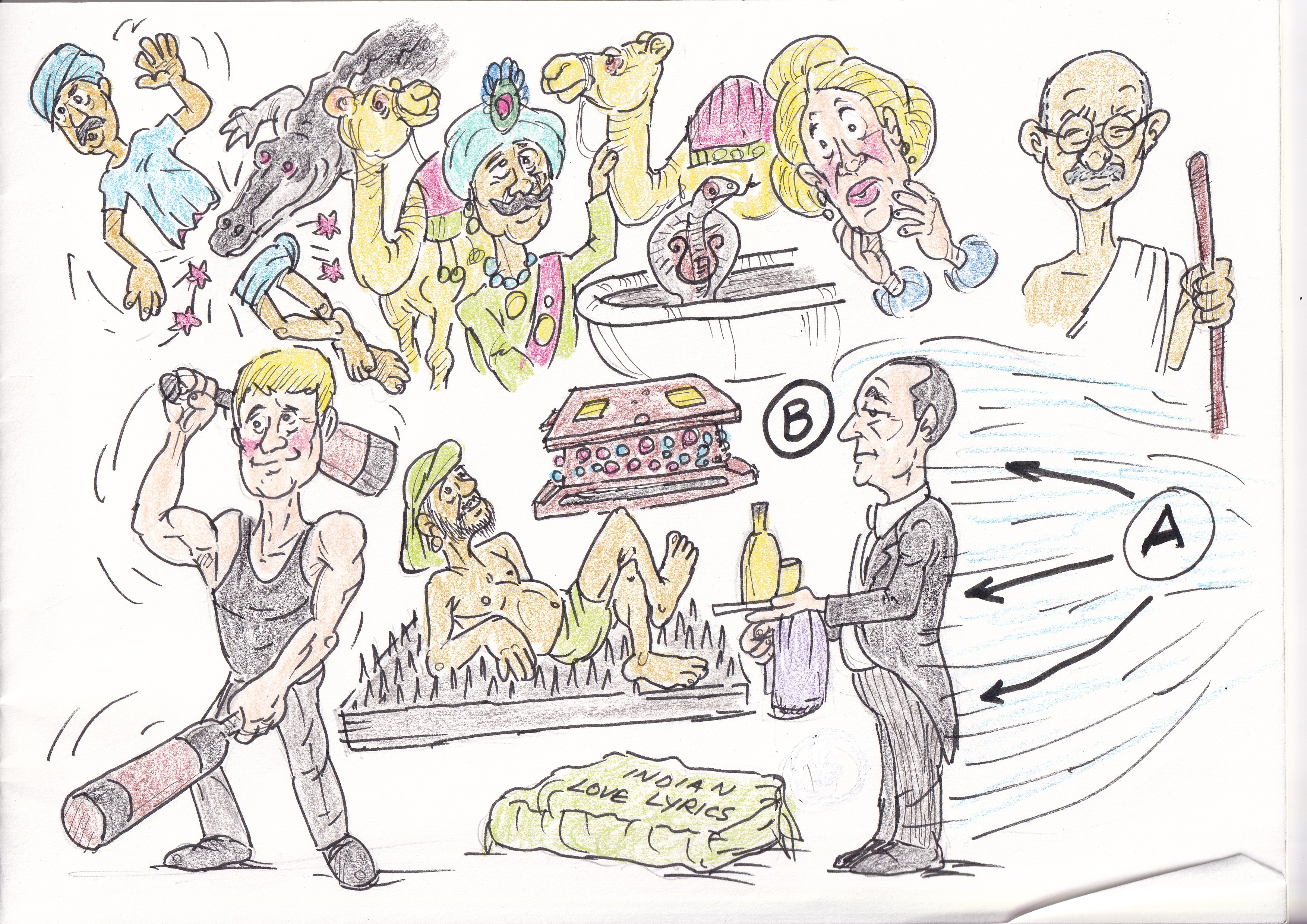
The Indian Ocean surrounds India on most of its Eastern, Southern and Western sides. It is the third largest of the world’s oceanic divisions. Often, cyclones and tsunamis come about, enabling water, one of the five elements of nature, to demonstrate its disastrous powers. Plum uses this to comic advantage.     

  • In Jeeves in the Offing, Kipper, upon seeing the newspaper announcement of the engagement of Bobby Wickham and Bertie, writes a stinker to her. Bobby Wickham takes umbrage. She takes his head off and Kipper experiences something akin to that of facing a typhoon on the Indian Ocean. She promptly announces her intention to get married to Bertie and returns Kipper to store. Jeeves, who is off to Herne Bay on a vacation, gets promptly roped in and helps Bertie Wooster to avoid a saunter down the aisle.  
  • In ‘Feet of Clay’, Nothing Serious, Captain Jack Fosdyke tells Agnes Flack of the time he saved Princess della Raviogli in the Indian Ocean. He claims that ‘there were half a dozen sharks horsing about then and behaving as if the place belonged to them’. He used a Boy Scout pocket knife to teach them a lesson or two.

Of Fakirs and Mystic Powers

Indian scriptures often use the Sanskrit term ‘siddhi’ to signify either a remarkable accomplishment or a singular proficiency attained by an aspirant. These could be material, paranormal, supernatural or magical in nature, attained by such practices as meditation, yoga and intense ‘tapas’ (austere practices).

Such attainments could include the ability to reduce one’s body to the size of an atom or even become invisible, to become infinitely large, to become weightless or lighter than air, to instantaneously travel or be anywhere at will, to achieve or realize whatever one desires, to control nature, individuals, organisms, etc., and also the ability to control all material elements or natural forces.

Like much else, this facet of India is also used by Plum to amuse, elevate and entertain his readers.

Floating Around Like a Gas

One of the sterling qualities of Jeeves is that of quietly popping up as and when the Master needs him. This quality of his is routinely invoked by Plum, using the teleportation analogy from India.

  • In ‘The Artistic Career of Corky’, Carry On, Jeeves, he is described as ‘one of those birds in India which dissolves itself into thin air and hop through space in a sort of disembodied way, assembling the parts again just where it wants them’.
  • In such other narratives as Right Ho, Jeeves and Stiff Upper Lip, Jeeves, he is said to be like those who go into thin air in Bombay (now Mumbai), reassemble the parts a little later in Calcutta (now Kolkata), displaying the property of a kind of gas which seems to float from Spot A to Spot B without much ado.
  • Joy in the Morning compares Jeeves to Indian blokes ‘who shoot their astral bodies to and fro’, disappearing in Rangoon (now Yangoon) and reassembling the parts in Calcutta (now Kolkata).
  • In ‘Trouble Down at Tudsleigh’, Young Men in Spats, Freddie demonstrates a similar proficiency by means of the speed at which he rushes down the stairs, only to run into Captain Bradbury. He behaves like an Indian fakir who would go ‘into thin air in Bombay (now Mumbai) and reassemble the parts two minutes later in Darjeeling’.
  • Galahad at Blandings also alludes to Indian fakirs of this kind.

Curling Up on Spikes

  • In Pigs have Wings, Jerry Vail does not like the ambience of Emsworth Arms and finds a furnished villa on rent as an option. However, when inspecting the bed on offer, he shrinks from the prospect of occupying it for many nights. After all, he is not an Indian fakir who is accustomed from childhood onwards to curling up on spikes.
  • In Summer Lightning, Rupert Baxter, when he starts becoming conscious of a growing cramp in his left leg, turns on one side with the nonchalance of those Indian fakirs who spend the formative years of their lives lying on iron spikes.

Contemplating the Infinite

  • In The Clicking of Cuthbert, Plum captures the kind of discipline and meditative contemplation required while playing golf. The club gets raised at least two times, touching the ball and being raised back again after a careful inspection of the horizon. At the third attempt, he brings it down and ‘then stands motionless, wrapped in thought, like some Indian fakir contemplating the infinite. Then he raises his club again and replaces it behind the ball. Finally he quivers all over, swings very slowly back, and drives the ball for about a hundred and fifty yards in a dead straight line.’
  • In The Girl on the Boat, when Sam achieves an almost imbecile state of boredom, his position is described as that of one of those Indian mystics who sit perfectly still for twenty years, contemplating the Infinite.
Indian Love Calls

Wherever Plum is, love cannot be far behind. India has gifted the world with the Kama Sutra, but it is not surprising that Plum never alludes to this unique treatise, because he never used sex as a ploy to popularize his narratives. All of his male characters are steeped in chivalry, strictly bound by Victorian norms. This aspect of his work had been covered by me in an earlier article entitled ‘Cupid in Plumsville’: (https://ashokbhatia.wordpress.com/2019/02/14/cupid-in-plumsville)

In his narratives, Wodehouse appears to have instead based his observations on The Garden of Kama, a collection of lyric poetry of Indian origin published in 1901, which makes liberal use of imagery and symbols from the poets of the North-West Frontier of India and the Sufi poets of Persia (Iran). The poems, written by Laurence Hope, a pseudonym of Violet Nicholson, are typically about unrequited love and loss. She had married Colonel Malcolm Hassels Nicolson, who was a commandant of the 3rd Battalion of the Baluch Regiment. The couple lived in Mhow in the central part of India from 1895 to 1900. 

One of her famous compositions, known as a ‘Kashmiri Song’, also appears in at least two of Plum’s narratives. 

  • In ‘The Knightly Quest of Mevryn’, Mulliner Nights, when Mervyn pops up at Clarice’s abode to report having suffered several privations and challenges in procuring strawberries in the month of December, he is made to wait in the drawing room where there is not much to entertain and amuse a visitor. He finds a photograph of the girl’s late father on the mantelpiece and several other items, including a copy of Indian Love Lyrics bound in limp cloth.
  • In Galahad at Blandings, Galahad strongly urges Lord Emsworth to be alert and on his guard. Dame Daphne Winkworth is not to be allowed to get him alone in the rose garden or on the terrace by moonlight. If she starts talking about the dear old days, he is to change the subject. He is to be wary if Dame Daphne Winkworth asks him to read her extracts from the Indian Love Lyrics after dinner. According to him, these have to be avoided like poison, because the consequences could be disastrous.
  • Jeeves and the Feudal Spirit opens with Bertie Wooster in his bath tub. ‘As I sat in the bath tub, soaping a meditative foot and singing, if I remember correctly, “Pale Hands I Loved Beside the Shalimar”, it would be deceiving my public to say that I was feeling boomps-a-daisy. The evening that lay before me promised to be one of those sticky evenings, no good to man or beast. My Aunt Dahlia, writing from her country residence, Brinkley Court down in Worcestershire, had asked me as a personal favour to take some acquaintances of hers out to dinner, a couple of the name of Trotter.’
  • In Ring for Jeeves, we find an alert and bright Captain Biggar crooning ‘Pale hands I loved beside the Shalimar, where are you now, where are you now? Where are you now? Where are you now?’ Jeeves walks in just then and outlines his ‘spider sequence’, a scheme to deprive Mrs. Spottsworth of a precious pendant she wears around her neck, thereby bringing some financial relief to all concerned. 

(Continued)

Notes:

The inspiration for this essay comes from the scholarly work done by Ms. Masha Lebedeva, who had earlier whipped up a research paper entitled The Russian Salad by P. G. Wodehouse.

The author expresses his sincere gratitude to an eminent expert on Plummy matters for having spared the time to go through a part of this composition and provide insightful suggestions. Some fans of P. G. Wodehouse have also suggested improvements in its contents.

Thanks are also due to Mr. Suvarna Sanyal for dishing out the main illustration in Part 1; also, to Ms. Sneha Shoney, who has edited the text.

Those of you who wish to cruise through this essay in its entirety may kindly write to akb_usha@rediffmail.com for a PDF version of the complete document to be mailed to them.

Related Posts:
Read Full Post »

(Continued)

Of Civil Disobedience and Mutinies

Till the year 1947, India was under the British Raj. The period was marked by Indians struggling to gain independence through means which were peaceful as well as violent. From 1920 onwards, the self-rule struggle was characterized by Mahatma Gandhi’s policy of non-violence and civil disobedience, duly complemented by several other campaigns.  

  • When people are hungry, they become angry. They want to go out and fight. This could even be true of Mahatma Gandhi, who is given a singularly juicy mention in ‘The Juice of an Orange’ in Blandings Castle and Elsewhere.

While narrating the story of Wilmot Mulliner, Mr. Mulliner blames the modern dieting craze of women for all the unhappiness which afflicts the world.

‘Women, of course, are chiefly responsible. They go in for these slimming systems, their sunny natures become warped, and they work off the resultant venom on their men-folk. These, looking about them for someone they can take it out of, pick on the males of the neighbouring country, who themselves are spoiling for a fight because their own wives are on a diet, and before you know where you are war has broken out with all its attendant horrors.

‘This is what happened in the case of China and Japan. It is this that lies at the root of all the unpleasantness in the Polish Corridor. And look at India. Why is there unrest in India? Because its inhabitants eat only an occasional handful of rice. The day when Mahatma Gandhi sits down to a good juicy steak and follows it up with roly-poly pudding and a spot of Stilton you will see the end of all this nonsense of Civil Disobedience.

‘Till then we must expect Trouble, Disorder … in a word, Chaos.’

  • Those who are familiar with the Indian mutiny of 1857 may recall that the Siege of Cawnpore is one of its key episodes. The British forces and civilians in Cawnpore (now Kanpur) were unprepared for an extended siege and surrendered to rebel forces in return for a safe passage to Allahabad (now Prayagraj), another city nearby. As a rescue force approached Kanpur, an unfortunate massacre took place, leading even to a war cry ‘Remember Cawnpore’. On at least two occasions, Plum captures the sentiments of elation experienced by girls under siege in Kanpur when they hear the sound of the bagpipers of the British reinforcements.   

The Girl in Blue describes how an authoress feels when she finds that a horn-rimmed American is trying to locate a copy of her latest book Daffodil Days. Flannery and Martin’s book shop in Sloane Square in London does not stock her latest brain child but when a stranger walks in and asks for it, Vera Upshaw is thrilled beyond measure. 

She whips around, her lips part, her eyes widen and her lovely body experiences a tingling of sorts. Her sentiments get compared to the thrill a girl would have experienced when, in the midst of the Indian Mutiny, during the siege of Cawnpore (Kanpur, 1857), she would have heard the skirl of the bagpipes, heralding the arrival of British reinforcements.

In Pearls, Girls and Monty Bodkin, similar uplifting sentiments are experienced by Monty when he suddenly finds a friend and sympathizer in Mr. Llewellyn.

Men in Uniform, the North Western Frontier Province (NWFP) and Hunting

Military men who had served in India as part of their duties tell us interesting anecdotes about that distant land, including about their time in the NFWP. The latter was a province of British India from 1901 to 1947, when it was ceded to Pakistan. Hunting was a common pastime. Some such references enrich many of Plum’s narratives.   

  • In Right Ho, Jeeves, while allaying the fears of Gussie that his trousers will split while delivering a speech at the Market Snodsbury Grammar School, an example is cited by Bertie Wooster – that of General Bosher, who was a D.S.O. (Distinguished Service Order), ‘with a fine record of service on the north-western frontier of India, and his trousers split.’  
  • In ‘Ukridge and the Home from Home’, Lord Emsworth and Others, we find that Ukridge has turned his Aunt Julia’s house into a hotel. Amongst the six guests, we find one Lieutenant-Colonel B. B. Bagnew, late of the Fourth Loyal Lincolnshires. In Ukridge, we find a suave and genial host, presiding over the dinner-table on most nights. As and when the conversation in the group ‘touched a high level and feasts of Reason and flows of Soul occurred’, one of the major contributors was the Colonel. He narrated his anecdotes of India, where he had served his country faithfully and well.
  • In the same story, Ukridge tells Corky that Indian army men are not to be trusted.  He thinks that all of them believe themselves to be heroes. Hence, they get greatly disliked. He cites Lieutenant-Colonel B. B. Bagnew’s clear views on lesser mortals like burglars. Colonel is of the view that if he were to ‘show them a good old army revolver, they would run like rabbits.’
  • In ‘Trouble Down at Tudsleigh’, Young Men in Spats, Freddie Widgeon gets formally introduced by Lady Carroway to Captain Bradbury from the Indian Army. He is competing with Freddie for the affections of April. Freddie believes that the Captain might have such advantages as a natty moustache, a rich tan and deep-set eyes, but what bowls over a refined and poetical girl is a refined soul. He intends to devour Tennyson over the next few days and be equivalent to six souls so as to beat his rival hollow.

At the end of a get-together, Captain Bradbury draws him aside and gives him the sort of look he would have given a Pathan discovered pinching the old regiment’s rifles out on the North-Western Frontier. He also mentions to Freddie that he had won the Heavyweight Boxing Championship of India earlier  

  • In the same narrative, one gets to learn that when one is up against one of the Indian Army strategists, one realizes how thoroughly they get trained from early youth to do the dirty on the lawless tribes of the North-Western Frontier. Captain Bradbury, when outfoxed at the door, is not one to beat a hasty retreat. Rather, he tries to outflank Freddie by trying to enter through the sitting-room window.

This is how Plum describes the aftermath:

‘But the interchange of glances did not last long. These Indian Army men do not look, they act. And it has been well said of them that, while you may sometimes lay them a temporary stymie, you cannot baffle them permanently. The Captain suddenly turned and began to gallop round the corner of the house. It was plainly his intention to resume the attack from another and a less well-guarded quarter. This, I believe, is a common manoeuvre on the North-West Frontier. You get your Afghan shading his eyes and looking out over the maidan (field), and then you sneak up the pahar (mountain/hillock) behind him and catch him bending.’

  • In the story ‘Bill the Bloodhound’ in Man with Two Left Feet, we find Henry, dressed up as an old Indian colonel one week, contentedly puffing away at a cigar provided by Walter Jelliffe while fondling his silver moustache. Only when Walter finds him comfortable enough does he pop the question.

‘And now tell me, old man, which of us is it you’re trailing?’

  • In Summer Moonshine, Colonel Tanner tells Mr. Waugh-Bonner about his life in Poona (now Pune), while Mr. Chinnery plays croquet with Mrs. Folsom. Throughout the narrative, he speaks enthusiastically of his life in the city, supplementing the spoken word with a display of photographic snapshots illustrating conditions in those parts. He also speaks of the Bengal Lancers, a regiment of the British Indian Army.
  • Captain Biggar, one of the several unique characters in Ring for Jeeves, loves hunting. One would never get surprised to run into him ‘in such hunting grounds as in Kenya or Malaya or Borneo or India’! It would be perfectly in order.

(Continued)

Notes:

The inspiration for this essay comes from the scholarly work done by Ms. Masha Lebedeva, who had earlier whipped up a research paper entitled The Russian Salad by P. G. Wodehouse.

The author expresses his sincere gratitude to an eminent expert on Plummy matters for having spared the time to go through a part of this composition and provide insightful suggestions. Some fans of P. G. Wodehouse have also suggested improvements in its contents.

Thanks are also due to Mr. Suvarna Sanyal for dishing out the main illustration in Part 1; also, to Ms. Sneha Shoney, who has edited the text.

Those of you who wish to cruise through this essay in its entirety may kindly write to akb_usha@rediffmail.com for a PDF version of the complete document to be mailed to them.

Related Posts:
Read Full Post »

(Continued )

Indian Fauna, Royalty

Indian fauna such as spiders, scorpions, cobras, elephants, tigers, cheetahs and lions regale the reader across many of Plum’s narratives. Princes and maharajas of yore also find a mention occasionally. 

  • Take the example of Summer Moonshine’s Colonel Tanner, who, during his tenure in India under the English raj, had learnt to be comfortable with the presence of Afridis, snakes, scorpions and even tigers in his sleeping quarters. Members of these species would ‘saunter into his abode as if it were a country club to which they had paid the entrance fee’.
  • In Thank You, Jeeves, Chuffy introduces Bertie to Sergeant Voules, who claims to have tackled as many as ninety-six big spiders while in India. Bertie’s protests that he is unable to sleep in his own bedroom because there is a big pink spider lurking around there (indirectly referring to Pauline Stoker, Chuffy’s fiancée, in his heliotrope pajamas!) get ignored. He gets hauled back to his bed. Luckily for all concerned, Pauline has already done the vanishing trick by then. 
  • In Aunts Aren’t Gentlemen, Orlo Porter runs into Bertie Wooster and is as startled as an Indian native who sees a scorpion in his path. He goes on to ejaculate: ‘Wooster, you blasted slimy creeping crawling serpent, I might have expected this!’
  • What does an Indian native do when bitten by a scorpion? In Uneasy Money, Plum tells us that ‘He does not stop to lament, nor does he hang about analysing his emotions. He keeps running until he has worked the poison out of his system. Not until then does he attempt introspection.’ The amiable Lord Dawlish, after a rather unpleasant meeting with Lady Wetherby, follows a similar policy. After leaving her house, he does not run. Instead, he takes a very long and rapid walk. He has an acute sense of being poisoned and wishes to work the poison out of his system. He has nothing on his mind other than walking faster and faster.
  • In Jeeves and the Feudal Spirit, Ma Trotter, upon going through a morning journal, discovers that the powers that be have gone ahead and knighted Robert Blenkinsop instead of her illustrious husband. ‘She stares at The Times much like an Indian resident would eye a cobra, had he found it nestling in his bath tub’.
  • On his part, the husband, L. G. Trotter, is a man who suffers from dyspepsia and is already out of harmony with his wife. The latter screaming her head off in the middle of the breakfast startles him, making him give her ‘the sort of look the cobra might have given the resident of India who had barged in on its morning bath.’
  • In Bachelors Anonymous, we run into Mr. Ivor Llewellyn, head of the Superba-Llewellyn studio of Hollywood. Having suffered through as many as five divorces, he wishes to remain a bachelor. However, upon Joseph “Joe” Pickering’s insistence that he visit a hospital, Cupid strikes yet again. He ends up proposing to Amelia Bingham, a nurse he comes in touch with at the hospital. He squarely blames Joe for having got him entangled into yet another prospect of marriage. Upon return, he looks at Joe with an open dislike, much like a resident of India registers ‘when he comes to have his morning bath and finds a cobra nestling in the bath tub.’
  • In Galahad at Blandings, as also in Pigs Have Wings, Plum says that Beach never buzzes off, ‘his customary mode of progression being modelled on that of an elephant sauntering through an Indian jungle.’
  • As per Meet Mr. Mulliner, as well asthe story ‘Gala Night’ in Mulliner Nights, when royalty goes a-hunting, it expects to be supported by elephants which display an easy nonchalance when their masters spot a tiger in an Indian jungle. But there are times when such hunting expeditions get spoiled by ‘the failure of the elephant to see eye to eye with its owner in the matter of what constitutes sport.’ How does one avoid the prospect of an elephant turning and galloping home? How does one ensure that a timid elephant would instead trumpet loudly and charge the fiercest tiger without any hesitation, ‘facing the tiger of the jungle with a jaunty sang-froid?’
  • Wilfred Mulliner has a solution in the form of a tonic known as Mulliner’s Buck-U-Uppo. Were a teaspoonful of it be mixed with the morning bran-mash, better results ensue.
  • Sunset at Blandings tells us how one feels when one is likely to face the prospect of facing a formidable person like Dame Daphne Winkworth? If Gally is to be believed, one would find oneself in the position of a native of India who knows that a tigress is lurking in the undergrowth near at hand and wonders how soon she will be among those present.
  • In Big Money, when Berry acts like a buoyant and aspiring sportsman in the jungles of India who has caught a tiger by its tail, he realizes that even though all has been well so far, his next move would need careful consideration.
  • Uncle Dynamite records the reaction of Sir Aylmer when being told by Lord Ickenham that he would go hundred miles to judge bonny babies. This thwarts the ambitions of Sir Aylmer no end. He starts ‘like a tiger that sees its Indian villager being snatched away from it.’ His face, already mauve, becomes an imperial purple.
  • Uncle Dynamite also describes the emotions of Hermione, a young authoress, who finds that her royalty earnings are likely to go up substantially but her father is conniving to rob the publisher of his means to publish her work. Her feelings are said to be even more poignant than those of ‘wolves which overtake sleighs and find no Russian peasant aboard and of tigers deprived of their Indian coolie just as they are sitting down to lunch.’
  • In Full Moon, Freddie, at Gally’s suggestion, smuggles Bill Lister back into Blandings Castle disguised as a false-bearded gardener, having paid off Angus McAllister. Lister soon ruins things, however, when he mistakes Veronica’s mother, Lady Hermione, for a cook and tries to bribe her to pass a note to Prudence. Later on, when Freddie appears to be whole-heartedly welcoming Lister after the latter has been asked to leave, Lady Hermione is found twitching her hands and has gleaming eyes. She is then likened to the puma of an Indian jungle about to pounce upon its prey.
  • In Piccadilly Jim, Jimmy has a unique style of proposing to Ann. He points out that if he were to go out of her life, she would be miserable. She would have nobody to fight with. She would be like the female jaguar of the Indian jungle who expresses her affection for her mate ‘by biting him shrewdly in the fleshy part of the leg, getting a shock one day to find that the mate has simply vanished.’
  • In ‘The Story of Cedric’, Mr. Mulliner Speaking, when Cedric crawls on all fours on the floor, his teeth are clenched and his eyes gleam with a strange light, he is said to look like an ‘exact replica of the hunting cheetah of Indian jungle stalking its prey.’
  • In the same narrative, when he cries out aloud, he sounds like an Indian peasant who, ‘while sauntering on the banks of the Ganges, suddenly finds himself being bitten in half by a crocodile.’
  • ‘Leave it to Algy’, A Few Quick Ones depicts Purkiss, having handed over a five-pound note to Bingo, giving a defiant look at Algernon Aubrey. His look gets likened to that of an Indian coolie, who, when he is safe up a tree, may give it to the baffled crocodile at the foot of it.
  • In The Girl in Blue, Jerry chooses to celebrate his triumph at the grill room of the Barribault’s which is said to be a ‘stamping ground of Texas millionaires and Indian Maharajas.’
  • In Luck of the Bodkins, Mr. Llewellyn wonders if his sister-in-law has ‘mistaken him for Rockefeller, Pierpont Morgan, Death Valley Scotty or one of those Indian Maharajas.’  
  • In Bachelor’s Anonymous, Sally realizes the true nature of Joseph Pickering while sitting in the lobby at Barribault’s, infested by Texas millionaires and Indian maharajas.
  • In Pearls, Girls and Monty Bodkin, Monty waits for Gertrude to show up in the lobby of Barribault’s world-famous hotel, the doors of which normally swivel around only to admit Texan millionaires and Indian Maharajas. The doors then revolve yet again to admit an elderly man with a face like a horse, Mr. J. B. Butterwick, who promptly proceeds to inform him that Gertrude will not be lunching with him on the day.
  • The story The Man Who Disliked Cats in The Man Upstairs speaks of Hotel Jules Priaulx in Paris. When rich people of any nationality come over to stay there, they often bring their pets along with. If an Indian prince has two dromedaries for company, the other one brings along a giraffe. The giraffe is reported to drink a dozen of the best champagne every day, so as to keep his coat in good shape. Young lions and alligators also pop up once in a while.

(Continued)

Notes:

The inspiration for this essay comes from the scholarly work done by Ms. Masha Lebedeva, who had earlier whipped up a research paper entitled The Russian Salad by P. G. Wodehouse.

The author expresses his sincere gratitude to an eminent expert on Plummy matters for having spared the time to go through a part of this composition and provide insightful suggestions. Some fans of P. G. Wodehouse have also suggested improvements in its contents.

Thanks are also due to Mr. Suvarna Sanyal for dishing out the main illustration in Part 1; also, to Ms. Sneha Shoney, who has edited the text.

Those of you who wish to cruise through this essay in its entirety may kindly write to akb_usha@rediffmail.com for a PDF version of the complete document to be mailed to them.

Related Post:

Read Full Post »

What ho!

To the best of my knowledge and belief, P. G. Wodehouse never set foot on Indian soil. But he has often alluded to its exotic temples, its wildlife, its royalty, its fakirs and mystics with magical powers, and even its love lyrics. Many times he has vividly captured facets of my beautiful country, serving up a delectable curry spiced with uniquely Indian condiments.

In this essay, the reader will find a random sample of references to India in Wodehouse’s novels and short stories. Such references are found across all his narratives, whether he is writing a Jeeves and Bertie story, a tale of Blandings, or a stand-alone novel.

Plum’s Indian Connection

Plum’s elder brother, Ernest Armine Wodehouse, was an English Theosophist, poet and educator. He is better known as the tutor of Jiddu Krishnamurti, the famous Indian author and lecturer on spiritual and philosophical subjects. He was admitted to the Theosophical Society at Poona (now Pune) in 1908. Before the First World War, he held a position as professor at Deccan College in Poona, India. After the war he returned to India. One can understand the source of Plum’s inspiration when he named one of his pet cats as Poona.

One of the important landmarks on Wodehouse Road in the Indian city of Mumbai is the Cathedral of the Holy Name. The seat of the Archdiocese of Mumbai, the cathedral is one of the most striking churches of the city. Its foundation stone was laid in 1902. It had then come to be known as the Wodehouse Church since it stands on Wodehouse Road, named after Sir Philip Edmond Wodehouse who was Governor of the city from 1872 to 1877. He was a distant relative of Plum’s. Sometime back, the road was renamed Nathalal Parekh Marg.

Few writers have Plum’s mesmerizing command over English. He uses it in an innovative manner, leaving the reader stepped to the gills with an overdose of Vitamin H(umour). It comes as no surprise that English-speaking Indians who are aware of his works simply adore him.

One of the unique features of India is its linguistic diversity. By default, English is the sole means of communication between different people from across the country. It acts as a bridge between large chunks of its 1.4 billion people who otherwise speak as many as 447 languages. Of these, 22 happen to be scheduled ones, deserving official recognition and support. Six languages – Kannada, Malayalam, Odiya, Sanskrit, Tamil and Telugu – are recognized as classical ones. English being a prominent link between people, Plum’s popularity in India is readily understandable.

But we digress. We are here to consider the kind of ingredients Plum uses while dishing out an Indian curry.

Some Indian fans of P G Wodehouse who have a chin-up attitude like that of Bertie Wooster and also a hearty capacity to laugh at themselves may appreciate the kind of India-centric similes Wodehouse uses at times to depict the behaviour of his characters.

In reading what follows, it may be advisable for a reader to imagine herself taking a leisurely stroll through either the Shalimar or the tulip gardens of Kashmir, or the Mughal Gardens in New Delhi, relishing the enchanting aroma of each section at a time.

The Indian Curry

Idols, Temples and Priests

Religious fervour is one of the main strands in the socio-cultural tapestry of India. One of its many unique features is its vast pantheon of gods and goddesses, its handcrafted and bejewelled idols, its magnificent temples and its overzealous priests.

  • In Ring for Jeeves, Rory speaks to Monica of a story published in The Strand Magazine in which a gang of blighters pops over to India and pinches a great jewel which is the eye of an idol. When one of the gang is deprived of his share in the booty, he seeks revenge by tracking down all the others and wiping them out. Rory is of the opinion that Captain Biggar is likewise casting a vengeful eye on Bill, as if the latter had denied the former his share of the proceeds of the green eye of the little yellow god in the temple of Vishnu. 
  • The feisty heroine of Something Fresh, Joan Valentine, acts as a muse for Ashe Marson when he suffers from a temporary writer’s block. She suggests that ‘The Adventure of the Wand of Death’ can only be about the sacred ebony stick stolen from an Indian temple which is supposed to bring death to whoever possesses it. Priests dog this person and send him threatening messages. Yet another episode of the adventures of Gridley Quayle, Investigator, gets dished out by Ashe.
  • Mr. Chinnery of Summer Moonshine is said to be an enormously rich person in spite of the incessant demands placed on his income by a platoon of ex-wives to whom he has to keep paying alimonies. Notices keep getting served on him in that respect. He suspects Mr. Bulpitt to be following him to serve yet another notice and shares his discomfiture with Sir Buckstone. He describes his latest encounter with Mr. Bulpitt as that of someone who steals the jewel and thinks he has hid himself rather well, only to look over his shoulder to find some sinister Indian priests around the corner. (Continued)

Notes:

The inspiration for this essay comes from the scholarly work done by Ms. Masha Lebedeva, who had earlier whipped up a research paper entitled The Russian Salad by P. G. Wodehouse.

The author expresses his sincere gratitude to an eminent expert on Plummy matters for having spared the time to go through a part of this composition and provide insightful suggestions. Some fans of P. G. Wodehouse have also suggested improvements in its contents.

Thanks are also due to Mr. Suvarna Sanyal for dishing out the main illustration; also, to Ms. Sneha Shoney, who has edited the text.

Those of you who wish to cruise through this essay in its entirety may kindly write to akb_usha@rediffmail.com for a PDF version of the complete document to be mailed to them.

Read Full Post »

One amongst the many services available to the citizens of India is the vast postal network it boasts of. However, due to legacy issues and a missing proactive technology-oriented drive, it is yet to reach its full potential.

Here is a thought-provoking post on the subject.

millennialmatriarchs's avatarMillennial Matriarchs

When is it that you last saw letters slipped under your door by the postman? For that matter, can you recall where your nearest postbox is?

The Indian postal system has a hoary history. The official website of India Post informs us that: ‘For more than 150 years, the Department of Posts (DoP)has been the backbone of the country’s communication and has played a crucial role in the country’s social economic development. It touches the lives of Indian citizens in many ways: delivering mails, accepting deposits under Small Savings Schemes, providing life insurance cover under Postal Life Insurance (PLI) and Rural Postal Life Insurance (RPLI) and providing retail services like bill collection, sale of forms, etc. The DoP also acts as an agent for Government of India in discharging other services for citizens such as Mahatma Gandhi National Rural Employment Guarantee Scheme (MGNREGS) wage disbursement and old age pension payments…

View original post 539 more words

Read Full Post »

ashokbhatia's avatarashokbhatia

Those who happen to know me personally are often deceived by my polite manners. They often wonder as to why I never opted for a diplomatic career.

Allow me to set the record straight. P G Wodehouse played some role in indicating that my Guardian Angels had planned my life much unlike that of Eustace Mulliner, who was a part of the British Embassy in Switzerland.

Jeeves’ psychology-of-an-individual factor has also led me to believe that the diplomatic corps on this planet are better off without me.

My limited intuitive faculties also tell me that life as a career diplomat could not be as glamorous and hunky dory as it might appear to be from the outside of an embassy building.

The Eustace Mulliner saga

Wodehouse fans might recall that the splendid idea of Eustace Mulliner joining the British Embassy in Switzerland was dangled before him by his godfather, Lord…

View original post 988 more words

Read Full Post »

ashokbhatia's avatarashokbhatia

Music has great power. It touches the innermost recesses of our being. It invigorates. When we attend a concert and soak in music which is uplifting and rich, there are moments when we can hardly bear the sheer bliss. Mellifluous notes surround us. We float in an ocean of musical waves, enjoying its depth and grandeur. We just wish for the time to stop its relentless onward march. We wish to forever live in that frozen moment of inward happiness. We crave to be left alone in space and time.

We live in exciting times. We have geniuses who enthrall us with music of diverse genres. Scintillating dance performances, mesmerizing concerts and rapturous vocals keep us spellbound. Right from the snow-clad Swiss Alps to the lush green plains of India, one is fortunate to have heard and seen maestros who have perfected the art of touching our souls and made…

View original post 536 more words

Read Full Post »

ashokbhatia's avatarashokbhatia

While dishing out the unique fare that P G Wodehouse specialized in, never would he have imagined the kind of spell it would cast upon the unsuspecting youth in a country like India which remained a colony of the British Empire for quite some time. The kind of whodunits which he unleashed on the gullible youth occasionally launched an array of goofy schemes and practical jokes. And if the setting for rolling out such schemes happened to be an educational institution, one can merely bemoan the fate of its Reverend Aubrey Upjohns and other illustrious lion-tamers who had no other option but to be at the receiving end.

Imagine an educational institution which is teeming with a bevy of intellectually inclined youth. It is not difficult to surmise just how busy the institute’s Wodehouse Society office bearers would be, whipping up one goofy scheme or the other at regular intervals.

View original post 1,112 more words

Read Full Post »

Summary

These days, as a pandemic stalks us, people are hooked to movies of all kinds, even while supposedly working from home. The cumulative effect of using high-definition gadgets, lockdown ennui, death tolls and binge-watching movies is that of a higher level of stress. The lack of freedom to venture out on long drives further compounds the problem. 

To avoid landing up in a loony bin, we could cut off our daily diet of depressing news. We could ensure interacting only with those who radiate positive vibes. We could also think of consciously changing our movie-watching palette so as to start appreciating flicks which have a deeper layer in their themes.

In this series, we consider some movies through the spiritual lens of 12 personality traits mentioned by The Mother of Sri Aurobindo Ashram at Pondicherry in India.

Introduction

When the upright good guy defeats the morally deficient bad guy, we cheer. Think of the James Bond franchise, courtesy Hollywood.

When a movie ends on a positive note, we applaud. Imagine any movie from Bollywood where the hero and the heroine finally walk into the sunset on a sandy beach, with a romantic song playing in the background. The unstated assumption is that the couple lived happily ever after.

When the outcome is negative but the movie is well crafted, we may sulk but still carry a favourable impression of it. Go back to either Titanic or Mughal-e-Azam. Both were tragedies but mounted lavishly, with excellence in almost all the departments of film making.

But once in a while comes along a movie which touches us somewhere deep inside. The script may carry a key message. Or, it may showcase certain values which we cherish ourselves, thereby creating a deep resonance within. We experience love. We feel hopeful and uplifted in a somewhat deeper manner. The soul gets awakened.

If we were to muse upon the theme much afterwards, we could say that such movies had been conceptualized with a dash of spirituality. These are movies which inspire us to live through and face difficult situations in our lives. We could think of classifying these in the genre of what we could refer to as Conscious (or Soulful) Entertainment.

Of a Spiritual Streak

Think of such movies as Shawshank Redemption, Avatar, Contact, Gladiator, Schindler’s List, The Sound of Music, Lagaan, Jagte Raho, Swades, Guide, Abhimaan, Mr. and Mrs. Iyer, Veer Zara and many others of a similar ilk. What do all these have in common? Yes, most of these are big hits. Yes, they have A category stars. Yes, all are well made. But these are not their most important features.

When we go back to the first time we watched one of these, most of us would recall having felt uplifted and hopeful. We would have felt compassion and love for the entire humanity. Our hearts would have felt much enlarged. Much like the short sequence from Mera Naam Joker where the hero’s heart goes on expanding and no one has a clue as to how to solve the problem!

We would have felt like living much longer, drinking deep from the rivulets of unalloyed joy that life offers. These films are but a few in the genre of ‘Conscious’ or ‘Soulful’ films which have the potential to change lives, inspire choices, and elevate human consciousness.

One of the spiritual lenses available to us to view such movies has been offered to us by The Mother of Sri Aurobindo Ashram at Pondicherry in India. She has mentioned the following twelve traits which are essential for the spiritual progress of an aspirant:

Sincerity, Humility, Gratitude, Perseverance, Aspiration, Receptivity, Progress, Courage, Goodness, Generosity, Equality and Peace.

Some movies which touch upon Mother’s 12 traits


Sincerity

The sincerity with which an individual takes up a challenging task and executes it well, even while risking his or her own welfare,  generates a swell of positive emotions within the viewer and sets an example of achieving perfection in the discharge of one’s professional duties.

Do Aankhen Baarah Haath (1957) which captured the valiant efforts of a jail warden Adinath (V Shantaram) to rehabilitate six dangerous prisoners released on parole to persons of virtue in an open jail experiment. Besides demonstrating how concentration, perseverance and hard work can make one realize one’s goals in life, the movie also drives home the point that if people focus their energy on a worthy cause in a sincere manner, success is easy to come by.

Maria (Julie Andrews) who is a free-spirited person lacking in self-discipline and self-confidence assumes the role of a governess for the seven children of Captain Georg von Trapp (Christopher Plummer) and ends up winning the hearts of the entire family in The Sound of Music (1965).

In Khamoshi (1970), we meet nurse Radha (Waheeda Rehman) who loses her own mental balance by being so sincere in discharging her duties as a professional as to neglect her own emotions of love towards two of her successive patients, Dev Kumar (Dharmendra) and Arun Choudury (Rajesh Khanna). A key lesson underlying the storyline is that of cultivating a sense of detachment in one’s profession, as highlighted in the Bhagavad Gita as well.

Think of Debaraj Sahai (Amitabh Bachchan) mentoring Michelle (Rani Mukherji) in Black (2005). The movie was inspired by The Miracle Worker (1962).

Humility

Here is a quality which covers such personality traits as purity, charity and obedience.

Gladiator (2000) captures the saga of General Maximus Decimus Meridius (Russel Crowe) who is devoted to Emperor Marcus Aurelius and works throughout his life to keep the Roman Empire safe. When offered the throne, he declines the offer, preferring instead to return to his village. Before he dies, he asks for political reforms, for his gladiator allies to be freed, and for Senator Gracchus to be reinstated. Maximus’s friends and allies honor him as “a soldier of Rome”. His character represents not only the purity of his intentions and loyalty to the empire, but also humility.

When denizens of planet Earth soar into space, they have this humbling experience of realizing how infinitesimal Homo sapiens happen to be in the overall scheme of a vast universe. We may be rooted in our prejudices and may be overly busy, what with our ego-skirmishes with others over petty matters and a relentless chase of the materialistic goals in our lives; yet, we are merely a fraction of a speck in the divine arrangement.

Watching movies like Apollo 13 (1995), Gravity (2013), and many others leaves us humbled in more ways than one.  

(This series of posts is dedicated to Ms Usha Bhatia, my late wife. Inputs from Mr Sanjay Mohan and Ms Gargi Banerjee are gratefully acknowledged)

(Related Post:

https://ashokbhatia.wordpress.com/2020/08/16/some-movies-with-a-dash-of-spirituality-part-2-of-4

https://ashokbhatia.wordpress.com/2020/08/20/some-movies-with-a-dash-of-spirituality-part-3-of-4

https://ashokbhatia.wordpress.com/2020/08/24/some-movies-with-a-dash-of-spirituality-part-4-of-4)

Read Full Post »


Here is how the sight of a wren, the smallest of birds in creation, fighting to protect her little nest from an intruding hawk taught me the difference between patriotism and nationalism.

As she unleashed the fury of her miniscule wings and beak, I heard the wren say the following to the overbearing hawk who had obvious contempt for the little bird seeking to defend so negligible a homestead:

“Dear predator, here is what you need to understand: the same god who made you a hawk made me a wren, gave me a tree into which I could build my nest.My nest is not the greatest of homes, but the only home I know and love, like every other wren in every other part of the earth. Like all other wrens everywhere, I love my nest, just as every hawk on every mountain peak everywhere feels proud of the peak upon which it keeps its offspring safe, regardless of which nation the mountain belongs to.

I make no claim that my nest is the greatest of all nests, or has any magical properties. I defend it because I am used to it and is the only nest I have. I labour in sunshine and sleet to keep it safe, just like wrens in other places value their little nests and defend the same with vigour. And god gives me the strength to fight for its preservation, as wrens in other countries fight for theirs.”

In not claiming that her little nest was anything but a little nest, but one dear to her and her fledglings, the wren was simply proclaiming herself a patriot. And in admitting that her nest was not the greatest abode in the wide world, the wren was disclaiming to be a nationalist.

Many years later, when I was in the United States of America, the memory of the wren became my political inspiration.

Persuaded to stay back and accept a tenure-track teaching job at a reputed university, I declined the kind offer.

Pressed to explain why I was foregoing so exclusive an opportunity, I found myself saying that I would miss home.

On being asked what it is I meant by the term “home,” I found myself pleading that home was something entirely different from a fine house equipped with all the comforts that material advancement makes available. Home evoked the memory of sights, sounds, smells, cadences of social interaction, attitudes to time, space, money, the deep oneness with the languages we wa are born into and in which our imaginations embellish our realities. I remember referring to the charms of the wayside oven (tandoor), now fast vanishing, alas, under press of sophisticated urbanization, where I often stop while traveling to savour a hot-baked bread—a pretty proletarian fetish, but one that filled some deep longing in me. I pleaded that this was a feeling akin to an ordinary American lapping up a bowl of clam showder or beans along an ordinary street; and that just as an ordinary American working man or woman made no claims for American “exceptionalism” on the strength of her quotidian repast, I loved my roadside baked bread without extending that sentiment to claiming that India was the greatest of nations.

Home was simply a cadence of un-self-conscious living that informs everything from our palate to the structure of our interactions with our weltanschuuang. Something that enables us to understand similar feelings in other peoples who live outside the territories that define our geographical nations.

Indeed, the current spectacle of hundreds of thousands of migrant workers trudging to their villages away from the metropolises teaches us that home may not always correspond even to the designated countries of which we are citizens, but recede into hinterland spaces. A migrant worker from Uttar Pradesh or Bihar may feel as alienated in Mumbai or Bengaluru as a rangy Texan in New York, unimpressed in either case by the superior claims to glitter of the megapolises they leave. In such episodes not only is nationalism a distant thought, but even our patriotism may shrink to pieces of land that speak to our souls.

Thus, were I to echo the sentiment “India first” I would not mean by that India above all, but to express the sentiment of the least inhabitant of my country who might wish her little hutment to be clean and attractive because, simply, it was a space closest to her existence.

I came to realize that such attachment to the concrete conditions of our grooming and lived being constitutes patriotism, whereas projecting that concrete into an unfelt abstraction that has never any basis in fact or reality comprises nationalism. My confluence with my given space and order of living did not, I made clear, in the least cloud my objective recognition that other peoples in other countries have notched up achievements that transcend what India may have to her credit. And, like the wren, I do not covet the mightier claims of the hawk, but simply seek to defend the nest I love.

Patriotism, or our love of our given clime, leaves us free to value a like sentiment among peoples in other climes and countries, and free to find fault with what we may be lacking without letting bravado or false claim distort those realities.

Nationalism, like religious faith, permits no such room. It asks of us that we propagate that we outshine all other peoples, cultures, climes, countries in every sphere of life because of some divine origin or exclusive right to perfection.

Where patriotism denotes love of our country and clime, nationalism denotes a politics of dominace, built on myths and legends that have no discernible or objective reference to who we are and how we subsist in our daily lives.

In that context, I recall a most instructive vignette to which I just happened to be witness.

A political pracharak (propagandist) working with people in a slum area was encouraging little slum children to say “Bharat Mata ki Jai” (Obeisance to Mother India). At which a little girl with disheveled and matted hair asked “where is she? Where can we meet her”? The pracharak, rather askance, said “She is everywhere.” The little rag picker then wondered why she never comes to meet them, and why, if she is such a caring mother, are they always hungry and destitute.

In that interaction, I saw a telling debate between the abstract and the concrete, and an innocent but searing refusal of reality to be fibbed off by a great nationalist idea. Clearly, the abstract idea of a supervening mother did not square with the little girl’s experience of motherhood as she experienced it.

It struck me that the same sentiment afflicts downtrodden peoples in all parts of the world, and nationalist slogans about their particular countries being “first” do not help alleviate the miseries of the marginalized.

The episode of the little slum girl brought to mind another. In my undergraduate class, there used to be an African-American student named Rufus. Over the semester, I found that he was not coming to class. One day along the university street I saw him, discovering to my astonishment that he had acquired a fair-skinned face, rather like the legendary Michael Jackson. When I expressed my astonishment, he simply said: “this country is great only for the whites, and I mean to be great.” Rufus had clearly decided to go over to a prevailing, even if covert, definition of nationalism. Even as his patriotism remained strong enough to disallow him from abandoning the country he was born and grown up in.

It should be obvious that our love of our countries bears no relation to the abstract constructions of their alleged greatness, but only to the concrete fact that we are born there, speak our own dialects, and commiserate with one another in specific forms of cadence. And, the fact that other climes and countries may have lesser or greater claims to national stature makes little difference to our love of our little nests.

Natonalism enjoins upon us to believe that our air is the most salubrious, our water magical, our sunsets and sunrises unique ly blessed, our accumulated histories and legends superior to those of all others, our culture the only worthwhile culture, our religious faiths nearest to god, and our stores of knowledge beyond compare.

Patriotism acknowledges that where I live is my beloved space, warts and all. It makes no claims to exceptionalisms that are thought to be god’s unique gift to us. It recognises that our streets are shabby, our lanes full of clutter, our habits shoddy, our resistance to rationality often grossly debilitating, our defiance of law a routine habit of mind, our male chauvinism shameful and violent, our casteism or racism or communalism deleterious to the most desirable ideals of human rights and human oneness. Patriotism recognizes that things may be better in other countries and, less so in yet others, and patriots seek to better such conditions and realities without covering them up in sham slogans born of abstraction that have no real existence, or impelled by a gnawing sense of inferiority.

Patriots understand and honour patriots in other nations. Nationalism constructs them as potential enemies.

Patriotism accepts the great reality of diversity; nationalism seeks to obliterate diversity and aims to create the world in its own abstract theology of supremacy.


(The author, who taught English literature at the University of Delhi for over four decades and is now retired, is a prominent writer and poet. A well-known commentator on politics, culture and society, he wrote the much acclaimed Dickens and the Dialectic of Growth. His book, The Underside of Things—India and the World: A Citizen’s Miscellany, 2006-2011, came out in August 2012. Thereafter he wrote two more books, Idea of India Hard to Beat: Republic Resilient and Kashmir: A Noble Tryst in Tatters.

Permission to publish this article is gratefully acknowledged.)


Read Full Post »

« Newer Posts - Older Posts »