Here are some words of praise from people across different professions, diverse backgrounds, and from varied geographies.
Anatoly Yakorev
Mentor for Conscious Enterprises Network,Montenegro (Former Director, Centre for Business Ethics & Compliance,Moscow, Russia)
Managers face mighty challenges while delivering results. Ashok Bhatia cleverly alludes to the Bhagavad Gita’s lessons they can learn and begin to practise such concepts as detachment, and equanimity. He provides relevant examples from the corporate world to illustrate his arguments, making this book an interesting read.
Dr Bharat Nain, Arbitrator & Management Consultant, PhD, MBA, BE(Mech), FSIArb, MCIArb,Pune, India.
Ashok Bhatia, through his excellent book, propounds an alternative path that draws on the spiritual aspect of what is regarded as the foremost “religious book” in the Asian context, the Bhagavad Gita. Differentiating between the “mind and intellect”, he has used an ancient spiritual text to convey his message very simply and with humour.
Dr Ananda Reddy
Director, Sri Aurobindo Centre for Advanced Research, Puducherry, India
I am of the view that business leaders and managers may not consciously want it, but they really need it. It offers the only remedy for correcting mankind’s lopsided growth and bringing him sanity, inner and outer balance, peace, and harmony. The book by Ashok is a commendable effort. I wish the book and its future readers the very best in life.
This book is a rare, business-friendly bridge between timeless Gita wisdom and the lived realities of modern organisations. Ethics and values are made to feel operational rather than ornamental. It speaks directly to pressure points leaders recognise, from stress and burnout to ego, desire, conflict and office politics. Karma Yoga stands as skilful action with steadiness in success and failure. It offers a calm, practical case for inner resilience, detachment, and better judgment in uncertain times. The book’s light humour keeps profound ideas accessible without diluting them. It finally acknowledges the technological moment, including the challenges of Industrial Revolution 4.0 and AI-era complexity. It leaves the reader with a clear invitation to go deeper into the original scripture, guided by a grounded corporate lens shaped by Ashok Kumar Bhatia.
Late Dr (Prof) G P Rao,
Founder-Chairman, SPANDAN, India (Former Senior Professor and Founding Head, Department of Management Studies, Madurai Kamaraj University, 1981–1997)
Ashok Bhatia paints a wide canvas of the kind of strategic and tactical issues business owners and managers face in their routine lives. With a calm objectivity, he demonstrates how the same could be resolved by imbibing what the scripture says. The undercurrent is essentially that of following high values and ethics in management, so a business may run on a sustainable basis.
Marco Suomalainen,
MMM Enabler at UHM (Uncovering Hidden Meanings),
Kotka, Finland
The book enables one to keep learning about the precious jewels existing in India. Industrialists and managers who wish to understand the basic concepts of the Bhagavad Gita and improve their ability to handle challenges in a more constructive manner would find this book very useful.
Mohan Arumugham
Global Technology Leader; IT Director – ERP
Digital Technology
GE Power, USA
This book motivates me to look at the bigger picture in life, while at the same time remaining connected to my inner self. Using many examples of the kind of challenges we face in our careers, it makes us appreciate the deep wisdom contained in the Gita. The book, even though rooted in ancient Indian wisdom, has a global appeal.
Ashok Narayan
IAS (Retired), Expert in Indian Scriptures,
Gandhinagar, India
The author has done a wonderful job of demonstrating how the eternal knowledge of the Bhagavad Gita can be applied to the business world, thereby enabling managers and CEOs to achieve their goals with maximum efficiency and to deal with all the problems without accumulating stress or losing the balance of mind.
Chandra Shekhar Dwivedi
Ex-Vice President (Manufacturing and Corporate Planning)
HCL Infosystems Limited, Pondicherry, India
Mr Bhatia is back with his references to what he calls the ‘corporate jungle’. If the theme of his earlier book was about survival, this one addresses the issue of doing well in one’s career. However, his underlying message continues to be that of adherence to values and ethics in business, of corporate governance, of human values and of conscious management.
P R Ganguly
Member, Industrial Advisory Board, Manufacturing Department, Cranfield University, England
Ex-Deputy Chairman and Managing Director, Grenson Shoes Ltd, UK
The book is a great primer for CEOs and managers who are keen to get a basic grasp of the universal concepts highlighted in this unique scripture from India. The timeless lessons enshrined in the Bhagavad Gita have been innovatively presented by Ashok, with limited doses of subtle humour of a British kind.
Nilima Bhat
Founder: Shakti Leadership and Shakti Fellowship, Global Program for building Conscious Leaders & Change-makers, Co-convener Truth & Reconciliation Work, Distinguished Professor in Gender and Conscious Leadership. Business School and School of Humanities and Education, Tec de Monterrey, Mexico
I have no doubt that this book would be a valuable addition to the personal book collection of all leaders, as long as it does not merely remain either on their shelves or on their ‘To-Be-Read’ lists but gets quickly absorbed and put to practical use.
Ram Mohan Pisharodi, Ph.D.
Marketing Professor,
Oakland University,
Rochester, Michigan, USA.
Ashok’s latest book is like a scuba dive which gently nudges the reader toward experiencing a deeper sea-bed exploration of the original scripture itself!
Vasco Gaspar
Human Flourishing Facilitator
Portugal
Ancient works like the Bhagavad Gita offer a source of knowledge to help leaders have this inner guidance. The work of Ashok Bhatia offers a convenient bridge between these ancient pieces of wisdom and the modern fast-paced world, allowing leaders and managers to apply this knowledge to their own lives and careers.
Gayatri Majumdar
Author, Founder-Editor, The Brown Critique Literary Journal, Pondicherry, India
Just as in life, there are varied ways to approach the perceived challenges and stress in a corporate environment! How can one navigate this ‘jungle’ with equanimity and inner resilience by “controlling the wild horse called mind”? Answers to many of our predicaments can be found in the eternal wisdom of the Bhagavad Gita. Ashok Kumar Bhatia’s Bhagavad Gita’s Guide to Corporate Dharma is an extraordinary book for all. He elucidates profound ideas with great simplicity, tremendous authenticity and logic. This captivating book draws parallels with Arjuna’s dilemma on the battlefield, and can be invaluable for management students and corporate leaders alike. It can guide us to enhance the quality of not just own life but everyone we cross paths with.
How does a member of the tribe of the delicately nurtured feel when taking a just-born baby into her hands? As someone who is instead a member of the so-called sterner sex, I am least qualified to describe that moment of overwhelming joy.
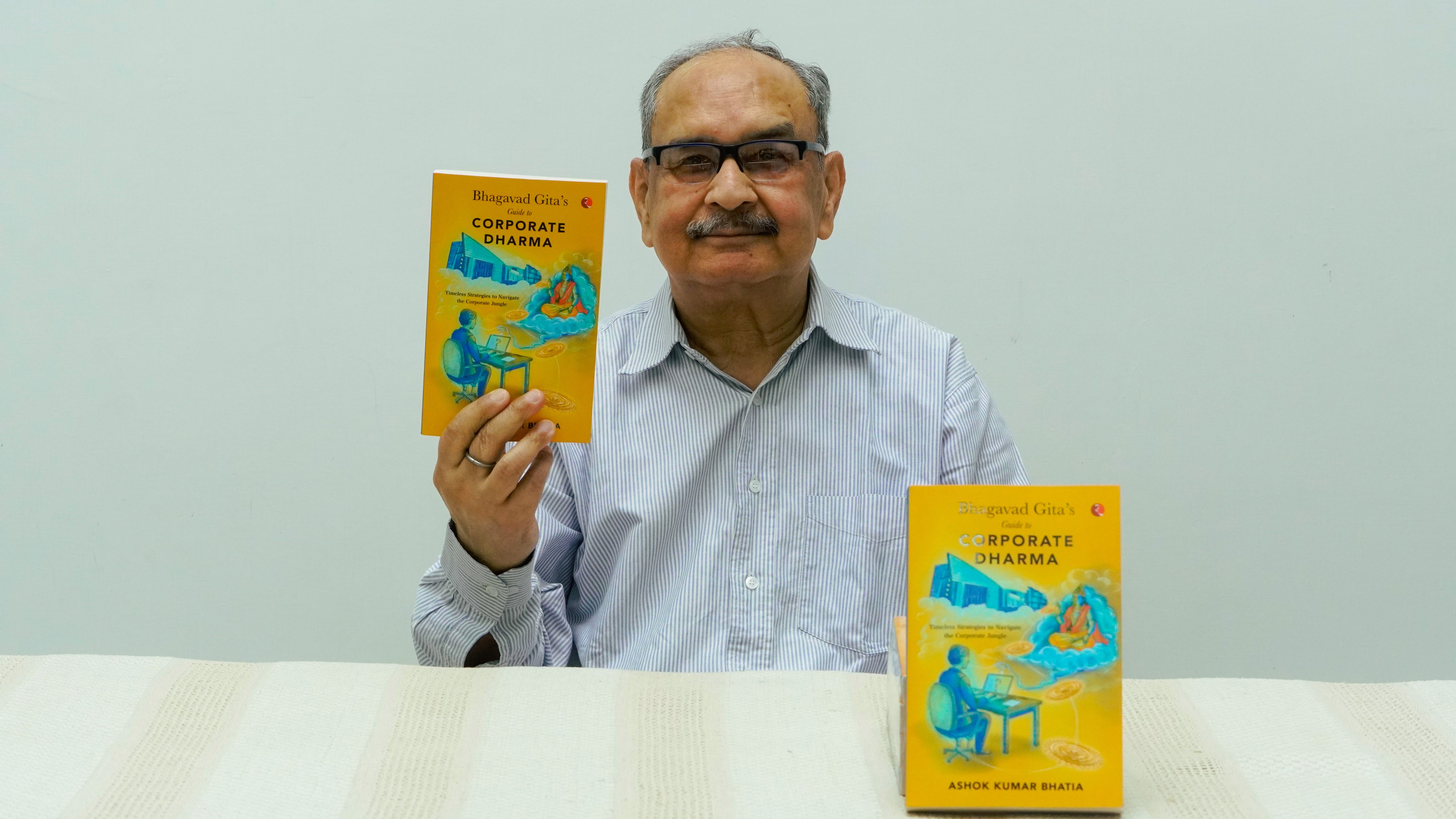
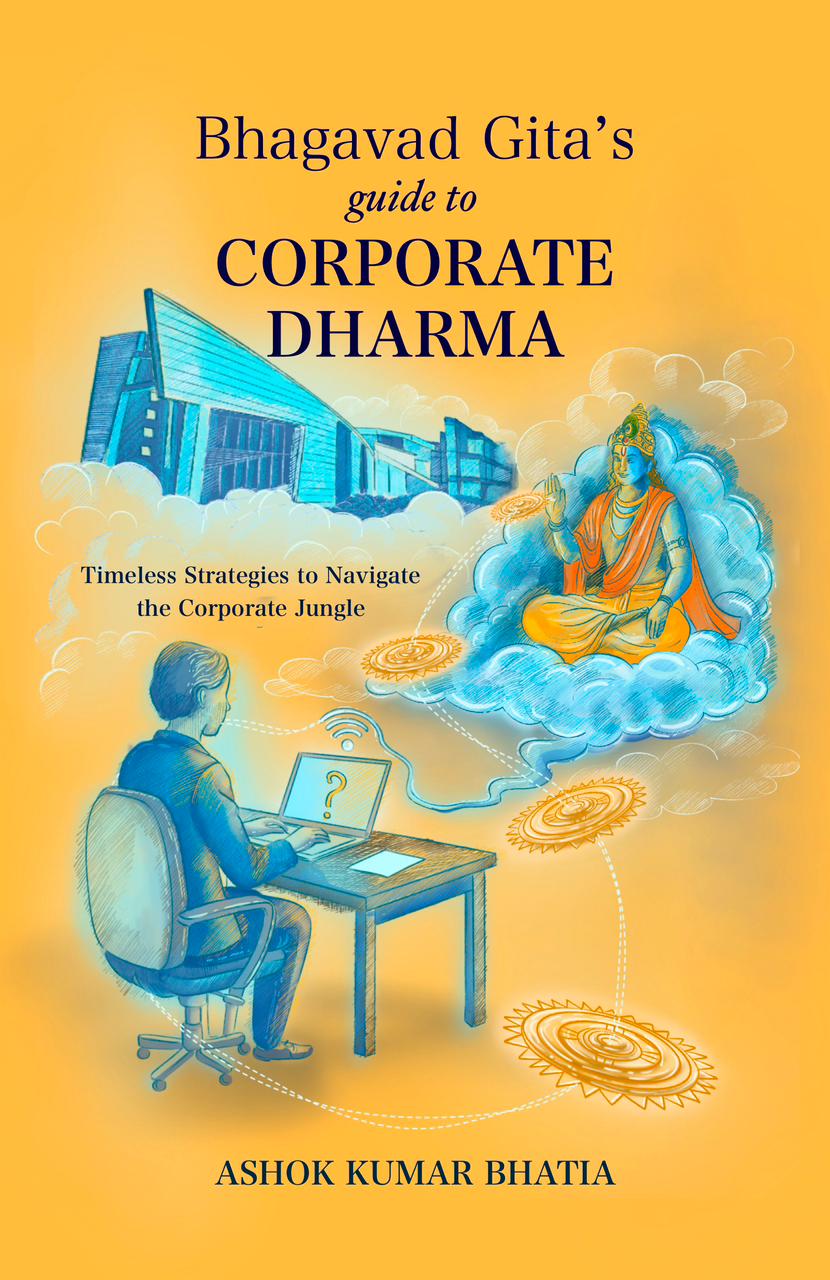
However, I guess I came pretty close to experiencing a somewhat similar emotion recently. A few days back, the first lot of my recently published book Bhagavad Gita’s Guide to Corporate Dharma: Timeless Strategies to navigate the Corporate Jungle arrived at my humble abode. A cloud of unalloyed joy enveloped me. I confess that a few tears of uncontrolled mirth rolled down my cheeks. This baby took close to seven years from its conception to delivery. Finally, I could hold it in my hands!
How this book happened
Studying the Gita had remained a pious intention for many years. Every time I tried to go through it, I could not progress beyond its fourth chapter. But the book then went back to its place on the bookshelf. Mundane concerns of life distracted one. Life rolled by.
Until the day, when Fate sneaked up from behind and struck me with the proverbial lead pipe. In 2018, my companion of over forty years passed away. A long phase of grieving followed, wherein the words of the Gita made little sense. When Reason started returning to its throne, the desire to go through the scripture resurfaced.
Having been a corporate warrior throughout my career, the only way I could look at the scripture’s contents would be through the tinted glasses of the art and science of management. Thus, when I again picked up one of the commentaries on the Gita, I was wondering if it had anything to say that would be considered relevant by managers. Gita did not disappoint. In fact, I found the vast canvas it paints to be of immense utility in the corporate world. It even touched upon the responsibilities of business leaders and entrepreneurs. It touched upon the importance of having saatvic (pious) thoughts and performing acts in a similar vein.
The assigned action, which is done without attachment, attraction (or) repulsion and without clinging to (its) fruit that is called ‘sattvic.’
During my career span of 35+ years, I have had a privilege to be associated with many organisations. Each one had a unique set of values that it followed. Thus, each one’s culture was different. Quite a few of these could be found on the opposite ends of a spectrum of corrupt practices. To some, the means were as important as the ends. They put a high premium on values and ethics in business. An experience of this kind made a subjective interpretation of the Gita through the tinted glasses of someone who remains a student of management even more interesting.
Slowly, an idea of sharing this interpretation with a larger audience started taking shape. This is how the book under reference came about.
An Epidemic Intervenes
By the end of 2019, a manuscript was in place. During January 2020, an agreement was signed with a publisher.
However, my Guardian Angels had their own plans for the book. Come March 2020, and the epidemic of Covid played a spoilsport. The book went into cold storage. Every two years, I kept updating the manuscript. Finally, it was in 2025 that the book found its place on the conveyor belt of the publishers.
From October to December 2025, the publisher’s editorial team burnt the proverbial midnight oil, tolerating my tantrums on finer details. Like ministering angels, they kept supporting me in polishing up the text and giving the book its present shape. The manuscript underwent as many as six upgradations during this period, even as I was recovering from a previously planned eye surgery.
Much like Jonathan Livingston Seagull, the book is soon going to take a flight of its own. Time will tell how business owners, entrepreneurs, management scholars, and students receive it. That alone will decide if it soars to greater heights or gets dumped in the wastepaper basket of Time.
Well, I have done my duty. Results are surely not within my control, as Lord Krishna advises in the Gita!
In today’s volatile corporate jungle, business leaders face relentless pressure to build value-driven organisations.
Across generations and geographies, managers have relied on the timeless principles of the Bhagavad Gita to make sound decisions in the workplace. Whether bogged down by ethical or moral predicaments, the ancient spiritual treatise offers clarity that corporate leaders find incredibly beneficial, helping them to lead with both head and heart.
Bhagavad Gita’s Guide to Corporate Dharma distils the scripture’s profound teachings by drawing vivid parallels between today’s boardroom conflicts and Arjuna’s dilemmas on the battlefield. It reimagines Lord Krishna’s timeless counsel to Arjuna for the digital-age corporate warrior. Its framework offers a rare compass for contemporary management practitioners—burdened with ethical decision-making in the age of AI—to lead with clarity without being enslaved by outcomes.
Replete with captivating examples from India and abroad—whether it is the Tata Group’s value-driven legacy or Kodak’s resistance to change—this book shows corporate denizens how to navigate through chaos and arrive at clarity.
Borrowing from Krishna’s teachings on compassion, the book urges managers to also lead with empathy, citing relatable examples—from Vijaypat Singhania’s feud with his son to the Dassler brothers’ rift that created Adidas and Puma.
Whether you are a CEO, mid-level manager, student or entrepreneur, the upcoming book is a thought-provoking management guide that shows, through Krishna’s teachings, how corporate Dharma can be practised in the modern workplace.
Now, what could be common between a 5,500-year-old scripture and the art and science of management as we practice it today? After all, while on the battlefield at the beginning of the Great War, Arjuna was facing a dilemma – to fight or not to fight. Surely, the poor fellow could not have then opened his smartphone and ask AI or ChatGPT as to what to do. He could not have expected a blockchain app to come up with a strategy to defeat the 11 divisions of the Kaurava army while using only the 7 divisions of the Pandava army.
Luckily, he had Lord Krishna acting as a friend, philosopher, and guide to assist him in the matter. The Lord patiently removes all his doubts, much like a friendly mathematics teacher would. Towards the end of the 18th chapter, he does not say what Arjuna should do in that situation. Rather, having motivated him to do his duty, He leaves the choice to Arjuna, who decides to fight the war.
Humanity is thus gifted with what I would refer to as the ultimate Manual of Motivation. It provides us with a template of inner transformation. It tells us how to live our lives to be more contented, joyful, and happy.
I confess that Gita is not easy to understand. Most of us believe that it is something a reading of which should be deferred to our post-retirement days, in our sunset years on this planet.
Far from it. The earlier one starts grasping the philosophical thoughts of Gita in life, the better it would be.
When looked at from the jaundiced glasses of either a CEO or a management executive, it offers rich lessons in navigating the corporate jungle. It provides a moral and ethical compass which we can use to handle real-life situations.
It does not provide a band-aid kind of two-minute solutions to the daily challenges we face. Instead, it does a root cause analysis and offers a long-term perspective on life and the googlies it throws at us from time to time.
Could we, ordinary people like us, even aspire to become an Arjuna? He had the capability to fight. He was facing a dilemma. Above all, he had options.
In a business situation, a brand could have been going downhill. Could it be reaching the end of its product life cycle? If so, would you recommend to the management to scrap it altogether and consider newer product options? Consider what Gita says:
Therefore, remaining unattached, go on doing action worthy of performance. Engaging in action, truly unattached, man attains the supreme.
Lord Krishna suggests that we detach ourselves from one of our favourite brands and try to look at it objectively. We could then see the writing on the wall and sense that it may soon be taken over by another product based on advanced technology. He expects us to focus on preparing the plans for designing such a product, test-market it without delay, and then proceed to launch it.
Likewise, there are many situations in our careers where Gita can help.
The soon-to-be-released book Bhagavad Gita’s Guide to Corporate Dharma may help one to grasp the nuances of this unique scripture.
Once a week, I shall endeavour to keep you posted.
(Mr K V Rao, Senior Advisor – BCG, Chairman Tata International Singapore Pte Ltd & TML Holdings Pte Ltd, had posted this thought-provoking article on LinkedIn, wherein he summarises insights shared at a talk with students at IIM Ahmedabad — The E.A.G.L.E. Mindset. His permission to blog it here is gratefully acknowledged!)
Earlier this month, I had the privilege of visiting the Indian Institute of Management, Ahmedabad — India’s undisputed premier management institution and one that consistently ranks among the world’s finest business schools. (Thanks to the IIM Alumni Association of Singapore Suresh V Shankar and @Ravish Kumar of IIMA).
Over the years, I have worked closely with many IIM Ahmedabad alumni — as friends who have gone on to become global leaders, as colleagues in boardrooms across continents, and as young management trainees who began their careers under my leadership and today occupy very senior roles. Visiting the campus and engaging with the current MBA cohort was both inspiring and energising.
During my interaction with the students, I spoke on a theme that defines our times — how to build a successful career in a turbulent world.
I began with a simple analogy: turbulence on an aircraft. When turbulence strikes, we instinctively look to the pilot for calm and reassurance. Now imagine if the aircraft is facing external turbulence — and at the same time, the pilot is experiencing turbulence in his own mind and emotions. That would be a recipe for disaster.
In exactly the same way, the world today is going through unprecedented turbulence — economic, geopolitical, technological, and social. While we may have limited control over what happens outside, we have complete control over what happens within.
In a turbulent world, leadership — and career success — begin from within.
To make the conversation practical and memorable, I introduced a simple framework built around an acronym — E.A.G.L.E. – essentially to help do some self reflection !
E — Empathy: True leadership starts with awareness. Empathy allows us to understand people, not just processes. It helps us see the ‘why’ behind the ‘what’ and make decisions grounded in human connection. We seem to be loosing that personal touch and people connect, as leaders.
A — Agility: Agility is the modern superpower. It is not just about changing, but about how fast we adapt. In today’s world, the biggest risk is standing still, and this skill does not come naturally and adaptation demands a great deal of plasticity.
G — Growth: Learning is the process, but growth is the destination. A growth mindset means being willing to outgrow your old self to become your future self. This is what creates an internal stretch, and development
L — Learning: The moment we stop being students, we stop being leaders. In a world where knowledge has a shelf life, curiosity is the most valuable currency. It is a continuous cycle of learning, unlearning and relearning!
E — Endurance: Resilience helps us bounce back. Endurance helps us stay the course. Success is not built by sprints alone — it is built by marathons. It is most crucial to build that mental and emotional resilience to endure for the long haul to build a career in an uncertain and challenging environment.
When these five traits come together, we don’t just navigate turbulence — we perhaps rise above it. In a turbulent world, leaders don’t merely survive the storm. They can learn to fly through it or over it. This is like creating a strong inner compass to guide through the storms that are known and unknown.
After introducing the E.A.G.L.E. framework and sharing these perspectives, what followed was a truly engaging and energising interaction with the students — a group that represents some of the best and brightest young minds in India. Their questions were thoughtful, their curiosity was sharp, and their ambition was inspiring. The conversation moved effortlessly from careers and leadership to purpose, values, resilience, and navigating uncertainty in a rapidly changing world.
It was a powerful reminder that while the world may be turbulent, the future is in very capable hands.
Exploring the concept of Consciousness further, one may say that whereas a normal organization cares for Results alone, an organization steeped in Consciousnesswould provide an equal weight to all of its three ‘R’s – Results, Relationshipsand Righteousness – in its strategic and tactical thinking.
Results could be either of the financial kind, the market share kind, or a combination of the two.
Relationships would imply a positive working atmosphere where, besides harmonious relations, dissent is not suppressed; rather, it is encouraged. Following human values is an essential part of this attribute. So is respect and dignity towards people in general.
Righteousness would encompass such features as concern for sustainability, giving back to the society and running operations not only within the ambit of law but beyond it, wherever possible. Being pro-active, when it comes to corporate governance; taking care of the rights of the minority shareholders; ensuring that principles of…
A culture which is rooted in Consciousness does not throw up hapless leaders who keep burning the proverbial midnight oil in their relentless pursuit of commercial goals only, while shoving concerns such as the environment, the society and human resources under the corporate carpet. It does not merely mean that our marketing honchos are doing their best in servicing our customers effectively and efficiently; instead, it implies that they do so while ensuring that the product/service as well as its packaging is environment-friendly.
It means that those toiling on the operations side design the processes in such a way that the carbon footprints are at least neutral, if not positive; that our financial wizards keep nudging the organization towards maximizing returns to all its stakeholders; and the human resource executives keep burning the midnight oil to ensure that people and processes respect human values and dignity, while keeping the costs…
It is said that Mr. R. M. Lala, an editor, writer and publisher of repute, once commented to Mr. J. R. D. Tata that the latter believed in excellence. The great man is said to have retorted thus: “Not excellence. Perfection. You aim for perfection; you will attain excellence. If you aim for excellence, you will go lower.”
But even achieving excellence is not a cake walk. Many leaders are not clear how to go about doing it. The mirage of excellence is elusive, and most often, it is not a surrogate for achieving outstanding business performance alone by measuring and surpassing business results. There is more to it than what meets the eye.
Satyendra Kumar’s book endeavors to answer this question.
The author shares distilled insights from his four decades of accumulated learning from various organisations to portray the fundamentals — that are often elusive —in building organisational excellence.
This book is a valuable treasure trove of insights. It has the potential to enable as well as enrich the thinking process of business leaders when it comes to achieving excellence in a sustainable manner.
Elusive Secrets in Seven Chapters
The book etches out seven steps to facilitate the process of achieving excellence, each step being covered in a separate chapter.
The Foundation is obviously laid by a leader’s spark of genius beyond intelligence, evoking intuitive facets to nurture essentials that fuel a never-ending appetite for learning.
This leads to the concept of Learning Forever, which, in turn, instills a norm of Measurement and Predictability.
A climate of learning and measurement provides an impetus for Productive Working that leads to a build-up of confidence across teams and groups entrusted with the task of achieving business goals.
This brings out the criticality of The People Factor which is an important ingredient in creating a Culture of Improvement and Transformation.
Last, but not the least, is the Invisible Backdrop of a deep purpose guided by values and ethics that the author presents as it loops back to the very essence in the acts towards building the Foundation.
Each chapter progressively enhances the value of the conversation with an elevated level of awareness, thereby igniting the intuitive mind to grasp what is relevant and necessary.
Every company eager to protect its soul and spirit for worthy outcomes could benefit from reading this book.
Author’s Profile
Satyendra Kumar has enhanced the quality systems for world-class global organisations with his contributions for over 40 years. He has served on several industry bodies and has received numerous awards in shaping the conversation for progress with his deep understanding of the systems view of an organisation that is a precondition for nurturing a culture of excellence.
Kumar today continues his passion by helping organisations strengthen their systems maturity by providing his rich experience as an Independent Advisor and Consultant to several large and medium-scale institutions and enterprises since 2013. Kumar was the Global Head and Senior Vice President – Productivity & Quality, Technology Tools & Software Reuse at Infosys Limited (2000 – 2013). He has worked as Vice President at IMR Global, the USA, between 1998 and 2000. As Deputy Chief Executive for Tata Quality Management Services – Tata Group between 1996 and 1998, he provided an intellectual impetus in laying the foundation for instituting the Tata business excellence initiative. Kumar’s rich experience spans his consulting expertise to over 50 national and multi-national clients in areas of Business Excellence, Operational Efficiency, Customer Satisfaction Management, Business Continuity Management, Project and Programme Management, and Quality Management.
He has served on many Boards and Panels such as Board member (QuEST USA), On the Panel of Judges – Wisconsin State Award (USA), Administrative Reforms Committee of Indian Institute of Science, Bengaluru, and Chief Technical Advisor to the Confederation of Indian Industry – Institute of Quality. Has been a recipient of the IEEE-Software Engineering Institute (Carnegie Mellon University) International award (2011) and honoured with the “Lifetime Achievement Award for Quality and Business Excellence” by an IT industry association.
Some Accolades
Satyendra Kumar’s relentless and unfettered focus on excellence played an important role in the high percentage of repeat business Infosys obtained from customers. This book is a distilled wisdom of his impactful journey at Infosys during 2000 – 2013 and many other companies during his professional career. I recommend this book to leaders, managers, and development professionals in any company to read it, learn from it, and deploy the lessons.
— N.R. NARAYANA MURTHY Co-founder Infosys Ltd
Satyendra and I worked together at Infosys till 2009 … I believe his relentless pursuit of excellence played a seminal role in the evolution of Infosys. As you read through this book, you will get a glimpse of what I believe are the fundamentals that need to be put into place to aspire for excellence. The best part is that you will hear them from Satyendra first-hand! I hope that the next generation of leaders invests time and patience to learn from this work and find ways to incorporate it into their leadership, culture, and the basic fabric of their organisations.
— NANDAN NILEKANI
Chairman and co-founder Infosys Ltd, Chairman and co-founder EkStep Foundation
Achieving excellence in business is an arduous journey. One has to design for quality and innovation, and plan for longevity, a truer measure of business success. Satyendra Kumar, with his experience in steering quality movement in the IT industry, provides a practical guide for future leaders in building organisational excellence.
— KRIS GOPALAKRISHNAN, Former CEO and Co-Founder Infosys Ltd, Chairman Axilor Ventures
Satyendra Kumar’s book bestows upon the reader his wisdom, expertise, and countless years of professional and personal experience. We are fortunate that Kumar has taken the time to document his life’s work. One will learn from his many incredible successes and will also learn how to avoid or overcome difficulties he encountered over time. I enthusiastically recommend and endorse this book.
— STEVEN HOISINGTON,
Retired senior executive, leadership coach.
I have seen Satyendra Kumar in action for three decades. His unwavering focus on building a culture of learning and improvement with long term focus is amazing. This book elegantly reflects his experiences and should be leveraged by start-ups or established companies to instill these great practices for long term success.
— ARUN NARAYANAN,
President and the Mentor, US Technologies Global Ltd
Despite the enormous body of literature from the academic and consulting worlds, Organizational Excellence is still elusive to most people. This book precisely addresses this issue through interesting anecdotes, case studies, and experiential stories. It reflects — how organisational learning, people caring, and ethical governance can lead to long-term organisational excellence and sustenance. Satyendra Kumar has nicely brought out many hidden facets that business owners and leaders born or made, and passionate entrepreneurs should read and take advantage of.
— MITALI CHATTERJEE, Former Director General, STQC, Ministry of IT, Govt of India
A powerful and elegantly written book with deeper insights.
— MADAN MOHAN, EVP Coforge Ltd
Satyendra Kumar has written an interesting book backed by years of experience. His narrative is experiential, giving guidance and insights into systems, implementation, and achieving organisational excellence. I recommend this book to everyone in the corporate world who wish to focus on organisational excellence.
— S.D. SHIBULAL,
Former CEO and Co-Founder Infosys Ltd
Satyendra Kumar as a practitioner and leader brings three decades of his rich experience relevant to businesses and business leaders of various types. Quality is not just a buzz word but is about its leaders, their values or ethos and purpose imbibed through a long journey is well brought out. It was a pleasure for me to have been part of leading this journey with him in Infosys as well as relive that journey on reading it.
— K. DINESH, Chairman AHT Foundation and Co-founder Infosys Ltd.
Satyendra Kumar has distilled into this book, decades of his experience in creating a culture of excellence in some of the world’s most successful corporations. His incisive and yet simple principles are relevant equally for large corporations and young start-ups. I have seen him passionately inculcate excellence in every aspect of business at Infosys and I am confident that the book will be a key guide for leaders navigating an increasingly competitive world. Each chapter of the book provides a vivid road map for creating excellence through pragmatic steps. A must read for leaders who aspire to create world-class organizations!
— M.D. RANGANATH, Chairman, Catamaran Ventures, Independent Director, HDFC Bank








 ashokbhatia
Praise for the book on the Bhagavad Gita and Corporate Dharma
Posted in Management Lessons, tagged Bhagavad Gita, Book, CEOs, Comments, Leadership, Management, Managers, Praise on March 2, 2026| Leave a Comment »
What do professionals think of this book?!
Here are some words of praise from people across different professions, diverse backgrounds, and from varied geographies.
Anatoly Yakorev
Mentor for Conscious Enterprises Network, Montenegro (Former Director, Centre for Business Ethics & Compliance, Moscow, Russia)
Managers face mighty challenges while delivering results. Ashok Bhatia cleverly alludes to the Bhagavad Gita’s lessons they can learn and begin to practise such concepts as detachment, and equanimity. He provides relevant examples from the corporate world to illustrate his arguments, making this book an interesting read.
Dr Bharat Nain,
Arbitrator & Management Consultant,
PhD, MBA, BE(Mech), FSIArb, MCIArb, Pune, India.
Ashok Bhatia, through his excellent book, propounds an alternative path that draws on the spiritual aspect of what is regarded as the foremost “religious book” in the Asian context, the Bhagavad Gita. Differentiating between the “mind and intellect”, he has used an ancient spiritual text to convey his message very simply and with humour.
Dr Ananda Reddy
Director, Sri Aurobindo Centre for Advanced Research, Puducherry, India
I am of the view that business leaders and managers may not consciously want it, but they really need it. It offers the only remedy for correcting mankind’s lopsided growth and bringing him sanity, inner and outer balance, peace, and harmony. The book by Ashok is a commendable effort. I wish the book and its future readers the very best in life.
Dominique Conterno
Conscious Enterprises Network (CEN) Co-Founder
United Kingdom
This book is a rare, business-friendly bridge between timeless Gita wisdom and the lived realities of modern organisations. Ethics and values are made to feel operational rather than ornamental. It speaks directly to pressure points leaders recognise, from stress and burnout to ego, desire, conflict and office politics. Karma Yoga stands as skilful action with steadiness in success and failure. It offers a calm, practical case for inner resilience, detachment, and better judgment in uncertain times. The book’s light humour keeps profound ideas accessible without diluting them. It finally acknowledges the technological moment, including the challenges of Industrial Revolution 4.0 and AI-era complexity. It leaves the reader with a clear invitation to go deeper into the original scripture, guided by a grounded corporate lens shaped by Ashok Kumar Bhatia.
Late Dr (Prof) G P Rao,
Founder-Chairman, SPANDAN, India
(Former Senior Professor and Founding Head,
Department of Management Studies, Madurai Kamaraj University, 1981–1997)
Ashok Bhatia paints a wide canvas of the kind of strategic and tactical issues business owners and managers face in their routine lives. With a calm objectivity, he demonstrates how the same could be resolved by imbibing what the scripture says. The undercurrent is essentially that of following high values and ethics in management, so a business may run on a sustainable basis.
Marco Suomalainen,
MMM Enabler at UHM (Uncovering Hidden Meanings),
Kotka, Finland
The book enables one to keep learning about the precious jewels existing in India. Industrialists and managers who wish to understand the basic concepts of the Bhagavad Gita and improve their ability to handle challenges in a more constructive manner would find this book very useful.
Mohan Arumugham
Global Technology Leader; IT Director – ERP
Digital Technology
GE Power, USA
This book motivates me to look at the bigger picture in life, while at the same time remaining connected to my inner self. Using many examples of the kind of challenges we face in our careers, it makes us appreciate the deep wisdom contained in the Gita. The book, even though rooted in ancient Indian wisdom, has a global appeal.
Ashok Narayan
IAS (Retired), Expert in Indian Scriptures,
Gandhinagar, India
The author has done a wonderful job of demonstrating how the eternal knowledge of the Bhagavad Gita can be applied to the business world, thereby enabling managers and CEOs to achieve their goals with maximum efficiency and to deal with all the problems without accumulating stress or losing the balance of mind.
Chandra Shekhar Dwivedi
Ex-Vice President (Manufacturing and Corporate Planning)
HCL Infosystems Limited, Pondicherry, India
Mr Bhatia is back with his references to what he calls the ‘corporate jungle’. If the theme of his earlier book was about survival, this one addresses the issue of doing well in one’s career. However, his underlying message continues to be that of adherence to values and ethics in business, of corporate governance, of human values and of conscious management.
P R Ganguly
Member, Industrial Advisory Board, Manufacturing Department, Cranfield University, England
Ex-Deputy Chairman and Managing Director, Grenson Shoes Ltd, UK
The book is a great primer for CEOs and managers who are keen to get a basic grasp of the universal concepts highlighted in this unique scripture from India. The timeless lessons enshrined in the Bhagavad Gita have been innovatively presented by Ashok, with limited doses of subtle humour of a British kind.
Nilima Bhat
Founder: Shakti Leadership and Shakti Fellowship, Global Program for building Conscious Leaders & Change-makers, Co-convener Truth & Reconciliation Work, Distinguished Professor in Gender and Conscious Leadership. Business School and School of Humanities and Education, Tec de Monterrey, Mexico
I have no doubt that this book would be a valuable addition to the personal book collection of all leaders, as long as it does not merely remain either on their shelves or on their ‘To-Be-Read’ lists but gets quickly absorbed and put to practical use.
Ram Mohan Pisharodi, Ph.D.
Marketing Professor,
Oakland University,
Rochester, Michigan, USA.
Ashok’s latest book is like a scuba dive which gently nudges the reader toward experiencing a deeper sea-bed exploration of the original scripture itself!
Vasco Gaspar
Human Flourishing Facilitator
Portugal
Ancient works like the Bhagavad Gita offer a source of knowledge to help leaders have this inner guidance. The work of Ashok Bhatia offers a convenient bridge between these ancient pieces of wisdom and the modern fast-paced world, allowing leaders and managers to apply this knowledge to their own lives and careers.
Gayatri Majumdar
Author,
Founder-Editor,
The Brown Critique Literary Journal, Pondicherry, India
Just as in life, there are varied ways to approach the perceived challenges and stress in a corporate environment! How can one navigate this ‘jungle’ with equanimity and inner resilience by “controlling the wild horse called mind”? Answers to many of our predicaments can be found in the eternal wisdom of the Bhagavad Gita. Ashok Kumar Bhatia’s Bhagavad Gita’s Guide to Corporate Dharma is an extraordinary book for all. He elucidates profound ideas with great simplicity, tremendous authenticity and logic. This captivating book draws parallels with Arjuna’s dilemma on the battlefield, and can be invaluable for management students and corporate leaders alike. It can guide us to enhance the quality of not just own life but everyone we cross paths with.
Amazon links (In India and elsewhere)
Related Post
Read Full Post »