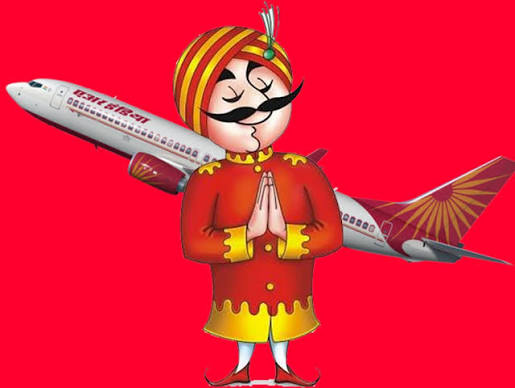
When one has been a part of the Tata group for a decade in one’s 35-year-long corporate saunter, one can be excused for feeling an innate affection towards Air India. Thus, as a septuagenarian based in Europe, when one needs to travel to India, one chooses to fly Air India. And when one notices a few deficiencies in the services on offer, one feels sad. Why? Because one imagines Air India becoming a top-rated brand in the aviation business in the not-too-distant future.
Thus, this note, written as friendly feedback. It is based on my experience with the airline earlier this year.
The USP that works for the brand
When you grow up in a country, you have an emotional bond with its culture, its regional diversity, its clothing styles, its sounds, its smells, and, above all, its food. When you board an Air India flight, the ‘namaste’ greeting by the crew is enough to transport you to a world of nostalgia. The hospitality of the staff on board further reinforces your feeling of being cocooned in a comfort zone. The care and attention from crew members such as Bhumika (on the Zurich-Delhi flight) and Alisha (on the Delhi-Copenhagen flight) go on to make the journey a pleasant experience. You are naturally drawn to the ambience and the warmth.
Life today is so fast and constantly changing. In the middle of all that chaos, when a carefully curated Indian meal gets served, you get a sense of belongingness, comfort, and stability. Nostalgic dishes carry emotions and evoke memories. The inflight meal becomes an elevating and satisfying experience.
This, indeed, is the USP which works in Air India’s favour.
Of course, this is not to downplay the importance of safe landings, thanks to the ever-alert and experienced pilots hired by the airline.
Where the brand takes a hit
Delays
All three AI flights that I had flown had suffered delays.
To be specific:
Flight number AI 152 of January 26, 2026: Zurich-Delhi
(ETD as per ticket issued: 2035 hrs; ATD as I remember it: 2200 hrs)
Flight number AI 537 of January 27, 2026: Delhi-Chennai
(ETD as per ticket issued: 1545 hrs; ATD as I remember it: 1700 hrs)
Flight number AI 157 of April 24, 2026: Delhi-Copenhagen
(ETD as per ticket issued: 1215 hrs; ATD as I remember it: 1715 hrs)
In case of the Zurich-Delhi flight, there was a delay of close to 85 minutes. Luckily, it was announced in advance, so one could adjust to it.
The connecting flight from Delhi to Chennai was delayed by close to 75 minutes. At the boarding gate, a reluctant announcement of the delay came about 30 minutes after the announced boarding time had lapsed.
The return flight from Delhi-Copenhagen-Oslo was delayed by close to five hours. The delay was announced around 70 minutes after the check-in time at the Indira Gandhi International Airport. This left one stuck at the airport for an interminable time, waiting to board an 11-hour flight. As against an ETD of 1215 hours, the flight took off only around 1715 hours IST.
Considering that time is money these days, Air India really needs to avoid such delays in all its flights. I am not sure whether the airline is overcommitting its fleet or is constrained by maintenance issues. But I fail to understand why the management does not treat punctuality as a core feature of its service package. To me, everything else becomes secondary. I do believe that most passengers would not mind a delay of, say, 10-15 minutes. But delays running into hours surely tend to sully the image of the brand.
Ground support sans empathy
A swarm of AI staff could be seen strutting about like headless chickens. When asked as to where a person who has requested wheelchair assistance was supposed to report, a vague indication of the direction to be taken was received, but no attempt was made to effectively guide the passenger to the right counter. After two failed attempts, one arrived, huffing and puffing, to a counter and joined a serpentine queue meant to serve such passengers.
The assistance check-in counter
As luck would have it, this counter was at the farthest end (security check side) of the registration bay allotted to Air India! (Bay C, if I recall right).
With my limited intelligence, I could not fathom the logic of not allotting the counter nearest to the gate to such persons who have requested wheelchair assistance.
When procedures overrule passenger courtesy
Since the flight was declared to be four hours behind schedule, and my physical frame is not as robust as in the earlier days, I requested the ground staff to allow me to access the lounge. It was flatly and rudely denied. A rule was quoted saying that the lounge is not accessible to those flying economy class. Rules are fine, but can these not be tweaked a bit in case of unusual delays?
Getting onboard entertainment: A game of chance
Upon boarding the flight, I discovered that many of the screens were not functional. When I enquired, I was told that many of the aircraft, including the one I was travelling on, are under retrofitting and hence only some screens were working. Surely, an advance intimation could have helped me, while the seat was being allotted by the airline’s algorithm? Or, perhaps, a 10% discount could have been offered on the fare being charged?
The overnight stay at Copenhagen
The five-hour delay meant missing out on the onward late-night flight from Copenhagen to Oslo. On board, no announcement was made about any alternative arrangements in Copenhagen. However, the ground staff were there to address the queries of stranded passengers. In my case, thanks to a Good Samaritan, an overnight stay at a hotel at the airport was arranged.
A communication gap with SAS?
The connecting flight to Oslo next morning was operated by SAS. It took running around between several counters at the Copenhagen airport before a fresh boarding pass could be obtained.
Upon arrival at Oslo, the baggage checked in at Delhi was missing. Well, it was traced and courteously delivered at home within 24 hours.
With due humility at my command
All these might look like routine complaints from a lay passenger of Air India. But for someone who has suffered such indignities first-hand, these would surely remain with me as painful memories for a long time to come. As an ex-Tata guy, one feels anguished, deeply hurt, and let down. On a door-to-door basis, if the Zurich flight took 27 hours, the Oslo flight took 31 hours!
Essentially, a brand stands for impeccable service. It signifies delivery of results which exceed one’s expectations, that too with due respect, politeness and sagacity. However, Tatas know all there is to know about managing a brand. I am a lesser mortal who cannot tell them much about it.
I write this with the fond hope that the powers that run Air India would implement systems, processes, and procedures to address these issues. To recapitulate:
- A rigorous system to ensure punctuality needs to be considered non-negotiable.
- Better rewards for the pilots and the onboard crew.
- An expansion of the culinary basket.
- Sensitising the ground staff to the varying needs of different kinds of passengers.
Long live the Maharaja!
(Note: I was associated with the Leather and Footwear Divisions of Tata International at Dewas and New Delhi in two phases: 1976-81, 1988-93.)
Related Post




 ashokbhatia