Feeds:
Posts
Comments

Posts Tagged ‘Management’

panjab-university-ubs

An academic course in management obviously does not offer lessons in managing the affairs of the heart. But the Class of 1977 broke through the academic shackles, with some of its members walking out of the campus with a clear strategy as to who their future soul mate shall be.

The stiff-upper-lip approach

Management education is all about the stiff-upper-lip approach of the mind. Analytical skills rule supreme, leading to rummy situations where analysis often leads to paralysis. Linear programming models get worked upon. Statistical techniques get dished out by stern looking professors who might have been hotter in their jobs more as police officers or as judges.

Hapless students are made to understand exponential smoothening techniques so as to be able to forecast business parameters in an uncertain business environment. Those with an engineering background struggle to match their debits and credits. The lucky ones who have had a background in commerce twiddle their fingers trying to grasp the complexities of quantitative techniques in decision-making.

The neglected need to boost our EQs

The behavioural sciences do provide a little bit of cheer to the tormented souls undergoing a typical MBA course. But to understand the psychology of an individual is no mean task. Mere case studies and management tips for handling an industrial strife do not improve one’s EQ substantially. Handling a tough boss eventually gets learnt only in the corporate world outside. The real world also teaches us to handle errant subordinates whose emotional blackmail upon reporting for work after a spell of French leave needs deft handling. The harsh realities of business world provide a high quality learning which can surely not be replicated within the stifling confines of a classroom.

The dashers and the rabbits

In fact, for some of those who formed the batch of 1977, the beautifully laid out campus outside provided a far better laboratory to test their hypotheses on the softer matters of the heart. These were the chosen ones who were smitten by the tender arrows of a smart Cupid.

The snag in the business of falling in love is much like that of mixed up career choices. Take an introvert and put him in a marketing assignment and the results could be disastrous. Take an extrovert used to making tall claims and put him in charge of manufacturing. The customers could soon melt away, leaving the company grappling with a credibility gap.

Bertie image

Same is the case in matters of love. As per the Bertie Wooster doctrine:

“….parties of the first part so often get mixed up with the wrong parties of the second part, robbed of their cooler judgment by the parties of the second part’s glamour. Put it like this. The male sex is divided into rabbits and non-rabbits and the female sex into dashers and dormice, and the trouble is that the male rabbit has a way of getting attracted by a female dasher (who would be fine for the male non-rabbit) and realizing too late that he ought to have been concentrating on some mild, gentle dormouse with whom he could settle down peacefully and nibble lettuce.”

The USP of the Class of 1977

The batch of 1977 had as many as five members of the tribe of the delicately nurtured. Since the previous one, the Class of 1976, had none, they were the cynosure of all eyes. They were invariably the prime focus of attention for many of us in the batch of 1976. All we seniors required was an inane excuse to pop up and try to grab the attention of at least one out of the five pairs of eyes we could feast on. The faculty members simply loved them – not necessarily for their academic proficiency, but merely for ensuring some discipline amongst the men folk loitering around.

Some of the members of our tribe of the so-called sterner sex were the shy and silent kind. Some were busy chasing their academic pursuits and kept their hormones under check. Others were benignly interested but limited their interactions to admiring gazes alone. Very few were the dashing types who, their puny chests all puffed up, attempted to indicate a more than passing interest in the parties of the other part.

Managed walks down the aisle

Those were traditional times when the distinction between an ‘arranged marriage’, a ‘love marriage’ and a ‘love marriage which had to be managed’ was pretty clear. Live-in relationships were not heard of.

The majority amongst us believed in the straight and narrow path that life offered then – the comfort of an ‘arranged marriage’ where the parents take the flak for subsequent problems, if any, and where love blossomed, albeit hesitatingly in some cases, much after the walk down the aisle took place. The time on the campus was, therefore, used by the members of this tribe merely to exchange furtive glances, suffer the pangs of transient infatuations and a silent admiration for the physical profile of the party of the other part.

pu-student-center

Then there were the dashing types, the risk takers who could use their time on the campus to firm up their affection for each other and concoct some dreamy plans for their future together. To avoid inquisitive and prying eyes, they would often vanish in thin air, possibly to land in such distant locales as the Sukhna Lake or the Rose Garden.

Management knowledge put to loving use

These were indeed the souls which put most of their management knowledge to actual use. No manual has been published till now, but it is clear that strategic decisions were taken by them with due diligence. Flawless planning and execution followed. Regression Analysis was applied to ensure that respective parents fell in line with the wishes of their wards. Soft-nosed commerce was used to draw up joint P&L Accounts and Balance Sheet, so the planned merger would face little financial turbulence. Principles of Materials Management were applied to ensure that the eventual stock transfer of one party to the abode of the party of the other part was carried out in a smooth and cordial fashion. Inspiration was drawn from a random sample of other couples who had successfully handled their affairs in an exemplary fashion.

Managing the Affairs of the Heart

cupidCupid, when it chooses to strike, is pretty democratic in nature. If one of the Class of 1977 decided to hitch her lot with a classmate of hers, yet another signed and sealed a merger deal with a senior of the Class of 1976. Both lived happily thereafter!

Close to forty years down the road, looking at the success of these mergers and alliances, it is highly regrettable that management academics still continue to adopt the stiff-upper-lip approach which focuses on analytical skills alone.

A day should surely dawn when ‘Managing the Affairs of the Heart’ gets introduced as a compulsory full semester subject across all management institutes; a time when doctoral theses on such subjects shall be encouraged.

After all, there are as many management lessons to be drawn from the works of Shakespeare, Thomas Hardy, P G Wodehouse, O Henry and Jane Austen as can be gleaned from the tomes dished out by such luminaries as Peter F Drucker, McGregor and Philip Kotler.

(Related Posts:

https://ashokbhatia.wordpress.com/2016/10/01/the-class-of-1976-how-it-managed-to-get-suspended-for-a-week

https://ashokbhatia.wordpress.com/2016/12/25/the-class-of-1990-how-ubs-prompted-sandeep-mann-to-learn-management-from-movies)

Read Full Post »

On the occasion of Thiruvalluvar day, celebrated on this day in the state of Tamil Nadu in India, in memory of Saint Thiruvalluvar who is said to have lived in a period between second century BC and 8th century AD.

ashokbhatia's avatarashokbhatia

Thirukkural (திருக்குறள்), also known as the Kural, is a classic Tamil ‘sangam’ (3rd century BC to 4th century AD) literature composition. It has 1,330 couplets or ‘kurals’. It was authored by the renowned poet Thiruvalluvar.

The Thirukkural is one of the most important works in the Tamil language. This is reflected in some of the other names by which the text is given by such as ‘Tamil marai’ (Tamil Vedas); ‘poyyamozhi’ (words that never fail); and ‘Deiva nool’ (divine text).

Just like ‘Ramayana’, ‘Mahabharata’, ‘Bhagavad-Gita’ and other scriptures, Thirukkural is also replete with words of wisdom. It is simple and contains profound messages.

Thirukkural has 133 chapters, each containing 10 couplets. Broadly speaking, all the 133 chapters can be divided into three sections: Righteousness, Wealth and Love. In the text below, the serial number of each couplet appears on the top, followed by its Tamil text and then by…

View original post 1,682 more words

Read Full Post »

Here is a good list of Hollywood movies which concern the area of management.

As to Bollywood, two movies come to my mind, especially when it comes to Work Life Harmony: ‘Chhodo Kal Ki Baatein‘ and ‘Baar Baar Dekho‘. Elsewhere, we have already had a look at movies from which we could draw rich management lessons.

Enjoy these over the next weekend!

Kally's avatarMiddleMe

One thing that always never fail to pull me up when I am down and frustrated is when I stumbled upon a movie that inspires me to do more in my work and to bring me back to the same spot where I believe in me, my passion. Today, I like to share those movies with you and hopefully that maybe one or two will inspire you when you have your down days.

Pursue of Happyness

This movie is my favourite career inspirational movie. Will Smith made me cry, gave me hope and had me rooting for him. It is one of the movies that I will make my sales team watch it. The raw emotions are so real and raw, it is motivating right up until the end. If you haven’t watch it, you should. If you are working as a sales person, you should watch it. If you…

View original post 401 more words

Read Full Post »

Respected Ladies and Gentlemen,

Some of you might be twiddling your fingers these days, trying to figure out exactly what is happening, why things have come to such a pass, and if there is some way you could pitch in to resolve the Tata-Mistry issue.

I do believe there is a way you can make a difference. You can do so by taking a stand which would make you look back at your decision in the future with a feeling of glowing satisfaction and contentment.

Allow me to share some of my own thoughts on the subject. I write with all humility at my command. I write this as a lesser mortal who is not privy to the power conflicts at the top levels of the Tata group. I write this as a common man, and also as an ex-employee of one of the companies of the group, namely Tata International.

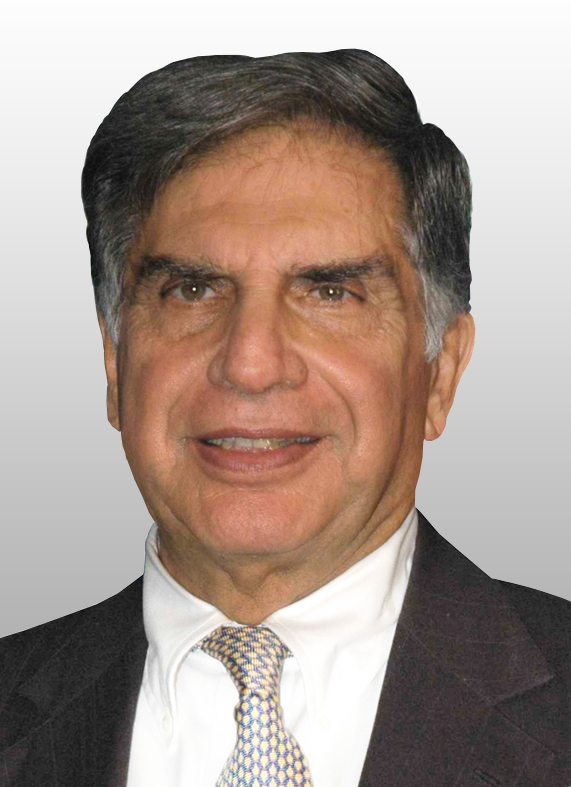
Ratan Tata

Forced separation only under grave provocation

The rather uncharacteristic manner in which Cyrus Mistry has been shown the door by Tatas some time back only goes on to establish a truth – that you all support an elephant which has not only learnt to dance but also knows how to be nimble-footed when the situation so demands. Step on the wrong toes and the message is loud and clear. Core values are not negotiable. Cross that invisible line at your own risk and peril. Provoke the elephant in a wrong way and face the music.

Way back in 1993, Russi Mody also underwent the experience of a forced separation.

There are many other instances which one can go on quoting, but the moot point remains that those entertain individual ambitions and start nudging the group against its core values invariably get ejected from the pilot’s cockpit.

Even at lower levels, the old perception that Tatas work like a massive bureaucracy and a job with them is for one’s life time is altogether wrong. I have myself been a witness to some such cases, where managers who had either performed very poorly, or offered speed money, or otherwise acted in bad faith, were clearly told to look for greener pastures elsewhere.

In Tata we trust

You are well aware that the brand equity that the group enjoys is as much about product quality as it is about trust and faith which stakeholders of all hues, sizes and shapes repose in its operations.

Tatas happen to support trusts which are some of the oldest charitable institutions in India. The group has pioneered modern ideas of secular, social services-oriented philanthropy.

It is not easy to name another business empire which has invested in the social sectors even when no law ever mandated it. Or, one which has invested in areas totally unrelated to the core business activities of the group. Iconic institutions like the Indian Institute of Science, the Tata Institute of Fundamental Research, the Tata Institute of Social Sciences, the National Center for Performing Arts are but some of the examples which spring to one’s mind.

A habit of going beyond the mandate

tata-crest

It may also not be possible for us to locate another business house which has gone out of its way to incur a liability out of a sheer sense of decency even when not having a formal agreement to that effect.
In one of his scintillating articles, Arun Maira, ex-member of the Indian Planning Commission and an ex-Tata senior, recounts a 1946 meeting between the KraussMaffei board and J R D Tata and Sumant Moolgaokar on the platform of the bombed out Munich station. In those times, Indian companies had no way of entering into any agreement with German companies. The Germans requested Tatas to take their best technicians and their families to India, who were starving without work in Germany. So, Tatas learnt metal-working from the best of the best.

He says that many years later, when India had become independent, the German company’s headquarters received a letter from Tatas, asking how much to pay for the technology they had provided to Tatas. That letter showed the true spirit of the group – one honours one’s debt, even when it is not legally binding, and even when it is not demanded of one.

You may also recall the Tata Finance fiasco in 2001, when a letter alleging some wrongdoings at the company reached the desks of several Tata seniors. Tata Sons could have well adhered to admitting its limited legal liabilities, but Ratan Tata took a courageous and humane view to publicly declare that interests of every small investor shall be protected.

In his brilliant book, Six Lenses, R Gopalakrishnan, cites several examples from the Tata history to sketch out the kind of culture the group has.

You are well aware that much of the goodwill enjoyed by the group is because of the perception that, as a business house, it has always tried to put into practice the Zoroastrianism principles of Humata (Good Thoughts), Hukhta (Good Words) and Hvarshta (Good Deeds).

A unique vision and the spirit of enterprise

jamsetji-tata

Elsewhere, R M Lala speaks of the spirit of enterprise by quoting the instance when Sir Jamsetji N. Tata traveled all the way to Pittsburgh in USA to realize his dream of building a steel plant in India. In 1901, he met Julian Kennedy, the foremost steel expert, who warned him that even the preliminary investigation could cost a fortune and there was no guarantee of any returns. He suggested that survey of the raw materials be made by Charles Page Perin, the best geologist in America.

In New York, Jamsetji went to Perin’s office who was impressed by the passion and the sincerity of the aging entrepreneur. In April 1903, his partner, C. W. Weld, came over to India to kick-start the process of setting up a steel foundry. Even though Jamsetji passed away in 1904, his vision was brought to fruition and the first ingot of steel rolled out of the Sakchi plant during 1912. World War I broke out soon after and Britain found that the only source of steel for the war effort East of Suez was in India.

Within two months of the War ending, the Viceroy came to the Steel Works at Sakchi, and rechristened it Jamshedpur.

Many of you may believe that the Tatas can grow faster by being more aggressive in existing as well as in green field verticals. But you can not miss the point that tremendous progress has been made already, and never by compromising on the core ethics and values the group companies adhere to. Running the same businesses without this core would be like having living organisms sans their souls.

Succession and moments of mental aberration

Succession in a complex organization which is 148 years old is often a delicate issue.

jrd-tata

JRD is reported to have often joked that the Tata Sons board made him chairman in a moment of mental aberration. While he was anointed thus in 1938, his ascendance was never a cake walk. He took over the baton of the group from his second cousin Nowroji Saklatwala.

To quote Jehangir Pocha:

Inwardly, he was none too pleased with Shapoorji’s “intrusion” into Tatas. He is said to have got even more infuriated when Shapoorji proceeded to buy further stakes in Tata Sons from his siblings, Sylla and Darab Tata. This event has now come back to haunt the group.

JRD himself never spoke publicly about Shapoorji, Darab or Sylla, as was the norm in the days when grace mattered and linen was never washed in public. But he did say in his later years that Shapoorji took advantage of people who were “weak-willed and credulous”.

He surrounded himself with exceptional managers and threw the somnolent group into expansion mode. Tata Chemicals was incorporated in 1939 and became India’s first soda-ash supplier under Darbari Seth. Tata Motors was established in 1945 and nurtured by Sumant Moolgaokar. Tata Steel grew under Homi, and then, Russi Mody. JRD himself was the steward of Air India’s growth, even after its nationalisation in 1953. Naval Tata led the Tata electric companies, and the group’s textile and oil mills.

Fast-forward to 1991, when Ratan Tata took over the reins of the house of Tatas. He then faced the challenge of managing the then existing power structure within the group to be able to assert himself.ratan_tata

Of de-globalization and corporate governance

On the global stage, these are challenging times for many of the group’s business verticals. Brexit and the recent US elections are events which need great attention. Post-2008, the world appears to have entered into a phase of de-globalization. Protectionist barriers are likely to get higher. Right-wing enthusiasts world over are basking in the perceived glory of their resurgence on the global stage. The Mistry fiasco is a distraction the group can surely do without.

The current feud does throw up several serious challenges. One is that of achieving managerial excellence within the framework of ownership by a particular family – something that Tatas have always managed to do so very well. Another is that of articulating the invisible authority lines between owners and professionals. Both these factors need strategic thought from persons of such eminence as your goodselves.

Yet another issue pertains to managing the employees and the business ecosystems as long as the turbulence persists.

Support a business with its soul intact

Tata logo

Allow yours truly to urge upon all of you to think deeply on the issues that the group faces at this time. Go back to your conscience and check if you view your relationship with any of the Tata companies purely through a materialistic lens, or through a lens which also incorporates the kind of values the group stands for.

You are well aware that in many areas of management, Tatas have set the bar very high. Giving back to society. Business strategy. Employee welfare. Women empowerment. Avoiding the bribe traps. Avoiding, but never evading, taxes. Going beyond the mandate.

One would hope that persons of your eminence would choose not to wash dirty linen in public and resolve your differences in a spirit of mutual accommodation. That you shall respect your custodianship role and live it. That you shall conduct yourself in a manner which would justify the trust and faith reposed in you not only by the group but also by the shareholders of the company you happen to be associated with.

That you shall subdue your ego and care for the long term bigger picture. That if your value systems happen to be out of sync with those of the Tata group, you shall quietly withdraw from the eminent position you enjoy on the board of any of the group companies. That, hopefully, you shall support Ratan Tata and his team to protect their turf.

If the differences between you continue to fester, the brand equity of the group might take a short-term hit. However, one has no doubt that, given your support, it shall scale greater heights in the years to come.

One wishes Ratan Tata the best of deliberations to find a perfect professional to steer the group in the coming decades.

(Further reading:
Article by Mr Arun Maira
http://www.livemint.com/Opinion/GOx9Ym0MSLSGwbHb6WSvsO/The-Tatas-and-a-matter-of-trust.html
Article by Mr R M Lala
http://www.thehindubusinessline.com/todays-paper/tp-opinion/in-the-company-of-men-of-steel/article1649373.ece
Book by Mr R Gopalakrishnan (www.themindworks.me)
Six Lenses, ISBN 978-81-291-3587-2)

(Related Posts:

https://ashokbhatia.wordpress.com/2012/12/27/bidding-an-adieu-to-mr-ratan-tata

https://ashokbhatia.wordpress.com/2016/04/04/super-leaders-the-near-perfect-ceos

https://ashokbhatia.wordpress.com/2012/12/09/getting-a-moral-compass-would-be-a-sound-business-strategy-for-india-inc)

Read Full Post »

One of the major rewards of being a part of the gang of 1976 has been the kind of strong and resilient bonds of friendship one has been able to forge. Bonds which have survived the harsh slings and arrows of Life. Bonds which are like underground cable connections – dormant, but in place, ready to be reactivated as and when necessary.Panjab_University

Way back in the 1970s, UBS was an integral part of what was then known as the Department of Commerce and Business Management. Students of the Commerce stream would tend to treat the ones from the Management stream with some degree of awe, though laced with not-so-healthy contempt. Some lecturers from the Commerce side regularly put on a tie, trooped down to the ground floor, and shared their wisdom in de-mystifying balance sheets and cash flows with the Management students.

How friends made me gate-crash, cruise through, and then leave UBS

For one of the university management outfits ranked as number one in India then, it could have surely done without having to grant admission to someone of such a low calibre and managerial potential as yours truly.

But fate had other plans. Thanks to some postmen and a bunch of caring friends and well-wishers, yours truly did manage to worm his way into the not-so-hallowed portals of UBS.

Friends made then assured a lively stay on the campus, notwithstanding the dinghy hostel corridors and the tepid food dished out by the canteen contractors.

Friends also ensured that one got evicted from the system in due course of time, despite a Bollywood-style road accident which almost prevented one from taking all the examinations scheduled in the final semester on the campus.

UBS surely heaved a sigh of relief when yours truly boarded an outbound train and headed to one of the metros on a job-hunting spree.

This is how the saga unfolded.

Worming one’s way into UBS

Rewind to December 1973. A nation-wide strike of postmen ensured that a letter from IIM Ahmedabad asking yours truly to attend a group discussion and interview never made its way to me at Delhi University where I was busy pursuing my M. Sc. in Physics.

May 2014 037

In the first quarter of 1974, a similar call letter from UBS was about to be summarily ignored. But two close friends finally managed to persuade me to catch an overnight bus to Chandigarh. My argument – that an important laboratory examination scheduled at Delhi University on the very following day could go for a toss – fell on deaf ears.

When a somewhat groggy me reached the hostel where a 1974 batch friend was staying, the latter was dumbfounded to discover that I planned to attend the group discussion and interview in our national dress – a simple pyjama and kurta. Prompt arrangements were made by him to borrow a corporate style dress. A crash course was conducted on the fundamental particles which govern the technique of participating in a group discussion. Thus, suitably dressed and armed, I was led to the UBS entrance, much like a reluctant lamb about to be slaughtered.

pu-student-center

The rest, as you would put it, is history. By evening, it became clear that UBS had had the misfortune of taking yours truly in its fold, howsoever grudgingly.

Resistance on the family side was gradually overcome. A property had to be liquidated by my parents so that a part of the proceeds could be used to finance my further education. In July 1974, the session began in right earnest.

Cruising through the university eco-system

Surviving the hostel food

The tyranny of the hostel canteen food – a relentless serving of raajma-chaawal ad nauseam – had to be overcome. Late night visits to gobble up greasy omelettes and bread slices topped with half of an Amul butter pack offered at the hand carts opposite the PGI gate were looked forward to. On Sunday mornings, delicious breakfasts served at the nearby PEC canteen were put down the hatch with a flourish.

With the help of a friend, a make-shift cooking arrangement was made in the hostel room of yours truly. Yet another friend pitched in with his procurement and logistics services.

Yummy omelettes followed by senwai-ki-kheer were often whipped up, leaving several of our hostel mates green with envy. Some others, unable to resist the aroma wafting around in the corridor, did attempt to replicate the endeavour in their own rooms, each with a varying degree of success.

The Sholay magic

sholay-poster

After having been through the rigours of Einstein’s Theory of Relativity and mind-numbing formulae of quantum mechanics, management subjects were relatively easy on the grey matter. Routine trips to movie halls boosted up their revenues somewhat. The highlight was the release of the movie Sholay at Jagat theatre. One did not realize then that box-office history was in the making.

A batch mate, ostensibly the only one who ever maintained a car while staying at the hostel, belonged to the family which owned two movie halls in the city, Jagat being one of those. One day, having seen the first day, first show, he came back hugely excited and was all praise for the Hollywood-style pacy, action thriller. So much so that he picked six of his batch mates in his Fiat car to watch the late evening show of the movie.

Much to our dismay, the hall was fully booked. But lo and behold, out came six chairs, placed on the aisle, for this bunch of crazy cine goers , a VVIP treat, courtesy the batch mate.

An exciting time for the automobile industry

The car owned by this particular batch mate was a source of perennial fun for many of the 1976 gang. We had endless sojourns, exciting trips and fun-filled days and nights exploring the City Beautiful and its neighborhood in the Fiat – the then Empress of the road. (The then Emperor being the strong and sturdy Ambassador car). A test model of Maruti was just in the offing, at a price point of Rs. 25,000 each!

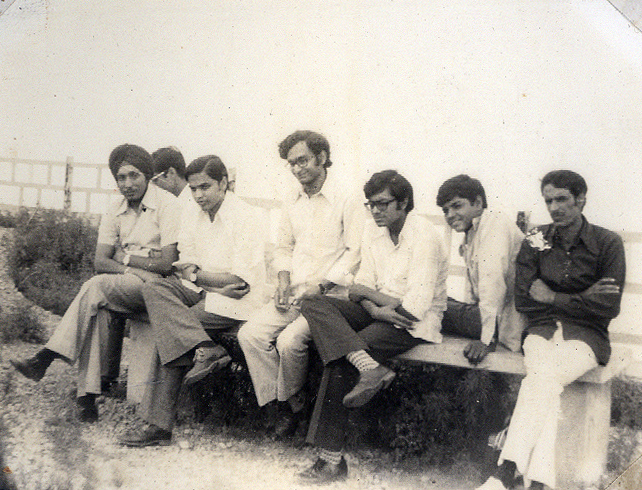
MBA 1976

Once in a while, nocturnal visits to Morni Hills cheered us up no end. So were visits to Sukhna Lake, Kasauli and Shimla. Rock Garden was just about beginning to take shape.

Shaping the intellect

The hostel room of yours truly also doubled up as a mini lecture hall. The door of the cupboard served as a blackboard. Classmates who had been busy – either with juicier escapades elsewhere on the campus or had been mentally absent when a lecture was getting delivered – made it a habit of trooping in to improve their intellect.

The trauma and the relief

The trauma of the final semester examinations eventually caught up with us. A friend from the 1975 batch offered to share some of his class notes with us. A mobike trip was made to his house nearby. However, on our way back, a wayward cyclist hit us near the Sector 15 market.

In my whole life so far, this was the first time I experienced a complete erasure of memory and a blackout which lasted a whole night. Much like in a Bollywood scenario, I came to my senses the next morning while reclining on my bed in the hostel room, only to ask in a feeble voice, ‘Where am I?’. Concerned friends had spent their entire night sitting by my side, keeping an eagle eye on my condition. They were quite relieved when I did not ask the dreaded question, ‘Who am I?’

With the final examinations due to start within a day’s time, a process of reverse coaching started, where I was at the receiving end. Groggy, unfocused and in a dazed condition, I was somehow made to take the Business Policy examination. Rest of the examinations followed in quick succession and were a bit challenging to the frayed nerves. End of examinations always calls for a celebration. This one was even more so.

The bonds that linger

These are but some of the memories one cherishes. All of us have a unique story of our own – that of entering, cruising through, and exiting the MBA program of Panjab University. Of the friends we made and the cliques we were a part of. Of the acts we indulged in, whether glorified or goofy.

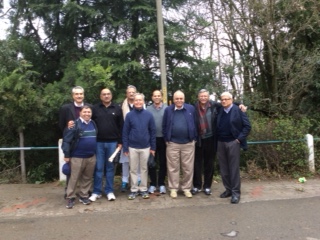
bacth-of-1976-in-2016

UBS played the role of an airport on which our individual planes taxied for some time and finally took off. Some became entrepreneurs. Some soared to great heights in their chosen career.

Wherever they happen to be, and whatever the time-lapse, the lingering bonds of friendship endure. Regular get togethers are not essential, but highly desirable. These do help us to keep the embers of friendship glowing.

(Inputs from Lalit Kapur and Kul Bhushan Khullar are gratefully acknowledged)

(Related posts:

https://ashokbhatia.wordpress.com/2016/10/01/the-class-of-1976-how-it-managed-to-get-suspended-for-a-week

https://ashokbhatia.wordpress.com/2016/10/09/the-class-of-1976-some-encounters-of-a-musical-kind

https://ashokbhatia.wordpress.com/2013/09/04/an-ode-to-our-teachers

https://ashokbhatia.wordpress.com/2014/06/01/revisiting-the-alma-mater)

Read Full Post »

The gang of twenty-five wannabe managers, when it entered the not-so-hallowed precincts of the University Business School of Panjab University, Chandigarh in the year 1974, was clueless as to the effective use to which the power of music could be put to practice the art of managing people.

Much later in their careers, some members of the gang might have woken up to the immense potential of healthy musical practices when it came to surviving in the corporate jungle. Some would have soared higher whistling the tune that their bosses wanted to hear from them. Others would have become great leaders based on the results their teams produced, much like an orchestra gets led by a conductor to produce mellifluous symphonies.HIS MASTER’S VOICE

Some might have perfected the art of phasing out dissent from their team members by the sheer power of their vocal chords, not alike the way even soulful lyrics get drowned by loud music in some of our best movies these days. Others might have formed a Mutual Appreciation Team by bonding with like-minded colleagues, much like a group of star artistes who transcend man-made borders to come up with their own brand of fusion music.

When faced with a challenging task, an informal chat, especially when conducted in the presence of appropriate tissue restoratives, duly backed by some soothing music playing in the background, often helps.

Discovering the Music Society

Two members of the gang, however, stood out. Having spent much of their previous years in understanding and memorizing basic principles of Physics and Chemical Engineering, a course in business administration gave their grey cells some well-deserved breathing time. Soon, they discovered the presence of a Music Society on the campus. Prompted by another musical soul from the 1973-75 batch, they joined the music classes on offer.Chandigarh Music Society 7

One aspired to learn playing the sarangi, while another, yours truly, weakly attempted to master the art of playing a guitar. Friends and critics obviously had their doubts on the efficacy of our musical endeavours. Luckily, they were too busy with their own lives to continue to watch our progress with any interest whatsoever.Chandigarh Music Society 2

On a personal note

Allow me to digress a wee bit and divulge that since childhood, my parents had repeatedly failed in their attempts to get me trained in classical vocal music. Subsequently, a banjo was gifted, in the fond hope that I might make something out of it. Alas, that too was not to be. Since there was no Wodehousean kid character like Edwin around, using paraffin sprays to douse fires, the instrument never went up in flames. It merely got lost in the rapids of time.

Eventually, my parents gave up and resigned to my limited capability of belting out some movie songs at birthday parties and some social events.

The original singers of most of these compositions were such stalwarts as Hemant Kumar, Talat Mehmood, Rafi sahib and Kishore Kumar. Luckily enough, none of my attempts to copy them ever reached their ears. Had a calamity of that nature come about, they would still be found shuddering in their graves.

My crude attempts at singing were carefully planned at such locations where donkeys could not have ready access. This way, I avoided the risk of a bunch of them joining me in unison, overjoyed at having finally found a brother-in-notes amongst the Homo Sapiens.MBA 1976

Treks to Kasauli and nocturnal visits to Morni hills nearby provided several other opportunities for me to display my singular lack of vocal skills. I still admire the tenacity and politeness of some of my hapless batch mates who not only tolerated but also applauded such renderings.

The sound of musicChandigarh Music Society 5

The association with Music Society added some colour and spice to the otherwise staid life on the campus. The members were drawn from different departments of the University. During 1975-76, the group even decided to confer on yours truly the title of Chairman, though I still wonder what I had done to deserve the honour.Chandigarh Music Society 4

Two events readily spring to my memory. One was a grand cultural show, where Mrs. Bimla Paul, wife of the then Vice Chancellor of the University, accepted our invitation to be the Chief Guest. The show was named ‘Swar Gunjan’. It was held at the University Auditorium.Chandigarh Music Society 3

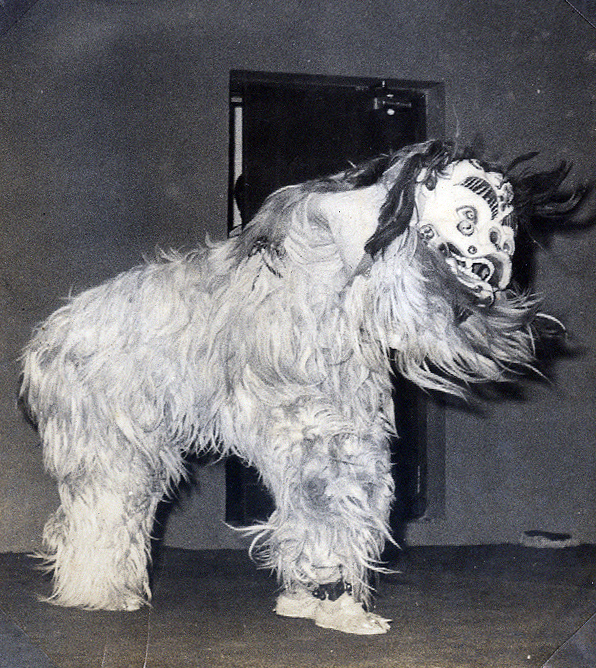
Some members performed a Tibetan Yak dance. My batch mate and I, more busy coordinating the back-stage gaffes and on-stage slip-ups, were part of a group which presented an instrumental version of an old song ‘Aayega aane wala…..’ from the movie ‘Mahal’.Chandigarh Music Society 1

Yet another highlight was a bloomer in the shape of a post-card handwritten invitation sent to the inimitable Amjad Ali Khan sahib, requesting him to play at the University. After some time, surely despite our invitation, he did come over to the city and performed at the auditorium of PGI, right opposite the University Campus. Needless to say, that was a veritable treat.Ustad Amjad Ali Khan

A tool for enriching our lives

Looking back, the key lesson was the importance of indulging in extra-curricular escapades in that unique phase of life. It broke the monotonous tyranny of a class room instruction. It came across as an instructive experience which broadened one’s mental horizons and provided one with a diverse group of people to interact with. One learnt the art of event management, a term which was not in vogue in those internet-less and smart-phone-less times.

One might not have learnt what exactly what one set out to learn, but the spin-offs have surely been a reward in themselves. Above all, a connection with music, howsoever tenuous, got reinforced.

Music is not only a food for the soul. It also nourishes our mind, cleansing it of all the negative toxins which dampen our performance. It enriches our lives in more ways than one. It helps us to have better interpersonal relations. It even helps budding managers and entrepreneurs to achieve their goals more efficiently!

(Related posts:

https://ashokbhatia.wordpress.com/2016/10/01/the-class-of-1976-how-it-managed-to-get-suspended-for-a-week

https://ashokbhatia.wordpress.com/2016/11/01/the-class-of-1976-forging-the-lingering-bonds-of-friendship

https://ashokbhatia.wordpress.com/2014/03/24/music-food-for-the-soul)

Read Full Post »

The Indian view of the discipline of management speaks of four pillars of Integral Management – Wisdom, Power, Harmony and Perfection. Of these, Power is a potent tool which, when harnessed judiciously, enables organizations and individual managers to scale greater heights.

Organizations wield tremendous power. They do so not only by virtue of their financial prowess but also by way of their brand equity, their size, their reach in the market and the kind of innovative products or services they offer. They exercise influence on the society – first, by identifying its latent desires, and then by serving the same.

Individuals who are part of organizations also wield tremendous power over its resources and its people. Arrogance and exploitation could easily follow.

However, if Power is understood as “strength and force, Shakti, which enables one to face all that can happen and to stand and overcome” difficulties connected with “men, events, circumstances, means”, then Power could be used for the overall good of humankind.

Thus, with power comes the attendant responsibility of using it wisely and equitably. Checks and balances need to be put in place to ensure that boundaries set by values and ethics do not get transcended. Keeping a strict control on arrogant behaviour is the sine qua non of long-term success in career.

Power needs to be used in a socially responsible manner. Using the power to share the gains of business with relevant stakeholders makes good sense. Deployment of power to benefit the society at large, that too in a manner which does not harm the environment, ensures that the business remains sustainable.

Managers also have a latent power – of their mind, their will, their ambition, their attitude, their passion and their soft skills. By channelizing the same appropriately, they could rise to greater heights and become more evolved persons, exercising greater influence on the events and people they are connected with.

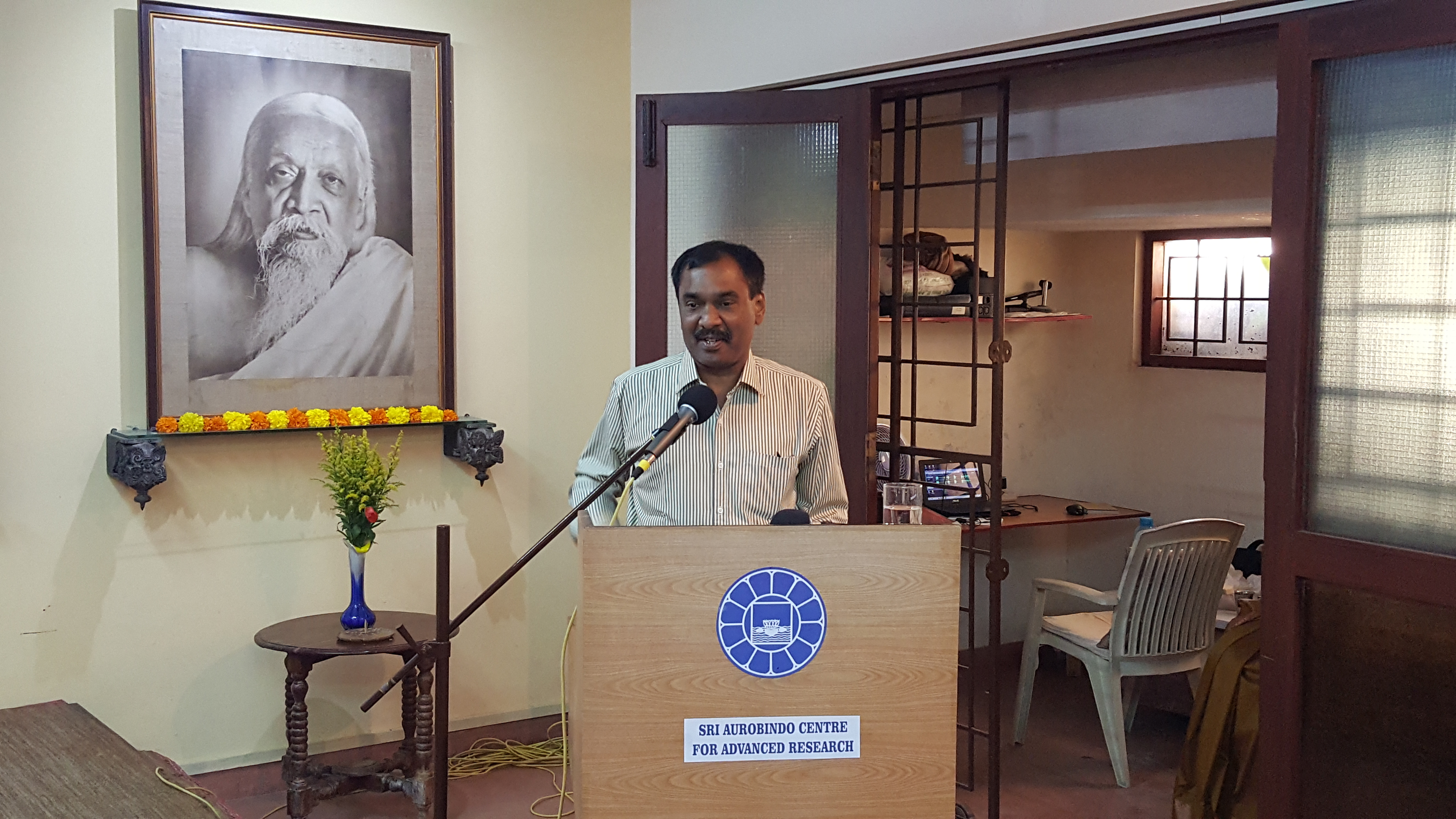
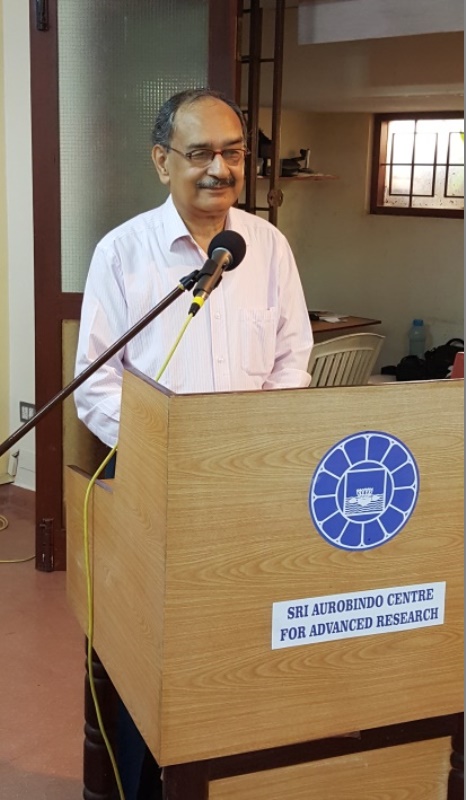
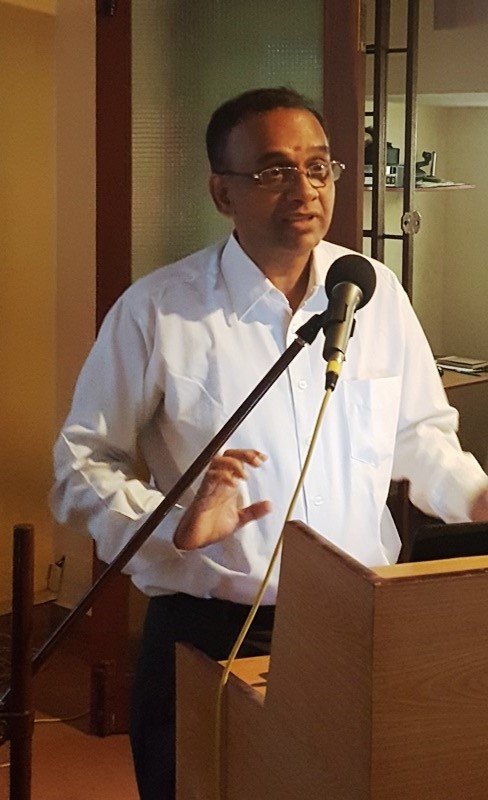
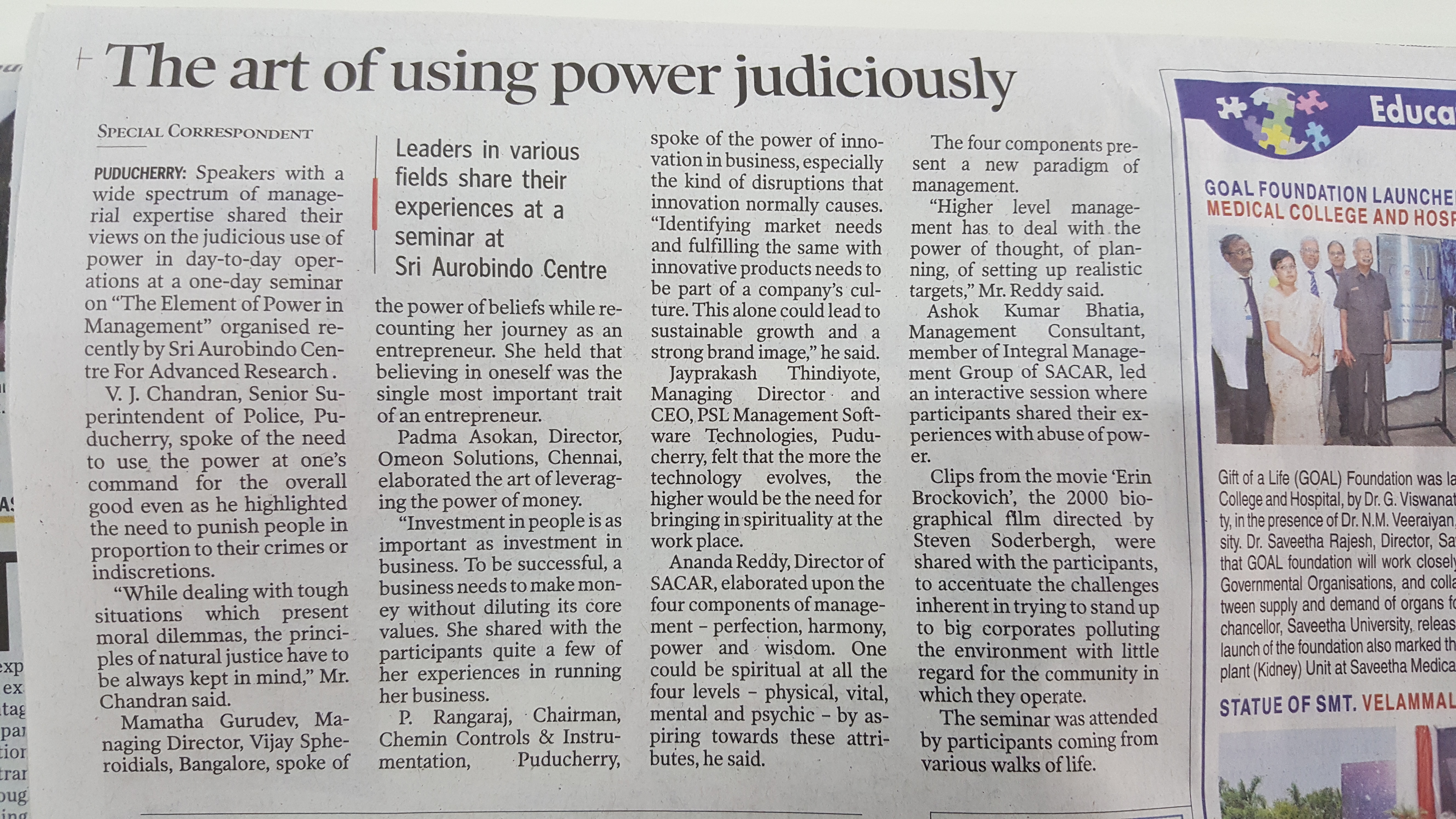
At a one-day seminar on “The Element of Power in Management” organized by SACAR on the 6th of August, 2016, speakers from a wide spectrum of managerial expertise shared their views on the judicious and responsible use of power in day-to-day operations.

SACAR Power Aug 2016 B

Dr. Ananda Reddy, the Director of SACAR, elaborated upon the four components of Management ― Perfection, Harmony, Power and Wisdom. He said that one could be spiritual at all the four levels – physical, vital, mental and psychic by aspiring towards what are called perfection, harmony, power and wisdom. These, he proposed, present a new paradigm of Management. On the level of thought, Power comes into play. Higher level management has to deal with the power of thought, of planning, of setting up realistic targets. He highlighted the importance of using power in a responsible and judicious manner.

SACAR Power Aug 2016 A

Dr. V. J. Chandran, IPS, SSP, Government of Puducherry, spoke of the need to use the power at one’s command in a spiritual manner – for the overall good. He highlighted the need to punish people in proportion to their crimes or indiscretions. While dealing with tough situations which present moral dilemmas, the Principles of Natural Justice have to be always kept in mind. Assuming responsibility and accountability is important. Improving upon one’s quality of work, one’s ability and one’s personal expertise alone helps. He shared with the participants certain instances where abuse of power led to severe complications for the society at large.

SACAR Power Aug 2016 3Ms. Mamatha Gurudev, Managing Director, Vijay Spheroidials, Bangalore, spoke of the power of beliefs while recounting her journey as an entrepreneur. She held that believing in oneself was the single most important trait of an entrepreneur. It makes sense to cultivate a habit of looking within and of being in touch with one’s own inner self. Trust reposed in one by others also empowers oneself. The focus should always be on the process, not on the person. She exhorted the participants to change their attitude from ‘I can’t do it yet’ to that of ‘I can do it’.

SACAR Power Aug 2016 4Ms. Padma Asokan, Director, Omeon Solutions, Chennai, elaborated the art of leveraging the power of money. Money needs constant activity and circulation. It should be used to increase wealth and prosperity. Wealth belongs to the divine and those who hold it are mere ‘’Trustees” and not “Possessors”. Investment in people is as important as investment in business. To be successful, a business needs to make money without diluting its core values. She shared with the participants quite a few of her experiences in running her business.

SACAR Power Aug 2016 5

As part of an interactive session, conducted by yours truly, participants spoke of the various ways in which they had experienced, and occasionally countered, the abuse of power. Clips from the movie ‘Erin Brockovich’ were shared with the participants, showcasing the challenges inherent in trying to stand up to big corporates polluting the environment with little regard for the community in which they operate.

SACAR Power Aug 2016 6

Mr. P. Rangaraj, Chairman, Chemin Controls & Instrumentation, Puducherry, spoke of the power of innovation in business. He touched upon some unique success stories and highlighted the need to make frugal engineering a routine habit. He described the kind of disruptions that innovation normally causes and explained the elements of perfection, harmony and wisdom which are necessary to upscale and market a new product or service.  Identifying market needs and fulfilling the same with innovative products needs to be part of a company’s culture. This alone could lead to sustainable growth and a strong brand image.

SACAR Power Aug 2016 7

Mr. Jayprakash Thindiyote, Managing Director and CEO, PSL Management Software Technologies, Puducherry, touched upon the power of technology. He spoke of rapid advances in the field of robotics and the advent of Artificial Intelligence. He felt that the more the technology evolves, the higher would be the need for bringing in spirituality at the work place. Having respect for alternative views, effective communication, genuine compassion and a creative approach to problem solving alone could help a business grow in future. He exhorted managers to be like an I-POD, that is, have an Inner Peace but be Outwardly Dynamic.

Mr. Ganesh Babu, Founder and CEO, Winning Minds Solutions, Puducherry, and Dr. Arvind Gupta, Assistant Director, Directorate of Distance Education, Pondicherry University, coordinated the entire event. Their back up support was invaluable in the planning as well as the hosting of the entire event.

Dr. Shruti Bidwaikar, Assistant Director, SACAR, summed up the proceedings and offered a vote of thanks.sacar-power-seminar-hindu

The seminar received an overwhelming response from participants coming from various walks of life, like government officials, management educationists, corporate executives, businessmen, Aurovillians, entrepreneurs and students.

The Integral Management Group of SACAR had already covered the facet of Perfection and Harmony in the past. The next event, focusing on the facet of Wisdom, is planned to be hosted during March, 2017.

(Link to a write up which appeared in The Hindu of September 13, 2016:

Best Regards

Read Full Post »

LEADERSThere is something unique about managers from India. Apparently, they have a Western mind and an Eastern heart. In other words, a unique combination of analytical prowess and intuitive faculties.

Here is a thought-provoking guest post from Mr K V Rao, Resident Director – ASEAN, Tata Sons Ltd , Singapore.

“I was born and raised in India in small towns, and started reflecting how is it that so many of my compatriots make it to global leadership positions ?

Many of our ilk have left the shores, for distant foreign lands. Have studied and imbued the best of cultures, but retained some of some of that inner rusticity, and native eclectic personalities. They have made it to the top jobs of Google, Microsoft, Mastercard, or a Pepsi, and the list is endless and still more to surface. All have been exceptional fighters, who seem to compete fiercely but fairly, often guided by their simple inner compass. All have had their roots in Middle Class India. What is the magic that’s at work ?

Typically, in a middle class family, that typifies some common basics – a high dose of personal values with low resources, what in a South Indian phrase is termed as “high thinking and simple living” hard work, education, discipline are the key mantras drilled into young minds, to help them break through the glass ceiling. Exceptionally strong personal family bonds, and a natural willingness to put oneself down for the other, compassion and care seem to naturally flower

What are those simple things that make them such effective leaders. Here are some reflections:

  1. There was never enough ….’   If one grew up in my generation in middle class India, life was always on the edge. Just about balancing ends with limited means. That meant, living happily and contented with what you have, than to aspire for what you don’t. Realism, practicality. But, also have the uncanny ability to stretch the buck – unbelievable value engineers, we are naturally. No wonder, hard to beat an Indian at cost cutting. !. Defining needs vs wants was deeply embedded in the frontal lobe of the mind, filtering away desires 🙂
  2. “We always ate together….” . Families would wait for each other to eat together. (Also the fact that there were hardly fridges then, and you ate hot and fresh !). There was sharing and caring. The bonds built were deep that lasted a life time, and giving and serving each other, imprinted that quality of care for a lifetime for another member of the family.
  3. “We celebrated together, we mourned together …” Families, lived as communities, extended with relatives, friends and neighbours. Much to the chagrin of modern nuclear families, there was little private and personal space  ! … All celebrations were shared, and so were the strains of illness or misfortune. Jumping in to help, give someone a shoulder was so very natural. That was the normal thing to do, not an act of valor or sacrifice. Your loss was mine, your success too was mine. Empathy a natural flow.
  4. Maths and English, are important…. “. Our fathers simply emphasized on 2 subjects, Maths and English, particularly in South India, as if they were meant to train the left and right brains, and eventually spur some whole brain activity. In hindsight, they seem to make sense. English opened the doors to global opportunities, the computational abilities pushed forward analytical thinking.
  5. “ We laughed a lot, joked, and pulled each others leg…Families, neighbors, and community living provided the best of entertainment, and a source of immense comedy. Radio and cinema were the only companions, and Black & White TV just came in with one or two long running serials. Sense of humour was valued, and we learnt to laugh, when nothing else could be done. Being sportive and getting the rough edge, is so normal, no big deal. It built great resilience and forbearance, for there were many things we could not change but had to live with.
  6. We prayed together….. . There was always a routine of prayer, whether you liked it or not. Before you start the day, go to college, go to exam, go to an interview. All of which, reinforced the positive belief, that no matter what, there is something more powerful and higher that resides above you, and cares for you should you make the effort to reach out. It ingrained the simple truth of focusing on the effort and leaving the ultimate result to the forces that be. It also made one more prepared to take risks, and face failure – a trait that today people struggle with, to fail, and yet to rise and be innovative.
  7. “ There is always a fix ….”  Last but not the least, there was never a “no” to be taken. There is always a fix, a ‘Jugaad’ if you may, or a work around. Hard to accept and give up. Persistence, thinking upside down, creativity or sheer street-smart tactical reflexes. Or the ability to bow, and accept failure honestly and humbly. It’s a potent combination of inner strength and outer smartness, to craft a strategy that works in the face of adversity.
  8.  “ You are not the smartest .. “. When you grew up, you always had someone much smarter than you, much better than you. You often wonder you were blessed or damn lucky to be where you are. There is a common streak of simplicity and most importantly humility. Go back to point 6, above – there was also someone “above” there who wished you well. Humility reinforced. !

It is not the top management schools that honed the skills alone, but the middle class homes of India that gave many of our generation, that inner compass and embedded CPU that makes one see life with a set of different lenses.

Leadership today, hinges on the ability to inspire, share, care, lead with empathy. Inflect clarity, sharpness, and fight the forces of competition with courage and tenacious persistence, never to give up. The ability to remain cheerful, spread laughter and joy around the work place. The training school of which is located in middle class Indian homes, that have often produced top class international business leaders.”


Read Full Post »

ashokbhatia's avatarashokbhatia

On the occasion of the upcoming International Yoga Day, managers of all sizes and shapes are all of a twitter, shuddering at the prospect of being called upon to celebrate the day by performing some complicated asanas, that too at the crack of dawn, on a day which, unfortunately, happens to be a Sunday.

It is not that people who pride themselves to be managers are any less patriotic. Nor are they any less health conscious. Those who believe that managers are forever thinking only of evading taxes while leading a sedentary life full of fun and frolic at star rated joints could not be more wrong.

The reason managers need not earmark a particular day for practicing yoga is rather simple. This hapless overworked breed is already devoting much of its time and energy to following yogic pursuits. This alone helps them to retain their sanity while riding…

View original post 1,408 more words

Read Full Post »

seagullHere are some gems of wisdom which can help you soar in your career:

  1. The more you analyse, the higher the state of inaction attained. Use intuition more often.
  2. Be unreasonable and deliver extraordinary business results.
  3. Always meet the boss halfway through.
  4. Call back yourself and be in for a surprise.
  5. Cultivate the art of Creative Dissatisfaction.
  6. Delegation without benchmarking and monitoring of targets amounts to abdication.
  7. Ethics and Values are important. Be smart. Steer your business using not only a Business Compass but also a Moral Compass.
  8. It always pays to have a credit balance in your interpersonal relationships.
  9. The only fire in the belly to be avoided is the one generated by ulcers and cysts.
  10. ‘Yes-men’ could be harmful to your career progression in the long run.
  11. Keep your learning batteries always charged up.
  12. Kiss frequently. The term ‘Kiss’ here stands for ‘Keep It Simple, Stupid’!
  13. Encourage dissenters to speak up; be a smart leader.
  14. While taking decisions, use your heart as well as your mind.
  15. Every five years, retire yourself. This would ensure you never get chucked out of a job.
  16. CEOs who succeed in the future would be the ones having a Western mind and an Eastern heart.
  17. Packages have a short shelf-life. Keep reinventing them.
  18. People are not spares of a machine, to be replaced once their utility is exhausted. Groom them for higher responsibilities, or out-place them.
  19. Always praise in public but reprimand in private.
  20. Keep your Propensity to Procrastinate under check.
  21. Being a ‘yes-man’ is a risky proposition. The higher you are in the pecking order, the higher the responsibility you carry on your shoulders – that of registering dissent.
  22. Keep your hormones under check. Love blossoming within the confines of office space can also turn into litigation and expensive lawsuits.
  23. A good way to kill an otherwise brilliant idea is to first convey it over mail.
  24. Pressure is an external stimulus. Stress is what we experience.
  25. Stress is inversely proportional to your inner resilience, which can be built up by forgiveness, a dash of humour, and meditation.
  26. Create a culture of observing, judging, and unleashing talent.
  27. Cultivate your underground cable connections. Things get done better when the informal organization gets going.
  28. Plan your vacations well. The absence of a good manager is never felt.
  29. It pays to build up and protect your own brand value.
  30. Strike the right balance between the following three: Concern for Production (read Results), Concern for People and Concern for Ethics.

(Picture courtesy Pixabay)

Read Full Post »

« Newer Posts - Older Posts »