Feeds:
Posts
Comments

Posts Tagged ‘Spirituality’

Abstract

The human race has come a long way in attaining its present state of evolution. From a single cell amoeba to the complex mechanism of our present-day physical bodies, one can look back at the journey so far with some reverence and pride.

But what does the future portend? What would be the salient features of the next level of our species? This article is an attempt at answering this query through the haze of our present-day myopic vision and limited capabilities.


As you read this, possibly with a steaming cup of coffee by your side and soothing music playing in the background, little do you realize the kind of miracle you and I represent.

One, we are both uniquely configured. As a physical body, we stand alone. As mental beings, we carry a unique set of beliefs and value systems which define our thoughts, actions and words. Our nature carries the baggage of all our habits and prejudices acquired during all our previous births, as also the ones freshly added from this one. Unknown to us, these determine the frame of reference we have in this lifetime. This in turn determines the perspective we have on whatever we encounter in life.  04

Two, we have been singularly lucky.  All our ancestors were successful in finding a soul mate and ended up furthering the process of procreation. Whether it was a random outcome of Cupid’s arrows or a decision which was governed by social norms prevailing then, we may not know. We ourselves are the veritable proof that we have appeared after a long drawn out series of successful reproductive endeavors of our ancestors.

Three, a million years back, even the most prescient of magicians could not have forecast that we would eventually evolve into a species known as Homo Sapiens. When it came to evolution, we have repeatedly enjoyed biological benevolence and good fortune. In the process, what an amazing transformation we have gone through! We were possibly the first organism to have been bombarded on earth by a meteoric shower originating from Mars. From a single cell structure, we have today become a highly sophisticated machinery which willy-nilly is aware of its own existence.

In the interim, we have undergone repeated transformations. We have never been attached to a particular type, shape, color or size for too long. We first developed a liking for oxygen. We then frolicked about in the deep oceans, before trying to rule land in various forms. We bore our way underground and climbed on trees. We took wings and enjoyed the freedom of mobility, often backed by a highly effective GPS. a1 1 (8)

We became as big as a zebra or an elephant and as small as a lizard or a rat. We attempted several hissing and slithering forms and showed exemplary flexibility in adapting to newer challenges from the environment. From bonobos and apes to Homo Sapiens has been a logical jump for us, and we know that we have indeed arrived.  

We now roam about all corners of the solar system. We keep messing up the fragile environment we have been gifted with. We have possibly come to believe that the journey of evolution is over. We think we can now rest on our laurels and remain content with inventing newer and better means to destroy ourselves.

Well, past experience does not support this line of thought. We are apparently on a journey the destination of which is still far away. The forces of nature are inexorably leading us towards further evolution, possibly into a kind of species which would be far more sophisticated and intelligent than we can presently imagine.

Sure enough, the seeds of our appearance and growth had been present amongst bonobos and other primates. Likewise, the seeds of the species to come must already be within us. More significantly, we do not have a choice but to ascend to higher planes of consciousness and physical perfection. The life force which has propelled us so far shall continue to do so in the times to come.a1 1 (13)

Let us consider this hypothesis further. What would be the salient characteristics of the next level of our species?

We might take a leap beyond logic. Intuitive powers may dominate our day-to-day living. We might become more aware of our souls and simply enjoy the bliss of pure and benign thoughts, leading to that elusive glow of inner happiness and an all-pervading joy. Our dependence on outer sources and gadgets for our happiness may see a gradual reduction, thereby freeing us from the incessant flow of our desires, as at present.

Our capacity to absorb knowledge may multiply manifold. The physical body might become much stronger and also capable of healing itself. A specialist may be able to ‘treat’ us in a distance mode and maintain our well-being. Visits to health centers may become less frequent, except in cases where organ replacements become essential.

Changes in our biological systems may come about. Our psychic powers may get more refined. May be, we shall become so evolved as to be less dependent on our sensory perceptions. We might be able to converse with each other without having to speak. We might be able to intuitively know how the other person is feeling and tailor our response and behavior accordingly. In other words, languages may start becoming extinct. a1 1 (11)

In evolving further, we are bound to face challenges. But the incessant process of evolution itself might present the solutions we shall need – not only to survive but to do even better. The struggle of the good ones amongst us to out-survive the bad ones shall continue forever. As we evolve further, the need for a spiritual outlook shall only grow. 

As the miracle unfolds in the centuries to follow, our heads shall bow in reverence to the mighty and inexorable forces of nature and nurture which continue propelling us on the highway of evolution. On our part, a focus on spiritual practices might hasten the process.

(Grateful acknowledgements are due to a spiritually evolved guide, friend and philosopher; paintings courtesy M F Hussain and Huta.)

(Published in NAMAH, the Journal of Integral Health, Vol 22, Issue 1 dated the 24th of April, 2014)



Read Full Post »

At present, the term GDP in India appears to have come to represent our collective Gross Despondency Perception. Our economists and statisticians can perhaps cheer up the hapless and overtly depressed citizens. They can do so by overcoming their obsession with pure materialistic growth. There are several ‘intangibles’ as well as ‘tangibles’ which can get added to the quantitative measure of our progress. For all you know, they could end up depicting a rosier picture which would also be closer to reality.

The following invisible facets of GDP could do with better visibility in the public domain:GDP Housewife

1.   Grand Domestic Pampering 

Household chores performed by a vast majority of the better half of our citizenry continue to remain invisible even to prominent economists who take such services for granted at their own homes. Home makers surely deserve a better deal. Without their contribution, the wheels of our economy would grind to a complete halt in no time. Home management services are provided by them 24×7. There is no doubt that they possess a high degree of multi-tasking skills. Also, their inventory management techniques always ensure that there are no stock-outs in the kitchen when uninvited guests suddenly pop up over the weekends.

 2.   Gross Dramatic ProduceGDP Tagore

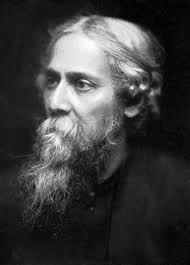
Why neglect works of entertainment, literature, music and art works? The movie industry keeps churning out pot-boilers one after the other. Over the years, only the bar of success at the box office keeps getting raised. Television has already blossomed into a primary source of entertainment for the masses. Both the mediums have transcended international boundaries and gone global. India boasts of prolific writers across all languages and there is no reason their contribution to the social thought process should get neglected. Creative personalities and achievers of all kinds have added value to the Indian identity – right from Rabindranath Tagore to M F Husain, from M S Subbulakshmi to Pandit Ravi Shankar, from Munshi Premchand to Vikram Seth and from Lala Amarnath to Saina Nehwal. The relative soundness of the Indian IP regime can facilitate the inclusion of this parameter in the GDP computation without much fuss.

 3.  Groovy Digital Products

With broadband getting rolled out across the country, and with spectrum sales eventually coming out of the depressing shadow of scams GDP Aishwaryaand judicial overreach, the Indian economy would soon start getting digitalized at a faster pace. Digital experiences are slated to improve in terms of reach as well as quality. This sector can boast of a unique range of intangible assets of its own. Such developments can only be ignored at our own risk and peril.

4.   Great Domestic Patience

Yet another soft power which remains ‘invisible’ to the Homo economicus (as opposed to the Homo reciprocans) amongst us is the religiosity, the innate bent towards spirituality and the resultant bias towards non-violence. The patience displayed by most of our denizens in dealing with shoddy civic facilities, super-slow public services and systemic corruption is perhaps a result of our social mores which are steeped in spirituality. By ignoring this facet, a great mechanism to handle setbacks in life is therefore left out of the reckoning.

GDP R&D

5.   Grand Design Patronage

R&D expenditure in the private sector is another area which deserves attention. Admittedly, we are far behind in the realm of innovation and design. But we do have the potential to catch up with the rest of the world. If such expenditure is considered an investment in the economy, a more realistic perspective would emerge.

6.   Green Development Plans

In the relentless pursuit of economic growth, we are guilty of drawing more than we replenish to Mother Nature. Whether it is mining, spectrum-sharing or water-management, we are taking myopic liberties which would prove very expensive, if not irreversible, in the timesGDP environment to come. Green initiatives taken to compensate for the loss of natural resources surely merit inclusion in our scheme of things. The aggregate value of ‘production’ should surely be adjusted to reflect the permanent damage caused to our fragile environment.

Considering intangibles in macroeconomics data is not a new idea at all. Way back in 1908, Thorstein Veblen, a sociologist and economist, had used the phrase ‘intangible investment’ to cover everything from innovation to promotion and advertising. At a business level as well, the proportion of tangible assets backing up a brand could be a miniscule 5% of the overall value of the brand.

The Bureau of Economic Analysis of US has recently created history of sorts by publishing a revised series of public accounts which include the R&D investment in private sector as well as original works of art such as films, books and music. As an example, for the period from 2002-12, the new data shows an annual average growth rate of 1.8% in place of the earlier declared rate of 1.6%.

We have a number of institutions, bodies, statisticians and economists who can surely propose a more balanced way of capturing the realities of the Indian economy. The data may not be easily available and may have its own share of initial controversies, but the attempt would certainly be an improvement in the right direction.

PS: Whatever little I understand of Economics, it is due to the learning received from late Prof. S P Singh, a friend, philosopher and guide. This article is merely a humble tribute to the great person. 

Read Full Post »

Poster The_Beauty_InsideWould hi-tech companies like Intel and Toshiba believe in the traditional Indian ethos of spirituality and reincarnation? The fact that their recent promos give us a glimpse into a universe where what is on the inside alone counts does indicate this. The key message appears to be that whether it is a man or a machine, it is only the entity inside which makes a difference. ‘The Beauty Inside’ promo has a narrative of daily incarnations, which fits in rather well with what Lord Krishna tells us in the Bhagavad Gita – that the soul inside us is what really matters!

This is obviously not to say that the essential principles enshrined in Eastern scriptures necessarily need an endorsement from the West. It is common knowledge that post-Lehman Brothers, premier management institutions from the West have started showing some interest in the Eastern philosophy. The concepts of morality and ethics have gained currency in management circles. The fact that Stephen Covey speaks of an inner voice and a soul in his book ‘The 8th Habit’ is yet another manifestation of this trend.

Learning it from intelligent apes

The concept of a soul is an integral part of various streams of religion and spirituality we see around us today. It is interesting to understand how religion and spirituality originated; also, the value these really add to our mundane lives.Bonobos

After years of research on bonobos – intelligent apes closely related to us, homo-sapiens – Frans de Waal argues that human morality is not imposed from above but comes from within us. In his path-breaking book entitled The Bonobo and the Atheist, he therefore proposes that moral behavior does not begin and end with religion. It appears that our values and ethics are instead a product of evolution and cultural response.

The fact that our innate goodness resulted into diverse streams of religions we see around us today readily explains the success of religion – and various Gods revered in each stream – as a concept. The spiritual thought process is also an outcome of the same core of our need to be good within ourselves, in our own eyes.

A cat or a dog may not think through the process so thoroughly, but bonobos surely appear to be aware of the nuances of social norms. Religion Ankara_Muzeum_They have a developed sense of reciprocity and fairness. They are even known to intervene in a fight between two tribe members so as to maintain peace and harmony!

Ancient apes, whales and dolphins deserve our gratitude for several qualities that we possess – our sensitivity to others, our concern for fairness, love of harmony and other just forms of societal behavior. If religion or spirituality attract us, it is because these touch a chord somewhere deep within us.

Templates of Exemplary Conduct  

The contribution of religion therefore is in presenting us with templates of exemplary conduct. It has codified the social and ethical norms for the average person. In particular, it has made it easier to explain the nuances of ethical and moral values by portraying examples of Gods and Goddesses whose conduct is worth emulating for the average person. Religion cleverly uses fear and temptation to guide and control human conduct.

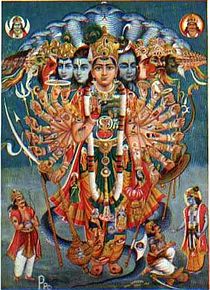
Irrespective of the stream of spirituality one chooses to follow, the basic template invariably is again that of exemplary conduct. However,A_Vishva-rupa_print the focus is on listening to one’s inner self. The endeavor is to silence the mind, thereby attaining inner peace and happiness. Each stream of spirituality has a different prescription and a unique methodology, but all are unanimous that the spirit is at the centre of it all. To that extent, spirituality has the potential of uniting people, whereas religion has been seen to divide it along communal lines.

As compared to religion, spirituality is more embracing. In religion, we have the good guys – devas – and the bad guys – asuras. Following one’s Dharma, the code of righteousness, man can hope to attain salvation. However, spirituality encompasses the good as well as the evil, both being manifestations of the Divine. When Krishna manifests his all-pervasive and all-inclusive Vishwarupa form in the midst of his sermon to Arjuna, it shows the negative side of the Divine as well.

A Heady Cocktail

Intel and Toshiba have surely come up with a winner promo in ‘The Beauty Inside’. Similar campaigns which work on a heady cocktail ofintel logo some basic tenets of religion and philosophy on the one hand and the latest that technology and management has on offer on the other would surely follow.

Given that our scriptures are replete with gems of wisdom and lay down templates of exemplary conduct, more and more corporates could be hopping on to the spiritual bandwagon in the days to come. Already, we find companies appointing Chief Belief Officers and Chief Ethics & Compliance Officers. Goes on to show that the role of conscience keepers in corporates is getting the recognition it deserves.

Toshiba logo

Such developments give one hope that the upcoming generations of our future business leaders and professional managers would rate high not only on their Intelligence and Emotional Quotients, but also on their Moral or Spiritual Quotient, bringing to the work place a set of ethical values and practices.

Read Full Post »

A vast majority of our management professionals may typically scoff at the idea of any common areas between the realms of happinessspirituality and management. After all, management is all about getting things done, irrespective – perhaps – of the means deployed. Result orientation, MBO, resource optimization, mentoring, etc, have been the key words in the better part of the last century. On the other end, spirituality is widely perceived as one being decent and nice to others, of being considerate and empathic. This sounds more like a surreal concept, because then, it is commonly feared, there is a good chance of either insubordination, or an emotional blackmail by others in the organization, thereby diluting the chances of achieving one’s goals effectively and efficiently.

In other words, management is perceived to be at one end of the spectrum whereas spirituality is believed to be at the opposite end. However, if one were to look a little deeper, one is likely to find not only several dots which join the two apparently diametrically opposite view points, but also a new vision and strategy to manage affairs more effectively than ever.

BEING SPIRITUAL

What do we understand by spirituality? Sure enough, it is not being good to others around us. It has more to do with an inner call and a yearning to do better, whatever may be the chosen field of one’s activity. Like perfection and happiness, which are not destinations in life but the journey of life itself, being spiritual is a process in itself. An inner process of self introspection, development and improvement is what makes a person spiritual. Spirituality is awakening oneself and developing one’s unique abilities to the maximum, thereby maximizing one’s innate potential to achieve excellence in management.

Spirituality is not about withdrawing from the worldly activities; instead, it is about an active engagement with the mundane affairs of life, whether pertaining to managing an enterprise, or related to one’s personal life and self-development,

A manager is not an exception to this fundamental truth. In fact, armed with his systematic approach, he would chalk out a plan to achieve the goal of becoming spiritual in all his dealings. And that would make him even more spiritual than he originally would have been!

ATTRIBUTES OF A SPIRITUAL MANAGER

A manager who is keen to realize his own self would be more empathic towards his team mates’ problems. He would instinctivelyMahabharat Krishna Arjuna know when to motivate whom and when to pull up a defaulting team member. He would never rebuke a team member in public and praise in private. He would do his own home work in advance, and base his plans on feedback and suggestions from his team. Invariably, he would go into minute details of the plan, thereby striving for and achieving perfection. Failures would be taken as stepping-stones of future successes, and not necessarily used for witch-hunting. He is a leader as well as a mentor.

Why did Krishna choose to teach the essential principle of detachment to Arjuna on the battlefield of Kurukshetra? Because due to a misplaced sense of attachment, Arjuna was deviating from his karma. The Lord was obviously a smart leader, so he decided to motivate him at a crucial juncture in his career. If the goal was to facilitate a win for the Pandavas in the war and avenge injustice and humiliation suffered by them at the hands of the Kauravas, he got it done very effectively indeed! Would it then be wrong to label Krishna as a Spiritual Manager?!

MOVING OVER TO “SQ” – A SPIRITUAL QUOTIENT

Management thought and practice has evolved dramatically over the past few decades.  The early 20th century saw our civilization coming up with an index for our cognitive and intellectual abilities – the IQ. Then in 1985, Howard Gardner came up with his research on “multiple intelligences” in his book Frames of Mind. Later, John Mayor and Peter Salovey co-propounded a new concept of “emotional intelligence” that is said to shape the quality of our inter- and intra-personal relationships. Reuven Bar-On coined the term “EQ” and described it thus:

            It is thought that the more emotionally intelligent individuals are those who are able to recognize and express their emotions,c1 (25) who possess positive self-regard and are able to actualize their potential capacities and lead fairly happy lives; they are able to understand the way others feel and are capable of making and maintaining mutually satisfying and responsible interpersonal relationships without becoming dependent on others; they are generally optimistic, flexible, realistic and are fairly successful in solving problems and coping with stress without losing control.

Daniel Goleman published his book Emotional Intelligence in 1996, confirming that success in life is based more on our ability to manage our emotions than on our intellectual capabilities; also, that a lack of success is more often than not due to our mismanagement of emotions. Some factors comprising emotional intelligence are “self-awareness, seeing the links between thoughts, feelings and reactions; knowing if thoughts or feelings are ruling a decision; seeing the consequences of alternate choices; and applying these insights to choices.”

Now, the time is coming for another paradigm shift – that of considering SQ – a Spiritual Quotient. Managers of tomorrow not only need to unlearn what they have learnt so far in business – their own or others’. To be effective, they need to refurbish their arsenal of managerial techniques by bringing in a spiritual awareness in whatever area they work in. Work, tempered with a liberal dose of contemplation alone would hold the key to managerial success in the days to come.

SELF-REVERENCE, SELF-KNOWLEDGE AND SELF-CONTROL  

The young executive today has excellent media exposure. A completely different set of rules at home have ensured an upbringing which is quite different from that of the earlier generation of managers. Undoubtedly, HR professionals today have a far more challenging job at hand in attracting as well as retaining the people.

The other day, the HR manager of a reputed software company bemoaned that unless one gets used to such inane tantrums as thea1 1 (11) aroma of toilet soap provided to employees in the wash rooms of their sprawling campus, and took care of the temperature at which a pizza or a hamburger was served in the canteen, the guy who is worth a couple of million dollars worth of revenue to the company might just decide to call it quits!

When it comes to appraising their team members, how many leaders are comfortable to be candid and straightforward? The underlying cause is for them to mix up between the person and his performance. Irrespective of the amount of rating scales developed, judging a person remains a subjective affair. But when it comes to rating performance, a great deal of objectivity is essential as well as desirable. A sense of detachment is of great help in such situations.

Likewise, when there are separations to be handled, true blue HR guys would handle the same with professionalism – in other words, with a sense of objective detachment.

Leaders have to make great sacrifices on the personal front so they may set a good example to their followers. “Self-reverence, self-knowledge, self-control – these three alone lead life to sovereign power”, Alfred Lord Tennyson wrote in Oenone, the poem named after the daughter of Mount Ida, who precipitated the Trojan War. Leaders without a spiritual compass in hand could result in their teams going astray.

THE HEART-MIND CONNECT

The heart, considered to be the seat of our spirit, isn’t a sentimental or an emotional entity. It is now understood to be intelligent and04 powerful in its own right. Its intelligence manifests itself as an intelligent flow of awareness and insight, or simply put, as intuition.

Several ancient civilizations, like the Egyptian, the Greeks and the Indian, have held the heart to be a primary organ capable of influencing our emotions, our morality and our decision-making abilities. Similar views are echoed in the Bible as well as in Chinese, Hindu and Islamic beliefs and scriptures. According to pioneering work done by Doc Childre, Howard Martin and Donna Beech: “All these conceptions have a common view of the heart as harboring an “intelligence” that operates independent of the brain yet in communication with it.”

Unlike the mind, the heart processes its intelligence in a more intuitive and different manner. The heart is not only open to new possibilities; it actively seeks from the environment newer understandings. The head “knows” but the heart “understands”.

In spiritual practice, we have streams which focus on quietening the mind; we also have systems in which the focus is on the “divine light” in one’s heart. All forms of spiritual practices nevertheless lead to better clarity of thought. This eventually translates into higher effectiveness and productivity at the work place.

THE AGE OF THE SPIRITUAL MANAGER

The following are some of the ways in which a spiritual manager stands to benefit:Technology MEDITATION-ENTREPRENEUR-SUCCEED

  1. Improving his self management, resulting into better effectiveness and improved personal productivity.
  2. Radiating his positivity to those around him/her, thereby improving organizational climate. This surely has a long-term impact on the operations.
  3. Improving communication, thereby enhancing his capability of getting things done.
  4. Facilitating sustained invigoration of operational strengths and continuous replenishment of organization’s resources.

In the future, thanks to shorter attention spans of consumers and an information overload, businesses would be facing higher levels of uncertainties. Managers with a high SQ would invariably have a higher chance of succeeding in meeting their goals.

Thanks to Lehman Brothers and the ensuing economic meltdown, there is an increasing realization in the west that there are serious pitfalls in the culture of materialism. No wonder that Harvard, MIT and Sloan are a few of the business schools which are now actively collaborating with management education institutes in India. This gives a unique opportunity to their students to learn the Indian culture and ethos first-hand. Management lessons from Gita, socially relevant projects and mentoring of under-privileged children in Indian slums are some of the points of interest to them.

Sure enough, the age of the Spiritual Manager is likely to dawn upon us rather early.

Read Full Post »

« Newer Posts