One of the lessons my Guardian Angels have taught me is that when one is overly critical of the task being done by someone else, they ensure that one willy-nilly ends up playing that very role for some time. Being in that person’s shoes (or sandals, if you prefer) helps one to realise exactly where the shoe pinches, literally as well as metaphorically. From being a critic, one turns up being a reluctant admirer of the art and craft of the task at hand. One develops empathy for the party of the other part. Scales fall from one’s eyes. It dawns upon one that the person performing the task in question is perhaps more to be pitied than censured.
Take the case of a husband who occasionally takes a jaundiced view of the quality of cooking of his spouse. However, after a heated argument, when she decides to go off in a huff to her parents’ house, all hell breaks loose. Regularly gobbling down instant noodles and takeaway food from nearby joints soon loses its charm. Deciding to take the matter into his own hands, he enters the kitchen arena, much like a Roman Gladiator showing up at the Colosseum. Finding the right raw materials and other ingredients in the kitchen becomes a major challenge. Locating either the right pots and pans or an appropriate ladle for whatever is planned to be dished out sounds tougher than overpowering a lion which has been deprived of its quota of vitamins for many days. Sweating profusely while seated on the dining table and trying to put some semi-cooked stuff down the hatch, he starts appreciating the cooking skills of his spouse. The post-cooking clean-up in the kitchen leaves him gasping for breath. Pretty soon, he decides to bury the hatchet and rush off to his in-laws’ place to charm the wife into accompanying him back to their abode. The dove of matrimonial peace restarts flapping its wings at home.
But I digress. After I hung up my corporate boots and decided to become an author, I had come to view editors of all sizes, shapes, and hues with a thinly veiled contempt. Most of them believed in following the dictum that silence conveyed a polite rejection. Even if they were to accept a manuscript for scrutiny, there was seldom a commitment as to when it might crawl up to the top of the pile on their cluttered tables. And yes, I dreaded the day when I would receive their detailed feedback. By then, they would have poked so many holes in the manuscript that it might as well be compared to Swiss cheese. Of course, the most traumatic experience was when I was asked to reduce the word length by close to 30% of what it was. To an author, it is akin to asking someone to perform a delicate surgery on oneself, sans anaesthesia of any kind!
However, my Guardian Angels soon decided to intervene and change my perspective. Somehow, I ended up becoming part of a three-member editorial team that has pious intentions of publishing a philosophical tome comprising as many as fifteen essays from as many authors located in different parts of the world.
For me, a voracious reader, it is obviously a pleasure to go through varying perspectives on the same subject. One’s mind opens up, much like a sunflower trying to soak in as much Vitamin D as possible. One’s outlook broadens. Each author’s voice is unique. The frequency, the amplitude, and the tone and tenor of each composition are different. At a casual glance, all these might sound like a cacophony of sorts. But together, they all generate a symphony of sorts, presenting a harmonious blend of the key message of the anthology.
Empathising with Editors
Thus, the task of editing offers quite a few perks. But it also makes one face many challenges in the process. Here is an indicative list of some of these faced by the team so far.
Ensuring that the content of any contribution fits into the overall purpose of the collection.
Maintaining the originality of the author’s voice, while suggesting improvements which would connect the narrative better to the key objective of the anthology.
To improve the readability of a paper, each one needs to be checked and ranked on a hypothetical Richter Scale of Comprehensibility. Those scoring higher than a threshold must be politely advised to tone down the narrative.
Having patience with contributors who are first-time authors. Supporting them to improve the general flow of the article. Assisting them in connecting disparate sections or paragraphs more smoothly.
Even though all contributions may be in the same language, the sentence construction, the choice of words used, and the way of conveying an idea vary widely. This requires a type of verbal dexterity which could leave one fogged, nonplussed, and perplexed.
Ensuring that a contributor is not trying to promote his/her own business interests through the paper submitted by them. One, that would be unethical. Two, if readers suspect that a commercial motive is embedded in any essay, our own credibility and brand image take a hit.
In case an expert has contributed a paper on a subject which is not understood by any of the members of the editorial team, referring it to a domain expert for a peer review makes eminent sense. Coordinating between the author and the expert helps in bringing about a better balance in the paper.
Since the idea is to deliver a book to our readers which does not leave them fretting and fuming over linguistic bloomers in the manuscript, the services of an external editor need to be hired. In many cases, this may entail a back-and-forth exchange of ideas between the author and the external editor. If the author has chosen to quote references and mentioned a few weblinks to support the arguments being advanced, a rigorous check of the same could be handled by him/her.
With advances in technology, a basic check to ascertain the AI-infestation level of any essay needs to be considered a sine qua non.
It transpires that editors need to be made of sterner stuff. Overcoming our prejudices and being impartial does not come easily. A bulldog spirit is essential. Nerves of chilled steel are required for picking up something written by someone else and transforming it into the kind of stuff potential readers would gleefully lap up, much like your pet relishing a slice of fish.
Having undergone an instructive experience of this kind, one may safely conclude that editors are more to be pitied than censured.
In fact, it was this experience that prompted yours truly to publish a detailed blog post earlier, capturing the kind of challenges faced by the owners and editors of journals in the oeuvre of Sir P. G. Wodehouse.
Choosing a Title and Subtitle
Once the manuscript is almost ready, thoughts of the team obviously turned to the challenge of choosing an appropriate title and subtitle for the collection.
The snag we always come up against when deciding upon these can be summed up as an existential dilemma between two vastly different atmospheric levels – the troposphere, closer to the ground realities which are showcased by different articles, and the stratosphere, which denotes the loftier goals with which the anthology was conceptualised, to begin with. This deserves serious thought. Both must be catchy and readily comprehensible. It is something one does not want to go wrong about, because one false step and the whole compendium is sunk. If a lay reader, while searching for something fresh to devour, does not become curious about what a book is all about, and does not get a promise as to what precisely to expect, they could not be blamed for failing to get attracted to the offering. Their short attention span of a few seconds makes them move away to greener pastures. They simply walk out on one.
Thus, if the title represents the loftier goal of the anthology in a rather obtuse manner, the subtitle must hasten to clarify what it is all about and what it promises to deliver.
So, one needs to put one’s thinking cap on, surf through the internet to locate the titles and subtitles of comparable works, if any, and then make a judicious call. The last thing one wants is to leave one’s public at a loss, simply raising their eyebrows, twiddling their thumbs, and trying to figure out what one is talking about.
The Challenge of Whipping Up an Introduction
The existential dilemma mentioned above also pervades this aspect of the book. While crafting an introductory chapter to the collection of voices presented in the anthology, a balance needs to be struck between the stratospheric level of the high ideals which the book intends to convey to its readers and the tropospheric real-life situations reflected in the different papers presented therein. Not an easy task! Recalling that sordid experience, one could be forgiven for quivering like an aspen, if you know what I mean.
If one starts describing the contents of different papers in brief, one leaves the audience wondering where the collection is headed. Of course, one does it with the best of intentions, trying to provide a bird’s-eye view of the whole affair. But even the most conscientious readers could be left clueless as to what purpose will be served by their having to trudge through as many as fifteen odd essays, each having a different ‘intellectual density’, with few connecting points between them. They would miss the woods for the trees.
On the other hand, if one takes too long to capture the beauty of the woods, create an atmosphere, and state the loftier goals which prompted one to curate a delectable collection of so many essays, many readers may simply call it a day and quietly walk out on one.
Perhaps wisdom lies in putting the salient facts as briefly as possible and linking them to the overall purpose of the book, prompting the reader to go ahead and start exploring different chapters, either sequentially or otherwise, one by one. It can be done the other way round as well. In any case, one needs to make sure that while going through the introductory chapter, one minimises the chances of letting readers’ attention wander even for a minute or two. By the time it ends, they need to be left curious enough to start their own journey by exploring the book in detail.
We have miles to go before we sleep…
Well, finalising the manuscript is only the first 35% of the story. What follows is a far more arduous journey: getting it produced, marketing and promoting it, and the like.
As Robert Frost says: “The woods are lovely, dark and deep, But I have promises to keep, And miles to go before I sleep…”
Wodehouse’s fiction, though celebrated chiefly for its whimsical aristocrats and shambolic bachelors, also furnishes a surprisingly detailed anatomy of the Edwardian and inter-war publishing world. He uses owners, publishers, and editors not merely as comic foils, but also nudges us towards a broader meditation on responsibility, power, and vocation. Through a kaleidoscope of characters—from absentee proprietors who think of their periodicals only while pronging a kippered herring on their plate with a gloomy fork, to editors who sacrifice sleep, dignity, and occasionally their trousers—Wodehouse rehearses the perennial tensions between commerce, conscience, and creativity.
Three Types of Owners
Wodehouse distinguishes three archetypes. The “absentee capitalist,” embodied by Mr Benjamin Scobell in The Prince and Betty, treats a publication as an elegant bauble within a far wider portfolio. The “romantic acquirer,” who buys a journal under the influence of either Cupid or a literary crush and sheds it as soon as the passion cools. Finally, we have the “hands-on mogul,” typified by Lord Tilbury of the Mammoth Publishing Company, who prowls city streets incognito lest aspiring scribblers hurl unsolicited manuscripts through omnibus windows. Lord Tilbury’s hunger for “juicy memoirs” and his ruthless eye on circulation figures epitomise the hard-nosed side of media ownership, reminding readers that even genteel magazines are ultimately businesses subject to profit and loss.
Editors: The Lion Kings
However, the slender shoulders on which the burden of keeping the publishing activity alive and kicking falls invariably happen to be those of the editors. They are the eager beavers who keep a sharp eye on the circulation figures and decide the nature and form of the content that gets routinely unleashed upon hapless readers like us. They happen to be industrious little creatures who work hard and shrink from the public gaze. They are the lion kings of their publishing fiefdom and are the masters of all they survey. Bosses love them when circulation figures show an upward trend. Yet, they are hated by authors whose manuscripts they keep throwing into the nearest dustbin in their office. In Plum’s world, alluded to above as Plumsville, editorial life is equal parts chess match and boxing bout; success demands both strategic foresight and literary prowess.
No case illustrates editorial resilience better than Aunt Dahlia Travers and her chronically unprofitable women’s weekly, Milady’s Boudoir. She marshals fox‑hunting grit, occasional grand larceny (commandeering a painting for a scoop), and the incomparable cuisine of Anatole to keep the presses rolling. Her magazine’s survival hinges not only on high finance but on familial diplomacy—extracting cheques from her dyspeptic husband, Uncle Tom, trading serial rights to pay printers, and manipulating Bertie Wooster into sartorial columns. Thus, Plum applauds tenacity while exposing the precarious economics of niche publishing.
Conversely, Cosy Moments—the ostensibly saccharine “journal for the home”—demonstrates how editorial ethos can metamorphose a title’s fortunes (Psmith, Journalist). When the fatigued Mr Wilberfloss departs for a rest cure, deputy Billy Windsor, aided and abetted by the restless Psmith, transforms the paper into a crusading watchdog. Exposés on New York tenement squalor replace homely recipes. A “fighting editor” is recruited to deter mob intimidation. Circulation soars, advertising revenue floods in, and Cosy Moments becomes “red‑hot stuff.” We discover the perils of mission-driven journalism: bribery, kidnapping, and street‑corner brawls lurk behind every righteous paragraph. Plum thus warns that social crusades, however noble, exact a steep personal price.
Hiring and firing supply further comic ammunition. Lord Tilbury, ever allergic to falling readership, sacks Monty Bodkin from Tiny Tots for peppering copy with whisky bottles and betting jargon, then dismisses Jerry Finch of Society Spice for failing to match Percy Pilbeam’s flair for fashionable scandal (Frozen Assets).
By contrast, editors like Joseph Kyrke of The Mayfair Gazette and Alexander Tudway of the Piccadilly Weekly (“The Kind-Hearted Editor”) discover that excessive kindness breeds calamity. Kyrke inherits the wreckage of predecessors who indulged amateur contributors; Tudway, having “improved” the dreadful manuscripts of Aubrey Jerningham and clan, ends up enslaved to an entire family of mediocre wannabe authors after marrying one to soothe her tears. Through these narratives, Plum demonstrates how editorial milk of human kindness could become a long-term liability.
A recurrent motif is the pursuit of sensational memoirs. Lord Tilbury’s frantic chase for the Hon’ble Galahad Threepwood’s reminiscences (Heavy Weather) and Florence Craye’s demand that Bertie incinerate Uncle Willoughby’s scandal-laden Recollections of a Long Life (“Jeeves Takes Charge”) dramatise both the cash value and moral hazard of exposé literature. Editors and owners salivate over sales figures, yet risk libel suits, family ruptures, and even the gobbling up of a manuscript by the Empress of Blandings.
Legal jeopardy surfaces again when Kipper Herring’s blistering anonymous review of Reverend Upjohn’s prep‑school history in the Thursday Review provokes threatened litigation (Jeeves in the Offing). Jeeves’s diplomatic ingenuity averts the writ, but the incident underscores an editor’s obligation to balance candour with accuracy.
Advertising masquerading as editorial content offers another ethical minefield. In “Healthward Ho,” quack doctors flood multiple periodicals with letters questioning the modern diet while discreetly touting their Spartan cure. Overworked editors struggle to distinguish between covert marketing and genuine debate, revealing how commercial pressures can erode editorial independence. Here, Plum, decades ahead of today’s “native advertising,” warns against blurred boundaries that compromise reader trust.
Romantic entanglements complicate these professional dilemmas. Editors woo rejected contributors to soften disappointment (“The Kind‑Hearted Editor”), propose marriage to avoid publishing dire stories, or, like Egbert Mulliner, fall in love only to discover their muse has begun penning bestselling fiction that traps them in promotional drudgery (“Best Seller”, the Mulliner version). We get to realise that the heart and the column space can conflict irreconcilably.
Sudden success in love enables Sippy, the editor of Mayfair Gazette, to stand up to his old headmaster. (“The Inferiority Complex of Old Sippy”)
Plum also cautions lovers about the perils of taking the romantic tips dished out by such columns as Doctor Cupid at face value. If so, much chaos, heartache, and hilarity could ensue (“When Doctors Disagree”).
Humour Laced with Social Conscience
Behind the laughter runs a social conscience. While Plum rarely preaches, the transformation of Cosy Moments and the tenement crusade reveal a genuine sympathy for the urban poor. He demonstrates that a periodical can transcend mere entertainment to serve as an agent of civic improvement, provided its guardians possess courage, networking prowess (even with underworld figures), and an unwavering purpose. The narrative demonstrates that there is indeed a socialistic streak in Plum, rebutting claims that he wrote solely for and about the idle rich.
Plum makes us realise that media, like all institutions, depend on people who must reconcile personal values with systemic demands. His brilliance lies in revealing that reconciliation as an endlessly inventive dance—sometimes dignified, often chaotic, always instructive.
More to be pitied than censured?
Having considered some of the journalistic escapades of quite a few of Plum’s characters, one may safely conclude that they are more to be pitied than censured.
When it comes to those who keep the giant wheels of the publishing universe spinning, Plum paints a broad canvas of the kind of constraints they work under. Financial pressures. A rigorous scrutiny of the content they decide to publish. Hiring the right talent and firing the deadwood is an area of concern. Interpersonal and legal challenges must be faced with a chin-up attitude. Ethical issues need to be tackled with aplomb. Relationships with authors and other stakeholders deserve to be managed with empathy and firmness. Cosying up to celebrity authors. If a major social concern is to be addressed, networking with the underworld and strongmen becomes crucial for achieving success.
Plum’s light-hearted depictions of publishing contain a rich commentary on leadership, ethics, and resilience. Owners personify strategic intent, whereas editors incarnate operational reality. He demonstrates that humane stewardship—anchored in empathy, clarity, and principled resolve—can turn the perilous art of publishing into an enduring public good.
While capturing the nuances of professional hazards faced by doctors, lawyers, bank managers, dog-biscuit marketeers, rozzers, detectives, principals, politicians, movie magnates, actors, musicians, artists, painters, accountants, secretaries, valets, butlers, cooks, gardeners, pig-keepers, et al, Plum’s sharp eye does not miss much. Likewise, when it comes to describing a journalistic life, he does not disappoint.
P. G. Wodehouse was a prolific author. Thus, it comes as no surprise that many of his books and stories provide us with an insightful take on the lives of owners, publishers, and editors.
In the publishing world, owners are often perceived to be the hands-off kind of entities who have invested their surplus funds into a journal which is supposed to serve a loftier goal of either reforming its target audience or keeping it amused, entertained, and informed. Over time, any journal could become an insignificant part of their portfolio, and they might think of it only while pronging a kippered herring on their plate with a gloomy fork. One case of an absentee owner is that of Mr Benjamin Scobell in The Prince and Betty.
Occasionally, we find owners who have bought a publishing business based on either a transient passion for the written word or a nudge from Cupid. Once the interest nosedives or the romance has drifted off like a meditative ring of smoke, they take prompt steps through proper channels to hive off the business to someone else.
But P. G. Wodehouse also introduces us to many publishers and editors who take their professional commitments with due alacrity, diligence, and seriousness.
Think of Lord Tilbury, founder and proprietor of that vast factory of popular literature known as the Mammoth Publishing Company, who often gets noticed rushing off on a busy street in disguise, ostensibly to avoid any manuscripts being hurled at him by aspiring authors from the windows of a passing bus. He detests missing out on juicy memoirs which could boost the topline of his business empire. He does not like editors who end up losing him subscribers.
Or, consider the case of Mr John Hamilton Potter, founder, and proprietor of the well-known New York publishing house of J. H. Potter, Inc. Imagine the hapless owner gazing dreamily across the green lawns and gleaming flower beds at Skeldings Hall, duly basking in the pleasant June sunshine. God, it seems to Mr. Potter, is in his heaven and all is right with the world. But a publisher is never free. He is on vacation, but his office has sent across a manuscript – Ethics of Suicide – which he has to go through in otherwise heavenly surroundings and decide if it is worth publishing. (“Mr. Potter Takes a Rest Cure”)
It is also not too difficult for us to understand why Aunt Dahlia often keeps thinking up brainy schemes to retain the services of Anatole. His absence would inevitably mean a weakening of the lining of Uncle Tom’s stomach. In turn, this would dry up the funds for keeping Milady’s Boudoir afloat and running.
Editors: The backbone of publications
However, the slender shoulders on which the burden of keeping the publishing activity alive and kicking falls invariably happen to be those of the editors. They are the eager beavers who keep a sharp eye on the circulation figures and decide the nature and form of the content that gets routinely unleashed upon hapless readers like us. They happen to be industrious little creatures who work hard and shrink from the public gaze, except when they are called upon to socially hobnob with the powers that be, or to pick up an occasional award in journalistic excellence at a public forum. They exercise unparalleled authority over all matters. They are the lion kings of their publishing fiefdom and are the masters of all they survey. Bosses love them when circulation figures show an upward trend. Yet, they are hated by authors whose manuscripts they keep throwing into the nearest dustbin in their office.
But this does not imply that their jobs are without any challenges. Their conscience may or may not permit the publication of either an item or a book, but they routinely face pressure from all corners to go ahead with the same. Remaining objective and balancing conflicting needs in such matters makes them lose their daily quota of beauty sleep. Whether to grant a raise to someone critical to the operations often leads to dark circles under their eyes. Keeping a sharp eye on the top stories of the day, verifying their authenticity, and being fleet-footed when keeping a libel suit at bay takes its toll. Some of them even offer their hearts to unsuccessful female authors when unable to offer them any column space, regretting the decision for the rest of their lives. If they decide to take up a social cause, they need to marshal the support of gang lords and pugilists, who are then known as ‘fighting editors.’
The books and stories dished out by P G Wodehouse are replete with cases of hapless publishers and editors who face the harsh slings and arrows of fate. Even if we ignore the kind of roadblocks they face while pursuing their romantic goals, we are often left overwhelmed by the kind of challenges they face in the discharge of their duties while keeping the rag with which they happen to be associated alive and kicking.
The challenge of keeping Milady’s Boudoir afloat
Aunt Dahlia’s example could inspire many owners and editors to keep their rags alive and kicking, even if only for a few years.
Readers would recall that Milady’s Boudoir is a weekly newspaper for women, of which Aunt Dahlia is the proprietor. According to her, there is a short story in each issue, adding that “in seventy per cent of those short stories the hero won the heroine’s heart by saving her dog or her cat or whatever foul animal she happened to possess.”
According to Bertie, each issue costs sixpence. Its office is in “one of those rummy streets in the Covent Garden neighbourhood”.
Uncle Tom’s support
Milady’s Boudoir never sold well and only stayed in business because Tom Travers reluctantly paid the bills.
In Right Ho, Jeeves, Dahlia loses the money to pay her magazine’s printers at baccarat and has Bertie and Jeeves help her get more money from her husband. In Jeeves and the Feudal Spirit, she temporarily pawns her pearl necklace to buy a serial from Daphne Dolores Morehead to help sell the Milady’s Boudoir to the newspaper magnate Mr. Trotter.
A sharp eye for content
Aunt Dahlia surely uses the hunting experience gained in her younger days to spot content which would keep regaling her readers. It is common knowledge that during her youth, she had spent quite a few years with such fox-hunting packs as the Quorn and the Pytchley.
In “Jeeves Makes an Omelette“, a story that takes place before the sale of her magazine, she asks Bertie to steal a painting so she can get a story for its use.
Here are some of the better-known persons who have contributed towards making Milady’s Boudoir an interesting magazine:
Bertie Wooster contributed an article, titled “What the Well-Dressed Man Is Wearing”, and proudly mentions it in other stories. (“Clustering Round Young Bingo”)
Lady Bablockhythe contributed her “Frank Recollections of a Long Life” as a serial. (“Clustering Round Young Bingo”)
Pomona Grindle was commissioned to contribute a serial. (The Code of the Woosters)
Cornelia Fothergill contributed her latest romance novel as a serial. (“Jeeves Makes an Omelette”)
Daphne Dolores Morehead, the famous novelist, was commissioned to write a serial. (Jeeves and the Feudal Spirit)
Blair Eggleston wrote a series of articles on The Modern Girl. (“Jeeves and the Greasy Bird”)
When the husband’s digestive troubles score
Unfortunately, wifely concerns about Uncle Tom’s lining of the stomach end up depriving the magazine’s readers of devouring a juicy piece “How I Keep the Love of my Husband-Baby”, written by Rosie M. Banks. Bingo, of course, is much relieved but has to pay a heavy price by sacrificing the services of Anatole, God’s gift to our gastric juices. (“Clustering Round Young Bingo”).
Much to the credit of the homemaker in Mrs Bingo, she had identified and employed Anatole. However, she made a bloomer by inviting Uncle Tom and Aunt Dahlia over for dinner. A combination of consommé pâté d’Italie, paupiettes de sole à la princesse, and caneton Aylesbury à la brocheconsommé pate d’Italie, ends up reviving Uncle Tom like a watered flower.
Aunt Dahlia gets Jeeves to somehow persuade Anatole to join her. Jeeves manages to pull off this feat. A breach of cordial relations between the two ladies ensues. Mrs Little declines to contribute the ghastly article for Aunt Dahlia’s rag. Matrimonial peace prevails.
The fact that she managed to launch and keep Milady’s Boudoir afloat for many years despite her onerous social responsibilities deserves to be applauded. She has a significant role to play as a Governor of Market Snodsbury Grammar School. She must keep a strict vigil on Tuppy Glossop who loses interest in Angela, her daughter, on at least three occasions. Bertie has to be often persuaded to undertake such delicate assignments as sneering at a cow creamer, pinching a painting, and kidnapping a cat which is a favourite of Potato Chip, the racehorse. Sir Roderick Glossop, the loony doctor, is to be roped in as a butler at Brinkley Court to investigate the sanity of a man courting her goddaughter Phyllis Mills.
A keen eye for Family Memoirs
Who does not want to read some juicy details of the younger days of the high and mighty? When memoirs overflowing with scandalous stories about people one knows to be the essence of propriety today, but who seem to have behaved, when they were in their twenties, in a wild manner, editors of publications which thrive on society gossip make a beeline for the same. They are always eager to lap up such manuscripts and often go to great lengths to secure these.
In Heavy Weather, when the Hon. Galahad’s reminiscences are withdrawn from the market, Lord Tilbury is anxious to get hold of the manuscript. Lord Tilbury had looked at the thing from a different angle. He knows that there is big money in that type of literature. The circulation of his nasty little paper, Society Spice, proved that. It seemed to him that Galahad’s memoirs could not fail to be the succès de scandale of the year. He goes to great lengths to lay his hands on the manuscript but, as luck would have it, the Empress of Blandings ends up gobbling it, depriving the Mammoth Publishing Company of an opportunity to earn sackfuls of the green stuff.
In “Jeeves Takes Charge”, Bertie’s Uncle Willoughby has whipped up his memoirs which contain scandalous stories, many of which involve himself and Lord Worplesdon, the father of Lady Florence Craye, to whom Bertie is engaged at the time. Florence is appalled and expects Bertie to destroy the manuscript of ‘Recollections of a Long Life.’
Thanks to Jeeves’ ingenuity, the manuscript eventually lands at the offices of Messrs. Riggs & Ballinger, the publishers, who had earlier published Lady Carnaby’s “Memories of Eighty Interesting Years.”
While Mr. Riggs is delighted to confirm to Uncle Willoughby that he has received the manuscript, he is blissfully unaware of the consequences of his confirmation. Florence breaks her engagement to Bertie. Bertie sacks Jeeves. However, having slept over the matter, Bertie realises that he has been saved from a walk down the aisle with the lady who had kept egging him on to improve his intellect by reading ‘Types of Ethical Theory.’ Jeeves gets rehired.
Facing the pressure to hire someone
In Heavy Weather, Lady Julia Fish, a handsome middle-aged woman of the large blonde type, and of a personality both breezy and commanding, decides to pay a visit to Lord Tilbury. She hopes to secure a job for her son Ronnie Fish who is trying to marry a chorus girl. It seems to her that if Ronnie were safe at Tilbury House, inking his nose and getting bustled about by editors and people, it might take his mind off the tender passion. Lord Tilbury hastens to clarify that his company publishes newspapers, magazines, and weekly journals. It is not a Home for the Lovelorn. He refuses to permit Ronnie Fish to punch the clock at his company.
He is already seething within for having earlier accepted a recommendation to hire Monty Bodkin, who happens to be the assistant editor of Tiny Tots which is otherwise ably edited by that well-known writer of tales for the young, the Rev. Aubrey Sellick. Since the latter is off on a vacation, Monty is holding the fort. Perusing an editorial which speaks of mugs, betting, and whisky bottles, Lord Tilbury imagines the publication to have already lost close to ten thousand subscribers. Monty gets a prompt sack.
When an editor’s output lacks zip and ginger
Among the numerous publications which had their being in Tilbury House was that popular weekly, Society Spice, a paper devoted to the exploitation of the seedier side of British life and edited by one whom the proprietor of the Mammoth had long looked on as the brightest and most promising of his young men – Percy Pilbeam.
When it comes to ferreting out juicy gossip from amongst the high and mighty of the city’s society, Percy never had any scruples. Talk of ethics and values in journalism, and one is apt to draw a blank. His focus is on boosting circulation figures, something which is highly appreciated by Lord Tilbury. To him, Percy had set a gold standard in editorial conduct. Under his guidance, the publication had reached a high pitch of excellence, with a new scandal featured almost every week.
When Jerry wriggles his way into the offices of Society Spice, he finds it difficult to perform as brightly as his predecessor. He finds it to be a loathsome rag, full of glamour girls and scandal. He hates his assignment. Tilbury House never believed in paying its minor editors large salaries, and the dinginess of the room which is allotted to him merely testifies to the limitations of Jerry’s means. The cubbyhole’s ink-stained furniture, cheap carpeting, and stuffiness invariably lowered his spirits. In such dismal surroundings, designed to send an editor’s spirits down in the basement, it was not easy for Jerry to concentrate on uncongenial work.
His friend, Biff, who is soon likely to inherit a massive sum from a recently departed uncle across the pond, assures him that when he is rich, he will buy the intellectual Thursday Review and make Jerry its editor.
Since Jerry falls short in the way of dishing the dirt, his work lacks zip and ginger. Lord Tilbury fires him.
By the end of the narrative, it indeed looks possible that Biff would end up inheriting millions. The reader hopes that he makes good on his promise of buying Thursday Review, giving Jerry his dream job.
(Frozen Assets; Biffen’s Millions)
The art of soothing irate contributors
We do not know much about the kind of challenges that Mr. Matthew Wrenn faced in his editorial capacity. However, we do know that he is a brainy cove. After all, during his off-duty hours, he plays chess with one of his friends. Moreover, someone who could manage to work with a boss of Napoleonic dispensation – like Lord Tilbury – for a long duration and could rise to become the editor of that same Pyke’s Home Companion of which he had once been the mere representative, surely deserves our respect and admiration.
In actual years, Matthew Wrenn was on the right side of fifty, but as editors of papers like Pyke’s Home Companion are apt to do, he looked older than he really was. He was a man of mild and dreamy qualities and was respected by all who knew him.
Sam Shotter, recommended by his uncle, worms his way into Tilbury House and charms Lord Tilbury into attaching himself to Wrenn’s team. He is a great admirer of the stuff that Pyke’s Home Companion keeps unleashing upon its readers. It keeps spreading sweetness and light. It includes such serials as Hearts Aflame, by Cordelia Blair, and a regular feature by Aunt Ysobel which he takes off the hands of the editor who used to hate having to write it.
To many of the rag’s devout followers, Aunt Ysobel was indeed like a wise pilot, gently steering her fellow men and women through the shoals and sunken rocks of the ocean of life.
A weakness Mr. Wrenn has is his inability to face a woman novelist who is all upset. There are indeed times when he wishes that he could edit some paper like Tiny Tots or Our Feathered Chums, where the aggrieved contributors would not come charging in. Mr. Wrenn was much persecuted by female contributors who called with grievances at the offices of Pyke’s Home Companion; and of all these gifted creatures, Miss Cordelia Blair was the one he feared most. The role of soothing such contributors was soon taken over by Sam.
Eventually, one thing leads to another and Lord Tilbury, when found by Sam in a trouser-less situation, loses no time in sacking him.
(Sam the Sudden)
The perils of refusing a raise
Mr. Hebblethwaite, editor of Ladies’ Sphere, protects his privacy by employing door-hounds like George Mellon, who sits in the anteroom at the offices of the publication and keeps people from seeing the editor. He looks fierce but George plans to look him in the eye and ask him for a raise with all the fortitude at his command.
On a fateful day, he takes the plunge but gets rudely rejected. When he is sulking at his failure, Mrs. Hebblethwaite walks in. George does not allow her to enter the sanctum sanctorum without a prior appointment and she leaves in a huff. The very next day, he gets called in by the hassled editor for questioning. Goerge clarifies that he had refused her entry because he is sincere about not permitting anyone without an appointment to disturb him. The editor asks him why he wants a raise. He clarifies that he wishes to marry Rosie. The editor then scribbles something on a bit of paper, which happens to be a note to the cashier for quite a decent raise.
(“The Spring Suit”; Saturday Evening Post; Illustration courtesy Charles D Mitchell)
When the passion for football ends an editorial career
Between Henry’s House and the School House there had existed for some time a feud, the intensity of which fluctuated over time. Scott, of the School House, spots a void in the unofficial newspapers being dished out at St. Austin’s. For some terms, a publication entitled The Glow-Worm had been appearing. It simply aimed at being a readable version of the dull Austinian, the official organ of the school. It chronicled school events in a snappy way, but it never libelled anyone. Scotts’ brainchild, which he called The Rapier, never did anything else. Moreover, it was presented free, not sold. Secondly, it was many degrees more scandalous. Scott virtually dictated it to Pillingshot, the so-called editor.
Scott was someone who would get easily bored with a thing, especially if a counterattraction presented itself. In his case, he wished to excel at football. He was soon cornered by the incoming captain of the football team, suggesting that a short notice be put in the journal’s third edition, due the next day, announcing that owing to the pressure of his journalistic work, he would be unable to play for the first fifteen against Daleby. Immediately, Scott has second thoughts. He wonders if the sedentary style of a journalistic life would be in his line, football being much healthier.
Thus ended the short editorial career of Pillingshot.
(“Pillingshot’s Paper”: The Captain)
Keeping libel suits at bay
Before going to Brinkley Court, Bertie learns that Reginald (Kipper) Herring, the chap with a cauliflower ear, is on the staff of the Thursday Review, a weekly paper. He had recently been tasked with reviewing a slim book authored by Rev. Aubrey Upjohn, giving an enthusiastic buildup to the Preparatory School. This brought back such nausea-inducing memories as the receipt of six of the juiciest from a cane that used to bite like a serpent and sting like an adder, the sausages on Sunday, and the boiled mutton with caper sauce. Normally, a book like that would get a line and a half in the Other Recent Publications column, but Kipper, driven by righteous fury, gave it six hundred words of impassioned prose. Anonymously, of course.
Upjohn eventually becomes aware that Kipper wrote the scathing review. He intends to sue Kipper’s paper for libel. He also refuses to stay in the same house. It takes some ingenuity from Jeeves and Bobbie Wickham to get Upjohn to withdraw the idea of filing a libel suit, thereby eliminating the risk of Kipper losing his job.
(Jeeves in the Offing)
Watching out for latent advertising
Conscientious editors are often bombarded with self-promoting doctors who boast of making New Men for Old. In the letters to the editors of different publications, they claim to do wonders for those who are out of shape. These letters have creatively crafted headings such as
THE STRAIN OF MODERN LIFE
DO WE EAT TOO MUCH?
SHOULD THE CHAPERONE BE RESTORED?
A hapless overworked editor could hardly be blamed for not being able to spot that all of these letters to them, cleverly spread across different major publications, are authored by the same gentleman, offering health-restoration residential programs to the gullible denizens who wished to be in the pink of health.
Once they report to the establishment, they are first made to part with the green stuff in sackfuls, covering the entire program duration. They are then subjected to sessions of skipping ropes, performing unpleasantness-inducing bending, and stretching exercises, holding their hands above their heads, and swinging painfully from what one may loosely term their waists. Subsequently, invigorating cold baths and rubdowns are unleashed upon them. Spartan meals are served, comprising a lean mutton chop apiece, with green vegetables and dry toast, accompanied by water. A spot of port is ruled out, as is consumption of tobacco in any form.
(“Healthward Ho”; Money for Nothing)
Of Doctor Cupid and the Heart Specialist
One of the more interesting features editors offer to their readers is by way of a column which addresses personal issues of a romantic kind. Just like Aunt Ysobel (of Pyke’s Home Companion fame in Sam the Sudden) whose advice is taken very seriously by her assiduous followers, publications like the Fireside Chat and Home Moments also take up complicated personal matters which cannot be left to amateurs. They offer sagacious advice under such pseudonyms as Doctor Cupid or Heart Specialist. It is not difficult to guess that the burden of burning the midnight oil to answer readers’ queries addressed to such experts falls inevitably on the editorial staff.
But what happens when such doctors or specialists offer contradictory advice to their respective followers? Well, much chaos, heartache, and hilarity ensue.
Arthur Welch is a barber at the Hotel Belvoir. He is engaged to Maud Peters, who is a manicurist at the same hotel. While she takes care of her customers’ hands, Maud thinks, as part of her profession, that she must chat gaily with them. Arthur, who is extremely jealous, thinks otherwise. One day he no longer seems jealous, which at first makes Maud happy though she soon worries he no longer cares about her.
She decides to take advice from Doctor Cupid, who answers questions on Matters of the Heart in the weekly magazine Fireside Chat. Dr Cupid advises her to try to pique her fiancé. And this is what she does with a bold young American pugilist, known as “Skipper” Shute. But surprisingly, Arthur does not appear to mind, leaving Maud further disheartened.
One evening, Arthur and Mr Shute get into a shuffle in the city but get interrupted by a constable who asks the contestants to stop creating trouble on the street. While they move away, Maud confesses to Arthur that Dr Cupid had advised her that when jealousy flew out of the window indifference came in at the door and that she must exhibit pleasure in the society of other gentlemen and mark his demeanour.
Arthur then shows Maud a paper clipping, from the magazine Home Moments, where, in answer to his request, the Heart Specialist has written that Arthur should show no resentment to her fiancée, whenever he sees her flirting with other men!
The couple gets fully reconciled with each other.
(“When Doctors Disagree”; Success; Illustration courtesy W D Rahn)
A happy riddance!
Roland Bleke, who has recently earned good money in a theatrical venture, meets a pretty young girl crying in the park. Trying to comfort her, he learns that she has lost her job as editor of the Woman’s Page of Squibs magazine. His chivalry stirred, he thinks of buying the paper.
Visiting the offices, he meets the vibrant young chief editor, Mr. Aubrey Petheram, who is full of ideas for boosting the circulation of the paper. The infusion of capital by Roland into the business acts upon him like a powerful stimulant. Roland not only buys the paper but also restores the girl to her position, but he soon finds that she has a clear affection for her boss.
Frustrated by yet another problematic venture, Roland goes to Paris for a month. Returning to London, he finds the place overrun with bizarre advertising stunts for the paper. The police even arrest six persons for disturbing the peace by parading the Strand in the undress of Zulu warriors, shouting in unison the words “Wah! Wah! Wah! Buy ‘Squibs.’” Confronting the editor, he finds that the sales are up, thanks to the campaigns and a new scandal page, which shocks him.
When the editor is hospitalised, Roland asks the girl to prepare the rest of the paper, while he volunteers to write the scandal page himself. He writes a provocative piece about Mr Windelbird and the financier’s morals. A week later he is approached with an offer to buy the paper. Happy to be rid of it, he nevertheless names a high price, which he is surprised to find accepted without quibble. He learns that the buyer is none other than his old friend, Mr Geoffrey Windelbird.
(A Man of Means: The Episode of the Live Weekly; In collaboration with CH Bovill)
Encouraging a best-selling author
Egbert Mulliner disliked female novelists. The reason was not difficult to understand. In his capacity as an assistant editor, attached to the staff of The Weekly Booklover, a literary weekly, he had to listen to female novelists talking about Art and their Ideals every week. The strain had taken its toll. He had been advised to visit a quiet seaside village for a rest cure. What he needed was to augment the red corpuscles in his bloodstream.
While there, the supply of red corpuscles suddenly makes a quantum jump when he is strongly attracted to a female he meets at a picnic. He feels that without her, life would not be worth living. He thinks of proposing to her. But before proposing, he must make certain that there is no danger of her suddenly producing a manuscript fastened in the top left corner with pink silk and asking his candid opinion of the same. He is assured that is not the case, thereby sowing the seed of a relationship between the couple.
The very next day, whereas Egbert goes on to play golf, Evangeline Pembury starts writing a novel of her own. When she confides in him and starts reading it out to him, Egbert feels that he has plumbed the lowest depths of misery and anguish. Evangeline, he tells himself, has fallen from the pedestal on which he had set her. She has revealed herself as a secret novel writer. He is also appalled to find that quite a few of the real-life interactions between them have become a part of her offering. He does not think highly of her work, and a rift of sorts arises between them.
But her guardian angels happen to be in a benevolent mood. Thanks to the boredom induced by an overdose of sex, the discerning public suddenly discovers that it has had enough of it. Instead, what it yearns for now is good, sweet, wholesome, tender tales of the pure love of a man for a housekeeper. “Parted Ways” ends up becoming a best seller. Publishers started queuing up at the door, fighting to secure the rights to her next manuscript. Mainprice and Peabody soon come up with a contract which obliges her to dish out as many articles and stories as she can.
When a ‘Chat with Evangeline Pembury’ is needed for the big Christmas Special Number, it is of Egbert that his editor thinks first. But upon landing for the occasion, Egbert is surprised to find her in a highly depressed frame of mind. She greets him accompanied by a Niagara of tears. And, on the instant, Egbert Mulliner’s adamantine reserve collapses. He dives for the sofa. He clasps her hand. He strokes her hair. He squeezes her waist. He pats her shoulder. He massages her spine. Pretty soon, he has committed himself to about two thousand words of a nature calculated to send Mainprice and Peabody screaming with joy about their office.
Before he had become an assistant editor, he, too, had been an author, and he understands. “It is not being paid money in advance that jars the sensitive artist: it is having to work.”
He proposes to her, assuring her that, once married, he will endow all his worldly possessions upon her. These will include three novels he was never able to kid a publisher into printing, and at least twenty short stories no editor would accept.
“I give them to you freely. You can have the first of the novels tonight, and we will sit back and watch Mainprice and Peabody sell half a million copies.”
(“Best Seller”, the Mulliner version)
How a romantic success leads to editorial authority
Bertie Wooster thinks that when Sipperley used to be a freelancer, bunging in a story here and a set of verses there, he used to be a cheery cove, full of happy laughter. However, after six months as an editor at The Mayfair Gazette, he looks careworn and burnt out. Haggard. Drawn face. Circles under the eyes.
Standing up to an old headmaster
The Mayfair Gazette is supposed to be a paper devoted to the lighter interests of Society. However, Waterbury, the headmaster of Sippy’s old school, an important-looking bird with penetrating eyes, a Roman nose, and high cheekbones, is putting undue pressure on him to publish such of his scholarly articles as “Landmarks of Old Tuscany.” As to the latest one, which is about Elizabethan dramatists, he also wants Sippy to give it a prominent position in the rag.
He shares his dilemma with Bertie.
“You must be firm, Sippy; firm, old thing.”
“How can I, when the sight of him makes me feel like a piece of chewed blotting paper?”
However, on his next call, Waterbury faces a transformed man. Bubbling over with self-confidence. Radiating. Old Sippy refuses to publish his latest article. He reaches out and pats him in a paternal manner on the back. He suggests that Waterbury would do well to try having a dash at a light, breezy article on pet dogs.
“If you do not require my paper on the Elizabethan Dramatists, I shall no doubt be able to find another editor whose tastes are more in accord with my work.”
“The right spirit absolutely, Waterbury,” said Sippy cordially. “Never give in. Perseverance brings home the gravy. If you get an article accepted, send another article to that editor. If you get an article refused, send that article to another editor.”
“Thank you,” said the bloke Waterbury bitterly. “This expert advice should prove most useful.”
The headmaster leaves in a huff, banging the door behind him.
Developing a spine of chilled steel
Earlier, Sippy had confided in Bertie his unspoken love for Miss Gwendolen Moon. But, in her presence, he feels like a worm.
“She is so far above me.”
“Tall girl?”
“Spiritually. She is all soul. And what am I? Earthy.”
Bertie mentions the problem to Jeeves, who is always known for his sagacity. Bertie eventually discovers that he is also quite capable of strong-arm work. Unbeknown to him, Jeeves had called Sippy over to Bertie’s lair and struck a sharp blow on his head with one of Bertie’s golf clubs. A phone call to Miss Moon ensured that she came rushing to the aid of the stricken hero. The pair had become engaged. Sippy’s inferiority complex had evaporated.
(“The Inferiority Complex of Old Sippy”)
It does not always pay to be kind-hearted
When Joseph Kyrke, the newly appointed editor of the Mayfair Gazette decides to encourage budding talent and give young authors a start, he learns of the kind of trauma another editor had to face owing to an excessive supply of the milk of editorial kindness coursing through his veins.
Being a kind-hearted editor had not suited Alexander Tudway, the editor of the Piccadilly Weekly. Rather than rejecting the inane contributions from one Mr. Aubrey Jerningham, he went on to recast the same. He would not only cut out the first thousand words, but write in fifteen hundred of his own, put the end of the story in the middle and the middle at the end, alter the murder to a croquet party, make a character the hero instead of the villain, and send it to the printer. When the author expressed his disappointment at the payment received, an additional amount was promptly sent to him, duly accompanied by an apology. Pretty soon, contributions of dubious merit started pouring in from brothers, cousins, and other members of the Jerningham family. Piccadilly Weekly ceased to be an exclusive journal carrying scintillating pieces from authors of established merit. Instead, it became quite a family affair, a Jerningham family affair. At the end of Tudway’s first year as editor, no fewer than seven Jerninghams were contributing regularly, and the amount of extra work he had to put in was appalling. However, his proprietor congratulated him on discovering such a bevy of geniuses.
“Imitators of your work, Tudway. Their style is singularly like yours in parts. But they could have no better model, my dear Tudway, no better model!”
And Tudway would thank him with a ghastly grin.
The risk of offering one’s heart but no column space
On a fateful day, a visibly upset lady from the Jerningham clan calls upon him to discuss the rejection of the story “Gracie’s Hero.” She whips out a pocket handkerchief and bursts into a flood of tears. Tudway’s dilemma is now painful. He cannot print “Gracie’s Hero.” No amount of doctoring would make any impression on that masterpiece of inept writing. On the other hand, he does wish to soothe his visitor somehow. Then he remembers that an option available to a kind-hearted editor, confronted with a similar situation, is to offer his heart where he cannot give his columns. Must he follow editorial etiquette? He has no desire to marry. Indeed, the prospect appals him. No.
However, just as he decides to be firm, his visitor’s heels begin to drum upon the floor. He waits no longer. Two minutes later he becomes an engaged man, and soon afterwards a married one.
Tudway continues to be the editor of the Piccadilly Weekly. He supports by his own exertions the entire family of Jerninghams, who are most prolific contributors. His wife writes a story every month. The strain of making these efforts readable has made him haggard, prematurely old, and bent. And all because he let his determination to be kind to the Young Author get the better of his judgment.
(“The Kind-Hearted Editor”; The Throne and Country)
How to win celebrity authors and secure your job back
When a rejection leads to a green slip
Upon becoming the editor of Wee Tots, Bingo Little perfected the art of rejecting articles that came his way from a few chums of his.
However, the rejection of Bella Mae Jobson’s literary outpourings proved to be his nemesis. The American author had for some years past been holding American childhood spellbound with her tales of Willie Walrus, Charlie Chipmunk, and other fauna. Purkiss, the proprietor of Wee Tots, met her on the boat while returning from New York. He thought that hers was the circulation-building stuff well-suited for his journal, and he entered into tentative negotiations for her whole output, asking her on arriving in London to look in at the office and fix things up with his editor – viz., Bingo.
However, Bingo gave her his customary brush off when she called upon him. A subsequent meeting with Purkiss made him realise his folly. It dawned upon him that Jobson was not a run-of-the-mill author. She was someone who had to be sucked up to, given the old oil and made to feel that she was among friends and admirers. Purkiss lost no time in handing him the pink slip.
Cosying up to a celebrity author
But Bingo was made of sterner stuff. He uses his spare time to fuss over Jobson, showing her around, without, of course, declaring his true identity. He takes her to the London Zoo, the Tower of London, Madame Tussaud’s, five matinees, seven lunches and four dinners. He also gives her a bunch of white heather, several packets of cigarettes, eleven lots of roses and a signed photograph. A day before Jobson is to sail back across the pond, she decides to throw a party to which, besides Bingo, Mrs Bingo and Purkiss and his wife are also invited.
Meanwhile, Purkiss, in his enthusiasm to soften up the author, has taken her to the National Gallery, the British Museum, and a matinee at Sadler’s Wells. And then, seeing that she was weakening, he gifts her a Pekinese which is the apple of the eyes of his spouse. This has created a domestic crisis, and he is keen on Bingo helping him to somehow stop his wife from attending the luncheon, where she is sure to recognise the dog and proceed to make enquiries which would stir the stoutest soul. Bingo, having already heard from his wife that she was cancelling her luncheon with Jobson to console Mrs Purkiss at the sudden loss of her favourite canine, gracefully accepts the task of ensuring matrimonial peace in the Purkiss household. Prompt negotiations follow between the proprietor and the editor, whereby the latter gets his job back, at double the salary.
(“The Editor Regrets”)
How the character of Cosy Moments gets changed
When the overworked and burnt-out Mr. J. Fillken Wilberfloss, editor-in-chief of Cosy Moments magazine, is forced to go away to the mountains for ten weeks of rest, leaving his subordinate Billy Windsor in charge, little does he know how the magazine’s character will undergo a major change in his absence.
Cosy Moments is a journal for the home. It is the sort of paper which the father is expected to take home from his office and read aloud to the kids at bedtime. Psmith and Mike happen to be across the pond. While Mike is busy with his cricket tournaments, Psmith is finding life a bit dull. He volunteers to act as an unpaid subeditor and ends up suggesting a different strategy. He outlines his vision for the magazine thus:
“Cosy Moments should become red-hot stuff. I could wish its tone to be such that the public will wonder why we do not print it on asbestos. We must chronicle all the live events of the day, murders, fires, and the like in a manner which will make our readers’ spines thrill. Above all, we must be the guardians of the People’s rights. We must be a search-light, showing up the dark spot in the souls of those who would endeavour in any way to do the PEOPLE in the eye. We must detect the wrong-doer, and deliver him such a series of resentful buffs that he will abandon his little games and become a model citizen.”
This is how Psmith goes about rebuilding the paper and making it more exciting for its readers.
Sacking all the existing contributors.
Befriending Bat Jarvis, a local gang leader by restoring to him his favourite cat which had gone astray.
Visiting “Pleasant Street”, a slum neighbourhood. Upset by the poverty and the living conditions, Psmith resolves to dedicate the energies of Cosy Moments to the issue. In this tenement business, he had touched the realities. He felt that here was something worth fighting for. His lot had been cast in pleasant places, and the sight of actual raw misery had come home to him with an added force from that circumstance. He was fully aware of the risks that he must run. It was a fight without the gloves, and to a finish at that. But he meant to see it through. Somehow or other those tenement houses had got to be cleaned up. If it meant trouble, as it undoubtedly did, that trouble would have to be faced.
Earning the gratitude of Kid Brady, who has been complaining to Windsor that he cannot get a fair chance in the crooked world of New York boxing; they resolve to use the magazine to boost his career. He has his first big fight and wins handsomely. After the fight, the Cosy Moments team hires Brady as “fighting editor”, to protect them. This helps them as and when they get dragged into unsavoury street fights.
Thanks to a series of articles on the conditions in “Pleasant Street,” a large new readership springs up and keeps growing every week. Advertisements come trooping in. Cosy Moments, in short, experiences an era of prosperity undreamed of in its history.
Highlighting the issues faced by tenement dwellers also draws the attention of an unsavoury kind. Bribes get offered and promptly refused. Death threats loom large.
Finding the paper’s distribution hit by thugs, Psmith realises they must up their game. He plans to use the tenement’s rent collector to track the owner.
After another skirmish gets successfully tackled, Windsor gets the rent collector to divulge a name, that of Stewart Waring, a candidate for city Alderman and former Commissioner of Buildings.
Kid Brady goes off for a round of fights, while Windsor gets picked up by the police. Psmith gets kidnapped in broad daylight but, thanks to Kid Brady, manages to escape.
Bat Jarvis and his henchman Long Otto are persuaded to stand guard at the Cosy Moments office the following day. Some gang members burst in but are chased off with a warning from Jarvis to leave the magazine alone.
Wilberfloss returns with the old contributors, enraged at the changes in the paper; he threatens to contact the owner, but Psmith reveals that he owns the paper, having bought it a month previously. Mr. Wilberfloss is deeply disturbed. Editorships of the kind which he aspired to are not easy to get. If he were to be removed from Cosy Moments, he would find it hard to place himself anywhere else. “Editors, like manuscripts, are rejected from want of space.”
Waring appears. He walks into the room with the air of one who would never apologise for existing. There are some men who seem to fill any room in which they may be. Mr. Waring was one of these. He threatens Psmith but is forced to give him $5,000 to improve the tenements, plus three to replace his hat which had got damaged in one of the untoward instances.
Psmith restores Wilberfloss and the staff of Cosy Moments to their positions, Billy Windsor having been offered his previous job at another paper at a fine salary.
A few months later, back in rainy Cambridge, Psmith hears that Waring lost his election. Still, he has one consolation. He owns what, when the improvements are completed, will be the finest and most commodious tenement houses in New York. Also, Kid Brady has won his chance at a title fight, while Mr Wilberfloss has regained the paper’s old subscribers.
To bring about the desired transformation, Psmith stands up to external pressure. He does not allow the magazine to get muzzled. Such are the perils of journalistic life.
(Note: There are quite a few differences between Psmith, Journalist and The Prince and Betty. However, both have a similar storyline, leading us to similar lessons from a journalistic life. Thus, the latter has not been covered here.)
A socialistic streak
Plum is often said to concentrate more on the aristocracy and the eccentricities of the upper echelons of British society. However, to be fair to him, he is an author who is concerned not only about the classes but also about the masses. If Something Fresh takes a detailed look at life below the stairs, Psmith, Journalist also reveals a socialistic streak by dwelling at length on the plight of those who live in Big Apple’s slums, and the courage shown by Psmith to serve them in some way.
More to be pitied than censured?
Having had a cursory look at the journalistic escapades of quite a few of Plum’s characters who have an abiding passion for the written word, one may safely conclude that they are more to be pitied than censured.
To sum up some of the challenges they face:
Being always on the lookout for revenue-yielding memoirs, juicy gossip, and current affairs of interest to the general public.
Correcting a manuscript while maintaining the sanctity of the voice of the author. Being kind-hearted has its own perils.
Having to face pressure from seniors in the hierarchy and from those who happen to be the pushy/dominating kind. Developing spines made of chilled steel helps.
At times, facing the guilt of having rejected a manuscript which eventually goes on to be a roaring success at the hands of another publisher.
The stress of having to interact with authors whose manuscripts have been found to have little merit.
Hiring those who come armed with references; firing those who end up losing subscribers.
When it comes to those who keep the giant wheels of the publishing universe spinning, Plum paints a wide canvas of the kind of constraints they work under. They face financial pressures. Keeping readers in a positive frame of mind implies a strict scrutiny of the content they decide to publish. Hiring the right talent and firing the deadwood is an area of concern. Interpersonal and legal challenges must be faced with a chin-up attitude. Ethical issues need to be tackled with aplomb. Relationships with authors and other stakeholders deserve to be managed with empathy and firmness. If a major concern of a social nature is to be taken up, networking with the underworld and strongmen becomes crucial for attaining success.
While capturing the nuances of professional hazards faced by doctors, lawyers, bank managers, dog-biscuit marketeers, detectives, rozzers, principals, politicians, movie magnates, actors, musicians, artists, painters, accountants, secretaries, valets, butlers, cooks, gardeners, pig-keepers, et al, Plum’s sharp eye does not miss much. Likewise, when it comes to describing a journalistic life, he does not disappoint.
While taking a leisurely stroll through the sunlit streets of Plumsville, lined on both sides with trees offering low-hanging ripe mangoes of unalloyed mirth, we come across quite a few authors, editors and publishers.
We get to meet Florence Craye, the famous author of ‘Spindrift’. We run into Oliver Randolph ‘Sippy’ Sipperley, the aspiring author. Gwendolen Moon, the poetess, crosses the street in front of us. George Webster ‘Boko’ Fittleworth bumps into us at the next corner. Smooth Lizzie, a poetess in whom critics might be disappointed, flashes past us in her two-seater. Even Bertie Wooster, our favourite hero, can be seen rushing to the offices of Milady’s Boudoir, possibly to submit his piece on ‘What the Well-Dressed Man is Wearing’.
Daphne Dolores Morehead can be seen headed somewhere in a hurry. Rosie M. Banks can be seen rushing to her humble abode, just to check if Bingo Junior’s bank…
Humor in the arts has a bad reputation. It’s not considered as worthy as drama. How many comedies have won the Oscar for Best Picture? Not many. Yet humor helps us throughout our lives. I think it’s a necessary quality to cultivate. The importance of humor in my life is enormous. I’ve suffered from anxiety […]
When it comes to writing, we are not too bad. Words help us to keep ourselves connected with the world around us. Our inner joys, sorrows, trials, triumphs take the shape of blogs which we keep posting at regular intervals. We can’t help ourselves but write. In other words, we are a bunch of declared Blogaholics. We have no intentions of getting rid of this addiction. And we do not wish to remain anonymous!
Writing is like an internal cleaning process for us. Some of us use it to unburden the soul; some others for spreading cheer. Some of us are here to promote our books, whether present, upcoming or still in the realm of our pious intentions. Some of us are here to make money. Quite a few of us are here simply to educate, entertain and amuse.
We have good days and we have bad days. Often, we…
Here is a juicy post which provides excellent tips to come up with the next whodunit the authors amongst you might be planning to dish out to an unsuspecting populace.
I recently found a series of fascinating interviews in The Paris Review, with half a century of famous writers discussing How They Wrote: a treasure trove of advice and inspiration for the aspiring author. The one that most struck a chord, though, was the interview with our beloved Plum in 1975 by Gerald Clarke.
Wodehouse returned to America in 1914, following earlier, brief visits – payment for his short stories being considerably more than that offered in England – and it was there that he found success in the musical comedies that would stylistically define the rest of his writing career. He’d first contributed a lyric to a London show in 1904, but his first substantial contribution, in 1914, had been a flop. Over in New York, Miss Springtime, his first outing with dream team Guy Bolton and Jerome Kern, was a success; a year later their musical
While taking a leisurely stroll through the sunlit streets of Plumsville, lined on both sides with trees offering low-hanging ripe mangoes of unalloyed mirth, we come across quite a few authors, editors and publishers.
We get to meet Florence Craye, the famous author of ‘Spindrift’. We run into Oliver Randolph ‘Sippy’ Sipperley, the aspiring author. Gwendolen Moon, the poetess, crosses the street in front of us. George Webster ‘Boko’ Fittleworth bumps into us at the next corner. Smooth Lizzie, a poetess in whom critics might be disappointed, flashes past us in her two-seater. Even Bertie Wooster, our favourite hero, can be seen rushing to the offices of Milady’s Boudoir, possibly to submit his piece on ‘What the Well-Dressed Man is Wearing’.
Daphne Dolores Morehead can be seen headed somewhere in a hurry. Rosie M. Banks can be seen rushing to her humble abode, just to check if Bingo Junior’s bank passbook has finally got updated with the tenner handed over to her loving husband some time back. Bingo Little, himself an editor of Wee Tots, can be seen trying to touch Oofy Prosser for a tenner, so the loss may be made up before her loving wife discovers it. Lord Tilbury, the famous publisher, may get noticed rushing off in a disguise, ostensibly to avoid any manuscripts being hurled at him by aspiring authors from the windows of a passing bus.
A transient state of mental menopause
Though we happen to know most of the authors, writers, poets and poetesses mentioned above, we have no clue as to how they keep whipping up juicy as well as not-so-juicy stuff for their public. We empathize with their feelings of despondency and gloom if they pass a single day without writing at least five hundred odd words. But we continue to be clueless if they ever encounter the dreadful condition described by those in the writing trade as a Writer’s Block. Given the challenges they face in their mundane lives, they would surely be facing a transient state of mental menopause, as it were, at some point in time or the other. But they hide such perils of their profession well.
With one exception – that of Ashe Marson, the hero of Something Fresh. In his case, we get a sneak peek into the kind of conditions which can leave a writer’s sensitive soul all of a twitter, facing a condition which stupefies the brain. The flow of ideas gets blocked. The words no longer pour out, much like a public water tap which goes dry without a warning in a city in one of the emerging economies of the world.
Ashe Marson and the Wand of Death
Residents of Plumsville are aware that Ashe keeps the wolves at bay by dishing out the adventures of Gridley Quayle, Investigator, which are so popular with a certain section of the reading public. He is also known to be a regular when it comes to performing Larsen Exercises in public spaces, having become immune to the no-longer-curious glances of the proprietors of Hotels Mathis and Previtali, few cabmen, some chambermaids and even a cat. Physical fitness is his gospel.
But one morning, he gets laughed at by a girl on a first floor balcony. Ashe gets beaten. On this particular day, this one scoffer, alone and unaided, is sufficient for his undoing. The depression, which his exercise regimen had begun to dispel, surges back on him. He has no heart to continue. Sadly gathering up his belongings, he returns to his room, and finds even a cold bath tame and uninspiring.
The breakfast, comprising a disheveled fried egg, some charred bacon and a cup of chicory which is euphemistically called coffee, aggravates the grip of misery. And when he forces himself to his writing-table, and begins to try to concoct the latest of the adventures of Gridley Quayle, Investigator, his spirit groans within him. He rumples his hair and gnaws his pen. He looks blankly for half an hour in front of a sheet of paper bearing the words: “The Adventure of the Wand of Death,” and tries to decide what a wand of death might be.
This is how Wodehouse describes the inner thoughts of his hero:
It was with the sullen repulsion of a vegetarian who finds a caterpillar in his salad that he now sat glaring at them.
The title had seemed so promising overnight–so full of strenuous possibilities. It was still speciously attractive; but now that the moment had arrived for writing the story its flaws became manifest.
What was a wand of death? It sounded good; but, coming down to hard facts, what was it? You cannot write a story about a wand of death without knowing what a wand of death is; and, conversely, if you have thought of such a splendid title you cannot jettison it offhand.
An interruption makes him feel all the more disoriented. However, the intruder happens to be the heroine, Joan Valentine. She de-mystifies the Wand of Death for him thus:
“Why, of course; it’s the sacred ebony stick stolen from the Indian temple, which is supposed to bring death to whoever possesses it. The hero gets hold of it, and the priests dog him and send him threatening messages. What else could it be?”
Ashe gets back on track!
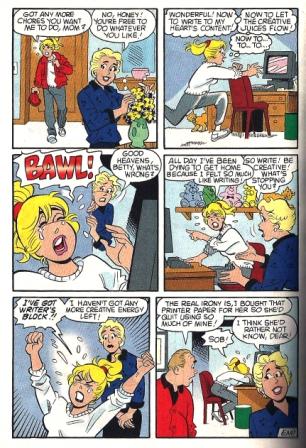
This is how poor Betty suffers one
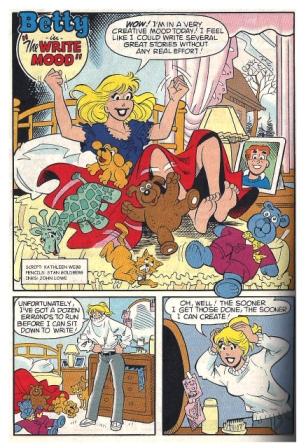
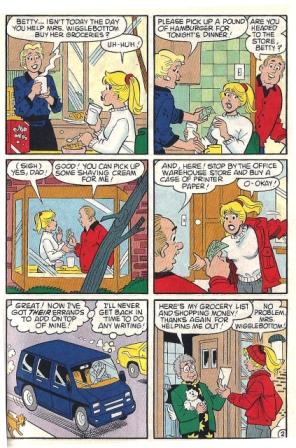
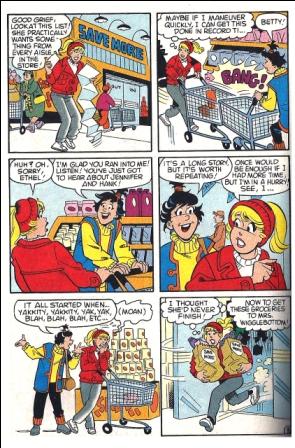
So widespread is the silent epidemic of Writer’s Block that even such popular series as Archie Comicshas been forced to accord recognition to it once in a while.
Take the case of poor Betty. She has unique qualities of head and heart. However, given her unselfish and helpful nature, she ends up hitting a Writer’s Block. The milk of human kindness sloshing about within her proves to be her undoing. In one episode of these popular comics, she runs quite a few errands. By the time she can please everyone else and hit her typewriter to start pouring out her ideas onto some sheets of paper, the brain refuses to fire even on a single cylinder.
Even the high and mighty suffer
Present day authors and bloggers can derive some solace from the fact that some of the greatest writers in literature — Leo Tolstoy, Virginia Woolf, Katherine Mansfield, Joseph Conrad, Ernest Hemingway — were tormented by momentary lapses in their ability to dish out some juicy text or the other.
The sensitive souls that authors are, they are apt to be influenced and distracted by external occurrences. But come to think of it, it is their jaundiced view of such occurrences alone that provides them the fodder for their literary produce.
Imagine an author like P G Wodehouse sitting lonely in a dense forest, trying to come up with some escapades of Bertie Wooster and Jeeves. With only a couple of birds and monkeys for company, he is likely to return home in the evening with some blank sheets.
He undoubtedly needs his quiet space. But he also gets in the bargain several distractions. Ethel pottering about in the kitchen. Pets who relish the joys of walking the ramp over some typewritten sheets lying on the floor. A maid who will come in just as he is brooding on his next Hollywood script. A surprise visit by a government official. A postman who brings in some fan mail.
Distractions all, yes. Leading to a Writer’s Block once in a while, yes. But each one is perhaps also an opportunity for him to view a mundane occurrence afresh, with a new perspective. Traits of each real-life person providing him the finer details of some fictional characters he is writing about.
Keeping the milk of human kindness from spilling over
Authors need an eco-system which enables them to strike a judicious balance between their off-society times of solitude and their open-for-interaction times. Successful ones perhaps perfect the art of walking this tight-rope. They make sure they do not exercise in public spaces. They get fed well. They do not get interrupted when they are in their quiet corner, dishing out the adventures of an investigator liked by their publishers and readers. Unlike Betty, they keep their milk of human kindness from spilling over to their grey cells. Their passion for writing keeps them more focused on their journey of creative expression.
Suffering from a Writer’s Block these days? Fret not. Some unique insight is bound to pop up in your mind soon enough. Perhaps, a Joan Valentine is about to walk in and talk about the Indian connection of the mysterious Wand of Death, thereby spurring you on to dizzying heights of creativity!
(Notes:
Images of Writer’s Block and Something Fresh courtesy www.
Archie source: Issue No. 221, Episode titled ‘Betty in the Write Mood‘)










 ashokbhatia