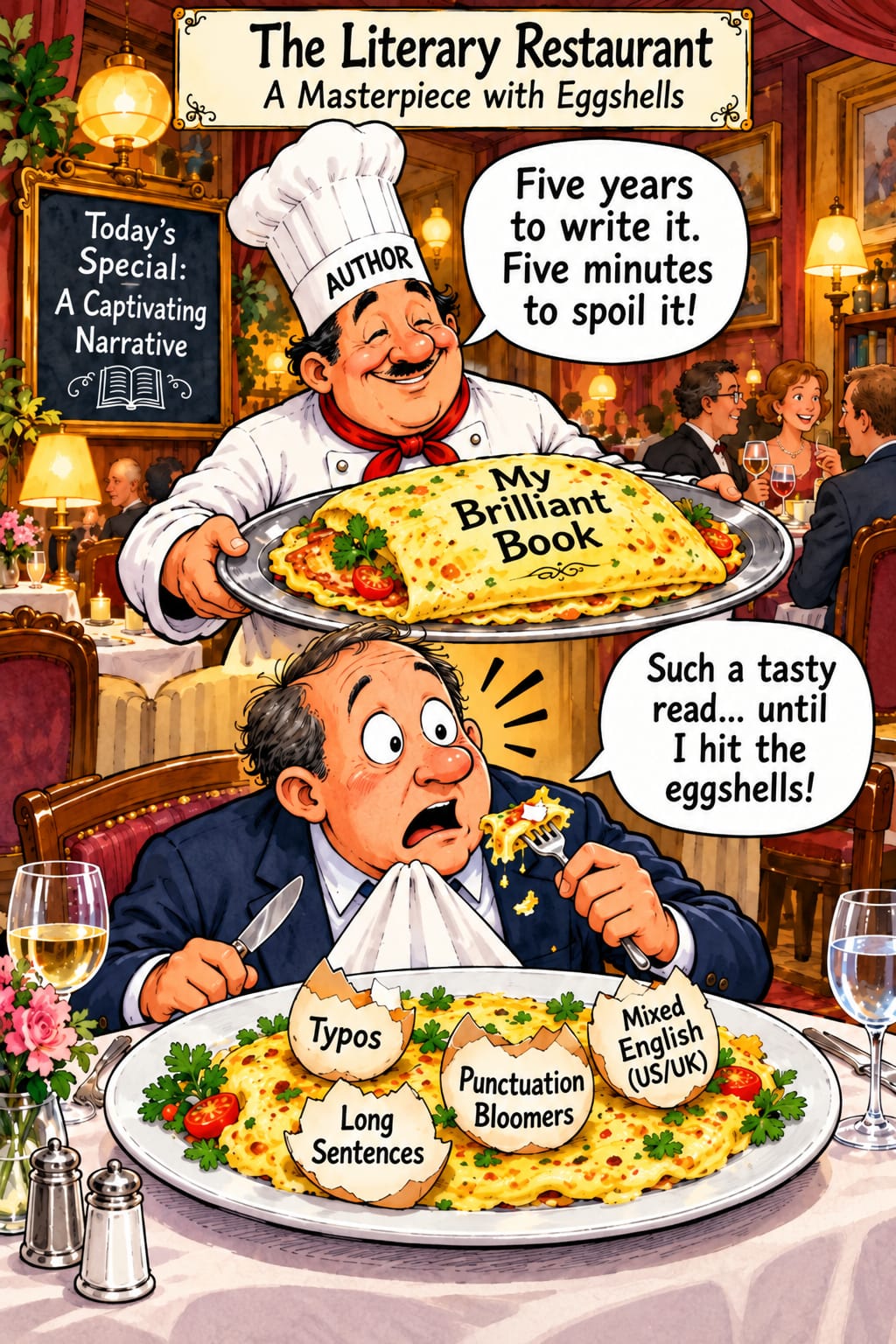
Whipping up a yummy omelette and putting it down the hatch is a pleasurable activity. But if the omelette has tiny pieces of eggshell in it, the whole experience turns negative. Each morsel turns to ashes in the mouth. The taste buds register a protest.
This is precisely what happens when a narrative, whether in the form of a write-up or a book, gets unleashed upon the unsuspecting public without proper editing.
The title and the subtitle of the manuscript may be short, crisp, and lucid. Both might give a clear idea to a potential reader of the contents. The subject may be good and set the book apart from others available in the market. The introductory chapter might be so attractive as to prompt the reader to go through all its chapters without any delay. The flow of logic might be smooth. The text may be divided into chapters which can be easily navigated. Sentences might be short and simple. The words might be simple and easy to comprehend.
But even minor irritants could put off many readers. Spelling disasters. Punctuation bloomers. An unpalatable mix of different versions of English. Inconsistent quotation presentation. Serpentine sentences that are hard to follow, and the like. They could not be blamed for putting the narrative aside and switching to a more delectable offering.
Having finished working on a manuscript, an author could then be found twiddling her thumbs trying to figure out ways of offering a product which is as defect-free as possible.
I confess I am not a professional editor. However, allow me to share a couple of lessons that I have picked up while looking at manuscripts from different authors, whether from India or elsewhere.
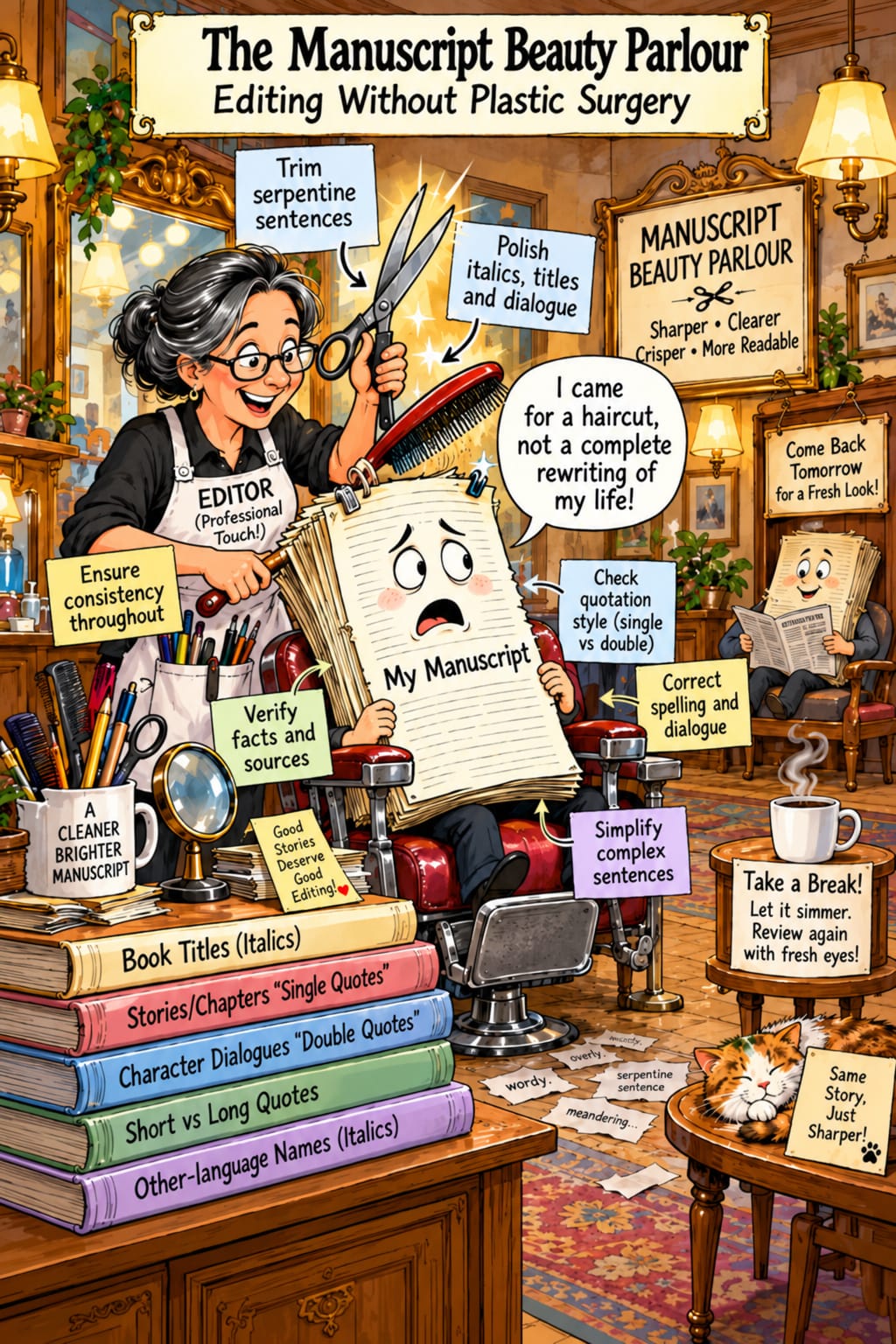
Names of books quoted in the text can be in italics.
Names of stories/journals/chapters quoted can be in plain text, highlighted with single inverted commas.
Dialogues of characters can be highlighted with double inverted commas.
Direct quotes can appear with either quote marks or in italics, not both. Quote marks are the norm, though. This practice can be consistent across the entire narrative.
Quotes of less than 140 words can be part of the running text, whereas the ones exceeding 140 words could be in a centre-aligned paragraph that follows, assuming the text is in a justified mode.
Lengthy quoted text can be set as display with a different font size.
Some names can be in italics for emphasis, especially if they originate from another language.
Having given finishing touches to the narrative, it helps not to be in a hurry to send it across for publication. Let it simmer within for some time. Take a break. Review it yet again after some time. You might discover a few more bloomers which had escaped your attention in the earlier round.
Editing is a delicate art. After all, a language is not like mathematics, where 1 + 5 will always equal 6! Depending on the context at hand, words have different connotations. Each author’s style of writing is different. When the manuscript gets revisited, new ideas might pop up. Expressing these ideas in a different way might sound more appealing to an author.
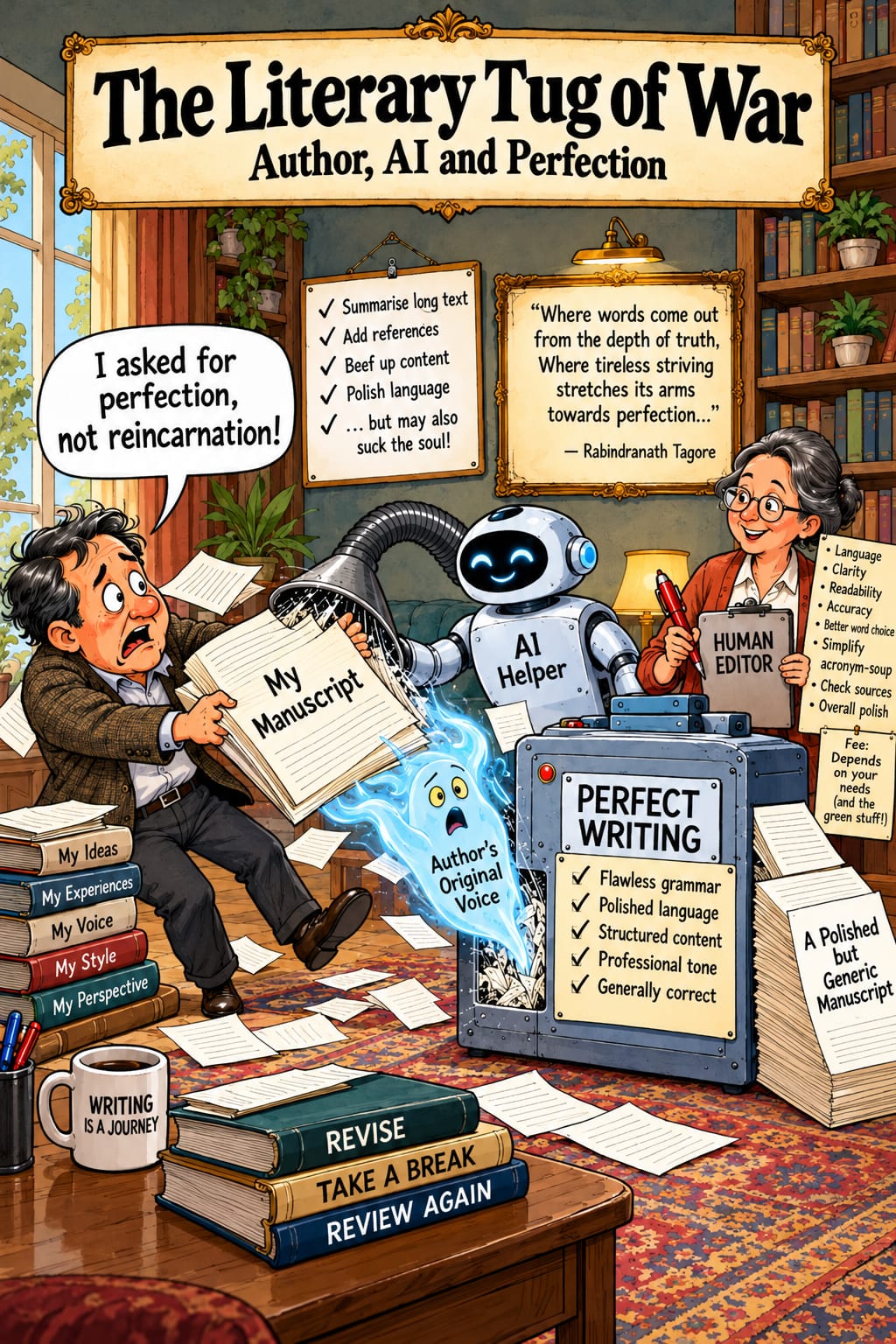
Of the online tools, Grammarly could be of some help. As far as AI is concerned it may be useful only if one needs a summary of, say, 2,000 words of a write-up which comprises 20,000 words. Or, if one needs to beef up the write-up with additional literary references. In any case, the risk of using AI is that it may end up sucking the soul of the narrative, thereby masking the author’s original voice itself.
There are quite a few professional editors available. Depending on the level of perfection you wish to achieve, and the green stuff you are willing to shell out, you may decide if you wish to approach one. Some editors may simply look at linguistic aspects. Others may go a bit deeper and suggest alternative words that could be used, recommend recasting complex sentences into shorter and crisper ones, check the veracity of sources quoted in the text, and even simplify the acronym-soup that some authors occasionally serve as an integral part of their text. A few could assist an author with developmental editing, suggesting improvements in the direction the narrative takes.
Editing is akin to a journey towards perfection, as described by Gurudev Rabindranath Tagore in his famous composition ‘Where the mind is without fear’:
…Where words come out from the depth of truth,
Where tireless striving stretches its arms towards perfection…
One of the lessons my Guardian Angels have taught me is that when one is overly critical of the task being done by someone else, they ensure that one willy-nilly ends up playing that very role for some time. Being in that person’s shoes (or sandals, if you prefer) helps one to realise exactly where the shoe pinches, literally as well as metaphorically. From being a critic, one turns up being a reluctant admirer of the art and craft of the task at hand. One develops empathy for the party of the other part. Scales fall from one’s eyes. It dawns upon one that the person performing the task in question is perhaps more to be pitied than censured.
Take the case of a husband who occasionally takes a jaundiced view of the quality of cooking of his spouse. However, after a heated argument, when she decides to go off in a huff to her parents’ house, all hell breaks loose. Regularly gobbling down instant noodles and takeaway food from nearby joints soon loses its charm. Deciding to take the matter into his own hands, he enters the kitchen arena, much like a Roman Gladiator showing up at the Colosseum. Finding the right raw materials and other ingredients in the kitchen becomes a major challenge. Locating either the right pots and pans or an appropriate ladle for whatever is planned to be dished out sounds tougher than overpowering a lion which has been deprived of its quota of vitamins for many days. Sweating profusely while seated on the dining table and trying to put some semi-cooked stuff down the hatch, he starts appreciating the cooking skills of his spouse. The post-cooking clean-up in the kitchen leaves him gasping for breath. Pretty soon, he decides to bury the hatchet and rush off to his in-laws’ place to charm the wife into accompanying him back to their abode. The dove of matrimonial peace restarts flapping its wings at home.
But I digress. After I hung up my corporate boots and decided to become an author, I had come to view editors of all sizes, shapes, and hues with a thinly veiled contempt. Most of them believed in following the dictum that silence conveyed a polite rejection. Even if they were to accept a manuscript for scrutiny, there was seldom a commitment as to when it might crawl up to the top of the pile on their cluttered tables. And yes, I dreaded the day when I would receive their detailed feedback. By then, they would have poked so many holes in the manuscript that it might as well be compared to Swiss cheese. Of course, the most traumatic experience was when I was asked to reduce the word length by close to 30% of what it was. To an author, it is akin to asking someone to perform a delicate surgery on oneself, sans anaesthesia of any kind!
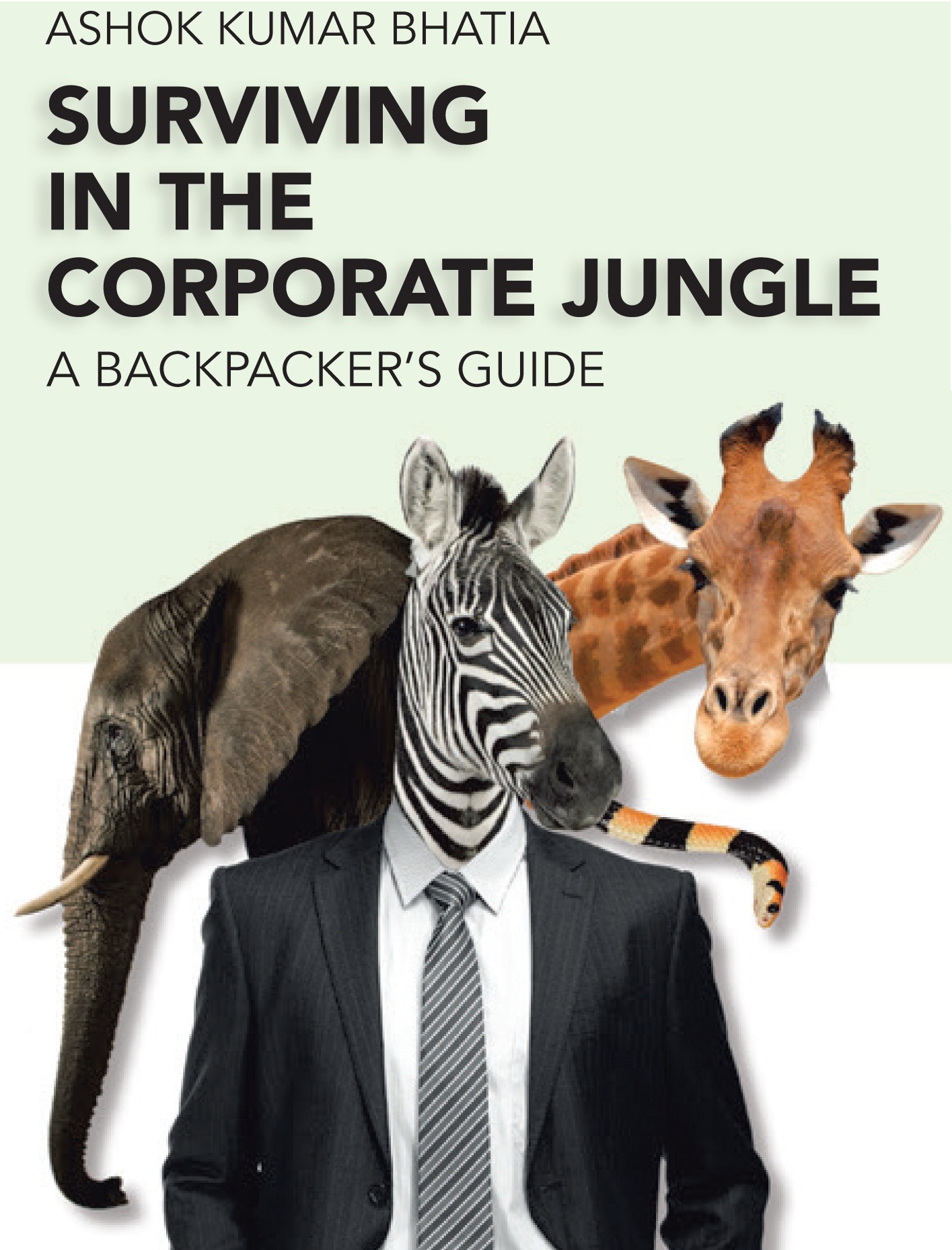
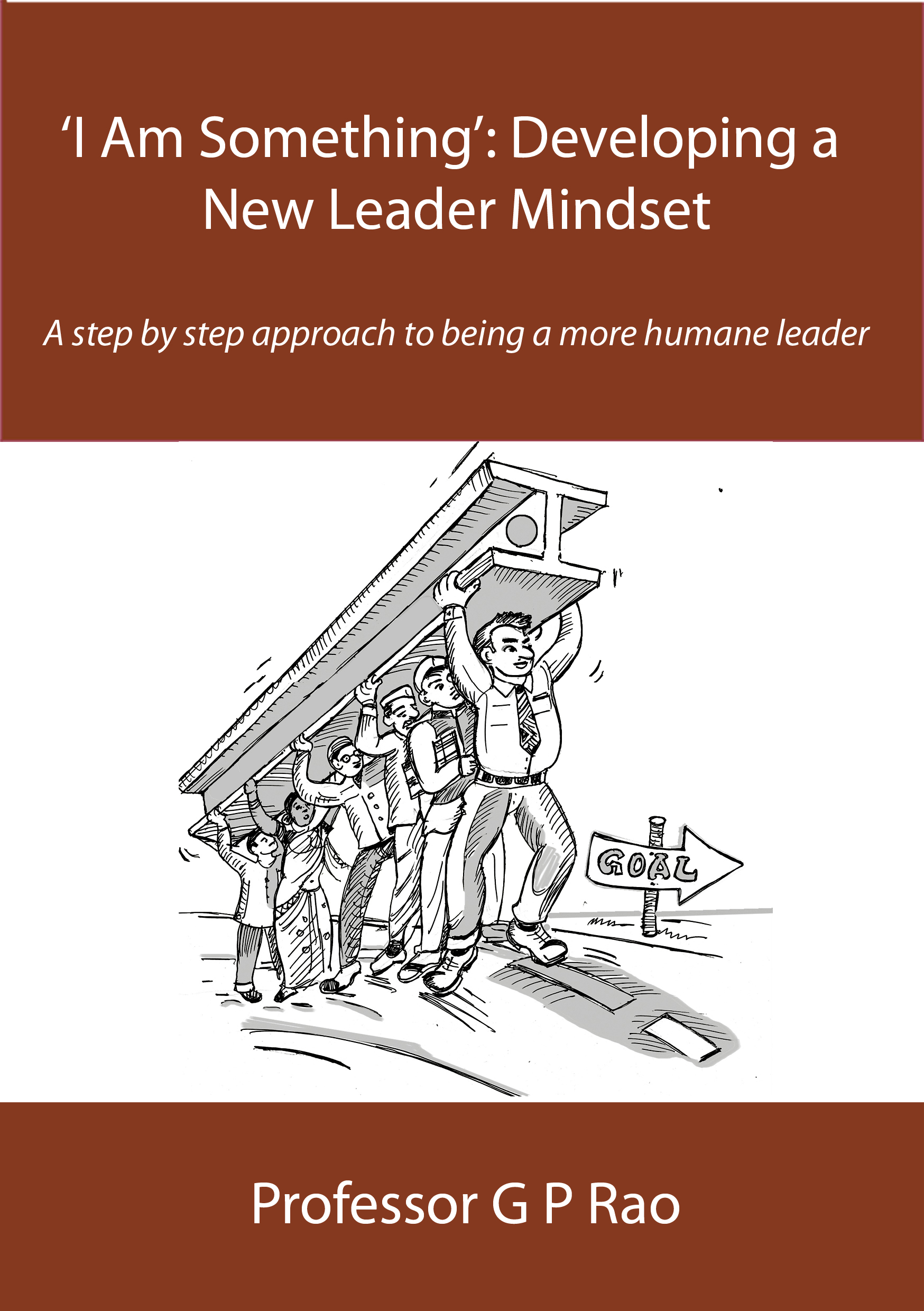
However, my Guardian Angels soon decided to intervene and change my perspective. Somehow, I ended up becoming part of a three-member editorial team that has pious intentions of publishing a philosophical tome comprising as many as fifteen essays from as many authors located in different parts of the world.
For me, a voracious reader, it is obviously a pleasure to go through varying perspectives on the same subject. One’s mind opens up, much like a sunflower trying to soak in as much Vitamin D as possible. One’s outlook broadens. Each author’s voice is unique. The frequency, the amplitude, and the tone and tenor of each composition are different. At a casual glance, all these might sound like a cacophony of sorts. But together, they all generate a symphony of sorts, presenting a harmonious blend of the key message of the anthology.
Empathising with Editors
Thus, the task of editing offers quite a few perks. But it also makes one face many challenges in the process. Here is an indicative list of some of these faced by the team so far.
Ensuring that the content of any contribution fits into the overall purpose of the collection.
Maintaining the originality of the author’s voice, while suggesting improvements which would connect the narrative better to the key objective of the anthology.
To improve the readability of a paper, each one needs to be checked and ranked on a hypothetical Richter Scale of Comprehensibility. Those scoring higher than a threshold must be politely advised to tone down the narrative.
Having patience with contributors who are first-time authors. Supporting them to improve the general flow of the article. Assisting them in connecting disparate sections or paragraphs more smoothly.
Even though all contributions may be in the same language, the sentence construction, the choice of words used, and the way of conveying an idea vary widely. This requires a type of verbal dexterity which could leave one fogged, nonplussed, and perplexed.
Ensuring that a contributor is not trying to promote his/her own business interests through the paper submitted by them. One, that would be unethical. Two, if readers suspect that a commercial motive is embedded in any essay, our own credibility and brand image take a hit.
In case an expert has contributed a paper on a subject which is not understood by any of the members of the editorial team, referring it to a domain expert for a peer review makes eminent sense. Coordinating between the author and the expert helps in bringing about a better balance in the paper.
Since the idea is to deliver a book to our readers which does not leave them fretting and fuming over linguistic bloomers in the manuscript, the services of an external editor need to be hired. In many cases, this may entail a back-and-forth exchange of ideas between the author and the external editor. If the author has chosen to quote references and mentioned a few weblinks to support the arguments being advanced, a rigorous check of the same could be handled by him/her.
With advances in technology, a basic check to ascertain the AI-infestation level of any essay needs to be considered a sine qua non.
It transpires that editors need to be made of sterner stuff. Overcoming our prejudices and being impartial does not come easily. A bulldog spirit is essential. Nerves of chilled steel are required for picking up something written by someone else and transforming it into the kind of stuff potential readers would gleefully lap up, much like your pet relishing a slice of fish.
Having undergone an instructive experience of this kind, one may safely conclude that editors are more to be pitied than censured.
In fact, it was this experience that prompted yours truly to publish a detailed blog post earlier, capturing the kind of challenges faced by the owners and editors of journals in the oeuvre of Sir P. G. Wodehouse.
Choosing a Title and Subtitle
Once the manuscript is almost ready, thoughts of the team obviously turned to the challenge of choosing an appropriate title and subtitle for the collection.
The snag we always come up against when deciding upon these can be summed up as an existential dilemma between two vastly different atmospheric levels – the troposphere, closer to the ground realities which are showcased by different articles, and the stratosphere, which denotes the loftier goals with which the anthology was conceptualised, to begin with. This deserves serious thought. Both must be catchy and readily comprehensible. It is something one does not want to go wrong about, because one false step and the whole compendium is sunk. If a lay reader, while searching for something fresh to devour, does not become curious about what a book is all about, and does not get a promise as to what precisely to expect, they could not be blamed for failing to get attracted to the offering. Their short attention span of a few seconds makes them move away to greener pastures. They simply walk out on one.
Thus, if the title represents the loftier goal of the anthology in a rather obtuse manner, the subtitle must hasten to clarify what it is all about and what it promises to deliver.
So, one needs to put one’s thinking cap on, surf through the internet to locate the titles and subtitles of comparable works, if any, and then make a judicious call. The last thing one wants is to leave one’s public at a loss, simply raising their eyebrows, twiddling their thumbs, and trying to figure out what one is talking about.
The Challenge of Whipping Up an Introduction
The existential dilemma mentioned above also pervades this aspect of the book. While crafting an introductory chapter to the collection of voices presented in the anthology, a balance needs to be struck between the stratospheric level of the high ideals which the book intends to convey to its readers and the tropospheric real-life situations reflected in the different papers presented therein. Not an easy task! Recalling that sordid experience, one could be forgiven for quivering like an aspen, if you know what I mean.
If one starts describing the contents of different papers in brief, one leaves the audience wondering where the collection is headed. Of course, one does it with the best of intentions, trying to provide a bird’s-eye view of the whole affair. But even the most conscientious readers could be left clueless as to what purpose will be served by their having to trudge through as many as fifteen odd essays, each having a different ‘intellectual density’, with few connecting points between them. They would miss the woods for the trees.
On the other hand, if one takes too long to capture the beauty of the woods, create an atmosphere, and state the loftier goals which prompted one to curate a delectable collection of so many essays, many readers may simply call it a day and quietly walk out on one.
Perhaps wisdom lies in putting the salient facts as briefly as possible and linking them to the overall purpose of the book, prompting the reader to go ahead and start exploring different chapters, either sequentially or otherwise, one by one. It can be done the other way round as well. In any case, one needs to make sure that while going through the introductory chapter, one minimises the chances of letting readers’ attention wander even for a minute or two. By the time it ends, they need to be left curious enough to start their own journey by exploring the book in detail.
We have miles to go before we sleep…
Well, finalising the manuscript is only the first 35% of the story. What follows is a far more arduous journey: getting it produced, marketing and promoting it, and the like.
As Robert Frost says: “The woods are lovely, dark and deep, But I have promises to keep, And miles to go before I sleep…”