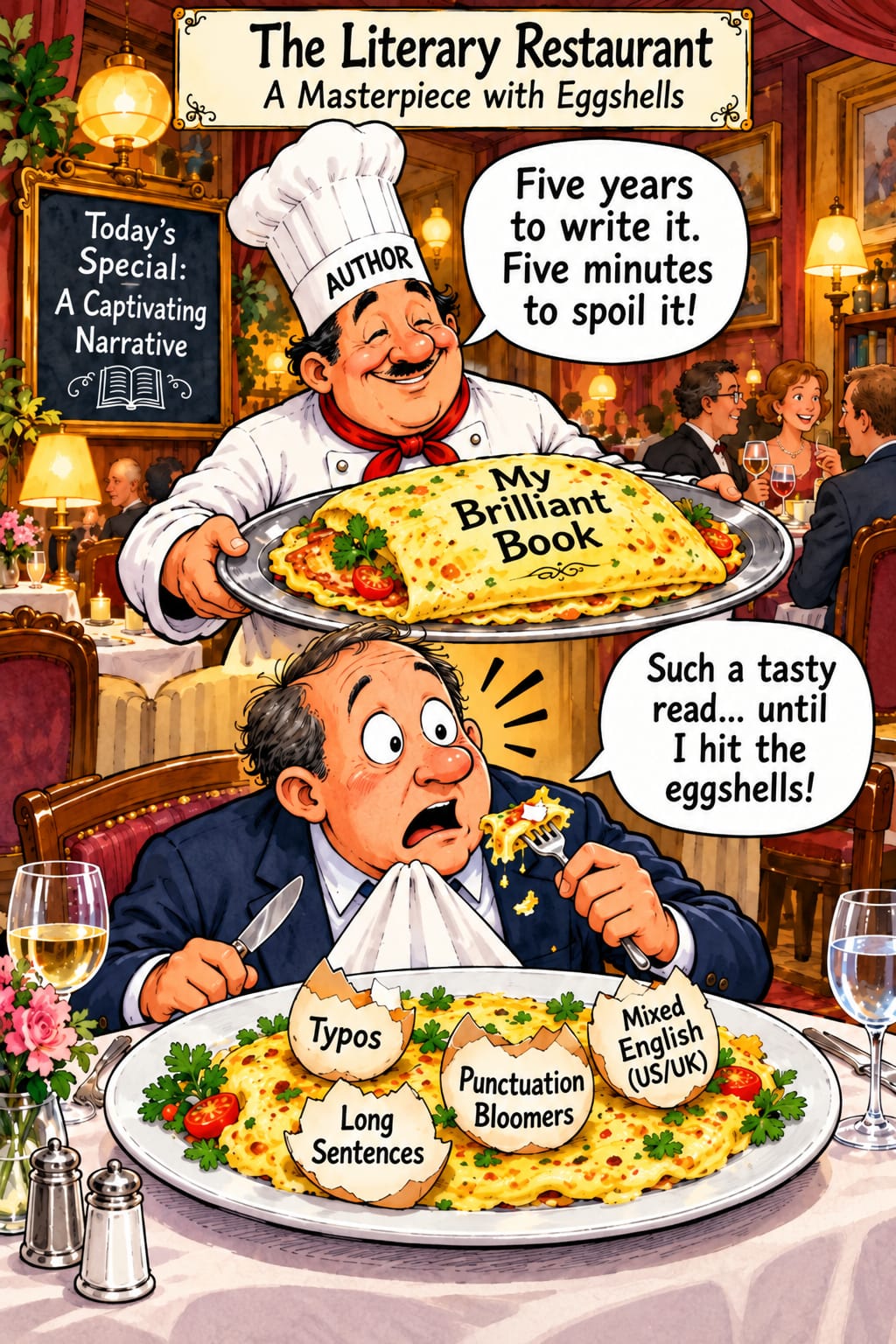
Whipping up a yummy omelette and putting it down the hatch is a pleasurable activity. But if the omelette has tiny pieces of eggshell in it, the whole experience turns negative. Each morsel turns to ashes in the mouth. The taste buds register a protest.
This is precisely what happens when a narrative, whether in the form of a write-up or a book, gets unleashed upon the unsuspecting public without proper editing.
The title and the subtitle of the manuscript may be short, crisp, and lucid. Both might give a clear idea to a potential reader of the contents. The subject may be good and set the book apart from others available in the market. The introductory chapter might be so attractive as to prompt the reader to go through all its chapters without any delay. The flow of logic might be smooth. The text may be divided into chapters which can be easily navigated. Sentences might be short and simple. The words might be simple and easy to comprehend.
But even minor irritants could put off many readers. Spelling disasters. Punctuation bloomers. An unpalatable mix of different versions of English. Inconsistent quotation presentation. Serpentine sentences that are hard to follow, and the like. They could not be blamed for putting the narrative aside and switching to a more delectable offering.
Having finished working on a manuscript, an author could then be found twiddling her thumbs trying to figure out ways of offering a product which is as defect-free as possible.
I confess I am not a professional editor. However, allow me to share a couple of lessons that I have picked up while looking at manuscripts from different authors, whether from India or elsewhere.
- Names of books quoted in the text can be in italics.
- Names of stories/journals/chapters quoted can be in plain text, highlighted with single inverted commas.
- Dialogues of characters can be highlighted with double inverted commas.
- Direct quotes can appear with either quote marks or in italics, not both. Quote marks are the norm, though. This practice can be consistent across the entire narrative.
- Quotes of less than 140 words can be part of the running text, whereas the ones exceeding 140 words could be in a centre-aligned paragraph that follows, assuming the text is in a justified mode.
- Lengthy quoted text can be set as display with a different font size.
- Some names can be in italics for emphasis, especially if they originate from another language.
Having given finishing touches to the narrative, it helps not to be in a hurry to send it across for publication. Let it simmer within for some time. Take a break. Review it yet again after some time. You might discover a few more bloomers which had escaped your attention in the earlier round.
Editing is a delicate art. After all, a language is not like mathematics, where 1 + 5 will always equal 6! Depending on the context at hand, words have different connotations. Each author’s style of writing is different. When the manuscript gets revisited, new ideas might pop up. Expressing these ideas in a different way might sound more appealing to an author.
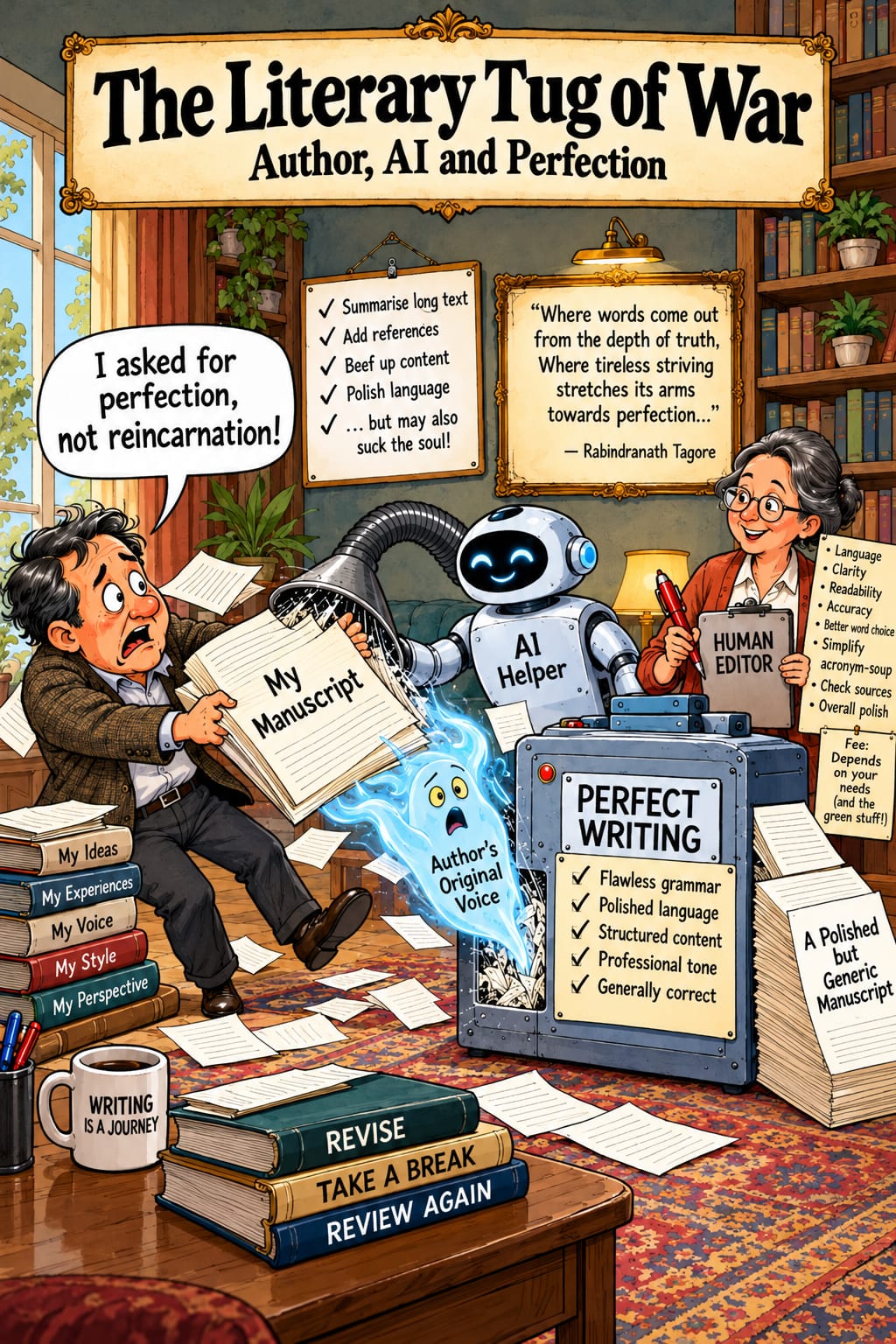
Of the online tools, Grammarly could be of some help. As far as AI is concerned it may be useful only if one needs a summary of, say, 2,000 words of a write-up which comprises 20,000 words. Or, if one needs to beef up the write-up with additional literary references. In any case, the risk of using AI is that it may end up sucking the soul of the narrative, thereby masking the author’s original voice itself.
There are quite a few professional editors available. Depending on the level of perfection you wish to achieve, and the green stuff you are willing to shell out, you may decide if you wish to approach one. Some editors may simply look at linguistic aspects. Others may go a bit deeper and suggest alternative words that could be used, recommend recasting complex sentences into shorter and crisper ones, check the veracity of sources quoted in the text, and even simplify the acronym-soup that some authors occasionally serve as an integral part of their text. A few could assist an author with developmental editing, suggesting improvements in the direction the narrative takes.
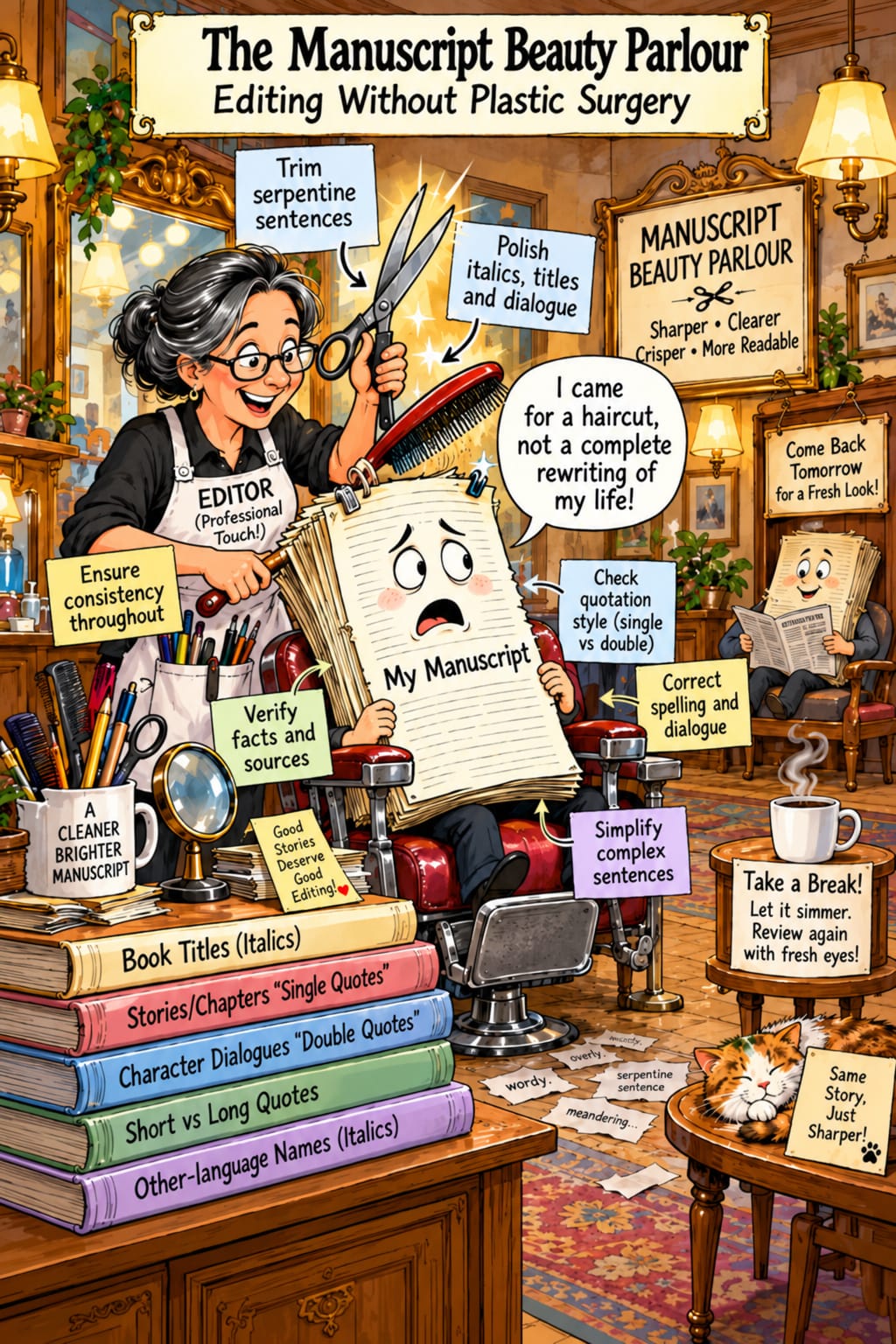
Editing is akin to a journey towards perfection, as described by Gurudev Rabindranath Tagore in his famous composition ‘Where the mind is without fear’:
…Where words come out from the depth of truth,
Where tireless striving stretches its arms towards perfection…
Note
Illustrations courtesy Suryamouli Datta.
Related Posts