Feeds:
Posts
Comments

The International League of Happiness (ILH) plans to host a two-day Workshop for the benefit of those fans of P G Wodehouse who might be twiddling their thumbs trying to understand such emerging technologies as Blockchain, AIMLA (Artificial Intelligence, Machine Learning, and Algorithm Analytics), Augmented Reality, Virtual Reality, 3D Printing, and the like.

Some details of the program are as follows:

Day 1


Inaugural Address

Lord Emsworth, Chief Patron of ILH 

The Role of Emerging Technologies in keeping the Empress in the pink of health, in floriculture, in ducking guests and in managing obdurate sisters


Key Note Address

Ms Roberta Wickham, Founder Director, Royal Academy of Goofy Technologies (RAGT)

Use of technologies to ensure happier and safer courtships for the delicately nurtured


Technical Session 1

Sir Watkyn Bassett, CBE, magistrate and Justice of Peace

My Experiments with Truth – Uncovering the mysteries of Blockchain Technologies

The speaker is likely to share his experiential wisdom and explain some aspects of Blockchain:

– A highly secured system which ensures that there is only one Truth, thereby curbing such social aberrations drunken revelries and umbrella;

– Supports transactions which are secured, thereby encouraging the emergence of a single Truth, which becomes the only truth. If you fake it up, you pay a penalty, leading to a drastic improvement in transparency levels;

– Tracking: One can track what happened. It is a decentralized, distributed, mass, general ledger which preserves the Truth in any given situation. This helps ardent collectors of all sizes, hues and shapes to protect their precious possessions better;

– Current technology is slated to become super-efficient and will eventually bring about a humbling equality among all human beings, thereby reducing a tendency on part of some to mock such striking dresses as prismatic checked suits and purple dressing gowns with yellow frogs.


Technical Session 2

Mr Reginald Jeeves, Deputy Secretary General, ILH

Improving the delight of Customers and Bosses by leveraging the Internet of Things

  • Using smart grids to alleviate poverty, eradicate diseases and reduce income inequalities
  • How machine to machine data exchange can be used to deliver better satisfaction to customers and employers
  • Improving the efficiency and effectiveness of valeting operations
  • Leveraging technology to ensure that one’s employer forever remains a bachelor, thereby ensuring stability in one’s valeting career

Day 2


Technical Session 3

Mr Rupert Psmith, Director General, ILH

Deploying Artificial Intelligence to improve Corporate Governance

Based on his exceptional career in banking, journalism and allied services, the speaker would demonstrate how:

– Pattern recognition in Big Data can lead to drastic improvements in corporate governance levels across all kinds of institutions, whether in the private or the public sector; even amongst central banks, judiciary, intelligence and investigation, and the legislative arms of a country;

– If one takes Yesterday as an experience, Today as an experiment, and Tomorrow as an expectation, one can forecast loan defaults by fugitive billionaires, non-performing assets of lending institutions and dramatic terror attacks;

– Using Hindsight and Oversight to improve Insight and Foresight could help in curbing gang wars, vigilante attacks and cyber crimes.


Technical Session 4

Sir Roderick Glossop, Director General, Royal Academy of Goofy Technologies

Deploying Emerging Technologies to improve mental well-being of those who struggle to maintain Work Life Balance  

Using practical examples from his illustrious career involving loony bins, anti-gambling leagues, and anti-smoking and anti-alcohol tirades, the speaker would touch upon the following facets:

  • Augmented Reality and Virtual Reality: Potent tools to avoid landing in a loony bin
  • How revenue authorities can use Algorithm Analytics to squeeze more out of gambling dens
  • Leveraging 3D printing to improve upon the mesmerizing effect of a voodoo performance; also, to minimize the impact of a bunch of cats on one’s digestive system.


Technical Session 5

Ms Stephanie Byng, Director, RAGT

Nipping #MeToo in the bud: Promoting new standards of Chivalry  

  • Countering amorous advances of lecherous members of the so-called sterner sex by use of Artificial Intelligence and other technologies on the horizon;
  • Using Virtual Reality to educate kids and aspiring grooms about the new norms of Chivalry, such as baby sitting, diaper changing, cooking, mopping, dusting and in general assisting a housewife;
  • Promoting active use of the Bartholomew technique of motivating the law enforcers to take a serious note of any offences being reported to them.
  • Using Virtual Reality to sensitize prospective offenders to the living conditions of our prisons.


Technical Session 6: The flip side of technologies – Some notes of dissent


Mr Roderick Spode, Chairman, Eulalie Enterprises

The right to privacy in a technology driven age


Ms Joan Valentine, Chairperson, Global Association of Start Ups

The need to lower tariff and other barriers to facilitate international trade


Ms Madeline Bassett, Deputy Secretary – Environment, ILH

The stark failure of Emerging Technologies to counter the threat of Climate Change


Ms Honoria Glossop, Deputy Secretary – Sports, ILH

The risks of increasing screen times; Getting back to what is Factual, Real and True


Valedictory Address

Right Hon’ble A B Filmer, Cabinet Minister

The speaker is expected to touch upon the future of modern technologies which would help politicos to:

  • Stick to power for longer durations by (i) Keeping their public image always spick and span, (ii) Using social media platforms to brow beat the opponents and sway public opinion in their favour, and (iii) Engaging with voters by using Virtual Reality;
  • Ensure hassle free vacations, with safer boat rides, sans angry swans.


Details


Venue: Blandings Castle

Dates: February 14-15, 2019

Registration: www.ilh.org

Catering: Anatole and team


The Empress of Blandings shall be in attendance. A LED display will showcase the use of algorithms to monitor her health and diet.


Note:


The International League of Happiness is a not-for-profit organization where:

-Destructive propaganda of any kind is sneered at

-Global interests are accorded higher priority than narrow national/regional interests

-Healthy discussion is encouraged but indifference to, or defiance of, its collective resolutions is discouraged


(Related Posts:

https://ashokbhatia.wordpress.com/2015/07/30/the-epidemic-of-wodehousitis

https://ashokbhatia.wordpress.com/2017/10/12/an-invitation-from-the-international-league-of-happiness

https://ashokbhatia.wordpress.com/2016/09/23/bertie-jeeves-and-the-internet-of-things)


ashokbhatia's avatarashokbhatia

Residents of Plumsville are aware of such couples as Piggy-Maudie and Joe-Julia. To lovebirds that are young at heart and have matured over time, lining of the stomach plays an important role. At times, the prospect of an alliance between their respective children reunites them. PGW RingForJeeves

In ‘Ring for Jeeves’, we get to meet Mrs. Spottsworth and Captain Biggar. They are also young at heart but not as advanced in age as to merit consideration either to bodily afflictions or to children’s marriage prospects.

The two get introduced to each other while on a hunting spree in Kenya. Much later, they run into each other in the coffee room of the Goose and Gherkin, one of the wayside inns in England. A day later, they happen to be staying together at Rowcester Abbey, a property Mrs. Spottsworth is considering buying.

Of chance meetings which are ‘meant’

Mrs. Spottsworth exudes…

View original post 896 more words

ashokbhatia's avatarashokbhatia

When it comes to writing, we are not too bad. Words help us to keep ourselves connected with the Blogging illustrationworld around us. Our inner joys, sorrows, trials, triumphs take the shape of blogs which we keep posting at regular intervals. We can’t help ourselves but write. In other words, we are a bunch of declared Blogaholics. We have no intentions of getting rid of this addiction. And we do not wish to remain anonymous!

Writing is like an internal cleaning process for us. Some of us use it to unburden the soul; some others for spreading cheer. Some of us are here to promote our books, whether present, upcoming or still in the realm of our pious intentions. Some of us are here to make money. Quite a few of us are here simply to educate, entertain and amuse.

We have good days and we have bad days. Often, we…

View original post 852 more words

ashokbhatia's avatarashokbhatia

For avid fans of P G Wodehouse, it is not easy to relish the kind of comedies Bollywood keeps churning out. Humour which is loud, crass and uncouth repels them. Back-slapping and guffawing is something they do not take kindly to. What appeals to their finer sensibilities is a subtle brand of humour. Even mild sarcasm does not make their shapely eyebrows arch upwards by a fraction of an inch, as long as it is delivered in fine taste.Movie Mad world

Play a so-called comedy which is full of inane humour, double entendres and much back-slapping, and they are apt to recoil in horror. Bring in a typical rom-com and they would bemoan the repetitive nature of the goings on. But switch to a movie with a dash of Wodehousian humour, and one would find them in good cheer, nibbling a yummy chocolate with their soul-mate sprawled next to them on the…

View original post 2,141 more words


What kind of desires would be found on the bucket list of a CEO? Perhaps due recognition, more power and pelf, special privileges, a fat expense account, rapid growth, ESOPs, a loyal and committed team comprising persons who happen to be competent in areas where she herself may be weaker, executing her business plans more effectively and efficiently, and the like.

In general, the Happiness Quotient of any professional could possibly be defined as follows: 

 HQ = [ { FD (t) / AD (t) } * f (IR, IG)]

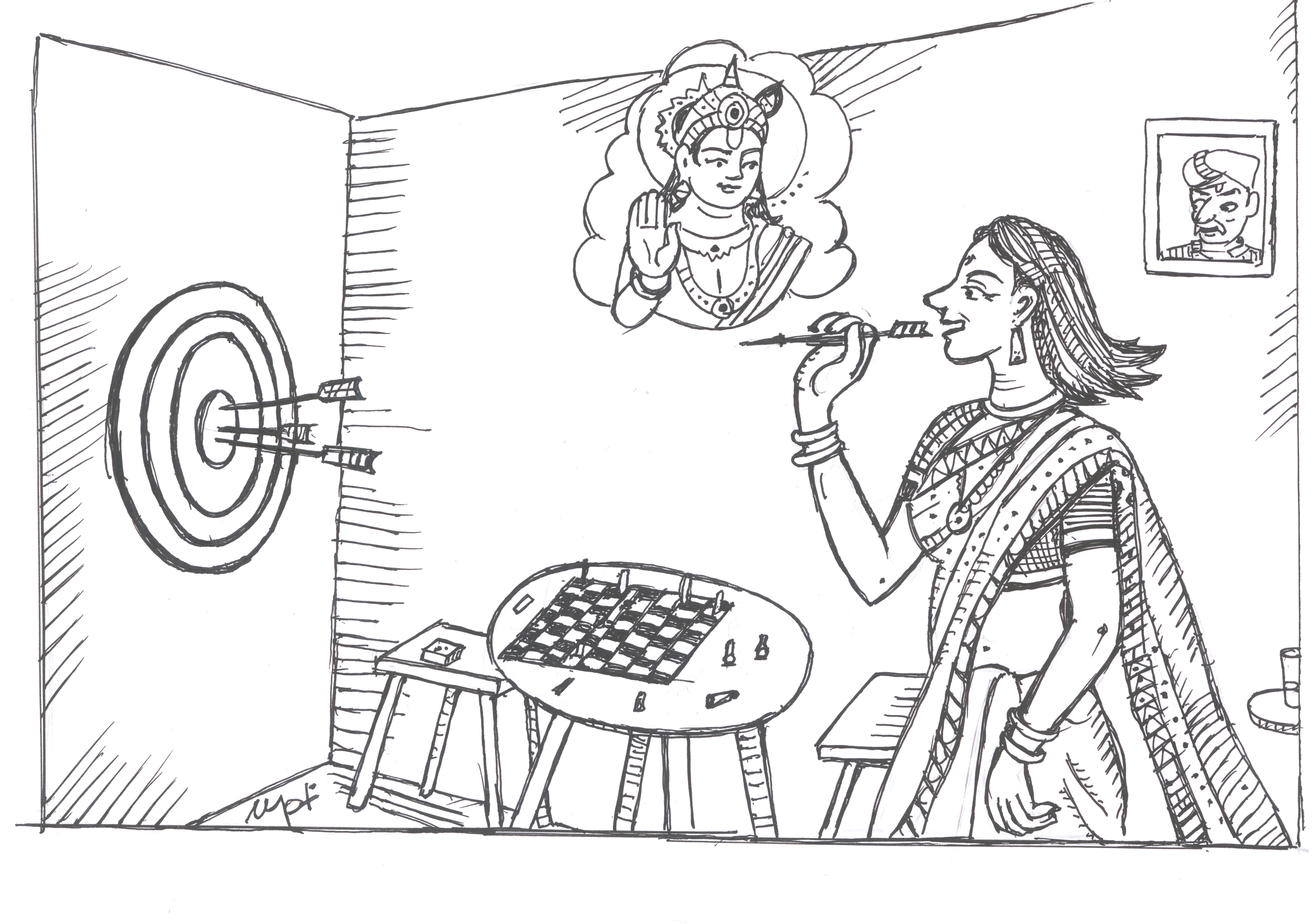
Where HQ is Happiness Quotient, FD (t) is the number of fulfilled desires at a given point in time, AD (t) represents the sum total of all her desires at the same point in time. The notation f (IR, IG) suggests that HQ is directly proportional to her Inner Resilience and the Inner Glow of satisfaction she feels when a job is well done. A happier CEO could often be spotted in the recreation room, perfecting her aim at throwing darts!

It also follows that one’s level of happiness could be improved upon merely by enlarging the scope of FD; or, by reducing the spread of AD.

The former is a Western proposition, leading to crass commercialism. A heavy dose of advertising and public relations keeps the inner fires of desires burning brighter with each passing year, making it the classic case of our chasing an elusive rainbow in a desert. Corporates keep stoking these embers of desire and we keep falling prey to the same at regular intervals.

The latter proposition happens to be an Eastern construct. By keeping a check on one’s desires, one can attain a state of happiness. This calls for an inner awakening and a realization that one needs to outgrow one’s sensual gratification and consciously shepherd oneself to use one’s intellect and restrict the spread of desires one has. Or, to focus on desires which are either aligned with the values of the organization or which happen to be our needs.

Western experts had originally recommended Command and Control as a means to generate wealth and had gone on to imply that stark materialism is the way to seek peace and happiness. However, the Eastern approach is based on an inward blossoming, an inner growth and development which holds an inner glow of success superior to sensual gratification of an external nature. By proactively adopting a Conscious Capitalism approach, several businesses have already recognized the truth that they have a greater purpose, much beyond delivering value to their own stakeholders.

Conscious businesses have trusting, authentic, innovative and caring cultures that make working there a source of both personal growth and professional fulfilment. They endeavour to create financial, intellectual, social, cultural, emotional, spiritual, physical and ecological wealth for all their stakeholders.

An inward blossoming

Bhagavad Gita gives us a clue to be happy, and also to create happier working places. Consider this verse:

यदा संहरते चायं कूर्मोऽङ्गानीव सर्वश: |
इन्द्रियाणीन्द्रियार्थेभ्यस्तस्य प्रज्ञा प्रतिष्ठिता ||2.58||

One who is able to withdraw the senses from their objects, just as a tortoise withdraws its limbs into its shell, is established in steady wisdom.

What is being recommended here is not a suppression of desires but a voluntary renunciation of those desires which take us on a path of sensuous gratification, sans a higher purpose in our life and career.

In fact, this takes us back to the idea of living in the present; also, a ‘We and Us’ approach to problem solving than an ‘I and Me’ one.

In Robin S. Sharma’s famous book ‘The Monk Who Sold His Ferrari’, Julian says that goals and dreams for the future are very essential elements in every truly successful life. But he advises never to put off happiness for the sake of achievement; never to put off the things that are important for your well-being and satisfaction to a later time. ‘Today is the day to live fully…..never put off living!’ he says.

Bhagavad Gita reinforces this message as follows:

रागद्वेषवियुक्तैस्तु विषयानिन्द्रियैश्चरन् |
आत्मवश्यैर्विधेयात्मा प्रसादमधिगच्छति ||2.64||

But one who controls the mind, and is free from attachment and aversion, even while using the objects of the senses, attains peace.

A CEO who exercises self-control would eventually experience a sense of inner peace. She would patiently hear out a voice of dissent and use the feedback judiciously. She would see something positive happening and share it with others, without getting attached to it. She would smell a coup in the making and take appropriate steps to defuse the situation in an objective manner. She would praise in public but reprimand in private. She would taste either the sweetness of a resounding success or the sourness of a colossal failure but would neither become complacent nor reach a stage of despondence thereafter. She would sit back and redraw her business plans and put them in motion.

Some manifestations of Self-control

One manifestation of self-control would be the need to accord an equitable and honourable treatment to women at the work place. Just like a cashier who is caught with his hand in the till, often we find some powerful male executives wrecking the careers and lives of relatively vulnerable female team members. If this had indeed been the case, the recent #MeToo campaign would not have gained much currency.

Hormones are surely more powerful than hierarchy. But when such incidents happen and the managements decide to look the other way, or decide to be opaque about handling such issues, they end up causing severe damage to their brand equity.

On the contrary, when business houses like Tatas are majority-owned by trusts which do pioneering philanthropic work for the society, the money with them is truly held in trust, in the true spirit of detachment.

Consider this verse from the Bhagavad Gita:

विहाय कामान्य: सर्वान्पुमांश्चरति नि:स्पृह: |
निर्ममो निरहङ्कार: स शान्तिमधिगच्छति ||2.71||

That person, who gives up all material desires and lives free from a sense of greed, proprietorship, and egoism, attains perfect peace.

Creating happier working places

What with the advent of Industrial Revolution 4.0, many HR honchos these days can be found to be twiddling their thumbs, trying to figure out how to create happier working places even while maintaining a sense of discipline, decorum and decency. Happier people make organizations thrive and prosper.

Dr. Noelle Nelson, in her book ‘Make More Money by Making Your Employees Happy’, explains how progressive employers try to understand the pain points of their employees and then try to address the same. One of the several examples she quotes is that of when Paul O’Neil who took over the reins of ALCOA in 1987, the world’s leading producer of aluminium; O’Neil announced that his sole priority was to increase worker safety. This came as a shock to the company’s directors. O’Neil understood, however, that safety was a major concern for his workers. Over the next 13 years, employee productivity soared as accident rates decreased from roughly one per week per plant to some plants going years without an accident. When O’Neil stepped away just over a decade later, ALCOA’s annual income had grown 500%!

Being happy is possible when one is at peace with oneself and others. Attaining a state of harmony is imperative. Managements need to enable this. They need to provide the necessary tools to their people so as to facilitate an inner sense of peace and happiness.

What makes Starbucks a good employer? Perhaps, one of the factors which contributes towards its people being happy is the kind of training they receive to handle angry and unreasonable customers. This takes the negativity away from a potentially stressful situation, leaving space for a sense of peace and happiness to prevail within the front line staff.

People in organizations do not always look for more monetary rewards. They seek recognition. They relish a sense of fulfilment arising out of their contribution towards a greater goal. They value positive relationships with other team members. Harmony, peace and happiness comprise their inner goal.

(Related Post:

https://ashokbhatia.wordpress.com/2018/05/03/from-an-i-and-me-approach-to-a-we-and-us-one)

The relationship between Efforts and Results

One would have often wondered as to the nature of the relationship between efforts and results. A project on which much energy and time has been spent may get shot down by one of the seniors and never come to fruition. Another one, which has received only a fraction of the attention that was paid to the former one might take off and become a roaring success. Other than the effort, the timing plays a role in the success or failure of a project. Market conditions, government regulations, interpersonal relationships, employee engagement and several other factors also play a role.

A sense of detachment, as brought out by Bhagavad Gita, is not about one losing the sight of the objective sought to be achieved. Nor does it recommend a defeatist attitude in one’s life and career. Rather, it is about handling successes and failures in a balanced manner. Smart leaders, who have achieved a spectacular success, do not become complacent. They remain humble. They determine the critical success factors and store these at the back of their minds, ready to be recalled when necessary. When faced with dire failures, they shoulder the blame, get requisite feedback and take steps to ensure the failure gets avoided the next time round. If they lose interest for some time, they bounce back with renewed enthusiasm and work towards delivering results.

If one were to go through the history of the Apollo series of missions launched by the National Aeronautical Space Agency of USA during the 1960s and 1970s, one would be struck by the kind of tenacity and equipoise demonstrated by the participating astronauts. Despite losing several of their colleagues in accidents, they remained committed to the overall goal, delivering some spectacular results for our scientists and technocrats to work upon. The same trend continues till date. Airspace disasters notwithstanding, we keep sending missions to Mars and to Sun. The quest of humanity to explore our universe continues unabated.

Inner Resilience and Equanimity

A related feature is the need for professionals to improve upon their levels of Inner Resilience and practice Equanimity. This is what Bhagavad Gita says in this context.

योगस्थ: कुरु कर्माणि सङ्गं त्यक्त्वा धनञ्जय |
सिद्ध्यसिद्ध्यो: समो भूत्वा समत्वं योग उच्यते || 2.48||

Be steadfast in the performance of your duty, O Arjun, abandoning attachment to success and failure. Such equanimity is called Yoga.

Professionals need to know not only what is to be done, but also how it has to be done. Lord Krishna does not fail them. He recommends an ‘evenness of mind’, the tranquility of inner composure in handling all the pairs of opposites in their careers and lives – success and failure, praise and reprimand, hiring and firing, sprees of expansion and down-sizing, products and services which are at opposite ends of their life cycles, mergers and demergers, favourable and unfavourable circumstances, and the like. This, indeed, is held to be the real ‘Yoga’.

In the process, we need to give up our false expectations, wrong imaginations, daydreams about the fruits of our actions, anxieties for results, resistance to change, and fears about future events which are still in the womb of the universal force called Time.

The traits of a Super Leader

Hers is a balanced personality, free of unreasonable desires which pose the danger of her losing sight of her sense of righteousness. She does not have a binding attachment with her emotions. Nor does she have a jealous preference for her pet ideas or for her pet people. She scoffs at any signs of nepotism. She encourages her team members to be nay-sayers, so voices of dissent could be heard and judiciously dealt with. She radiates positivity all around her. She is committed to the organization’s goals and looks after her team members much like a lioness would protect her cubs.

Such a person of steady wisdom is described in Bhagavad Gita as a Stitha-Prajna. Consider the following:

दु:खेष्वनुद्विग्नमना: सुखेषु विगतस्पृह: |
वीतरागभयक्रोध: स्थितधीर्मुनिरुच्यते || 2.56||

One whose mind remains undisturbed amidst misery, who does not crave for pleasure, and who is free from attachment, fear, and anger, is called a sage of steady wisdom.

Two concerns may arise here. One, could there really be persons who could be held to have all these qualities? Two, is it really possible for one to be free of one’s basket of desires and one’s ego?

In his book ‘Beyond the Last Blue Mountain‘, R M Lala quotes the case of Jamsetji Tata, the founder of the Tata group of companies. It was he who gave the group a unique position in India. In his later years, he did not ask ‘What enterprise is the most profitable?’ but, ‘What does the nation need?’ Since the answer in his times was steel, hydro-electric power or an institute of science, he made his best efforts to fulfil that need.

He is reported to have once said something very basic:

We do not claim to be more unselfish, more generous or more philanthropic than other people. But we think we started on sound and straightforward business principles, considering the interests of the shareholders our own, and the health and welfare of the employees the sure foundation of our prosperity.’

Alfred Sloan is reported to have once remarked, ‘What is good for General Motors is good for America.’ J R D Tata always thought the other way round. ‘What is good for India is good for Tatas.’

Theirs is only one example of a business house which is clear in its goals and in its priorities. Several others could be quoted in the current context, like N R Narayana Murthy, the founder of Infosys.

Getting rid of desires and ego is no cakewalk. A CEO may introspect and fine tune her desires so the same are aligned with the values of the organization she works for. In the process, her personal desires take a back seat. Likewise, getting rid of one’s ego completely has a flip side. One could end up becoming a doormat and getting taken advantage of by all and sundry. Her wisdom and intuition can help her to retain her individuality even while letting go of the ego. Ask any CEO who has ever worked in a single-owner driven company, and she would attest to the basic principle of leaving the ego at the office gate itself!

Professionals who remain undistracted by transient entrapments have the ability to be rational and calm. They are steadfast in reaching their goals and go on to make successful business leaders.


On a lighter note, one needs to be wary of managements which exhort one to follow this much misunderstood principle of detachment expounded in the Bhagavad Gita. They would have one believe that one should continue to slog all year long but would do well not to expect that elusive overdue promotion. One can then either lump it and trudge along, or take prompt action through proper channels to get oneself detached from the company at the earliest possible opportunity!

An inspired self-forgetfulness

What is the secret behind mighty achievements? What is the state of mind in which an artist like Vincent van Gogh would have created his unique gifts to humanity? Could he have done so while being worried if his latest masterpiece would turn out to be better than the one he had made earlier? Could Michelangelo have sculpted Pieta with the sole purpose of receiving a reward or recognition for creating the same?

Was Newton worried about either his past or his future when the apple fell? Had that been so, is there not a chance that he might have missed out on discovering the forces of gravity? What are the conditions under which a product developer based in Silicon Valley comes up with her next bright idea? Which is the state of mind which is conducive to creative work?

Scratch beneath the surface of any work of inspiration and one is apt to discover the ultimate secret of great accomplishments. Living every moment of the present is one of the factors which help one to live an inspired life and also enjoy it to the hilt. The creative process is akin to meditation of sorts, where the creative person, the universe and the surroundings – all end up in a single harmonious state.

This is precisely what Bhagavad Gita means by detachment. It exhorts a CEO not to worry over and get herself preoccupied with the anxieties for the rewards of her actions, thereby avoiding a tendency to live in the future. Nor does it make sense for her to keep analyzing as to what transpired in the past and get overly worked up about it. The advice here is not to waste the present moment in inane memories and in concerns about the future. Rather, she can do her very best in the present moment, keep relevant stakeholders in the loop, and perform her duties, as dictated by a sense of virtuous righteousness. This way, she is released from all of her mental preoccupations. Work alone makes her live in the joy and ecstasy of inspired self-forgetfulness. The work itself becomes the reward.

कर्मण्येवाधिकारस्ते मा फलेषु कदाचन |
मा कर्मफलहेतुर्भूर्मा ते सङ्गोऽस्त्वकर्मणि || 2.47 ||

karmay-evādhikāras te mā phalehu kadāchana
mā karma-phala-hetur bhūr mā te sa
go ’stvakarmai

You have a right to perform your prescribed duties, but you are not entitled to the fruits of your actions. Never consider yourself to be the cause of the results of your activities, nor be attached to inaction.

Management by loftier objectives and Resistance to Change

Is it really possible for one to be detached with the fruits of one’s actions? In a business scenario, when a manager is part of an organization, she is expected to deliver results. Efforts put in by her do not count; results alone do. If so, one might well wonder as to how one can remain detached with the outcome. Would it not be going against the philosophy of Management by Objectives?

What one is being advised here is not to take actions which are at divergence with what is sought to be achieved. The objectives are not under question; the means are. The underlying assumptions, prejudices and attitudes are. Management is the art of the possible. Of doing one’s best under the given constraints. A manager who works to the best of her ability, irrespective of how favourable or unfavourable the situation is, happens to be practising detachment. She is not one who would get swayed by petty short-term considerations. She is not someone who would allow her personal prejudices to shape her actions. Nor would she wallow in self-pity and misery, when faced with an adverse outcome. In other words, detachment helps professionals to not to lose sight of the overall good of the organization.

When an organization takes a decision to down-size, the onus of working out a detailed plan for affected employees falls onto the CEO and her team, especially on the person heading the Human Resources function. Typically, employees who are projected to be competent in the changed business scenario would get transferred to diverse locations. Those whose services in the past have been satisfactory but would not be relevant in future get assisted and out-placed. For the remaining employees, a transparent severance package gets worked upon and executed. In the entire process, a sense of detachment, devoid of personal emotions and prejudices, is essential. By handling separations well, the organization improves upon its brand equity and ends up creating brand ambassadors for itself.

Likewise, when a Chief Marketing Officer decides to either launch a new brand, or change a link in the company’s distribution network, a sense of balance and detachment helps. A Chief Finance Officer, when recommending a change in the external audit firm, has to leave her comfort zone, use a sense of detachment, and initiate a change which would bring better results for the company. A Production Manager, when asked to absorb a new technology or equipment on the shop floor, has to forsake a sense of attachment to the earlier methods of working and embrace change.

Consider the case of a team leader who is yet to learn the art of delegation. She retains a tendency to nano-manage operations and is not able to get work done based on a sense of detachment. The team members find it rather difficult to deliver exemplary results under such a leader, thereby harming the organization in the long run. The art of true delegation is also based on a deeper sense of detachment.

It follows that a sense of detachment helps professionals in many ways – to remain objective, to retain a sense of balance, to embrace change with lesser resistance, to handle adverse situations better, and to remain committed to the overall good of the organization.

The Art Institute of Chicago, founded in 1879 and located in the Grant Park of Chicago, happens to be one of the oldest and the largest art museums in the United States. Other than a sumptuous collection of art works, it also boasts of a gallery showcasing miniature rooms of different kinds from Europe, as also those from different states of America.

Some of these could be of interest to you:


It is instructive to see how people in different regions choose to live. Given the variations in climatic conditions, individual tastes and local resources, there exist fine differences between these homes, represented in miniature form at the museum.

Essentially, these miniatures represent European interiors from the late 13th century to the 1930s and American furnishings from the 17th century to the 1930s. These were constructed on a scale of one inch to one foot. Conceived by Mrs. James Ward Thorne of Chicago and constructed between 1932 and 1940 by master craftsmen according to her specifications, the sheer attention to details in all of these is truly captivating.

Vision and Mission Statements of corporates adorn their walls and can be readily copied. However, the value system of an organization is not something which can be copied very easily. It permeates the entire organization – its hierarchy, its various divisions or departments. It rubs off on most of its employees. Even service providers and supporting manufacturers get tuned to the same frequency. It would perhaps not be wrong to surmise that values are to an organization what the soul is to a physical body. Organizations which thrive over a long period of time and achieve sustainable commercial success would invariably be found to have sound values at the core of their operations.

Manifestation of values

Small things reflect the values being followed – whether nephews and nieces of the top person are getting freely hired to do jobs they are not competent at, whether spaces in the car parking lot are allotted hierarchy wise or are based on a first-come-first-served basis, whether the corner office has high sound-proof walls all around or is open to all to signify transparency, whether the boss is entitled to charge the company for her spouse accompanying her on a business trip, whether office stationery items get whisked off to executives’ households for use by their kids, or whether use of cell phones or social media platforms is viewed with a sense of benign resignation by a hapless human resources honcho.

One striking feature of values is that even if these remain spoken of in hushed tones and get communicated more effectively through grapevines which are embedded deep in any organization, it is leadership which sets the tone. Those down the ladder fall in line. Those who shape up, and have a reasonably good performance on the job, survive and do well. Those who do not, get eventually shipped out. The latter then try to look for other organizations where the values – theirs and those of the organization – happen to be in harmony.

When head-hunting for a CFO, Human Resources honchos know pretty well that even though the final three short-listed aspirants happen to have near-identical qualifications and experience, their personal value systems would set them apart. One would not mind being used to extensive window dressing to please diverse stakeholders, thereby raising the concern for a disaster lurking round the corner in not so distant a future. Another might admit to being open to transactions in hard cash, thereby consolidating his own power and pelf in the company, if appointed. Yet another one might take a dim view of any underhand dealings and project the image of someone who believes in transparency with the internal as well as the statutory auditors, thereby leaving the CEO and the board of directors breathing easier. If the management cares about maintaining high standards of corporate governance, the last one would land the assignment.

At the macro level, values of an organization manifest in the wisdom which underlies its actions. When it comes to achieving the heights of corporate excellence, organizations which have sound long-term values are invariably found to enjoy strong brand equity. Scratch beneath the surface and one is apt to discover the wiser ways in which it conducts its operations. Its initiatives lead to a sustainable growth of the business, giving back to society in ways which are imaginative as well as pragmatic.

Take the case of Tatas, a salt-to-software business conglomerate which has more than one hundred companies in its fold, spread over more than one hundred countries. Their businesses might be as diverse as chalk and cheese but much like beads strung together by a string, what holds all these outfits together is a common set of values which the group stands for. The name stands for dependability and better value for money. Around two-thirds of the profits of the group flow into Tata trusts which channelize these back to the society in myriad ways.

Speaking to the conglomerate’s leadership recently, Ratan Tata, Chairman Emeritus, said that the group has been under “fire” for the past few months due to allegations of mismanagement and “being in business for reasons other than good corporate governance”. “The spirit that we had that made us grow to $100-billion revenues has not been through mismanagement and unethical procedures,” he said, adding that it has grown by being a visionary, having a spirit of integrity, unity and doing philanthropy.

Products and organizations have life cycles of their own. Just like the human body is prone to many changes – birth, existence, growth, decay, disease and death. But values outlive these perils of life; somewhat akin to the Self which Gita holds to be eternal and deathless. Values pervade all arms of any organization.

अविनाशि तु तद्विद्धि येन सर्वमिदं ततम् |
विनाशमव्ययस्यास्य न कश्चित्कर्तुमर्हति || 2.17 ||

avināśhi tu tadviddhi yena sarvam ida tatam
vināśham avyayasyāsya na k
aśhchit kartum arhati

That which pervades the entire body, know it to be indestructible. No one can cause the destruction of the imperishable soul.

The Purpose of an organization

Why does an organization exist? What is its purpose? Can an organization be run in such a manner as to be long-lived? Can an organization strike a judicial balance between owner enrichment and societal good?

Nikos Mourkiaginnis, in his famous book ‘Purpose – the Starting Point of Great Companies’, demonstrates that the choice between values and success is no choice at all. He argues that companies must satisfy the need for purpose – a set of values that defines an organization and inspires and motivates its employees. Rather than organization and structure, ideas are what cause companies to go from good to great. Drawing on examples from across multiple industries, Mourkogiannis demonstrates how a strong purpose is the essential first step toward lasting success.

This is a great insight. An organization’s purpose is merely not to deliver goods and services to its customers. What really matter are the values which determine the choice of these products and services. Looked at from this perspective, one would not be wrong in concluding that values, which determine the purpose of an organization, indeed constitute its soul.

An inner connection to handle myriad challenges with aplomb

Hapless CEOs face myriad challenges. There are pinpricks from customers, employees, suppliers and many other stakeholders. The directors and the shareholders have to be kept in a positive frame of mind. Regulatory agencies and government departments have to be kept in good humour. Concerns for upholding norms of corporate governance keep snapping at their heels. Only nerves of chilled steel and deep reserves of inner resilience can help them to keep performing on all the twelve cylinders. An inner connection surely helps.

In an indirect manner, Gita touches upon the importance of an inner connection for business leaders. It holds that wise are those who enjoy a tranquility and calmness within themselves. Their inner being is in harmony with their outer being. Their decision-making is based on balanced, well-considered and a holistic view of the facts of the case. They do not manage crises in business with knee-jerk reactions. They deal with people according to their nature and with occurrences in the business environment according to their force and the truth or hard reality they represent. Impartial they are. Detached they are. Compassionate they happen to be, but never at the cost of their innate wisdom and truth. And never do they compromise on their core values.

(An edited version of this post appears in a just-released book authored by yours truly which connects Bhagavad Gita to Management)

Links to the book:


ashokbhatia's avatarashokbhatia

Once upon a time, behind every successful senior manager or CEO, there used to be a secretary. Without a secretary fussing over them, the best of bosses would collapse. Their performance ratings would drop. Meetings, appointments, conference calls, travel plans,  grapevine management, appointments, appraisals, promotions – there was virtually no activity in a company which fell outside the circle of influence of this omniscient and omnipotent tribe. Lesser mortals would invariably strive to always remain in the good books of the members of this species.

Over time, this species appears to have joined the ranks of such endangered ones as those of tigers, rhinos and panthers. The smart ones have managed to get kicked upwards and have assumed operational roles. The not-so-smart ones have gravitated towards the unalloyed bliss of handling some mundane chores. The dull ones have simply been asked to pack their bags and seek greener pastures elsewhere.

View original post 638 more words