Once in a blue moon, one comes across a remarkable book which stands as a living testimony to the high level of erudition, scholarship, and academic rigour an author can attain.
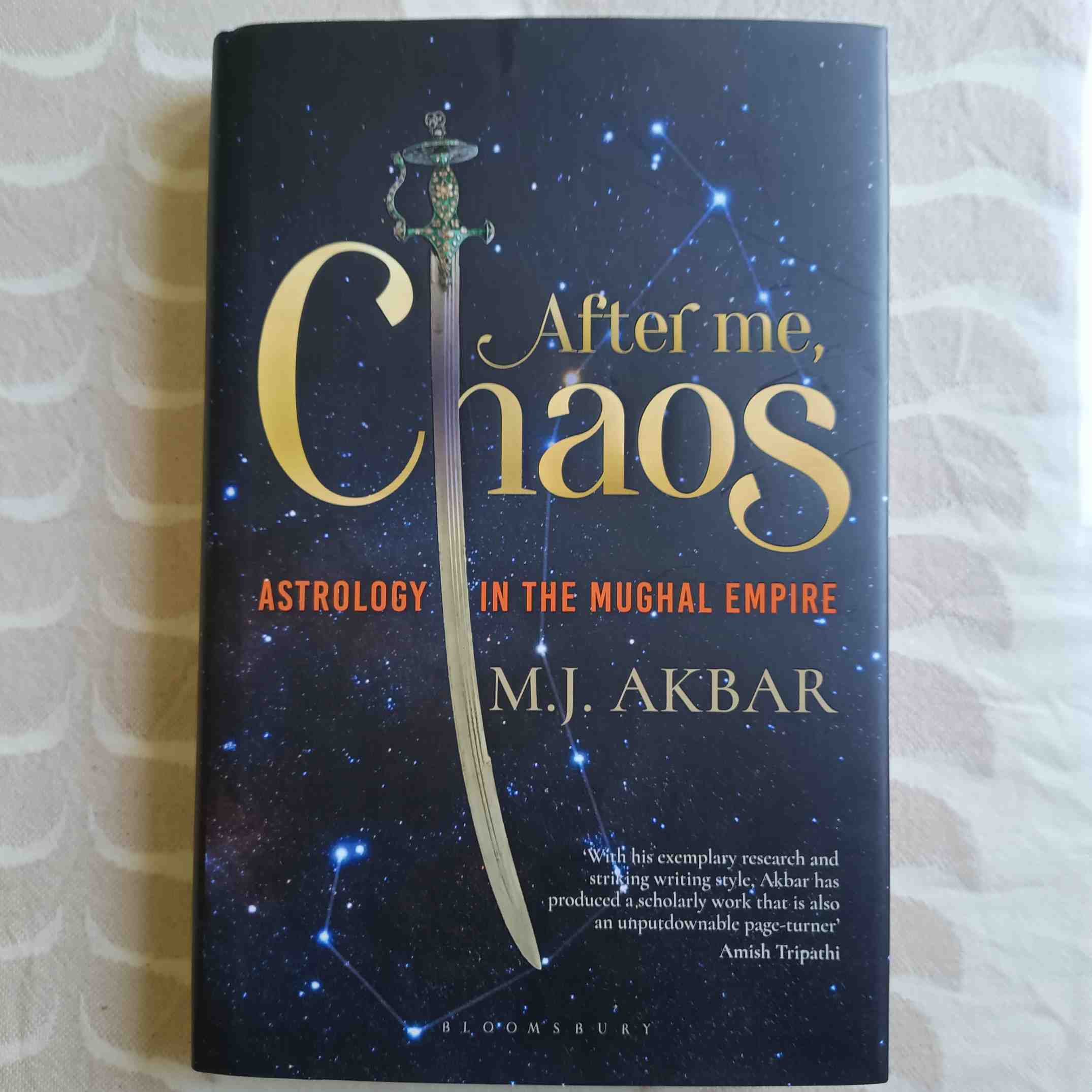
Could we, the lesser mortals, ever imagine the dependence of our past rulers on astrology? Many of us admire the Mughal dynasty for its contribution to our architecture and culture, our culinary baskets, and our administrative structures. But the level of their dependence on astrology is something we could never have guessed. Through his book ‘After me, Chaos’, M. J. Akbar makes us experience the same first-hand.
It is a fascinating book on a subject we have been blissfully clueless about so far. We come to understand that even the Mughals’ ancestors believed that astrology is essential for guidance in their lives. Many of the important decisions in their lives – waging a war, getting a marriage solemnised, planning hunting expeditions, coronation, weddings, deciding on food choices, introducing new currency, meetings with other rulers, friends or foes, naming a newborn – were taken after due consultations with the astrologers. The author even gives us an intriguing account of how Akbar’s birth was nudged to align with the most auspicious moment by the astrologer Maulana Chand!
The author goes on to point out that the use of astrology was not confined to the Mughals. It was also practised at the time by the Afghans, Persians, Arab Caliphs, in Central Asia, and even in the Vatican, as well as in other parts of Europe.
We come to discover that Aurangzeb believed that he would be the emperor based on what was foretold in his horoscope. He waited for twenty-four days before the astrologers decided upon an auspicious day for his coronation. The time of his death was predicted with great accuracy, as was the chaos that was to follow thereafter. The power and control of the Mughal Empire saw a rapid decline over the next two hundred and fifty years, ending with Bahadur Shah II. Hence, the title of the book: ‘After me, Chaos’.
We live in times when the communal polarisation of India’s multi-faith society has become a fashionable badge for many of us to wear. The forces of Hindutva would have us believe in the glories of the past. Laying claims over many branches of knowledge and spiritual practices surely gives us an ego boost. But this book prompts us to revise our prejudices and take off our tinted glasses coloured by an irrational definition of nationalism. It shows us that we cannot cast a supercilious eye on other civilisations and faiths and assert exclusive rights over such branches of knowledge as literature, building design, architecture, civil engineering, town planning, and the like. Astrology is also one such branch.
To me, this book is timely since it is a lesson in humility. It is based on exceptional historical research into a facet of the Mughal Empire that we had never heard of or even suspected. It is a great attempt at humanising one of our past rulers, revealing their vulnerabilities and their desire to make correct decisions when faced with uncertainties.
If you are a true-blue history buff, then this book could disappoint you. It is not a historical account of a dynasty which ruled over large parts of the Indian subcontinent for around three hundred and thirty years. However, history does form a backdrop to the events captured by the author. He puts us into a time machine, holds our hand, and allows us to take a sneak peek into the inner courtyards of the royal palaces and family quarters. He remains focused on the behind-the-scenes use of astrology by emperors we know only from a distance, marvelling at their fascination with and use of a branch of knowledge that satisfies the innate human trait of curiosity about the future.
(https://www.amazon.in/After-Me-Chaos-Astrology-Mughal/dp/9361316265)