Feeds:
Posts
Comments

Posts Tagged ‘Management’

This is the most commonly found breed of CEOs. They are crazy about getting results. They plan well. They execute even better. People rank high amongst their priorities. They protect them much like a tigress would shield her cubs. But when it comes to ethics, values and systems, they could not care less. Auditors cannot be faulted for labelling them as arsonists.

Managements love them. The efficient ones amongst their team members adore them. The sloppy ones dread them. Their Concern for Production is invariably high. They are often sharp when it comes to adapting newer technologies in the organization’s processes. Their Concern for People is also high. They can be found praising their people in public while ruthlessly ticking them off in private.

However, when it comes to Concern for Ethics, they rank very poorly. Their value systems are driven by commercial goals alone. Systems and procedures are merely the dust beneath their chariot wheels, leaving Finance honchos as well as auditors aghast and exasperated.

In terms of the modified Blake Mouton Grid, they rank at 9,9,1.X Y Z upgraded

Under them, short-term and medium-term goals get achieved. In their heydays, the Goddess of Success courts them. But harsh arrows and slings of an unforgiving commercial world bring about a day when their Guardian Angels are no longer in a benevolent mood. Regulatory agencies catch up with them and demand their pound of flesh. They get trapped in the intricate web of deceit, evasion and non-compliance they have woven around themselves. Brand image of the organization takes a hit. Competitors swiftly move in to occupy the mind-space of customers. Market valuations drop. Stakeholders and employees start seeking greener pastures.

Gradually, they start getting transformed into CEOs whom we could classify as Charmless Charlies.

A deeper malaise

A charitable way of looking at Arsonist Achiever CEOs would be to say that they happen to be the product of a system which thrives on greed and avarice. When they get results by using unfair means, managements feign to be in a state of blissful ignorance.

In general, the business world does suffer from this omnipresent affliction. When it comes to perpetrating a fraud on unsuspecting stakeholders, human ingenuity has never been found wanting.

If America had Enron, Lehman Brothers and Tyco, UK had Barclays. If Norway had Nortel, Portugal had Banco Espirito Santo. If Switzerland had UBS, India had Satyam and Kingfisher Airlines. Germany has just had Volkswagen.

No specific industry could lay an exclusive claim on such man-made disasters. Be it banking, insurance, mining, automobiles, energy, commodities, IT or real estate, all have set examples of devious plans to deceive the gullible stakeholders.

Human greed and avarice are obviously the root cause. The sheer pleasure derived by a minority in making some extra gains at the cost of a silent majority apparently has a sense of gratification which surpasses all else.

CEOs of the kind discussed here symbolize this deeper malaise. However, this does not mean that their acts of omission are worthy of being condoned. Apparently, there is a flaw in their innate character – they accept cheating as a way of life.

Correcting the myopic vision

What is it that makes a business owner or a CEO to put his conscience to sleep and take a decision which could impact the whole organization a few years down the road?

There could be several factors at work here. A trade-off between extraordinary gains in sight and the risks involved. A hope and a prayer that a deviation would never get caught. A major investment that cannot be written off merely to make a process legally compliant. A gut feel that the regulatory agencies are invariably open to manipulation. The need for a tight squeeze on costs which makes them shift a part of their operations to distant but cheaper pastures, at times ignoring the interests of the local community. The option of using speed money to get the necessary approvals from concerned government agencies.

More often than not, continued success in meeting business goals proves to be their undoing. Arrogance creeps in. Self-confidence brims over. Few Yes-men around them add fuel to the fire. In their relentless pursuit of business results, they develop a myopic vision. Everything else becomes the last priority.

Smarter ones, however, would take a longer view of things. They would have a 6/6 vision. Their decision-making models would invariably take into consideration the moral and the ethical aspects of a situation at hand.

Yet another solution could be to support them with a Conscience Keeper!

Note: Inputs from Ms Somali K Chakrabarti are gratefully acknowledged. She can be found at Scribble and Scrawl (https://prepforum.wordpress.com)

(Related Posts:

https://ashokbhatia.wordpress.com/2015/12/24/looking-for-ceos-inspired-by-the-yuletide-spirit

https://ashokbhatia.wordpress.com/2016/01/07/ceos-who-happen-to-be-charmless-charlies

https://ashokbhatia.wordpress.com/2016/01/14/ceos-who-end-up-becoming-road-rollers

https://ashokbhatia.wordpress.com/2016/01/22/the-sponge-comforter-ceos)
Read Full Post »

One of the relatively rare species of CEOs is that of the Sponge Comforters. These are hapless souls who are gifted with too much of the Milk of Human Kindness sloshing about within them. They happen to be compassionate by nature. People are their first priority. It is easier to persuade them to buy excuses.

Their key strength is their Concern for People. In their value paradigm, Concern for Production and Concern for Ethics take a back seat. In terms of the modified Blake Mouton Grid, they happen to be in the 1,9,1 slot.X Y Z upgraded

Their people just love them. The loyalty they command is often exemplary. Even though the feudal spirit prevails, their style of functioning is democratic in nature. People working with them are invariably happier. Work gets done in a calmer and more relaxed atmosphere. Physical activity does not get confused with efficiency. Their planning is excellent. Their execution is often tardy.

Such CEOs add value to their organizations by being great ‘Demo Versions’. They handle Public Relations with much aplomb. They are the first contact for professionals who aspire to make a career with the organization.

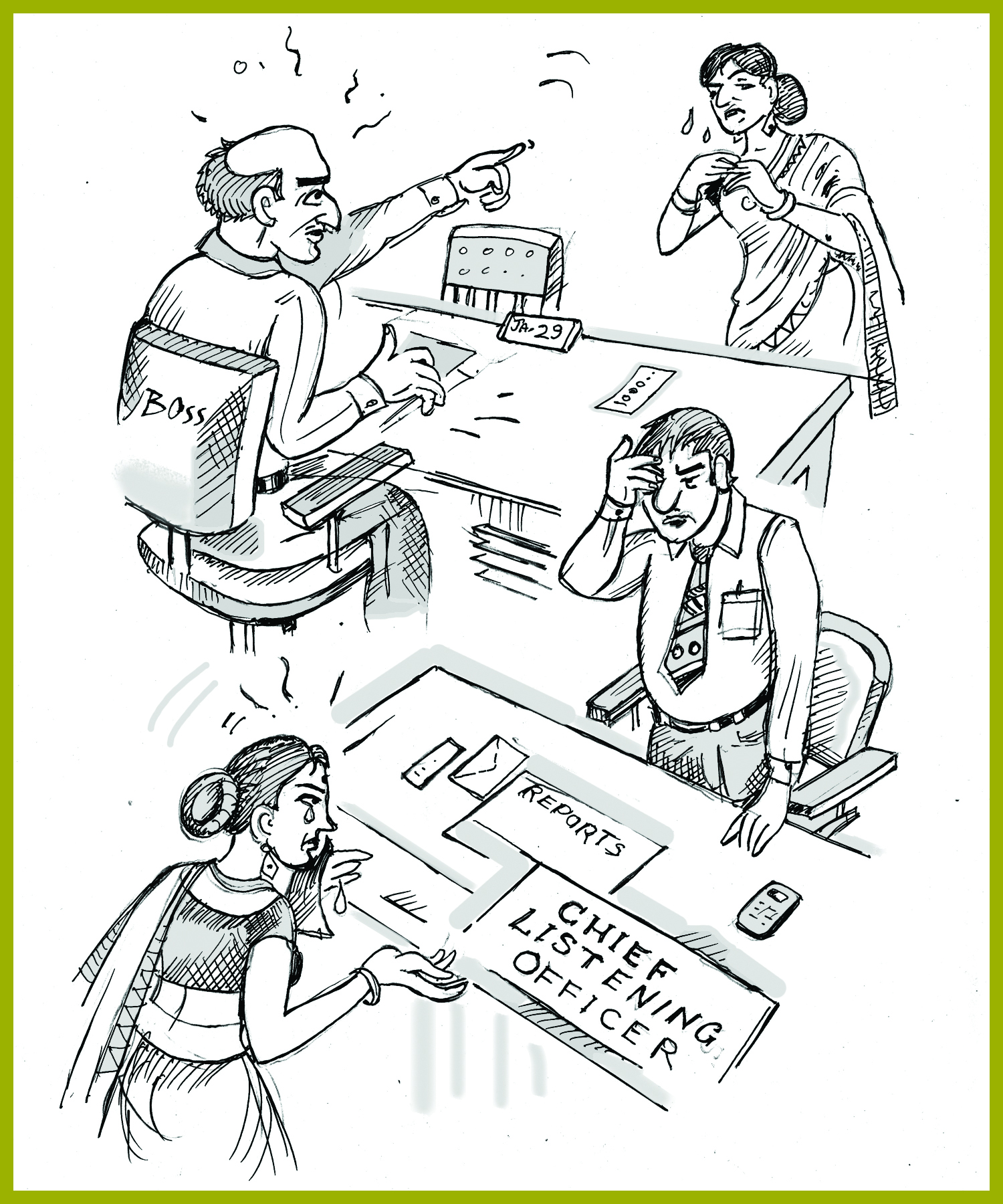
This breed thrives in an organization where the top boss happens to be unduly aggressive by nature. Employees often face an identity crisis. The CEOs offer a crying shoulder to those who feel harassed and victimized. After meeting them, a depressed employee entertaining suicidal thoughts could come back revived and invigorated – much like a watered plant. They are supreme comforters who are forever ready with a sponge, nay, even a bucket and a towel, to wipe off the tears of those who rush to them for solace.

Another designation that fits them is that of a Chief Listening Officer.

Featured Image -- 2827Their ability to convince top performers to not to seek greener pastures at the drop of a hat is unparalleled. So is their proficiency in the realm of grooming and mentoring.

Seniors from the realm of HR, who have decided to come out of their comfort zones and have started grasping the nuances of the core business process of the organization, could gradually evolve into Sponge Comforter CEOs. Externally, they sound like communists. Internally, they happen to be true blue capitalists.

Managements are often sceptical about such CEOs. To ensure that results keep coming in, they get some tough-as-nails managers to support them. Or, they are made to handle portfolios which keep them at an arm’s length from marketing and production.

Managements who excel at running their businesses without much regard for the norms of statutory compliance are desperately on the lookout for this species of CEOs. Members of this breed discharge their obligations with a misplaced sense of loyalty, often getting lynched in the process. An acrimonious parting of ways follows.

Note: Inputs from Ms Somali K Chakrabarti are gratefully acknowledged. She can be found at Scribble and Scrawl (https://prepforum.wordpress.com)

(Related Posts:

https://ashokbhatia.wordpress.com/2015/12/24/looking-for-ceos-inspired-by-the-yuletide-spirit

https://ashokbhatia.wordpress.com/2016/01/07/ceos-who-happen-to-be-charmless-charlies

https://ashokbhatia.wordpress.com/2016/01/14/ceos-who-end-up-becoming-road-rollers)

Read Full Post »

One of the professional hazards CEOs face is that of giving in to relentless pressure and becoming Road Rollers. Quarterly targets have to be necessarily met. Stakeholders have to be kept happy. Auditors have to be kept in good humour. Regulatory agencies have to be held at an arm’s length. Star performers have to be kept excited.

Amidst all this razzmatazz, CEOs run the risk of caring about results alone. They would achieve targets by ruthlessly crushing anything that comes in their way. Concern for Production gets the top priority. Concern for People takes a back seat. Concern for Ethics gets dumped. In terms of the modified Blake Mouton Grid, they end up being slotted at 9,1,1.X Y Z upgraded

Such heartless hard task masters end up neglecting even the genuine needs of their team members. Employees have to be dealt with in a stern manner. Shorter working hours are held to be injurious to employee’s health. Trade unions have to be manipulated. Signs of a white-collar mutiny, if any, are to be handled severely. People are like spare parts in a machine, simply to be replaced at the first signs of trouble.

In their jaundiced view, someone asking for some time off to ensure her kid makes a successful bid to enter a prestigious academic institution simply lacks commitment to organizational goals. A person wanting to leave office one hour early so as to be able to celebrate her marriage anniversary is merely offering an excuse to shirk her responsibility.

In the pursuit of excellence on the bourses, accounting norms evolve to loftier levels. Window dressing of financial information becomes the norm. Customer billings get preponed and get squeezed into the last few days of each month. Hapless auditors are kept busy highlighting Receivables and Customer Returns which get deftly swept under the carpet. Auditors keen on not losing a prestigious client easily get persuaded to fall in line.

Since the entire focus is on quarterly guidelines being exceeded, the organization suffers from Corporate Myopia. Vision Statements remain a set of pious intentions and can be seen only where these belong – on office walls and on display shelves.

When it comes to complying with a plethora of rules and regulations, the regulatory agencies have to be simply ‘managed’. Records need to be fudged, wherever necessary. Testing software and instrumentation has to be rigged, so as to show results within the legal parameters. Liaison officers need to be appointed so the inspectors could be kept in good humour. Government seniors have to be molly cuddled, so that they look the other way when violations are brought to their attention. Lobbying for suitable changes in government policy invariably assumes top priority.

When Road Rollers rule the roost for a long time, organizations often end up sitting on a dormant volcano which could erupt any time. Attrition rates gallop. Key performers get burnt out. People lack focus and work merely to show off. A sense of lethargy pervades. The percentage of employees of the Y-kind plummets. Managements concerned about lack of employee morale and motivation keep calling in experts to cheer up team members, with minimal results. MICROMANAGING

Often, micro-managing skills are applauded. Thus, grooming of future leaders assumes a lower priority. This leads to an absence of succession planning.

When faced with smarter government agencies who either sense a loss of public revenue or a scandal which might sully the image of the political party in power, such CEOs often invite greater trouble for their organizations. In one stroke, financial gains made over several years get wiped out. The organization’s brand image gets sullied.

Most of the times, such CEOs behave like pilots about to press the eject button in their cockpits. However, their reputation precedes them. Parachuting down to greener pastures becomes a challenge.

Have you ever had the good fortune of working with a Road Roller CEO? If so, and if you survived for a long duration, sincere appreciation is in order. You have already developed nerves of chilled steel, a trait so very essential to success in business. What you need now perhaps is a crash course to boost your Emotional and Spiritual Quotients, so your organization and your team members can breathe easy!

Note: Inputs from Ms Somali K Chakrabarti are gratefully acknowledged. She can be found here.

{Related Posts:

https://ashokbhatia.wordpress.com/2015/12/24/looking-for-ceos-inspired-by-the-yuletide-spirit

https://ashokbhatia.wordpress.com/2016/01/07/ceos-who-happen-to-be-charmless-charlies}

Read Full Post »

In an earlier post, we had looked at the various leadership styles which emerge from an upgraded Blake Mouton Grid which has three axes: Concern for Production, Concern for People and Concern for Ethics. One of the styles we came across was that of the Charmless Charlies.X Y Z upgraded

These are hapless souls who could not care less for getting results, or, for that matter, for the people who slog their butts out for them. Issues of ethics or improprieties involved in any decision-making do not appear to affect them.

They rank poorly on all the three dimensions – Concern for Production, Concern for People and Concern for Ethics. In terms of an upgraded Blake-Mouton Grid, they would earn a rating of 1,1,1. These are CEOs who, having reached their level of incompetence, exemplify the Peter Principle.

In large organizations, these could be very senior managers who carry a rich legacy of past accomplishments. Their sheen could have just started tapering off. Yet, their brand equity could be strong, owing to some unique strengths they bring to the table. They could have a networking prowess which could be useful to organizations having some skeletons in the cupboard. If shown the door unceremoniously, they could simply end up carrying a High Nuisance Value tag on themselves.

Managements have no other option but to kick them upstairs and park them in a harmless but dignified slot of the organization, duly assisted by a team of crack performers. The team members obviously do not carry a high opinion of their boss, utilizing him either for securing administrative clearances or for petty lobbying with the higher-ups.

OVERSTAYING ONE’S WELCOMEOnce the sunset phase of gratefulness and gracefulness gets over, managements ensure that such CEOs get eased out of the system without further delay. A grand farewell takes place, where everyone sings praises of the outgoing CEO. The latter, smug and pompous, makes all the right noises and fades into history, happily forgotten.

In smaller outfits, the sunset phase is much shorter and crisper. The exit is often harsh and swift, with a blue-eyed current favourite junior getting anointed as a successor. In case the organization has stopped growing, cost considerations provide a fresh lease of life to the junior who continues to bask in the glory of his newly acquired stardom. Over a period of time, strategic goals suffer, as does the level of excellence in the organization. Mediocrity rules the roost.

Well, one can only wish their organizations the best of luck!

What about you? Have you come across some Charmless Charlies in the course of your career?

(Related Post: https://ashokbhatia.wordpress.com/2015/12/24/looking-for-ceos-inspired-by-the-yuletide-spirit)

Read Full Post »

What is the best Christmas present a CEO can give to her organization?

In keeping with the Yuletide spirit, the best gift could perhaps be a resolve to take decisions based not only on commercial considerations but also on sound ethics and values. Decisions which would serve the strategic interests of the organization and would never lead it to a situation of public disgrace and compromise.

An upgraded Blake Mouton Grid

If one were to take the liberty of modifying the Blake Mouton grid, the leadership style of such a CEO would qualify for either a 9,9,9 or a 5,5,5 classification.X Y Z upgraded

Here is a quick rundown on the various leadership styles which emerge from a grid of this nature:

1,1,1: Charmless Charlies

One can only wish their organizations the best of luck.

9,1,1: Road Rollers

They would achieve a target by ruthlessly crushing anything that comes in their way.

1,9,1: Sponge Comforters

As long as employees have an identity crisis, they are in high demand, ready with a bucket and a towel to listen to their woes and comfort them.

9,9,1: Arsonist Achievers

Under them, short-term goals would get achieved. Means be damned.

1,1,9: Missionary Zealots

Saint-like souls who have willy-nilly ventured into the business world.

9,1,9: Crazy Conformists

Those working under them could soon get referred to a lunatic asylum.

1,9,9: Armchair Revolutionists

They could be assets to political outfits owing an allegiance to some outdated doctrines.

5,5,5: Understudy Chiefs

A middle-level successful manager on whom greatness has been thrust by a benevolent fate. His Moral Compass is in working order.

9,9,9: Super Leaders

A balanced Chief Executive Officer who leads his team successfully in the long run. To be spotted, head-hunted, and hired without further delay.

When it comes to corporate governance, most businesses are driven more by greed than by the norms of propriety. Compliance with statutory provisions is often given a short shrift. As a repercussion, we end up having more controls and complex laws, thereby making non-compliance even more rewarding in the short run.

A universal virus

When it comes to perpetrating a fraud on unsuspecting stakeholders, human ingenuity has never been found wanting. If America had Enron and Lehman Brothers, UK had Barclays. If Norway had Nortel, Portugal had Banco Espirito Santo. If Switzerland had UBS and India had Satyam, Germany has just had Volkswagen.

No industry could lay a specific claim on such man-made disasters. Be it banking, insurance, mining, automobiles, energy, commodities, IT or real estate, all have set examples of devious plans to deceive the gullible stakeholders.

Human greed and avarice are obviously the root cause. The sheer pleasure derived by a minority in making some extra gains at the cost of a silent majority apparently has a sense of gratification which surpasses all else.

Correcting the myopic vision

What is it that makes a business owner or a CEO to put his conscience to sleep and take a decision which could impact the whole organization a few years down the road? A trade-off between extraordinary gains in sight and the risks involved? A hope and a prayer that a deviation would never get caught? A major investment that cannot be written off merely to make a process legally compliant? A gut feel that the regulatory agencies are invariably open to manipulation? The option of using speed money to get the necessary approvals from concerned government agencies?

In their relentless pursuit of business results, CEOs are apt to develop a myopic vision. Everything else becomes the last priority.

Smart ones, however, would take a longer view of things. They would have a 6/6 vision. Their decision-making models would invariably take into consideration the moral and the ethical aspects of a situation at hand.

This way, their organizations would continue to celebrate Christmas year after year, much after they have hung their sandals and retired to an adrenaline-less life.

While affixing the mistletoe atop the door of their luxury mansion, they would then have the luxury of looking back at their career with an inner glow of warm satisfaction. The Yuletide spirit would pervade their entire being.


(For a somewhat detailed account of each of the leadership styles mentioned above, you may like to visit the following posts:

https://ashokbhatia.wordpress.com/2016/01/07/ceos-who-happen-to-be-charmless-charlies

https://ashokbhatia.wordpress.com/2016/01/14/ceos-who-end-up-becoming-road-rollers

https://ashokbhatia.wordpress.com/2016/01/22/the-sponge-comforter-ceos

https://ashokbhatia.wordpress.com/2016/01/28/ceos-who-are-arsonist-achievers

https://ashokbhatia.wordpress.com/2016/02/04/the-missionary-zealot-ceos

https://ashokbhatia.wordpress.com/2016/02/19/ceos-who-happen-to-be-crazy-conformists

https://ashokbhatia.wordpress.com/2016/03/22/the-armchair-revolutionary-ceos

https://ashokbhatia.wordpress.com/2016/04/04/super-leaders-the-near-perfect-ceos)
Read Full Post »

Interpersonal relationships happen to be a key factor in achieving success in aRelationship managerial career. Even otherwise, positive relationships boost our Happiness Quotient in life.

Here are few insights on relationships based on some well-known scientific principles.

FB and the Roentgen Effect

Never take a person at face value. Be ruthless in acting like a X-ray machine, Scientist Roentgenascertaining the inner motives of the party of the other part.

Create your own Facebook – a filtered version of the bosses, peers and subordinates you come across. Categorize them into, say, Close Friends, Friends, Acquaintances, Foes and those Vehemently Opposed to whatever you say or do. Deal with them at their respective wavelengths. You would vibe well.

Be sceptical of sudden unwarranted praise. A very tough project could be coming your way. The lynching mob could be sharpening its arsenal by the time you gleefully accept to drive a car all the way to the Moon.

Relativity and Relationships

The longevity of a relationship is directly proportional to the match between the Frames of Reference of two individuals.

The closer the two persons or organizations in their shared values andScientist Albert_Einstein principles, the longer the relationship would last. The more complimentary their needs happen to be, the better the longevity of the relationship.

All teams work on this principle. With each member bringing a unique strength to the table, the team emerges stronger.

The speed of Time in Relationships

The more you like a person’s company, the higher the speed of time spent together.

The more you hate a person, the lesser the speed of time spent together.

Laws of Motion of Relationships

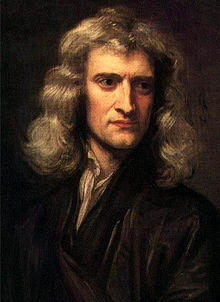
Newton was dead right when he said that every action has an equal and opposite reaction.

Hate a colleague. She would catch your negative vibes and return the same.Scientist IsaacNewton-1689

Be fond of a colleague and she could reciprocate the sentiment. Both of you could then produce some great results together.

The Optics of a Relationship

The way a relationship looks on the surface is often an optical illusion. Dive below the surface and you could be in for a surprise. Principles of reflection, refraction and diffusion work in the realm of relationships as well.

Take the case of a spouse. A perfect one cannot make us complete. He/she can only act as a mirror and help us in discovering ourselves and in becoming the right person.

The Orbit Effect

Those who happen to be Yes-men electrons with a negative charge can be readily seen orbiting around a boss who has a few protons of positivity up his sleeve and behaves like a pompous nucleus.

Once the nucleus gets hit by powerful rays of adversity, the Yes-men are forced to scurry for cover and look for another nucleus.

The Half-life of Relationships

Much like radioactive substances, almost all relationships suffer fromScientist Marie_Curie exponential decay. Constant emission of alpha particles of Anger, beta particles of Badmouthing and gamma rays of Greed lowers the warmth in a relationship.

At a personal level, infusing the relationship with innovative ideas often helps to arrest the trend.

In case of organizations, dealing with gifted high-performers can be a ticklish challenge. Prompt steps need to be taken to stem the rot. Job-rotation, job-enrichment, flexible working hours, higher level of empathy and engagement with the family members can be some of the techniques deployed by HR professionals to address this issue.

The Valency Factor

Two individuals whose Valency happens to be the same would intrinsically vibe well with each other. The compound they make together is bound to become a formidable team.

One risk here is that they could end up becoming a Mutual Appreciation Team,Gilbert_N_Lewis leading to lofty expectations and a self-belief which could be misleading in critical situations. Their bosses need to worry about this.

Another risk is of a more sinister nature. If one party is from amongst the tribe of the delicately nurtured and another from the so-called sterner sex, an amorous alliance could emerge. This could have even more serious implications if there is a hierarchical gap between the two individuals.

The boss has to then act like an anti-catalyst to defuse the reaction so the reputation as well as the work of the organization does not suffer.

The algorithm of Relationships

Relationships are a complex non-linear function of Expectations, Realizations and Time.

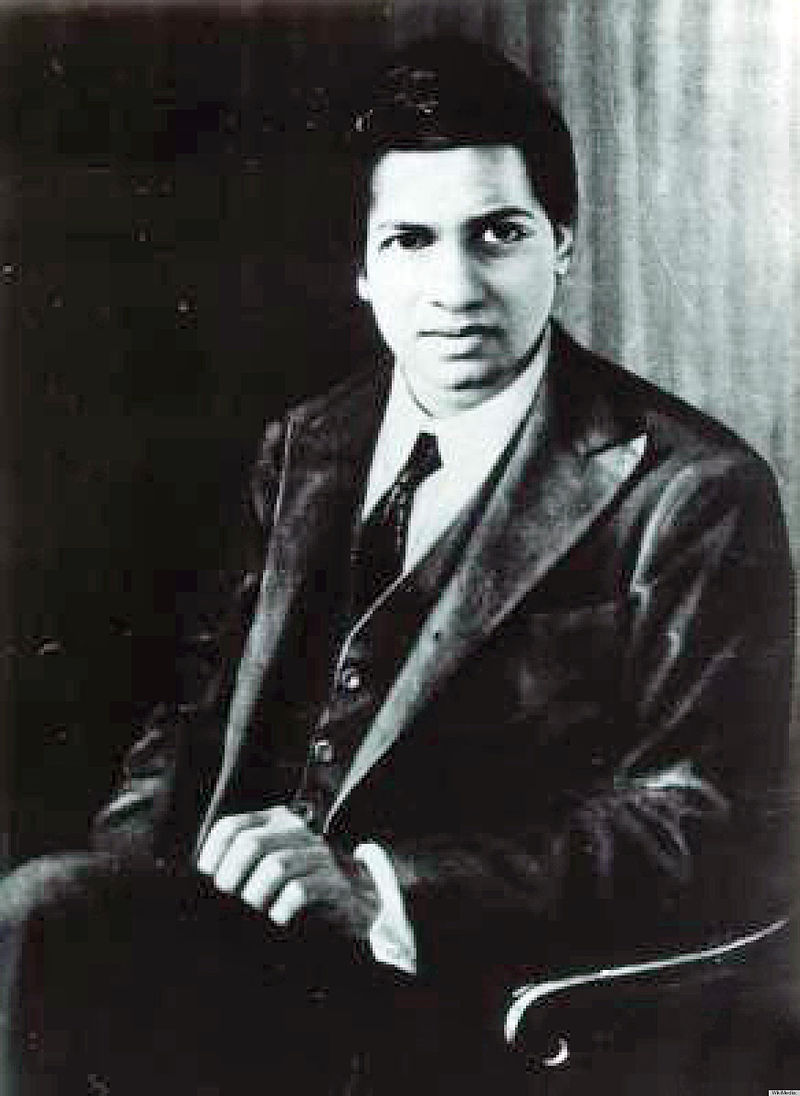
Expectations evolve over a period of time. If not matched with realizations in aSrinivasa_Ramanujan dynamic manner, deterioration in the quality of the relationship is bound to follow.

Having clawed your way up in an organization, do not expect to be treated the way you were treated the very first day when you walked in.

Do not rest on your laurels. Let successes not make you complacent.

The Warmth of a Relationship

The Coefficient of Warmth of any relationship is directly proportional to the love and trust put in to nurture the same; it is inversely proportional to the benefit expected in return.

Organizations which value their Brand Equity ensure they treat separations with kid gloves. An employee speaking well of her previous employer is a great asset to have. Here is a relationship which has a lingering warmth and sweetness.

Laws of Thermodynamics

Zero-th Law

If two persons/entities are in the equilibrium of a good relationship with aJosiah_Willard_Gibbs Thermodynamics third person/entity, it follows that they must be in a good relationship with each other as well.

First Law

The Law of Conservation of Energy applies. There is a limit to which you may work on improving a relationship. If the party of the other part fails to reciprocate, it is perhaps time to move on.

Second Law

Entropy or disorder is bound to increase in a relationship. The only way out is to keep cleansing your system of negative thoughts at regular intervals. Talking to the party of the other part about your areas of discomfort, and encouraging the other one to share her thoughts likewise alone helps.

The Botany of Relationships

Relationships happen to be like tender saplings. Given the right soil conditionsPlants relationships of our own character, regular exposure to the sunlit warmth of care, routine watering by the elixir of affection, and occasional nourishment by pleasant surprises, the plant grows. Its roots become stronger. Its branches and leaves provide the perfect shelter.

A relationship which is either not nurtured thus, or is planted on the soil of fear and necessity alone, tends to wither away over a period of time.

All these laws govern professional as well as personal relationships. Smart managers utilize these to grow in the organization they work for. They also deploy the same to keep the boss at home happy and grinning.

Post script

How about the relationship that we have with our own inner self? Do weTechnology MEDITATION-ENTREPRENEUR-SUCCEED under-rate ourselves? Or do we end up dominating those around us? When was the last time we patted ourselves on the back?

An introspection of this nature improves our inner resilience and reduces stress. Our dependence on others to determine our state of happiness comes down. Our chances of having positive interpersonal relations improve.

(Note: Published in New Race, the e-journal of Sri Aurobindo Centre for Advanced Research:

Read Full Post »

CEOs lead a challenging life. Apart from making and meeting long-term business goals, they face a relentless SQpressure, living from one quarter to the next. Customers have to be handled with kid gloves. Suppliers have to be kept in good humour. People have to be kept motivated at all times. Interpersonal conflicts between team members have to be sorted out. A lonely life has to be lived.

Unlike their juniors who invariably face Peer Pressure, CEOs face Pear Pressure. Some call it signs of prosperity. Some refer to it as a Battle of the Bulge. Others label it as flab around the waist.

The Battle of the Bulge

A CEO in possession of a portly disposition projects an image of a soul which has finally attained salvation and has become a super-hero of the species generally alluded to as managers. Walk into any gathering of the top dogs across most professions and one would be convinced that bosses are generally more portly than their bossed-over managers.

The smarter the top boss, the more he is likely to make his team members run around achieving targets. In the process, the juniors end up getting flatter tummies, a much-coveted attribute. In turn, hard-working subordinates often end up making their bosses lazier, with the latter ending up with convex-shaped protrusions in their midriffs.

Over 1.9 billion adults worldwide are overweight. Of these, some 600 million are further classified as obese. How does this come about? Lack of exercise is said to be the main culprit. Stress is yet another. Genetic factors take a part of the blame. Long working hours leading to lesser workouts get blamed.Exercise 1

Of decision-making and waistlines

Recently, a study by Australian universities has ended up linking decision-making to higher Body Mass Index.

According to researchers, people whose work days require constant decision-making are at greater risk of expanded waistlines. Conversely, workers who exercise control by regularly applying their skills to their jobs — known as skill discretion — were found to have lower Body Mass Index and a smaller waist size.

In other words, the researchers conclude that it is skinny people who are most often good at what they do and enjoy using their skills. However, those who have the power to make decisions are distinctly wider around the middle.

This justifies the derisive term Fat Cats often used to refer to those who control the levers of business. Admittedly, larger waistlines are perhaps a consequence of the CEOs’ sedentary job requirements instead of being the reason for their elevation to decision-making levels.

Perhaps further studies may reveal that weighty decisions need personal countervailing ballast in order to be balanced. It sounds as if power ends up making business leaders more expansive.

Beyond the Peter Principle

Concerned CEOs may wish further research to be designed in such a way as to establish the veracity of some Peters_principle.svgprinciples of the following kind:

1. A manager’s waistline is directly proportional to his position in any decision-making hierarchy.

2.  According to the Peter Principle, in any organization, employees rise to their level of incompetence. Further studies could confirm if their rise is also linked to the propensity of their bodies to achieve the maximum girth permitted by their constitution.

3.  Depending upon their Body Mass Index and the waistline, successful CEOs could be classified into three categories.
Potato CEOs: Those who have dazzled with their performance in the good old days. They have outgrown   the stage of feeling Pear Pressure.
Pear CEOs: Those who are currently guiding teams and delivering reasonably good results. The hapless souls are yet to come to terms with their pear-shaped midriffs.
Banana CEOs: Those who are good at planning as well as execution. They aspire to attain the status of Peer CEOs, without their bariatric blues.

4. For Potato CEOs, Pear CEOs are objects of envy. Likewise, Pear CEOs, howsoever reassured they might sound, secretly aspire to be like Banana CEOs, with concave-shaped bellies.

5. A hypothesis that can be put to test would be if the rate of rise in a hierarchy determines the rate of increase in waistlines.

6. All these propositions need to be cross-validated across different cultures and societies.

Such studies would enrich the science of Hierarchiology. These would be highly useful for head hunters as well as for Human Resource professionals. The insights gained thus would enable managers of all sizes and shapes to improve their quality of life.

Pear Pressure in organizations

Ironically, what is true of individual CEOs is also true of organizations.

The very successful and dynamic ones indulge in frequent bariatric surgeries and ensure that their midriffs remainZOO ORGANIZATIONS under strict control. They are acutely aware of Pear Pressure and have checks and balances in place to avoid carrying excessive flab.

The mediocre ones end up accumulating flab in the middle. At every success, they end up hiring more people than is necessary. At every failure, they undergo a liposuction procedure. They have learnt the art of managing Pear Pressure.

The not-so-successful organizations have the highest Body Mass Index. They are replete with massive layers in their hierarchies. Their processes are bogged down with archaic procedures. Most public sector undertakings are shining examples of this kind.

This is THE challenge all CEOs need to fight single-handedly. They have to wage a relentless war on adipose tissue of all kinds. Unless they decide to take the matter in their own hands, literally as well as metaphorically, the excess belly fat – whether on their own personas or in their organizations – would refuse to melt away.

(Reference: http://www.theweek.in/news/sci-tech/how-your-job-could-be-influencing-your-waistline-study.html)
Read Full Post »

CEOs and managers wanting to puncture the stress bubble these days have several options. Some can head to the nearest gym and burn away those blues. Some can simply switch off their technical gizmos and spend some quality time with their loved ones. Some can start learning yoga and meditation. Some can choose to put off the lights at home, put on some soothing music and relish their favourite tissue restorative, sans any distraction.

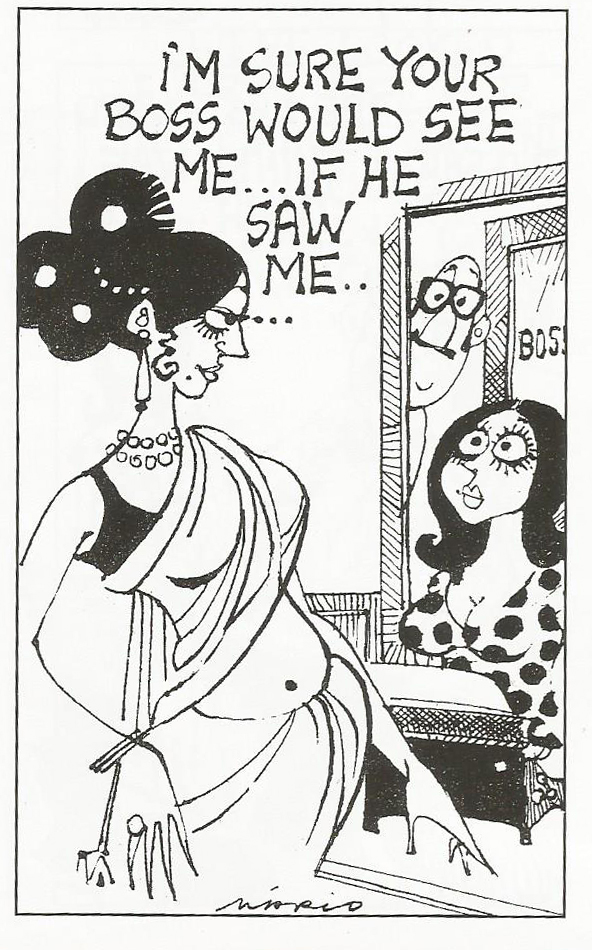
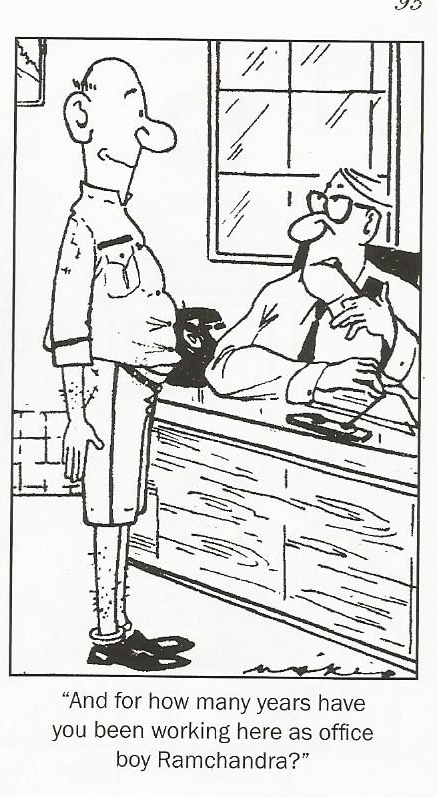
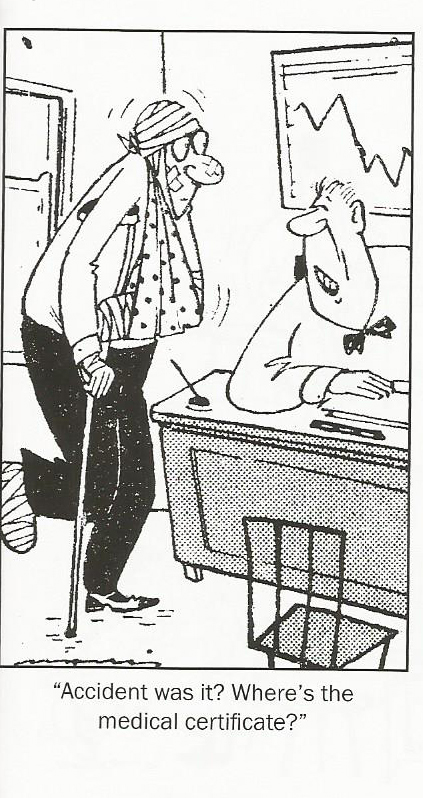
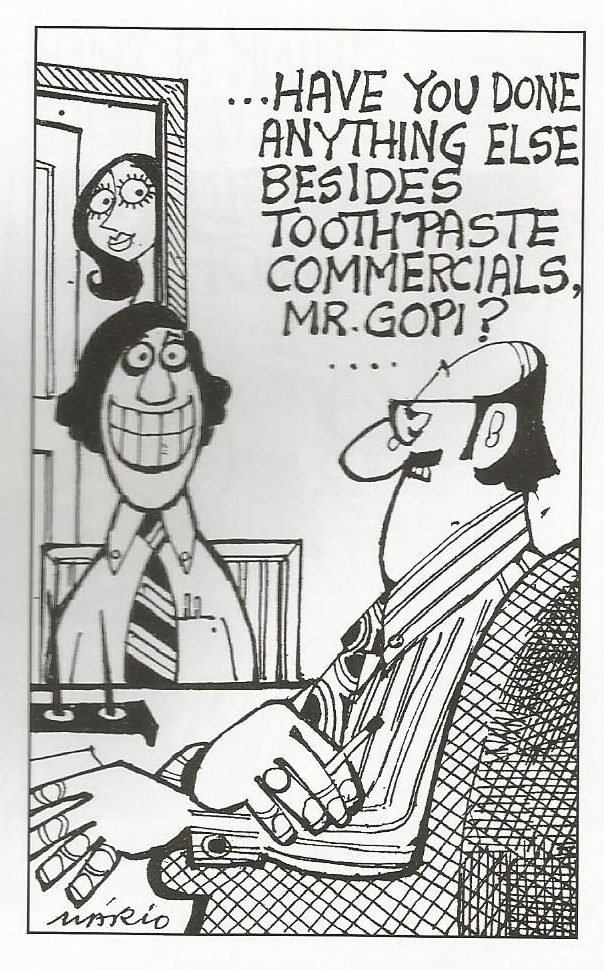
Others can pick up any work of P G Wodehouse or Terry Pratchett and recharge their batteries. Or, they can look up the delightful work of such eminent cartoonists as R K Laxman and Mario Miranda, both of whom have looked at managerial situations with the lens of sparkling wit and humour.

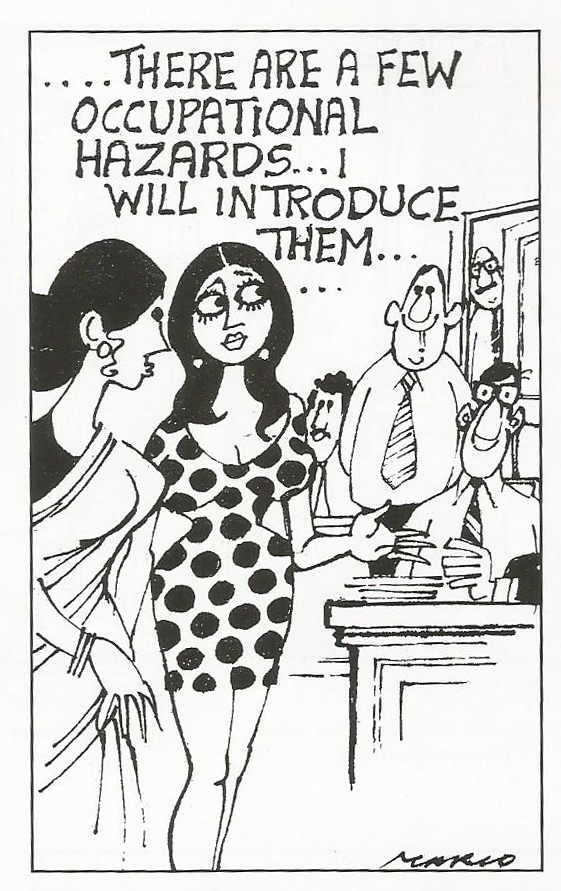
In Mario Miranda’s cartoons and illustrations, we come across the buxom but woolly headed secretary, Miss Fonseca. We also get to meet Mr. Godbole, the diffident and spineless manager, who is placed rather high in the hierarchy of goofy characters. And yes, no office scenario can be complete without a stiff-upper-lip superior, The Boss. He is the Lord and Master of all that he surveys.

Here is a delectable sample of some of Mario Miranda’s great work. Each one has an in-built lesson for a manager, whether an aspiring one or a practising one!

Not in a mood to work today? Think of an ingenious excuse to leave early. Or, just make a dash for it, hoping you remain invisible to The Boss.Office 01

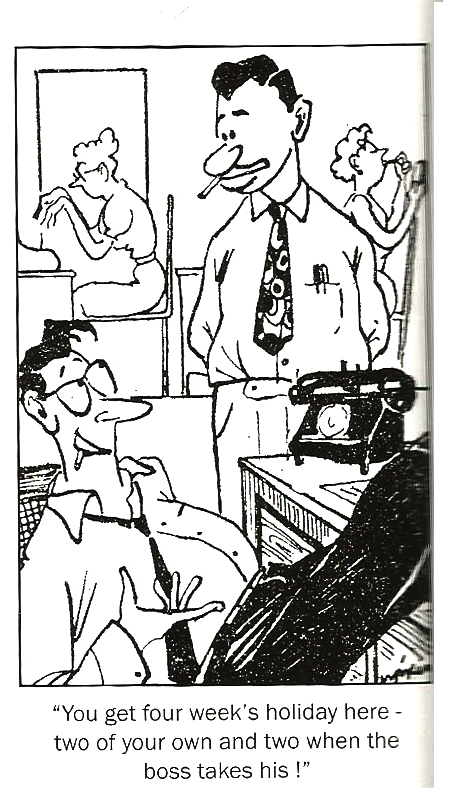
For those who have just joined the company, it is useful to interact with some old hands. They could explain the finer points of the company’s leave policy.Mario Office 02
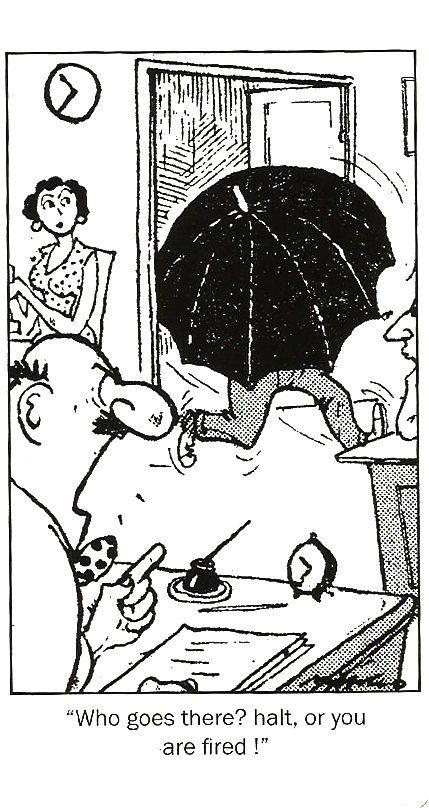
When hiring people, it is useful to enquire about their sleep patterns. This ensures that when an employee is taking a power nap, The Boss’ blood pressure remains under control.

Mario Office 03

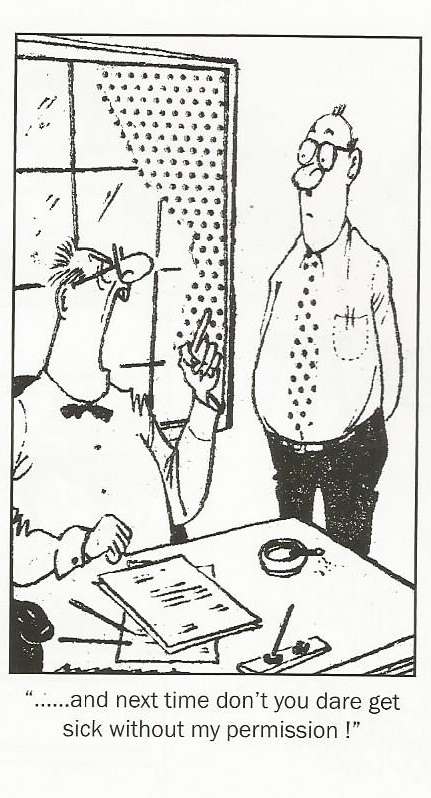
Wish to report sick? Better seek advance permission from The Boss!

Mario Office 04
The Boss’ reputation travels far and wide. Those wanting to gate-crash into his office invariably use it to their advantage.

Mario Office 05

Bosses can be forgiven for their blind spots. No office can run without those who have become a part of the landscape.

Mario Office 06

For blue-blooded bureaucrats, documentary evidence reigns supreme.

Mario Office 07
Employees often crawl into their place of work. Invariably, they run back home. Customers who happen to walk in at Closing Time get treated with as much derision as they deserve.

Mario Office 08
When selecting people, The Boss knows the importance of body language.

Mario Office 09
Just joined a company? Befriend someone who can give you the inner dope on all colleagues.

Mario Office 10
One way to keep The Boss happy is to allow him to refuse your request for a raise.

Mario Office 11
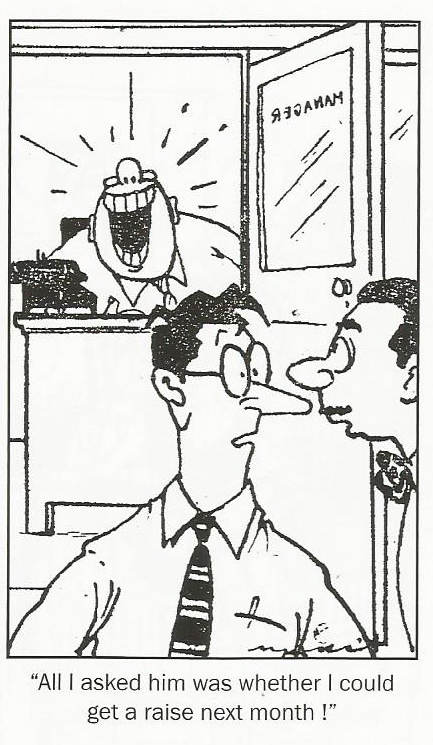
Yet another way to make The Boss laugh is to ask him for a raise!

Mario Office 12
When a raise does come about, smart managers make sure they pay their obeisance to The Boss at regular intervals.

Mario Office 14
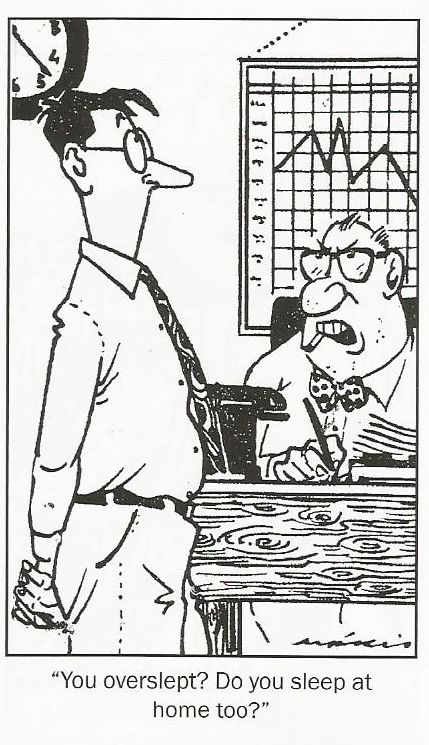
Reporting late for work? Think of a brand new excuse so as to escape The Boss’ wrath.

Mario Office 13
The Bosses always believe that physical activity of an employee is directly proportional to his/her real output at work.

Mario Office 15Mario Miranda’s cartoons not only entertain but also educate. To a stressed out manager, these are a ready means of chasing away those blues, much like a work of P G Wodehouse. To Plum fans, Miss Fonseca might sound like Madeline Bassett. Mr Godbole, the average Joe, may appear to be configured along the lines of Bertie Wooster, without the brainy support of Jeeves. The Boss might sound as if he is built along the lines of Sir Watkyn Bassett.

To aspiring managers, Mario Miranda’s cartoons offer unique insights into how companies function. They have a chance to learn how to navigate their way through the maze of management policies and practices, many of which are never covered in voluminous manuals and in Standard Operating Procedures of large conglomerates.

(Source: Mario’s Best Cartoons, Book I, ISBN 978-81-901830-6-2, gifted to yours truly by a thoughtful friend based at Goa in India)

(Related Posts:

https://ashokbhatia.wordpress.com/2015/11/01/of-secretaries-and-the-inimitable-miss-fonseca

https://ashokbhatia.wordpress.com/2013/10/15/the-inimitable-r-k-laxman)

Read Full Post »

In a highly competitive and inter-connected world, how can organizations keep pace with the ever-evolving business environment? How can business leaders and CEOs achieve results, when faced with disruptive technologies which keep changing the way the business works?

An alternative paradigm for management processes can perhaps help. This paradigm comprises four aspects which underlie all aspects of management, as it is understood, taught and practiced by working as well as by aspiring managers.

The four aspects of Integral Management, drawn from Sri Aurobindo’s writings, are: Perfection, Power, Harmony and Wisdom. Perfection in whatever an organization plans and does. The Power that a company uses to achieve its goals. The Harmony which is required to enable the achievement of goals. Above all, the Wisdom which goes into running a business enterprise in a sustainable fashion.jrd-tata

Smart managers always aim for Perfection. It is said that Mr. R. M. Lala, an editor, writer and publisher of repute, once commented to Mr. J. R. D. Tata that the latter believed in excellence. The great man is said to have retorted thus: “Not excellence. Perfection. You aim for Perfection, you will attain excellence. If you aim for excellence, you will go lower.”

Sri Aurobindo Center for Advanced Research (SACAR), a NGO devoted to disseminating the thoughts and vision of the well-renowned seer of India, recently held a day-long seminar on various aspects of managerial perfection. The seminar was held at Pondicherry in India.

DSC_0071 Resized

Some of the key issues deliberated upon at the seminar

Making ‘Make in India’ a success needs a change in the attitudes of those who practice the art of management. The attitude of compromise needs to be shunned in all spheres of life. A strong sense of self-belief is a pre-requisite.IMG_4242 Resized

Imperfection leads to higher stress. When faced with a challenge, ‘Root Cause Analysis’ often leads to a state of perfection being achieved. Attention to detail alone helps. Pushing down complexity is yet another way to realize our goal of perfection.

IMG_4245Resized

Perfection is a dynamic concept. It is a moving goal. Even 99.9% is not good enough. Factors which help a leader in her journey towards perfection are:
o Unquenchable thirst, constant endeavour
o Catering to revised customer expectations
o Vision to reach there
o Perfect planning
o Obedience
o Constant supervision and vigilance
o Perfect balance and enduranceIMG_4254 Resized

Decision making can be made more perfect by supplementing rational thinking with intuition. The higher the level of uncertainty, the greater the role that intuition can play. Intuitive faculties can be developed by means of:
o Listening better
o Reflecting on a decision before implementing
o Examining your beliefs
o Communicating to, and consulting, others
o Learning to recognize and interpret your emotions
o Creating the right learning environment; allow failures
o Using situational assessments and case studies

DSC_0113

Leadership styles can be perfected by following some concurrent processes:
o Leading oneself first – introspection, self-improvement, practicing gratitude, shouldering      responsibility, improving quality of action and self-discipline; self-image plays a crucial role
o Leading others – by example
o Delivering results
o Grooming leadersDSC_0114 Resized

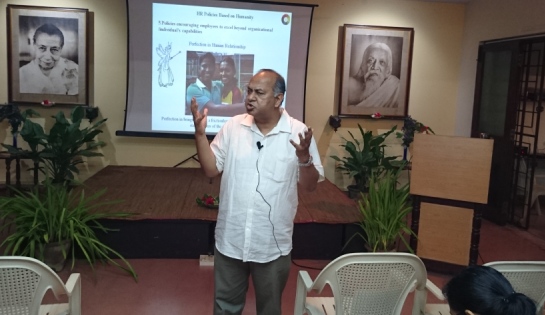
A sound HR philosophy is the essence of Perfection, which is an inner state of living. The principles of Liberty, Equality and Fraternity are useful in crafting innovative HR policies. Employees at all levels deserve an operational freedom which needs to be balanced with a sense of collective responsibility.DSC_0121 Resized

Some real-life examples which were touched upon

The following were some of the real-life examples which came up for discussion at the seminar:
• Evolution of manufacturing excellence across the world, from the first World War onwards
• Products of Apple and the no-nonsense attitude of Steve Jobs
• The SAS turnaround by Jan Carlzon; lessons from ‘Moments of Truth’
• Nestle India’s delayed decision to withdraw Maggi noodles from the shelves
• Recall of more than 2 million cars by Honda due to faulty air bags

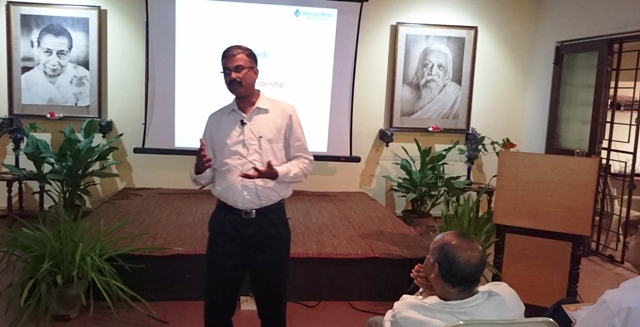
The seminar, entitled ‘In Pursuit of Managerial Perfection’, drew an enthusiastic response from business managers, scholars and students alike. It was addressed by Dr. Ananda Reddy, Director of SACAR, Mr. R. Mananathan, Chairman and MD, Manatec group of companies, Prof R. P. Raya, Dean, School of Management, Pondicherry University, Prof. Jaisree Anand, Founder LearnMore India Consultant, Mr. Ganesh Babu, Founder and CEO Winning Minds, Prof. Kisholoy Gupta, Senior HR Professional and yours truly – a heady mix of management educators, lifestyle coaches, business thinkers and influencers.

Dr Shruti Bidwaikar, Assistant Director, SACAR, summed up the proceedings of the day. Dr Arvind Gupta, Assistant Director, Directorate of Distance Education, Pondicherry University, advised the participants to imbibe the day’s learning in an appropriate manner while facing challenges in life.

SACAR proposes to organize a series of follow-up seminars touching upon the three other pillars of Integral Management, viz., Harmony, Power and Wisdom.

(Related Post: https://ashokbhatia.wordpress.com/2015/03/17/an-inner-approach-to-leadership-and-management-note-on-a-seminar)

Read Full Post »

Gandhi by R K Laxman

Mahatma Gandhi, revered the world over as an apostle of peace and non-violence, led India’s freedom movement. His birth anniversary gets celebrated on the 2nd of October.

Are his teachings relevant to the world of commerce and business? Can CEOs of today learn a thing or two from his aphorisms?

Here are few of his thoughts which business owners, CEOs and managers might find of some interest.

The future depends on what you do today.

Managements who care for their brands re-engineer their business processes and ensure sustainable operations. They respect the environment and the aspirations of the local communities. They ensure compliance with local laws. Ethics and values are strictly adhered to.

A customer is the most important visitor on our premises. He is not dependent on us. We are dependent on him. He is not an interruption in our work. He is the purpose of it. He is not an outsider in our business. He is part of it. We are not doing him a favor by serving him. He is doing us a favor by giving us an opportunity to do so.

Smart CEOs already know this, thanks in part perhaps to Philip Kotler and others who have proclaimed that ‘Customer is King.’ A small time retailer practices this axiom even without having come across it. Managements of organized retail chains try to drill this message into their front-line staff, hoping to make shopping a pleasurable experience.

Marketing honchos these days are twiddling their thumbs trying to solemnize a holy matrimony between e-commerce outfits and brick-and-mortar stores.

Be the change you want to see in the world.

CEOs spend a lot of their time trying to reform others. But the trick perhaps lies in understanding oneself internally – one’s own motivations, value systems, strengths and weaknesses.

To be a true leader also means to lead by example. A business leader who cries hoarse over corruption but is seen as dishing out lucrative business deals to a family member would never get taken seriously. A company which projects a clean image but does not deliver good value for customer’s money, or sets aside funds for speedier navigating through the politico-bureaucratic maze of a country it operates in, succeeds only in the short run.

Freedom is not worth having if it does not include the freedom to make mistakes.

CEOs in the King Lion mode make good mentors when they take the mistakes of their cubs in their stride, coach them appropriately and do not indulge in demolishing their sense of self-worth.

It is unwise to be too sure of one’s own wisdom. It is healthy to be reminded that the strongest might weaken and the wisest might err.

Great leaders are often humble. They learn from their failures as well as from their successes. CEOs and marketing heads of FMCG companies who are getting out of their silos and venturing into rural markets are learning this rather quickly.

Be congruent, be authentic, be your true self.

Gravitating towards an external profile which is a reflection of what one happens to be internally is one of the ingredients of success. This harmony leads to better degree of mental peace and equanimity, which in turn brings about better decision-making.

If I have the belief that I can do it, I shall surely acquire the capacity to do it even if I may not have it at the beginning.

A clear sense of purpose and a strong self-belief alone are necessary but not sufficient for go-getter CEOs to realize their aims. A conscious effort to acquire the knowledge and the skills necessary to achieve one’s aim is a pre-requisite of success.

Strength does not come from physical capacity. It comes from an indomitable will.

A strong will power and a sense of conviction help CEOs in achieving their goals. Followers look up to them for strategic inputs and end up assisting them in execution.

Will it with all your heart, and see your vision taking a tangible shape.

A ‘No’ uttered from the deepest conviction is better than a ‘Yes’ merely uttered to please, or worse, to avoid trouble.

Smart CEOs know when and how to say a ‘No’. They also understand the perils of being a ‘Yes’-person. Registering dissent is an art which they often learn the hard way.

Live as if you were to die tomorrow. Learn as if you were to live forever.

Living in the present is an art which successful CEOs practice in a state of blissful ignorance. Ensuring that all customer queries get responded to on the very day these are raised is a matter of habit for them.

Going back to school is an option which many senior managers exercise these days. Organizations which encourage such endeavours keep topping the charts of the most-favourite-employers year after year.

Mahatma Gandhi was not a management consultant. What he said was not in the context of business management. But some of the principles he has left behind for us to munch upon are practical, hard-nosed and shrewd.

Business owners, CEOs and managers of all hues are sure to find that many of his ideas are worth emulating. Mere brooding over these gems of business could transform our attitudes and produce gratifying results. Bringing them in practice could help businesses burnish their brands and build a formidable competitive edge.

(Caricature by late Sh. R K Laxman)

(This post can also be found at http://www.mdaceoworld.com/blog)

Read Full Post »

« Newer Posts - Older Posts »