Feeds:
Posts
Comments

Posts Tagged ‘Values’

ashokbhatia's avatarashokbhatia

Ravana, an ardent devotee of Lord Shiva, was not only a great scholar but also a capable ruler. He had a great taste in music and had mastered the veena. He is said to have been an expert in astrology and political science. He is also believed to have written a treatise on Siddha medicine.

He is described as having ten heads which are said to represent his knowledge of the six shastras and the four Vedas. Folklore has it that even while lying on his deathbed, he imparted valuable wisdom to Lord Rama and Lakshmana.

Much like powerful CEOs of large corporate bodies, Ravana had the necessary knowledge and skills to steer his kingdom to great heights. But his sheer pride, arrogance and a tendency of stifling dissent did him in. His obstinacy, and intolerance towards dissent, eventually led to his fall from grace.

The fact that…

View original post 596 more words

Read Full Post »

When leadership deficit leads to a compromise on values  

It is understandable that our business leaders keep biting their nails trying to beat the competition. But when they chase business goals by compromising on their core values, they eventually get caught in a regulatory web and start losing customers. Their brand image takes a serious hit.

Consider the following instances:

The 1986 Space Shuttle Challenger disaster 

For a space exploration agency of the stature of NASA, revenues and profit were not the motives, but it appears that deviations were indeed made from standard safety protocols because the top leadership put a higher premium on expediency. The now infamous O-ring pressure seals, supplied by a Utah-based contractor, served as the cause of the crash.

The O-rings had been tested to perform in 40-degree Fahrenheit or above weather conditions. On that fateful morning in Florida in 1986, it was only 18 degrees. NASA knew it was an issue, but hours before the launch pressed the contractor to “green light” the launch. Robert Ebeling, heading a team the concerned contractor’s employees experienced with the O-rings debated whether they could knowingly approve that the O-rings would not fail.

In the end, the team wanted NASA to wait until the afternoon when temperatures would be closer to 53 degrees Fahrenheit. Due to the pressure exerted by NASA—in addition to the wilting of the contractor’s senior managers—the company reversed its original decision and ended up giving the go-ahead for launch.

Alas, Challenger broke apart 73 seconds into its flight, killing all seven members on board.

The Samsung Galaxy Note 7 fiasco

During 2016, Apple was set to launch the iPhone 7. Samsung leaders rushed into bringing Galaxy Note 7 into the market before Apple. Here also, market forces determined the behaviour of the company’s management. In a rush to beat the competition, a design flaw in the battery was overlooked. Safety standards were apparently compromised.

Within weeks of the launch, the phones started catching fire. A recall ensued with over 2.5 million phones sent back to Samsung. The company lost billions of dollars in the recall, let alone billions more in lost revenues.

The Boeing 737 Max Issue

In October 2018, Indonesia’s Lion Air flight plummeted to the ground shortly after taking off, killing all 189 people on board. Subsequently, in March 2019, a crash happened in an eerily similar manner in Ethiopia, killing all 157 persons aboard.

Boeing claims to work on such ‘enduring values’ as integrity and safety.  The company defines integrity as taking “the high road by practicing the highest ethical standards.” Likewise, safety is captured thus: “We value human life and well-being above all else and take action accordingly,” the company suggests, and that “by committing to safety first, we advance our goals for quality, cost, and schedule.”

But to match the launch of A320neo by Airbus, said to be 15% more fuel efficient, Boeing moved fast and launched the 737 MAX nine months after Airbus’s announcement. Regulatory approvals were apparently rushed through, by simply declaring the 737 MAX to be merely a ‘derivative’ model of the company’s cash cow – 737. Technical changes of a material kind were apparently made, but the need for pilot training was never highlighted. The Flight Crew Operating Manual was not modified to reflect the changes. If this had been done, perhaps the pilots might have been in a better position to know what to do should the plane begin to behave unpredictably after takeoff due to the bad sensor data.

The common thread running through all these instances is the leadership deficit these organizations faced at the time. When values become mere words on a company’s website, disaster just lurks around the corner. As technology advances, the human angle can only be ignored at the risk of a great cost to the organization as also to the society at large.

Of revenue-hungry businesses and governments

World over, history has repeatedly taught us that when it comes to the Rajasic world of commerce, truth is a casualty. Cigarette and liquor manufacturers contribute to the exchequer and also keep their own stakeholders happy. Pharmaceutical companies keep peddling drugs which may have serious side effects on hapless patients. After holding up cholesterol as the main villain for cardiac problems for a very long time, suddenly we find that medical research comes up with results which are contrary to the original stand.

A recent example is that of the mad rush to bring in 5-G which rides on a much stronger dose of radiation. Nowhere does one see a reasonable debate on the impending costs of environmental degradation owing to a high dose of radiation.

The risk of data privacy

As businesses and governments go in for higher levels of digitisation, lay citizens who avail of products and services end up living in more transparent fish bowls. Individuals cease to matter. Somewhere in a data repository, they become mere numbers, coded by a binary system and mercilessly crunched into big data; data which is eagerly lapped up by the corporate world.

One who loves undergoing a Virtual Reality experiment is shocked to find that he and even his family members are denied an insurance policy because the body reactions detected during the said experiment indicate that he is likely to be suffering from dementia, a disease which runs in families. One who books a bnb apartment has to not only substantiate his true identity as a living person, but also establish that his past legal record is as pure as fresh driven snow. Personal interactions with a customer have ceased to matter in most digital transactions.

Hapless customers and citizens are no longer kings and queens; they are jacks of all trades who master none, let alone themselves or their own thought processes.

Political parties have already perfected the art of using Artificial Intelligence and Data Analytics to shape public opinion en masse. There are no bad politicos and good politicos. Scratch the surface and one would find that underneath they are all the same. In many countries, democracy is touted as a virtue, but just beneath its soft velvety cover can be discerned the cloven hoof of dictatorial tendencies.

Caveat emptor (or, buyer beware) is the only way forward!

Some lessons from Bhagavad Gita

Smart CEOs can perhaps look up to this ancient scripture to find some ways out of a quagmire of this kind. We explore this theme in the next part.


(Inputs from an IT expert and an aviation expert are gratefully acknowledged)

(Related Post: https://ashokbhatia.wordpress.com/2019/09/07/the-challenges-of-industrial-revolution-4-0-part-1-of-3)


Read Full Post »

We live in times when the allure of the C-suite appears to be wearing off. Expectations from CEOs of all hues, sizes and shapes are reaching stratospheric levels, with the ostensible result that attrition rates at that level of management reflect an upward tick.

A recent report by Price Waterhouse Coopers had revealed that the CEO turnover at the world’s 2,500 largest companies rose to 17.5% in 2018 – 3% higher than the 14.5% in 2017. For the year 2018, the first time in the study’s history, more CEOs were dismissed for ethical lapses than for financial performance or board struggles. CEO turnover rose notably in every region in 2018 except China, and was quite high in Brazil, Russia, and India (21.6 percent) while the lowest was in North America (14.7 percent).

According to the report, in 2000, a CEO could expect to remain in office for eight or more years, on average. Over the last decade, however, average CEO tenure has been only five years.

The mixed bathing challenge for CEOs

While those who aspire to occupy a C-suite keep an ear to the ground and eagerly wait to seize an opportunity as and when it comes up, the ones who have benevolent Guardian Angels and end up occupying one soon realize the perils of mixed bathing on the Dark Continent where, attracted by the tourism propaganda of some innovative travel agents, they end up swimming in the Zambezi river. To their utter horror, they discover that mixed bathing regulations are in vogue there, and that their dip is being shared by a couple of young crocodiles. What leaves them literally cold in the feet are the penetrating and unfriendly eyes of some of the crocodiles swimming alongside, who have taken a jaundiced view of their habitat being infested with a juicy specimen of the tribe of Homo  sapiens. Quite a few others are gleeful, drooling over a good source of their daily vitamins. These crocodiles might as well be representing the kind of challenges CEOs would face when, and if, they return to their office desks: Business Goals, Quarterly Guidelines, Investor Pressure, Ethical Dilemmas, Compliances of all kinds, to cite only a few.

Business leaders of the future

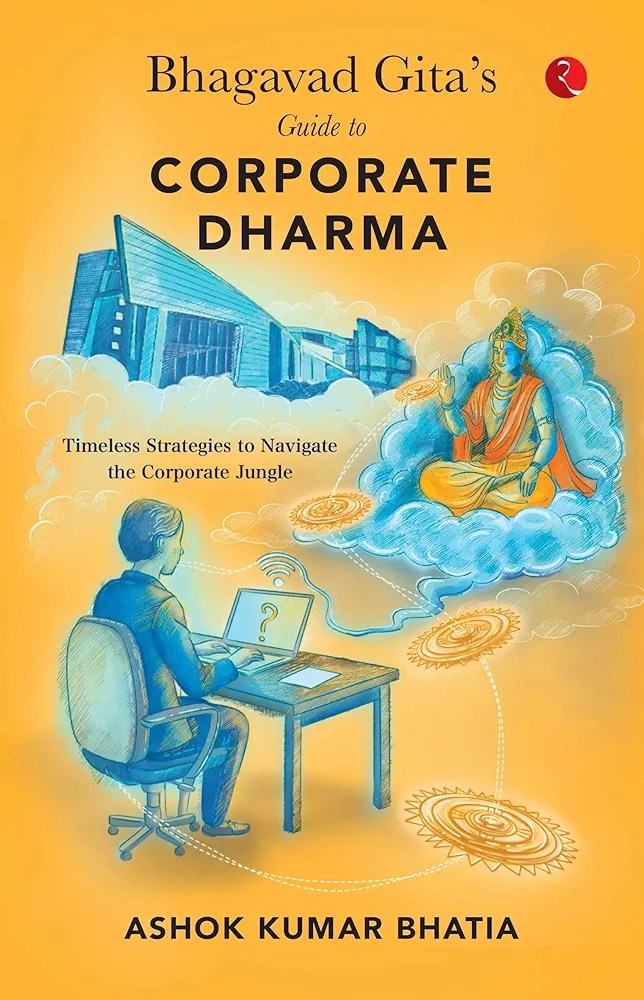
Increasingly, there is a need for business leaders who can steer their businesses using not only a Commercial but also a Spiritual Compass. In an era when technological developments are redefining the manner in which businesses interact with their stakeholders, there is much that CEOs and managers can learn from the Bhagavad Gita. It is a Do-It-Yourself Manual of Motivation. Its language is pregnant with symbolism at times. But it has rich lessons to offer for day-to-day conduct of business.

Of jackals, cobras, giraffes, elephants and tortoises 

To run a business well, wily jackals and cobras are required; but so are friendly giraffes, brainy elephants and wise tortoises. If the leader herself happens to be a spiritually inclined person, focused on steering the business successfully towards its purpose and goals but without running into a collision with massive icebergs hiding a hidden mass of compromises with core values and ethics, she would attain the exalted status of a Conscience Keeper for the entire business.

(Related Post: https://ashokbhatia.wordpress.com/2015/06/01/towards-sq)

Read Full Post »

ashokbhatia's avatarashokbhatia

LEADERSThere is something unique about managers from India. Apparently, they have a Western mind and an Eastern heart. In other words, a unique combination of analytical prowess and intuitive faculties.

Here is a thought-provoking guest post from Mr K V Rao, Resident Director – ASEAN, Tata Sons Ltd , Singapore.

“I was born and raised in India in small towns, and started reflecting how is it that so many of my compatriots make it to global leadership positions ?

Many of our ilk have left the shores, for distant foreign lands. Have studied and imbued the best of cultures, but retained some of some of that inner rusticity, and native eclectic personalities. They have made it to the top jobs of Google, Microsoft, Mastercard, or a Pepsi, and the list is endless and still more to surface. All have been exceptional fighters, who seem to compete fiercely but fairly, often guided…

View original post 898 more words

Read Full Post »

ashokbhatia's avatarashokbhatia

Here is a country where the mind is without fear

And the head is held high

Where knowledge to children and youth is virtually free

And those distressed by the world are welcomed with open arms;

Where the definition of nationalism implies inclusivity

Fine arts of all countries and cultures are welcome

If narrow domestic walls exist, these are only to protect national interests

Where respect for the law of the land reigns supreme;

Where gender equity and diversity is not a mere slogan

The care offered to the elderly is exemplary

Some wish the taxes to be lower but realize the money is well spent

In many ways does it serve and comfort the citizens; 

Where human endeavour aims to attain perfection

Words come out from an inner conviction

Gentle, helpful, physically active and resilient

Following a work culture which deserves to be aped;

Where one can encounter the true…

View original post 51 more words

Read Full Post »

ashokbhatia's avatarashokbhatia

You are the main engine of economic growth,

Making global MNCs continue to fuss over you;

Splurging on goodies, traveling all over the world,

Your hard work yielding fruits which are your due.

You work very hard to secure a better future,

For yourself, for your progeny, and for your kith and kin;

The joint family system you appear to have given up,

Bringing up kids amidst the social media din.


You are the upholder of values and character,

Quietly paying your taxes, fulfilling social commitments;

A God-fearing and law-abiding citizen of the country,

Balancing a scientific outlook with superstitious predicaments.


Great sacrifices you are also willing to make,

When making India stronger is your belief and view;

You do not mind spending hours in a queue,

Retrieving hard-earned cash which is due to you.


Government subsidies you are willing to give up,

So the poor and…

View original post 207 more words

Read Full Post »


Vision and Mission Statements of corporates adorn their walls and can be readily copied. However, the value system of an organization is not something which can be copied very easily. It permeates the entire organization – its hierarchy, its various divisions or departments. It rubs off on most of its employees. Even service providers and supporting manufacturers get tuned to the same frequency.

Our youth are already reeling under the impact of latest technologies being unleashed on the unsuspecting work-force with gay abandon, leading to drastic changes in the skills required to survive and do well in the times to come. Were they to decide to join an owner-driven smaller business, it would be wise on their part to be aware of the nature of values that such outfits could be following.

Those who get hired by such businesses are the ones who offer willing service and selfless cooperation, even to the extent of taking pay cuts when they are told that business is in the red. They need to be quiet, respectful and deferential by nature. They need to have an adventurous outlook on life and be always prepared to receive a pink slip at a very short notice.

Employees are expected to be timid and behave like worms endowed with a backbone made of cottage cheese. Smarter ones who have backbones made of sterner stuff would be inclined to look for greener pastures within a few months of joining up. Those who somehow survive longer would soon find getting hauled out unceremoniously, much like worms found floating on top of a bowl of chicken soup meant for the Lion King.

While entering the company campus, the employees find it worth their while to leave their ego at the main gate. A doormat-like behaviour alone ensures that they do not suffer the spiritual anguish like that of the person who, having grown accustomed to opening the crackling salary envelope on the first day of each month, reaches out for it one day and finds it empty.

When securing a job offer, only the naïve ones amongst us would expect to be issued a formal appointment letter. As to firing, the axe could fall any time anywhere, irrespective of the length of service. A person who gets fired would do well to not only forget about any parting compensation being shelled out but also give up hopes of ensuring that the money deducted towards provident fund etc has indeed been deposited with the regulatory bodies. 

When asking for leave, they need to deploy tact and delicacy. Long vacations are obviously ruled out, simply because the stiff-upper-lip visage of the Lion King simply discourages such inane requests, work-life balance be damned.

The proceedings are invariably of a nature as to create an inferiority complex amongst its employees. Whenever anything goes wrong, even if the decision had emanated from either the Lion King or a member of his family, they willingly take the rap and get frequently ticked off by the top brass. Over time, they start resembling one of the more shrinking and respectful breeds of rabbit.

One of the values which some owner-driven companies find difficult to imbibe is that of respecting its people. Employees often get treated like chattel, getting hired and fired based on assessments made either in the bedroom or on the dining table of the owner’s abode. If the mood of the Lion King fluctuates in tandem with either the Dow Jones Index or the Sensex, the employees feel as if they are always on a roller coaster ride.

An incoming employee is never permitted to meet the outgoing one, thereby ensuring that negative vibes do not get passed on from the latter to the former. Inevitably, this ensures that past experience continues to get lost. Continuity in systems and procedures becomes a victim. Each incumbent keeps trying to reinvent the wheel.

When a meeting gets called, the Lion King alone presides. When he throws out a statement of opinion, a respectful silence prevails. He looks about him expectantly. This is the cue for the senior Yes-Sheep to say yes. He is followed, in order of precedence, by the middle-rung Yes-Sheep and then the junior Yes-Sheep. Then the turn of all the Nodder-Dormice comes. They simply nod, one after the other.

When the Lion King delineates a new business plan, he merely informs. He directs the Marketing-Monkeys, the Production-Bovines and the Supply-Chain-Management-Goats to get down to their respective tasks without delay. The Human-Resources-Canines are told to take care of their part of the work, while the Finance-Felines are told to keep a sharp eye on the collections against invoices raised by the Marketing-Monkeys. The Research-Pachyderms are exhorted to keep coming up with innovative products and services. The System-Giraffes are advised to ensure that the high-hanging fruits of the latest advances in technology are made available to the team. The Liaison-Fox is tasked to see that all regulatory permissions are in place well within due time.

All this is not to say that all smaller outfits fit the pattern outlined here. There are many others who respect the people who contribute towards their goals. But if one does willy-nilly get stuck with one of the obnoxious kinds, one can work with a sense of true detachment and seek greener pastures at the earliest possible opportunity. 

Working in a smaller outfit has some unique perks as well. Besides being able to observe the core business processes at a close quarter, one is apt to face mighty challenges, thereby growing spiritually. One can pretty soon evolve into a Spiritual Manager who practices detachment and handles tough situations with alacrity and equanimity.

Peter Drucker, the renowned management expert, has this to say about imbibing spiritual values:

‘The individual needs the return to spiritual values, for he can survive in the present human situation only by reaffirming that man is not just a biological and psychological being but also a spiritual being, that is creature, and existing for the purposes of his Creator and subject to Him.’

Different organizations sport different cultures, presenting an interesting rainbow of values. The most prominent colour in such parabolas of joy happens to be black, denoting profits. The most disliked colour is obviously red, a prospect which leaves many a business owner and CEO cold in the feet and shuddering.

Read Full Post »

ashokbhatia's avatarashokbhatia

Bollywood’s take on corruption differs across various time zones. Just as the society has evolved, so has the approach taken by Bollywood on depicting and tackling corruption changed over the past few decades.

In the black and white era of Gandhian simplicity, it was often more about the bad guys being urban gentlemen and the good guys being rural urchins. Movies like ‘Do Bigha Zameen’ (1953), ‘Jagte Raho’ (1956) and ‘Parakh’ (1960) readily come to one’s mind.

Jagte_Raho_1956_film_poster

We have also had movies where the lead cast suffered in dignified silence. The audience was often left with a feeling of disgust towards all those who were shown as corrupt. Movies like ‘Satyakam’ (1969) left us with a fond hope that things would somehow improve in the future. satyakam

Then came the angry-young-man phase. Here, we had the revenge theme. Muscular power ruled and the…

View original post 851 more words

Read Full Post »

All of us have our role models in life – people who not only leave behind a deep impression on our psyche, but also make us who we are.

Here is a touching tribute to one such role model from a professional doctor and an upcoming writer Dr Shivani Salil, who has an ample supply of creative juices coursing through her veins. She has already won many accolades in her budding career.

shivanisalil's avatarShivani Salil

She was lovingly named ‘Raj Kumari’ (princess) by her parents. Their first born, she was born with the proverbial silver spoon, and was pampered silly by all. Growing up in the pre partition era, she must have known what abundance meant. But when random lines were drawn, her entire family, immediate and extended was advised to make the move. Comply, they did, but in return had to give up everything they had…to find themselves cooped up in refugee camps in what we call India now.

For a nine year old girl, life as she had known, vanished into thin air. What they must have taken for granted back home, was now a luxury. Making ends meet was an uphill task but the family managed. They were relocated to a small town where her studies couldn’t be continued so she was packed off to a relative’s place where it was possible.

View original post 765 more words

Read Full Post »


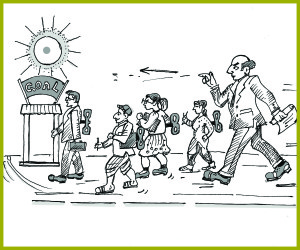
On a lighter note, one needs to be wary of managements which exhort one to follow this much misunderstood principle of detachment expounded in the Bhagavad Gita. They would have one believe that one should continue to slog all year long but would do well not to expect that elusive overdue promotion. One can then either lump it and trudge along, or take prompt action through proper channels to get oneself detached from the company at the earliest possible opportunity!

An inspired self-forgetfulness

What is the secret behind mighty achievements? What is the state of mind in which an artist like Vincent van Gogh would have created his unique gifts to humanity? Could he have done so while being worried if his latest masterpiece would turn out to be better than the one he had made earlier? Could Michelangelo have sculpted Pieta with the sole purpose of receiving a reward or recognition for creating the same?

Was Newton worried about either his past or his future when the apple fell? Had that been so, is there not a chance that he might have missed out on discovering the forces of gravity? What are the conditions under which a product developer based in Silicon Valley comes up with her next bright idea? Which is the state of mind which is conducive to creative work?

Scratch beneath the surface of any work of inspiration and one is apt to discover the ultimate secret of great accomplishments. Living every moment of the present is one of the factors which help one to live an inspired life and also enjoy it to the hilt. The creative process is akin to meditation of sorts, where the creative person, the universe and the surroundings – all end up in a single harmonious state.

This is precisely what Bhagavad Gita means by detachment. It exhorts a CEO not to worry over and get herself preoccupied with the anxieties for the rewards of her actions, thereby avoiding a tendency to live in the future. Nor does it make sense for her to keep analyzing as to what transpired in the past and get overly worked up about it. The advice here is not to waste the present moment in inane memories and in concerns about the future. Rather, she can do her very best in the present moment, keep relevant stakeholders in the loop, and perform her duties, as dictated by a sense of virtuous righteousness. This way, she is released from all of her mental preoccupations. Work alone makes her live in the joy and ecstasy of inspired self-forgetfulness. The work itself becomes the reward.

कर्मण्येवाधिकारस्ते मा फलेषु कदाचन |
मा कर्मफलहेतुर्भूर्मा ते सङ्गोऽस्त्वकर्मणि || 2.47 ||

karmay-evādhikāras te mā phalehu kadāchana
mā karma-phala-hetur bhūr mā te sa
go ’stvakarmai

You have a right to perform your prescribed duties, but you are not entitled to the fruits of your actions. Never consider yourself to be the cause of the results of your activities, nor be attached to inaction.

Management by loftier objectives and Resistance to Change

Is it really possible for one to be detached with the fruits of one’s actions? In a business scenario, when a manager is part of an organization, she is expected to deliver results. Efforts put in by her do not count; results alone do. If so, one might well wonder as to how one can remain detached with the outcome. Would it not be going against the philosophy of Management by Objectives?

What one is being advised here is not to take actions which are at divergence with what is sought to be achieved. The objectives are not under question; the means are. The underlying assumptions, prejudices and attitudes are. Management is the art of the possible. Of doing one’s best under the given constraints. A manager who works to the best of her ability, irrespective of how favourable or unfavourable the situation is, happens to be practising detachment. She is not one who would get swayed by petty short-term considerations. She is not someone who would allow her personal prejudices to shape her actions. Nor would she wallow in self-pity and misery, when faced with an adverse outcome. In other words, detachment helps professionals to not to lose sight of the overall good of the organization.

When an organization takes a decision to down-size, the onus of working out a detailed plan for affected employees falls onto the CEO and her team, especially on the person heading the Human Resources function. Typically, employees who are projected to be competent in the changed business scenario would get transferred to diverse locations. Those whose services in the past have been satisfactory but would not be relevant in future get assisted and out-placed. For the remaining employees, a transparent severance package gets worked upon and executed. In the entire process, a sense of detachment, devoid of personal emotions and prejudices, is essential. By handling separations well, the organization improves upon its brand equity and ends up creating brand ambassadors for itself.

Likewise, when a Chief Marketing Officer decides to either launch a new brand, or change a link in the company’s distribution network, a sense of balance and detachment helps. A Chief Finance Officer, when recommending a change in the external audit firm, has to leave her comfort zone, use a sense of detachment, and initiate a change which would bring better results for the company. A Production Manager, when asked to absorb a new technology or equipment on the shop floor, has to forsake a sense of attachment to the earlier methods of working and embrace change.

Consider the case of a team leader who is yet to learn the art of delegation. She retains a tendency to nano-manage operations and is not able to get work done based on a sense of detachment. The team members find it rather difficult to deliver exemplary results under such a leader, thereby harming the organization in the long run. The art of true delegation is also based on a deeper sense of detachment.

It follows that a sense of detachment helps professionals in many ways – to remain objective, to retain a sense of balance, to embrace change with lesser resistance, to handle adverse situations better, and to remain committed to the overall good of the organization.

Read Full Post »

« Newer Posts - Older Posts »